VOLUME 7 ISSUE 13
$3
“Mardi Gras,” from Kirma’s Art Page B1 March 20 - 26, 2026
Here’s what happened to 10 key 2026 session issues By Jim Turner and Ana GoñiLessan The News Service of Florida
F
lorida lawmakers put forward just under 2,000 bills and resolutions as they entered the 2026 legislative session. They returned home on March 13 having agreed to about 235 measures that await action from Gov. Ron DeSantis. Here is what became of 10 key issues: — ARTIFICIAL INTELLIGENCE: DeSantis’ priorities included creating an “Artificial Intelligence Bill of Rights” and imposing regulations on massive energy and water consuming data centers. Rules involving utility consumer protections around data centers passed, with some businessfriendly carve outs that will keep the early planning stages under wraps from the public. The House, preferring federal rules on potential broad AI impacts, declined to take up a Senate approved “AI Bill of Rights.” — BUDGET: For a second year, unresolved disputes between the House and Senate over spending resulted in the fiscal plan not being completed within the scheduled 60-day session. The chambers could not even reach the point where they could sit down to work out differences in desired spending levels for areas including health care, education, transportation and the environment. House Speaker Daniel Perez and Senate President Ben Albritton vowed to return in mid-April. — EDUCATION: Florida has dramatically expanded schoolvoucher programs in recent years. But there are growing pains in the programs that include questions about whether money properly follows students as they shift between public schools and private schools and homeschooling. The Senate passed a plan early in the session to address those issues, but the House never took up the bill. See 10 key 2026, page A8
Deadly pattern The Marion County Jail. [Bruce Ackerman/Ocala Gazette file photo]
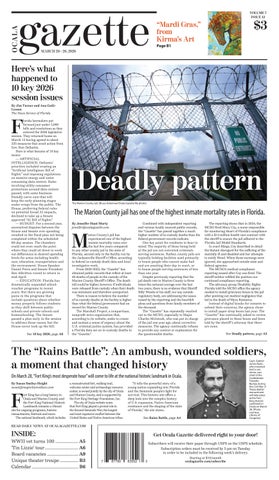
The Marion County jail has one of the highest inmate mortality rates in Florida. By Jennifer Hunt Murty jennifer@ocalagazette.com
M
arion County’s jail has experienced one of the highest inmate mortality rates over the last five years compared to any other county jail in the state of Florida, second only to the facility run by the Jacksonville Sheriff ’s Office, according to federal in-custody death data and local investigative work. From 2020-2025, the “Gazette” has obtained public records that reflect at least 40 deaths of people in the custody of the Marion County Sheriff ’s Office. The death toll could be higher, however, if individuals were released from custody when their death was imminent and therefore unreported. There is reason to believe the number of in-custody deaths at the facility is higher than what the federal government had on record for Marion County. The Marshall Project, a nonpartisan, nonprofit news organization that, according to its website, seeks to create and sustain a sense of urgency about the U.S. criminal justice system, has provided a Florida data set on in-custody deaths to the “Gazette.”
Combined with independent reporting and various locally sourced public records, the “Gazette” has pieced together a much higher number of in-custody deaths than the federal government records indicate. One key point for residents to bear in mind: The majority of those being held at the jail are not convicted criminals serving sentences. Rather, county jails are typically holding facilities used primarily to house people who cannot make bail and are awaiting their day in court, or to house people serving sentences of less than one year. Despite previously reporting that the jail death rate in Marion County is three times the national average over the last two years, there is no evidence that Sheriff Billy Woods or his staff, nor any outside regulatory body, are addressing the issues raised by the reporting and the heartfelt pleas and questions from family members of the deceased. The “Gazette” has repeatedly reached out to the MCSO, especially to Major Charles McIntosh, who was put in charge of the jail one year ago, about corrective measures. The agency continually refuses to provide any context or explanation for the questionable deaths.
The reporting shows that in 2024, the MCSO fired Mary Coy, a nurse responsible for monitoring Heart of Florida’s compliance with a $14 million health care contract with the sheriff to ensure the jail adhered to the Florida Jail Model Standards. In court filings, Coy described in detail the blatant disregard for the suffering of the mentally ill and disabled and her attempts to notify Wood. When those warnings were ignored, she approached outside state and federal agencies. The MCSO’s medical compliance reporting ceased after Coy was fired. The sheriff neither refilled the position nor continued compliance reporting. The advocacy group Disability Rights Florida told the MCSO office the agency needed to install grievance boxes in the jail after pointing out medical negligence that led to the death of Myra Ramierez. Instead of digital kiosks for inmates to submit their concerns, the agency chose to install paper drop boxes last year. The “Gazette” has continually asked to review grievance placed in those boxes and been told by the sheriff ’s attorney that there are none. See Deadly pattern, page A3
The “Rains Battle”: An ambush, wounded soldiers, a moment that changed history
Capt. Gabriel James Rains, who invented land a sea mines, was chief of the Confederate Torpedo Bureau during the Civil War. A “Rains Battle” reenactment will take place at the Fort King Historic Landmark in Ocala on March 28. [Photo courtesy Library of Congress]
On March 28, “Fort King’s most desperate hour” will come to life at the national historic landmark in Ocala. By Susan Smiley-Height susan@magnoliamediaco.com
F
ort King has a long history in Ocala and Marion County, and the Fort King National Historic Landmark remains a vibrant site for ongoing programs, historic reenactments, festivals and more. The national landmark, which includes
a reconstructed fort, walking trail, welcome center and archaeology resource center, is owned jointly by the city of Ocala and Marion County, and is supported by the Fort King Heritage Foundation, Inc. The city of Ocala website notes that Fort King played a pivotal role in the Second Seminole War, the longest and most expensive conflict between the United States and Native American tribes.
“It tells the powerful story of a young nation expanding into Florida and the Seminole people’s fight for survival. This historic site offers a deep look into the complex history of U.S. expansion, Native American resistance and the shaping of the state of Florida,” the site states. See Rains Battle, page A4
READ DAILY NEWS AT OCALAGAZETTE.COM
INSIDE:
WWII vet turns 100..................... A5 'Tin Lizzie' tour.............................. A6 Board vacancies............................ A9 Unique theater troupe................. B3 Calendar......................................... B6
Subscribers will receive their paper through USPS on the USPS schedule. Subscription orders must be received by 5 pm on Tuesday in order to be included in the following week’s delivery. Starting at $10/month ocalagazette.com/subscribe