VOLUME 7 ISSUE 8
$3
Raney’s Road to Wishes Truck Show Page B3 February 13 - 19, 2026
Hands-on and historic
FWC releases hunt data Four black bears taken in Marion County By The News Service of Florida
A
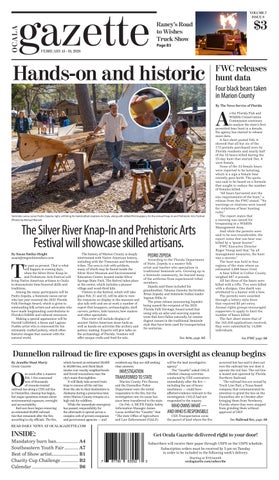
Seminole canoe carver Pedro Zepeda, right, will bring his handcrafted creations to Ocala, along with skilled flint knappers, for the annual Knap-In and Prehistoric Arts Festival. [Photos by Michael Warren]
The Silver River Knap-In and Prehistoric Arts Festival will showcase skilled artisans.
By Susan Smiley-Height susan@magnoliamediaco.com
T
he past as present. That is what will happen in coming days, when the Silver River Knap-In and Prehistoric Arts Festival will bring Native American artisans to Ocala to demonstrate time-honored skills and traditions. Among the many participants will be Pedro Zepeda, a Seminole canoe carver who last year received the 2025 Florida Folk Heritage Award, which is given to outstanding folk artists and advocates who have made longstanding contributions to Florida’s folklife and cultural resources. Making a special appearance will be Harold Littlebird, a Kewa and Laguna Pueblo artist who is renowned for his intimately crafted pottery, which often features images that connect with the natural world.
The history of Marion County is deeply intertwined with Native American history, including with the Timucuan and Seminole tribes. The area is rich with artifacts, many of which may be found inside the Silver River Museum and Environmental Education Center, located inside Silver Springs State Park. The festival takes place at the center, which includes a pioneer village and wood-fired kiln. Visitors to the festival, which will take place Feb. 21 and 22, will be able to view the treasures on display in the museum and also talk with and see at work a number of expert flint knappers, archaeologists, shell carvers, potters, hide tanners, bow makers and other specialists. This event will include displays of ancient Native American stone tools as well as hands-on activities like archery and pottery making. Experts will give talks on the archaeology of Florida. Vendors will offer unique crafts and food for sale.
PEDRO ZEPEDA
According to the Florida Department of State, Zepeda is a master folk artist and teacher who specializes in traditional Seminole arts. Growing up in a Seminole community, he learned many of the artforms from experienced tribal members. Zepeda said these included his grandmother, Tahama Osceola; his brother, Brian Zepeda; and Seminole Indian leader Ingram Billie Jr. The press release announcing Zepeda’s being named the recipient of the 2025 Florida Folk Heritage Award noted that using only an adze and sourcing cypress trees that have fallen naturally, he creates dugout canoes in the traditional Seminole style that have been used for transportation for centuries.
s the Florida Fish and Wildlife Conservation Commission continues to analyze the state’s first permitted bear hunt in a decade, the agency has started to release more data. A fact sheet posted Feb. 6 showed that all but six of the 172 permits purchased were by Florida residents and nearly half of the 52 bears killed during the 23-day hunt that started Dec. 6 were female. None of the 24 female bears were reported to be lactating, which is a sign a female bear recently gave birth. The quota was said to be based on a formula that sought to reduce the number of females killed. “All bears harvested met the size requirements of the hunt,” a release from the FWC stated. “No warnings or citations were issued for violations of bear hunting rules.” The report states that a warning was issued for trespassing in a Wildlife Management Area. And while the permits were said to be non-transferable, the report notes that one bear was killed by a “guest hunter.” FWC Executive Director Roger Young said that “by all management measures, the hunt was a success.” The hunt was held in four regions of the state where an estimated 3,609 bears lived. A bear killed in Collier County weighed 697.4 pounds. All but three of the bears were killed with a rifle. Two were killed with a shotgun. One death was attributed to a hunter with a bow. The permits were awarded through a lottery style draw that required $5 per entry. Animal rights groups encouraged supporters to apply to limit the number of bears killed. The fact sheet states that of the 163,459 applications received, they were submitted by 14,996 individuals.
See Arts, page A5
See FWC page A6
Dunnellon railroad tie fire exposes gaps in oversight as cleanup begins By Jennifer Hunt Murty Ocala Gazette
O
ne week after a massive Feb. 1 fire consumed tens of thousands of creosote-treated railroad ties along a CSX rail line in Dunnellon, cleanup has begun, but major questions remain about environmental exposure, oversight and accountability. Rail cars have begun removing an estimated 60,000 railroad ties that remained after the fire, according to city officials. The fire,
which burned an estimated 30,000 to 40,000 ties, sent thick black smoke over nearby neighborhoods and forced evacuations near the city’s main thoroughfare. It will likely take several train trips to remove all the rail ties from the site to their destination in Alabama during a precarious time when Marion County remains at a high risk for wildfires. While the immediate emergency has passed, responsibility for the aftermath is spread across a complex web of private companies and government agencies — and
residents say they are still seeking clear answers.
INVESTIGATION TRANSFERRED TO STATE
Marion County Fire Rescue and the Dunnellon Police Department were the initial responders to the fire, but the investigation into its cause has since been transferred to the state. On Feb. 4, MCFR Public Safety Information Manager James Lucas notified the “Gazette” that “The state Office of Agriculture and Law Enforcement (OALE)
will be the lead investigative agency.” The “Gazette” asked OALE whether cleanup activities conducted by CSX contractors immediately after the fire — including the use of heavy machinery — could have affected evidence relevant to the investigation. OALE had not responded to the inquiry.
WHO OWNS WHAT — AND WHO IS RESPONSIBLE
CSX Transportation owns the parcel of land where the fire
occurred but has said it does not own the railroad ties nor does it operate the rail line. The rail line is leased and operated by Florida Northern Railroad. The railroad ties are owned by Track Line Rail, a Texas-based company that communicated its intention to grind the ties on the Dunnellon site in October after bringing them from Newberry, Florida where they were stopped from grinding them without approval of DEP. See Railroad fire, page A9
READ DAILY NEWS AT OCALAGAZETTE.COM
INSIDE:
Mandatory burn ban.................... A4 Southeastern Youth Fair............. A7 Best of Show artist....................... B1 Charity Cup Challenge................ B2 Calendar......................................... B6
Subscribers will receive their paper through USPS on the USPS schedule. Subscription orders must be received by 5 pm on Tuesday in order to be included in the following week’s delivery. Starting at $10/month ocalagazette.com/subscribe