OG Digital Edition 01-30-2026

Page 1


Campy classic blooms at The Civic

GOP lawmakers OK minimum wage change

HB 221 is sponsored by Ryan Chamberlin, R-Belleview.

After more than 20 years, Audrey II again takes root in Ocala with catchy tunes, dark humor and a fresh cast.

After more than two decades, the infamous man-eating plant Audrey II is making a triumphant, tendril-waving return to the Ocala Civic Theatre stage, ready to sink its teeth into a fresh crop of theatergoers as part of the 75th season.

According to Melody Murphy, director of marketing and public relations, it has been decades since the “Little Shop of Horrors” terrorized the local stage.

“It’s been 20+ years since we did the show the last time and the time before that was the late ‘80s/early ‘90s, so if we have a few audience members who have seen both previous productions, it’s been long enough that this time around will feel very new and fresh,” Murphy said.

Murphy said “Little Shop of Horrors” continues to resonate because of the distinct and offbeat world it creates, paired with the lasting popularity of the 1986 film adaptation.

“It’s so incredibly specific in the bizarre universe it creates. People also remember the cult-classic 1986 movie version of the musical so fondly and the nostalgia is a

big factor in people wanting to see the live version on stage. The music is great, really catchy, the kind you’ll be humming for days, but you won’t mind. ‘Little Shop’ is just a fun show. Audrey II keeps reeling in new victims,” she said.

OCT, also known as The Civic, brings the beloved cult musical” to life from Jan. 29 through Feb. 15 at its home at 4337 E. Silver Springs Blvd., Ocala. Directed by Rob A. Lott, with music by Alan Menken and book and lyrics by Howard Ashman, this gleefully twisted tale unfolds in the gritty Skid Row of 1960s New York City, where catchy doo-wop harmonies, pitch-black humor and one very hungry houseplant collide in a story of love, ambition and the perils of getting what you wish for.

In a rundown flower shop, meek, nerdy floral assistant Seymour Krelborn pines for his sweet coworker Audrey while dodging the wrath of her abusive, leather-clad dentist boyfriend. When a bizarre, solar-eclipseborn plant appears and starts growing at an alarming rate, Seymour names it Audrey II after his crush. What begins as a quirky discovery quickly turns sinister: the plant can talk, demands blood to thrive and has grand plans that go far beyond a bigger pot.

Guiding the audience through the

Annual PIT count

The HUD point in time assessment seeks to identify people living in shelters, outdoors and unsheltered in Ocala/Marion County.

mayhem is a sassy trio of street-smart urchins who narrate with Motown flair while the shop’s cranky owner and a host of colorful characters get pulled into escalating chaos. It’s a deliciously dark ride that mixes campy thrills with surprisingly heartfelt moments.

Timothy C. Rodd makes his debut at The Civic, starring as Seymour. His credits include Archibald Proops in “Jekyll and Hyde,” Bun Foo in “Thoroughly Modern Millie” and the wizard in “Once Upon a Mattress” at Miami Children’s Theatre; Benny Southstreet in “Guys and Dolls” at the Coral Gables Youth Center in Miami; and Rapunzel’s prince in “Into the Woods” at The Art Center of Citrus County.

Rodd described Seymour’s transformation in the show as more than a shift from a “nerdy florist” to a lead character.

“To approach Seymour’s transformation, it’s helpful to see him as a character trapped in a Faustian bargain. His journey takes him from a person defined by inaction and insecurity to one consumed, and ultimately destroyed, by ambition and guilt,” Rodd said.

See The Civic, page A3

Republican lawmakers are trying to revive an effort to create an exemption to the state’s voterapproved minimum wage that would apply to workers classified as trainees.

The GOP-controlled House Industries & Professional Activities Subcommittee on Jan. 28 voted 11-6 along party lines to approve a measure (HB 221) that would allow people to waive their rights to the minimum wage if they are in a work-study, internship or preapprenticeship program.

Supporters said the state’s minimum wage, which will increase to $15 an hour in September, limits entry level jobs.

“It cripples an employer’s ability to provide more opportunities for unskilled workers in areas of apprenticeship and education,” bill sponsor Ryan Chamberlin, R-Belleview, said.

When he filed the bill, Chamberlin wrote that the minimum wage “has become a weight on Florida’s economy and a hindrance to workers seeking to improve their personal finances.”

“Wage controls are always enacted with good intentions but lead to a decrease in opportunities,” Chamberlin wrote. “We must seek alternative options like career development and continued education to ensure workers are receiving the skills needed to compete in today’s economy.”

See Minimum wage page A4

The appeal for information was made during the second day of the annual Department of Housing and Urban Development required “PIT,” or point in time, count of people living within local shelters or outdoors and unsheltered.

The PIT count seeks to find the number of people living in outreaches like the Salvation Army Center of Hope or outdoors in cars, camps or wherever they can find refuge throughout Marion County on one specific night.

See PIT, page A2

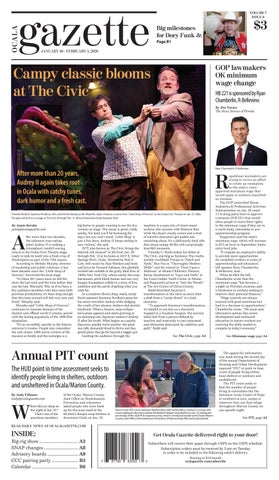
Timothy Rodd as Seymour Krelborn, left, and Patrick Stanley as Mr. Mushnik, right, rehearse a scene from “Little Shop of Horrors” at the Ocala Civic Theatre on Jan. 27, 2026.
The play will be live on stage at The Civic through Feb. 15. [Bruce Ackerman/Ocala Gazette] 2026.
Point in time (PIT) count volunteer Heather Berry with Saving Mercy conducts a survey with a man waiting for the noon meal at the Brother’s Keeper soup kitchen on Jan. 22, during the second day of the 2026 HUD required survey, which is conducted locally by the Ocala/ Marion County Joint Office of Homelessness Prevention. [Photo by Andy Fillmore/Ocala Gazette]
Ryan Chamberlin, R-Belleview

Teams spread out countywide on Jan. 21, the first day of the count, to census people living unsheltered in Ocala, Belleview, Summerfield and other areas, according to August Bonno, a PIT count volunteer and city of Ocala outreach and referral specialist.

Robin Ford, the city’s deputy director of Community Development Services, said about 20 counters were involved in this year’s PIT count. She said the count could continue for up to about a week, but the sleeping whereabouts response must be for the night of Jan. 21.

Records shared by Sister Concepta Najjemba, manager of the Brother’s Keeper soup kitchen, showed an average of 185 people were served the noon meal on at least two recent days.

Several people waiting in the food line shared their situations with PIT counters. Scott Eugene “Cowboy” Richardson, 68, for example, said he slept outdoors within the city limits. He has a bicycle to get around.

Derrek, his 13-year-old daughter and his fiancée slept in his silver Hyundai SUV wherever they could discreetly park overnight. His losing his job was a factor in their situation.

Scott, 43, sleeps unsheltered wherever he can until police officers, who he called “jump out boys,” make him move along. Scott said he has had four strokes and two heart attacks.

“The doctor said I can’t work, so what do you do?” he said.

James Haynes, a PIT count volunteer and the city’s director of Community Development Services, commented on his observation of unsheltered outdoor camps in the county.

“The camps are not as big and they’re spread out in the county,” he said.  Haynes said the warmer weather this year compared to last may lead to a better census.

Michelle Collier, a count volunteer, is with Interfaith Emergency Services, a leading local agency that provides essential services to people experiencing

homelessness, including a walkin engagement center to help with obtaining identification, employment information and more.

Collier said she made contact with about 16 people at one point of the count and that five, all of whom were homeless, agreed to an interview.

Andrea and Michael, who preferred to use only first names for security, are with the antidomestic violence outreach CASA Marion (Community Action Stops Abuse). The two were PIT volunteer counters, as were Courtney Salem and Heather Berry with Saving Mercy, a local housing support outreach.

The annual PIT count is required by HUD to establish local guidelines for allowing federal grants to members of the Continuum of Care, which provide services to people experiencing homelessness.

The Marion County HUD FL514Continuum of Care includes several local help agencies and outreaches like Interfaith and the Salvation Army.

The Florida Department of Children and Families website, at myflfamilies.com, states that last year’s preliminary PIT count data listed 160 people living unsheltered and 231 people living sheltered countywide.

Thomas Butler, the Marion County Public Schools homeless liaison, stated in an email that MCPS has about 1,200 students who are considered homeless and that 447 families are expected to

“face homelessness through the school year,” under McKinney-Vento Act guidelines used by the school district to identify homelessness.

However, Butler cautioned, the guidelines are different for the PIT count and the McKinney-Vento Act guidelines.

“The McKinney-Vento Homeless Assistance Act is a federal education law designed to ensure educational stability and access for children and youth experiencing homelessness. Under McKinney-Vento, homelessness is defined more broadly as lacking a fixed, regular and adequate nighttime residence. This definition includes students who are doubled up with other families due to loss of housing or economic hardship, living in motels or hotels, staying in shelters or residing in places not meant for human habitation,” Butler noted.

“The PIT count provides a snapshot of homelessness on one night and focuses on the most visible forms of homelessness. In contrast, McKinney-Vento captures a cumulative and broader view of student homelessness over the course of the school year. As a result, many students and families who qualify as homeless under McKinney-Vento are not counted in the PIT count,” he said.

The 2026 PIT count results, when completed, will not be immediately released by HUD. The “Gazette” will report the numbers when they become available.

Big-rig show returns to Ocala

This year’s Raney’s Road to Wishes fundraiser will span two days, add activities.

Driving off of the success of the inaugural Raney’s Road to Wishes big-rig show last year, Raney’s Truck Parts, a provider of aftermarket parts and accessories for the heavy-duty trucking industry, will stage its second showcase/fundraiser on Feb. 6 and 7 in Ocala.

The Raney’s Road to Wishes event will take place at Raney’s Chrome Shop at 3030 W. Silver Springs Blvd., Ocala, with proceeds to benefit the Make-AWish Foundation.

“The biggest change this year is that we extended the show to include a fun filled Friday night light show. On Friday night, from 3 to 8 p.m., we will have food trucks, live music and, as it gets dark, all of our registered show trucks will be lighting up the parking lot with their custom lights of all types of patterns, colors and levels of brightness to try to win the Lights Out award for 2026,” said Joel Raney, CEO of the company, via email.

“We will also have more show trucks this year and more kids’ events, such as more bounce houses, a mechanical bull, face painting, balloon artist,

“The press was to serve the governed, not the governors.”

- U.S. Supreme Court Justice Hugo Black in New York Times Co. v. United States (1971)

Publisher Jennifer Hunt Murty jennifer@ocalagazette.com

Bruce Ackerman Photography Editor bruce@ocalagazette.com

Dani Eskridge Director of Operations & Sales dani@magnoliamediaco.com

Andy Fillmore Reporter andy@ocalagazette.com

Caroline Brauchler Reporter caroline@ocalagazette.com

Greg Hamilton Editor greg@magnoliamediaco.com

Susan Smiley-Height Editor susan@magnoliamediaco.com

Belea Keeney Reporter belea@magnoliamediaco.com

Jamie Berube Reporter jamie@ocalagazette.com

Lauren Morrish Reporter lauren@ocalagazette.com

News tips tips@ocalagazette.com

Distribution Inquiries info@ocalagazette.com

Follow us @ocalagazette

caterpillar trainer and more,” he added. The show will run from 9 a.m. to 4 p.m. on Feb. 7, with at least 75 semi-trucks, industry and local vendors, food trucks and a “burnout performance.”

Awards will be given for Best Theme, Kids’ Choice, Lights Out, Old School Cool and more. Each category winner will receive a cash prize and commemorative trophy.

“The other very exciting change this year is that we will have more of the Wish Kids attending so everyone helping support this cause

can actually meet the kids and their families they are helping to support and give hope to by granting them these amazing wishes. Some of the kids will be helping to present the awards at the end of the evening,” Raney noted.

The inaugural event had a goal of raising $80,000 for the MakeA-Wish Foundation but wound up bringing in more than $90,000. The goal this year is to raise $90,000.

To learn more, visit raneystruckparts.com/road-towishes-truck-show

Our mission is to inform and uplift our readers by reporting on the events, issues and stories that shape Ocala with accuracy, fairness and passion. We also strive to serve as a forum where all voices can be heard and to chronicle our community’s history.

ocalagazette.com

©2024 Ocala Gazette, LLC

Ocala Gazette (USPS# 25590) (ISSN 27711595) is published weekly by Magnolia Media Company, LLC, PO BOX 188, OCALA, FL 34478. Periodicals postage paid at Ocala, FL. POSTMASTER: Send address changes to: Ocala Gazette, PO Box 188, Ocala, FL 34478.

Share your news

The Ocala Gazette invites you to share your important news events with the community. Email your submissions to info@ocalagazette.com. Please include your name and contact information on the submission.

• Letters to the editor: 200 words or less.

• Honorable Mentions: 150 words or less about an individual or organization accomplishment in the business, education, community service, athletics or other area of endeavor. Attach a photo of the individual or group being honored, if available.

• Upcoming events: Are you holding a charitable or community event that is open to the public? Include the organization hosting the event as well as the time, date and a brief description of the event, along with registration information or other important instructions.

News tips: Include whatever information you consider relevant.

Volunteers for the annual point in time, or PIT count, which is mandated by the U.S. Department of Housing and Urban Development,
Diana Garcia, Draven Zambrano, Dennis Zambrano and Damien Zambrano attended the inaugural Raney’s Road to Wishes show in Ocala on May 31, 2025, and checked out the R.D.H. Trucking autism-themed 2024 Kenworth T680 semi-tractor trailer. [Bruce Ackerman/Ocala Gazette file photo]

Civic Continued from page A1

“His role is as an underdog who represents universal human desires, the longing for a better life, the search for love and the pressure of success,” he said of what makes Seymour relatable. “Balancing Seymour’s inherent ‘goodness’ with his descent into becoming a literal accomplice to murder is the central challenge of the role. To make the character work, you have to play him as a man who is reacting to impossible choices rather than someone seeking out evil.”

For Rodd, the goal is for audiences to recognize Seymour’s situation.

“The performance must highlight the tragedy of his entrapment. You want the audience to walk away feeling that while Seymour’s actions were inexcusable, his circumstances were nearly inescapable. Audiences empathize with Seymour when they see him as a product of Skid Row. He isn’t seeking power for the sake of being powerful; he is seeking safety for the first time in his life. The audience empathizes because they know that if he hadn’t made those dark choices, he never would have felt ‘worthy’ of Audrey. It’s a classic tragic arc where the hero’s greatest virtue (his love) becomes his greatest downfall,” he said.

Ali Shea Kells makes her debut at The Civic, in the role of Audrey. Kells played Audrey in “Little Shop of Horrors” at the Flag Theatre in Hutchinson, Kansas, and Velma Kelly in “Chicago” at the McPherson Community Theatre. Locally, she appeared in “Evil Dead: The Musical” with the Bay Street Players in Eustis.

She said “Little Shop of Horrors” is her favorite musical.

“I absolutely adore everything about it, from the score to the dialogue to the giant plant,” Kells said.

Kells said she sought to portray Audrey as gentle and strong, pushing back on the idea that those qualities cannot coexist. In shaping the character, she said she embraced moments of humor or silliness in the script as sources of resilience.

“You can be sweet and vulnerable and even a little ditzy but still be extraordinarily powerful and strong,” Kells said, adding that Audrey’s continued kindness and ability to see the best in others, even while facing abuse, ultimately define her strength.

Kells said Audrey’s solo, “Somewhere That’s Green,” reveals the character’s vulnerability and quiet resilience. She said the song is “lovely and iconic,” but also underscores how limited Audrey’s dreams are because of her circumstances.

“All she wants is a toaster and a husband who doesn’t abuse her,” Kells said, noting that even those modest hopes reflect Audrey’s ability to “still dream and find beauty in simplicity.”

While “Little Shop of Horrors” is largely a comedy, Kells said it confronts serious and relevant issues, particularly domestic violence. She said it was important that the production not minimize those realities.

“Audrey is a victim of domestic violence, and while the show itself is more of a comedy, it was very important to me that we didn’t gloss over the real-life traumas that a lot of women have gone through,” Kells said.

Kells said she hopes audiences recognize Audrey’s strength beneath her lighthearted exterior.

“While she is a little silly, she is also very strong,” she said, adding that enduring abuse and emerging with dignity “takes a tremendous amount of strength” and ultimately defines Audrey’s character.

Sebastian Lombardo portrays the sadistic Orin Scrivello. His Ocala credits include Nicky/

Trekkie in “Avenue Q” and Cosme McMoon in “Souvenir” at the Insomniac Theatre.

Lombardo said he approached the role of Orin by leaning into the contrast between humor and danger, using each to sharpen the other. He said he constantly adjusted his performance, dialing up menace when the character risked becoming too likable and injecting charm when the threat lingered too long.

“The contrast alone heightens both the comedy and the menace if done well,” Lombardo said, adding that the key to the role is remembering that Orin’s humor is inseparable from his threat.

“The real thing to remember, though, is that his comedy is menacing,” he continued.

“My absolute favorite thing about Orin’s personality is just how extreme every emotional swing could get at the drop of a hat. One minute, he could be very personable and almost endearing, but one thing sets him off and immediately you get a small taste of what’s hiding behind that façade,” he shared.

“The mental trick to unlocking him was holding onto his most grotesque motivations. No matter what he says or who he’s talking to, there is no good intent. He needs to be in control at all times and definitely doesn’t view anyone as an equal, especially not women. He’s grounded and believable because he’s a controlling, domineering misogynist at his core,” Lombardo said.

Lombardo said he hopes audiences leave with an intense dislike for Orin, to the point that his removal from the story feels justified, at least at first.

“I hope they hate him with every fiber of their being,” Lombardo said. “I want them to find him so repulsive that they’d prefer to risk time with the plant! But then I want them to consider whether that actually justifies the actions of the other characters.”

La’Nya Solomon returns to The Civic to play Crystal, one of three street urchins, along with Ronnette and Chiffon. Often dressed in 1960s girl-group style, the trio functions as a Greek chorus, commenting on the action, advancing the story and occasionally interacting directly with the other characters.

Crystal is typically portrayed as the most outspoken and assertive of the three, often delivering sharper observations and pushing the narrative forward with confidence and sass. Together, the street urchins provide musical narration, humor and social commentary, grounding the show’s fantastical elements in the harsh reality of Skid Row.

Solomon previously played Sandy Cheeks in “The SpongeBob Musical” and Cinderella in Roger and Hammerstein’s “Cinderella.”

She said the chemistry among the urchins developed quickly during rehearsals, driven by the trio’s constant reliance on one another for dialogue and musical numbers. She said their bond was established early in the process.

“We all became cousins at the start of the table read,” Solomon said, adding that working alongside her castmates Jalis Redmond and Iyanna Lynell, whom she described as hardworking collaborators, was essential to bringing the trio to life on stage.

“Crystal is bubbly, knows what she wants and is very direct. We all have little stuff that we do, but onstage we hold ourselves differently from each other,” she said.

Solomon said several musical numbers highlight the urchins’ influence on the story, calling “Prologue,” “The Meek Shall Inherit” and the finale especially powerful to perform. She said “Ya Never Know” is her favorite.

“I hope that people have a wonderful time on Skid Row. This show is funny and such a classic. I hope some can find themselves in Crystal and the urchins. I hope they know the

urchins are both narrators and Skid Row citizens,” Solomon said.

Resident Music Director Justin Davis called the actors playing the urchins the “storytellers.”

“They are the Greek chorus; they are also the personification of street people in Skid Row. They are very dynamic. As a music director, I was also blessed with the innate singing gifts of our three actors. I often sit back and just let them sing. Because they are stellar,” he said.

“Being that it is a classic score from early ‘80s, before computeredited music being the norm, the actual physical representation of the music is a challenge. Once we dug through that part, everyone locked in and enjoyed the prep. We are blessed with three talented, gifted singer-actors who portray our urchins and give life to those tight harmonies. Anything that mirrors life, I think, has value, and the rapid shifts in tone of musical tone as well as emotional tone are easy to perform when we relate them to those skills in our real lives.”

According to Davis, the themes of “Little Shop of Horrors” remain timeless.

“This story, while set in music and scene of 1960’s NY Skid Row, is also a timeless story of growth, love, redemption, conflict and the concerning issues of unrestricted power. What better concepts to tell and make come alive than the ones we see right in front of our eyes,” Davis said.

According to Murphy, “Little Shop of Horrors” is a strong fit for The Civic audiences this season because it delivers high-energy entertainment and familiar music.

“Our audience is ready for a good jolt of pure musical fun, catchy tunes they know, a wild romp of a story, some silliness, a little horror, some great special effects and just a campy good time,” Murphy said.

As the show blends comedy with moments of unease, the production’s prop design plays a key role in maintaining that balance.

“Comedic horror lives in a really specific space. You’re not just trying to make something funny or serious; you’re balancing both at the same time. Props have to support the humor without undercutting the stakes, and they have to be eerie without becoming too realistic or disturbing. It’s all about walking that line where the audience can laugh, feel a little uneasy and still stay fully engaged in the story,” said prop designer Tara Oathout.

She said she hopes the audience does not notice the props at all, or notices them very intentionally.

“Ideally, most of the props should feel so natural in the world of ‘Little Shop’ that they disappear into the storytelling and just belong there. But when a prop does stand out, I want it to do so in a way that reminds the audience that this is a heightened, campy universe that doesn’t follow our everyday rules. Whether subtle or bold, every piece is there to quietly support the tone, the characters and the world they live in,” she said.

Murphy said audiences will be impressed by the cast’s talent and the production values of The Civic’s creative team.

“You will have a great time, and we will make it a memorable, warm, welcoming experience for you, because we want you to keep coming back,” she said.

Performances are at 7:30 p.m. Thursdays and Fridays; 2 and 7:30 p.m. Saturdays; and 2 p.m. Sundays. The show is rated PG. For tickets, go to ocalacivictheatre.com or call the box office at (352) 236-2274 from 10 a.m. to 2 p.m. Monday–Friday.

Photos by Bruce Ackerman Ocala Gazette
Timothy Rodd, as Seymour Krelborn, rehearses a scene with Audrey II.
La’Nya Solomon as Crystal, Iyanna Lynell as Ronnette, Jalis Redmond as Chiffon, Timothy Rodd as Seymour Krelborn, and Patrick Stanley as Mr. Mushnik.
Ali Shea Kells as Audrey, Patrick Stanley as Mr. Mushnik and Timothy Rodd as Seymour Krelborn.
Timothy Rodd as Seymour Krelborn and Audrey II.
La’Nya Solomon as Crystal, Sebastian Lombardo as Orin Scrivello, Jalis Redmond as Chiffon and Iyanna Lynell as Ronnette.
Cast members rehearse a scene from “Little Shop of Horrors.”
Cast members rehearse a scene.
Ali Shea Kells as Audrey.

Dreyer calls for action

Council member is concerned about mental health crisis following shooting in Orlando and local issues.

Citing a recent triple homicide in Orlando as evidence of systemic failures, Ocala City Council member Kristen Dreyer has urged the council to prioritize addressing mental health and institutionalization issues in discussions with state and federal lobbyists.

During closing comments at the council’s Jan. 20 meeting, Dreyer referenced the shooting of three tourists in Orlando the previous weekend.

Three tourists from Ohio and Michigan were fatally shot in a random attack outside their vacation rental home near Kissimmee on Jan. 17 while waiting for help after their car broke down, Osceola County authorities said. Their neighbor, 29-year-old Ahmad Jihad Bojeh, who had previously been acquitted by reason of insanity in a 2021 shooting incident, was arrested and charged with three counts of first-degree murder.

“On our way up in the elevator today, Councilman (Jay) Musleh and Councilman (Barry) Mansfield and I were talking about what happened in Orlando over the weekend, where a murderer shot three tourists who were here visiting for a car auction, who were actually late in going home because their car broke down,” Dreyer said. “They were in front of their vacation rental. The horror of this story, besides the obvious, is that the man who killed these three people had already shot randomly at a Wawa years prior and had been acquitted by reason of insanity.

“That is not OK,” she continued. “We cannot be walking around among people, yet we are, who have been committing violent crimes and then being released to the public.”

Dreyer shared personal experiences from her neighborhood.

“There is somebody roaming around my neighborhood who is very clearly having a mental health crisis. There’s no

help for people like that. I don’t know if we’re all aware of this, but if you are a family like what everybody in this room has, and you have a mentally ill relative, it’s not easy to get them help,” she said. “If they don’t want help, good luck to you. I mean, it really is up to the person who has a mental illness.”

Dreyer shared about an individual who has been experiencing homelessness in the area for years and is currently in jail. Residents are aware the individual tends to return to the neighborhood upon release. Over time, the person developed an unhealthy fixation on a teenager in the area. On one occasion, the person entered a home uninvited. The father of the teenager, a former law enforcement officer, exercised restraint by removing the person from the property rather than using force and the individual was arrested. Dreyer expressed concern that it could possibly be only a matter of time before this person harms a child or someone else. She noted that whenever the person reappears, neighbors alert one another.

City council approves cart lease for Ocala Golf Club

to supply 83 carts under a 48-month agreement, saving $207,000.

On Jan. 20, the Ocala City Council approved a proposal from E-Z-GO to manufacture 82 RXV gas golf carts and one Refresher Oasis beverage cart for the Ocala Golf Club, authorizing the total expenditure not to exceed $566,238.

The acquisition is structured as a 48-month fair market value lease, with monthly payments totaling $7,484.12, $7,093 for the golf carts and $391.12 for the beverage cart, for a total lease cost of $359,237.76. Delivery is scheduled for April 2026, with the first payment due in May.

According to Greg Davis, public information officer for the city, there are no maintenance issues that prompted this proposal.

“The current lease-purchase agreement expires in April 2026. Our lease-purchase agreements are typically a 48-month term,” Davis said.

The lease will terminate two existing PNC Bank schedules in early 2026, with E-Z-GO covering the remaining balloon payments.

“In the new lease, the balloon payment is $207,000, which will be the savings. The annual lease amount is $89,809.44 and is included in the golf course FY26 annual budget,” Davis said.

Indigo Sports Management, LLC, which operates the city-owned golf course, provided a fiscal year 2026 lease analysis comparing E-Z-GO, Club Car and Yamaha. Davis said the analysis considered several factors.

“In addition to price, Indigo Sports factored warranty, service, reputation

and product into their evaluation. It was determined that each category reflects long-term performance, manufacturer support and reliability within the municipal and golf course operations,” he said.

Revel Golf Carts has committed to purchasing the existing fleet of 82 golf carts and one beverage cart for $207,000 at the end of the lease, contingent on inspection and verification of condition.

“The carts are regularly maintained throughout the 48-month lease term to ensure they are in above-average condition at the end of the lease,” Davis said.

The new golf carts include fuelefficient engines, extended warranty coverage and a range of custom accessories.

“Every four years, the carts are replaced. Newer models are more efficient, require less maintenance and in turn provide a better user experience,” Davis said.

The Ocala Golf Club, a public 18-hole course at 3130 E. Silver Springs Blvd., operates under a management agreement with Indigo Sports Management, originally executed in 2012 and extended through Sept. 30, 2027.

“As part of their contractual obligations, Indigo Sports must procure services and equipment necessary to operate the golf course using their national discount contracts; however, the contracts derived from these purchases are in the city’s name and require approval by the city. Contracting out course management and having the ability to use their national discount contracts is a cost savings supporting the city’s strategic goals of fiscally sustainable and operational excellence,” Davis said.

Dreyer criticized the current system.

“The community-based care model that was put into effect, kind of started in California, made its way here between the ‘50s and the ‘90s. It has failed. The great experiment of de-institutionalizing mentally ill people has failed and now we’re seeing innocent people bear the brunt of that. It’s not right,” she said.

“I would like for this board, when we go up and see our lobbyists, we have state and federal lobbyists, I want the discussion of the mental institution to be on the forefront of the city of Ocala because we can’t keep going to funerals. We can’t keep reading about this. The time is now, and not that we’re going to build it, but at some point, the federal government has to say enough is enough with this, it’s mentally ill people. They are as much at risk not having housing and being on the street as innocent civilians are. It’s also very dangerous for them,” she stated.

Earlier this month, the Trump administration suddenly cut nearly $2 billion in federal mental health and addiction funding. Central Florida organizations, including Aspire Health Partners, were directly impacted, losing funding for youth services and crisis response training. The decision was reversed within 24 hours, however, after significant backlash from organizations providing mental health services.

Ocala Police Chief Mike Balken supported Dreyer’s concerns.

“You hit the nail on the head. I couldn’t have said it better myself, and I think there’s a great way to illustrate this right here in Ocala,” he said.

“We got called to a suspicious person incident out at the Home Depot just a couple years ago. That individual ended up pulling out a nine-millimeter pistol and tried to kill three of our police officers. We ended up having to kill him. I spoke to his father after that death and he was screaming at me on the phone for about 20 minutes, so frustrated that he had called

Minimum wage

Continued from page A1

Democrats derided the proposal as providing businesses with cheap labor.

Rep. Angie Nixon, D-Jacksonville, said the bill isn’t about creating opportunities for people, but “getting corrupt corporations and greedy billionaires richer.”

Rep. Anna Eskamani, D-Orlando, said people are struggling, and $15 an hour, which would total about $31,200 a year, “is not even enough anymore.”

“I understand that there is an ideological opposition to the minimum wage in this body, I get that,” Eskamani said. “But at the end of the day, the free market is not going to always operate in the best interest of the consumer, let alone the best interest of the worker, it operates in the best interest of the profit. And profit doesn’t always keep in consideration worker’s health benefits or safety.”

Rep. Bruce Antone, D-Orlando, said the concept of the bill is good, but it’s not practical today.

“Affordability is just a huge issue across this entire country and I don’t know that folks can afford to get the experience they might need to get them to a much higher income level,” Antone said.

A 2020 Florida constitutional amendment required gradual increases in the minimum wage. It is $14 an hour and will go to $15 an hour on Sept. 30. For tipped employees, the state’s minimum wage is $10.98 an hour.

Employers in Florida are allowed to pay sub-minimum wages to certain workers, such as people ages 19 and younger during the first 90 days of employment and to students working

so many police departments, so many sheriff’s offices across the state of Florida, trying to get his son the help that he needed. And you’re right, there is no longterm help for these people,” Balken said.

“We can certainly deliver them to a receiving facility. They may stay in there for up to 72 hours, but in the end, they’re coming back to our neighborhoods,” he said.

“And you’re right that we wonder why people are getting set on fire in subways and stabbed to death on buses. And it’s happening here. It is happening across the state of Florida and across the country. So, we absolutely need to do a better job with mental health across the board. We’re average at about 1,000 Baker Act (cases) a year, just over 1,000, it’s a tremendous number from where we were 20 and 30 years ago when I started. So, it is certainly trending up, getting worse by the day,” he continued.

Dreyer reiterated her request.

“My ask for this board would be that we instruct the city manager to instruct his staff to engage our lobbyists at the state and federal level, just to open up the conversation,” she said.

“I don’t know that we’re going to be the groundbreakers of this, but I, at least, would like an update on what the plan is. What is the plan for people? It’s as unsafe for them as it is for us. Is anybody in disagreement with that?” Dreyer asked.

Ocala City Manager Pete Lee responded, asking if Dreyer would like something written on behalf of the council to bring back to review or just for individual review.

“You can write something,” Dreyer responded. “I would like a verbal dialogue to start taking place as well, and if you have to include the chief and the mayor, whoever you want to include in this. I mean, we can meet separately about this and figure it out, but we need a plan. We can’t just keep hoping and praying this problem away.”

part-time in vocational training programs.

The bill wouldn’t allow employers to go below the federal minimum wage of $7.25 an hour.

Rep. Judson Sapp, a Green Cove Springs Republican and the CEO of a railroad construction company, said the bill has more guardrails than he’d have proposed, noting that “if there are no opportunities, companies are going to stop giving it.”

“Not only is it our job to make money as a company, it is also our job to look after our employees, to make a payroll,” Sapp said.

Under Chamberlin’s proposal, which was revised Wednesday, the “workbased” opportunities couldn’t last longer than 252 days or two semesters for people earning school or college credits. People 18 and younger couldn’t accept pay under the minimum wage for longer than 126 days or one semester when earning school credit.

“This just creates a scenario for those that are desiring to enter into a specific kind of career and there’s an opportunity for them to get some real strong mentorship, some leadership, and maybe even more beneficial to them than paying $25,000, $50,000 or $100,000 for a year of college,” Chamberlin said.

A similar measure by Chamberlin cleared three House panels during the 2025 session but was not heard on the House floor. A Senate version did not get through the Rules Committee. Sen. Jonathan Martin, R-Fort Myers, has filed the Senate version (SB 1412) for this year’s session.

Marion County commissioners open door for new contractors

The Marion County Board of County Commissioners has voted to renew contracts with five construction management firms while simultaneously reopening the solicitation process to allow other local businesses to apply. The decision follows a debate regarding workload capacity and the evolving legal landscape of public construction procurement in Florida.

The backdrop for board’s decision involves state regulations known as the Consultants’ Competitive Negotiation Act (CCNA). According to a recent article in The Florida Bar Journal, while the state’s infrastructure demands have grown, “The last four amendments to the CCNA (2009, 2020, 2023, and 2024) have primarily only been to update the monetary thresholds defining a ‘continuing contract’.”

These “continuing contracts” allow counties to hire firms for multiple projects on an asneeded basis without individual bidding, provided the costs stay within specific limits. During the commission meeting, county staff noted that since the original contracts were signed, the allowable threshold for these projects under statute “went from $4 million to $7 million” and noted that “they’re going to change that number every year.”

The current statutory limit for construction cost per individual project under such contracts is $7.5 million.

HISTORICAL CONTEXT AND WORKLOAD

The county originally entered into continuing contracts with six firms in December 2020. These contracts were set to expire in April 2026, with renewal options available. Since 2021, the county distributed “$63 million worth of work” across approximately 58 projects among those six firms,

according to Assistant County Administrator Amanda Tart.

One of the original six firms, Ethridge Construction of Marion County, Inc., has discontinued its contract with the county. This reduction left the board with five active firms: Dinkins Construction, Cullison-Wright Construction Corp., Ausley Construction Co.- all of which are locally owned companies; Charles Perry Partners, Inc. and D.E. Scorpio Corp. are both based in Gainesville.

Since 2020, Dinkins Construction has received the highest volume of payments, totaling $30,750,558; D.E. Scorpio has received $16,853,312; Charles Perry Partners, $11,640,312; Ausley Construction, $9,461,455; and Cullison-Wright Construction, a total of $4,103,684.

THE COMMISSION DEBATE

County Administrator Mounir Bouyounes presented the board with options, recommending they renew the current five firms but

also offering an option to open the Request for Qualifications (RFQ) to new applicants.

Commissioner Carl Zalak supported the move to admit new applicants, emphasizing opportunities for local businesses.

“Especially for the local guy who wants a shot, I’m in complete favor of that,” he said.

Commissioner Kathy Bryant voiced strong concerns that there was enough work to add another contractor to the mix. “I have questions about how much work we actually have in the pipeline for the term of the contract. Is there enough work at this time for us to add[another contractor?]”

When pressed on whether the current five contractors could handle the upcoming workload, Bouyounes confirmed, “It can be handled by the contractors we have in place today.” However, he deferred to the board on the expansion, noting, “Does it hurt to add another firm to the list?

That’s the policy decision.”

Zalak countered that the original 2020 contract included six firms, suggesting that replacing the retired firm would return the pool to its intended size. “This was a renewal option, and their expectation was there was going to be six contractors,” he said.

Zalak further noted that project lists are fluid. “If you have 12 in the pipeline today, you’re going to have more than that over the next five years,” he said.

Commissioner Craig Curry made the motion to approve “Option 2,” which renews the existing firms and directs staff to reopen the solicitation to add qualified firms to the pool.

Commissioner Michelle Stone seconded the motion, clarifying that the intent was to “leave it open” for applicants.

County staff will now proceed with the renewal of the five existing contracts while simultaneously advertising to establish an expanded pool of qualified construction managers.

Lawsuits over vaccine ads backed Bill would allow people

injured by vaccines

to sue drug manufacturers that advertise the products.

With supporters pointing to diminished “public trust” in vaccines and the health care system, a Senate committee on Jan. 20 approved a bill that would allow people injured by vaccines to sue drug manufacturers that advertise the products.

The Senate Regulated Industries Committee voted 5-3 to approve the bill (SB 408), which drew opposition from business and health care groups.

Bill sponsor Erin Grall, R-Vero Beach, said childhood vaccination rates have decreased and that she thinks it is a “trust issue.” She pointed to difficulty in holding vaccine

manufacturers accountable for problems.

“We must build back public trust when it comes to this,” Grall said.

But opponents said federal laws prevent the state from addressing such issues and that Grall’s proposal could violate the First Amendment. A federal law passed in the 1980s, for example, provides a system for people to be compensated if they are injured by vaccines — and is designed to help keep such disputes out of court.

William Large, president of the business-backed Florida Justice Reform Institute, described the federal law as creating a “no fault” system that is financed through excise taxes on vaccines.

George Feijoo, a lobbyist for the U.S. Chamber of Commerce

Institute for Legal Reform, argued that Grall’s bill would increase costs, describing it as a “hidden tort tax on health care.”

Grall, who said Texas has passed a similar measure, said the bill doesn’t focus on vaccine design defects — an issue that would be trumped, or “preempted,” by federal law. She said it is focused on “advertising conduct that is leading people to have this distrust in the industry and leading to harmful results and causing injuries there is not compensation for.”

The bill would allow lawsuits in state courts and make manufacturers liable “if the manufacturer advertises a vaccine in this state and the advertised vaccine causes harm or injury to an individual.”

Among organizations opposing the bill were the

MAN FOUND DECEASED IN NW OCALA YARD

Law enforcement and fire rescue services personnel responding to an address in northwest Ocala around noon on Jan. 27 found a man deceased on the property.

According to Ocala Police Department Public Information Officer Jeffrey Walczak, OPD officers responding to a report of a death in the 700 block of Northwest 8th Avenue found a deceased man, said to be in his

50s, and that “fire was involved.”

“(The deceased person) was located in the back yard,” Walczak wrote in a text.

Ocala Fire Rescue PIO Ashley Lopez stated in an email that OFR “responded to the 700 block of NW 8th Avenue. The deceased was located outside the residence. There was no active fire upon firefighters’ arrival.”

“The Ocala Police Department and the Florida State Fire Marshal are investigating if fire was a factor in the death,” Lopez stated.

Florida Chamber of Commerce, Associated Industries of Florida, the Florida Osteopathic Medical Association and the Florida Association of Family Physicians. Grall disputed that the bill would violate First Amendment rights.

“The pharmaceutical companies can educate doctors,” Grall said. “They can put materials within the doctors’ offices. They can help consumers understand what the vaccine is and what might happen if they get the vaccine.”

The bill comes amid widespread debate about vaccines, including Florida health officials looking to do away with certain vaccination mandates for schoolchildren.

U.S. Department of Health and Human Services Secretary

Robert F. Kennedy Jr., a longtime vaccine skeptic, has fueled controversy about vaccinations — with many physicians and health groups pushing back by touting the importance of vaccines in preventing the spread of diseases.

Senate Regulated Industries Chairwoman Jennifer Bradley, R-Fleming Island, said Tuesday that people hear ads from pharmaceutical companies “claiming their vaccines are safe and incentivizing people to use them and they (people) have no redress, and they know that. And it creates an atmosphere of distrust.”

Bradley said the bill “is not pro-vaccine or anti-vaccine.”

“We can put our head in the sand, but public trust in our health system is weak right now,” she said.

Lawmakers target local climate efforts

ASenate committee on 5-3 party-line vote approved a Republican measure on Jan. 27 that would severely restrict cities and other local governments from adopting policies to fight climate change, over the objections of Democrats and environmentalists.

Sen. Bryan Avila, R-Miami Springs, sponsored the proposal (SB 1628), arguing that “net zero” policies from local governments drove up costs for residents and businesses in pursuit of “some goal that they’re never going to reach.”

Avila told the members of the Environment and Natural Resources Committee that policies pushing for reductions in greenhouse gas emissions amounted to an unseen tax that would discourage people and companies from relocating to Florida.

“It should not be left up to the state giving this unique taxing authority to our local governments, and then our local governments thinking that they are Switzerland or California or

New York,” he said. “That is not what we’ve done historically in the state of Florida.”

Avila’s legislation would ban many kinds of activities by cities, counties and other types of local agencies. It would, for example, prohibit them from adopting comprehensive plans, land-development regulations or transportation policies that discourage the use of fossil fuels or that align with the 2015 Paris Agreement, which seeks to reduce worldwide greenhouse gas emissions.

The bill also would block local governments from using climate considerations in making purchasing decisions, such as considering the fuel source when buying vehicles. Also, it would prevent local agencies from paying dues to groups advocating net-zero policies and from implementing cap-andtrade systems to limit carbon emissions.

Several parts of the state have adopted net-zero policies, as South Florida is one of the regions in the country most vulnerable to climate change.

Broward, Miami-Dade, Monroe and Palm Beach counties formed a compact in

2009, for example, to address climate concerns in the region. The resulting Southeast Florida Climate Change Compact issued a report in 2022 calling for a 50 percent reduction in greenhouse gas emissions by 2030 and netzero carbon emissions by 2050.

In North Florida, Leon County adopted a plan to decrease greenhouse gas emissions by making county buildings more energy efficient, switching to electric vehicles, using sustainable purchasing and educating the public about energy efficiency. Alachua County adopted a climate action plan in November that addressed a variety of concerns and included a goal of reducing greenhouse gas emissions by 80 percent by 2050.

Sen. Carlos Guillermo Smith, D-Orlando, said Avila’s proposal would tie the hands of local officials as they try to address problems in their communities.

“We have local leaders … all across the state, they’ve adopted climate resilient plans because they are already dealing with flooding. They’re dealing with extreme heat, saltwater intrusion, storm damage,” he said. “This bill will wipe all those

plans out entirely.”

“We can’t ban our way out of climate change,” Smith added later. “This bill will literally trap Florida and lock us into fossil fuels in perpetuity. So, I can’t support the bill.”

Jennifer Webb, a former Democratic state House member speaking for the Sierra Club, told the committee the legislation “isn’t just bad environmental policy, it’s bad for Florida’s economy, bad for cities, counties, HOAs (homeowners associations), businesses and Florida’s families.”

Webb said the clean energy industry is a “thriving sector and SB 1628 kneecaps it. It sends a clear signal to business: Florida is closed for clean energy investment. While other states compete for jobs and capital flowing into renewable energy, we would be telling investors to look elsewhere.”

Kim Ross, co-executive director of Rethink Energy Florida, said the legislation would hamper local policies that are cost-effective and lead to greenhouse gas reductions. Electric vehicles can have lower lifetime costs than gaspowered vehicles, she said, and

energy-efficiency incentives for buildings can help businesses and residents save money over the long run.

Ross also said federal grants are available to communities that are trying to reduce greenhouse gas emissions.

“How is it in the economic interests of the state or any entity in it to turn down funds because of a blanket law?” she asked.

A representative of the group Americans for Prosperity indicated it supports the bill. In recent years, other Republicanled states have passed laws to prevent local governments from adopting various kinds of carbon-reduction policies.

But Avila said he didn’t “model this after anything other than what we’ve seen in Europe, what we’ve seen in California, what we’ve seen in New York. This is legislation that is leading the way in terms of trying to prevent additional costs on our residents.”

The bill would need to clear two more committees before it could go to the full Senate. Rep. John Snyder, R-Stuart, has filed a similar bill (HB 1217) in the House.

Lawmakers look to boost campus security

Top of FormBottom of FormAfter a student last year killed two people and wounded five others at Florida State University, state lawmakers on Jan. 27 began moving forward with a plan to try to bolster security on state college and university campuses.

The plan, unanimously approved by the House Judiciary Committee, borrows from changes made in the public school system after the 2018 mass shooting at Parkland’s Marjory Stoneman Douglas High School. That includes allowing college and university employees to become armed “school guardians” to help respond to incidents.

Rep. Kevin Chambliss, D-Homestead,

said the bill addresses preparedness and recounted how he knew a campus shooter while he was a graduate student at Northern Illinois University. Chambliss said such incidents are “all too common of a story.”

“It can happen anywhere, at any time,” Chambliss said.

The bill, sponsored by Rep. Michelle Salzman, R-Pensacola, would take a series of steps, including:

— Allowing colleges and universities to choose to take part in the guardian program, which involves employees who receive training and have concealed weapons licenses being able to carry guns on campus.

— Requiring colleges and universities to take steps such as having “active assailant response” plans that include being able to issue campus-wide alerts and certifying

that faculty, staff and students each year receive training to prepare for assailants. Also, the colleges and universities would have to adopt “family reunification” plans to reunite students and employees with family members if schools are closed or evacuated.

— Requiring annual security risk assessments at colleges and universities.

— Requiring establishment of “threat management teams” that, in part, would help intervene with students whose behavior might pose risks.

— Creating a second-degree felony charge for people who shoot guns within 1,000 feet of schools during school hours or activities, unless the guns are fired because of reasons such as selfdefense. That would be an expansion of a law that prevents firing guns on school property.

Calling campus security “paramount,” Salzman said lawmakers and staff members began working on the issue after FSU student Phoenix Ikner was charged in the April 17 shooting in Tallahassee that killed a campus dining director and a vendor. Ikner is awaiting trial.

The Legislature over the past eight years made a series of changes to bolster security in public schools after the Marjory Stoneman Douglas shooting, which killed 17 people. At least some of those changes are reflected in the bill about security at colleges and universities.

“This was really borne out of a horrible tragedy in Parkland,” Rep. Mike Gottlieb, D-Davie said.

The bill would need to pass two more committees before it could go to the full House. Sen. Don Gaetz, R-Niceville, has filed a similar bill (SB 896) in the Senate.

Proposal seeks to speed up public records

Government agencies would have three days to respond to public records requests, provide estimates of how long it would take to produce the records or deny the requests, under a measure approved Jan. 21 by a House panel.

Sponsor Alex Andrade, R-Pensacola, told the House Government Operations Subcommittee that the bill (HB 437) is intended to improve the way local governments and state agencies respond to records requests and provide “more guardrails” to “make sure that everybody understands what they do and need to have done to be compliant with” the state’s Sunshine Law. Under the bill, agencies

that do not comply with the three-day deadline would not be allowed to charge for the records.

Andrade, a lawyer, wrangled last year with Attorney General James Uthmeier’s office when he sought records related to an investigation into potential wrongdoing by a nonprofit associated with Hope Florida, First Lady Casey DeSantis’ signature public-assistance program.

Bobby Block, executive director of the First Amendment Foundation, told the House panel Wednesday that his group has been swamped with complaints from people whose records requests are being ignored or who are being charged exorbitant fees by government agencies. As an example, Block pointed to a request a person submitted to the

Florida Department of Transportation for documents pertaining to artwork in a crosswalk that had been painted over. The agency said 115 records fit the request and charged the requester $34.62 for the records. The requester paid the invoice on Oct. 22 but “to date, he has received nothing, no records, no explanation and no response to repeated follow-up emails,” Block said.

A newspaper made a similar request for the same information but received no response until the publication filed a lawsuit, after which the agency said a single record matched the request.

“So, one requester is told 115 records exist and receives none. Another receives one record only after litigation is initiated. This is not an anomaly. This is how the

system, too often, functions today,” Block said.

Andrade’s bill came amid broader complaints from news outlets and others about delays or nonresponses when seeking records from Gov. Ron DeSantis’ administration and Uthmeier’s office.

“They don’t produce public records unless it’s somehow beneficial to them,” Andrade told The News Service of Florida after the House panel unanimously approved the bill. “The governor’s office and attorney general’s office think they’re above the law. It’s a real shame the bill is even necessary,” he added.

The proposal would need approval from three other House panels before it could go to the full House. A similar Senate bill (SB 770) has not been heard in committees.

CF RENAMES FARM CAMPUS

The College of Central Florida has renamed its farm campus the Center for Agricultural Innovation at Vintage Farm.

Approved during a recent meeting of the district board of trustees, the name reflects the college’s commitment to advancing innovation in agriculture and equine education, recognizing the campus’ growing focus on precision agriculture, emerging technologies and forward-thinking workplace preparation that aligns with the future of Florida’s agricultural economy, the news release noted.

The new name honors the legacy of Vintage Farm, as the location at 4020 SE Third Ave, Ocala, has been known since the 103-acre working farm was gifted to the college by an anonymous donor in 2017.

“Changing the name to the Center for Agricultural Innovation at Vintage Farm represents our dedication to the rapidly changing world of agriculture,” said John D. Ash, CF dean of business, technology and agricultural sciences, in the release. “CF is preparing future generations with the tools, technologies and experiences they need to be successful in an industry that is being driven by innovation, precision agriculture and partnerships that shape the future of food, sustainability and workforce development.”

CF will launch the state’s first associate in science degree in precision agriculture at the center in August, providing hands-on education including cutting-edge drone and semiautonomous tractor technologies. The campus is the home of the college’s Agribusiness and Equine Studies

COMMUNITY NEWS

programs and serves as a hub for collaboration with partners such as Embry-Riddle Aeronautical University, UF/IFAS and the Florida High Tech Corridor, supporting applied research, autonomous systems, data-driven agriculture and advanced equine studies.

“CF is proud to be leading the way in agriculture education to prepare students for the high-tech agriculture workforce of today and tomorrow,” said Jennifer Fryns, CF vice president of workforce innovation and technology. “Our graduates are well prepared to meet the demand for highly skilled professionals in Florida’s second largest industry.”

For more information, visit cf.edu.farm

POETS OPEN CALL FOR FESTIVAL

The city of Ocala Cultural Arts Division, in partnership with the Marion County Public Library, is accepting submissions for a poets open call for the Art Park Literary and Poetry Festival, which will take place April 11 at the Tuscawilla Art Park, 213 NE 5th St., Ocala.

The festival theme, “My Place, My Story,” invites poets to explore interpretations of home. Participants are encouraged to reflect on the places, memories and experiences that shape their sense of belonging. This may include physical spaces, emotions, relationships, a favorite corner of a home, a meaningful place in nature or even a secret garden. Submissions should capture the stories and emotions that make these places significant.

Poets must be 18 or older, reside and work in North Central Florida and be eligible to work in the United States with a valid IRS Tax Identification Number. Students must be enrolled in a Marion County middle or high school and have parental or legal guardian consent. Students under 18 must be accompanied by a parent or legal guardian. A valid email address is required.

There is no fee to apply. Each poet may submit one original poem that includes a title and does not exceed 40 lines. Submissions must be original, unpublished work in English. AI-generated content, plagiarized work and copyrighted material will not be accepted. Poems must be family-friendly, nonviolent and nonpolitical.

Selected poems will be featured in the inaugural edition of “My Place, My Story: Art Park Literary and Poetry Book.” Applications may be submitted at ocalafl.gov/ poetryfest, emailed to artinfo@ocalafl.gov or mailed to

City of Ocala Cultural Arts, 201 SE Third St., Second Floor, Ocala, FL 34471. The deadline to apply is March 2. For more information, contact (352) 629-8447 or artinfo@ocalafl.gov.

HEART OF HR CONFERENCE

Early bird tickets are on sale for the “Heart of HR: People Purpose Potential” conference headlined by Curtis Campogni, a motivational speaker, consultant, author and founder of Speak4MC. The fifth annual conference, presented by CareerSource Citrus Levy Marion and SHRM Greater Ocala, will take place April 9 at the Circle Square Cultural Center, 8395 SW 80th St., Ocala.

The event will be emceed by Ricky Baez, host of the seminal “H” in HR podcast, educator and founder of the HR consultancy, Baezco Learning.

The conference is eligible for continuing education credits from SHRM and the Human Resources Certification Institute.

Early bird tickets are available at bit.ly/ HEARTOFHR2026.

MARIAN RIZZO UNVEILS NEWEST BOOK

Award winning, local multi-genre novelist Marian Rizzo and WordCrafts Press announce her latest novel, “Time Capsule,” available in hardback, trade paperback, audiobook and all major ebook formats.

Set in the not too distant future of 2058, Rizzo imagines a world that is eerily reflective of current events; one that could easily evolve if the tenuous balance of power slips to one side or the other, with America falling to the joint power of Russia and China, where survival of the few is only guaranteed in advanced, carefully constructed Time Capsules. But are those structures really arks of survival, or something far more ominous, the news release noted.

A Pulitzer Prize nominated journalist, Rizzo has won numerous awards for her writing, including the “New York Times” Chairman’s Award and first place in the 2014 Amy Foundation Writing Awards. She worked for the “Ocala Star-Banner” newspaper for 30 years. She also has written articles for the “Ocala Gazette,” “Ocala Style” magazine and Billy Graham’s “Decision Magazine.”

CF Farm Manager Jacob Dorland with the college’s new semiautonomous tractor. [Photo courtesy College of Central Florida]

As SNAP changes shift food assistance costs, states face new choices

This is the third in a series of five articles examining key debates that will unfold in the nation’s statehouses this year.

State legislators will grapple with familiar budget questions in 2026 about health care and tax policy, but they’ll also have to confront a relatively new challenge: How to pay for the nation’s largest antihunger program.

The Supplemental Nutrition Assistance Program (SNAP) provides monthly food stipends for nearly 42 million low-income Americans. For decades, SNAP has been basically the same: States run it and pay half the administrative costs, while the federal government covers the other half and provides 100% of the monthly benefits. But the 2025 federal reconciliation law sought a major rebalancing of fiscal responsibility among levels of government, including new SNAP provisions that will push billions of dollars in costs, previously incurred at the federal level, onto states.

Beginning in October 2026, states will pay an additional 25% of the administrative expenses, with more significant cost shifts scheduled for the following years. It’s the biggest structural change to SNAP since President Lyndon B. Johnson signed the program into law more than 60 years ago. One study estimates that states’ collective SNAP costs could rise to $15 billion annually once the provisions are fully phased in. Meanwhile, new eligibility rules are expected to decrease SNAP enrollment, which could increase demand at food pantries, but the federal law also eliminated a program that helped food banks.

As legislative sessions kick off this year, lawmakers are in for a crash course on their state’s SNAP programs and how benefits are determined. They can also expect to face a probable chorus of appeals from state human services agencies seeking additional funds to handle the increased workload, from food banks asking for replacement grants and even from retailers hit by potentially lower food sales.

“Education is absolutely going to be needed — and quickly, given the time frame,” said Lauren Kallins, senior legislative director for state-federal affairs at the National Conference of State Legislatures, which has hosted several webinars for legislators. “Most of our members likely have some familiarity with SNAP, but the federal changes are going to require an in-depth understanding of payment error rates and the quality control process.”

At a time when revenue is flattening and pandemic-era surpluses are gone, the new SNAP funding requirements may spark one of the most consequential state fiscal debates in 2026: How much to invest now in technology and staffing, and what those choices could cost years later.

More work, less funding and little time State agencies and budget offices have quickly coalesced around a top priority: Reducing SNAP payment error rates, the share of SNAP benefits paid that either exceeds or falls short of a recipient’s allotted aid.

Beginning in October 2027 (federal fiscal year 2028), any states with rates of 6% or higher will have to pay a portion of SNAP benefits, with each state’s share determined on a sliding scale by error rate. States with rates of 10% or higher will pay the maximum 15%, but those exceeding a formula-based threshold will have the option to delay implementation for up to two years.

States conduct monthly reviews of select cases to track errors and make adjustments. The U.S.

Department of Agriculture’s Food and Nutrition Service reviews a subset of those cases each October and typically publishes state and national error rates the following June. Because of the lag in this publishing schedule, states’ required payments will be based on rates from three years prior, though in the first year states can opt to apply their rates from 2025 instead of 2026.

Most errors are the result of a misunderstanding or oversight and states can only control so much, said Chloe Green, assistant director of policy at the American Public Human Services Association. A recipient might report the total monthly rent for her apartment rather than the share she pays after splitting with a roommate, which affects the take-home income calculation that determines her benefit amount.

A college student might forget to report that he went home during the summer months, which affects his household composition, another benefit measurement.

“SNAP is calculated so precisely, unlike any other benefits I’m familiar with,” Green said.

Most states have adopted at least one federally approved eligibility modification, such as a streamlined application process or a work requirement waiver. These changes increase access and decrease staff burden by requiring less frequent paperwork, but they also mean a change in any given month to a household’s configuration or income might go undetected for longer.

“States assume some level of risk when they take on a flexibility … knowing that it might increase payment error,” Green said. “And states are going to now be more risk-averse than ever.”

The stakes are high. For example, an analysis from Maryland estimates that the state will pay around $58 million more annually just to administer SNAP, but that’s only a fraction of the potential $240 million in yearly benefit payments the state will need to start making by the end of the decade unless it can reduce its error rate.

Even in states with lower error rates, the bills will escalate significantly: Iowa’s projected benefits share is double its administrative cost increase.

Only eight states — Idaho, Nebraska, Nevada, South Dakota, Utah, Vermont, Wisconsin and Wyoming — had error rates below 6% in 2024, but lawmakers won’t get confirmation on their 2025 rate until most legislative sessions are well underway this year. Data from Utah’s legislative office, for

example, indicates that an increase in its error rate of even 0.26% could cost the state an additional $20 million in annual benefits payments.

In addition to these challenges, states will need to contend with changes to benefits and eligibility requirements that will complicate payment accuracy going forward. The federal reconciliation law expanded work requirements to adults ages 55 to 64 and parents of children over 14 and removed exemptions for homeless individuals, veterans and former foster care youth. It also limits who can use a standard deduction for utilities when calculating their income for SNAP benefits. In short, more recipients will need to provide more information more often. Washington’s Department of Social and Health Services cautioned that these policy changes “will increase the complexity of eligibility work, likely leading to more errors and a higher [payment error rate].”

States were given just a few months to comply with the new rules and start requiring more documentation, such as pay stubs and utility bills, from the thousands of affected residents in each state. Policymakers say that’s not enough time. Eligibility systems are typically integrated with dozens of other public assistance programs and the software development cycle alone can take months of coding and testing. In Ohio, one of 10 states where counties administer SNAP, Franklin County Health and Human Services Deputy Administrator Joy Bivens said complying with the new rules in the time allotted would probably mean that staff will be reviewing verification documentation by hand until their system could accommodate the new requirements.

“That additional administrative task,” Bivens said, “can create bottlenecks and longer wait times.”

Tech and talent

In the race to increase accuracy, state human services agencies are planning initiatives that will require state funding beyond just replacing the lost federal funds. Arizona, New Mexico, Oregon and Washington are among the states eyeing new teams devoted to quality control and identifying systemic issues. Rhode Island hired a consultant to analyze and recommend ways to reduce its error rate. Agencies are also stepping up staff training and prioritizing technology improvements.

The message to lawmakers is that money spent on technology, staffing and data systems today

indicated that changes in federal policy or administrative rules could pose risks to the project’s costs and timeline.

“Every delay,” she added, “has real consequences.”

Food insecurity expected to rise Davis’ fears are echoed by others throughout the country who warn that eligible families may lose access to their food benefits.

“With automated processes,” said Derek Wu, a University of Virginia assistant professor who studies safety net programs, “you might reduce potential fraud, but you will also reduce the ability for people who really need SNAP to get benefits.”

could save tens or hundreds of millions of dollars later.

“Without funding this team, there are no dedicated resources explicitly focused on [reducing the error rate],” Washington’s Department of Social and Health Services warned in its $1.7 million request for additional staff. “The state will be less equipped to manage policy changes, prevent costly errors or meet federal compliance standards, making this proposal a critical investment in program integrity and fiscal responsibility.”

Arizona’s Department of Economic Security estimates that hiring contactors and implementing system changes to comply with the new federal rules will cost more than $26 million in ongoing funding (in addition to the administrative cost increase) and that “program operations will be disrupted and potentially not be possible at all if these costs are not funded with state dollars.”

But as with most investments, the payoff will be years down the road. Hiring staff, training them on the new requirements and common documentation errors, and conducting outreach to recipients all take time.

“Even if you make process improvements now, you’re not necessarily going to see the benefits for a while, even though we’re all hands on deck trying to reduce our error rate,” said Rhode Island’s Daniels.

Substantial technology upgrades also operate on yearslong timelines. Florida’s $205 million ACCESS modernization project, for instance, which began in 2022 with the replacement of the state’s 30-year-old eligibility mainframe, now includes mobile capabilities and automatic case processing. Early results suggest improved staff productivity and document management, and Florida officials argue that automation investments translate into fiscal savings. But others say automation adds barriers between case workers and recipients, especially in times of high demand.

Florida state Senator LaVon Bracy Davis (D) said that’s what happened in 2024 when Medicaid enrollees lost coverage after federal pandemic-era protections ended and then struggled to regain access to the program.

“I had so many constituents call me and tell me that nobody’s answering the phone, that they’re on hold for four hours,” Davis said.

She’s concerned about more upheaval, given that the state’s Department of Children and Families has previously

In fact, the Congressional Budget Office estimated that the new requirements will reduce SNAP participation by roughly 2.4 million people in an average month. State administrators are aware of the trade-off. Maryland’s analysis, for instance, warned that the new rules could reduce benefits for nearly 119,000 households and increase food insecurity statewide. It noted that 21% of the state’s SNAP households leave the program only to reapply within four months, often because of paperwork or recertification issues.

Food banks are ill-equipped to make up the gap. And unless states step in to help, they will have even fewer resources going forward because the federal law eliminated the SNAP-Ed program, which provided more than $520 million annually in state-administered grants to organizations that often partnered with food banks.

The economic implications of rising food insecurity ripple outward. In places where significant numbers of residents rely on SNAP, even small reductions in participation can meaningfully affect local retail sales. For instance, New Mexico, where 1 in 5 residents relies on SNAP, estimates that the $1.2 billion in benefits residents receive generate $1.8 billion in economic activity and supports nearly 18,000 jobs.

Gina Plata-Nino, SNAP director for the Food Research & Action Center, pointed to potentially higher rates of eviction and homelessness if former program recipients are forced to choose between paying for food or rent. Her organization is working with partners across the states to bring this message to lawmakers.

Legislative balancing act

State lawmakers will be weighing spending decisions and their ramifications amid a bevy of budget complexities created by a more constrained fiscal picture and new federal policies. Last year’s budgeting season was one of the most difficult in recent memory because of slowing revenue growth and several legislatures went into overtime before reaching budget deals.

In the short term, states can turn to rainy day funds and whatever remains of their pandemic era surpluses, but longterm challenges remain.

And state human services agencies are contending not only with increased scrutiny but also with capacity constraints that have lingered since the pandemic, which exposed big gaps in their staffing capacity and system adaptability. One survey found that, despite receiving pandemic recovery funding, many of these agencies were unable to invest in long-term improvements because of the limited window to spend federal aid.

Liz Farmer works on The Pew Charitable Trusts’ Fiscal 50 project. To learn more, go to pew.org

Maxi Rodriguez, food distribution manager, stands in a freezer with little food in the Reuben Brawner Center Warehouse Food Pantry at Interfaith Emergency Services in Ocala on April 23, 2025. New SNAP eligibility rules are expected to decrease enrollment, which could increase demand at food pantries. [Bruce Ackerman/Ocala Gazette file photo]

Government advisory board vacancies

Staff report

By serving on a local board, your experience and knowledge can influence governmental decisions and help you and fellow citizens.

CITY OF BELLEVIEW:

The city link is belleviewfl. org/151/Boards-Committees

The application is at belleviewfl.org/DocumentCenter/ View/39/City-Board-ApplicationPDF?bidId=

Planning & Zoning Board

Three terms expiring March 2026

The advisory board to the commission hears and decides variance and special exception requests. The board is subject to the Sunshine Regulations and members must file financial disclosure forms upon appointment and annually thereafter. Meetings are the second Tuesday of each month at 5:30 pm. For more information, visit belleviewfl.org/175/ Planning-Zoning-Board

CITY OF DUNNELLON:

The link is dunnellon.org/ government/boards-commissions

Historic Preservation Board

1 vacancy for 2nd alternate member

The purpose of the board is to promote and preserve educational, cultural and economic welfare of the public. The board has established uniform procedures to preserve the city’s historic resources by enhancing public participation and involvement in the preservation and protection of such resources, including buildings, structures, monuments and other historic resources. The board has developed the Application for Historic Preservation Grant Facade Renovations. Interested person(s) should complete the application and submit to the Community Development Department. Meetings are the third Tuesday of each month at 5pm. For more information, visit dunnellon.org/government/ boards-commissions/historicpreservation-board Planning Commission

1 vacancy for regular member: 2 for alternate members

The commission has an administrative review function whereby it reviews all changes to the city’s Comprehensive Plan, by amendment, evaluation, addition and appraisal for consistency and reviews all land-related/ zoning ordinances. The commission holds quasijudicial hearings with regards to land planning/zoning cases, site plan reviews, variances, special exceptions and review/ appeal of administrative orders and forwards its findings/ recommendations to the City Council. Meetings are the second Tuesday of each month at 5 pm. Learn more at dunnellon.org/government/ boards-commissions/planningcommission Police Officers & Firefighters Pension Board

1 vacancy

The duty of the board is to operate and administer the Fire and Police Pension Plan in accordance with the direction of the City Council. Duties include, but are not limited to, administration of the plan assets. Meetings are the third Tuesday of the second month of each quarter at 8:30 am. For details, go to dunnellon.org/government/ boards-commissions/policeofficers-firefighters-pensionboard

CITY OF OCALA:

The link is ocalafl.gov/ government/city-departmentsa-h/city-clerk/boards-andcommissions

The City Council appoints individuals to serve on over 20 boards, advisory committees and commissions. The volunteers are from all over Ocala and their experience, knowledge and expertise help influence decisions affecting the city by providing advice and feedback to city leaders and council members. Many boards have specific requirements, such as living within the city limits, being a qualified city voter or owning real property within the city limits.

Affordable Housing Advisory Committee

The committee is responsible for developing an analysis of impediments to the creation of affordable housing, as required by the city’s affordable housing funders. The committee is established to recommend monetary and non-monetary incentives for the local housing assistance. The city council shall appoint members to the committee by resolution.

Vacancies: Multiple terms

Size: 11 Members Term Length: 3 years

Airport Advisory Board

The board assists and makes recommendations to City Council on subjects such as construction projects, leases, land sales, state and federal grants and all other matters relating to the Ocala International Airport. The board shall make recommendations on any and all matters referred to it by City Council regarding the operation and management of the airport.

Membership Qualifications:

Appointed board members must be legal residents of Marion County and possess one or more of the following qualifications: own real property within the city, reside within the city, own real property within the city or have a vested interest within the city.

Vacancies: 1 term

Size: 5 Members

Term Length: 4 years

Board of Adjustment

The board considers applications for zoning variances and special exception considerations for business and residential construction projects within city limits. Hear and decide appeals where it is alleged there is error in any order, requirement, decision or determination made by the building official in the enforcement of the zoning code (chapter 122), authorize special exceptions and authorize variances as provided in the zoning code.

Vacancies: 1

Size: 7 Members

Term Length: 4 years

Brownfields Advisory Committee

The purpose of the committee is to promote and receive public comment on the identification, rehabilitation and redevelopment of identified Brownfield sites. The committee shall provide guidance in areas such as land use, employment opportunities, development proposals, community safety and environmental justice. The committee consists of 11 members appointed by the Ocala City Council from boards, committees and organizations primarily representing West Ocala.

Vacancies: 4

Size: 9 Members

Term Length: 4 years

Downtown Redevelopment Advisory Committee

The committee is an advisory board to the CRA Agency and City Council for the area

defined as the Downtown Ocala Redevelopment Subarea.

Membership Qualifications: The committee shall consist of seven members appointed by the CRA Agency and City Council from property owners and organizations representing downtown Ocala.

Vacancies: 1

Size: multiple members

Term Length: 4 years

East Ocala Redevelopment

Subarea Advisory Committee

The committee is an advisory board to the CRA Agency and City Council for the area defined as the East Ocala Redevelopment Subarea.

Vacancies: 1

Size: multiple members

Term Length: 4 years

Historic Preservation Advisory Board

The board oversees historic resources and advises City Council and city departments on matters relating to these resources, as well as manages Certificates of Appropriateness for properties located within the Tuscawilla Park and Ocala Historic Districts.

Vacancies: 4

Size: 9 Members

Term Length: 3 years

Housing Authority Board

The authority is committed to providing and expanding safe, decent and sanitary housing in the most costefficient manner, to residents of Marion County; and to provide economic opportunities and housing free from illegal discrimination; and to build better neighborhoods by providing comprehensive opportunities for residents through partnerships and networking within our community. Provides subsidized housing units and rental assistance payments to income eligible residents.

Membership Qualifications: May not be an officer or employee of the city of Ocala. At Least one commissioner shall be a resident who is current in rent in a housing project or a person of low or very low income who resides with the housing authority’s jurisdiction.

Vacancies: 2

Size: 7 Members

Term Length: 4 years

Municipal Arts Commission

The commission acts in an advisory capacity to city government in connection with the artistic and cultural development of the city and aesthetic aspects of city activities. The purpose of the commission grant program is to provide nonprofit organizations and individual artists financial support to pursue artistic endeavors that will benefit the community by fostering the awareness and development of the cultural climate in Marion County.

Membership Qualifications: Appointments shall be made by City Council on the basis of experience and interest in the cultural arts at the sole discretion of City Council. Whenever possible, the membership of the commission shall include a representative member from the College of Central Florida’s Visual and Performing Arts Department, Fine Arts of Ocala, Marion County School Board, Marion Cultural Alliance, Ocala Civic Theater and The Ocala Symphony Orchestra.

Vacancies: 1

Size: 11 Members

Term Length: 4 years

Municipal Code Enforcement Board

The Code Enforcement Division enforces codes that pertain to zoning

laws, nuisance abatement, contracting and permitting requirements of the city of Ocala and state of Florida, occupational licenses, sign codes, alcohol location permits and many other local ordinances and state statutes. The board hears cases relating to code violations. Examine code violation cases presented by City Code Enforcement Officers. Empowered to levy fines and place liens on property if, violation is not corrected.

Vacancies: 2

Size: 7 Members

Term Length: 3 years

North Magnolia Redevelopment Advisory Committee

The committee shall advise the Community Redevelopment Agency on redevelopment efforts of the established subarea.

Membership Qualifications:

The committee shall consist of seven members appointed by the CRA Agency and City Council from property owners and organizations representing the North Magnolia CRA area.

Vacancies: 1

Size: 7 members

Term Length: 4 years

Planning & Zoning Commission

The commission is responsible for advising City Council on current and long-range planning, review and permitting of land development within the city. Make recommendations to City Council relating to zoning and land use and ensures that changes proposed are consistent with City’s Comprehensive Plan.

Membership Qualifications: Members must be qualified voters of the city. Form 1 Financial Disclosures are required to be submitted annually to the Florida State Ethics Commission.

Vacancies: 3

Size: 7 members

Term Length: 3 years Tree Commission

The commission is responsible for the development and administration of a plan care, preservation, pruning, planting, replanting and removal of trees on governmental properties within city limits.

Membership Qualifications:

All of whom will be licensed tree surgeons, licensed landscape architects, licensed landscaping contractors or other interested citizens chosen for their knowledge of, concern about and participation in issues affecting the city’s urban tree population.

Vacancies: 2

Size:  5 members

Term Length: 4 years

West Ocala Redevelopment Advisory Committee

The committee shall advise the CRA Agency and City Council on redevelopment efforts of the established subarea.

Vacancies: 2

Size: 9 members

Term Length: 4 years

MARION

COUNTY

An application can be downloaded at marionfl.org/ my-commissioners/advisory-

boards or at the Marion County Board of County Commissioners’ Office at 601 SE 25th Ave., Ocala, or by calling 352-438-2323.

Board of Adjustment

Vacancies: 1 full member, 1 alternate member

Responsibilities: Review and make decisions under the Marion County Land Development Code regarding citizen requests for variances or special exceptions. Hear and decide appeals concerning interpretations of the Land Development Code by the Zoning Department Manager. Alternate members may act in the temporary absence or disability of any regular member or may act when a regular member is otherwise disqualified in a particular case that may be presented to the Board of Adjustment. No member of the Board of Adjustment shall hold any other public position or office in any municipality or county government in Marion County.

Qualifications/restrictions: Shall be residents of the county and registered voters.

Land Development Regulation Commission Vacancies: 1 full member, 1 alternate member

Responsibilities : Members should have knowledge in planning, environmental science, agriculture and the development industry and be capable of evaluating and recommending specific regulatory standards and criteria, reviewing and advising the County Commission on the adoption and amendment of the Land Development Code and Zoning Code, and preparing an annual report with recommended amendments to these codes. Alternate members attend meetings when regular members are unavailable and may serve in their absence.

Qualifications/restrictions: Shall be residents of Marion County.

Marion County Historical Commission Vacancies: 1

Responsibilities: Must have interest or background in the history, cultural heritage, development and institutions of Marion County, as well as a commitment to preserving and commemorating that legacy. Members are responsible for collecting, organizing, recording and preserving historical materials and data, including books, maps, manuscripts, family histories, census records, and other relevant documents and artifacts.

Rainbow Lakes Estates Vacancies: 1

Responsibilities: Participate in preparation of the annual budget request; review and comment on programs, activities, goals and objectives and make recommendations on these and other issues as directed by the Board of County Commissioners.

Qualifications/restrictions: Must be registered electors residing within the Rainbow Lakes Estates Municipal Service District.

People, Places and Things

The ring of life

Ocala’s iconic wrestling champion Dory Funk Jr. is celebrating two significant milestones.

He may be getting ready to turn 85 on Feb. 3, but when Dory Funk Jr. puts up his dukes, he means business — or he’s just having some fun.

It’s usually the massive grin that gives away the latter.

Ocala’s own wrestling icon is as tall as can be, and when you top him off with his signature cowboy hat, he nearly scrapes the ceiling. His smile is mega-watt, and his Texas drawl oozes out like warm maple syrup.

And you never see the world champ without his faithful companion, Marti, to whom he will have been married for 40 years on Feb. 21.

Dory is retired now, and the couple no longer runs the Funking Conservatory, where he taught a long list of contemporary wrestling stars, but this dynamic duo still draws a crowd wherever they go.

Earlier this month, while attending a convention in Jacksonville, Dory was featured in “Going Ringside” on Jax Channel 4 and his family was featured in the “Dave Knows Wrestling” show on YouTube, which was described as a “deep dive into the history of the legendary Funk family and their influence on the wrestling business.”

And what a business that has been.

In April of last year, Dory Funk Sr. became a legacy inductee into the WWE Wrestling Hall of Fame, joining his sons Dory Jr. and Terry. During a recent interview with the “Gazette” at his home in Ocala, Dory Jr. donned his father’s diamond WWE hall of fame ring, which is about the size of an egg, and talked with pride about his early days of learning life lessons from his dad on their ranch in Texas. Dory’s own hall of fame ring, along with his gold National Wrestling Alliance Champion of the World Wrestling Heavyweight belt, are currently on display in Japan, but he does have a replica belt at home in Ocala, which was on a table nearby.

“His belt was the last one made with real gold, 10 ounces of gold,” Marti said of the one that is on display in Japan.

According to Dory’s website, his father was more than a wrestling legend, “he was the iron-willed foundation of one of the sport’s greatest dynasties.” A World War II Navy veteran and gifted amateur wrestler, the senior Funk built his legacy in and out of the ring. As a performer, he was feared for his toughness and respected for his skill. As a promoter in Amarillo, Texas, he helped shape the future of pro wrestling and was a noted mentor to some of the most famous names in the business, the site notes.

Like a chip off the old block, Dory Jr. has cemented his place in wrestling history not only for his in-ring achievements, but also for being a promotional innovator and for his legacy as a respected coach and teacher.

He will be quick to tell you that taking good care of yourself physically is an absolute must for a professional, along with mastering the tactics that translate into magic when a skilled wrestler goes into the ring.

“And you have to have good instincts,” he added.

Dory was born Feb. 3, 1941. His career in professional wrestling began in 1963, following his college football career with West Texas State University.

It was at a wrestling match in Jacksonville in 1980 that Marti met Dory. She wasn’t into the sport but had gone along as a favor to a friend.

“I wound up on my chair screaming,” she recalled.

“It was September and then we went back in October. And then I chased him until he caught me,” she said with a laugh.

Over time, Dory’s list of accomplishments became extensive, including his induction into the WWE Hall of Fame in 2009 and holding the CWA World Heavyweight Championship, WWC Universal Heavyweight Championship

and the NWA World Heavyweight Championship, for which he was the second-longest reigning champion of all time.

His brother Terry also had a stellar career. Terry, who was known for his “hard core” style of wrestling, passed away in 2023.

It had been in 1973 that Dory had made his debut for All Japan Pro Wrestling, and he then went on to have a lengthy career with that organization. On Aug. 24, 2024, for his final professional match, Dory teamed up with old friend Osamu Nishimura. A wrestlingheadlines.com description of the event notes that it was a Double Hell Current Explosion Death Match at the FMW-E Terry Funk Memorial and Atsushi Onita 50th anniversary at the Fujitsu Kawasaki Stadium.

“At age 83, he teamed with Osamu Nishimura to defeat Atsushi Onita and Raijin Yaguchi. During the match, Dory was hit with an exploding baseball bat, but he successfully secured victory with a spinning toe hold after just over 13 minutes,” the post explains.

“He went out in a blaze of glory,” Marti said with a big grin, gently touching the strong arm of her hubby and hero.

When asked about some of the highlights of his storied career, Dory said in his best Texas drawl, “Well winning the world championships, of course. And my first match.”

“All of the promoters that I worked with, they had good associations with the wrestling fans and the publicity that comes out first gets everybody interested in going to the performance. The fans in Texas

were terrific, really good, Florida too. And Japan,” he added.

When asked what advice he would have for young wrestlers just getting started, he at first said in a soft lift, “Never quit.” Then, a bit louder, “Never quit!” And then, very loudly and forcefully, “NEVER QUIT!”

Throughout this career, Dory has landed in the pages of a wide range of media, including print and television. Marti has “thousands of magazines from Japan” featuring her husband. She also has copies of the highly collectible July 1972 comic book, “The Incredible Hulk vs. Everybody!” which has a panel on page three that states: “Gotcha! This is the way Dory Funk Jr. always starts ‘rasslin’ matches… and if it’s good enough for the champ, it’s good enough for ol’ Benjamin Grimm!”

“Who knew Stan Lee was a Dory Funk fan,” Marti said with a smile.

In 2022, Dory wrote his own story, in his book “The Last of a Great Breed: True Stories from a Career in Pro Wrestling.”

The cover photo, which features a snarling Dory, in a black cowboy hat, holding a bullwhip and with fire seemingly coming from his fist, was created by Dave Schlenker, a noted longtime Ocala writer, editor and photographer.

The two had formed a friendship over years of Dory being featured in the pages of the “Ocala Star-Banner,” where Schlenker worked for a long time. As a guy known for supporting local causes and for being a bit of a daredevil, Schlenker went head-to-head with Dory on Nov. 24, 2012, at the Funking Conservatory, in a match/fundraiser for the Marion County Literacy Council.

Schlenker noted in a column published Nov. 8, 2012, that he had been encouraged to “smack-talk” Dory to amp up the stakes.

“After all, we will be fighting, and bloodthirsty fans will be screaming some smack of their own. Truth be told, Funk is a really nice guy. And I will feel guilty hurting him so much. He is, after all, like 500 years old and needs a good Schlenker whuppin’ to realize it’s finally time to leave the ring and buy a golf cart in The Villages,” Schlenker wrote.

“I now tell you Funk’s a punk! And his feet stink and he’s too tall and, I’ve heard, he hates puppies. His time has come and gone. There’s a new legend in town, and his feet do not smell as bad. I’M TALKING ABOUT ME! You hear me, Funk? Are you listening, Ebeneezer?? Even though I have nothing against you whatsoever, THIS IS PERSONAL! PERSONAL in all CAPS, which, for newspaper columnists, is REAL personal, Buster,” he continued.

As someone who was in the crowd that night, this writer can tell you those two truly did knock heads in the ring. Who won? Who cares? It was a night of fun for a good cause.

When asked a few days ago what he has to say about Dory nowadays, Schlenker texted: “I have always loved the dichotomy that is Dory Funk Jr. This is a guy who used to toss 300-pound to 400-pound dudes out of the ring after nearly crushing them with the spinning toe hold. There’s also barbed wire and blood in there somewhere. But he’s the sweetest, gentlest human. Just a bear of a grandfather. He’s an icon, both in Ocala and in professional wrestling.”

To learn more, go to dory-funk.com

Dory Funk Jr.’s book, “The Last of a Great Breed” and a Marvel comic book that features him inside.
Dory Funk Jr. in a Japanese wrestling magazine.
Dory Funk Jr., right, with his father, Dory Funk Sr.
Dory Funk Jr. poses with his wife, Marti Funk. They will celebrate their 40th wedding anniversary on Feb. 21.
Dory Funk Jr. is featured on the cover of this wrestling magazine.
Dory Funk Jr. poses with a replica of his Heavyweight Wrestling Champion of the World belt at his home in Ocala on Jan. 23, 2026. The original, which features 10 ounces of gold, is in display in Japan.
Dory Funk Sr.’s Wrestling Hall of Fame ring. Dory Jr.’s ring is on display in Japan.
A close up of Dory Funk Jr. in a Japanese magazine.

New exhibit to open Jan. 31 at Appleton

‘Portraits in Passing: Contemporary Chinese Brush Painting by A.E. Kozeliski’

Staff report

The Appleton Museum of Art, College of Central Florida, will unveil “Portraits in Passing: Contemporary Chinese Brush Painting by A.E. Kozeliski” on Jan. 31. The exhibit will be on view through June 21.

The subjects in “Portraits in Passing” are the people of the street — those encountered in daily life yet often overlooked: the wanderers, the unhoused and the forgotten. Through Tallahassee-based artist A.E. Kozeliski’s brush, these fleeting figures become thoughtprovoking reflections of contemporary society. Rather than traditional portraits, they capture a moment in time, revealing glimpses of humanity that might otherwise go unnoticed, according to the news release.

and Japanese “Sumi” ink, 24 x 30 in., on loan from the artist.

Saturday activities that day, during which admission to the museum is free.

The Appleton Museum, Artspace and Store are open Tuesday-Saturday, 10 a.m.-5 p.m. and Sunday, noon-5 p.m. The museum is a campus of the College of Central Florida and is located at 4333 E. Silver Springs Blvd., Ocala.

For more information, call (352) 2914455 or visit appletonmuseum.org.

Rooted in the ancient traditions of Chinese brush painting, Kozeliski’s process draws on the discipline’s four foundational strokes, techniques that require mastery of brush pressure, water-ink balance and handmade paper selection. Painting in the Mogufa (“boneless”) style, she captures not physical likeness but the energy, or qi, of her subjects. Composed without backgrounds, these minimal yet expressive portraits allow a simple line or gesture to suggest place, emotion and humanity, the release explained.

“I have embraced an ancient art form,” Kozeliski shared. “And through the

depiction of contemporary subject matter, I have made it my own while respecting its traditions.”

Opening in the Balcony Gallery for Florida Artists on the museum’s second floor, each work invites viewers to engage and find their own stories within the faces and gestures portrayed. As subtle details reveal themselves, the once unseen become visible, gaining presence and dignity through the artist’s hand, the release noted.

At 1 p.m. April 4, Kozeliski will give a talk about the works in the exhibit and give a live demonstration. Her presentation will be part of the Free First

Design ideas that can create a peaceful feel

From

paint to lighting, there are ways to make one’s home seem more serene.

Staff report

Homes are often characterized as sanctuaries for their residents. A calm place to come home to after a busy day at work or school is often just what people need to unwind.

Certain design components can help individuals turn their homes into relaxing respites from the daily grind. With that goal in mind, individuals can consider these ideas to create a peaceful feel inside their homes.

Paint with neutral colors. Wall colors can define the mood in a given room and neutral colors have long been linked to a calming effect. Subtle shades like beige, taupe and light gray are known to create a relaxed vibe in a room, so these colors can be a go-to choice. Some people consider neutral colors a tad boring, so individuals concerned by that impression can limit neutral colors to rooms designated as sanctuaries, like a reading room, a spa bathroom or a bedroom.

Employ natural light. Natural light also can help to establish a serene setting at home. Large windows that let daylight in can improve anyone’s mood.

A 2022 study from researchers at the University of Chile in Santiago found that the more natural light that entered a home, the happier people said they felt. Study authors even noted that the largest uptick in well-being was found among participants who lived in homes in which windows covered at least 40 percent of the dwelling’s wall space. Opening blinds or curtains and, if possible, installing larger windows in a home can help to establish the relaxing, happy vibe individuals are aiming for.

Utilize plants to set a peaceful tone. The United Kingdom-based Royal Horticultural Society notes that research

has found that indoor plants can benefit psychological well-being. The RHS says that improved mood and reduced stress levels are two benefits that indoor plants can provide. A good mood and less stress can help individuals establish the peaceful feel they’re aiming for at home. Keep devices out of bedrooms

Watching television while lying in bed,

scanning a smartphone before turning off a nightstand light and retiring for the night or reading an e-reader instead of a print book at night can transform a bedroom from a serene setting into one that’s overrun with stimuli. According to the Sleep Foundation, technology stimulates the mind, which can make it harder to fall asleep. In addition, blue light emitted by

devices disrupts the natural production of melatonin, a hormone that makes it easier to fall asleep. That can negate any efforts individuals have undertaken to make their bedrooms as peaceful as possible. Designate bedrooms in the house as technology-free zones to ensure the peaceful vibe continues uninterrupted until everyone goes to bed.

“Abandoned,” 2021, Chinese brush painting on Double Xuan using Eastern watercolors
Stock image
“Purple Rain,” 2025, Chinese brush painting on Double Xuan using Eastern watercolors and Japanese “Sumi” ink, 28 x 21 in., on loan from the artist.
“Sun Salutation,” 2024, Chinese brush painting on Double Xuan using eastern watercolors and Japanese “Sumi” ink, 62 x 36 in., on loan from the artist.
Photos courtesy Appleton Museum of Art

Pairing party matchups announced Teams have been chosen for the Children’s Charity Classic in Ocala on Feb. 20.

United Way of Marion County hosted a pairing party on Jan. 22 for its second annual Children’s Charity Classic, which will take place Feb. 20 at the HITS Post Time Farm west of Ocala.

This year’s event will feature nonprofits paired with equine teams under a selected board game theme.

The inaugural show jumping event, which took place Feb. 21, 2025, featured riders and horses adorned in costumes based on classic children’s books. Event proceeds of $100,000 were distributed to 10 local agencies and programs.

The Children’s Charity Classic was envisioned by Niki Tripodi, United Way’s vice president of resource development, who saw an equestrian event that combined a love of horses and philanthropy. Each participating organization in the classic was selected from a pool of applicants that proposed innovative programs to support children and families.

As with the inaugural pairing party, this year community leaders served as celebrity drawers to match the charities, board games and equine team captains.

“The charities will benefit based on their riders’ performance, ensuring that every jump supports programs advancing

education, financial stability and health for children in Marion County,” the news release stated.

The pairings of nonprofit, board game and team captains, respectively, are: CASA Marion, Clue, Lee Hughes

Community Partnership Schools, Candyland, Tracy Fenney Cornerstone Ocala, Monopoly, Jamie Gibson

Episcopal Children’s Services, Twister, Dorrie Douglas

• Grateful Hearts Educational Resource Center, Operation, Elizabeth Reilly

• ReadingPals, Chess, Morgan Ward

• Kimberly’s Center for Child Protection, Battleship, Emil Spadone

• Strong Families, Uno, Jessica Grutkowski

SMA Healthcare, Hungry Hungry Hippo, Jonathon Martin

The Pearl Project, Scrabble, Dana Waters

Peter Engelhardt, owner of HITS Post Time Farm, was a celebrity drawer and shared remarks about the power of combining world-class equestrian sport with philanthropy and Grand Prix Sponsor HCA Florida Healthcare was represented by Alan Keesee, CEO of HCA Florida Ocala Hospital and United Way board chair, who shared the organization’s commitment to the event, the release noted.

The Children’s Charity Classic is a family-friendly event. General admission tickets are $10, with free admission for those 12 and younger.

To register, go to uwmc.org/childrenscharity-classic

Hobbies that encourage adults

Various activities might be just what’s needed to reap the rewards of being

more creative.

Staff report

Parents of young children have undoubtedly read or learned about the benefits of giving them time to engage in creative pursuits. Such activities can help foster cognitive development in youngsters, but the benefits of being creative don’t end in adolescence. In fact, adults also have much to gain from being creative as well.

A 2021 study published in the “International Journal of Environmental Research and Public Health” noted a positive relationship between creativity and subjective well-being in adults. Such findings are a feather in the cap of creative pursuits and enough to compel some adults to wonder which hobbies they can pursue in an effort to ignite their creative fire.

Creativity can be defined in a number of ways, particularly with respect to recreational pursuits, but various activities might be just what adults need to reap the rewards of being more creative.

• Painting: Many adults who paint characterize this recreational activity as a great way to unwind and ease stress. Painting requires creativity, and even avid painters may not recognize that painting is a mental exercise that encourages problem-solving. That can have a profound impact on mental health, as a 2015 study in the journal “Neurology” found that adults who engaged in creative pursuits like painting were 73 percent less likely to develop cognitive issues that can lead to dementia.

Writing: Writing is another creative pursuit that can make for a great hobby. Writing in a journal, even if it’s a recap of the day’s events and not writing fiction, can clear up mental clutter, which in turn can open a pathway to more creative thinking. Adults also can utilize a journal to do some creative writing.

• Knitting: Knitting is another hobby that allows adults to indulge their creative side. Adults can design patterns, choose colors and even create items wholly from scratch when knitting, which makes this a great way to be more creative with personal time.

• Playing an instrument: Learning to play a musical instrument affords adults an opportunity to express themselves.

Playing a musical instrument also has been linked to a range of cognitive benefits, including sharpened decisionmaking, improved memory and focus and enhanced mental flexibility. Various activities encourage adults to be creative and foster a greater sense of creativity in men and women. Such pursuits make invaluable hobbies and pay both short- and long-term dividends.

Bryn Sadler of the Harry Potter team clears a jump with Badley’s Waymaker during the inaugural Children’s Charity Classic presented by the United Way of Marion County at HITS Post Time Farm in Ocala on Feb. 21, 2025. This year’s event is set for Feb. 20 at the farm. [Bruce Ackerman/Ocala Gazette file photo]
Stock image

Get ready to ‘pawty’

Annual Pounds for Pounds Animals Charities fundraiser collects

For four years, Andrea Smith staged a fundraiser in her Citrus Springs yard to collect pet food and donations to feed hungry cats, dogs and other pets. This year, on Feb. 7, she is collaborating with Rainbow Springs Art in Dunnellon gallery for the fifth annual fundraiser for her nonprofit Pounds for Pounds Animal Charities.

Smith and gallery members are inviting the public to the “pawty” from 9 a.m. to 4 p.m. on the gallery lawn at 20826 Walnut St., Dunnellon. Those who attend are asked to bring Purina dog or cat food or a check that will be donated to Citrus County Animal Services.

Twenty-two vendors, mostly who do arts and crafts, plan to attend. Barbecue, popcorn and funnel cake will be for sale, and singer and guitarist Barry Denham will perform.

Gallery member and woodworker Steve Burden is among the artists who have displayed their work at Smith’s events in the past.

“I do it just to help the animals,” he said.

Outgoing President Kathy Sage said the gallery is working with Smith because Smith “outgrew her space.”

food and donations.

Smith said last year, her Pounds for Pounds Pawty collected 3,116 pounds of pet food. And, of course, she’d like to collect more this year.

The gallery is participating, Sage said, “because it’s a community-based event that needed support. ... We think it’s a worthy cause.”

Smith said she’s grateful to work with the gallery.

She started the fundraiser when she turned 60. Instead of participating in a typical birthday celebration, she decided she wanted to give something back to the community -- and to the community’s pets, specifically. Over the previous four years, she has collected 8,000 pounds of pet food.

Smith’s birthday is Feb. 6, and this year she turns 64. She said her daughter and granddaughter will be visiting from Maryland and, “If we’re all smiling at the end of the day, it will be a good day for me.”

Smith said some dogs will be available for adoption from Citrus County Animal Services at the event, and some kittens also might be available.

Area photographer Julie Mancini will offer a “kissing booth,” where attendees can have their photos snapped with a cuddly pet.

There will be silent auctions for gift baskets, a 50/50 raffle

and a comedian emcee running the auctions. The art will include woodworking, glass art, paintings and hand-sewn art.

Smith said she does the fundraiser “for my love of animals.” She has six cats at home.

“When we started, I wanted to unite the community and make them aware of the needs of animals. There are so many feral communities,” she said.

She added that she finds the work rewarding but could use some volunteers.

Citrus County Animal Services oversees a food pantry of pet food for people who might not be able to afford to feed their pets. Some of Smith’s collected food goes to the pantry or to other needs of Animal Services.

Part of Pounds for Pounds’ mission statement says, “Together we can create a ripple of compassion and care, ensuring that no pet goes hungry and every tail has a chance to wag.”

The art gallery is accepting donations of Purina cat and dog food or checks ahead of the “Pawty.” So is Smith. Purina cat and dog food can be purchased online from such places as Tractor Supply in Dunnellon and held there for Smith to pick up or to be sent to the gallery. Tractor Supply is at 11242 Williams St. The donations also will be collected the day of the event. Checks may be mailed to Smith

at 10847 N. Orva Drive, Citrus Springs, FL 34434.

Meanwhile, the gallery is hosting its “Community PopUp Pet Show” exhibit, which will be on display through March 5. Area artists have contributed pieces for the show and guests will be able to vote for their favorite pet portrait, which will win a $150 “People’s Choice Award.” A reception for new gallery artists is from 4 to 6 p.m. on Feb. 7 and free “nibbles and sips” will be offered.

The Rainbow Springs gallery is open 10 a.m. to 4 p.m. Tuesday through Saturday and 11 a.m. to 2 p.m. Sunday and Monday.

To learn more, call (352) 7634048 or visit rainbowspringsart. com. Text Smith at (941) 2248145 or find the Pounds for Pounds Florida Facebook page.

MCSO SEEKS INFO ABOUT THREE

PEOPLE INJURED IN NW OCALA SHOOTING

The Marion County Sheriff’s Office is seeking information from the public about a shooting during a gathering in the 2800 block of Northwest 90th Street on the evening of Jan. 25, which left three people injured. According to an MCSO

Facebook post on Jan. 26, deputies responded to what was described as a “large gathering” at the address around 5:30 p.m. and found three adults — two men and a woman — had been shot. They were transported to a local hospital and were in stable condition.

A large number of the people gathered had left when law enforcement

arrived, the post states, and investigators are asking anyone with information to call Detective McMurray at (353) 438-5932 or contact Crime Stoppers of Marion County at (352)-368-STOP (7867) or crimestoppers.com and reference case 26-02.  Information that leads to an arrest may be eligible for a $1,000 reward.

A young girl wears a Pounds for Pounds T-shirt. [Photo courtesy Andrea Smith]
Andrea Smith of Citrus Springs has been holding a Pounds for Pounds Pawty in her yard for four years to collect pet food. This year, she is moving the event to Rainbow Springs Art in Dunnellon gallery on Feb. 7. Last year, she collected 3,116 pounds of pet food.
[Photo courtesy Andrea Smith]

OTRAK CHALK WALK WINNERS ANNOUNCED

Staff report

The city of Ocala Cultural Arts Division has announced the winners of the third annual OTrak Chalk Walk Competition, held Jan. 24 at the Tuscawilla Art Park at 213 NE Fifth St. The event featured professional and student chalk artists competing in themed categories. The 2026 competition theme was “Hidden Gems of Florida.”

2026 OTRAK CHALK WALK COMPETITION WINNERS:

Best in Show: Jordan Jones, $1,000 Second Place: Brian Morris, $500

People’s Choice: Sky Noel Sadler, $500 STUDENT COMPETITION

WINNERS:

Best in Show: Charlotte Reed, $500 People’s Choice: Abigail Hunter, $100 Reed and Hunter also received a one-year membership to the Marion Cultural Alliance and the Appleton Museum of Art, donated by the respective organizations. The event was sponsored by Fun 4 Ocala Kids, “The Marion Mosaic” and the “Ocala Gazette.”

For more information, call 352 629-8447 or email artinfo@ocalafl.gov.

Lnz Steger of Davenport puts the finishing touches on her sidewalk chalk art “The Hidden Gems of Florida” during the OTrak Chalk Walk at the Tuscawilla Art Park in Ocala on Jan. 24, 2026.
People walk past some of the chalk art during the event.
This work by artist Jordan Jones earned Best in Show at the 2026 OTrak Chalk Walk.
Holland King created this chalk art.
Sidewalk chalk art by Rachel Harvick.
Courtney Stanek of Jacksonville poses with her piece, “Snorkeling With Manatees.”
Brian Morris’ chalk art took second place in the competition.
Sidewalk chalk art by Brittany Dawn.
One of the sidewalk chalk art creations.
A few of the presentations in the competition.
Sidewalk chalk art by Jessica Rasdall.
Justin Alsedek created this work of art.
Sidewalk chalk art, created during the event.
Photos by Bruce Ackerman Ocala Gazette

Government

FEB. 2, 9, 16 AND 23

Marion County Development Review Office of County Engineer, 412 SE 25th Ave., Building 1, Ocala

9am

The committee meets each Monday to review and vote on waiver requests to the Land Development Code, major site plans and subdivision plans. See marion.fl.legistar.com/ calendar.aspx for agenda and minutes.

FEB. 3 AND 17

Marion County Board of County Commissioners McPherson Governmental Campus Auditorium, 601 SE 25th Ave., Ocala

9am

The commission meets the first and third Tuesday of the month. Agendas, minutes and video are available at marionfl.legistar.com/ calendar.aspx

Ocala City Council

Ocala City Hall, 110 SE Watula Ave., Ocala

4pm

The council meets each first and third Tuesday of the month. Agendas and minutes are

Arts

JAN. 29-FEB. 15

“Little Shop of Horrors”

available at ocala.legistar.com/calendar.aspx

Belleview City Commission

Belleview City Hall, 5343 SE Abshier Blvd., Belleview

6pm The commission meets the first and third Tuesday of the month. Agendas, minutes and video available at belleviewfl.org/200/ agendas-minutes

FEB. 10 AND 24

Marion County School Board

1614 E Fort King St., Ocala

5:30pm The board meets on the second and fourth Tuesdays of the month. Agendas and minutes are available at go.boarddocs.com/fl/marion/ Board.nsf/Public

FEB. 11

Dunnellon City Council

Dunnellon City Hall, 20750 River Dr., Dunnellon

5:30pm The council generally meets the second Wednesday of the month. Agendas, minutes and video are available at dunnellon.granicus. com/ViewPublisher.php?view_id=1

Community

FEB. 6

Healthy Aging Expo

Mary Sue Rich Community Center at Reed Place, 1821 NW 21st Ave., Ocala

10am-2pm

The Florida Department of Health in Marion County invites the public to the expo, hosted in partnership with AdventHealth Ocala, with 36 community partners offering free resources, hands-on demonstrations and expert advice. To learn more, call (352) 629-0137.

FEB. 10

Internet Safety Presentation

Florida Department of Health in Marion County, 1801 SE 32nd Ave., Ocala

6-8pm

DOH-Marion offers an internet safety presentation for parents, guardians and trusted adults. Attendees will learn practical strategies for recognizing unsafe online behavior, supporting safe digital habits and helping young people make informed, healthy choices while using the internet and social media. Call (352) 644-2687 to learn more.

FEB. 13

Interfaith Emergency Service

Legacies of Love luncheon

College of Central Florida Klein Conference Center

11am

The annual luncheon fundraiser is hosted by Interfaith Emergency Services to honor men and women who have made a significant impact in the community. This year’s honorees are Dr. Tina Chandra and Casius “Cash” Pealer, Ph.D. Proceeds support services provided by Interfaith Emergency Services. For tickets, go to iesmarion.org/legaciesof-love

FEB. 2, 12, 19, 26 AND MARCH 3

available by calling the Master the Possibilities main office from 9 a.m. to 4 p.m. Monday through Friday, at (352) 861-9751.

FEB. 26

HUGS fundraiser

Ocala Downtown Market at 360 SE Third Ave. 6pm HUGS Charities of Ocala is a nonprofit organization that raises funds throughout the year with events and individual donations. Through the HUGS Patient Assistance Program, the money is used to help cancer patients in Marion County with things such as rent, utilities, auto repairs, gas for travel to cancer treatments and more. HUGS hosts a signature fundraiser every year and its 16th annual event will honor cancer survivor Whitney Batsel Griffith and the College of Central Florida Nursing Program. It will include heavy hors d’oeuvres, beer and wine, live music and a silent auction. To learn more and get tickets, go to hugscharities.org

FEB. 28

Run for the Springs 5K Silver Springs State Park, 5656 E Silver Springs Blvd., Ocala 8am

This family-friendly “run for fun” event supports an important environmental and public health cause. All proceeds from the race will go toward grant funding for Marion County residents and businesses to receive septic tank pump-outs and inspections, as well as rebates for septic repair permits. Learn more at marionfl.org/ runforthesprings

THROUGH MAY 9

Forever Forest exhibit

Ocala Civic Theatre, 4337 E Silver Springs Blvd., Ocala Times vary With music Menken & Ashman, this campy, black-comedy musical was an off-Broadway smash hit in 1982, followed by the cult-classic 1986 movie adaptation. Let the show take you somewhere that’s green – and gleefully gruesome. But remember: Don’t feed the plants. There will be 15 performances: Thursdays and Fridays at 7:30 p.m., Saturdays at 2 p.m. and 7:30 p.m., and Sundays at 2 p.m. The show is rated PG. For tickets and to learn more, go to ocalacivictheatre.com

JAN. 30

Los Lonely Boys Reilly Arts Center, 500 NE Ninth St., Ocala

7:30pm

Join Los Lonely Boys for an electrifying night of their signature “Texican rock & roll.” After returning to the stage reinvigorated and releasing their acclaimed 2024 album “Resurrection,” the Grammy-winning Garza brothers bring the soulful harmonies, heartfelt stories and powerhouse musicianship that made hits like “Heaven” international sensations. Learn more at reillyartscenter. com

JAN. 31 THROUGH JUNE 21

‘Portraits in Passing: Contemporary Chinese Brush Painting by A.E. Kozeliski’

Appleton Museum of Art, 4333 E. Silver Springs Blvd., Ocala Times vary Rooted in the ancient traditions of Chinese brush painting, Kozeliski’s process draws on the discipline’s four foundational strokes, techniques that require mastery of brush pressure, waterink balance and handmade paper selection. For more information, call (352) 291-4455 or visit appletonmuseum.org.

FEB. 1

Yellow Brick Road – A Tribute to Elton John Reilly Arts Center, 500 NE Ninth St., Ocala

7:30pm Experience an unforgettable evening as Brann, the incredible Elton John tribute artist, takes the stage with his talented five-piece band. From his spot-on vocals and piano playing to the iconic costumes and signature glasses, Brann brings Elton’s music to life. Learn more at reillyartscenter. com

FEB. 6

Preservation Hall Jazz Band

Reilly Arts Center, 500 NE Ninth St., Ocala

7:30pm Celebrate the rich, ever-evolving sound of New Orleans with the torchbearers of the city’s legendary music for over 60 years. The ban bridges the past and present, drawing from AfroCuban roots, Afrobeat and Fire Music while connecting with modern icons from Stevie Wonder to Beck. Experience a vibrant, living history of New Orleans music that continues to inspire audiences from Coachella to Newport. Get details at reillyartscenter.com

Never Give Up On Country Benefit Concert

Sheltair Aviation 1770 SW 60th Ave. Ocala

4-11pm

The Travis Mills Foundation will bring back multi-platinum country music artist Chris Janson as the headliner. Proceeds benefit programs that support post-9/11 veterans injured during service. Get details at travismillsfoundation.org/event/never-give-up-on-country-benefit-concert-2/

First Friday Art Walk

1 SE Broadway St. Ocala

6-9pm

The First Friday Art Walk takes place the first Friday of each month, October through May. Event festivities include artist displays, live entertainment, free family art activities and extended shopping hours. Learn more at ocalafl.gov

FEB. 7

Free First Saturday Appleton Museum of Art, 4333 E. Silver Springs Blvd., Ocala

10am-5pm

Admission to the museum is free. Explore the permanent collection, special exhibitions and enjoy family-friendly artmaking activities in the Artspace. Two documentaries will be shown, at 11am and 2pm, both in connection with the special exhibition “Under the Cover of Knowledge: Betty Ford-Smith’s Pinecone Quilts.” Food trucks will be on-site. Learn more at appletonmuseum.org

America 250 programming Master the Possibilities, 8415 SW 80th St., Ocala Times vary Master the Possibilities (MTP) invites the community to explore history, culture, innovation and the arts through visiting speakers and special events. Many of these one-day programs are part of MTP’s America 250: Exploring 250 Years of America theme, which recognizes the nation’s upcoming 250th anniversary. For more information or to register, visit masterthepossibilities.org. Registration also is

Discovery Science Center, 701 NE Sanchez Ave., Ocala Tuesday – Saturday, 10am-4pm Experience the new 2,000-square-foot immersive exhibit produced by the Omaha Children’s Museum. The exhibit teaches families how their everyday lives are connected to forests through the ways they live, work and play. The exhibit is inspired by the Hardwood Forest Foundation’s educational program, The Truth about Trees. Forever Forest includes hands-on activities focused on forest life and sustainable harvesting; lumber transportation with a realistic kid-sized replica of a Union Pacific engine and mini grapple skidders that children can operate, a tree-top climber and a mini home under construction in which children can help finish by adding siding, molding and other details. Get details at mydiscoverycenter.org

The Sixties Show

Reilly Arts Center, 500 NE Ninth St., Ocala

7:30pm Step into a high-energy time machine with the award-winning Off-Broadway spectacle that recreates the greatest music of the 1960s with stunning authenticity. Featuring former members of legendary bands and powered by immersive multimedia, vintage gear, mod costumes and note-for-note performances, this unforgettable concert-theater experience brings the sights, sounds and spirit of the ’60s roaring back to life. Learn more at reillyartscenter.com

Brick City Bluegrass Festival Citizens’ Circle, 151 SE Osceola Ave., Ocala 1-7pm The event will include performances by nationally recognized and local bluegrass artists, Bronwyn Keith-Hynes featuring Jason Carter, Lonesome River Band, Authentic Unlimited – Bringing, Becky Buller with Ned Luberecki and The Flattlanders. Food trucks, beer and wine. Kids 8 and under get in free and veterans receive discounted admission. Bring lawn chairs or blankets. Get details at ocalafl.gov/brickcitycluegrass

FEB. 12

Golden Anniversary Gala Reilly Arts Center, 500 NE Ninth St., Ocala 6pm This fundraiser in celebration of the Ocala Symphony Orchestra’s 50th anniversary will include dinner, drinks and entertainment. Black tie optional; navy/gold attire encouraged. Learn more at reillyartscenter.com

THROUGH FEB. 22

“Under the Cover of Knowledge: Betty Ford-Smith’s Pinecone Quilts” Appleton Museum of Art, 4333 E Silver Springs Blvd., Ocala Ford-Smith’s quilts are striking, contemporary interpretations of the traditional pinecone quilt, a form rooted in African American quilting practices dating back to the late 19th and early 20th centuries. To learn more, go to appletonmuseum.org

THROUGH MARCH 5

“Manifest” exhibition CF Webber Gallery, 3001 S.W. College Road, Ocala Monday-Thursday, 10am-4pm The collaborative exhibition features works by two longtime friends and Georgia-based artists, Craig Hawkins and Matt Armstrong. The artists channel their

Catch The Sixties Show in Ocala on Feb. 7 [Photo courtesy Reilly Arts Center]

Sudoku is played on a grid of 9 x 9 spaces. Within the rows and columns are 9 “squares” (made up of 3 x 3 spaces). Each row, column and square (9 spaces each) needs to be filled out with the numbers 1-9, without repeating any numbers within the same row, column or square.

TIFFANY

Attorney

BARRETT MANN & DEW

1700 66th Street N., Ste. 502 St. Petersburg, FL 33710

Telephone: (727) 892-3100

Fax: (727) 898-0227

E-Mail: tiffany@hbmdlaw.com

Secondary E-Mail: denise@ hbmdlaw.com

IN THE CIRCUIT COURT OF THE FIFTH JUDICIAL CIRCUIT IN AND FOR MARION COUNTY, FLORIDA

IN RE: THE ESTATE OF MERLIN HEYE, DECEASED Case No.: 42-2026-CP-000019-CPAXMX Probate Division

NOTICE TO CREDITORS

The administration of the estate of MERLIN HEYE, deceased, whose date of death was December 23, 2025, is pending in the Circuit Court for Marion County, Florida, Probate Division, the address of which is 110 NW 1st Avenue, Ocala, Florida 34475. The names and addresses of the personal representative and the personal representative’s attorney are set forth below.

All creditors of the decedent and other persons having claims or demands against decedent’s estate on whom a copy of this notice is required to be served must file their claims with this court ON OR BEFORE THE LATER OF 3 MONTHS AFTER THE TIME OF THE FIRST PUBLICATION OF THIS NOTICE OR 30 DAYS AFTER THE DATE OF SERVICE OF A COPY OF THIS NOTICE ON THEM. All other creditors of the decedent and other persons having claims or demands against decedent’s estate must file their claims with this court WITHIN 3 MONTHS AFTER THE DATE OF THE FIRST PUBLICATION OF THIS NOTICE.

The personal representative has no duty to discover whether any property held at the time of the decedent’s death by the decedent or the decedent’s surviving spouse is property to which the Florida Uniform Disposition of Community Property Rights at Death Act as described in ss. 732.216-732.228, applies, or may apply, unless a written demand is made by a creditor as specified under s. 732.2211, Florida Statutes. ALL CLAIMS NOT FILED WITHIN THE TIME PERIODS SET FORTH IN FLORIDA STATUTES SECTION 733.702 WILL BE FOREVER BARRED. NOTWITHSTANDING THE TIME PERIODS SET FORTH ABOVE, ANY CLAIM FILED TWO (2) YEARS OR MORE AFTER THE DECEDENT’S DATE OF DEATH IS BARRED. The date of first publication of this notice is January 23, 2026. Personal Representative: /s/ ANDREW P. HEYE 6615 McCambell Cluster Centreville, Virginia 20120

Attorney for Personal Representative : /s/ GANON J. STUDENBERG, Esq. E-mail Address: Info@studenberglaw.com Florida Bar No. 0013991 Ganon J. Studenberg, P.A. 1119 Palmetto Avenue Melbourne, Florida 32901 Telephone: (321) 722-2420

IN THE CIRCUIT COURT OF THE FIFTH JUDICIAL CIRCUIT IN AND FOR MARION COUNTY, FLORIDA IN RE: ESTATE OF CYNTHIA DIANE DORAMUS, CASE NO.: 2026-CP-0065 DECEASED, NOTICE TO CREDITORS The administration of the estate of Cynthia Diane Doramus, deceased, whose date of death was May 14, 2024, is pending in the Circuit Court for Marion County, Florida, Probate Division, the address of which is, 110 NW 1st Ave., Ocala, Florida 34475. The names and addresses of the personal representative and the personal representative's attorney are set forth below. All creditors of the decedent and other persons having claims or demands against decedent's estate on whom a copy of this notice is required to be served must file their claims with this court WITHIN THE LATER OF 3 MONTHS AFTER THE TIME OF THE FIRST PUBLICATION OF THIS NOTICE OR 30 DAYS AFTER THE DATE OF SERVICE OF A COPY OF THIS NOTICE ON THEM.

All other creditors of decedent and other persons having claims or demands against decedent's estate must file their claims with this court WITHIN THE LATER OF 3 MONTHS AFTER THE TIME OF THE FIRST PUBLICATION OF THIS NOTICE. ALL CLAIMS NOT FILED WITHIN THE TIME PERIODS SET FORTH IN SECTION 733.702 OF THE FLORIDA PROBATE CODE WILL BE FOREVER BARRED.

The personal representative or curator has no duty to discover whether any property held at the time of the decedent's death by the decedent or the decedent's surviving spouse is property to which the Florida Uniform Disposition of Community Property Rights at Death Act as described in sections 732.216-732.228, applies, or may apply, unless a written demand is made by a creditor as specified under section 732.2211. NOTWITHSTANDING THE

IN THE CIRCUIT COURT FOR MARION COUNTY, FLORIDA PROBATE DIVISION FileNo. 2025-CP-003165

IN RE: ESTATE OF JONATHAN MARINO JACOB,

Deceased.

NOTICE TO CREDITORS

The administration of the estate of JONATHAN MARINO JACOB, deceased, whose date of death was October 14, 2025, is pending in the Circuit Court for Marion County, Florida, Probate Division, the address of which is PO Box 1030, Ocala, Florida 34478. The names and addresses of the personal representative and the personal representative's attorney are set forth below. All creditors of the decedent and other persons having claims or demands against decedent's estate on whom a copy of this notice is required to be served must file their claims with this court ON OR BEFORE THE LATER OF 3 MONTHS AFTER THE TIME OF THE FIRST PUBLICATION OF THIS NOTICE OR 30 DAYS AFTER THE DATE OF SERVICE OF A COPY OF THIS NOTICE ON THEM. The personal representative has no duty to discover whether any property held at the time of the decedent's death by the decedent or the decedent's surviving spouse is property to which the Florida Uniform Disposition of Community Property Rights at Death Act as described in ss. 732.216-732.228, Florida Statutes, applies, or may apply, unless a written demand is made by a creditor as specified under s. 732.2211, Florida Statutes. All other creditors of the decedent and other persons having claims or demands against decedent's estate must file their claims with this court WITHIN 3 MONTHS AFTER THE DATE OF THE FIRST PUBLICATION OF THIS NOTICE. ALL CLAIMS NOT FILED WITHIN THE TIME PERIODS SET FORTH IN FLORIDA STATUTES SECTION 733.702 WILL BE FOREVER BARRED. NOTWITHSTANDING THE TIME PERIODS SET FORTH ABOVE, ANY CLAIM FILED TWO (2) YEARS OR MORE AFTER THE DECEDENT'S DATE OF DEATH IS BARRED. The date of first publication of this notice is January 30, 2026.

Attorney for Personal Representative: DAVID W. VELIZ, ESQUIRE Florida Bar No. 846368

DANIELLE WHITE, ESQUIRE Florida Bar No. 1035906 VELIZ KATZ LAW 630 North Wymore Road, Suite 330 Maitland, Florida 32751 Telephone: (407) 849-7072

Facsimile: (407) 849-7075

E-Mail: VelizKatz@VelizKatzLaw.com

Secondary: Isantos@VelizKatzLaw.com

Attorney for Petitioner

Personal Representative: JOSEPH JONATHAN JACOB 3728 NW 105th Street Ocala, Florida 34475

IN THE CIRCUIT COURT OF THE FIFTH JUDICIAL CIRCUIT, IN AND FOR MARION COUNTY, FLORIDA. IN RE: THE ESTATE OF ROGER C. NAVRATIL, Deceased. CASE NO: 2026-CP-84 NOTICE TO CREDITORS

The name of the decedent, the designation of the court in which the administration of this estate is pending, and the file number are indicated above. The address of the court is 110 N.W. 1st Avenue, Ocala, FL 34475. The names and addresses of the personal representative and the personal representative’s attorney are indicated below. If you have been served with a copy of this notice and you have any claim or demand against the decedent’s estate, even if that claim is unmatured, contingent or unliquidated, you must file your claim with the court ON OR BEFORE THE LATER OF A DATE THAT IS 3 MONTHS AFTER THE DATE OF THE FIRST PUBLICATION OF THIS NOTICE OR 30 DAYS AFTER YOU RECEIVE A COPY OF THIS NOTICE. All other creditors of the decedent and other persons who have claims or demands against the decedent’s estate, including unmatured, contingent or unliquidated claims, must file their claims with the court WITHIN 3 MONTHS AFTER THE DATE OF THE FIRST PUBLICATION OF THIS NOTICE. ALL CLAIMS NOT SO FILED WILL BE FOREVER BARRED. EVEN IF A CLAIM IS NOT BARRED BY THE LIMITATIONS DESCRIBED ABOVE, ALL CLAIMS WHICH HAVE NOT BEEN FILED WILL BE BARRED TWO YEARS AFTER DECEDENT’S DEATH. The

IN THE CIRCUIT COURT OF THE FIFTH JUDICIAL CIRCUIT IN AND FOR MARION COUNTY, FLORIDA PROBATE DIVISION File No. 2026-CP-0078

IN RE: ESTATE OF MICHAEL T. MEHAFFEY

Deceased.

NOTICE TO CREDITORS

The administration of the estate of MICHAEL T. MEHAFFEY, deceased, whose date of death was August 28, 2025, is pending in the Circuit Court for MARION County, Florida, Probate Division, the address of which is 110 N.W. 1st Avenue, #1, Ocala, Florida 34471. The names and addresses of the personal representative and the personal representative's attorney are set forth below. All creditors of the decedent and other persons having claims or demands against decedent's estate on whom a copy of this notice is required to be served must file their claims with this court ON OR BEFORE THE LATER OF 3 MONTHS AFTER THE TIME OF THE FIRST PUBLICATION OF THIS NOTICE OR 30 DAYS AFTER THE DATE OF SERVICE OF A COPY OF THIS NOTICE ON THEM. All other creditors of the decedent and other persons having claims or demands against decedent's estate must file their claims with this court WITHIN 3 MONTHS AFTER THE DATE OF THE FIRST PUBLICATION OF THIS NOTICE.

ALL CLAIMS NOT FILED WITHIN THE TIME PERIODS SET FORTH IN FLORI-

DA STATUTES SECTION 733.702 WILL BE FOREVER BARRED. NOTWITHSTANDING THE TIME PERIODS SET FORTH ABOVE, ANY CLAIM FILED TWO (2) YEARS OR MORE AFTER THE DECEDENT'S DATE OF DEATH IS BARRED.

The date of first publication of this notice is January 30, 2026. Personal Representative: JACQUELINE SQUIRE Attorney for Personal Representative: SHANTA MATTHEWS, Attorney Florida Bar Number: 69935 814 E. Silver Springs Blvd., Suite D OCALA, FL 34470

Telephone: (352) 421-8722

Fax: (352) 306-3759

E-Mail: shanta@smatthewslaw.com

Secondary: lori@smatthewslaw.com

FREE FIRST SATURDAY + GEE’S BEND FILM SCREENINGS

Saturday,

February 7

Admission is free from 10 a.m. to 5 p.m. to enjoy the galleries and Artspace. At 11 a.m., see a screening of “Quiltmakers of Gee’s Bend” (NR, 56m), and at 2 p.m., “The Quilting Women of Gee’s Bend” (NR, 53m). Free to attend as part of Free First Saturday.

Food trucks will be on-site throughout the day.

Gasoline Alley
Broom Hilda
Middletons
Animal Crackers

Edinburgh’s Royal Mile

There’s no better introduction to Edinburgh – the historical, cultural, and political capital of Scotland –than a walk straight down the spine of the old town. Stretching from a hill-topping castle to a queen’s palace, this ramble is appropriately called the Royal Mile. Despite being crammed with tourists, it’s one of Europe’s best sightseeing walks.

I begin my stroll on the bluff where Edinburgh was born 1,300 years ago, and where a castle now stands. Over the centuries, this mighty fortress was home to many of Scotland’s kings and queens. Today it’s well worth touring to see the old buildings, stunning views, and crown jewels.

As Edinburgh grew, it spilled downhill along the sloping ridge that became the Royal Mile. Back in the 1600s, this was the city’s main street, bustling with breweries, printing presses, and banks. With tens of thousands of citizens squeezed into the narrow confines of the old town, there was nowhere to go but up. So builders lined the street with

multistory residences called tenements – some 10 stories and higher. My next stop, Gladstone’s Land – a restored merchant's house with costumed guides and an almost-lived-in, furnished interior – helps me picture those days.

Though much of the Royal Mile is now a touristic mall filled with tartans, shortbread, and Scottish kitsch, it's still packed with history. Exploring back alleys and side lanes, it's easy to imagine Edinburgh in the 17th and 18th centuries, when visitors scurried through these alleyways, buying and selling goods and popping into taverns.

Everywhere I turn, the Royal Mile is littered with symbols of Scottish pride – from a statue of philosopher David Hume, one of the towering figures of the Scottish Enlightenment of the mid-1700s, to its very own Church of Scotland, embodied by St. Giles’ Cathedral. Filled with monuments, plaques, and stained-glass windows dedicated to great Scots and historical moments, St. Giles’ serves as a kind of Scottish Westminster

Abbey.

St. Giles’ was also the home church of John Knox, whose fiery sermons helped turn once-Catholic Edinburgh into a bastion of Protestantism. Knox’s influence was huge. His insistence that every person should be able to read the word of God firsthand helped give Scotland an educational system 300 years ahead of the rest of Europe. A dramatic stained-glass window shows the commotion that surrounded Knox when he preached. With his hand on the holy book, Knox seems to conduct divine electricity to the Scottish faithful packing the church.

Just down the road from St. Giles’ is the John Knox House. Knox probably never actually lived here, but preservationists labeled the building “Knox’s house” to save it from a wrecking ball in the mid-1800s. It features atmospheric rooms, period

SERIOUSLY SIMPLE

Wfurniture, exhibits on printing – an essential tool for early reformers – and good information on Knox and his intellectual sparring partner, Mary, Queen of Scots. I like to imagine the Protestant firebrand Knox and devout Catholic Mary sitting face-to-face in sparse rooms like these, discussing their spiritual lives and molding the course of Scotland’s religious future. A little farther down the street is an enjoyable stop: Cadenhead’s Whisky Shop. Whisky is high on the experience list of most visitors to Scotland. While there are plenty of distillery tours, a visit to a fine whisky shop like Cadenhead’s offers a chance to gain an education and buy a small bottle filled directly from the cask of your choice.

Founded in 1842, Cadenhead’s prides itself on bottling pure whisky without watering it down or adding cosmetic coloring.

Popping in, I’m shown a shelf of aged wooden casks. The shop owner explains: “A single-cask whisky is like a football team where all the players come from the same town.” Sipping this whisky with an expert, I see why Scots call this drink “a very good friend.”

Fortified, I continue down the Royal Mile. Finally, after centuries of history, I’ve reached modern times: the Scottish parliament building. After 300 years of being ruled from London, the Scots regained their own parliament in 1999, and a few years later built this striking, eco-friendly home for it. The soaring building, mixing wild angles and bold lines, seems to surge right out of the earth like Arthur’s Seat, the craggy summit visible in the distance.

My last stop is the Palace of Holyroodhouse, one of King Charles III’s official residences and the home of Scottish royalty, including James IV and Mary, Queen of Scots. The Scottish monarchs also kept a home at the top end of the Mile, but they preferred the cushier Holyroodhouse to the blustery castle on the rock.

I’ve soaked up plenty of Scottish history on my walk from castle to palace. But no Royal Mile walk is complete without dropping by a pub – and there’s no shortage of them – where a bit of live music and more whisky await.

Enjoy a satisfying start to your meal on a cold day

hen it’s cold outside this soup satisfies my wish for comfort in a bowl. Easy to put together, this bright orange puree has lots of interesting flavor notes.

Roasting the squash brings out its inherent sweetness by lightly caramelizing it. (Once you roast squash you may never cook it any other way.) Use a sheet pan that has been lined with parchment paper for easy cleanup.

Fresh thyme leaves add an herbal flavor layer, and the chipotle sour cream provides a creamy, spicy note without a lot of extra fat. Many soups call for cream in the base; this rendition gets its creamy texture from blending the vegetables and stock so you can enjoy it guilt-free. Serve this in small soup cups.

Tasty tips

Look for a ripe butternut squash and carefully peel it with either a sharp knife or a serrated peeler. Scoop out the seeds, and cut it into small pieces.

The crispy onion rings can be found in the canned vegetable department of your grocery store.

If you are strapped for time, pick up a 2-pound package of peeled and cut-up squash.

If you don’t have crispy onions, garnish with chopped parsley, chives or thyme.

Roasted Butternut Squash Soup with Chipotle Cream and Crispy Onions

Serves 4 to 6

For the soup:

2 pounds peeled butternut squash, cut into 1-inch pieces

1 medium leek, light green and white part only, cleaned and sliced into thin rings

1 teaspoon finely chopped fresh thyme

Salt and pepper

2 tablespoons olive oil

5 cups vegetable or chicken stock

For the chipotle sour cream: 1/2 cup sour cream

1 to 2 teaspoons chipotle Tabasco sauce, or to taste

2 teaspoons lime juice

Salt

To serve:

Canned crispy onions

MAYO CLINIC

1Turn on the oven. Preheat the oven to 425 F.

2In a large bowl, combine squash, leek, thyme, salt, pepper and olive oil; toss to coat. Spoon mixture onto a parchment lined sheet pan, spreading the vegetables out to a single layer. Roast vegetables 35 to 40 minutes, moving them around with a spatula once, until lightly caramelized. Watch carefully to avoid burning the squash.

3Remove baking sheet from oven and place the vegetables in a blender with a cup of chicken stock. Puree. Add remaining chicken stock and process the soup until smooth. Or transfer to a saucepan and add the stock slowly while using an immersion blender to puree the soup. Taste for seasoning. Place in saucepan until serving. (If doing ahead, place in bowl, cover and refrigerate.)

4In a small bowl, mix together sour cream with Tabasco sauce, lime juice and salt. Taste for seasoning. Refrigerate until using.

5When ready to serve, heat soup on medium to just simmering then ladle into small bowls. Swirl a spoonful of chipotle sour cream into each bowl and sprinkle with crispy onions. Serve immediately.

Advance preparation: This soup may be prepared up to two days ahead through Step 4, covered and refrigerated. Reheat gently. It also freezes well. Adjust the seasonings when you reheat the frozen soup.

Hope through HIPEC: A new heated treatment for stomach cancer

DEAR MAYO CLINIC: My husband has late-stage stomach cancer, and we’ve heard there’s a new treatment for it, something called HIPEC. What is HIPEC? How does it work?

ANSWER: HIPEC or hyperthermic intraperitoneal chemotherapy has been used in other types of cancer for several decades, but in the last few years, especially in the U.S., HIPEC has received more traction and experienced some success in treating stomach cancer or gastric cancer.

We use HIPEC in two ways:

1. We can use it on its own as a treatment before surgery. We can do this minimally invasively (with small incisions). This allows us to evaluate the extent of cancer in the

peritoneum (a membrane that lines the abdomen and pelvis) and the response to previous treatments.

2. The other way we use HIPEC is in addition to a cytoreductive surgery — which removes all visible cancer — to treat any cancer that we can’t see.

With HIPEC, chemotherapy is delivered to the abdomen, a confined space. This prevents the chemo from being absorbed into the blood and making patients sick. The chemo can then stay in the abdomen region and continue to take effect even after the procedure is over. This allows us to use high concentrations of the chemo directly where the cancer is.

The abdominal cavity is essentially bathed in the heated HIPEC drugs to penetrate and kill the cancer cells. Heat damages

cancer cells in general because cancer cells are more vulnerable to high temperatures.

For patients with peritoneal metastasis from stomach cancer, which is when the cancer spreads to the part of the abdomen lined by the peritoneum, the traditional chemotherapy treatments have been systemic therapies. Systemic therapies target the entire body. If you look at most of those trials, unfortunately, the outcomes are not optimistic. The patient would only live 12 months on average after treatment. In our new research, over half our patients lived three years after treatment, so three times longer — that’s promising. Our goal is to help patients and improve outcomes. We want

to increase survival rates, allow our patients to spend more years with their loved ones and do it more safely with fewer risks and complications. We are still learning who the ideal candidates for HIPEC are.

We know it is currently limited to a small portion of patients with limited peritoneum disease. Candidates need to be reasonably healthy to undergo a big operation. Much of the research we are also working on is how to get patients with a lot of disease down to a little disease so they can become candidates for HIPEC.

We are seeing younger and younger stomach cancer patients in their 20s-40s. Symptoms of stomach cancer to look for include:

• Unintentional weight loss

• Heartburn and acid reflux

• Gas and indigestion

• Difficulty swallowing or food getting stuck in the throat

Vomiting Anemia

With obesity being a risk factor for stomach cancer, eating a healthy diet and exercising are beneficial for overall health and are associated with decreased cancer risk.

The HIPEC treatment is new and evolving. We still have a lot to learn, and it requires a lot of expertise. I recommend that people seek out healthcare teams to consult. It takes an entire team with expertise, skills and experience to treat and ultimately heal patients.

A dramatic stained-glass window at St. Giles’ Cathedral depicts John Knox in the middle of one of his many fiery sermons. (Cameron Hewitt, Rick Steves’ Europe)
Small changes can go a long way. (Dreamstime/TCA).

Turn static files into dynamic content formats.

Create a flipbook
Issuu converts static files into: digital portfolios, online yearbooks, online catalogs, digital photo albums and more. Sign up and create your flipbook.