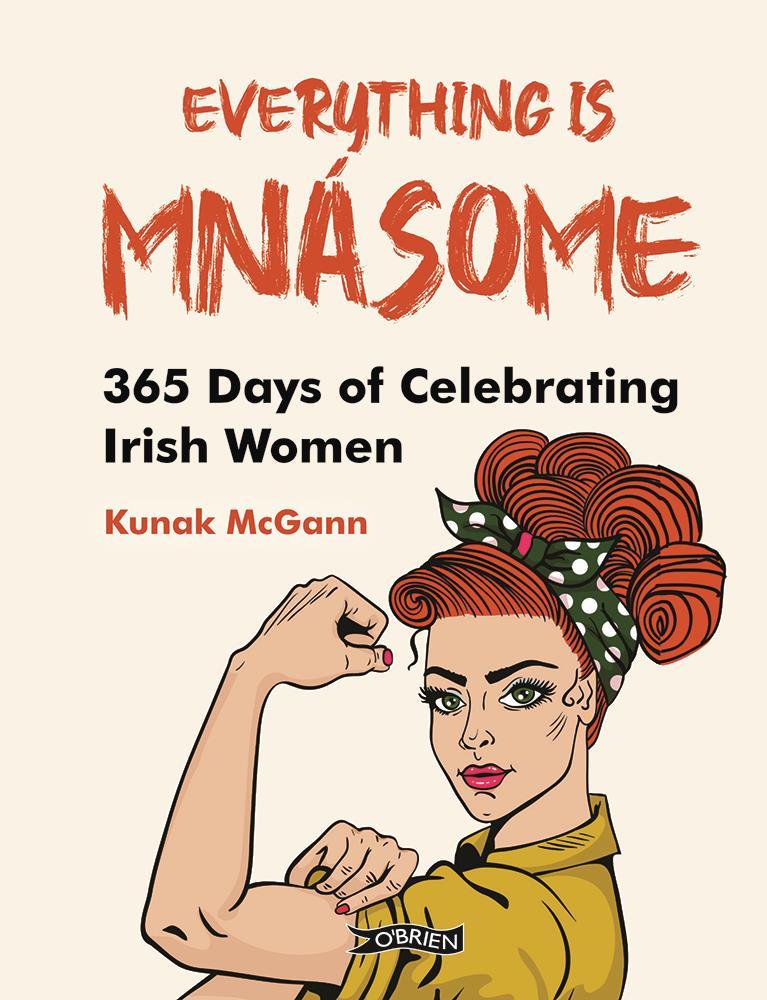
365 Days of Celebrating Irish Women
Kunak McGann
Acknowledgements
As I grow older, I realise how lucky I am to have a life filled with the most interesting, inspirational, fierce and funny women. My heartfelt thanks to my mum and sister, mother-in-law, sisters-in-law, cousins, aunts and nieces, and good friends, especially my weekenders and book clubbers who make me laugh so much.
And to the amazing women I’ve worked with in publishing, from the femtastic OBP crew – past and present – to the army of writers and illustrators who fearlessly put themselves out there. Special thanks to my editor, Nicola Reddy, who is brilliant of course, but always just ‘gets’ me, and Emma Byrne, for really smashing it with this cover.
For Mum and for my sister, Erika, the most mnásome women I know.
Introduction
When I first suggested this idea for a book – a celebration of Irish women for every date in the year – I was very pleased with myself. at feeling lasted only as long as it took me to get stuck into allocating dates. What I had created for myself was a jigsaw puzzle for which there might not be connecting pieces. But the more I went down the rabbit hole of internet research, the more obsessed I became with learning about these women. For every icon I had a date for – Constance Markievicz, Mary Robinson and Sinéad O’Connor – there were other, less well-known women like Nancy Corrigan, Dorothy Stopford Price or Kate Kennedy blazing a trail in their own ways. And of course, there were far more extraordinary women than there were dates in the year.
When Elizabeth Blackburne put together the first anthology of biographies of Irish women in the 1870s, she called it ‘the silent patriotism of my life’. While this
little book is not nearly on that scale, by the time I had finished it, I was a prouder Irish person and a prouder feminist. My hope is that these little tasters will serve as inspiration to find out more about the many, many Irish women who have made this world a better place.
1st January 2012
Dr Rhona Mahony became master of the National Maternity Hospital in Holles Street. She was the first woman to head up an Irish maternity hospital. During her term, she oversaw the care of ten thousand pregnant women – and their little bundles of joy –every year.
2nd January 1945
An extract from Mary Lavin’s debut novel, e House in Clewe Street, appeared in e Atlantic magazine in the US. Born in Massachusetts, Mary moved back to Ireland at the age of nine. Her many novels and short stories centred on women’s lives – her stories on widowhood are thought to be some of her best. In 2021, she was the first Irish female writer to have a public space named after her. You can now take a stroll down to Mary Lavin Place near Dublin’s Grand Canal.
3rd January 2001
Dublin journalist Orla Guerin was appointed the BBC’s Middle East correspondent, based in Jerusalem. Her award-winning career began in Ireland when she joined RTÉ as their youngest ever foreign correspondent – she was posted to Eastern Europe at just twenty-three years old. Cool under fire (literally), she has reported from the likes of Kosovo, Johannesburg and Haiti.
4th January 2018
e first episode of sitcom Derry Girls was broadcast on Channel 4, and it was love at first ‘Catch yourself on!’
With razor-sharp writing by Lisa McGee and a truckload of 90s nostalgia, we all adored the gang of teen misfits. e show ran for three seasons, catapulting the actors to full-blown stardom. It won an Emmy, and BAFTAs for Lisa’s writing and Siobhán McSweeney’s brilliantly sardonic portrayal of Sr Michael. *giant eyeroll*
5th January 1927
Roscommon teacher Margaret ‘Gretta’ Cousins founded the All India Women’s Conference to empower and educate women. At home, Gretta was a fierce campaigner for Ireland’s independence and women’s rights, and she continued her mission after moving to India in 1915. She was imprisoned in three different countries for political protest: in Ireland and Britain for suffrage activities, and in India in support of Gandhi.
6th January
Nollaig na mBan or Women’s Christmas is an Irish celebration getting a welcome new lease of life. It was traditionally a day for women to put their feet up after the work of the festive season. ey would meet in each other’s houses for a cup of tea and a bite of Christmas cake. With household duties more evenly spread these days (you’d hope), it’s a chance to celebrate the amazing women in our lives. Did somebody say ‘girls night out’?
7th January 1966
Mary Finn from Sligo was the first female winner of the Young Scientist exhibition. Bucking the stereotype, she used complex maths to tackle the ‘Four Colour Problem’ (that it only takes four colours on a map to avoid having two neighbouring countries of the same colour). She later put her smarts to good use by becoming a science teacher.
8th January 2008
Cork native Dr Clare O’Leary became the first Irish woman to ski to the South Pole. She was also the first Irish woman to reach the top of Mount Everest and to climb the Seven Summits, the highest mountains on each continent. ose of us with tamer aspirations – and frankly, less energy – can honour her by trying the popular Clare O’Leary Walk between Bandon and Innishannon.
9th January 2003
e news was out: twenty-one-year-old Cecelia Ahern had secured herself a ‘million-dollar book deal’. Her debut novel, PS I Love You, was a huge international hit the following year. e Dubliner has been a regular on the bestseller lists ever since, with a new offering almost every year. She has sold a stonking twenty-five million copies in thirty languages worldwide.
10th
January 1877
Eliza Walker Dunbar was the first woman in Ireland or Britain to obtain a medical licence. Travelling over from Scotland, Dunbar took her exams at the only university that would let her: King and Queen’s (now the Royal) College of Physicians in Ireland. e year before, new equality legislation was passed in Westminster, and this Dublin college was the first in the United Kingdom to step up. It was a breakthrough in the fight for women doctors.
11th January 2024
Blinne Ní Ghrálaigh gave a blistering closing statement in the International Court of Justice as she and her team made the case against Israel for Palestinian genocide. e Mayo-born lawyer specialises in international law and human rights, and she previously worked on the Bloody Sunday Inquiry and the CroatiaSerbia genocide case. She saw firsthand the conditions in Gaza on a fact-finding trip.
12th January 2018
Deborah Somorin appeared on RTÉ’s e Late Late Show to share her experience of homelessness. Living in a hostel at thirteen and pregnant at fourteen, Deborah tragically lost her mother, who took her own life. Now a successful management consultant, she founded Empower the Family to help disadvantaged students. Her vision earned her a place on the Forbes ‘30 Under 30’ list.
13th
January 1964
After twenty-four years of men only, Jane ‘Jennie’ Dowdall was the first woman appointed to the Irish Council of State, where she remained the only woman for over a decade. A trained nurse, she was Cork’s first woman mayor. She was a great patron of the arts and used her influence to secure funding for the Cork Opera House.
14th January 2019
Sindy Joyce donned her cap and gown to receive her PhD from the University of Limerick. She was the first Traveller – or Mincéir in her own language, Cant –to earn a doctorate. From Newcastle West, Sindy had carried out her sociological research on young Travellers’ experiences of racism in urban spaces. Dr Joyce was appointed to the Council of State later that year.
15th January 1912
Sarah Cecilia Harrison topped the poll to become the first woman elected to Dublin City Council. A leading portrait artist, the County Down woman helped establish the Hugh Lane Gallery. As a councillor, she fought for equal pay for women and relief work for the unemployed.
e Dublin trades council called her ‘the noblest, bravest and most accomplished woman in Ireland’.
16th January 1891
One of the first women in Ireland to qualify as a doctor, Mary Hannan was recruited to run the Dufferin women’s hospital in Agra, India. A real progressive, the Dubliner was a strong proponent of sex education.
In later life, she lived in South Africa and point-blank refused to pay its ‘super-bachelor tax’ on single women (but not men). She was described as a ‘champion of the unmarried ladies’. Too right.
17th January 1886
Cousins Edith Somerville and Violet Martin met for the first time on this day and soon began writing together as ‘Somerville and Ross’. ey published more than a dozen social satire novels – their most popular was later adapted for TV as e Irish R.M. Violet died more than thirty years before her cousin, but Edith would continue to write under their joint pen name.
e pair are buried side by side.
18th January 2002
e acclaimed biopic of the Dublin-born writer Iris Murdoch, Iris, opened in cinemas. Iris published twenty-six novels on morality, sexual relationships and life versus art. Nominated for the Booker Prize an impressive seven times, she won in 1978 for e Sea, e Sea. She once said, ‘I think being a woman is like being Irish … Everyone says you’re important and nice, but you take second place all the same.’
19th January 1865
Upon the death of her husband, Ellen Jane Corrigan became CEO of the Bushmills whiskey distillery in all but name. A shrewd businesswoman, she modernised the County Antrim company for a world market. She introduced electricity, massively bumped up production, and set up a limited company. When she sold it fifteen years later, she retained a seat on the company board –unheard of for a woman at the time.
20th January 1848
e good ship Garrick docked in New York after a forty-day voyage from Liverpool. irty-three babies were born during the journey, including a little girl called Bridget, born to mother Anne Kerny. During the Famine years, eight thousand babies were born on the coffin ships to New York. Women fled Ireland to give birth in the dark, airless and fetid conditions of steerage passengers. Incredible courage and endurance.
21st January 1974
French footie club Stade de Reims signed seventeenyear-old Dubliner Anne O’Brien. Technically, France didn’t allow professional women footballers, so Anne was contracted as a part-time factory worker. She went on to play in the Italian league, winning six titles and playing to fifty-thousand–strong crowds. When her son was born, she returned to play after just four weeks, breastfeeding him in the dressing room at half-time.
22nd January 1904
Isabel Marion Weir Johnston arrived in Dublin, the first woman to be admitted to Trinity College as a student. She and forty other women on campus were not allowed attend lectures, use the canteen or be present on the grounds after 6pm. Marion organised dances and tennis tournaments and founded the Elizabethan Society (the Eliz) for debating. ( e university’s other debating societies wouldn’t admit
women until the 1960s – for shame!). Trinity’s former provost George Salmon said that ‘over my dead body will women enter the college’. Ironically, he died the day Marion arrived in Dublin. Her examination had to be delayed til after his funeral.
23rd January 1834
Mother Mary Aikenhead founded St. Vincent’s Hospital at St. Stephen’s Green, the first hospital in Ireland or Britain to be managed and staffed entirely by women. Mary was known for her immense energy and passion. When confined to bed with spinal problems, she wrote more than four thousand letters asking for hospital donations. What someone like her could have done with the power of email and social media ...
24th January 2017
Ruth Negga landed her first Oscar nomination for her portrayal of the real-life Mildred Loving. Ruth
was born in Addis Ababa and grew up in Limerick. After a number of roles in homegrown productions including Love/Hate, Hollywood came a-calling. Talking about on-screen characters, Ruth once said, ‘I don’t know why women aren’t allowed to have the same sort of breadth and scope and flaws of men. It kinda nags at me, you know?’ We know exactly.
25th January 1990
Sinéad O’Connor’s heartrending version of ‘Nothing Compares 2 U’ topped the Irish charts. One of the country’s most talented singer-songwriters, her acclaimed album I Do Not Want What I Haven’t Got sold over seven million copies. A defiant human rights activist, she sparked outrage in 1992 when protesting clerical sex abuse by ripping up a photo of the Pope on Saturday Night Live. Sinéad’s death in 2023 was met with a national and international outpouring of grief.
26th January 1907
Riots broke out at the opening night of J. M. Synge’s e Playboy of the Western World at the Abbey eatre in Dublin. e crowd was appalled by the word ‘shift’, meaning a modest piece of women’s underwear. e rioters were applauded by the Irish Independent for their good taste and common sense. One can only imagine what they would have made of e Vagina Monologues.
27th January 1942
Sheila Tinney had her first scientific paper published, based on her PhD research on crystal lattices. She was a gifted physicist and the first Irish woman to earn a doctorate in mathematical science. Born and raised in Galway, Sheila was one of only eight girls to tackle Honours Maths the year she sat her Leaving Cert. She went on to lecture in UCD, developing their first course on quantum mechanics and inspiring generations of students.
28th January 2024
e final episode of Second Chances, hosted by Ireland’s first trans TV presenter, was broadcast. Rebecca Tallon De Havilland was shockingly outed as a trans woman on the front page of an Irish newspaper thirty years ago. Following her diagnosis with HIV and a hard-fought battle with addiction, she published her landmark memoir in 2010. She is a trailblazing activist on trans rights and HIV awareness.
29th January 2015
Anne Enright was named Ireland’s inaugural Laureate for Irish Fiction. e Dubliner’s talent had been recognised right from her first book, e Portable Virgin, which scooped the Rooney Prize. Her fourth novel, e Gathering, was awarded the Booker. She once mused that ‘If you grow up in Ireland and read books then you really are obliged to attempt your own some time.’
30th January 1995
On this day, the government increased maternity leave to eighteen weeks. It would be increased again a decade later to the current twenty-six weeks. Ireland introduced maternity leave back in 1981, but we still lag behind many of our European sisters on maternity pay. If you live in Bulgaria, you can expect to be paid 90% of your full salary.
31st January 1881
Wicklow sisters Anna and Fanny Parnell set up the Ladies’ Land League in Dublin. When the male leaders of the Land League were imprisoned, the women’s league took over – and to much better effect.
ey opened five hundred branches countrywide and distributed £60,000 in relief funds (equivalent to millions today). e Archbishop of Dublin accused them of forgetting ‘the modesty of their sex and the high dignity of their womanhood’ – which only
spurred them on. Of the two sisters, Anna was much more radical and militant. She would inspire the next generation of women activists.