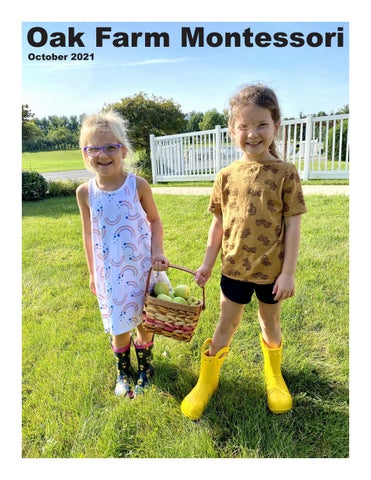
Oak Farm Montessori October 2021
But how did they learn these skills if no one was demanding the behavior? Montessori believed that when the adult steps out of the way, the child will reach their full potential. Through her countless hours of observation, she saw independence, joy, confidence and a building of community that she could not explain. This trust and collaboration between the students and the teachers who encouraged them led her to say, “Anyone who wants to follow my method must understand that he should not honour me but follow the child as his leader.” Take a peek into the classrooms of Oak Farm Montessori to see how our teachers encourage and model collaboration at each stage of development.
Candice
2
HEAD OF SCHOOL
Did you know that the first classroom Maria Montessori established was to provide basic care for the impoverished small children left home alone all day while their parents went to work? Dr. Montessori decided to take these 50 children and ‘free’ them to discover the materials without adult interruption. Instead of strictly confining them, they were provided with practical life materials and explorative constructs that we refer to today as sensorial materials. Within a few weeks, these formerly wild and disheveled children had learned to wash their hands upon entering the room, how to wait patiently for use of a material, collaboratively worked with other children to complete tasks and respectfully care for the environment.
tiny
>
Lending a hand
Jeni Ekovich, Infant Teacher
It is fairly easy to visualize what collaboration looks like in an elementary classroom; students working together to learn concepts in a practical and mutual way. However, you may be impressed to know just how much collaborative learning takes place even at the Infant and Toddler levels when the environment is prepared to meet the needs of its students. “The true strength in our classroom lies in the collaboration of learners, not in the knowledge of one expert.”
We see toddlers working together to help a classmate load (and then unload) a wagon with rocks, infants exploring a new material to discover how it works and perseverance when a friend is struggling and they offer to help. Maria Montessori knew so well that children learn by doing. They learn by using their hands and bodies as well as observing their peers. Their social development is guided in an environment where they can work as equals with their peers. In the early childhood classrooms of Oak Farm Montessori, we are blessed to be able to witness beautiful and meaningful collaboration among our youngest friends each and every day. #supportourschool
Let’s do it... TOGETHER! Elizabeth Green, Primary 3 Teacher
A recent visitor to our classroom remarked on how many students she saw working together. Not surprising! While our environments foster independence in students, collaboration (working together to achieve a goal or complete a task) can be seen every day throughout Oak Farm Montessori School. Adults and children alike work together to solve problems or accomplish a goal. Collaboration often occurs organically when there is a specific need. Other times, however, working together is an integral part of the work or lesson. In the Primary environment, children are encouraged to first look to their classmates if they have a question or need help. Because of the three-year age groupings in a Montessori environment, we often observe older friends guiding younger ones with lessons, assisting with a zipper or tying shoes. Walking through the woods, it’s not uncommon to see two children moving a large branch that has fallen across the path or another child holding a friend’s hand as he balances on a log. In addition, a student may need support counting a long cube chain or finding where the pieces fit on the map of Europe. Conversely, that same student who needed assistance in math might be able to help a friend figure out a word she is reading in a book. Some lessons, on the other hand, are carefully designed for students to work together. In the Bank Game, for example, two or three students gather large quantities with the golden beads and add them together in a systematic way to discover the sum. Others might partner to trace and label a map or do animal research. Collaboration in the Primary environment often involves adults as well. In an effort to best support their students, Primary teachers work closely with our Reading Specialist and Speech Therapist to reinforce the concepts or skills currently being worked on. One of the most important forms of collaboration, though, involves the child, the parents and the teachers. This partnership helps ensure open communication and consistency between home and school. Regardless of how collaboration occurs, critical social skills are practiced. Students learn how to ask a peer for help, take turns when working together and problem-solve when challenges arise. These are important life skills for anyone!
4
#supportourschool
A return on investment BY KIM DAVIDSON STRATEGIC PARTNERSHIPS DIRECTOR
6
“In school they call it cheating. In the workplace it is called collaboration.” I remember the day my former boss said this. I had never really thought about it, but how true. How are students who are brought through a traditional education system prepared to transition to one of teamwork and collaboration? If you ask someone who works in industry or in human resources, they will tell you that being able to collaborate and be a responsible team member are among the skills needed in today’s workforce. When you reflect on your days in a traditional classroom, do you remember your teacher encouraging you to work with others on a daily basis as you worked through your assignments? Three important skills needed to have a collaborative environment are trust, tolerance and self-awareness. In Montessori classrooms, children learn to be self-aware and understand how one’s actions affect others around them. These lessons begin in the Nido room and continue throughout each developmental plane. Montessori teachers are facilitators of a child’s learning. They spend much of their time asking questions and creating an
environment that encourages the aforementioned skills, among many other soft skills, that are crucial as our students grow into world changers and adults who contribute to society. The youngest children learn self-control, how to use their words and how to comfort friends. This builds self awareness. Community is integral in the Montessori environment and students quickly learn we are interdependent upon each other. This builds trust. Students are immersed in an environment where respecting each other is modeled by teachers and older students; as well as being set as an expectation in the classroom environment. Whether respecting a classmate’s workspace or learning to respect their thoughts and opinions as valuable, respect is interwoven into how faculty interact with each child and how the children interact with each other. The Peace Rose is another intentional strategy in Montessori. Students are taught how to respect what others say and how to take turns; hearing how the other person feels. Through this tool, students are learning that everyone’s opinions have value and that each person is deserving of respect. This
builds tolerance. These simple practices are building blocks for the adult each child will become; an adult who is gifted with conflict resolution, as well as, the fundamentals of teamwork and collaboration. When we, as individuals, choose to support Oak Farm Montessori School, we are choosing to invest in an environment that equips students with both soft skills and the academics necessary to become contributing citizens and to make a positive impact on their local communities. Not all investments have immediate returns, so how does one capture the impact from investing in a future outcome? One way is the impact our students and alumni make on the world. A recent candidate for a position at OFMS shared the following when asked, “Why Oak Farm Montessori School?” The candidate shared that in a previous position he had the opportunity to work with students from Oak Farm Montessori School who, “truly cared about their learning, had strong social and emotional intelligence, and maturity.” Now that is a return on investment! #supportourschool
Making connections Critical Thinking, Collaboration, Creativity, Communication = The 4 C’s
Tiffany Fennig, Lower 3 Teacher
W
hen I reflect on the word Collaboration in the Lower Elementary Montessori environment, the first word that comes to my mind is Connection. According to the Merriam Webster Dictionary, “Connection is defined as something that joins or connects two or more things; a situation in which two or more things have the same cause, origin, goal, etc.” Collaboration, working with others or together on an intellectual endeavor, and Connection are two essential elements in the Lower Elementary Environment. The students in the Lower Environment are a part of a multi-age classroom which includes 6, 7, 8, and 9 year olds. Multi-age classrooms ensure that the students moving through the lower elementary classroom have the opportunity to be exposed to older and younger students allowing for imitative learning, peer tutoring, and collaboration all around.
8
Montessori philosophy facilitates collaborative learning from the onset. The lower elementary student is entering a new plane of development, which Dr. Montessori characterized as the “acquisition of culture.” A student in the second plane of development is craving social interaction. While during the first plane of development the child is fully focused on himself. The child only thinks and does for himself and is considered to be egocentric during this stage. This next stage provides the child with the opportunity and need to work with others and understand the world around them. Dr. Montessori considered the child’s need so intense during this plane of development that she referred to this urge of socialization as an instinct. Montessori stated in her book, To Educate the Human Potential, “that in a child of six (elementary age) is his need to associate
himself with others, not merely, for the sake of company, but in some sort of organized activity. He likes to mix with others in a group wherein each has a different status. A leader is chosen, and is obeyed, and a strong group is formed. This is a natural tendency, through which mankind becomes organized.” When one walks into a Lower Elementary Classroom, he will observe that the classroom is arranged purposely to promote collaboration among the students. One will see individual tables, group tables, and floor tables. Students have the freedom to communicate with each other freely during the work cycle. Students plan, organize, and consult with each other and the adults all day long. The teachers provide guidance right along with the students. The beauty of the lower elementary classroom is in observing the students working together to
solve a problem, tutor another student or model boundaries of appropriate social interactions and sensitivities to one another’s emotions. Throughout the student’s daily interactions, they are continuously observing and connecting with each other. The Lower Elementary Montessori materials provide multiple opportunities for collaboration. Students support each other with about any material from the Golden Beads in the Math area to the Command Cards in the Language area. Older students support younger students with not only reading, but also learning how to write in cursive, completing daily chores, investigating scientific demonstrations related to the formation of stars and so much more. The highest level of learning (mastery) is for a student to teach a skill to another student. This occurs often in our environment. When you walk into our classroom, it may be difficult to find “The Teacher” because the teacher is not always the adult. “The Teachers” are all of our students at some point in the day. “The Teacher” is the student who is slowly modeling how to sound out a word or identify a noun from the Farm Animal basket, “The Teacher” might be the student who is modeling for another child how to use their words when they are upset, or “The Teacher” might be the student who is hugging another student telling them that they believe in them and it’s going to be okay (modeling empathy and compassion). Together, through our connections and collaborative learning environment, our students are building an inclusive community by being “The Teacher”. How do you support your child at home to be “The Teacher”? Do you plan and organize the dinner menu and grocery list together? Do you allow your child to plan and organize your day of errands or help plan a vacation? Do you allow your child to choose his chores or help plan the cleaning schedule? Do you encourage your child to set goals for reading at home or how to complete a project? Do you provide opportunities for your child to plan, organize, and collaborate with you? How do you EMPOWER your child? #supportourschool
10
Elizabeth Danielson, Upper3 Teacher
Think about a time when you have worked through a challenging task collaboratively with a group. You probably walked away feeling accomplished, connected and possibly gained a new perspective. It’s amazing what can happen when we are given the opportunity to combine our talents and create something that wasn’t possible on our own. Building a culture of collaborative learning is a priority in the upper elementary classroom. The first few weeks of school are spent building a foundation of trust and community. As a class, we work through our Guiding Principles: Take Care of Self, Take Care of Others, and Take Care of the Environment. Time is spent in collaborative groups discussing classroom procedures, chores and routines. Rich conversations start to happen and guidelines are established. Students are empowered to contribute to our community and they quickly begin to understand their importance and value in our classroom. As trust and community are established, collaborative learning naturally becomes part of our daily work cycle. If you were to walk into an upper elementary classroom, you would likely see students collaborating on classroom chores, research, creative writing and other various projects. Through this meaningful work, students learn to ask each other questions and listen to others’ perspectives and thoughts. Together, they form new conclusions and understandings. These collaborative opportunities not only deepen students’ learning, but provide them with lifelong skills. “The education of even a very small child does not aim at preparing him for school, but preparing him for life.” Maria Montessori #supportourschool
Collaboration is key
Heather lemmon, middle school director & teacher
Merriam-Webster defines collaboration as “(working) jointly with others or together especially in an intellectual endeavor.” At Oak Farm Montessori Middle School, that is one of the most important aspects of our day. From start to finish we are working together to accomplish tasks. This includes Erdkinder, when we’re working together on our business, taking care of our animals, or working together in the greenhouse. As we move into our academic work we are constantly finding ways to work together. This may be through Socratic Seminar where we hear each other’s ideas on an article or primary document, working on our math studies, doing a science lab or a Spanish project, or preparing for a Humanities debate. At this plane of development (young adulthood) working with peers is fundamental. The Middle School staff is constantly integrating opportunities for this social-emotional piece in the curriculum. The adolescent needs opportunities to collaborate with their peers, find facts, wrestle with their own opinions along with those facts, and come to their own conclusions. This is one of the most fascinating occurrences we, as teachers, get to witness. These young adults are literally practicing being adults. Through working together, students are able to share ideas with each other in a respectful and productive manner. Recently, the middle school students and staff spent four days together at Camp Tecumseh in Brookston, IN. Here we learned about many things including leadership, trust, problem-solving, self-confidence, and communication. There is a common theme in each of these pillars...COLLABORATION. Students spent each day working on getting to know each other and becoming comfortable with each other and trusting one another. By the end of the third night a transformation is visible. Everyone feels it, from the students to the teachers. We have all stretched ourselves by this point and been a little uncomfortable; whether it be in the camp bed, or the height of the zipline, or the lack of our normal routine. We have all found ways to communicate better with each other. We have had all of these experiences together. These experiences bring us closer and we feel more comfortable with each other. This trip is imperative to our work the rest of the year. This comfort allows for much richer collaboration in the classroom, in the barn, in Community, and throughout our day. This collaboration happens much easier and in a way that is kinder and deeper than before our trip together. Collaboration at the middle school level is key! We find ourselves enjoying one another and our studies even more after having had time to really dig deep into working together and getting to know each other better. The middle school staff delights in the work of these amazing young adults and are enthusiastic about what this year holds at Oak Farm Montessori Middle School. Be on the lookout for some of their collaborative works to shine through their microeconomy items.
12
Theatrical interactions Kavin Ley, Theatre Teacher
In most classrooms, much of the work being done is individualized to the student--writing, math, reading. Individual ideas, individual work, individual assessments. In the theatre classroom, it is quite the opposite! Most work is collaborative. It is rare for an individual to work on a solo project. Creating something as a group is key to a successful theatre class. At the start of the school year, students are introduced to collaborative work through games and activities that rely on the contribution of others. Playing games like “What are you doing?” and “Do you want to buy a…” begin students on the path of group work. Working together, students start focusing on more specific tasks. Playing catch with a partner with an imaginary ball builds trust in partner work and develops bodily responses to external stimuli (even if those stimuli are only in our mind!). As the class progresses through the year, students will work through script writing and performing small skits and plays that depend on collaboration. Developing characters that interact with each other relies on the other members of the group to be prepared. Collaborative efforts from everyone, not just an individual or a small group, is what creates successful work in theatre. The collaborative skills developed in class can be applied directly to other aspects of the learners’ lives as well. A few examples are: working together on a class project, being a productive member of the household, and being a team member in their future career. Encourage the learners around you to demonstrate their new skills! #supportourschool
The high school kicked off the year with a Fall Odyssey Trip. The objective of this outing was to help the group step into shared activities and experiences that would help facilitate social and emotional connections. After months of planning that included many pre-made deposits, packaged meals, reservations, borrowing gear, packing, and many phone calls and emails; we were well prepared! However, when the day arrived to depart, it became obvious that little was going as planned. Pre-arranged vehicles were not available as promised and high winds harbored the ferry from our destination in Michigan. This is not an ideal way to start a trip with students, and it left doubt that this trip would happen at all. After receiving the news of the ferry, the high school community sat together to discuss options for the week. In doing so, one thing was certain; there would not be the same opportunities for social connection here on campus as there would be on a trip. So we posed the question to the students, “where do you want to go?” The faculty had some stipulations based on budgets and our previous packing. It needed to be within 5 hours of driving, and it needed to involve the camping gear that we had packed. We also needed to all agree on the destination. After some discussion, the group decided on Red River Gorge in Kentucky. For anyone who has not visited this national park, it is a real gem in the Midwest. We knew it would provide beautiful scenery, capacity to accommodate our large group, and many opportunities for adventure. After a vote and an agreed upon destination, the students quickly went to work creating seating charts and packing gear into the vehicles while the teachers called each family to get permission for this change in plan. There was a fun buzz of excitement. We were heading off on a real Epic Adventure. Much could be shared from the trip that would make for great stories; like our hikes to the tops of cliffs, meeting an astronomer at dusk who shared about constellations, snakes at night, or the rain storm that left 2 inches of water in the few budget tents that I picked up before the trip. All of these are fun stories, and we are closer to each other because of them, but the one that stands out among them came on a “leisurely” drive around the gorge. After a few long hikes and spending time in sun and rain, we decided that we would take a scenic drive around the gorge and river to rest. Our five vehicles slowly made our way on the winding narrow country road that followed rocky rivers, bluffs and rock walls. Along this road is a narrow tunnel, named the NADA tunnel. This is a fun part of the drive, but you must be careful as a driver. The tunnel only allows one vehicle to enter at a time, but it still functions as a two-way tunnel. As we came to the tunnel, we saw a small white
Synergy to the rescue JJon on Agler, Agler, High High School School Administrator Administrator
sedan off on the side of the road, partially blocking the entry. There was room to go around, but since this was an odd place to stop a vehicle, we decided to investigate. As we would quickly come to find out, this person was a young college aged student who had never driven this road. When they came to the tunnel, they saw another car coming the other way, and attempted to back up and over. In doing so, their wheels fell off the road into a washed out rocky ditch; leaving their axel resting on the edge of the pavement. They were thoroughly stuck. This person was alone, did not have any cell phone reception and was struggling to find help from other drivers. When the students realized the situation, they quickly piled out of the vehicles to help. They began to discuss options to help get the vehicle free of the ditch. They proposed different ideas of pushing or picking up the vehicle. They asked trucks if they had chains or tow straps. Finally, they settled on the idea of building a ramp with rocks that would allow the vehicle’s wheels to roll back up onto the pavement. Once the plan was set, everyone got to work. Students quickly gathered and assembled rocks while teachers directed traffic. It was a very eye opening scene to see angry adults, frustrated by the now blocked tunnel, complain and shout while high school students joyfully and selflessly collected large rocks and collaborated to assemble a ramp for the front and rear wheels. Some passers-by even mocked our efforts, saying that we would never get the car out. This did not slow our work, but emboldened us to complete the task.The final step included partially lifting the car to place a large rock under each tire, which helped get the axle off the pavement. Students and teachers gathered around the car, secured a holding place and in unison yelled, “Three, Two, One, Lift!” We lifted the vehicle just long enough for two large rocks to be placed under each tire. After some grimacing and grunts, we shouted, “Three, Two, One, Lower!” It was a success! Everyone eagerly watched from a safe distance as the vehicle was slowly pulled from the ditch. The wheels slowly and smoothly followed the ramp until they were safely planted on pavement! There was an eruption of cheers from students, teachers, the owner of the car and all of the drivers of the stopped vehicles; which now counted well over twenty vehicles. Everyone had a great sense of achievement and bonding through this task that could have only been completed with cooperation and synergy. We could not have planned or facilitated a better experience. This was a real problem and a real need, and our students really solved it.
Mark your P/T
Conferences
Parent Education Founders Day OFMS
calendars October 28 - 29th, 2021
Event
October 28th, 2021
Celebration
november 10th, 2021
Day of Giving
OF Connects
november 10th, 2021
Movie Night
november 12th, 2021
TALL OAK FUND
SGO
VOLUNTEER
DAY OF GIVING
SUPPORT OUR SCHOOL
“To provide a Montessori environment that inspires children to reach their potential through meaningful work.”
Oak Farm Montessori School | 502 Lemper Road | Avilla, IN 46710 | 260.897.4270 | www.oakfarm.org