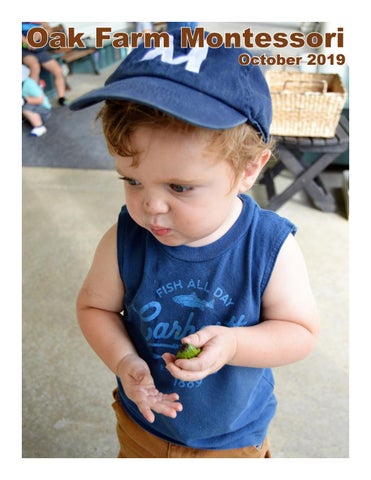
Oak Farm Montessori
October 2019
back to our roots This year at Oak Farm Montessori School we are taking the time to go “Back to Our Roots” in preparation of our 20th birthday celebration. But what does “Back to Our Roots” really mean? To help illustrate this, think about the purpose of roots. The entire root structure serves to anchor the tree in the soil, preventing erosion. The tip of the root does this amazing work that produces an acid that allows the root to power through rocks and around rocks, expanding and growing over time. But, don’t forget that it all begins with the root, as it is the first thing that comes out of a seed when germinated. It is the root that absorbs the water and nutrients from the soil. Without the root, the tree would die. The “root” of Oak Farm is the Vision and Values document that Lorene Dekko Salsbery, our founder, helped write as a guide for the future of our school. These core principles, established almost 20 years ago, still impact and guide Oak Farm Montessori School today. The more we understand the inner workings of what makes us who we are, the greater chance we have to fulfill our mission into the next 20 years and beyond! Going “Back to Our Roots” is taking the things that we believe at our core, making sense of them and bringing them into action! This is going to take time as we nourish our roots as a faculty and as a school community. We, altogether, are the ones providing the water and nutrients to be absorbed in order to ensure that Oak Farm GROWS AND THRIVES! This year, our newsletter has a theme each month that will help you understand the vision and values that were intentionally left for us. In the forward of the document, former Head of School, Judith Cunningham and founder, Lorene Dekko Salsbery state, “This comprehensive document was created to guide strategic and academic decisions for the life of the school without fear of getting lost in a handbook revision, website redesign, or leadership change.” Enjoy this month’s edition that focuses on the significance of guidelines and routines across the levels and how we put that into action at Oak Farm Montessori School.
Candice
PANEL DISCUSSION
Following Inside Montessori’s screening Thursday, October 3rd, 2019
Oak Farm Montessori School - 413 Lemper Road Avilla, IN | Screening starts at 6:00pm | Panel starts at 7:20pm
Candice Holbrook OFMS Head of School
Jennifer Nolan Seton Montessori Head of School
Mark Nardo President - United Montessori Schools of Indiana (UMSI) & Principal IPS George Washington Carver Montessori
Joe Pounds Director of Adolescent Well-being Dekko Foundation
Bridget York OFMS Director of Curriculum &Student Services
Mariah Clark OFMS High School Junior & aspiring teacher
Join us immediately following the screening for conversation and discussion about the importance of education for our children. Topics will include: the benefits to communities when they invest in early childhood education, how Montessori is different from other methods of education and identifying other organizations beyond schools that can support education opportunities.
RSVP here: https://www.eventbrite.com/e/inside-montessori-documentary-screening-free-tickets-66878719049
The Importance of Routine Jeni Ekovich, Infant Teacher
Children need routine and predictability, especially at ages birth through age three. Having a predictable routine helps children know what is coming next and feel secure. It builds trust between the children, their caregivers and the environment. In our classrooms, the children enter through the cubby doors every day in the same way, put their belongings in a prepared cubby space with their name and picture, and begin their day. Snack, morning work cycle, outdoor exploration, lunch, and nap all flow along in a predictable pattern. Children gain confidence and independence within this framework and it is a beautiful sight. Maintaining a similar routine at home as what they experince during the school day is especially helpful for young students. Freedom within limits and clear guidelines help our children reach their full potential.
Order is one of the needs of life which, when satisfied, produces real happiness. Maria Montessori
Laying the foundation Beginning the year in Primary Elizabeth Green, Primary Teacher The start of every school year brings great excitement and anticipation. While the new students enter the environment somewhat cautiously, even hesitantly, the older students return with a sense of confidence that is the result of the familiarity they feel after spending the past year or two in the same environment with the same adults guiding them. It often feels like home to them. In the early weeks, we talk frequently about the guidelines of our classroom. These important ground rules are created each year with the help of our returning students and become what we refer to as our “Guiding Principles,” those rules that help us work, play and live together in our classroom environments (indoor and outdoor). At the Primary level, we set guidelines for: Care of Self, Care of Others and Care of our Environment. To help clarify what this looks like, we discuss with the students what they might “say” or “do” in each category. We record these student-created guidelines so they can be posted in the classroom. It is heartwarming to see how very clearly our 4 and 5 year olds can verbalize what it might look like to care for ourselves (“keep my body calm”), care for others (“help my friend with her shoes”) and care for our environment (“wipe up a spill, even if it’s not mine”). The older students are our “veterans” who understand what it takes to help us function in a positive way throughout our time together at school. They play an integral role in helping the younger friends acclimate to their new environment, guiding them with lessons, helping with shoes or coats or walking them to the nap room. We appreciate their help as we build a sense of community.
“To let the child do as he likes when he has not yet developed any powers of control is to betray the idea of freedom.” ~Maria Montessori
“Geared” up for the new school year Abby Roughia, Lower Elementary Teacher
As the school year begins once again, a new community of classmates come together; each with unique gifts, abilities, and personalities. In Lower Elementary, we use the beginning of the school year to establish routines and create a community where each child feels valued, cared for, and empowered. This work is done as we daily come together as a community. Establishing routines provides the structure that the children begin to count on. It becomes their cadence, and soon, they are doing it without our prompting. The community, like a clock, has many gears that work together to accomplish the tasks needed to make the day complete. Community is the foundation of the work we do together every day. Each child is an important, integral piece in the moving gears of the classroom. Without each child putting their responsibilities into motion, the gears cannot link up and “run” the classroom. In order to grow together and become a cohesive community, we do a number of community building activities. These activities provide opportunities to depend on one another, trust one another, and encourage one another. We learn that it takes a collaborative effort to reach the highest potential for each of us, independently. We also learn that the motion of one gear can impact the entire machine; without each gear, the day may not reach completion. We quickly see that one small change to a gear can make an impact on the whole system. Classroom Guidelines are like the lubricant in the machine that helps the classroom “run” smoothly. We refer to these foundational guidelines as the Three Pillars: Care of Self, Care of Others, and Care of Environment. The classroom community brainstorms different ways they can honor these three pillars within the environment, and this becomes the rationale of how the gears will carry out the work. Our classroom guidelines are created and recorded during this process, and each member of the class commits to honoring them throughout the year. If our ‘gears’ become worn or need attention throughout the year, we can easily refer back to these guidelines.
The Heart of the Classroom Sandra Deacon, Upper Elementary Teacher Upper Elementary students find security in consistent expectations and routine. If children seem disorganized and/or anxious, this may be due to an inconsistent schedule, expectations, and/or routines. This is one, among many, reasons that routines and guidelines are so important in the classroom. This is the focus of the first few weeks of school. If we are careful to show exactly what is expected in regards to learning goals, chores, community, transitions and guidelines, this will nearly ensure that the rest of the year will progress smoothly and peacefully. There are many aspects of a student’s daily and weekly routines. Generally, the Upper Elementary students enjoy having a weekly outline of their schedule, and benefit from the daily use of a “work plan”. These both allow the student to plan the learning they want to achieve that week, while also being able to plan around the routine of classes such as: Art, Music, Theatre and other specials. When teaching the students about how to set learning goals, we emphasize that doing their best work includes challenging themselves, pushing themselves outside of their comfort zone, and enjoying the feeling of working hard and taking pride in their final product. The heart of the classroom is the community. Being a part of a community allows students to feel content and safe. They are expected to take care of their environment, help each other while learning, and treat each other with kindness and respect. When students feel safe, they are free to learn, exhibit excitement while learning, allow mistakes/failures to be learning opportunities, and to celebrate each other in all of those experiences. An important aspect of the foundation of this safe and secure community is the classroom guidelines. In Upper Elementary, the students formulate these guidelines; thinking about what is acceptable in their community, what is necessary, and what everyone can do to contribute to a family-like community. The general ideas of “Care of Self”, “Care of Others”, and “Care of the Environment” are put forth, and the authorship is almost solely charged to the students. There is a promise to try to abide by these guidelines, usually through a signed contract by the entire community, including the teachers. These guidelines can be brought up during community meetings, during decisions about rules, and one-on-one discussions between two community members to help them work through a conflict.
“When the child goes out, it is the world itself that offers itself to him. Let us take the child out to show him real things instead of making objects which represent ideas and closing them in cupboards.” ~
Maria Montessori
Middle School Adventures Heather Lemmon, Middle School Teacher
Each year, the Middle School takes off for an adventure together. During this adventure we have three main goals: 1. Come together as a community 2. Stretch outside of our comfort zones 3. Tickle our intellect. We achieved all of our goals, and for some of us, we even surpassed them. Below are some ways we met our goals and had fun together while doing it… Come together as a community: • We participated in a camp-wide scavenger hunt where teams combed the campus of Camp Storer in Jackson, Michigan for clues to help orient us with our new home for the week. • We ate every meal together, shared in the activities (some were taxing and some were silly), shared bunking quarters (this is where we learn so much about each other in the conversations we share as we are winding down for the day), and shared so many common experiences together Stretch outside of our comfort zones: Most of us found at least one thing during our trip that was a little (or a lot) uncomfortable.
• Horseback riding is a stretch for some • High ropes--this was a 15 foot high ropes course that was not for the faint of heart. • Campfire skits--the transformation from the first campfire to our last was unbelievable. The first campfire we felt a bit guarded with each other. The last campfire gave us chills...we had skits, songs, and smiles all around. • The WALL--a 12 foot high wall that the students had to help, encourage and work together to get everyone over the wall. Tickle our intellect: Probably our most memorable moment of getting intellectual on the trip was our night sky tour with a local astronomer, Austin Edmister. We heard so many engaging questions from the students, the two hours we had with Austin just flew by in a snap. Michigan Country was a role playing scenario where students were taken back to the early times of the first settlers. They had to find food, work, build shelters, etc. This was an activity that we had two shots at...the first year there were many groups that did not survive, but the second year was filled with success! Check out our pictures to see for yourself the meaningful adventure we took together.
“We were challenged but we worked together as a team to figure things out”- Ethan “I learned ‘if you don’t succeed at first try again.’”Gabe “I’m really surprised with the ability of my peers to support each other.” - Sami “I liked hanging out with my friends and getting to know the 7th years.”- Hannah “When we did the wall it was cool to know how everybody else had my back.” - Laila
College and Career Ready!
Oak Farm High School Prepares Students for College and Careers as well as Life!
2019-20 School Profile: CEEB Code: 150031 Head of School: Candice Holbrook Director of Curriculum and Student Services: Bridget York College and Careers Counselor: Rikki Colon Provisional Accreditations: American Montessori Society 6 weeks to 18 years Independent Schools Association of the Central States through 12th grade Memberships: American Montessori Society Full Member School Great Lakes Montessori Consortium United Montessori Schools of Indiana National Association for College Admissions Counseling Positive Discipline Association
Oak Farm High School has had an incredible start to the 2019-20 school year. So many exciting things preparing lifelong learners, global citizens with emotional literacy and leadership are happening every day. We are preparing our students for life with rigorous academics and experiential learning. We are thrilled to be a College Board Member School and our College Board Code is 150031. This allows our campus to provide AP classes and proctor AP tests as well as the SAT and ACT. Currently, we are offering AP Computer Science and AP Seminar with many more AP classes being added based on student interest in the years to come. Our students are using the premier college and career preparation program Naviance (https://www.naviance.com/) which “allows students to create a personalized plan that helps them make the right decisions throughout their academic journey.” Oak Farm Montessori High School Program is committed to supporting each student’s individual path to success through meaningful work. We are excited to share, with the community, the Oak Farm Montessori High School Program College Profile. This will be shared with college admissions directors as our Juniors begin applying for post secondary programs. We are proud of our Class of 2021! Community: Oak Farm Montessori High School is an academically integrated, rigorous, and individualized program that supports adolescent inquisitive minds prepare for life’s opportunities. Oak Farm Montessori High School educates young people in accordance with the Montessori principles of purposeful work, respectful community, personal self-expression and practical life skills, in addition to exceeding Indiana State Core 40 graduation requirements. At Oak Farm Montessori High School, adolescents have motivation for gaining expertise and truly working toward their own futures. School: Oak Farm Montessori School’s original property, consisting of twenty-two acres, opened in January, 2000. The school was created to give families in Northeast Indiana a new choice for education other than traditional public or parochial schools, and was established as a Montessori school in order to educate the whole child in a way that would support each child’s ability to make choices in their learning and fulfill their individual potential. Today, Oak Farm Montessori School is made up of one hundred topographically diverse acres, ten buildings housing classrooms and offices. There is also a greenhouse and a large animal barn located on the campus. In the fall of 2017, the Oak Farm High School program opened and added one grade level each year until 2020. Classrooms accommodate students from infants (six weeks) through 12th grade. Oak Farm Montessori School’s location in rural Northeast Indiana makes ethnic diversity a challenge, but diversity of thought is celebrated here. Since its founding, an implicit mission of Oak Farm is to be available to any family regardless of financial means. An annual two million dollar operating grant from the Dekko Foundation allows Oak Farm to have significantly reduced tuition, so that full price tuition is approximately half of the cost per student. Additionally, over half of our students receive additional tuition support through a tuition grant or through faculty tuition remission, with 43% of gross tuition revenue reserved for grants and additional amounts allocated to faculty tuition remission and sibling discounts
Rank: Oak Farm Montessori High School does not rank students. Curriculum: The Oak Farm Montessori High School program offers all the core academics of a conventional high school program through integrated, individualized work in a developmentally appropriate environment with a team of talented teacher mentors. Graduates earn credits that exceed the Indiana State Core 40 requirements through integrated, rigorous and relevant coursework. Graduation Transcript Requirements: English (English I, II, III, IV) *: 8 credits Mathematics (Algebra I, Algebra II & Trig, Geometry, Pre-Calculus, Calculus, Statistics) *: 6 credits Science (Biology, Environmental Science, Earth Science, Anatomy & Physiology, Chemistry, Physics) *: 6 credits Humanities (World Geography, World Cultures, US History, US Government, Psychology, Geography and History of Civilizations) *: 6 credits Second Language (Spanish I, II, III, IV): 4 credits Directed Electives (Computer Science I, II): 4 credits^ Electives (Health, Fine Arts, Performing Arts, Music, Academic Independent Study, AP course work, Online course work: Middlebury Interactives, Babbel, MIT OpenCourseWare, Khan Academy, InnoLab,, Mechanical): 14 credits Health Education (On and Off campus, real world personal fitness activities offered quarterly): 1 credit Advisory (Personal and Social Responsibility, Speech and Communication, Theory of Knowledge, AP Capstone): 5 credits Business (Introduction to Entrepreneurship, Global Economics, Personal Financial Responsibility, Principles of Business Management, Business Electives) *: 6 credits *Honors Available ^Required if f not taking Second Language Minimum Credits: 56 credits Schedule/ Academic Program: The school year is two semesters; each lasting 18 weeks. The school day begins at 8:25 A.M. and ends at 3:30 P.M. Course work is integrated with each core class averaging 4 hours per week in a blocked schedule. Oak Farm students need a minimum of 56 credits to graduate. Students are regularly assessed through a variety of methods. Teachers clearly communicate objectives to students with the intent of more active student engagement in taking personal responsibility to achieve the grades they choose to receive in each class. Additional Opportunities for Students: Senior Capstone The Senior Capstone focuses on the student’s long-term commitment to a personal passion. It is one aspect of the Oak Farm Montessori HIgh School where the student must move outside the walls of the school and engage with the community. Two, environmental and social two-year immersions in a community activity are an integral part of the curriculum. The student will keep a portfolio of these community projects and have a presentation of learning to the wider community in May of their Sophomore year and a more in depth presentation in May of their Senior year. Projects may take place at the Oak Farm campus, in the broader community, or in a digital context. Business: Bike Shop Oak Farm Montessori High School bike shop, “Pedal Power”, provides learning opportunities for young adults ages 14-18. 9th and 10th years have an opportunity to work in the shop while they study business aspects in detail, including economics, sales, bookkeeping, marketing, and bike mechanics. 11th and 12th years have the opportunity to take on managerial roles in the bike shop, as well as to develop their own business projects, either brick and mortar businesses or digitally based. Seminars in finance, economics, business management and entrepreneurship will also take place throughout the year.
Intersessions Twice a year the regular curriculum stops for Intersession, when students participate in two immersion studies lasting one to two weeks. Each fall there is a mandatory Intersession based on grade level, and each spring, students choose from a list of offerings. These field studies can involve travel to other countries, other cities, or just other locations in northeast Indiana; but they likely include day trips or one overnight. 9th - Freshman Orientation to High School 10th – Adult Practical Life – Personal Finance and Budgeting, Safe Driving 11th - College Application Process – Essays, Interviews, School Selection 12th – Career Internship InnoLab Oak Farm Montessori High School’s Innolab adds a hands-on component to the overall curriculum. The Innolab was conceived as a “makerspace,” part of the international movement to integrate technology, hands-on learning, invention, creativity, and design into a community workshop setting. The “Makerspace Movement” now expands beyond initial community-center-like spaces to educational settings around the world. Makerspaces are characterized by readily accessible tools that allow for student centered work that is creative and collaborative, in addition to promoting communication and critical thinking. These tools range from hand tools like hammers, saws, and drills, to more tech based tools like 3D printers and computers. Makerspaces are also directly related to prompting and encourage interest in STEAM oriented learning. The Innolab makerspace includes a Lulzbot 3D printer, a CO2 laser cutter and engraver, a Roland SG-300 large-format printer and vinyl plotter, three dedicated design computers running the Adobe Creative Suite for photo manipulation and media production, a vacuum former for prototyping, materials and tools for light electrical work and light wood work and cameras and sound equipment for media production. Job Shadowing and Internships: Oak Farm’s High School program is able to provide a rigorous curriculum to every student while still responding to students’ individual interests and learning needs through our small student/faculty ratio. Each student’s learning style is supported throughout their explorations by staff members who are both experts in their fields and gifted Montessori guides. In addition to our core faculty, our students are given the means to work with inspiring adults outside of Oak Farm through service learning, internships and the Capstone program. Community partnerships provide students opportunities to job shadow and intern in careers they find interesting. Students will work with mentors and meet experts in a variety of fields throughout their High School years. Colleges and Universities Attended by Oak Farm Montessori School Alumni: Oak Farm Montessori High School is graduating its first class in 2021. Oak Farm Montessori School alumni of our infant through 8th year program have attended the following four year institutions: Ball State University Indiana State University University of Alabama Cedarville University Huntington University
Notre Dame University Purdue University University of Dayton Young American College Manchester University
Kenyan College Indiana University Trine University Wabash College LaSalle University Ivy Tech College United States Naval Academy St. Francis University Albion College
Here is a timeline of what our high school students do throughout the 4 years of High School to prepare for college and careers. College and Careers Timeline - Oak Farm Montessori High School
Freshman Year • Share with students and families the College and Careers Timeline document. • Discuss with students and guardians to determine if they will take PSAT or PreACT. • Guardian and student access to Naviance college and careers management software. • Begin learning about potential careers using Roadtrip Nation on Naviance.
Sophomore Year • Access to Sophomore College and Career Planning Checklist document on Naviance. • Student meets individually with college and careers counselor at least once a quarter for all the tasks on their Sophomore College and Career Planning Checklist document. • Take the PSAT in the fall when offered by Oak Farm. • Review PSAT results with college and careers counselor. • SAT/ACT prep: • Access to online resource links uploaded to Naviance for student and guardians. • Create personalized SAT practice plan and tests on Khan Academy using PSAT results. • Test prep integrated in curriculum as appropriate. • Complete career assessment on Naviance and review results with college and careers counselor. Junior Year • Access to Junior College and Career Planning Checklist document on Naviance. • Student meets individually with college and careers counselor at least once a quarter for all the tasks on their Junior College and Career Planning Checklist document. • Attend a college visit trip in the fall with Oak Farm. • 2 day trip to visit 2-4 colleges that showcase diversity of colleges (rural, urban, small, large, public, private, etc.) • Sign up and take the SAT/ACT in the fall or spring, or both. • Student meets with college and careers counselor in the fall to discuss possible majors and colleges, or careers, based on their Naviance career assessment and personal preferences. • Fall Intersession focused on teaching students about Common App, Essays, References, and other college and career prep items. • November meeting for all students’ guardians to discuss college application process with college and careers counselor. • January meeting for guardians and students to individually meet with college and careers counselor and discuss prospective college lists, or careers, for their student. • Student completes college virtual tours and up to 3 personal college visit days on their own. Senior Year • Access to Senior College and Career Planning Checklist document on Naviance. • Student meets individually with college and careers counselor at least once a quarter for all the tasks on their Senior College and Career Planning Checklist document. • August meeting for all students’ guardians to review and discuss college application process with college and careers counselor. • Guardians and student meet individually with college and careers counselor in early fall to determine colleges the student is applying to, or career student is pursuing. • Optional: Sign up and take SAT/ACT retest in the fall. • Student completes college virtual tours and up to 3 personal college visit days on their own. • Fill out FAFSA by your earliest college choice’s deadline. • Complete all college applications with your college and careers counselor using the tools and tracking on Naviance. • Student meets with college and careers counselor to identify and apply for scholarships using scholarships specific to your college choices and scholarship information listed on Naviance by Oak Farm. • If seeking a career placement after high school, student meets with college and career counselor throughout senior year to apply to desired job placements. • Complete internship/ mentorship through Oak Farm.
Respecting Reading Routines Lisa Bockelman, Reading Specialist
Since I started teaching, I have advised parents to implement the following guidelines: begin reading to your child at the infant stage, encourage elementary aged children to read 20 minutes a day, and finally, set a good example for children by reading themselves. Experts have told us time and time again that if you do these activities on a regular basis, your child will love to read and be fantastic at it. But what about those of you who have taken the advice, used it consistently, and your child still hates to read because it is difficult for him/her? Let me assure you, you are still doing everything you can to promote good reading habits. All children learn differently and the “routine reading guidelines” will look different for every child. Here are some ideas to make your child’s reading time a little bit easier. • Stop before the tears start to flow, even if the 20 minutes isn’t up. This is just going to intensify the negative feelings toward reading. • Don’t skip reading because you know the outcome. Five minutes is better than not reading. • Try breaking up the time into smaller chunks. Twenty minutes can be an eternity to a child. • Read the page or sentence to them first, then he/she can read it back to you with a little more ease. • Struggle to sound out words as you are reading to them. Let them know he/she is not alone. • Listen to audiobooks and take turns pointing to the words as the narrator is reading. • Listen to audiobooks in the car and just enjoy the story. Ask questions or make predictions when you park the car and talk about what has happened so far in the story as you begin your next journey. • Read “how-to” books and then make what you are learning to do. • Read a recipe and then make it. • Read kid’s magazines based on your child’s interest. Select an article or two a day. It is ok to pick and choose articles, you don’t have to read all of them. • Reread favorite books. • As a family, read a play or Reader’s Theater. • Read graphic novels (comic books) and be a character. • Turn the closed caption on, mute the TV or device, and have your child read their favorite TV show or movie • Find the time of day to read that works best for your family. It may be sitting in the backseat with your child on the way to a ball game, right after dinner with a full stomach, or in the morning between bites of breakfast. As a parent, I know how frustrating those 20 minutes a day can be because your child did not develop that love of reading, even though you exposed them to books since the day they were born. The ‘experts’ advice is not going to work with every child; you need to be your child’s own expert. Do whatever you need to do to help develop the reading skills at his/her own pace. Just as we do in the classrooms, be sure to follow the lead of your child.