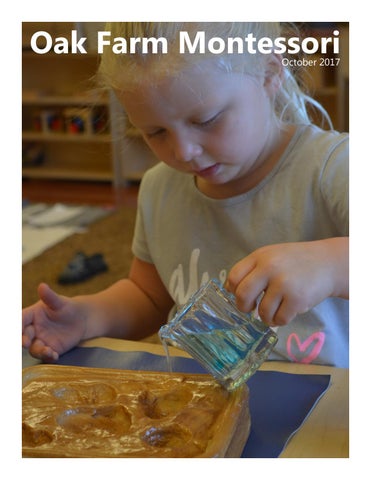
Oak Farm Montessori October 2017
E
Tia Matney, Primary Teacher
Why a Multi-aged Classroom?
ducation is a natural process carried out by the child and is not acquired by listening to words, but by experiences in the environment. ~ Maria Montessori One of the hallmarks of the Primary Montessori method is that children are in a classroom with a variety of students ranging from3-6 years of age. The age groupings are based on the developmental planes for the students. The developmental plane for the Primary classroom is called Infancy. This is the plane of fundamental importance for the formation of the individual. Because the work is individual, children are able to progress at their own pace, and there is cooperation rather than competition between the ages. They learn from each other by observing and interacting; it gives the older students a leadership role and gives the younger children a feeling of trust and respect for their peers. Multi-aged classrooms also give children time to build long lasting relationships that last for multiple years and also help the children develop a sense of community while also supporting social development.
A Family Affair Kim Davidson, Fund Development
This year we will have a new feature article in which we will spotlight an Oak Farm family that gives their time, talent and treasure to the school. Support of the school comes in many different sizes and shapes—just like our families! It does not take long to see why this month’s article title “A Family Affair” is so fitting for our October Family Spotlight. The Wolheter Family is “all in” when it comes to supporting Oak Farm and the education of their three children and grandchildren. Second and third generation farmers, they are from the Kendallville area and have long had a tradition of being engaged in the community by supporting friends, church and service organizations. Neal and Lydia first visited Oak Farm five years ago and were immediately drawn in by the teaching style. Lydia shared, “allowing children to play outside and learn outside is so important to us. I love the family atmosphere—my kids’ teachers know them and love them.” Lydia and Neal have three Neal, Lydia, Reese, Breanna & Parker children; Reese (9) and Breanna (7) are both in Lower Elementary and Parker (4) is in Primary. Lydia (Mom) began volunteering at the school about 3 years ago when she was asked to be part of the Gala committee. Since that time she has continued on the committee; overseeing the solicitation of items for the silent and live auctions. She has also been involved by volunteering in her children’s classrooms and supporting the children’s work on the Gala classroom projects. Julia (Grandma) is always ready and willing to lend her expertise in quilting for the projects, helping with the infant-toddler project last year and plans to contribute her talents again this year (but we won’t tell you which project!). When answering the question, “Why volunteer at Oak Farm”? Julia’s answer was quite simple, “My grandchildren are thriving and R.D. & Julie Wolheter learning at Oak Farm. We feel education is important to a person’s success and will support our grandchildren in their endeavors.” R.D, Julia, Neal and Lydia are regular guests at the Gala. When explaining why they enjoy that evening so much, Lydia shares, “I really enjoy the gala because it is a great time of celebration. I love the feeling created by the event; truly showcasing all that is great at Oak Farm. “ When not busy on the farm, volunteering at school or in the community, the Wolheter’s enjoy time outside; camping, ATVing or enjoying nature. Both generations enjoy spending time with extended family eating, hanging out and playing card games together.
Inspirational Arts Tricia Marshall, Music Specialist
Last month, ten Oak Farm students participated in a workshop presented by The Young Americans College of the Performing Arts in California for the YA Live tour. The students took part in singing, dancing, and acting workshops taught by over 40 young adults over the 2 ½ days and then gave two performances at the Central Noble Auditorium. Oak Farm freshman, Claire Weiss said, “It was an amazing experience that taught me how to incorporate myself into my dancing, and that even if I am not a soloist, I can sing my heart out.” Bringing the workshop to Noble County was a combined effort by West Noble, Central Noble, and Oak Farm fine arts teachers & directors. For much of the show, all 207 students were performing on stage together. Many of our students were handpicked to be featured during these performances for their various talents and abilities. When asked “What did it mean to you?” Charlie McNaughton replied, “It helped me learn how to dance in public. It made me comfortable. It was also fun to get to be with people that were from different schools and all around the world.” Oak Farm graduate, Erin Cole, was integral to bringing this event to her hometown. Her enthusiasm and work ethic was contagious. Afterwards, she said, “This crazy dream of mine that I had to bring this group to Albion and expose my community to the work that I’ve been doing has finally come true and I am still awestruck!” Her official title is Tour Manager, which meant she was making all the plans with the hosting school, securing homestays for the cast, as well as performing. As a teacher of the arts, I was thrilled over and over again as I watched our students grow and learn from many instructors through a variety of lessons at this workshop. When I asked Ruby Zolman about her experience, she said, “I learned just be yourself and anything you do is inspiring. Anyone can do anything.”
. bella A a s I & A. ., Isaac g new skills M e i l in Char d learn enjoye
HS students, Emma C. & Claire W.
Teaching Tomorrow’s Leaders Today Macy McNaughton, Upper Teacher
Rubric: a set of instructions, a guide, a heading, and an established rule or tradition. Portrait of a Graduate: what an Oak Farm student should look like upon leaving Oak Farm. Several years ago, a small group of faculty members came together with Lorene, our school’s Founder, to define what an Oak Farm student’s character would “look” like upon them leaving the school. This document was called “Portrait of an Oak Farm Graduate.” This information was used to guide the expectations for all Faculty members as well in a document titled “Portrait of an Oak Farm Faculty Member.” The idea is to have guidelines that allow parents and students to know what the faculty members strive for while instructing the students. After this document was made, the various levels began to adapt the information and formed rubrics to help the students self-assess themselves. This month the Upper Elementary students reviewed the process of understanding what a rubric is and then transferred that information to the Portrait of a Graduate rubric that we have. These rubrics are then discussed during parent/teacher conferences and during student-teacher conferences for the students to set goals for themselves for the school year. In Upper Three the students were reminded that this rubric is looked at as a set of instructions from Lorene. She may not be with us physically, but her vision and expectation for the school is alive and well within every student and faculty member on campus everyday. Our school is a beautiful place - the buildings, the grounds, the classroom environments, and the work that happens here. We look at the Portrait of the Graduate, and the follow-up work that goes along with it, as a tool to help ensure that the beauty of Oak Farm continues off campus. When a student graduates from Oak Farm we strive for them to value: LIFE LONG LEARNING CITIZENSHIP LEADERSHIP VALORIZATION / EMOTIONAL LITERACY The graduates of Oak Farm will continue to carry the beauty of Oak Farm to all corners, valleys, and mountains of the world - making the world a better place for all around them.
Pies + Pork = Profitability Fall Festival Micro Economy Sales, MS Students Adolescents are seeking a connection to the adult world. Our teenagers want to take responsibility in their community and Oak Farm will give them that place. Somewhere they can belong and for which they are responsible, a place to safely express themselves, to try (and possibly fail) and learn and try again, opportunities to use all of their intellectual capabilities for the good of themselves and the good of their larger community. The MS Sales at Fall Festival are just one example of this work at Oak Farm for teenagers.
Oak Farm Middle School Believes Micro Economy Sale Opportunities are... 1. They are real. 2. They are meaningful to the students and community. 3. They satisfy the need of teenagers to participate in the adult world. 4. They are rich in possibility. 5. They support economic independence. 6. They encourage feedback. 7. They are rigorous. Teamwork on pulling over 40 lbs of pork: “Pulling pork was great because you do not normally get to do something like that. I got to learn how the pork was made.”- Polly F. “I helped pull pork and that helped raise money for snacks and other school activities.-Aidan H. “I enjoyed helping to pull pork with my friends and it benefited the community by making money for the middle school”-Alex T. Learning the art of cooking for a crowd: “The challenge was to bring the scones and pie recipes to life. We did really well and all worked together to bake 10 dutch apple pies, 10 pumpkin pies and a lot of scones.”- Juliana B. Preparing the environment to sell: “I helped set up the MS Sales tables and I know from working last year how important it is to help out the students working the sales tables.”- Cayragan C. The art of sales: “I helped sell food at the food stands and it was really challenging to sell the things we needed to sell like eggs and pork. We had success in our pie sales because a lot of people like pie” -Rachael S.
“People like to see and smell our products. I think that really helped us to sell out of our pies and pork!” -Sophia M. “Pork and egg sales needed more advertisement and we will correct that in the future. ” - Cassidy C. “It was fun to work at the pork stand and sell food; it was also cool to see and talk to parents and friends that you dont get to see that often.”~Birk H.
W
e have grown up in a punitive society based on punishment and rewards. If that model worked, we wouldn’t have overcrowded prisons and entitled kids. Therefore, if we want to change behavior, you must first change a child’s belief. This starts with seeing a mistake as an opportunity to learn. -Dina Emser, MA, CPDLT
Positive Discipline Abby Roughia, Lower2 Teacher
Positive Discipline? Many believe that “discipline” shouldn’t be comfortable in order to cause change. An Adlerian Psychology based theory, Positive Discipline, is actually based on maintaining dignity and respect through firmness and kindness at the same time. A few key components to keep in mind while disciplining: 1. Connect before you Correct. When a child feels safe, they are much more open to learning what you would like to teach them because the brain is more receptive. 2. EnCOURage. Cour-means heart. The child’s heart and your heart connect when you are able to let go of some control and begin to support their thinking. 3. Get Into the Child’s World. Psychologist and Montessori student, Alfred Adler, said, “We each look at the world, including a child, differently. Wouldn’t it be great if you could put on your child’s glasses to see the world through the eyes of the child?” 4. Empowerment & Contributions. Allow children to be part of the decision making process. Contributing feels more optimistic and creates happiness for the child. 5. Consistency. Children like predictability, it brings them comfort and a feeling of safety. They quickly begin to learn that X is going to happen EVERY TIME. 6. Choices. Choices = Peace. Provide (2) choices, you the adult, can live with and let the child choose which they would prefer. Examples for different aged children include: Primary: “We are crossing the street. Would you like to hold my right hand or my left hand?” Lower: “Today at playtime would you rather wear a jacket or a sweatshirt?” Upper: You earned money for helping the neighbor. Would you like to donate part of that to the Animal Shelter or Hurricane relief?” 7. Consequences. When we aren’t willing to allow a child to experience natural consequences, we rob them of the learning they could gain from the moment or experience. Sometimes, you just have to stand back and observe. This can often be the hardest to do as the adult, but the most impactful for the child. To find out more about Positive Discipline, consider reading Jane Nelson & Lynn Lott’s best-selling book entitled, “Positive Discipline” or consider signing up for our six-week in depth course offered this spring! The 9 Temperaments children can be born with 1. Activity Level- this child is always moving 2. Rhythmicity-this child has a natural rhythm -predictability of physical functions 3. Adaptability- this child easily adapts to change 4. Sensory Threshold- this child may hate tags or certain socks 5. Quality of Mood- children are born either optimistic or pessimistic 6. Initial Response- this child screams when they hear a clap of thunder 7. Intensity of Reaction- this child is not easily distracted 8. Distractibility- this child is easily distracted 9. Persistence- this child seems relentless
STUDENT PROPOSALS As the trailblazers of Oak Farm High School, it is our responsibility to build the high school that will be our (second) home for the next four years of our adolescence. Part of this responsibility is to build the InnoLab that will fuel our minds. We have recently participated in a business/InnoLab activity that helped us do just that. We had to discover and propose InnoLab machines that we believe will be beneficial for our learning. We proposed machines such as; vinyl cutters, vacuum formers, 3D printers, airbrushes, a milling machine, digital paper, and large format printers. This project got us thinking about not only what we wanted, but also price and efficiency. Don’t get me wrong- this project was not just for fun (although it was fun), we will actually be adding these machines and tools to our InnoLab and using them to help us solve real world problems. Building an environment where we can grow into creative young adults is so important, so letting us make the choices that will affect future Oak Farm High Schoolers was very rewarding. ~Claire W. INTEGRATED INTO ACADEMICS The InnoLab has been very useful in its connection with our academic classes. We have created many individual projects for English, science, and humanities using the 3D printer, 3D pens, and various other materials. For example, Abby and Callie worked together to create a paper mache’ model of an allergic reaction on a cellular level! ~Emma C.
High School Students
THE BIG IDEA- InnoLa The HS InnoLab is a place lem solve, imagine ideas t and be creative. We all wor ually; exploring hands-on “InnoLab is an amazing p blossom!” ~Callie S.
T-SHIRTS This year, the high school make our own class t-shir what we are; “the trailblaze happen are endless now w a potential vinyl cutter, in people in the Oak Farm c us with this. We are also th for our bike shop (a logo also be a great experience terials. The opportunities the materials in the InnoL we can do. ~Violet L.
share their perspective...
ab e where we can learn to probthat can influence the future, rk collaboratively and individn projects in any way we can. place to let your creative ideas
decided that it would be fun to rts, with our school name and ers.� The abilities to make this with our screen print materials, nks, and so much more! A few community have been helping hinking of making shirts or hats o is in the process), which will for us to work with these mas are endless now that we have Lab to set us up to do the best
LASER CUTTER The laser cutter is an important asset to the Innolab and the high school students. The opportunities and materials you can use to put in the laser cutter are nearly endless. We can do etching in glass, denim, wood, some plastics, and cardboard! Not only does it etch, but it even can use pinpoint accuracy to burn cleanly through material. This is no laser pointer! An average laser pointer has an output of 5mW (Milliwatts). The average laser cutter has an output of about 30-120 watts. That’s 6,00024,000 times the output of a normal laser! We are so thankful to be able to have this in our maker-space, and look forward to using it for projects in the future! ~Gavin B. THE FIRST PROBLEM SOLVING CHALLENGE
To put our creativity and problem solving skills to practice, the Class of 2021 was faced with the challenge of creating a way to successfully transport six duck eggs down a ramp using a box of random materials like bottle caps, paper towel rolls, and plastic bowls all from the InnoLab. We were also given a choice of three tools to use to make our projects. We put trial and error to the test in the design process and learned about how we can design more successfully in the future. We certainly had fun while exercising our imaginative brains in this group project. ~Mariah C. TINKERCAD & THE 3-D PRINTER The 3-D printer is a very fun and useful tool to use. It can be used in different academic areas of school, such examples include: InnoLab, English 9, and science. It is also a way to express our creativity in ways that could be useful in classes such as business. As an example, we could make a useable wrench for our bikes that we are fixing as an option just in case we were somehow to lose one. On this- we can put the size and who the wrench belongs to. It is a very useful option! ~Dominic C.
“When we are capable of stopping, we begin to see.” ~ Thich Nhat Hahn
Discovering me. . .
Lori Zacharias, Discovering Me Teacher
W
hat is the hardest thing we hope we ever get to do? Hopefully you’d say, “Parenting!” In the Discovering Me program, we learn effective approaches to raising children. Some of these techniques include: becoming familiar with the Montessori philosophy, Oak Farm’s Portrait of the graduate and utilizing Jane Nelson & Lynn Lott’s “Positive Discipline” book while also using practical skills from our own personal toolboxes. We believe in learning the art of observation first; it is a skill. To be the best at something (and we do want to be the best parents we can be, right?), we must improve on our skills. Thich Nhat Hahn says, “When we are capable of stopping, we begin to see.” The first half of each session, parents observe their infants and toddlers as they explore the environment. The second half is reserved for open discussion and a community time with songs. Students benefit from the Discovering Me program by gaining emotional development as they are in a new environment; assisting friends and learning respectful boundaries; learning coordination, cooperation, independence and order; and how to socialize respectfully with their peers. Parents benefit by learning better ways to help their child develop intrinsic motivation, independence and responsibility for appropriate stages of development while developing the skill of observation which creates knowledge of knowing when to step in and when to allow the child to do it himself. Parents also meet other parents of similar aged children; allowing for the formation of natural networks that build a foundation for this big work we call parenting. This opportunity, for many, is just as important as the tools they learn during our 90 minute class.
Other topics of discussion in our program beyond Montessori philosophy, observation and Positive Discipline include: • • • • •
Intrinsic Motivation Nutrition Toilet Learning Healthy Relationships Sleep
• • • •
The Importance of the Outdoors Social and Emotional Development Language Development Balance and parenting “juggles”