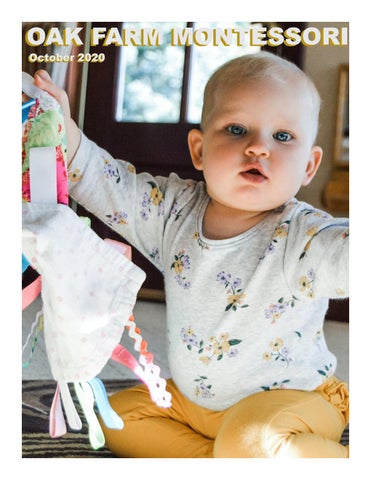
OAK FARM FARM MONTESSORI MONTESSORI OAK October 2020 2020 October
! k c a B e m o Welc
To kick off this 20-21 newsletter, I wanted to begin by thanking each and every one of you for your support in providing the best possible start of the school year during this unprecedented time in our lives. While things look different, temporarily, there is so much that still continues to stand the test of time, even in the middle of a pandemic. The joy of the children is still here. The love for the children is still here. The independence, leadership, and citizenship among our students is still here. The prepared Montessori environment is still here. Our school commitment to our vision, values, and mission is still here as well and provides the foundation for all of our work. The focus for this year’s newsletter will be on the eight principles of Montessori, as shared by Dr. Angeline Lillard from Montessori: The Science Behind the Genius. Dr. Lillard identified 8 principles in her book that can be observed in any Montessori environment. Our newsletter will share how Oak Farm Montessori embeds these eight principles; beginning in our infant environment all the way through our high school environment, even as we face the challenges that the pandemic presents to us. The eight principles include the following: 1. Movement and cognition 2. Children and young adults are given opportunities to choose 3. Interest 4. Avoiding extrinsic rewards 5. Learning from and with peers 6. Learning in context 7. Teacher ways and child ways 8. Order in environment and mind This month’s newsletter highlights movement and cognition, demonstrating that both are closely entwined. Movement can enhance thinking and learning! This is evident in the prepared environment in the Victorian House PE room where you observe children engaging in movement that is specifically designed to improve neurological function so that the areas of the brain are more strongly connected and accessible for any given task. This is also evident in the materials. Think about the iconic pink tower for example. When a child engages in this work, he must carry each block, one by one. As he does so, he is able to feel the size differences of each block. His brain starts to make comparisons. With the use of his senses and movement, the learning becomes cemented. This is also evident in the work our young adults do each morning as they start their day in the barn caring for the animals. Not only does this provide an opportunity for adolescents to feel accepted by their peers, learn to work together, and establish independence from their families, but they are preparing their brains for learning at the same time. Movement makes learning “sticky” for children and young adults. Enjoy learning how movement and cognition are utilized across the levels in this month’s newsletter and please note that many of the photos utilized were taken prior to the guidelines currently in place for Covid.
2
Candice
First steps lead to independence
Jeni Ekovich, Infant Teacher
For any Montessori teacher, providing a prepared environment is important work. Anyone who works with infants and toddlers quickly learns that they have a big need for movement and do not want to be still for very long - they do not want to miss out on any of the new experiences around them! The world is so exciting, we can’t blame them! Our prepared environment must be a space that provides free movement to explore in order to fulfill that inherent need within the child. Movement is a staple in the curriculum of an Infant/ Nido classroom. Some of the most important work an infant does is to learn how to sit up, crawl, stand, and eventually walk. In the classroom you will see specific areas to encourage and enable these developmental milestones. We have a pull-up bar, walking bridge, stairs, tunnels, ramps and more to provide appropriate gross motor challenges. Our goal is to foster independence. Even our shelf work involves gross and fine motor movements (a ball track, stacking, opening and closing containers, etc). Dr. Maria Montessori said it best, “What the hand does, the mind remembers.”
“What the hand does, the mind remembers.” ~Maria Montessori
You will see a continuation of this work in the Toddler classrooms. Movement continues to be a large piece of the curriculum. It is so special to see a line of toddlers walking into the woods ready to explore. The Toddler 2 classroom, for example, is learning the names of trees as they walk and explore them in real life, not just in pictures. Moving the body and having experiences first hand can never be replaced by seeing them in a book or just talking about them. The work we do in the Infant and Toddler Classrooms reflects this knowledge and it is exciting to witness every day in our active young community. #supportourschool
4
On the move...
Elizabeth Green, Primary 3 Teacher
Children love to move and it may seem that some children never stop moving! Maria Montessori noted this need for movement as she observed children and worked to develop the Montessori Method. But why is movement so important and how does it relate to learning and cognition? Montessori found that it actually begins with educating our senses. She stated we must first “educate the senses, and only then, the intellect”. The Sensorial materials in a Primary environment are specifically designed to isolate and refine many of the child’s senses. A wellintegrated sensory system leads to more coordinated movement which ultimately results in higher cognitive abilities. For example, by discriminating the slight differences in the sound cylinders (a Sensorial material) it trains the ear to listen for the sounds at the beginning or end of a word. The development of writing and reading begins (in part) with this much earlier Sensorial work of the child. Maria Montessori recognized the importance of movement in a child’s development. In a Primary environment, one might see children moving throughout the space carrying trays with their work, navigating around a friend’s work rug on the floor, pouring water to do cloth washing or walking on the line. Outdoors, children can be seen running down a hill, balancing on a fallen tree, hanging from a large branch and raking leaves into a pile. Movement is critical to their overall development. As Montessorians we believe in educating the whole child. Through careful observation, we can better determine any individual needs our students may have. One student might need to carry something heavy or pound nails into a stump to regulate his system so he can then concentrate on a work that he’s been wanting to practice. Another might need to do push-ups, while still another might need to begin his day by listening to an audio book. Each student has unique needs that must be met in order to develop fully. Maria Montessori wrote about the connection between mind and body, and she developed a method that supports the integration of the whole child. Children on the move are children doing purposeful work.
#supportourschool
6
Connecting I Mind and Body Tiffany Fennig, LE3 Teacher
Warrior 2
Cobblers Pose
n the Elementary Classroom, we observe movement in our students all day long. Students choose works from different areas of the classroom, care for the environment, explore the outdoors, attend lessons and so much more. Dr. Montessori said, “The hands are the instruments of man’s intelligence.” The children at this level demonstrate knowledge through movement with their hands and connecting to the world around them. Being a part of the Montessori classroom, students build executive functions along with concentration and focus. Not only do the children receive the opportunity to move throughout the day, but in many of the classrooms, students have the opportunity to learn yoga. In our classroom, children have the freedom to choose this movement activity each day throughout their work cycle. Yoga develops foundational skills and complements the Montessori materials. Just as Dr. Montessori observed and wrote thousands of words about how movement is connected to learning, many neuropsychologists, psychologists, and other researchers are studying the connection between yoga and cognition as well. From the beginning, Dr. Montessori focused on developing the WHOLE CHILD, not just academic progress in the child. She discovered 100 years ago what many researchers concur today; that there is a connection between the mind and body. Practicing yoga can also help students develop problem solving and reasoning skills; along with improving overall wellbeing (AKA: the whole child). Children who practice yoga have fewer behavioral problems, reduced stress, rumination, and intrusive thoughts. The practice also helps to build self-esteem within the child. Montessori researcher Angeline Lillard states that, “The body is an active entity that moves in the service of the mind; cognition is born from manual movement.” When a student does yoga and uses their breath to connect to the movement of their whole body, they are continuing to strengthen their cognition and executive functions. In today’s world it is more important than ever to prepare our children with the skills and desire to build self-resilience. When teaching children yoga and mindful relaxation skills, the response from the students is that they feel more relaxed and even energized. Yoga builds more than just relaxation and stability, it can energize and motivate those who practice it. My goal as an educator and working with young minds is to help guide these children to become the person that they are intended to become. I believe that teaching students yoga and mindfulness practices will help guide them in this development. B.K.S. Iyengar said it perfectly when he stated, “Yoga is the light; which once lit will never dim. The better your practice, the brighter your flame.” Let’s continue to light the flame in our children. #supportourschool
Kim Davidson, Director of Strategic Partnerships
Making music matters 8
At Oak Farm Montessori School, the related arts have been an integral part of the curriculum from the beginning. As we look at the tie between movement and cognition, music is a relatable place to start. We may not all be musicians, but that doesn’t mean music hasn’t played an important role in our lives. Whether it is a favorite song that reminds you of high school, a special family holiday or that song that you find yourself tapping your toes to every time it is played, music is at the heart of many events in our lives. For years, research has cited many studies that promote music for young children. In the Montessori curriculum music is not only integrated into the individual classrooms, but is also given as a choice during the work cycle. Toddler and Primary students can often be heard singing the blessing before a meal, the clean-up song before recess or listening to peaceful music as they complete their work. Our youngest students are immersed in melody throughout their day. As students progress through elementary and into the secondary program, music is integrated into cultural learning through folk dancing and other American traditions; as well as, those from around the world. OFMS Music teacher, Sara Pulse, shares the intentionality and learning that takes place behind the harmonious sounds of music. Students experience music in her music class in a variety of ways. They must first learn to hear and feel the beat in their bodies. Sara uses several techniques to help students learn to feel connected to the music: hand claps on legs, crossing hands over the midline of the body, using scarves, instruments and something called Move-it’s, part of a music curriculum founded by Dr. John Feierabend. These are just a few of the different activities children will do as they follow Sara in class. The movements, while they may seem like just moving around with pretty scarves, are actually very intentional and purposeful.
Students may begin learning about music through movement; however, their learning will evolve to where they are able to anticipate the music beats and rhythms on their own. By being able to anticipate the beat and move to it, such as with the scarf dance, students are also learning to work with others through spatial awareness. Sara shared that students who can feel the beat and keep a beat are better at organizing thought patterns and tend to be better readers. There are also studies that show the success of high performing athletes to rhythmic movement. In studies completed by Phyllis Wiekart, (professor of kinesiology for 28 years at University of Michigan and inducted into the Michigan Amateur Sports Hall of Fame) she cites a strong connection between athletic success and an athletes ability to keep a steady beat. Through the generosity of our donors, combined with the commitment of our leadership, the related arts remain an important part of the daily curriculum. At OFMS, our students are able to benefit from multiple creative expression classes from infants through 12th grade. The related arts include: Spanish, P.E., Music, Theater and Art; as well as, speech and reading therapy. Students at the secondary level have additional creative expression classes that are available within their weekly curriculum and are more varied to include cooking, sewing, woodworking and pottery to name a few. While many schools have had to make significant cuts to their related arts programming, we are grateful for our communities continued funding of these important resources. #supportourschool
Making Connections Sandra Deacon, Upper Elementary Teacher
We all recognize the importance of movement in our daily lives…especially when it comes to the health of our children. It helps to improve physical health, as well as mental health. But how often do we think of movement being connected to the ability to concentrate, problem solve, and learn? Maria Montessori built it into her curriculum as she was developing it more than 100 years ago! Movement is an integral part to learning in so many ways. This can include the small motor movements it takes to add small details to a painting or the effort it takes to perfecting cursive handwriting, to large motor movements such as running, kicking, and balancing. Maria Montessori knew that movement was necessary for the child to make strong connections to what she/he was learning. She wrote in The Absorbent Mind, that “Till now, almost all educators have thought of movement and the muscular system as aids to respiration, or to circulation, or as a means for building up physical strength. But in our new conception the view is taken that movement has great importance in mental development itself, provided that the action which occurs is connected with the mental activity going on.” (Montessori, p. 142) She developed movement in almost every aspect of the Montessori student’s education. The work that is set up on the shelves is set up in order from left to right, and top to bottom…this is the same way we read and write. When a teacher sets up his or her work on the work rug for a lesson, it is set up left to right and top to bottom for the same reasons. After a lesson, you can often observe the student doing it the same way. Another way that meaningful movement is integrated into the child’s day is in the process that a child will go through to get her/his workspace ready. They will walk over to where the rugs are stored and set up a rug by carefully unrolling in a space that does not impede on others’ work. Then the child will go to the shelf to pick up the tray that has the work they need, which they carefully carry to their work rug. All of these movements help the student move consciously, being more aware of where they step, where others are around them, keeping the tray balanced, and then carefully lowering it down to the work rug. Most work shows the connection of movement to learning as well. When a student learns how to exchange from the hundreds place to the tens place for subtraction, they are literally removing a 100 tile and exchanging it for ten 10 tiles. This is a concrete movement that solidifies exactly what is happening when we borrow/exchange in a larger subtraction problem. Studies continue to show that Montessori’s theory was correct and the need for children to move around and explore their environment is far more conducive to learning than sitting quietly, and passively being taught. 10
A Foundation of fun Jon Agler, Middle School Teacher
Every year the Middle School looks forward to a Fall Trip early in the school year. It is a time of laughter, singing, team-building, high energy games and a lot of time outside. This is customarily a four night event at a youth camp, but due to Covid-19, this had to change significantly. We were not able to stay overnight, we were not able to leave the state to go to our youth camp of choice, and we were limited in our ability to do the same activities. Even with these needed changes, the Middle School community thought that we still needed to have a week that encouraged laughter and movement.
“One shared memorable experience can produce the medicine for a year’s worth of headaches.” - Unknown
Montessori makes a strong connection between adolescents and toddlers and their need for movement. The toddler is new to the world, exploring with all of their senses, moving and trying to find the boundaries for their environment. For the adolescent, their movement is all connected to their social structure. It’s hard to find a middle schooler doing anything by themselves. Walking?… with others. Running?… with others. Swinging?… with others. Climbing a tree?… with others. During this Fall Trip week, we had many experiences designed for movement. These shared experiences and moments allow them to find the boundaries of their emotional and social capacities. Helping them to find confidence in who they are and acceptance as a valued member of their community. Building a stable foundation for the community to grow the rest of the school year. #supportourschool
Bigger is better! Beginning Monday, you are going to see us in a BIG new way. We have two large billboards going up to advertise our amazing school and our upcoming High School open house. The first billboard will be located on Highway 3 North, near the intersection of Highway 6 in Kendallville. Our Fort Wayne billboard will be placed on I-69 North at the Washington Center overpass. We are excited to not only grow our secondary program through this advertising campaign, but to also bring awareness to our larger community of the world class Montessori education available at Oak Farm Montessori School. Be sure to share the open house opportunity with anyone you think might be interested in an education that inspires, encourages and fosters a feeling of value in it’s students. You can register for the event at this link. We will be hosting the open house in person while following socially distancing guidelines for parents, students and faculty.
12
Life Lessons
Wesley Kromer, High School Teacher
Think of a time, a long time ago, when human beings didn’t have a common language, or any language at all. How could they possibly learn anything? By moving, dancing, and repeating those movements to communicate. It is as natural for humans to move while we learn, just as it is for humans to learn while we move. Do you remember the first time you opened a bag of chips? The first time you used scissors to cut out a pretty picture? Or even the first time you unlocked a door with a key? Probably not. Why do you think these events are so easily forgotten? It’s possible that it’s merely because we were so young, but I would argue it’s because learning by moving creates powerful and permanent pathways in our brain; meaning, we don’t have to use as much brain power the next time. We can see this when we first learn to tie our shoes or when we learn to ride a bike. I’ll never forget when the movement of my body seemed to finally align with the bike and all was good in the world! These seemingly innate skills belong to a specific type of memory called procedural memory, or simply, the long-term memory involved with how to perform actions and skills. How did you (or will you) learn to drive a motor vehicle? First, you get into the car with your instructor. Then they talk for what seems like an eternity, giving you all the necessary instructions for operation of every do-dad and switch for everything from the steering wheel to the auto-eject-seat. After they finish, you seem to forget most of what they have said. So, now you’re ready to take a trip around the block on your own, right? Eh, not so quick. You have to go back to all the switches and knobs in the vehicle, try out each one; press the brake, slowly press the gas, steer around a corner. It takes physically doing the motion of each component to really learn a skill like driving. Here at the high school, students are constantly moving while they learn. Just the other day, students in physics were exploring the tension in a rope when forces are applied at different angles. I gave them a challenge to tow my car with only a heavy tow rope and a tree, no pushing allowed. How can it be done? Quite simply actually. All it takes is tying the tow rope taught between the car and a steady pole (here we used a tree). Then, with the car out of gear, push the rope to the side with all of your force and voila, the car begins to move towards the tree faster and easier than pushing it by hand could have done. How boring and forgetful would this experience have been if, instead, we were looking at drawings of ropes, cars and tension vectors? This challenge made for a fun physics class! The students got to go outside, move a large object, smarter not harder, all while learning about rope tension vectors at different angles when downward forces are applied to the rope. Maria Montessori summed it up succinctly when she said, “What the hand does, the mind remembers.” #supportourschool
14
Making connections to Language
lili morales & flor ortega, spanish teachers
Movement…children need to move just as they need to breathe. Movement does not always mean that they have to be running around with abandon, although some children need movements of this type, most movement is done with a purpose. Children are not created to sit still and listen to something for endless hours. They can sit in one place and explore something for a long time, but the exploration should include movement. For example, in our classes, a child could sit at a table to polish a piece of silver for half an hour. While sitting in one place for a period of time, they are strengthening their fine motor skills through applying polish, rubbing it in, and working to make that piece of metal shine. When they are satisfied with the results, they get up from their chair to clean the container that still has the polish residue, and then they dry the container. Finally, they go back to their chair, put everything back on the tray, and return it to the shelf; ready for the next person. As when learning a new language, such as Spanish, different age levels receive different lessons. Infants and toddlers sing, make rhythms with their hands and feet, dance and listen to short stories. At the primary level, during the color lessons, we ask the students to look around the classroom for a specific color or we ask them to collect objects and bring them to the work table. The child is moving around while thinking about the color they were asked to find. They might bring back a red pencil, a red ruler and a red cube or a red bead. The importance is not only learning new vocabulary, but allowing the child to move while learning to build muscle memory. Another example of displacement practice is when elementary school children learn a game or song in Spanish, and after memorizing the song, we go to play outside. The sequence of the game or song is carried out while implementing the gross motor movements involved. Thus, in addition to having the lesson solidified through repetition of vocabulary and movement, they are also learning about another culture! There is much similarity in popular games between different countries around the world. An example is “London Bridges falling down”, it is very similar with a popular Mexican game called “A la vibora de la mar”. In our Spanish lessons we present, we always try to integrate activities that involve everyday actions such as: cooking and eating a regional cooking recipe with ingredients in Spanish, or when they build a robot cockroach, or celebrate Day of the Dead by writing letters to their own deceased loved ones. The child builds her knowledge of a new language not only by learning vocabulary and pronunciation, but also through activities, experiences and movement. #supportourschool
Mark your Parent Education OF Connects High School
Event
calendars october 8, 2020
Movie Night
Open House
Parent Teacher Founders Day
october 16, 2020 October 22, 2020
Conferences
october 29, 2020 october 30, 2020
Event
november 10, 2020 TALL OAK FUND
SGO
VOLUNTEER
DAY OF GIVING
SUPPORT OUR SCHOOL
www.oakfarm.org