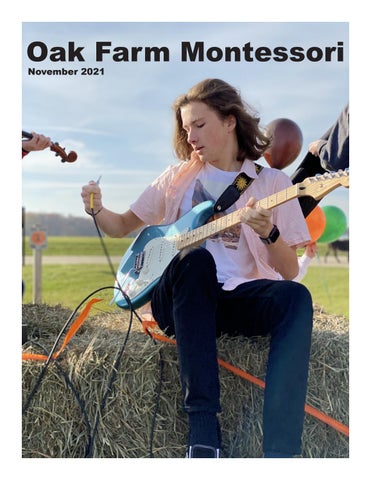
Oak Farm Montessori November 2021
Often, adults will look at the ‘work’ choices available to students in the Victorian House as mundane chores: table scrubbing, transfer work, hand washing, plant care or snack preparation. In reality, these fine and gross motor activities help the child to concentrate, develop confidence and create neural pathways to future intelligence. As the child grows, so do the opportunities for hands-on learning. In Elementary, students raise and lower the flags, care for the environment and get to go grocery shopping for snack preparation. Our middle school Erdkinder program gives ample opportunities for the adolescent student. Each morning and afternoon they feed and water animals, do farm chores during pull out and volunteer in various outreach programs. The culmination occurs at our high school where students go out into the community to serve, learn and mentor! Montessori said, “The hands are the instruments of man’s intelligence.” Enjoy this month’s issue that depicts the various ways our teachers and classrooms support this growth and development.
Candice 2
HEAD OF SCHOOL
Maria Montessori was a pioneer in many facets of her life; at age 13 she entered an all boys school for engineering, in 1896 became one of the first female physicians in Italy, she was an early feminist proponent, and also a leader in peace education. Through all of her research, experiences and studies, she gleaned factual data that she used in developing her Montessori methodology. Perhaps it was this work in engineering and the medical field that first prompted her to realize the correlation between the hand and the mind? While she does not give credit to one particular experience, she devotes an entire chapter in her book, The Absorbent Mind, to intelligence and the hand.
Building Blocks of Learning Jeni Ekovich, Infant Teacher
P
rocess over product is a mantra of sorts in the Infant and Toddler Montessori environments. At our level, the big work of the day is ‘care of self’: eating, toileting, napping and social skills. We have all day to do this work - what a relief that is, because it really is big work for a 0-3 year old! If you peek into our observation windows, you may see a toddler, for example, with their pants on backwards or even inside out. However, you will also see a toddler beaming with pride because they put their pants on all by themself! If our focus was just on the end product of a perfectly placed pair of pants, we would have missed the beauty and learning experience that took place. There is no better way to instill pride in a child than by letting them witness their own ability. This fosters confidence, as well as intrinsic motivation. If a child knows they can do something for themselves, they will likely try to do more things. Allowing a child to struggle through challenging work (in a prepared environment where they can be successful), helps them develop not only physical muscles, but also emotional “muscle”. This growth mindset fosters emotional intelligence which will suit them well all through their life. Unnecessary intervention by an adult robs a child of the opportunity to have this type of growth. Hands-on learning is really the core of Montessori education, but it goes far beyond the classroom manipulatives you picture in your mind when you think of Montessori. It takes place at all levels, in a wide variety of ways. It can be as simple as being offered the opportunity to feed yourself with a spoon as an Infant, dress yourself as a Toddler, or as complex as learning how to operate and manage a bike shop as an Adolescent. It’s all equally beautiful and significant, regardless of the age of the child. #supportourschool
What’s all the “buzz” about Hands-on Learning? Stacia Diggins, Primary 4 Teacher
Students in Primary 3 and Primary 4 had a wonderful opportunity for hands-on learning this month when we invited Oak Farm Montessori parent, Kelly Williamson, into our environment to provide a lesson about bees! Students learned vocabulary, the important role bees play in pollination, and techniques to extract the honey from the hive. From scraping the honeycomb off the wooden frame and separating all the honey through a strainer, Kelly demonstrated the steps of each process. Students were encouraged to use their hands to explore how the honeycomb felt and how really sticky the honey was on their fingers! They held the beehive and the wooden frame to see how heavy it was, smelled the sweet nectar as it dripped into the container, and some experienced the delicate work of scraping the honeycomb off the hive. This hands-on lesson provided our children with real world experience to see how bees produce honey and provide for us and our environment. In the Primary aged Montessori classroom, children are encouraged to move around the space and engage with the wide variety of materials that are available to them. The child chooses a material they have had a lesson on, takes it to a table or mat, and explores the material to create discoveries for themselves. Materials such as the red and blue rods in Math, and the brown stair in Sensorial, encourage the child to move. As he carries each individual piece from the shelf to the rug, in a different area of the classroom, they use their eyes and hands to see the difference in grading and count each section. Maria Montessori emphasized that the child’s hand is the true teacher of the child. The younger child is better able to express through their hands before they can articulate it in words. This methodology of hands-on learning creates a deep concentration within the child and allows their attention to be focused on an individual task. When a child uses their hands, they gain a concrete understanding of the materials and will develop many neural connections as they touch and explore. This foundation helps to later lead to more abstract learning. 4
Muscle Memory Meghan Dohring, LE3 Teacher
When you think of your favorite hobby, does it involve using your hands? Do you enjoy woodworking, painting, coloring, or gardening? What joy you can receive by exploring the world with your hands. When learning something new, do you find it easier to do this new task when you read the directions? We learn so much more by exploring and trying new things with our hands. Understanding and manipulating numbers can be explored in this way as well. Students are encouraged to feel and compare the golden beads; how does the unit, ten bar or thousand cube compare? The weight difference alone speaks volumes to a child. When learning to add and subtract large quantities, they can feel the weight changing or being distributed as they calculate the sum or difference. Even the bead bars, from 1-10, have a visual and weight difference. One of the comments I hear most when we have a guest teacher or a visitor who has watched a student work through a huge math equation is, “Wow, I wish I had learned this way.” Students are able to see and master what base 10 really means. They are taught, with every math material exposure, to see how numbers are exchanged between place values; rather than just being taught the route memorization of facts. With manipulation of the materials, they have access to the reasoning behind the mathematical equations. Maria Montessori spent many years exploring and testing out materials. Her goal was to find the best ways for a child to relate to their environment, provide tools that were self correcting (didactic) and make them attractive and engaging to the child. More than a hundred years later, this method still proves to be innovative and extraordinary to children and adults alike. #supportourschool
“Tell me and I forget, teach me and I may remember, involve me and I learn”
Tactile Teaching S a n d r a D e a c o n , U p p e r E l e m e n ta r y 1 Te a c h e r
6
~Benjamin Franklin
PREPARING THE ENVIRONMENT When you walk into a Montessori classroom, there are a few things someone might notice; many examples of living things, a lot of open floor space, materials on rugs spread around the floor, and the beautiful materials that are on the shelves around the room. Montessori materials teach abstract ideas and concepts using concrete materials. SHAPING LANGUAGE In Grammar, we have the Noun Family. This consists of a large black triangle for the noun, a medium sized blue triangle for the adjective, and a small light blue triangle for the article...and then their cousin the pronoun, represented by a tall purple triangle. This representation allows students to see that all of these parts of speech are related to each other; as well as, make them more memorable through symbolism and stories. MANIPULATION OF MATERIALS Mathematics materials are always a point of particular interest to children and adults alike. Many of us can relate to the struggles of understanding various math concepts...double digit multiplication, long division, multiplying decimals, and the dreaded fractions! The Montessori math materials concretely demonstrate not only how the process works, but also shows why the process works. All of the algorithms we learned as students, such as moving the decimal the same number of zeros to the right when we multiply by 10, 100, or 1,000 should not be taught in a Montessori classroom. The students discover those patterns for themselves more often than not. We call that an “aha” moment; when a student solves a difficult problem, makes a connection from previous work, or sees a pattern and understands the “why” of what they are doing. NO SUCH THING AS FAILURE The goal behind teaching students to engage in the process first, and then to focus on the product, is to engage their problem solving skills and their critical thinking skills. These are honed through failure, struggle, and then that great “aha” moment when all the parts of the puzzle fall into place before their very eyes. HANDS-ON, NOT HOMEWORK We are often asked why students don’t bring work home. Where is their completed work? Homework? Worksheets? Students usually keep notebooks on different subjects which stay at school. They keep examples in these notebooks; notes from lessons, and most of their work. They also create projects, do research, have in depth discussions, and engage in “games” that help them learn. #supportourschool
For most of us, the Montessori education our children are experiencing is very different from our own. As students and, for many, as adults, we have been trained to complete a work and then expect to see an immediate result. It is not hard then to understand why a Montessori education may not seem to have tangible results or outcomes. The transformation each child experiences, as they grow and transition through the developmental planes, can be eye opening and exciting. The scaffolding of curriculum, the opportunity to be a follower and then leader within a plane, and the increased freedom to ‘fail forward’ that students experience as they move into the secondary
8
program are all important components of the process. While seemingly small steps, they are the product of meaningful work and development of a love of learning that the children and young adults are instilled with on our campus.
note taking skills, learn about different animal life, their habits and how the changing weather of each season impacts their habitats. While gathering scientific information about weather, animals and habitats, these students are also building skills that will When a child is working be important as an adult. with the pink tower, they are developing fine motor So, where does the process skills and coordination as come to fruition? Where do the tower requires a steady we see the end product? hand to build. Students are At Oak Farm Montessori also learning concretely School, the culmination of about ratios, similar figures, the school’s role is at high square root and spatial school graduation. Whether patterns. All of these pursuing the workforce, skills prepare the student vocational training or college for abstract mathematical bound, being prepared to concepts they will learn transition to the next step is as secondary students. really the outcome of their Students sitting quietly in Montessori education. This the woods during a class is where students are able develop observation and to put all of the skills gained
The Final Frontier KIM DAVIDSON, STRATEGIC PARTNERSHIP DIRECTOR
throughout their time at Not all freshmen are given these opportunities, so my OFMS into play. appreciation for my worldly A couple of our 2021 learning experiences graduates shared their are unbounded.” Violet experience as they Landrum, a 2021 graduate transitioned. of OFMHS, shares about “Right now I am finding the success as a freshman Indiana University, myself immersed in exactly at the kind of work I want to be Bloomington. performing. Only OFMHS On a recent visit to our could have encouraged me campus, 2021 OFMHS to look further and say, ‘yes’ graduate Gavin Burtch to every open opportunity. I echoed similar feelings often find myself pulling from about being prepared and experiences in unique fields ready with the skills and (who knew eco-literacy confidence needed to would come in handy!) participate in the honors and feeling comfortable college program at IUPUI. working as an equal with With a major in Biomedical adult peers. As I write this, Engineering and PreI’m about to conduct my Med, confidence, time own study that a team and management and the I have been working on all ability to self-manage new semester (which is both very independence have all scary and exhilarating!).
contributed to the success he is experiencing. “Oak Farm’s curriculum helped prepare me for college. They laid a foundation with classwork and expectations similar to what I am experiencing in college, which made for a smooth and successful transition.”
“Right now I am finding myself immersed in exactly the kind of work I want to be performing. Only OFMHS could have encouraged me to look further and say, ‘yes’ to every open opportunity. Violet Landrum, 2021 OFMHS Graduate
#supportourschool
Grounded in reality Crystal Leu, Farm Manager
Agriculture education has always embraced a hands-on approach to learning with the FFA motto, “Learning to Do, Doing to Learn, Earning to Live, Living to Serve,” which is focused on preparing the student for life. Maria Montessori also believed that this approach to learning was essential, especially for our middle school students. She stressed the importance of the work of the hand as she recommended providing a learning environment where adolescents could use their hands and bodies to experience real world work, connect to the foundation of all civilizations and be in touch with the natural world. Montessori observed the role the hand plays in building intelligence, language, and social connection long before modern science noted this connection. Providing adolescents with the opportunity to spend time putting their hands to work on a farm provides the perfect learning environment to support their development on the journey to adulthood. While most students will not become farmers, working on a farm is about more than the products that are produced. It is about teamwork, critical thinking, problem solving, and working at adult tasks with the safety net of adult support. Adolescents find the work engaging and relevant as it tests their growing bodies and minds. The work at hand also provides a place to experience new social situations within the community as they work to solve real world problems and make adult decisions. Farm work provides rich
10
experiences and endless possibilities for young adults to connect with nature, understand their role in the community at large, and recognize their impact on the world. As students do to learn, they also gain experience in how their actions and decisions impact the farm and it’s sustainability. They are learning about the process of earning to live in a real world setting. A working farm community must focus on income, purpose and priorities in order to be efficient and productive. Students witness daily how their hands-on work helps provide for the community. Marketing their farm products is just one of the outcomes of their work. New skills and knowledge gained during the daily process of producing and marketing products on the farm are transferable to other experiences in their life, now, and in the future. Every day is filled with meaningful work for our middle school students. Whether tending to the needs of plants and animals during Erdkinder, building and repairing structures on farm pullout days, or marketing farm products; our young adults are engaged in real life tasks relevant to the work of adults in the agriculture industry. Using tools of the trade, from computers to pitchforks, they get the opportunity to experience a wide range of learning as they solve day to day challenges. Working on a farm is great preparation for life and the foundation for living to serve!
#supportourschool
Applied Science Katie Lautzenhiser, Science Teacher
Scientific inquiry employs an investigative approach to learning about the natural world; where students investigate a problem or incongruent event. Students make observations, pose questions, make predictions based on previous knowledge, test out their ideas and predictions, and evaluate their evidence to develop solutions or explanations for their questions. Beginning in upper elementary science labs, we rely heavily on scientific inquiry to learn about concepts in the subjects we are studying. Students keep science journals where they record their steps of the scientific method as they proceed through the process. Students learn and practice the process of science, including how to use scientific equipment, as they discover important concepts in science. Learning science in a hands-on manner is naturally motivating and fun as students work to satisfy their curiosity. One concept upper students discovered this year was about the sum of the volumes of two substances. Students previously discovered that the mass of all the pieces of an object equaled mass of the whole object. Since we had been working with mass and volume, this discovery led them to question whether the sum of partial volumes would also equal the whole volume. Students wrote their hypotheses and as a class decided on the materials and procedure we would need to test them. Students measured out 20 ml of water and added it to 20 ml of different substances. They recorded the resulting volume for each substance, performed as many trials as time would allow, and averaged their results. They shared their findings with the class and then used their evidence as support for or against their hypothesis. 12
“When you teach a child something, you take away forever his chance of discovering it for himself” –Jean Piaget
OFMHS Environmental Science students recently investigated the question of whether carbon dioxide warms faster than air. After posing this question, students used their previous knowledge to develop their hypotheses. Next, the class designed an experiment to test their question. They combined baking soda and vinegar in a jar to produce carbon dioxide and then sealed the jar. They poured the same amount of water as the liquid in the first jar into a second jar and sealed it with the classroom air inside. Both jars were placed in front of a heat lamp, and the temperatures of the jars were recorded with an infrared thermometer every 10 minutes until the end of class. Students were able to see for themselves that the carbon dioxide generally heated more than the air. However, some of the results were inconsistent; which led them to discuss unintended variables that occurred during the experiment, such as some inaccurate thermometer readings due to low battery and some uneven heating due to inadequate space for all jars to be the same distance from the heat lamp. They used these observations to plan improvements for when the experiment is repeated. Using hands-on teaching practices through scientific inquiry deepens the learning of science. Inquiry motivates children to follow their curiosity to discover and make meaning on their own. They gain more opportunities to apply their knowledge and discuss ideas. Also, it is an effective way to differentiate the materials for different learners. They practice research and experimentation; actually doing science instead of just hearing or reading about science. #supportourschool
Writers in the sand lisa bockelman, reading teacher
While hands-on learning may look different during one-on-one reading instruction than in the general classroom, it can incorporate many tactile activities to reinforce skills. I use the Orton-Gillingham Approach for reading intervention, which uses multisensory techniques to teach, review, and retain literacy skills. This method is designed for students whose reading, writing, and spelling don’t come naturally to them. Students use all the learning pathways during the lessons: saying, hearing, seeing, and writing. These are then all brought together by the ‘thinking’ brain. The tactile component of the approach consists of finger tapping, fist-pounding, and arm tapping. For example, students will tap sounds, pound syllables, and use arm tapping for words that don’t follow spelling patterns. They will also use tactile mediums to spell sounds or phrases, such as sand, plastic canvas, gel, or chalkboards. Reading work can also incorporate kinesthetic movement into lessons. For instance, students can tap sound cards with their feet to spell words, jump up for how many syllables are in words, air write letters with large arm movements or play hopscotch with sounds. The possibilities are truly endless! The more movement students have, the better they learn and retain information. Multisensory reading provides engaging lessons for students that result in greater ease and success in reading. This success helps students develop the skills that they will utilize for a lifetime. 14
Thanks to the generosity of students, parents, grandparents, faculty, board of directors, founding family and community members, we raised a total of $65,480.55 during our Day of Giving! #supportourschool
Mark your Half Day
Dismissal
Thanksgiving OF Connects
calendars November 23th, 2021
School Closed
November 24 - 26th, 2021
Movie Night
Middle School
December 4th, 2021
WinterFest
December 10th, 2021
TALL OAK FUND
SGO
VOLUNTEER
DAY OF GIVING
SUPPORT OUR SCHOOL
“To provide a Montessori environment that inspires children to reach their potential through meaningful work.”
Oak Farm Montessori School | 502 Lemper Road | Avilla, IN 46710 | 260.897.4270 | www.oakfarm.org