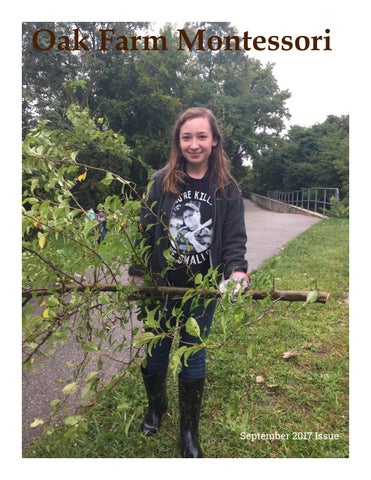
Oak Farm Montessori
September 2017 Issue
WHY “ECO-LITERACY”? MEGAN O’SULLIVAN, HEAD OF SCHOOL
S
ince Oak Farm’s founding, the development of ecoliteracy in each of our students has been one of our school’s primary objectives. But, what does this mean? And why do we do it?
At the heart of Montessori education is peace education. Montessori wrote out a course for all of us to develop a more peaceful, more respectful world. At the core of peace, she believed, was an understanding that there are common binds that connect all life, that connect humans with nature, and that connect people with one other. To see the common binds and to guard and nurture them is what leads us to understand that we work best in harmony with one another, and in harmony with nature. The curriculum weaves topics of history, of biology, of ecology, of physical science, and studies of peoples into a web of interdependency. When a butterfly flaps its wing, a hurricane can be born. We work to help students understand that each of their actions has an impact, not only on those in their classroom, but on their broader community, and on the natural environment. Educated, thoughtful actions, therefore, can lead to positive outcomes. For these reasons, we connect with our woods, wetlands, allow them to breathe in forlove with trees. We encourage so that they can soak in the pers, dragonflies, and other to research, classify and cataflora and fauna that live with invite them to study leaves, cate systems contained within
our children on a daily basis prairies, and gardens. We est air so that they can fall in them to play tag in the prairie sounds of crickets, grasshopprairie friends. We ask them log the hundreds of species of us on our hundred acres. We stems, flowers, and the intrithe bodies of animals.
We ask them to move food work with that compost to decomposition. They see how leads to rich soil; that they will edibles, and other plants in
waste to compost piles, and understand the process of the work of worms and insects then use to help grow flowers, our garden beds.
We help them to learn how to care for animals such as chickens, goats, alpaca, and bees. Those animals provide gifts of food, fiber, honey, and serve as a communicator of the health of the natural environment. Students are digging into caring for our natural campus. By removing invasive species, high schoolers are taking careful stock of the needs of our immediate land, and learning to shoulder the responsibility of care for one’s home. They are becoming stewards. Students will help us seed the new prairies, savannah, and wetlands being built on our new property so that we can present a variety of natural ecosystems for study and appreciation. They will build the rain gardens with us, and they will plant pollinators. We will welcome thousands of new plants and animals into their care. Eco-literacy activities and lessons take place each and every day both inside and outside the classroom. The point of all of this is not to create graduates who will all become ecologists or environmentalists. The point is to help peace grow within each of them by making them aware of the natural world, aware of interconnectedness, and to have an intrinsic sense of empathy and of the power of their choices, as well as their responsibility to take care of the natural world. We are working to make world changers, adults who will spread peace to the world beyond Oak Farm. By watching our students in action every day, we are confident that this is who they already are becoming.
T
he first aim of the prepared environment is, as far as it is possible, to render the growing child independent of the adult. —Maria Montessori, The Secret of Childhood, 1966
The Importance of a Prepared Environment Jeni Ekovich, I/T Teacher
A prepared environment is essential to building independence. In the Infant and Toddler classrooms this means furniture that is appropriately sized, work that is developmentally appropriate as well as self-correcting, and freedom to explore the environment. The prepared environment includes materials that meet the child’s needs, interests, and developmental level. Glass and any other breakable materials should be modeled by a parent; demonstrating how to carry materials with two hands (and use slow “walking” feet). Limit the amount of materials you provide for your child, this will allow the environment to be organized and peaceful. The environment should be welcoming and beautiful. Just as we prepare our spaces for the children, so we should prepare ourselves to foster independence and peace.
The Importance of Order Elizabeth Green, Primary Teacher
When asked by parents, “What can we do at home to help our child?” a Montessori teacher often responds with suggestions like: simplify the number of toys; find a shelf and choose just a few items to put on it for the child to use and then rotate new ones: create a space where the child can hang his tote bag and coat and place his shoes as soon as he returns home. These ideas all suggest an orderly environment for the child in the home. But why is order so critical for the young child? Maria Montessori defined order as a basic human tendency, a natural urge to satisfy our own needs. The human mind strives for it. Children need to see things in their correct places; this consistency provides a sense of comfort for them and they begin to rely on it. In fact, it is the physical order in our environments that leads to mental order for the child and ultimately lays the foundation for the mathematical mind. In a Montessori setting, the teachers take great care in setting up the environment. The work is displayed in a specific order on each shelf with the least difficult conceptually located at the top left (progressing left to right/ top to bottom) to the most difficult located on the bottom right. The child soon discovers this and learns to anticipate which lessons he will soon receive! In addition to the materials being displayed in an orderly fashion, one might also observe the care and attention to detail the teacher uses when laying out the materials during a lesson. Some children have been observed re-starting their work with a given material when they realize that they haven’t done it in exactly the same way that the teacher did! While this isn’t required by any means, it does speak to the child’s sense of order! There are countless other ways that we lay the foundation for order for a young child. When the child arrives in the morning, she knows to hang up her coat, put her shoes in her cubby and place her folder in the basket. There are specific procedures we show the child in how to serve himself snack or how to clean up after lunch. We offer a spot for the child to place his slippers before he leaves for PE. All of these are easy ways to provide order for the young child.
Sowing the Seeds of Knowledge Nancy Bradtmiller, UE2 Teacher
Oak Farm’s Upper Elementary classrooms offer a rich environment with interesting and purposeful activities that foster learning and curiosity in our students. Under their teachers’ guidance, students learn to make good choices which enhance motivation, learning, and well-being. With the help of reasoning and imagination, Upper students discov-
Upper students meet regularly with guides to learn how to manage their time and choose work effectively.
er more about the world in which they live and the life that occupies it. Reasoning helps Upper students comprehend the decisions and actions of others and imagination becomes a tool to picture the past and sparks interest. You’ll see the possibilities are endless as our students follow their interests and use the skills they are developing in lessons. Come check us out!
Students learned about static electricity during science lab and used a static generator, the Van de Graff machine. This generated interest in electricity leading to wiring a lightbulb to a battery and using trial and error to make it light up.
Bird identification has become a popular work choice. Students make note of flying patterns, diet, and nesting habits.
Middle School Fall Trip Reflection MS Students
Krazy Kroger!
On the bus ride we were given a budget of $5 each to come up with a strategic plan to make sure everyone got enough to eat. Another challenge we were given was to feed two teachers. When we arrived at the store, the two groups split up, and we started bargaining for prices! After we got our food, we loaded the bus and drove to Prophetstown State Park to eat our lunch. This was a fun, good experience because we learned how to manage our money. -Cora
Games and activities
After our campfire it was extremely dark and Eclipse and Dingo, our counselors for our trip, split us up into two groups and said “Okay, everybody! We are going to play Wolfpack!” It’s like a pitch-black Marco polo game where each team keeps moving and howling until one team turns on their flashlights and yells, Wolfpack! The puzzles were very difficult mental challenges and the camp had us participate in groups in order to solve them. Some of us were apprehensive at attempting the puzzles, but many of us took the lead in working to solve them. The rock wall and Zipline were on the lookout tower. At the top of the tower was a perfect view right across the lake. The Ziplines were up there too and on the side of the lookout tower were plastic rocks used for rock climbing.
Rockwall / zip lining
One of our many fun filled activities we enjoyed on our trip was the zipline and the rock wall. Although we all were nervous for the zipline and rock wall, our MS community and camp guides encouraged us. Many of us reached out of our comfort zone and created lifelong memories.
Our Meals at Camp Tecumseh
Our eating experiences at camp Tecumseh were different. Meals were eaten family style, which means we passed the dishes by hand to whoever wanted them. Our main goal was to have zero food waste every meal. We got close to our goal; just under half a pound each meal, almost no food waste!
Canoeing
We left Camp Tecumseh at approximately 8:30 am and were canoeing by 9:00 am. Our canoeing experience was frustrating because the water was so shallow. We went into our canoes and went down the river. At first it was okay then all of a sudden, BOOM, we hit a rock; we were stuck. I took off my shoes and my socks and went in and pushed the canoe off of the rocks. When we were canoeing, it felt like hours on the journey. I got soaked, I was freezing, my coat fell in the water, my hair was dripping, and my shoes were unwearable. Sofia and I were working together as a team and that was all it took to have a great experience. - Cassidy C. My experience, on the other hand, was quite un-delightful. Might I say, and to sum it up, SHALLOW WATER IS NOT FOR CANOEING. “Why”, you may ask? The situation led to getting stuck and having to get out of the canoe to walk it to safety, flipping over and hurting our hands on the rocks, and the fatal loss of an oar. Most importantly though, we one-hundred percent gained trust both in ourselves and each other through struggle and frustration. - Rachael S.
ns
Suspension Bridge
One night, under the cover of darkness, the camp guides decided to take us on a route that went over the lake, on a suspension bridge that is over 40 years old. During the daytime, the suspension bridge had a beautiful panoramic view of the sparkling green lake, but at night it was hard to see. I had never gone to the end of the bridge, and not many other people had either, so it was a little bit of a surprise when we realized we were already a fourth of the way across. At the start of the bridge, tall, cylindrical posts of rusting metal set up on either side would have given away the start of the bridge, but they were hidden at night by thick foliage. Each pole was connected by a big, long copper-colored wire, which served as the bridge supports. A little later, the class walked past the line of oak trees, I heard gasps of surprise, because we walked out onto wooden planks that looked incredibly rickety and chipped. The gasps did not come from that sight, instead they were from the bridge supports that turned into steel railings and open air. We were already over the lake, 50 or more feet in the air. The water looked black and menacing to me, but probably only harbored fish and seaweed, as well as other normal lake stuff. The planks dipped down ever so slightly as we walked across, but then it started shaking. The planks wobbled left and right, up and down and turned my legs to jelly. My knees wobbled. Then, before I knew it, the bridge stopped. We were on the concrete camp pathway again. Some people said “So cool!” or “Wow!” or “I think I’m going to throw up,” but I just stayed silent. What amazed me was how sturdy it was. Later, when we got back to our cabins and got ready for bed, I felt sad, because I knew I would miss the suspension bridge. -Joseph K.
The Survival Simulaion:
During fall trip we got to do something called survival simulation. The survival simulation is where you experience real life occasions that can be threatening. We had a couple of resources to build a shelter, find food, water, make a fire, and signal flags. Finding food and water was easy. The real challenge was building a fire because we got only a couple matches and the leaves wouldn’t catch on fire. We completed the fire at the end of our fifteen minutes and it felt amazing. Overall I think we all had an amazing time! - Rowan Z. In survival simulation, we all worked together as a team; altogether we had 50 lives. If didn’t complete a task, then we lost a life. We all split into groups such as food gatherers, water gatherers, fire makers, and shelter makers. We had to find five sources of food. Our five sources were acorns, walnuts, wild rose, (when I tried it some of my mouth went numb) pokeweed, and a mushroom. While the others were boiling the water, the rest of us struggled to build a shelter. This “sturdy” shelter consisted of a tarp and a bunch of logs. We lodged a branch in between two trees. We then threw the tarp over the branch lodged in between the trees. We still had an opening where the cold wind could come through, so we blocked it off with logs and brush. We worked together and we survived with 42 lives. -Alex T.
Cardboard boats
we
Something we weren’t expecting to do on the trip was building cardboard boats. We had 30 minutes to build a raft with cardboard boxes, trash bags, and duct tape. Once the 30 minutes ended, we decided who was going to get in the raft. When Trevor got in the raft it almost went underwater. Thank goodness we were in the shallow end of the lake. “You dragged me around the ground the whole race”, said Trevor. The important part is that we all had fun doing it. “We had a great time getting to know each other and playing games and building rafts” - Peyton S., 7th year.
Beginning with the End in Mind Michal Miller, LE Teacher
By the end of each school year, our hope is that our classroom community will work together harmoniously. The role of the students is to solve problems peacefully, work together collaboratively, and respect one another’s ideas and work. As teachers, our goal is to blend into the environment as the students lead the way. With this in mind, we start the beginning of the school year with the end in mind, “to have a strong community.” Therefore, we focus heavily on community building work right from the start! Some of the things that we have done to build our community this year are: • Students collaborate with each other to learn more about their classroom envi ronment, each other, and themselves. • Students partner up to problem solve in games, puzzles, and poetry writing. • Students make a plan about what the class should be like, how we should work together, and how we should care for one another and the environment. • Students turn chaos into order by sorting, classifying, and ordering materials and themselves to learn how we will all fit together as a cohesive community. We are excited about the year ahead of us as these students are already demonstrating the beginning skills that we will be looking to find by the end of the year.
HS Makes an Environmental Impact Claire Weiss, HS Student
As our outreach and environmental science work, the high school students are doing a variety of projects relating to invasive species on the Oak Farm campus and in our community. On our campus, we are working under the brilliant expertise of Brett Bloom, Eco Literacy Coordinator and Jon Brittenham, Restoration Ecologist with Blue Heron. We are slowly restoring our property to its former glory, but also clearing the way for buildings and roads as needed. We are researching and clearing the invasive species on our property to make way for beautiful native landscaping that will last a lifetime. Additionally, as our first environmental outreach project, the high schoolers took a trip to the Fort Wayne riverfront. We partnered with Dan Wire and Watershed Alliance; the beginning of an amazing collaboration. We learned that as a part of land restoration, the Fort Wayne community is cleaning up and restoring the river front environment. We also got to learn about the riverfront development project which will create a series of paths, buildings, and other attractions. We acted as land restorationists for the day. As a result, we cleared a significant portion of the river front of brush, trees, weeds, and other invasive species.
Here were some of our highlights… “My favorite part of the trip was seeing the end result, seeing the impact that we’ve made on our community forever was so rewarding.” -Claire W. “It was a great learning experience; we were giving back, and having fun all at the same time.” -Gavin B. “It was a great experience for all of us; I can’t believe how much we accomplished!” -Violet L. “Hard work is good work” -Callie S. “I think it was really neat what we could get done as a group in such little time, that we never could’ve done alone!” -Abby M. It was hard work, but a very enjoyable experience. It was rainy & cold, but as Pat says, “The more miserable, the more memorable”! -Emma C.
Oak Farm is an Ecoliterate Community Ecoliteracy Coordinator, Brett Bloom
Ecological Literacy, Ecoliteracy, was a part of Lorene’s vision for Oak Farm. It is a concept that is deeply embedded in Montessori curriculum and the way it cultivates awareness of the world. My appointment as Ecoliteracy Coordinator is to support existing ecological awareness as it unfolds in Oak Farm student works, after school activities, and in campus infrastructure. I am also charged with developing new projects and engaging in community building. Below are samples of things that have happened or are in the works.
T
he Oak Farm Land Stewardship Volunteers group, open to all, kicks off as an Oak Farm Connects event on October 20th. It will be an evening of invasive plant removal, eating dinner together, and having fun doing beneficial work for Oak Farm. See the full listing in this newsletter.
O
ur annual shoe drive to collect unwanted, worn out, shoes—in support of the Dekalb Animal Shelter—brought in 278 shoes. Your generosity will help homeless animals, and people who really need shoes but can’t afford them. Thank you for your donations! We will be starting various parent/ teacher/student working groups on ecological issues that are important to our community. New working groups will be commenced around the following opportunities: carpooling; GMO-free snacks; and the Oak Farm Land Stewardship Volunteers group. If you would like to get involved, send me an email and be prepared to roll up your sleeves!
One of the immediate benefits of removing invasive plants from our campus is to make room for native plants. I have been supporting middle school students daily doing their Erdkinder work. We have been repotting native plants as a part of a partnership with ACRES Land Trust. The plants will go into nature preserves that ACRES maintains as well as into Oak Farm’s new wetland, prairies, and oak savanna. We are working outside the greenhouse and have prepared the ground in front for planting. We will sow a winter ryegrass cover crop and in the spring will plant popping corn. The popcorn we produce will be one of the first steps towards providing the Oak Farm campus with GMO-free snacks that students are involved in raising. Several other exciting things are in the works. Send an email to me at: bbloom@oakfarmschool.com if you want to hear more or to get involved.