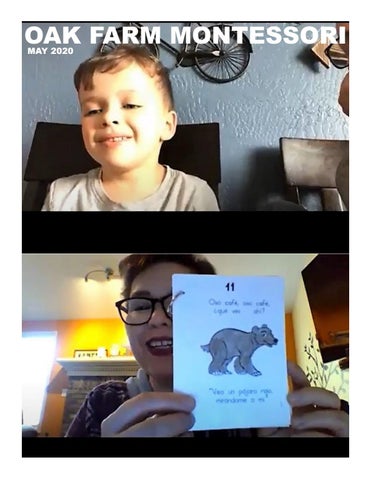
OAK FARM MONTESSORI MAY 2020
Ig n i t i n g I n qu isitive Min ds Over the last month, during our social distancing, I have enjoyed looking at social media posts from staff and families sharing why they love Oak Farm Montessori School. I see connection and togetherness as a family. I see children inspired and encouraged in their learning. I see parents doing what they can in this time to support their children and each other. I see the smiling faces of the faculty that serve our families each and every day. Inquisitiveness is the theme of this month’s newsletter and it made me think about how fortunate we are to have our school and how this pandemic has stretched each and every one of us. I do not think there is a person in the country, possibly the world, that has not exercised inquisitiveness within the last month. We have been put into a position that has us asking questions. We are all asking, How? We are all asking, What if? Some of us might even be asking, Why? Throughout this year I have been connecting our newsletter theme to our Vision and Values document as we took the year to reflect on the roots of our school. These roots anchor us in our principles and beliefs so that Oak Farm can continue to grow and thrive without losing sight of purpose. Did you know that I could not find the word “inquisitive” in our Vision and Values document? I was quite surprised. What I did discover, however, were many synonyms for inquisitiveness....
“We believe in viewing problems as creative opportunities” “We believe in being active, not passive” “We encourage students to figure things out for themselves” “We believe in creativity leading to innovation” “We believe in evaluating any effort to find ways to improve” “We believe in an experimental attitude” “We believe in leading with questions” While our founder never used the word “inquisitive” specifically in the document, it is evident that inquisitiveness is deeply rooted in everything we do at our school and this time of distance learning is no different. As a school we are asking, “How can we follow the needs of our families?” “How can we individualize education for our children?” “How can we bring our community together when we must be so far apart in a physical sense?” This pandemic has activated the inquisitiveness deep inside all of us; whether we wanted it to be there or not. It has given us a gift of opportunity to be creative, to innovate, and to try things we have never done before. Thank you for your inquisitiveness this year as we journeyed through the Vision and Values of the school we love so dearly and hold so close to our hearts.
#supportourschool
Candice 2
Tracy Reincke, Toddler 2 Teacher
Natural Instincts
Children are naturally inquisitive. This curiosity drives a child to focus and persevere, not only now; but in the future as well. Young children learn naturally through observing and exploring the world around them. In the Toddler environment the child’s inquisitiveness is always at work; whether it is figuring out how to master a new work, observing other children, or exploring the world around them. The joy on their faces as they discover new revelations is profound and genuine. In our current time of upheaval and uncertainty, small children have questions too, “Why can’t we go see grandma?” “Can I go to the store with you?” These probing questions are all related to them learning about and from the world around them. The more children ask questions, explore, invent, create, or observe, the more they understand and feel safe in the environment in which they inhabit. Now, during this time of at-home learning, is a great time to get outside; explore nature and encourage the inquisitive mind of your young child.
“Curiosity keeps us moving forward, exploring, experimenting, opening new doors.” Walt Disney 3
#supportourschool
The joy of discovery Stacia Diggins, primary 4 teacher
Children in a Montessori classroom love to explore, use their imagination and ask questions. These opportunities create a natural environment where children can discover their own ‘aha moments’. As a child compiles solutions to their various questions, they apply this knowledge to create a new level of purpose to their work. This positive cycle of seeking to understand, and implementing the results, is fueled by the joy that comes from discovery. The first step for students in our classroom, prior to using a material, is to receive a lesson from the teacher in its intended use. This lesson can be given verbally with step by step instructions and conversation between the teacher and child, or it can be a silent lesson where the child learns through observation, visual cues or exploration with other senses. After practice and mastery of the material, the child begins to question ways the material can be used differently, but still achieving the main purpose of the work. While as teachers, we have ways to offer ‘extensions’ of the intended use of the material, it is also important to encourage, provide support and guide them in their explorations. By doing so, we allow them creativity to discover the “how and why” questions on their own; creating a connection that is concrete, meaningful and long lasting.
“Education is a natural process carried out by the child and is not acquired by listening to words, but by experiences in the environment.” – Maria Montessori.
#supportourschool
The pink tower is the first sensorial lesson given in a Primary classroom. It is a silent lesson that has an intended purpose to teach the child to visually discriminate differences in dimension. As the child practices this work, they may notice similarities to the brown stair. A natural extension would be for the child to use both materials at the same time. One of the most common ways children explore these materials is to see how high they can stack them; only limited by their own height! The child is using previous knowledge to see what works and what doesn’t, while at the same time they are acquiring new questions and hypotheses as they find a new purpose for the material. Finally, a child may create their own personal extension while combining many materials. One of our students created a “farm city” using all of the Sensorial materials in the classroom. Knobless cylinders became a chicken coop, Red Rods acted as bridges to connect the various components of the farm, and the Brown Stair became a silo to store grain. Questioning, testing and freedom to explore help our students to build knowledge that will carry them through other areas of learning and confidence throughout their lives. As a teacher, there is no greater joy than to observe this inquisitiveness blossom and grow in each child. 4
Never stop asking “Why?” Nikole Albright, Community Relations Liasison
When I was growing up, the concept of a hand held device that could answer any question you might have was about as fictional as little green men showing up at my doorstep. When I had a question I went to one of the two resources I trusted; my dad or the local library! Fast forward to the year 2020 and we all have learned a little too much about being fearful of strangers showing up at your door without a mask and hand-held devices have become our life line to the world. Without people asking “Why?” or “How”, many of the things we take for granted today would never have been developed. Did you know that the founders of Google, Facebook and Amazon were all Montessori students? The prepared Montessori environment encourages and supports children to be inquisitive learners. When students have an interest in a particular subject, they are not told to wait until that unit of study occurs in the curriculum. Instead, a student may choose an independent study that can then be shared with their teachers and classmates. Some students have even raised funds and awareness as an extension of their passion; Vacita Dolphins, children of Jacaranda and Common Grace Ministries are just a few of the topics that have sparked interest for students. As we try to adjust to the abrupt changes in our lives over the last two months, we have all become teachers and students in our own homes. “How do you sign on to Zoom?” “When can we leave our home?” “What is the best way to get slime out of carpeting?” Most of us don’t have to ponder these questions for long; we can run a poll on social media, use our phones to ask Google or maybe just have our tween create that Zoom account for us. While this pandemic has not been fun, it has been educational! Maybe not in the way we intended the school year to look, but in our own understanding of what is important. Whether you research at a library, call a friend or just ask Siri, just don’t stop asking questions... you never know where it might lead you. 5
#supportourschool
Divergent Thinking Nancy Bradtmiller, Upper 2 Teacher
“Anyone can ask a question, but those with an inquisitive mind will seek to find the answer.” In Upper Elementary, our desire is not to provide all the answers for our students, but to ignite their curiosity. We do not see our students as passive learners, like empty vessels into which we pour knowledge, but as active participants in their learning. We recognize Upper Elementary students have a thirst to understand the world in which they live, as well as their role in it. They want to comprehend the cause and effect of things. As their guides, we want to feed this hunger by offering them the chance to explore. Montessori said, “The task of teaching becomes easy, since we do not need to choose what we shall teach, but should place all before him for the satisfaction of his mental appetite”. At the beginning of the year, Timelines and Great Lessons introduce Upper’s Culture lessons; they intertwine mystery with facts and laws of science. As Upper students listen to the stories and examine the timelines, their imagination aids their understanding. To say the ocean is vast does not compare to the image portrayed when we explain that the sea could hold a mountain turned upside down. After the Great Lessons, we encourage students to pursue their interests. With their curiosity sparked, our students find pleasure in learning the details. According to Larry Schaefer, “Montessori is inspiration; not information”, Upper teachers hope to touch the hearts and minds of our students. Divergent thinking is the ability to see lots of possible answers to a question and different ways to interpret a question; this starts with our students being inquisitive and the result being creative thinkers. Students choose who they want to collaborate with in small groups on projects. This is particularly beneficial for quieter and more reflective thinkers who desire a safe and less competitive environment to voice their thoughts and opinions. The Upper classrooms are prepared with the students’ interests in mind. Books and attractive, sequentially placed, materials that invite inquiry and further research are the norm. As #supportourschool
6
their guides, Upper teachers seek to know our students’ strengths, weaknesses, interests, and aversions. We do this through repeated observations and building relationships. The work cycle provides opportunity to concentrate on the choices they have made. Science class with Katie also supports Upper students’ inquisitive nature. Students explore concepts in Chemistry, Physics, Electricity and Magnetism with hands-on activities and experiments. As a culminating activity, students are asked to demonstrate their understanding of the Scientific Method by performing their own experiment. Students choose a question that interests them and then develop an experiment to test it. Upper students seek wider boundaries that extend outside of the classroom; giving them experiences to form new ideas. Phenology brings lessons in Biology and Earth Science to life and gives students the chance to engage with the outdoors. Phenology, also referred to as “nature’s calendar”, has students track the weather making note of the day’s temperature, precipitation and amount of daylight while observing how these affect biological events such as leaves changing color, birds migrating or plants emerging. As students sit at their chosen spot, they make entries in their journals describing what they see, smell, or hear; adding further details with illustrations. Seeing a snake sunning itself in February or looking for salamander eggs in vernal ponds initiates a child’s desire to know more, and new intellectual interests arise.
7
#supportourschool
What does Inquisitiveness look like to you? Susan Dieli, MS/HS Spanish Teacher
When I think of the word “inquisitive” I picture an eager, hyperactive little squirrel, ferreting out delicious nuggets of information to store for later use. On the other end of the spectrum I visualize a bottlenose dolphin, quietly swimming up to a curiosity, taking in what lies before him, reporting to his fellow dolphins of his find and then, with strength in numbers, all returning to the scene to check it out, process and discuss. Both of the above descriptions personify my students in Middle and High School Spanish. While many are independent learners, all, at some point, need to work together to process, digest and support one another in their learning because part of being inquisitive is the desire to share. Language, after all, is a social medium. There is a threefold nature to being inquisitive when learning a new language; not necessarily a hyper squirrel nor the pod-minded dolphin, but certainly curiousity. Why?Learning a foreign language is laborintensive on several levels. Level 1 – Cognitive Inquisitiveness: How does this work????? Wait, what? It requires: 1. the ability to think abstractly. 2. the brain to develop new pathways for storing information in a logical format that isn’t always sequential in order. 3. the learner to consciously process and file the information in a manner uniquely his/her own so that s/he can access it when needed. 4. training the ear to hear a new rhythm and cadence to the spoken word. 5. a level of bravery to speak, risking mispronunciation and inaccurate word stress, incorrect verb conjugations and sentences being set up incorrectly. 6. an adventurous spirit, a willingness to open one’s thinking and accept different perspectives on life and the world with respect and empathy. 7. Above all, perseverance to continue forward, uphill and down vale, in dogged determination to get “it” right.
I have no special talents. I am passionately curious. ~ Albert Einstein #supportourschool
8
Level 2 - Self-reflective: Why do does it do that? Why can’t we all speak English! Learning a foreign language isn’t just limited to the new language. Inevitably learning a new language ties back to one’s own native tongue and why things work the way they do. How many of us take our native language skills for granted, never giving it a moments’ thought as to why we choose a particular tense to speak in. Whether the verb we’re using is correctly conjugated. Why we’re using that particular adjective. If it’s clear who the subject of our sentence is. Should we use a direct object pronoun in here? Am I trying to show possession? Who thinks about that stuff? Well, foreign language learners do. They have to because they are doing consciously what all of us did unconsciously as young children – playing with words and sentence structure until we got it right. Only this time, Mama isn’t there applauding if we say “cookie” and “Dada” or “me want pasketti”. Level 3: Pushing boundaries and stepping out of our comfort zone – Oh I don’t know about this…. Learning a new language also means pushing our boundaries outward and meeting the world. It means becoming familiar with the people and cultures tied to the language we’re studying. For Spanish, it means being introduced to twenty different countries that speak their own version of Spanish - 450 million people. Each of these countries have their own history, traditions and cultures that are completely unrelated to one another except in sharing the same language. Yet even in sharing the language there are subtle differences within each of the twenty countries akin to the differences between American English and British English.
American English
British English
Apartment Trunk, of a car Hood, of a car Stroller Sweater Sneakers
Flat Boot Bonnet Pram Jumper Trainers
Level 3: Pushing boundaries and stepping out of our comfort zone – Oh I don’t know about this…. Learning a new language also means pushing our boundaries outward and meeting the world. It means becoming familiar with the people and cultures tied to the language we’re studying. For Spanish, it means being introduced to twenty different countries that speak their own version of Spanish - 450 million people. Each of these countries have their own history, traditions and cultures that are completely unrelated to one another except in sharing the same language. Yet even in sharing the language there are subtle differences within each of the twenty countries akin to the differences between American English and British English. To my mind, this last facet is the true nature of being inquisitive as it relates to a foreign language. In the end it’s about exploration and building bridges. How do we do that in education? By providing students with ample experiences that expand their horizons through projects in which • they learn about others • develop empathy and understanding • learn life skills • put into practice their Spanish language expertise 9
#supportourschool
Mystery Globetrotter Clue Number 2 Student Name Travel to Madrid, Spain; stay 5 days; eat 5 typical meals. Take a Madrid City tour; eat tapas; see 3 historic places, 2 museums and 1 park. Take a scenic Madrid Cycling tour. Go see a Flamenco Tablao. Travel by train to Toledo; visit 3 historical sites. Go to Manzanares el Real and see Mendoza Castle.
Students at the Middle School are working on “Mi Viaje a Través del Mundo” (My trip around the world) that is set up like “The Amazing Race”: • Students receive clues that direct them to a destination. • They must do research to find certain pieces of information in order to complete the clue. • They must find transportation, lodgings, typical food for the region, etc. • They must problem solve randomly given Roadblocks that deal with real-life issues: lost passport, missed train, becoming ill in a foreign country. • Students complete journal entries in Spanish, a country fact sheet of the current country, mileage traveled to date, vocabulary words in the native language, Spanish and English. • Complete a travel scrapbook and a google slide presentation to the class.
The limits of my language are the limits of my world. Ludwig Wittgenstein
#supportourschool
10
High School Spanish 2 and 3 are investigating aspects of the Hispanic world that captures their interest in “A Window into The Hispanic World”. Students choose a country: Argentina Chile El Salvador Venezuela
Cuba Perú Spain México
Nicaragua Dominican Republic Colombia Panamá
Bolivia Honduras Guatemala Puerto Rico
The Environment Tourism Agriculture/Ranching
Textiles/Fashion Society: Customs Society:Class systems
Students choose a topic: Fine Arts Politics Music Architecture History Arts and Crafts Ancient Civilization/Indigenous People • • • • •
Explore and dig for what appeals or draws them in. Do research and complete the written portion by answering prompts about their interest. Develop a vocabulary list of words tied to their topic Create a crossword puzzle or a bingo game so that classmates can practice the new vocabulary. Create a product to illustrate what they’ve learned: a mask as a personal reflection of something learned, choreograph a dance, recreate a scale model of a historic site, a timeline for a moment in history, etc. There are so many possibilities.
High School Spanish 4: Students are developing their own projects that are communicative in nature and based on loose ideas which they must develop and then design. Examples: Option 1 – A cooking show: choose a recipe of a typical Hispanic meal from any of the 20 countries. Film yourself preparing the meal speaking entirely in Spanish in a cooking show format. It must be a complete meal. Option 2 – Adapt a Montessori learning activity for Spanish language learning and demonstrate how to use it speaking in Spanish. Option 3 – Write a skit in Spanish and use gifs to illustrate and support the dialog. Record yourself doing the voices of the different characters. Option 4 –In Spanish write and illustrate a short children’s story. Record yourself reading it. 11
#supportourschool
#supportourschool