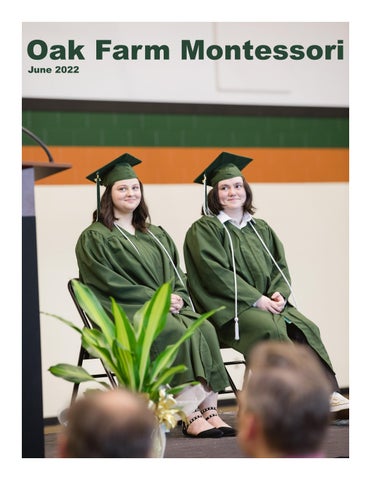
Oak Farm Montessori June 2022
Dr. Montessori placed a great importance on the process of completing work. Did you know that there are over 50 steps to flower arranging in the Primary classroom? Each of our teachers are trained to present lessons to the students they serve. They practice with the materials themselves during training and are required to create binders for each area of curriculum. Not only does each lesson have a purpose, but it also has a direct and indirect aim that the teacher identifies. Much like this mastery that our teachers achieve through practice and repetition, our students learn in the same way. What work will I choose? How do I complete the work? What do I need to be successful? And, finally, how do I restore the material so it is ready for the next person? It is amazing to watch the many steps our students take to complete their work. Take a moment the next time your child shares with you to ask about the process and not just the end result.
Candice
2
HEAD OF SCHOOL
“Look what I made!” All of us have heard our child say these words. How easy it is to give a quick response of, “It’s beautiful.” But what if we asked, “Tell me how you created this?” Too often we place more emphasis on the finished product than the hard work, creativity and learning that went into the project.
THE
absorbent
MIND
ASHLEY KNUDSON, INFANT TEACHER
In the Montessori philosophy, process over product will look different at each level. Creating meaningful work and instilling learning of the process is holding true to this pedagogy. Maria Montessori was one of the first scientists to identify the importance of development in the early years of the child, including in the womb. Her thoughts in the early 1900’s were quite startling to the established educational beliefs that the university years were the most important. Montessori designed her classrooms around the child, beginning with the infant environment; or, as she called it, Nido (the nest). This method is very simple and child led, with little interruptions from the adult. Montessori environments are prepared to be a flexible space that evolves with the infants capabilities. Here, the child gets to choose how to move and what to explore, all within the safe limits of what you’ve made available. Examples of this process are basic steps of returning a work to a shelf and that being their “big” work; whether it is all in the right order or in the correct spot is not the goal. The process of work is choosing, using and returning; that is the focus. Putting on clothing, feeding themselves independently, pulling up to look in a mirror, helping around the environment or setting the table and cleaning up their dishes when done eating. All of these “processes” help in building the adult he/she will become one day. #supportourschool
All in a days work Devon Diaz-Crouse, Primary1 Teacher
Children in a primary age Montessori classroom experience an intrinsic satisfaction while discovering the materials and the various works on the shelves. Through this work, the children are not usually producing something that they can take home in their backpacks. The work is done for the child and for the development of his/her own inner workings, not to produce something that is to be judged or graded by his/her peers, teachers or parents. The work itself is what the child craves as he/she does the activity through hands on experiences. They go through the process of picking up the red rod and feeling the length with their hands as they carry it across the room. This work helps them to figure out spatial awareness as well as being mindful not to bump into another’s work or the table on the way to their mat where they will carefully place each of the 10 rods individually. They learn about their movements through the space and they compare the size of each object with the other red rods on their mat. Then, they self-correct as they try to figure out which piece comes next. Putting the work back on the shelf correctly serves as a second lesson and reinforces that new synapse or connection that has just been formed in the brain as they have gone through the process of differentiating the length of the red rods. This is big work for a 3 year old. The child may not remember the name of the work right away and when mom and dad ask them what they did at school today, the child may say, “nothing.” However, the inner workings of that child’s brain utilizing the red rod activity is so crucial for establishing order, concentration, coordination and independence! The classroom teachers learn so much about the development of the child and how to support them as they grow through observing the child as they use these amazing materials in the Montessori classroom. There is no need for worksheets or testing the children, which alleviates much stress for a child and allows them to instead focus on growing and enjoying the learning process. 4
#supportourschool
CHOICES MATTER HATTIE PRESTON, ART TEACHER
Art and creative exploration builds problem solving skills, connections to other subjects and confidence, just to name a few. The best art from children is not product oriented, but instead the importance is the process; the ‘how’ and ‘why’ the child chose to create the art. Often when you talk to a child about the art they created there is such a rich backstory to the art that would not be easy to understand without the conversation. While skill development is of course important, the way those skills are learned and practiced are even more important. Just copying a premade art project has its merits, but ultimately the child’s choices, opportunities to build decision making skills and creativity is hindered. For example, instead of introducing a follow me dog painting to teach color mixing and texture techniques, where the teacher prescribes the colors and how each part should look, allow the child to study a dog or animal of their choice. Let them explore what happens when you mix different colors together and how different paint brushes and movement create different textures. This is a much richer experience for the child! It can be hard to step away and allow the freedom and possible failures that this type of process may produce, but the finished idea of a painted dog in an adult’s mind is much different than what is developmentally appropriate for a child’s abilities. When we craft a lesson for any age we follow the creative process, as well as think of the skills we want the children to learn, but we also do not have a finished product in mind. For example, the lower elementary students created portraits this year. They looked at examples of portraits from many different artists and learned how symbolism can help add meaning to a portrait. They received mini lessons about how to draw facial features and facial proportions. They were given lessons on how to mix colors and what colors can be used to create skin tones. From there, each student had access to many materials and paint choices. They added beads and fabric to create unique clothing and mixed colors to create individualized skin tones. Some students had to paint many layers as they learned how much mixed paint was necessary to cover the space. When they felt finished we gave feedback and encouraged them to improve in one area. The opportunity for choice helped each student build technical skills and social emotional skills. They truly love observing not only their own finished work, but that of their peers in the gallery. 6
I encourage you to have an art drawer, box or area at home for your child. I have a drawer at my house for my nieces. In it, I keep tape, drawing materials like pencils, markers and crayons, scissors, glue and paper. I also add things like stickers, pipe cleaners and other odds and ends I accumulate; like twisty ties, recyclables and bits of ribbon. My nieces always head straight for the drawer and have the freedom to create anything from the materials. I have artwork on my fridge with glued flowers and found objects from around the yard; it’s one of my favorites. They know the expectation is that they restore the materials when they are finished. Having things in baggies or organized into bins helps in the process too. Having materials available for children to use and experiment with is an important part of our art program. Establishing guidelines and systems for using and cleaning up those materials helps students enjoy success. Process over product in art education is invaluable for children’s development. Imagine the possible future if children, while growing, are allowed to find their voices and own path creatively; it would help bring beauty to every corner of the world.
“The aim of art is to represent not the outward appearance of things, but their inward significance.” Aristotle
#supportourschool
Keeping it real... Linda Hoffman, Upper Elementary 2 Teacher
A student accused me of being false for organizing a clean up of the classroom before parent conferences. She said it was like lying to have everything picked up and items on the shelves adjusted neatly; giving the impression that’s how the classroom looks everyday. I disagree that cleaning is deceitful, but her comment had some merit. Upper classrooms are a bit messy. Work is on the floor, books lie about, the odd pencil has rolled under a shelf, water rings are visible around the plants, the compost bin is overflowing, the pet enclosures have become odoriferous… typical. Typical, messy, and meaningful. Children are after all, in the process of learning and growing. During the second plane of development, the elementary years, an expansion takes place. Physical changes might mean the child is louder, and rougher, and clumsier. Mental expansion means abstract concepts are grasped and ideas are formed leading to debates, projects, moral questions, and testing. Upper elementary teachers recognize that expanding minds don’t always glue things on straight, use their best handwriting, or give oral presentations smoothly. It is not the job of the teacher to clean up or criticize the work of the child. That does happen, though. In a traditional classroom, teachers and students are pressured to present perfection. Frequent testing is proof of learning, and proof that the school and its teachers are doing their job. In order to test well, students must practice the skills as they will appear on the test. 8
This thinking is logical, but Maria Montessori didn’t study test scores. She studied children. She cataloged development. She lectured and wrote about the freedom children need to learn. This is called a process. We cannot rob the children of discovery for themselves by providing them with a roadmap of the product! Upper Elementary teachers understand that the process is far more meaningful. Children are observed as they choose work, commence set up, converse with peers and clean up. The observation of the process is just as meaningful, in some cases more so, than the outcome of the work. Teachers look for how much assistance was needed for remembering the steps of the set up. We look for how much concentration was needed to accomplish the task. We look for the child’s interpretation of completion. We observe the process and there is not always a product. Every book that is read doesn’t require responsive questions. Every math lesson does not have an assignment. Research can look like a poem, a poster, a sculpture, a play, or a paper. Is it deceitful then, to guide a student by insisting on complete sentences and properly spelled writing? Would you call it cheating to offer suggestions regarding body language, tone of voice, and organization of an oral presentation? Maria wouldn’t. She had very high expectations for her students and her teachers. She also found that encouragement of the process was more effective than rewarding the product. Upper elementary does too.
This is a shelf on the first day of school.
This is the same shelf today. The clock and pencil sharpener have broken, and the books and cards have been put away carelessly. #supportourschool
Progress
Perfection OVER
Oakleigh Butler, Middle School Teacher
At the beginning of the 2020 school year, middle schoolers were tasked with showing gratitude to three former Oak Farm Montessori teachers. The previous school year had ended abruptly, with remote learning and the overwhelming presence of a global pandemic. Returning that fall, we were grateful for a fresh start, even if our gratitude was masked by fear and uncertainty. Our first collaborative project began with the guiding question: “How can we show gratitude to Emma (our tender-hearted theater teacher), Pat (the iconic farm manager), and Susan (the spunky Spanish teacher)?” Students began brainstorming and decided to create a pillow, a scarecrow, and a mosaic to share our appreciation. The project leaders delegated various responsibilities; from communications to materials and finance, design and construction. With the planning complete and the schedule set, the only thing left was implementation. As a new Montessorian, I had to tie back my perfectionist wing to avoid flying in to rescue these well-intentioned adolescents. I had to step back as they chose a Shrek mask for the scarecrow’s face, placed the big blue mosaic tile there, and accidentally sewed the pillow case onto the pillow. The process was challenging to watch as a natural helper who pays attention to details. I had to remind myself that this was not my work and that the mistakes and roadblocks were an important part of the process. The project rubric consisted of skills like effective communication, time management, and perseverance; it did not mention an anatomically correct scarecrow, symmetrical mosaic, or even a removable pillow case. As much as I would’ve loved these things, it was the process of collaboration that was invaluable. My journey as a Montessori teacher has helped me step back and get out of the students way as they collaborate, create, and enjoy the messy process of learning. Middle School Micro-economy Consumer Alert: If you’re looking for perfection, please purchase your products from Hobby Lobby. 10
P o t e n t i achieved l Jon Agler, High School Administrator & Business Programs Director
For young adults, it is important that they find real world meaning in their work. As they grow in independence and maturity, they grow in a deep desire to find their place among the adult world. Because of this, their work is valued by its contribution to society and we must always seek to find ways to create opportunities for their work to have real influence on the greater community. One ability that we value greatly in our culture, that is not learned until later in adolescent development, is the skill of efficiency. Efficiency is only developed through practice. As a Montessori teacher, we observe the painstaking process of students learning how to be efficient. Our curriculum and class schedule allows students flexibility in completing assignments and managing due dates. They are provided independent work time to evaluate, reach out to teachers and complete said assignments in a timely manner. Should they work efficiently, they will have additional time to use as they please. However, if they don’t use this dedicated time at school efficiently, they will have to complete work at home or on the weekends. The ‘process’ of time management is self-evident to the adolescent as they experience the ‘product’ of having more free time at home when school hours are used to their advantage. At the High School, our students are given freedom to choose. They can choose how they show mastery of their work. They choose if they want to do this work in groups. They also choose how and if they will add flare and creativity in this work. As they explore these choices, they are inherently less efficient. However, the purpose of this freedom is to allow them to determine for themselves what the end result will be. Will the investment in time and energy benefit their overall grade and satisfaction in the work instead of just producing a product predetermined by the teacher? Instead of assignments that are graded only on the end result, we use Rubrics that measure the effectiveness of planning, research, presentation and execution; resulting in a true picture of the process and not just the product. As older adults, it is always important for us to give space for these students to explore. As they develop efficiency and time management skills, they are also confirming the portrait of an Oak Farm Montessori graduate: leadership, emotional literacy, citizenship and lifelong learning. Traits that will serve them in college, future employment and as members of society far beyond the tangible product that was the end result of the process. #supportourschool
Mark your Backyard
Barbeque
Summer Camps School Closed
june 2, 2022
Begin
June 13th, 2022
July 4th week
Summer Camps Parent
calendars
July 4th - 8th, 2022
End
august 5th, 2022
Orientation
august 18th, 2022 TALL OAK FUND
SGO
VOLUNTEER
DAY OF GIVING
SUPPORT OUR SCHOOL
“To provide a Montessori environment that inspires children to reach their potential through meaningful work.”
Oak Farm Montessori School | 502 Lemper Road | Avilla, IN 46710 | 260.897.4270 | www.oakfarm.org