OAK FARM MONTESSORI March 2020
E
nvironmental stewardship is very much a part of the Vision and Values exemplified here at Oak Farm Montessori School; as demonstrated in the following pages of this month’s newsletter. Where it is most emphasized is through the Eco Literacy project established early in the foundation of the school. Lorene Dekko Salsbery describes it as follows, “The goal of the Eco-Literacy Project is to expand learning beyond the classrooms and into the greater campus setting of the gardens, woodlands, wetlands, prairies, and conversation corridors” (Vision & Values, 8). Guided by the Montessori Chart of Interdependencies, the outdoor environment is an extension of the indoor classroom, bringing learning to life through experiences such as: gardening, conservation, field studies, and micro-economy opportunities. This chart emphasizes how important every person is and how we are all connected beyond ourselves as individuals. Not only is this interconnectivity evident across the levels, but also among our alumni who have taken their experiences from OFMS and put them into practice as adults contributing to the communities in which they live. This stewardship is the heart of why we do what we do every day. Regardless of the age of the child, we strive to expand learning in any and all environments.
Candice
Stewardship (n): the conducting, supervising, or managing of something, especially the careful and responsible management of something entrusted to one’s care (Merriam-Webster) Montessori Chart of Interdependencies
Making an Impact Jeni Ekovich, Infant Teacher
If you pause and observe the work of Infants and Toddlers, you will see an intrinsic motivation to help others, as well as a desire to independently care for self. It is so important to foster this desire because it is a foundation for building stewardship. At Oak Farm Montessori we often use the term “World Changers” when referring to students. We would love for our students to leave our school with the tools they need to not only be successful adults, but also make an impact on the greater community. Becoming a “World Changer” starts in the Infant and Toddler classrooms. Grace and Courtesy are lessons given daily. Teachers and older peers model empathy and kindness in caring for others, the environment, and even themselves. We take advantage of this intrinsic motivation to encourage independence and a desire to be helpful; our classrooms provide endless opportunities to do just that. Maria Montessori knew that the absorbent mind was crucial to later development, saying, “The things he sees are not just remembered; they form a part of his soul.” When our students restore work to the shelves, put food scraps in the compost, or care for a hurt friend, they are becoming stewards of their community. How exciting it is to think of what they will do next!
The art of Caring Elizabeth Green, Primary 3 Teacher
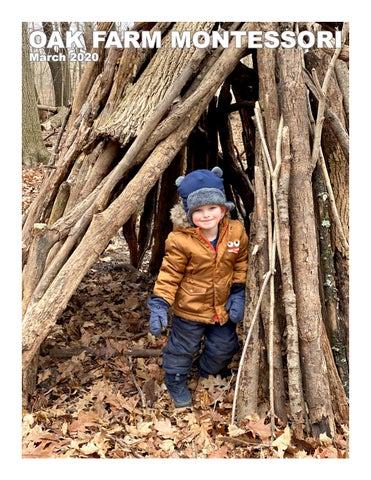
At the Primary level, we see acts of stewardship as our students care for the environment, care for others and care for themselves. These are fundamental skills that the Primary-aged child develops through the exercises of Practical Life, those daily living skills that children observe their older siblings and parents doing throughout each day. Inside the classroom, students wipe up spills, water plants, help prepare snack and wash soiled polishing cloths. They set tables for lunch, serve water to their classmates and clean up after everyone has eaten. When outdoors, our students fill bird feeders for our feathered friends, shovel snow from sidewalks and wipe off the slides after a rain. Recently during a Kinderforest outing, Primary students worked to line the path in the woods with large branches to better define the path for our younger toddler friends who enjoy the woods each day. They are caring for their environment. Our students also care for those around them. They help younger classmates with their coat zippers, read a challenging word for a friend, tie a bow on a friend’s dress and guide a new classmate to the far playground. They are caring for their friends. As young children grow and develop, they work toward independence. They want very much to do things for themselves. They change their clothes when they become soiled (or not soiled!), toilet independently, clean up when they are finished with lunch and put on all their winter outwear. They are caring for themselves. Primary students very naturally embrace stewardship!
Stewardship - the job of supervising
or taking care of something.
“THERE CAN BE NO STEWARDSHIP WITHOUT STEWARDS.” John Jay Jackson, Jr.
MANAGING RESOURCES ~ Michal Miller, Lower 1 Teacher When I think of stewardship, I often think of responsibly handling money or being a good steward of the land and environment. So, I looked up the definition for stewardship and I found that stewardship means: “the care, handling, and management of resources.” In our Lower Elementary classrooms, our students practice “the care, handling, and management of resources” throughout the day. For example, our students practice stewardship by caring for and managing the materials in the classroom. The students carefully handle the delicate glass golden beads as they work through division exchanges and subtraction equations. They care for and maintain the pencils, pens, glue-sticks, and tissue boxes in our environments. Our students handle and manage the responsibility of fully loading and unloading the dishwashers, washers, and dryers; drying, sorting, and putting away the dishes and folding, sorting, and putting away the laundry. In these ways our Lower Elementary students are practicing good stewardship. Additionally, our Lower Elementary students practice stewardship through caring for the plants and animals that inhabit our classrooms and the outdoors. Each lower elementary classroom has flora and fauna for the students to care for and appropriately handle. Additionally, as the students venture outdoors through their ecoliteracy lessons, adventure and PE lessons, cultural lessons, and during playtime, the students practice stewardship by caring for the environment and the Earth. It has been a big work on campus to protect parts of the environment and to restore them to their natural state. As part of their outdoor work, the lower elementary students have begun labeling the sanctuary or protected environments to signify which outdoor areas are to be protected and which outdoor environments are for play. By managing the environmental resources that can be found on our beautiful Oak Farm Montessori campus, our Lower Elementary students are practicing stewardship. While our students might not be managing their own bank accounts and budgets or farming the land, they are practicing stewardship in a myriad of ways throughout their days in Lower Elementary
World Changers Elizabeth Danielson, Upper 3 Teacher
As Upper Elementary Teachers, a big part of our work is helping our students grow socially, emotionally and to think globally. Do they understand who they are in this world? Do they realize the impact they can have individually on our Earth? As human beings, we have a gift to be able to help other human beings and to care for our Earth through our everyday actions. We encourage our students to see themselves as world changers, just as Dr. Montessori did. “The land is where our roots are. The children must be taught to feel and live in harmony with the Earth.” said Dr. Maria Montessori. In Upper Elementary we apply Dr. Montessori’s philosophy about environmental stewardship to our everyday curriculum. We believe that if we want to teach our students to take care of our Earth, they must spend time in nature to truly appreciate it and see the value of conservation. We are always looking for an opportunity to extend learning outside our four classroom walls. All winter long, students bundle up to spend time outside daily during lunch hour; building forts in the woods or connecting with friends on our grassy field and playground. Twice a week, Upper students walk to the Art Center rather than taking the Oak Farm bus. Fresh air and a walk can be so powerful! Weekly phenology visits to the woods give students an opportunity to peacefully observe their surroundings and analyze changes in nature “The land is where our roots are. by recording data in their phenology notebook. The children must be taught to feel Connecting with nature on a daily basis leads to a and live in harmony with the Earth.” deeper love and respect for our beautiful planet. Experiences to care for our Earth are woven into daily routines in Upper. Reducing waste is a priority that you would see exhibited in all Upper Elementary classrooms. Paper, cardboard, aluminum and plastic are all recycled or reused whenever possible. Food scraps are collected daily into our compost or pig buckets. Students take pride in walking the bucket over to the compost pile or taking food scraps to feed the chickens at the barn. Sometimes our classroom pets are lucky enough to snag some leftover fruit and veggies as well. We hope that these experiences will have a lasting impact on our students and extend into their lives outside of Oak Farm. Each of us, individually and collectively, have the power to change the world.
*This article was originally published in the March 2019 newsletter
Restoration Map of Oak Farm Brett Bloom, Ecoliteracy Coordinator
Oak Farm has stunning classrooms—Maria Montessori’s prepared environments. Equally vibrant outdoor classrooms stretch from one edge of campus to another. Student work unfolds in this infinitely prepared environment, which holds tremendous potentials a child cannot exhaust in her time at the school. We are working on existing natural areas and preparing new ones. Our goal is to foster biodiversity and intensify teacher and student experiences. The map shows natural areas and restoration work across campus. The highlighted spaces progress through various states of establishment, restoration, and future development; some are proposals we are discussing, while others are long term dreams of collaboration with neighbors and funding windfalls. You will notice conservation work on them from time to time including: seeding, seed gathering, mowing, planting, pest control, micro-habitat experiments, and controlled burns. We are creating immersive spaces for study and exploration. Immersion is a critical component of experiencing a wetland, forest, and prairie. This quality enhances learning. To understand what I mean by immersion, consider the differences you might feel standing in the midst of 4 trees versus being surrounded by 24 acres of trees (approximate size of the forest at Oak Farm) or the magnificence of 747,956 acres (Yosemite). The map above shows some of the habitats you can explore, and Oak Farm students find themselves in all around our campus.
Life after Oak Farm Montessori ~ Kim Davidson, Strategic Partnership Director Those who have been immersed in a Montessori environment often exhibit many different traits that are woven into their being. It seems impossible to talk about one characteristic without an interweaving of multiple others that reflect their time at Oak Farm Montessori School (OFMS) and the Portrait of a Graduate. This month, we share the stories of two former Oak Farm Montessori students who embody the characteristics of stewardship. Matt Pounds, 8th grade graduate, and Olivia Salsbery, alumni, have each taken different approaches to being good stewards; however, their goal of being responsible members of a social and ecological community are very much the same. Enjoy reading as they both reflect on their time at Oak Farm Montessori and the impact that has made on their lives as adults.
Name: Matt Pounds Age: 25 years old OFMS: 2002-2008 (3rd through 8th grade) High School: Central Noble College: Cedarville University in 2016. Resume: Grow Ohio Valley, Wheeling, VA Essex Farm, Essex, NY Vocation: Sustainable Farming with Grow Ohio Valley. Manages 25-acre rural farm whose food gets distributed via a 200 share CSA, a mobile food truck and a year round, local food grocery story. Purpose: “We aim to build a robust and sustainable agricultural community in the Ohio Valley—a community that considers the health of both people and land”.
Matt clearing a stall while a student at Oak Farm Montessori Middle School
Matt reflects on his thoughts on stewardship and the road he has traveled, his obligation as an adult and how Montessori had an impact on this important duty. A responsibility that he refers to as a contract; a binding promise to a community that you will do your best. Stewardship is the intersection of values and environment. In other words, as I work out my values, in relationship to a given circumstance or environment, I am practicing stewardship. During my time at Oak Farm, the emphasis on virtue in the classroom had great influence on my views today. We were encouraged as students to be virtuous. We also explored the expectations of communities, which I believe shaped my current understanding about community. The peace corner stands out as an example of this emphasis on virtue and community. This early form of healthy conflict resolution, and the opportunity to practice understanding and empathy from others in community, impacts almost every area of my relationships. Through the guidance of my teachers and through the ownership we students had of our community, my time at OFMS helped me define what I expect from others in a community, but most importantly what I expect from myself in a community.
As I reflect on Dr. Montessori and her teachings and why stewardship was such an integral part of the philosophy, I believe she preoccupied herself largely with the concept of vocation. I, personally, have taken vocation to mean contribution—an innate cosmic task unique to each person and child. One might say that stewardship is an important tool, a gift like intellect or strength, to be deployed in the working out of one’s vocation. The stewardship in my life’s work happens to align with a traditional thinking of stewardship in a Montessori setting which focuses on respect of land and nature. With my chosen vocation as a farmer, I am committed to practicing agricultural in a sustainable way. Land ethic (stewardship of the land) defines my life. My approach to farming is one that benefits both humans and non-humans. It is not only about a responsible use of natural resources, but also functions to restore the ecological environment in which the act of agriculture occurs. I try to make sure everything I put in my body comes from a place I have been or from a person I know personally. This is important as I am deeply concerned with the health of our social and ecological communities, and I want to be sure that I am a responsible member of both. As a farmer, it is my job to understand the conditions that make my non-human neighbors (soil, air, water and life forms) thrive or suffer. I didn’t set out to be a farmer, I attended Cedarville University and majored in English. An interest that I attribute greatly to having Elizabeth Smith-Meyer as a teacher at OFMS. During college I had several events that greatly influenced my thinking about stewardship. As a student, I was very frustrated with many of my peers who were unhealthy in many ways, which created an unhealthy community for me to live. While studying John Milton, I realized that while I can encourage my community members to have expectations of themselves and stewardship, I cannot regulate their behavior. A second point was, admittedly an odd one. While reading an eight-page article on the threat of ISIS, the author ended the article with a question about the environment. The impact of this topic at the end of an article about ISIS was profound and though provoking, to say the least. I realized all the ways in which my personal stewardship fell short. It was then that I decided to start doing my part and I started at the bottom of the list and most fundamental—food. I made it my mission to eat only food that I grew as a starting point. As I farmed in West Virginia, I got closer and closer to my goal, but it was hard. Upon moving to Essex Farm in upstate New York, I learned that it could be done. Each day we sat down to a full table of food from that farm. Up until this moment, I thought that I would have to live life as an outcast. What I realized was that the rule of nature is abundance which is a hard contrast to the rule of scarcity that man has invented for himself. I was very pleased to know that I would not have to spend the rest of life without the comforts that I enjoyed (food) and that I was not destined to a life of raw beets and cooked cabbage! What does Stewardship mean to me? Stewardship takes sacrifice and humility and willingness in one’s heart to change at all costs for something larger than one’s self.
Life after Oak Farm Montessori ~ Kim Davidson, Strategic Partnership Director Olivia shares how her thoughts on stewardship and sustainability have evolved over the years and how the role of observation, learned at Oak Farm Montessori, has been a key to her life as a responsible, empathetic adult. Olivia is the youngest daughter of OFMS founder, Lorene Dekko Salsbery. Name: Olivia Salsbery Age: 26 OFMS: 2000 - 2007 (1st - 7th grade) High School: Hershey Montessori School (8th & 9th grade), Canterbury High School (10th - 12th grade) College: University of Oklahoma (OU) Vocation: Olivia is working on her Masters of International Sustainable Tourism at Monash University in Melbourne, Australia. She has also lived in Washington D.C. and traveled South America. Collective Responsibility is the first word that comes to mind when I think of stewardship. I believe that, as humans, we have a responsibility to take from and give back to our world in a way that is sustainable and regenerative and to realize that we are just a small component of a larger ecologicalecologic ecosystem that sustains us. The natural world reacts to imbalance through evolution. To take the idea of stewardship one step further, our responsibility to the earth is not limited to how we treat the earth, but also how we treat other humans and even ourselves. From the time I was at OFMS to my current work in Melbourne, the causes that I have chosen to devote time to have centered on sustainability. Whether it was OU Green Week and being on the Global Brigades Executive Committee, a capstone project on the 2010 BP Oil Spill, to several courses and projects that related to sustainable development and wildlife tourism, they have all shaped who I am today and how I take responsibility for being a good steward. When I think about where I am today, I know that my time at OFMS and the philosophy of Dr. Montessori shaped my beliefs. In a Montessori environment, so much time is spent outdoors. As I reflect on this time, the art of observation cannot be missed; whether it is observing what is going on around you or quietly listening. That may be listening to yourself or listening to others. I think that Dr. Montessori saw how innately children sense the interconnectedness between ourselves and the environment. One personal alone cannot be a steward, it fundamentally requires collective action. At Oak Farm Montessori, children work together, and it would be impossible for a child in a Montessori environment to be or learn in isolation. For Montessori students, the norm is collectivism and stewardship. After I left the Montessori environment, it was the first time I realized not everyone is involved with or caring about things as I had always been accustomed to. Having spent time during college focused on environmental sustainability (green transport, recycling, green travel), I think I was missing the bigger picture; such as the many components of other aspects of sustainability that are required to have a sustainable environment. How can we ask people to care for the environment when we don’t give them space to care for their own mental health and wellness? I think we need to start going deeper with our conversations about interconnectedness.
Even while at OFMS, Olivia sought out ways to be a good steward while encouraging sustainability.
Observation is key according to Olivia. Her father took this photo of her in New Zealand studying a small plant on the path.
Tasmanian bush walk at the base of Cradle Mountain, Tasmania.
Now, instead of viewing stewardship as doing right or wrong, I view it as listening and observing my environment in order to better understand my choices and their impacts. I believe we can’t be environmentally sustainable without being economically viable and socially respectful with our actions and consider how they impact others and others’ decisions. In Montessori, stewardship shines in the way children are encouraged to solve problems and the way children are positioned in the larger community from a young age. At OFMS, I was able to see just how important every member of our small community was and it began teaching me how different, yet similar, we all are are. As I reflect on my experiences at OFMS, I realize just how unique it was and just how different everyone was who believed in OFMS from the start. It wasn’t a group of homogenous people coming together, it was a diverse group coming together for different “I find myself being reasons and motives with an underlying, shared vision. It more conscious and more taught me good things grow not from one person or one viewpoint or one goal or one motive; but from a collective intentional in realising of many who are flexible, have open ears and encourage that my actions do creativity. Oak Farm Montessori is probably pretty close to matter, no matter how what my mom envisioned, but it’s also probably not exactly what she envisioned; that to me is why it worked and why it’s little they are.” sustainable. It’s a collective vision based on individual visions and ideas. As you can tell, OFMS and principles of Montessori are woven into my being. Through my parents and the influence of Montessori, I was taught to be empathetic and listen, but also to never feel small. What I do in my backyard and a friendly smile in Indiana, could ultimately impact someone in Argentina. Change occurs when a community feels a collective responsibility to be advocates for sustainability and regeneration. I think that’s really what stewardship is at its most basic level.
Many thanks to Matt and Olivia for sharing their life’s stories, views on stewardship and the impact that Oak Farm Montessori has had on both.
TAKING OWNERSHIP JON AGLER, SECONDARY TEACHER
Cultivating stewardship is a significant aspect of becoming a thriving, wellrounded adult. We work hard as adults to steward what we own and what we do. We do this to prepare for retirement, to protect against unforeseen problems in life, and to invest in the future of our children. We acquire wealth and seek to steward it well through investing, saving, and giving. We also steward our abilities through furthering our education, fine tuning our skills, and progressing in our careers. As I observe our high school students, I am reminded that we would do well to look at stewardship from a much broader perspective. Young adults are in the process of figuring out what it means to be successful in the adult world. They are seeking independence and, ultimately, ownership of all things in their lives; however, to them, the most important commodity to steward is their relationships. If you come observe a secondary environment, there are moments that can appear to be unproductive. It is loud, energetic, and includes a lot of giggling. As a teacher, I tend to want to use the typical teacher redirection prompts. “Stop talking.” “Stay focused.” Yet, I am aware that these phrases are rarely effective and often miss the point of the work they are doing. Even though sometimes it is difficult to cope with the incessant chatter, when I take a closer look I see that this social banter is much more profound than what I observe from afar.
Even though I hear a lot of pop culture references, and a lot of talk about shoes, I also notice them engaging with politics and even teaching each other about math. They are training each other on appropriate use of language and humor. They are correcting each other and also encouraging each other; they are investing in one another. The potential opportunities for teaching are vast within these conversations. During this age, they are like pack animals. Though it may appear as if the group dynamics detract from productivity, they are actually much more stable and open to learning than when they are alone. I love teaching at Oak Farm; because at our core, we celebrate the development of the whole child and we aim to guide them in stewarding all they bring to the table. Needed skills for their development include classes like math, science and language. However, if we ignore the development of this very relational community, then they will lack the less measurable skills like confidence, problem-solving, team-work, and empathy. At the secondary level, we strive to steward this developmental stage well. We hope to maximize our investment, and theirs, for the betterment of the community as they learn to take ownership of the relational skills they will use long past their days at Oak Farm Montessori School.
“To stimulate life, leaving it free, however, to unfold itself, that is the first duty of the educator.� Maria Montessori
Preparing the next generation brett bloom, ecoliteracy coordinator, kristine landrum, outdoor teacher, katie lautzenhiser, science teacher
Stewardship is a life-long practice. It is an integral component of sustainability and ecoliteracy on our campus. Students encounter stewardship on every level of development at our school. A beginning step is fostering awareness of the natural world. If you are out in the Oak Farm Montessori forest at the start of any given school day, you will undoubtedly encounter toddler teachers taking a group of students on a walk through the woods. Wherever we live, we know it’s important that our children grow up to become the next generation of environmental stewards. The best way to protect our environment in the future is to help them grow up with a love for the Earth today. At Oak Farm Montessori, it’s important to engage our primary level students in conservation activities that focus on positive actions without worrying them about frightening aspects of environmental problems they’re too young to understand. For example, each primary class is involved in recycling, composting and purposeful green work. After a storm, the children help clean up debris that has fallen in our woods paths, keeping them clear and neat for everyone to enjoy. Kinderforest allows the students to see the physical changes that occur in nature over the course of weeks, months and hopefully years of play in the same area which gives them deep love and care for their little space. It’s these “little” things that will stay with them as they get older making them more aware and proactive moving forward.
“Study nature, love nature, stay close to nature. it will never fail you.” Frank Lloyd wright
Cultivating a sense of stewardship and responsibility for the campus and our planet informs many of the things we do with Lower Elementary. In early February, a strong wind blew through campus. It took plastic, styrofoam, cardboard and other garbage out of the dumpster next to the new wellness center and threw it all over the prairies and wetlands in the center of campus. We started an Ecoliteracy session with a conversation about what conservation is and entails. Students had noticed all the trash littering campus and immediately connected having a healthy prairie with removing the trash. We spent a half hour cleaning the debris. These same students had been active in other aspects of
using, preserving, and understanding the prairie. They had collected, dried, cleaned, and spread seeds helping to establish native plants that will help strengthen the biodiversity that is returning to campus through our multi-year restoration efforts.
“When one tugs at a single thing in nature, he finds it attached to the rest of the world.� John Muir
In Upper Elementary, students still connect to and take care of the campus, but also begin to look beyond the school to global environmental issues. Students explore and study the wetlands on campus as well as learn about different types of wetlands around the world. They make natural laundry soap for the classrooms here at school and make some of their own personal care products that they can take home. In their final project, students research an environmental problem and possible solutions for this problem. Then they present their findings to other students at the level of their choice to encourage others to recognize the problem and to provide them with ideas on how to help solve this problem. A group of Middle School students have decided, on their own, to make a group to plan and initiate the planting of more than 300 native trees in the lawn and prairie near the bike shop. They were inspired by a guest lecturer who shared with them the fact that our area used to be densely covered with trees. Together, we will plant burr oak, shagbark hickory, chokeberry bushes, hazelnut bushes, pecan, walnut, butternut, Washington hawthorn, and assorted red oaks. The high school students in the Eco Impact class have been investigating biodiversity and stewardship on campus. In late August, they spent an entire class documenting butterfly diversity in the upland prairie and ephemeral wetland in the middle of campus. They found 8 species of butterflies, 5 species of grasshoppers, and a lot of beetles, spiders, and other creatures. The students also did work removing invasive trees and shrubs from campus near the train tracks and around wetlands. They collected seeds of walnut and tulip trees at a nature preserve maintained by ACRES Land Trust. We planted the seeds and hope they will grow. The goal is to return the small trees to the nature preserve and plant them. Students gave a presentation about their work to students in Lower Elementary 1 in February. It is through these encounters with nature that we are instilling an awareness to the next generation of environmental stewards to care for this precious earth we have been given.
Thank you Kristine Landrum, Primary Outdoor Teacher, for sharing your photos and passion for the outdoors while working with the children of Oak Farm Montessori all around our beautiful campus!