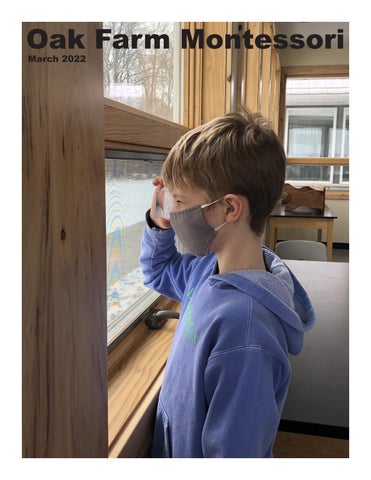
Oak Farm Montessori March 2022
Each day our students enter the classroom and there is a hum of activity, greetings and general socialization. But soon, this energy begins to transform into focused and meaningful work. Dr. Montessori found, through her research, that children, as young as three years old, found great joy in having this window of opportunity to independently choose work, practice to their hearts content and then repeat the cycle again with autonomy and purpose. Just as you and I would find ourselves frustrated if we were interrupted constantly while we try to complete a task, Dr. Montessori found that children found their greatest success and joy when they were allowed to engage without interruption. In the Victorian House, the younger children have a three hour work cycle in the morning, while our elementary age students and up have one in both the morning and afternoon. Our guides protect this important time frame because once the child’s work is interrupted, it is difficult for them to become engaged again. The beauty of our classrooms is that everything the child needs is available and presented in a way that beckons the child to interact and engage. Whether they are looking for gross motor activities, numerical practice, language exploration, practical life skills or scientific research, the guide has ensured that each work on the shelf is ready and prepared for the child. Our homes were not meant to replicate the classroom setting at Oak Farm Montessori. Yes, provide opportunities for your child to experience independence and success in self care. However, also allow for problem solving and opportunities for growth and play! As you will see in this month’s edition, our students are engaged and working for long stretches of time each day. Their work is truly to create themselves, and our role, whether parent or guide, is to allow them the freedom to explore and discover.
Candice
2
HEAD OF SCHOOL
I am often asked when giving a tour how our classrooms appear so peaceful. Many parents wonder why their children are able to exhibit such focus during the school day, but are less successful at home. Maria Montessori referred to the classroom as a prepared environment; where the guide, materials and children worked in harmony to provide the optimal learning experience.
#supportourschool
Tantrums, outbursts, big emotions. These were common occurrences in my home with our now six-year-old. Five years ago, I made the journey to Oak Farm Montessori every week to drop my children off in carline and then attend the Discovering Me program. I wanted to better understand what my toddler was going through and learn how to prepare her for the OFMS experience. I quickly realized that the program was more about educating me as a parent rather than my child. Perhaps the most important piece of the parenting curriculum was to sit back and observe my child, without interrupting them, for a full 30 minutes of a day. Observe their work choices, beginning to end, and unless they are going to hurt themself, others, or the environment, do not step in. One day at home I observed my daughter empty a shelf and walk away. I stepped in to bring her back to the shelf so she could restore it, which resulted in a huge meltdown. I walked away and a few moments later I observed that she had taken all the items from the shelf and moved them to a 4
drawer in the kitchen. I realized then that I had interrupted her work. She had a plan for that shelf of objects, and I broke her concentration, which resulted in big emotions. Concentration of a child is essential, and those skills improve when uninterrupted by outside factors. Interruptions may include verbal and nonverbal communication. If we can observe for a time and plan to communicate to a child when they are done with a work it will allow them time to engage, concentrate and restore a work. This also gives the child time to work at their own pace and to reach deeper levels of concentration. At the toddler age it may look a little messy, but they are taking it all in and finding their “flow”, a state of deep concentration and absorption. Montessori observed that children with a twoto-three-hour, uninterrupted, work cycle can reach deep concentration. The last hour of the cycle their work will progress into deeper concentration on more challenging work. The work in the toddler environment is sure to
Stepping back ...to move forward Laura Zollman, Toddler 2 Teacher
look chaotic in that two to three hours. That is because after the initial peaceful stage of the work cycle there comes what Montessori called a “false fatigue”, the need for a mental break that results in about ten minutes of restlessness and increased volume. This is necessary and a signal to teachers that the students are getting ready for their most challenging work and deepest concentration. Our role as teachers, parents and caregivers is to keep the children and environment safe and to let these little ones continue their work. “In creating an environment that encourages concentration, it is important to remember that if the child becomes conscious of anything other than the task at hand, his concentration is broken. By applauding, saying “wonderful”, giving a kiss, or whatever, the well-meaning adult draws the child’s attention to the adult and away from the task at hand. Too much such interference, and the child becomes self-conscious. When we are self-conscious, it is very hard to concentrate on the task at
hand, whatever our age.”—Paula Polk Lillard and Lynn Lillard Jessen “Montessori from the Start.” In the world of infants and toddlers it is easy to swoop in for a hug or a kiss or to continually praise, interrupting their concentration. Observe. Wait. Acknowledge. As you provide feedback for your child’s accomplishments, use phrases such as, “You did it! “You tied your shoe!” Not only will you be allowing their mind time to absorb their work, but you will also assist them in building an intrinsic sense of motivation for deeper concentration.
“When the children had completed an absorbing bit of work, they appeared rested and deeply pleased.” —Maria Montessori #supportourschool
under construction Diana Mccreery, primary 4 teacher
Imagine the start of your typical work day. You stop for a nice cup of coffee, greet your coworkers, check your mailbox; the normal morning routine. You finally sit down at your desk and turn on your computer to check emails. Just as you become deeply involved in your work, your door swings open followed by a few of your coworkers wanting to discuss last night’s episode of Survivor. After they leave, it takes 10 minutes to return your focus to your work. An hour later you’re interrupted once again by a last-minute office meeting. Now you’re frustrated because you know you won’t finish your work on time, not only that, but you’ve lost your focus and concentration, and feel exhausted from the constant interruptions. Now, imagine if this routine was the norm for our children at school. How unfortunate this would be if they were only provided a few minutes at a time to work before being interrupted. Once the child’s concentration is broken, it is very difficult to try to engage them in the environment once again. Through many years of observation, Dr. Maria Montessori discovered that children, when left in a careful balance of freedom and responsibility, displayed a distinct cycle of work. Montessori believed that the most beneficial environment for self-development is one in which students themselves are responsible for constructing their own knowledge. As a guide in the classroom, we stress the importance of an uninterrupted work cycle, and work to protect it. We have two work cycles at the primary level, one in the morning and one in the afternoon. During these work cycles, students may decide if they will start the day with less demanding tasks and gradually build up to their big work of the day, or they can decide to immediately dive into a long-term project they have been working on for days or even weeks. The goal is to prevent unnecessary activities that would break their concentration during this work cycle. Of course, there’s the occasional fire drill, holiday celebration, or group lesson; all of which are an appropriate exception. We want to give our children a fair chance to learn at their own pace, allowing them to concentrate and focus on their work uninterrupted and in a peaceful environment. They’re given the opportunity to choose their work freely, developing each critical skill necessary to the specific sensitive period that they are currently in. One of the best gifts we can give your child is the opportunity to fully develop their concentration and independence in an interruption free environment. 6
Do not disturb...
Debbie Kovets, Lower 2 Teacher
The prepared Montessori environment is vital in the process of allowing children to make decisions, be independent, and have the freedom to concentrate on personally chosen materials without interruption. The three-hour work cycle gives students the time to make choices and gain a level of concentration without over-direction and instruction from the adult in the environment. During this time, the students also experience a period of false fatigue. The room seems a bit unsettled during this fifteen-minute window, but if left alone, they will return to a second period of focused work. Lower Elementary students enjoy big work. Cultural work often includes meaningful discussions with classmates. The presentation of learning that follows can be a creative outlet. Math, on the other hand, involves time for individual focus and opportunities for ‘aha’ moments! The length of the uninterrupted work cycle allows them to internalize the information in these ways. As the children work with focus and independence, the teachers have the opportunity to observe the interactions of students with each other and with the prepared environment. This plays an important role in the teaching and preparation that follows. #supportourschool
8
Finding ‘flow’
Why did Montessori plan uninterrupted work time? Nancy Bradtmiller, Upper 2 Teacher
Maria Montessori’s extensive research determined numerous benefits to uninterrupted work periods. She observed how children immersed themselves for extended amounts of time and appeared rejuvenated by their work. We see the same joy in our Upper Elementary students as their minds guide their hands in meaningful work. The uninterrupted work cycle gives students the chance to delve into their learning while improving their concentration skills. Upper students choose work to hone their skills and/ or follow their interests. Students work at their own pace; not worrying about who finished before them and feeling left behind. Our students find time slips by quickly when they are focused or in what we call, “flow”. Small group lessons are offered during the work cycle honoring the elementary child’s developmental need for socialization. This is also the time teachers check in with students making sure they are meeting their goals and offer strategies to help them. While we want students to be self-directed and make their own work choices, they still are to meet academic guidelines. Teachers try to limit interruptions which distract them from what they were doing and can make it difficult to return with the same intensity. In Upper classrooms, we often observe our students move through the “three steps of normalization”. At the start of the work cycle we often see students milling around and shuffling through their belongings, then a quietude settles into the classroom. Everyone is engaged in a task they have chosen for themselves, this is beautiful to witness. Teachers think to themselves, “my students work as though I don’t exist”. The students are working independently and the auto-educational materials are revealing their message to the child. Eventually, students look up from their work with a euphoric look on their face and might chat with a friend about what they just learned or might have the need for movement. Montessori referred to this vitality and inner transformation as being a “new child.” According to Montessori, “A unique type of child appears, a ‘new child’; but really it is the child’s true personality allowed to construct itself normally”. The work cycle is a tenet of Montessori giving students the chance to develop autonomy, make choices, and find genuine joy in their work. #supportourschool
10
#supportourschool
REIMAGINING ROUTINES Misty Schoof, Middle School Teacher Our morning middle school routine has transformed this year. We moved away from three class periods into an open work cycle. This change has taken observation, communication, purposeful planning, flexibility, and openness. At the beginning of the school year, it became apparent that our current schedule was not meeting the needs of our learners. In October, after hearing feedback from our adolescents, we shared with our middle school community that we were considering moving forward with some adjustments to the daily schedule. We reassured parents and guardians that “there [would] be no loss of academic minutes… but hopefully, those minutes [would] be more productive” and offer more freedom for learners (MS Team). During parent student teacher conferences, we discussed the benefits of an open work cycle including, “increased independence, time management, organization, time for students to get into “flow” with their work, communication between adolescents, teachers and families, and deeper joy and satisfaction” (MS Team). Through research and observation, we moved forward with this plan and began a morning open work cycle. We sought feedback from our learners, made adjustments, and continued working towards a new morning routine. 12
Balancing the need for social interaction along with independent work has been a challenge for many of our young adults. One 8th year student shared, “Sometimes I feel like I get very distracted socially talking to my friends and then eventually I look at the time and it’s an hour later and I remember all the work that is due the next day and I will have a lot of homework”. It is important as Montessori guides to help our adolescents navigate the need for socialization and productivity. Our work is still “in progress” as we continue to observe our learners and make necessary adjustments to our classroom environment to meet their needs. We discussed as a community the need for more focus and silence during our morning work cycle. Our school committee proposed a thirty minute quiet time at the beginning of our schedule along with quiet spaces for learners to focus. Student feedback has been one of the driving motivations behind our work. When asked Do you feel that the open work cycle is productive? one 7th year student shared, “Yes, because if you are in one class at a time before we did the open work, you wouldn’t have a lot of time to get into the work because right when you would be in the zone, then you would have to switch classes”. On the other hand, an 8th year student answered, “Umm, yes and no. I like the previous schedule
so I know when to transition, but sometimes you don’t have work for each class, so it’s nice to have an open work cycle. At the same time, I like having a scheduled time to change. [During the open work cycle], sometimes I will use a timer to know when to transition. Yes, that’s worked.” Knowing our learners is vital to understanding each individual need. The open work cycle offers the flexibility to have some students settle in a work space while providing others with the freedom to move and transition between spaces.
Absolutely. But this failure is an opportunity for reflection and growth. As a community, we listened to our learners, dared to reimagine our routine and actively seek feedback as we navigate this change. The home environment provides another area to foster independence and a safe space to grow and learn.
In addition, students “can ask teachers questions and get one-on-one help during that time”. One student shared, “I get alot done and I have a checklist in my mind and I like how I can go in any space and work on what I need to get done”. Since each student has a different “checklist in their mind” [or ideally on paper], it’s important to have an uninterrupted work cycle that is open and adaptable to each unique set of goals. Students can establish their own schedule and routine, collaborate in small groups, and seek advice or lessons from teachers or peers. Finally, our new open work cycle helps bridge the gap between Upper Elementary and Middle School. One student shared, “In upper, the open work felt more open just because there wasn’t as much work to be done. Overall, [our schedule] mimics the work cycle time in upper pretty closely”. A 7th year student shared, “Here you are always busy. In upper, you had more time to read or talk”. Our new morning routine not only eases the transition from 6th to 7th, but also prepares our 8th years for the rigor and academic demands they will experience in high school. The uninterrupted work cycle opens the door to concentration and happiness through meaningful work. It allows learners to explore their own methods of effectiveness and efficiency while giving me, the guide, an opportunity to observe and better understand learners. At home, this means providing your young adult with the space to manage their own time. This space allows for children and teens to struggle independently and use boredom as a catalyst for creativity. When we step back, we can “follow the child” and let them take the lead. Will they misuse their time? #supportourschool
Not too long ago, I was listening to my favorite podcast, ‘’The Next Right Thing,’’ by Emily P. Freeman and I had a mind blowing realization. The number of light bulbs and news flashes going off in my head were quite possibly visible from outer space! I realized that I am a maker and not so much a manager. It impacted me to the core to have a named understanding of this part of myself. What does it mean, and how does it relate to the uninterrupted work cycle? Emily P. Freeman, quoting from Paul Graham, explains that a Manager schedule is run like a traditional appointment book with one hour tasks and appointments. This is just one way to use time, and it works well in many settings. I have employed it productively myself many times. However, a Maker schedule is different. ‘’Makers’’ work well when they have an extended amount of time to think, create and ponder. The interruptions of a traditional schedule break into their thoughts and potentially derail the progress they were about to make. Hearing this differentiation of work styles impacted me deeply because I have often felt like I can’t get traction with my ideas or make progress with a project. It’s because part of me is a MAKER. I need the time and space to process my thoughts and to take action. Having this realization made me appreciate the Montessori method of uninterrupted work cycles more than ever. In the Montessori world, an uninterrupted work
14
cycle is a period of time, up to three hours long, when students choose their own work and have materials and resources available to support their learning. This allows students to learn at their own pace without interruption. Their concentration skills improve and they are able to reach deep levels of understanding. Just as adults have different work styles, students also have the need to choose their own work style. In the Infant through Upper Elementary levels, the uninterrupted work cycle is spent with manipulatives and shelf work. In the Middle school through High School levels, their learning is more abstract but they still need the time to process the material. This is achieved through reading, writing, practicing and collaborating with peers. Student learning is more meaningful when they have time to struggle in some ways, but ultimately gain a deeper understanding. In conclusion, I really enjoyed learning more about myself through the podcast and it became even more relevant as I applied it to my son at home and my students at school. How can we help our children and adolescents use their time to benefit themselves? Perhaps creating a comfortable work environment would be beneficial for your child. There might be a way to pare down your evening schedule to allow undisturbed work or play time. Ultimately, encouraging our students, children, and adolescents to develop the space and routine that they need to feel and become successful is the most valuable outcome.
Timing is not everything Rachael McGuire, secondary spanish teacher
#supportourschool
16
#supportourschool
Immersed in culture Lisa Yde and Flor Ortega, Spanish Teachers
18
The uninterrupted work cycle includes several choices to provide students with variation in their work. The opportunity to learn Spanish is one of these options for all levels. We start our Spanish language learning program with the infants and toddlers three times a week and continue through the upper elementary levels. Studies have shown that children who are exposed to a second language when they are as young as three months old have an advantage when learning to speak the language later in life. The sounds that are not native to their first language come much easier to them.
There is also research showing that early second language learning can improve problemsolving. The students at Oak Farm Montessori are at a great advantage to have Spanish as a choice! With the infant group, the Spanish teacher talks to the them, reads them stories, sings to and sometimes plays with them - all in Spanish! The students who can walk or crawl around make the choice to sit with the teacher or continue on with another work choice. This language learning opportunity continues with the toddlers. When the Spanish teacher
enters the toddler environment, the toddlers who participate generally sit around the teacher and the magic begins. The teacher speaks only Spanish with the infants and toddlers, so it is a type of total immersion. This provides them work-time to absorb Spanish through listening to songs, stories and regular communication in Spanish. The Spanish language program becomes a bit more intentional at the primary level, but it is still student-driven. When the Spanish teacher is not present, primary students have the option to listen to the collection of Spanish CDs in their classroom while reading along in the teacher-made booklets. When in the classroom, the Spanish teacher invites the students to work with her during the work cycle. The teacher works together with one or two students at a time on basics such as: colors, numbers, greetings, the weather, clothing, etc. Students may continue to work independently on Spanish after first being led by the teacher. The children use manipulatives, color and cut activity sheets, do puzzles and make vocabulary booklets of their work that include pictures and vocabulary words in Spanish. Maybe you have experienced your child reading some of their booklets to you! For lower and upper elementary students, Spanish is a continuation and a review
of vocabulary that they began learning as infants and beyond. Depending on the student’s curiosity and intrinsic motivation, these students also begin learning about parts of speech: articles, nouns, adjectives, verbs, prepositions, etc. They also learn how to conjugate verbs in Spanish within sentences. Hispanic culture is interwoven as well; with opportunities to prepare foods native to different Spanish-speaking cultures. Spanish is an option on the shelf most days for our infants through kindergarteners during the uninterrupted work cycle. We are also reminded of Maria Montessori’s study about the sensitive periods that children pass through their first six years of life. Since language is one of these sensitive periods, our students at OFMS are right on track. Children “absorb” language naturally during these six years when curiosity is at its peak.
“The child has a mind able to absorb knowledge. He has the power to teach himself.” ~ Maria Montessori
#supportourschool
Mark your P/T
Conferences
Virtual Parent Ed Lower
calendars march 10th, 2022 march 11th, 2022
Event
march 17th, 2022
Learning Fair
Make up
march 24th, 2022
Snow Day
march 25th, 2022
TALL OAK FUND
SGO
VOLUNTEER
DAY OF GIVING
SUPPORT OUR SCHOOL
“To provide a Montessori environment that inspires children to reach their potential through meaningful work.”
Oak Farm Montessori School | 502 Lemper Road | Avilla, IN 46710 | 260.897.4270 | www.oakfarm.org