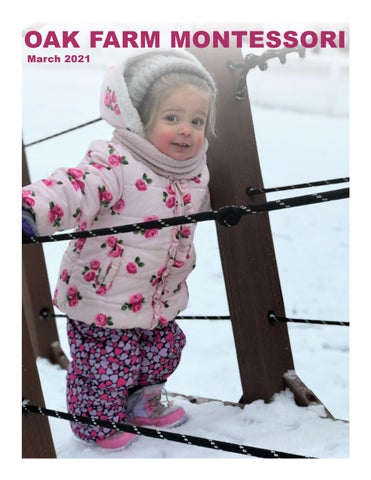
OAK FARM MONTESSORI March 2021
Each of these concepts is quite abstract for most students, but important in their understanding of the world around them. Maria Montessori created her methodology of teaching by isolating specific qualities in each of these four categories: Math, Language, Culture and Sensorial. She saw the importance of learning first concretely before moving to abstract. A child can touch the sandpaper of the continents on the land and water globe and call it ‘rough’, while also experiencing the ‘smooth’ property of the water characterized in the areas around the continents. Later, these continents are identified by name and then further categorized as land and water forms that the child creates by pouring water into molds to replicate the various formations. An island is land completely surrounded by water, while a lake is water completely surrounded by land. Dr. Montessori realized that these hands-on experiences would solidify the understanding and lead to deeper exploration of knowledge. When Jack moved from Primary to Lower, I saw how he built upon his math lessons with the beads and chains to conquer more complex division and multiplication work. As he moves through the levels at Oak Farm Montessori, these lessons will be the foundation for algebra and beyond! Learning within context helps our students become critical thinkers and lifelong learners.
Candice 2
HEAD OF SCHOOL
What is the difference between smooth and rough? How does an island compare to a lake? Why is a whole more than a third?
Give glass a chance... Brittani Russel, Toddler 1 Teacher Have you ever observed an Infant or Toddler environment and wondered why such young children are using glass dishes and cups instead of plastic? Montessori environments focus on learning through context instead of abstract concepts because children gain a deeper understanding when they are able to learn by doing. When you drop a plastic dish on the floor it responds much differently than the more fragile glass version. The Infant and Toddler environments are prepared with materials that have a built in control of error. What does this mean? A control of error helps children identify their mistakes and correct them without the help of an adult. Children learn how to “use two strong hands” and to “walk slowly” when they are carrying their dishes.There are many teachable moments that breaking a dish can provide. You can demonstrate how to move safely around broken glass, how to properly clean and dispose of broken glass, and modeling empathy to the child that glass does break and it is okay. There is no need for anyone to feel guilt or shame over breaking a dish. If it happens, we clean it up safely and try again. Glass cups and dishes can be introduced from the very beginning of self feeding; both at school and at home. Won’t you please give glass a chance? #supportourschool
learning
Hands on Tia Matney, Primary 1 Teacher
4
In the Montessori philosophy, a very vital part of the work and lessons revolve around the language of concrete to abstract. Montessori developed a set of manipulable objects designed to support children’s learning of sensorial concepts such as: texture, color, shape and dimensions, as well as academic concepts of: mathematics, literacy, science, geography and history. The children learn components of these areas by engaging with hands-on materials. They are able to use their five senses to help them take information from the world around them and give language and meaning to these concepts. Because of these concrete materials, the learning that is taking place is often deeper and richer than learning in abstract contexts. For example, in the mathematics curriculum, quantities 0–10 and their symbols are introduced separately before being combined, and large quantities and symbols (tens, hundreds and thousands) and fractions are introduced soon after; all through concrete materials. Operations (addition, subtraction, multiplication, division,) are again introduced using concrete materials, which the child can choose to stop using when he is able to succeed without that concrete support. The bead cabinet is seen in classrooms from Primary through Upper Elementary and provides the mathematical foundation for students who need practice with manipulatives prior to the introduction of an abstract concept like squaring or powers. A key principle running throughout the design of these learning materials is that the child learns through movement and gains a concrete understanding with the aim of preparing him for learning more abstract concepts. One of the beautiful things about the Montessori materials is that most have a built in ‘control of error’ which alerts the child to any mistakes independently; thereby allowing self-correction with minimal teacher support. Through observations and lessons, when the child is able to show mastery of a skill, it also communicates to the teacher when the child is ready to move towards more abstract ideas.
#supportourschool
LEARNING IN CONTEXT Debbie Kovets, Lower Elementary 2 Teacher
As a student, did you ever ask yourself, “When am I ever going to use this? What does this really mean?” In the Montessori environment, application and concrete materials support the concepts that we teach the students. Work on the shelves provides the structure and vocabulary for outdoor exploration. The Timeline of Life is a visual representation of plant and animal life that evolved over time. The Six Kingdoms Chart provides the big picture of the scientific classification of all living things. The Animal Kingdom Chart allows students to begin identifying specific characteristics of vertebrates and invertebrate classifications. The Plant Kingdom Chart classifies plants according to their stems, seeds, roots, and flowers. These concepts of science are further explored in the extensive outdoor environment. Physical science, botany, and zoology are a strong focus of the lower elementary curriculum at Oak Farm Montessori. Puddles of water, shadows, wind, and sunlight provoke adventure and spontaneous questioning during free play and structured lessons. Science experiments provide the opportunity for students to discover the answers to some of their hypotheses and questions. Students collect seeds, investigate the structure of the seeds, and draw conclusions about seed dispersal. Identification of plants and their function in the environment also intrigues the elementary student. Animal tracks, scat, nests, and observation excite the children as they are learning who shares this amazing environment with us and how we all interact to learn from one another. Students learn that science is all around us and is used every day as we evaluate and reflect our place in the world. 6
3-Dimensional Learning Kim Davidson, Strategic Partnerships Director
I have often said, “If I could have learned in a Montessori environment, I would have had a completely different educational experience.” The concepts I learned throughout my education rarely had any real meaning; other than it was really important to memorize my multiplication tables and learn all the theories of geometry. My learning was very one dimensional and consisted of paper, pencils and a lot of erasers. Meaningful learning is a core principle of the Montessori philosophy, and so it makes perfect sense that so much of a student’s learning involves immersion. Whether learning algebraic equations with the binomial cube, botany lessons while observing in one of the many biomes on our campus, or basic business principles through the Middle School Micro-economy; Montessori students have many opportunities for enriching, immersive learning. These experiences are often the ones that students remember, parents value, and those new to the philosophy notice immediately. On our campus, we are fortunate that our faculty and students have daily access to a variety of resources and diverse natural environments. On our South campus, the Primary teachers have worked with our Eco-Literacy Coordinator and Outdoor Specialist as they continue to develop the KinderForest program. While developed for our Primary aged students, all classrooms use the woods and will have access to a proposed outdoor classroom structure that is the next phase of implementation. For our secondary students, our Erdkinder (children of the land) program at the middle school is foundational to the middle school experience through the simulation of a farm and micro-economy. Erdkinder provides opportunities for learning about, and how to care for, animals, biology, the greenhouse, the cycle of production for the micro-economy and understanding a balance sheet—especially when it doesn’t balance. Our high school students also have various opportunities to explore their interests and learn about business through Innolab, the Bike Shop or, for some, their own personal business. These are just a few of the ways our students learn in context. These programs incorporate many different aspects of learning life skills and important lessons in the context of real world application. When we say, “The world is our classroom,” it applies not only to the 150+ acres of our campus, but the ever changing global community that our students will impact and help develop in the future. If, like me, you believe that the Montessori philosophy provides the best foundation for lifelong learning in context, please contact me at kdavidson@oakfarmschool.com to find out how you can support Oak Farm Montessori School in their commitment to this value. #supportourschool
“To provide a Montessori environment that inspires children to reach their potential through meaningful work.” Oak Farm’s mission statement guides our decisions every day in the Upper classroom. How can we make work truly meaningful for our learners? When students have a personal interest in a topic, it naturally leads to deeper learning. They can make connections to prior knowledge and curiosity sparks endless questions. Each classroom at this level has a variety of learning topics because we are constantly striving for learning experiences to be meaningful to each child. Students often take the learning much further than the teacher could have ever imagined; it’s definitely not a ‘one size fits all’ approach. When thinking about learning situated in a meaningful context, it is important to base it on real-life experiences. This means allowing for the opportunity to happen at the right time in the right place. Students are motivated to learn and achieve to their fullest potential when it happens organically versus in a contrived environment. Learning that involves this cognitive process is meaningful and memorable. Some real-world examples of things happening in Upper right now would include: exploring human development by tracking a teacher’s pregnancy, going to see sandhill cranes during their migration through Indiana, or creating square roots on the patio using rocks and sticks. These opportunities also occur frequently in our science lab as well when Katie Lautzenhizer connects science to real life. “Education cannot be effective unless it helps a child open up himself to life.” Maria Montessori. The work we do each day creates new paths that lead to endless possibilities.
real learning Real life =
April VanOsdale & Liz Danielson, UE 3 Teachers
8
#supportourschool
A breath of fresh air
Oakleigh Butler, Middle School Math Teacher
As I arrived on campus for my first day as the new math teacher at Oak Farm Montessori, I’ll admit I was a bit nervous. My experience is from a traditional school system and I wondered what this Montessori-based school was all about. Regardless, I was eager for the new opportunities and journey upon which I was about to embark. My nerves, however, turned quickly into enthusiasm as I joined the OFMS family. My dream, from a very young age, was always to be a teacher. By the time I graduated from college and obtained my degree, I had come to realize that children have an innate sense of curiosity and wonder. Further, I wanted to be the teacher that might make a difference in the lives of my students by encouraging them to embrace their talents and develop a love of learning. Students should be eager to learn, cultivate their own interests, learn leadership skills and become independent, responsible and productive members of society. Lofty goals, but I felt I had the skills to pull it off! As a first-year teacher in a traditional school setting however, I found a lack of enthusiasm for learning for all but a few top students, a lack of respect for others, and a general malaise when it came to completing assignments; most considered them a part of the drudgery of “getting through school.” What I also found as a teacher was mandatory standardized testing to insure funding and a curriculum based on pre-approved traditional school lesson plans focused on rigidity and compartmentalized learning.
“The environment must be rich in motives which lend interest to activity and invite the child to conduct his own experiences.” - Dr. Maria Montessori Conversely, on my very first day at Oak Farm Montessori, I encountered eager, confident students with the ability to set their own goals, explore their passions and learn at their own pace. I realized that many of the concepts I was taught in college for engaging students, including differentiating learning and giving students choice, mirrored much of the Montessori philosophical principles. Principles that, sadly, seem to be missing in traditional teaching. Dr. Maria Montessori said that, “the environment must be rich in motives which lend interest to activity and invite the child to conduct his own experiences.” OFMS has that environment. I have been especially impressed with the micro-economy at the middle school and the many opportunities it gives to apply math concepts. The students sell farm produce, organize sales, determine how to raise money and, most recently, were able to use a recent lesson over percentages of increase and decrease to evaluate how much to charge per pound for the cow that was butchered. These types of math concepts will be invaluable to them as adults. This learning is meaningful to these young adolescents because the content is important to them. This is their work and their business. I have found this school to be a breath of fresh air, both literally and figuratively. The farm setting creates the type of environment that I believe Dr. Montessori envisioned. It is a place that promotes the joy of learning, values respect for others, and allows children to gain independence. As I mentor these amazing students, I have come to realize that my dreams to see students eager to learn indeed come true at Oak Farm Montessori!
10
Montessori • • • • • • • • •
Multi-age grouping Individualized curriculum Low student-teacher ratio One-on-one lessons Hands-on experiences Child focused Choices Freedom of movement Concrete to abstract
Traditional • • • • • • • • •
Grouped chronologically Grade level curriculum Larger student-teacher ratio Group instruction Textbook teaching Teacher focused Teacher guided Students work at desks Abstract and memorization #supportourschool
REGISTER ONLINE: WWW.OAKFARM.ORG/APPS/PAGES/SUMMERCAMP Held on the campus of Oak Farm Montessori School | 502 Lemper Road | Avilla, IN 46710
For more info. contact: Nicole Lowe nlowe@oakfarmschool.com 260.897.4270
CLOSED THE WEEK OF JULY 5TH 12
Express yourself Mindy Cox, Theatre Teacher
Theatre is one of the art forms that truly reflects life and society. It is exciting, as a new faculty member, to see the commitment Oak Farm Montessori School has made to offering theatre to students from elementary school on up. For me, one of the most important facets of theatre in a classroom setting is to encourage young people to think outside of themselves, think about the world at large, and their role in it; aligning perfectly with Oak Farm Montessori’s mission! With COVID restrictions this year, we have not been able to jump in as I would like; but, we are still finding ways to get the students on their feet and their imaginations rolling! Just this week, the lower elementary students are reading and re-telling the story of the Three Billy Goats Gruff. They listened to the story, did a reader’s theatre with a little twist to the ending, and soon our younger students will be acting out the play as the older students read! In addition, we are reading the same story from the perspective of the Troll under the bridge, and discussing how there’s always another side to every story! In the Upper Elementary classes, we are exploring improvisation and some reader’s theatre with the same twist: Little Red Riding Hood with the Not So Big and Not So Bad Wolf who really would rather be a kindergarten teacher. In our Opera and Musical “Imagination Theatre class, we recently discussed Vaudeville as does not a part of the American musical tradition. The kids put on their own vaudeville show, complete with become great singing, dancing, a puppet show, a comedy act, and until human even horse tricks!
beings, given the courage and strength, use it to create.” —Dr. Maria Montessori
I am looking forward to next year, where we can immerse our students in some theatrical experiences outside of the classroom. But, as we have all found ourselves a little more isolated in the past year, we are still finding ways to make connections and use theatre as a medium for expression and team building inside our classrooms at Oak Farm Montessori!
SELF RELIANCE, SELF DRIVE & GRIT Doug Desper, High School Teacher
The Question
Self-reliance vs. community? Or selfreliance plus community? There is no denying that much like the United States of America, Montessori was founded on self-reliance. Did you know that the original classrooms that Dr. Maria Montessori set up had all of the materials locked in a cabinet that only teachers could access? It was only after a teacher forgot to lock it at the end of the day that they paused to consider the effect of this decision. As they entered the classroom that morning and saw the open cabinet, they also observed students working independently, yet as a community; waiting for their turn to use a material and returning it to the cabinet when they were finished. Like the early settlers who had to adapt to a new land, grit and selfreliance led these students to determine their own path.
The Rationale
The role of educating children, whether it be parenting, home-schooling, public schooling, or private schooling 14
is to produce productive citizens that are self-reliant. Montessori education so beautifully provides this framework with peer mentoring, mixed age group classrooms and individualized lessons that meet the child’s needs. Community is woven into everything in the Montessori classroom. There are socratic discussions, community meetings, outreach in the larger community, care of self and others, care of the environment and a realization that each of us is part of the whole.
The Opportunity
“A Capstone Project is a multifaceted body of work that serves as a culminating academic and intellectual experience for students”, according to the Colorado Department of Education. Students at OFMHS, begin their own Capstone Projects as Freshmen and it culminates with a Senior presentation to the community. These projects reflect the individual interest of each student and define who they believe they want to be in their future. Each student is in control of their own pursuit; devoid of too much teacher directive or
parental involvement. However, it does require each student to reach out to a mentor, someone that is a professional or expert in the field the student has chosen to study in depth, and develop a working relationship. This brings real-life initiative to students, a skill that young adults need to develop and step out of their comfort zone to reach their full potential. It truly is a “capstone” to the quality education that is available at Oak Farm Montessori. The project, though, is not the real end product of the Capstone Project. The end product is the self-reliance, the self-drive, and the “grit” that each of these students develops as they work their way through the four year process of a project that is all their own. It is a project they have pursued because they chose it. It is a project that they have refined because they ran into roadblocks and had to problem solve to get around those roadblocks. It is a project that helps them define their future because they have a passion in the project they chose. And in many cases it is a project that gives something to their community that wouldn’t exist had they not pursued this opportunity with passion and desire.
The Outcome
Back to the initial questions: Self-reliance vs. community? Or self-reliance plus community? The latter, self-reliance plus community, presents itself as the true sense of a Montessori education, progress, possibilities, and potential. Not only for every graduate of Oak Farm Montessori School, but for the community that we live in, for the communities they will live in, and for our country as a whole. Let’s celebrate their accomplishments as we send them out into the world to forever shape the future. SENIOR CAPSTONE
The Senior Capstone focuses on the student’s long-term commitment to a personal passion. Oak Farm Montessori High School students must move outside the walls of the school and engage with the community. Two-year environmental or social-immersions in a community activity are an integral part of the curriculum. Each student keeps a portfolio of these community projects and gives a presentation of learning to the wider community in May of their Sophomore year and a more in depth presentation in May of their Senior year. Projects may take place on the OFMS campus, in the broader community, or in a digital context.
#supportourschool
Mark your Parent Teacher
calendars
Conferences
Virtual Early Childhood
Parent Event
march 18, 2021
Make up Snow Day
march 26, 2021
Infants & Toddlers
march 26, 2021
School open Primary - HIgh School School Closed Good Friday
March 1 1 , 2021 March 12, 2021
School Closed
april 2, 2021
TALL OAK FUND
SGO
VOLUNTEER
DAY OF GIVING
SUPPORT OUR SCHOOL
“To provide a Montessori environment that inspires children to reach their potential through meaningful work.”
Oak Farm Montessori School | 502 Lemper Road | Avilla, IN 46710 | 260.897.4270 | www.oakfarm.org