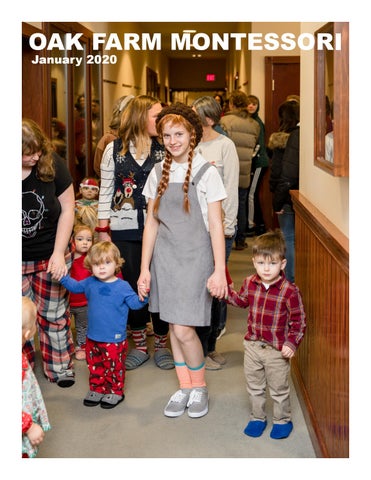
OAK FARM MONTESSORI January 2020
“What the new year brings to you will depend a great deal on what you bring to the new year.”
2 0 2 0
Vern McLellan This quote by Vern McLellan seems fitting to support this month’s theme of the newsletter: LifeLong Learner. It makes me think about how I am going to grow myself to be a better mother, a better wife, and a better Head of School. The following pages demonstrate how students are given the opportunity to build this, from within, across the levels as they are curious, critical thinkers, and problem solvers. I would like to use this as an opportunity to highlight what lifelong learning looks like for faculty as it is a core value at Oak Farm Montessori School that extends beyond the children and young adults. Did you know that Oak Farm Montessori School invests over $80,000 in professional growth for our faculty annually? We do this because we are committed to Montessori principles. We do this because we believe in empowering staff and teachers and support their personal and professional development. We do this because we believe in continuous improvement. We do this because we believe in promoting a culture that embraces a commitment to life-long learning. The investment to support life-long learning for faculty is much deeper than a financial investment; we also invest time and resources. We approach problems as creative opportunities by taking the initiative, identifying the root cause, and being active. We do this through collaboration and teamwork, by developing a strong staff culture, practicing Montessori values ourselves, and establishing external collaborations and partnerships (more to share about this in a future spring issue). We maximize each others strengths by respecting individual differences, encouraging individual thought and opinion without judgement, and developing a self awareness that encourages every staff member to utilize those strengths in their work; sometimes pushing each other outside our comfort zones in order to grow. We take on an experimental attitude, often leading to innovation by trying new Montessori approaches to increase learning and sharing effective practices. We not only learn from each other, but also discuss and learn from the methods of others as we strive to be a model of excellence (Vision & Values, 13-15). The core value and commitment of life-long learning that embodies the principles of Montessori by the faculty will continue to make an impact on your family’s experience for years to come. How will you grow your mind into the new year? Perhaps you “What the new year brings to you will depend on a great deal what you bring to the new year.” will get some ideas from the experiences shared with the children in this month’s newsletter? However you decide to spend your time growing, you will reap the benefits of that into the new year!
Candice
Cultivating an environment of
growth
Nefy Hathaway, Toddler 1 Teacher
Lifelong learning is critical in today’s fast-changing world. Learning is not only a matter of absorbing information, but a process of developing many other internal skills including: curiosity, perseverance, confidence, independence, intrinsic selfmotivation and the ability to challenge one’s self. Maria Montessori believed that skills such as these begin to develop at birth. From the time a child is born, he or she is learning every waking moment. Between the ages of birth to three years of age, a child learns at a rapid pace as more than 85 percent of his or her brain is being formed. By age three, the brain has established a pattern of processing information that will be used throughout his or her life. A child’s early experiences affect the quality of his or her whole being, creating a foundation upon which future development lies. As the architecture of the brain is formed between birth and three, a child’s early understandings are then ingrained, become instilled and then have life lasting effects. It is our work as parents and/or caregivers to nurture these characteristics in young children as they develop into lifelong learners. We can do so by asking and receiving questions, offering choices, encouraging curiosity and creativity, promoting problem solving skills, supporting their passions, guiding resourcefulness, exploring new places and creating new experiences.
organic learning Diana McCreery, Primary 4 Teacher
Lifelong learning is the “ongoing, voluntary, and self-motivated” pursuit of knowledge for either personal or professional reasons.
When we think about what we want for our children, many of us will say, “a love of learning!” Lorene Salsbery founded Oak Farm Montessori School 20 years ago with a vision. She wanted to create an environment where the children had the opportunity to not only be engaged with their learning, but to develop a life-long love for learning. She chose the Montessori method over other early childhood programs because it encourages in the child a desire to independently seek and create their own knowledge, rather than relying on others to just tell them the answer. In the Primary classroom environments we strive to construct our own knowledge. Yes, we have the initial presentations and aim for each lesson, but once the child feels successful with the work they are encouraged to explore adaptations or extensions from the original presentation. The focus and concentration it takes to carefully stack 15 knobless cylinders into a patterned tower is a powerful tool. He is learning balance, architecture, measurement, patterns, comparison and contrast all while ‘discovering’ how to keep the tower from falling over. The outdoor environment for the primary students is a blank canvas for learning! During exploration time at Kinderforest, a fallen tree becomes a train, airplane, bus, balance beam, and a weighing scale. The children are learning communication skills, math, and strengthening their gross motor skills, all while exercising the natural cause and effect of their interactions with nature. Each day at Oak Farm Montessori we present opportunities for learning; across various levels and ages. While the lessons and end products may look different, the joyful and engaged expressions found on the faces of our students exemplify what a lifelong learner looks like. The desire to learn starts young and only grows stronger with age.
Leading by example Michal Miller, Lower Elementary 1 Teacher
In Lower Elementary, students have reached a plane of development in which they greatly care about learning and discovering about the world around them. The elementary student is preparing to become a lifelong learner: a person who is eager to learn, discover, and explore new places, new things, and new ideas throughout their lifetime. As a teacher, this is quite exciting! What better way to engage a young mind than to ignite their interests and passions into studying the world around them?
Recently in our Lower 1 classroom, we invited our students further down the path of lifelong learning with our “Open Lab” opportunity. Students had been studying the animal and plant kingdoms in our Montessori culture work. Specifically, students had practiced and discovered the Montessori “Timeline of Life” and the “Tree of Life” as they explored and researched various living organisms. We then elevated the content studied in culture by digging deeper into Science and Engineering by following the Next Generation standards about students designing a model that represented a living organisms’ life cycle. Each student chose one organism to further research and then record the information they learned about their organism’s birth, growth, reproduction, and death. Each student loved researching their organism’s life cycle! After the research was complete, students developed a plan to create a model that effectively represented their organism’s life cycle. Next, the students invited guests to observe and assist them in bringing their work to life. It was wonderful to see the guests engaged in the student’s learning and designing! As our students demonstrate daily, being a lifelong learner isn’t hard, but it does take effort. So, what can we do to support our students so they continue to grow into lifelong learners? First, listen to your student’s interests and take the time to help them learn more about what they find interesting. Read books, watch documentaries together, travel, and explore together. Learn alongside your student and help them value the process of learning new things! Second, model for your student the importance of always learning and trying new things. Share with your child the ways in which you are learning and trying new things and what you get out of the experience. Finally, participate in as many opportunities to engage in your student’s learning at school as possible. Attend school events like our “Open Lab” and/or ask how you can support your student’s class in engaging in lifelong learning opportunities. We look forward to engaging in lifelong learning opportunities with you and your students soon!
Natural Curiosity Sandra Deacon, Upper Elementary 1 Teacher
The desire for lifelong learning is something that humans are born with, and something that we nurture in the Montessori classroom. Human’s curiosity and fascination with the world around us is most obvious when a baby becomes mobile and intently explores the world around her. In the Upper Elementary environment, we continue to foster this natural tendency by introducing students to areas of study that spark their interests and imaginations. Topics such as astronomy, chemistry, biology, phenology, meteorology, etc. allow students to delve into topics that they see in and that affect their daily lives. Students begin to make connections between all of the areas of their academics; learning how everything is interrelated. This is the age when they engage in deep thinking and their desire to ask and answer “Why?” is insatiable. Our job, as educators, is to teach them how to find answers and explore new and old points of view. How to think critically, and to continue to love the process of learning, without putting limits on them.
“We cannot know the consequences of suppressing a child’s spontaneity when he is just beginning to be active. We may even suffocate life itself. That humanity which is revealed in all its intellectual splendor during the sweet and tender age of childhood should be respected with a kind of religious veneration. It is like the sun which appears at dawn or a flower just beginning to bloom. Education cannot be effective unless it helps a child to open up himself to life.” Maria Montessori
POSITIVE DISCIPLINE
PROBLEM SOLVING
SELF-DISCIPLINE
RESPONSIBILIT Y
C O O P E R AT I O N CLASS SESSION DATES: Tuesdays: 1/14, 1/21, 1/28, 2/4, 2/11 & 2/18 TIME: 6:00 - 7:30PM COST: $25 / person or $45 / couple When your child was little it was easy to set boundaries; both physically and ethically. But what do you do when that Toddler becomes a troublesome teenager pushing back against every boundary put in place? Control! This is the reaction most parents have when confronted with these difficult teenage years. But what if exerting control only magnifies the resitance from the adolescent? Dr. Jane Nelson has created the Positive Discipline program that provides parents with a handbook of tools and real world examples that help foster mutual respect between you and your teen. Join Lower Elementary Teacher and Positive Discipline instructor, Ines Oldenburg, as she leads our Positive Discipline for Teenagers course at Oak Farm Montessori School. • Find out how to encourage your teen and yourself. • Grow to understand how your teen still needs you, but in different ways. • Discover how to develop sound judgement without being judgmental. • Learn how to get to know who your teen really is.
OPEN TO THE PUBLIC * REGISTER HERE * TEENAGERS WELCOME
The Greatest Teacher (hint...it’s not me!)
misty schoof, middle school teacher
There are five different strategies for watching the 22 hours and 30 minutes of the Star Wars movies. I have approximately 5 hours and 50 minutes remaining in the saga. Malcolm Gladwell shared that “researchers have settled on what they believe is the magic number for true expertise: ten thousand hours” (40). Although I am a long way from being a Star Wars expert, I have unknowingly rejuvenated my love of learning. The epicenter of my newfound interest began with a paper plate full of turkey, mashed potatoes, green bean casserole, sweet potato casserole, and a dinner roll (it was a big plate). I was sitting across from my younger cousin Tyler, who had an equally full plate of food. Tyler and I both love food and Tyler also loves Star Wars. I, on the other hand, had only watched a few of the movies. We talked while emptying our plates and our minds only to fill them up again. Later that evening, I learned that my mother-in-law purchased Disney+ and [insert angels singing] I now had unlimited access to all 22 hours and 30 minutes of Star Wars entertainment. For every learner, there is an epicenter, a spark, that fuels their interests. Once that ignition happens, there is a burning desire to know more and the foundational awareness that you don’t know enough. Life-long learners have the humble knowledge of their deficiencies. They fully understand and embrace the belief that they are unfinished. They are not there yet. Their “there” isn’t a location or the top rung of a ladder. They are introspective droids who can compute a shortcoming in their software. Once a learner recognizes their knowledge-sized crater, they begin filling it with practice, failure, and growth.
The earthquake of learning ripples into countlessly quantifiable hours of work. The Jedi must sit, legs crossed and eyes closed, clearing their mind and opening themselves to the connectedness of the universe. Regardless of the skill being mastered, the practice is all consuming. Stephen King said, “By the time I was fourteen… the nail in my wall would no longer support the weight of the rejection slips impaled upon it. I replaced the nail with a spike and went on writing.” (41) Before he became a published author, Stephen King was a teenager with a book of “no thank you” letters bound together by a spike. Setbacks give learners the perseverance to master a skill: to sit in the dark 8,769th hour and know its worth. As learners reach those 10,000 hours, they cannot settle into their mastery. The aftershock of expertise is reflection and momentum. In the book Educated, Tara Westover said, “When I was a child, I waited for my mind to grow, for my experiences to accumulate and my choices to solidify, taking shape into the likeness of a person. It was only as I grew older that I wondered if how I started is how I would end-if the first shape a person takes is their only true shape” (327). A life-long learner knows that self knowing is complex, a shade of deep gray. They need to know that the first shape they’ve inhabited is only a shadow of who they can become. Venturing to a new planet in the galaxy doesn’t erase the previous worlds; it sharpens them. As an educator with over 8 years of teaching experience, I have exceeded Gladwell’s threshold of mastery. With approximately 11,520 hours of expertise, I have learned that learning is a balance of discovery, trial, lots of errors, and reflection in failure. Life-long learners have the grit to master a skill and the bravery to advance into a new one. In the movie The Last Jedi, Yoda said, “Pass on what you have learned. Strength, mastery, hmm… but weakness, folly, failure also. Yes: failure, most of all. The greatest teacher, failure is. Luke, we are what they grow beyond. That is the true burden of all masters.”
1. Information obtained from the quora.com article “How long would it take to watch the Star Wars movies in chronological order? and the mentalfloss.com article “5 Theories on the Best Order to Watch the Star Wars Movies” written by Sean Hutchinson on June 22, 2017. 2. Quote obtained from the book Outliers by Malcom Gladwell. 3. Quote obtained from the book On Writing by Stephen King.
Life long Learning: At the Heart of Seconary Bonnie Bloom, Creative Media Specialist
You may have heard about the Portrait of an Oak Farm Montessori graduate, but did you know that these same characteristics are part of the profile of Professional Excellence for Montessori Teachers? The same four characteristics: Life-long Learner, Emotionally Literate, Leadership, and Global Citizenship are all part of what shapes an Oak Farm educator as outlined in our Vision and Values book. Written by our Founder, Lorene Dekko Salsbery, and then Head of School, Judith Cunnigham, in 2008, our Vision and Values book defines and describes the “core values” that shape Oak Farm as an organization and a community. So, how is the Secondary staff embodying these core values in the work they do with our Secondary students? Oak Farm’s Secondary staff includes Middle School and High School teachers, and Secondary Director, Bridget York. In the past year alone, the Secondary staff has gone to training both in state and out of state, participated in professional development opportunities, and done their own research on topics of interest ranging from metacognition to birds. They choose to pursue a path of life-long learning and they are bringing this to classrooms across Oak Farm’s campus. Jenn Jordan, High School Lead Teacher, writes: “This summer I attended a College Board training. I learned about how to teach AP Seminar while there. This course emphasizes critical thinking and research methods, two skill areas that we already incorporate into our curriculum here at Oak Farm. By offering our students the option of stretching themselves to do college level work with these skills, we are helping prepare them for adulthood, regardless of the obstacles they encounter, as well as offering them a chance to earn college credit while still in high school. Next summer, I am attending another training in order to offer AP Research to our students as well. I’m looking forward to offering our students the opportunity to take these classes because, unlike many AP courses in these classes, students are able to choose their own topic which fits very well with our Montessori philosophy.” I (Bonnie Bloom, High School Creative Media Specialist) also attended AP training over the summer. I attended the Pathway/Infosys Summer Institute at the University of Indiana-Bloomington where I became certified to teach Code.org’s AP Computer Science curriculum. This training includes monthly professional development workshops throughout the school year. This allowed us to offer AP Computer Science as a new course for our High School students. I have loved deepening my skills in tech. Secondary Math teacher, Doug Desper shares, “I attend the AP Calculus conference each year to get updated information on the curriculum expectations for students in AP Calculus AB and AP Calculus BC. It is also a great place to exchange project ideas for applications to Calculus and to build relationships among colleagues across the state.”
Bridget York participated in an American Montessori Society accreditation team visit to Darmascotta Montessori School in Nobleboro, ME where she was able to observe their Erdkinder program and talk to their Middle School students about their micro-economy program. This professional development and networking opportunity allowed her to deepen her knowledge of Montessori and build professional connections for our faculty and staff at Oak Farm. This aids her work both as Secondary Director and Director of Curriculum and Student Services at Oak Farm. She brings this knowledge back to our campus where she meets with teachers, like new Middle School Language Arts teacher, Misty Schoof, who writes that her professional development includes working closely with Bridget on planning Middle School English curriculum and understanding summer reading material. High School English and College & Careers Teacher, Rikki Colon attended the National Association for College Admission Counseling (NACAC) conference in September. The three day event hosted over 6,000 college admissions specialists and high school counselors. At the conference, Rikki “gained a better understanding of the admission process, what colleges are looking for in prospective students, and the importance of a well written school profile.” In addition to developing her skills as a College & Careers educator, Rikki is doing a study on metacognitive strategies in her spare time. She writes, “It is proving useful as I grow in my awareness of how to assess a student’s level of mastery of a given topic.” Secondary Science teachers, Wesley Kromer and Heather Lemmon both developed their knowledge base at interesting workshops and trainings. Wesley attended the Flying WILD workshop where he “learned new models and explorations for teaching environmental science with a focus on birds.” He notes that this will “feed my ability for sharing with others my passion for environmental caretaking.” Heather recently completed the Cincinnati Montessori Secondary Teacher Education Program. She brings the skills she gained at this program to her classroom everyday. She is currently reading the new edition of Montessori: The Science Behind the Genius and says, “This is helping me as an educator by learning more about why we do what we do and how to do it best.” Heather is also enjoying our all Secondary professional development, a year long deep dive into improving executive functioning skills in our students. At our monthly staff meetings we discuss a new aspect of executive functioning skills. Heather says, “I learned how the emotional needs of students can drive so much of their functioning from this group learning work we are doing.” Finally, Jon Agler Secondary Business and Middle School Humanities teacher flew out to Colorado to attend training at Barnett Bicycle Institute, where “bicycle mechanics is a science, not an art.” Barnett’s provides professional-grade technical education and Jon learned about the methodology and measurable, repeatable processes behind running a bicycle shop. He is putting these new professional skills to use with High School students at the Oak Farm Bike Shop. Life-long learning clearly forms the heart of Oak Farm’s culture!