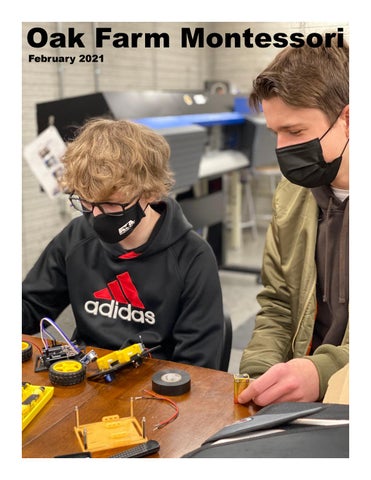
Oak Farm Montessori February 2021
The first time I showed Jack how to tie his shoes he was a bit timid. We would continue to practice together, but he didn’t have his “Ah-ha” moment until his same-aged cousin from Ohio showed him how she tied her shoes. After observing, and then practicing himself, he now confidently, and independently, can tie his shoes. As you read through how collaboration looks at each level of our school, I hope you will see how this skill builds upon itself; culminating in what we call the Portrait of a Graduate. Learning from and with peers may be a principle of Montessori education, but it is also the most relevant and tangible way each of us has to master a new skill, whether you are three or 103.
Candice 2
HEAD OF SCHOOL
Imagine accepting a new position without any training or instruction. How would you be successful? Where would you turn for help? Most of us would seek out someone who had previously done the job or had experience in the role. Students at Oak Farm Montessori School rely not only on the teachers for instruction and knowledge, but also their peers. Walk into any Early Childhood or Elementary classroom and you will see student observers. “May I watch you do that work?” Intuitively, these students know that the best way to learn a new skill or concept is to watch someone else complete the work. Not only does this build excitement for what is to come for the observer, but the student modeling the correct use of the material enjoys confidence building and value as a contributing member of the community.
Learning language with others Sarah Holland, Speech Language Pathologist
The understanding and use of language, like many areas of development, is typically learned from, and with, others. We do not come hardwired with tools on how to communicate; we learn from hearing others use language. Speech and language development starts at infancy and continues to develop and be refined through adulthood. • An infant sees a peer smile and smiles back. This is language development! These infants just expressed an emotion. They imitate each other’s gestures and sounds. • A toddler hears one of their peers ask for “more orange” and sees that peer receives an orange. This toddler then says, “more orange”. This toddler just learned that their words are powerful.
“The development of language is part of the development of the personality, for words are the natural means of expressing thoughts and establishing understanding between people.” ~Maria Montessori
• A preschooler hears the teacher ask them to “put their snow pants on before their boots”. This preschooler starts to put on their boots, but sees classmates putting their snow pants on first. This preschooler just learned the meaning of “before”. • An elementary student hears a couple peers resolving a conflict by expressing what happened and how it made them feel. This elementary student then later uses the same script in their own conflict resolution skills. • In adolescence and adulthood, a student hears a peer use a new, fun word and begins to use that word. One of the many beauties of our Montessori classrooms at Oak Farm Montessori School is the range of ages within the class. The classroom environment provides students with a variety of speech and language models. The opportunities to hear language used by peers and teachers is endless. Language is constantly being modeled and learned; how are you learning from others? #supportourschool
Me and my shadow Devon Crouse, Primary 1 teacher
Walking into a Primary classroom for the very first time can be exhilarating, wondrous and a bit overwhelming for a 2.5 year old child (or an adult). There are so many interesting materials on each shelf that fill the room and create this magical space for a young child to explore; but, where do you even begin? However, for a second or third year primary student who has navigated this space for several years, knows how the room is organized, where its proper place is maintained and has mastered all of the routines and rituals, the environment seems like home. Now all you need to do is introduce the two and watch the magic unfold. At first, the third year student may seem to have a shadow for a few weeks or months. The first year student is watching, observing and absorbing every move the older friend is making; perhaps still not ready to try it on their own. Slowly he/she begins to feel more comfortable walking around the room and using a few of the works that their classmate has presented to them. One of my favorite moments in a primary classroom is when a student says to another, “Do you want me to give you a lesson on that?” The second or third year student has become so confident in their ability that they become the teacher. How much fun is it to have a lesson from your peer? The coolest! The first or second year student is engaged, focused and excited to learn from their new friend and think of the pride instilled in that new “teacher”! By the second half of the school year, the two are now exploring and experimenting together. Both have played such an important role in the success of their classroom and individually. This is the magic of having the three year cycle and peers collaborating in our environments. This process of observation, practice and teaching continues year after year; giving the children an opportunity to take on all of the roles and experience the satisfaction in completing the cycle. What a wonderful way to learn and grow in this community of ours! 4
#supportourschool
OFMS
PEER MENTORING at 6
Probletunities to the rescue
Meghan Dohring, Lower Elementary 3 Teacher
When walking into a Montessori classroom there can be a steady buzz of sound or even a roar. You might hear, “What if you presented it this way?”, “How do you think it might be spelled?” While these questions sound like something a teacher might ask, and they do, more often than not, these are questions you will hear students asking other students. What an opportunity to have within their daily classroom experience! A multi-tiered classroom lends itself to peer teaching or tutoring, imitative learning, and group collaboration. Our students are ready to help a friend when they might be stuck or fill in the blanks about a missed lesson. Often as teachers, we make sure students have already asked a friend prior to seeking an answer or help from us. This encourages them to be independent, collaborative and intentional. Not only is the student with the question learning, but the student who holds the answer is also showing their mastery of a skill or also learning something new from the experience. While giving lessons or watching a student complete a work, I often see what I refer to as ‘drive by learning’. Something within the lesson or work presented has piqued a student’s interest as they are passing by. A student might hover for the remainder of the lesson or return to ask the student who is working to explain more about their work. That student might then go back to their own work or try out what they
heard or saw the other student working on. It’s really rewarding to see that the excitement a student has about being invited to a lesson is a direct result of watching a classmate previously do the work. This experience leads to intrinsic motivation within that child and lights a spark of learning within them. Students love to work together on projects. One of the first things the students ask after a lesson is if they can do the work together. Not only do the students learn together, they will teach each other, and do some great problem solving. They incorporate compromise, listening, and planning. The pride that students have when the work is finished is just the icing on the cake. (Maria Montessori called this ‘process’ over ‘product’.) During community time students are given time to present what our classroom refers to as probletunities; problems that are an opportunity to learn. Every student who has a solution is heard and then the community chooses which solution they would like to try. At times a solution might be just what the community needs. Other times...it might be a complete failure and the students go back to the drawing board. This problem solving collaboration leads to more buy-in from the students, critical thinking, and an opportunity to fail in a safe place. So the next time a problem arises at home, don’t jump in to solve it; see what solutions your child or children might have. You will be surprised by their brainstorming and solutions.
#supportourschool
8
DIAPER DRIVE The high school students have decided to host a diaper drive to help an organization called YoungLives. All donations made will be given to teen moms to help aid their financial burden.
Collection Dates: Feb 1st- Feb 12th
Donations can be left on the front porch of the High School during school hours
All sizes of diapers are welcome!
Help us reach our goal of 1,500 diapers!
Please email Mariah Clark at mclark@oakfarmms.com with any additional questions #supportourschool
Lead by example Nicole Lowe, Community Relations Liaison
N
ot every opportunity to learn is presented in the classroom or even by someone with the title of teacher. Some of us learn to cook in the kitchen with grandma, change the oil in the car with our father, or learn by working alongside our colleagues in the same profession. In 2020, people in all professions had to learn to be creative, innovative, and strategic as the world responded to a pandemic. Out of this difficulty came the opportunity to adapt and grow as individuals, families, and organizations.
10
Peer learning happens organically on our campus daily with Montessori multi age classrooms. In the field of medicine, where my personal profession began, we referred to it as “See one, Do one, Teach one”. First you would watch the surgeon close the chest, then you would close the chest under supervision, and finally you would teach someone else to close the chest. In the classroom setting, it may be a first year asking a third year student for help with their animal care chore that he has just been assigned. Peer learning is mutually beneficial and involves the sharing of knowledge, ideas, and experiences. Whether you are a child or an adult, the person doing the teaching in that instant feels a sense of accomplishment and knowledge, and the person learning feels engaged, respected and valued. At the secondary level, community meetings and seminar give students the opportunity to explain their ideas to others and participate in activities where they can learn from their peers. They learn to collaborate together, give and receive feedback, and evaluate their own learning. These experiences between individuals move learning forward from independent to interdependent learning. Students at Oak Farm Montessori School are not the only ones encouraged to be lifelong learners, it’s also a pillar of our Portrait of a Teacher. Our teachers continue to grow their personal passions and deeper knowledge of the Montessori philosophy and then share it with students and peers. Through grants and fundraising, OFMS has access to $80,000 annually. These funds are available to faculty to immerse themselves in online courses and in person around the country. Over the years some of the programs brought back to our students include: Biliteracy, Project Learning Tree, Business with Bicycles, Montessori certification, and Positive Discipline training; all with direct impact on our students and faculty. The learning doesn’t stop there! Our administrators are also committed to growing alongside our teachers and students. As our school increases in number of students, buildings, and acreage, they are working to ensure the viability and stability of the school for years to come. Many hours have been spent in training for the launch of our new website and management systems, implementing a donor database software program, visiting other elite Montessori schools to see how our peers navigate growth, and much more! I have often wondered how my path brought me to OFMS, and the answer is simple... “Be willing to change, to learn, to grow”. I left the medical profession to meet the needs of my family, later, an opportunity opened at OFMS where I could grow and connect to a community while helping it become sustainable for the future. At OFMS, I have learned to grow, both as an employee and as a mother, and nothing makes me more proud than to support this school with my time, talents, and treasure. To find out how your you can make a difference and sustain the future of OFMS, visit our website or contact Kim Davidson or Nicole Lowe. #supportourschool
12
Working Together April VanOsdale, Upper Elementary 3 Teacher
There are many opportunities for students to collaborate in their learning throughout the day. In the Upper Elementary classroom it is encouraged to think first as an individual, and then to bring those unique thoughts together with the community to create a solution or presentation of learning. Our multi-age classrooms at Oak Farm Montessori lead to countless possibilities for collaboration when the creativity of many different views are presented. At the elementary level, collaboration is not only a choice when chossing work, but a need. Our students work together to save animals, find ways to recycle, research countries and their cultures, dive into history and also play. Play? Yes! Collaborating during play is just as important as collaborating academically as they start their transition into adolescence. Questions you are likely to hear include, “How can we include everyone?”, “ What are the agreed upon rules?,” or “What do we do if there are differences?” Setting the stage for this type of learning with peers is important. Making sure that all students have an opportunity to be heard and respected in the community makes them feel safe and valued; ideas are freely shared. Sometimes though there is a need for constructive feedback, from or with their peers, this is where the teachers step in to support and model this important tool for communicating. Student work can be found displayed all around our classroom. This provides opportunities for the interested student to ask questions of their classmate to understand the thought process or learn more about the project. It also provides a way for the student who did the work to become the expert on the topic, showing mastery and building confidence. By reflecting on the steps they took to solve a problem, or the reason behind a text caption, students can make their learning visible to others. In a collaborative classroom, students learn both from their peers as well as their own research and understanding. #supportourschool
Math + Collaboration = Doug Desper, High School Math Teacher
problem solving
Last year in the April newsletter we asked the questions: “What is Calculus?”, and “When is Calculus ever used in real life?” These are still great questions, and the answers continue to increase at a faster pace each year. Calculus, in its most basic form, is a method for computing the rate at which something is changing; a method for finding maximums and minimums to various scenarios, as well as a method for accumulating total amounts in which variables are continually changing. These applications are used on a daily basis today in the disciplines of architecture, engineering, graphic arts, biology, chemistry, physics, astronomy, medicine, pharmacology, business, manufacturing, banking, and economics. In our current world we have been dealing with the Coronavirus pandemic; in particular, the rates in which the virus has spread throughout various parts of the world, how infectious it is to people of different blood types, how it affects people with different health issues, how deadly it can be to different age groups, in the development of vaccines, and in the distribution of the vaccine. Calculus has been an integral part in finding solutions to all of these issues related to the Coronavirus in the collaborative fields of biology, medicine, pharmacology, chemistry, physics, and manufacturing. The key word here is “collaborative”. Professionals from these disciplines are all working collaboratively to find solutions that are needed to get society back to a greater sense of normality. With all of that said, it is critical to know that here at Oak Farm Montessori School, in our mathematics classes, students are encouraged to collaborate to find solutions to problems. Not only are they encouraged to collaborate, they find that it is imperative to collaborate to find solutions to the most difficult real-life problems that are presented to them in class. As students continue to take higher and higher level mathematics, they find that mathematics cannot stand alone in solving real-life problems. Knowledge of other fields of study are 14
essential to understanding and solving these real-life problems. Currently, we see professionals from the previously mentioned disciplines of biology, medicine, pharmacology, chemistry, physics, mathematics, statistics, and manufacturing all working tirelessly to find the needed solutions to the current pandemic. What do we see here at OFMS that prepares students for that collaborative work experience between disciplines? First, all mathematics classes incorporate applications to various professional work careers. Those applications become more complex and more interwoven with multiple disciplines as students move up to higher and higher level mathematics. Second, we are continually looking for curricular situations that encourage and even require integration of multiple disciplines. These collaborative problem solving opportunities require two elements from students. The first is a mastery of the underlying mathematical skills (which is required at all levels of mathematics at OFMS) needed to solve the problem. The second is the ability to integrate all students’ individual background knowledge needed to collaboratively address the real-life problems that are presented to the students. This is the arena where true problem-solving skills are developed and where students get the opportunity to experience success in the collaborative work of individuals with diverse knowledge and educational backgrounds. This is the goal of mathematics here at Oak Farm Montessori School; developing students who possess a wealth of higher level mathematical skills and can effectively work with others to integrate their knowledge and insight to become the problem solvers of tomorrow. These students will be the ones that find the solutions to real-life world-changing issues of the future.
Mathematics is not about numbers, equations, computations or algorithms: it is about understanding. ~William Paul Thurston #supportourschool
Mark your
calendars
Moving Up to Lower
february 4, 2021
School Closed
In-Service
February 12, 2021
School Closed
Mid-Winter Break
february 15, 2021
Virtual
TALL OAK FUND
SGO
VOLUNTEER
DAY OF GIVING
SUPPORT OUR SCHOOL