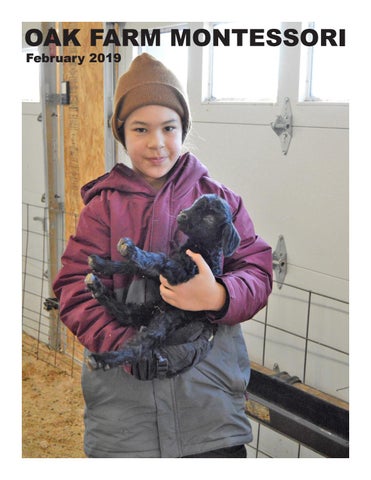
OAK FARM MONTESSORI February 2019
Loss Celebration
Coming Together in and
I have had the opportunity to not only feel our Oak Farm Community come together, but to experience our Oak Farm Community come together. Not once, but twice in one month; both in loss and in celebration. I could not feel more blessed to be part of this Oak Farm Community. Together we are Oak Farm STRONG and we have demonstrated that over and over again! Our first experience together began in the middle of the night, early Thursday morning on January 31, at approximately 2:30 a.m., when Oak Farm received notification that an alarm was going off at the middle school. It was signaling a fire, but that was because there was so much water being released from a frozen sprinkler pipe that had burst in the attic. With the point of origin at the top of the house, the water had nowhere else to go but down. All. Three. Levels. There was an estimated 4 inches of water in the basement by the time it was turned off. As a result of the water damage, floors had to be removed, drywall and ceilings had to come out and every belonging had to be stored. Fortunately, some of the original wood of the house was saved and can be preserved. We can also use this as an opportunity to restructure the layout in parts of the house to enlarge rooms for our growing middle school community and make improvements where needed. Most importantly, no one was hurt and the loss experienced at the middle school were physical items that can be replaced. The water damage at the middle school has been sad and discouraging. However, the middle school is not what defines Oak Farm; it is the people in our community that do. These people are committed to inspire children to reach their potential through meaningful work, regardless of the building they occupy. The sadness and loss that we have experienced is a part of our story, how we choose to fill the remaining pages is up to us. We, as a community, have decided to live each day through this mission with the children of Oak Farm. The amount of support from the Oak Farm community has been overwhelming. In the face of adversity, our community has been resilient. Oak Farm High School was positioned to welcome the middle school students to a beautifully prepared learning environment with the least amount of disruption possible for all students. The students, families, and faculty have come together and embraced this new challenge to start a new normal for as long as needed.
“It was a day of varying emotions, but it ended with such a feeling of accomplishment, support and gratitude (and maybe exhaustion)!” -Lauren Moyer Our second experience together was much more enjoyable and occurred late Saturday evening on February 23rd, at 6:00 p.m., when 345 Oak Farm supporters came together to celebrate “The Greatest Story, Let it be Told!” at the 12th annual Tall Oak Gala. For the first time ever, the event was sold out and accomodations were made to add 80 more guests! Together, we raised over $146,000...$21,000 over our goal! The generosity given by the community allows us to continue Lorene’s legacy through the support of the overall operations of the school. There was laughter. There were tears. There was dancing. There was music. There were new friendships made and memories that will last until we come together again. The Tall Oak Gala was an evening to remember as we came together to celebrate Oak Farm’s history; how Oak Farm came to be, what we have accomplished and where we are going in the years to come. No matter the reason for bringing our community together, I know we will do so collectively with grace and support of one another. Each individual moment is a part of the story of Oak Farm, our story, and I am grateful to be writing it with each of you!
Candice How is it that a school fundraiser ranks as one of our favorite evenings of our year? It’s because the Oak Farm Gala is so much more than a “school fundraiser.” It is a celebration of all things Oak Farm! It is coming together as a community, laughing with long-time and new friends, crying happy tears as we see pictures and video of all of the wonderful opportunities our children experience at school, and it is an occasion to show our appreciation for all of the blessings Oak Farm brings to each and every family. We are grateful to be a part of “the greatest story ever told.” ~ Cara Kaiser
The Greatest Story…Let it be told Transitioning Leadership from the Founder to the Next Generation Featuring, Judith Cunningham, Head of School 2007-2013 I hope that you all enjoyed the great memories shared by our parents, both past and present, in our January issue! This month, I am excited to continue our walk down memory lane by sharing the insights of Judith Cunningham, the school’s third Head of School (2007-2013). Judith worked closely with Lorene as she transitioned away from her daily work with the school to have time to heal her body from her recent bout with cancer. Judith’s time at Oak Farm was expected to last approximately two years to allow the healing needed for Lorene to re-engage in the school. Kim Davidson, Director of Strategic Partnerships Judith Cunningham, currently lives in Rome, Italy to be near her daughter and grandchildren where she continues to oversee the Model Montessori United Nations program. She shares her first memories of learning about Oak Farm: “On a beautiful wintery day in Toronto I received a call from David Kahn telling me that Oak Farm needed a Head of School while the founder and current head recuperated and got well. Toronto was much more appealing to me than the pictures I had seen of Avilla on the internet, but after about a month of back and forth with David, I ultimately agreed to a phone call with Lorene.” That phone call in early 2007 was the beginning of an adventure that would take Cunningham and her husband, Michael, from the big city of Toronto, Canada to rural Avilla, Indiana. Judith recounts her first impression of Lorene, “Within the first few moments of speaking to Lorene I was captivated. As she spoke of her vision for the school, her understanding of the value of a Montessori education and her willingness to fight the odds by establishing the school in Avilla. I felt as if she was paralleling the life of Dr. Montessori. Lorene explained that she wanted to benefit the children of the families that had worked for Group Dekko, rather than take the easy path of establishing it in Fort Wayne. Dr. Montessori did not take the easy path either. She defied convention by working to help the untutored children of workers and their success led them, and her, to new opportunities. Lorene had that same vision for the children of northeast Indiana. ‘Oak Farm,’ Lorene said, ‘can open doors they cannot reach on their own by providing them quality Montessori education.’ ” The conversation was one that Judith recounts like it was yesterday and one that ultimately led to her first trip to northeast Indiana. “Lorene said that she set her sights high, but that she was also a realist. She knew that building Oak Farm in her vision was a struggle and felt that the struggle had led to the exhaustion that had lowered her resilience and knew she needed rest to recuperate from her illness. She stressed that whomever joined her needed not only to understand her vision, but also needed to be willing to take the challenge of continuing to follow the path she had set. Because of her caring vision, her realistic approach and her humor, she was winning me over, and I agreed to meet with her for an interview.” On the flight in June 2007 to meet her, I began to have second thoughts. I feared that a small-town could have such a strong local community that it would keep such a different concept for school from being successful. But moments after Lorene met me at the airport and we began our ride to the school, those doubts left me. Lorene was not only a visionary, she was a natural, inspiring leader.
As soon as we arrived at Oak Farm and I saw its welcoming beauty, and met the staff Lorene had picked, I knew the school was on a path to success. I knew that if Lorene’s vision could be followed and fulfilled, Oak Farm would indeed become recognized as a premier Montessori school. As Lorene guided me through the building, pointing out all the wonderful details she had put into the current buildings and her plans for the other structures on the grounds, I began to understand and appreciate the full scope of the challenge she had taken on. When I remarked on the beauty of the environment she had created, she admitted, “It hasn’t been easy. When it hasn’t given me tears, it has given me wonderful smiles. But there is a lot to be done.” Then, in her relaxed, but matter of fact way, she said, “Let’s talk.” It was not a traditional interview. It was more like two new colleagues sharing a dialogue as they learned more about one another. Lorene shared her expectations, wanting someone that could follow the path she had set. I told her the only way I felt she could achieve that goal would be if she was willing to be available as a sounding board. That she could remove herself from the energy expending toil of daily administration, but for her to achieve her vision, she needed to be an advisor to the Head of School, no matter who she selected. As the interview came to an end, she reached into her purse and handed me her car keys. “Take my car,” she told me. “Drive around the area and drive over to Fort Wayne.” She wrote down places she thought I should see in Avilla and Fort Wayne. “See the sights,” she told me, “but also speak to the people.” She flashed a smile that warmed my heart. “I want you to know if you think you can be happy here. It should only be for a year or two, while I recuperate. And of course, bring your husband as soon as you can. We need to know he’ll be happy here too.” That’s the gracious, caring and kind woman Lorene was. With that interview and visit, Judith accepted the role of Head of School. A role that was not only important because of the vision she was to carry out, but also because under her leadership, the school would transition from founder to first generation leadership.
Judith Cunningham Head of School 2007 - 2013
As the “year or two,” grew into still more years, Lorene and I continued on the path we had agreed upon. I never made a major decision without consulting her, and she always said, “You don’t have to ask me, you know the plan.” But I knew she enjoyed the consideration, and now as her Head of School, I wanted to make sure we were following her vision. In my second year at the school, it became obvious that her health might be failing, so I suggested to her that we write down her thoughts. Under the leadership of the board, we created a book we called, “Visions and Values for Oak Farm” When it was completed, we both sighed with relief. “This is as good a roadmap as I can give the next generation,” she told me, and she thanked me for my help. The “Vision and Values for Oak Farm” was approved by the Board of Directors on April 9, 2009. Little did Judith and Lorene know the timeliness of that document. On December 15, 2009, Lorene unexpectedly passed away. Judith, living up to her promise, continued to serve as Head of School until 2013. We want to thank Judith for taking the time to share her experiences as she transitioned into the first Head of School without the partnership of our founder, Lorene. Please stay tuned for next month’s newsletter where we will highlight the best and first memories from across the years!
Sign Language Ashley Knudson, Infant Teacher
Most children begin to talk around 12 months old, but infants and toddlers try to communicate much sooner. Before they learn to speak, it can be difficult to communicate with your child. Teaching basic sign language may offer a way to help them express their emotions and needs peacefully while also developing a connection with others. Every child is different, but if you sign consistently and often, you may see your child start signing back around the time they start waving hello and goodbye. If you think about it, that is also just a simple sign! Here at Oak Farm one of our many expectations is to meet the needs of each individual child through joy and love. By helping them communicate their needs and feelings through a positive connection, it helps them become less frustrated as they begin speaking. Some opportunities where we encourage sign language throughout our day include: during meal time, toileting, while presenting some lessons, and communication with friends. We use basic signs such as “yes”, “please”, “thank you”, “more”, “eat”, “help”, and “all done”. If you are interested in learning some basic signs to help communicate with your young child, reach out to us; we have helpful hands that we would love to share with you!
Education — we are ‘everlearning,’ every moment of time, everywhere, under all circumstances something is being added to the stock of our previous attainments. Mind is always at work when once its operations commence. All men are learners, whatever their occupation, in the palace, in the cottage, in the park, and in the field. These are the laws stamped upon Humanity.” – Edward Paxton Hood
Creating a Life Long Learner Tia Matney, Primary 1 Teacher
Here at Oak Farm, we want the students to understand that a Life Long Learner may look like many different things throughout one’s life. We show them that a ‘learner’ can develop from many different professions and that people of all ages and backgrounds can play a variety of roles in their education. It is a passion for learning that can empower them to fulfill their greatest potential and follow their dreams. During the month of January, we had a nurse come into the Primary classrooms and talk with us about the importance of staying healthy. She gave the students a lesson about what a “germ” is and how we, as a community, can stay healthy in the classroom, as well as at home. The students did an experiment with her and were able to see, under a black light, germs that were still present even after washing their hands! They were taught to wash all parts of their hands, wrists and fingernails for 20 seconds. They even learned a catchy song to remember why it’s important to have clean hands. During the coming months, we will continue to invite members of the community to come into the classrooms to give short presentations about their professions and explain how they are still continuing to be a Life Long Learner. It is our goal to teach the students that learning is a never ending process; one that grows and flourishes with the support of the world around us.
RAISING THE FLAG Meghan Dohring, LE 3 Teacher
While many of us can remember saying the pledge of allegiance as students long ago, how many of us would know the proper steps to raising, lowering and folding the flag? In the Lower Elementary classrooms, students are responsible for this important process each morning and afternoon. At the beginning of the year they receive lessons on all aspects of the flag including: why we do not raise the flag in inclement weather, why there might be an instance where they might only raise the flag half-mast, how to respectfully raise, lower, and fold the flag as well as the various types of flags and why we display them. Most importantly, they learn why it is important to pay respect to the flag. In their daily practice of care for the flags, the students are sharpening their skills of selfdiscipline, collaboration, and responsibility. Through these lessons they are learning that all members of the Oak Farm community are contributors and that the shared values of being a life-long learner, emotionally literate, a strong leader, and a global citizen are the goal for all. We, as teachers, encourage these traits by giving the students responsibilities and the tools to be successful. Third year students are expected to be leaders and role models within the classroom and in the larger community of Oak Farm. Part of their leadership duties is to be in charge of raising and lowering a flag each day. Respect, care and responsibility may be shown at the flag pole each morning and afternoon, but these are also traits we hope to instill in them as we send them out into the community at large.
The Journey of a Lifetime starts with the turning of a page. ~Rachel Anders
Literature Circles in Upper April VanOsdale, Upper 3 Teacher The purpose of forming literature circles in the upper classroom is to extend our students’ knowledge and deep analysis of rich literature. Groups are formed based on interest and/or independent text level. In these groups, students are exposed to various story elements. They read and discuss wonderings, themes, character traits, protagonists, antagonists, point of view, author’s purpose, and much more. While in these groups, students become comfortable with voicing their opinions and expressing them in a thoughtful, respectful way. Often times, ideas for further research are sparked. For example, while reading stories such as “Johnny Tremain” and “Once”, students have researched different wars as well as different aspects of the German invasion during WWII. Note taking is emphasized so that there is a record of student responses while he/she reads independently. These notes are important to bring to the group discussion. Students learn to take these notes in a variety of ways: summaries, lists, charts, storyboards, webs and pictures. These groups are student-led with teacher check-ins throughout the week. As these adolescents are encouraged to become critical thinkers and collaborators they are also fostering a love of reading that will last a lifetime.
Roadmap to
Restoration Brett Bloom, Ecoliteracy Coordinator
Oak Farm has stunning classrooms—Maria Montessori’s prepared environments. Equally vibrant outdoor classrooms stretch from one edge of campus to another. Student work unfolds in this infinitely prepared environment, which holds tremendous potentials a child cannot exhaust in her time at the school. We are working on existing natural areas and preparing new ones. Our goal is to foster biodiversity and intensify teacher and student experiences. The map shows natural areas and restoration work across campus. The highlighted spaces progress through various states of establishment, restoration, and future development; some are proposals we are discussing, while others are long term dreams of collaboration with neighbors and funding windfalls. You will notice conservation work on them from time to time including: seeding, seed gathering, mowing, planting, pest control, micro-habitat experiments, and controlled burns. We are creating immersive spaces for study and exploration. Immersion is a critical component of experiencing a wetland, forest, and prairie. This quality enhances learning. To understand what I mean by immersion, consider the differences you might feel standing in the midst of 4 trees versus being surrounded by 24 acres of trees (approximate size of the forest at Oak Farm) or the magnificence of 747,956 acres (Yosemite).
High school students have experienced the intensity of immersion in a wild space. Their Friday afternoon class is called Eco Impact. Last fall, we spent an afternoon with Blue Heron Ministries collecting seeds of plants native to our bioregion. We were in a remnant wet prairie that dates back to the end of the last ice age over 10,000 years ago. The students could not believe that this beautiful and diverse landscape, near Pleasant Lake, was Indiana; as it looked different than anything they had seen before. It was at that moment that they realized they are part of the effort to help us all understand the rich variety of landscapes Indiana has by bringing them to Oak Farm. The following are some of the habitats you can explore, and Oak Farm students find themselves in.
Beech-Maple Forest
The loamy (a mix of sand, silt, and clay) soil types that dominate our campus are ones that beech and maple trees like. Both species are shade tolerant and contribute to a dense canopy above and a dark, shady forest floor below. The beech, maple, and other shade tolerant trees have been slowly taking over the previously open oak woodlands at Oak Farm even since the native peoples were removed from the area more than 200 years ago.
Restoration to Open Oak Forest
Oak trees do not like shade and are choked out by shade-tolerant trees. There is historical evidence of an open oak forest from two sources: 1) An 1829 government land survey, and 2) in the form of old oak trees within the forest that have branching patterns that only develop when they grow out in the open. Prior to settler colonization of Indiana, native people used fire for thousands of years to keep oak forests open. It is highly likely that native people used fire where Oak Farm now sits to keep its forests open. We do not know why they did so on this site—perhaps it was for hunting, farming, camping, or a combination of all three. Nonetheless, Lorene Dekko’s prescient decision to locate the school here has deep grounding; Oak Farm deserves its name!
Forested Swamp, Shrub Swamp, and Marsh
This is a large area that is wet most of the year. The southern part is considered forested swamp and contains living and dead trees. The northern part supports bushes and grasses and is more open. The conditions are ideal for amphibian habitat.
Oak Prairie Continuum
Pond
The Oak-based landscapes we are restoring or recreating through work in the forest and out into the newly planted prairie, are some of the most endangered on the planet. This area will be a rich mix of prairie, oak and hickory trees, and savanna grasses and forbs that have evolved to be tolerant of fire pressure.
In the short life of the new pond by Lower Elementary, we have been in awe of the exponential explosion in biodiversity; most of it came on its own and we have worked to bolster this through seeding and planting plugs. Before we did much work, we witnessed tens of thousands of tadpoles; it was hard to walk on campus in the spring and not encounter toads.
Ephemeral Wetland
As you drive to and from car line, you will see this area fill up with water and then empty out a week or two later. Last winter, Upper Elementary and Middle School students help spread seeds of native species that are suited to areas that vacillate wildly between dry and wet conditions.
Historic Wetland
John Brittenham, restoration ecologist with Blue Heron Ministries and an Oak Farm parent to the 4th power, believes this to be an original wetland that predates human settlement. It is in need of heavy conservation work to remove invasive cattails, phragmites, and other pests. It sits at the top of our conservation list.
Tall Grass Prairie
This is the oldest conservation project on campus. It takes several years to establish a mature prairie. This one was damaged during construction and we have begun repairing part of it. You will notice Big Bluestem and Indian Grass dominating this area. We collected seed during a community event last fall, and with several classes. The seeds will be used on other parts of campus.
Oak Savanna
The traffic circle is being restored to an oak savanna—a lightly forested grassland where oaks are the dominant trees. Expect to see a nice diversity of wild flowers filling in this area over the next few years. Send me an email if you would like to take a walk around campus and see some of this for yourself, or if you want to find out how to get more involved: bbloom@oakfarmschool.com
Creating Respectful Relationships in Homes and Schools
Positive Discipline
Connect vs. Control The most rewarding and difficult job you will ever have is that of a parent. While play dates, errands and school provide opportunities for social interaction, what do you do when that outing turns into a meltdown? Anger! Frustration! Tears! (from your child and from you) is the reaction most parents have when confronted with these challenging situations. Dr. Jane Nelson has created the Positive Discipline program that provides parents with a handbook of tools and real world examples that help foster mutual respect between you and your child. FIVE CRITERIA FOR POSITIVE DISCIPLINE 1. Is Kind and Firm at the same time. (Respectful & encouraging) 2. Helps children feel a sense of Belonging and Significance. (Connection) 3. Is Effective Long-Term. (Punishment works short term, but has negative long-term results.) 4. Teaches valuable Social and Life Skills for good character. (Respect, concern for others, problem-solving, accountability, contribution, cooperation) 5. Invites children to discover how Capable they are and to use their personal power in constructive ways. Sign up at: https://tinyurl.com/y8halycm or email nalbright@oakfarmschool.com to register today. *Childcare may be available for $5/child per session based on registration.
Join instructor, Candy Slabaugh, for this exciting six week course.
Class Session Dates: TUESDAYS:
4/9, 4/16, 4/23, 4/30, 5/7 & 5/14
Time:
6:00 - 7:30pm Victorian Farmhouse
Cost:
$25 per person / $45 per couple *Parents will receive a Positive Discipline workbook that will be used during the class & is yours to keep.
Spanish Scribes Flor Ortega, Spanish Teacher
Even while Primary students are learning to “write” with the moveable alphabet and some with a pencil, they are also being introduced to making simple sentences in a second language, Spanish! We start by learning colors, numbers and animals in the Primary classrooms. As they learn common phrases such as: “I like”, “I see” and “I want” in Spanish (me gusta, veo y quiero), they naturally begin to make simple sentences using this knowledge. Some examples include, “Me gusta la flor roja”, (I like the red flower)” Veo un gato negro” (I see a black cat), or “Quiero la planta verde” (I want the green plant). Repetition and practice of creating sentences and learning new vocabulary is important to expanding progress at this age. Throughout the school year, we provide different activities to engage the students in practicing what they have learned. In past years, Lower and Upper Elementary students wrote and illustrated their own books using a Spanish song as the subject matter. First they learned the song, then the meaning of the words, I taught them how to write the lyrics in Spanish and then they used their own creativity to bring the song to life on paper. These interactive opportunities solidify the meaning and understanding of the vocabulary in a way that route memorization cannot. This school year, the second and third graders have been reviewing the vocabulary that they have learned since Primary: colors, greetings, days of the week and names of the months, numbers from 1 to 31, names of eight animals, parts of the plant, some regular verbs, some irregular verbs and names of some common fruits. After the students completed their review, each at his or her own pace, they moved on to make individualized books. Using 14-16 sentences, the students recorded the story in a blank writing book, adding illustrations for each sentence, and then also designed a cover for their book. These Lower Elementary students are really proud of the books that they created, and have requested to share them with Primary, Toddler and Upper students.
Presentations of Learning Sophomore Passport Presentations & Senior Capstone Bridget York, Secondary Program Director
At Oak Farm High School, students are encouraged to develop their passions and interests in a meaningful way. In addition to visits to Montessori High Schools around the country, one of the inspirations for OFHS was the documentary Most Likely to Succeed and a visit to High Tech High in California by members of the OFHS committee in 2017. A major takeaway from the trip was the importance of students sharing their research, projects and knowledge with the larger community. This led to the development of a plan for OFHS students to have dedicated time to explore and present their findings twice during their OFHS career. Presentations of Learning Flow: Freshman- This year is exploratory. Students are exposed to technology in the InnoLab, thematic curriculum, advisory, Naviance personality and career tests, as well as business in the bike shop. Discussions about who they are as people, learners and world changers take place. Sophomores- Students begin to narrow their focus on a specific area of interest. Students are given guidelines for the preview in December to their class community and support for public speaking as well as connections with experts in the field of study they find interest. The purpose is to share the long term goals and orient peers and teachers to your Passion Project topic. Another benefit is to receive encouragement, as well as support and constructive criticism, that will help you develop the project.
Sophomore Passport Guidelines: · 20-30 minutes · Share long term presentation goals · Answer: What? How? Why? What if… · Showcase your learning goals for yourself and community · Use effective presentation techniques and public speaking skills · Use multiple intelligences · Be interactive or include a demonstration · Have a product · Include research and research plans Rubric for May Passport Presentation: http://www.bie.org/object/document/9_12_presentation_rubric_ccss_aligned
There are opportunities for students to share their learning with the larger community and get feedback from experts in the community to support the students as they continue to develop as global citizens, critical thinkers and experts in their own right. The current Sophomores are in the process of exploring topics that they care greatly about and want to dive deeply into understanding. The students have shared a preview of their topics this past December which included: • Exploring Public Art with the goal of creating a mural at Oak Farm that includes a visual representation of the vision and values of the school with all classes taking part.-
• • •
• • • •
Self Compassion and its importance for teenagers. Montessori education and the importance of discovery learning Researching, designing and building a biodiesel engine“We are really challenged to find an engine to convert. We enjoy problem solving this and teaching others about the benefits of biodiesel for the environment.”- Gavin B. & Jackson W. Becoming a pilot and women in aviation Creating a comic book or graphic novel- “I learned here at Oak Farm High School that I can further refine my artistic skills and that I am a really good writer.”- Dom C. Exploring careers in art and the effect on art in our lives Psychology of Adolescent Self Esteem- “I found that I really enjoy diving deep into highly academic peer reviewed research.”Claire W.
The students are continuing to actively research and are working on designs as the year progresses. Sophomores will be sharing a further developed presentation of learning in May with a panel of adult community members from NE Indiana as well as classmates and family. Juniors: This year is focused on connecting with mentors from around the world and developing their lens on the specific topics further. Senior Capstone: Students will have scheduled time throughout the week to finalize their work, participate in internships and mentoring continues. Students will present in May, the composite of their work in a formal presentation for the larger community. This is the capstone of their passion project and is a prerequisite for graduation.
Why do it? When students share their learning with an authentic audience, we provide them with an opportunity to share their story, reflect on their growth, and engage in real dialogue with others about their learning and their futures.
Presentations of Learning (POLs) promote… Student Ownership, Responsibility & Engagement. POLs can serve as a powerful rite of passage at the end of a semester or academic year. By reflecting on their growth over time, grounded in evidence from their work, students are encouraged to take ownership of their learning in relation to academic and character goals. Just as an artist wants their portfolio to represent their best work, POLs encourage students to care deeply about the work they will share. Community Pride & Involvement. When peers, teachers and community members come together to engage with student work and provide authentic feedback, they become invested in students’ growth and serve as active contributors to the school community. Equity. POLs provide an opportunity for all students to celebrate, reflect, plot a course forward, and ask for the support they need. They ensure that all students are seen, and provide insight into what learning experiences students find most meaningful and relevant to their lives. From www.shareyourlearning.org
“The dreams and passions stored within hearts are powerful keys which can unlock a wealth of potential.”John C. Maxwell
Meaningful Mathematics Doug Desper, Secondary Math Teacher
Whether we are aware of it or not, all of us are consumers of mathematics. From our smart phone to our smart home, from our car to the GPS that gets us to our destination, and from the bridges we cross to the airplanes in which we travel, we are continual consumers of mathematics. The question that needs to be addressed, though, is whether or not we are producers of mathematics. For our society to continue to enjoy the benefits that we gain from mathematics, we need to have adolescents and young adults that are excited about becoming producers of mathematics and are experts in mathematical concepts and their applications that lead to improvements in our lives within our local community, as well as the global community.
Council of Teachers of Mathematics. This series of textbooks includes 6th grade Pre-Algebra, 7th grade Pre-Algebra, 8th grade Pre-Algebra, Algebra I, Algebra II, Geometry, Pre-Calculus, Calculus I, and Calculus II. As the students have been working through these texts, they continue to be introduced and challenged to the reality of how mathematics applies to the future in which they will live and the real-life problems in which mathematics can be applied. In addition, Probability & Statistics, as well as Discrete Math will be electives that students may choose to take at the high school. These courses will be entirely hands-on courses where students will create/collect their own data here at Oak Farm as they learn the concepts and the applications of Prob/Stat and Discrete Math.
At the beginning of the 2018-19 school year, middle school and high school students here at Oak Farm were introduced to a new textbook series, authored by mathematics guru and college professor, Ron Larson. The new textbooks provide more rigor and relevance into the mathematics curriculum at Oak Farm, as well as align the mathematics curriculum with standards that have been identified as critical skills for STEAMrelated careers in the 21st century by the National
Even with the introduction of a new textbook series, the focus of mathematics at Oak Farm remains on the application of mathematics in the realm of meaningful work. But what does meaningful work look like at the different levels of mathematics? At the middle school, students are asked to take measurements in the barn to calculate/estimate how many bales of hays are needed to restock the loft in the barn for the winter months to feed the animals. Students are also asked through their
“...the absorption of mathematical knowledge can be natural, easy, and a source of joy; the joy of one who discovers in himself powers that he had not even suspected.” ~Mario Montessori Choice Projects to apply the skills that are in their textbook to investigate and/or solve a problem that pertains to the Oak Farm environment or the student’s own personal environment. One example of these Choice Projects currently includes data collection of the cost for middle school snacks up to this point in the year, resulting in the creation of algebraic and graphic models that the middle school micro-economy can use. These algebraic and graphic models can be used to better inform the middle school micro-economy on the necessary revenue to cover those costs each month according to the number of school days in each month. Again, students are learning how to apply the mathematical skills that they are learning to reallife situations in which they themselves can benefit. In their future careers, they will be applying their mathematical skills to the larger environment in which they will live. At the high school, the Geometry students will be working in the InnoLab starting toward the end
of February to apply their Geometry and Algebra skills to find solutions to real-life problems that exist here at Oak Farm and out into the greater community. The high school students will be challenged to apply the principles of the Hoberman Sphere and origami to create prototypes of real solutions that can be applied here at Oak Farm and to the outside world. If you are curious as to what these projects may entail, you can check out the following YouTube videos: https://www.youtube.com/ watch?v=xN9hTo3iR6A&feature=youtu.be https://mail.google.com/mail/u/0/#search/ in%3Asent+bonnie?projector=1 Stay tuned to see what amazing mathematical ideas our students here at Oak Farm develop and how these ideas can extend beyond the classroom, beyond our local community, out into the world in which they will soon be the caretakers.