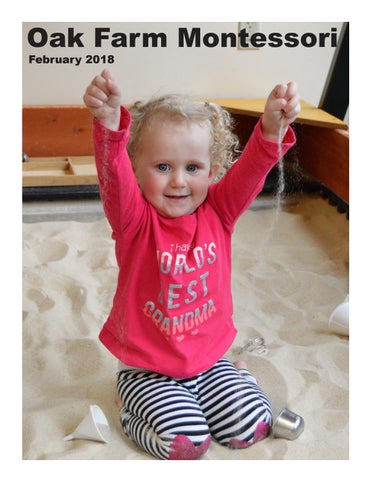
Oak Farm Montessori February 2018
scientific observation Jenna Abbs, Primary 1 Teacher
E
ach day, students in the Primary classroom are exposed to Science and Culture during their work cycle. They have the freedom to choose from an array of works and materials that cover many topics in science including: the timeline of life, zoology, botany, and forms of matter. Maria Montessori recognized the importance of a young child’s need to observe and absorb the world around them. Stepping into a Primary classroom, you will see students exploring and immersed in the science and cultural works provided for them. To expand upon the students awe and interest in a particular science topic, each week they are given the opportunity to participate in a community science experiment. Topics are chosen based on what is being discussed in the classroom that week or what is currently being discovered by students through works on the shelves of the science area. Science provides an opportunity to encourage a child’s sense
of wonder and curiosity about the world around them. Experiments encourage students to ask, “What is that? How does that work? What makes that happen?” Students work from the beginning stages of experiments, creating a hypothesis, all the way to discovering a conclusion upon the final result of the process. Montessori believed that children’s experiences with real objects (concrete) should always proceed the abstract; watching water in a kettle turn into steam prior to learning the term “evaporation.” Experimentation provides students with the opportunity to break down complex topics to their simple form and to visually explore, touch, smell, and ask questions to better understand the process. Our students look forward to these experiments each week. Not only is it an exciting way to foster a child’s desire to know more, but it provides a hands-on approach to better understand a specific topic.
Give me a sign! Angie Black, Toddler 2 Teacher
While observing in the Infant and Toddler environments you will see the children and teachers using sign language to communicate with one another. Research suggests that using sign language can provide a way to communicate several months earlier than those who only use verbal language. Teaching this skill also improves cognitive and emotional development. Having the ability to effectively communicate decreases frustration, while allowing very young children to express their wants and needs. You can begin incorporating sign language in your daily conversations during early infancy and will see your infant signing back to you around six to eight months of age. It is important to verbally speak the word as you sign the word. Start with signs that describe their routine, activities and familiar objects. Common early signs include: eat, drink, more, all done, please, thank-you, hurt, colors, numbers, toileting/diapering, etc. It is fine for the Infant/Toddler to use signs incorrectly, as it may be challenging for their fingers and hands to mimic some more complicated signs. As long as the child is attempting to do a similar sign/movement and you are able to understand what they are attempting to say, they have effectively communicated. This increases the bond between parents and their child. It is also acceptable to make up your own signs that work for you and your child, as long as you are communicating. After all, who doesn’t love to feel heard and understood?
Children are made readers on the laps of their parents. —Emilie Buchwald
oh, the places you can go! Lisa Bockelman, Reading Interventionist
Since your baby was born, you have known the importance of reading to your child. As they mature and become independent readers, most of us tend to struggle with maintaining the recommended 20 minutes of reading. So how can you encourage this routine and prevent frustration or disinterest in this important life skill? Below are some tips and ideas on how you can still be involved with your child’s reading by making it less of a chore and more of an adventure!
• • • •
• • •
• • •
Be sure to be a good role model. Let your child see you reading. Have your child create their own special place to read. Children of all ages love to be read to, don’t ever think your child is too old for this. Let them choose different types of reading materials: magazines, graphic novels, online articles, or books. It doesn’t matter what they choose, as long as they are reading. Turn the sound off on the TV and have them read the closed captions. Turn off the electronics for an hour once a week to dedicate to family reading time. Start a family book club. Everyone in the family reads the same book and then comes together to discuss thoughts, likes, dislikes, etc. This is also a time to ask probing questions to make sure everyone understood the book; reading comprehension. Listen to an audio book as a family. This can also be done on long car trips. If you are traveling, have them read books about the destination prior to the departure. When your child asks you to buy a new gadget, have them do research and read reviews. Afterwards, let them present their findings in a written or oral plea prior to purchasing the item.
The most important thing to remember is that your child needs to be reading. The books being read don’t need to be a classic; they can be anything that sparks your child’s interest. Reading is just like a sport, the more you practice, the better you get.
“We began by imagining that we are giving to them; we end by realizing that they enriched us.” ~ Pope John Paul ll
The Leathermans live in Albion near their children Marc (Amy) Leatherman and Jamie (David) Worman. They are pictured here with their grandchildren at Disney World. Left to right: Cindy, Ryan, Lydia, Cami, Bella and Gary.
Gary and Cindy Leatherman February Family Spotlight
If you know Gary and Cindy Leatherman, it will not surprise you that this is their favorite quote. They became involved with Oak Farm over 13 years ago when their daughter, Jamie Worman, started working at the school and their three grandchildren began their own Montessori journeys in the Victorian Farmhouse. Over the years, the Leathermans have volunteered their time and talent in a number of ways. Cindy has shared her sewing skills on a variety of projects as well as her nursing skills when she worked with students to understand dementia for a nursing home project. She has also taught CPR and first aid to upper elementary and middle school students over the years. After retiring from a long career in law enforcement, Gary began volunteering at the school as a way to use his handy-man skills; supporting staff and students. He also admits that, after his retirement, being a positive role model for the students was very appealing. “The students at Oak Farm are our future and by doing whatever is asked of me to assist the staff is rewarding on numerous levels,” he added. As grandparents, both Cindy and Gary have been asked to help with classroom projects for the annual Gala. There have been a couple of last minute requests and those challenging projects where they are asked, “Can you do this?” Between the two of them, they can do almost anything. Gary shares his reason for helping on these projects with the following statement, “To see an idea develop and the students put their personal touch on projects, resulting in excellent funding for classroom activities, is very rewarding.” Gary added that an extra bonus to his time spent at Oak Farm is that he was able to see and interact with his three grandchildren and daughter on a daily basis. Even though their grandchildren have grown and moved on and Gary’s volunteering led to working on staff; Gary and Cindy continue to support the school by sharing their time, talents and treasures whenever asked. Over the years, they have found a variety of ways to support the school financially and are regular guests at the Gala. In their free time, they enjoy making memories with their family through work and play. Cindy explains, “I think our children and grandkids would tell you that our family traditions are things like: kick ball tournaments, sand sculpting competitions, impromptu family dinners and, always, lots and lots of laughter. We like to make memories. We try to take a family vacation with all ten of us every other year. I think we have as much fun plotting and planning as we do on the actual trip.”
Making the Simple, Complex... Oak Farm MS students
Oak Farm Middle School students have been studying the theme of ‘change’ this Trimester. Humanities and Science both focused on this topic through discovery of inventions of the Industrial Revolution and the use of simple and compound machines that make human work more efficient. Investigations into potential and kinetic energy were key elements of this study. Compound machines springing from creative engineering have played an intimate role in people’s activities for thousands of years, and since our industrial revolution, this country has seen an explosion in complex machines. Rube Goldberg was a Pulitzer Prize winning cartoonist best known for his zany invention cartoons. He went to school to be an engineer, but decided to pursue his passion for art by creating cartoons that took simple activities and made them a set of complex actions. Oak Farm MS students practiced engineering in their integrated science class by choosing a simple task to complete: hitting the “k” key on a computer, turning on a light, throwing away a piece of trash, watering a plant and others. Next, they culminated the experiment by creating these complex machines to complete the simple task. Many
factors went into their creation: learning about Newton’s Laws of Motion, creating experiments using the scientific method to test these laws and doing work to build simple and compound machines using K’NEX building sets. Let us explain the “HOW?”: Essential Question: How can we design and construct a device that uses multi-step processes to accomplish a simple task either on the farm or in the MS? Trevor: “Change in energy and a change of action was how we counted our steps. We needed to have 8 steps in our process.” Jacob: “Rube Goldberg takes simple machines to make a compound machines.” Students followed the design process to construct a compound machine that was a useful addition to the daily work at the MS. The machine was to complete the work reliably. Students had to use repurposed and recycled materials for the Rube Goldberg machines; no materials could be purchased. Students pondered the answers to the following questions in the design process: What is the goal? Who is the user/ client? What is the problem? What are the constraints? What materials will we use?
Turning on a light switch has never been so much fun! First, they sketched their plans and labeled the energy changes and changes in action. Next, the designs went through a peer review process. Students then constructed prototypes and tested them. An important part of the process was the reflection, review and redesign steps. Finally, the students reconstructed the Rube Goldberg machines and tested them again. And the “What?”: Wesley: “Rube Goldberg machines are very interesting because they have so many different parts. I learned they don’t always work the first time and that is ok.” Birk: “I like them a lot because everytime you fix one problem another problem pops up from the first problem. There’s no ‘perfect’ in a Rube Goldberg machine- there is only ‘as close as you can get’. All of the inventions during the Industrial Revolution are compound machines and Rube Goldberg’s are bizarre compound machines too.”
Global Citizenship
Linda Hoffman, Upper Elementary2 Teacher
Popcorn sales raise money for the DNR of Indiana
Personal choices regarding recycling can affect the world around us.
Knitting and crocheting provide opportunities to help others
The portrait of an Oak Farm graduate includes becoming a global citizen. In Upper Elementary, that characteristic is accomplished by students in a variety of ways. How our personal choices affect the world around us might include researching and discussing issues such as: recycling, clean water, conservation and preservation. However, it might also manifest itself by students learning how to knit and crochet in an effort to make hats for cancer patients, scarves for displaced persons, and toys to cheer children in Nicaragua. Isabella writes, “I have been working with Olivia on a project called S.T.E.A. (Save the Endangered Animals – of Indiana). We would like to save the endangered animals because they are in trouble and someone needs to do something about it. So, why not us?” Isabella and Olivia presented a proposal to the Upper teachers to sell popcorn on Fridays during lunch in an effort to raise money. This money will be contributed to the DNR of Indiana to preserve habitats and enact protection for the animals. Derek writes, “In world changers, we found a passion and some of us are starting our way to change the world. I am doing a Prezi to give awareness about children without homes. The Villages is where my grandma works and when they were having trouble, I wanted to help, that is why I am doing a project.” Upper students can say, “I know of issues in the world that need acted upon, and I am finding ways to make a difference.” – Portrait of a Graduate.
Students SWIG in Global Waters Humanities Jennifer Jordan, HS Teacher
As a common good, water is not an easy resource to govern. Just look at recent events in South Africa, Arizona or Western Lake Erie and you can see the conflicting needs of water stakeholders coming to a head. But it’s easy to sit on the sidelines and say “Why don’t they do something about that?” What better way to learn about the difficulties of the governance of water resources then to try it? This is the philosophy behind the Oak Farm High School’s Supreme Water International Government (SWIG). This simulation committee has been created as part of this semester ’s Global Water Humanities class in order to take a look at some of the toughest water issues the world is currently facing. Each of our 9th graders has been assigned a role on the committee representing stakeholders from industry, energy, politics, agriculture, environment, culture, transportation, and public health. By researching and debating real-world issues like: whaling, water rights, non-point pollution, drinking water purification, etc. then debating actual propositions (ones that have been put before real-world government agencies at various levels), students learn about global water issues while developing stronger skills in communication and argument. Seeing the optimism, intelligence and enthusiasm with which these young people problem solve paints a bright picture for their futures and the future of our world.
Abby Roughia, Lower Elementary3 Teacher
How to Grow Your Young Reader
Reading Tips and Tricks:
“The more that you read, the more things you will know. The more you learn the more places you’ll go.” — Dr. Seuss
Parents today are overwhelmed with educational toys, videos, apps and other resources; all with the promise of helping your child learn to read. So much so, that it can be difficult to distinguish benefit versus hindrance. Let us help you streamline and simplify this process by providing you the tried and true necessities to helping your child not only learn to read, but grow to have a love of reading. Remember, you are the example; let your children see you reading too. Show them that reading can be a fun or relaxing activity. Talk about what you are reading, they will benefit from hearing you process and condense the story as a narrator. INFANTS New brain research has proven what Montessorians have believed for years: it is never too early to start reading to your child. As a matter of fact, reading to a very young child is a crucial aspect of language and literacy development. Your 3 month old may not do much with a book other than hold and maneuver it in their hands or possibly even chew on the pages. He may not be reading, but there is a positive relationship that is being developed with the books. Hold your infant and enjoy a bedtime story or an ‘anytime’ story! Repeating nursery rhymes as you change their diaper, clip their nails, or take a bath all associate a fondness for language and literacy. When you combine love and literacy, a lasting connection is formed. TODDLERS Focus literacy on letter sounds instead of letter names. After all, only 5 letters say their name when you read them, and they are all vowels. To read and write, children need to learn the sounds letters make, not their names. Most commercial products focus on the letter names rather than the sound. This is what makes YOU their best teacher. In Montessori, we start by teaching letter sounds exclusively, making the process less confusing when they begin to blend those sounds together to read and write. For children about 2 years of age or older, a fun game is to play an “I Spy” sound game. Collect a few items, maybe as you are picking up their toys, and place them in front of your child. Focus your child’s interest on the beginning sound of each object,
“I spy something that starts with bbbbbb: a b-b-b ball”. Once your child has begun to master their letter sounds, you can begin to play a real “I Spy” game. Ask them to look around and find items in the environment that start with the sound you suggest. These are great games because you can do them anywhere! Even at the table of a restaurant you can say “s-s-s spoon”. Teach lower case letters first (the majority of letters they will be reading and writing are lower case) and try to engage the mind and the hand simultaneously. A fun way to do this is to squirt a tub of colored hair gel into a baggie. Keep this in your purse or diaper bag. When you are waiting or are out and about, pull out the baggie and put it flat on the table (still sealed shut). Press your finger through the gel until it touches the table and form letters calling them by sound. “This as a s-s-s-s like in snake”. As they begin to master letter sounds, ask them to draw the letters you call out. PRIMARY Make reading fun! Go to the library and allow them to be involved in choosing books. Create a large family library. Your collection should include books that you are still reading to your child, but can also begin to include books they can read independently. Look for books with pictures and very simple wording. A page may have a picture of a blue ball with the words “blue ball” on the page. As they grow in their reading, ask your child’s teacher for recommendations of books appropriate for their reading level. Keep those hand muscles in mind. Things like playing with playdough, squeezing sponges, wringing washcloths and cutting with scissors all develop the muscles in the hand needed to control the hand for writing. Let your child tell you stories! Recalling events in sequential order are an essential component for the writing process later. Ask them to recall the events of their day, re-tell stories you have read to them, or create their own stories by using the pictures of any book as a catalyst (even one with lots and lots of words) ELEMENTARY Although your child is NEVER too old to be read to, it is also your turn to listen. Let them read to you; in the car, at bedtime or even record themselves to play back and listen. The important aspect is that you are together, in the same place, and don’t have distractions to keep you from listening. At the end of a story, ask them to re-tell the story in their own words. By making reading a part of your daily life, kids will learn to love it. Make it fun! Allowing older children to read to younger children is an excellent way to practice the skill and mentor at the same time. When your child finishes a book that has been turned into a film, pop some popcorn and watch it as a family or head out to the theater. Get involved in reading programs at your local library or other reading programs often held at books stores. Meeting an author or getting a signed copy of their favorite book can add excitement for reluctant readers. The goal is to make reading a regular, enjoyable part of your family routine. Continue to grow their library as they develop and grow as a reader. Make sure your child has plenty of books to choose from. Consider the theme and complexity of the books you choose, otherwise it could make reading less appealing. If you are unsure of the level of books your child should be reading at home, ask your child’s teacher. Reading beyond their independent reading level can cause frustrations. The transition from learning how to read to learning from your reading takes place around 3rd grade. Providing a variety of genres is also desirable. Non-fiction writing becomes more and more important to their academic work, so finding topics of interest for your child in this category is especially helpful as they mature. Give their writing purpose: let them make the grocery list, ask them to write little notes to remind you of things or give them a journal where they can write their thoughts and feelings. Another journaling idea is to have a “Mom and Me” notebook where you can write back and forth with your child. Not only will they be practicing reading, writing and comprehension, but what child doesn’t look forward to a special message from their parent?