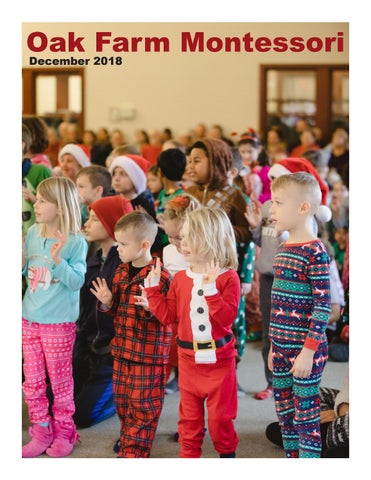
Oak Farm Montessori December 2018
Candice Holbrook,, Head of School
The Gift of Montessori
I don’t know about your family, but in our house the holidays are a favorite time of year! It is a time to be together with those we love; surrounded by beautiful lights, cheerful music, and glorious food while we continue traditions and make memories with one another. It almost seems magical... But, too often, the holidays pass us by in the blink of an eye because of the hustle and bustle of what the holidays bring. This includes: stress, possible ungratefulness (as my 6 year old is quick to point out that he only has one present under the tree), and lack of time to get everything done that needs to get done; which, by the way, includes rest and relaxation. Quite honestly, the holidays can be a roller coaster of emotions for everyone in the family at any given time. For anyone that has felt this whirlwind of emotions, I am here to tell you that you can take a deep breath and give yourself a pat on the back. (Did you do it? Trust me...you deserve it!) Before any physical gifts are placed under the tree or in a stocking, you have already given your children two amazing gifts. The first is time, and I can say this quite literally, because we had an extra long winter break here at Oak Farm. The time your children spend with you is what matters most to them. If you feel you have not been able to give your children the time you hoped for because of the hurried pace of the holidays, I have good news for you...we still have a week left of winter break! The other gift that you have deliberately and consciously given your child, and continue to give, is the gift of a Montessori education. Your gift of Montessori instills values of respect, integrity, acceptance of differences, responsibility, and independence within your child. All of these values have the potential to change the world for the better! Your gift of Montessori will impact generations to come because your productive, peaceful and intrinsically motivated child will face the world with determination to advocate for social justice. Your gift of Montessori education is rooted in the eight principles below, as described by Dr. Angeline Lillard in Montessori: The Science Behind the Genius.
The first principle is movement and cognition, where your child is provided with opportunities to freely move when needed. Your child is using her hands as she interacts with the materials and movement is directly linked to the enhancement of critical thinking and learning. The second principle is choice. Your child has the opportunity to choose what to work on, who to work with, where to work, and even how long to work. This fosters independence and personal responsibility for the selection and care of materials. Choice will empower your child to have a sense of control over his life, building independence and his willingness to do things for himself. The third principle is interest. Montessori education follows the child and that includes their interests! We all learn better when we are interested in what we are learning, and that is true for your child. The fourth principle is intentionally avoiding extrinsic rewards such as stickers for good behavior or money for good grades, which can negatively impact motivation to engage in an activity. We want children to be self-motivated to do something. Instead of extrinsic rewards, your child is receiving specific feedback from his teacher or guiding questions to prompt deeper thinking. The fifth principle is learning from and with peers. This is a beautiful thing to observe when I visit classrooms. Your gift of a Montessori education allows your child to present lessons to others, solidifying her own understanding of the content, or to receive lessons from an older peer. Your child is working collaboratively with others to solve a problem or advocate for social justice (remember that ‘changing the world for the better’ part I shared?). The sixth principle is learning in context. Your child has opportunities to do practical math in the barn as they calculate the number of hay bales needed to last through winter, how to develop a sustainable business by actually creating one, how to care for the outdoor environment as they clean the gazebo, tend to the garden, or engage in land restoration practices. The point of this principle is that your child is actually doing ‘real work’ while they learn; making the experience more meaningful and purposeful and one that will stick with them as they grow. The seventh principle is teacher interaction. Montessori teachers are referred to as guides because, through careful observation of the individual child, they can prepare an environment that your child will thrive in and reach his greatest potential. Your child’s teachers know him well; including his social, emotional, physical, and academic development. The final principle is the order in the environment and mind. Order in the environment is beneficial to your child and they actually crave it! Order, routine, and ritual are used to stimulate learning. After reading and understanding these eight principles, I think you (parents and grandparents) can agree that you should give yourself a pat on the back because you truly have given your child a special gift; time spent with you and the gift of a Montessori education that will make an impact on your child and the world! In January, re-enrollment packets will be mailed home to current families. We will also be holding our ‘Moving Up’ meetings for children transitioning to Lower, Upper, and the Middle School. This will be an opportunity for you to meet the teachers at each level and to learn how your gift of Montessori is attentive to your child’s plane of development as they prepare for this big transition. I look forward to seeing many of you later this month! Wishing you and your family all the best during the New Year,
Candice
let it be told...
Lorene, Joanne, Leslie, Jill & Nancy @ Fall Festival
The greatest story, Kim Davidson, Director of Strategic Partnerships
In our last issue, we shared the progression of the Oak Farm campus through the lens of enrollment, number of faculty and the addition and remodeling of buildings. As we continue to tell the story of Oak Farm, we wanted to go back to the beginning; a beginning that dates back prior to the initial land purchase and first classroom opening in January 2000. This month our journey takes us to the east coast where the first head of school, Joanne Stutz (JS), now lives. She was more than happy to share her memories of the early years at Oak Farm and her time working closely with our founder. Joanne, who was co-owner of a Montessori school in Tucson, met Lorene through a mutual friend who was a Montessori teacher in Fort Wayne.
understand how important that the school (it didn’t have a name yet) is established under the strictest guidelines of Maria Montessori’s philosophy. It must grow into a PREMIERE Montessori school. We must find good people who understand and believe the philosophy, and we must retain those people whenever possible. This school must set an example of what Montessori done well looks like. If we do this right from the beginning, it could one day be a training ground. As Lorene explained it to me, she felt strongly that Northeast Indiana needed educational choice other than traditional, standard curricula. She believed Montessori philosophy met the needs of children at different developmental planes and could be the beginning of choice for parents in the area. I believe this was her inspiration for what became Oak Farm.
KD: Joanne, tell us a little bit about your first meeting with Lorene and seeing the property KD: What is your favorite memory about your time at Oak Farm? on Lemper Road for the first time. JS: Lorene and I first met in the teachers’ lounge JS: There are so many memories, but the favorites at Three Rivers Montessori. We drove to several are of the children. It was so gratifying to watch property possibilities for the school in the area. young children begin their learning experiences The third and last property we saw was on Lemper as infants or toddlers and develop new awareness Road. By the time we arrived at the Lemper Road every day. Preschoolers, who come in nervous or property, Lorene had explained her vision for a unsure, make new discoveries about themselves farm school. As soon as I saw the property I knew and their environments very quickly. I then got to it was the place. We talked about how the existing witness the excitement of those same preschoolers buildings could be transformed to meet the getting ready to move on to be “one of the big kids” immediate and long term needs for the school. We in elementary. I can still feel those memories today. also “dreamed” about how the property could be KD: You were the first head of school for a utilized for expansion as the school grew. Lorene campus that is now over 100 acres, 297 students knew, even then, that the school’s growth would and serves infants through 10th grade: What are be through different styles of farmhouses to meet your thoughts? What makes you most proud the needs of children; birth through high school. about your contribution to the school? KD: Can you share with us your understanding JS: Wow! I guess I knew from the beginning that it of Lorene’s vision and the inspiration behind would happen. Lorene’s dream, her vision, was so her vision? strong. I’m very grateful to have had the opportunity JS: That’s easy…I heard it in my head almost to work with Lorene to help make that dream a every day I was at Oak Farm! Joanne, you MUST reality.
As I chatted with Joanne, she shared many more fond memories of the early days on campus. Those families who started their Oak Farm journey in Primary may be interested to know that Brown Dog, from the book Oakey, was an actual dog who first came to Oak Farm with an employee. It did not take long for Joanne to adopt the dog and give Oak Farm its first official mascot! Brown dog and his brother Sam (adopted by another teacher) quickly became favorites of all the students and were regulars on campus each day. Brown Dog is honored in the windmill on top of the Red Barn (did you ever notice it looks like a chocolate lab?). Brown dog only lived a couple of years at the school; however, the students had become quite fond of having a dog on campus. Soon after brown dogs passing, the families of Oak Farm got together and gave Joanne a second “fluffy, brown, furball” that would quickly become the second mascot, a dog named Hershey. As we all know, animals have long been a tradition on Oak Farm’s campus and Brown Dog and Hershey were just the beginning. The early years had many rescue animals; including Baby the deer who, according to Joanne, would sneak food off the children’s lunches as they ate outdoors at the picnic tables. Baby was followed by more traditional farm animals such as chickens and goats. Another interesting fact is that before its official opening, the name Oak Farm School was decided upon because of the big oak trees that were prominent on the property. Lorene and Joanne were seated under the big oak tree that is to the right of the Victorian House drive. As they sat under the oak tree, looking at the other tree across the yard, the name quickly became obvious. Since Montessori was such a new concept to the area,
Joanne interacting with Oak Farm Students
Montessori was not added to the name until 2008. KD: Please share any insights about the families, students and campus expansions that you oversaw during your time as head of school. JS: A lot of credit should be given to the core families who put faith in Oak Farm from the beginning. Families who wanted to learn more about the philosophy and how it could help their children develop into caring and confident humans with a passion for life-long learning. Oak Farm eventually developed an educated staff who believed that the children were top priority in every decision made. In wrapping up our time with Joanne, we asked her, “What are you most proud of?” Her answer was pretty simple and straight forward: “All of it”. She further explains, “In September 1999 my office was in the basement of a small farmhouse (Green Farmhouse) that was being remodeled for the first classroom. I had a card table for a desk, cardboard boxes for files, a 1990’s word processor, and a cordless phone I had to go outside to use. Most people in the area had no idea what a Montessori school was. We want to thank Joanne for taking us back to the beginning; when Oak Farm was nothing but a field and the campus consisted of two classroom buildings, a small shed and animal barn. Thank you also for sharing your time and talent to begin the journey of Oak Farm Montessori and believing it could happen. Next month join us as we talk to parents and students from the early years. If you know of an alumni or past parent who was part of the Oak Farm community between 2000 and 2008, we would love to hear their story (kdavidson@ oakfarmschool.com)!
Lorene working with Lower Elementary students. (First Oak Farm bus in the background)
Nancy Hathaway, one of the school’s first employees, with the backdrop of what would become the Victorian House.
“To appreciate the beauty of a snowflake, it is necessary to stand out in the cold.� The beauty of winter
Aristotle
Jeni Ekovich, Infant Teacher
Winter provides many opportunities to develop emerging and established skills for Infants and Toddlers. Navigating the putting on and removal of winter wear, walking through snow or pulling a sled behind them challenges a young toddler in new ways. The beauty of falling snow develops a sense of wonder in all of us, but especially in the eyes of little ones. The changing season also brings a lot of new vocabulary for our students: snow, ice, cold, white, etc. It is important to find and model the joy and beauty in the winter season, despite the cold temperatures. Being outside is good for our bodies, mind, and spirits!
Let it snow
Diana McCreery, Primary 4 Teacher
Science is about investigating. Even something as simple as testing which glue to use on a project constitutes investigation on the part of the student. Technology is more than just computers; it’s about using tools, both simple and complex, to improve peoples’ lives. Engineering can be boiled down to recognizing problems and testing the possible solutions. Art is about creatively expressing one’s ideas and Math is about recognizing patterns of numbers and shapes to find solutions. STEAM and the Montessori philosophy of following the child are highly complementary to one another. They both place emphasis on the child determining what he or she learns through exploring and experimenting in the classroom. This year, the Primary classrooms have expanded their art shelves with STEAM experiments. Materials offered to students to conduct their own investigations include: buttons, cardboard, feathers, bottle caps, string, glue, tape, staples, construction paper and much more. In our Primary 4 classroom, each week there is a “problem” or “challenge” that needs solved and it is up to the child and his peers to find a solution. They start by having a plan for solving the problem of the week. Then they “shop” for their materials at the STEAM Shop described above. Once their creation is complete, they move on to testing the product for success in solving the problem. Finally, they explain what happened and how they can improve their creation. An extension of this work is offered to the Kindergarteners in the classroom that includes: writing up a plan, testing it and then recording what happened and how they could improve the solution for next time.
What is a scientist? We give the name scientist to the type of man who has felt experiment to be a means guiding him to search out the deep truth of life, to lift a veil from its fascinating secrets, and who, in this pursuit, has felt arising within him a love for the mysteries of nature... ~Maria Montessori
Peace is what every human being is craving for, and it can be brought about by humanity through the child. ~Maria Montessori
Peaceful Living Ines Oldenburg, LE 2 Teacher
Most parents would like to see their children succeed in life and become valuable, contributing members of society. Education is, therefore, very important to accomplish this goal. However, when we speak of education, we must not forget that the academic component is only one piece of the larger picture. In a world where we seek equity and try to overcome dominance by others, developing the skills of emotional literacy and communication are more valuable than ever. In our Lower Elementary classrooms, we hold daily meetings that are led and facilitated by the children. We encourage conflict resolution between students and choose to see mistakes, not as poor choices but, as opportunities for growth! We teach our children to listen with an open heart (empathy) and how to respect a differing view to create synergy instead of animosity. Finding and building connections to others in a respectful manner not only establishes trust, but it is the foundation for successful relationships; in their family, community and future lives. When blame, shame and judgement are eliminated, and the focus is on finding a solution, we are contributing to each other’s well being. Compassion and empathy are the key to peaceful living; today and every day.
Come Together Linda Hoffman, UE 2 Teacher
Com is a prefix meaning “together” or “with”. You could generate a long list of words beginning with this prefix whereby the meaning is easily identified: commit, compress, combine, etc. The word community also begins with com. Upper students learn that community means classmates, building mates, campus mates, those in their neighborhood, town, city, and so forth including the world at large; a community of people living at the same time. These can be big concepts for 9 to12 year old Upper students, whose concerns tend to be close to themselves. However, when given the opportunity to shine, our Oak Farm students often reveal their maturity. They demonstrate care for the classroom community by making snacks, helping each other clean, being silent so others can work, caring for classroom pets, teaching lessons and problem solving together. Upper students are also part of the larger community of Oak Farm by feeding animals at the middle school, assisting Primary teachers as mentors to younger students, composting to help the earth and creating Gala projects to raise funds for the school. Some Oak Farm Upper students dog sit, work at food banks, participate in church groups, help out with therapy horses, rescue cats, and entertain the public. Others even make products to sell and give the money to charitable organizations. The underlying message is that they are actively seeking to make a mark in this big world. Such sense of community now, as young adolescents, may lead their generation to shape the larger world community with strong leaders, compassionate citizens, and peaceful problem solvers.
Stepping up & out...on the stage Bridget York, Secondary Program Director
Purposeful laughter and joy stream from the MS Dining Hall as students prepare to perform the annual plays presented by the OFMS Players! Each December, Oak Farm Middle School students look forward to writing, performing, producing and directing plays as a gift of creativity to the Oak Farm community. Every aspect of the final production is student chosen, directed and produced. We work hard to keep in mind our audience of younger students and Oak Farm Montessori School’s vision and values. During this season of giving, the MS gift of theatre to the Oak Farm community includes some of your favorite characters from American folklore: Bremen Town Musicians, Davy Crockett, Janet Appleseed, Kate Shelley, Pecos Bill and even Bigfoot! We developed unique twists on these familiar stories and made them all our own. The first tale is the modernized version of the Bremen Town Musicians: BTM. These modern folktale heroes lose their jobs and create the hugely popular band BTM. They save the town from bank robbers and then rock out from the stage. The next tale is called Folktales Exposed. For this rendition, we combined three stories: Davy Crockett and the Bear, Johnny Appleseed- which we changed to Janet Appleseed, “I and Kate Shelley. First, the students decided to tell the exaggerated version of like doing the the story and then expose the real story as a comparison. The final tale is a plays because it is fun mishmash of two stories: Pecos Bill and Bigfoot. Although they are an odd to write the script and pairing, true friendship is found on Pecos Bill’s hunt for Bigfoot. We decide what the characters l o v e the literary license we get to take to make these stories come to life for our do. I also like the acting community. and stage design.” -Wesley W., 8thh
This is the process we followed to create the shows this year: Step 1: Brainstorm ideas as a group Step 2: Narrow our choices and select the characters and theme Step 3: Collaborate together on creating a plot diagram (Freytag Pyramid) for the story Step 4: Divide story into beginning, middle & end groups & then collaboratively write using Google Docs. Step 5: Read through and refine scripts Step 6: Block the staging, memorize our lines and organize props and costumes Step 7: Rehearse, rehearse and dress rehearsal for older students Step 8: Perform for the community at the Victorian House! Step 9: Debrief the process and celebrate successes
This process is not only fun, but is tied to Oak Farm’s mission of inspiring students to reach their potential through meaningful work. Students truly OWN the plays and are engaged in making the stories successful. It is beautiful to observe the students problem solving and supporting each other. This work is also supported by multiple educational studies such as this report from the Arts Education Partnership: http://usatoday30.usatoday.com/news/education/2002-0520-arts.htm that states, “Students enjoy performing arts and benefit from participating in drama, music, dance, visual arts and multimedia arts in a variety of meaningful ways.” “I remember being a part of the MS winter plays was a very unique way to express my creativity through being onstage.”
• • • • •
Higher Academic Achievement Confidence & Presentation Skills Medium for Deep Self- Expression Problem Solving & Perseverance Empathy & Compassion
Emma C., 10th
“I like doing plays and the process - memorizing lines and performing in front of people. The plays show everyone what we have worked really hard on”Gabe K., 7th
“I like writing the plays because it helps me to understand plot structure and grammar. Practicing acting helps me feel more comfortable when I have to do any sort of public speaking.”- Birk H., 8th
“I am really excited to present our play. I have been watching them since I was in Upper and now I get to be in one!” Hannah A., 7th
A
Jon Agler, Secondary Business Teacher
s teachers, we love “Aha!” moments. It is like a burst of adrenaline, keeping us going. For me, it is almost better than a shot of espresso in the morning. An “Aha” moment, defined by Merriam-Webster, is “a moment of sudden realization, inspiration, insight, recognition, or comprehension.” It is the moment that you see growth in the students as they make connections between different concepts. More often than not, at Oak Farm, these moments happen when the students are free to explore and learn within the boundaries of the environment and coursework. As Montessori teachers, we are given the task of creating an environment with the balance of freedom and purpose. We are constantly critiquing our work and environment to create the perfect balance. Then we wait and observe, looking for the moment of “Aha!”
Aha! moments from Fall 2018 • Inno-Lab: There was a moment when a student learned that she could utilize a Skype conversation and record it, using it for her Video Essay. • Inno-Lab: There was also the moment when a student learned why we had been cutting out black squares and arranging them in Graphic Design. He saw how it helped him in his computer design process. • Bike Shop: “For a while I couldn’t figure out how to reinstall the sprocket on my bike, but as soon as I asked for someone else’s perspective I was able to figure it out!” – Emma C., sophomore. • Math: The “Aha moment” in the math department was when our five Geometry students realized that they are going to successfully complete and master the entire Geometry course by March! This will allow them to get a 2-month head start on their subsequent math course for next year! • Language: While in Language, a student shared a piece of writing with a peer for an edit/ revision. I watched the editor give feedback and the writer’s eyes light up when it was proclaimed, “Amazing, it should be in TypeWrite!” • Science: A student was doing an experiment last week and needed to identify what scientific principle and equation he was proving. He identified the variables he was measuring and worked through a handful of equations for about 10 minutes; trying to identify which variables he was testing and he eventually realized he was testing for torque. It was a great moment to see him connect the principles he learned about to the reality his experiments were showing. • Inno-Lab: There was a literal lightbulb that went off when this “Aha” moment occurred! The students made lamps in our Creative Circuits class. They put everything together and then turned on the lamps they created. Lots of “yeahs!” and “wows!” were heard!