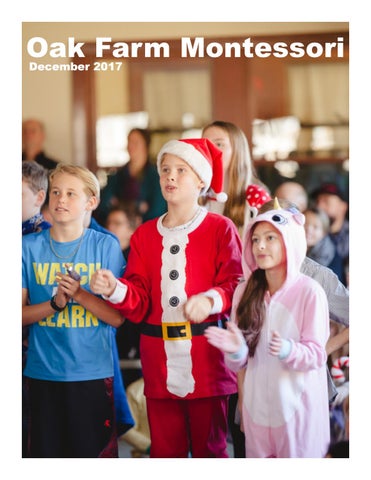
Oak Farm Montessori December 2017
“The land is where our roots are. The children must be taught to feel and live in harmony with the earth.” ~Maria Montessori
cosmic e duc at i on Ines Oldenburg, LE Assistant Teacher
Sometimes people use the term “Montessori” in conjunction with the phrase, Cosmic Education. But, what is cosmic education and what does this mean for my child? Cosmic education is the idea that all life is dependent on one another. This idea is not taught through a specific lesson, but rather absorbed by the children that go through Montessori education. Even the youngest children in Infant and Toddler classrooms learn how to pour water carefully and how to take care of themselves. These lessons allow them to learn that for every action, there is a consequence. As Montessorians, we do not put fragile things away so that the child can not touch it; instead, we allow and encourage exploration as this is how the child learns. Once something is broken, that beautiful thing is gone forever. In a Montessori classroom you will also find a lot of materials made from natural wood. This is another way that the child
subconsciously connects to the natural world around them. As the child continues to grow, s/ he learns that his/her actions directly affect the people around us. In order to live in harmony with each other, we must have mutual respect towards one another. As the child continues to move through the elementary years, the ability for abstract thought grows. S/he learns various beliefs about how the universe began and how life formed on earth. With this knowledge, the child learns subconsciously how one thing led to another and how all living things depend on each other. As the child continues to mature, s/ he will gain a deeper understanding of how the generations that have come before us helped shape what we have today and appreciate those contributions as well as their own. The Montessori cultural lessons (including: history, biology, zoology and geography) are designed to give the child the key to the universe to create a better tomorrow.
Ohm’s Law Voltage = Current x Resistance
R= resistor + & - indicate the battery arrows indicate the direction of the current The defining characteristic of a series circuit is that there is only one path for electrons to flow. In a Parallel circuit the resistors (R) form more than one continuous path for the electrons to flow.
MAGNETS AND MENTORING Sandra Deacon, UE Assistant Teacher
Conductors, magnetic fields, resistance, circuits, and Ohm’s Law are just a few of the topics the 4th year students have been studying and conducting experiments on this school year. They have defined power and discussed the equation: Power = Current x Voltage… an experiment to demonstrate this equation, was to challenge the students to figure out how to create a circuit where a battery could be added without decreasing the brightness of the bulb. They’ve also discussed and reviewed AC (alternating current) vs DC (direct current), as well as series and parallel circuits. Students are now beginning to investigate and experiment with the interaction between the poles of two magnets. The past couple of weeks they have worked on choosing and practicing an experiment to present to the Kindergartners. Friday afternoon, before winter break, was the culmination of all of their hard work, and it was very exciting. The Kindergartners loved learning from the 4th years, and the 4th years were very eager to present their experiments to such a curious audience!
Nefy Hathaway, Toddler Teacher
(Tantrums & Transitions)
Tr ying Two’s
H
ave you ever walked out of a grocery store with guilt or embarrassment after your toddler threw a temper tantrum in the middle of the store? Have you found yourself negotiating with your 2-year-old over bed time? Let’s be realistic, we often do find ourselves in these types of situations. Terrible twos you say? Let’s deepen our positive thinking and try saying this instead, “Trying two’s.” This is not a terrible age, but rather a trying period for your toddler. During this age, your child is researching. Therefore, your child is learning appropriate and acceptable behavior. With the following tactics, you will better understand how to constructively work through any trying time with your child successfully. In my experience and research, young children long for connection and predictability. With a sense of belonging and consistency comes a feeling of respect and trust. It is our role as caregivers to model, guide and encourage. It’s fair to say that sometimes it’s easier said than done. Let’s start with connection. As adults, we often find ourselves in such a hurry, and even say, “I’m too busy.” What’s the rush? Are we too busy, we can’t put our phones down when a child seeks our attention? Are we in so much of a hurry that we must do everything for our child, due to “lack of time,” that she becomes so dependent on us which leads us to one day with rage and frustration shouting out loud, “Why can’t you do it yourself?” Busy is a choice. Connection is the cure. Your child needs consistent routines and boundaries as well as adult follow through. The predictability of a set routine gives a child a sense of security and belonging. Trust and
respect is gained as the caregiver follows through with both words and actions of set expectations. For example, when your toddler transitions from school to home, is there a specific place for her to put her coat and shoes? What’s the expectation at home? Is it followed? To better connect with your toddler, motivate their independence while offering choices. Would you like to use your loop or hood to hang up your coat? Would you like me to lift you up or would you like to get your stool? A predictable routine, as well as free choice, applies at the grocery store as well and may prevent a tantrum. Prepare your toddler for what’s next. An idea might be, in the car on the way to the store, share with your child that you both are going to the store to get food for the home. Offer your toddler the opportunity to help you pick out specific items. Offer choices, then name the items and have your toddler repeat them back to you if able. Express joy and appreciation for her willingness to help at the store. When in the store, if your child asks for a toy, remind her of why you are there and repeat the items again that she will be helping you pick out. If a tantrum should begin, calmly share that you hear her. Also
communicate that if she chooses to continue to scream, you will both have to leave. Allow your child time to process the information and follow through from there. If your child chooses to continue to scream or whine, remain calm and leave. The same goes for bed time. Is bed time at 8 or 9pm? Is it one book and two songs before bed or two books and no songs? Find a routine that works best for your family, and stick to it. We all know that once in a while a curve ball gets thrown our way, and it changes our whole schedule. It happens, and it’s okay. Let your child know ahead of time that there will be a change in her routine; you may even choose to share why. This will prepare your child for what’s to come and may prevent a tantrum during a transitional time. The next time you decide to go to the store or wonder how to get your child to stay in her bed, ask yourself these questions, have I connected with my child? Is she truly prepared for what’s to come? Is the routine that I have set realistic and predictable? Maria Montessori said it best, “Children are human beings to whom respect is due, superior to us by reason of their innocence and of the greater possibilities of their future.”
No Ordinary Volunteer... Kim Davidson, Fund Development
Having no children at Oak Farm and living three hours away from the school may seem like an unusual combination for a volunteer, but this is exactly what makes Elaine Davidson the perfect volunteer spotlight this month! As she found out, you do not have to be local to contribute volunteer hours (and many might we add), you just have to be creative in thinking how you can make it work! Elaine has been part of the Oak Farm Community since the school began in 2000, “My brother Mike and his wife have sent all four of their children to Oak Farm. I have always been impressed with the dedicated and patient faculty who stand out in the cold to greet each child by name and help them out of the car in car line.” Having been part of the Oak Farm Community since the beginning, she has also seen the many changes on the campus with new buildings to accommodate the growth and now, the campus expansion to add the high school. As she talks about Oak Farm, she also highlights the education her nieces and nephews have received. Robert, now a freshman in college; was in the first toddler class which was held in the original farm house (now LE1); Connor, a junior in high school, started as an infant in the converted farm house garage (now LE1); Katie, in her freshman year of high school, started Oak Farm as a toddler in the Vic House. Claire, a 4th grader is in UE1 and has been at the school since the age of three. Their education at Oak Farm not only includes academics, but also life skills. The many opportunities for real life learning through outdoor exploration, caring for classroom pets and farm animals, but also an appreciation for art and music; the opportunities are endless. Her campus visits have included being a guest at the Lower Elementary restaurant, participating in field trips, attending several Fall Festivals, Grandparents Days and The Tall Oak Gala. Having retired 12 years ago from Eli Lilly as an Executive Assistant to the leadership team, Elaine seemed like a perfect fit to help the Fund Development Team establish processes for communication and data base entry; including the input of all information needed for the database. When not helping Oak Farm, Elaine stays busy volunteering at her church, the hospital and helping other family and friends as needed. Sharing her time, talent and treasure is simply how she grew up, “We were always taught that education is important and that we should share our talents for the good of all. Helping Oak Farm with data entry allows me to support the school community that I have grown to love over the last 17 years, share my administrative talents with others and helps keep me active and busy in retirement!”
Middle School Showtime Juliana B., Cayragan C., and Cora G. Middle School students
Each year the Middle School students share their gift of storytelling with other classes, parents and faculty right before winter break. This year, the Middle School Players started the play-making process by deciding what fairy tale we wanted to cover. Next, we filled out a plot Freytag pyramid which shows what the story is about, the exposition, the main idea, conflict, rising action, climax and much more. We write, act, create costumes and design the traveling shows all on our own. We perform a dress rehearsal for Upper and a main show for Toddlers, Primary and Lower the next day. We discussed ideas about fairy tales and morals. One of our classes came up with “Shrek and the Four Dwarves”. Our story is about Shrek, a lonely ogre who lives in a swamp. When he comes across Donkey and the four Dwarves they offer Shrek help, but he declines. Later on, Shrek finally gives in and lets Donkey and the four dwarves help him in his everyday life. An Evil Queen from the Kingdom of Far, Far, Away steals Princess FIona and thus starts the journey to save the princess. A friend gets hurt along the way, which encourages the team to try to save them both. During the journey they come across a few roadblocks, which they utilize to create a stronger relationship. In the end, they all become friends and celebrate their differences. Everyone apologizes for their past decisions and celebrates by throwing a party. This fairy tale teaches children to be yourself and that friendship is key. Another class wrote the play called, “Snow White?” It tells a story about many different fairy tale characters coming together for their annual winter ball. But, when the characters realize that two different Snow Whites came to the ball, the characters must come up with different ways to reveal who is the real Snow White. This intriguing mystery introduces many characters throughout the story such as: Snow White, Belle, The Gingerbread Man, Little Red Riding Hood, Prince Florence, the Fairy Police, and others! Our play’s moral is to teach people that being who you are is most important, and that the right people will love you no matter what! The plays culminated in a full on dance party that had every student, guest and teacher celebrating in the grand finale.
reflecctions of a trailblazer...
Abby-I see being a trailblazer as
an opportunity that very few have. We are laying a foundation for many years to come. Being at a school like Oak Farm is not something I ever saw happening, but I’m so glad it did. I love our community, our traditions, and learning more about my classmates every day.
Gavin- Being a trailblazer is being
the pioneers, the first ones to experience this amazing high school. I enjoy the new friends I have made, and times we have as a class. We are a wonderful community!
Claire- Being a trailblazer means being a leader. I feel that we are the ones that will be remembered to have begun this wonderful journey. We have overcome the challenges of beginning something new. I have enjoyed laying the groundwork and making the big decisions that will directly impact future classes.
Violet- Being a high schooler at Oak Farm
means you have new opportunities to grow and learn what you need to learn about yourself and your world. As a starting freshman, I am excited for the new trips and concepts I’ll be able to learn from to guide me into becoming an adult. Business class and InnoLab are exciting new additions and I can’t wait to do more!
Emma- Being a trailblazer means
discovering the joy of change and laying a foundation for others. Every day is a new adventure as we plan for the future but still enjoy the present. We want all the future generations of Oak Farm students to know what an amazing experience the high school is. Plus, it really helps when all the “Trailblazers” get along so well!
Callie- I feel that being a trailblazer
is a fun and exciting role. We all have unique opportunities as we start the high school. Overall, I think it is a great experience and a lot of fun.
Mariah- Being a Trailblazer is such
a unique opportunity. I get to be a part of an amazing group of people who encourage me to grow everyday. We always have so much fun when we work together. I love the way our group combats problems and finds innovative solutions. We have made so many memories and we will continue to make many more.
Top 10
Dominic- I love working with the bikes in business class. I’ve always loved working with tools and materials and putting two and two together. It’s so fun and it is kind of therapeutic in a way. We just put decals on one of our bikes and it makes it look amazing! It’s interesting to experiment with things and figure out where things go on a bike.
10. Water Tube Challenge 9. Helping Dan Wire and Tri-State Watershed Alliance remove invasive species from the riverfront 8. Going to The Hedge to learn about the history of printing 7. Halloween Murder Mystery Party 6. InnoLab Egg Challenge 5. Gala Chess Pieces 4. Starting the Bike Shop 3. Navigating our way around the city on the bus 2. Cultural restaurant and grocery trips 1. Gooey Love and Support- we are the first Oak Farm HS Class
Joy, feeling one’s own value, being appreciated and loved by others, feeling useful and capable of production are all factors of enormous value for the human soul. ~Maria Montessori
leading by example Diana McCreery, Primary teacher
The three-year age range found in Montessori environments creates a natural culture of mentoring. Older students helping and guiding younger ones is a beautiful sight and benefits everyone involved. Just as a younger child looks up to the older friend helping him with a difficult task, the older student gains confidence and solidifies the lesson he has learned by demonstrating the skill. This mentoring occurs every day in a classroom; when a child helps a classmate zip her coat or when a student explains a difficult math concept to a friend. It also occurs across levels when primary students read to toddlers or when middle school students visit a primary classroom and listen to budding readers or guide lower elementary students with their writing. As parents, we can observe this behavior at home when an older child helps a younger sibling pack his lunch or make his bed. A mentor gives from his heart and leaves a legacy of helping to those he has impacted.
physical for life... Kyle Black, P.E. Teacher
W
e have had an exciting quarter of PE! It’s been full of fun, sweat, complaints of sore muscles, and the growth that comes with those sore muscles. My goal is to show and teach our students how beneficial and fun movement and exercise can be; even if you’re not a natural athlete. I have been introducing the positive mental effects exercise provides to our brains with the release of endorphins, serotonin, and dopamine. Studies have found exercise to be very beneficial in combating depression, A.D.D/A.D.H.D., and increased learning retention. As we come into the winter months, where many struggle with seasonal depression; I hope our PE play will help keep spirits high and our brains focused. My long term goal for our students is that they continue to move and exercise, especially after they are in their careers and adult life. It’s these times, in adulthood, where we often see exercise get pushed down the priority list. When weight gain starts, along with back and hip pain, a decrease in confidence, joy, and flexibility are sure to follow if exercise is not incorporated into the lifestyle. To accomplish this long term goal, we have been playing an array of games that utilize eye-hand-foot coordination, along with pass and catch, chase and tag, and hide-n-seek skills. I’m grateful that Oak Farm supports taking the students off campus, to further challenge and appeal to everyone’s interests and talents. This quarter, different levels have gone swimming, roller skating, and even taken yoga lessons. Many have jumped at a trampoline park, climbed rock walls and challenged themselves on a Ninja Warrior course. All of this is in an effort to build new strength, confidence, endurance, spacial awareness and to promote team work. Another way we’re growing in PE is through our leadership skills. After teaching the Upper Elementary students our large muscle and dynamic warm up moves, I’ve asked each student to stand in front of the class and lead us through our warm ups. I have found this to grow their leadership skills and confidence, while making warm ups more enjoyable for the students, since it’s not just me leading each class. We also stop game play periodically, to allow students to work together and resolve how the game can be improved. This allows them to take ownership in their play and growth. It is my hope that this ownership will continue throughout adulthood.