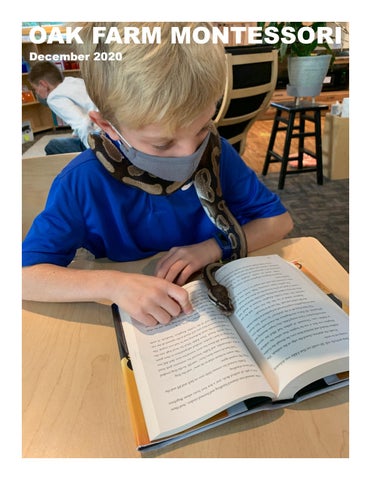
OAK FARM MONTESSORI December 2020
At Oak Farm Montessori School, our teachers are guides who observe each child’s interests and ability to know when they are ready for a specific lesson or even when they may need some extra time to really dig in and explore a topic they love. Montessori teachers intimately know a child’s strengths, weaknesses and interests across a broad spectrum of areas. When a young child may not love reading, the teacher, through careful observation, knows that they are passionate about horses and can suggest a book on the subject matter that will spark excitement. This edition of our newsletter shares how each level prepares their environments, and themselves, for children to pursue their personal interests. We all learn best about things we are interested in, whether we are 2 or 102! Following the child means to respect their interests and provide them with learning opportunities that allow them to reach their full potential.
Candice 2
HEAD OF SCHOOL
“Follow the child”, is a phrase parents often hear in Montessori schools. But, what does this really mean? For most of us, our learning occurred based on the classes we signed up for and the times in which we sat in those classrooms. Biology lessons only happened from 8:15 - 9:15 am and Math was dutifully taught right after lunch each day. What would happen if your dissection work was not completed within the hour? Who would you talk to if you couldn’t figure out that last problem in Trigonometry? Maria Montessori believed that learning does not happen only within specific time frames, or even at the same age or level for each child, and that is why she developed her methodology.
DIVERSITY, EQUITY AND INCLUSION
C
ere lick h
to
COMMUNITY COFFEE
THURSDAY, DECEMBER 3RD 6:00 - 7:15PM
GUEST SPEAKERS Jon Ha le , Ph .D . Uni versit y o f I ll i noi s A s sociate Profess or , E duc at io n Policy, Organ i za tion a nd Leade r sh ip Naomi Sim mo ns -T ho rne , B. S. Univ ersity of So uth Ca r ol i na Graduate Stude nt , I ns tr uc ti on and Teach er Edu ca ti onF e llo , Research Institu te f or S ch o la r s of Equ i ty
#supportourschool
The Absorbent Mind Bayley Siewek, Infant/Toddler Support
I think, as adults, we can all agree that we learn and retain information more if it is relative or of interest to us; the same holds true for young children. When a child is showing interest in a certain area or topic we call this a child’s sensitive period. Children, from birth to age 6, go through stages of growth called sensitive periods. These periods are broken into 5 main categories which include: order, language, sensory skills, movement, and social skills. The length of time these periods last depends greatly on the child. A sensitive period is defined as, “a time or stage in a person’s development when they are more responsive to a certain stimuli and are quicker to learn particular skills”, according to Webster’s dictionary. Children enter into their first sensitive period, which is order, at birth. They strive for routine which helps them organize and make sense of their environment. In this stage, children may find more interest in placing things in order; such as sorting objects from small to large. Disruptions in a child’s order could likely cause a temper tantrum. This period lasts until around age five. Unlike order, the sensitive period for language does not begin until seven months of age. Babies start recognizing their mother and fathers voice before entering this lovely, complex world. However, this period doesn’t officially start until they start mimicking the words and sounds their peers are making. As infants move onto toddlerhood they will find the need to learn the skills to communicate with their friends and the people around them. It is important during this period to have conversations and use language to describe what is happening; both at home and school. Children are taking in all the information around them; Maria Montessori referred to this phenomenon as the absorbent mind. Developing sensory skills is the next period of sensitivity. During this stage of development, children are interested in learning through their senses: touch, smell, taste, sight, and hearing. By surrounding the child in environments where they can explore their interests through their five senses you will help them develop these skills more acutely. A great opportunity for infant exploration is to have scent jars displayed on a shelf with corresponding pictures so that children can connect the smell to its object (lavender, mint leaves, other spices.) Older toddlers can be included in your holiday baking by smelling the muffins baking in the oven and even tasting the treat once it is finished baking. This not only supports the development of this sensitive period, but it allows the child to take ownership and pride in their work. Movement is the next big sensitive period that young children go through. It begins once the child starts to roll over or even starts to crawl. As the child grows older, they develop skills in both gross and fine motor movements. Finding the right activities to support these movements can range from allowing the child time at the park or in the backyard to explore and run around. Coloring and painting are also good activities that can fuel the child’s spark to practice movements. Another example, is if a child is in their sensitive period for fine motor, set up a threading work and allow the child to make a necklace by stringing noodles onto a piece of yarn. Developing social skills is the last sensitive period that children will go through in their early years. This sensitive period is correlated with building friendships and using courtesy. Helping children communicate with peers in a respectful way can benefit them during this period. Using kind manners at home with the rest of the family will display positive interactions for your child to see and mimic with their friends. As previously stated, children are absorbing and taking in all of these interactions and ideas; expanding their knowledge and perception of the world through their own observations and interests. It’s important work to inspire and aid that love and interest so they learn and expand their perception of the world around them. Each of us plays a part to positively impact the children we come into contact with. 4
“
The studies which have been made of early infancy
leave no room for doubt: the first two years are important forever, because in that period, one passes from being nothing into being something.
�
Maria Montessori #supportourschool
“The secret of success [in education] is found to lie in the right use of imagination in awakening interest, and the stimulation of seeds of interest already sown.” Maria Montessori
Sowing seeds of love... Lisa Collins, Primary 1 Teacher
Have you ever noticed that your child is more involved in a work or activity that they discovered on their own? Interest is a key component for motivation and engagement in our work. This ultimately leads to intrinsic motivation which drives a child’s early development. Children are born with a desire to learn and a need to explore. In a Primary classroom, the materials encourage children to engage in lessons that interest them. These materials have all been created to appeal to a child’s interest. As Montessori teachers, we want to cultivate a love of learning in our students. This is the beauty of the prepared environment and observing our students discover what interests them. A child who is interested in animals might be encouraged to study the parts of animals, do animal research or learn about the animal kingdoms. A child who loves art can be shown extensions in every area of the classroom, such as: painting maps, using clay for letter formation or finding recycled materials to create their own masterpiece. In an environment where children are free to choose their own work, they tend to choose that which is most interesting to them. This would explain why children are so engaged much of the time during their work cycle. 6
Tools of the trade Maria Ontiveros, Lower Elementary 1 Teacher
One of the things I enjoy most about being a Montessori teacher is that not only do I get to know my students individually, but I can take this a step further and cater their education to their interests. It’s true, we do need to follow the Montessori framework and educational standards for first, second, and third grade children, but there is still space for changes and personalization both in the content (what we teach) and the methods (how we get to teach it). Students learn better when they are interested and invested; the space and freedom within the what and the how are our tools to be able to follow the child. In Lower elementary, students are often presented with a lesson on a broad topic (e.g. space) and are invited to choose an area of interest within that topic for further study. I love watching them decide! When the children are deeply interested in what they are learning, they invest so much of themselves into their learning. We love watching new passions blossom! But...what of the child who does not find interest in a specific area? And what if the area is not optional, such as learning division? That is an opportunity. Our work, as teachers, is to present the material in such a way that even a child who imagines that he or she has no interest in division, still finds excitement in the work. Anything can be made interesting, as long as we find the right angle from which to teach it. When might a child use division in his or her life? There are so many applications! Each is a new possibility to spark interest for the child. Do they enjoy sports? Learning about reptiles? Studying the origins of the universe? Whatever the area of interest may be, we can present the material, be it division, grammar, or writing, in such a way that sparks interest and provides a way for the child to connect to the topic. #supportourschool
Life -long love of learning Lisa Bockelman, Reading Speciaist Teacher
“Childhood is not a race to see how quickly a child can read, write and count. Childhood is a small window of time to learn and develop at the pace that is right for each individual child.” Anonymous
8
As a reading specialist, it breaks my heart when my daughter tells me she “hates to read.” When I ask why she feels this way, her answer is, “because the teachers make me read books I am not interested in.” This answer is all too common within the traditional school environment. In the Montessori classroom, and during my reading lessons, determining a child’s interest is crucial to academic success. When cultivating individual interests, teachers will choose books to get students intrinsically motivated to read. Teachers will provide the students with text that include coherence, relevance, and vividness to sustain the student’s attention. This text may be in a fiction novel, a non-fiction book that combines text and illustrations, or a magazine article. Whatever the media source, it is chosen based on the child’s interest. The benefits of topic-focused reading are two-fold: children improve their reading abilities and gain a more in-depth understanding of their passion. In certain situations, students will need to read material that may not be geared toward their interests. In this case, it is up to the teacher to foster curiosity and teach self-regulation strategies. Often, in my reading lessons, I need to make a conscious effort to get students “ready to read.” To do this, I ask about similar personal experiences, give them a sneak peek at the ending, ask questions to pique curiosity, or provide them with something to think about while reading. I also show excitement and talk enthusiastically about the book to get the students excited. During lessons, I teach students how to monitor their reading to help them stay focused while reading text that may not be their choice. Some of these strategies include re-reading for better understanding, asking questions while reading, and determining the reason for reading. Modeling these strategies through think-alouds can help students lessen their disinterest rather than just give up on the task. Allowing students the opportunity to read books, do research, or complete a project that they are interested in, gives the students the power of knowledge while building reading, writing, and spelling skills. Teaching students how to self-regulate while reading gives them the tools needed to persevere through less stimulating reading works. Hopefully, in the long run, it will have students saying, “I love reading!”
“Let us leave the life free to develop within the limits of the good, and let us observe this inner life developing.” Maria Montessori
FREEDOM WITHIN LIMITS Linda Hoffman, Upper elementary 2 teacher
It’s Monday morning. The Upper Elementary student has a work plan ready to fill out for the day, the week, or even just the work cycle. This piece of paper represents choice for the student. This piece of paper says to the student, “we trust that you understand the expectations of this (work cycle, day, week) and you will make choices that will help you accomplish those expectations.” It might be difficult to think of a piece of paper as empowering, but this one is. When students have the choice of how to spend their time, we are telling them we believe in them. We believe they are capable. We believe they have good ideas. We believe they are equipped with what they need to stretch themselves as learners, to strengthen the skills they already have, and to seek understanding and guidance as needed. Choice does not mean freedom from responsibility. Within the classroom, lessons are given. Students are invited to these lessons, as deemed appropriate, and they are encouraged to continue the learning on their own. There is responsibility within the student’s freedom of choice. Maria Montessori is often famously quoted, “A child needs freedom within limits”. Adults sometimes erroneously think that children will never choose to work on things that are difficult. Some children do need extra attention and guidance to see the importance and reward of hard work. But more often than not, in the Upper Elementary classroom, students find difficult work satisfying. Imagine working on a math problem for 45 minutes, then finding your solution correct. Imagine writing and rewriting a story, poem, or thought immersed in words, searching for synonyms, utilizing literary devices, then having a friend react to it just as you expected. Imagine searching through several texts, tediously using indexes, guide words, and chapter headings to light upon the information you seek. These are exciting moments to the Upper Elementary student, and the teachers as well. As the adults in the room, we must resist the urge to jump in and help, or (gasp!) do it for them. The message to the student when we step back is one of trust. We are saying, “your ideas matter”, “you are valued” and “you can do it”. So, students take that piece of paper seriously. They consult with friends, they plan around fixed lessons, they take care of their responsibilities first. Is this process perfect? Not at all, but the choices they make provide opportunities for further learning. Making the choices is just part of the learning, owning those choices creates growth. #supportourschool
The power of interest Kim Davidson, Director of Strategic Partnerships
The Montessori philosophy not only provides many “aha” moments for students, but for the adults who are on this journey with them. Adults who observe a Montessori classroom will often respond with a reflection of how their educational experience differed and how they, too, would have thrived in a setting where engagement in learning was an important outcome. At the core of a peaceful Montessori classroom is students engaged in their work. Engagement that comes from having an interest in learning and the topic being studied. As adults we know that we cannot always pick and choose how we spend our time or the work we do; however, we also know that we thrive when we are given the opportunity to engage in work that interests us and allows us to use the learning from our past to move the current project forward. The diversity of thoughts, backgrounds and personal interests that are reflected in the Oak Farm Montessori community is broad. It may be surprising that such a diverse population is unified through a strong common interest and desire to move our school, and the Montessori philosophy, forward in a way that unites and energizes those around us. The power of interest resulting in success has been evident the past few weeks as our community worked together to raise funds to ensure that the uniquely prepared learning environments at OFMS remain strong. While we have not yet met our financial goal for fund development, we have been successful in many ways. We celebrate that over 33% of our support has come from new donors. Alumni and past parents are engaged and have supported our school, and those closest to our community, such as parents, grandparents, faculty, board members and our founding family joined together to have our Day of Giving exceed its goal by over $25,000. During this time, we do not want to forget all those who shared their time and talent to provide support for our community goal. Many helped with preparations before the event or provided social media support during the Day of Giving. Our students also shared their time and talents by participating in the middle school call night and being creative in ways to raise money for their school. Everyone was motivated by a common interest to support our school. Whatever motivates your family to be interested in the sustainability of OFMS, we say “thank you.” In many educational studies, the word interest is often buried deep in some bigger, scientific theory or definition and is forgotten. However, upon reflection, interest can be seen as an integral part of success. Success that enables us to reach for our goals and share successes along the way. May we always use our common interests and the power it can create to continue our journey with our Oak Farm Montessori Community and beyond. 10
#supportourschool
Igniting the Flame by offering choice Misty Schoof, Middle School teacher
There is no better hook to catch my students’ interests than a well written book. Although Fahrenheit 451 by Ray Bradbury is one of my favorites, it was not originally on the list of options for this literature cycle. After a peer recommendation, my students were curious: Why does the firefighter set fires instead of putting them out? All I needed to do was add Fahrenheit 451 to the reading list and step out of their way. The best way to pique my students’ interests is to let it happen organically. In saying that, I don’t mean accidentally; but rather intentionally, with a classroom environment that offers choice and allows students to propose ideas (and books) that go beyond the choices listed. Choice is pivotal in engaging adolescents because they become invested in their learning. Adolescents also thrive in social settings. The peer recommendation of Fahrenheit 451 was an important key to unleashing their curiosity. Adolescents are inherently social beings. Providing opportunities to work collaboratively, discuss reading, or debate historical issues allows students to activate their social nature. 12
Outside of the academic realm, the farm offers a natural avenue to tap into students’ interests. Many of our middle schoolers are enthusiastically involved in anything related to our animals (even poop). Besides the comfort of holding a chicken or the joy of feeding a goat, there is a real world need that these animals have for our students. Our farm depends on them. On any given day, students are surveying their community on baby Alpaca names (all absentee ballots have been counted and the name is officially Juan), planning an animal parade, or simply cleaning out the stalls. Before stepping into our classrooms or walking out into the barn, our adolescents come with their own personal interests and hobbies. Tapping into students’ interests is a balance of exposing them to new and intriguing learning opportunities while also building upon their individual passions. The Let’s Get Outside creative expressions class planned a geocaching adventure to introduce our new trimester theme: cooperation. This experience was sparked by one student’s interest in geocaching with their family. Every learning experience in the classroom, on the farm, or geocaching around campus has one focus: our students. And at the end of the day we want them to “stuff [their] eyes with wonder… live as if [they’d] drop dead in ten seconds. See the world. It’s more fantastic than any dream made or paid for in factories” (Bradbury, 150). Bradbury, Ray. Fahrenheit 451. New York: Simon and Schuster, 1967. Print.
Fahrenheit 451 is a dystopian novel by American writer Ray Bradbury, first published in 1953. Often regarded as one of his best works,[4] the novel presents a future American society where books are outlawed and “firemen” burn any that are found.[5] The book’s tagline explains the title: “Fahrenheit 451 – the temperature at which book paper catches fire, and burns...”, also known as Autoignition temperature. The lead character, Guy Montag, is a fireman who becomes disillusioned with his role of censoring literature and destroying knowledge, eventually quitting his job and committing himself to the preservation of literary and cultural writings. #supportourschool
14
Candid photos, sports, events, classroom pets, spirit week and more! Don’t miss out on the year in photos...order your yearbook today at this link.
Follow the child Kristine Moreland, Outdoor Teacher
Children are naturally curious about their world and enjoy exploring their surroundings. The outdoor environment is already prepared to nurture that curiosity and encourage early interests in nature. On a recent walk through the woods, I heard children asking questions like, “Why do the leaves change color?” “Why is this caterpillar furry?” “What is that hawk eating?” By incorporating nature into our Oak Farm Montessori curriculum, we can help students find the answers to their questions in both indoor and outdoor classrooms. There are many days when I have a structured plan for what we will be doing during outdoor work that morning. Sometimes it goes exactly how I planned, but many days the weather or the students have something else in store. Being willing to change and be flexible is key; both at home and school while outside. Tossing away the plan sets them off on a myriad of discoveries and adventures. All you have to do is follow their lead, taking interest without taking over. The object of interest may be anything from a salamander found under a log to a mud puddle. So if the plan was to pull weeds at Brett’s garden, but the kids have gotten really excited about picking warm raspberries to eat, then I don’t want to pull them from that experience. Joining them in their curiosity is still an opportunity to bring in impromptu lessons. How do we know these are raspberries? Are there other plants that look the same? How do you tell when they’re ripe and ready to eat? Do you think there are animals here that also might want to eat the berries? Traditional education makes the assumption that the adults have the knowledge and it is their job to teach that same knowledge to the child. But, by following the child’s curiosity and interests, all you have to do is catch that moment and help it expand. Our job is to facilitate and watch the amazing growth that is bound to happen.
“Let the children be free, encourage them; Let them run outside when it’s raining. Let them remove their shoes when they find a puddle of water; and when the grass of the meadows is wet with dew, let them run on it and trample it with their bare feet; let them rest peacefully when a tree invites them to sleep beneath it’s shade; let them shout and laugh when the sun wakes them in the morning.” –Maria Montessori
#supportourschool
Mark your Virtual
calendars
Community Coffee
Half Day
In-Service
Christmas
DECEMBER 3, 2020 DECEMBER 18, 2020
Break
DECEMBER 21, 2020 JANUARY 3, 2021
TALL OAK FUND
SGO
VOLUNTEER
DAY OF GIVING
SUPPORT OUR SCHOOL