Oak Farm Montessori April 2022
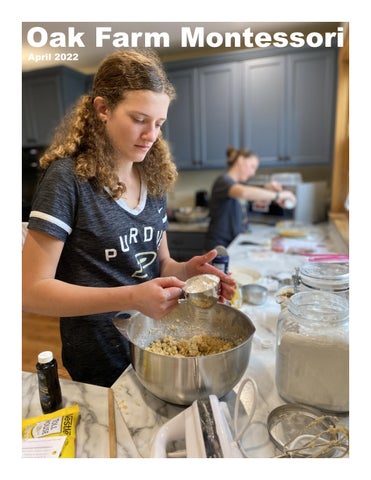
Each day in our classrooms, children are given opportunities to learn, practice and make mistakes. A student may be asked, “Why do you think this happened?” Not to point out the deficit or error, but rather to encourage the child to identify a better method or remedy on their own. This builds confidence and leadership skills that would never come from the teacher pointing out the error and offering a solution. Montessori spoke of providing freedom in the classroom for the child to explore their interests and pursuits. However, she also measured this standard within the prepared environment; within limits. Whether it is a toddler carefully slicing strawberries or a middle school student preparing homemade pesto, the environment is carefully prepared for them to succeed. But what happens if the bowl of strawberries falls on the floor or an ingredient is forgotten in the recipe? The student is trusted to problem solve and develop possible solutions. Should we throw the strawberries away or wash them for our friends? By ‘doing’ with their hands and stimulating their executive functioning with these freedoms, the students are being given the gift of self satisfaction. Instead of working towards a measure predetermined by the adult, these students ‘work’ towards reaching their individual potential. This month you will read stories of how Oak Farm Montessori students are encouraged by their teachers; invested by being a part of the process and emulating the portrait of a graduate through freedom within limits.
Candice 2
HEAD OF SCHOOL
“What the hand does, the mind remembers.” When Maria Montessori said these words, she was speaking to the way in which a child learns best; by practice and by internalizing the process in which things are done.
#supportourschool
Nice & N e at Nefy Hathaway, Toddler 1 Teacher
F
reedom within limits is an empowering concept created by Dr. Maria Montessori. The concept itself may seem to be contradictory. After all, aren’t limits the opposite of freedom? Some may even think that the absence of rules may lead to negative behavior. Surely, no rules lead to chaos, right? So what does this mean? Freedom and discipline go hand and hand. Too much freedom creates chaos, and too much discipline becomes punishment. Montessori encourages freedom within limits through the design of the prepared environment. Especially relevant are the low open shelves; logically placed and ordered activities, or works, that are set up left to right, top to bottom, concrete to abstract and gross to fine. The idea of freedom within limits embraces the child as an explorer who is capable of learning and doing for themselves. This encourages
4
the child to move freely around the classroom and choose their own work materials within limits of interest and ability. According to Montessori’s theory, the learning environment, and everything in it, should foster a child’s Order, Concentration, Coordination and Independence (OCCI). So what does this look like? In an Infant and Toddler Montessori classroom, self-discipline is something that grows within the individual child. During these crucial stages of life, the child absorbs everything in the world around them; through all of their senses, unknowingly. This is referred to as the unconscious absorbent mind. For example, a child who learns to sit, stand, walk and speak, will do so naturally, repeatedly and spontaneously as well, without conscious effort and reasoning. This stands true for our guiding principles at the Infant and Toddler level:
Care of self, Care of others and Care of environment. With respect, consistency and adult follow through, a child will meet the expectations you set. Within the constant cycle of activity, the child becomes conscious of his/her actions; activity that his/her hands perform or manipulate. Once he/she is able to concentrate for periods at a time, he/ she is driven to repeat the activity. This cycle fosters control of movement as well as independence. Along with the materials, there are very clear boundaries in the Montessori classroom. This structure ensures a respectful and peaceful environment in which everyone is both cared for and honored. For example, as a young toddler comes to school each day at Oak Farm Montessori, they each have a prepared environment, their own cubby. This space provides a bench
platform for their individual bodies, two hooks for tote bags and coats, and an open area for their shoes and slippers. Rather than throwing or laying their items on the floor, he/she follows steps through both adult language and modeling such as, “hat off, mittens off, mittens in hat and hat in cubby.” We find that with the repetition of movement and freedom of choice, each child meets this expectation while creating their own sense of order. Freedom of choice offers the child a sense of control. Even when a child does not want to meet an expectation, their choice may be, “You may do it, or I can help you.” With as little as a $2.00 plastic hook strip and a small basket on the floor, your child too will begin to display OCCI with his/her care-of-self work at home. As mastery is displayed, extensions may be added. In our Toddler classroom, I call this, “nice and neat.” Shoes are now placed together nice and neat, tote bags are hung by both handles, and the child learns to pull the arm sleeves out of their coat so that they are right side in.
stone through a child’s journey to discover self-regulation, controlled impulses, and to become a well-adjusted adult in our society. Within a prepared environment that encourages freedom of choice and consistent boundaries and expectations, that we call freedom within limits, the child develops an innate desire to explore and do for themselves as if we, their caretakers, guides, and environment keepers, do not exist. Maria Montessori said it best with one of my favorite and her most famous quotes, “The child is now working as if I do not exist.”
A balance of freedom and responsibility supports the development of the child’s will. By developing a child’s will power, they find purpose, inner peace and are best prepared for the world around them. A child’s will is the stepping #supportourschool
safe boundaries Melissa Witt, Primary 4 Teacher
The concept of freedom within limits is a key component of Montessori education that embraces the idea that children are explorers capable of learning and doing for themselves. In The Absorbent Mind, Maria Montessori said that, “to let the child do as he likes when he has not yet developed any powers of control is to betray the idea of freedom.” Placing limits on freedom may seem counterintuitive at first glance, but healthy and appropriate boundaries are necessary to empower children to feel safe in exploring their environments. Within the framework of Montessori education there are only three core limits. These are: Respect for oneself, Respect for others and Respect for the environment. These core limits are used to collaboratively strike a balance between an overly rigid structure and a chaotic classroom environment. Instead of being locked into a strict schedule, classrooms utilize a flexible routine that allows children freedom to explore and learn at their own pace, while maintaining the integrity of the classroom. This predictability allows children to feel comfortable and secure to make their own decisions and test their own limits. What does that actually look like in our community? Having a flexible routine means trusting children to make their own decisions within the confines of a generalized schedule and appropriate behavior. During our morning work cycle, kindergarteners are encouraged to use their work plans and choose works from each area of our classroom. Within the work cycle we have PE and other specials available that they can choose to participate in based on their personal needs each day. This enables individual children to recognize and address their needs as a whole person. In addition to working within a generalized schedule, children choose work with its intended purpose in mind. For example, when a child chooses to use the Brown Stairs, they would place it on their work rug from thickest to thinnest and then replace it back on the shelf in the same manner. If they choose to build with it instead, they will be asked to restore the work and be guided to our building logs or magnet tiles. This allows them to meet their need to build while being held to the core boundary of respect for the environment. Freedom within limits empowers children to take responsibility over their learning and growth. They are being trusted to make their own decisions and they know they are safe within the boundaries that have been set for them. Try this idea at home: Sit down as a family and collaborate to create sensible and safe boundaries for your home. An idea might be: “At home, we use walking feet on the stairs.” Practice modeling the desired behaviors together to solidify the expectation. 6
Guiding principles kirsten nold, lower 1 dlip teacher
All humans, regardless of age, desire freedom. Freedom supports us in feeling autonomous, capable, independent, and adventurous. This said, too much freedom can cause feelings of insecurity, fear, anxiety, and a sense of being overwhelmed. Imagine a highway that operated with complete and total freedom of the drivers. Sure, it would be convenient, and maybe even adventurous, for drivers to be able to drive 100 miles per hour. However, it would likely make other drivers on the road feel unsafe and could result in physical harm. Though we all desire freedom, true empowerment is derived from freedom within limits. Just as the awareness of the speed limit empowers us to make choices that support our wellbeing, in addition to the wellbeing of those around us, establishing limits in the classroom empowers children to make choices that support their wellbeing and the wellbeing of those around them. A Montessori classroom is a space that offers children a wide variety of opportunities to experience freedom within limits. This is an elaboration of the commonly heard phrase “follow the child,” as it puts as much choice within the hands of the child as possible, while still preserving their physical and emotional wellbeing and prioritizing their learning and growth. From a short 5-minute observation in an elementary classroom, one can see students making a variety of choices that demonstrate their freedom within limits: one student is choosing to work with a partner, another student is designing her own work plan for the day, yet another student is choosing to move his work from a table to a rug on the floor. The children are empowered to take care of their own needs. They are encouraged to explore topics that most pique their curiosity. They are invited to work in a way that best supports their learning. And yet, there are reasonable limits in place that make the environment rich in opportunities for learning and growth. For instance, the students are free to choose any work, yet the work must be returned to the shelf and properly restored for the next child. The students are free to communicate about their feelings or preferences, yet they must communicate respectfully and with grace and courtesy. The students are free to work on the surface that feels most comfortable to them, whether that be a table, floor table, or the floor; yet their work must be organized and tidy. The kinds of limits that exist in an elementary Montessori environment support the child’s evolving internal moral compass, as well as their growing awareness of their impact on others. Experiencing freedom within limits guides children to becoming respectful, independent, and curious learners, which allows them to grow into adults who are empowered, motivated, and inspired. Curating an environment that aligns with the ideology of “freedom within limits” is fundamental to the Montessori philosophy. We encourage you to explore ways to incorporate this practice with your child at home! Some areas that you might find freedom within limits most naturally fits in your elementary child’s life at home are choices about clothing, food, and free time. Keep in mind that each one of these freedoms comes with limits that need to be communicated to the child. #supportourschool
“Without freedom it is impossible for personality to develop fully. Freedom is the key to the entire process, and the first step comes when the individual is capable of acting without help from others and becomes aware of himself as an autonomous being.” Maria Montessori, Education and Peace.
April VanOsdale, Upper 3 Teacher
In our upper classrooms, a prepared environment with expectations sets the tone for students to be free to explore their learning, while showing care for others as well as our environment. These expectations are created by the students. This gives them ownership of their environment as well as the safety to make mistakes. We encourage this freedom without allowing children to be rude, destructive, hurtful, unkind or disruptive. The secret is a balance between rules and freedom. With this freedom, children feel empowered to try new things and to be a contributing member of society. They know that this is all based on trust and that as guides, we are counting on them to be responsible. When this trust is broken, freedoms are scaled back for a temporary time period. As children gain more and more control over their decisions and movements while moving through each plane of development, observations are made and another try will be encouraged. Children rely on our support to allow them these freedoms while also providing restrictions that help them stay safe. 8
Watch the Community Memo for additional details!
Kids in the Kitchen Kristine Moreland, School Chef Cooking is an essential skill that our children will use throughout their lives. Fortunately, it’s also an easy skill to teach! No complicated curriculum or lesson plans are necessary, simply by being involved in preparing a meal together gives them a sense of accomplishment from their contribution and hard work. Learning how to use tools in the kitchen will also help to refine their fine motor and executive functioning skills; as well as the ability to master a sequence of steps. These activities are building the child’s independence and freedom to do things for themselves. We are excited to bring students back into the school kitchen soon. The primary age students are eager to help and can do simple tasks like washing fruit and sorting them into each classes’ baskets. As they get older, we will move onto tasks like peeling potatoes and cracking eggs. The lower and upper students will learn how to use a knife properly to slice vegetables and help prep for our school lunches. As their skills grow, we will continue to increase their responsibility and freedom in the kitchen. Before long, they will be able to prepare many of our recipes at home on their own! Here are some practical life kitchen skills that are used in the early Montessori classroom that can easily be done at home also. *peeling and slicing fruit *adding and mixing ingredients *helping to set the table *squeezing orange juice *grating cheese *using kitchen appliances with supervision *spinning salad By learning these skills early, it will help their independence and confidence as they get older; giving them the freedom to make their own meals and snacks. Don’t be afraid to let them help and/or let them experiment on their own. #supportourschool
ROOM TO GROW EXPONENTIALLY Heather Lemmon, MS Director & Teacher
10
AS TEACHERS, IT IS OUR GOAL TO CREATE A BEAUTIFULLY PREPARED ENVIRONMENT AND MATERIALS THAT WILL ALLOW FOR STUDENT CHOICE AND FREEDOM IN WORK. WE ARE ALWAYS REMINDING STUDENTS THAT “MISTAKES ARE PROOF YOU ARE TRYING!”
T
he math classroom at the middle school level is a prepared environment that abounds in choices and freedom for students. As teachers it is our goal to create a beautifully prepared environment and materials that will allow for student choice and freedom in work. We are always reminding students that “Mistakes are proof you are trying!” Here’s a glimpse into what “Freedom within Limits” in a middle school math environment looks like… As teachers, we prepare the environment in such a way that students can move at their own pace. They get lessons at their own pace. This could be in small groups or individually. They have a cycle guide that directs their work. They can choose when they complete their works and how the work is completed. For example, the cycle guide for Trimester 3 shares the three chapters that need to be completed. Students choose how to complete those chapters. Will they follow a contract that shares which problems to do, grade those problems, make corrections, and come for reteaching if needed? Or choice two, which leads them to complete an in-depth research and demonstrations on the
chapter. We call those choice projects. In the research section they dig deep into the history of the concepts in the chapter and even some key mathematicians that contributed to the field. The demonstrate section asks them to write and solve problems to “demonstrate” their understanding of the concepts. Teaching someone else how to do the work really helps one fully understand the concept! Finally, the create section asks them to create a product they could use to teach others about this chapter’s work. They conference with their teachers along the way, always checking for understanding. Other choices allow for students to assess their understanding and move more quickly if they can demonstrate mastery of the work. More examples of freedom within limits include shelfwork. Their goal is to pace themselves at one shelfwork a week. Of course, they can always choose to do more. Shelfwork is a key component in that bridge from concrete to abstraction. The concrete work is that of the hands and the head. Making the work visible in front of the student in order to manipulate and physically see. Abstraction refers to work consisting of
students “seeing” the work with their mind’s eye. Shelfwork is an opportunity for our students to work with their hands and make that connection between the concrete and the abstract work they are doing. Shelfwork choices are many. We have VersaTiles to work on their key concepts, we have made our own shelfworks that go along with the lessons they are receiving, we have math board games, students have created shelfworks, and even some games to work on multiplication facts. So many choices and the freedom to choose how they will accomplish their shelfwork. There are many freedoms within the math classroom at the middle school. The cycle guide helps lead students through their math work each trimester. They have many opportunities to choose when they will get their lessons, the speed at which to complete their math works, when they will accomplish their shelfwork, and ultimately how far they want to go in math while at the middle school. It is a beautiful process and privilege to see Dr. Montessori’s principle of freedom within limits come to life in our math classroom every day. #supportourschool
Characteristics of Third Plane: • Idealism • Need to discover their intended vocations • Great change and relative instability • Puberty • Rapid physical and emotional changes • Emotional and sensitive • Need nurturing environment • Need for respect • Decrease in intellectual capacity • Abstract learning
12
THE ROAD TO ADULTHOOD Rikki Colon, HS Teacher, College & Careers Advisor
Seven! That is how many parents were moved to tears as they listened to their child present their portfolio at our student led conferences in March. They were so moved, due to the sense of pride they had in their burgeoning adolescent. On the other side of that pride is the hard work they, as the parents, have put into raising these amazing individuals. Along with those tears of pride, we all know that at some point, they were accompanied by tears of sadness, frustration, and angst. We have all been there; either as the student or the parent. These years can be filled with both triumph and trial. The third plane of development is ladened with great vulnerability, of doubt and hesitations, of risk taking and pushing the limits. It is a time of great change to their physical body and relative instability in their emotions and identity. It is also a time when the adolescent is hungry for freedom. They are no longer children, and they are not yet adults. Does this seem like a recipe for disaster: unstable emotions + greater risk taking + hungry for freedom? It certainly can be if we are not cognizant of what they are experiencing. Many individuals are tempted to pull back, to disengage, during this sensitive time. Yet, it is our collective job to help them through this turbulent plane of development and into the adult world. In the Montessori environment, one way we navigate this is through freedom within limits. From the first week of school, students are offered many freedoms: the freedom to set the guiding principles for the year, freedom of choice in projects, freedom in how they share their knowledge, freedom of movement, and the freedom to solve problems that arise in the community. Now, before one thinks that it is a “free for all” at the high school, you should be aware that we are careful to place limits on said freedoms. However, without giving freedom, how does one know how to succeed, to make wise choices, to learn from their mistakes? Gandhi said, “Freedom is not worth having if it does not include the freedom to make mistakes.” When providing choices to adolescents, it is imperative to keep in mind the motto that “with freedom comes responsibility.” If the adolescent is not responsible with their new-found freedom of making choices, then it is our responsibility to re-evaluate them and possibly scale back so that they can practice and try again. Limiting the options can be helpful for adolescents who may not consistently make good choices. That being said, one must always keep in mind that changes in behavior must be seen as normal passageways to maturity, not as problems. Freedoms, therefore, must be constantly evaluated; we must consistently extend more freedoms when the adolescent is ready for more responsibility. Our collective goal must remain: guiding them through this turbulent time into the process of valorization and ultimately into adult life. #supportourschool
Mark your Spring Break Primary
April 4 - 8th, 2022 April 14th, 2022
School Closed
april 15th, 2022
Parent Day
Community Earth
School Closed
Parent Day
Good Friday Toddler
calendars
Fest
april 21st, 2022
Coffee
april 22nd, 2022 april 29th, 2022 TALL OAK FUND
SGO
VOLUNTEER
DAY OF GIVING
SUPPORT OUR SCHOOL
“To provide a Montessori environment that inspires children to reach their potential through meaningful work.”
Oak Farm Montessori School | 502 Lemper Road | Avilla, IN 46710 | 260.897.4270 | www.oakfarm.org