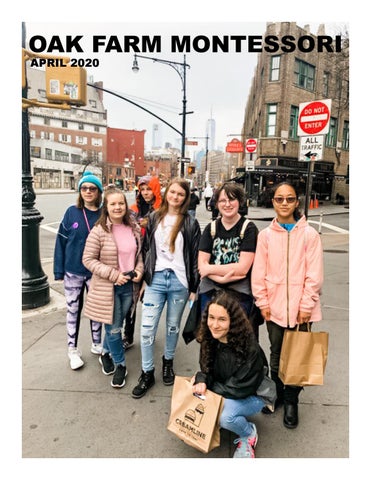
OAK FARM MONTESSORI APRIL 2020
“The child is both a hope and a promise for mankind.” Maria Montessori
G
lobal citizenship could not be a more timely theme for our newsletter this month. How we are all helping one another, across the world and across the street, as we face the health and financial crisis happening around us. Montessori, and the cosmic education at its core, is the best way to develop good mental health and find ways to function and cope to support one another. This philosophy, that teaches the interconnectivity we all share, has always been promoted, but now our community is reliant on these core beliefs more than ever. The chaos around us can be an asset if we allow it to be thought of in terms of community; how our children and their bigger community have shown adaptability. I see this in the way we are supporting one another from a distance to fulfill our school’s mission and what your own families are doing as responsible citizens of the community. Behind the doctors and nurses on the frontlines, there are everyday individuals supporting these professionals. Whether that is caring for their families, or sewing masks, or supporting local businesses, or staying home. We all are doing our part to make a difference in the world. Together. We are all connected and we understand that when something has an effect on one person, it has an effect on another. Global Citizenship is a characteristic fostered in even our youngest students through our Portrait of a Graduate and is also outlined in our Vision and Values document. Our students are civic-minded and have the knowledge and awareness of the impact of each person’s actions on society. While all of us have realized, through this pandemic, the importance and role of each individual within a community, Oak Farm students practice global citizenship in countless other ways. I invite you, as a family, to read how these characteristics are exhibited at every level in impactful ways across our Oak Farm Montessori campus and around the world.
Candice
PEACE BEGINS WITH ME ABBY MINICH, PRIMARY 2 TEACHER
Each September we come together as a whole campus community, along with thousands of other Montessori schools around the world, in honor of International Day of Peace to sing a song called, Light a Candle for Peace. The lyrics of the song simply state, “Light a candle for peace. Light a candle for love. Light a candle that shines all the way around the world. Light a candle for me. Light a candle for you. That our wish for world peace, will one day come true!” I believe that, even at the Primary level, our students demonstrate this global citizenship of peace and truly want to make the world around us a better place in which to live. At our level, 3-6 year olds, one way students practice Global Citizenship of the Earth is through the recycling and composting done each day in our classrooms. Students also extend this practice outside while participating in preserving, protecting and finding a deep respect for the woods during their work at Kinderforest. The children have learned to understand that we are guests in the woods, and while some areas are for play; we are not to disturb the natural habitat for the creatures that dwell there. During our community time, we read many non-fiction books that lead to discussions on how we can protect the ocean, animals, and the world around us. We also are fortunate to have Upper Elementary mentors who research environmental passions and then present their findings to the Primary students. Some examples have included: how to protect insects, whales and the importance of recycling. While we may not currently be physically present at the school, I still see student’s practicing global citizenship during this time of crisis. Many students, while completely at-home learning, have helped sew masks for hospitals or made cards for nursing homes and essential workers. How amazing is that? Practical life skills, compassion, empathy and global citizenship is alive and well in the hearts of these inspiring students; wherever their physical bodies may be.
Connecting to the Global Community Kim Davidson, Strategic Partnerships Director
Global citizenship is about being part of a growing world community. It is about choosing to contribute to making that world community a better place. In a Montessori community, children learn to envision the world with a higher sense of awareness, learning to form global connections. Megan Green, 8th grade class of 2012, shares the impact OFMS had on her awareness of others around the world. Megan is a Montessori student from the early years; however, she did not begin attending OFMS until the first grade. She attended Oak Farm Montessori 2004-2012, leaving after 8th grade to attend Carroll High School. Megan is currently a senior at Indiana University, Bloomington who is majoring in early childhood education (birth to third grade) with a minor in sociology. Megan is involved with the Kappa Delta Pi Educational Honor Society and Young Life International Christian Program as a middle school mentor. “I believe that Global Citizenship is being an active participant in global affairs and can play out in many ways. You don’t have to be president. You can be knowledgeable and educated about global affairs. There is no question that my belief is influenced by my time at Oak Farm Montessori. The Montessori curriculum and philosophy are so much about community. I remember this from primary and it is truly part of the culture. It is experienced in real ways. Our learning was not an abstract idea when we learned about the world. Through our classrooms and how that community operated, we not only learned about different perspectives, ethnicities and backgrounds; We also learned how to honor and respect those who were different than
ourselves. It was simply part of the culture. Respect is so important in Montessori and fundamental to understanding, embracing and practicing global citizenship. At Oak Farm Montessori, the culmination of this comes to life during the Middle School Years and Model Montessori United Nations (MMUN). This is when I became aware of the international problems through MMUN and how to be advocates on the behalf of others. As a 13-year old, it is pretty empowering to know that what you say and do really matters. What a wonderful way to foster Global Citizenship in students! As I look ahead to my upcoming student teaching in New Zealand, I have no doubt that my time in Montessori and the emphasis on global citizenship has impacted my desire to be an educator and provide a similar learning experience for the children I will teach. I know that I have a stake in global citizenship, what it looks like and how future generations will embody that characteristic. I know I will learn more about being independent, learning to live in a different country and culture and to develop a deeper understanding of their life. At the end of the day, I believe that being a global citizen means that we are all connected by similar human experiences and are linked together, regardless of our cultural differences. I am excited to embark on this journey to learn more about another culture, to teach in a bi-cultural educational system that honors cultural differences and to be able to share those learnings in my career.
Primary 3 Teacher, Elizabeth Green, is Megan’s first introduction to the Montessori philosophy; her mom!
Megan and her 8th grade OFMS classmates were interviewed by an Italian reporter to show how body language and gestures help with language barriers.
Using K.I.N.D. to enhance Global Citizenship Linda Hoffman Upper 2 Teacher
So often, when we meet someone new, we try to make a connection. “ Where are you from? Oh, that’s very close to where my Aunt Judy lives!” “What do you do? Well, you probably can’t wait for tax season to be over!” Making connections not only drives the conversation, it helps us make a memory for future conversations. In Upper Elementary at Oak Farm Montessori School (OFMS), teachers craft opportunities to connect our students to each other, the rest of the campus, the community, and the world. K.I.N.D. is one of those opportunities. Kids Investigate Natural Disasters (K.I.N.D.) is in its third year. Nearly one-third of our Upper Elementary students participate, but all are impacted in some way. During the year-long study, students learn about what constitutes a natural disaster, who is affected, and who helps. While they research earthquakes, volcanic eruptions, hurricanes, tornados, wildfires, and the like, they realize there are few places on the entire Earth that are unaffected. Doesn’t that connect us all? They discover multiple disaster relief organizations; big and small, federal and local, that mobilize vast amounts of money, supplies, and people to help after an event. Disasters bring people together and global connections are made. When students share how different parts of the world handle a natural disaster in the same category, they can see how location, governmental structure, and lifestyles affect the response and recovery. This curriculum brings geography, weather, science, math, ecology, language arts, and even history all together as a student studies a specific disaster that occurred during their lifetime. The culmination of this worldwide focus on natural disasters is a speech. The speech is prepared by the students as the result of the research, and offers a call to action on the part of the world. As individuals, or in groups, what action can be taken to prevent loss of life and property in the future? K.I.N.D. participants look beyond just reporting the particulars of a disaster. They connect what has passed with what is ahead, and offer a way to improve life for humanity; in the hopes that people will join together, connected by a common purpose of simply caring for others. This is Global Citizenship. Those that work hard on all the lessons of K.I.N.D., those that lend support, and those that are moved as a result are all practicing this important component of our Portrait of a Graduate.
A window full of perspective
Alex Balle, Librarian
When any student, parent, or visitor enters through the main door at the Victorian Farmhouse, one of the first things they will notice, after Abby’s welcoming smile, is the glass display case in front of the library. Each month, this display changes in correspondence with what history/heritage month is being celebrated. The purpose of history/heritage months is to remember and honor groups of people who have been marginalized during various times of our country’s existence. Each month, books are highlighted on that month’s topic and students engage in age appropriate discussions and read alouds within this theme. These discussions and read alouds help students empathize and imagine what it has been like for the people whom history/ heritage months honor and celebrate. Some examples include: Women’s History, African American History, Jewish American Heritage and National Hispanic Heritage month. In these times of social distancing, discussions like these are even more important to help children see a world outside of their own. If you are in need of any book recommendations on history/ heritage months, or book recommendations in general, please feel free to email the library or check out the lists provided on the google doc within the School Site for athome learning.
Making an impact... Bridget york, Director of Curriculum and Student Servces
7th Years’ Week
Theme: Lifelong Learning Why: To begin the development of our upcoming 8th-year leaders and to broaden our minds beyond our classroom to deepen our experiences and our learning Schedule: • Mon at 10:00-Jared Knipper, Albion Elementary principal • Tues at 10:00- Pam DeCamp, Local natural gardener and entrepreneur • Wednesday- Trip to Fort Wayne, IN • Thurs at 10:00-Kay Donaldson, Service Excellence Advisor, Parkview Noble Hospital • Thurs at 11:00-Candice Holbrook, Head of School, Oak Farm Montessori • Friday- Explore the impact the arts have on community
As Maria Montessori wrote in To Educate the Human Potential, “Since it has been seen to be necessary to give so much to the child, let us give him a vision of the whole universe. The universe is an imposing reality, and an answer to all questions.” Montessori’s visionary idea was based on her observations of children’s (young adults) eagerness to understand themselves, the world, and how they fit into it. This is an essential component of the Secondary Program at Oak Farm Montessori School. Each Spring, students at the Middle School explore and learn about other perspectives from around the world. This year the 7th Years’ Week was focused on learning from a stellar line up of community members that resembled a TED-X Conference. Students were involved in committees to help plan the exciting week of leadership and learning. 8th Years participated in the Montessori Model United Nations (MMUN) Conference in New York City with students from around the world. Students worked throughout the year to write academic persuasive
papers and speeches on topics ranging from safety of journalists to deforestation. Students planned many aspects of the trip and learned to navigate the NYC subway over our week in the city. At the conference, they shared their ideas and worked with other delegates representing the countries of the United Nations to find consensus on these global issues. We also enjoyed time in the city as well as a MMUN Hip Hop concert/ celebration night with all of our new friends. According to Montessori, we have a moral responsibility or a “cosmic task” to respect and protect humankind. Nurturing the core value of global citizenship is meant to prepare young adults to successfully handle the issues that the modern world faces in a peaceful way. Thank you to the chaperones and MS Team for providing these amazing opportunities to grow as global citizens. At Oak Farm Montessori School, we believe with social lessons, positive exposure to others, real world experiences and support that our young people can make a positive impact on our world today!
8th Year MMUN Week
Schedule: • Monday: Flight to NYC, walk the Brooklyn Bridge and Grialdi’s Pizza • Tuesday: Color Factory, Chelsea Market, Broadway: Beetlejuice • Wednesday: Ellis Island, Statue of Liberty, World Trade One, Ground Zero Memorial, MMUN Opening Ceremony • Thursday: MMUN Conference Committee Sessions, Museum of Illusions • Friday: MMUN Conference Committee Sessions, Planet Hollywood and Celebration Night Concert • Saturday: MMUN Closing Ceremony (Anna Sondek spoke on behalf of her committee to over 1500 people) and flight home
Where is calculus? Everywhere! Doug Desper, Secondary Mathematics Teacher
Calculus? What is Calculus? And when am I ever going to use Calculus? Are these questions you asked when you were in school? Or even still now, you are asking this same question. Students today ask these questions when they begin Calculus, but here at Oak Farm the answers to the question, “When am I ever going to use Calculus in real life?� become apparent as the students learn more than just algorithms for a math test. Students are given the opportunities to discover the how and whys of Calculus through problem solving in the fields of architecture, engineering, graphic arts, biology, chemistry, physics, astronomy, medicine, pharmacology, business, manufacturing, banking, and economics. Basically, Calculus concepts are the most efficient method for finding the rate at which something is changing, for finding maximum and minimum values, and for use as an accumulator of values. At Oak Farm High School, we have our first group of students (juniors) completing the Pre-Calculus course and starting Advanced Placement Calculus (for college credit) prior to Spring Break this year. They have set a goal of mastering the applications of Calculus I and Calculus II and passing the AP Calculus BC Test before graduation in the spring of 2021. So, what will our Oak Farm students experience as they progress through the Calculus courses? That answer may vary from student to student, according to their interests and the applications that we incorporate to match their interests. Calculus synthesizes all the math skills from Algebra, Geometry, and Trigonometry to form the building blocks for applications to real-life, high-tech solutions to problems that professionals encounter in their daily work life. For example, currently biostatisticians working in conjunction with medical professionals are using Calculus to create models that will predict the rate at which the Coronavirus will spread, as well as predicting which areas of the world are most susceptible to its spread. Combine this with Game Theory (mathematics that is taught in our Finite Math course here at Oak Farm), and medical professionals can best advise how to deal with this disease to limit the effects it has on our country and the rest of the world in terms of physical and economic health.
Specifically, for our current students we will be focusing on business applications, graphic design applications, and applications to the medical field. In the context of business, we will investigate the mathematical methods for maximizing profits and minimizing costs. More specifically, Calculus can be used to predict marginal costs, which is the rate at which costs are changing as compared to the change in the amount of product that is being produced. Likewise, marginal revenue can also be used to predict the rate at which revenue will change in relationship to the change in the amount of product that is being produced. In the realm of graphic design, Calculus is used by graphic design artists to determine the behavior of 3D models in an environment in which there are rapidly changing conditions. In this manner, graphic design artists are able to create environments within movies and video games that appear to be realistic. In the medical field, Calculus is used in a myriad of applications. One example is the frequent use of Calculus to monitor the rate of change of tumor growth or tumor reduction in cancer patients. In a similar manner, Calculus is used to determine prescription doses for medicines by calculating the changing rate at which a medicine diffuses into the body, by calculating the changing rate at which a medicine is removed from the body, and by calculating the total amount of medicine that has accumulated in the body at any moment in time. These, and many more are all real-life, high-tech solutions to problems that professionals encounter on a daily basis. Our Calculus students here at Oak Farm will be tackling problems of this nature as they master the mathematical concepts of Calculus. So, in the near future when our Oak Farm graduates are the adults creating a new and more sustainable world for us to live in, it’s important to remember that it all started for them in the basic STEM curriculum, one which uses Calculus as one of the building blocks to a better society.