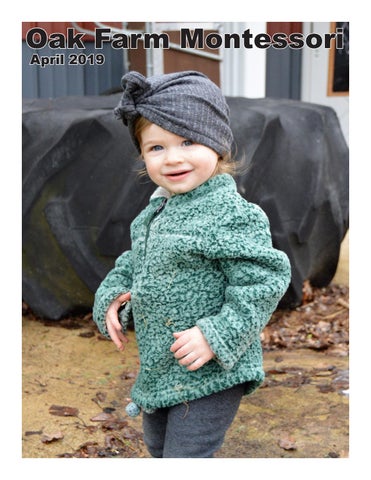
Oak Farm Montessori April 2019
Curiosity caught on camera Candice Holbrook, Head of School
Evidence of spring is taking place in many ways at Oak Farm! Initial signs came with the arrival of three baby goats last month. Primary students collecting eggs, to care for and monitor back in their classroom until the chicks hatched, discovered them during their work. It wasn’t until my own Primary aged son, Jack, began to provide a vivid description of how the new goats were discovered, that I realized the children actually witnessed a live birth! This is an experience that I have yet to have myself, but the odds are in my favor here at the farm. Since then, the farm animals continue to multiply. Classes visiting the farm this spring are in for a real treat! Other signs of spring have also been observed as children conduct outdoor work and explore the natural environment of our 100+ acre campus. Whether that is through the toddlers taking their regular walks in the woods, the upper students recording data of change, or the primary children wading knee deep in mud during their Kinderforest class; we have many opportunities to enjoy the great outdoors! While you may have seen a Facebook post, attended the educational event or heard first hand stories from your children, you may still be asking, “What is Kinderforest?” Kinderforest is an extension of our ecoliteracy program at Oak Farm and is an opportunity for our children to engage with natural spaces. The program allows the primary classrooms to extend the indoor environment to the outdoor environment; as we like to say, “the world is our classroom”. Outdoor work has been a favorite choice for children since Oak Farm was founded 19 years ago, so it didn’t take long for Brett Bloom, Ecoliteracy Coordinator, and Kristine Landrum, Primary Outdoor Specialist, to put the idea of Kinderforest into action! Together, they researched to determine what a forest school might look like at Oak Farm. A decision was made to travel to Chattanooga, TN where they conducted visits to schools that have nature based learning experiences for young children on a daily basis. Their host? Dr. Jean Lomino, who recently came to Northeast Indiana to help support the momentum of forest learning that is blossoming with area childhood development advocates in our area. Brett and Kristine have been supporting the primary classes and preparing an outdoor environment where children can continue to grow and thrive. The benefits of Kinderforest are undeniable. If you observe children in their Kinderforest work, you will see children collaborating, communicating, and working together as a team as they try to lift a heavy log to see what creatures they can discover hidden below. If you are lucky, you will see children peacefully resolve their own conflict, unprompted by the adult observing from afar. You will see a deep level of motivation and engagement in the learning; whether that is identifying endangered salamanders or analyzing and predicting the movements of a fire that has been started in the fire pit. You will see even more creative, imaginative, and complex play in a swimming pool constructed of logs or a vast array of forts that are scattered out across the woods. You will see resiliency, persistence, and grit in the way a child might climb up a log a little higher and higher each time, building her confidence and self esteem with each climb. You will see self regulation as a child is able to listen to his own needs of being cold, wet, or muddy. Some children may continue to immerse themselves in a knee deep puddle engrossed in the experience, while others navigate to higher ground avoiding any contact with moisture. You will see children developing gross motor skills, coordination, agility, and balance. You will see children taking risks and then assessing them; without the need for an adult to tell the child to be careful.
April Reinhard, an Oak Farm parent, shared that her primary aged daughter, DaisyMay, “wants to do Kinderforest every day. She always comes home so happy on Kinderforest days, and I can tell that her spirit is being fed and filled more on those days.”
The question I am asked by parents when discussing Kinderforest is, “Will this expand to other levels?” I love this question because it supports and values the work we are doing. The Kinderforest we currently offer is developmentally appropriate for young children in their Enjoy these photographs of the children engaged first plane of development. As children move into their and curious about the world around them. Be on second plane of development, their needs change. UE the lookout for Oak Farm Montessori to be featured 2 teachers, Nancy and Linda, share below a way their in an upcoming WNIT Education Counts series classroom utilizes the outdoor environment as an extension highlighting Kinderforest in action. You can watch of the indoor environment; developmentally appropriate the video at this link. for 9-12 year olds: Now, I encourage you to go into a natural space of “The students use the woods to learn about phenology your own this month. Take time to stop, observe and or “nature’s calendar”. Our students understand how the really explore the environment through the eyes of abiotic, non-living factors, influence the living. We track your child. the weather making note of precipitation, temperature ranges, and amount of daylight while observing how these Candice affect biological events such as leaves changing color, birds migrating, or plants emerging. Our students have learned that weather is what we are experiencing today and climate is the average of what happens over an extended amount of time such as 30 to 40 years. Weekly, we go for a walk in the woods with a lesson specific to what is happening outside. They might have a followup to support the lesson, but every week they are to spend thirty minutes in the woods recording and illustrating their observations. These lessons are easily augmented with math such as graphing highs and lows or using metaphors when describing the bark of trees. Currently, students have marked a three foot by three foot plot to observe and record over time. We started a couple of weeks ago when there was very little plant emergence and only decaying leaves. Now, they see and hear wildflower seedlings, insects, and birds calls with the onset of longer and warmer days. Earlier, students had lessons on identifying trees looking at leaf margins, veins, and position. Students will then use this information to identify the plants in their plots. We will also compare the plants we see emerging on higher ground versus lower lying areas or where children play versus conservation areas. Phenology will be a tool scientists use to determine how populations respond to changing climate. It will be used to predict whether flora and fauna populations will grow or shrink. This study will help students understand the world and specifically the area in which we live so they can make more educated decisions and live a little softer on our planet.”
The Greatest Story, Let it be told… Kim Davidson, Director of Strategic Partnerships
It’s hard to believe this year is already coming to a close. When we began our series, The Greatest Story, Let it Be Told, last September, we opened with a letter from our Founder, Lorene Dekko Salsbery. During the year we have heard from past Heads of School, parents and alumni. They have all shared their memories of the school and some of the steps that it took to bring us to where the last chapter of our history begins. This month we begin in 2013 to see the many changes of the last five years. • • • • •
Enrollment increased from 207 to 277 A third Lower Elementary classroom was added The Primary 4 classroom re-opened The Lash property, which connected the north and south campus, was purchased. Our High School program started with 7 students and was housed in the Middle School for the first year. • A new Upper Elementary building was built on the former Lash property and plans for an Arts & Wellness Center and increased outdoor learning environments was implemented. • The old Upper Elementary was retrofitted to house the High School With so many things happening in such a short time-frame, it is no surprise that when I talked with faculty and administration team members who were at the school during this growth, everyone agreed that the growth has been “fast, to say the least!”. Lauren Moyer, Kelly Elias, Bridget York and Macy McNaughton took a few minutes to share their thoughts and insights from the last five years. What do you believe is the impetus behind the school’s success? The commitment to the mission, vision and values; as well as, the commitment to the Montessori philosophy. This can be evidenced by the fact that so many new families are here because they
know someone who is already part of the community. Word of mouth is a great asset and being committed to our mission and philosophy are components of such growth. From teachers to specialists to students to parents, Oak Farm is a community that lives out its mission. Credit for the success should go to the whole Oak Farm community—students, parents, grandparents, faculty and board members. What has had the greatest impact on the Oak Farm community and been the most exciting thing to happen? Across the board, purchasing the Lash Property that connected the whole campus and has expanded opportunities for eco-literacy, curriculum offerings and building community, was the answer. Owning the property had been a dream since the beginning of the school and was, along with the launch of the high school, an important piece of completing Lorene’s vision. With so much growth in a short time, what has been the biggest challenge? Growth this fast, impacts many areas: faculty, facilities, student needs and processes. Keeping up with the pace and successfully bringing everyone on board with the culture and philosophy are at the top of the list. For those who have been at the school a long time, you forget that not everyone knows everything, so stopping to realize that just because you know it and how it is done, does not mean everyone does—that was the biggest eye opener. What has been the most important thing learned over the last five years? Success is not dependent upon one person, but together we can accomplish anything! We have seen this over and over during the past 20 years. We have an amazing community that works together to achieve all of our goals. I want to thank Lauren, Macy, Bridget and Kelly for sharing their experiences with us as we build the bridge between 2013 and today. Next month we will wrap up our story and look ahead how our current Oak Farm community will begin to write the next chapter of the Oak Farm story.
Why ask “Why?” Angie Black, Toddler 2 Teacher
Children are naturally inquisitive and seek to understand the world around them. They observe and analyze so much more than we do as adults. At times, this can be exhausting for parents, but it is natural and it is important for their brain development. Young children begin communicating by expressing their wants and needs only (simple sentences), then their language skills progress to conversation with back and forth dialogue. “Why?” is a simple question, just as “No,” is a simple sentence; both words often cause a reaction from the adult (cause and effect). It is important to be patient and be mindful when answering the many “Why?” questions. If you show frustration, ignore their question or give silly/incorrect answers you will be more likely to hear the same question asked repeatedly. If your child is asking questions to be defiant, (“Why do I have to take a bath?”) avoid saying “Because I told you to.” Instead, explain what will happen if they do not take a bath or why bathing is important. Always be factual when answering their questions; children will usually accept the answer (with satisfaction) or they will ask follow-up questions. Only answer the question they are asking, giving too many details or answering beyond your child’s comprehension will leave them unsatisfied and the cycle of asking “Why?” continues. When you are sure your child already knows the answer to the question they are asking, turn the question around on them and ask, “Why do you think….” Be honest if you do not know the answer to their question, simply tell them, “That’s a great question, let’s find the answer together.” You can research the answer at the library or a museum, in books/encyclopedias, searching online, etc. Making a special “field trip” to research their question will help them feel connected and heard. Sometimes they are only asking questions because they are seeking to connect with you. We never want to stifle a child’s curiosity and desire to learn; instead we want to feed their desire and encourage them to ask questions and be life-long learners. At Oak Farm, whether you are a Toddler exploring the woods, High School student preparing for college or a parent seeking to understand, we encourage you to always feel free to ask, “Why?”
The Great Outdoors Jodi Lambert, Primary 4 Teacher
This spring, the primary students have been given a great opportunity to begin experiencing Kinderforest. Utilizing two base camps in our woods, Kinderforest allows children to partner with nature and learn in an outdoor classroom environment. Instead of spending the day inside, children are allowed to explore, within identifiable parameters, and observe what is around them. Research confirms what we already know; children need to be outdoors. They need a place that is not surrounded by walls to explore and learn. On March 28th, the children of Primary 4 had their first opportunity to get their feet wet, literally and figuratively, in the Kinderforest environment. Our children are very familiar with the woods, but we wanted to show them a way to explore and learn in a different way. Ecoliteracy Coordinator, Brett Bloom, and Outdoor Specialist, Kristine Landrum, are leading this wonderful program. They worked hard to build two areas within the woods called our Base Camps. Each Base Camp has ample area for the children to explore, with areas to dig, logs to climb on and build with, in addition to a community area to gather and hear stories or lessons. The camps also provide a visual boundary so everyone can be safe through the use of wooden “cookies” tied to trees that show children how far to wander. “The tree cookies show me where to go and not to go so I am safe” said Michena. I sat down with a few students and asked them to share with me their favorite part of Kinderforest. This is what they shared. “We loved digging” said Joaquin and Riley. “My favorite part was my ‘sit spot’. I liked the quiet” said Emma. Gavin said, “I liked making our own compost area.” Jack said, “I liked sitting on the fallen trees.” Everyone may have brought back a different highlight from the day, but all agreed that they LOVED Kinderforest.
“The child who has felt a strong love for his surroundings and for all living creatures...gives us reason to hope that humanity can develop in a new direction.” ~Maria Montessori
Classroom Compassion Courtney Pillars, UE 1 Teacher
Beginning in the infant room and culminating in the middle school farm program, the inclusion of animals in the Montessori classroom is important and fundamental to learning the importance of caring for others. In the first plane of development, children are self-absorbed and providing opportunities for them to feed, water and care for an animal teaches responsibility, empathy and respect for other living creatures. In the second plane of development, where most of our upper elementary students fall, they are starting to examine their purpose and role in the world around them and seeking to understand what impact they can make. By caring for the animals in the classroom, students are able to ask probing questions to better understand and support a comfortable living environment for the animal. “How much food should they eat daily? How can classroom noises disrupt their natural sleep cycle? Should they be placed near a window or protected from the sun?” As our Upper Elementary students work hard to nurture and care for animals, it also extends to relationships with their peers. Learning to observe their friends’ preferences for a successful work cycle or realizing that snack time for one person may be different than their own is a direct outcome of this important developmental stage. As the young adolescent moves into the third plane of development, the farm environment provides a structured opportunity to develop social independence. Students research animals at the beginning of the year to decide which species will be purchased and present persuasive speeches as to the rationale behind their choices. Once again, the inclusion of animals in the curriculum provides the students with opportunities to grow and learn; as each day they are responsible for gathering eggs, scooping manure, feeding appropriately and maintaining the well-being of another living creature. So, while the addition of a fish, hamster, snake or bearded dragon provides interest and lessons in the lifecycle of animals, it is also teaching respect, empathy and care of others that is carried on in relationships with all living creatures.
Crossing the Midline
l-
lisa bockelman, reading specialist
The imaginary symmetrical line dividing our bodies is referred to as the midline. As children develop, it is essential for them to do activities that will have them cross this midline. Without being able to cross the midline spontaneously, they will not be able to tie their shoes, brush their teeth, shake someone’s hand, or even read! Crossing the midline helps the hemispheres of the brain to work together which is vital for the brain. This activity helps develop complex motor skills, self-care tasks, and cognitive skills such as writing and reading. For most of us, this skill is acquired naturally. For those children who avoid crossing the midline, it could block the development of many different skills including, fine motor skills (pencil grip), bilateral coordination (catching a ball), upper/lower body coordination (riding a bike), and left/right discrimination (reversals). It also can affect the ability to read and write. While reading, these children may move their eyes across the page, but the eyes may stop in the middle of the page causing them to lose their place. When writing, a child may switch the pencil to the other hand to finish the line. Here are activities you can do with your child to help them practice crossing the midline to avoid developmental delays: 1. 2.
3. 4. 5. 6. 7. 8. 9. 10.
Have them pop bubbles with only one hand. Draw large “lazy eight� (an eight on its side) or the infinity sign with their finger in the air or on the floor, on paper, or push a small toy car in that pattern. Scoop sand from one side of the body and dump it on the other side. Do windmills (touch toes with opposite hand). Do the grapevine walk (walk sideways, legs crossing over). Wash the car, making sure they cross the midline while scrubbing. (Wax on, wax off) Crafts: cutting, folding, threading, pasting Play Twister. Put stickers on one arm, and have the child take them off with the other. Ribbon dance (put a streamer on the end of a stick and have them twirl it around).
A day in the life of a farm manager... Pat Cole, MS Farm Manager
To set the scene: It’s the last week before spring break and one of our Nubian goats decides to go into labor on Wednesday. We’re very fortunate to have triplets, but unfortunately, one doesn’t make it through the night. The other two are weak, so it’s urgent to get colostrum into their system ASAP. To do that you need to milk out the doe so the kids can be bottle fed. The doe is so engorged that she won’t let anything touch her teats, so milking turns into a bawling, kicking, jumping, hold her leg and milk with one hand, kickover-the-milk-bucket mess! We have a milking stand, but the doe is so determined to avoid being milked and has managed to escape each time so the milking has to be done on the floor. I have just begun the next round of the ‘milking wrestling match’ when two students come into the barn, 8th year Julianna and 7th year Anna, and offer to help; I GLADLY accept. Julianna and Anna: “Can we help? What do we need to do? We’ve never milked a goat!” Pat: “You grab a teat and squeeze the milk into this ice cream bucket like this…” (Pat tries to demonstrate but the goat is fighting to get away from him so not much success.) Julianna: “I can’t touch it… I’ll hurt her.” (As the goat escalates its fight to escape, Julianna assumes it’s because Pat is hurting her…which he is, but that’s because her teat is so swollen that the only long term relief is milking, plus it avoids the chance for mastitis!) Anna: “What should I do?” Pat: “Hold up her back leg so she can’t kick while I hold the rest of her body. C’mon Julianna, SQUEEZE!” Julianna: “I can’t get anything to come out and it feels so weird. I don’t think there’s anything in there.” Pat: (with his back and legs cramping; he is incredulous!) “Oh My Word! They’re about to BURST! There’s plenty in there and we have to get it out so we can feed these babies!” (Pat demonstrates again but at the precise moment that he squeezes, the doe lunges and Pat sprays Julianna with the milk.) Julianna: “PAAAT!” Pat: “I’m sorry, but I can’t aim while this goat is jumping all over the place…Anna, grab the other back leg so she doesn’t move at all.” (Which Anna does…but, then the goat decides to lie down on the floor so now everyone goes to floor as well. Now the ‘milker’ is trying to aim the stream into a gallon ice cream bucket spraying it horizontally rather than straight down.) Anna: (now relieved of her leg-holding duty.) “Let me try!” (She manages a successful spray but totally misses the bucket and sprays Pat!) Pat: “See Julianna, Anna did it and I know you can do it too!”
Julianna: “Pat, my rings will hurt it!” (Julianna has several rings on several of her fingers.) Pat: “No they won’t! See, I have a wedding ring and it won’t hurt it.” (To demonstrate, Pat takes another squeeze, but now with his LEFT hand and still lying on the goat to restrain her; this results in spraying milk all over ANNA!) Anna: “PAAT!” Pat: “Hey I can’t aim very well with my left hand. C’mon Julianna, get in there and SQUEEZE it like a toothpaste tube.” (She finally gives a squeeze with some determination and gets about a thimble-full of milk to dribble out. The goat bawls, partly from the pain of being milked, but also from being forced to lie on its side with Pat holding it down!) Anna: “Good job, Julianna!!” Julianna: “I DID IT!” Pat: “Excellent, now we have to get enough out to fill this bottle!” (By now at least a half hour has passed and we have one squirt from Anna that never made it into the bucket and a thimble-full from Julianna!) “Use both hands now and try to get a rhythm going. We don’t have enough time to get a thimble full per squirt!” “It helps to do it to the rhythm of your favorite song” (Pat breaks out into the only song he can think of “In the Shallows” by Lady Gaga and Bradley Cooper to demonstrate how it helps. The goat either doesn’t like being milked or Pat’s singing and struggles and bawls; causing Pat’s next squirt to completely miss the bucket and spray BOTH girls!) Julianna and Anna (simultaneously): “PAAAT!” Julianna: (as she is wiping milk from her coat) “Let me try again.” (Anna picks up the singing responsibility relieving Pat to concentrate on doing what he does best…using his overweight and worn-out body to hold down the goat! In the meantime, Julianna gets a couple of good, full squirts of milk that miraculously make it into the bucket and she is thrilled!) Julianna: (over-the-top with excitement) “PAT, I MILKED THE GOAT!” Anna: (always the encourager) “WAY TO GO, JULIANNA!!” Pat: (disappointedly) “Dang! Its time for you girls to get to class….and we were on a roll! I’ll have to finish up by myself (which he knows will be no easy feat). Thanks for offering to help out. GREAT JOB!”
The scene ends with the girls departing for class elated with their success, goat milk dripping off of them and Pat still on the ground, humming “In the Shallows” with the goat still struggling and bawling out in pain and frustration. Unfortunately, barely any milk is making it into the bucket and Pat’s thinking is that his only hope of winning this battle is that two more middle school students might come into the barn and just casually inquire: “Can we help? What do we need to do? We’ve never milked a goat!” Stay tuned for the next episode of “A Moment in the Day of a Farm Manager.…”
Environmental Impact Caleb Tedders, HS Teacher
Understanding their outdoor environment, its impact on them and their impact on it, is central to the students learning through their environmental impact class. During their freshman and sophomore years, Oak Farm High School students have spent the final 3 hours of every week by taking time to better understand, serve in and help manage the environment around them. The class started out with a blank slate to be able to design what they wanted to do, and through their partnership with Brett Bloom, Oak Farm’s Ecoliteracy Coordinator, the students were able to create a class that has achieved a lot during this startup phase. The following is a list of some of the things the students have accomplished: • • • • • • • • • •
Land management plans, in partnership with Blue Heron Ministries, for restoration of high school retention pond and prairie to their native environments. Presented at the Stewardship Network Conference on their ownership in the land management process at Oak Farm in partnership with Blue Heron Ministries. Creation of passion projects: Beekeeping, Vermiculture (the process of using worms to decompose waste), Compost Education and Rain Garden. Identification of invasive and native plants in Oak Farm’s prairies. Identification and removal of invasive cattails around high school retention pond. Native seed collection through Blue Heron Ministries, ACRES Land Trust and Oak Farm’s prairies. Native seeding and planting on Oak Farm’s prairies. Over 33 service work hours at Merry Lea Environmental Learning Center. Service work on the development of Avilla’s Heritage Park. Service work cleaning up Fort Wayne riverbanks with Tri-State Watershed Alliance.
As the sophomore class moves on to Social Impact during their junior and senior years, we look forward to seeing how they are able to take the concepts of order, harmony and beauty and apply them to creating ideas for change that better the community around them. And with the incoming freshman class, we look forward to watching them partner with the sophomores to be able to build upon their previous work, develop new ideas and create their own environmental passion projects based upon their interests.
“There must be provision for the child to have contact with nature, to understand and appreciate the order, the harmony and the beauty in nature‌ so that the child may better understand and participate in the marvelous things which civilization creates.â€? ~ Maria Montessori