NZ Plumber February-March 2026

Page 1


New Crimp Fittings

For Hot & Cold Water Installations

TRY NEW RIFENG PPSU

 Lead-Free and corrosion resistant.

 Multi jaw compatible. Crimp with U/LD. Faster to install.

 Stronger and more durable.

 More affordable than brass.

 25 Year Warranty.

Leakage Indicator Leak before crimp

PPSU ADVANTAGES

Main Body PPSU Lead-Free Material

Learn More Scan the code

Triple O-Ring Seals EPDM Material

PPSU Material lead-free, for better hygiene Leakage Indicator, Leak before crimp

MM Brands is New Zealand’s No. 1 supplier of quality piping and plumbing products with seamless ordering, efficient delivery and streamlined customer service. For more information go to: www.mmbrands.co.nz

Can be crimped profile jaws with U/L D

Plastic Gasket PE Material

Sleeve SUS304 Material

Hygenic, safe for use in drinking water supply

NORTH ISLAND

Three O rings for better sealing performance Corrosion resistant

MM Brands - Auckland (Head Office) 263 Ti Rakau Drive, East Tamaki, Auckland 2013. P.O.Box 51-525, Pakuranga, Auckland 2140.

Phone: +64 9 274 0111 or 0800 536 252 Fax: +64 9 274 0347

Email: sales@mmbrands.co.nz

www.facebook.com/mmbrandsnz

More affordable than brass fittings

PEX chamfer-free processing

SOUTH ISLAND

MM Brands - Christchurch 9 Syd Bradley Road, Dakota Park, Christchurch Airport, Christchurch 8142. P.O.Box 51-525, Pakuranga, Auckland 2140.

Phone: +64 3 341 1271

Fax: +64 3 341 1271

Email: sales@mmbrands.co.nz

www.instagram.com/mmbrandsnz

Volume 78, Number 1

MAGAZINE TEAM

CEO Greg Wallace

EDITOR Beverly Sellers 0272 923 923 bsellers@masterplumbers.org.nz

PRINT Blue Star 33 Jackson Street, Petone, Wellington

DESIGN

SCG Senior Designer – Julian Pettitt

SCG Senior Account Director – LauraGrace McFarland scg.net.nz

SUBSCRIPTIONS

NZ Plumber is published six times a year by Master Plumbers, Gasfitters & Drainlayers NZ. Members receive all six editions. If you wish to opt out, please email admin@masterplumbers.org.nz

To order an annual subscription, go to www.masterplumbers.org.nz

MAILING LIST

For enquiries, or to update your details: admin@masterplumbers.org.nz

Non-Master Plumbers’ members with address detail changes should notify the PGD Board direct, giving their registration number: registration@pgdb.co.nz

TO ADVERTISE advertising@masterplumbers.org.nz

NZ Plumber is the official magazine of Master Plumbers, Gasfitters & Drainlayers NZ Inc. Contact details for the Master Plumbers board, staff, branches and associations are available at www.masterplumbers.org.nz

©NZ Plumber 2013. Registered as a Newspaper, GPO, Wellington, ISSN 0111-4379. NZ Plumber is subject to copyright in its entirety. The contents may not be reproduced in any form, either in whole or in part, without written permission of the publisher. All rights reserved in material accepted for publication, unless initially specified otherwise. All letters and other material forwarded to the magazine will be assumed intended for publication unless clearly labelled ‘Not for Publication’. Views expressed in articles in NZ Plumber magazine are not necessarily those of Master Plumbers, Gasfitters & Drainlayers NZ Inc, or of the Editor. While every effort has been made to ensure the accuracy of the information included in this publication, the publisher and the Editor take no responsibility for errors or omissions or for any consequences of reliance on this information. Publication of advertising material implies no endorsement of either a product or service.

Past and future

It’s an auspicious year for Master Plumbers. The national association was established 125 years ago by a group of visionary plumbers from around the country, who saw the need for a collective voice.

Eleven delegates were present at that very first national convention for the Master Plumbers of New Zealand, held in Christchurch on 8 January 1901.

Those leaders, and many more who have followed in their footsteps, have helped bring about major progress for the plumbing industry in New Zealand, including the registration of plumbers in 1912.

Plumbing, gasfitting and drainlaying technologies and materials have advanced hugely over the years, and we’ll be taking a look at these changes in the 125th anniversary special in our next edition.

One thing has stayed the same, however. Master Plumbers remains at the forefront of progress for our industry.

By way of example, the organisation’s advocacy work has led to the Government’s commitment to introduce self-certification by plumbers and drainlayers in 2026. It has also led to new lead-free plumbing product regulations, which come into effect this May.

This year sees yet another significant project underway, as Master Plumbers

establishes its own Private Training Establishment (PTE) to ensure a better training experience and outcome for apprentice plumbers, gasfitters and drainlayers. Read more about plans for this new PTE on page 27.

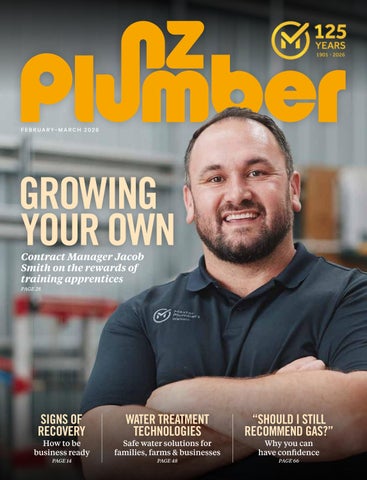
That these same apprentices now also benefit from updated, industry-led qualifications is thanks to today’s leaders like Jacob Smith, our cover star and dedicated member of Master Plumbers. Jacob is one of the representatives on the PGD Strategic Reference Group who reviewed the previous qualifications, paving the way for the new apprenticeship programmes introduced in 2025.

From that very first Master Plumbers convention of 11 industry stalwarts, the New Zealand Plumbing Conference has grown to attract more than 400 attendees. Turn to page 13 to find out how to register for this year’s event from 24-26 June in Kirikiriroa Hamilton—and know that you’ll be among a strong and active community with a proud heritage.

60 Work should not hurt

Sausages & sauce with a serious message for Ergo Bros prize winners 62 Breathe easy

Which respirator for which job? 64 Gas lines News in brief for gasfitters

“Should I still recommend gas to clients?”

GasNZ provides answers to some frequently asked questions 68 Success for hydrogen pilot

Behind the scenes of NZ’s first hydrogen blending trial 72 Products & services

New to market in the first quarter of ’26

Foot in the door

Why plumbing is the right fit for apprentice Rosa Thompson

“You can thank a plumber for that” Meet award-winning apprentice Rory Van Vroonhoven

87

10 minutes with... Camron Horo, apprentice plumber and rising lawn bowls star

Dodgy plumbing

Thank goodness for real plumbers to get things right!

Jacob Smith won the coveted 2025 Mark Whitehead Training Leader of the Year Award—and with good reason. Jacob, who is co-director and contract manager at Plumbing & Gas Works in Hamilton, couldn’t be more passionate about apprentice training. By training their own apprentices from scratch, instead of taking people who’ve trained elsewhere, the business can set the standard from day one, he says. Turn to page 28 to discover why Jacob finds training apprentices so rewarding and why the business works hard to create a culture where learning never stops.

Cover photograph: Mark Hamilton Photography

CEO’S REPORT

Welcome to 2026. This year is a significant milestone for Master Plumbers, as we celebrate our 125th anniversary. We are immensely proud of our history and how the sector has continually adapted and responded to major change over the decades.

To mark the occasion, we will be holding a celebratory event at Government House in Wellington this March. Our annual conference in June will also provide a fantastic opportunity to recognise how far our industry has come over the past 125 years.

There are already signs of economic recovery in 2026 and the latest consent data suggests a stronger construction workload in the years ahead. It is critical that we continue to employ apprentices so we have the skilled workforce required for the next decade.

This year will see a General Election on 7 November. We are currently preparing our Advocacy Action Plan and will be surveying all political parties to ensure plumbing, drainlaying and gasfitting remain front of mind within the building and construction portfolio.

In other advocacy news, MBIE has confirmed the deadline for the new lead-free product regime will remain 1 May 2026. Although Australia has provided a two-year extension to the lead-free product installation timeframe, we understand this decision may be legally challenged.

the reality is the changes were announced in November 2022, giving the industry more than three years to transition existing stock.

As legislation progresses for self-certification and strengthened occupational licensing, Master Plumbers recently apperared before select committees considering both Bills. Our view is that both need modification to be practical and deliver genuine productivity gains.

While we strongly support self-certification by plumbers and drainlayers, the exemption requirements currently written into the Bill appear overzealous and risk adding unnecessary complexity to the licensing regime.

We are hopeful our feedback will be taken on board so adjustments can be made, enabling a self-certification programme that properly reflects the level of training plumbers and drainlayers complete to become qualified.

On page 27, you’ll find an update on progress for our Nexa Training Academy. We are currently going through the application process for this new private training establishment (PTE) and are extremely excited about this opportunity.

“After 125 years, Master Plumbers remains focused on protecting public health and building a strong future workforce.”

Here in New Zealand, we note with interest that Australia’s decision to extend the date wasn’t made with good consultation or wider industry support. Given its two-tier federal and state government structure, some states may still choose to remain with the original deadline.

Master Plumbers’ position has always been clear: public health must be prioritised, and that includes providing lead-free drinking water to New Zealand consumers. While I understand the financial burden this change has placed on some suppliers and merchants,

Although a significant amount of work is required to secure the necessary approvals, having a truly industry-led plumbing, gasfitting and drainlaying training provider will deliver positive, long-term change for our sector. Finally, registrations are now open for the 2026 New Zealand Master Plumbers Conference. As part of our 125th anniversary celebrations, we are hoping for a strong turnout in Hamilton from members, Business Partners and industry supporters. With the excellent Claudelands Convention Centre as our venue, we are aiming to make this our biggest and best conference yet.

Delivering quality you can count on since 1964.

Reliable quality is at the heart of everything we do.

With decades of strong partnerships with the most trusted brands in the industry, we can ensure:

• Volume buying power and a full range of in-stock product with access to leading brands.

• Complete parts backup and warranty support service.

• Urgent, direct, time critical delivery support.

With Plumbing World, it’s not just about products — it’s about the reassurance that comes from knowing you have a merchant partner committed to quality, reliability, and support every step of the way.

GRANNY FLAT EXEMPTIONS ARE GO!

The ‘granny flat’ building consent exemption can now be used.

The granny flat building consent exemption commenced on 15 January, allowing new, single-storey, standalone dwellings up to 70sq m to be built without a building consent, provided all exemption conditions are met and the work is carried out or supervised by licensed building professionals.

Plumbers and drainlayers must provide a Record of Work (RoW) for prescribed sanitary plumbing and drainlaying to the homeowner within 20 working days of completion.

Gasfitters must provide certificates of compliance and safety certificates for all prescribed work to the homeowner within 20 working days of completion. Homeowners must submit all required documentation to the council within 20 working days of completion. All building work under the exemption must comply with the New Zealand Building Code.

For more guidance and to access the updated RoW form, visit www.building.govt.nz/grannyflats

NEWS UPDATES FOR OUR INDUSTRY IN THE FIRST QUARTER OF 2026.

Hydraulic services engineering achievements acknowledged

Excellence in hydraulic services engineering was honoured by AHSCA-NZ (Association of Hydraulic Services Consultants AustraliaNew Zealand) at their annual awards night, held late last year.

“It was another fantastic night to acknowledge many member and sponsor achievements throughout the year,” says AHSCA-NZ President Nick Fleckney. “A huge thank you to all our association sponsors, members, and invited guests who joined the Association for this memorable evening. We are already looking forward to an even bigger and better celebration in 2026.”

Nick himself was recognised with the top award, which he says was a nice surprise on the night!

The 2025 award recipients are:

Nick Fleckney – Peter Downey Excellence to Hydraulic Services Award

David Walker, Flow Consulting – Individual Contribution to Hydraulic Services Award

TM Consultants – Company Award

Oscar Roberts, TM Consultants – Up and Coming Hydraulics Consultant Award

Garry Cruickshank, retired Plumbing Inspector – President’s Recognition to Industry Award

Find out more about AHSCA-NZ at https://nz.ahsca.org.au

Nick Fleckney (right) being presented with the 2025 Peter Downey Excellence to Hydraulic Services Award by Tai Tulaga of MM Brands.
The assembled group at Eden Park for the 2025 AHSCA-NZ awards evening.

INDUSTRY SKILLS BOARD APPOINTMENTS ANNOUNCED

Greg Wallace, Chief Executive of Master Plumbers, Gasfitters & Drainlayers NZ and Masterlink Ltd, and Tina Wieczorek, Chair of the Specialist Trade Contractors Federation, have been ministerially appointed to the Construction and Specialist Trades Industry Skills Board (ISB).

This is one of eight new ISBs, which replace the former Workforce Development Councils. They will set standards, shape qualifications, endorse programmes, and ensure vocational training stays aligned with employer expectations and workforce needs.

“These high-calibre appointees bring deep industry knowledge, governance capability, and a commitment to supporting a vocational education system that delivers the skilled workforce New Zealand needs,” said Vocational Education Minister Hon Penny Simmonds on announcing the appointments in December 2025.

Greg Wallace says he is very pleased to be one of the two ministerial appointments. “Tina and I have strongly advocated for recognition of the contribution that specialist trades make to the wider construction sector, and I’m pleased the Minister has recognised this. We know we have a tremendous amount of work to do to ensure we have a training regime we can all be proud of.”

11 MARCH IS WORLD PLUMBING DAY!

To celebrate, Master Plumbers has an amazing line-up of prizes for members to win—including awesome giveaways from Mico, Rheem, Soudal, Mobil Fuelcard and Apex Valves.

Members also have the chance to Win a CEO for the Day with CEO Greg Wallace. “A golden opportunity. Invaluable.” — Matt & Jo Hobbs, 2025 winners Keep an eye on the website and social media for instructions on how to enter.

World Plumbing Day 11 March

COMPULSORY NEW HOME WARRANTY RULES PROPOSED

Another step has been taken towards the proposed new proportional liability regime for defective building work.

Measures to support a move away from the current joint and several liability model, announced in late 2025 by Building and Construction Minister Chris Penk, include: Requiring building design professionals, such as architects and engineers, to hold professional indemnity insurance.*

Mandatory home warranties for all new residential buildings three storeys and under, and for renovations $100,000 and above.* Owners would be covered for a one-year defect period and a 10year structural warranty.

Increasing the maximum fine for Licensed Building Practitioners (LBPs) from $10,000 to $20,000, and the maximum suspension period from 12 months to 24 months.

*Now also with the proposed ability to temporarily suspend the requirement for building warranties and/or insurance.

The home warranty and professional indemnity insurance changes will be progressed through the Building Amendment Bill, expected to be introduced in early 2026. Once legislation is passed, there will be a oneyear implementation period before the new requirements take effect.

Master Plumbers CEO Greg Wallace has been ministerially appointed to the Construction and Specialist Trades ISB.

AUSTRALIA PUSHES OUT LEAD-FREE IMPLEMENTATION

The Australian Building Codes Board has decided to extend the period during which Lead Free WaterMark certified products can be installed in Australia by two years, to 1 May 2028. This decision, it said, was made due to risks of insufficient Lead Free WaterMark certified products being available in the market given the strong housing agenda. Australia’s 1 May 2026 lead-free manufacturing deadline still stands, but the extension will allow the sell down of existing WaterMark certified products currently in the market.

Master Plumbers NZ supports the New Zealand government’s decision to stick with the original 1 May 2026 implementation date.

“It is disappointing that Australia has extended its deadline at the 11th hour, which means high lead content products can continue to be installed there for another two years,” says Master Plumbers Chief Executive Greg Wallace. “Master Plumbers has pushed hard for leadfree plumbing product rules in New Zealand and they have been nearly four years in the making. We are pleased to see this finally becoming a reality in 2026 and, in our view, it can’t come soon enough.”

PEOPLE LEADERSHIP

“COULD

HELP SOLVE NZ’S WORKFORCE CHALLENGES”

With a 100,000+ worker shortfall, high early-career churn, and an ageing workforce, New Zealand’s construction and infrastructure sector faces serious risk—but also clear opportunity through effective people leadership.

This is the key finding of new deep-dive research, carried out by the former Waihanga Ara Rau Construction and Infrastructure Workforce Development Council, in partnership with ConCOVE Tūhura.

NEW MEGA MINISTRY TO BE UP AND RUNNING BY JULY

Only time will tell if the Government’s new Ministry of Cities, Environment, Regions and Transport will provide the efficiencies promised. Its aim in bringing together the Ministries for Environment, Housing and Urban Development, Transport and local government functions from the Department of Internal

During the research project, people leadership consistently emerged as essential to overcoming industry challenges by strengthening retention, attraction, wellbeing, and cultural safety.

“Effective leaders build engaged and supportive teams, improve workplace collaboration and enhance team productivity,” notes the People Leadership: Overcoming Industry Challenges report, published in December.

“In contrast poor leadership contributes to high turnover, burnout, and underperforming teams. This is particularly critical in construction and infrastructure, where demanding schedules, the physical nature of the work and complex project delivery can challenge staff and their wellbeing.”

To help sector business leaders, the report is accompanied by a free, downloadable People Leadership Toolkit—a starter kit of practical tools for leaders to help strengthen everyday interactions with their teams.

Read the report and download the People Leadership Toolkit at: www.waihangaararau.nz/people-leadership/

Affairs, is to create more joined-up thinking and cut duplication— helping speed up its reforms in the areas of planning, land use, housing, transport, water and local government.

At this stage it’s not known how many jobs might be lost, with 1,300 staff currently working across the four ministries.

The good stuff... and the fun stuff

Maurizio Cattelan’s fully functional gold toilet creation, fashioned in 2016 from just over 100kg of solid 18-carat gold, has sold for US$12.1 million at auction in New York. This is the only fully fabricated edition of the work, titled America, still known to exist, following the 2019 theft from the UK’s Blenheim Palace of the edition that first came to fame when exhibited as a fully functioning piece in a bathroom cubicle at the Guggenheim Museum.

The sole bidder, Ripley’s Believe It or Not! entertainment franchise, celebrated their purchase on social media on World Toilet Day, saying they were ‘flush with excitement’.

Jarvis Plumbing & Gas Works in Wellington enjoyed a team trip to Auckland to round off their year in style—including a guided tour of Allproof’s factory. “It was awesome for the team to see all their drainage products being fabricated and learn more about their commitment to making sustainable products,” says Rhiannon Jarvis. “And while in the city of sails, we just HAD to take the opportunity to thank our incredible team for the year’s mahi.” Good one, team!

Black Diamond Technologies (BDT) wrapped up 2025 on a high with its Charity Golf Day, bringing together local plumbers and HVAC businesses for an afternoon of friendly competition, networking, and giving back. Timed with perfect weather, attendees hit the green in support of the Wellington City Mission. Thanks to the generosity of everyone involved, the event raised over $1,700 to help the Mission continue its vital work in the community.

Kerryl Bawden and Andrea Lovell of Auckland Master Plumbers came up with the idea to hold regular Admin Ladies Lunches to connect women in plumbing business office roles across Auckland. Their second successful event combined a lunch with an exclusive behind-the-scenes experience at the Rheem factory and office, kindly hosted by Sales & Marketing Manager Duane Rice, to see what goes into Rheem’s manufacturing and innovation.

“Here’s to more opportunities that empower and connect women in plumbing!” said Duane.

Scott Garvie of Scotties Potties, Campbell Gray of Euroheat, Phil Mauck of Hockly Plumbers with his son Dylan, Leo Summerfield of BDT, and Simon Tait of Flow Plumbing & Heating.
Photograph: Sotheby’s
Duane Rice showing Auckland Ladies Lunch attendees around the Rheem factory.

Pipe Masters Plumbing, Gas & Drainage in Tauranga say they’re humbled to have been part of helping a family have hot water after months of no plumbing in their house. Pipe Masters donated their mahi to the project, while Rheem kindly gifted the hot water cylinder. The couple rallied their relatives and embraced each task with the Pipe Masters team, from ripping out walls and ceiling lining to re-gibbing, plastering and painting. This whānau can now enjoy the comfort of hot water in their own home instead of travelling to friends’ houses just to enjoy a warm shower. “Moments like these remind us of the power of community, collaboration and aroha,” say the team.

Congratulations to McBeth Plumbing & Gas for winning this edition’s Peachy Plumbing prize for this top-notch hot water ring main installation at the Hilton Lake Taupō. “We are super proud of this project!” say the McBeth team—and rightly so.

SEND US YOUR PHOTOS AND BE IN TO WIN!

Now over to you... Email your photos to the Ed: bsellers@masterplumbers.org.nz

Done some peachy plumbing lately? Send us your photos of projects that make you proud to be a professional. If your project is featured in NZ Plumber, you’ll be in to win a Constricta Multi Pot Grip PLUS Soudal’s premium Pureseal PVC Pipe Cement and Primer. Everything you need to keep your glue and primer secure and your connections strong!

MATES Long Lap is back from 1-30 April! Sign up as an individual or team to run, ride, swim, walk or wheel. Every kilometre you track contributes to the Long Lap! Get moving for your mates to raise funds and awareness for mental health and suicide prevention across the construction industry. www.mateslonglapnz.net.nz

Leon at Pipe Masters has done great work on site, helping get hot water hooked up for a local family.

THE MAIN EVENT

Registrations are now open for the 2026 New Zealand Plumbing Conference— one event on the annual industry calendar you won’t want to miss!

WHEN: 24-26 JUNE WHERE: CLAUDELANDS, HAMILTON BOOK: PLUMBINGCONFERENCE.ORG.NZ

An exciting programme is shaping up for the 2026 New Zealand Plumbing Conference, with a broad mix of speakers, discussion panels, industry updates and more.

Come along to the Claudelands Events Centre in Hamilton to get up to speed with all the latest developments in the world of plumbing, gasfitting and drainlaying— including new products and technologies at the extensive trade show.

Discover what’s happening in the apprentice training space, and why Master Plumbers is establishing a brand-new industry training provider. Take home

some great business advice, including how to streamline your pricing and estimating processes. Plus, join in celebrating an amazing 125 years for Master Plumbers.

You’ll also be able to complete your CPD requirements for the 2026-27 licensing year during the event.

The conference provides an unbeatable opportunity to connect with the plumbing industry community from across New Zealand. Entertainment is assured each day, from the Mico and Iplex Welcome Night at the brand-new, award-winning Te Āhurutanga cultural centre to the Marley

Fun Night at the incredible Grassroots Trust Velodrome in Cambridge (get your Fast Times in the Tron costumes ready!), and the glittering NZ Plumbing Awards Night finale, sponsored by Plumbing World.

Master Plumbers has secured accommodation at the Novotel Tainui and Ibis Tainui, just a short walk away from Claudelands. With the beautiful, themed Hamilton Gardens, Hobbiton Movie Set and nearby Waitomo Caves, you might want to book for a longer stay.

Never been to the Conference before? You’re guaranteed a warm welcome!

SEND IN YOUR 2026 AWARD ENTRIES!

Entries are also open now for the 2026 New Zealand Plumbing Awards. The winners will be celebrated in Hamilton on Friday 26 June at the New Zealand Plumbing Awards Night, sponsored by Plumbing World.

The brand-new, award-winning Te Āhurutanga cultural centre is the fabulous venue for the Mico and Iplex [check] Welcome Night.
Find 2026 NZ Plumbing Awards nomination forms on the Master Plumbers website.
With its rolling green hills, spectacular limestone caves and black sand coastline, the mighty Waikato is an awesome region to explore.
Book your place on the optional excursion to the Annah Stretton flagship store, gallery and Café Frock in Morrinsville, with a behind-the-scenes tour and presentation by Sami Stretton!

The first quarter of the year often sets the tone for the rest of the year, so confront your challenges early, urges business advisor Luke Kemeys in this article for NZ Plumber.

AUTHOR: LUKE KEMEYS, NEXTADVISORY

The first quarter is often a tricky one for small and medium businesses. After the rush of the holiday period, reality sets back in: revenue dropped, wages and overheads remained the same, cash flow tightens, customers can take longer to pay, and business owners start grappling with the real state of their numbers.

It’s also the most important time of the year to get ahead of issues rather than react to them later.

In late 2025, I warned that there could be more job losses to come. We don’t just enter a new year and everything is magically better. Much like ‘survive to ‘25’ wasn’t a strategy, the recent talk about ‘green shoots’ isn’t your new strategy. Green shoots is just the latest catch cry for economists and property commentators referencing signs of recovery, optimism and house price rises.

Running an accounting and business advisory practice in small business world, we get A LOT of live insight to data and a lot of enquiries from people who need help.

Tax debt realities

In Q4 of 2025, we started to notice a wave of enquiries from business owners understanding that they need to get on top of overdue tax as Inland Revenue (IR) went on a massive push via media articles, letters and direct outreach to encourage businesses to tidy up their arrears or enter into arrangements on overdue tax.

Arrears ballooned from $4b in 2020 to an expected $10b in early 2026.

Of course, people want to get on top of their arrears and most are acting with good intentions. Something is just not working in their business, leading to this unpaid tax.

Unfortunately, many owners don’t quite grasp these frustrating realities:

1. It’s very easy to sign up for an instalment arrangement with the IRD and keep them happy for a bit longer (or access new high interest debt to clear another debt), but it doesn’t fix the underlying problem in the business. I repeat… it doesn’t fix the underlying problem in the business.

2. Tax debt has to be repaid out of after-tax profits. That makes it incredibly tough to catch up AND stay current if reality 1 isn’t addressed.

3. Personal tax rates haven’t been indexed with inflation, so household costs are still climbing, and household budgets are under pressure too. Real wages haven’t improved for many business owners (nor employees). In 2023 it was said 46% of business owners and 60% of sole traders

‘Green shoots’ refers to signs of economic recovery, but it's not a strategy – businesses have to create their own opportunities.
“SMEs that confront their challenges early, especially around cash flow, pricing, and planning give themselves a far greater chance of achieving stability and growth in Q2, 3 and 4. There will be plenty of work out there—you need to get your hands on it!”

weren’t paying themselves in order to keep their business running. That gets old pretty quickly and household costs have not decreased.

Business owners face hard choices: Do they reduce their own pay? (Hard, given reality 3.)

Or do they face the real issue in the boardroom that maybe they’re carrying too many staff, or are simply not profitable enough? Unless they are getting solid advice, they may not know the actual issue.

Some will work through it. Others won’t. For some, it will mean letting people go. For many, it will mean tidying house before pursuing expansion and growth.

Continue to be careful

The tail of a recession is long. It is often said that it can take five years from the depths of the economic pain to see all bad debt and deals wash out.

While the headlines start to talk recovery, many small businesses are still fighting for survival, so continue to be careful who you are lending to or providing credit.

If you are an SME in IR debt, you need to seek advice to solve the underlying issues in the business. Apart from the tall poppy crowd, no one wants to see you fail. Speak to your accountant, your advisers, your industry peers and understand your numbers and the reality of those. Just like you learnt plumbing, you can learn the numbers. And for those of you who aren’t in debt, you have a real advantage as the economy turns because debt isn’t slowing you down financially and mentally. Think about how powerful that makes you!

Planning for the future

The first quarter often sets the tone for the entire year, so have a think about what business you want to run by December 2026. SMEs that confront their challenges early, especially around cash flow, pricing, and planning give themselves a far greater chance of achieving stability and growth in Q2, 3 and 4. There will be plenty of work out there—you need to get your hands on it!

We are already noticing more enquiries from business owners planning and thinking about the future, which is a great sign that they can see growth and hope again. Let’s just hope an election year doesn’t slow this progress and create a new form of uncertainty! All the best for 2026.

ABOUT THE AUTHOR:

Luke Kemeys is a Chartered Accountant, business advisor, and co-founder of nextAdvisory, which supports business owners through coaching, workshops and general business advice. Luke teaches financial literacy to everyday Kiwis via his podcast, Keep The Change. His work focuses on helping New Zealanders build stronger financial foundations and make better decisions in business and life.

The future of energy 100 years and counting

For over a century, we’ve perfected warming homes, not the planet. Our German engineered hot water solutions, pioneered by the first heat pump 50 years ago, deliver unmatched efficiency and sustainable hot water. Experience the future of home comfort, today. Make your next project a STIEBEL ELTRON project.

www.stiebel-eltron.co.nz

ARE WE ON THE UP?

The economy is expected to ‘defrost’ this year, according to BNZ Chief Economist Mike Jones. That’s welcome news—but what are the actual signs of a thaw? NZ Plumber takes a look.

BNZ is not alone in predicting economic recovery in 2026.

KiwiBank Economist Sabrina Delgado forecasts above-trend growth, as long as there are no “adverse shocks”.

“2025 was a frustrating year, but we’re seeing markings of a recovery, not just in a few areas, but across the board,” she said at the end 2025. “It is important to stress that interest rates today are significantly lower than they were this time last year. That matters. And it’s having an impact. Household budgets are starting to feel the ease and we’re seeing growing confidence. The recovery won’t be overnight, but the settings are now right, priming the Kiwi economy to expand around 2.4% [in 2026].”

Consumer confidence

In its monthly measure of confidence across Kiwi households, the ANZ-Roy Morgan Consumer Confidence survey report noted a lift of 3 points from 98.4 to 101.5 in December—the highest level since September 2021.

Whilst that stat makes confidence sound strong, the report says in level terms it isn’t. “Consumer confidence took a body blow from the rapid increase in inflation in 2021 and is still recovering.”

Discretionary spending appears to be up for those at the high end. “For others, it’ll take a change in the labour market to make a difference to their willingness to spend.”

House price values

Average house values across New Zealand rose by 1.1% over the three months to December 2025, according to the latest quarterly QV House Price Index, published in mid-January.

Among the main centres, Christchurch recorded the strongest quarterly growth at 2.5%, followed by Hamilton at 2.1% and Auckland with a modest rise of 0.8%.

Wellington was the only major centre to see values weaken (down 0.5%), though it stayed relatively stable.

Among the regional centres, Invercargill recorded the strongest gains at 3.3%.

“A clear majority of the areas we measure recorded quarterly growth, indicating that value movements are now occurring across a broader range of regions,” said QV National Spokesperson Andrea Rush.

Looking ahead, she said early indicators point to a more stable outlook in 2026, although some uncertainty is likely to remain. “An election year can create a degree of caution, which may restrain activity at times as buyers and sellers take a more wait-and-see approach.”

Meanwhile, the cost of building a home is edging up again, with the latest Cordell Construction Cost Index showing the largest quarterly increase (0.9%) in over a year during the three months to December 2025. However, the pace of growth remains contained, according to Coality Chief Property Economist Kelvin Davidson.

“We are certainly not seeing the extreme inflation experienced in the post-COVID phase, when the CCCI annual growth rate peaked at more than 10% in late 2022. During that period, there were supply chain issues for key materials such as plasterboard and rising wages also drove up costs significantly.”

Forward construction pipeline

2.3 unit consents to drive growth in residential activity

In the year ended November 2025, 35,969 new homes were consented—up 7% compared to the year ended November 2024, according to figures released by Stats NZ in mid-January.

We forecast new residential consents to grow from 33,600 in 2024 to 40,000 at the end of the forecast period. In 2024, 53% of new dwelling consents were multi-units. This is anticipated to grow to around 56%. Multi-unit consents account for over 115,000 of the 215,000 new dwelling consents over the forecast period.

Multi-unit homes drove the increase, with 15,643 townhouses, flats and units (up 9.6%), 2,647 apartments (up 49%) and 1,291 retirement village units (down 26%).

Source: BRANZ
Source: BRANZ (from National Construction Pipeline Report 2025)
latest National

The number of stand-alone house consents was 16,388, up 3.6% over the year.

Auckland continued to account for a large share of new home consents, particularly for townhouses, flats, and units, with Canterbury, Otago, and Wellington also contributing to growth. Waikato also recorded an increase in new home consents over the year.

As the residential sector recovers strength, construction activity is forecast to trend upwards to $65.4b in 2030, according to the National Construction Pipeline Report 2025, released in December.

Residential building regional comparison

Multi-unit consents are predicted to drive the growth in residential activity, with the number of new consents forecast to grow steadily from 33,500 in 2025 to 40,000 by 2030.

continues to be the largest initiator of nonresidential buildings, contributing 67.3% of the value of intentions for 2025-2030.

Residential construction activity

Auckland will remain the largest market for building and construction in the country, according to the National Construction Pipeline Report 2025

By 2030, 44% of the building consents in the forecast period are expected to be in Auckland. Total construction activity in the region is forecast to be 13.5% higher than compared with 2024.

Strong residential consenting activity is forecast for the Waikato/Bay of Plenty region. Non-residential activity is forecast to fall further but rise again in 2029.

from early 2026, while non-residential building activity is expected to remain steady. Infrastructure activity is forecast to peak in 2028.

The 10 remaining regions in New Zealand are combined under the ‘Rest of New Zealand’ reporting category. Total construction activity for Rest of New Zealand is forecast to continue to slow through to $9.6 billion per annum in 2027 before rising again to reach $10.7 billion in 2030.

Infrastructure projects

The number of new residential consents has decreased over the last 12 months, as total new residential consents went from 37,238 in 2023 to 33,600 in 2024. The Auckland region represented 41.5% of consents in 2024. Waikato/Bay of Plenty, Canterbury and Rest of New Zealand regions each represented 13-17% of the total number of new residential building consents.

Between 2025 to 2030, multi-unit consents will make up 115,000 of the 215,000 new dwellings, with their share rising from 53% to 56% over the period.

All regions are forecast to track downwards, to different extents, over the next year However, we see growth throughout the Auckland, Waikato/BoP, Otago and Rest of New Zealand regions for the remainder of the forecast period.

Non-residential activity declined from a peak of $14.1b in 2024 and is forecast to rise steadily to $13.5b by 2030. The private sector

Figure 4.1 2 Number of residential consents, by region

Wellington and Otago can expect further reductions in residential building activity through to 2027, while non-residential and infrastructure building activity is expected to be relatively constant in both regions through the forecast period.

Residential building activity in Canterbury is expected to begin decreasing

Infrastructure activity is forecast to increase gradually year-on-year, to reach $19.6b in 2030, supported by a strong pipeline of projects throughout the forecast period. The stronger pipeline of intentions is in part due to both local and central government agencies having finalised future work programmes in infrastructure.

Twenty-five new infrastructure proposals have been endorsed in the second round of the New Zealand Infrastructure Commission’s Infrastructure Priorities Programme (IPP), bringing the total to 42 independently assessed priorities.

The endorsed proposals, submitted by both public and private organisations, include Golden Triangle Rail Electrification, Waimakariri Eastern Transport, Auckland Biosolids Servicing, Auckland Level Crossings, and Queenstown Transport proposals, as well as hospital projects in Tauranga, Hawke’s Bay and Palmerston North.

Number of residential consents, by region

Source: BRANZ (from National Construction Pipeline Report 2025)

Source: BRANZ

Activity in the residential sector took a bit of a hit in 2024 because of reduced consenting activity. Residential activity, however, remained strong as the industry worked through the backlog of residential consents. We forecast residential workloads to fall in all regions in 2025, before increasing across most of the regions through the remainder of the forecast period.

4.1 3 Value of residential buildings, by region

Together with the National Infrastructure Plan out early in 2026, the IPP helps build consensus on where New Zealand’s infrastructure dollar will have the greatest impact.

With 90+ years of experience delivering Plumbing, Drainage, Gasfitting, Electrical, and HVAC services to domestic customers and commercial partners, Foleys continues to grow. And so does our team. Foleys prioritise building capability and back our people across all 13 branches.

Interested? Find out more!

Source: BRANZ

Figure

How to prepare for lead-free and dezincification-resistant plumbing by 2 May 2026.

hat’s

happening on 2 May 2026?

WFrom 2 May 2026, building consent applications that choose to follow the Acceptable Solution G12/AS1 for potable water plumbing systems must ensure all products are lead-free and dezincification resistant (DZR).

Why the move to lead-free products?

Research shows the real risk begins after water leaves the treatment plant, as it travels through pipes, fittings and fixtures that may contain lead. It typically enters the water supply through corrosion of lead-containing materials, such as copper alloy products or leadbased solder after the water leaves the treatment plant.

Currently, the lead content in these materials is up to 4.5 per cent, which is considered safe under existing standards. However, lead exposure is cumulative over time. Lead can leach into household drinking water, potentially leading to lead poisoning and a range of short- and long-term health concerns.

Reducing the average to 0.25 per cent lowers this risk and enhances long-term public health protection.

The changes give New Zealanders greater confidence that drinking water from our taps remains healthy and safe.

From 2 May, you must use Amendment 14 of G12/AS1.

Why the dezincification requirements too?

Copper alloy plumbing components containing more than 15 per cent zinc are susceptible to dezincification under certain water conditions, such as stagnant water or elevated chlorine levels. This process selectively removes zinc from the alloy, leaving behind a weakened, porous copper structure.

As a result, zinc may leach into the water supply, posing potential health risks including zinc toxicity. Additionally, the structural integrity of the affected parts can be compromised, increasing the likelihood of leaks and system failures.

What

should

plumbers do to prepare?

The transition requires careful planning. To follow the Acceptable Solution G12/AS1 consent pathway from 2 May 2026, all copper alloy components must be lead free and those products under hydrostatic pressure must be DZR.

Plumbers should avoid high-temperature brazing that could compromise corrosion resistance. All copper alloy products to be used in contact with drinking water need to be tested to NSF/ANSI/CAN 372:2020 for lead-free and dezincification resistance to AS 2345:2006.

Ensure that all products have valid IANZ accredited test certificates for both lead-free and dezincification to show compliance with G12/AS1.

Compliance can be demonstrated through Building Product Specifications or by providing evidence of certification to a recognised New Zealand or overseas standard, such as WaterMark, or equivalent international certification.

Suppliers, manufacturers and retailers are also encouraged to ensure that appropriate products in contact with potable water they provide have the appropriate stipulation on the Building Product Information.

Additionally, suppliers should aim to clear any existing stock by May 2026 to support a smooth transition to compliant products.

What’s the transition period and its impact on consent applications?

To support industry readiness, this Building Code compliance pathway update includes a transition period that permits projects with building consent application lodged on or before 1 May 2026 to continue using the current Acceptable Solutions.

G12/AS1 3RD EDITION AMENDMENT 13

The transition period for G12/AS1 3rd Edition Amendment 13 ends at 11:59pm on 1 May 2026.

This MBIE Acceptable Solution can still be used as a means of demonstrating compliance for building consent applications submitted up to and including 1 May 2026.

From 2 May 2026, Amendment 13 will no longer be an MBIE Acceptable Solution.

From 2 May 2026, Amendment 14 will become the only MBIE Acceptable Solution.

G12/AS1 3RD EDITION AMENDMENT 14

G12/AS1 3rd Edition Amendment 14 is a current MBIE Acceptable Solution and can be used now and after 2 May 2026.

Consented building work (including plumbing works) being carried out after the transition period, will continue to be subject to the conditions, plans, and specifications within the building consent granted by the relevant Building Consent Authority.

Onsite construction and installation work must follow the specifications in the building consent for a code of compliance certificate to be issued.

The compliance pathways do not apply retroactively to existing plumbing installations.

What is the implication for exempt building work?

For building work exempt from requiring a building consent under Schedule 1 of the Building Act 2004, the person who carries out the work (eg, the plumber) is responsible for ensuring the products and methods used in carrying out the work comply with the Building Code requirements in effect at the time of installation.

Where to find more information?

Be prepared—learn more under the G12 section of the Building Code: www.building.govt.nz/building-code-compliance/g-services-andfacilities/g12-water-supplies/lead-in-plumbing-products

The All Pressure Solution

The new Rheem APVE® range is the easy drop-in replacement for legacy copper cylinders.

• Fits like-for-like: Same height, diameter, and bottom entry as the cylinders it replaces

Built to last: Superior corrosion resistance and longer-lasting materials

Designed & made in New Zealand

10-year cylinder warranty

Partners

Master Plumbers, Gasfitters & Drainlayers NZ thanks the following Partners for their support:

INTRODUCING ESTER YOUR PERSONAL AI ESTIMATOR

An industry-first innovation, Ester is designed to help you create fast, accurate quotes and estimates using advanced AI.

What Ester does for you

Reviews your plans: Upload a building plan and Ester will analyse fixture layouts, drainage runs, hot water systems and more

Estimates labour: Using standard benchmarks, Ester quickly calculates realistic labour times

Adds materials and fittings: A 40% labour allowance is automatically included to cover pipes, valves and fittings, with the option to include frontof-wall fixtures if required

Calculates costs: Ester applies your hourly rate and industry standard markups for a complete estimate (upload your own pricing files for even more accuracy)

Generates a spreadsheet: Get a clean, editable spreadsheet with organised tabs.

Matthew Maley, owner of iPlumb Plumbing & Gas in Dunedin, says his company has subscribed to Ester to use as a price check on residential and commercial jobs.

“If you can use ChatGPT, then you can use Ester,” he says. “It’s scarily accurate—I would say between 5-10% maximum. A great feature is being able to upload plans direct to Ester and it can do all of your take-offs for you.”

Matthew reckons Ester will save his business countless hours once they build up confidence. “I would recommend it to others, even if just as a tool to gain confidence in someone’s own pricing.”

Ready to get started?

Ester is available via a monthly direct debit subscription of $50+GST. Visit https:// masterplumbers.org.nz/ester to sign up or learn more. Have a question? Email: admin@masterplumbers.org.nz

Meet Ester—the Master Plumbers AI quoting and estimating tool!

BE IN TO WIN THREE MONTHS OF ESTER!

In the lead-up to World Plumbing Day on March 11, we’re giving Master Plumbers members the chance to win three FREE months of Ester. To enter, head to Master Plumbers’ Facebook or Instagram and follow the instructions on the World Plumbing Day Ester post.

Note: You must be a Master Plumbers member to be eligible.

IT’S A BIG YEAR FOR MASTER PLUMBERS, GASFITTERS & DRAINLAYERS NZ, AS THE ORGANISATION CELEBRATES ITS 125TH ANNIVERSARY AND GETS UNDERWAY WITH ESTABLISHING A NEW TRAINING PROVIDER FOR OUR TRADES!

125 years young

Christchurch was the location of the very first National Convention of Master Plumbers, held on 8 January 1901, marking the birth of the New Zealand Association. The conference brought together delegates from Christchurch, Dunedin, Wellington, Invercargill, Hokitika and Ashburton. Auckland was yet to get involved, as it was affiliated with the Australian Association at the time.

Huge changes have taken place for New Zealand’s plumbing industry over the ensuing 125 years—

PROVIDING FEEDBACK ON SELF-CERTIFICATION & PGD CODE OF ETHICS

In a win for Master Plumbers, a huge step has been taken along the path to a plumber and drainlayer self-certification regime with the first reading of two significant pieces of legislation in Parliament:

1. Building and Construction Sector (Self Certification by Plumbers and Drainlayers) Amendment Bill – this would amend both the Building Act 2004 and the Plumbers, Gasfitters & Drainlayers Act 2006

2. Building and Construction Sector (Strengthening Occupational Licensing Regimes) Amendment Bill

“With these two Bills, we are backing tradies who take pride in their work,” said Building and Construction Minister Hon Chris Penk in late 2025. Consultation was open until 8 January on both Bills and Master Plumbers has provided some recommendations

many of them, such as the registration of plumbers, thanks to the advocacy work of those early leaders. Master Plumbers will be marking this milestone anniversary during the year with a formal event at Government House in Wellington in March and celebratory plans for the 2026 New Zealand Plumbing Conference in Hamilton.

Look out for a 125th Anniversary special in the next edition of NZ Plumber!

to ensure the self-certification scheme is workable, aligned with industry practice and will achieve its intended outcomes.

Master Plumbers supports the Government’s aim of strengthening occupational licensing regimes in the construction sector. This second Bill would introduce a mandatory Code of Ethics and bring significant changes to disciplinary processes, investigative powers, public transparency, and licensing oversight.

“Master Plumbers looks forward to working with the Plumbers, Gasfitters & Drainlayers Board and the Ministry of Business, Innovation and Employment to develop a Code of Ethics for the PGD sector that reflects modern professional practice while remaining practical for businesses of all sizes,” said Master Plumbers CEO Greg Wallace.

Self-certification by plumbers and drainlayers is expected to come into effect this July.

Members can read both Master Plumbers’ submissions in full in the Advocacy section of the Member Toolbox at www.masterplumbers.org.nz

KOHLER ANNOUNCES GROUND-BREAKING NEW PREMISES

Kohler New Zealand has officially broken ground on its state-of-the-art new facility in Whenuapai, marking a major investment in local manufacturing and innovation. After 43 years in their Glenfield site, the move signals a renewed focus on improving operational performance, staff wellbeing and long-term sustainability.

Developed in partnership with Midpoint Investments and Aspec Construction, and located in the Spedding Industrial Estate, the premises will bring all New Zealand operations—including Englefield—under one roof. With 4,500m² of warehousing and manufacturing, modern offices, a showroom, a dedicated training centre, and R&D space, the facility is designed to support better collaboration and faster service for customers across the plumbing industry.

From day one, sustainability has been a key driver, with EV charging, energy-efficient systems, rainwater harvesting and high-performance insulation all incorporated to minimise environmental impact.

Completion is expected in July/August 2026—a milestone that reinforces Kohler’s commitment to innovation and growth in Aotearoa’s manufacturing sector.

MEMBER SURVEY RESULTS

The 2025 Master Plumbers Membership Survey attracted record responses. The annual survey gauges satisfaction levels among member plumbing, gasfitting and drainlaying businesses across New Zealand.

Survey respondents scored an eight out of 10 on member satisfaction, with the top five ranked member benefits being discounts and deals, the Master Plumbers brand, employment guidance, the HR helpline, and the Master Plumbers Guarantee.

The survey also provides an opportunity for members to provide their individual feedback. Master Plumbers takes these comments and suggestions on board in its work planning for the coming year.

“Our organisation’s purpose is to drive the success of our industry,” says CEO Greg Wallace. “We do this by providing members with services and support that add genuine, tangible value to their businesses.”

Master Plumbers can only provide relevant services by having a clear understanding of what the membership wants. “We are extremely grateful to all our members who take the time to complete our annual survey,” says Greg.

In 2026, members want to see Master Plumbers continuing its advocacy work for self-certification by plumbers and drainlayers, the long-term viability of the gas sector, and an industry-led apprentice regime.

Congratulations to the three winners of the survey prize draw, who have each won a $300 Prezzy Card!

Hutt Gas & Plumbing

Rawlinson Plumbing and Gas

Accrete Plumbing and Gas

AVERAGE WAGE RATE REPORT

Following a survey of the nationwide membership, Master Plumbers has released its 2025 Average Wage Rate Report. The report provides average wage rates around the regions for apprentices, labourers, tradespeople, certifiers and supervisors. Members can use this information to benchmark pay rates, support recruitment and retention, and inform workforce planning.

Members can download the report from the HR & Employment section of the Member Toolbox at www.masterplumbers.org.nz

Breaking ground on Kohler and Englefield’s new facility in Whenuapai. From left: Selena Wong, Upper Harbour Local Board Member; Matthew Donaghy, Managing Director Aspec; Anna Atkinson, Chair, Upper Harbour Local Board; Alexander Hyslop, General Manager, Kohler; Geoff Ridley, Executive Director, Midpoint; Richard Nahi, Senior Advisor Māori Outcomes, Auckland Council; Peter Goodburn, Senior Operations Manager, Kohler.

VITAL PROTECTION FOR YOUR BUSINESS

Gallagher brings decades of experience supporting trades and contractors across the country. Gallagher’s scale provides a significant advantage when negotiating benefits, conditions and premiums on your behalf. And if you need to make a claim, a dedicated New Zealand based claims team is ready to act on your behalf.

The team understands the unique challenges plumbing, gasfitting and drainlaying professionals face, whether you’re working on residential homes, multi-unit developments, or large-scale commercial sites.

With more than 30 branches nationwide, you now get access to local, dedicated brokers who understand the risks faced by Master Plumbers members. The team are committed to providing tailored insurance solutions that meet your specific needs, so you can financially survive any insurable event.

With over 15 years of partnership with Master Plumbers, Gallagher provides you with exclusive access

to a comprehensive insurance programme offering unique policy benefits, competitive rates and vital protection for your business, tools, vehicles and reputation.

Why Gallagher?

Dedicated local brokers who understand the realities of plumbing, gasfitting and drainlaying work

Comprehensive cover for your business assets, liabilities and motor vehicles

Group buying power providing exclusive cover and competitive scheme rates

Claims advocacy to ensure fair, timely outcomes when things go wrong.

For a second opinion on your insurance, connect with Gallagher: masterplumbers@ajg.co.nz

OBITUARY

It is with sadness that we acknowledge the passing in January of Barry Dell, long-time member of the Otago Master Plumbers. Barry founded Barry Dell Plumbing in Dunedin, which has continued to thrive over many years of serving the local community. While the company has grown and changed, its legacy— and the name above the door— remains. Our sincere condolences to Barry’s family and the team at Barry Dell Plumbing.

WELCOME

A warm welcome to new Master Plumbers member businesses:

Crosby Plumbing Ltd

Auckland

Roundhouse Plumbing & Gasfitting Ltd

Auckland

A1 Gasfitting and Plumbing Ltd

Waikato

Ruahine Plumbing and Pumps Ltd

Manawatu

Forte Plumbing Ltd

Hutt Valley/Wairarapa

InDepth Plumbing Ltd

Wellington

Chapmanz Ltd

Nelson

Infinity Plumbing Solutions Ltd

Nelson

Endeavour Plumbing and Gas South Island Ltd

Canterbury

RJ Crouch (2021) Ltd

Canterbury

WANT TO JOIN?

Master Plumbers is here to support all businesses in the plumbing, gasfitting and drainlaying industry. Members are Quality Assured and backed by the Master Plumbers Guarantee. We offer a wide range of business resources, health and safety, employment, legal and technical support, plus training and member discounts—and we advocate for our members as a collective industry voice. Get in touch today!

Contact 0800 502 102 membership@masterplumbers.org.nz

MASTER PLUMBERS TO ESTABLISH OWN INDUSTRY TRAINING PROVIDER, NEXA

Master Plumbers is establishing its own Private Training Establishment (PTE) as a way of ensuring a better training experience and outcome for apprentice plumbers, gasfitters and drainlayers.

Industry-led training academy

The Master Plumbers Board has agreed to establish the PTE, to be called Nexa Training Academy, and Chief Executive Greg Wallace says it is an exciting development for the sector to have its own industry led and owned training academy.

“We believe Nexa will help deliver a higher quality training product to apprentices, improving the experience and outcomes for apprentices, employers and the wider PGD sector.”

He is also confident that Nexa will deliver training that meets industry needs by ensuring the sector has a stronger voice on the future of training for its industry. Nexa will have a national footprint and be focused on the PGD sector, at least initially.

“Nexa aims to overcome years of frustrations and challenges with PGD training, including large numbers of apprentices taking too long to complete their training or leaving the sector and their apprenticeship prematurely.”

Master Plumbers is establishing Nexa as a PTE, which is an independent training provider registered with the New Zealand Qualifications Authority (NZQA) and funded through the Tertiary Education Commission (TEC).

The PTE will initially deliver the same national training model as EarnLearn and apprentices will still need to attend block course training at the same polytechnics they currently attend (eg, SIT, ARA, Weltec, EIT, Wintec, MIT and Unitec).

Recent changes to the vocational education and training sector require all PGD learners who are currently enrolled with EarnLearn to transition to a registered provider by the end of 2028.

Until that transition occurs, EarnLearn apprentices will continue their training with EarnLearn uninterrupted and new apprentices will still be able to sign up with EarnLearn.

All current apprentices enrolled with Skills Trades Training (formerly ICE) will continue to be supported by Skills Trades Training and there will be no need to transition to a new provider in the future.

Seamless transition for apprentices

Whilst owned by Master Plumbers, Nexa will be run separately with its own board and management team. Master Plumbers has employed experienced vocational education leader Mike Grumball to lead the establishment work. Mike was most recently a General Manager within Waihanga Ara Rau, the Workforce Development Council for Construction and Infrastructure.

He says there are currently about 2,700 PGD apprentices training under EarnLearn and it is anticipated that all current and new apprentices will transition seamlessly from EarnLearn into Nexa in January 2027.

“I’m working closely with all stakeholders, including the recently established Industry Skills Boards (ISB) and EarnLearn, to ensure there is a smooth transition.”

He says establishing Nexa won’t require any change or action from apprentices.

“Once operational, new apprentices will sign up with Nexa in the same process they do now, and all current apprentices will just transition from EarnLearn straight across. They won’t initially notice any difference apart from the name.”

He says a key focus of Nexa will be ensuring work-based learning continues uninterrupted and is well supported.

“There’s been a real push from the industry to have more opportunities for work-based learning and assessment and less reliance on block courses.”

Mike says the name Nexa was chosen as it is derived from nexus—and aims to be a central hub for the next generation of industry capability. “It reflects a desire not only to ensure PGD training is fit for purpose and professional, but is also future proofed.”

Changes to training will not happen overnight but will be progressively introduced as the model of training is transitioned.

Mike will keep the sector updated on Nexa’s establishment plans.

Information Sessions on the Proposed Master Plumbers Nexa Training Academy are underway around the country. Find details in the events calendar at www.masterplumbers.org.nz

Experienced vocational education leader Mike Grumball is leading the establishment work for the new Nexa Training Academy.

By training their own apprentices, Plumbing & Gas Works set the standard from day one. “They enter as young adults and end up as highly skilled tradespeople. It’s a privilege to help shape that,” says Director and Contract Manager Jacob Smith.

TOP TIER TRAINER

Award-winning trainer Jacob Smith talks to NZ Plumber about building skills, confidence and culture at Plumbing & Gas Works in Hamilton.

WORDS: JE T’AIME HAYR PHOTOGRAPHY: MARK HAMILTON

For Jacob Smith, Director and Contract Manager at Plumbing & Gas Works in Hamilton, helping young people thrive in the industry has become a huge part of his life. With nine apprentices currently on the books—eight through Masterlink—it’s clear that Jacob’s dedication to youth development is core to his approach to the business.

Training the PGW way

Jacob sees in-house apprentice training as both a strategic and a moral choice.

“When we took on people trained elsewhere, we’d spend a couple of years retraining them to our standard,” he explains. “By training apprentices ourselves, we set the standard from day one. Just as importantly, our training gives young people the opportunity to unlock their potential in an industry we are proud of.”

The company’s scope means apprentices enjoy exposure to plumbing, gasfitting and drainlaying across both domestic and large commercial projects.

“It takes a full apprenticeship to cover everything, and our apprentices are lucky to come out with well-rounded skills and a huge amount of confidence,” says Jacob. “That diversity of work builds versatility— they finish knowing how to handle whatever the job throws at them and they love the variety of work too.”

“Our training gives young people the opportunity to unlock their potential in an industry we are proud of.”

Fostering growth and experience

Ask Jacob what he enjoys most about training, and he’ll tell you without hesitation: supporting growth.

“Watching people develop, gain confidence and realise what they’re capable of is awesome. In their final apprenticeship year, everything suddenly clicks and it is incredibly rewarding.”

That growth isn’t just technical; it’s personal too. “They enter as young adults and end up as highly skilled tradespeople. It’s a privilege to help shape that.”

Training at Plumbing & Gas Works is a team effort. Senior tradespeople mentor the younger ones, and everyone shares responsibility for guiding the next generation. The company runs Wednesday-night study sessions where apprentices get help with their theory work and correspondence, in addition to sending apprentices to Masterlink training workshops.

Finding and keeping talent

Plumbing & Gas Works attracts apprentices from multiple sources. “We have a good relationship with Masterlink through Master Plumbers and they are our most common source. They interview thousands of applicants per year, so they produce some of the better apprentices,” he says. Others come through Wintec, Māori and Pasifika training teams, local schools’ Gateway programmes, and even word of mouth.

Jacob with fellow directors Mike Foote (right) and Neil Warriner.

Jacob’s training skills were recognised at the 2025 NZ Plumbing Awards with the Mark Whitehead Training Leader of the Year Award.

“Respect, lifelong learning, teamwork, and whanaungatanga (sense of family) are our non-negotiables and these values are woven through every stage of the apprenticeship journey.”

What does he look for in an apprentice?

“Attitude and punctuality are key. If you show up on time and you are keen to learn, we’ll take care of the rest.”

Jacob says most apprentices choose to stay with the company once qualified and the company prides itself on staff retention. A big part of this retention strategy is culture. The company’s internal committee, called ‘The Greenskeepers’, focuses on ‘watering the grass’ so the workplace always feels like a place to thrive.

They’ve introduced initiatives such as long-service awards, company pride signage and wellbeing programmes. The company has also created pathways for senior staff to become shareholders and

encourages ongoing professional growth— training doesn’t stop at the end of the apprenticeship.

“We work hard to create a place where people want to be,” Jacob says.

“Respect, lifelong learning, teamwork, and whanaungatanga (sense of family) are our non-negotiables and these values are woven through every stage of the apprenticeship journey.”

Leading change in training

As a member of the Workforce Development Council’s PGD Strategic Reference Group (SRG) for apprentice training, Jacob has been at the forefront of improving how apprentices learn and are assessed.

“One of the industry’s biggest challenges has been apprentices falling behind on block courses due to scheduling issues,” he says. “Some were pushed through to meet timeframes and competency levels dropped.”

As part of the SRG, Jacob helped develop the new, flexible apprenticeship training model, where on-the-job training can count toward unit standards, reducing unnecessary delays.

“Two of our newest apprentices are doing 100 percent on-the-job training,” he explains. “It gives us confidence in their competence because we won’t sign them off until they’re producing work to a commercial standard.”

He also credits the Labour government’s Apprenticeship Boost Scheme initiative for helping companies commit to training even during quieter times. “The number of companies that train people in-house is pretty low, so anything that encourages that is good.”

Proudly Māori, proudly leading

As a proud Ngāti Kahu man, Jacob appreciates that his role is an opportunity to show young Māori what’s possible.

“It’s important for young Māori to see role models they can relate to, so it inspires them to believe they can achieve and excel in this industry.”

Māori values of tikanga like manaakitanga, whanaungatanga, and kaitiakitanga, (care, relationships, guardianship) underpin his leadership approach. “I’ve worked hard to celebrate diversity and Māori culture in our company. We are working on Tainui-led projects, and I believe that having Māori apprentices and staff has opened doors.”

However, Jacob points out that inclusion goes hand in hand with standards.

“Opportunities should be based on attitude and commitment. We want people who meet the requirements and live the values.”

Jacob Smith’s approach to training is about building people as much as it is about building skills. As the 2025 Mark Whitehead Training Leader of the Year, he exemplifies what top-tier training looks like—investing in people, fostering pride in the trade and creating a culture where learning never stops, respect runs deep and teamwork is part of the company’s DNA.

Jacob believes with success comes responsibility, and to be guided by that success means widening the path for those to follow.

Ehara taku toa I te toa takitahi, engari he toa takitini.

Explore Rinnai’s Hot Water Heat Pump Range

Rinnai HydraHeat® Integrated Hot Water Heat Pump

Using the efficiency of a NZ designed and manufactured Heat Pump head unit, HydraHeat® will quickly heat a home’s water from the top-down while saving you up to 75% on your water heating costs* Available in 275L & 340L capacities.

Rinnai HydraHeat® Split Hot Water Heat Pump

Introducing the HydraHeat® Split –a versatile top-down water heating solution compatible with both new and existing cylinders**. Designed and built right here in NZ.

Rinnai Enviroflo™ GR Series Hot Water Heat Pump

Designed to meet a variety of installation needs across New Zealand, the GR Series offers capacities of 215L, 265L and 300L

*When a comparison calculation is made to a 250L standard electric hot water cylinder when heating water from 19°C to 55 °C.

** Please refer to our cylinder compatibility checklist to find out if your cylinder is compatible with the HydraHeat® Split system.

OUT & ABOUT

There’s been some awesome community support and industry recognition around the regions in recent months.

Wellington charity dinner raises over $44k

The Wellington Branch raised $44,119.05 for Riding for the Disabled Wellington at their charity dinner, held late last year at Public Trust Hall. Of that, $39,519.05 was collected on the night and a further $4,600 came from two companies sponsoring a horse for the year.

Donations from business partners, branch members and local businesses supplied a strong catalogue of items for silent auctions and raffles. The highlight was the main

auction—handled with gusto by seasoned auctioneer Ian Klinac (Champion’s Lunch Auctioneer)—whose repeated call to “Come back to me” rallied the crowd and kept the bids rolling until the final hammer.

“The generosity on the night far exceeded our expectations,” says Wellington Branch President Scott Garvie. “It was inspiring to see everyone come together to support such an amazing cause.”

Sam Brown accepting the 40- Year Membership Milestone Award for Turfrey’s, a long- standing and significant company in Hawke’s Bay.

Dylan Findlay collecting the 40-Year Membership Milestone Award for Rob’s Plumbing & Heating. Dylan’s late father Rob started the company, which has a big presence in the region.

Membership milestones marked in Hawke’s Bay

Two impressive 40-year Master Plumbers membership milestones have been acknowledged in Hawke’s Bay, with award certificates presented to Rob’s Plumbing & Heating Ltd and BR Turfrey Ltd at the Branch Christmas event at Craft & Social in Hastings.

The event was attended by Master Plumbers People & Culture Manager Lisa Duston and General Manager Rhys Nimmo, who provided an update from Master Plumbers. Grayson Allen also gave his National President update.

“It was a very successful evening, and a great catch up with our members,” says Branch President Kenny Geenty. “Live music was Brad & Nathan from The Hound Dogs, who were an awesome addition.”

Three easy steps to New Zealand’s cleanest water

Three stages: Sediment, carbon and UV 20".

Watts™ Hydroguard™ is a residential water filtration unit, suitable for mains supply or rainwater harvesting, that provides sediment, CTO (Chlorine, Taste and Odour) and Ultraviolet filtration to remove contaminants, odour and bacteria to make water safe for your home

The Hydroguard range features both 10 and 20-inch fi lters with or without UV filtration to offer the correct level of protection for your home and budget

MASTERLINK IS PERFECTLY PLACED TO SUPPORT APPRENTICES AND HOSTS IN ALL ASPECTS OF A PGD APPRENTICESHIP IN 2026, WITH SOME FRESH FACES AND WELCOME INITIATIVES.

New Year brings fresh opportunities

With the newly created Industry Skills Board for Construction and Specialist Trades, and Te Pūkenga set to be disestablished by 31 December 2027, a key question for industry is how apprentice training will be managed in the future.

The clear sentiment is that apprentice learning will become more industry led than ever before. That creates opportunity, but the real challenge lies in how industry chooses to respond.

As outlined in the article on page 27, Master Plumbers is developing a Private Training Establishment to replace EarnLearn. Once established, apprentices currently enrolled with EarnLearn will transition to the new entity with no disruption to their learning. The new organisation will continue to manage block course placements as currently in place, but with a stronger focus on enabling workplace-based assessments.

The new PGD qualifications launched last year—including EarnLearn’s ITA and Skills Trades

“Once established, apprentices currently enrolled with EarnLearn will transition to the new entity with no disruption to their learning”
Rhys Nimmo General Manager, Masterlink and Master Plumbers

Training’s (previously ICE’s) V4 —provide greater flexibility by allowing block course learning to be supplemented with workplace assessments. This creates the potential to fast-track apprentice

NEED SOME EXTRA SUPPORT?

If you—or someone you know—could use some additional wellbeing support, Masterlink is referring apprentices and Master Plumbers members to Catherine Hill, a wellbeing and lifestyle coach based in Ōtautahi Christchurch, with some really positive feedback.

Here’s her message to you: “Hi, I’m Catherine! I help you tackle life’s curveballs with practical strategies, a robust toolkit, and a safe, honest space—sometimes with a bit of banter thrown in. You can think of me as the ‘merry family member’ at the party, checking in with you, sticking around, and making sure you’re okay. I look forward to connecting with you soon!”

To be in touch with Catherine, contact Master Plumbers and Masterlink People & Culture Manager Lisa Duston. Go to Contact Us at www.masterplumbers.org.nz for Lisa’s details.

progress. To make this work, employers need to support strong on-job learning environments and have certified supervisors in place.

Masterlink is well positioned and already fully certified, with a team of workplace assessors led by Apprentice Training Manager Pete Shields. Employers can either recruit and certify their own in-house verifiers and assessors or rely on the Masterlink team to manage this on their behalf.

This is a clear opportunity to add further value to Masterlink’s group training scheme, and we look forward to working closely with apprentices and host employers while leading the way in workplace assessment delivery.

As the market begins to recover in 2026, increasing workforce demand will inevitably expose skills shortages. Taking on a Masterlink apprentice now allows businesses to get ahead, with workplace assessments managed for you, and your team able to stay focused on growing the business.

Wellbeing and lifestyle coach Catherine Hill is on hand to support apprentices and hosts.

MEET JOHNNY ALLEN MASTERLINK LOWER SOUTH ISLAND REGIONAL

MANAGER

Johnny Allen joined Masterlink in October, replacing Rae Meharg in the role of Lower South Island Manager. Originally from Christchurch, Johnny has spent the past 13 years in Invercargill with his wife and two children, aged 21 and 19.

He brings 25 years of sales experience across a wide range of industries, including five years in the plumbing trade. The opportunity to join Masterlink was the perfect next step—keeping Johnny connected to the trade he loves while allowing him to support young people entering it.

“I am a people person,” he says. “I am involved in team sport, as president of a rugby club, and enjoy the relationships and my part in helping the young folk to reach their goals.”

Outside of work, Johnny loves to spend time with family and friends, socialising, watching sport, cooking and eating good food. “It’s great to know that things like this allow me to check into relax mode and unwind.”

A chef, reaching head chef level, in New Zealand and London during the first 12 years of his working life, Johnny says cooking is a passion and hobby—and sometimes a side hustle. “Check out my Facebook page Jonnie’s Kitchen if you want to see my cooking!”

He also loves to walk each day and is keeping pretty busy in his spare time, studying part-time for an online Level 5 Diploma in Social Media Marketing.

WELCOME

Nau mai, haere mai to new Masterlink apprentices, and huge thanks to your hosts!

Simon Radford

Macklin Plumbing & Gas, Wanaka

Joel Commane

MacMillan Plumbing & Gas, Wellington

Tony Lasenby

Kumeu Plumbing, Auckland

Bradley Naidoo

Regency Plumbing, Auckland

Blake Scrimshaw

DWYERtech Services, Palmerston North

Tom Parsons

Pinpoint Plumbing & Gas, Auckland

Troy Jeffries

RL Jeffries Plumbing, Auckland

Harold Arbuckle

Laser Plumbing Blenheim

Isaac Snowling

Illingworth Plumbing, Auckland

Bradd Bottcher

Ben Mayne Plumbing, Auckland

Samuel Moreu

Tranquility Plumbing & Gas, Motueka

QUALIFIED!

Completing Level 4 NZ

Certificates is a major career milestone. Congratulations to:

Plumbing, Gasfitting & Drainlaying: Jacob

Hooker, Ash Jackson, Sean Thompson and Rosa Thompson

Plumbing and Drainlaying: Joshua Marshall and Josh Clegg

Plumbing: Cody Dacre

Drainlaying: Jack Conder, Noah Payne, Kyle Shields and Zoe Kusanic

GET IN TOUCH

Need an apprentice in your business? Masterlink is

Helen Mitchell
Callum Dimond
Steve Meadows
Peter

HYDRATION MEETS INNOVATION

Elkay® Drinking Water Solutions

Available from MacDonald Industries

Elevate your space with Elkay’s sleek, sustainable hydration stations. Whether it’s a busy office, school, or public facility, Elkay bottle filling stations and drinking fountains deliver:

pEco-friendly performance - Reduce single-use plastic with touchless bottle fillers

pClean, filtered water - Designed for health, safety, and convenience

pSmart design - Seamlessly integrates into modern environments

MacDonald Industries - Trusted Solutions for Smarter Spaces

Visit macdonaldindustries.co.nz for more information

DO YA HEAR ME?

With Hearing Awareness Week this March, what better time to make sure you’re keeping you and your team protected from exposure to loud work noise?

Standard headphones are popular with tradies wanting to listen to music and podcasts on the job, or take calls without having to down tools. But there's a problem: they don't protect your hearing.

On a loud worksite, standard headphones offer virtually no defence against harmful noise levels, leaving you vulnerable to gradual, irreversible hearing damage.

The numbers in New Zealand tell a concerning story. About one in six Kiwi adults live with some form

of hearing loss. And workplace noise is a major culprit, with an estimated 100,000 New Zealanders affected by noise-induced hearing loss from their jobs.

That's what makes certified hearing protection essential safety gear for anyone working with loud tools, heavy machinery, or repetitive impact noise. Bluetooth earmuffs, like the ones shown here from Mufftech, provide the same connectivity and entertainment as standard headphones but with certified hearing protection that actually works.

On the tools

PUTTING THE CUSTOM INTO CUSTOMER SERVICE

When it comes to stormwater and hazardous substance storage, there’s not much ‘off the shelf’ about APD, as NZ Plumber discovers on this factory tour.

WORDS: JE T’AIME HAYR

PHOTOGRAPHY: ROBIN HODGKINSON

From its Wiri, Auckland factory, APD designs and manufactures madeto-order stormwater systems and chemical storage tanks for projects across Aotearoa—often solving problems that standard products simply can’t.

From one-man band to 60-strong team

APD began life in the 1980s as a one-man plastic fabrication business, “doing just about anything made from plastic,” as Chief Executive Officer Neil Prime explains. Over time, the company moved into composite PVC/fibreglass tanks for road

tankers carrying hazardous substances, then into roto-moulded tanks and fittings for water and wastewater treatment plants.

In the mid-2000s, when new hazardous substances regulations and codes of practice were introduced, APD became the first New Zealand company to have an approved code of practice for supplying hazardous substance tanks fabricated from polyethylene sheet— something they still specialise in today.

At the same time, APD expanded its offering to include below-ground stormwater tanks, as the business continued to grow.

In 2018, APD outgrew its 800m² premises and relocated to a 3,000m²

factory. Fast-forward to today, and the company has expanded again, completing yet another significant upgrade to support rising demand.

“We have grown to a team of around 60 people and just increased the factory to 4,000m² with an additional 750m² office block. We now have more space, better facilities and even more capacity for future growth.”

Prime says this shift has enabled significant investment in plant and capacity, including three rotational moulding machines, new bending equipment and CNC capability.

StormLite belowground tanks can be made to whatever volume the designer or drainlayer specifies.
“APD became the first New Zealand company to have an approved code of practice for supplying hazardous substance tanks fabricated from polyethylene sheet.”

Three core streams

Today, APD’s business is built around three core streams:

1. Stormwater solutions – including above ground StormSlim tanks, in-slab StormSlab systems, and StormLite below-ground tanks, often integrated with pits and custom structures.

2. Water and wastewater pumping stations – including pressure sewer systems.

3. Bulk chemical storage tanks – for hazardous substances used in water and wastewater treatment, beverage and dairy processing, and industrial applications such as galvanising and powder-coating.

For Prime, what makes the company unique is a mix of technical capability, manufacturing flexibility and a deeply customer-centric mindset.

“As a plastic fabricator and a rotational moulding company, we control the process from raw material to finished product in-house. We’re not constrained to a single mould or size. We can make a solution work—and we support our customers before, during and after installation.”

What’s more, APD builds products that stand the test of time. Chemical tanks have a 25-year design life, while rotationally moulded stormwater products carry a 10year warranty and an expected service life of 50 years or more.

Custom tanks as standard

APD’s underground stormwater tanks are an example of its flexible manufacturing approach. Instead of offering a fixed set of tank sizes, APD builds tanks to whatever volume a designer or drainlayer specifies.

“We can make whatever size the customer needs,” Prime says. “And there’s no custom surcharge; it’s just how we work.”

The process starts with rotational moulding. Polymer powder is poured into steel or aluminium moulds, which heat and rotate until the material melts and coats

Peeling off extra ‘flesh’ to make the lid smooth.

the interior. Once cooled, the parts are removed, trimmed and held in inventory. APD then cuts and welds sections together to achieve the exact tank length and capacity required.

Because the moulded parts are modular and the welding is done in-house, every underground tank is made to order—yet, surprisingly, typical production time is just two to five days from order, even with no finished stock held.

“In a market where some products take months, that’s exceptionally fast,” says Prime.

Fabrication for hazardous substances

APD also fabricates chemical storage tanks for hazardous substances, using polyethylene, polypropylene or PVC sheet sourced from specialist suppliers. Sheets are cut, shaped and plastic-welded to form tanks from a few hundred litres to tens of thousands.

“It’s a bit like being a boilermaker, but with plastic,” Prime explains. “Our welding process creates a homogeneous joint, so once it’s cooled you can’t see where the material was joined.”

APD is one of only a few New Zealand companies approved to both design and fabricate polymer chemical tanks under

“As a plastic fabricator and a rotational moulding company, we control the process from raw material to finished product in-house.”

the WorkSafe Hazardous Substances Regulations. Each tank is hydrostatically tested, welders are independently assessed annually, and designs are verified to the relevant standards.

Innovation over imitation

True to its ‘innovation, not imitation’ philosophy, APD has brought several clever features to market in recent years.

An example is StormSlab, the company’s in-slab stormwater tank system, which won a Master Plumbers Product of the Year Award. Where some competing systems use multiple small modules connected beneath the slab— each connection a potential leak point—APD moulds a large single tank and keeps all connections outside the building footprint.

“Nobody wants a leak under their slab,” Prime notes. “By having a single tank and

accessible connections, you dramatically reduce risk and make any future maintenance possible.”

Another example of company innovation are the anti-buoyancy ribs moulded into APD’s pump stations and pits. Traditionally, installers pour concrete around buried tanks to prevent them floating when the water table rises. APD’s design uses shaped ribs so the backfill itself locks the tank down.

“You don’t need to pour concrete at all,” says Prime. “It’s faster, simpler, and you avoid leaving a big block of concrete in the ground.”

APD has also squared off many of its pits and tanks, because, as Prime points out, “You don’t dig a round hole with a digger. A square tank in a square hole reduces excavation size and backfill volume, saving time and cost on site.”

Quality systems and sustainability

Always striving for excellence, the company is currently working towards ISO 9001 certification. “We’re already doing a lot of it; ISO 9001 is about documenting and tightening what’s there to further support the quality of our products,” Prime explains.

The rotational moulding machine in operation.

On the environmental front, APD already has several practical initiatives. Polymer offcuts and scrap are segregated and sent back to suppliers for grinding and reprocessing into new sheet or powder, used in non-critical applications.

Roof rainwater is captured and used for toilet flushing, hand washing and hydrotesting tanks. Cardboard cafeteria waste, like milk bottles, and other recyclables are separated and collected to minimise landfill.

“We already have very little waste,” Prime says. “And once ISO 9001 is embedded, we’ll look more formally at environmental standards as well.”

Support for installers and specifiers

For drainlayers, engineers and councils, APD’s technical support is invaluable. The company provides detailed manuals, drawings and installation instructions, plus PS1 documentation where installation follows APD’s specified details. In addition, a dedicated technical support team works with specifiers at design stage to solve layout challenges and size tanks correctly.

“We’ll often go to site before anything starts,” Prime says. “And if someone hits a problem once they start digging— wrong invert level or unexpected ground conditions—our technical people will help to work through a solution.”

Because APD is both a fabricator and a moulding house, it can modify designs

with additional supports, deeper burial ratings or bespoke connections to suit unusual conditions.

“There’s not too many situations we can’t resolve,” Prime says. “That’s a big part of what sets us apart from offshore or catalogue-only suppliers.”

A culture of care

Ask Prime what he’s most proud of and he’ll point to APD’s culture. “We’ve built a team that supports each other,” he says. “Visitors often comment that there’s a really good vibe in the factory—and that’s something we work hard on.”

APD’s monthly company updates are followed by a shared lunch, with shoutouts recognising staff who go the extra mile. The company offers practical support too: factory staff can help themselves to breakfast supplies, fruit snacks and get six free doctor’s visits each year.

“We genuinely care about our people,” Prime says. “If the team is well supported, everything else flows from there.”

What lies ahead?

With strong demand in stormwater, water and wastewater, APD sees plenty of room for growth.

“We don’t have an end point in mind,” says Prime. “We’ll keep developing new products, growing the existing range and moving with the technology. For us, it’s about the company that offers the products that customers know can solve the hard problems.”

In a sector facing increasing regulatory complexity, climate pressures and infrastructure challenges, APD’s combination of custom manufacturing, technical depth and genuine customer care leaves the company exceptionally wellplaced for the future.

Close up view of the finely ground powders in three distinct colours, ready for use in the manufacturing process.
Manually rotating the mould post cooling.

Next generation tradies

DELIVERING PGD TRAINING EMPLOYERS NEED

Three of New Zealand’s most recognised trades training brands are now one, creating new opportunities for employers seeking skilled PGD apprentices.

ICE (Industry Connection for Excellence), Etco and E-tec have united as Skills Trades Training, creating the country’s most extensive trades training network. With 11 campuses from Auckland to Dunedin, the organisation delivers electrical, plumbing, gasfitting, drainlaying, roofing, and electrotechnology training.

For employers in the PGD sector, this means access to proven training expertise and apprentices who complete their training with the full skillset employers need. What makes this training effective is the expertise behind it – Skills Trades Training only employs certified plumbers, gasfitters and drainlayers as tutors, bringing real industry experience into the training environment. Apprentices learn from professionals who know what it’s like on the tools.

Martin Kelly, Academic Lead for Plumbing, Gasfitting, Drainlaying and Roofing, explains how this works in practice. “Not every employer can expose apprentices to every aspect of the trade. Our structured block courses fill those gaps and complement their on-job learning. The result is versatile apprentices who can tackle a wider range of workplace challenges once qualified.” What sets Skills Trades Training apart is keeping everything integrated. Rather than splitting training delivery from apprentice support, it’s all under one roof. “Training advisors are part of our Skills team – we are one,” Martin notes. “This means better communication and better results for everyone.”

Skills Trades Training is investing in facilities that make a real difference. A new purposebuilt gas lab currently under development in Dunedin will be a major win for South Island employers when it opens mid-2026. “This will give apprentices access to live gas systems with domestic and commercial appliances – so they can train hands-on with modern equipment,” Martin explains.

Hamilton is also getting a future-focused hub with a brand-new campus built specifically for modern trades training.

The investment reflects growing demand in the Waikato and Bay of Plenty regions, where infrastructure projects and residential construction are creating opportunities.

“These regions represent over 14% of national apprentice training, and there’s a strong pipeline of work coming through,” Martin notes.

“This will give apprentices access to live gas systems with domestic and commercial appliances – so they can train hands-on with modern equipment”

Moving forward as Skills Trades Training means delivering the apprentice training that New Zealand employers needdeveloping skilled tradies they can count on. For more information on PGD apprentice training, visit skillstrades.co.nz

MULTI-FACTOR PLUMBING FAILURES Understanding the exponential impact of

Recognising and addressing the compounding effects of multiple, interrelated factors is essential to creating plumbing systems that stand the test of time, as hydraulic design specialist Phil Woolhouse explains here.

In over a decade of investigating plumbing failures across high-rise, commercial, and residential buildings, I’ve observed a recurring pattern: plumbing failures are rarely due to a single issue. Instead, they result from a series of compounding problems that interact exponentially to accelerate system failure. This multi-factor effect demonstrates why isolated repairs rarely resolve plumbing issues in the long term and why a holistic approach is essential.

The core issues in plumbing failures

From my analysis of over 150 buildings— high-rise commercial and residential—I’ve consistently identified several recurring factors that contribute to plumbing system failures.

Not all these factors need to be present for issues to arise; even a few in combination can lead to an exponentially reduced system lifespan. While each factor is familiar to the industry, it’s their combined effect that leads to accelerated wear and reduced longevity. Here are some of the most common:

Entrained Air: Entrained air can be found in both hot and cold water systems, though it’s more commonly an issue in hot water systems, especially those systems installed at the top of the building. According to Henry’s Law, air solubility decreases as temperature rises, resulting in more air trapped at higher elevations where the pressure is lower. These air pockets rise within the pipes due to lower density, amplifying pressure surges and contributing to cavitation erosion. When paired with pressure, entrained air can lead to sudden pressure drops when a tap or outlet opens, triggering water hammer or transient pressure surges that reverberate through the system.

Water Hammer and Pressure

Transients: Fast-acting taps, solenoids, and backflow valves generate pressure transients that shock the system, creating waves that can damage sections of pipe integrity over time. The Joukowsky equation can be used to calculate the peak pressure increase during water hammer events, highlighting the sudden stress this creates on piping. In homes and high-rises alike, these transients, when combined with other stressors, increase the likelihood of material fatigue and failure. Due to the use of acoustically absorbent materials like polymer pipes and

flexible tap connectors, water hammer in modern systems is often silent, making it a hidden but persistent risk.

Thermal Expansion Pressures: With temperature variations common in both high-rise and residential systems, thermal expansion pressure is another overlooked stressor. Expansion can be especially pronounced in piping systems downstream of check valves, even from a small change in the surrounding ambient air temperature. Without allowances for expansion and contraction, pipes can be exposed to significant pressure rise, leading to micro-failures that spread over time.

Pressure Oscillations and Harmonic Resonance: These oscillations most often occur between valves, such as pressure-reducing or tank fill valves, and backflow valves at the boundary. Oscillations between these components create frequency interactions that amplify cyclic stress. These oscillations can extend into the network provider’s system, travelling significant distances and causing damage in other buildings connected to the network. Damage is most likely to occur in the regions where two pressure waves converge in a ring main, intensifying stress in these sections.

Incorrect Pipe Support and Bracketing: Poor support or bracketing, along with inadequate allowances for movement, creates localised stress points. Insufficient support amplifies cyclic stresses and accelerates fatigue in these areas, particularly if the system is exposed to entrained air or water hammer, which can introduce additional movement into the piping. Over time, these stresses compound, significantly accelerating failures.

Oversized Booster Pumps: System designs with oversized booster pumps frequently cause large cyclic pressure variations, amplifying the risk of system failure. These pumps are generally fitted with small attenuators designed primarily to protect the pump from sudden shutdowns, such as power loss. However, the time it takes for system pressure to drop from the pump’s stop point to its start point is often overlooked, leading to frequent cycling during low-demand periods. This constant starting and stopping subjects the system to significant cyclic pressure variations, which greatly accelerates wear and amplifies the risk of premature failure.

Oversized Pipes: Oversized pipes, often installed to meet incorrectly perceived flow demands, can lead to poor water turnover, allowing sediment and biofilm to accumulate. This buildup increases microbial levels, especially as residual disinfectant levels drop off over time. Additionally, low flow velocities in oversized pipes prevent entrained air from breaking up and discharging through outlets, causing air pockets to persist within the system. These conditions create an environment for microbial growth and stagnation, compromising water quality and system performance.

Excessive Temperatures:

Temperature is one of the greatest accelerators of material degradation, with failure rates doubling for every 10°C increase. This phenomenon aligns with the Arrhenius equation, which governs chemical reaction rates, including those involved in corrosion. Higher temperatures introduce more entrained air, following Henry’s Law, which creates turbulence that disrupts circulation and increases thermal expansion and contraction within pipes. This turbulence also causes cavitation, where collapsing air pockets damage copper pipes and oxidise polymer pipes, further reducing system lifespan. This principle is particularly significant in polymer pipes, where high temperatures hasten chemical degradation.

7 8 9 10

Cavitation: Often triggered by entrained air and turbulent flow, cavitation occurs when local pressures fall below the vapour pressure of water, causing air bubbles to collapse and generate intense localised pressure surges. This process erodes copper pipes and 1 2 3 4 5 6

Corrosion from High Levels of Disinfectants: Particularly common in healthcare facilities, corrosion often results from excessive disinfectant dosing to address microbial issues. Facility managers may introduce chemical dosing systems in response to frequent microbial testing, overlooking mechanical causes such as oversized cold water ring mains without proper flow modelling or failed check valves in thermostatic mixing valves that allow hot and cold water to crossconnect. Residual chlorine levels, when too high, react with pipe surfaces and accelerate corrosion. These undiagnosed mechanical issues drive excessive disinfectant use, which, in turn, accelerates corrosion in the piping.

“Even minor flaws in design or installation can lead to early-stage failures in systems that otherwise appear robust.”
Phil Woolhouse Phil Woolhouse Hydraulics

promotes oxidation in polymer pipes, leading to accelerated material degradation and increased failure rates.

Changes in Vertical Elevation: In low-pressure systems, installation practices accounted for the hydraulic gradient line, with pipes installed on slopes and air valves at high points to prevent air locking. However, as pressurised systems became standard, awareness of air management in pipes has declined. It’s now common to see plumbing pipes with frequent elevation changes, such as offsets over ducts or beams, where air pockets accumulate at high points. Oversized pipes, with low flow velocities,

are unable to flush out these pockets effectively. These trapped air pockets act as hydraulic attenuators, and when a nearby tap opens, they can reverse flow conditions, causing an unexpected system pressure drop and an area of extreme turbulence as the air rushes toward the opening.

The compounding effect of multiple stressors

These issues don’t simply add up; they multiply each other’s effects. While most systems can withstand individual stressors for extended periods when installed correctly, errors in installation or design create localised weak points. These weak links are particularly vulnerable to the

multiplier effect, where combined factors like entrained air, thermal expansion, and pressure transients work together to dramatically shorten the system’s lifespan and expose weaknesses.

For instance, a system with both entrained air and thermal expansion can experience a sudden pressure drop when a tap or outlet opens, triggering water hammer that reverberates through the pipes. This cascade effect illustrates why even minor flaws in design or installation can lead to early-stage failures in systems that otherwise appear robust.

A call to action: embracing a holistic approach

As the plumbing industry advances, so must our approach to system resilience. Plumbing failures shouldn’t be treated as isolated events. By understanding the interconnected stressors at play, we can proactively design, install, and maintain systems to prevent costly, premature failures and enhance overall reliability, whether in high-rise buildings or singlefamily homes.

When designing or installing a new plumbing system, careful consideration of the factors described above is essential. Many of these issues are already familiar to the industry and are addressed within existing standards. By thoroughly addressing the known factors, we build in the resilience needed to understand and manage the more complex or emerging issues that standards may not yet fully address.

When investigating a failure, a thorough forensic approach should examine all potential multipliers, as effective rectification begins with turning off as many of these stressors as possible. Although this may sound challenging, substantial improvements can often be achieved with minimal expense, resulting in dramatic reductions in failure risk and a significant extension of the system’s lifespan.

Recognising and addressing the compounding effects of multiple, interrelated factors is essential to creating plumbing systems that stand the test of time.

About the author: Phil Woolhouse is the Director of Phil Woolhouse Hydraulics in Perth, Western Australia. A New Zealand trained licensed plumber and gasfitter, Phil has over 30 years’ experience in the plumbing, construction and building services sector. He is widely recognised in the Australian industry as a specialist in the resolution of complex installed hot and cold water system issues. www.pwhydraulics.com.au

New Installation Guide for Hot Water Heat Pumps

EECA’s Good Practice Installer’s Guide for Hot Water Heat Pumps has just been released!

Developed with industry experts, the guide helps you to choose the right system and achieve top performance through quality installation. It covers system sizing, refrigerant handling, pipework, plumbing, electrical work, and maintenance — plus key standards and regulations. Deliver efficient, reliable, and safe results for your customers.

Download a copy today at eeca.govt.nz/hwhp-installers-guide

A BOLD BLUEPRINT

The jewel in the crown at the new state-of-the-art Apex factory is the sophisticated plumbing system that runs on harvested, treated and recycled rainwater, as NZ Plumber discovers.

Fast forward from Apex Valves’ humble garage beginnings to today’s state-of-the-art manufacturing facility and it’s clear this has always been a company that sets big goals.

Over the past 40 years, that growth mindset has taken the business from local supplier to global exporter—but it’s their most recent achievement that’s raising the bar for what’s possible in the industry.

At their new Auckland site, Apex has built something few manufacturers have attempted: a factory that runs on 100% harvested and recycled water. The scale and sophistication of the plumbing is not only impressive, it also places Apex at the forefront of sustainable manufacturing in New Zealand.

General Manager Mark Gracie says the move is everything they dreamed of. “For 28 years the company expanded in stages, eventually operating across four separate

buildings—and still outgrowing them in a matter of years. We needed a factory layout that improved communication, supported seamless R&D and enabled faster, more efficient production,” he explains.

And for a plumbing manufacturer, treating water as a precious resource is second nature. With sustainability front of mind, Apex embarked on its most ambitious project: a purpose-built factory that consolidates all production into one modern site and reimagines how the company uses—and saves—water.

Chance to rethink operations

“Apex Valves’ new 4,100m² purposebuilt facility wasn’t just a relocation,” says Gracie. “It was an opportunity to design a coherent flow through the whole production cycle.”

Raw materials now enter at one end, move through machining and assembly,

and finished products leave through dispatch at the other. Forklifts and pedestrians are physically separated for safety, ergonomically designed workstations are height-adjustable for comfort, and the result is a huge uplift in staff safety, morale and productivity.

But the building’s most remarkable feature isn’t the layout; it’s the way rainwater is harvested and recycled.

Complete approach to rainwater collection

“What we’ve built here is a benchmark for the sector,” says James Hammond, Apex Valves’ R&D Manager, who adds that he has never seen a system that does so much. He’s not exaggerating.

The new factory runs on 100% recycled rainwater. Every toilet, tap, kitchenette, test bench, the cooling system for Apex’s injection moulding machines, along with

The new factory runs on recycled rainwater, stored in these two 30,000-litre tanks.

pride and excitement at the December 2025 opening of the new 4,100m² purpose-built Apex

the entire R&D wet lab—all operate without using a drop of mains water.

That’s huge because Apex’s R&D and production testing facilities use enormous volumes of water; some valves undergo three to four months of nonstop cycling, reaching over 100,000 test cycles. Previously, that water came from mains supply. Now, it is harvested, treated and wherever possible recirculated for reuse.

The epic scale is hard to imagine. A single large downpipe collects rainwater and stores it in two 30,000-litre Promax tanks, then treats it through a multistage Watts filtration and UV sterilisation process. Over 20 million litres of water will be reused at the facility each year.

“If we’re going to advocate for best practice across the industry, then we need to be willing to do it ourselves,” says Hammond.

Becoming a registered water supplier

Because staff drink and use the treated water on site, Apex didn’t simply build a water collection system; it has officially become a registered water supplier under national water regulator Taumata Arowai.

Apex has met compliance requirements by implementing the published Drinking Water Acceptable Solution and has gone above and beyond with additional stages of filtration, as well as an active UV monitoring system that automatically shuts off supply if sterilisation levels drop.

“We wanted to follow absolute best practice,” Hammond says. “We’ve built in redundancy everywhere. If one water treatment line stops, there’s another running in parallel.”

Engineering a closed-loop system

One of the project’s most exceptional elements is the reuse of heated and chilled water used during R&D testing.

If hot water is used for a thermal endurance cycling, the system captures it and recirculates it back into the hot water cylinders to retain as much energy as possible. The same happens with chilled water, which significantly reduces energy consumption.

“It’s not just water saving; it’s energy saving too,” Hammond explains. “I haven’t seen another system in New Zealand doing this.”

The new R&D wet lab now has six independent test stations—a huge step up from the two single-use bays at the old site. That means plumbers, customers and technical partners can all be brought in for training without interrupting ongoing testing.

Plumbing feat behind the vision

While Apex designed the outstanding system from a blank sheet of paper, the plumbing execution fell to one man: Alun Thomas, owner of Truline Plumbing and a 40-year industry veteran with vast international experience, who singlehandedly installed the entire facility.

“It was a huge undertaking,” he says simply. “There were four main areas: the injection moulding cooling, the rainwater collection and filtration, the production test benches and the R&D facility across two levels. It took many months to complete.”

A hydraulic consultant provided early guidance, but as the building opened in stages, Thomas and the Apex team refined and solved problems in real time.

“Plans may look perfect on paper,” Thomas says. “But once you start putting it together, it changes, and you must work through each challenge one by one.”

There was much
Valves facility.
Apex Valves General Manager Mark Gracie (left) and broadcasting legend Scotty Morrison at the opening event.
“For a plumbing manufacturer, treating water as a precious resource is second nature.”

A stickler for perfection, his dedication to craftsmanship is visible everywhere.

The treatment wall with its mirrored dual filtration systems, parallel UV units, and crisp pipework is testament to the pride he takes in his work.

“You’ve never seen straighter pipework than Alun’s,” says Hammond with pride. “Plumbers walk in and immediately notice.”

Thomas’s response? “I’m proud it works.” When the system was switched on, to his delight, the flow outperformed the street mains. “That was a relief!”

He adds that he never takes a ‘get the job done and get out’ attitude. “Every moment is a chance to do your absolute best. I hope that when people see what we have achieved, it helps others to take pride in their work too.”

Smart monitoring and factory-wide controls

The entire building is connected to Watts Water Technologies’ (Apex Valves’ parent company) NEXA monitoring system—a network of sensors that tracks water pressure, flow rates, temperature, filter blockage levels, potential leaks, and environmental conditions across the factory floor. The system can immediately flag anomalies such as unexpected water usage, inadequate sterilisation, or unsafe temperatures.

“It’s pretty high-tech,” Thomas says. “If a filter is getting blocked, the system knows. If a part of the factory is overheating, it knows. It keeps the site running safely and efficiently.”

Setting

an industry benchmark

Apex has no intention of being secretive about what they’ve achieved with this build. “There’s nothing else like it in our industry,” Hammond says. “We don’t want to hide this away; we want people to see what’s possible.”

The impressive water treatment wall is intentionally on display and tours are encouraged, with other businesses already taking the opportunity to see what’s possible.

“We want to help move the industry toward better water usage and sustainability practices,” says Hammond. “And we want to keep learning from others too.”

Culture

lift across the business

Perhaps the most surprising outcome isn’t the advanced technology and streamlined solutions, but the culture shift.

“You can feel the positivity across the whole factory,” Gracie says. “Everyone is so proud of this place. The opening event was amazing. I’ve never seen the whole industry so excited.”

Thomas agrees. “I’ve looked forward to going to work every day, which is a true testament to the people I have had the pleasure of working alongside, as much as the project.”

In an era of tightening water regulations, pressure on infrastructure and increasing focus on sustainability and environmental stewardship, Apex Valves has built a working model of what the future of industrial water use could look like. A closed-loop (toilets aside), fully recycled, intelligently monitored, industry-leading system that proves that with the right vision—and the right plumber—anything is possible.

BUILDING IT TOGETHER

Apex wishes to acknowledge its key partners who contributed to the build:

Rheem – hot and chilled water cylinders

Hydroflow – stainless steel piping systems and valves

Marley – dBlue drain piping in the wet lab

Promax – water storage tanks

Buteline – piping throughout the production facility

Allproof – drainage in the wet lab

Watts – backflow prevention, filtration and UV water treatment systems

Flow Consulting – hydraulic design

“It was important to us to use NZ-made products where possible,” says James Hammond, R&D Manager at Apex Valves. “Everyone involved is thrilled to be a part of this project.”

Truline Plumbing owner Alun Thomas installed the plumbing for the entire facility. With six test stations at the new R&D wet lab, plumbers can be brought in for training with no interruptions to ongoing testing.
Because staff drink the treated water on site, Apex Valves has become a registered water supplier. The water treatment wall is on prominent display and tours are encouraged.

The new Bactosure system from Watersmart allows plumbers to test water for bacterial elements on site for the three-, six- and nine-monthly testing requirements.

Understanding water testing requirements for self-supplied buildings under the Water Services Act 2021—plus, a new time-saving option for plumbers.

With the introduction of the Water Services Act 2021, there has been a large focus on the implementation of systems to support self-supplied buildings and communities to ensure they have a safe supply of water. One obligation is the need for ongoing water testing.

What

are

the water testing requirements?

The frequency and complexity of the required water testing differs based on the source of the water supply—such as a river, bore or roof. However, an example of testing requirements and type of testing is covered in the chart to the right.

other chemical determinands that are identified as presenting a risk to the supply

Built-in WiFi technology automatically logs and tracks every test, thereby reducing manual uploads, ensuring the required information is sent fast, secure and error-free.

How is water testing usually done?

Typically, a plumber would need to go to site with a preordered IANZ lab kit that contains the sterile containers and reagent you need. The sample would be collected following the prescribed testing guidelines, which helps to ensure the sample is not contaminated.

Once the sample is taken, it needs to be correctly labelled and placed in a temperature controlled chilly bin. The sample then needs to be delivered to an accredited IANZ site or sent on a specialist courier.

IANZ-approved water testing made easy onsite

There is now a slightly easier way of testing for bacterial elements for the three/six/nine monthly requirements, which can save plumbers and their customers travel time and paperwork, making the testing process easier.

Note: A full 12-monthly water make up test must still be completed via an IANZ-approved laboratory.

A new system from company Bactosure takes the testing onsite, meaning samples can be tested anywhere and without the need to transport chilled samples to a testing laboratory.

The test follows the sample process as above—ie, collect the sample and mix in the reagent.

Built-in WiFi technology automatically logs and tracks every test, thereby reducing manual uploads, ensuring the required information is sent fast, secure and error-free.

Results can be available in as little as 16 hours, with the tests having the ability to pick up E. coli quicker than a standard test, whilst still being IANZ approved.

This onsite solution makes it more economical for plumbers to increase water testing capacity, given the time savings created, and therefore carry out more testing work in their local area. Because you only pay per test, there is no capital outlay for the machine.

Becoming a valued water partner

With water quality testing and asset management being an integral part of clean water supply, as well as meeting legislative requirements, plumbers can look to secure further work— especially ongoing maintenance and testing contracts.

range suitable for PEX (cold water), PE (Potable water, Grey water, Rural), Galvanised Steel, Copper, CPVC, PVC, and ABS

About the author: Watersmart is here to help with support, advice, and the ability to provide your clients with the initial installation for you to support, monitor, and maintain any water treatment system.
Watersmart has partnered with Bactosure and will shortly be offering preferential testing rates for Master Plumbers members.

Water treatment solution

FROM ARSENIC TO ACE

Thanks to a comprehensive water treatment system designed by Davey Water Products, a young Taupō family can now enjoy water that is clean, safe and free from harmful contaminants.

Brown water from the tap and high levels of arsenic had made it impossible for the Weston family to safely drink their water—let alone bathe or brush their teeth. The family live on a small lifestyle block just five minutes out of Taupō and rely solely on bore water.

“We were spending a fortune on bottled water for drinking and cooking,” recalls Steph Weston. “I had to replace my jug because the water had destroyed it and I thought I was going to have to replace my washing machine, as the laundry powder compartment was full of brown slimy stuff, and I couldn’t get our clothes clean. I would clean the shower and the toilet and two days later they were brown again.”

SYSTEM COMPONENTS

Pre Filter/Strainer

To remove large particles, grit and debris

Kinetico Twin Tank Water Softener

Darryl Watson from Fineline Plumbing had previously completed a bathroom alteration for the family, which revealed the insides of their pipes were caked orange.

“The water colour coming out of the taps was disgusting and we had to do a big flush

“ It wasn’t until we got the water tested and realised how high the arsenic levels were that we started talking about treatment solutions.”
Darryl Watson Fineline Plumbing

An easy solution to remove iron, manganese and other minerals, offering an uninterrupted supply of soft water to the home using a non-electric system

Arsenic Reduction Filter

Metsorb Media is used to remove both type 3 and type 5 arsenic

out of the pipes,” says Darryl. “The family were drinking bottled water, but it wasn’t until we got the water tested and realised how high the arsenic levels were that we started talking about treatment solutions.”

What the water test revealed

Low pH (6.4)

Dissolved carbon dioxide had lowered the water’s pH, making it corrosive to pipes, tapware and appliances. The biggest risk for homes with acid water and copper piping is copper leaching into the drinking water.

Hard water with high iron levels (2.9) Hard water naturally occurs when there is an excess level of dissolved minerals, such as calcium, magnesium, manganese and

Davey Aquashield 3 Stage UV System

Coarse filtration (20 micron) followed by fine filtration (1 micron) and UV—which is effective in killing or inactivating a variety of microorganisms such as E. coli—makes the water safe to drink and improves taste and odour

Microlene Neutralising Filter

These contain sacrificial media that react with the corrosive carbon dioxide present to neutralise water pH.

iron. This can result in scale build-up, iron staining, cloudiness on glassware, and poor washing results.

High arsenic levels (0.0134)

Along with other natural minerals found in water, such as iron and manganese, arsenic poses significant risks to health when present in elevated levels.

High turbidity (6.4)

Sediment, grit and turbidity in water causes issues with water systems and can cause blockages in pipes and fittings. It also makes your water taste like dirt!

With higher than acceptable levels of arsenic present, and the risk of consuming contaminated water while bathing and brushing their teeth, the Westons needed a system that would treat water throughout the whole house.

The treatment solution

The Zip Plumbing Plus Taupō team sent the Westons’ water samples off to multiple companies to find the best solution for making their water safe.

“Davey came back with the best price and an option of how to set it all up,” says Store Manager Jason Carmichael. “It was quite a process getting it all sorted—but it was a complex situation that needed more

than just a UV, and the customer wanted the best quality.”

“Whilst arsenic is naturally occurring, it is tricky to deal with and getting the right solution can be complex,” says Warren Lawrence, Water Treatment Specialist for Davey Water Products. “Specialist testing allows us to understand what type of arsenic we’re dealing with along with the recommended media type and size of the vessel to treat it effectively.”

Davey designed a system that would address all the Westons’ water concerns and ensure they had clean, safe potable water throughout the whole house.

“Now, it’s amazing—we’re so happy,” says Steph. “We don’t have to buy a new washing machine, everything stays clean— the water looks clear and we’re not afraid to drink it. We’re definitely happy, plus it’s saved us a lot of money.”

Installation and ongoing maintenance

Darryl says his team had never installed anything like this before. “We do filtration all the time but had never done anything this big or intricate. Dallas our technician did an awesome job. We had support from Davey and training throughout the process, and the learning has been good for the

“Now, it’s amazing – we’re so happy. We don’t have to buy a new washing machine, everything stays clean – the water looks clear and we’re not afraid to drink it.”
Steph Weston Homeowner

whole team. It’s another service we can offer customers now.”

Warren says it was nice they were keen to give it a go—to get stuck in and ask lots of questions. “They were very enthusiastic and willing to learn on the go,” he says.

“Like any system, you’ve still got to look after it, maintain it and clean it to make sure it keeps performing. Given the nature of the original test results, periodic water testing is important to make sure the family aren’t putting themselves at risk.”

About the author: Davey Water Products is a local brand, headquartered in Melbourne, where they design and manufacture an extensive range of efficient, easy to use, connected, quiet solutions for pool care, water pressure/ management and water treatment/filtration. Find out more at daveywater.com

The team on site at the Westons’ property, from left: Dallas Latoa from Fineline Plumbing, who installed the system, with Jason Carmichael from Zip Plumbing Plus Taupō and Darryl Watson from Fineline Plumbing.

HARD WATER, WATER SOFTENERS & FILTRATION A simple guide

Hard water is a common issue in many homes in certain parts of New Zealand. It causes limescale on taps, reduces appliance efficiency, uses more soap, and can leave skin and hair feeling dry. If this sounds familiar, a water softener could be the solution, advises Taylor Purification.

Hard water vs soft water

Hard water contains minerals like calcium and magnesium. While safe to drink, these minerals cause scale buildup in pipes and appliances, reduce soap lathering, and leave residue on skin, hair, and surfaces. Soft water has these minerals removed, making cleaning easier, improving appliance performance, and leaving skin and hair feeling smoother.

Why hard water costs you money

Over time, hard water: Shortens the life of appliances Increases energy bills Causes plumbing issues Makes you use more soap and cleaning products.

For many households, a water softener can deliver long-term value through ongoing savings and reduced wear on appliances.

Water softener myths debunked

They don’t make water salty – they remove hardness minerals

Soft water is safe to drink

They aren’t hard to maintain – most just need salt refills

They work for city and bore water alike

They save money long term, despite upfront costs.

Water softener vs water conditioner

Water softeners remove hardness minerals and are best for serious scale problems

Water conditioners reduce scale without removing minerals and require less maintenance but are less effective in very hard water areas.

Do you need water filtration too?

Water softeners don’t remove contaminants like chlorine, lead or bacteria. Filtration systems improve taste, smell, and safety. Many homes benefit from using both: a softener for plumbing protection and a filter for drinking water.

Testing your water

Testing your water shows exactly what problems you’re dealing with. DIY kits check hardness and chlorine, while professional tests identify metals, bacteria, and other contaminants. Results help you choose the right system and avoid unnecessary costs. Taylor Purification can point you in the right direction for professional water testing and can then correctly analyse the results and recommend the best solution for your water.

Eco-friendly options

Modern softeners are more efficient than ever. High-efficiency systems use less salt and water, while salt-free conditioners reduce scale without wastewater discharge. Look for certified, demand-initiated systems to minimise environmental impact.

The bottom line

If you’re dealing with scale, appliance damage or dry skin, a water softener is a practical investment. Pairing it with filtration can give you softer water, cleaner drinking water, lower running costs and long-term peace of mind.

About the author: Taylor Purification is a local New Zealand company and market leader in wholesaling water treatment products to nationwide dealerships throughout the country. For any enquiries, contact sales@taylor-purification.nz

Built for plumbers who value time, precision and performance.

Discover the next generation of push-to-connect fittings.

SharkBite Max™ re-engineered to meet today’s high-demanding environments. Re-designed with high-performance polymer resins, EPDM seals and a reinforced 304 stainless steel retainer for extra strength. SharkBite Max™ helps you cut labour costs, boost productivity, and get more done in less time.

SharkBite Max™ is the smart choice for secure and durable plumbing connections.

Stronger. Faster. Smarter.

SCAN TO LEARN MORE

RURAL WATER FILTRATION

Hydroflow explains why it matters more than ever to ensure rural communities have compliant drinking water systems.

e Value of Water on Farms a System that is...

Hydroflow’s focus is on the full lifecycle of water, providing solutions that improve water quality, protect plumbing infrastructure, and help ensure long-term system performance. Clean, safe drinking water is essential for all New Zealanders—yet in rural communities, it’s never been more important to ensure water systems are up to standard.

With the introduction of the Water Services Act 2021, the rules have changed, and many rural landowners may not be aware of their responsibilities. This is

where practical solutions become critical, and Hydroflow’s filtration and backflow prevention products are helping rural plumbers and property owners meet these new expectations with confidence.

The Act was created with one purpose: to make sure every New Zealander, no matter where they live, has access to safe, reliable drinking water. But with that comes new obligations for anyone supplying water to people outside their own home—a group that now includes many farms, lifestyle blocks, shared rural properties, and multi-

dwelling setups. New Zealand’s water regulator, Taumata Arowai, oversees these requirements and provides clear pathways for staying compliant.

Are you a water supplier?

One of the most significant changes under the Water Services Act is who is considered a ‘drinking water supplier’. Many rural property owners who previously thought of themselves as private users are now legally defined as suppliers—and must comply with the relevant rules.

You may be a water supplier if you: Provide water to more than one dwelling (including rentals, staff housing, or family homes)

Own a farm or lifestyle block with multiple households or on-site workers

Share a water source with neighbouring rural properties.

If any of these apply, you are no longer categorised as a private supplier. Instead, you must register with your local council and meet the required drinking water safety standards. Most suppliers will also need a Source Water Risk Management Plan, unless they choose to follow an Acceptable Solution approved by Taumata Arowai—a simplified compliance pathway.

Filtration and protection

For most rural systems, achieving compliance hinges on two critical components: effective filtration and robust backflow prevention.

UV filtration is a cornerstone of the Acceptable Solutions framework. UV treatment eliminates bacteria and viruses without the need for chemicals, making it

ideal for rural setups where water sources may be exposed to livestock, wildlife, or environmental contaminants.

Hydroflow’s Hydroguard Filtration Systems meet compliance standards and provide a layered defence, including:

A 5-micron sediment filter to remove grit and particulates

A 3-micron carbon filter to reduce chlorine, improve taste, and eliminate odours

Optional system upgrades such as lime-scale reduction for hard water areas.

Equally important is backflow prevention. Backflow devices protect drinking water from contamination caused by chemicals, animal effluent, or irrigation systems flowing backward into clean water lines—a risk commonly found on farms and mixed-use properties.

Backflow protection is required under Section 4.11.1 D3 of the Drinking Water Quality Assurance Rules. Hydroflow’s Watts Backflow Preventers are fully compliant with NZ Building Code G12 AS/1, giving plumbers confidence in meeting regulatory requirements.

Safer future for rural water

As regulation tightens, plumbers play a crucial role in helping rural clients navigate compliance. With the right filtration, treatment and backflow solutions, achieving safe and legal water supply is not only manageable—it’s straightforward.

About the author: Clean water is essential. Compliance shouldn’t be complicated. Hydroflow is here to help ensure rural New Zealanders get both. Contact the team on orders@hydroflow.co.nz

Realise the Value of Water on Farms Through a System that is...

Rural landowners who supply drinking water to people outside their own home have specific obligations under the Water Services Act 2021.

SAUSAGES & SAUCE WITH A SERIOUS MESSAGE

Three plumbing businesses got great advice on preventing strains and sprains while enjoying a team BBQ, thanks to winning the Ergo Bros and Master Plumbers prize draw.

Plumbing Bros in Wellington, McIvor Plumbers & Gasfitters Wanaka and K10 Plumbing in Auckland were the three lucky winners of the Ergo Bros and Master Plumbers prize draw, held in 2025.

By completing a 10-minute online health and safety assessment, Master Plumbers member businesses could enter the competition to win a free ergonomic workshop evaluation, practical toolbox talk, and team BBQ—all hosted by ergonomists Steve Kolose and Chris Polaczuk, aka the Ergo Bros.

Plumbing Bros owner Kiran Jina says it was a real honour to be part of the event. “We’re incredibly grateful to have won this experience. The atmosphere was fantastic, the company even better, and it was a great reminder of how important it is to look after our bodies in this trade.”

Ash McIvor, managing director at McIvor Plumbers & Gasfitters Wanaka, agrees. “The BBQ and toolbox talk was a fantastic afternoon that brought everyone together in a relaxed setting,” she says.

“It was great to see the team engaging positively, and the recognition through the interactive activity added a fun and motivating element. We really appreciate Ergo Bros supporting initiatives that reinforce a strong team culture and health and safety awareness.”

Plumbers have high numbers of ACC claims for backs, knees, and fingers and thumbs

Each ACC claim has an average of 42 days off work

March is the peak time for musculoskeletal claims in the plumbing industry

Over 50,000 days off work a year are due to musculoskeletal injury in the plumbing sector.

The prize-winning Plumbing Bros team with Steve Kolose (right) of the Ergo Bros—part of the CHASNZ Work Should Not Hurt programme.
The three winning businesses gained useful tips on avoiding strains and sprains, with a tasty grill up included.

Work Should Not Hurt

Ergo Bros Steve and Chris are part of the Work Should Not Hurt programme from Construction Health & Safety NZ (CHASNZ). They want to introduce New Zealand’s plumbers to the many ways ergonomics can help make their work easier and save needless wear and tear on their bodies.

Some of the tips they shared include:

Using a bucket on site to move tools and gear, while also using it as a seat and surface to get work off the ground

Using a simple dolly with multi directional wheels to move heavier loads, such as hot water cylinders and gas heaters

The importance of protecting your knees when kneeling... and better still arranging work off the ground to avoid kneeling altogether

Having a tool sled for underfloor work, including a polythene slide sheet to make crawling easier.

ERGO BROS RESOURCES

The Ergo Bros have heaps of useful information and resources to help you prevent and manage musculoskeletal injuries to your staff.

1. Foundation Assessment Toolkit

Take 10 minutes to assess your approach to preventing and managing injuries at work. Your report will show your answers, recommendations, and a graph to see what areas you are doing great in and areas needing improvement.

2. PainPal AI tool

Purpose-built for construction workers, the PainPal AI tool from BetterWorx™ can help your team self-manage and prevent musculoskeletal problems.

3. Instagram page

Share and follow the Work Should Not Hurt Instagram page with your workers to help them learn practical ways to implement injury prevention.

4. Plumbing-specific resources Work Should not Hurt has customised resources for plumbing, gasfitting and drainlaying businesses, including online toolbox talk, guidance and advice downloads for people working on the tools.

Today’s bathroom is no longer just a pure functional space, but a modern expression of relaxation and user comfort. With the Signature™ Collection by American Standard, your intimate bathroom space is defined to be both pleasing on the eye and comfortable for the user. Proportions and thickness of each fixture are carefully refined and pared down to present a lightweight appearance that blends more seamlessly into the bathroom architecture, with no sharp corners.

B ROTHERS E RGO THE

If you would like to organise an Ergo Bros BBQ and toolbox talk at your workplace, please contact info@chasnz.org

ASBESTOS

Old pipe lagging, linings, ACM

Hazard

Airborne asbestos fibres—microscopic and deadly.

Respirator

Full-face reusable respirator with P3 filters – as per WorkSafe NZ guidance

Use fit-tested gear only—half masks don’t provide full protection against asbestos dust

Change filters regularly and dispose of them safely after use.

PRO TIP: Look for kits like the 3M 6835 P3

Asbestos/Dust Kit, compliant with AS/NZS 1716 and designed for asbestos removal.

Which respirator for the job? Read on for this plumbers’ guide from NZ Safety Blackwoods.

When you’re cutting, drilling or grinding—especially with concrete, cement board or pipes—you’re creating airborne hazards that your lungs don’t forgive easily. The right respirator depends on what’s in the air and how often you’re exposed.

Below is a quick cheat sheet built with plumbers in mind, based on NZ Safety Blackwoods’ technical respiratory guide (AS/NZS 1715 & 1716 standards).

If you’re unsure what you’re exposed to, check the Safety Data Sheet (SDS) before selecting respiratory protection.

DUST & SILICA

Concrete, tiles, masonry

Hazard

Fine respirable crystalline silica—invisible but damaging to lungs over time.

Respirator

P2 disposable respirator – for short jobs

Reusable half-mask with P2 or P3 filters –for longer tasks or multiple daily uses Powered air-purifying respirator (PAPR) – for frequent cutting or drilling (gives cooler airflow and higher protection).

PRO TIP: P3 filters only reach full protection when used with a full-face mask.

When solvents and strong fumes are part of the job, a half face respirator with the right cartridges helps protect your lungs. Ideal for tasks like cleaning with solvents, degreasing or working around chemical vapours.

WELDING & BRAZING

Hazard

Fumes from metals and flux—especially manganese, zinc and oxides.

Respirator

GP2 or P2 filters – protect against welding fumes and ozone

PAPR with welding headtop – for enclosed or long welding sessions (reduces heat and fatigue)

PRO TIP: Always keep filters dry and date them when opened.

SOLVENTS, SEALANTS & ADHESIVES

Hazard

Vapours from toluene, xylene, MEK or adhesives (eg, butyl, PVC cement).

Respirator

Half-face reusable respirator with A1 organic vapour cartridges

A1P2 combination filter – if dust and vapours are both present

Avoid isocyanates in two-pot paints, as they need specialist protection.

PRO TIP: A disposable P2 mask won’t protect against vapours — only particulates.

WHEN IT’S ALL IN THE MIX

If you’re moving between dusty and solvent tasks, look for combination filters like A1P2 or A1B1E1K1P2 (multi-gas + particulate). They handle both dust and fumes in one unit.

FIT, COMFORT AND REALITY

Even the right respirator is useless if it leaks. NZ Safety Blackwoods’ data shows 20% of people need a small mask, 48% medium and 32% large—one size does not fit all. Get fittested annually (AS/NZS 1715 requirement) and replace filters every six months after opening, even if they look fine.

QUICK REFERENCE: RESPIRATOR TYPES

Job Type Recommended Respirator Filter Type Notes

Cutting concrete or chasing walls

Removing old insulation/ACM

Soldering/ welding

Applying solvent adhesives

Mixing or grinding multiple materials

Half-mask reusable P2 or P3 P3 = full face only

Full-face reusable P3

Asbestos specific

Half-mask reusable GP2 or P2 For fume and ozone

Half-mask reusable A1 or A1P2 Vapour protection

Half or full-face A1B1E1K1P2 Multi-gas combo

Long, hot, or dusty shifts PAPR (powered air unit) As specified Comfort + high protection

For longer wear times and higher protection levels, powered air respirators (PAPR) deliver filtered airflow to help reduce fatigue. A great option for demanding environments where comfort, cooling airflow and consistent protection are key.

Disposable respirators are designed for single use only and help protect workers against short-term or lowlevel exposure to dust, fumes, and hazardous particles.

When working around fumes, dust or airborne contaminants, choose respiratory protection suited to the hazard. For chemical vapours and airborne particles, a reusable half face respirator can help protect your breathing zone. Whether it’s fumes, dust or chemical exposure, the right cartridges and filters make all the difference.

About the author: If in doubt about which respirator to use, talk to NZ Safety Blackwoods— they’ll help you choose the right gear and keep it compliant. To find out more, scan the QR code here to check out the NZ Safety Blackwoods Respiratory Protection web page.

NEWS SNIPPETS FOR THE GASFITTING SECTOR.

LATEST BIOGAS DEVELOPMENTS

Ecogas has officially broken ground on the new Ecogas Ōtautahi

Christchurch Organics Processing Facility, building on the proven success of its Reporoa operation in the central North Island.

Using fully enclosed anaerobic digestion technology, the Hornby site will process up to 100,000 tonnes of food and garden waste each year, transforming it into renewable energy and biofertiliser and removing the need for landfill disposal of organic waste.

Once operational in early 2027, the facility will play a key role in reducing

PUBLICATION OF NEW HYDROGEN EQUIPMENT STANDARDS

In what has been a six-year project, Standards New Zealand has developed a suite of 11 standards for hydrogen equipment.

Representatives from across the gas sector and government agencies, including WorkSafe’s Energy Safety team, have worked with the Standards NZ committee on the project.

emissions, recovering valuable resources, and supporting a more circular economy for Canterbury.

“We’re excited to begin the next stage of work and deliver lasting benefits for Canterbury,” says Ecogas CEO Peter McClean.

TIS in Taranaki is underway with a biogas development project to complement its existing hydrogen equipment production and processing initiatives. Working with Armatec Environmental and Venture Taranaki, TIS will build up to five containerised micro anaerobic digestion (AD) plants for pilot scale trials of locally available feedstocks, close to the major

“For me personally, this milestone completes a journey on developing a hydrogen standards framework that started with a blank piece of paper six years ago,” says Standards New Zealand project manager Chris Forsman.

feedstock sites—and hopes to have the first commissioned early this year.

Uses could include biogas production for industrial heat; as a feedstock for chemical manufacturing industries; CO2 production for horticulture and industry; as digestate for on farm use; or refined into biomethane to replace natural gas for local use or injection into the gas grid.

TIS’s pilot project is part of what is eventually intended to be a regional hub for biogas produced from organic waste and could be the precursor to the development of a commercial large-scale biogas production plant in Taranaki.

“I can confidently say that as a country, we are now firmly positioned to support the safe integration of hydrogen as a fossil-fuel alternative and industrial feedstock. From production through distribution to storage and refuelling, no stone has been left unturned, and this is something we can all be immensely proud of.”

Photograph: David Baird Photography.
Breaking ground at the new Ecogas Ōtautahi Christchurch Organics Processing Facility. From left: Andrew Fisher, Eco Stock Managing Director/ Owner, Andrew Bedford, Ecogas GM Operations, and Jonathan West, Pioneer Energy Group CFO.

SHOULD I STILL RECOMMEND GAS TO CLIENTS?

In this article, GasNZ Chief Executive Jeffrey Clarke provides answers to some frequently asked questions about gas and its future in New Zealand.

While it’s true that natural gas production in New Zealand is declining more rapidly than expected, the Government and regulators expect it to be around for at least another 20 years. And happily, there is no shortage of LPG.

This should give you confidence when advising clients about their preferred energy choices and the future availability of gas.

Q: Are New Zealand’s natural gas reserves really declining?

A: Yes. Annual production of natural gas has dropped by almost half from 2020 to 2025. This was faster than expected but doesn’t mean natural gas supply is grinding to a halt.

While some older fields are reaching end-of-life, some younger fields hold significant gas—for example, the Turangi field, which alone currently produces almost three times as much natural gas each year as is consumed by all households.

GAS USE TO CONTINUE “FOR AT LEAST 20 YEARS”

Recent statement from the Commerce Commission, one of the regulators for the gas sector:

“Domestic gas production is declining faster than anyone expected. Yet natural gas, including some biogas blends, remains an essential fuel for many homes and businesses.

“We expect gas use to continue for at least 20 years. Investment in gas networks will need to continue, to provide safe and reliable networks over this horizon.”

There is no

Q: Are LPG customers affected?

A: There is no New Zealand or worldwide shortage of LPG. All the recent discussion about a ‘gas’ shortage has been about the decline of our natural gas fields.

LPG, delivered in cylinders, is used by around 302,000 customers in New Zealand—280,000 of them residential. This number has grown by about 23 percent since 2020.

Q: With the move to electrification, is natural gas still needed in the medium term?

A: Natural gas is an important part of our current energy mix. It makes up 14 percent of all energy used in New Zealand, and 28 percent of all energy used by industry.

Our economy needs to transition to lower-carbon energy, but natural gas will continue to be critical for electricity generation— especially to back-up renewable generation for when the wind doesn’t blow, the sun doesn’t shine, or the hydro lakes are low. Currently, 26 percent of natural gas production is used to generate electricity.

Natural gas will also continue to be important for industrial users who cannot easily switch to electricity or bioenergy.

Q: With declining supply of natural gas, will households and small businesses be cut off in the near future?

A: Residential use of natural gas is small: it accounts for just 6.3 percent of total production. Commercial (non-industrial) usage is just slightly higher at around 6.7 percent.

However, residential and small business customers are greatly valued by the gas sector—they make up about 95 percent of the sector’s customers, and they provide a steady, predictable energy demand.

Both the current and the previous government have explicitly rejected suggestions for banning either new gas connections and/ or gas appliances, and homes and businesses are expected to still be using natural gas for at least the next two decades.

shortage of LPG, which is used by more than 300,000 customers in New Zealand.
“Natural

gas will continue to be critical for electricity generation—especially to back up renewable generation for when the wind doesn’t blow, the sun doesn’t shine, or the hydro lakes are low.”

Q: What about so called ‘renewable gases’—could they replace natural gas for household use?

A: Renewable, low- or no-carbon gases are being developed in New Zealand, including biogas and hydrogen. Biogas is produced from organic waste and contains biomethane, which is identical to natural gas. The Government is actively encouraging biogas production in New Zealand and this is already beginning to happen.

BREAKDOWN OF NATURAL GAS USAGE IN NEW ZEALAND (2024)

Introducing Greens Tapware’s new Lead Free Trade Ranges. Marrying design with functionally these ranges are both stunning and highly practical.

Q: There’s talk about importing LNG (liquified natural gas) as a back-up for local natural gas—is that going to happen?

A: As New Zealand’s own supply of natural gas tightens, the Government has confirmed its proposal to import liquified natural gas into New Zealand.

This will effectively backup our natural gas supplies if needed for electricity generation in ‘dry years’ when hydro lakes are low, and/or for large industrial use.

Greens Tapware - designed and engineered in NZ since 1935 – fostering the plumbing industry today for a bright future tomorrow.

We go behind the scenes of New Zealand’s very first hydrogen blending pilot to discover what’s being done to assess hydrogen’s viability as part of our future energy mix.

The pilot project was a collaboration between Firstgas, Te Horo residents, gas distributors, energy retailers, WorkSafe and MBIE.

New Zealand’s first ever hydrogen blending pilot was carried out in Te Horo on the Kāpiti Coast from June to October 2025. Led by Firstgas (part of Clarus), the pilot involved blending green hydrogen with natural gas into the existing natural gas pipeline.

Having started with a 3.5% hydrogen blend in June, the trial reached a 10% milestone in September, duly celebrated by Firstgas and its pilot partners GasNet, Nova Energy, Powerco and Vector. The pilot was completed in early October, successfully reaching a 12% hydrogen blend while staying within the gas specifications.

“This pilot demonstrates the feasibility of using our existing gas infrastructure and appliances to transport hydrogen blends,” said Peter Sandston, Acting GM Future Fuels. “Our energy future will be shaped by a mix of options, and this work helps us understand the option of hydrogen blending in more detail.”

Household involvement

Te Horo was selected for the pilot due to its small and accessible location and pipeline compatibility. The pilot team worked with 14 Te Horo households, who used the blended gas in their home appliances.

To ensure safety at every stage, the team met frequently with the residents to talk about their gas supply, check their gas appliances and take samples across the whole network.

A hydrogen blend display home was established, with heating and stovetop gas appliances supplied by Rinnai, using the blended gas for cooking and heating to demonstrate how existing assets performed during the pilot.

“The display home has allowed us to show what’s possible while we gather evidence to inform the development of renewable gases in New Zealand,” explains Peter Sandston. “It’s not about introducing hydrogen into every household but about proving that our networks and infrastructure can be ready, if and when hydrogen is widely available.”

Proven overseas

Hydrogen blending is not new, and the technology has been proved safe and effective. It is already being used in the US, UK, Canada, Japan and Australia.

In Markham, Ontario, for example, energy company Enbridge is blending up to 5% hydrogen into its natural gas network serving over 3,600 customers, including manufacturing plants, municipal buildings and institutional facilities.

While electricity will continue to play a major role in New Zealand’s clean energy future, not every sector can make the switch. Hydrogen is recognised internationally as a possible renewable gas option that can be stored and transported at large scale.

This could make it a useful complement to solar and wind generation, and a valuable tool for helping decarbonise hard-toelectrify sectors, such as high-heat industries, heavy transport, and those already using hydrogen as a feedstock. For them, hydrogen could provide a viable lower-carbon solution.

Safety first

More than five years of preparation and planning went into ensuring the pilot could be delivered successfully, with close monitoring at every stage. The project team worked closely with WorkSafe’s Energy Safety team.

“We were pleased Firstgas engaged with us at an early stage in their preparations to ensure safety for consumers and the public, as well as workers,” said WorkSafe Energy Safety Manager Mark Wogan. “This included sharing engineering studies which assess the suitability and safety of the distribution network and installations involved.

“Because piping blended gas into homes is new under the Gas Regulations 2010, Firstgas applied to us for two regulatory exemptions so the pilot could go ahead.”

On 1 October, Standards New Zealand released a major revision to the national standard for reticulated gas (NZS 5442:2025) and provides guidance for the additional blending of hydrogen up to 10% injection within the local distribution network, which supports the potential for hydrogen blending within New Zealand’s evolving energy system.

Once the site installation was complete, the project team prepared the site for hydrogen injection using hydrogen delivered by BOC Gas.

It takes a team

Firstgas Project Manager Adeel Mushtaq led the hydrogen blend pilot, which began in late 2023. He says bringing the project to life took an enormous amount of cooperation from Te Horo residents, gas distributors, energy retailers, WorkSafe, the Ministry of Business, Innovation and Employment (MBIE) and many more.

“Everyone pitched in to support this project across our organisation and externally,” he says. “If people hadn’t worked so well together, we could not have done it all.

“While some teams worked on legal and regulatory hurdles, the technical team reviewed and completed a detailed design phase for the pilot, drawing on research from similar overseas trials.

“Then with materials delivered from various suppliers, the hydrogen blend setup was integrated in the workshop for testing. After site installation was completed and we received the delivery of hydrogen from BOC Gas, the team started working to prepare the site for hydrogen injection.

“All sorts of works were involved, starting with the civil works to increase the footprint of the existing delivery point in Te Horo, so the new equipment would fit in it. In parallel, we were doing instrumentation and electrical works in the workshop and assembling, integrating, testing and doing functional checks too, back here in New Plymouth.”

Into the future

New Zealand’s energy future will be shaped by a mix of options, and this pilot has helped properly understand hydrogen blending, says Mushtaq.

“We need to keep an eye on the price of hydrogen. I think there is medium- and long-term potential for hydrogen to be put into the gas network for all sorts of customers, such as highheat industries that are hard to electrify and heavy transport.

“The purpose of this pilot is not to suggest hydrogen blending is a total solution, but to test whether our existing infrastructure and appliances can safely transport hydrogen so that, if and when hydrogen becomes commercially viable, the networks and capability are ready.

“By doing this groundwork now, we can make betterinformed choices about the role hydrogen might play alongside other renewable energy options in the future.”

DWV Pipe & Fittings

A hydrogen blend display home was established, with heating and stove top gas appliances supplied by Rinnai.

Haier Hot Water Heat Pump Range Now at Mico!

Haier Hot Water Heat Pumps are now available across all Mico branches nationwide. This energyefficient solution is designed for Kiwi homes and is 70% more efficient than an electric water cylinder. Extending the trusted brand of Haier home appliances and backed by Haier’s customer support.

Talk to your local Mico team for product details and training support.

New from Aqualine

Spartan NZ Copper Press Adapter

NZ and AU compatible

Introducing the Spartan NZ Copper Press Water/Gas Coupling x AU Adapter—the only NZ- and AU-compatible copper press adapter currently available in the New Zealand market.

Designed both for water and gas applications, it comes in three convenient sizes: 15mm, 20mm, and 25mm. Each fitting is AMI certified, lead-free, and fully compliant with NZS 3501, ensuring the highest standards of safety and reliability.

Installation is quick, easy, and flame-free, making it perfect for trade professionals who value efficiency and consistency. Every connection is clearly marked with AU or NZ for simple identification, reducing errors on-site.

These adapters are built to perform, providing a durable, long-lasting solution for joining New Zealand and Australian copper press systems seamlessly. Whether you’re upgrading, repairing, or installing, the Spartan NZ Copper Press Adapter delivers confidence, quality, and professional performance every time.

Makita 40V Max Brushless 1” Impact Wrench

Designed for heavy-duty applications, the Makita TW009GZ 40V Max Brushless 1” Impact Wrench delivers an astounding 4,000Nm of nut-busting torque, effortlessly tackling the toughest jobs.

Built with high-durability

construction and innovative vibration suppression, the TW009G protects both the tool and battery for longlasting performance. Achieve superior control with the optimised application selector offering six adaptable modes, fine-tuning speed and impacts for any task. The full-speed mode enhances efficiency, minimising trigger travel to reach maximum speed instantly.

With four power stages, you can customise rpm and fastening torque to match the demands of each job. Illuminate your workspace with the integrated ring LED light, engineered to reduce socket shadow for enhanced visibility and accuracy.

Whether you’re working on industrial machinery, automotive repairs, or construction projects, the Makita TW009G redefines what an impact wrench can do. Built for professionals who demand the best, this advanced tool combines raw power, precision, and durability.

NZ Copper Press Swivel Ball Valve

The NZ Copper Press Swivel Ball Valve – Water & Gas is engineered for dependable performance across a wide range of plumbing applications. Designed for both water and gas systems, this valve is fully compliant with NZS 3501, AMI certified, and lead free, ensuring safety, quality, and regulatory confidence on every installation.

Ideal for residential and commercial plumbing projects, the swivel design allows for easier alignment and installation, reducing on-site installation time. The copper press connection enables a quick, secure, and flame-free joint, delivering consistent results and improved job efficiency.

Featuring a durable tee handle for smooth operation and positive shut-off control, this valve is built to perform under demanding conditions. Clearly designed for professional use, the NZ Copper Press Swivel Ball Valve offers reliability, ease of installation, and longterm durability—making it a trusted solution for modern plumbing and gas installations throughout New Zealand.

DEBT MANAGEMENT

HOW TO PROTECT CASHFLOW

When clients don’t pay

5 practical steps plumbing companies can take to reduce non-payment by clients.

Plumbers are often called in to deal with urgent problems. A leaking ceiling, a burst mains pipe, a failed hot water cylinder, or a gas system down in winter all require immediate action. In many cases, the work needs to be done before the customer has funds readily available. To manage this risk, there are five practical steps you can take to reduce nonpayment and protect cashflow.

not been received. Invite the customer to discuss any payment issues early. If communication stops, follow up with a firmer reminder. A structured reminder process encourages early resolution and helps prevent unnecessary escalation.

4

Reinforce fee structures and escalation steps

Strengthen your Terms and Conditions

NZ law allows late fees, interest, and collection costs only when customers agree upfront. Your Terms and Conditions should clearly outline payment timelines, consequences for overdue accounts, interest, and collection costs.

Providing these terms before the job starts gives legal protection and makes fees enforceable. For commercial clients such as builders or developers, additional provisions can apply. Speak with a lawyer or a qualified expert to review your current Terms and Conditions and ensure they meet legal standards.

Invoice immediately

Send invoices as soon as the job is finished. Immediate invoicing keeps the work fresh in the customer’s mind and makes it easier for them to factor the cost into their current budget.

Delaying the invoice reduces urgency and often makes recovery harder. In some cases, plumbers issue invoices months after the work is completed. Clients will not chase you for the invoice.

1 2 3

Use a friendly-to-direct reminder flow

Send a polite reminder just before the due date, again on the due date, and shortly after if payment has

Restate your Terms and Conditions for overdue accounts. Confirm when late fees or interest apply, when the account will be referred to a collection agency, and when legal recovery becomes an option. Only outline escalation steps you are prepared to follow through on and apply them consistently. Predictable, disciplined action leads to fair outcomes and faster resolution.

5

Use credit checks for business customers

Residential work is usually B2C; credit checks have limited value. Developers, builders, construction companies, or landlords operating as businesses are B2B.

CreditWorks provides company credit reports, director history, defaults, judgements, and ongoing monitoring. Reports help decide whether deposits, staged payments, or tighter terms are required.

Trade credit insurance is rarely relevant for residential work but may help with larger commercial clients.

Emergency jobs require extra care

Emergency work carries higher financial risk. Clear Terms and Conditions, immediate invoicing, structured reminders, and defined escalation steps give control over cashflow.

These steps help protect your business while maintaining good customer relationships.

ABOUT THE AUTHOR: Phil Ashby is CEO of CreditWorks, a New Zealand owned company that specialises in providing comprehensive commercial (Company) data to the credit industry of NZ. Established in 1998, Creditworks has the largest credit database of its kind in New Zealand. Contact the team on 09 520 0626; enquiries@creditworks.co.nz; creditworks.co.nz

Growing plumbing businesses can benefit from done-for-you pricing systems to gain job-level visibility, delegate quoting, and free up owner capacity, as Nik McIntosh of Trade Lab explains.

Asuccessful plumbing business owner recently described his pricing challenge this way: “The business was consistently profitable—we were always in the black. But at month-end, I’d just see overall numbers. I couldn’t look at a specific project and say definitively, ‘We made 23% on that one.’”

He’d grown his business from four people to 14 through strategic acquisitions. His team was handling everything from $20-30k residential new builds to $100200k commercial contracts. Revenue had climbed to $3.5-4M annually. By every measure, this was a success story.

Yet he was spending half his week quoting work—and he was the only one who could do it. The business couldn’t scale further until he solved that bottleneck.

This scenario is playing out across New Zealand’s plumbing industry. Profitable businesses hitting growth ceilings, not because of technical capability or market opportunity, but because of systems—or the lack of.

Hidden cost of experience-based pricing

Most plumbers learn pricing the way they learn pipe fitting: through the trade. You work for someone, observe their methods, and carry those practices forward when you start your own business. Cost-per-fixture numbers are set by best guesses rather than understanding their cost structure. It’s how it’s always been done.

And it works—at a certain scale. The business owner put it plainly: “When we were four people, experience-based pricing worked fine. We stayed busy, we were profitable, and I could keep track of everything in my head.”

The problems emerge during growth. Without systematic job-level cost visibility, business owners face three critical constraints:

1. Delegation becomes impossible. When pricing lives in the owner’s head— accumulated experience, judgment calls, mental adjustments—it can’t be handed off to team members. The business remains dependent on the owner for every quote.

2. Optimisation stays out of reach. Without job-level margin data, owners can’t identify which types of work are most profitable or where margin might be leaking. They know the business overall is profitable, but they can’t see the details that would let them optimise their mix of work and push harder into markets where the money is.

3. Owner capacity becomes the growth ceiling. If the owner is spending half their week quoting, that’s time not spent on business development, team planning, or strategic work. The business can only grow as fast as the owner can quote.

Why DIY pricing systems can fail

Many business owners recognise these constraints and attempt to build pricing systems themselves. They invest in software like Simpro or Fergus, and commit to

getting it set up properly. Six months later, they find they’re still quoting the old way. The software has favourites and prebuilds functionality, but it’s largely unused.

The business owner I spoke to admitted: “We were using maybe 30% of Fergus’s capability. I’d create jobs, schedule them, invoice them, quote them—but I wasn’t using any of the systematic pricing features.”

The challenge isn’t capability or commitment. It’s time and expertise. Building a comprehensive pricing system inside job management software requires 60-100+ hours of focused work: setting labour rates properly, allocating overheads, creating unit rates for every installation type, building out material libraries, structuring risk allowances, and integrating takeoff workflows.

For a business owner already working 50-60 hour weeks, that systematic buildout stays perpetually on the ‘when I have time’ list—which means it never happens.

The ‘done-for-you’ alternative

This is where done-for-you pricing systems like PriceRight are changing the landscape. Rather than giving business owners another thing to implement themselves, Trade Lab’s PriceRight handles the entire buildout.

ABOUT PRICERIGHT

PriceRight is Trade Lab’s donefor-you pricing and estimating system for plumbing and electrical businesses. Custom-built inside your existing job management software (Simpro or Fergus) and integrated with GroundPlan takeoff templates, PriceRight provides: Reusable pricing library aligned to your suppliers and installation methods

GroundPlan integration for fast plan-based quoting Structured risk controls and margin protection

Back-costing capabilities for continuous improvement

Delivered in 4-6 weeks with training and ongoing support.

Typical ROI: 5-10x in the first year through margin improvement and capacity gains. Learn more by contacting Trade Lab directly at hello@tradelab.co

The process starts with a detailed onboarding call: which suppliers do you use? How do you actually install different systems? What’s your preferred methodology? What margins do you need?

The business owner invests 60-90 minutes providing context. Then the pricing system gets built inside their existing software— Simpro or Fergus—customised to the owner’s specific suppliers, methods, and business model.

“What attracted me was the customisation,” the business owner said. “They built it for our suppliers, our installation methods, our preferred products. It wasn’t generic pricing—it was our pricing, just structured properly. And because the team are ex-plumbers with 25+ years of experience pricing work from $20k to $5.5m, they understood exactly what I was talking about when I described how we work.”

What changes with systems in place

The immediate benefits are operational: quotes that used to take hours now take 3060 minutes. Job-level cost visibility becomes clear. “We can see our target net margin when we quote the job, and see where we did or didn’t achieve it and break down why it happened,” says the business owner.

But the strategic benefits matter more. With systematic pricing in place, he is now training one of his plumbers to handle residential quoting. “That should free up a day to a day and a half per week. That’s time I can spend on business development, team planning, maybe another acquisition. That’s what lets you scale.”

The job-level visibility also enables better strategic decisions. “Now I can analyse which types of work are most profitable for

us. That data informs which opportunities we pursue and how we structure our team.”

Perhaps most importantly, systems create the foundation for succession and sustainability. As the owner noted: “You can’t scale a business that’s entirely dependent on one person’s knowledge. Getting it out of my head and into systems means the business can function without me. That’s what real business value looks like.”

The right time to systematise

When asked about timing, the business owner was specific. “I wish I’d done this when we hit four to five people, three or four years ago. That’s probably when you need to transition from owner-dependent methods to scalable systems.”

The signal is clear: if you’re spending significant time on quoting and you can’t delegate it, that’s your constraint.

Grant Vortex Diesel Boilers

If everything lives in your head and you want to grow, you need systems. And if you lack job-level cost visibility while managing a diverse project portfolio, you’re leaving strategic insights on the table.

As the business owner says: “The business was profitable before. But we lacked the job-level visibility and scalable systems needed for the next phase. Now we have both. That’s what lets you grow intentionally rather than just reacting.”

ABOUT THE AUTHOR:

Nik McIntosh is the founder of Trade Lab, which provides technical training and business systems for plumbing and electrical businesses across NZ and Australia. A former hydraulic engineer, Nik launched Trade Lab five years ago in response to PGDB exam challenges and has since expanded into pricing systems and business mentoring. The company now specialises in done-for-you pricing systems through its PriceRight service.

Nik McIntosh is helping plumbing businesses with his done-for-you PriceRight pricing system.

When great tradespeople become managers

Promoting your tradespeople into managerial roles helps keep good people, build stronger teams, and set your business up for the long term—but giving them the right support is vital, as Lisa Duston explains.

WORDS: LISA DUSTON, PEOPLE & CULTURE MANAGER, MASTER PLUMBERS & MASTERLINK

In many plumbing businesses, people step into leadership roles because they’re great on the tools, reliable, and trusted. That makes sense. But managing people is a different skill set, and it’s one many new managers are expected to learn on the job.

It often looks like this: a senior plumber or foreperson is promoted, the title changes, and suddenly they’re managing jobs and people. They’re still on the tools, but now they’re also dealing with late starts, performance issues, team tensions and awkward conversations with people who were workmates last week.

This happens a lot in the PGD world, where supervisors and team leaders are often promoted without much people management experience. The biggest risk for employers isn’t promoting the wrong person—it’s not supporting them once they step into the role.

New managers do best when expectations are clear. What does ‘being a good leader’ look like in your business? Are they expected to manage performance issues, lead toolbox talks, or step in when there’s conflict? Being clear early helps everyone get on the same page.

Regular check-ins also matter. Many new managers won’t ask for help, especially if they’ve been promoted from within the team. Making time to talk through people issues and decisions helps build confidence and stops small problems turning into big ones.

Managing people involves skills most tradespeople were never trained for: giving feedback, setting boundaries, and having uncomfortable conversations. These skills can be learned, but they need time and support.

Not sure where to start?

The Master Plumbers HR team can help. Whether it’s supporting a new manager or talking through a people issue, sometimes a quick conversation is all it takes to get things moving. Find the HR Helpline number in the Member Toolbox at www.masterplumbers.org.nz, under HR & Employment.

Health & Safety Getting the basics right

Health and safety at work doesn’t need to be complicated. Putting some simple, practical steps in place will help make sure everyone gets home safe at the end of the day.

Running a plumbing business means spinning a lot of plates—people, jobs and paperwork. Health and safety compliance can seem like yet another thing on the to-do list. The good news is that getting the basics right doesn’t have to be hard and can make a real difference.

Most plumbing businesses operate as a PCBU. In simple terms, this means you’re responsible for taking reasonable, practical steps to keep people safe at work. It’s not about perfection or paperwork for the sake of it—it’s about understanding your business risks and managing them sensibly.

Health and safety isn’t only about hard hats and hi-vis. Physical risks like manual

handling and working at height are important, but so are less obvious issues like fatigue, stress and psychological safety. If something could cause harm, it’s worth considering how you reduce the risk.

A good health and safety setup can be simple and practical. At a minimum, it should help you identify and record risks, capture incidents and near misses, talk regularly with your team about safety, and review what’s working. You’re also required to involve your workers—the people on the tools often spot risks first and have the best ideas for fixing them.

Some injuries, illnesses and incidents are legally notifiable to WorkSafe,

with guidance available on what must be reported. WorkSafe also expects businesses to manage psychosocial risks, including stress, fatigue and bullying. Putting a few practical processes in place and keeping the conversation going can make a real difference, helping support your people and your business.

The Master Plumbers Health & Safety Manual is a great starting point, with practical guidance and ready-to-use templates. For a more comprehensive option, try the Master Plumbers BWARE health and safety software solution. Both are available through the Master Plumbers

Career starters

FOOT IN THE DOOR

With this edition coming out as the world celebrates International Women’s Day, we thought it fitting to profile Masterlink apprentice Rosa Thompson, who is proud to be part of the growing number of women entering the plumbing, gasfitting and drainlaying trades.

To enable Rosa Thompson to complete her PGD apprenticeship on time, following block course delays, Masterlink Apprentice Training Manager and workplace assessor Pete Shields assessed four of her installations in Wānaka and Lake Hāwea.
WORDS: DAWN ADAMS

For Rosa Thompson, plumbing is a career that rewards her effort and passion. “If you show up, work hard, and are keen to learn, there are incredible opportunities waiting,” she says.

As a woman trying to break into a traditionally male space, securing her first opportunity was the hardest part, she says—but once she got her foot in the door, it felt right immediately.

Connecting with Masterlink helped her get interviews and meet employers looking for motivated apprentices. “Having Masterlink’s support early made a big difference in getting started and building confidence in the industry.”

Rosa is now nearing completion of her qualifications at host business McIvor Plumbers & Gasfitters Wānaka. Working at this female-led company has been inspirational, she says. “It’s shown me what strong leadership in the industry looks like. The team invests time in teaching, supports each other, and truly feels like a work family.”

Coming from a beekeeping background, Rosa has always been familiar with hard, hands-on work, and says beekeeping also taught her to stay calm under pressure.

A plumbing career appealed for the satisfaction of doing work that genuinely helps people. She loves nothing more than seeing a happy customer at the end of the day. The practical focus and feeling of accomplishment on a job done well are important to her, too.

Most of the work she does is on new residential builds, including some of Wānaka’s high-end architectural homes. “I’ve loved being part of projects such as a six-duplex development, as well as gaining experience in rural plumbing and central heating, which has become a favourite of mine.”

She also enjoys maintenance jobs for the way they teach her to troubleshoot and fix installations.

Playing catch up

Rosa has her plumber and drainlayer registration exams under her belt and was about to sit her gasfitter exam as this edition of NZ Plumber went to print. Due to complete her plumbing, gasfitting and drainlaying qualification by the end of 2025, block course delays meant she was running behind on the gasfitting modules. To enable her to complete on time, Masterlink Apprentice Training Manager Pete Shields—a registered workplace assessor— visited Rosa to assess four installations at sites across Wānaka and Lake Hāwea.

He was impressed both by the standard of her gasfitting work and the fact that it

“I believe in always pulling my weight, showing up with a positive attitude, and continuing to grow my skills.”

had been completed with the minimum supervision requirements.

“The pipework and fittings are immaculate and a real testament to the quality work she is doing,” said Pete of her plant room installation for an underfloor heating system. “It’s clear that McIvor Plumbers & Gasfitters has complete faith and trust in Rosa’s ability to work on such properties—and it’s well-deserved.”

Exciting times for gas

Rosa believes gas will continue to evolve alongside New Zealand’s sustainability goals, and says the industry is an exciting space to work in during this time of innovation and transition.

“There’s a strong push toward greener energy, and gasfitting will play an important role in providing efficient,

reliable alternatives as technology develops—especially in areas like central heating and hot water,” she says.

Keen to specialise in central heating at some point in the future, Rosa says she’d also like to expand her knowledge into related areas like electrical work.

“I’m interested in learning about heating systems used overseas, like radiant [heated] driveways in Canada, and continuing to build a career that keeps challenging me in the best way.”

Quality and creativity

Outside of work, Rosa keeps herself busy with a love of being creative, “whether that’s pottery, art, or writing my own stories”. Skiing, tennis, hiking and beekeeping also keep her inspired—and she’s planning a short, well-earned ski holiday once she’s fully qualified.

Then she’ll be back to it, in a career that keeps her constantly motivated as she’s always learning. She loves being part of a supportive team and enjoys earning respect on site by showing she can work hard and produce quality results.

“I believe in always pulling my weight, showing up with a positive attitude, and continuing to grow my skills,” she says.

Rosa completed all the gasfitting and plumbing work on this new pool house at a high-end Wānaka property.

“YOU CAN THANK A PLUMBER FOR THAT”

A keen golfer in his spare time, Rory Van Vroonhoven has found a career in the plumbing industry suits him to a tee.

After 10 years in warehousing logistics, Rory Van Vroonhoven decided it was time for a change, as he wasn’t getting much enjoyment from his role. He spent a few months considering his options, made a ‘matchmaking list’ of personal attributes, and found they aligned closely with a plumbing career.

The diversity of plumbing, gasfitting and drainlaying work suits Rory perfectly, with all the different jobs and work sites he gets to visit each day. “You’re always being utilised, always important, and you’re an asset to your community,” he says.

Getting started

It took Rory a while to discover the easiest way into his new career. “I called basically every company in Hamilton and asked for an apprenticeship until I came across Masterlink and they sorted me out.”

Masterlink host company CF Reese Plumbing placed Rory in their business, and he’s proved himself to be a high achiever. So much so that he won one of three Plumbing World Scholarships presented to promising Masterlink apprentices at the 2025 NZ Plumbing Awards.

In his letter of support for the nomination, Rory’s supervisor Cody Hall noted: “Rory has been an inspiration to the new apprentices we have coming through, continually pushing others to reach outside their comfort zone.”

Unfortunately, Rory couldn’t make it to the awards ceremony but says he was there in spirit and it was “pretty cool” to win.

Project highlights

Now in the third year of his apprenticeship, Rory plans to complete his online study and paperwork in the next six to 12 months. Then he’ll just be waiting on his final block courses. Having Masterlink on hand to organise block course arrangements and admin for him has been really helpful, he says. “You can just focus on the work and give that 100%; you don’t have to worry about anything else.”

Rory has had the opportunity to be involved in some interesting projects during his apprenticeship, including work on high-end residential properties and pump stations for local hospitals.

A job for a key client at Tiwai Point is a particular highlight. He and the team spent a few months on a major FIFO (fly-in-fly-out) roofing project. “Me and four or five of the team got to fly down there and fly home a week at a time. I wasn’t expecting to do that as a plumbing apprentice. It was really cool.”

Rory spends any spare time on the green. “Golf is my passion,” he says.

“I called every company in Hamilton and asked for an apprenticeship until I came across Masterlink and they sorted me out.”

The problem-solving aspect of his role is something he really enjoys—constantly feeling stimulated, with no two days or tasks the same. “You’re always learning, that’s the best part.”

Pride

in plumbing

Long-term, Rory’s goal is to be a business owner. He wants to be an integral part of the community, create jobs for locals and provide similar support for apprentices as he experiences with CF Reese. “There are role models from apprentices, tradesmen, managers and owners [at the company],” he says. “It’s not just from the top.” Rory would also like to see the plumbing industry and other trades getting the respect they deserve. “People think plumbers just unblock toilets... but if you’ve ever had a warm shower or washed your hands, you can thank a plumber for that.”

*Price excludes on-road costs, tyre fee and accessories. Overseas model shown. New Zealand specifications, configuration, and

10 MINUTES WITH...

CAMRON HORO Apprentice plumber

and rising lawn bowls star

Selected by Bowls New Zealand this January to debut for the Blackjacks, Camron Horo is also deftly rolling into the second year of his plumbing apprenticeship in New Plymouth.

WORDS: VICTORIA CLARK
Camron Horo has just completed the first year of his apprenticeship at Master Plumbers’ member business Flow Masters.

Twenty-year-old apprentice plumber Camron Horo was awarded the national title of Emerging Player of the Year for lawn bowls in 2025 and recently returned from Northern Ireland with gold and bronze medals earned at the Under-25 Junior World Indoor Bowls Championships.

This January, Camron became the 120th male lawn bowls player to be given his cap to play his first game with the Blackjacks, in the New Zealand Silver senior men’s team. He and young Auckland player Aiden Takarua debuted for the Blackjacks in the New Zealand Silver and New Zealand Black teams representing our country at the Nations Cup tournament in Kuala Lumpur, Malaysia, from 15-18 February.

How old were you when you first played lawn bowls?

Well, I’d have been about five years old when my mum started taking me to watch my dad, Gavyn, playing lawn bowls at Rahotu Bowling Club. My grandfather was

also a bowls player. When I was 12, I pretty much forced my dad to let me play, too.

After years of watching the game, I knew the rules well enough to know what the go was. I always thought it was pretty cool playing with the older people. They obviously don’t want to lose to a 12-yearold, so I quite liked that challenge!

Rahotu is your hometown and home club, too?

Rahotu is a really small town about 45-minutes’ drive from New Plymouth. I grew up in Rahotu and first started playing lawn bowls there. I went to the local primary school, then on to Opunaki High School. By the time I was leaving high school, I was ready to get away to a bigger place—a city. So now I’m in New Plymouth and I’m a member of the Paritutu Bowling Club. I was their youngest player there for quite a while, but now a high school student has joined the club.

Tell us about your PGD apprenticeship journey.

When it was my last year in high school, I was keen on getting an apprenticeship in some sort of trade. I decided to work towards getting a plumbing apprenticeship, so I did a six-month pretrade course at WITT [Western Institute of Technology, Taranaki]. Once I’d done that, I applied to do my apprenticeship with Flow Masters Plumbing in New Plymouth. I’ve just finished my first year. It was a busy year with my lawn bowls commitments, but my boss, Dom Cooksley, is encouraging and supportive— and he’s good about giving me the time off I need for bowls.

What are your future aspirations for competing on the green?

My dream would be to get to represent New Zealand with the Blackjacks at the Commonwealth Games.

Camron bowling for Taranaki during a rep fixture at Paritutu.

Buyer beware

“I went to a house the other day and found Dux Qest crimped on to class D PVC,” says Chris Matthews of Matthews Plumbing. “They had used a bit of thread tape also. We are going to re pipe the house after the sale goes through and have warned our client about what they were buying.”

High and dry?

Thanks to Adam Jervis for sending in this gem of a photo. “Taps are just a touch below the flood level,” he says.

It’s World Plumbing Day on 11 March— time to thank the authorised plumbers, gasfitters & drainlayers who know how to get things done right!

No relief

“This was the relief drain for a hot water cylinder ,” says Dan from Dan Parker Plumbing. “Needless to say, I remedied the issue.”

How not to do it

“Pulled these examples out of one single reno and mounted them for future apprentices,” says Josh Tauai of ITS Plumbing. Great idea, Josh.

Hang in there

“Came across this in Te Aroha when servicing an Ajax valve,” says Damon Walsh from JT Carter Plumbers. “A hose tap suspended in the air, held up by a bungee rope hooked on an electrical cord. Pretty shocking honestly ”

Stranger things

“A couple of photos of someone’s home DIY—hopefully not a plumber,” says Anton Natoli of Natoli Plumbing and Drainage. This one’s a new one for me.”

Improved design Improved performance

Marley’s Curve® leaf and debris diverter protects your water tank or stormwater system, improving water quality and reducing maintenance.

Designed for easy installation with the Marley RP80® round downpipe system –no glue required.

DURABLE

UV resistant to handle NZ’s harsh summer sun, high UV levels and coastal conditions.

NZ MADE

Marley Curve® and RP80® are made in New Zealand, with RP80® being trusted by Kiwis for over 50 years.

15 YEAR GUARANTEE

We stand by our product, and back it for 15 years.

Turn static files into dynamic content formats.

Create a flipbook
NZ Plumber February-March 2026 by NZ Plumber - Issuu