The QUEST Program was initiated in 2018 by the Department of Applied Psychology, NYU Steinhardt. The ideas and opinions contained in this publication solely reflect those of the authors and not New York University. All work is licensed under the Creative Commons Attribution Noncommercial No Derivative Works License. To view a copy of this license, visit http://creativecommons.org
Q.U.E.S.T.
Quality Undergraduate Education And Scholarly Training
Summer 2025 | Volume VIII
Editor-in-Chief
Blair Cox
Copy Editor
Ella Forty
Aiyana Ruiz
Layout & Design
Jordan Morris
Cover Art
Bhumika Rai
Sohini Paul
QUEST Scholars
Adrika Sen
Angelica Ho-Olinger
Bhumika Rai
Carsyn Parmelee
Corrina Jones
Devin Thompson
Edgar Perez-Lopez
Elon Barbee
Michelle Mascorro Santibanez
Monique Robinson
Onyx Harrison
Phuong Nguyen
Wasayef Bsharat
Faculty Mentors
Anil Chacko (FACES)
Erin Godfrey (RISE)
Gigliana Melzi (CFE)
Lauren Mims (Homeplace)
Pamela Morris-Perez
Shabnam Javdani (RISE)
William Tsai (CEH)
Lab Mentors
Adami Benzekri (Arcadia)
Ana Ramírez Rojas(CFD)
Berta Bartoli (Arcadia)
Dulce Lopez Alvarez (Homeplace)
Elisha Arnold (Homeplace)
Grace Zhang (CEH)
Iris Mann (RISE)
Madison Forde (FACES)
Uma Guarnaccia (RISE)
Paola Montúfar Soria(CFD)
Yikai Xu (CEH)
39
• Adrika Sen •
Acculturative Stress, Perceived Discrimination, And Approach Vs Avoidant Coping In East Asian International Young Adults And The Moderating Role Of Meaning-Making In Stressful Experiences
• Devin A. Thompson • The Protective Role Of Gratitude In Caregiver Burden And Posttraumatic Growth Among Cancer Caregivers
• Onyx Harrison • Digital Fugitive Spaces: A Study on Black Girls’ Resistance to Eurocentric Beauty Standards Displayed Online
• Phuong Nguyen • East Asian Caregiver Racial-Ethnic-Gender Socialization In Adolescent Boys: A Strengths-Based And International Qualitative Approach
• Carsyn Parmelee • Disaggregating Lgbtq+ Mental Health: The Role Of Inclusive School Climates And Liminality In Social-Emotional Health Among Lgbtq+ Youth
58
• Corrina Jones • Examining The Association Between Mortality Cognitions And Suicidal Behaviors Among Black Youth Presenting To Emergency Departments
• Michelle Mascorro Santibanez • Integrating The Arts In Mexican Public Preschool Curricula To Better Support Children With Developmental Disabilities
• Wasayef Bsharat •
A Culturally Adapted Executive Function Intervention for Pediatric Acquired Brain Injury (ABI): Improving Adaptive & Executive Functioning
• Angelica Ho-Olinger • Theatre-Based Youth Participatory Action Research: Gaining Insight Into The Emotional Well-Being Of Children Of Color With Attention-Deficit/Hyperactivity Disorder
• Elon Barbee • Emotion Regulation In Early Childhood: Exploring The Strategies Black Caregivers Use To Support Emotional Development In Young Black Children
• Edgar Pérez-López •
“Aguántate”: An Emic Examination Of Maternal Emotion Socialization And Preschooler Emotion Regulation In Mexican Immigrant Dyads
• Bhumika Rai • An Ecological Systems Perspective On School Connectedness: Implications On Educational Motivation And Aspirations Among Incarcerated Youth
• Monique Robinson • Invisible Scars:
Exploring The Impact Of Bereavement Intervention On Black Adolescent Girls In The Juvenile Justice System
The Culture, Emotion, and Health Lab
PI: William Tsai
Mentors: Grace Zhang + Yikai Xu
The Culture, Emotion, and Health Lab studies how people regulate their emotions, cope with stress, and how these processes lead to health and well-being. We focus our research questions on how cultural tendencies and values can shape the development and use of these processes. Our work is interdisciplinary, spanning across social, clinical, and health psychology, and we study both healthy and clinical populations.
Asian International Young Adults and the Moderating Role of
Acculturative Stress, Perceived Discrimination, and Approach Vs Avoidant Coping in East
Meaning-Making in Stressful Experiences
Adrika Sen
Acculturative
stress refers to the psychological strain that emerges during intercultural adaptation (Berry, 2006). It arises directly from the process of acculturation, defined as the cultural and psychological changes that occur when individuals or groups interact with a different cultural context (Berry, 1980). According to Berry’s (1997) bidimensional acculturation model, individuals navigating a new cultural environment adopt one of four strategies: integration, assimilation, separation, or marginalization. These strategies reflect the degree to which individuals maintain their heritage culture while engaging with the host culture.
A central premise of this framework is the relationship between acculturation strategy and acculturative stress. Research consistently demonstrates that the integration strategy, which involves sustaining one’s cultural heritage while participating in the host society, predicts the lowest levels of acculturative stress and the most favorable psychological outcomes (Berry, 2005; Sullivan & Kashubeck-West, 2015). In contrast, separation, defined as holding tightly to one’s original culture, and marginalization, or disconnection from both the heritage and host cultures, are associated with higher levels of acculturative stress (Berry, 2003; Sullivan & Kashubeck-West, 2015).
This theoretical model provides the foundation for examining how East Asian international young adults in the United States experience and respond to acculturative stress. As part of a broader immigrant population, these students report notably elevated stress levels (Ma et al., 2020; Su et al., 2021). Their cultural adjustment is shaped by a range of challenges, including language barriers, academic pressure, social isolation, and difficulties adapting to different cultural norms. Moon and Larke’s (2020) meta-analysis revealed that Asian students experience significantly higher acculturative stress than other ethnoracial groups, such as Latine and European young adults.
Yan and Berliner (2011) further note that Chinese international students encounter multifaceted
stressors during cultural adjustment, which collectively contribute to substantial acculturative stress in their daily lives. Recognizing these challenges is the first step toward providing empathetic support and appropriate resources. Altogether, the prevalence of acculturative stress among East Asian international young adults underscores the need to understand how they cope with such stress.
Prolonged exposure to acculturative stressors can heighten psychological vulnerability, defined as increased susceptibility to adverse mental health outcomes (Ma et al., 2020; Wei et al., 2007). Studies show that acculturative stress predicts lower quality of life and increased anxiety, depression, and suicidal ideation among East Asian international young adults (Zhang, 2012; Xu & Chi, 2013; Hamamura & Laird, 2014; Bai, 2016; Su et al., 2021; Tineo, 2023). Moreover, cultural expectations rooted in collectivist values, such as prioritizing family honor, restraining emotional expression, and avoiding help-seeking due to mental health stigma, may amplify psychological distress (Ma et al., 2020). These cultural influences on coping strategies are central to the present study and highlight the importance of cultural sensitivity in supporting East Asian international young adults who encounter these stressors.
Perceived Discrimination Stress
Acculturative stress often co-occurs with additional stressors, and for East Asian international students, perceived discrimination stress is particularly salient. This stress refers to the subjective experience of being mistreated relative to others in daily life (Dion et al., 1992; Williams et al., 2003). Many East Asian international students encounter both subtle and overt forms of racial discrimination as part of their lived experience in the United States. Prior research consistently documents that international young adults face racial and ethnic discrimination, including unfair treatment, stereotyping, social exclusion, and prejudice (Lee & Rice, 2007; Poyrazli & Lopez, 2007).
Wu et al. (2023) further identified how structural and interpersonal forms of discrimination—including explicit acts such as verbal abuse and stigmatization, as well as implicit forms such as exclusion, invisibility, cultural invalidation, and racialized treatment in public spaces—contribute directly to international students’ perceptions of discrimination. These persistent encounters reinforce feelings of inferiority, vulnerability, and diminished social standing, thereby heightening perceived discrimination stress.
The consequences of perceived discrimination are significant. A substantial body of literature links perceived discrimination to heightened psychological distress, depression, anxiety, and posttraumatic stress symptoms (Hwang & Goto, 2008; Pascoe & Smart Richman, 2009; Lee & Ahn, 2011; McMurtry et al., 2019; Matheson et al., 2019). Additionally, perceived discrimination may elevate the risk of chronic health conditions (Gee et al., 2007). Pascoe and Smart Richman’s (2009) meta-analysis found strong associations between perceived discrimination and both psychological and physiological stress responses, particularly when discrimination is chronic, interpersonal, and attributed to race or ethnicity.
Collectively, these findings underscore perceived discrimination as a major stressor that compounds the psychological burden already faced by East Asian international students. Understanding the coping strategies these students employ in response to discrimination is therefore essential, particularly in ways that align with their cultural beliefs and lived experiences.
COVID-19 and Heightened Acculturative Stress and Discrimination
The prevalence and severity of acculturative stress and perceived discrimination stress have intensified for East Asian individuals in recent years due to the COVID-19 pandemic and its sociopolitical aftermath (Cong et al., 2024). International students faced a range of stressors, including social isolation, barriers to accessing healthcare, and disruptions to academic and career development (Koo & Nyunt, 2022; Cong et al., 2024). Many students reported increased sadness, anxiety, and uncertainty about their academic and immigration futures. These concerns were compounded by travel restrictions, reduced social contact, and difficult decisions about whether to remain in the United States
or return home (Cong et al., 2024).
For Asian international students, these stressors were exacerbated by rising anti-Asian sentiment. Asian populations have long been stereotyped as “perpetual foreigners” (Chen et al., 2020; Huynh et al., 2011), a stereotype that was amplified by media narratives and political rhetoric linking Asians to the spread of the virus (Croucher et al., 2020). As a result, many East Asian students were stigmatized as potential virus carriers, compounding existing experiences of discrimination (Koo & Nyunt, 2022; Zhai & Du, 2020).
Reports of racially motivated hate crimes, harassment, and microaggressions surged nationwide. Between March 2020 and December 2021, nearly 11,000 selfreported incidents of anti-Asian bias—including verbal harassment, bullying, and shunning—were recorded (Stop AAPI Hate, 2022). Additionally, hate crimes targeting Asians in major U.S. cities increased by 224 percent (CSU San Bernardino Center for the Study of Hate and Extremism, 2022). These developments raise serious concerns given their psychological consequences.
Patterns of exclusion and hostility serve as chronic stressors that directly affect the psychological well-being of Asian international students. Hahm et al. (2021) found that 68 percent of Asian and Asian American young adults experienced COVID-19-related discrimination, with 15 percent reporting verbal or physical assault. Importantly, these experiences were significantly associated with elevated symptoms of posttraumatic stress disorder, even when accounting for prior mental health conditions and lifetime discrimination.
As acculturative and discrimination-related stressors intensify and their psychological consequences deepen, examining the coping strategies individuals use and the cultural beliefs that shape those strategies has become increasingly critical. These dynamics underscore the importance of culturally sensitive support systems for East Asian international students navigating the dual burdens of acculturative stress and discrimination during and beyond the COVID-19 era.
Stress and Coping
Understanding how East Asian international students respond to acculturative stress and perceived discrimination stress requires a focus on coping and the strategies individuals use to manage stress. Coping
refers to the cognitive, emotional, and behavioral efforts individuals employ to regulate the internal and external demands of the person–environment interaction that are perceived as taxing or exceeding their resources (Folkman & Lazarus, 1986).
The Transactional Model of Stress and Coping (Lazarus & Folkman, 1984) conceptualizes stress as a dynamic process rather than a simple reaction to external events. According to this framework, stress involves two key appraisals: whether an event poses a threat (primary appraisal) and whether one has the resources to manage it (secondary appraisal). These appraisals then influence the coping strategies individuals adopt, which, in turn, shape psychological outcomes.
A substantial body of research supports this model, demonstrating that coping styles play a critical role in how individuals adjust to stress (Sánchez et al., 2010; Stanisławski, 2019; Cheng et al., 2023). Effective coping strategies can buffer the negative impact of stress, whereas maladaptive strategies may heighten distress (Akthar & Kroener-Herwig, 2019; Hinch & Sirois, 2024). For international students, who often face unique cultural, academic, and systemic challenges, coping becomes central to their psychological adaptation to the host country. Hurst et al. (2013) found that international students who relied on maladaptive coping strategies were more likely to experience psychological distress, even after accounting for the degree of stress they faced. Similarly, Aldwin and Revenson (1987) noted that individuals experiencing high levels of stress reported more favorable psychological outcomes when they used effective coping strategies, reflecting the buffering effect of adaptive coping.
Collectively, this body of research underscores that the impact of stress is not fixed but is shaped by the coping strategies individuals employ. This insight is essential for understanding the experiences of East Asian international students, whose stress responses emerge within both cultural and contextual constraints.
Approach versus Avoidant Coping
Coping strategies are commonly categorized into two broad types: approach coping and avoidant coping. Approach coping involves actively confronting or attempting to resolve a stressor, whereas avoidant coping involves efforts to distance oneself from the stressor or its emotional impact. For example, suppose
an East Asian international student is experiencing acculturative stress. In that case, an approach coping strategy may involve seeking emotional support from friends or family, while an avoidant strategy may involve withdrawing from social interactions.
This study focuses on three specific coping strategies. Seeking emotional support and seeking instrumental support are both considered approach-oriented strategies. Emotional support involves turning to others for comfort, empathy, or understanding. Instrumental support involves seeking practical assistance, guidance, or advice. In contrast, behavioral disengagement is an avoidant coping strategy in which individuals withdraw effort or give up on pursuing a goal that is obstructed by stressors.
Research consistently shows that approach and avoidant coping strategies have different implications for psychological well-being. Approach coping is generally associated with more favorable mental health outcomes, including fewer symptoms of depression and anxiety, whereas avoidant coping is often linked to increased psychological distress (Carver et al., 1989). Among international students, increased social support―an approach-oriented strategy―has been associated with lower depressive symptoms. In contrast, higher levels of acculturative stress and perceived discrimination have been linked to greater depressive symptoms (Dao et al., 2007).
Conversely, Asian international students who relied on suppressive coping, a form of avoidance, experienced more severe adverse psychological outcomes related to discrimination. Students who did not rely on suppression were less affected (Wei et al., 2010). This pattern illustrates the generally adaptive nature of approaching stressors and the potentially maladaptive consequences of withdrawing from them.
Culture and Meaning-Making in Stressful Experiences
The process of finding meaning in stressful experiences can strongly influence how individuals cope with stress, shaping both emotional and behavioral responses. Meaning in stressful experiences (MISE) refers to individuals’ beliefs about the significance or value of stressful events, as well as their tendency to actively reflect on these experiences (Ji et al., 2022). MISE includes two interconnected components: (1) the belief
that stressful experiences hold meaning or value, and (2) active reflection on that meaning. Importantly, the inclination to engage in meaning-making is not universal but is shaped by cultural norms and worldviews. Meaning-making is particularly prominent within East Asian cultural contexts.
Research indicates that East Asians are more likely than North Americans to perceive value or lessons in adversity, reflecting cultural traditions rooted in dialectical thinking, acceptance of contradiction, and beliefs in the utility of suffering (Ji et al., 2022). In many East Asian cultures, children are taught from an early age to view hardships as opportunities for growth, which fosters a cultural orientation toward meaningmaking when encountering stress. In contrast, North Americans tend to rely more on analytic thinking and primary control strategies, prioritizing efforts to modify external circumstances rather than searching for meaning within them (Ji et al., 2022; Weisz et al., 1984). These cultural differences highlight the importance of examining how coping processes vary across cultural groups. Ji et al. (2022) found that Chinese participants scored significantly higher on the MISE scale than EuroCanadians and were more likely to use acceptance and positive reframing as coping strategies.
These findings emphasize that meaning-making is not merely an individual tendency but a culturally embedded process shaped by socialization practices and collective beliefs. Individuals with a greater tendency to find meaning in stress are more likely to use adaptive emotion-focused coping strategies, such as acceptance and positive reframing. They are better able to withstand and recover from stressors (Ji et al., 2022). Within the context of acculturative stress and perceived discrimination, East Asian international young adults who actively engage in meaning-making may show different coping patterns, potentially influencing whether they rely more on approach or avoidant strategies and how these choices affect their well-being. This makes MISE a culturally sensitive and theoretically meaningful moderator for examining coping responses among East Asian international students in the United States. By investigating MISE as a moderator, the current study aims to provide a nuanced understanding of how meaning-making may shape coping strategies when these students face acculturative and discriminationrelated stressors.
The Present Study
Few studies have directly examined how acculturative stress and perceived discrimination stress uniquely relate to three distinct coping strategies—behavioral disengagement, emotional support-seeking, and instrumental support-seeking—within East Asian international student populations. This focus is important because East Asian students encounter unique challenges in cultural adjustment and discrimination, which can influence their mental health and overall well-being. Even fewer studies have investigated how these relationships may be shaped by culturally specific belief systems that influence coping.
The present study addresses these gaps by examining how acculturative stress and perceived discrimination relate to these coping strategies and by exploring whether meaning-making in stressful experiences moderates these associations among East Asian international students in the United States.
To address these questions, the study investigates how acculturative stress and perceived daily discrimination stress relate to the use of three coping strategies— seeking emotional support, seeking instrumental support, and behavioral disengagement—among East Asian international undergraduate and graduate students living in New York. Six primary relationships were examined:
1. Acculturative stress and emotional support
2. Acculturative stress and instrumental support
3. Acculturative stress and behavioral disengagement
4. Perceived discrimination, stress, and emotional support
5. Perceived discrimination, stress, and instrumental support
6. Perceived discrimination stress and behavioral disengagement
Meaning in stressful experiences (MISE) was tested as a moderator in each relationship, aligning with the broader goal of understanding how culturally shaped cognitive dispositions influence coping responses. This study asks what coping strategies East Asian international young adults use when confronted with acculturative and perceived discrimination stress, and whether cultural models moderate these coping responses.
Drawing on the culture-fit hypothesis (Ryder et al., 2011; Tsai & Kimel, 2021) and research on coping flexibility (Cheng, 2001; Cheng, 2009), the study proposes two hypotheses:
(i) Higher levels of acculturative stress and perceived discrimination stress will each be associated with greater use of both approach-oriented (emotional and instrumental support) and avoidant (behavioral disengagement) coping strategies.
(ii) Meaning-making in stressful experiences will moderate the relationship between stress and coping, such that individuals with higher MISE belief and MISE reflection will report greater use of approach-oriented coping in response to stress.
Method
Participants
A total of 340 East Asian international undergraduate and graduate students (including Chinese, Japanese, and Korean participants) residing in the United States took part in the study. The sample was 65.59 percent female, with a mean age of 20.70 years (SD = 2.15, range = 15–31). On average, participants had lived in the United States for 3.26 years. Additionally, 78 participants (23.01 percent) identified as first-generation college students. Procedure
Participants recruited from social media received $7 as compensation, and those recruited from the university subject pool earned 0.5 credits for their participation. All participants provided informed consent before beginning the survey. They completed an online crosssectional survey in English via Qualtrics. Data collection occurred between 2023 and 2024.
Measures
Acculturative stress
Acculturative stress was assessed using the 24-item SAFE-Short Scale (Mena et al., 1987), a self-report measure designed to evaluate acculturative stress. This scale is a condensed version of the original 60item Social, Attitudinal, Familial, and Environmental Acculturative Stress Measure developed by Padilla et al. (1985). The SAFE-Short Scale assesses dimensions such as social isolation, conflicts between cultural values and
the host culture, tensions between personal goals and family expectations, and experiences of racism. Items are rated on a 5-point scale ranging from 1 (not stressful) to 5 (extremely stressful). Example items include “Many people have stereotypes about my culture or ethnic group and treat me as if they are true” and “Loosening the ties with my country is difficult.”
Internal reliability of the SAFE-Short Scale in the current sample was adequate. All items were summed to calculate a mean acculturative stress score, with higher mean scores indicating greater acculturative stress.
Perceived Daily Discrimination Stress
Perceived daily discrimination stress was measured with the 9-item daily discrimination subscale of the Perceived Discrimination Scale (Williams et al., 1997). This subscale captures how often individuals experience unfair treatment in daily life. Participants rated each item on a 4-point scale ranging from 1 (often) to 4 (never). Example items include “You are treated with less courtesy than other people” and “People act as if they think you are not smart.”
The internal reliability of the subscale in the current sample was high (Cronbach’s α = .89). All items were reverse-scored and summed, with higher scores indicating more frequent experiences of perceived discrimination.
Active and Avoidant Coping
Coping strategies were assessed using the Brief COPE Inventory (Carver, 1997), which measures the extent to which individuals engage in different coping responses. Participants rated how frequently they used each strategy on a 4-point scale ranging from 1 (I have not been doing this at all) to 4 (I have been doing this a lot). Three subscales were examined in this study: seeking emotional support, seeking instrumental support, and behavioral disengagement. Seeking emotional support consisted of two items: (i) “I have been getting emotional support from others” and (ii) “I have been getting comfort and understanding from someone.” Seeking instrumental support also consisted of two items: (i) “I have been getting help and advice from other people” and (ii) “I have been trying to get advice or help from other people about what to do.”
Behavioral disengagement was measured with two
items: (i) “I have been giving up trying to deal with it” and (ii) “I have been giving up the attempt to cope.” Internal consistency was strong for all three subscales, with Cronbach’s α values of .73 for emotional support, .78 for instrumental support, and .73 for behavioral disengagement. Items within each subscale were summed, with higher scores indicating more frequent use of the coping strategy.
Meaning in Stressful Experiences (MISE)
The Meaning in Stressful Experiences (MISE) Scale (Ji et al., 2022) was used to assess participants’ tendency to find meaning in stressful situations. The scale was developed and validated with cross-cultural samples, including East Asian international students in North America, making it culturally appropriate for this study. The scale contains two components: belief that stressful experiences are meaningful (MISE Belief) and active reflection on their meaning (MISE Reflection), each measured with four items. Participants rated their agreement with each item on a 6-point scale from 1 (strongly disagree) to 6 (strongly agree). Internal consistency was strong in the current sample, with Cronbach’s α = .83 for MISE Belief and .71 for MISE Reflection. Scores were summed for each subscale, with higher scores indicating stronger beliefs in or reflection on the meaning of stressful experiences.
Compliance With Ethical Standards
This study is a secondary analysis of data from a larger cross-sectional project examining coping and dialectical beliefs among East Asian international young adults in the United States. All study procedures and materials were approved by the Institutional Review Board (IRB) at New York University prior to data collection. Informed consent was obtained from all participants during the original study.
The authors of the present study were not involved in data collection but were granted access to the de-identified dataset for secondary analysis. Ethical guidelines regarding confidentiality and privacy were upheld in accordance with institutional and national research standards, including the 1964 Helsinki Declaration and its subsequent amendments. The authors report no conflicts of interest.
Analytical Plan
All analyses were conducted using STATA Version 18. First, descriptive statistics for all study variables were calculated. Bivariate correlations were then conducted to examine associations between each type of stress— acculturative stress and perceived discrimination— and each coping strategy: emotional support-seeking, instrumental support-seeking, and behavioral disengagement. Given the cross-sectional design, these analyses were correlational and do not support causal inferences.
Next, to test for moderation effects, 12 multiple linear regression models were estimated. For each combination of stress type (acculturative stress or perceived discrimination) and coping strategy (emotional support, instrumental support, or behavioral disengagement), two models were run: one testing the interaction with MISE Belief and one with MISE Reflection. Each model included the main effects of the stressor and moderator, as well as their interaction term.
All continuous predictors were mean-centered to reduce multicollinearity. Demographic covariates—age, gender, years in the United States, and socioeconomic status—were included in every model. All key coefficients, standard errors, and p-values (evaluated at p < .05) are reported.
Results
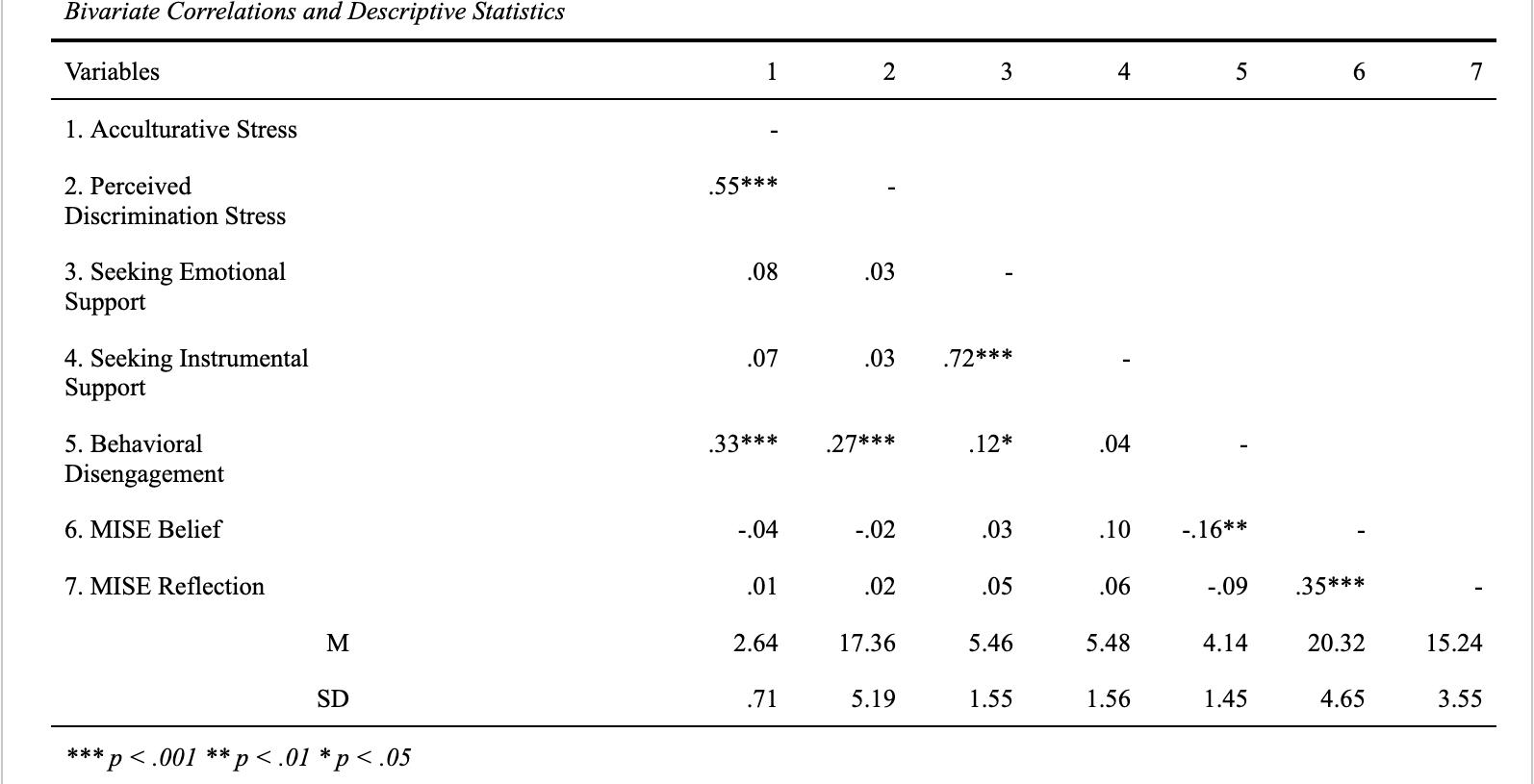
Bivariate correlations and descriptive statistics for all study variables are presented in Table 1. On average, participants reported an acculturative stress score of 2.64 (SD = .71) and a perceived daily discrimination stress score of 17.36 (SD = 5.19). For coping strategies, participants reported mean scores of 5.46 (SD = 1.55) for seeking emotional support, 5.48 (SD = 1.56) for seeking instrumental support, and 4.14 (SD = 1.45) for behavioral disengagement. Participants scored an average of 20.32 (SD = 4.65) on the MISE Reflection subscale and 15.24 (SD = 3.55) on the MISE Belief subscale.
Bivariate correlation analyses showed that acculturative stress was positively correlated with perceived daily discrimination stress (r = .55, p < .001) and with behavioral disengagement (r = .33, p < .001). Perceived daily discrimination stress was also positively correlated with behavioral disengagement (r = .27, p < .001). Emotional support was positively correlated with instrumental support (r = .72, p < .001) and with behavioral disengagement (r = .12, p < .05). Additionally, MISE Belief and MISE Reflection were positively correlated (r =
.35, p < .001). Behavioral disengagement was negatively correlated with MISE Belief (r = -.16, p < .01).
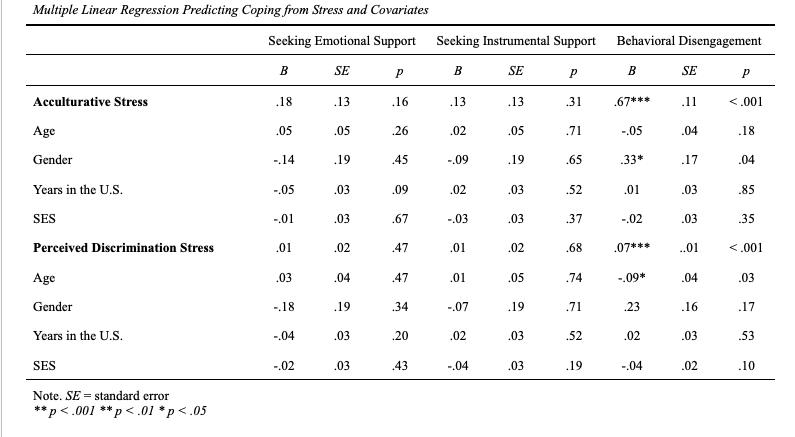
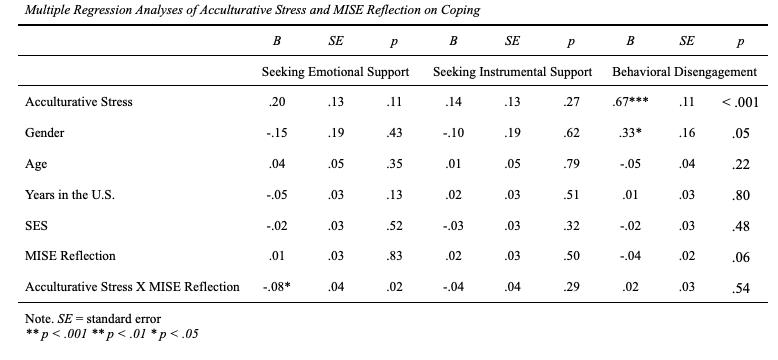
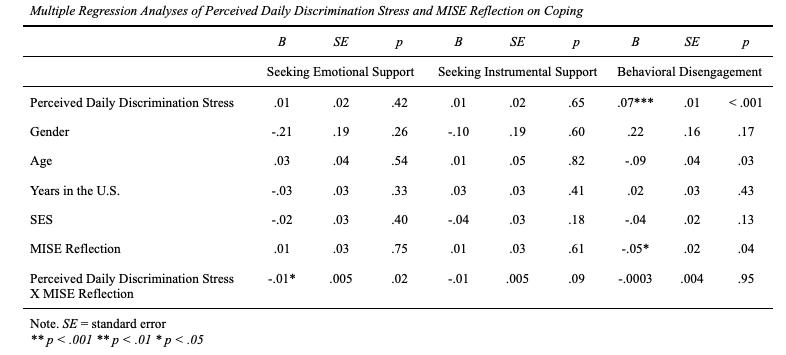
Multiple linear regression analyses examined associations among the two stress variables—acculturative stress and perceived daily discrimination—and the three coping strategies: seeking emotional support, seeking instrumental support, and behavioral disengagement. Covariates in all models included age, gender, years in the United States, and socioeconomic status. Results from these analyses are summarized in Table 2.
To begin, behavioral disengagement was regressed on perceived discrimination stress. Higher levels of perceived discrimination significantly predicted greater behavioral disengagement (B = 0.07, SE = 0.01, p < .001). Among covariates, age was negatively associated with disengagement (B = -0.09, SE = 0.04, p = .03), indicating that older participants reported lower disengagement. Gender was positively associated with disengagement (B = 0.23, SE = 0.16, p = .17), although this effect was not statistically significant. Years in the United States and socioeconomic status were nonsignificant predictors (ps > .05).
Behavioral disengagement was also regressed on acculturative stress. Acculturative stress significantly predicted behavioral disengagement (B = 0.67, SE = 0.11, p < .001), indicating that individuals with higher acculturative stress reported more disengagement. In this model, male participants reported significantly higher disengagement than female participants (B = 0.33, SE = 0.17, p = .04), while age, years in the United States, and socioeconomic status remained nonsignificant.
Next, emotional support-seeking was regressed on both perceived discrimination stress and acculturative stress. Neither stress variable significantly predicted emotional support-seeking, and none of the covariates were significant. These findings suggest that emotional support-seeking may not be a primary coping response to stressors in this sample.
Instrumental support-seeking was then regressed on both types of stress. Neither acculturative stress nor perceived discrimination stress significantly predicted instrumental support-seeking, and none of the covariates remained significant.
Interactions Between MISE, Acculturative Stress, and Perceived Discrimination in Predicting Approach
and Avoidance Coping
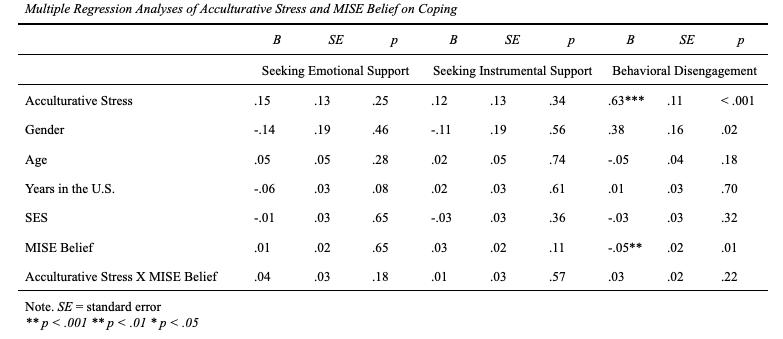
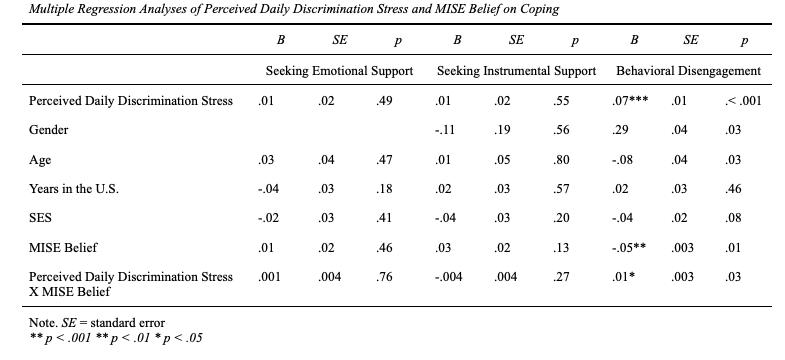
To examine whether meaning-making in stressful experiences (MISE) moderated the relationships between stress and coping, a series of multiple linear regression analyses tested interaction effects between each stressor (acculturative stress or perceived discrimination stress) and each MISE component (Belief and Reflection) on emotional support-seeking, instrumental supportseeking, and behavioral disengagement. Results are reported in Tables 3-6.
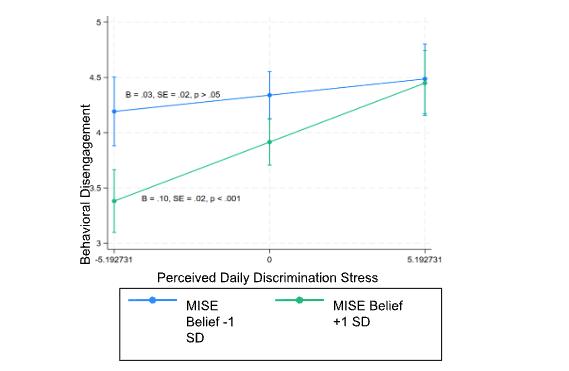
A significant interaction emerged between MISE Belief and perceived discrimination stress in predicting behavioral disengagement (B = -0.01, SE = 0.003, p < .05), while controlling for age, gender, years in the United States, and socioeconomic status. As illustrated in Figure 1, perceived discrimination stress predicted increased behavioral disengagement among individuals with higher levels of MISE Belief but not among those with lower levels. This finding contradicts the hypothesis that higher MISE Belief would be associated with greater use of approach-oriented coping. It highlights the need for a nuanced interpretation of meaning-making processes when individuals face discrimination.
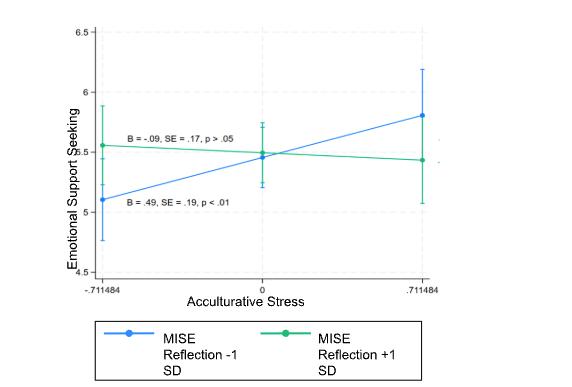
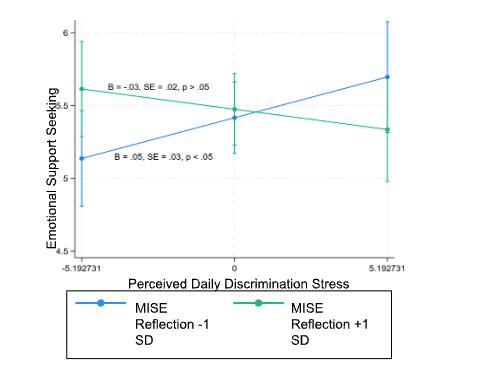
Another significant interaction was found between MISE Reflection and acculturative stress in predicting emotional support-seeking (B = -0.08, SE = 0.04, p < .05), controlling for covariates. As depicted in Figure 2, individuals with lower levels of MISE Reflection showed greater emotional support-seeking as acculturative stress increased. In contrast, no such association was found among those with higher levels of reflection.
A similar interaction emerged when predicting emotional support-seeking from perceived discrimination stress. MISE Reflection moderated this association (B = -0.01, SE = 0.005, p < .05), as shown in Figure 3. Individuals with lower MISE Reflection sought more emotional support as perceived discrimination increased, while those with higher levels of reflection did not show this pattern.
Finally, MISE did not moderate the relationship between either stressor and instrumental support-seeking, suggesting that meaning-making processes may have a greater influence on emotional coping than on practical help-seeking.
Discussion
This study contributes to a culturally grounded understanding of stress and coping among East Asian international young adults by examining the relationships between acculturative stress, perceived discrimination, and coping strategies in this population. The findings highlight how cultural stressors shape coping behaviors and reveal the distinct moderating roles of meaning-making processes.
The significant associations between both acculturative stress and perceived discrimination stress with behavioral disengagement align with previous research, indicating that cultural stressors can contribute to maladaptive coping responses (Saasa et al., 2024). Behavioral disengagement involves withdrawing effort from goaldirected activities and may hinder cultural adjustment and academic success for East Asian international young adults. These findings carry important implications for university counselors and mental health practitioners. Counselors should be trained to recognize behavioral disengagement not only as reduced motivation but also as a possible response to chronic acculturative or discriminatory stress that warrants culturally responsive intervention.
Furthermore, the absence of significant associations between either type of stress and approach-oriented coping (emotional or instrumental support-seeking) provides a meaningful insight. Students experiencing cultural stress may not naturally turn to support-seeking strategies, even when they are beneficial. Intervention efforts should therefore encourage and normalize approach-oriented coping, including help-seeking and community-building, while acknowledging cultural norms surrounding emotional restraint, self-reliance, and stigma. Creating supportive and identity-affirming campus environments may help international students feel more comfortable using adaptive coping strategies. The interaction between MISE Belief and perceived discrimination in predicting behavioral disengagement offers nuanced insights into meaning-making processes. Perceived discrimination was associated with greater behavioral disengagement among individuals with higher levels of MISE Belief but not among those with lower levels. As Figure 1 illustrates, individuals with high MISE Belief reported lower disengagement when discrimination stress was low, suggesting a potential buffering effect. However, as discrimination stress intensified, disengagement increased among those
with high MISE Belief, indicating that meaning-making may be protective only under lower-stress conditions and may become insufficient when individuals face persistent or severe discrimination. Those low in MISE Belief reported consistently elevated disengagement across stress levels, possibly reflecting a general tendency toward withdrawal when stress is not perceived as meaningful. These patterns underscore the importance of considering both belief systems and stress intensity when examining coping behaviors.
Findings for MISE Reflection offer additional insights. Individuals low in MISE Reflection demonstrated greater emotional support-seeking as acculturative stress and perceived discrimination increased, whereas individuals high in reflection did not show this pattern. This suggests that those who engage less in internal reflection may rely more on others during stress, turning to external sources for comfort or guidance. Importantly, high reflection did not appear to reduce emotional supportseeking, indicating that meaning-centered approaches can be integrated into care without discouraging help-seeking. For clinicians, this highlights the need to recognize that different forms of meaning-making may shape distinct pathways to support-seeking. The nonsignificant findings for instrumental supportseeking, along with the absence of moderation effects for this strategy, indicate that meaning-making may not influence practical help-seeking. Cultural considerations may play a role here. East Asian international students may hesitate to seek instrumental support due to concerns about burdening others, maintaining social harmony, or adhering to norms of emotional restraint and independence (Shea & Yeh, 2008). Future interventions should consider culturally responsive ways to normalize and facilitate instrumental supportseeking among international students.
Strengths
This study has several notable strengths. By focusing on East Asian international students in the United States, it centers on a population that is both contextually relevant and underrepresented in coping research. Highlighting this group provides valuable insight into their unique experiences while also validating their struggles and coping strategies. Collecting data in the post-COVID context further enhances the relevance of the findings, as East Asian international students have faced intensified stressors in recent years, including heightened anti-Asian sentiment. Examining this
population after significant sociopolitical shifts provides insight into how culturally rooted beliefs and coping strategies operate under increased strain.
By incorporating both acculturative stress and perceived discrimination stress, the study takes a contextually sensitive approach to understanding how different types of stress shape coping behavior. These stressors are central to the lived experiences of international students navigating cultural adjustment, and the findings offer a more nuanced picture of how psychological challenges relate to coping responses.
The consistent association between both forms of stress and behavioral disengagement has important implications for clinical practice. Practitioners must assess not only levels of stress but also the degree of student disengagement, as disengagement may signal deeper emotional or motivational struggles. Recognizing early signs of withdrawal can help practitioners intervene before disengagement negatively influences academic or personal functioning.
Finally, the finding that stress was associated with avoidant rather than approach-oriented coping raises important concerns. Because behavioral disengagement is often linked to poor mental health outcomes, its association with cultural stressors suggests that many students may be coping in ways that deepen their distress. This underscores the importance of interventions that encourage more adaptive coping strategies and provide culturally responsive support.
Limitations
While this study provides meaningful insights, several limitations should be considered when interpreting the findings. First, the sample consisted solely of students in New York, which may limit generalizability. East Asian international students in other regions of the United States may encounter different cultural, social, and academic environments. Differences between urban and rural contexts or between East Coast and West Coast settings, for example, may shape distinct experiences of stress and coping. Additionally, the study does not include certain East Asian groups (such as Taiwanese and Mongolian students) or broader Asian populations (such as South Asian and Southeast Asian students), thereby limiting the applicability of the findings to all Asian international students. The sampling method also introduces potential
selection bias. Because participants were recruited through social media and a university subject pool, the sample may overrepresent students who are more digitally connected, more engaged with university systems, or who have greater availability or interest in the study topic. Students with heavier workloads, greater financial strain, or less institutional integration may be underrepresented.
Methodological limitations further constrain interpretation. The cross-sectional design prevents examining how acculturative stress, daily discrimination stress, coping strategies, or meaning-making processes evolve. Without temporal data, it is not possible to determine the directionality or causality of the relationships among these variables.
A second methodological limitation concerns the measurement of coping. Although the study aims to examine coping responses to specific stressors, the Brief COPE assesses general coping tendencies rather than stressor-specific coping. This mismatch may obscure how students respond to specific types of stress, reducing the ecological validity of the findings.
Finally, the study relies entirely on self-report measures. Self-reported data are vulnerable to biases such as social desirability, recall inaccuracies, and subjective interpretation. These limitations may affect the accuracy of the results and fail to capture the full complexity of stress and coping experiences. Despite efforts to ensure reliability, self-report instruments may overlook important behavioral and physiological aspects of participants’ experiences.
Together, these limitations should be considered when interpreting the results and drawing broader conclusions.
Future Research
Future research should address the limitations identified in this study. Longitudinal designs are needed to examine the temporal relationships among stress, perceived discrimination, and coping strategies to better understand how acculturative stress, perceived discrimination, and coping strategies unfold over time. Such designs may also reveal cumulative effects of culturally specific stressors and coping patterns that are not detectable through cross-sectional methods. Experimental work could further clarify the
directionality of associations between stress and coping in this population.
In addition, more research is needed to explore how culturally influenced belief systems shape coping responses. Investigating the conditions under which meaning-making processes are most beneficial may help clarify when MISE Belief and MISE Reflection promote adaptive coping. Expanding research to include other cultural groups and geographic contexts would also strengthen generalizability and help capture variations in cultural adaptation across different environments. Finally, incorporating qualitative methods would offer deeper insight into how international students interpret and navigate stress. Qualitative approaches can illuminate the nuanced ways individuals make sense of acculturative stress, discrimination, and coping, thereby enriching the understanding gained from quantitative measures and providing a more holistic representation of their lived experiences.
Conclusion
This study highlights the complex relationships between acculturative stress, perceived discrimination stress, coping strategies, and cultural meaning-making among East Asian international students in the United States. Both types of stress were associated with greater behavioral disengagement, and neither was directly associated with approach-oriented coping. The moderating effects of meaning-making processes, particularly MISE Belief and MISE Reflection, further underscore the influence of cultural beliefs on how individuals respond to stress.
Taken together, these findings emphasize the importance of culturally informed frameworks when examining stress and coping among international students. Interventions that target avoidant coping and promote adaptive meaning-making may be especially beneficial. Despite the limitations of this study, the findings contribute to a deeper understanding of stress and coping in a marginalized population and offer practical implications for mental health professionals and university support systems. Supporting resilience among East Asian international students requires acknowledging their unique stressors and providing culturally congruent coping tools that empower them in navigating academic, social, and psychological challenges.
References
Akhtar, M., & Kroener-Herwig, B. (2019). Coping styles and socio-demographic variables as predictors of psychological well-being among international students belonging to different cultures. Current Psychology, 38, 618–626.
Aldwin, C. M., & Revenson, T. A. (1987). Does coping help? A reexamination of the relation between coping and mental health. Journal of Personality and Social Psychology, 53(2), 337.
Bai, J. (2016). Development and validation of the Acculturative Stress Scale for Chinese College Students in the United States (ASSCS). Psychological Assessment, 28(4), 443–447.
Berry, J. W. (2003). Acculturation: New approaches in theory, measurement, and applied research. American Psychological Association.
Berry, J. W. (2005). Acculturation: Living successfully in two cultures. International Journal of Intercultural Relations, 29(6), 697–712.
Berry, J. W. (2006). Acculturative stress. In P. T. P. Wong & L. C. J. Wong (Eds.), Handbook of multicultural perspectives on stress and coping (pp. 287–298). Spring Publications.
Berry, J. W. (2015). Acculturation. In J. E. Grusec & P. D. Hastings (Eds.), Handbook of socialization: Theory and research (2nd ed., pp. 520–538). The Guilford Press.
Brief COPE. (n.d.). University of Miami, Department of Psychology. https://www.psy.miami.edu/faculty/ ccarver/brief-cope.html
Carver, C. S. (1997). You want to measure coping but your protocol’s too long: Consider the Brief COPE. International Journal of Behavioral Medicine, 4(1), 92–100.
Cheng, C., Ying, W., Ebrahimi, O. V., & Wong, K. F. E. (2023). Coping style and mental health amid the first wave of the COVID-19 pandemic: A culture-moderated meta-analysis of 44 nations. Health Psychology Review, 18(1), 141–164.
Choi, I., Koo, M., & Choi, J. A. (2007). Individual differences in analytic versus holistic thinking. Personality and Social Psychology Bulletin, 33(5), 691–705.
Cong, M., Don, Y., & Chao, R. C. (2024). Acculturative stress of Asian international students before and during the COVID-19 pandemic. Journal of Comparative & International Higher Education, 16(1).
Croucher, S. M., Nguyen, T., & Rahmani, D. (2020). Prejudice toward Asian Americans in the COVID-19 pandemic:
The effects of COVID-19 threat, authoritarianism, and support for Trump. Frontiers in Communication, 5, 39.
Dao, T. K., Lee, D., & Chang, H. (2007). Acculturation, coping, and mental health among international students. International Journal of Intercultural Relations, 31(2), 247–259.
Dion, K. L., Dion, K. K., & Pak, A. W. (1992). Personality‐based hardiness as a buffer in the relationship between social support and stress. Psychology and Health, 7(3), 161–174.
Ezzedine, L., & Poyrazli, S. (2020). Perceived ethnic discrimination, race-related stress, and coping styles. International Journal of Educational Research Open, 100017.
Finset, A., Steine, S., Haugli, L., Steen, E., & Laerum, E. (2002). The Brief Approach/Avoidance Coping Questionnaire: Development and validation. Psychology, Health & Medicine, 7(1), 75–85.
Folkman, S., & Lazarus, R. S. (1986). Stress processes and depressive symptomatology. Journal of Abnormal Psychology, 95(2), 107–113.
Gee, G. C., Spencer, M. S., Chen, J., & Takeuchi, D. (2007). A nationwide study of discrimination and chronic health conditions among Asian Americans. American Journal of Public Health, 97(7), 1275–1282.
Hahm, H. C., Ha, Y., Scott, J. C., Wongchai, V., Chen, J. A., & Liu, C. H. (2021). Perceived COVID-19-related antiAsian discrimination predicts posttraumatic stress disorder symptoms among Asian and Asian American young adults. Psychiatry Research, 303, 114084.
Hamamura, T., & Laird, P. G. (2014). The effect of perfectionism and acculturative stress on levels of depression experienced by East Asian international students. Journal of Multicultural Counseling and Development, 42(4), 205–217.
Hinch, R., & Sirois, F. M. (2024). A meta-analysis of coping strategies and psychological distress in rheumatoid arthritis. British Journal of Health Psychology, 29(3).
Huynh, Q. L., Devos, T., & Smalarz, L. (2011). Perpetual foreigner in one’s own land: Potential implications for identity and psychological adjustment. Journal of Social and Clinical Psychology, 30(2), 133–162.
Hurst, C., Baranik, L., & Daniel, F. (2013). International students and mental health. Journal of International Students, 3(1), 17–28.
Hwang, W.-C., & Goto, S. (2008). The impact of perceived racial discrimination on the mental health of Asian
American and Latino college students. Cultural Diversity and Ethnic Minority Psychology, 14(4), 326–335.
Ji, L., Yap, A. J., & Ma, Z. (2022). Beliefs about adversity and meaning-making across cultures. Journal of Personality and Social Psychology, 123(1), 85–104.
Kim, B. S. K., & Omizo, M. M. (2005). Asian and European American cultural values, collective self-esteem, acculturative stress, cognitive flexibility, and general self-efficacy among Asian American college students. Journal of Counseling Psychology, 52(3), 412–419.
Kristiana, I. F., Karyanta, N. A., Simanjuntak, E., Prihatsanti, U., Ingarianti, T. M., & Shohib, M. (2022). Social support and acculturative stress of international students. International Journal of Environmental Research and Public Health, 19(11), 6568.
Lee, J. J., & Ahn, M. H. (2011). Perceived discrimination and distress among East Asian international students. Journal of College Counseling, 14(1), 65–79.
Lee, J. J., & Rice, C. (2007). Welcome to America? International student perceptions of discrimination. Higher Education, 53(3), 381–409.
Levin, B., & Perst, K. (n.d.). Report to the nation: 2020s – Dawn of a decade of rising hate.
Ma, K., Pitner, R., Sakamoto, I., & Park, H. Y. (2020). Challenges in acculturation among international students from Asian collectivist cultures. Higher Education Studies, 10(3), 34.
Matheson, K., et al. (2019). Stress from discrimination: Mental health impacts. Journal of Community Psychology, 47(6), 1375–1390.
McMurtry, S. L., et al. (2019). Racial discrimination and stress. American Journal of Orthopsychiatry, 89(4), 423–433.
Mena, F. J., Padilla, A. M., & Maldonado, M. (1987). Acculturative stress and specific coping strategies among immigrant and later generation college students. Hispanic Journal of Behavioral Sciences, 9(2), 207–225.
Moon, C., & Larke, P. (2020). Meta-analysis of Asian students’ acculturative stress in the U.S. Journal of Multicultural Affairs, 5.
Padilla, A. M., Wagatsuma, Y., & Lindholm, K. (1985). Acculturation and stress-responses. Journal of Cross-Cultural Psychology, 16(2), 202–213.
Pascoe, E. A., & Smart Richman, L. (2009). Perceived discrimination and health: A meta-analytic review. Psychological Bulletin, 135(4), 531–554.
Poyrazli, S., & Lopez, M. D. (2007). An exploratory study of perceived discrimination and homesickness. Journal of International Students, 7(2), 364–378.
Ramos, M. R., Cassidy, C., Reicher, S., & Haslam, S. A. (2016). A longitudinal study of the effects of discrimination on the acculturation strategies of international students. Journal of Cross-Cultural Psychology, 47(3), 401–420.
Ruiz, N., Im, C., & Tian, Z. (2023, November 30). Asian Americans and discrimination during the COVID-19 pandemic. Pew Research Center.
Ryder, A. G., Alden, L. E., & Paulhus, D. L. (2011). Is acculturation unidimensional or bidimensional? Journal of Personality and Social Psychology, 81(1), 49–65.
Saasa, S., Okech, D., Choi, Y. J., Nackerud, L., & Littleton, T. (2021). Social exclusion, mental health, and social well-being among African immigrants in the United States. International Social Work, 65(4).
Sánchez, M., Rice, E., Stein, J., Milburn, N. G., & RotheramBorus, M. J. (2010). Acculturation, coping styles, and health risk behaviors among HIV positive Latinas. AIDS and Behavior, 14(2), 401–409.
Shadowen, N. L., Williamson, A. A., Guerra, N. G., Ammigan, R., & Drexler, M. L. (2019). Prevalence and correlates of depressive symptoms among international students: Implications for university support offices. Journal of International Students, 9(1), 129–149.
Shea, M., & Yeh, C. (2008). Asian American students’ cultural values, stigma, and relational self-construal: Correlates of attitudes toward professional help seeking. Journal of Mental Health Counseling, 30(2), 157–172.
Stanisławski, K. (2019). The coping circumplex model: An integrative model of the structure of coping with stress. Frontiers in Psychology, 10, 694.
Stop AAPI Hate. (2022). Statement: Report shows almost 11,000 hate acts, most reported by women. https:// stopaapihate.org/
Su, Z., McDonnell, D., Shi, F., Liang, B., Li, X., Wen, J., Cai, Y., Xiang, Y.-T., & Yang, L. (2021). Chinese international students in the United States: The interplay of students’ acculturative stress, academic standing, and quality of life. Frontiers in Psychology, 12.
Sullivan, C., & Kashubeck-West, S. (2015). The interplay of international students’ acculturative stress, social support, and acculturation modes. Journal of International Students, 5(1), 1–11.
Tineo, P. (2023). The impact of acculturative stress on internalizing problems among racially and ethnically minoritized adolescents and young adults in the U.S.: A systematic review and metaanalysis (Publication No. 1342) [Master’s thesis, Syracuse University]. SURFACE at Syracuse U.
Wei, M., et al. (2007). Acculturative stress and mental health. Counseling Psychologist, 35(1), 1–26.
Wei, M., Heppner, P. P., et al. (2010). Racial discrimination and suppressive coping. Journal of Counseling Psychology, 57(4), 411–422.
Weisz, J. R., Rothbaum, F. M., & Blackburn, T. C. (1984). Standing out and standing in. American Psychologist, 39(9), 955–969.
Wu, M., Lou, J., Kung, L. Y., Chen, X., & Shouse, R. C. (2023). Perceived discrimination among Chinese international students during the COVID-19 pandemic: A qualitative study based on grounded theory. E3S Web of Conferences, 409, 06013.
Yan, K., & Berliner, D. C. (2011). Chinese international students in the United States: Demographic trends, motivations, acculturation features and adjustment challenges. Asia Pacific Education Review, 12, 173–184.
Zhai, Y., & Du, X. (2020). Mental health care for international Chinese students affected by the COVID-19 outbreak. The Lancet Psychiatry, 7(4), e22.
Zhang, J., & Goodson, P. (2011). Predictors of international students’ psychosocial adjustment to life in the United States: A systematic review. International Journal of Intercultural Relations, 35(2), 139–162.
Zhang, Y. (2025). An examination of acculturative stress, perceived social support and depression among Chinese international students [Master’s thesis, Syracuse University]. SURFACE at Syracuse U.
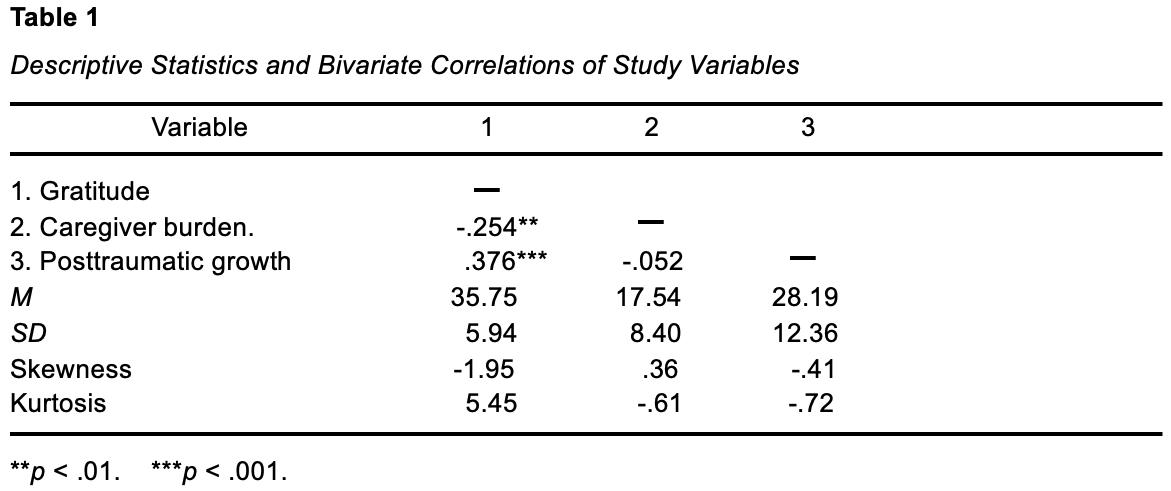
Table 2.
Table 4.
Table 6.
1. Effect of Interaction between MISE Belief and Perceived Daily Discrimination Stress on Behavioral Disengagement
2. Effect of Interaction between MISE Reflection and Acculturative Stress on Emotional Support Seeking
Figure
Figure
3. Effect of Interaction between MISE Reflection and Perceived Daily Discrimination Stress on Emotional Support
Figure
The Protective Role Of Gratitude In Caregiver Burden And Posttraumatic Growth Among Cancer Caregivers
Devin A. Thompson
In 2018, cancer was responsible for the deaths of 9.6 million people, and this figure is projected to double by 2040 (WHO Health Organization, 2020). Cancer poses a significant health challenge, adversely affecting those diagnosed with it by causing pain and emotional distress (Wang & Feng, 2022). It also leads to psychosocial problems, including emotional turmoil, difficulties in maintaining social relationships, and a decline in selfconcept (Wang & Feng, 2022). However, cancer affects not only patients but also their informal caregivers. Informal caregivers are relatives, partners, friends, neighbors, or anyone with a close personal connection who assists those with chronic conditions without financial compensation (Family Caregiver Alliance, 2009). Caregiving duties typically encompass various domestic tasks, such as cooking and cleaning, as well as medical-related responsibilities, such as administering injections and driving to medical appointments (Family Caregiver Alliance, 2009). These duties can be both time-consuming and emotionally draining for the staff. Cancer caregivers spend approximately 33 hours per week with patients (Faramarzi et al., 2025) while managing other commitments (Oedekoven et al., 2019).
Informal caregivers often face significant burdens that affect their mental and physical well-being (Oedekoven et al., 2019). A central concept that encapsulates this experience is caregiver burden, which is defined as the perceived effects of caregiving on emotional, social, financial, physical, and spiritual functioning (Zarit et al., 1986). The burden experienced by informal caregivers can lead to elevated stress, anxiety, and depression levels (Schulz & Sherwood, 2008). It may also cause challenges in their personal lives, such as limited social interactions and financial difficulties, as well as in their professional lives, including tardiness and absenteeism (Society of Actuaries Research Institute 2023). To gain a deeper understanding of the effects of caregiver burden, it is essential to examine the factors contributing to it. This understanding is vital not only for caregivers’ well-being but also for developing effective support systems and interventions.
Several factors contribute to caregiver burden, including
gender, income, and level of education. Notably, female caregivers report experiencing a greater burden (Schrank et al., 2016=) and higher levels of perceived stress, depression, anxiety, and social strain (Ketcher et al., 2020) than their male counterparts. This disparity may arise from societal and cultural stereotypes that expect women to assume more intensive caregiving roles and greater household responsibilities (Revenson, 2016). Regarding income differences, caregivers with higher incomes generally experience less burden (Papastavrou et al., 2009; Willert & Minnotte, 2021), possibly because they have access to more resources to support caregiving (Willert & Minnotte, 2021). The level of education also plays a role in caregiver burden. Caregivers with higher levels of education typically experience less burden (Papastavrou et al., 2009; Palos et al., 2011), which may be attributed to their use of problem-focused rather than emotion-focused coping strategies (Palos et al., 2011). This study aimed to examine further the factors affecting caregiver burden.
Despite the significant burden on informal caregivers, some experience personal growth and psychological benefits from their caregiving role (Tedeschi et al., 2018). Posttraumatic Growth (PTG) refers to the positive psychological changes that occur after a significant or potentially traumatic struggle (Tedeschi & Calhoun, 1996). PTG is fostered by positive coping strategies, cognitive processing, and resilience (Henson et al., 2021). Some cancer caregivers have reported a heightened sense of pride and an increased desire to live in the moment following PTG (Harvey & Berndt, 2021). This resilience and capacity to find growth in the face of adversity are genuinely inspiring. Previous research has begun to explore various predictors of PTG, revealing that perceived stress, depression, psychological distress, and neuroticism are all negatively correlated with PTG (Faramarzi et al., 2025). Conversely, conscientiousness, spiritual well-being, agreeableness, and extraversion are positively correlated with PTG (Faramarzi et al., 2025). Religious and spiritual well-being, along with the use of positive religious coping strategies (e.g., Benevolent Religious Reappraisal, Spiritual Connection), are primarily associated with increased PTG in informal caregivers (Thombre et al., 2010). Overall, identifying
psychological resources that predict adjustment (e.g., caregiver burden and posttraumatic growth, or PTG) among caregivers of cancer patients is essential for understanding and supporting caregiver well-being in the long term.
Gratitude and Caregiver Adjustment
Gratitude is generally understood as the inclination to recognize and appreciate the generosity of others (McCullough et al., 2002) and to acknowledge and value positive aspects (Wood et al., 2010). Typically, individuals with higher levels of gratitude are more likely to engage in prosocial behaviors, experience moderate to intense life satisfaction (Portocarrero et al., 2020), display more grateful emotions (Rash et al., 2011), and exhibit communal strength (Lambert et al., 2010). Gratitude is also linked to reduced depressive symptoms and loneliness (Zhang & Tsai, 2023) and is associated with stronger social support networks and active coping strategies (Lin & Yeh, 2014). The potential of gratitude to enhance caregiver adjustment is a promising research area that offers hope for caregivers’ well-being.
Gratitude may predict better caregiver adjustment. Fredrickson’s broaden-and-build theory explains how positive emotions expand the range of thoughts and actions available to a person, thereby building cognitive resources, such as resilience, to enhance psychological well-being (Fredrickson, 2004). For example, the emotion of contentment encourages individuals to savor life circumstances and integrate these experiences into their self-perceptions and worldviews (Fredrickson, 2004). Similarly, gratitude may expand individuals’ thoughts and actions, aiding caregiver adjustment. Previous studies have indicated that gratitude acts as a protective factor in caregiving contexts. For instance, among family caregivers of individuals with Alzheimer’s disease, gratitude was found to predict a sense of meaning in life; in other words, greater gratitude correlated with caregivers reporting more meaningful lives (McGee et al., 2024). Gratitude also mediates the impact of caregiver burden on caregivers’ sense of meaning in life (McGee et al., 2024). Related studies have noted that gratitude affects the caregiver burden. Higher levels of dispositional gratitude were linked to reduced burden among Australian caregivers of individuals with severe mental illnesses (Stomski et al., 2019). Gratitude also served as a protective mechanism among employees at Seattle Pacific University following a campus shooting, being associated with increased
PTG and decreased posttraumatic stress (Vieselmeyer et al., 2017). Finally, higher levels of gratitude enhanced participants’ capacity for PTG during the COVID-19 pandemic (El Khoury-Malhame et al., 2024). To our knowledge, gratitude has not yet been explored as a predictor of caregiver burden and PTG among informal caregivers of cancer patients.
Moreover, there are clinical implications if gratitude predicts caregiver adjustment. Prior research has shown that gratitude-based interventions can decrease the subjective burden of caregivers of individuals with cerebral palsy (Rahmah & Utami, 2023) and reduce depression and psychological distress among palliative caregivers (Bernard et al., 2023). Similarly, a qualitative analysis of a four-week positive psychology group intervention emphasizing gratitude for cancer survivors and caregivers found that participants felt less alone and more connected to their loved ones (Raque-Bogdan et al., 2020). A better understanding of how gratitude interacts with caregiver adjustment — specifically, caregiver burden and PTG — could improve the well-being of informal caregivers and lead to the development of clinical interventions.
The Present Study
The research question (RQ) and corresponding hypothesis (H) are as follows:
RQ: Is gratitude associated with caregiver burden and posttraumatic growth (PTG) among informal caregivers of cancer patients?
H: We hypothesized that higher gratitude is associated with lower caregiver burden and greater posttraumatic growth (PTG) among informal caregivers of cancer patients.
Methods
Participants
Informal caregivers were recruited via social media and online cancer support organizations. The study’s procedures and materials were approved by the Institutional Review Board (IRB) of New York University. The IRB approval protocol number is IRB-FY2024-8006, and Inclusion criteria for informal caregivers were: (1) age 18 or older; (2) residence in the United States; (3) ability to read English; (4) having a family member
diagnosed with cancer; (5) that family member is either currently undergoing treatment or completed treatment within the past two years; and (6) being the primary informal caregiver for that family member.
A total of 141 informal caregivers were recruited for this study. Thirteen participants were excluded from the final sample: six failed the attention checks, and seven had missing data. Attention checks were included to ensure data quality, and participants who failed them were excluded from the analysis. Missing data were due to technical issues during survey completion. The final sample consisted of 128 informal caregivers (Mage = 50.10; SDage = 15.22; 43.8% male; 56.3% female). The racial and ethnic backgrounds of the participants included: 0.8% Arab American, Middle Eastern, or North African, 6.3% Asian or Asian American, 4.7% Black or African American, 2.3% Bi/Multi-racial, 6.3% Latino/a/x or Spanish Origin, 3.1% Native Hawaiian or Other Pacific Islander, 0.8% Southeast Asian, and 75.8% White/European American. The participants’ education consisted of: 4.7% high school graduates, 20.3% with some college or specialized training (AA degree), 45.3% with a college degree (BA, BS), and 29.7% with a postgraduate degree (MA, PhD). Finally, the annual income distribution was as follows: 2.3% earned less than $15,000; 11.7% between $15,000 and $45,000; 12.5% between $45,001 and $75,000; 17.2% between $75,001 and $100,000; and 56.3% more than $100,000.
Study Design and Procedure
A research team member contacted the participants by phone to assess their eligibility after obtaining their contact information through the screening survey. Eligible participants were sent either a Qualtrics link to complete a 30-minute online survey or a printed survey by mail, based on their preferences. Demographic questions included age, gender, race/ethnicity, education, annual household income, and perceived social status measured by the MacArthur Scale of Subjective Social Status (Adler et al., 2000). Participants received a $20 Amazon e-gift card upon completing the study.
Measures Gratitude
Gratitude was assessed using the Gratitude Questionnaire-Six Item Form (GQ-6; McCullough et
al., 2002) on a Likert scale ranging from 1 (Strongly Disagree) to 7 (Strongly Agree). An example item is “I have so much in life to be thankful for.” The scores were summed to create an overall gratitude score, with items 3 and 6 being reverse-coded. The GQ-6 has good convergent and construct validity. Moreover, the GQ-6 has acceptable to good internal consistency, with Cronbach’s α ranging from .76 to .84 (McCullough et al., 2002). Internal consistency was good in the current sample (Cronbach’s α = .843).
Caregiver Burden
The Zarit Caregiver Burden Assessment: Twelve Short Form (ZBI-12; Bédard et al., 2001) assessed caregiver burden on a Likert scale ranging from 0 (never) to 4 (Nearly Always). Example items include “Do you feel you should be doing more for your relative?” and “Do you feel you don’t have enough time for yourself?”. The scores were summed to create an overall caregiver burden score, with higher scores indicating greater burden. The internal consistency of the ZBI-12 was good, with an alpha coefficient of 0.88 (Bédard et al., 2001). Internal consistency was good in the current sample (Cronbach’s α = .878).
Posttraumatic Growth
Posttraumatic growth was assessed using the Posttraumatic Growth Inventory - Ten Item Short Form (PTGI-10; Cann et al., 2010) on a Likert scale from 0 (I did not experience this change as a result of my crisis) to 5 (I experienced this change to a very great degree as a result of my crisis). An example item consists of “I am able to do better things with my life.” PTG was calculated by summing all the scores, with higher scores representing a greater perceived positive change. The PTGI-10 has an internal reliability generally in the range of .90 across various samples (Cann et al., 2010). The internal consistency was excellent (Cronbach’s α = .908) in the current sample.
Data Analysis
To address our research question, a bivariate correlation was conducted to examine the relationship among all study variables of interest: gratitude, caregiver burden, and PTG.
Two separate linear regression analyses were conducted to investigate the relationships among gratitude,
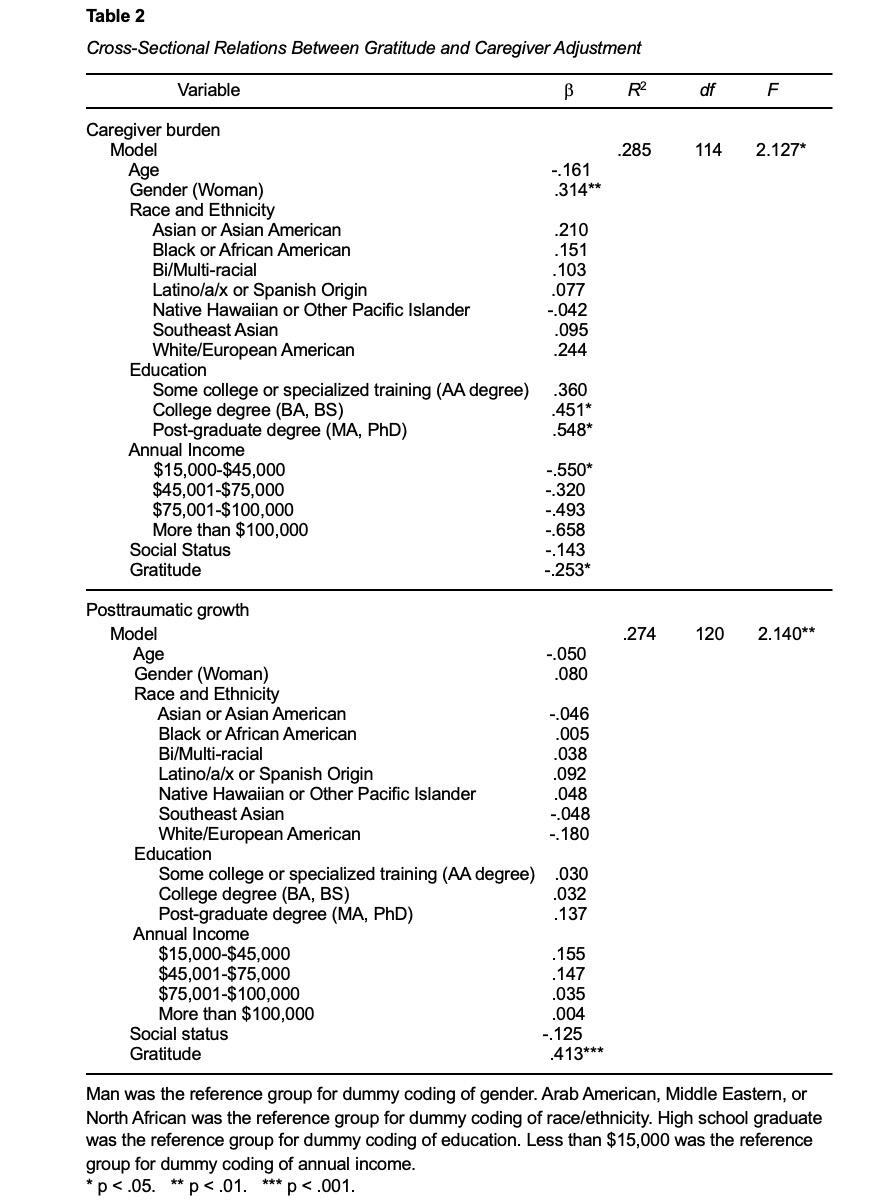
caregiver burden, and PTG, while controlling for demographic factors such as gender, race, education, annual income, and perceived social status. Dummy coding was used, with the reference groups being Men (Gender), Arab American, Middle Eastern, or North African (Race), high school graduate (Education), and less than $15,000 (Annual Income) in the regression analyses.
Results
Table 1 presents the descriptive statistics and bivariate correlations of the study variables. Listwise deletion was used to handle missing data from the participants. The skewness and kurtosis are reported in Table 1. Gratitude was negatively correlated with caregiver burden(r = -.254, p = .006) and positively correlated with PTG (r = .376, p < .001). Caregiver burden and PTG were not significantly correlated (r = -.052, p = .582).
The results of the two linear regression analyses are presented in Table 2. Higher gratitude was associated with lower caregiver burden (β = -.253, p = .019) and greater PTG (β = .413, p < .001), controlling for gender, race, education, annual income, and perceived social status. Among the covariates for caregiver burden, women reported greater burden than men (β = .314; p = .001). Informal caregivers with a college degree (BA, BS) (β = .451; p = .045) and postgraduate degree (MA, PhD) (β = .548; p = .010 ) also reported experiencing more caregiver burden than those with lower levels of education. Finally, informal caregivers with an annual income of $15,000 to $45,000 (β = -0.550; p = 0.038) had lower caregiver burden than those with higher annual incomes. No significant covariates of PTG were observed.
Discussion
Although prior studies have found that gratitude is linked to meaning in life (McGee et al., 2024) and to greater gratitude (Rash et al., 2021), gratitude has not been investigated as a predictor of caregiver burden and PTG among informal caregivers of cancer patients. Thus, the current study examined the association between gratitude, caregiver burden, and posttraumatic growth among informal caregivers of cancer patients. Consistent with our hypotheses, bivariate correlations and linear regression analyses showed that higher levels of gratitude were significantly associated with lower caregiver burden and higher PTG, controlling
for several demographic factors. Among demographic factors, women reported greater caregiver burden than men, consistent with prior studies (Schrank et al., 2015). Regarding education, caregivers with a college degree (BA, BS) and postgraduate degree (MA, PhD) reported a higher caregiver burden. These findings are inconsistent with prior research (Papastavrou et al., 2009; Palos et al., 2011) and may be explained by highly educated caregivers taking on greater responsibility for organizing care and navigating resources, which can increase their perceived burden.
Additionally, caregivers with higher education may be more likely to hold professional or full-time employment, which could introduce role conflict and heighten the perceived burden. It was also found that participants with annual incomes ranging from $15,000 to $45,000 reported less caregiver burden than those with higher incomes, which does not align with prior research (Papastavrou et al., 2009; Willert & Minnotte, 2021). A possible explanation for this finding is that caregivers in this income range may be retired or not working fulltime, which allows them more time and flexibility to focus on their caregiving responsibilities. Furthermore, caregivers in this income range may rely on support from family networks, which can reduce the individual burden. No significant covariates were observed for the PTG. Overall, gratitude may serve as a protective factor, decreasing burden and increasing caregiver well-being.
Some consistent findings with prior literature examining the association between caregiver burden and PTG were observed. Our findings align with those of a previous study reporting that increased dispositional gratitude among Australian caregivers of individuals with severe mental illnesses decreased caregiver burden (Stomski et al., 2019). Likewise, our findings align with prior research suggesting that gratitude is associated with greater PTG following stressful events such as campus shootings (Vieselmeyer et al., 2017) and the COVID-19 pandemic (El Khoury-Malhame et al., 2024). We extended the prior literature by demonstrating that this association is present in informal caregivers of patients with cancer. This population is typically overlooked despite facing substantial psychological and practical challenges in their daily lives.
Given that the cancer death rate is expected to double by 2040 (WHO, 2020), the burden on informal caregivers is likely to grow. Therefore, identifying protective psychological resources such as gratitude
is important. Our study further supports the notion that gratitude serves as a protective factor for informal caregivers during stressful periods, enabling them to thrive in challenging situations (Zhang & Tsai, 2023). Building on Fredrickson’s broaden-and-build theory, increased gratitude could broaden people’s thoughtaction repertoires and foster mindsets and behaviors that help caregivers cope with stress more effectively. Indeed, informal caregivers who are more grateful are more likely to appreciate what they have, recognize the support they receive from others, and reframe caregiving stressors as opportunities for meaning or growth, which could reduce perceived burden and promote PTG.
These findings have significant implications for caregiver-support services. Despite being a dispositional trait, gratitude is malleable and can be promoted and cultivated through simple activities such as counting one’s blessings (Emmons & McCullough, 2003). Integrating gratitude-based interventions into caregiver support services could offer a scalable, costeffective approach to mitigate burden and promote well-being. Prior research has shown that gratitudebased interventions can reduce subjective burden among caregivers of individuals with cerebral palsy (Rahmah & Utami, 2023) and decrease depression and psychological distress among caregivers of palliative patients (Bernard et al., 2023). A four-week positive psychology group intervention for cancer survivors and caregivers that emphasized gratitude was found to be beneficial for participants (Raque-Bogdan et al., 2020). Qualitative analysis revealed that participants felt less isolated and more connected to their loved ones and to other cancer survivors and caregivers (Raque-Bogdan et al., 2020). By continuing to explore gratitude-based interventions, we can validate caregivers’ experiences and further enhance their resources to support their well-being.
Limitations and Future Directions
Our results should be considered in light of some limitations. First, we recruited most participants via social media platforms, using convenience sampling. The majority of our sample consisted of highly educated, financially stable, heterosexual, White/European Americans, which limits the generalizability of our findings and our ability to examine potential cultural and socioeconomic differences in the experience of caregiving and the role of gratitude. Future research should explore these associations in more diverse
informal caregiver populations to assess the cultural relevance and generalizability of gratitude as a protective factor for mental health. Second, the cross-sectional design limits our ability to assess the directionality of the associations among gratitude, caregiver burden, and PTG, as well as to examine the mechanisms of change effectively. Future research should employ longitudinal designs to clarify these directional relationships and explore potential mediators (e.g., emotion regulation, coping strategies, or social support) to understand better the processes through which gratitude exerts its protective effects among informal caregivers of cancer patients. Third, self-report measures of gratitude are subject to reporting biases, including social desirability and memory bias. Future research should incorporate behavioral or informant-based assessments of gratitude to enhance our understanding of this phenomenon. Fourth, the mediating mechanisms linking gratitude to caregiver burden and PTG were not explored. To further understand the association between gratitude, caregiver burden, and PTG, mediators such as coping strategies should be examined to observe when gratitude exerts its mental benefits on informal caregivers. Finally, future studies should investigate how cancer stage or time since diagnosis may impact the association between gratitude toward caregiver burden and PTG.
Conclusion
The present study examined how gratitude could predict caregiver adjustment, specifically caregiver burden and PTG. We explored whether gratitude was associated with caregiver burden and PTG among informal caregivers of cancer patients. Our results demonstrate that gratitude is significantly associated with lower caregiver burden and higher PTG after controlling for demographic factors.
References
Adler, N. E., Epel, E. S., Castellazzo, G., & Ickovics, J. R. (2000). Relationship of subjective and objective social status with psychological and physiological functioning: Preliminary data in healthy, White women. Health Psychology, 19(6), 586-592.
Amaro, L. M. (2017). Dyadic effects of gratitude on burden, conflict, and contribution in the family caregiver and sibling relationship. Journal of Applied Communication Research, 45(1), 61–78.
Bédard, M., Molloy, D. W., Squire, L., Dubois, S., Lever, J. A., & O’Donnell, M. (2001). The Zarit Burden Interview: a new short version and screening version. The gerontologist, 41(5), 652-657.
Bernard, M., Poncin, E., Bovet, E., Tamches, E., Cantin, B., Pralong, J., & Borasio, G. D. (2023). Giving and receiving thanks: a mixed methods pilot study of a gratitude intervention for palliative patients and their carers. BMC palliative care, 22(1), 52.
Cann A, Calhoun LG, Tedeschi RG, Taku K, Vishnevsky T, Triplett KN, Danhauer SC. A short form of the osttraumatic Growth Inventory. Anxiety Stress Coping. 2010; 23(2):127-37.
El Khoury-Malhame, M., Sfeir, M., Hallit, S., & Sawma, T. (2024). Factors associated with posttraumatic growth: gratitude, PTSD and distress; one year into the COVID-19 pandemic in Lebanon. Current Psychology, 43(13), 12061-12070.
Emmons, R. A., & McCullough, M. E. (2003). Counting blessings versus burdens: An experimental investigation of gratitude and subjective well-being in daily life. Journal of Personality and Social Psychology, 84(2), 377–389.
Family Caregiver Alliance. (2009). National Policy Statement. Retrieved from: https://www.caregiver.org caregiving
Faramarzi, M., Azizi, M. G., Ahangari, N., Moslemi, D., Jalalian, E., Kheirkhah, F., ... & Jafari, S. M. (2025). Psychological factors influencing post-traumatic growth in caregivers of breast cancer patients. BMC Palliative Care, 24(1), 156.
Fenton, A. T., Ornstein, K. A., Dilworth-Anderson, P., Keating, N. L., Kent, E. E., Litzelman, K., ... & Wright, A. A. (2022). Racial and ethnic disparities in cancer caregiver burden and potential sociocultural mediators. Supportive Care in Cancer, 30(11), 96259633.
Fredrickson, B. L. (2004). The broaden-and-build theory of positive emotions. Philosophical Transactions of the Royal Society B: Biological Sciences, 359(1449), 1367–1377.
Grant, A. M., & Gino, F. (2010). A little thanks goes a long way: Explaining why gratitude expressions motivate prosocial behavior. Journal of Personality and Social Psychology, 98(6), 946–955.
Harvey, J., & Berndt, M. (2021). Cancer caregiver reports of post-traumatic growth following spousal hematopoietic stem cell transplant. Anxiety, Stress, & Coping, 34(4), 397–410.
Henson, C., Truchot, D., & Canevello, A. (2021). What promotes post traumatic growth? A systematic review. European Journal of Trauma & Dissociation, 5, 100195.
Lambert, N. M., Clark, M. S., Durtschi, J., Fincham, F. D., & Graham, S. M.(2010). Benefits of expressing gratitude: Expressing gratitude to a partner changes one’s view of the relationship. Psychological Science, 21(4), 574580.
Lin, C.-C., & Yeh, Y.-c. (2014). How gratitude influences wellbeing: A structural equation modeling approach. Social Indicators Research, 118(1), 205–217.
Ketcher, D., Trettevik, R., Vadaparampil, S. T., Heyman, R. E., Ellington, L., & Reblin, M. (2020). Caring for a spouse with advanced cancer: similarities and differences for male and female caregivers. Journal of Behavioral Medicine, 43(5), 817-828.
McCullough, M. E., Emmons, R. A., & Tsang, J.-A. (2002). The grateful disposition: A conceptual and empirical topography. Journal of Personality and Social Psychology, 82(1), 112–127.
McGee, J. S., Polson, E. C., Myers, D. R., McClellan, A. M., Ke, W., Zhao, H. C., & Meraz, R. (2024). Gratitude predicts meaning in life in family caregivers of persons with Alzheimer’s disease. Geriatrics, 9(3), 72.
Oedekoven, M., Amin-Kotb, K., Gellert, P., Balke, K., Kuhlmey, A., & Schnitzer, S. (2019). Associations between informal caregivers’ burden and educational level. GeroPsych: The Journal of Gerontopsychology and Geriatric Psychiatry, 32(1), 19–29.
Palos, G. R., Mendoza, T. R., Liao, K. P., Anderson, K. O., GarciaGonzalez, A., Hahn, K., Ramondetta, L. M., & Cleeland, C. S. (2011). Caregiver symptom burden: The risk of caring for an underserved patient with advanced cancer. Cancer, 117(5), 1070–1079.
Papastavrou, E., Charalambous, A., & Tsangari, H. (2009) Exploring the other side of cancer care: The informal caregiver. European Journal of Oncology Nursing, 13(2), 128–136.
Portocarrero, F. F., Gonzalez, K., & Ekema-Agbaw, M. (2020). A meta-analytic review of the relationship between dispositional gratitude and well-being. Personality and Individual Differences, 164, Article 110101.
Rahmah, S., & Utami, M. S. (2023). Applied gratitude therapy in cerebral palsy’s caregiver to reduce subjective burden: A single-case design. Gadjah Mada Journal of Professional Psychology, 9(1), 126–145.
Rash, J. A., Matsuba, K. M., & Prkachin, K. M. (2011). Gratitude and well-being: Who benefits most from a gratitude intervention. Applied Psychology. Health and WellBeing, 3(3), 350–369.
Revenson, T.A. et al. (2016). Gender and Caregiving: The Costs of Caregiving for Women. In: Caregiving in the Illness Context. Palgrave Pivot, London.
Schulz, R., & Sherwood, P. R. (2008). Physical and mental health effects of family caregiving. Journal of Social Work Education, 44(sup3), 105-113.
Schrank, B., Ebert‐Vogel, A., Amering, M., Masel, E. K., Neubauer, M., Watzke, H., ... & Schur, S. (2016). Gender differences in caregiver burden and its determinants in family members of terminally ill cancer patients. Psycho‐oncology, 25(7), 808-814.
Society of Actuaries Research Institute. (2023). Informal caregiving: Measuring the cost and reducing the burden. Society of Actuaries.
Stomski, N. J., Morrison, P., Sealey, M., Skeffington, P., & O’Brien, G. (2019). The association between gratitude and burden in Australian mental health carers: A cross‐sectional study. Scandinavian Journal of Caring Sciences, 33(1), 215–221.
Tedeschi, R.G., Shakespeare-Finch, J., & Taku, K. (2018). Posttraumatic Growth: Theory, Research, and Applications (1st ed.). Routledge.
Tedeschi, R. G., & Calhoun, L. G. (1996). The Posttraumatic Growth Inventory: Measuring the positive legacy of trauma. Journal of Traumatic Stress, 9(3), 455–472.
Thombre, A., Sherman, A. C., & Simonton, S. (2010). Religious Coping and Posttraumatic Growth Among Family Caregivers of Cancer Patients in India. Journal of Psychosocial Oncology, 28(2), 173–188.
Vieselmeyer, J., Holguin, J., & Mezulis, A. (2017). The role of resilience and gratitude in posttraumatic stress and growth following a campus shooting. Psychological Trauma: Theory, Research, Practice, and Policy, 9(1), 62.
Wang, Y., & Feng, W. (2022). Cancer-related psychosocial challenges. General psychiatry, 35(5), e100871.
Willert, B., & Minnotte, K. L. (2021). Informal caregiving and strains: Exploring the impacts of gender, race, and income. Applied Research in Quality of Life, 16(3), 943-964.
Wood, A. M., Froh, J. J., & Geraghty, A. W. (2010). Gratitude and well-being: A review and theoretical integration. Clinical psychology review, 30(7), 890905.
World Health Organization. (2020). WHO report on cancer: setting priorities, investing wisely and providing care for all. World Health Organization.
Zarit, S.H., Todd, P.A. and Zarit, J.M. (1986) Subjective Burden of Husbands and Wives as Caregivers: A Longitudinal Study. Gerontologist, 26, 260-266.
Zhang, Q., & Tsai, W. (2023). Gratitude and psychological distress among first-year college students: The mediating roles of perceived social support and support provision. Journal of Counseling Psychology, 70(4), 415–423.
Table 1. Descriptive Statistics and Bivariate Correlations of Study Variables
Table 2. Cross-Sectional Relations Between Grattitude and Caregiver Adjustment
The Homeplace Lab
PI: Dr. Lauren Mims
The Homeplace Research Collective (Homeplace) studies the brilliance of Black children and their families through community-engaged, child-centered research on Black child development.
Mentors: Dulce Lopez Alvarez + Elisha Arnold
Digital Fugitive Spaces: A Study On Black Girls’ Resistance To Eurocentric Beauty Standards Displayed Online
Onyx Harrison
Adolescents use social media platforms (e.g., Instagram, TikTok) at incredibly high rates: 95% have access to a smartphone and 85% use at least one social media platform (Pew, 2018). These high rates of social media usage among adolescents are often associated with increased comparisons with others online (Scully, 2023; Yang et al., 2021). Social media comparisons, as theorized by Scully et al. (2023), are influenced by the emphasis on physical appearance and ‘picture-perfect’ lives, which may contribute to feelings of inadequacy among impressionable teens. This is especially important, because adolescence is a critical point in the development of identity and self-esteem (Harter, 2006).
Social media comparisons are particularly salient among adolescent girls because of societal expectations of physical beauty (Markey 2025). Past research has asserted that social comparisons on social media are associated with lower self-esteem, reduced body satisfaction, and poorer mental well-being among adolescent girls (Markey, 2025; Scully, 2023; Yang, et al. 2021). For Black girls, the impact of social media comparisons may be compounded by racial biases and gendered expectations; for instance, through Eurocentric beauty standards displayed online. These standards, which have existed long before social media, center on white European features and reject Afrocentric features, display their deep roots in antiBlackness (Bodenhorn, 2002; Mady et al., 2022; Sekayi, 2003). Typically, praised features include light skin, straight hair, light-colored eyes, small noses, big eyes, and high cheekbones (Bodenhorn, 2002; Mady et al., 2022). Although research has shown that black youth understand and endorse Eurocentric beauty standards (e.g., Clark & Clark, 1947), less is known specifically about digital contexts. It is increasingly important to explore how Black girls navigate these standards online, given the time they spend online.
In addition to understanding how Eurocentric beauty standards displayed on social media negatively impact black girls, we must also explore how they negotiate and resist these standards. While research has investigated the negative impact of social media on adolescent girls
(Markey, 2025; Pew, 2018; Scully, 2023) and the effect of Eurocentric beauty standards on Black girls (Byrd et al., 2017; Milkie, 1999; Sekayi, 2003), little is known about the ways black girls display resistance against these standards in digital contexts using a strength-based approach. One meaningful way to explore how black girls cultivate empowerment on social media is through the concept of fugitive spaces. Fugitive spaces: An extension of Jarvis R. Given Fugitive pedagogy (2021), marginalized groups create to support themselves and resist in varying contexts. Expanding upon fugitive spaces, this study explores them through a digital lens, specifically examining Black girls’ resistance to digital fugitive spaces. Failing to examine these digital fugitive spaces misses critical insights into how Black girls actively develop their identities and resistance strategies in response to dominant beauty norms. In sum, using a strength-based approach, this study aimed to examine how black girls create digital fugitive spaces to resist dominant Eurocentric beauty standards on social media.
Eurocentric Beauty Standards
Eurocentric beauty standards are pervasive and use anti-Black ideals to police Black bodies. These ideals manifest as colorism, the preference for lighterskinned individuals; featurism, the favoring of narrow Eurocentric facial features; and texturism, the preference for looser hair textures (Bencosme, 2017). These standards have become prevalent among the Black community, and many are pressured to conform. Black youths with Eurocentric beauty standards have been documented in sociological and psychological studies. Clark and Clark’s (1947) Doll study was one of the earliest to measure the perpetuation of colorism and featurism among young children attending segregated schools. In Clark and Clark’s study, Black children in segregated schools were presented with both white and Black dolls; the Black children consistently favored the white doll over the Black doll. Similar studies have been conducted in modern contexts, with children consistently attributing positive traits to white and lighter-skinned dolls and negative traits to Black, darker-skinned dolls. The Eurocentric beauty standards
are ever-pervasive and use anti-Black ideals to police Black bodies. These ideals manifest as colorism —the preference for lighter-skinned individuals —featurism —the favoring of narrow Eurocentric facial features — and texturism — the preference for looser hair textures (Bencosme, 2017). These standards have become prevalent amongst the Black community, and many are pressured to conform.
Black youth’s experiences with Eurocentric beauty standards have been somewhat documented in sociological and psychological studies. Clark and Clark’s (1947) Doll study was one of the earliest to measure the perpetuation of colorism and featurism among young children attending segregated schools. Within Clark and Clark’s study, Black children in segregated schools were presented with both white and Black dolls; the Black children consistently favored the white doll over the Black doll. Similar studies have been conducted in modern contexts, with children consistently attributing positive traits to white and lighter-skinned dolls and negative traits to Black, darker-skinned dolls. The same colorist ideals have been observed in Black adolescents. For example, Abrams et al. (2020) found that Black adolescent girls acknowledged their lighter-skinned peers as being perceived as ‘prettier,’ having ‘good hair,’ and earning special privileges, simultaneously some considered their darker-skinned peers as, ‘ghetto ‘’ghetto” loud,’ ‘loud,’ and as being full of ‘violence and rage.’ These perceptions perpetuate anti-Black stereotypes that, in turn, can cause Black youth to attempt to conform (Rosario et al., 2021).
Research exploring the ways Black girls internalize Eurocentric beauty standards is well-established. Nevertheless, much of the previous literature centers on Black girls’ relationships with Eurocentric standards surrounding body image (Milkie 1999; Sekayi 2003). However, few studies have explored the impact of colorism and features on Black girls. Both of these aspects are important to study, as colorism and featurism have awarded Eurocentric individuals privileges and Afrocentric individuals punishment since the beginning of European colonization and American slavery (Bodenhorn, 2002; Mady et al., 2022). In contemporary society, colorism and featurism continue to affect Black girls through pressure to appear as lighter skin and looser hair textures. While these pressures may negatively impact Black girls, they may still find ways to counter these standards.
Black Girl Fugitive Spaces
Recent literature has begun to explore resistance through an increase in acceptance of Afrocentric features and rejection of colorist and texturist ideals among Black girls in their school and family environments. This resistance fits Mims et al.’s (2022) framework for Fugitive Spaces. In Mims et al. (2022), the researchers highlight spaces Black educators and students create to support themselves while defying external systems of oppression. They draw on Jarvis R. Given’s “Fugitive pedagogy” to argue that “The ‘fugitive space’ recognizes external threats while celebrating the agency and power of those who persist in defiance” (p. 138, 2021). For example, Rosario et al. (2021) found that some Black American girls actively resisted daily real-world colorist and texturist biases by embracing darker skin and textured hair to empower themselves and their peers. While they recognize the outward expectations of conformity, they choose to defy them by embracing their dark skin and ‘nappy’ hair. These girls also hope that, through their noncompliance, they can encourage their peers to follow in their footsteps. While these girls may not be creating a physical space for their fellow Black dark-skinned girls, they use confidence and noncompliance to encourage their peers to follow their footsteps, thereby creating a space free from Eurocentric ideals of beauty.
Social Media & Digital Fugitive Spaces
The rise of social media has curated a digital ecosystem in which Eurocentric features are praised and endorsed online (Herman 2024). Recent research has begun to explore how social media platforms have leveraged Eurocentric ideals and silenced Black individuals, such as through algorithms on Instagram and TikTok. For example, Eurocentric beauty standards have impacted social media algorithmic processes by reducing the amount of Black representation through overmoderation, removal policies, and shadow-banning, a process in which a platform limits the visibility of a person’s content without alerting them (Harris et al., 2023; Karizat et al., 2021; Williams et al., 2025). While these oppressive algorithmic practices may limit how marginalized groups appear online, social media users can counter them individually.
As Black girls in Rosario et al. (2021) did, individuals may engage in noncompliance in real-world colorist environments to resist Eurocentric ideals displayed on
social media. In Karizat et al. (2021), a racially diverse group of adult TikTok users (33% Black women) reported making conscious efforts to alter their algorithms to center communities suppressed by the platform. To fight this suppression, participants wanted to share content to diversify their feeds and help diversify their friends’ algorithms. By altering their algorithms, they not only facilitated their liberation as individuals but also contributed to communal liberation. By centering on marginalized creators, they increased creators’ success on the platform while spreading ideas of liberation across social media, ultimately using previously oppressive algorithmic mechanisms to create a digital fugitive space. Black girls may employ the same method of resistance in their digital resistance.
Current Study
While previous studies have investigated the impact of Eurocentric body standards on Black girls and women, the current study intends to address gaps within the literature surrounding Eurocentric beauty standards of colorism, featurism, and texturism, and how they impact Black female adolescents online. This study also seeks to understand how Black girls resist these standards. Drawing on Fugitive Pedagogy (Givens, 2021) and Fugitive Spaces (Mims et al., 2022), this study aims to answer the following question: What ways do Black adolescent girls create digital fugitive spaces in response to Eurocentric beauty standards displayed on social media? By utilizing a strength-based approach that centers on Black girls’ experiences, we can discover new ways to support their creative resistance to colorism, featurism, and texturism.
Methods
Participants
The sample consisted of 12 Black American girls. To be eligible for the study, participants must be between the ages of 12 and 17, live in New York, have used TikTok and/or Instagram daily for at least the past two months, and be identified as Black and/or African American.
Recruitment
We aim to recruit 12 Black American girls ages 12-17 in New York through TikTok and Instagram ads and by collaborating with New York school administrators to post recruitment fliers advertising the study.
Participants will be screened through email to ensure that they meet the minimum eligibility criteria for the study. Participants will be compensated with $25 gift cards to the online haircare brand Shea Moisture.
Ethics/IRB
The Institutional Review Board will obtain ethical approval for this study in accordance with the ethical guidelines mandated by New York University. No anticipated risk of physical harm from participating in the study was observed. However, participants may feel emotional discomfort, such as anxiety and/or sadness, owing to the sensitive and personal nature of the study. To ensure the emotional well-being of all participants, they were alerted to local low-cost support resources. To address confidentiality concerns, all collected data will be de-identified with pseudonyms assigned to each participant, and participants will be reminded not to share the content of group discussions with others. All participant information and collected data were stored securely using NYUBox. The authors declare no conflicts of interest.
Procedure
As the sample consisted solely of minors, we will acquire voluntary participation from both the participants and their caregivers. Written informed consent will be obtained from parents, and assent from minor participants will be obtained to ensure that they are aware that their anonymous participant information will be published. We will conduct semi-structured focus-group interviews with four participants at a time. Data will be collected through semi-structured focus group interviews followed by group activities. Focus groups were selected as a means of data collection because they aid in a better understanding of a range of perspectives, encourage participants to elaborate upon shared knowledge, and solidify participants as experts of their own experiences (Hughes & DuMont, 1993). Therefore, transforming the focus group session into a fugitive space for participants to share and brainstorm digital spaces to uplift themselves and their peers. These methods prioritize a strength-based approach to measure how Black American girls support themselves and each other online.
Three focus groups will be conducted, consisting of a 45-minute semi-structured interview. Participants will first be asked questions about their racial identity,
social media use, and perceptions of Eurocentric beauty standards. Questions about racial identity, such as “What does being a Black girl mean to you?” will be included. Questions that merge social media usage and racial identity, like “Do you feel like Black girls are celebrated on social media?” and “As quickly as you can, name as many Black beauty content creators that you relate to and that affirm your Black girl identity,” will be used.
Following the group interview, participants will be asked to outline a digital space they would create on social media for Black girls like themselves. The researcher will provide them with paper prompts that say, “If you could create a social media platform or digital space on an existing platform to encourage Black girls as a community to resist Eurocentric beauty standards, what would you include?” They will be given 15 minutes as a group to discuss and write as much as possible, independent of the researcher’s guidance.
Positionality Statement
The Author identifies as a Black non-binary lesbian who was socialized as a cisgender woman. As a child, they remember viewing Eurocentric beauty standards in person and online, which led them to feel obligated to assimilate to colorist, featurist, and texturist ideals. Through years of deconstructing these Eurocentric ideals and developing their own fugitive spaces, they began embracing their Afrocentric identity. The Author understands the experience of navigating Eurocentric beauty standards in dominant media and, through this study, hopes to stand in solidarity with today’s Black adolescent girls to redefine resistance and Black girlhood.
Planned Analysis
All interview sessions will be transcribed and cleaned by Otter.ai, an artificial intelligence software, and cleaned again by researchers to ensure all data is accurate and descriptive. All the data will be de-identified and coded using Google Docs. The analysis will be conducted in accordance with Hill’s Essentials of Consensual Qualitative Research (2011) and Dr. Watkins’sRADaR (Rigorous and Accelerated Data Reduction, 2017). Both prioritize team-based qualitative data analysis. In the current study, a team of three researchers will analyze the transcribed and cleaned data to create codes. Using these codes, the team will categorize them and identify central themes.
Team meetings will occur frequently to ensure that the themes are consistent among groups of researchers.
Additionally, we incorporated auditors to enhance the rigor and trustworthiness of the analysis (Hill, 2012). The analysis continues until no further codes or themes can be identified, ensuring saturation is reached (Watkins, 2017). Furthermore, the data will be triangulated using the written material participants produced during the digital space brainstorming session.
Anticipated Results
Through qualitative methods and analysis, this study aims to examine how Black girls resist the digital preference for Eurocentric ideals and the stifling of afrocentric creativity and beauty. We expect Black girls to report both their motivations for and methods of resistance. Black girls may be motivated by negative racial encounters (e.g., hate comments online) they observe and experience on social media platforms, transforming negativity into encouragement to further resist Eurocentric beauty standards. Furthermore, the motivation to resist may be fueled by a strong sense of community.same colorist ideals have been observed as upheld in Black adolescents. For example, Abrams et al. (2020) found that Black adolescent girls acknowledged their lighter-skinned peers as being perceived as ‘prettier’, having ‘good hair’, and earning special privileges, simultaneously some considered their darker-skinned peers as ‘ghetto’, ‘loud’, and as being full of ‘violence and rage’. These perceptions perpetuate anti-Black stereotypes that, in turn, can cause Black youth to attempt to conform (Rosario et al., 2021).
Black Girlhood
Noticing EBS on Social Media
1.“What does being a Black girl mean to you?”
2. “What do you find beautiful about Black girls/women?”
3. “What traits do you think people find beautiful on social media?”
4. “Do you feel like Black girls are celebrated on social media?”
5. “What are the ways you notice Eurocentric beauty standards/anti-blackness on social media?”
6. Which social media platform do you feel best supports your identity as a Black girl? Instagram or TikTok?”
a. “Do you feel there is another plat form that better affirms you?”
Motivations to Resist EBS Online
Digital Methods of Resistance to EBS on Social Media
7. How does seeing Eurocentric beauty creators being celebrated make you feel?”
8. “Have you seen people leave rude comments to Black girls online?”
a.“What did those comments look like?”
b.“How did they make you feel?”
9.“What motivates you to resist EBS on social media?”
10. As quickly as you can, name as many Black beauty content creators that you relate to and that affirm your Black girl identity.”
11. “When you see something on social media that doesn’t make you feel beautiful/good, what do you do?”
12. “In what ways do you resist internalizing Eurocentric beauty standards you see on social media?”
Social Media Activity
Digital Fugitive Spaces Activity
13. “What social media content genres do you usually watch?”
14. “What’s your favorite social media app to use?”
15. “What do you think about your TikTok and/or Instagram algorithm?”
16. “How many hours a day do you use social media?”
17. “If you could create a social media platform or digital space on an existing platform to encourage Black girls as a community to resist Eurocentric beauty standards, what would you include?”
According to previous literature, Black girls may center on Black women’s communities when reporting on the content they watch and feel affirmed by (Sekayi, 2003; Milkie, 1999). Regarding methods of digital resistance, Black girls may mention disregarding Eurocentric beauty standards to center on Afrocentric standards of beauty instead. Finally, we anticipate that Black girls will reinforce their algorithm through both positive and negative means; they may limit engagement with content they do not find affirming and increase engagement with content they do (Karizat, 2021).
Impact of Hate Comments Online
Black girls may report intense emotional responses to
racially motivated hate comments on Black content online. Feelings of anger, disappointment, and sadness can also arise. However, we anticipate that Black girls will cope with these feelings through resistance (Rosario et al., 2021). These comments may encourage them to combat online colorism, featurism, and texturism.
Sense of Community
A sense of community is necessary when investigating Black girls’ navigation of Eurocentric Beauty Standards. Black girls’ resistance may be related to their connection with their peers and Black American girls as a community. Their resistance may be rooted in the deep bond they feel with other Black girls; by resisting, they are not only uplifting themselves but their Black Girl peers (Rosario et al., 2021). We expect Black girls to report feeling a sense of responsibility and pride in their Black girl communities and to report countering colorists, featurists, and texturist messaging online, which may make them feel that they are uplifting their Black girl peers.
Prioritization of Afrocentric Beauty Standards
The connection to Black American communities and values may play a role in how Black girls purposefully and unconsciously choose the content they consume. In previous literature, Black girls reported feeling detached from Eurocentric Body Standards due to differing standards within the Black community (Milkie, 1999; Sekayi, 2003). Therefore, we expect that Black girls will report a positive in-group bias in which they value the beauty standards displayed by Black women content creators over others. They may report feeling more affirmed by Black women content creators, especially those whose content centers on darker skin and afrohair textures. They may demonstrate this by sharing a majority of Black creators when asked who they follow online.
Resistance Through Reinforcement of Algorithm
Black girls may strategically augment their social media algorithms in response to oppressive online algorithmic practices. For example, Karizat et al. (2021) showed that adults working to reinforce their algorithm to include better communities were undervalued online. We expect Black girls to do the same using both positive and negative reinforcement. They may negatively reinforce their algorithms by limiting their interaction with
content that centers on Eurocentric beauty standards, and they may even block creators who de-affirm them. Inversely, they may make a point of engaging with the content that they feel affirms their identity. They may do this by liking, sharing, and commenting on content that aligns with their Black girl’s identity.
Digital Fugitive Space Activity
In the last activity, participants will outline the acommunity digital fugitive space for Black girls to create on an existing social media platform or on a new platform they design. If choosing an existing platform, they may create group chats, video content that centers on Black girl beauty, or a social media profile that highlights existing Black femme content creators. If creating a new social media platform, they may draft new algorithmic processes to ensure more equal opportunities for diverse creators on the app, add an interactive community forum, or invite existing Black Femme creators to create content on the platform. In accordance with earlier anticipated findings, we expect that they will prioritize Afrocentric beauty standards and center their Black Girl community through this activity.
Discussion
The proposed study will contribute to existing investigations of dominant Eurocentric standards of beauty and aid in narrowing the gap in research surrounding Black adolescent girls’ online resistance. However, this study distinguishes itself by expanding on Given’s Fugitive Pedagogy (2021) and Mims et al.’s Fugitive Spaces (2022), prioritizing how Black girls take resistance and community care into their own hands. The anticipated findings will exhibit the responses and actions taken by Black girls to individually and collectively resist colorism, featurism, and texturism. We expect that themes such as a sense of community and the impact of hate comments online are likely to motivate digital resistance, and themes such as prioritization of Afrocentric standards and reinforcement of algorithms are likely to be methods Black girls utilize to resist. This research will provide qualitative insights into the digital resistance strategies employed by an understudied group, adolescent Black girls, ultimately shaping how we support Black girls and our understanding of how they support themselves.
Implications
This literature and its anticipated results can aid families and caregivers in understanding social media as a tool for Black racial-cultural socialization. Furthermore, this work advocates for better representation of Black femme creators and increased auditing of oppressive moderation practices used by existing social media platforms (e.g., Instagram and TikTok). Additionally, this study can assist in the argument that more diverse social media platforms are needed to promote solidarity and resistance among black girls.
References
Abrams, J. A., Belgrave, F. Z., Williams, C. D., & Maxwell, M. L. (2020). African American adolescent girls’ beliefs about skin tone and colorism. Journal of Black Psychology, 46(2–3), 169–194.
Bencosme, Y. (2017). Beauty is pain: Black women’s identity and their struggle with embracing their natural hair. Perspectives, 9(1).
Bodenhorn, H. (2002). The mulatto advantage: The biological consequences of complexion in rural antebellum Virginia. The Journal of Interdisciplinary History, 33(1), 21–46.
Byrd, D., Ceacal, Y. R., Felton, J., Nicholson, C., Rhaney, D. M. L., McCray, N., & Young, J. (2017). A modern doll study: Self concept. Race, Gender & Class, 24(1–2), 186–202.
Clark, K. B. & Clark, M. P. (1947). Racial identification and preference in Negro children. In T. M. Newcomb & E. L. Hartley (Eds.) Readings in Social Psychology (pp. 169–178). Henry Holt.
Givens J. R. (2021). Fugitive pedagogy: Carter G. Woodson and the art of Black teaching. Harvard University Press.
Harris, C., Gayle Johnson, A., Palmer, S., Yang, D., & Bruckman, A. (2023). “Honestly, I think TikTok has a vendetta against Black creators”: Understanding Black content creator experiences on TikTok. Proc. ACM Hum.-Comput. Interact. 7, CSCW2, Article 320.
Harter, S. (2006). The development of self-esteem. In M. H. Kernis (Ed.), Self-esteem issues and answers: A sourcebook of current perspectives (pp. 144–150). Psychology Press.
Herman, A. A., Brammer, S. E., & Punyanunt-Carter, N. M. (2024). Face off: Exploring college students’
perceptions regarding face filters on TikTok. Media Watch, 16(1), 93–107.
Hill, C. E. (Ed.). (2012). Consensual qualitative research: A practical resource for investigating social science phenomena. American Psychological Association.
Hughes, D. & DuMont, K. (1993). Using focus groups to facilitate culturally anchored research. American Journal of Community Psychology, 21, 775–806.
Karizat, N., Delmonaco, D., Eslami, M., & Andalibi, N. (2021). Algorithmic folk theories and identity: How TikTok users co-produce knowledge of identity and engage in algorithmic resistance. Proceedings of the ACM on Human-Computer Interaction, 5(CSCW2), Article 346, 1–35.
Mady, S., Biswas, D. & Paul, R. (2022). “A whiter shade of pale”: whiteness, female beauty standards, and ethical engagement. Journal of International Marketing, 31(1), 69–89.
Makkar, J.K. & Strube, M.J. (1995), Black women’s selfperceptions of attractiveness following exposure to white versus Black beauty standards: The moderating role of racial identity and self-esteem. Journal of Applied Social Psychology, 25, 1547–1566.
Markey, C. H., August, K. J. , Gillen, M. M., & Rosenbaum, D. L. (2025). An examination of youths’ social media use and body image. Journal of Media Psychology: Theories, Methods, and Applications, 37(1), 52–59.
Milkie, M. A. (1999). Social comparisons, reflected appraisals, and mass media: The impact of pervasive beauty images on Black and white girls’ self-concepts. Social Psychology Quarterly, 62(2), 190–210.
Mims, L. C., Rubenstein, L. D., & Thomas, J. (2022). Black brilliance and creative problem solving in fugitive spaces: Advancing the BlackCreate framework through a systematic review. Review of Research in Education, 46(1), 134–165.
Nagata, J. M., Memon, Z., Talebloo, J., Li, K., Low, P., Shao, I. Y., Ganson, K. T., Testa, A., He, J., Brindis, C. D., & Baker, F. C. (2025). Prevalence and patterns of social media use in early adolescents. Academic Pediatrics, 25(4), Article 102784.
Ozer, E. J. (2016). Youth-led participatory action research: Developmental and equity perspectives. In S. S. Horn, M. D. Ruck, & L. S. Liben (Eds.), Equity and justice in developmental science: Theoretical and methodological issues (pp. 189–207). J. B. Benson (Series Ed.), Advances in Child Development
and Behavior, 50. Academic Press.
Pew Research Center. (2018). Teens, social media, and technology 2018.
Rosario, R. J., Minor, I., & Rogers, L. O. (2021). “Oh, you’re pretty for a dark-skinned girl”: Black adolescent girls’ identities and resistance to colorism. Journal of Adolescent Research, 36(5), 501–534. Scully, M.,
Sekayi, D. (2003). Aesthetic resistance to commercial influences: The impact of the Eurocentric beauty standard on Black college women*. The Journal of Negro Education, 72(4), 467–477.
Scully, M., Swords, L., & Nixon, E. (2023). Social comparisons on social media: Online appearance-related activity and body dissatisfaction in adolescent girls. Irish journal of psychological medicine, 40(1), 31-42.
Swords, L., & Nixon, E. (2023). Social comparisons on social media: online appearance-related activity and body dissatisfaction in adolescent girls. Irish Journal of Psychological Medicine, 40(1), 31–42.
Watkins, D.C. (2017). Rapid and rigorous qualitative data analysis: The RADaR technique for applied research. International Journal of Qualitative Methods, 16(1),1–9.
Williams, G., Chen, N., DeVito, M. A., & To, A. (2025). Why can’t Black women just be?: Black femme content creators navigating algorithmic monoliths. In CHI ‘25: Proceedings of the 2025 CHI Conference on Human Factors in Computing Systems (Article 108, pp. 1–14). Association for Computing Machinery.
Yang, Cc., Holden, S.M. & Ariati, J. (2021). Social media and psychological well-being among youth: The multidimensional model of social media use. Clinical Child Family Psychology Review, 24, 631–650.
East Asian (e.g., Chinese, Japanese, Korean, Taiwanese) individuals are uniquely racialized in the United States (US) and face stereotypes tied to their intersecting gender and racial identities (Ahn et al., 2022; Keum et al., 2023; Kyler-Yano & Mankowski, 2020; Young & Pedersen, 2024). One way Asian subordination in the US is facilitated is through the negative stereotyping of Asian men’s masculinity (Connell, 1995; Kyler-Yano & Mankowski, 2020). When subjected to dominant ideals of masculinity in the US, Asian men are often deemed less masculine than their white counterparts (Kyler-Yano & Mankowski, 2020; Young & Pedersen, 2024). White imperialist ideologies manufacture this phenomenon, facilitated through discriminatory citizenship, employment, and immigration policies in the US, in which Asian men were forced into traditionally feminine occupational roles (e.g., hospitality) and portrayed as less desirable partners than white men (Keum et al., 2023).
This perceived inferior masculinity, often reinforced through popular media, has negative implications for Asian individuals’ mental well-being and self-esteem, as they may internalize these negative attitudes about their masculine self-constructs (Keum et al., 2023). In line with previous literature on the effects of internalizing racism and white supremacy for Asian people (Keum et al., 2023), the idealization of white masculinity can introduce complex stressors that affect psychological health. Especially for adolescent youth who are going through a key period of identity development that is contextual in nature (Branje, 2022), this negative bias against Asian masculinity—rooted in an intergenerational legacy of white supremacist ideals— can have significant implications for young boys’ selfconcepts. However, these racialized adverse effects can be buffered through ethnic–racial socialization (ERS; Hughes et al., 2006). ERS plays a critical role in children’s development, with links to ethnic identity development, self-esteem, coping mechanisms for discrimination, school performance, and mental health (Hughes et al., 2006). While gendered racial socialization has been somewhat explored among Black families (e.g., Allen, 2016; DeGue et al., 2024), limited research has examined
and International Qualitative
Approach
East Asian Caregiver Racial-Ethnic-Gender Socialization in Adolescent Boys: A Strengths-Based
Phuong Nguyen
these processes among Asian caregivers (e.g., Ahn et al., 2022; Keum et al., 2023). The current study aims to explore the gendered racial socialization strategies that East Asian caregivers in the United States employ in conversations with their adolescent sons. Adopting an intersectional perspective (Crenshaw, 1989), this study seeks to describe the nature of these conversations and examine how caregivers buffer the negative impact of societal messages of hegemonic masculinity—a form of masculinity tied to whiteness, power, and control (Connell, 1995)—on children’s well-being and emerging sense of self.
Ethnic–Racial Socialization and Gender Socialization
Families with marginalized identities have consistently demonstrated remarkable strength and adaptability in raising children within racially unjust societies (Arnold et al., 2025; Allen, 2016; DeGue et al., 2024; Halim et al., 2023; Hughes et al., 2006; Johnson, 2022; Juang et al., 2016; Ren et al., 2022; Umaña-Taylor et al., 2013). Through ERS, caregivers play a central role in shaping their children’s identity, development, and well-being. These practices often involve preparing children for racial bias and discrimination, affirming cultural pride, and reinforcing culturally grounded values and coping strategies (Hughes et al., 2006; Johnson, 2022; Juang et al., 2016). Caregivers may shield children from harmful messages or intentionally create conversations that resist internalized oppression (Allen, 2016; Arnold et al., 2025). However, ERS research has typically focused on racial and gender socialization separately (e.g., Halim et al., 2023; Hughes et al., 2006; Umaña-Taylor et al., 2013), rather than explicitly examining how race and gender intersect to create unique messages.
There is a growing field examining how caregivers navigate messages about gender in racially marginalized contexts through gendered racial socialization (Thomas & King, 2007). Gendered racial socialization is particularly important, as negative racial stereotyping is often gendered (e.g., Asian men’s perceived inferior masculinity; Young & Pedersen, 2024). Previous research shows that marginalized families socialize masculinity through ERS strategies. For instance, Black fathers have
been shown to challenge hegemonic masculinity by encouraging their sons to navigate racialized labor markets pragmatically while maintaining a distinct sense of Black masculinity (Allen, 2016). Black caregivers also demonstrate critical consciousness in their awareness of racialized differences in how masculinity is socialized (DeGue et al., 2024). These strategies reject dominant white ideals of masculinity and promote self-preservation through culturally rooted, affirming gender constructs. Such messages are critical given how dominant narratives often portray men of Color as either hypermasculine (Del Pino et al., 2022; LaPollo et al., 2014) or emasculated (Kyler-Yano & Mankowski, 2020; Young & Pedersen, 2024), rarely acknowledging alternative adaptive masculinities.
However, non-dominant forms of masculinity are often mischaracterized in the literature as compensatory responses to failure to achieve hegemonic white masculinity, rather than as affirming identities in their own right (Del Pino et al., 2018; LaPollo et al., 2014). Viewing masculinity embodied by individuals of Color as solely compensatory is at best an oversimplification and at worst a dangerous assumption. This framing obscures the strengths-based, culturally meaningful strategies caregivers use to help boys of Color construct resilient gender identities. While this literature has primarily focused on Black families (e.g., Allen, 2016; DeGue et al., 2024), similar inquiries into East Asian caregiving practices remain limited. Such research is crucial for understanding the unique challenges and strategies of East Asian caregivers in the US.
There is increasing recognition of the need to understand how East Asian caregivers engage in both racial-ethnic and gender socialization. Although some strategies may overlap across racially marginalized groups, the specific content and cultural values emphasized by East Asian families may differ due to their distinct historical and sociopolitical positioning in the US (Hughes et al., 2006; Juang et al., 2016). For example, East Asian boys are often subjected to the emasculating effects of the model minority myth, which frames them as intelligent yet passive and lacking dominant masculinity (KylerYano & Mankowski, 2020; Keum et al., 2023; Young & Pedersen, 2024). Within this stereotype, perceived passivity aligns with dominant ideals of femininity for East Asian women, while in East Asian men, this lack of dominance is scrutinized. In response, East Asian caregivers may use various forms of gender socialization to affirm alternative masculinities rooted in cultural
pride, emotional control, academic achievement, and family honor.
To address gaps in ERS research, Juang et al. (2016) developed a scale tailored specifically to Asian-American caregivers. Expanding upon the dominant four-theme framework by Hughes et al. (2006), they introduced seven distinct themes, including “maintenance of heritage culture,”“becoming American,” and distinctions between “minimization of race” and “promotion of equality.” These dimensions highlight how Asian families in the US navigate racial and cultural identity differently from other racialized populations. Recent research also suggests that East Asian caregivers may socialize sons and daughters differently (Ahn et al., 2022; Keum et al., 2023; Ren et al., 2022), though this area remains underexamined. Addressing this gap, the present study examines caregivers’ responses to the exclusion of Asian men and boys from dominant norms of masculinity and how they socialize their adolescent sons.
Crenshaw’s (1989) Theory of Intersectionality
Kimberlé Crenshaw (1989) introduced the concept of intersectionality to explain how African American women navigate both racism and sexism. The framework argues that systems of power intersect to shape lived experience, and failing to acknowledge this overlap can erase people with multiple marginalized identities. Although initially applied to Black women’s legal erasure, the concept has expanded to understand overlapping power structures affecting many marginalized identities. In this study, intersectionality is used to examine how East Asian individuals navigate both Asian subordination in the US and pressures to adhere to dominant masculinity. We aim to explore how race and gender intersect to shape the socialization of East Asian masculinity.
Connell’s (1995) Theory of Masculinity
The discussion of hegemonic masculinity in this study is situated within Connell’s (1995) framework of four prominent patterns: hegemonic, subordinate, complicit, and marginalized masculinities. This theory suggests that masculinity exists within a hierarchy that excludes certain groups based on gender expression, sexual orientation, race, and other factors. Hegemonic masculinity, informed by white supremacy and patriarchy, positions white heterosexual men at the top. In this framework, Asian men are excluded from
hegemonic masculinity and may rely on adaptive or compensatory masculinities to navigate its inaccessibility (Connell, 1995; Connell & Messerschmidt, 2005; Young & Pedersen, 2024).
Connell’s theory contextualizes Asian men’s exclusion from dominant masculine ideals as a product of white supremacy rather than personal shortcomings. Thus, adverse mental health consequences associated with attempts to achieve masculine norms (Keum et al., 2023) can be understood as products of systemic racism. This study uses this framework to examine how caregivers may be influenced by systemic trends beyond their control in their socialization practices.
The Current Study
Given the limited research on racialized gender socialization among East Asian caregivers, there is a critical need for more strengths-based studies that highlight positive nuances of socialization. Investigating how East Asian families support their children, especially sons, in resisting racialized and gendered oppression can illuminate how they challenge hegemonic masculinity. While some work has examined how Asian-American caregivers help daughters resist gendered stereotypes (Ahn et al., 2022), far less is known about how these caregivers support boys navigating the dual burdens of racialization and emasculation. Using Crenshaw’s (1989) intersectionality and Connell’s (1995) masculinity theory, this study explores the masculinity norms that East Asian caregivers construct through socialization. Research Question:
What messages do East Asian caregivers communicate to their sons about race, masculinity, and manhood?
Methods
Participants
This study will include 8–15 self-identifying East Asian caregivers of at least one son aged 12–18. Caregivers must still cohabit with their sons, who must be monoracially East Asian. Multiracial children (e.g., White–East Asian) may have complex identities that affect masculinity constructions; thus, this criterion ensures a focus on boys culturally excluded from dominant masculinity. Caregivers will provide demographic data, including racial–ethnic background, gender, income, immigration generation, number of children, children’s
gender identity, and age. All participants will provide informed consent.
Procedures
Ethical approval for this study’s human research was obtained from the appropriate institutional review board.
This study follows Hill et al.’s (1997) recommendations for consensual qualitative research (CQR). Participants will be recruited online through a call for study participation posted on public online forums and social media pages for East Asian (e.g., Chinese, Japanese, Korean, Taiwanese) caregivers in the United States. Caregivers will be offered up to $50 in compensation. Interested caregivers will contact the researchers through the phone number listed in the recruitment materials.
A demographic screening phone call will be conducted with each caregiver to ensure eligibility and to build rapport with the researchers. During the screening call, caregivers will be broadly informed about the study’s purpose: to examine how East Asian caregivers teach their sons about their identity. Caregivers will be compensated $5 for their time in contacting the researchers, regardless of whether they qualify for the study.
After confirming eligibility, researchers will obtain informed consent for the pre-focus group survey, the focus group itself, and the focus group recording for transcription purposes. Participants will be informed that all data will be de-identified during analysis and in any publications; however, complete confidentiality cannot be guaranteed due to the nature of focus groups.
Participants will receive an online pre-focus group survey one week before their scheduled focus group. Each participant will then join an online Zoom focus group consisting of four to five caregivers and facilitated by two researchers. After completing the focus group, caregivers will be thanked for their participation and compensated $45. They will also be invited to follow up with researchers if they think of additional information they did not share during the focus group.
Measures
Pre-Focus Group Survey
The pre-focus group survey serves as a priming tool to help caregivers provide in-depth answers during the focus group and to supplement the data collected from the group discussion. The survey will take approximately 15–20 minutes to complete and includes three openended questions:
• How do you teach your son about his East Asian identity?
• What does it mean to be an East Asian man?
• How do you teach your son about being an East Asian man?
The survey also asks caregivers to provide demographic information, including specific racial–ethnic background, gender, household income, immigration generation in the United States, number of children, children’s gender identity, and children’s age.
Focus Group Discussion
This study includes a semi-structured focus group hosted by two researchers. The discussion features questions about caregivers’ personal definitions of their East Asian identity, how they teach their sons about their racial and ethnic identities, and how these messages reflect or resist hegemonic masculine narratives.
Focus groups were selected instead of individual interviews to gain insight into the key messages that East Asian caregivers communicate with their sons. Participants may be influenced by others’ responses, which is acceptable and even beneficial for this study. Because we aim to understand common racial–gender socialization themes, the group dynamic allows participants to build on each other’s ideas, identify shared values, or express agreement with themes present in their community. This format supports a richer, more natural conversation.
As part of our ethical commitment to the community, we also aim to create an affirming space where caregivers can benefit from participation. By hearing how other caregivers approach similar issues, participants may gain insight, feel supported, and build confidence in their own socialization strategies.
During the focus group, one researcher will serve as facilitator, guiding the conversation and ensuring that all participants have an opportunity to speak. The second researcher will take memo notes—summaries
of key points and observations—and manage the video recording. Each focus group will include four to five caregivers and last approximately one hour.
Prompts include:
• How do you teach your son about his East Asian identity?
• How do you teach your son about being a man?
• How important is it to you that your son embodies the values of a good East Asian man?
• Are East Asian masculinity ideals different from mainstream American ideals?
• How do your approaches differ from how your parents/caregivers taught you?
Appropriate follow-up questions will be asked to encourage elaboration. The facilitator will monitor group dynamics to ensure equitable participation.
Data Analysis
Both survey and focus group data will be analyzed using CQR (Hill et al., 1997). The research team will independently review data to identify potential domains, then meet to reach consensus. Core concepts will be identified and collapsed into themes through cross-analysis. An external auditor will review the coding. Themes will be coded deductively using Juang et al.’s (2016) seven ERS strategies and inductively to identify new gendered racial socialization themes (Thomas & King, 2007). Differences across caregiver demographics will be examined.
Researcher Positionality Statement
The author’s positionality informs all aspects of the research process. She identifies as a Southeast Asian queer individual socialized as a cisgender woman, born to middle-class Vietnamese parents. Her experiences growing up in an Asian household with siblings of different genders, and her more recent experiences living as a minoritized Southeast Asian individual in the US, ground her commitment to understanding the gendered and racialized experiences of East Asian individuals. Although she may not personally understand the intimate struggles Asian men internalize, she has witnessed Western media mischaracterize Asian men, motivating this work. Her experiences will inform the analysis and interpretation in ways that respect the population and uplift the community of East Asian caregivers.
Anticipated Results
Although the study is exploratory and we remain mindful of preconceived notions, we anticipate patterns based on prior RES research and the principal investigator’s experience. We expect caregivers to discuss their own intersectional experiences with gendered racism and how these inform their socialization strategies. Caregivers may demonstrate varying levels of critical consciousness and awareness of racism. Consistent with previous research (Ahn et al., 2022; Allen, 2016), some caregivers may resist hegemonic white masculinity, especially later-generation immigrants (Hughes et al., 2006). We also expect caregivers to articulate positive constructions of East Asian masculinity grounded in cultural and community values.
We anticipate caregivers’ responses will align with Juang et al.’s (2016) ERS themes while expanding them to incorporate masculinity-specific messages. For instance, within the theme of heritage transmission, caregivers may reinforce messages about being a “good East Asian man” and cultural pride in masculinity. Within American assimilation, caregivers may promote mainstream masculine ideals to support their sons’ conformity to popular culture. Awareness of racism may include explicit recognition that East Asian men are perceived as less masculine due to racist beliefs. Promoting equality may include teaching sons to treat all boys equally, regardless of masculine presentation. Overall, we expect alignment with Juang et al. (2016) but with novel gendered insights.
Discussion
Caregivers with marginalized identities understand the realities of living in a racialized society. Navigating racism against East Asians, including negative stereotyping of Asian men (Kyler-Yano & Mankowski, 2020), East Asian caregivers’ ERS strategies may reflect their efforts to protect and support their sons (Keum et al., 2023). As adolescent boys experience a key period of identity development (Branje, 2022), it is vital to explore how caregivers inform this process through ERS (Hughes et al., 2006).
Consistent with prior research (Ahn et al., 2022; Allen, 2016; Arnold et al., 2025), we expect to find caregivers shielding sons from emasculating stereotypes and reinforcing culturally informed masculinity. We frame caregivers’ choices as extensions of their
own intersectional experiences. Through their lived experiences as minoritized individuals, they may transmit knowledge to reduce racialized stress and promote healthy identity development (Hughes et al., 2006; Ren et al., 2022). This study aims to illuminate the cultural capital caregivers pass on to sons.
Conformity to Dominant Masculine Ideals
One strategy caregivers may use is promoting conformity to dominant masculine ideals. Similar to how Black caregivers encourage sons to present themselves in particular ways to increase employability (Allen, 2016), East Asian caregivers may promote hegemonic masculinity to support their sons in a society that deems their masculinity inferior. Caregivers might encourage stereotypically masculine presentation to reduce prejudice. Through Juang et al.’s (2016) lens, this may reflect American assimilation. Caregivers may also internalize dominant narratives and be less critically conscious of their strategies.
Resistance to Dominant Masculine Ideals
However, consistent with earlier research (Ahn et al., 2022; Allen, 2016), caregivers may also resist whitecentric masculine ideals. Later-generation caregivers, with potentially lower anxiety about discrimination, may be more likely to resist. As public education on social injustices grows, East Asian caregivers who have been in the US longer may feel more comfortable encouraging children to depart from white-centric norms. Caregivers of later generations may also work more actively to establish their children’s ethnic–racial identity (Hughes et al., 2006), supporting East Asian masculine ideals over hegemonic white masculinity. Additionally, caregivers who experienced pressures to conform to hegemonic masculinity in their own childhoods may seek to break this cycle with their sons. Whether caregivers reinforce, resist, or combine both strategies, their interest lies in providing sons with the knowledge needed to navigate a racialized society. This study aims to explore how they do so.
Limitations
This study has limitations. First, the broad category of East Asian caregivers may introduce heterogeneity that within-group analyses may not fully capture. Although this strengths-based qualitative design seeks to highlight nuance, we acknowledge diversity in values
across East Asian ethnic groups. Some nuance may be lost in aggregating across these groups.
Second, although we will collect information on immigration generation, it is not an inclusion criterion. This decision supports recruitment feasibility and allows a broader picture of caregiver values, as all East Asian caregivers remain minoritized in the US. However, acculturation affects identity development and socialization strategies (Umaña-Taylor et al., 2013), and failing to examine acculturation explicitly may limit interpretation.
Lastly, gender is operationalized in a binary manner for caregivers and children, which excludes fluid gender identities and gender-nonconforming caregivers. This aligns with hegemonic understandings of gender within caregivers’ ideologies, but limits generalizability to families who embrace less rigid gender roles.
Implications and Future Directions
Masculinity construction affects help-seeking behavior and coping with racialized stress (Keum et al., 2023; Loiseau & Mahalik, 2025). Understanding the construction of East Asian masculinity can inform culturally sensitive educational and clinical interventions. This study contributes to foundational work for developing resources aligned with East Asian families’ meaning-making around gender and race. For mental health professionals, more profound insight into masculinity socialization can inform care—e.g., an East Asian adolescent boy’s insecurities may stem from navigating American norms rather than individual selfesteem issues.
A better understanding of diverse masculine ideals can also inform policy addressing gender and racial stereotypes. Ultimately, we aim to reduce stigmas surrounding Asian masculinities by providing a nuanced perspective on East Asian communities’ gendered experiences.
Future studies should examine the dialogic nature of racial and gender socialization, including children’s active roles in shaping conversations. This study includes only caregiver perspectives; future work incorporating children’s perspectives may strengthen links between ERS and youth outcomes (Hughes et al., 2006).
East Asian families in the US demonstrate resilience
through the socialization strategies they use to prepare sons to navigate expectations of manhood within racialized contexts. We encourage future scholarship that examines how caregivers affirm their own marginalized identities through caregiving and how dominant narratives of Asian masculinity may be disrupted. Further work redefining masculinity and developing caregiver-affirmation frameworks will play an important role in disentangling power systems in the US.
References
Ahn, L. H., Keum, B. T., Meizys, G. M., Choudry, A., Gomes, M. A., & Wang, L. (2022). Second-generation Asian American women’s gendered racial socialization. Journal of Counseling Psychology, 69(2), 129–145.
Allen, Q. (2016). ‘Tell your own story’: Manhood, masculinity and racial socialization among Black fathers and their sons. Ethnic and Racial Studies, 39(10), 1831–1848.
Arnold, E., Anekwe, A. P., Duane, A., Sylvester, G., Ohalete, A., & Mims, L. C. (2025). Black women caregivers’ homeplace fortification in response to negative news media. Journal of Family Studies, 31(3), 361–379.
Branje, S. (2022). Adolescent identity development in context. Current Opinion in Psychology, 45, 101286.
Connell, R. (1995). Masculinities. Univ. of California Pr.
Connell, R. W., & Messerschmidt, J. W. (2005). Hegemonic Masculinity: Rethinking the Concept. Gender & Society, 19(6), 829–859.
Crenshaw, K. (1989). Demarginalizing the Intersection of Race and Sex: A Black Feminist Critique of Antidiscrimination Doctrine, Feminist Theory and Antiracist Politics. University of Chicago Legal Forum, 1989(1), 139–167.
DeGue, S., Singleton, R., & Kearns, M. (2024). A qualitative analysis of beliefs about masculinity and gender socialization among U.S. mothers and fathers of school-age boys. Psychology of Men & Masculinities, 25(2), 152–164.
Del Pino, H. E., Steers, W. N., Lee, M., McCuller, J., Hays, R. D., & Harawa, N. T. (2022). Measuring Gender Role Conflict, Internalized Stigma, and Racial and Sexual Identity in Behaviorally Bisexual Black Men. Archives of Sexual Behavior, 51(2), 1019–1030.
Halim, M. L. D., Atwood, S., Osornio, A. C., Pauker, K., Dunham, Y., Olson, K. R., & Gaither, S. E. (2023). Parent and selfsocialization of gender intergroup attitudes, perceptions, and behaviors among ethnically and geographically diverse young children. Developmental Psychology, 59(10), 1933–1950.
Hill, C. E., Thompson, B. J., & Williams, E. N. (1997). A guide to conducting consensual qualitative research. The Counseling Psychologist, 25(4), 517-572.
Hughes, D., Rodriguez, J., Smith, E. P., Johnson, D. J., Stevenson, H. C., & Spicer, P. (2006). Parents’ ethnicracial socialization practices: A review of research and directions for future study. Developmental Psychology, 42(5), 747–770.
Johnson, D. J. (2022). Critical themes in parental socialization: The state of racial-ethnic and gender socialization. Research in Human Development, 19(1–2), 5–12.
Juang, L. P., Shen, Y., Kim, S. Y., & Wang, Y. (2016). Development of an Asian American parental racial–ethnic socialization scale. Cultural Diversity & Ethnic Minority Psychology, 22(3), 417–431.
Keum, B. T., Ahn, L. H., Choi, A. Y., Choudhry, A., Nguyen, M., Meizys, G. M., Chu, A., & Hearns, M. (2023). Asian American Men’s Gendered Racial Socialization and Fragmented Masculinity: Interpretive Phenomenological Analysis. The Counseling Psychologist, 51(5), 684–718.
Kyler-Yano, J. Z., & Mankowski, E. S. (2020). What does it mean to be a real man? Asian American college men’s masculinity ideology. Psychology of Men & Masculinities, 21(4), 643–654.
LaPollo, A. B., Bond, L., & Lauby, J. L. (2014). Hypermasculinity and Sexual Risk Among Black and White Men Who Have Sex With Men and Women. American Journal of Men’s Health, 8(5), 362–372.
Loiseau, K. J., & Mahalik, J. R. (2025). Gendered racism and mental health for Black men in the United States: Examining moderating factors. Journal of Counseling Psychology, 72(3), 223–239.
Ren, H., Cheah, C. S. L., Zong, X., Wang, S., Cho, H. S., Wang, C., & Xue, X. (2022). Age-varying associations between Chinese American parents’ racial–ethnic socialization and children’s difficulties during the COVID-19 pandemic. Asian American Journal of Psychology, 13(4), 351–363.
Thomas, A. J., & King, C. T. (2007). Gendered Racial Socialization of African American Mothers and Daughters. The Family Journal, 15(2), 137–142.
Umaña-Taylor, A. J., Zeiders, K. H., & Updegraff, K. A. (2013). Family ethnic socialization and ethnic identity: A family-driven, youth-driven, or reciprocal process? Journal of Family Psychology, 27(1), 137–146.
Young, M., & Pedersen, C. L. (2024). Understanding queer Asian in/visibility via stereotype application. Asian American Journal of Psychology, 15(2), 63.
The Arcadia Lab
PI: Pamela Morris-Perez
Mentors:
Adam Benzekri
ARCADIA is a research lab that takes a developmentally-informed, population-health approach to adolescent suicide. Traditional approaches to suicide prevention have been largely confined to the formal mental health system, creating a disconnect from the places and people that shape adolescents’ daily lives. This system-level isolation has led to delayed intervention, limited accessibility, and difficulty in early identification - ultimately reaching only a small portion of youth who need support, often years after suicidal thinking begins.
Disaggregating Lgbtq+ Mental Health: The Role of Inclusive School Climates and Liminality in Social-Emotional Health Among LGGBTQ+ Youth
Carsyn Parmelee
Youth members of the LGBTQ+ community are at increased risk for numerous psychological and physical distress factors, including but not limited to substance use and abuse (Marshal et al., 2008), depression (Marshal et al., 2011), and suicidality (Johns et al., 2019; Marshal et al., 2011). However, there is a group within the LGBTQ+ community beyond traditional identity labels that is both misunderstood and misrepresented within research and experiences heightened risk and distress relative to their LGBTQ+ counterparts: those who are “liminal.” In the context of this study, “liminal” refers to individuals who identify beyond traditional societal binaries and/or categories (e.g., man or woman, gay or straight, Black or white), for sexual and gender minorities (SGM), identities included in this definition of liminality are bisexual, pansexual, queer, non-binary, genderqueer, asexual, and similar identities. For this paper and the present study, “liminal” and “non-liminal” will refer strictly to LGBTQ+ status (e.g., race, ethnicity, etc. will not be considered under our current definition of liminality).
Liminality in LGBTQ+ Research Spheres
Typically, lesbian, gay, and liminal SGM individuals are placed in a combined sample, primarily to maintain statistical power and increase sample size. However, this practice obscures within-group differences that are important to the literature and scientific consensus (Bostwick et al., 2010; Pachankis et al., 2015; FredriksenGoldsen et al., 2013). Recent literature has identified substantial biases and prejudices against various SGM identities, revealing meaningful differences that were, until recently, masked by the combination of these unique groups in research.
For example, being bisexual, considered liminal under the present definition, is consistently associated with a heightened risk for mood and anxiety disorders (Bostwick et al., 2010), greater psychological distress (Fredriksen-Goldsen, 2010), increased sociodemographic risks (Fredriksen-Goldsen, 2010), and elevated levels of physical health concerns (Cochran et al., 2007) compared to their non-liminal (e.g., gay,
lesbian) SGM peers. Likewise, nonbinary individuals also experience a higher risk of suicidal ideation (AparicioGarcia et al., 2018), anxiety (Kennis et al., 2021), and depression (Kennis et al., 2021) than their cisgender and transgender peers.
Guided by the Minority Stress Theory (Meyer, 2003), this study recognizes that health disparities among marginalized populations arise from chronic exposure to stigma and discrimination. Such stressors can be distal or proximal, operating together to produce psychological distress. For liminal SGM youth, minority stress may be exacerbated by identity-based stress and invalidation from both majority (non-LGBTQ+) and minority (LGBTQ+) communities. This dual marginalization, often referred to as “double discrimination” (Doan Van et al., 2019), may limit access to support networks and protective resources. Thus, at minimum, liminal and non-liminal SGM groups should be disaggregated in modern research to illuminate these differences and guide appropriate inclusion efforts. Ideally, LGBTQ+ identities should be consistently sampled and analyzed separately.
Liminality and LGBTQ+-Inclusive School Climates
To better understand stress and associated health concerns among liminal SGM youth, it is important to consider the contexts they navigate. For SGM youth, school can function as either a sanctuary of support or a site of harm and exclusion. Given that youth spend nearly half of their waking weekday hours at school, school climate, defined as the perceptions of students, teachers, and other school community members regarding connections, values, education quality, and perceived safety (Ioverno et al., 2022), plays a significant role in shaping psychological well-being among all students (Arshad et al., 2023).
A 2022 national survey by The Trevor Project found that LGBTQ+ youth who perceived their school climate as affirming were significantly less likely to report suicide attempts (Trevor Project, 2022). Similarly, LGBTQ+ students in schools with more inclusive climates,
often characterized by stronger connectedness, lower victimization, and greater perceptions of safety, report fewer suicidal thoughts, decreased peer harassment, and stronger academic engagement (Hatzenbuehler et al., 2014; Kosciw et al., 2020; Trevor Project, 2022). Together, research suggests that affirming and inclusive school climates can serve as protective factors for LGBTQ+ students. However, more research is needed to determine whether these benefits extend equally across all SGM identities and subgroups (i.e., liminal and non-liminal).
Few studies disaggregate LGBTQ+ populations to examine whether all LGBTQ+ youth benefit equally from inclusive school climates. Existing LGBTQ+inclusive practices may be perceived as more applicable or approachable for gay and lesbian students than for those with liminal identities. Liminal SGM youth may feel unwelcome or misunderstood in these spaces, potentially leading to lower help-seeking behaviors and higher levels of perceived isolation. As such, disaggregating identity within the LGBTQ+ umbrella is not simply a methodological concern; it is essential to achieving mental health equity.
Present Study
The present study addresses the gap in LGBTQ+ mental health research by disaggregating liminal identities (i.e., bisexual and nonbinary individuals) from their nonliminal SGM peers (i.e., gay and lesbian individuals). First, we examined whether LGBTQ+-inclusive school climates are associated with social-emotional health (i.e., optimism, life satisfaction, suicidality, and socialemotional distress) among all SGM California high school students (both liminal and non-liminal). Next, we explored whether this relationship differs by liminality status using moderation analysis.
Hypothesis 1. LGBTQ+-inclusive school climates will be positively associated with social-emotional health (i.e., optimism, life satisfaction, suicidality, and socialemotional distress) among all SGM students in California high schools.
Hypothesis 2. This relationship will be stronger for liminal (i.e., bisexual and nonbinary) SGM students than for nonliminal (i.e., gay and lesbian) SGM students.
Methods
Study Design and Participants
The present study utilizes de-identified, cross-sectional data in a secondary data analysis. Data were collected from a large, state-wide sample of Californian secondary (middle and high school) students as part of the ongoing biannual California Healthy Kids Survey (CHKS), conducted by WestEd, and matched with publicly available administrative data on school characteristics from the California Department of Education (CDE). Participating school districts administer the CHKS survey biannually to fifth-, seventh-, ninth-, and 11thgrade students, assessing experiences related to school climate, social-emotional health, physical health, and risk behaviors. All students involved participate voluntarily and provide assent, while parents provide passive consent. In the present study, we use CHKS and CDE data from the 2023-2024 school year.
Participants (N = 15,957) were included in the study if they were in 9th, 10th, 11th, or 12th grade at the time of survey administration during 2023-2024. They were also identified for inclusion in questions assessing sexuality and gender identity. For sexuality, one question was used: ‘Which of the following best describes you: (1) Heterosexual (straight), (2) Lesbian or Gay, (3) Bisexual, (4) Something else, (5) Not sure, (6) Decline to respond’. Eligible participants would have selected Heterosexual, Lesbian, Gay, or Bisexual for participation in the secondary data analysis in the present study. For gender identity, two questions were used: (1) ‘What is your gender? ‘(1) Male, (2) Female, (3) Nonbinary, (4) Something else; and (2) ‘Are you transgender?: (1) No, I am not transgender, (2) Yes, I am transgender, (3) I am not sure if I am transgender, (4) Decline to respond. Participants who chose either ‘Nonbinary’ or ‘No, I am not transgender’ were included in the secondary data analysis.
Transgender students were excluded from the present analysis because their inclusion complicates the operationalization of “liminal” versus “non-liminal” identity status. While transgender individuals might be categorized as non-liminal under a binary framework, societal perceptions and treatment of transness often render them liminal in practice. Given these complexities, we determined that transgender identity could not be cleanly or meaningfully categorized into either group within the current study. Future research
should explore the unique experiences of transgender youth as a distinct category, especially given their heightened vulnerability to discrimination and mental health risks.
The final analytic sample comprised responses from 15,957 students in grades 9th to 12th who identify as either (1) bisexual and/or nonbinary (N = 1,984), or (2) cisgender and gay/lesbian (N = 13,973).
Ethics
The present study involves a secondary data analysis of publicly accessible data from the California Healthy Kids Survey. Within the primary study, all data were deidentified to complement its anonymous and voluntary nature. In this study, no new data are being collected, and analysis will be limited to existing datasets that have been reviewed and approved by the IRB. This study is not classified as human subjects research, as it involved a secondary analysis of de-identified data obtained from a provider (CHKS), which is prohibited from releasing identifiers under established regulations/ policies. Per New York University and NIH guidelines, IRB review was not required. All participants and their respective guardians completed consent and assent procedures to ensure ethical participation. Data privacy and confidentiality standards have been established and followed to ensure proper use of data in the analysis.
Measures
Predictors
LGBTQ+ Inclusive School Climate. The LGBTQ+inclusive school climate will be evaluated using a composite score based on three scales: Perceived LGBTQ+ Safety at School, LGBTQ+-Based Victimization at School, and School Connectedness. This measure demonstrated good internal consistency, with a Cronbach’s alpha of .86.
Perceived LGBTQ+ Safety at School. To assess participants’ perception of safety for LGBTQ+ people at their school, they were asked to scale the extent to which they agree or disagree with the following statements: (1) ‘My school is safe for students who are lesbian, gay, bisexual, transgender, queer, or questioning (LGBTQ)’; (2) ‘My school is safe for… guys who are not as “masculine” as other guys’; (3) ‘My school is safe for… girls who are not as “feminine” as other girls’; (4) ‘My school is safe for…
students with LGBTQ parents’; (5) ‘My school is safe for… teachers and staff who are LGBTQ’; and (6) ‘My school is safe for… LGBTQ allies (people who are supportive of LGBTQ people). Answer options were situated within a 4-point Likert scale from “Strongly Disagree” to “Strongly Agree”. This measure demonstrated high internal consistency, with a Cronbach’s alpha of .97.
LGBTQ+-based Victimization at School. To assess participants’ perception of LGBTQ+-based victimization at their school, they were asked: ‘In the past month, how many times on school property were you harassed…(1) Because you are gay, lesbian, or bisexual or someone thought you were; (2) Because you aren’t as “masculine” as other guys or because you aren’t as “feminine” as other girls; (3) Because you have LGBTQ parents or family members or because someone thought they were; and (4) Because you have LGBTQ friends or because someone thought you did’. Answer options were situated within a 4-point Likert scale from “0 times” to “4 or more times” for each statement. Responses were reverse-coded to reflect inclusion in the composite score (LGBTQ+inclusive school climate). This measure demonstrated high internal consistency, with a Cronbach’s alpha of .96. School Connectedness. School connectedness is a student-level variable that reports how connected students feel to their school, classmates, and teachers. School connectedness was assessed using the school connectedness scale, comprising five items rated on a 5-point Likert scale from “Strongly Disagree” to “Strongly Agree”. Questions included: (1) ‘I feel close to people at this school’; (2) ‘I am happy to be at this school’; (3) ‘I feel like I am part of this school’; (4) ‘The teachers at this school treat students fairly’; and (5) ‘I feel safe in my school’. This measure demonstrated good internal consistency, with a Cronbach’s alpha of .85.
Outcomes
Past-Month Optimism
A scale consisting of three items assessed with a 4-point Likert scale from “Not at all true” to “Very much true”. (1) Each day I look forward to having much fun; (2) I usually expect to have a good day; and (3) Overall, I expect more good things to happen to me than bad things. This measure demonstrated high internal consistency, with a Cronbach’s alpha of .93.
Past-Month Life Satisfaction
A scale consisting of five items assessed with a 6-point Likert scale from “Very dissatisfied” to “Very satisfied”. (1) I would describe my satisfaction with… my family life as; (2) I would describe my satisfaction with… my friendships as; (3) I would describe my satisfaction with… my school experiences as; (4) I would describe my satisfaction with… myself as; and (5) I would describe my satisfaction with… where I live as. This measure demonstrated high internal consistency, with a Cronbach’s alpha of .91.
Past-Month Social-Emotional Distress
A scale consisting of 5 items assessed with a 4-point Likert scale from “Not at all true” to “Very much true”. (1) I had a hard time relaxing; (2) I felt sad and down; (3) I was easily irritated; (4) It was hard for me to cope, and I thought I would panic; and (5) It was hard for me to get excited about anything. This measure demonstrated high internal consistency, with a Cronbach’s alpha of .93.
Past-Year Active Suicidal Ideation
Active Suicidal Ideation was assessed with a single dichotomous item: “During the past 12 months, did you ever seriously consider attempting suicide?” (1= yes, 0 = no).
Analytic Approach
Independent variables, covariates, and outcome variables were first examined descriptively using frequencies, means, and standard deviations to understand the sample relative to other samples. First, we used linear regression to examine the relationship between LGBTQ+-inclusive school climate and each social-emotional health outcome among all SGM students (Hypothesis 1).
Next, to test whether this relationship differed by liminal status (Hypothesis 2), we conducted a series of multivariate regressions including an interaction term between LGBTQ+-inclusive climate and liminal identity status. For continuous outcomes (life satisfaction, optimism, social-emotional distress), we used linear regression; for active suicidal ideation (binary), we used logistic regression. All models controlled for gender, grade, and race (multiracial vs. not).
Descriptive statistics for the sample are presented in
Table 1. The analytic sample included 15,957 high school students, of whom 12.4% identified as liminal SGM (i.e., bisexual and/or nonbinary). On average, students reported moderate levels of school connectedness (M = 3.01, SD = 0.90), optimism (M = 1.91, SD = 0.96), and life satisfaction (M = 3.95, SD = 1.44), as well as relatively low levels of social-emotional distress (M = 1.88, SD = 0.98) and LGBTQ+-based victimization (M = 1.24, SD = 0.69). About 14% of participants endorsed seriously considering suicide in the past year (M = 1.14, SD = 0.35).
All analyses were conducted using R version 4.3.1.
Results
To examine the associations between LGBTQ+inclusive school climates and social-emotional health, regression analyses were conducted for four outcomes: life satisfaction, optimism, social-emotional distress, and suicidal ideation. Liminality status (e.g., liminal or non-liminal) was tested as a moderator. A composite score including perceived LGBTQ+ safety, school connectedness, and LGBTQ+-based victimization represented LGBTQ+-inclusive school climate.
Discussion
The present study explored two primary questions: (1) whether LGBTQ+-inclusive school climates are associated with increased social-emotional health among SGM high school students, and (2) whether these associations differ by liminal status. Across the full SGM sample, more inclusive LGBTQ+ school climates were associated with better social-emotional health, regardless of liminality status. Consistent with previous literature, these findings reflect the broader consensus that positive school environments characterized by high levels of connectedness and low levels of discrimination are protective for sexual and gender minority youth (Kosciw et al., 2022; Hatzenbuehler et al., 2014).
The primary contribution of this study is its examination of how liminality status influences social-emotional health across varying degrees of LGBTQ+ inclusivity within school climates. Liminal SGM students (that is, bisexual and/or nonbinary youth) reported lower life satisfaction, higher social-emotional distress, and higher past-year active suicidal ideation than their non-liminal LGBTQ+ peers. These conclusions are consistent with within-group marginalization theories (cite), which suggest that liminal LGBTQ+ youth may be
particularly vulnerable to mental health disparities due to erasure and invalidation that occur in both queer and cisheteronormative spaces.
A unique pattern emerged for optimism, with a significant interaction between liminal SGM identity and school climate. At low levels of inclusivity, liminal SGM youth reported higher optimism than their non-liminal peers. However, as perceived inclusivity increased, the trend reversed. Non-liminal youth experienced substantial increases in optimism, while liminal SGM youth showed a slight decline. This may indicate that liminal SGM youth initially demonstrate resilience or hope even in less supportive environments, but feel increasingly alienated as school climates seem more inclusive while still failing to reflect their identities meaningfully. In other words, inclusivity appears to benefit the LGBTQ+ community broadly but not equally.
Strengths and Limitations
This study offers several notable strengths. First, it addresses a gap in the literature by highlighting differences between liminal and non-liminal SGM youth, representing a long overdue and necessary disaggregation in LGBTQ+ research. Second, the use of a large, representative dataset from the California Healthy Kids Survey strengthens the generalizability of these findings. Finally, anchoring the study in the Minority Stress Model provides a strong theoretical framework for interpreting the psychological risks and disparities observed among LGBTQ+ youth.
Several limitations must also be acknowledged. The data are cross-sectional and self-reported, limiting causal inference. Additionally, the operationalization of liminality was restricted to the response options available for sexual and gender identity, thereby excluding several identities within the LGBTQ+ community (for example, pansexual, asexual, genderqueer) and limiting generalizability. Categorizing students as either liminal or non-liminal may also unintentionally create another binary, despite the study’s intention to critique the restrictive nature of such binaries. Future research should explore more complex identity categories and use longitudinal designs to assess better the impact of inclusive school climates on SGM youth.
Implications
youth, particularly those with liminal identities, face increasing threats to their safety and well-being. In 2021, Executive Order 14021 marked a significant advancement in federal protections for LGBTQ+ students against discrimination in education (Russell et al., 2021). However, this progress is fragile. Its repeal by the current administration has created a more hostile climate for LGBTQ+ youth in many regions of the United States (Executive Order No. 14168, 2025).
In addition, the current administration has enacted a series of anti-LBGTQ+ policies, including banning transgender individuals from military service (Edwards, 2025), restricting gender-affirming documentation (Martinez, 2025), and mandating the forced outing of LGBTQ+ students in educational settings (Martinez, 2025). Symbolic acts of erasure have also occurred, such as the removal of the terms “bisexual” and “transgender” from the National Park Service’s Stonewall National Monument website (Factora, 2025; Kim, 2025). These policies represent significant retreats in equitable legislation and may further exacerbate disparities in LGBTQ+ well-being.
Against this backdrop, the present study underscores the critical importance of inclusive school climates, not only for promoting psychological well-being among LGBTQ+ youth but also as a means of resistance against broader sociopolitical threats. The findings highlight the urgent need to disaggregate LGBTQ+ identities in both research and practice. Tailored support strategies are essential to address the distinct risks faced by liminal LGBTQ+ youth.
Conclusion
The present study provides evidence that liminal SGM youth, such as bisexual and nonbinary students, experience disproportionate risks to their psychological well-being, even in school climates they perceive as LGBTQ+ inclusive. While general inclusivity efforts in schools offer protective benefits for all SGM students, these benefits are not distributed equally. Liminal SGM students reported lower life satisfaction, higher social-emotional distress, and higher rates of suicidality compared to their non-liminal peers. This may indicate that school-based interventions aimed at LGBTQ+ inclusivity do not fully encompass the needs of students whose identities fall outside binary categorizations of gender and sexuality. Without intentional efforts to support liminal SGM youth as distinct from their more visible peers, inclusive school climates may inadvertently perpetuate the very erasure they aim to challenge.
References
Aparicio-García, M. E., Díaz-Ramiro, E. M., Rubio-Valdehita, S., López-Núñez, M. I., & García-Nieto, I. (2018). Health and Well-Being of Cisgender, Transgender and NonBinary Young People. International Journal of Environmental Research and Public Health, 15(10), 2133.
Bostwick, W. B., Boyd, C. J., Hughes, T. L., & McCabe, S. E. (2010). Dimensions of sexual orientation and the prevalence of mood and anxiety disorders in the United States. American Journal of Public Health, 100, 468 – 475.
Cochran, S. D., & Mays, V. M. (2007). Physical health complaints among lesbians, gay men, and bisexual and homosexually experienced heterosexual individuals: results from the California Quality of Life Survey. American Journal of Public Health, 97(11), 2048–2055.
Doan Van, E.E., Mereish, E.H., Woulfe, J.M., & Katz-Wise, S.L. (2019). Perceived Discrimination, Coping Mechanisms, and Effects on Health in Bisexual and Other NonMonosexual Adults. Archives of Sexual Behavior, 48, 159–174.
Edwards, J. (2025, June 22). Transgender troops face deadlines to self-report under Trump’s ban. The Washington Post.
Executive Order No. 14168 (2025). Defending Women from Gender Ideology Extremism and Restoring Biological Truth to the Federal Government. Factora, J. (2025). After Axing the Word “Transgender,” Stonewall Monument Website Quietly Cuts “Bisexual” Too. Them.
Fredriksen-Goldsen, K. I., Kim, H. J., Barkan, S. E., Balsam, K. F., & Mincer, S. L. (2010). Disparities in health-related quality of life: a comparison of lesbians and bisexual women. American journal of public health, 100(11), 2255–2261.
Fredriksen-Goldsen, K. I., Kim, H. J., Barkan, S. E., Muraco, A., & Hoy-Ellis, C. P. (2013). Health disparities among lesbian, gay, and bisexual older adults: Results from a population-based study. American Journal of Public Health, 103, 1802–1809.
Hatzenbuehler, M.L., Birkett, M., Van Wagenen, A., & Meyer, I.H. (2014). Protective School Climates and Reduced Risk for Suicidal Ideation in Sexual Minority Youths. American Journal of Public Health, 104, 279-286.
Ioverno, S., Bishop, M. D., & Russell, S. T. (2022). Does a decade of school administrator support for educator training on students’ sexual and gender identity make a difference for students’ victimization and perceptions of school climate? Prevention Science, 23(1), 108–118.
John, A., Pirkis, J., Gunnell, D., Appleby, L., & Morrissey, J. (2020). Trends in suicide during the covid-19 pandemic. Bmj, 371.
Kennis, M., Duecker, F., T’Sjoen, G., Sack, A. T., & Dewitte, M. (2021). Mental and sexual well-being in nonbinary and genderqueer individuals. International Journal of Transgender Health, 23(4), 442–457.
Kim, J. (2025). Park Service erases ‘transgender’ on Stonewall website, uses the term ‘LGB’ movement. NPR.
Kosciw, J. G., Clark, C. M., & Menard, L. (2022). The 2021 National School Climate Survey: The experiences of LGBTQ+ youth in our nation’s schools. New York: GLSEN.
Kosciw, J.G., Clark, C.M., Truong, N.L., & Zongrone, A.D. (2020). The 2019 National School Climate Survey: The Experiences of Lesbian, Gay, Bisexual, Transgender, and Queer Youth in Our Nation’s Schools. Gay, Lesbian and Straight Education Network (GLSEN).
Kosciw, J.G., Palmer, N., Kull, R., & Greytak, G. (2013). The Effect of Negative School Climate on Academic Outcomes for LGBT Youth and the Role of In-School Supports. Journal of School Violence, 12(1), 45–63.
Martínez, C., Tomicic, A., Brandelli Costa, A., Chinazzo, I. R., & Soll, B. (2025). Resilience and Gender Affirmation: Coping Suicidality in Transgender and Gender Nonconforming People. In New Perspectives on Suicidal Behavior: Cultural Context, Clinical Assessment, and Intervention (pp. 67-83). Cham: Springer Nature Switzerland.
Marshal, M. P., Dietz, L. J., Friedman, M. S., Stall, R., Smith, H. A., McGinley, J., Thoma, B. C., Murray, P. J., D’Augelli, A. R., & Brent, D. A. (2011). Suicidality and depression disparities between sexual minority and heterosexual youth: a meta-analytic review. The Journal of adolescent health: official publication of the Society for Adolescent Medicine, 49(2), 115–123.
Marshal, M. P., Friedman, M. S., Stall, R., King, K. M., Miles, J., Gold, M. A., Bukstein, O. G., & Morse, J. Q. (2008). Sexual orientation and adolescent substance use: a meta-analysis and methodological review. Addiction (Abingdon, England), 103(4), 546–556.
Meyer, I. H. (2003). Prejudice, social stress, and mental health in lesbian, gay, and bisexual populations: Conceptual issues and research evidence. Psychological Bulletin, 129(5), 674–697.
Pachankis, J. E., Cochran, S. D., & Mays, V. M. (2015). The mental health of sexual minority adults in and out of the closet: A population-based study. Journal of Consulting and Clinical Psychology, 83(5), 890–901.
Russell, S. T., Bishop, M. D., Saba, V. C., James, I., & Ioverno, S. (2021). Promoting School Safety for LGBTQ and All Students. Policy insights from the behavioral and brain sciences, 8(2), 160–166.
The Trevor Project. (2022). 2022 National Survey on LGBTQ Youth Mental Health. The Trevor Project.
Zaman, S., Dar, H., & Arshad, S. S. (2023). Assessing Students’ Life Skills and their Sources of Learning. Review of Education, Administration & Law, 6(2), 167–179.
Table 1. Descriptive Statistics of Students
Note: AI = American Indian; AN = Alaskan Native; HI = Native Hawaiian; PI = Pacific Islander. LGBTQ+ = lesbian, gay, bisexual, transgender, queer. Cronbach’s α reflects internal consistency reliability for multi-item scales. Liminal status includes individuals identifying as bisexual and/ or nonbinary. Non-liminal status includes individuals identifying as cisgender and gay/lesbian.
Table 2. Adjusted Associations Between School Climate and Life Satisfaction Among Liminal and Non-Liminal SGM Youth
Note: β = unstandardized regression coefficient; CI = confidence interval; Bolded values are significant at p < .05.
aAdjusted for all variables in the model, including covariates not shown gender, grade, and race (multiracial vs. not);
bDifferences between liminal and non-liminal groups examined in a single model including both groups and a multiplicative interaction term to test the significance of moderation.
Figure 1. Interaction Between Liminal Identity and School Climate on Life Satisfaction
As shown in Table 2 & Figure 1, a significant interaction was observed: life satisfaction increased with more inclusive school climates across all students (B = -0.051, p = 0.002), but liminal SGM youth consistently reported lower predicted life satisfaction compared to non-liminal SGM youth across all levels of inclusivity.
Table 3. Adjusted Associations Between School Climate and Optimism Among Liminal and Non-Liminal SGM Youth
Note: β = unstandardized regression coefficient; CI = confidence interval; Bolded values are significant at p < .05;
aAdjusted for all variables in the model, including covariates not shown: gender, grade, and race (multiracial vs. not);
bDifferences between liminal and non-liminal groups examined in a single model including both groups and a multiplicative interaction term to test the significance of moderation.
As shown in Table 3 & Figure 2, a significant interaction between liminal SGM identity and LGBTQ+-school climate was observed (B = 0.070, p < 0.001). At lower levels of perceived inclusivity, liminal LGBTQ+ youth reported higher optimism than non-liminal SGM peers. However, this trend reversed at higher levels of inclusivity, where non-liminal SGM youth reported higher optimism
Figure 2. Interaction Between Liminal Identity and School Climate on Optimism
Table 4. Adjusted Associations Between School Climate and Social-Emotional Distress Among Liminal and Non-Liminal SGM Youth
Note: β = unstandardized regression coefficient; CI = confidence interval; Bolded values are significant at p < .05;
aAdjusted for all variables in the model, including covariates not shown: gender, grade, and race (multiracial vs. not);
bDifferences between liminal and non-liminal groups examined in a single model including both groups and a multiplicative interaction term to test the significance of moderation.
3. Interaction Between Liminal Identity and School Climate on Social-Emotional Distress
As shown in Table 4 & Figure 3, Liminal SGM youth showed significantly higher distress overall (B = 0.129, p < .001), and distress decreased as perceptions of LGBTQ+-inclusive school climate increased (B = -0.177, p < .001). There was no significant interaction (p = 0.116), indicating similar protective effects of climate across groups
Figure
Table 5. Adjusted Associations Between School Climate and Active Suicidal Ideation Among Liminal and Non-Liminal SGM Youth
Note: aOR = adjusted odds ratio; CI = confidence interval; Bolded values are significant at p < .05;
aAdjusted for all variables in the model, including covariates not shown: gender, grade, and race (multiracial vs. not);
bDifferences between liminal and non-liminal groups examined in a single model including both groups and a multiplicative interaction term to test the significance of moderation.
4. Interaction Between Liminal Identity and School Climate on Active Suicidal Ideation
As shown in Table 5 & Figure 4, liminal SGM youth were more likely to report suicidal ideation than non-liminal LGBTQ+ peers (aOR = 2.04, 95% CI (1.27, 3.26), p = 0.003). Greater LGBTQ+-inclusive climate was associated with lower odds of suicidal ideation across both groups (aOR = 0.49, 95% CI (0.39, 0.61), p < .001), though the interaction was not significant (p = 0.331).
Figure
Examining the Association Between Mortality Cognitions and Suicidal Behaviors Among Black Youth Presenting to Emergency Departments (Eds)
Corrina Jones
Amental mental health crisis is impacting Black youth in the United States. Between 2013 and 2023, Black youth suicidality has climbed. There was a 17% increase in the percentage of Black high school–aged students who attempted suicide (from 8.8% to 10.3%) in the past year, closely mirroring the 18.8% increase among all youth, respectively. Meanwhile, active suicidal ideation (the serious consideration of killing oneself) has increased among Black youth by 35% (from 14.5% to 19.6%), exceeding a 20% increase among all youth (Centers for Disease Control and Prevention [CDC], 2024). Risk is even more severe for youth with intersectional identities, as Black LGBTQ+ youth aged 13 to 24 exhibit higher reports of suicidal thoughts and suicidal behaviors (41%, 14%) compared to White LGBTQ+ youth (37%, 10%; Nath et al., 2024). Given these trends, it is a national priority to mitigate suicidality among Black and LGBTQ+ youth, necessitating the development and implementation of targeted interventions.
Frameworks to Understand Suicide Attempts
Preventing suicide requires an understanding of how adolescents come to think about and engage in suicidal behaviors. There are two types of suicidal ideation (SI): active SI and passive SI. Active SI is the serious consideration of death by suicide. In contrast, passive SI is the wish or desire to be no longer alive (Benzekri & Morris-Perez, 2024).
Prior theoretical frameworks often used an ideation-toattempt model to explain trends in Black youth suicide research. This framework describes a progression from active SI to suicidal behaviors, emphasizing the presence of active SI (Benzekri & Morris-Perez, 2024). Active SI is one of the primary predictors of suicide attempts during adolescence and young adulthood (Cantor et al., 2023). However, active SI as a sole predictor of suicidal behavior may fall short. A meta-analysis spanning 50 years found that researchers are only slightly better than chance at predicting suicidal behavior, even when including proximal indicators such as active SI and prior attempts (Franklin et al., 2017). Thus, it is critical to
challenge current approaches that may be ineffective and have life-changing consequences for youth.
Reliance on traditional frameworks fails to explain recent suicide research that has found that Black youth are engaging in suicidal behaviors in the absence of suicidal ideation (Cubbage & Adams, 2023; Romanelli et al., 2021). Analyzing suicidal behavior patterns among a nationally representative sample of high school students, Romanelli et al. (2022) found that endorsement of suicidal behaviors without thoughts of suicide was greater among Black youth compared to White youth. This finding challenges established understandings of suicidal behavior that often rely on ideation as the precedent. The ideation-to-attempt framework does not account for all suicide attempts among Black youth. It suggests the need for a framework that looks beyond a sole focus on active suicidal ideation.
The cognition-to-action framework is a theoretical model that builds on the ideation-to-attempt approach by considering how an individual progresses from active SI to suicidal behavior. This alternative framework expands the traditional ideation-to-attempt framework by suggesting that mortality cognitions, or non-suicidal thoughts about death, may play a role in how adolescents cognitively frame and attempt suicide (Benzekri & Morris-Perez, 2024). For example, an adolescent who views death as an alternative to pain may be more willing to consider suicide. The cognition-to-action framework hypothesizes that mortality cognitions that emerge in early adolescence are relevant to understanding suicide risk during this developmental period (Benzekri & Morris-Perez, 2024). Although empirical research on this framework is still limited, some studies have examined mortality cognitions and suicidality among children and adolescents.
Mortality Cognitions and Suicidality
While children learn about death as early as age 8, it is imperative to understand how mortality cognitions are formed during adolescence (Normand & Mishara, 1992). Mortality cognitions refer to an individual’s
thoughts and beliefs about death, including their emotional responses and coping strategies. Two mortality cognitions are explored in detail: death thought avoidance and death acceptance. Death thought avoidance refers to an adolescent’s tendency to suppress death-related thoughts. Death acceptance captures adolescents’ emotional responses to their own awareness of mortality (Benzekri & Morris-Perez, 2024). Both cognitions are essential to the cognition-to-action framework, illustrating how adolescents’ mortality cognitions may influence suicidal behavior.
Death thought avoidance is grounded in terror management theory, which suggests that adolescents enact this defense mechanism in response to anxious feelings about death (Benzekri & Morris-Perez, 2024; Greenberg et al., 1986). Research has shown that adolescents with a history of SI or suicide attempt may report more death-related thoughts compared to children who do not (Orbach & Glaubman, 1978; Pfeffer et al., 1984). This finding suggests that suicidal adolescents may be more prone to experience thoughts about death. In response, these adolescents may avoid or suppress these thoughts as a way to calm death anxieties and ultimately reduce the risk of suicidal behavior.
It is important to note that not all adolescents experience death cognitions in the same way. A study conducted by Gothelf et al. (1998) showed that suicidal adolescents enrolled in emergency departments were less likely to be fixated on death-related thoughts compared to suicidal adolescents in inpatient programming. However, deathrelated thoughts were assessed immediately after a suicide attempt for emergency department patients, which may not have allowed for the development of these thoughts (Gothelf et al., 1998). Thus, suicidal adolescents in emergency department services are still at risk, warranting investigation.
Death acceptance furthers the understanding of why suicide risk persists in some adolescents by examining their emotional responses to death. There are three types of death acceptance: approach acceptance, escape acceptance, and neutral acceptance, each with unique implications for cognitive well-being. Approach acceptance is the view of death as a passage to the afterlife. Escape acceptance refers to viewing death as a solution to pain and suffering. Neutral acceptance views death as a natural occurrence of life (Tezanos et al., 2021; Wong et al., 1994).
Tezanos et al. (2021) explored types of death acceptance and suicide risk among a racially diverse sample of adolescents (25.7% White, 21.6% Black, 21.6% Asian, 29.7% other/multiracial, 1.4% did not report). They found that suicidal adolescents reported higher escape acceptance compared to non-suicidal adolescents. This finding suggests that adolescents who view death as a solution to pain are at greater risk for suicidal thoughts. Despite our growing understanding of mortality cognitions, research examining adolescents with intersecting racial, ethnic, sexual, and gender identities remains limited. One exception is a qualitative study examining death conceptualizations among Chinese adolescents who have engaged in suicidal behavior. In that study, one adolescent described, “it’s better to die; it feels like a relief,” aligning with the construct of escape acceptance (Miao et al., 2025; Wong et al., 1994). This finding supports the applicability of the cognition-toaction framework in understanding suicidal behavior among youth with diverse backgrounds. Although research on mortality cognitions is beginning to expand to diverse populations, little is known about how Black and LGBTQ+ youth come to understand death and how those cognitions may contribute to suicide risk.
Current Study
The extant literature lacks findings on adolescent mortality cognitions that are representative of the population of interest (Black and LGBTQ+ youth). Given their diverse lived experiences, further research is necessary to examine how mortality cognitions interact with suicidal behavior. To our knowledge, research has yet to investigate direct associations between death thought avoidance and death acceptance and suicidal behaviors among Black youth. Additionally, research has yet to consider LGBTQ+ identity in the presumed association. Therefore, the current study addresses these gaps by exploring the association between death thought avoidance and death acceptance and suicidal behavior among Black youth, and whether LGBTQ+ identity moderates this association.
The following research questions will be addressed:
RQ1: What is the association between death thought avoidance and death acceptance (i.e., escape acceptance, neutral acceptance, and approach acceptance) and lifetime suicidal behavior among Black youth presenting to emergency department (ED) services in New York City (NYC)?
RQ2: How does LGBTQ+ identity moderate the presumed association between death thought avoidance and death acceptance and lifetime suicidal behavior among Black youth presenting to ED services in NYC?
Methods
Participants
Participants were drawn from an ongoing study conducted by the Silver School of Social Work and the ARCADIA for Suicide Prevention Lab at New York University to test the efficacy of a care service (WeCare) tailored for Black youth at risk for suicide. The current study is a cross-sectional analysis of baseline survey data collected in a randomized controlled trial. Survey data were collected before the intervention was delivered. Participants were 172 Black youth aged 12 to 19 enrolled in two hospital emergency departments in New York City. When presenting to the ED, the youth completed a universal screening for various complaints. Participants were identified using Institutional Review Board (IRB)–approved patient-tracking systems at the Harlem and Kings ED hospital sites. Inclusion criteria for these sites were based on their leadership’s investment in the pressing public health concern of Black youth suicide. Table 1 displays descriptive statistics for Black youth participating in the study. Of 172 Black adolescents, 55.2% were male and 44.8% female. The majority of participants identified as monoracial Black (n = 162; 94.2%), not Hispanic/Latino (n = 103; 59.9%), and heterosexual (n = 131; 76.2%). Two-thirds of the study sample were enrolled at the Harlem ED site. Sixteen (9.3%) participants reported engaging in suicidal behavior in their lifetime.
Measures
Columbia–Suicide Severity Rating Scale (C-SSRS)
The C-SSRS is a questionnaire that determines the occurrence of suicidal thoughts and behaviors across dichotomous variables (1 = yes, 0 = no). Participants reported the extent to which they engaged in lifetime suicidal behavior (present vs. absent). The following variables were observed: (1) “Have you ever in your life made a suicide attempt?” and (2) “Have you ever in your life done anything, started to do anything, or prepared to do anything to end your life?” (Posner et al., 2011).
Death Thought Avoidance and Death Attitude Profile–Revised (DAP-R)
Death thought avoidance and death acceptance were assessed using four items from the DAP-R, a 20item questionnaire that assesses how participants conceptualize death. Death thought avoidance was measured by a single item (“I avoid thinking about death altogether”). Death acceptance was measured using three items: neutral acceptance (“Death is simply a part of the process of life”), escape acceptance (“I see death as a relief from the burden of life”), and approach acceptance (“I look forward to a life after death”). Each construct is scored on a 7-point Likert scale, with responses ranging from strongly disagree to agree (Wong et al., 1994) strongly. The DAP-R was scored by calculating the mean score for death thought avoidance and each death acceptance type.
Covariates
Survey items assessed racial, ethnic, and LGBTQ+ identities. Youth self-reported Hispanic/Latino identity using a one-item, dichotomous measure. Race was grouped into three categories: monoracial Black, biracial Black, and multiracial Black. Monoracial Black included participants who identified only as Black (African, African American, Caribbean/West Indian). Biracial Black included Black and one additional racial or ethnic identity, and multiracial Black included Black and two additional racial and ethnic identities.
LGBTQ+ identity was measured by combining sexual, gender, and transgender identities. Participants were included in the LGBTQ+ group if they reported a sexual orientation other than heterosexual/straight, a gender identity other than cisgender, or reported being transgender. Participants with missing responses or who did not identify with these categories were excluded from these groupings.
Data Analyses
First, we used logistic regression to examine the association between the predictors (death thought avoidance and death acceptance types) and the outcome (lifetime suicidal behavior), adjusting for ethnicity.
Second, moderation analyses were conducted via logistic regression to test whether LGBTQ+ identity
moderated the association between death thought avoidance and death acceptance and lifetime suicidal behavior. An interaction term between LGBTQ+ identity and the predictor was included in the models. Cases with missing data were deleted for all analyses. All analyses were performed using R Statistical Software (Version 4.5.1).
Ethics/IRB
The BRANY IRB of New York University’s McSilver School approved the ongoing WeCare study, allowing a separate analysis of baseline data involving human participants. All participants and their legal guardians provided assent or consent before participating in the study. Participants in the study are de-identified, and confidentiality is protected. The risks of participating in the study were minimized, thereby maximizing the potential benefits for suicide prevention.
Results
Death Thought Avoidance and Death Acceptance With Lifetime Suicidal Behavior
Results of the logistic regression analyses examining the association between death thought avoidance and death acceptance types and lifetime suicidal behavior, fully adjusted, are presented in Table 2. When controlling for covariates, Black adolescents who reported greater avoidance of thoughts about death had lower odds of lifetime suicidal behavior at a trend level (adjusted odds ratio [aOR] = 0.98; 95% confidence interval [CI] [0.97, 1.00]; p > .05) compared to adolescents who were less able to avoid thoughts of death.
Additionally, Black adolescents who reported viewing death as a relief from the burden of life had higher odds of lifetime suicidal behavior (aOR = 1.04; 95% CI [1.02, 1.07]; p < .05) relative to adolescents who endorsed lower levels of viewing death as a relief from the burden of life. Neutral acceptance (aOR = 1.00; 95% CI [0.98, 1.03]) and approach acceptance (aOR = 1.00; 95% CI [0.98, 1.02]) were not significantly associated with lifetime suicidal behavior.
Moderation Analyses
Figure 1 shows the association between death thought avoidance and lifetime suicidal behavior moderated by LGBTQ+ identity. Black LGBTQ+ youth who could
not avoid death-related thoughts were at greater odds of lifetime suicidal behavior (aOR = 1.84; 95% CI [1.52, 2.21]) compared to Black non-LGBTQ+ youth.
Figure 2 shows the association between escape acceptance and lifetime suicidal behavior moderated by LGBTQ+ identity. Black LGBTQ+ youth who endorsed escape acceptance were at greater odds of lifetime suicidal behavior (aOR = 1.48; 95% CI [1.03, 2.56]) compared to Black non-LGBTQ+ youth.
Discussion
The current study aimed to identify whether death thought avoidance and types of death acceptance (escape acceptance, neutral acceptance, and approach acceptance) were associated with lifetime suicidal behavior among a sample of Black youth, and to determine whether LGBTQ+ identity moderated these associations. Given that Black youth may engage in suicidal behavior in the absence of ideation, it is imperative to understand how death thought avoidance and death acceptance may help clarify unique expressions of suicidality. Our analyses revealed that escape acceptance and death thought avoidance were associated with lifetime suicidal behavior among Black youth. These mortality cognitions may help explain why Black LGBTQ+ youth may be at greater risk for suicide compared to their Black non-LGBTQ+ peers.
Consistent with prior research, we found that escape acceptance was positively associated with lifetime suicidal behavior among Black youth. Tezanos et al. (2021) found that suicidal adolescents endorsed escape acceptance more than non-suicidal adolescents. Similarly, our finding indicates the presence of escape acceptance among Black youth presenting moderate or high risk for suicide, linked to lifetime suicidal behavior. This suggests a relationship between Black youth who view death as a relief from the burden of life and lifetime suicidal behavior.
Additionally, we found that death thought avoidance was negatively associated with lifetime suicidal behavior among Black youth. Aligning with prior research showing that suicidal adolescents are less avoidant of death-related thoughts, we observed that Black youth who did not avoid death-related thoughts were more likely to report lifetime suicidal behavior (Tezanos et al., 2021). While these findings follow prior research, there is more nuance in how escape acceptance and death
thought avoidance relate to lifetime suicidal behavior among youth with intersecting identities.
Our findings expand on prior research on death acceptance and suicide by considering the role of identity. When moderating by LGBTQ+ identity, we found that Black LGBTQ+ youth who reported escape acceptance were at greater risk of lifetime suicidal behavior compared to Black non-LGBTQ+ youth. This finding suggests that Black LGBTQ+ youth who hold the perception that death is a relief from the burden of life are more likely to report lifetime suicidal behavior. For death thought avoidance, Black LGBTQ+ youth who were unable to avoid death-related thoughts were at greater risk of lifetime suicidal behavior compared to non-LGBTQ+ Black youth. It appears that risk is heightened for Black LGBTQ+ youth who engage with death-related thoughts compared to Black cisgender and heterosexual youth.
This pattern of risk among Black LGBTQ+ youth highlights the role of identity. The minority stress model posits that marginalized groups are exposed to chronic societal stressors that may impact mental health outcomes (Meyer, 2003). Individuals with multiply oppressed identities may face compounding effects that progressively worsen their well-being. Therefore, escape acceptance and death thought avoidance are two potential mechanisms by which Black LGBTQ+ youth may be at greater risk of suicide compared to their Black non-LGBTQ+ counterparts.
Taken together, our findings suggest that adolescent mortality cognitions, specifically death thought avoidance and escape acceptance, are critical to understanding suicidal behavior among Black youth at heightened risk. There was an important interaction between identity and exposure, such that escape acceptance and limited death thought avoidance further impacted LGBTQ+ Black youth compared to cisgender and heterosexual Black youth. Suicide prevention research must utilize an intersectional approach, recognizing that LGBTQ+ youth of color experience unique stressors that may interact with suicidal behavior.
Strengths and Limitations
The current study has several strengths. Our study sample is composed entirely of Black youth, which avoids the tendency in cross-comparison studies
to frame marginalized groups as deficient. Another strength is that the sample was recruited from ED services, contributing to suicide prevention research within high-risk populations. The study uses the C-SSRS to measure lifetime suicidal behavior, a clinically relevant assessment tool that has been widely used to assess suicidal ideation and behaviors. Lastly, the study takes an intersectional approach, including analyses by race/ethnicity and sexual and gender identity, to understand the relationship between adolescent mortality cognitions and suicidal behavior.
Despite these strengths, several limitations must be considered. The study is a cross-sectional analysis, in which data were collected at a single point in time, limiting our ability to examine temporality. Since we are unable to assert the directionality of the observed associations, Black youth may have experienced suicidal behavior prior to forming specific mortality cognitions, potentially altering the way they conceptualize death. A longitudinal study would allow examination of how adolescent mortality cognitions that occur prior to suicidal thoughts or behaviors may be associated with suicidality over time.
The data were collected from two hospital EDs in New York City. Because recruitment is from the ED, there may be specific risk behaviors associated with ED care for Black youth compared to other Black youth who receive care in other clinical or community settings (e.g., schools). This may constrain our findings in mitigating Black youth suicide by overlooking individuals who do not present to EDs but still engage in suicidal behaviors. Another limitation is that our sample size is relatively small, with only 16 participants reporting lifetime suicidal behavior. With a larger sample, a more pronounced effect may be detected in other types of death acceptance (e.g., neutral acceptance and approach acceptance). Additionally, our sample of 172 Black youth did not allow for further examination of LGBTQ+ subgroups, with some identities represented by very few youth. Within-group differences may provide a more nuanced understanding. Future work investigating adolescent mortality cognitions and suicide should assess the temporal sequence of suicidal behavior and consider co-occurring cognitions, such as hope, that may serve as protective factors (Benzekri & Morris-Perez, 2024).
Conclusion
The current study sought to examine the associations between death thought avoidance and death acceptance and lifetime suicidal behavior among Black youth presenting to ED services. We identified two potential mechanisms by which lifetime suicidal behavior may be more prevalent among Black LGBTQ+ youth. Specifically, Black LGBTQ+ youth who had high escape acceptance and low death thought avoidance were at heightened risk for lifetime suicidal behavior. These findings highlight the importance of prioritizing youth with intersectional identities in suicide research to detect early preventive markers that can ultimately mitigate suicide risk.
References
Benzekri, A., & Morris-Perez, P. (2024). How do adolescents consider life and death? A cognition-to-action framework for suicide prevention. Development and Psychopathology, 1-18.
Cantor, N., Kingsbury, M., Warner, E., Landry, H., Clayborne, Z., Islam, R., & Colman, I. (2023). Young adult outcomes associated with adolescent suicidality: a meta-analysis. Pediatrics, 151(3), e2022058113.
Centers for Disease Control and Prevention. (2024). Youth Risk Behavior Survey Data Summary & Trends Report: 2013–2023. U.S. Department of Health and Human Services.
Cubbage, J., & Adams, L. (2023). Still ringing the alarm: An enduring call to action for Black youth suicide prevention. Johns Hopkins Center for Gun Violence Solutions & Johns Hopkins Bloomberg School of Public Health, Department of Mental Health.
Franklin, J. C., Ribeiro, J. D., Fox, K. R., Bentley, K. H., Kleiman, E. M., Huang, X., ... & Nock, M. K. (2017). Risk factors for suicidal thoughts and behaviors: A meta-analysis of 50 years of research. Psychological bulletin, 143(2), 187.
Gothelf, D., Apter, A., Brand-Gothelf, A., Offer, N., Ofek, H., Tyano, S., & Pfeffer, C. R. (1998). Death concepts in suicidal adolescents. Journal of the American Academy of Child & Adolescent Psychiatry, 37(12), 1279-1286.
Greenberg, J., Pyszczynski, T., & Solomon, S. (1986). The causes and consequences of a need for self-esteem: A terror management theory. In Public self and private self (pp. 189-212). New York, NY: Springer New York.
Meyer, I. H. (2003). Prejudice, social stress, and mental health in lesbian, gay, and bisexual populations: conceptual issues and research evidence. Psychological bulletin, 129(5), 674.
Miao, Q., Li, J., Wang, X., Qiu, L., & Li, Y. (2025). Exploring the meaning of life and perception of death: a phenomenological study of the psychological experiences of Chinese adolescent patients who attempted suicide. Psychology, Health &
Medicine, 1-19.
Nath, R., Matthews, D.D., DeChants, J.P., Hobaica, S., Clark, C.M., Taylor, A.B., Muñoz, G. (2024). 2024 U.S. National Survey on the Mental Health of LGBTQ+ Young People. West Hollywood, California: The Trevor Project.
Normand, C. L., & Mishara, B. L. (1992). The development of the concept of suicide in children. OMEGA-Journal of Death a nd Dying, 25(3), 183-203.
Orbach, I., & Glaubman, H. (1978). Suicidal, aggressive, and normal children’s perception of personal and impersonal death. Journal of Clinical Psychology, 34(4), 850-857.
Pfeffer, C. R., Zuckerman, S., Plutchik, R., & Mizruchi, M. S. (1984). Suicidal behavior in normal school children: A comparison with child psychiatric inpatients. Journal of the American Academy of Child Psychiatry, 23(4), 416-423.
Posner, K., Brown, G. K., Stanley, B., Brent, D. A., Yershova, K. V., Oquendo, M. A., ... & Mann, J. J. (2011). The Columbia–Suicide Severity Rating Scale: initial validity and internal consistency findings from three multisite studies with adolescents and adults. American journal of psychiatry, 168(12), 1266-1277.
Romanelli, M., Sheftall, A. H., Irsheid, S. B., Lindsey, M. A., & Grogan, T. M. (2022). Factors associated with distinct patterns of suicidal thoughts, suicide plans, and suicide attempts among US adolescents. Prevention science, 1-12.
Tezanos, K. M., Pollak, O. H., & Cha, C. B. (2021). Conceptualizing death: How do suicidal adolescents view the end of their lives?. Suicide and Life‐threatening Behavior, 51(4), 807815.
Wong, P. T. P., Reker, G. T., & Gesser, G. (1994). Death Attitude Profile—Revised: A multidimensional measure of attitudes toward death. In R. A. Neimeyer (Ed.), Death anxiety handbook: Research, instrumentation, and application (pp. 121–148). Taylor & Francis.
Figure 1. Death Thought Avoidance by LGBTQ+ identity on Lifetime Suicidal Behavior
Black LGBTQ+ youth who cannot avoid death-related thoughts are at greater odds of lifetime suicidal behavior (aOR: 1.84; 95% CI, 1.52-2.21) as compared to Black non-LGBTQ+ youth.
Figure 2. Escape acceptance by LGBTQ+ identity on lifetime suicidal behavior
Black LGBTQ+ youth who see death as a relief from the burden of life are at greater odds of lifetime suicidal behaviors (aOR: 1.48; 95% CI, 1.03-2.56) as compared to Black non-LGBTQ+ youth.
Universal Pre-K Project
PI: Pamela Morris-Perez
Mentor: Berta Bartoli
UPK is an initiative with NYU University & NYC Schools Division of Early Childhood Education to foster a research-practice partnership to support the roll-out of universal pre-kindergarten through Pre-K For All improving the quality of its programming. This partnership aims to provide quantitative & capacity-building solutions to educational problems faced by the DOE-DECE.
Integrating the Arts in Mexican Public Preschool Curricula to Better Support
Children with Developmental Disabilities
Michelle Mascorro Santibanez
Children Children with developmental disabilities often face significant challenges in early education environments, particularly in low- and middle-income countries (LMICs) (Nair et al., 2023). These challenges may include difficulties in emotional regulation, communication, executive functioning, and social interaction (Nair et al., 2023), which can limit their ability to follow routines, engage with peers, and develop foundational academic skills (Rios & Burke, 2020). Compounding these developmental challenges is the global concern about the overall quality of early childhood education (ECE). A meta-analysis of 72 studies across 23 countries found that ECE process quality was generally mediocre, with particularly low levels of instructional support in lower-income contexts, directly affecting inclusivity within early educational settings (Slot, 2018). At the same time, diagnoses of developmental disabilities in young children have increased worldwide (Olusanya et al., 2018), yet many LMIC educational systems have made limited progress in adapting practices to support this population (Price, 2018; Slot, 2018). These intersecting challenges highlight the pressing need to reimagine early childhood education systems—especially in lowand middle-income countries—to create inclusive, high-quality, and developmentally responsive environments that support the diverse needs of children with developmental disabilities.
There is strong evidence demonstrating the potential of early childhood interventions to improve outcomes for children with developmental disabilities. For example, a recent systematic review by Fang et al. (2023) found that arts-based teacher training interventions in the United States can produce significant improvements in communication, language, and social skills. Interventions that focused on social and communication training yielded significant effects on peer interaction and expressive abilities, while language-based programs promoted notable gains in verbal development (Fang et al., 2023). Although this evidence points to the promise of arts-based interventions in early childhood classrooms, further
research is needed to understand how these approaches can be effectively implemented and sustained in lowand middle-income country contexts.
This research proposal introduces the CREATE professional learning (PL) series as a potential intervention model in Mexico. Despite national policies promoting integration, Mexican schools face substantial challenges, including insufficient teacher training, limited access to specialized support professionals, and inconsistent implementation of inclusive practices, particularly in underserved regions (García-Cedillo et al., 2015). Having demonstrated positive outcomes in New York City, the CREATE PL model offers a promising framework for promoting more equitable and inclusive early childhood education (Barahal & Barahal, 2021). In the sections that follow, this proposal outlines the promise of arts-based interventions for students with disabilities in LMIC educational systems. It discusses the importance of understanding Mexico as a unique context for intervention.
Arts-Based Interventions for Inclusive Early Education: Evidence and Opportunities for Children with Developmental Disabilities
Arts-based interventions have increasingly gained recognition as a practical approach to supporting child development in early education. These programs integrate creative modalities such as music, dance, theater, and visual arts to foster emotional expression, language development, self-regulation, and cognitive growth. Robinson (2019) introduced the Arts Integration Engagement Model (AIEM), which draws on theories of self-efficacy, motivation, and recognition to explain how arts-based learning can enhance student engagement and resilience. The model incorporates Universal Design for Learning (UDL) principles to promote accessibility for all students, including English Language Learners and children with disabilities. Notably, the model emphasizes that marginalized students often benefit most from arts integration, making it a powerful tool for addressing educational inequities.
Supporting this framework, Hancock and Wright (2017) found that early childhood classrooms using arts-based strategies demonstrated improvements in vocabulary, attention span, and emotional regulation. These gains were especially pronounced in economically disadvantaged settings and among students with special needs. Additional studies further underscore the developmental benefits of creative interventions for children with disabilities. Zyga et al. (2017) found that musical theater activities supported students with intellectual disabilities’ emotional understanding, turn-taking, and classroom engagement. D’Amico and Lalonde (2017) reported that art therapy helped children on the autism spectrum improve social skills through guided and expressive activities. Similarly, visual art instruction has been linked to improved behavior, communication, and sustained attention in special education classrooms (Bingham et al., 2012).
Structured arts integration also enhances inclusive practices in general education classrooms. Şenol and Metin (2021) demonstrated that drama-based education promoted prosocial behavior and social interaction in kindergarten classrooms that included both neurotypical children and those with disabilities. O’Rourke et al. (2021) found that multisensory storytelling increased engagement and social communication among children with autism and Down Syndrome, offering further evidence that arts-based environments are developmentally appropriate and effective across a range of learner needs. Despite these findings, limited research examines the intersection of arts-based interventions and the specific needs of children with developmental disabilities in Latin American contexts, highlighting an important gap in the literature and an opportunity for innovation in inclusive early childhood education in the region.
Systemic Barriers: Addressing Inclusion for Children with Disabilities in Latin America
Children with developmental disabilities in Latin America experience a distinct set of overlapping systemic barriers that complicate their participation in early learning environments (Rios & Burke, 2020). These barriers include limited access to resources, cultural stigma surrounding disability, insufficient knowledge of special education practices, and a lack of instructional support. In addition, many educational systems in the region are not designed to meet the developmental needs of children with disabilities (Slot, 2018). These
challenges are particularly concerning during the preschool years, a critical developmental period and an important window for early intervention (Nair et al., 2023).
One promising avenue for addressing these barriers is through comprehensive teacher training programs. In Mexico, educators often face constraints such as large class sizes, limited professional development opportunities, and limited material resources (Cuéllar, 2011). These conditions make it difficult for teachers to implement actual inclusive practices that support all students. Effective inclusion requires more than simply placing children with disabilities in general education classrooms. It necessitates intentionally designed learning environments, culturally responsive teaching strategies, and curricular adaptations aligned with each child’s developmental needs and cultural identity (Donath et al., 2023).
A significant challenge in developing countries is the limited number of teachers trained in special education who can adapt instruction for students with disabilities (Price, 2018). A meta-analysis of 342 studies found that professional development programs can significantly improve teachers’ knowledge, skills, and beliefs about inclusive education and positively affect students’ social and behavioral outcomes (Donath et al., 2023). This evidence suggests that high-quality professional development can serve as a meaningful strategy for addressing systemic barriers to inclusion across diverse educational contexts.
Preschool Education in Mexico: Prevalence of Children with Special Needs, Gaps in Teacher Training, and Barriers Preventing Inclusive Classrooms
Data from public preschool evaluations in Mexico suggest that 53.8 percent of classrooms include at least one child with special educational needs (SEN) (Cuéllar, 2011). National estimates indicate that approximately 256,000 preschool-aged children with SEN are enrolled in regular public schools, with the highest concentrations in urban settings where classrooms often include multiple children requiring support. In contrast, rural, Indigenous, and community-based preschools report lower levels of formal inclusion, largely because they receive fewer services from specialized support units such as USAER (Unidades de Servicio de Apoyo a la Educación Regular) and CAPEP (Centros de Atención Psicopedagógica de Educación Preescolar) (Cuéllar,
2011). Emerging evidence suggests, however, that many underserved communities may actually have the highest concentrations of children with intellectual and developmental disabilities (IDD). A national study estimated that roughly two million children under age 18 in Mexico have IDD, yet the issue remains largely absent from public health, education, and legal policy agendas (Lazcano-Ponce et al., 2016). Chiapas is a particularly salient example, as it is consistently identified as one of the least educated states in Mexico and is heavily affected by extreme poverty, language barriers, and inequities in early education access (Sanchez, 2025). These findings underscore the importance of disaggregating IDD prevalence data and recognizing that systemic barriers not only hinder early identification and service access but also perpetuate exclusion in early educational settings.
The actual prevalence of developmental disabilities in Mexico is likely higher than reported due to widespread underdiagnosis, particularly in rural, Indigenous, and low-resourced communities. Additional systemic barriers also limit children’s access to appropriate treatment and support. For instance, a pediatric sample in northern Mexico showed that the average age of autism diagnosis was 5.52 years—significantly later than the recommended early intervention window (González-Cortés et al., 2019). Children with milder symptoms (Level 1) were diagnosed even later, suggesting that those with more subtle presentations are less likely to be identified early. The study also found disparities in access to pharmacological treatment and specialized services, further indicating systemic inequities. Importantly, the researchers noted that Mexico lacks comprehensive epidemiological data aligned with DSM-5 criteria, contributing to inconsistent identification and intervention.
These clinical and diagnostic disparities intersect with broader educational inequities in preschool settings. Beyond delays in diagnosis, structural barriers within Mexico’s early education system create additional challenges for inclusion. Only 5.9 percent of teachers in Indigenous unitary schools reported receiving specialized support, compared to 61.1 percent in urban schools with more favorable conditions (Cuéllar, 2011). Furthermore, only 42 percent of classrooms nationwide allow children free access to classroom materials, with restrictions widespread in Indigenous and community preschools. At the same time, 61.7 percent of teachers reported lacking recent special needs training, and
66.2 percent said they found implementing inclusion difficult. These disparities highlight the urgent need for investments in inclusive infrastructure, culturally and linguistically relevant assessments, and equitable professional development for educators. Without such investments, the current system risks perpetuating misidentification, educational exclusion, and longterm developmental inequities among Mexico’s most vulnerable children.
A Promising Program: The CREATE Professional Learning Series
One intervention model that integrates inclusive pedagogies, the arts, and cultural responsiveness is the CREATE PL series, originally developed and piloted in New York City. CREATE PL uses a teaching-artist model grounded in arts-based learning. Teachers receive training from professional teaching artists in dance, theater, music, and visual arts, and learn to embed these modalities into daily instruction. Evidence from the original implementation shows improvements in children’s emotion regulation, attention span, engagement, and literacy and numeracy skills (Aviles et al., Under Review). These benefits were observed even among nonverbal children and those identified with disabilities. Notably, 46 percent of participating children in the original CREATE PL study were Hispanic, suggesting the model may be particularly effective for Latine students. The availability of assessments in both English and Spanish also supports the feasibility of implementation in bilingual or Spanish-speaking contexts.
The CREATE PL model is designed to drive systemic change through sustained teacher training and capacitybuilding. At its core, the program pairs classroom educators with teaching artists who model and co-teach strategies for embedding the arts into everyday lessons. Teaching artists typically come from arts organizations and partner with education systems to participate in the program. Implementation involves several teaching artists—each specializing in one arts modality—who visit classrooms to model lessons, offer feedback, and collaborate with teachers to identify a SMARTE goal (Specific, Measurable, Action-oriented, Realistic or Rewarding, Time-bound, and Evaluable). Each semester or trimester, teachers receive at least four visits from one teaching artist focused on a specific modality. This structure allows teachers to concentrate on integrating one modality at a time while ensuring repeated guidance
and practice.
In addition to in-classroom coaching, teachers complete online modules aligned with their assigned art modality, which deepens their understanding and reinforces implementation between visits. This handson, collaborative structure not only supports children’s developmental growth but also equips teachers with the skills and confidence to lead creative, inclusive lessons independently. While arts modalities support gains in literacy, numeracy, and socioemotional development, the long-term impact of CREATE PL lies in its focus on sustainability. The program aims to empower educators to sustain arts-based practices independently, promoting meaningful inclusion across diverse school contexts.
Several private organizations in Mexico have recently offered short-term workshops that promote inclusive education through arts-based strategies such as music, movement, storytelling, and visual arts (IMSS, 2025). Although some have demonstrated promising outcomes in improving children’s engagement and performance, these workshops are limited in reach and dependent on individual preschool budgets. This creates barriers for underserved and rural communities with fewer resources. In contrast, integrating CREATE PL as a government-led initiative would expand equitable access to high-quality, arts-based ECE across Mexico. Such an approach would support consistent implementation, sustained teacher development, and long-term benefits for children regardless of geography or socioeconomic background.
These contextual and structural considerations lead to the central research question guiding this study:
Would implementing the CREATE PL series in public preschools serving Mexican communities improve school readiness among children with special needs or disabilities?
Methods
Intervention
The CREATE PL intervention is a one-year professional development program that provides biweekly support from local teaching artists across four disciplines: dance, theater, visual arts, and music. Each modality is implemented across an eight-week block aligned
with Mexico’s trimester system. During each block, a dedicated artist-specialist conducts biweekly classroom visits that include in-class modeling, co-planning sessions, and coaching. These interactions are designed to help teachers implement inclusive, process-oriented, and culturally responsive arts-based activities that support student engagement and developmental growth. Unlike typical preschool programming, which may include informal or occasional art activities, CREATE PL embeds structured, intentional arts integration into the classroom schedule in ways that minimize disruption and allow for context-specific adaptation.
To ensure equitable access across participating sites, all schools will receive the same level of materials, mentorship, and online training. Each modality includes a materials kit: visual arts supplies such as paint and brushes, puppets and books for theater, and musical instruments. The program is supported by partnerships with professional musicians, dancers, theater educators, and visual artists who have demonstrated positive community impact in under-resourced regions of Mexico (About VAMOS! | VAMOS! In Mexico, n.d.; El Teatro Campesino, n.d.; Alfredo, 2025; JUNTOS Collective, n.d.). Their involvement strengthens cultural relevance and supports the integration of local art forms.
In addition to in-person coaching, teachers participate in online professional development modules aligned with their assigned modality and instructional goals. Courses will include asynchronous sessions, synchronous meetings, and final presentations, totaling approximately ten hours per modality. These modules allow teachers to explore concepts, review sample lessons, and apply new strategies during classroom visits. Teachers also have opportunities to share their progress with peers, expand their professional networks, and model how arts integration can be adapted across classroom contexts. This blended approach fosters continuity in learning, builds teacher confidence, and supports the long-term sustainability of inclusive artsbased practices.
Randomization
A block-randomized controlled trial (RCT) will be used to assess the impact of the CREATE PL intervention on school readiness among preschool children with developmental disabilities. Randomization will occur at the preschool level within four geographically and socioeconomically diverse Mexican cities: Monterrey,
León, Torreón, and Tuxtla Gutiérrez (Chiapas). Thirty preschools will be selected in Monterrey, fifteen in León, fifteen in Torreón, and thirty in Chiapas. These locations were chosen for their demographic diversity and documented challenges in disability identification, early intervention, and inclusive preschool support (Terán Cárdenas et al., 2022; Fombonne et al., 2016; GonzálezCortés et al., 2019; Ballard Brief, 2023). Although this variation supports generalizability, local conditions may influence implementation fidelity and outcomes.
Eligible preschools must have at least one child identified as having special needs or disabilities, including intellectual disabilities or autism spectrum disorder. Identification will be based on early developmental screenings conducted by USAER and CAPEP specialists in collaboration with the Secretaría de Educación Pública (SEP). Schools that meet eligibility criteria and agree to participate will be randomly assigned to treatment or control conditions through block randomization. Although this process reduces bias, limitations remain due to potential underdiagnosis in low-income and rural communities. Parental awareness and access to evaluations may also affect the identification of eligible students.
Data Collection
Baseline equivalence between intervention and control groups will be tested using multilevel modeling. A mixed-methods approach will be used for data collection. Quantitatively, the Preschool Early Literacy Indicators (PELI) and the International Development and Early Learning Assessment (IDELA) will be used to assess children’s school readiness. PELI measures oral language, phonological awareness, alphabet knowledge, and comprehension among children ages three to five (Acadience Reading Pre-K: PELI, n.d.). IDELA assesses early numeracy, motor skills, socioemotional development, and literacy (IDELA and CWD.pdf, n.d.). Both tools are available in Spanish, and recent adaptations have improved IDELA’s inclusivity for children with disabilities by incorporating UDL principles and flexible response formats. All assessors will be trained in inclusive data collection practices to ensure accuracy and ethical administration.
Qualitatively, teachers will complete structured logs after each teaching artist visit. During the first week, teachers will record their initial SMARTE goals and action plan. In subsequent weeks, they will document adjustments
to their goals, classroom challenges, and adaptations made in response to student needs. These logs provide ongoing insight into instructional dynamics, teacher decision-making, and contextual barriers or facilitators. Additionally, a customized version of the CLASS Pre-K tool will be developed to measure instructional quality across emotional support, instructional support, and classroom organization, consistent with national guidelines for inclusive education (Terán Cárdenas et al., 2022).
Analysis Plan
Data will be analyzed using multilevel modeling (MLM) to account for the nested structure of children within classrooms and classrooms within schools. The primary independent variable is treatment assignment. Covariates include age (set at 4 years old for developmental consistency), demographic characteristics, and classroom-level indicators measured using the adapted CLASS tool. Dependent variables include school readiness outcomes across physical, cognitive, language, and socioemotional domains, with qualitative data examining teacher confidence and professional growth. Baseline scores will be included as covariates to adjust for pre-existing differences. Although randomized at the school level, family recruitment may influence participation decisions, introducing potential selection bias.
The study will be reviewed by an Institutional Review Board (IRB) and local ethics committees in Mexico, with procedures aligned with COFEPRIS regulations. Consent will be obtained from parents or guardians, and verbal assent will be collected from children when appropriate. Participation will be voluntary, and control group schools will receive access to CREATE PL in the following academic year. Assessment tools will be administered in the child’s dominant language, and all ethical and confidentiality standards will be followed. Special attention will be given to ensuring that teachers receive training aligned with SEP’s guidelines for special education and inclusive practice.
Anticipated Results
We anticipate observing higher PELI and IDELA scores among children in the intervention group, indicating greater cognitive, socioemotional, and literacy skill development than in the control group. By embedding arts into daily instruction through sustained coaching, CREATE PL is expected to promote more consistent,
equitable, and lasting improvements in early learning outcomes. These gains are also anticipated to include increases in teacher confidence, responsiveness, and adaptability. In the original New York City implementation, teachers participating in CREATE PL frequently adjusted their SMARTE goals to meet their students’developmental needs better (Aviles et al., Under Review). We expect a similar pattern in Mexico, where teachers may demonstrate greater responsiveness and flexibility, creating classroom environments that recognize and support children’s needs.
We also anticipate greater responsiveness from teachers and teaching artists to children’s cultural identities and home languages. This will be supported by the intentional selection of teaching artists who celebrate Indigenous heritage, validate cultural backgrounds, and integrate culturally relevant content into classroom activities. These artists are expected to tailor lessons to reflect local histories, traditions, and artistic practices, strengthening the cultural relevance of the intervention.
Visual Arts
In Mexican preschools, where limited materials and training may constrain inclusive instructional practices, CREATE PL’s visual arts coaching is expected to help teachers create more intentional and accessible learning spaces. In New York City, teachers progressed from observing modeled lessons to independently leading three-part, environmentally sustainable, process-based art activities that supported expressive language, fine motor development, and student independence (Aviles et al., Under Review). We anticipate similar growth in Mexico. Visual arts activities may also be culturally adapted to incorporate regional art forms, allowing children to practice fine motor skills while engaging with local traditions.
Theater
The theater modality is expected to provide meaningful tools for language development, emotional expression, and classroom engagement. In New York City, activities such as Story Whoosh, dramatic storytelling, and puppetry supported vocabulary development, empathy, and collaborative play. Teachers reported increased participation from multilingual children and shy students. In Mexican preschools, we anticipate that teachers may integrate culturally rooted activities such as retelling folktales, acting out characters from
Indigenous legends, or using puppets to perform local stories, fostering language growth and social connection.
Dance
The dance component is expected to support embodied learning, self-regulation, and gross motor development. In New York City, teachers used structured routines such as movement sentences and freeze dance to reinforce vocabulary, motor coordination, and curriculum-aligned content. Using Laban Movement Analysis (LMA) (Laban Movement Analysis (LMA), n.d.), children learned to express complex ideas physically. We anticipate similar outcomes in Mexico. Culturally responsive adaptations may include movement stories inspired by traditional dances, such as imitating animals from the Danza del Venado (Deer Dance) or exploring circular and sweeping movements reminiscent of regional folk dances. These activities support rhythmic awareness, cultural pride, and physical expression.
Music
In classrooms with limited multisensory instruction, we expect the music modality to support communication, emotional regulation, and classroom engagement. In New York City, teachers integrated bilingual songs, body percussion, and simple instrument routines into daily learning, which increased participation and joy among children with language or socioemotional needs. Teachers who were initially unfamiliar with music pedagogy gained confidence and adapted musical strategies for diverse learners. In Mexican classrooms, we anticipate that teachers may incorporate Indigenous lullabies, call-and-response patterns, or simple percussion activities. Using handmade instruments such as maracas or drums may further support cultural connections and creative exploration.
Discussion
To investigate whether implementing the CREATE PL arts-based intervention in Mexican public preschools would increase school readiness among children with special needs or disabilities, this study uses a randomized controlled trial with multilevel modeling to account for contextual differences across classrooms and cities. Consistent with our hypothesis, we anticipate that children in the intervention group will show greater developmental gains, particularly in language,
socioemotional, and motor domains, compared to those in the control group. Each CREATE PL component is expected to contribute to different developmental areas: music supporting self-regulation and attention; dance improving body awareness and motor coordination; theater enhancing vocabulary and empathy; and visual arts strengthening fine motor skills, expressive abilities, and student independence. We also anticipate positive outcomes for teachers, including increased confidence, adaptability, and responsiveness, which can promote meaningful inclusion and create learning environments where children’s cultural identities and home languages are acknowledged, valued, and integrated into the classroom experience.
These anticipated findings align with a substantial body of literature demonstrating the effectiveness of artsbased interventions in early childhood education. Prior studies have shown that creative modalities can foster communication and social interaction in children with developmental disabilities (Zyga et al., 2017; D’Amico & Lalonde, 2017) and that inclusive drama and storytelling programs support engagement, collaboration, and empathy among neurodivergent children (Şenol & Metin, 2021; O’Rourke et al., 2021). Robinson’s (2019) Arts Integration Engagement Model further supports these mechanisms by highlighting how arts-based learning enhances self-efficacy, recognition, and motivation. These mechanisms are especially impactful for children in underserved or marginalized communities, where inequities in access to high-quality early education persist. The CREATE PL intervention incorporates these principles by combining structured, inclusive arts instruction with culturally responsive, sustained teacher coaching.
The potential relevance of this study extends beyond Mexico. Many LMICs face parallel challenges in early childhood education, including limited assessment resources, under-resourced classrooms, and teachers who lack training to meet the needs of students with developmental disabilities (Nair et al., 2023; Slot, 2018). The CREATE PL intervention responds to these gaps by providing long-term professional development and culturally grounded arts-based strategies that equip teachers to support diverse learners. Rather than relying on sporadic workshops or short-term initiatives, the model embeds inclusive practices into daily instruction and builds teacher capacity in ways that support sustainability. As such, CREATE PL offers a scalable approach for improving equity and quality in early
childhood education systems across different regions.
Implications and Limitations
The implications of this study are particularly relevant for Mexico’s early education system. National reports consistently highlight deep inequities in preschool infrastructure, teacher preparation, and access to materials. These challenges disproportionately affect children with disabilities in rural, Indigenous, and lowincome regions (Cuéllar, 2011). By integrating CREATE PL into public preschools, this study offers a scalable, sustainable model for embedding inclusive practices into daily instruction, rather than relying on sporadic workshops or resource-intensive programs that many schools cannot afford. If the intervention proves effective, it could inform national policies to improve early developmental outcomes and close schoolreadiness gaps, especially for children who are least likely to be diagnosed or supported through current systems. Another implication involves the potential shift in teacher attitudes and confidence. In the original New York City study, teachers reported greater comfort in adapting their instructional strategies to meet diverse student needs. We anticipate similar teacher-level changes in Mexico, including increases in instructional quality, familiarity with inclusive strategies, and responsiveness to student diversity. These shifts could foster long-term improvements in school culture and learning environments beyond the intervention period.
Although this study offers several methodological strengths, it also has limitations that may affect implementation and outcomes. The use of a block randomized control trial design enhances internal validity and accounts for regional variability. At the same time, the mixed-methods approach provides a comprehensive understanding of how and why outcomes occur. The adaptation of IDELA and PELI for linguistic and cultural inclusivity and alignment with SEP’s “Conceptos Básicos de la Educación Especial” further strengthens their relevance and ethical consistency. However, underdiagnosis of developmental disabilities remains a significant limitation. In many regions, particularly rural and Indigenous communities, children who would benefit from the intervention may not be identified or included in the study.
Additionally, family participation may be influenced by stigma related to disability, limiting enrollment and potentially introducing selection bias. Variation
across schools in physical space, staffing, and material availability may also affect the fidelity of CREATE PL implementation. While the research team aims to identify suitable physical spaces and provide the necessary materials, real-world conditions may constrain the consistency of delivery across sites. The study also cannot fully control for variability in the type and severity of children’s disabilities, which may influence outcomes despite the flexible and adaptive nature of the program. Nonetheless, these limitations reflect the realities of early education in under-resourced contexts and underscore the importance of evaluating whether the program can generate positive impacts in the conditions where it is most needed.
Future Research
These limitations open several important directions for future research. First, expanding the intervention to additional regions in Mexico would deepen understanding of how sociocultural, linguistic, and geographic factors influence implementation and outcomes. Because classroom conditions, teacher preparation, and community resources vary widely across the country, further research is needed to examine how CREATE PL performs in contexts beyond the four selected cities.
Second, future studies should explore integrating family engagement components. For instance, incorporating at-home arts activities or family workshops could strengthen home-school connections and increase the reach of the intervention. Understanding whether CREATE PL’s effects extend beyond the classroom and influence family attitudes toward developmental disabilities would provide valuable insight into the program’s broader impact.
Finally, additional research is needed to examine how CREATE PL can be adapted to support children with different diagnoses and varying levels of severity, such as autism, Down Syndrome, dyslexia, ADHD, or intellectual disabilities. Identifying how educators differentiate arts-based strategies to meet diverse learning profiles will strengthen the model’s flexibility and inform its scalability in other low- and middle-income country contexts.
Conclusion
This study contributes essential evidence on the
potential of arts-based, inclusive pedagogies to address long-standing disparities in Mexico’s early childhood education system. By implementing the CREATE PL intervention in a block-randomized controlled trial across public preschools in four diverse cities, the study aims to address systemic educational barriers through sustained teacher training, culturally grounded pedagogies, and alignment with national educational frameworks. This approach is expected to improve school readiness outcomes for children with developmental disabilities, particularly those in underserved, rural, and Indigenous communities. Anticipated outcomes include gains in language, socioemotional, and motor domains, accompanied by improvements in teacher confidence, instructional quality, and the integration of inclusive practices in daily classroom activities.
In doing so, this study not only advances the research base on inclusive early childhood interventions in Mexico but also offers practical policy guidance for ensuring that all children, regardless of ability or geography, have equitable opportunities to learn, belong, and thrive. The CREATE PL model provides a feasible, scalable approach for strengthening inclusive early childhood education and supporting children with developmental disabilities in contexts where high-quality, culturally responsive instruction is urgently needed.
About VAMOS! | VAMOS! in Mexico. (n.d.). VAMOS! in Mexico. https://www.vamosinmexico.org/about-vamos
Alfredo. (2025, June 16). ¿Qué es el IMASE? IMASE.
Aviles, C., Morris-Pérez, P. A., & Barahal, H. (Under Review). Early Education and Development.
Ballard Brief: Sanchez, E. (2025, January 2). Lack of access to special education in Chiapas, Mexico. Ballard Brief.
Bingham, A., Hubbard, H. L., & Pennington, J. L. (2012). The role of visual art instruction in the special education classroom. The Researcher, 1, 1–13.
Cuéllar, G. R. (2011). El sistema educativo mexicano visto a través de la educación preescolar: Pérez, Ma. Guadalupe (coord.), La educación preescolar en México: Condiciones para la enseñanza y el aprendizaje. Revista Mexicana de Investigación Educativa, 16(48), 307–315.
D’Amico, M., & Lalonde, C. (2017). The effectiveness of art therapy
for teaching social skills to children with autism spectrum disorder. Art Therapy, 34(4), 176–182.
Donath, J. L., Lüke, T., Graf, E., Tran, U. S., & Götz, T. (2023). Does professional development effectively support the implementation of inclusive education? A meta-analysis. Educational Psychology Review, 35(1).
El Teatro Campesino. (n.d.). https://elteatrocampesino.com/
Fang, Z., Liu, X., Zhang, C., & Qiao, D. (2023). Early childhood interventions in educational settings that promote school readiness for children with autism and other developmental disabilities: Systematic review. Research in Autism Spectrum Disorders, 108, 102257.
Fombonne, E., Marcin, C., Manero, A. C., Bruno, R., Diaz, C., Villalobos, M., Ramsay, K., & Nealy, B. (2016). Prevalence of autism spectrum disorders in Guanajuato, Mexico: The León survey. Journal of Autism and Developmental Disorders, 46(5), 1669–1685.
García-Cedillo, I., Romero-Contreras, S., & Ramos-Abadie, L. (2015). Where do Mexico and Chile stand on inclusive education? International Journal of Special Education, 30(2), 145–156.
González-Cortés, T., Gutiérrez-Contreras, E., Espino-Silva, P. K., Cruz, J. H., Álvarez-Cruz, D., Rosales-González, C. C., SidaGodoy, C., Nava-Hernández, M. P., López-Márquez, F. C., & Ruiz-Flores, P. (2019). Clinical profile of autism spectrum disorder in a pediatric population from northern Mexico. Journal of Autism and Developmental Disorders, 49(11), 4409–4420.
IDELA and CWD. (n.d.). International Development and Early Learning Assessment: Children With Disabilities Toolkit. Save the Children. https://idela-network.org/
Laban Movement Analysis (LMA). (n.d.). https://www.limsonline. org/laban-movement-analysis/
Lazcano-Ponce, E., Katz, G., Rodríguez-Valentín, R., De Castro, F., Allen-Leigh, B., Márquez-Caraveo, M. E., Ramírez-García, M. A., Arroyo-García, E., Medina-Mora, M. E., Angeles, G., Urquieta-Salomón, J. E., & Salvador-Carulla, L. (2016). The intellectual developmental disorders Mexico study: Situational diagnosis, burden, genomics and intervention proposal. Salud Pública de México, 58(6), 694–703.
Legorreta Martínez, G., Galíndez Chávez, I., Solorio Salgado, J. D., Ponce Valencia, A. L., González Flores, C. S., Cruz Lira, G., García Trujillo, D., Guillén Espinosa, A., López Pintor, A. M., Mancera Hernández, I., Pasapera Limón, J. E., Rivera Blas, H., Rodríguez Reyna, S., Romero Hernández, J. M., & Sigala Alvarado, E. N. (2019). Línea técnica operativa de los servicios de educación especial Valle de México.
Nair, M. K. C., Radhakrishnan, R., & Olusanya, B. O. (2023). Promoting school readiness in children with developmental
disabilities in LMICs. Frontiers in Public Health, 11.
O’Rourke, J., Main, S., Gray, C., & Lovering, C. (2021). Observations of children with disability during arts-based multisensory story and rhyme activities. Australasian Journal of Special and Inclusive Education, 45(2), 237–251.
Price, R. A. (2018). Inclusive and special education approaches in developing countries (K4D Helpdesk Report 373). Institute of Development Studies.
Rios, K., & Burke, M. M. (2020). Facilitators and barriers to positive special education experiences and health among Latino families of children with disabilities. Review Journal of Autism and Developmental Disorders, 8(3), 299–311.
Robinson, A. H. (2019). Frameworks and methodologies for understanding arts integration with culturally diverse and struggling learners. In Springer eBooks (pp. 215–233).
Şenol, F., & Metin, N. (2021). Drama-based education in inclusive kindergartens. Early Child Development and Care, 191(6), 848–860.
Slot, P. (2018). Structural characteristics and process quality in early childhood education and care. OECD Education Working Papers.
Terán, M., Tarriba, L., Navarro, G., & Villalobos, G. (2022). Struggle and resilience of migrant Indigenous communities in irregular settlements in Mexico [Case study]. The Reach Alliance. https://reachalliance.org/case-study/resilienceof-migrant-indigenous-communities-in-mexico/#article
Van Lith, T., Quintero, A., Johns, S., & Grzywacz, J. G. (2020). Promoting kindergarten readiness using early intervention art therapy with Latinx farmworker children. The Arts in Psychotherapy, 73, 101753.
Zyga, O., Russ, S. W., Meeker, H., & Kirk, J. (2017). A preliminary investigation of a school-based musical theater intervention program for children with intellectual disabilities. Journal of Intellectual Disabilities, 22(3), 262–278.
The F.A.C.E.S. Lab
PI: Anil Chacko Mentor: Madison Forde
The vision of the Families and Children Experiencing Success Lab is to contribute to the generation of knowledge that informs how to support youth experiencing behavioral difficulties and their families to lead successful and flourishing lives. Our mission is to engage in research, scholarship, and direct services that develop, evaluate and provide informal and formal approaches to increase access and engagement to optimize interventions to reduce burden and enhance flourishing of youth with disruptive behavioral challenges and their families.
Improving Adaptive & Executive Functioning
A Culturally Adapted Executive Function Intervention for Pediatric Acquired Brain Injury (ABI):
Wasayef Bsharat
Neurorehabilitation
interventions serve neurological populations through interdisciplinary approaches that improve overall functioning. One such population includes children and adolescents with pediatric acquired brain injury (ABI). Pediatric ABI refers to brain damage occurring after birth and may result from falls, accidents, tumors, or hypoxic events, each leading to distinct neurological outcomes (Pozzi et al., 2019). Early intervention is critical following ABI diagnosis due to the risk of long-term cognitive, psychological, and social challenges that can affect development and quality of life (Wales et al., 2021).
Current interventions target multiple functional domains, including executive functioning. Executive functions (EFs) comprise cognitive processes such as working memory, cognitive flexibility, and inhibition that support goal-directed behavior and daily functioning (Diamond, 2013). EF interventions range from online training programs to cognitive-focused approaches. Cognitive rehabilitation represents an evidence-based intervention that includes EF training components to support individuals with executive functioning differences (Pisano et al., 2025). Numerous remotely delivered, evidence-based online programs also target EFs through structured, gamified activities designed for pediatric populations (Conesa & Duñabeitia, 2021). Although these interventions demonstrate empirical support and flexibility in delivery, they often provide limited consideration of cultural values or community context.
Existing literature underscores the importance of considering cultural factors when working with pediatric ABI populations, particularly in assessment and intervention implementation (Lequerica & Krch, 2014). Insufficient cultural consideration may lead to misinterpretation of behaviors that are culturally normative but perceived as deficits in other contexts, increasing the risk of diagnostic and treatment errors. This concern is especially salient for underrepresented and underserved communities due to their
disproportionate exposure to harmful environmental factors, including but not limited to air pollution and diesel engine particles, arising from the proximity of these sites to their homes (Adhikari et al., 2024). Systematic inequities, including increased unemployment and poverty rates, and limited access to health insurance, further compound these environmental risks.
Cultural values play a significant role on the executive function development of children, with distinct differences between communal and individualistic communities that influence their problem solving, inhibitory control, and overall treatment outcomes. Within some cultural contexts, children are raised with the importance of collective responsibility and interdependence, which influences their self-regulation strategies (Sarma 2020). Furthermore, the literature has shown that children from various ethnic backgrounds (i.e., East Asian) have outperformed. children from a Western background, highlighting how differences in cultural upbringing practices influence development outcomes. Most importantly, when interventions are developed without the consideration of these differences, children from communal backgrounds may show reduced treatment engagement and outcomes, not due to merely non-compliance but rather due to the cultural dissonance (Gaskin & Alcala, 2023). In sum, highlighting how Cultural values collectively shape executive function development and influence intervention accessibility, affecting recovery trajectories and functional outcomes. Understanding the neurobiological basis of pediatric rehabilitation further highlights the importance of early intervention.
Pediatric neuroplasticity reflects the brain’s heightened capacity for structural reorganization, creating a critical window for learning and intervention (Mundkur, 2005). Neurodevelopmental processes, including neurogenesis, apoptosis, synaptogenesis, and synaptic pruning, support this plasticity. Together, these processes enable adaptive neural restructuring in response to environmental stimuli. However, neuroplasticity plays a dual role: while it enhances the capacity for learning and intervention, it also
increases vulnerability to injury-related disruption (Johnston et al., 2009). This duality underscores the importance of timely intervention following pediatric ABI to support cognitive development and functional recovery. Executive functioning, in particular, is strongly influenced by neuroplasticity and continues to develop throughout adolescence.
During adolescence, the prefrontal cortex (PFC) undergoes substantial developmental changes that often extend into the mid-20s (Konrad et al., 2013). Concurrently, executive functions strengthen across developmental stages, with attentional control and inhibition typically emerging between ages 10–11, working memory strengthening between ages 14–15, and maturation occurring between ages 17–19 (Best & Miller, 2010). These changes correspond with ongoing white- and gray-matter development in the PFC (Konrad et al., 2013). As a result, ABI during adolescence poses a significant risk to the development of executive function.
ABI occurring during this developmental period can lead to long-term challenges in executive functioning. Adolescents with ABI face an increased risk for executive functioning differences because development remains ongoing. When disrupted by injury, EF development may slow or regress, a phenomenon known as cognitive stall (Tonks et al., 2011). Clinically, cognitive stall has been associated with adverse outcomes in adaptive, academic, and cognitive functioning (Fletcher et al., 2023). Nevertheless, ongoing brain development presents a critical window for intervention to support adolescents’ functional outcomes as they transition into adulthood. This window emphasizes the need for evidence-based, accessible, and culturally responsive pediatric neurorehabilitation approaches. Due to the limitations of traditional interventions, structured frameworks are essential to systematically adapt evidence-based interventions that are considerate of cultural factors.
The Southwest Interdisciplinary Research Center (SIRC) framework provides a structural foundation for systematically adapting clinical interventions to consider cultural values while maintaining fidelity to the original evidence-based intervention (Marsiglia & Booth, 2015). The SIRC model builds on Barrera and Castro’s heuristic framework by operationalizing the cultural adaptation process through an iterative five-phase sequence. These phases include (1) community engagement and
needs assessment; (2) collaborative partnerships with community stakeholders to adapt the evidence-based intervention, followed by preliminary adaptation; (3) pilot testing of the adapted version within the target population; (4) refinement based on pilot study results; and (5) use of a randomized controlled trial to evaluate the effectiveness and efficacy of the adapted intervention.
This framework is unique among cultural adaptation processes because it extends beyond surface-level adaptations (e.g., language translation, culturally relevant imagery) to deeper adaptations that address core cultural values. Importantly, the framework emphasizes that any modifications to theoretical elements must be empirically validated (Marsiglia & Booth, 2014). The SIRC framework has been used to systematically adapt multiple interventions, including a Mexican cultural adaptation of Mantente REAL (Keepin’ It Real), a school-based intervention addressing substance use disorders (Marsiglia et al., 2022). Overall, SIRC offers a methodologically rigorous approach to integrating cultural humility with scientific rigor in clinical interventions. However, while the framework provides an evidence-based approach to adaptation, it does not inherently ensure increased engagement among target populations. In contrast, CommunityBased Participatory Research (CBPR) provides an established framework for enhancing engagement.
CBPR emphasizes increased research participation, particularly among underrepresented communities (Collins et al., 2018). Core principles include (1) viewing community as a central component of identity; (2) maintaining openness to learning and practicing cultural humility to address systemic inequities; (3) implementing an ecological approach that highlights multilevel determinants of health; (4) integrating existing community relationships and strengths throughout all research phases; and (5) employing cyclical and iterative processes. Incorporating CBPR into clinical interventions offers a culturally informed strategy to enhance treatment engagement and retention, which is particularly relevant given the historically rooted mistrust of traditional clinical care among underrepresented communities. When integrated, the SIRC and CBPR frameworks provide a powerful, evidence-based, and culturally informed approach.
Together, these frameworks can be integrated to
enhance treatment outcomes and overall quality of life. Each framework contributes distinct yet complementary strengths: SIRC provides a structured methodological foundation for systematic adaptation while maintaining intervention fidelity, whereas CBPR ensures that interventions incorporate community input rather than relying on researchers’ assumptions. Despite this potential, limited research has applied these frameworks within pediatric neurorehabilitation contexts.
In sum, heightened neuroplasticity, critical periods of EF development, and gaps in culturally responsive pediatric neurorehabilitation underscore the importance of evidence-based, community-centered interventions. Integrating SIRC and CBPR offers a strong foundation for addressing this need by ensuring systematic cultural adaptation that maintains intervention fidelity while incorporating community input. Given that traditional neurointerventions frequently overlook cultural considerations, improving pediatric neurorehabilitation approaches requires approaches that both consider both methodological rigor and technological accessibility. Once approach is the The Move It to Improve It (Mitii™) program, a technology-driven, home-based intervention that combines physical activity and cognitive rehabilitation through game-based modules (Boyd et al., 2015). Recent literature has further supported the positive implications of gamified rehabilitation for pediatric neurological populations (Iosa et al., 2022), particularly for pediatric ABI populations. Mitii™ has been shown to have limited treatment engagement and outcomes in its current protocol, highlighting the need for establishing strategies that would enhance engagement (Wrightson et al., 2023). Its remote delivery and modular structure offer flexibility for cultural adaptation while preserving core therapeutic components.
Therefore, this study aims to develop and assess a culturally adapted version of the Mitii™ program for underserved adolescents with ABI. The following research questions guide this pilot study:
1. What cultural and contextual adaptations to the Mitii™ program do underserved adolescents (ages 12–17) with acquired brain injury and their caregivers identify as essential through a community-based participatory process?
2. To what extent does the culturally adapted Mitii™
program demonstrate initial effectiveness in executive and adaptive functioning among underserved adolescents with ABI compared to a waitlist control group?
3. How does the integrated SIRC–CBPR adaptation process influence treatment engagement and retention among underserved adolescents with ABI and their families?
Method
Study Design
This study will use an embedded mixed-methods pilot randomized controlled trial (RCT) to develop, implement, and evaluate a culturally adapted version of the Mitii™ program for underserved adolescents with ABI (Creswell & Clark, 2011; Bastable et al., 2019; Braga et al., 2024). The design will embed qualitative methods within a quantitative experimental framework to assess both the cultural adaptation process and the program’s initial effectiveness (Bastable et al., 2019). This approach allows the study to examine acceptability and feasibility alongside preliminary outcomes.
The study will use a parallel-group design with a waitlist control to test the primary hypothesis that the culturally adapted program will yield greater improvements in executive and adaptive functioning than the waitlist control. Participants will be randomly assigned to either an immediate intervention group or a waitlist control group, which will receive the intervention after a 6-month delay. The study will use block randomization to support balanced group allocation. Trained assessors will remain blinded to group assignment to reduce bias. Data analysts will also remain blinded until completion of primary analyses. The study will use web-based randomization to maintain allocation concealment and reduce selection bias. However, due to the nature of the intervention, participants and intervention staff cannot be blinded.
The primary aims of this pilot study are to evaluate feasibility and acceptability and to generate preliminary evidence of effectiveness rather than definitive conclusions. The qualitative component will be embedded at two points. Phase 1 will include focus groups to inform cultural adaptation prior to the RCT, and Phase 4 will include interviews to contextualize quantitative findings. Qualitative findings will guide both intervention refinement and interpretation of
outcomes.
The study will be conducted as a single-site study in New York City, New York. Recruitment and community engagement will occur across multiple community settings, including pediatric clinics, community health organizations, vocational school settings, and rehabilitation centers serving underrepresented communities. The intervention will be delivered primarily remotely in participants’ homes through the Mitii™ platform, with trained research staff monitoring progress throughout the 20-week program.
Participants
The study aims to recruit adolescents aged 12–17 from underserved communities with a clinical diagnosis of acquired brain injury who are at least 12 months postinjury. Participants will be drawn from communities with limited access to comprehensive neurorehabilitation services, specifically those who are publicly insured or uninsured. Recruitment will occur through a community-participatory approach in partnership with community health organizations, vocational school settings, and rehabilitation centers. The estimated sample size is 60 participants (30 per group), based on a medium effect size (Cohen’s d = 0.5) and a power of 0.80 to detect clinically meaningful pre- and postintervention differences.
Inclusion Criteria
Participants must meet all of the following criteria to be eligible:
1. Between the ages of 12 and 17 years
2. Clinically diagnosed acquired brain injury (ABI), confirmed through medical record review
3. A minimum of 12 months post-injury
4. Able to operate a computer to engage with the technology-based intervention
5. Publicly insured or uninsured
6. Cognitive capacity to provide informed assent, with caregiver consent and authorization for release of information
Exclusion Criteria
Participants will be excluded if they meet any of the following criteria:
1. Currently in the acute recovery phase of rehabilitation
2. Diagnosed with degenerative or progressive neurological conditions (e.g., multiple sclerosis, Parkinson’s disease)
3. Diagnosed with refractory or drug-resistant epileptic seizures
4. Active enrollment in an intensive neurorehabilitation program
Assessments & Measures
The following assessments will be used to address the research questions. Assessments will occur at four time points: pre-intervention (T1), mid-intervention at 10 weeks (T2), post-intervention immediately following the 20-week intervention (T3), and follow-up at 3 months post-completion (T4), for both groups.
Confirmation of ABI Diagnosis
During informed consent, researchers will obtain authorization to release information for diagnosis confirmation. Medical records will be reviewed to verify ABI diagnosis and document injury characteristics, including type, severity, and time since injury.
Demographic Information
Demographic information will be collected at baseline (T1), including participant age, gender, race/ethnicity, primary language, time since injury, injury type and severity, current educational status, caregiver relationship to the participant, insurance status, and household income. These data will be used to characterize the sample, assess baseline group equivalence, and explore potential moderators of treatment outcomes.
Executive Functioning
The Delis-Kaplan Executive Function System (D-KEFS; Delis et al., 2001) will be administered to assess executive functioning. The D-KEFS includes nine tasks that assess core components of executive functioning, including cognitive flexibility, inhibition, problem-solving, planning, impulse control, concept formation, abstract thinking, and verbal and spatial fluency. The D-KEFS is normed for individuals ages 8–89 and has demonstrated reliability and validity for pediatric populations with ABI.
Adaptive Functioning
The Vineland Adaptive Behavior Scales, Third Edition
(Vineland-3; Sparrow et al., 2016) will assess adaptive functioning across four domains: communication, daily living skills, socialization, and motor skills. The Vineland-3 will be administered as a caregiver interview to assess everyday adaptive behavior.
Treatment Engagement and Retention
Treatment engagement and retention will be assessed via continuous collection of engagement analytics throughout the intervention, including session completion rates, time to complete modules, replay/ rewind usage, performance changes, and level of technical support required. The Mitii™ platform will automatically capture these metrics.
Qualitative Data Collection
Qualitative data will be collected through two approaches. During Phase 1, focus groups will be conducted with four stakeholder groups (caregivers, youth, healthcare providers, and community health leaders) using semi-structured protocols to inform the adaptation process. During Phase 4, semi-structured interviews will be conducted with participants and caregivers to assess experiences with the adapted intervention, including barriers and challenges with trainers, recommendations for future changes, and perceptions of relevance and effectiveness.
Procedure
Participant recruitment will occur through community partnerships developed during the pre-implementation phase, including pediatric clinics, community health organizations, vocational schools, and rehabilitation facilities. The research team will work closely with community partners to support referrals. After initial interest, the research team will conduct a telephone screening interview (TSI) to assess eligibility.
After the TSI, eligible participants will complete an informed consent and HIPAA authorization process that includes a detailed explanation of study procedures, risks and benefits, and participant rights. For adolescent participants, caregiver consent and participant assent will be obtained. Consent materials may be available in participants’ preferred primary language if an IRBapproved translation exists. After caregivers authorize the release of health information and provide consent, the research team will review medical records to confirm
the ABI diagnosis.
Following consent and confirmation of diagnosis, participants will be randomly assigned via web-based randomization (randomizer.org) to either the immediate intervention group or the waitlist control group. The study will use block randomization to maintain balanced group allocation. Allocation concealment will be maintained by ensuring that recruitment personnel do not know upcoming assignments before confirming eligibility and obtaining consent. Outcome assessors administering the D-KEFS and Vineland-3 will remain blinded to group assignment. Because participants and intervention staff cannot be blinded, data analysts will remain blinded until primary analyses are complete.
Participants who are randomized to the waitlist control group will receive regular communication and care from the research team during the 6-month delay period. This will include monthly check-in calls from the research team to assess participants and the families’ overall well-being, current barriers, and continued interest in participating in the clinical intervention. The monthly phone calls will be limited to approximately 10-15 minutes to reduce participant fatigue and reduce exposure to the intervention material. Furthermore, upon entry into the study, participants will receive a resource guide that provides psychoeducational information on ABI and community-based resources.
Protocol
Phase 1: Community Partnership and Stakeholder Engagement (Months 3–12)
Objective: To establish a Community Advisory Board (CAB) and identify cultural adaptation targets using a Community-Based Participatory Research (CBPR) framework.
• Capacity Building: The research team will undergo reflexivity training and identify non-negotiable “Core” intervention elements (e.g., 20-week duration, progressive difficulty) versus “Adaptable” peripheral elements (e.g., visual content, reward structures)
• Community Mapping: A systematic assessment of the local healthcare ecosystem, cultural caregiving norms, and community assets will be conducted to identify potential barriers to neurorehabilitation
• CAB Formation: A multi-stakeholder CAB (n ~15) representing caregivers, youth with ABI, clinicians, and community leaders will be convened monthly
to oversee the adaptation process and recruitment strategies.
• Focus Groups: Qualitative data will be gathered via category-specific focus groups (Caregivers, Youth, Providers) to solicit feedback on the Mitii™ interface and therapeutic relevance.
Phase 2: Systematic Iterative Adaptation (Months
13–18)
Objective: To execute surface-level and deep-structure adaptations based on Phase 1 findings.
• Adaptation Framework: The SIRC framework will guide modifications to the Mitii™ platform. Surface-level changes include language translation and culturally relevant auditory/visual assets. Deep-structure adaptations will address implicit cultural values, family involvement hierarchies, and community-relevant goal-setting frameworks.
• Technical Integration: To mitigate the digital divide, participants will be provided with standardized hardware and connectivity support.
• Documentation: All modifications, including rationale and CAB consensus, will be documented in an Adaptation-Tracking Log to ensure scientific rigor and replicability.
Phase 3: Pilot Feasibility Testing (Months
17–20)
Objective: To assess the preliminary acceptability and feasibility of the adapted intervention.
• Pilot Design: A small-scale implementation (n=15 families) will complete a 10-week abbreviated version of the intervention.
• Measures: Feasibility will be assessed through engagement analytics, fidelity checklists, and postpilot qualitative interviews with families and virtual trainers.
Phase 4: Implementation and Evaluative Trial
(Months 21–35)
Objective: To evaluate the efficacy of the adapted intervention using an embedded mixed-methods RCT design.
• Randomization: Eligible participants will be randomized into an immediate intervention group or a waitlist control group.Intervention
• Delivery: Participants will engage in 20 weeks of 30-minute daily sessions, supported by culturally
trained virtual trainers.
• Data Collection: Quantitative outcomes (Executive Function, Engagement) will be collected at four time points (T1–T4). Qualitative semi-structured interviews will explore participant perceptions of cultural relevance and intervention burden.
Phase 5: Sustainability and Knowledge Translation (Months 33–40)
Objective: To ensure long-term community ownership and dissemination of findings.
• Sustainability Plan: In collaboration with the CAB, the team will transition adapted materials to community professionals and establish low-cost technology access points.
• Dissemination: Results will be disseminated through peer-reviewed publications and plainlanguage community reports to support policy shifts in insurance reimbursement for telehealth-based neurorehabilitation.
Data Analytical Plan
Quantitative Analyses
Preliminary descriptive analyses will summarize baseline characteristics to establish a sample profile and identify potential confounders that may influence outcomes. To address RQ3, descriptive statistics will summarize engagement analytics (e.g., session completion rates, module completion time, and technical support frequency).
To address RQ2, repeated-measures analyses of variance (ANOVAs) will assess change in executive functioning and adaptive functioning across time points: pre-intervention (T1), mid-intervention at 10 weeks (T2), post-intervention at 20 weeks (T3), and follow-up at 3 months postintervention (T4). These analyses will examine withinsubject change over time and between-group differences across intervention and waitlist control conditions.
Multivariate analysis of covariance (MANCOVA) will assess executive and adaptive outcomes while controlling for baseline covariates (age, time since injury, injury severity, socioeconomic status). MANCOVA allows examination of correlated outcomes while reducing the risk of a Type I error compared with multiple univariate tests. Between-
group comparisons will evaluate differences between the intervention and waitlist control groups. Cohen’s d effect sizes will quantify the magnitude of pre- to postintervention changes in both groups, informing future trials.
Qualitative Analyses
To address RQ1 and RQ3, qualitative data from focus groups (Phase 1) and semi-structured interviews (Phase 5) will be analyzed using reflexive thematic analysis (Braun & Clarke, 2006). For RQ1, the analysis will focus on themes related to cultural adaptations, community values, and implementation barriers. For RQ3, analysis will focus on engagement facilitators and barriers, retention challenges, and experiences with the adapted intervention. To support credibility and trustworthiness, the following procedures will be implemented:
• All interviews and focus groups will be audiorecorded and transcribed verbatim.
• Independent review of a subset of transcripts by a second coder to assess coding consistency
• Intercoder reliability will be calculated with a target agreement of at least 80%.
• Regular consensus meetings among coders to resolve discrepancies
• Member checking with the CAB to verify the interpretation of themes
• Maintenance of an audit trail documenting analytic decisions
Mixed-Methods Analyses
Consistent with an embedded mixed-methods design, quantitative and qualitative data will be analyzed independently and integrated at two points. First, during intervention development (Phase 2), qualitative findings from Phase 1 focus groups will inform the cultural adaptation of the Mitii™ program, integrating these data into the design stage. Second, during interpretation (Phase 5), qualitative interview data will contextualize quantitative findings related to effectiveness and engagement.
Specifically, qualitative themes related to engagement barriers and facilitators will be examined alongside quantitative engagement metrics to understand treatment engagement better. Similarly, qualitative data on participant experiences will help explain quantitative outcomes in executive and adaptive functioning by
identifying contextual influences. This integration allows qualitative data to refine the intervention and illuminate quantitative findings, consistent with recommendations for embedded designs in intervention research (Bastable et al., 2019; Creswell & Clark, 2011).
Anticipated Results
Quantitative Outcomes
It is anticipated that participants in the intervention group will show statistically significant improvements in executive functioning and adaptive skills compared with the waitlist control group. Based on previous Mitii™ research, a medium effect size (Cohen’s d > 0.5) is anticipated. High engagement metrics are also expected, including session completion rates above 70% and consistent return-to-session participation, which support the feasibility and accessibility of the culturally adapted intervention.
Qualitative Outcomes
Drawing on prior research and the guiding theoretical framework, the following themes are anticipated:
RQ1: Themes may include the importance of family involvement structures and collective cultural values; preference for visual content and situational scenarios that reflect participants’ lives; language considerations, including multilingual needs and plain-language modifications; meaningful reward systems that differ from rigid models; and concerns about technology access and digital literacy in home settings.
RQ3: Anticipated themes include the importance of therapeutic alliance with virtual trainers; the role of the CAB and community liaison research assistants in supporting engagement and retention; and barriers related to home space, time constraints, and the current intervention schedule.
Potential mismatches between standard EF intervention framing and community values related to cognitive development and rehabilitation may also arise, underscoring the value of the integrated SIRC–CBPR approach. Qualitative feedback is expected to reinforce the need for a community-centered, culturally adapted intervention that builds on community strengths and
addresses identified barriers.
Discussion
The adapted intervention is expected to provide meaningful preliminary evidence regarding the effectiveness of a community-centered, culturally responsive neurorehabilitation program for adolescents with ABI. This approach may increase accessibility and equity in pediatric neurorehabilitation by offering an engaging and feasible intervention. The study also contributes to emerging research on cultural considerations in pediatric rehabilitation, offering a perspective on how environmental and cultural contexts may shape intervention engagement and outcomes during a critical developmental period.
The intervention design explicitly links cultural considerations to specific program components. The SIRC model guides adaptation at both surface and deeper levels while maintaining the core components of the Mitii™ program. The CBPR approach is operationalized through the Community Advisory Board, ensuring that adaptations reflect community input rather than researcher assumptions.
ABI impacts the ongoing executive function development in adolescents, leading to a cognitive stall that occurs during a critical neurodevelopmental window. Through the Mitii™ program, this cognitive stall is addressed by providing daily, incrementally challenging cognitive exercises that leverage neuroplasticity. However, neuroplasticity changes are reliant on consistent engagement with the intervention, which was a key weakness in the standard delivery. The cultural adaptation of the intervention is anticipated to enhance engagement and, in turn, improve neuroplasticity outcomes. Compared to standard neurorehabilitation approaches, which are often inaccessible, a culturally adapted intervention simultaneously addresses all three barriers (cost, access, and cultural relevance), providing an accessible and culturally relevant approach to cognitive rehabilitation.
Limitations
As a pilot study, the primary goals are feasibility, acceptability, and preliminary evidence of effectiveness rather than definitive efficacy. Generalizability to other underserved populations or geographic regions may be
limited, and findings should be interpreted as preliminary to inform a larger-scale trial.
Because recruitment occurs through community partnerships, selection bias is possible. Although a waitlist control group helps account for confounding variables, unmeasured factors (e.g., school transitions, developmental changes) may still influence outcomes. Despite technological support, differences in digital literacy may affect engagement and outcomes. Additionally, standardized assessments may not fully capture culturally specific factors, potentially limiting the measurement of relevant outcomes and participant characteristics. Finally, requiring a confirmed ABI diagnosis may restrict participation because individuals from underserved communities may experience delayed diagnosis or misdiagnosis (e.g., as conduct disorders), limiting access to intervention.
In addition, adaptive functioning is assessed primarily through caregiver interviews and qualitative interviews, which may introduce subjectivity and may not fully reflect adolescents’ adaptive functioning. Future studies should incorporate multiple informants to provide a more comprehensive assessment of this domain and related outcomes.
Implications
This study provides an empirically supported foundation for shifting from a one-size-fits-all model to a systematic and flexible approach to pediatric neurorehabilitation. The study emphasizes that culturally responsive adaptation may improve not only engagement but also clinical outcomes and quality of life.
This work addresses a gap in pediatric neurorehabilitation by examining culturally informed interventions for underserved populations. Findings from the adapted framework may contribute to cultural adaptation research in clinical interventions and provide a replicable model for community-engaged intervention development.
Improvements in executive functioning hold meaningful functional implications across various domains of daily life, particularly for adolescents with ABI. Improved inhibitory control provides adolescents with the ability to regulate their impulses and distractibility in both academic and home environments, including vocational tasks and daily family interactions. Enhanced cognitive flexibility supports
adolescents in their ability to adapt to unpredictable changes in daily life (i.e changes in routines at home). Additionally, improvements in planning and problemsolving abilities allow adolescents to independently navigate daily tasks, address anticipatory obstacles, and execute tasks in their entirety with reduced reliance on others.
These functional improvements are significant for adolescents in underserved communities within the New York City area, where access to rehabilitation services is limited by barriers such as cost and transportation. The improvements in executive functioning underscore the importance of culturally responsive, communitycentered interventions that address everyday functioning while considering barriers in access to services.
Future research should extend these preliminary findings through larger, multi-site randomized controlled trials. In addition, child-centered approaches that incorporate adolescent perspectives throughout adaptation and evaluation may further strengthen community engagement. Longitudinal designs may also clarify long-term effects of culturally adapted interventions on executive functioning, adaptive skills, and quality of life.
If the current pilot study demonstrates effectiveness, it will provide an evidence-based argument to support the need for insurance coverage around a remote and culturally adapted neurorehabilitation, which addresses a historical gap where culturally tailored interventions hold clinical significance but lack the post-intervention data that would drive the development of reimbursement policies. Telehealthbased neurorehabilitation approaches have been established and supported by numerous medical and professional organizations, including but not limited to the American Academy of Neurology, which highlight the long-term benefits within ABI populations and the potential for these approaches being more costeffective. Critically, for telehealth to be accessible, it requires underrepresented communities to be centered not only in the design but in the infrastructures around payment and reimbursement processes. If efficacy positions this adapted intervention as a replicable framework for expanding coverage across underresourced populations, which reflects a broader needed shift in public policy where accessibility, cultural humility, and community empowerment are recognized and implemented as essential standards in care rather
than exceptions.
References
Adhikari, A., Nwosu, A., Qian, M., Hellegers, C., Devanand, D. P., & Doraiswamy, P. M. (2024). Characterizing neighborhood vulnerabilities in mild cognitive impairment using the environmental justice index. Journal of Alzheimer’s Disease Reports, 8(1), 793–804.
Bastable, E., Meng, P., Falcon, S. F., & McIntosh, K. (2019). Using an embedded mixed methods design to assess and improve intervention acceptability of an equityfocused intervention: A methodological demonstration. Behavioral Disorders, 48(3), 201–211.
Best, J. R., & Miller, P. H. (2010). A developmental perspective on executive function. Child Development, 81(6), 1641–1660.
Boyd, R. N., Baque, E., Piovesana, A., Ross, S., Ziviani, J., Sakzewski, L., Barber, L., Lloyd, O., McKinlay, L., Whittingham, K., Smith, A. C., Rose, S., Fiori, S., Cunnington, R., Ware, R., Lewis, M., Comans, T. A., & Scuffham, P. A. (2015). MITIITM Abi: Study Protocol of a randomised controlled trial of a web-based multi-modal Training program for children and adolescents with an acquired brain injury (ABI). BMC Neurology, 15(1).
Braga, L. H., Farrokhyar, F., Dönmez, M. İ., Nelson, C. P., Haid, B., Herbst, K., Garriboli, M., Cascio, S., Nieuwhof-Leppink, A., Kaefer, M., Bägli, D. J., Kalfa, N., Ching, C., Fossum, M., & Harper, L. (2025). Randomized controlled trials – the what, when, how and why. Journal of Pediatric Urology, 21(2), 397–404.
Braun, V., & Clarke, V. (2006). Using thematic analysis in psychology. Qualitative Research in Psychology, 3(2), 77–101.
Collins, S. E., Clifasefi, S. L., Stanton, J., The LEAP Advisory Board, Straits, K. J., Gil-Kashiwabara, E., Rodriguez Espinosa, P., Nicasio, A. V., Andrasik, M. P., Hawes, S. M., Miller, K. A., Nelson, L. A., Orfaly, V. E., Duran, B. M., & Wallerstein, N. (2018). Community-based Participatory Research (CBPR): Towards equitable involvement of community in psychology research. American Psychologist, 73(7), 884–898.
Conesa, P. J., & Duñabeitia, J. A. (2021). Effects of computerbased training on children’s executive functions and academic achievement. The Journal of Educational Research, 114(6), 562–571.
Creswell, J. W., & Plano Clark, V. L. (2011). Designing and conducting mixed methods research. SAGE Publications. Diamond, A. (2013). Executive functions. Annual Review of Psychology, 64(1), 135–168.
Fletcher, K., Wydera, S., Thorpe, N., Radford, K., das Nair, R., & Booth, V. (2023). A rapid realist review of clinical neuropsychology rehabilitation programmes to improve psychological wellbeing and quality of life for people with
Gaskins, S., & Alcalá, L. (2023). Studying executive function in culturally meaningful ways. Journal of Cognition and Development, 24(2), 260–279.
Iosa, M., Verrelli, C. M., Gentile, A. E., Ruggieri, M., & Polizzi, A. (2022). Gaming Technology for Pediatric Neurorehabilitation: A systematic review. Frontiers in Pediatrics, 10.
Johnston, M. V., Ishida, A., Ishida, W. N., Matsushita, H. B., Nishimura, A., & Tsuji, M. (2009). Plasticity and injury in the developing brain. Brain and Development, 31(1), 1–10.
Konrad, K., Firk, C., & Uhlhaas, P. J. (2013). Brain development during adolescence. Deutsches Ärzteblatt International.
Lequerica, A., & Krch, D. (2014). Issues of cultural diversity in acquired Brain Injury (ABI) rehabilitation. NeuroRehabilitation, 34(4), 645–653.
Marsiglia, F. F., & Booth, J. M. (2014). Cultural adaptation of interventions in real practice settings. Research on Social Work Practice, 25(4), 423–432.
Marsiglia, F. F., Kulis, S. S., Cutrín, O., Medina-Mora, M. E., Real, T., Nuño-Gutiérrez, B. L., Corona, M. D., Mendoza-Meléndez, M. Á., Gresenz, K., & Alcala-Calvillo, D. (2022). The feasibility, acceptability, and utility of Mantente Real: The culturally adapted version of keepin’ it REAL FOR MEXICO. Prevention Science, 23(8), 1483–1494.
Mundkur, N. (2005). Neuroplasticity in children. The Indian Journal of Pediatrics, 72(10), 855–857.
Pisano, F., Rizzo, G., & Bilotta, F. (2025). Cognitive rehabilitation for patients with acquired Brain Injury. Current Opinion in Anaesthesiology, 38(5), 591–597.
Pozzi, M., Galbiati, S., Locatelli, F., Carnovale, C., Gentili, M., Radice, S., Strazzer, S., & Clementi, E. (2019). Severe acquired brain injury aetiologies, early clinical factors, and rehabilitation outcomes: A retrospective study on pediatric patients in rehabilitation. Brain Injury, 33(12), 1522–1528.
Sarma, U. A., & Mariam Thomas, T. (2020). Breaking the limits of executive functions: Towards a sociocultural perspective. Culture & Psychology, 26(3), 358–368.
Tonks, J., Yates, P., Frampton, I., Williams, W. H., Harris, D., & Slater, A. (2011). Resilience and the mediating effects of executive dysfunction after childhood brain injury: A comparison between children aged 9–15 years with brain injury and non-injured controls. Brain Injury, 25(9), 870–881.
van de Wouw, C. L., Visser, M., Gorter, J. W., Huygelier, H., & Nijboer, T. C. W. (2023). Systematic review of the effectiveness of innovative, gamified interventions for cognitive training in paediatric acquired Brain Injury. Neuropsychological Rehabilitation, 34(2), 268–299.
Wales, L., Davis, K., Kelly, G., & Lynott, H. (2021). Long term participation outcomes for severe acquired brain injury in childhood – an expanded scoping review. Developmental Neurorehabilitation, 1–9.
Theatre-Based Youth Participatory Action Research: Gaining Insight into the Emotional Well-being of Children of Color with Attention-Deficit/Hyperactivity Disorder (ADHD)
Angelica Ho-Olinger
Attention-deficit/hyperactivity disorder (ADHD) is a common neurodevelopmental condition characterized by challenges with attention, emotional regulation, behavioral control, and executive functioning. It is among the most frequently diagnosed neurodevelopmental disorders in childhood due to increasing clinical recognition and broader public awareness (Faraone et al., 2021). In 2022, approximately 6.5 million children in the United States, or 10.5 percent of those ages three to seventeen, were diagnosed with ADHD, and 77.9 percent had at least one co-occurring disorder, such as anxiety or conduct disorder (Danielson et al., 2024). Despite this growing awareness, many children with ADHD continue to face persistent challenges.
Children with ADHD commonly report lower levels of subjective well-being compared to peers without the diagnosis, even when they receive treatment (Peasgood et al., 2016). A core component of this broader construct is emotional well-being. Courtwright and colleagues (2020) define emotional well-being as a positive state of emotions, self-esteem, and resilience that supports self-actualization, self-efficacy, and health-promoting behaviors. In childhood, emotional well-being shapes how young people perceive the world, navigate stressors, build relationships, and make decisions. Therefore, children with ADHD require targeted support to enhance emotional well-being and prevent longterm difficulties.
Several factors contribute to the lower emotional well-being often reported by children with ADHD. These children frequently experience poor physical health, sleep disturbances, and chronic exposure to bullying linked to their symptoms (Peasgood et al., 2016). ADHD is also associated with numerous adverse outcomes, including strained family and peer relationships, emotional and conduct problems, academic underachievement, school exclusion, criminal involvement, and elevated mortality rates (Strine et al., 2006; Fleming et al., 2017; Faraone et al., 2021). These patterns highlight the need to better understand and
support children’s emotional well-being, particularly for those experiencing intersecting forms of adversity.
Children of Color in under-resourced communities face especially significant threats to emotional wellbeing. Research indicates that Children of Color are diagnosed with ADHD at considerably lower rates than White children (Faraone et al., 2021). The odds of receiving a diagnosis are 70 percent lower for Black children, 50 percent lower for Latine children, and 46 percent lower for children of other racial groups (Healy, 2013). This underdiagnosis means many Children of Color go without essential services while symptoms continue to influence emotional regulation, academic performance, and social relationships. Contributing factors include racial prejudice, limited ADHD awareness among caregivers and teachers, caregiver mistrust of healthcare systems, cultural interpretations of behavioral symptoms, and stigma surrounding mental and behavioral disorders (Moody, 2016; Avila, 2023). These conditions may leave children feeling misunderstood or unsupported, often intensifying emotional and behavioral challenges (Moody, 2016, 2017). Financial obstacles further exacerbate disparities, as evaluation and treatment costs may discourage families from seeking needed care (Baker-Ericzén et al., 2013; Williams, 2011).
Families of Color in the United States are disproportionately affected by poverty, inadequate insurance access, and transportation barriers, all of which limit the ability to pursue assessment and sustained treatment (Goicoechea et al., 2014; Moody, 2016). In 2021, roughly 71 percent of children living in poverty were Children of Color (Children’s Defense Fund, 2021). Research increasingly shows that low socioeconomic status is closely associated with heightened ADHD risk and poorer outcomes (Russell et al., 2015). In underresourced neighborhoods, chronic stress, limited access to mental health care, and persistent stigma combine to intensify emotional and behavioral challenges. These patterns make it necessary to consider the broader environmental systems that shape development and well-being for children with ADHD.
Bronfenbrenner’s Ecological Systems Theory
Bronfenbrenner’s Ecological Systems Theory (1977) offers a helpful framework for understanding the complex influences that shape child development and the challenges associated with ADHD. The theory emphasizes that children exist within multiple interacting systems that influence their growth over time. The microsystem includes immediate environments such as caregivers, schools, and peers. The exosystem involves broader contextual factors such as caregiver employment, neighborhood conditions, healthcare access, media exposure, and educational policies. The macrosystem reflects societal forces, including cultural values, systemic racism, and public policy, while the chronosystem accounts for historical and generational influences that unfold over time.
These interconnected systems collectively influence a child’s emotional well-being and behavior, often producing compounded effects for Children of Color with ADHD who experience structural inequality and limited access to mental health services. Both parents and schools play central roles in shaping children’s daily experiences; however, consistent and practical support is not always guaranteed. Understanding ADHD within this ecological context highlights the need for culturally responsive and systemically informed approaches to care.
Key Figures on Children of Color with ADHD
ADHD symptoms can place considerable strain on both caregivers and educators. For caregivers, these symptoms often contribute to heightened stress, increased parent-child conflict, and overall family tension (Chacko et al., 2015). In response, caregivers may rely on inconsistent, overreactive, or coercive discipline strategies more frequently than parents of neurotypical children because prior attempts at behavior management have been unsuccessful (Chacko et al., 2015). In school settings, when teachers lack adequate understanding of ADHD, their responses to behavior can negatively influence students’ self-esteem and learning.
For Black students in particular, ADHD-related behaviors are frequently misinterpreted as defiance or aggression. This misunderstanding can result in harsher punishment and disproportionately higher rates of office referrals, behavioral misconduct reports, and suspensions
compared to their White peers (Moody, 2017). As a result, students with ADHD, especially Children of Color, remain at elevated risk for academic underachievement, including low grade point averages, placement in remedial classes, school failure, and dropout, as well as difficulties with social relationships and later vocational outcomes (Fabiano & Pyle, 2018).
As key members of the child’s microsystem, caregivers and educators hold significant influence over children’s emotional and developmental trajectories. However, without sufficient support and training, their ability to respond to ADHD-related challenges can be limited. Addressing these concerns requires more than increasing access to services or improving awareness. It also requires a commitment to culturally responsive care and a deeper understanding of the child’s emotional well-being.
Research on Children with ADHD
Although ADHD has been widely studied, much of the existing research relies on a deficit-based lens. This perspective emphasizes impairments, adverse outcomes, and behavior management strategies, often positioning children as problems to be corrected rather than as individuals with strengths, insights, and developmental potential (Danielson et al., 2024; Antshel & Barkley, 2020). Similarly, adolescents are frequently portrayed as developmentally inferior to adults, leading to research and interventions that center on adult authority and minimize youth voice and agency (Wright, 2020). Challenging these dominant narratives requires shifting toward strength-based approaches that center youth experiences and, in this context, prioritize emotional well-being. Such approaches provide a more holistic and empowering framework for understanding and supporting adolescents with ADHD.
A strength-based perspective emphasizes children’s existing capacities, including creativity, resilience, and potential. Grounded in self-determination theory, this approach supports the basic psychological needs of autonomy, competence, and relatedness (Gradito Dubord & Forest, 2023). When these needs are met, children are more likely to experience self-determination and higher emotional well-being, with engagement in learning, behavior change, and self-advocacy driven by internal motivation rather than external pressure. Strength-based approaches also affirm youth identities and create opportunities for meaningful participation
and self-advocacy.
Youth Participatory Action Research and Creative Arts
Youth Participatory Action Research (YPAR) is a strengths-based pedagogical approach and research method that positions young people as decisionmakers, leaders, and agents of social change. It empowers youth to investigate issues that affect their communities and promotes subjectivity, questioning, power, knowledge production, and agency (Wright, 2020). A central feature of YPAR is the cyclical process of reflection, action, and further reflection. Although the level of collaboration between youth and adults varies across projects, a core principle is that adult facilitators support youth throughout the research process and take youth-generated evidence seriously. YPAR has been associated with several benefits, including strengthened relationships with peers, adults, and communities; improved social-emotional learning, such as emotional regulation and empathy; increased empowerment and sociopolitical awareness; and the potential for policy change (Ozer et al., 2024). While YPAR takes many forms, integrating creative arts offers youth rich opportunities for expression and generates powerful and meaningful data.
Incorporating the arts within YPAR adds an important dimension, particularly for Children of Color whose voices have often been pathologized or marginalized in traditional research settings (Wright, 2020). Artistic practices can serve as both a method and a form of data, facilitating storytelling, reflection, healing, and meaning-making. Creative work can promote curiosity and ownership by offering space for youth to explore meaningful questions through humor, creativity, and transformative expression. Photography, videography, drawings, writing, webpages, and theater have all been used within YPAR for data collection, analysis, and dissemination.
Barfield and Driessnack (2017) illustrate the value of arts-based methods in research with children diagnosed with ADHD. Using a draw-and-tell approach, they invited children ages 7 to 11 to create drawings of times when life felt exceptionally positive and then to describe their artwork in conversation with the researcher. Three themes emerged: engaging in activities alone or with others, spending time outdoors, and connecting with close relationships such as family. Although this was not a YPAR study, the method created a child-centered environment in which children could express their
thoughts, emotions, and experiences authentically, demonstrating the potential of creative tools to elicit rich narratives. Building on this foundation, the present study uses theater as the primary medium for both data collection and dissemination, offering participants an active, embodied way to explore their lived experiences and emotional well-being.
Theater as a YPAR approach provides expressive avenues such as singing, dancing, musical composition, spoken word, and the use of props, all of which support embodied storytelling (Cheung et al., 2021). Unlike other YPAR techniques, such as surveys, interviews, or photography, theater invites children to step into roles, scenarios, and emotions in a playful, interactive way. It creates a space where children can experiment with identity and emotion free from real-world constraints, making it easier to process difficult experiences and practice regulation strategies in a supportive environment. This work aligns with Augusto Boal’s Theatre of the Oppressed (1979), which uses exercises, techniques, and dramatic forms to explore collective struggles, understand social realities, and envision new possibilities (MacDonald & Rachel, 2000). It also resonates with narrative identity theory, which posits that individuals construct evolving internal narratives to make meaning (McAdams, 2011).
Amel, Rahnamaei, and Hashemi (2023) offer further support for narrative and play-based approaches. In their intervention with children diagnosed with ADHD (N = 30), they compared a play therapy and storytelling intervention to a control group. The intervention included interactive stories, role-play, group activities, and visual materials such as toys, crafts, and clay to promote cooperation, self-regulation, and social skills. Children expressed emotions through characters, which helped externalize challenges and reinforce positive behavior through guided interaction. These findings highlight the value of imaginative play for children with ADHD in exploring their experiences and supporting developmental growth.
For Children of Color specifically, a theatre-based approach may offer a culturally resonant alternative to traditional, Eurocentric therapeutic models that emphasize linear thinking, verbal processing, and individualism. As Goicoechea and colleagues (2014) note, children from non-Western cultural backgrounds may benefit from interventions that reflect Africentric or collectivist worldviews emphasizing emotional
expression, rhythm, movement, community, and creativity. While prior work supports the use of play and storytelling, a theatre-based approach extends this by intentionally incorporating culturally aligned values. It provides opportunities for nonverbal expression, collective experience, and affirmation within a collaborative and empowering process.
Despite the expanding use of YPAR in community and educational contexts, very few studies have included children with ADHD. Existing YPAR research more commonly explores youth experiences of race, identity, and community issues, leaving the lived experiences of children with ADHD largely unexamined. Additionally, most YPAR projects involve adolescents ages twelve to eighteen who possess more advanced critical thinking skills and familiarity with community dynamics (Ozer et al., 2024). There is a clear need to extend this work to elementary-aged children, as this is a developmental period when emotional regulation is emerging, and ADHD symptoms are highly visible.
Although ADHD typically appears early in childhood, overt hyperactive and impulsive behaviors often become less pronounced during adolescence (Wolraich et al., 2019). Elementary school is a common focus for ADHD interventions, underscoring the importance of early support (Fabiano & Pyle, 2019). At this developmental stage, children are beginning to understand systems of authority, are capable of symbolic play, and typically feel enthusiastic about creative, performance-based activities. Their self-regulation is still developing, making this a significant period for intervention.
Even fewer studies have examined how theatre-based YPAR approaches can support Children of Color with ADHD in expressing their experiences and building emotional resilience. Incorporating children’s voices into the design of research and interventions has the potential to shift dominant narratives that pathologize neurodivergent behavior and deepen understanding of their everyday lives.
This study asks the questions:
How do Children of Color understand and describe their experiences of ADHD?
How might theatre-based YPAR gain insight into the development of emotional well-being in Children of Color with ADHD in an underserved community?
Method
Sample
The sample will include English-speaking Children of Color ages nine to eleven years old (fourth and fifth grade) with a diagnosis of ADHD. Recruitment will occur through a Title I school identified by school staff and caregivers, as well as through snowball sampling. The goal is to include variation in age and sex; however, a greater number of male participants is expected due to the higher prevalence of male participants. Students who qualify for free or reduced-price lunch will serve as an indicator of low family socioeconomic status. To align with the study’s focus on under-resourced communities and their impact on children’s development, both family-level indicators (free or reduced lunch) and school-level indicators (Title I status) will be considered during recruitment. The goal is to recruit ten or more participants.
Procedures
Pre-semi-structured interviews
Personal interviews will be conducted with each participant before the intervention to explore their perceived relationships with family members, educators, and peers; aspects of emotional well-being such as positive and negative affect, sense of belonging, and optimism; and experiences related to ADHD symptoms (see Appendix A for additional details). These interviews will also help build trust with participants and offer insight into how they describe their identities and challenges in their own words.
Drama workshops
Following the interviews, participants will attend eight ninety-minute afterschool meetings held twice a week for four weeks. During these sessions, they will be introduced to dramatic language and supported in expressing themselves through a variety of dramatic techniques. Meetings will take place either in a designated school classroom or in the auditorium, depending on feasibility.
The group will be facilitated by the first author and two drama therapists. During the first two weeks, students will learn a range of dramatic techniques to help them become comfortable with themselves and one another,
as well as with the foundational elements of theater. Weeks three and four will shift toward open group discussions in which participants are invited to share their lived experiences and explore how to express them through the techniques they have learned. They will be encouraged to ask questions, engage deeply with one another, and reflect on shared themes. If a participant feels uncomfortable speaking verbally, they will be given the option to express themselves in a dramatic form.
As discussions unfold, the group will collectively decide how they want to represent their stories. They may choose to highlight a few individual stories or collaboratively create a new story that incorporates common themes. The sessions will draw on principles from Theatre of the Oppressed (1979), using drama not only to share experiences but also to reflect on them, shift perspectives, and imagine possible solutions. Sessions during weeks three and four will be video recorded for data collection.
After each meeting, the first author will review the video footage to identify emerging patterns in both conversation and expressive performance. These insights will then be shared with participants in the following session to promote ongoing reflection and co-interpretation of the process. Throughout the workshops, the focus will remain on fostering selfexpression, collaborative decision-making, and youth empowerment. Table 1 provides an overview of the sessions, and Appendix B includes further detail.
Session Focus Description
1 Dance and Expression Children will express emotions through movement reacting to various music genres. They will also practice emotional expression thorugh short improvisational scenes.
2 Voice Children will explore poetry, songs, or spoken word that present who they are and how they feel. Emotional expression through pacing, tone, face and body expressions will be practiced.
3 Mime and Narrative Gesture
Children will be introducted to group mime activities and image theatre, where they will collaborate in creating and narrating stories
Session Focus Description
4 Hats and Props
Children will use hats and sock puppets to create personalities, stories, and conflict situations.
5 Identity Flexibile dicussions abouthow ADHD show up physically and emotionally, identities/labels, and exploration of strength adn weaknesses.
6 School Experiences Flexxible dicussions about experiences with school role models, educators, and peers.
7 Home Experiences Flexible dicussions about relationships and experiences at home.
8 Hopeful thinking Flexible dicussions about dreams, goals, and positive outlets.
Field notes/Reflective journal
The group facilitator (first author) will document each session in a structured reflection journal, including detailed descriptions of the session, group interactions, and any challenges that arise. The journal will also capture each participant’s level of engagement in discussions and activities, noting indicators such as comfort, positive or negative affect, and observable behaviors. In addition, the first author will record personal reflections, including thoughts and feelings related to the session. See Appendix C for the structure of the field notes.
Performance
At the conclusion of the workshops, participants will be asked whether they would like to create a performance and, if so, whom they would like to invite. With support from the researchers, participants will spend four weeks developing a script and preparing the performance, drawing on the themes and stories shared throughout the sessions. The performance will showcase the group’s dramatic material and take place in either the school auditorium or the cafeteria, depending on availability.
Post Semi-structured Interviews
One week after the performance, individual semistructured interviews will be conducted with each participant to reflect on the overall experience. These interviews will explore their thoughts on the study, what they learned about themselves, skills they developed, and any perceived changes in emotional well-being, including sense of belonging, relationships, optimism, and positive or negative affect (see
Table 1. Content of drama workshop sessions
Appendix D). The purpose of these interviews is to encourage self-reflection and highlight any increases in empowerment or emotional well-being resulting from their participation.
Ethics/IRB
This study will adhere to all ethical guidelines for research involving minors and will be submitted to the Institutional Review Board (IRB) for approval. Participation will be voluntary, and both parental consent and child assent will be obtained using developmentally appropriate and accessible language. Children will be informed that they may withdraw from the project at any time without penalty or consequence. All identifiable information about participants and any individuals mentioned in the sessions will be kept confidential, and pseudonyms will be used in all documentation, transcription, and dissemination of findings.
Facilitators will be trained in trauma-informed, culturally sensitive, and neurodiversity-affirming practices. Children will never be required to share stories they feel uncomfortable discussing. Video recording will occur only with explicit consent, and participants will be reminded of their right to opt out of recordings at any time. Any sensitive disclosures, including those related to harm or abuse, will be handled in accordance with mandated reporting laws and will be discussed with caregivers when appropriate. A brief debriefing will take place after each session to assess participants’ emotional well-being.
To support families and encourage consistent participation in the afterschool program, facilitators will provide healthy snacks during each session and coordinate with caregivers regarding transportation needs. Information about essential resources, such as food, housing, and clothing support, will be available upon request. Families will be informed of the study schedule and asked to report any challenges with attendance or pickup. Small incentives such as candy may be offered with caregiver approval to acknowledge participants’ time and contributions.
The study will also seek permission and collaboration from the participating school district and school site. All research activities will be aligned with district policies and the school’s values. Ongoing communication with school staff and caregivers will be maintained to ensure
transparency, trust, and student-centered collaboration.
Data Analysis
An inductive thematic analysis approach will be used for all data collection points. This method enables themes to emerge directly from the data rather than being imposed by the researcher (Thomas, 2003). Because this study centers on youth voice and lived experience, it is important to approach participants’ narratives without imposing adult-defined expectations on their emotions or behaviors. Several strategies will be used to ensure credibility and rigor. Triangulation will be employed by drawing on multiple data sources, including interviews, session observations, and video recordings, to cross-check and validate emerging themes. Reflexivity will be maintained throughout the analytic process by acknowledging the researcher’s positionality and potential biases that may shape interpretation. Participant debriefing will further enhance trustworthiness by inviting youth to review and reflect on preliminary analyses, allowing them to confirm or refine interpretations based on their lived experiences. To promote inter-coder reliability, a team of coders will independently analyze transcripts using a shared codebook and then compare results to ensure consistency and accuracy in identifying themes.
Anticipated Results: Areas of Exploration
Theme 1. What is ADHD?
This theme explores how participants understand ADHD. We expect to identify data related to the signs they notice, the challenges they experience, and whether they view their symptoms as strengths, weaknesses, or both.
Theme 2. Stigma and false narratives
This theme captures participants’ experiences with stigma and misconceptions across their social environments, including family, school, and peers. We expect findings related to ADHD diagnosis and symptoms, racial bias, cultural values, and bullying.
Theme 3. Self-esteem
This theme reflects how participants perceive and evaluate themselves, including both positive and negative selfassessments. Experiences may include confidence, vulnerability, acceptance, insecurity, and the emotional complexity of becoming comfortable with one’s identity. We expect to see variation in these perceptions and potential shifts over time.
Theme 4. Social supports
This theme highlights supportive relationships and experiences of belonging. We expect data on cultural influences, family members, teachers, and friendships.
Theme 5. Outlets for joy
This theme explores the activities and spaces where participants experience self-expression, comfort, and meaning. Anticipated examples include time spent outdoors, dancing, creative activities, cultural events, and other forms of play.
Theme 6. Hope
This theme reflects participants’ sense of possibility, motivation, and belief in their ability to improve their circumstances and shape their futures. We expect data on emotional resilience, future-oriented thinking, and moments when participants express optimism and perseverance.
Discussion
The present study seeks to explore the emotional wellbeing of Children of Color with ADHD who live in an underserved community. Using a theatre-based YPAR approach, the study will analyze pre- and post-interviews, observations, and group discussions to identify themes related to participants’ lived experiences.
Participants will have opportunities to explore their stories through narrative identity theory. They may describe themes such as what it feels like to live with ADHD, the stigma and false narratives they encounter from family, educators, and peers, and how their selfesteem evolves during the intervention. Participants may also engage with one another around cultural values, practices, and personal experiences. Through storytelling and reflection, the process is anticipated to support healing and empowerment (McAdams, 2011). The proposed findings may also illustrate how theatre can function as a pedagogical tool that supports specific strengths, particularly emotional well-being (Wright, 2020). Themes related to joy, hopefulness, and identification of sources of social support may emerge, demonstrating participants’ growing sense of self-actualization, self-efficacy, and health-promoting behaviors, all of which are central to emotional wellbeing (Courtwright et al., 2020). The anticipated findings underscore the importance of centering children’s
perspectives and emotional well-being to ensure they feel empowered to shape their narratives and futures. This research has the potential to contribute to the growing body of literature on the lived experiences of children with ADHD while demonstrating how creative, performance-based YPAR can support their development. Existing school-based interventions for ADHD often focus on behavior management strategies designed for adults, frequently overlooking children’s strengths and subjective experiences (Danielson et al., 2024; Antshel & Barkley, 2020; Fabiano & Pyle, 2019). Theatre-based YPAR offers a complementary strengthsbased model in which children engage in group reflection and symbolic play, supporting emotional growth. YPAR further enhances this approach by fostering deeper connections between peers and adults, promoting empowerment, and encouraging community engagement and change (Ozer et al., 2024). For Children of Color with ADHD, whose emotional well-being is often shaped by structural and cultural barriers, this approach offers an important platform for visibility and voice. While much of the existing research centers on adult perspectives, this study highlights the importance of listening directly to children, ensuring they feel heard, valued, and included in conversations about their needs and futures.
Implications
This study has several potential implications for families, educators, mental health practitioners, and policymakers. First, the anticipated findings may inform culturally responsive and holistic approaches that shift perceptions and practices related to Children of Color with ADHD. This could include encouraging open conversations, expanding awareness of ADHD-related disparities, and incorporating more creative and inclusive approaches to learning and care. By highlighting the emotional experiences of Children of Color with ADHD through an arts-based YPAR framework, the study may help shift deficit-based perspectives toward more empathetic and strengths-focused viewpoints.
The findings may also influence school-based strategies and broader educational policies. The final performance, grounded in children’s perspectives, can inform how schools conceptualize behavioral challenges, emotional well-being, and the role of creativity in promoting inclusive learning environments. Additionally, this study may contribute to understanding disparities in ADHD
diagnosis and treatment, particularly the underdiagnosis and misdiagnosis experienced by Children of Color. The anticipated results could support efforts to improve access to care by underscoring the need for culturally sensitive, flexible treatment and intervention strategies. An essential implication lies in the empowerment of participants themselves. Through reflection, storytelling, and collaborative engagement, participants may build self-advocacy, emotional awareness, and self-efficacy skills that continue beyond the study. These skills may help strengthen relationships, enhance communication, and motivate participants to pursue their goals in the future.
Strengths and Limitations
This study presents several limitations. The two-month commitment and the performance component may discourage participation from children who lack acting experience or feel nervous about performing. The anticipated small sample size will also limit the generalizability of findings outside the specific context in which the research is conducted. Group size may influence participation patterns, with some children potentially dominating activities more than others. Variation in participants’ comfort levels may also influence engagement. Additionally, because participants are young children, their interview responses may be less reliable due to developing emotional language and critical thinking skills. Since the intervention occurs after school, attendance will depend on caregiver availability and transportation, and scheduling conflicts or family obligations may lead to inconsistent participation, affecting continuity.
Despite these constraints, the study offers several important strengths. It contributes to the limited qualitative research examining the emotional well-being of Children of Color with ADHD. To our knowledge, no existing studies have applied a theatrebased YPAR model to this population. This makes the approach innovative, combining creative expression with a strengths-based framework to support emotional development.
Future Directions
This study has the potential to generate rich qualitative data through a theatre-based YPAR process, which can inform future research on identity development, stigma
experiences, and expressions of hope among Children of Color with ADHD in underserved communities. Future studies could also examine additional outcomes associated with the intervention, such as agency, leadership, social skills, and critical consciousness, which are commonly linked to YPAR frameworks.
Given that the intervention occurs during a formative developmental stage, a follow-up longitudinal study could examine the lasting impact of participation, including whether gains in emotional awareness, confidence, and self-advocacy persist over time. Expanding the intervention to additional elementary schools or testing it with different age groups could also help determine the model’s adaptability and relevance across various contexts. Incorporating a comparison group of children who do not receive the intervention would strengthen evidence of its effectiveness.
Beyond theater, future research may examine the impact of other arts-based methods, such as drawing, spoken word, or dance, to further understand the perspectives and strengths of this population. Collectively, these extensions could deepen knowledge about how creative and childcentered approaches support emotional well-being among Children of Color with ADHD.
Conclusion
In conclusion, this study emphasizes the importance of centering the perspectives of Children of Color to deepen understanding of ADHD-related disparities and shift dominant narratives present in research, caregiving, and educational settings. Through a theatre-based YPAR approach, the anticipated findings suggest that creative, strengths-based frameworks can support emotional expression, foster self-determination, build community, and inform more inclusive practices of care. Although limited in scope and sample size, this proposal highlights the potential for culturally responsive interventions that prioritize lived experience.
Future research should build on these findings by examining additional outcomes and assessing effectiveness through approaches such as incorporating a comparison group or conducting follow-up longitudinal studies to explore longterm impact. Expanding the use of arts-based methods may further illuminate how creative, youth-centered approaches can support emotional well-being among Children of Color with ADHD.
References
Amel, A. K., Rahnamaei, H., & Hashemi, Z. (2023). Play therapy and storytelling intervention on children’s social skills with attention-deficit/hyperactivity disorder. Journal of Education and Health Promotion, 317(1).
Antshel, K., & Barkley, R. (2020). Attention deficit hyperactivity disorder.
In Handbook of Clinical Neurology (Vol. 174, pp. 37–45). Elsevier.
Avila, N. X. (2023). The underdiagnosis of ADHD in children of color. Culture, Society, and Praxis, 15(1).
Baker-Ericzén, M. J., Jenkins, M. M., & Haine-Schlagel, R. (2013). Therapist, parent, and youth perspectives of treatment barriers to family-focused community outpatient mental health services. Journal of Child and Family Studies, 22(6), 854–868.
Barfield, P. A., & Driessnack, M. (2018). Children with ADHD drawand-tell about what makes their life really good. Journal for Specialists in Pediatric Nursing, 23(2).
Boal, A. (1979). Theatre of the oppressed. Theatre Communications Group.
Bronfenbrenner, U. (1977). Toward an experimental ecology of human development. American Psychologist, 32(7), 513–531.
Chacko, A., Allan, C. C., Uderman, J., Cornwell, M., Anderson, L., & Chimiklis, A. (2015). Training parents of youth with ADHD. In R. A. Barkley (Ed.), Attention-deficit hyperactivity disorder: A handbook for diagnosis and treatment (4th ed., pp. 513–536). Guilford Press.
Cheung, A., Reid-Varley, W. B., Chiang, M., de Villemejane, M., Wood, L. L., Butler, J. D., & Fan, X. (2021). Dual diagnosis theater: A pilot drama therapy program for individuals with serious mental illness and substance use disorder. Schizophrenia Research, 230, 95–97.
Children’s Defense Fund. (2021). The state of America’s children 2021.
Courtwright, S. E., Flynn Makic, M. B., & Jones, J. (2020). Emotional wellbeing in youth: A concept analysis. Nursing Forum, 55(2), 106–117.
Danielson, M. L., Claussen, A. H., Bitsko, R. H., Katz, S. M., Newsome, K., Blumberg, S. J., Kogan, M. D., & Ghandour, R. (2024). ADHD prevalence among U.S. children and adolescents in 2022: Diagnosis, severity, co-occurring disorders, and treatment. Journal of Clinical Child & Adolescent Psychology, 53(3), 343–360.
Fabiano, G. A., & Pyle, K. (2019). Best practices in school mental health for attention-deficit/hyperactivity disorder. School Mental Health, 11(1), 72–91.
Faraone, S. V., Banaschewski, T., Coghill, D., Zheng, Y., Biederman, J., Bellgrove, M. A., … Wang, Y. (2021). The world federation of ADHD international consensus statement: 208 evidence-based conclusions about the disorder. Neuroscience & Biobehavioral Reviews, 128, 789–818.
Fleming, M., Fitton, C. A., Steiner, M. F. C., McLay, J. S., Clark, D., King, A., Mackay, D. F., & Pell, J. P. (2017). Educational and health outcomes of children treated for attention-deficit/ hyperactivity disorder. JAMA Pediatrics, 171(7).
Goicoechea, J., Wagner, K., Yahalom, J., & Medina, T. (2014). Group counseling for at-risk African American youth: A collaboration between therapists and artists. Journal of Creativity in Mental Health, 9(1), 69–82.
Gradito Dubord, M. A., & Forest, J. (2023). Focusing on strengths or weaknesses? Using self-determination theory to explain why a strengths-based approach has more impact on optimal functioning than deficit correction. International Journal of Applied Positive Psychology, 8(1), 87–113.
Healy, M. (2013, June 24). Under-diagnosis of ADHD begins early for some groups. USA Today.
MacDonald, S., & Rachel, D. (2000). Augusto Boal’s forum theatre for teachers. Retrieved January 6, 2024, from Wordpress.com.
McAdams, D. P. (2011). Narrative identity. In S. J. Schwartz, K. Luyckx, & V. L. Vignoles (Eds.), Handbook of identity theory and research (pp. 99–115). Springer.
Moody, M. (2016). From under-diagnosis to over-representation: Black children, ADHD, and the school-to-prison pipeline. Journal of African American Studies, 20(1), 152–163.
Moody, M. (2017). Us against them: Schools, families, and the diagnosis of ADHD among Black children. Journal of Racial and Ethnic Health Disparities, 4(1), 949–956.
Ozer, E. J., Abrizinskas, M., Ballonoff Suleiman, A., Kennedy, H., & Nash, A. (2024). Youth-led participatory action research and developmental science. Annual Review of Developmental Psychology, 6, 401–423.
Peasgood, T., Bhardwaj, A., Biggs, K., Brazier, J. E., Coghill, D., Cooper, C. L., Daley, D., … Sonuga-Barke, E. J. (2016). The impact of ADHD on the health and well-being of children and their siblings. European Child & Adolescent Psychiatry, 25, 1217–1231.
Russell, A. E., Ford, T., Williams, R., & Russell, G. (2015). The association between socioeconomic disadvantage and attention deficit/hyperactivity disorder. Child Psychiatry & Human Development, 47, 440–458.
Strine, T. W., Lesesne, C. A., Okoro, C. A., McGuire, L. C., Chapman, D. P., Balluz, L. S., & Mokdad, A. H. (2006). Emotional and behavioral difficulties among children with a history of ADHD. Preventing Chronic Disease, 3(2), A52.
Thomas, D. R. (2003). A general inductive approach for qualitative data analysis. American Journal of Evaluation, 27(2).
Williams, M. (2011, November 2). Why African Americans avoid psychotherapy. Psychology Today.
Wolraich, M. L., Hagan, J. F., Allan, C., Chan, E., Davison, D., Earls, M., … Zurhellen, W. (2019). Clinical practice guideline for the diagnosis, evaluation, and treatment of ADHD in children and adolescents. Pediatrics, 144(4), e20192528.
Wright, D. E. (2020). Imagining a more just world: Critical arts pedagogy and youth participatory action research. International Journal of Qualitative Studies in Education, 33(1), 32–49.
Appendix A
Interview guide for the initial interviews (4th grade level):
1. Have you felt happy this week?
2. Have you felt sad this week?
3. Who in your life really cares about you?
4. Are you optimistic about the future?
5. Do you believe things will work out, no matter how hard it may seem?
6. Do you love your life?
7. Do you have a lot of fun at home? At school?
8. Since this week, have you felt like you have control over your life?
9. How could you describe your relationship with the adults who take care of you? How do you feel about that?
10. How do you get along with your siblings or other family members who live with you? How do you feel about that?
11. Do you ever have challenges at school? At home? What kind?
12. Do you feel like people understand how you feel most of the time?
13. Do you feel like you belong in your group or school?
14. Do you understand your ADHD symptoms?
15. Do you have any difficulties doing homework or staying on one task?
16. How do you usually react when someone disagrees with you or forces you to do something?
A. Participants will express emotions through movement, guided by emotion cards and music as affective cues
b. The participants will practice emotional expression, such as anger and happiness and perform short improvisational scenes.
2. Dramatic Technique: Voice
A. Poetry, songs, or spoken word that present who they are and how they feel
B. Provided scripts read out loud to focus on emotional expression through pacing, tone, face and body expressions
3. Dramatic Technique: Mime and narrative gesture
A. Group mime activities where they have to work together to create bigger shapes and present basic stories with the other group being the narrator.
B. Image theater: two people create an event/action (i.e. shaking hands) and freeze. The spectators tell what story they see. One person emerges from the frozen picture and tells a different story. The situations get complicated over time.
4. Dramatic technique: Hats and Props
A. Hats: present a character they might like to be. Mingle with each other and they present a life story and personality for the character.
B. Sock puppets and forum theater: a group or a pair of students each tell a story about a conflict. The situation is performed once and then replayed for the second time; however, the audience can stop the scene at any
time and switch roles with the protagonist or add other characters to offer alternative actions.
Weeks 3 & 4: Warm up, group discussion prompts, embodying stories using chosen dramatic techniques. These open-ended questions are intentionally flexible to allow for open conversation, with the understanding that topics may naturally overlap.
Session 1: How does your ADHD show up physically and emotionally? What identities/labels do people give you? What identities/labels do you give yourself? What are your strengths and weaknesses?
Session 2: Who or what supports you at school? What are your experiences with school staff? What are your experiences with your peers?
Session 3: Who or what supports you at home? How is your relationship with your family? What is it like at home?
Session 4: Who do you want to be when you grow up? Describe your dreams. What makes you happy?
Appendix C
Field Observation Notes:
• Individual participation (i.e. was the participant’s movements more dramatic and enthusiastic or are they shy and hesitant to act, etc)
• Group dynamics (i.e. communication skills, words of encouragement, disagreements, etc)
• Any behaviors of resistance to the activity and how it was handled
Interview guide for the post interviews (4th grade level):
1. How did it feel to be part of the performance?
2. What did you think about how the project was set up (the warm up, activities, group discussion)? Is there anything you would change about it?
3. What parts of the study did you like the most?
4. Did you feel like your voice and ideas were heard during the project?
5. What’s something you learned about yourself from doing this?
6. Did you learn any new skills like talking in a group, using your imagination, or working with others?
7. If another student were going to join this kind of project, what would you tell them it’s like?
8. Since this week, have you felt like you have control over your life?
9. Do you think anything changed in how you see your teachers, caregivers, and other adults after doing the study?
10. Do you feel any different about how you talk to or connect with your peers now?
11. Do you feel any different from how you felt before the intervention to now?
12. Do you feel like you belong in your group or school?
13. Do you feel like people understand how you feel most of the time?
14. Do you believe things will work out, no matter how hard it may seem?
15. Do you love your life?
The Culture, Families, and Early Development Lab
PI: Gigliana Melzi
Mentor:
Ana Ramírez Rojas + Paola Montúfar Soria
The work conducted at the CFD team reflects our joint commitment to address systemic inequities faced by children from minoritized and marginalized communities in the US and Latin America. Our work spans three main areas: Family Language and Literacy Practices, Family STEM Practices, and Family-School Connections.
Emotion Regulation in Early Childhood: Exploring the Strategies Black Caregivers Use to Support Emotional Development in Young Black Children
Elon Barbee
From infancy, children rely heavily on their caregivers to manage and support their emotional states (Thompson, 2016). With continued caregiver support, children develop the capacity to self-regulate their emotions during early childhood, shifting gradually from external to internal sources of control (Kopp & Neufeld, 2003). This developmental process unfolds alongside growth in motor and cognitive skills, including the emergence of goal-directed behavior and representational thinking (Kopp & Neufeld, 2003). As children begin to anticipate the consequences of their actions, they increasingly depend on caregivers to help them interpret emotions and cope effectively. Strong emotion regulation skills in early childhood have long-term benefits, including improved mental health, academic achievement, and social functioning (Moffitt et al., 2011).
Emotion-Related Conversations in Black Families
Emotion-related conversations involve discussions in which caregivers and children label, explain, and make meaning of emotional experiences. These interactions can occur in the moment or as reflections on past events, and they allow caregivers to model coping strategies and guide children’s understanding of emotions (Thompson, 2016; Kopp & Neufeld, 2003). Researchers typically study these conversations by observing parent-child interactions or conducting semi-structured tasks that prompt discussion of emotional events. Such methods reveal how caregivers validate, redirect, or minimize emotional expressions, providing insight into their regulatory support strategies (Eisenberg et al., 1998; Denham et al., 2007).
For Black families, emotion-related conversations are shaped by cultural values and experiences with racism. Emotional socialization often occurs alongside racial socialization, which involves preparing children to understand, cope with, and respond to racial bias (Hughes et al., 2006; Labella, 2018). These practices may involve emphasizing emotional strength, selfcontrol, or caution, guiding children in learning how
to manage emotions in ways that are protective and culturally grounded (Dunbar et al., 2023). Emotionrelated conversations in Black families thus serve dual purposes: supporting day-to-day emotional coping and equipping children to navigate a world where their emotional expressions may be judged through a racialized lens (Jones et al., 2020; Anderson et al., 2021).
Much of the research on emotion regulation has centered on White, middle-class families, often relying on raceneutral coding frameworks or self-report measures that do not reflect the full range of emotional socialization practices occurring in Black households (Eisenberg et al., 1998; Denham et al., 2007; Dunbar et al., 2023; Anderson et al., 2021). The absence of observational research leaves significant gaps in understanding how Black caregivers naturally respond to and guide their children’s emotions during daily interactions.
Present Study
This study addresses these gaps by exploring the intersection of emotional and racial socialization in realtime caregiver-child conversations within Black families. It focuses on understanding how Black caregivers model emotion regulation strategies and how these observed strategies align with those they report using on a questionnaire. The study examines two primary questions:
• How do Black caregivers demonstrate and model emotion regulation strategies during in-person, emotion-related conversations with their children (ages 2–6)
• How do these observed strategies align with caregivers’ reported approaches on the Early Emotion Regulation Behavior Questionnaire?
Main Hypothesis
The findings of this study could have significant implications for developmental psychology, cultural studies, social work, and the design of interventions for Black families. It is expected that Black caregivers
will report using more emotion regulation strategies than are observed in their recorded conversations with their children. Caregivers are expected to describe more supportive strategies, such as problem-solving or validating emotions. At the same time, recorded conversations may show a greater reliance on basic strategies such as distraction or directing the child to stop.
This study focuses on Black caregivers and their children ages 2–6, a critical period for emotional development when children begin shifting from relying almost entirely on caregivers to using their own strategies to manage emotions (Thompson, 2016; Kopp & Neufeld, 2003). Data will be drawn from audio-recorded caregiver-child conversations and caregiver-completed questionnaires. Emotion regulation strategies will be identified using the Early Emotion Regulation Behavior Questionnaire (EERBQ) and through coding of recorded interactions. This mixed-methods approach compares caregivers’ perceptions of their children’s emotion regulation strategies with those observed in real time, providing deeper insight into how emotion regulation is supported within Black families and creating space to recognize the strategies Black caregivers are already using, such as naming and validating feelings.
Method
Participants
115 Black caregivers with children aged 2–6 will be recruited for this study. Caregivers must be between 18 and 35 years old, may identify with any gender, and must identify as the primary caregiver of the participating child. The sample will include caregivers of boys and girls to explore potential differences in emotion regulation strategies by child gender. Recruitment will occur through community centers, early childhood programs, schools serving predominantly Black populations, and flyers and social media. The study will be conducted in person to encourage more natural caregiver-child interactions, as face-to-face settings make it easier to capture genuine conversations and emotional cues that might be missed or feel less authentic in virtual formats.
Study Design
The study will receive Institutional Review Board (IRB) approval to ensure ethical treatment of participants prior to data collection. Informed consent will be
obtained from all caregivers, and verbal or written assent will be obtained from children. Caregivers will have time to review consent documents and ask questions before agreeing to participate. Participants will be informed of their right to withdraw at any time. All sessions will take place in a private space so that caregivers and children feel comfortable and secure. Video recordings will be stored on a password-protected, encrypted device accessible only to the research team. Pseudonyms will be assigned during transcription and analysis, and any identifying information will be removed from transcripts and reports. All physical and digital data will be stored securely in accordance with institutional guidelines.
Procedure
Families will participate in an in-person session that includes a brief demographic and consent process, a recorded caregiver-child conversation, and completion of a caregiver questionnaire. At the start of the session, caregivers will respond to questions about their age, gender, race and ethnicity, education level, and relationship to the child, as well as the child’s age and gender. This form will also include sections for documenting caregiver consent and child assent. After the demographic portion, the caregiver and child will sit together for a recorded conversation. They will be encouraged to interact as they usually do at home, using their natural tone and language. Caregivers will be provided with a simple emotional prompt such as, “Talk with your child about a time when they felt angry or upset, and what you both did to handle it.” This setup allows researchers to observe caregivers’ support and responses to their child’s emotions in real time. At the end of the session, caregivers will complete the EERBQ to report the emotion strategies they believe their child typically uses.
Emotion-Related Conversations
Caregivers and children will participate in semistructured, in-person conversations designed to explore emotional experiences. During these conversations, caregivers will be given a prompt such as, “Can you talk with your child about a time when you felt sad, frustrated, or upset, and how you handled it?” This task allows caregivers to share personal experiences and model emotion regulation strategies in a familiar way. All conversations will be recorded, transcribed, and coded using the Early Emotion Regulation Behavior Questionnaire framework to capture caregivers’ realtime strategies.
Measures
Early Emotion Regulation Behavior Questionnaire (EERBQ; Perry & Dollar, 2021)
Caregivers will complete the Early Emotion Regulation Behavior Questionnaire (EERBQ), a validated self-report measure designed to assess the strategies their child is likely to use in emotionally challenging situations. For each item, caregivers will rate how likely their child is to use a specific regulatory strategy in response to hypothetical scenarios, such as being upset after losing a toy or experiencing peer rejection, on a scale from 1 (very unlikely) to 7 (very likely). The questionnaire includes eight behavioral regulation strategies: physical venting, distraction, seeking help, avoidance, verbal venting, self-soothing, rule reminders, and cognitive reappraisal. Scores for each strategy will be averaged to reflect caregivers’ perceptions of their child’s typical emotion regulation behaviors.
In this context, distraction refers to shifting attention to a less arousing subject or activity, while avoidance refers to withdrawing from or avoiding the distressing situation. Verbal venting involves expressing emotions through yelling or crying, while physical venting involves expressing emotions through actions such as hitting or kicking. Self-soothing is calming oneself independently using physical methods. Seeking help may involve verbal help-seeking, such as asking for support, or physical help-seeking, such as seeking comfort through physical contact with a caregiver. Cognitive reappraisal involves changing the way one thinks about a situation to reduce its emotional impact, and rule reminders involve recalling or stating rules that guide appropriate behavior. Together, these strategies offer a detailed picture of how caregivers view their children’s typical behavioral responses to emotional distress.
Distraction Shifting attention to a less arousing subject or activity
Mindfulness Recognizing and acknowledging one’s own emotions
Verbal Help-Seeking Asking for support thorugh competition
Physical Help-Seeking Seeking comfort though physical contact with a caregiver
Avoidance Withdrawing from or avoiding the distressing situation
Verbal Venting Expressing emotions by yelling, crying, etc
Physical Venting Experssion emotions thorugh phsyical like hicking or kicking
Self-Soothing Independently calming oneself using physical methods
Caregiver Self-Report Measure: Early Emotion Regulation Behavior Questionnaire (EERBQ)
In addition to reporting on their children’s behavior, caregivers will complete a set of self-reflective questions based on the EERBQ to describe how they believe they themselves support their child’s emotional development. The EERBQ was initially developed by Perry and Dollar (2021) as a parent-report measure to evaluate children’s behavioral strategies when experiencing negative emotions, and it has been used in developmental psychology research to examine early self-regulation and parent-child interactions. For example, Perry and Dollar (2021) used the EERBQ to link children’s behavioral strategies to later adjustment in preschool settings, and it has been used in work on parenting and executive function during early childhood. In the current study, this framework will be extended to include caregivers’ reflections on their own strategies for supporting their child’s emotions.
When caregivers complete this self-report component, they will answer open-ended questions that prompt them to consider key aspects of their emotional socialization practices. For example, to assess emotion coaching beliefs, caregivers will respond to questions such as, “What do you try to teach your child about their feelings?” To examine strategy awareness, they will consider questions like, “What do you usually do when your child is upset or crying?” To encourage reflection on the recorded conversation, caregivers will be asked, “Was what you just did with your child typical of how you normally respond?” Finally, to explore cultural influence, they will reflect on questions such as, “Do you think your background, culture, or upbringing shapes your approach to emotions?” These responses will provide rich qualitative data on how caregivers understand and describe their own roles in supporting emotion regulation.
Subject Sample Question
Emotion Coaching Beliefs
“What do you try to teach your child about their feelings?”
Strategy Awareness “What do you usually do when your child is upset or crying?”
Reflection on Conversation “Was what you just did with your child typical of how you normally respond?”
Cultural Influence “Do you think your background, culture, or upbringing shapes your approach to emotions?”
Data Cleaning
Videos will be transcribed and then verified for accuracy. Any errors or unclear speech will be clarified where possible. Incomplete data, such as cases where a participant withdraws or a recording fails, will be documented and excluded from the final analysis. Reasons for exclusion will be noted in analytic memos to ensure transparency and to provide context for interpreting the findings.
Coding
Caregiver-child conversations will be coded using both deductive and inductive approaches. The deductive coding will focus on identifying instances of the eight behavioral emotion regulation strategies defined by the EERBQ, such as distraction, avoidance, or seeking help. Each time a caregiver demonstrates a strategy during the recorded conversation, it will be coded and assigned a frequency count, beginning at zero for strategies that do not occur and increasing with each additional instance. In addition to this structured coding, an inductive approach will be used to capture emotion regulation strategies that emerge during conversations but are not represented within the EERBQ framework. This open coding process will allow for the identification of culturally specific or contextually unique strategies that may be particularly relevant to Black families. Combining deductive and inductive approaches will support a more comprehensive understanding of the regulatory strategies caregivers use in real time.
Data Analysis
Analysis Plan
Following the coding process, observed caregiver
Following the coding process, observed caregiver strategies will be compared to caregivers’ self-reports of how they support their child’s emotion regulation using the EERBQ-based questions. The analysis will examine overall patterns in caregivers’ support for emotion regulation and identify where observed and reported practices align and where they diverge. It will also explore how caregivers describe their role in supporting their child’s emotional development. A multiple linear regression will be conducted to test whether the strategies caregivers use during recorded conversations match those they report in their questionnaire responses. In this model, the caregiver’s EERBQ-based score will serve as the outcome (dependent variable), and the strategies coded from the conversations—such as labeling emotions, offering solutions, or redirecting— will serve as predictors (independent variables). Child age and gender will be included in the model to assess whether these factors influence the relationship between what caregivers do in the conversation and what they report. This analysis will help determine whether observed strategies are meaningfully related to caregivers’ perceptions of their role in supporting their child’s emotions.
Rigor and Trustworthiness
To ensure rigor, I will document my process and reflect critically throughout the analysis. First, I will take detailed notes while coding, recording emerging patterns, analytical decisions, and initial impressions to maintain organization and trace the development of findings. Second, I will use a clear, structured coding system by applying the EERBQ (Perry & Dollar, 2021) framework and developing a codebook to ensure consistency in labeling strategies across transcripts. I will be working with a coding partner to review the conversations together and ensure everything is coded accurately. Third, I will engage in reflexive practice by acknowledging how my background and experiences may shape my interpretation of the data and capturing these reflections in analytic memos. Finally, I will incorporate direct quotes from caregivers and children to ground findings in participants’ voices and enhance transparency in the analytic process.
Anticipated Results
This study will compare the emotion regulation strategies Black caregivers think their children use with those children use during real-time conversations. While
differences between reported and observed strategies are expected, some consistency is also anticipated. For example, caregivers who frequently coach their children through calming techniques may report and demonstrate similar approaches during the recorded interactions. Patterns may also vary based on child characteristics. Caregivers may encourage older children to use more independent problem-solving strategies while offering younger children more direct guidance. Prior research suggests that caregivers sometimes engage in more emotional talk and nurturing behaviors with daughters compared to sons (Labella, 2018), which may contribute to gender-based differences in how strategies are reported and displayed.
Discussion
Prior research has shown that caregiver support plays a critical role in the development of emotion regulation skills during early childhood, as children shift from relying on external regulation to developing internal strategies (Thompson, 2016; Kopp & Neufeld, 2003). Stronger regulation in childhood has been linked to better social, academic, and mental health outcomes later in life (Moffitt et al., 2011). However, much of this work has focused on White, middle-class families and has relied on self-report measures or coding systems that were not designed to capture culturally specific practices (Eisenberg et al., 1998; Denham et al., 2007; Dunbar et al., 2023; Anderson et al., 2021). By examining Black caregivers’ observed and reported strategies, this study adds to the growing body of research that calls for culturally responsive frameworks in developmental science.
The findings from this study highlight the importance of observing and listening to how caregivers and children talk about emotions in real life, rather than relying solely on survey data. Naturalistic observations can provide a clearer picture of everyday emotional interactions and reveal strengths that may be overlooked in traditional measures. The study also underscores the limitations of race-neutral tools such as the EERBQ. It suggests that such instruments may need to be adapted or expanded to reflect the experiences of Black families better. Creating culturally informed measures that capture both what parents say they do and what they actually do in everyday contexts would support a more accurate and equitable understanding of emotion regulation.
This work contributes to the field by offering a more
nuanced and culturally grounded understanding of emotion regulation within Black families. By comparing what caregivers say they do with what they actually do in real time, the study highlights both the strengths and the complexities of Black caregivers’ emotion socialization practices. It challenges the use of one-size-fits-all coding tools.
Conclusion
Ultimately, this study aims to highlight the strengths of Black caregivers and support the emotional wellbeing of young Black children. The findings may help refine how emotion regulation is measured and guide the development of culturally grounded resources that better support Black caregivers and their families. By centering Black families’ experiences, this work contributes to a more just and inclusive understanding of emotional development in early childhood.
References
Anderson, R. E., Jones, S. C., Anyiwo, N., McKenny, M. C., & GaylordHarden, N. K. (2021). A review of youth participatory action research (YPAR) in Black communities: Critical tools for addressing racial stress. Child Development Perspectives, 15(1), 12–17.
Denham, S. A., Bassett, H. H., & Wyatt, T. (2007). The socialization of emotional competence. In J. Grusec & P. Hastings (Eds.), Handbook of socialization: Theory and research (pp. 614–637). Guilford Press.
Dunbar, A. S., Leerkes, E. M., & Coard, S. I. (2023). Racial socialization and emotion socialization in African American families: A culturally informed approach. Developmental Psychology, 59(1), 48–61.
Eisenberg, N., Cumberland, A., & Spinrad, T. L. (1998). Parental socialization of emotion. Psychological Inquiry, 9(4), 241–273.
Hughes, D. L., Rodriguez, J., Smith, E. P., Johnson, D. J., Stevenson, H. C., & Spicer, P. (2006). Parents’ ethnic–racial socialization practices: A review of research and directions for future study. Developmental Psychology, 42(5), 747–770.
Jones, S. C. T., Anderson, R. E., Gaskin-Wasson, A. L., Sawyer, B. A., Applewhite, K., & Glover, M. D. (2020). From “crib to coffin”: Navigating coping with racism-related stress throughout the lifespan of Black Americans. American Psychologist, 75(1), 74–88.
Kopp, C. B., & Neufeld, S. J. (2003). Emotional development during infancy. In R. J. Davidson, K. R. Scherer, & H. H. Goldsmith (Eds.), Handbook of affective sciences (pp. 347–374). Oxford University Press.
Labella, M. H. (2018). The sociocultural context of emotion socialization in African American families. Clinical Psychology Review, 59, 1–15.
Moffitt, T. E., Arseneault, L., Belsky, D., Dickson, N., Hancox, R. J.,
Harrington, H., ... & Caspi, A. (2011). A gradient of childhood selfcontrol predicts health, wealth, and public safety. Proceedings of the National Academy of Sciences, 108(7), 2693–2698.
Perry, N. B., & Dollar, J. M. (2021). The Early Emotion Regulation Behavior Questionnaire: Development, reliability, and validity. Journal of Applied Developmental Psychology, 75, 101309.
Thompson, R. A. (2016). Emotional development. In D. Cicchetti (Ed.), Developmental psychopathology: Social and emotional development (3rd ed., Vol. 3, pp. 119–160). Wiley.
Across an individual’s lifespan, the preschool years (ages 3 to 5) represent a particularly pivotal developmental period. Among the many intrinsic aspects of the person that develop during this stage, socioemotional development is especially significant, serving as a lens through which individuals navigate their lives. A central component of socioemotional development is emotional regulation, defined as a person’s capacity to understand and modulate emotional responses to external stimuli (Eisenberg et al., 2018). Preschool is a critical juncture for emotional regulation, given the heightened developmental plasticity characteristic of this period. Emotional regulation at this stage shifts from infancy strategies involving minimal cognition to strategies that increasingly depend on external parental modeling to support the emergence of cognitive coping skills (Eisenberg & Morris, 2002). These newly acquired cognitive-emotional regulation strategies also stabilize during the preschool years, suggesting that early emotional regulation has longitudinal implications across the lifespan (McRae et al., 2021; Morris et al., 2007).
Proper development of emotional regulation during this period has been associated with favorable longterm outcomes, including positive self-esteem, prosocial peer relations, academic achievement, career development, and the emergence of empathy, behavioral competence, and prosocial behavior (Gross & Muñoz, 1995; Fabes & Eisenberg, 1992; Eisenberg et al., 1996). Conversely, difficulties in emotional regulation have been linked to internalizing and externalizing problems, anxiety, depression, ADHD, drug use, antisocial behavior, and the development of maladaptive coping strategies (Compas et al., 2017; Cole et al., 2019; Althoff et al., 2010; Eisenberg et al., 1996; Gross, 2002).
In addition to long-term outcomes, short-term implications during early childhood are equally consequential. Among preschool-aged children, effective emotional regulation has been associated
Immigrant Dyads
“Aguántate”: An Emic Examination of Maternal Emotion Socialization and Preschooler Emotion Regulation in Mexican
Edgar Pérez-López
with increased social competence, greater engagement in school, academic and social success, fewer behavioral problems, and stronger overall adjustment (Hill & Calkins, 2006; Liew, 2012; Ursache et al., 2011; Ursache et al., 2013; Ferrier et al., 2014; Calkins & Dedmon, 2000; Graziano et al., 2007). Alternatively, poor emotional regulation has been associated with aggression, antisocial behaviors, negative affect, increased distractibility, reduced attention, and heightened psychological and behavioral difficulties, including decreased resilience, depression, and anxiety (Calkins & Dedmon, 2000). Given the plasticity of emotional regulation during the preschool years and its influence on both immediate and long-term outcomes, it is essential to understand how parental modeling shapes emotional regulation during this critical developmental stage.
Parental Emotional Socialization
Among the biological and social factors contributing to the development of emotional regulation, parental emotional socialization serves as a central mechanism. Parental emotional socialization refers to the transmission of attitudes, emotional expressions, and regulation strategies from parents to children (Eisenberg et al., 1998). Eisenberg and colleagues’ (1998) seminal Emotion Socialization Antecedent and Mechanisms Model posits that parental emotional socialization plays a crucial role in shaping children’s emotional regulation. This model identifies three core modes through which parents socialize emotions: (a) parental reactions to children’s emotions, (b) emotion-related discussions, and (c) parental emotional expression. These modes capture specific pathways through which parents influence their children’s emotional development.
Building on this model, Fabes and colleagues (1990) identified supportive and nonsupportive parental behaviors within each mode of emotional socialization. Supportive reactions include emotion-focused, problem-focused, and expressive encouragement. The use of these supportive strategies has been associated with better emotional regulation in children and with favorable outcomes in related domains, including
reduced internalizing and externalizing problems, lower emotional lability, enhanced peer play, improved emotional knowledge, stronger academic achievement, and greater socioemotional competence (Eisenberg et al., 1998; Dunsmore et al., 2013; Lunkenheimer et al., 2007; Katz & Windecker-Nelson, 2004).
By contrast, nonsupportive reactions include minimizing, punitive, and dismissive reactions (Fabes et al., 1990). These nonsupportive strategies have been linked to poorer emotional regulation in children, as well as adverse outcomes such as increased risk for anxiety, depression, and internalizing problems, along with diminished emotional competence, coping abilities, and emotional understanding (Aldao et al., 2016; Suveg et al., 2005; Gross & Jazeieri, 2014; Denham et al., 1997). Although the existing literature presents seemingly strong evidence for these associations, substantial limitations constrain the generalizability of these findings to diverse populations. Most studies rely heavily on European American samples and employ homogenous measures developed within the same demographic context (Binion & Zalewski, 2018; Williams & Woodruff-Borden, 2014; Scrimgeour et al., 2015; Qu et al., 2016; England-Mason & Gonzalez, 2020; Laifer et al., 2025; Xu et al., 2019; Leerkes et al., 2020; Edler & Valentino, 2024). Consequently, these measures often fail to capture cultural variation in what constitutes supportive or nonsupportive emotional socialization. Practices labeled as nonsupportive in one cultural context may be normative or even adaptive in another.
To move beyond these limitations, the following section examines the influence of culture on emotional socialization. It highlights why culturally grounded approaches are essential for understanding parental emotional socialization among Mexican immigrant families.
Impact of Culture on Parental Emotional Socialization
Despite substantial research indicating associations between parental emotional socialization and children’s emotional regulation, a significant limitation across studies is the lack of cultural diversity in existing samples. Much of the literature relies primarily on European American participants and employs measures designed and validated within that same demographic context (Binion & Zalewski, 2018; Williams & WoodruffBorden, 2014; Scrimgeour et al., 2015; Qu et al., 2016; England-Mason & Gonzalez, 2020; Laifer et al., 2025; Xu
et al., 2019; Leerkes et al., 2020; Edler & Valentino, 2024). As a consequence, research often fails to consider that strategies deemed nonsupportive in one cultural setting may be normative or effective in another.
Although the limited literature on emotion socialization among diverse families reveals mixed findings (Raval & Walker, 2019; Seligman et al., 2025; Ricker et al., 2024; Barajas-Gonzalez et al., 2022; Díaz & McClelland, 2017; Hausmann-Stabile et al., 2011), several studies focusing on Latine families challenge deficit-based assumptions. For example, research with majorityLatine samples has shown that unsupportive parental emotional socialization behaviors do not necessarily impair children’s emotional regulation (Lugo-Candelas et al., 2015; Pintar-Breen et al., 2018). These culturally grounded, or emic, findings stand in direct contrast to the predominantly European American literature, underscoring the need for culturally specific frameworks. A key explanation for these discrepancies is the Cultural Normativity Hypothesis proposed by Lansford and colleagues (2005), which suggests that normative parenting practices within a cultural group tend to have minimal adverse effects on children. Emotional socialization responses labeled as ‘nonsupportive’ for White American families may be typical, expected, or adaptive within Latine cultural contexts, thereby mitigating any predicted adverse outcomes. As evidence grows in support of this hypothesis, it becomes increasingly important to consider the specific parenting practices and cultural values within Latine families that shape emotional socialization. Doing so helps avoid deficit-based generalizations derived from measures validated solely on White populations.
Given these considerations, the present study seeks to address the limited cultural sensitivity of existing research by examining maternal emotional socialization and preschooler emotional regulation in Mexican immigrant families using a culturally adapted measure. The following sections explore cultural influences on emotional socialization in greater depth to support the rationale for the proposed study.
Modeling in Latine Culture
Individual parenting practices exert a significant influence on both parental emotional socialization and children’s emotional regulation. According to the tripartite model proposed by Morris and colleagues (2007), three mechanisms within the family context
shape emotional socialization processes: (a) modeling and observation, (b) emotion parenting practices, and (c) the emotional climate of the family.
Research suggests that Latine families engage in fewer modeling behaviors than European American families (Laosa, 1980). As a result, measures based on Morris’s model may characterize Latine emotional socialization as less supportive because of the reduced emphasis on parental emotional modeling. When these cultural differences in parenting practices are not accounted for, measures inadvertently privilege White American parenting styles while positioning Latine parenting as deficient.
Latine Emotion Parenting Practices
The second mechanism in Morris et al.’s (2007) model, emotion parenting practices, is also closely tied to cultural norms. Morris acknowledges that diverse cultural groups, including Latine families, employ distinct socialization practices. Within Latine parenting, two cultural values described by Harwood and colleagues (2002) play central roles: familismo and respeto. Both values influence parental emotional socialization behaviors and children’s emotional regulation.
Familismo
Familismo refers to the cultural value that prioritizes family cohesion, loyalty, and the needs of the collective over those of the individual (Wing Sue & Sue, 2008; Calzada et al., 2014). In Latine communities, the family serves as the primary source of emotional support (Bornstein et al., 2005), fostering a high degree of emotional interdependence and cohesion. Although family cohesion has been associated with positive outcomes, such as stronger conduct and rule-following (Marsiglia et al., 2009), it also carries implications for emotional regulation. For instance, efforts to maintain family harmony may promote emotional suppression, which has been linked to emotional dysregulation among children (Harwood et al., 2002). In addition, familismo has been associated with more protective parenting (Rodriguez et al., 2009; Durrett, 1975), which may inadvertently limit children’s opportunities to practice autonomous emotional regulation (Grolnick & Ryan, 1989).
At the same time, familismo is a critical protective factor. It has been associated with higher parental support,
greater maternal warmth, fewer behavioral problems, and increased prosocial behavior (Serrano-Villar et al., 2017; Marsiglia et al., 2009; Zhao et al., 2022). Familismo also protects against mental health concerns, including depression and suicidality (Noelle et al., 2012; Peña et al., 2012; Polo & Lopez, 2009). The complexity of familismo highlights the need for culturally grounded assessments rather than deficit-oriented interpretations.
Respeto
Respeto emphasizes respect for family hierarchies, elders, and social roles (Wing Sue & Sue, 2008; Calzada et al., 2010). Because Latine families tend to be matriarchal, mothers often serve as children’s primary socialization agents (Bornstein et al., 2005; Halgunseth, 2019). Mothers are therefore perceived as more consistently supportive (Gamble et al., 2007; Rodas et al., 2017) and exert significant influence on children’s emotional experiences.
Respeto shapes parenting through expectations of obedience, positioning maternal practices as central to shaping children’s emotional regulation. Latine mothers often use higher levels of control and lower levels of warmth than European American parents (Ispa et al., 2004). These practices may be perceived as nonsupportive within White American frameworks but may serve different functions within Latine cultural contexts. For instance, Latine mothers tend to minimize emotional discussions and emotional consequences (Eisenberg et al., 1999), which does not necessarily predict adverse outcomes when evaluated through an emic lens. When culturally supportive practices are considered, Latine children show strengths in areas such as lower internalizing behaviors and greater emotion knowledge (Rodas et al., 2017; Denham & Grout, 1993).
Emotional Climate within Latine Families
The third mechanism of Morris et al.’s (2007) tripartite model, the Emotional Climate within the family, also varies significantly across cultural groups. This mechanism reflects the broader context in which families operate, including cultural values, ethnicity, and exposure to stressors. One key distinction relevant to emotional socialization is the difference between collectivistic and individualistic cultural orientations. Collectivistic cultures tend to emphasize family harmony and cohesion over the expression of individual emotions, especially negative emotions. As a result, collectivistic
cultural norms may promote greater emotional restraint as a way to maintain relational stability (Matsumoto et al., 1998; Halgunseth, 2019).
Within Latine families, the pressure to maintain harmony often involves discouraging overt expressions of anger or frustration, particularly toward authority figures (Morelen et al., 2012). Negative emotions may be punished or discouraged, as they are viewed as disrespectful or disruptive to family unity (Maccoby, 1984). This cultural emphasis on emotional control influences the emotional socialization strategies that Latine parents use and shapes the emotional displays children are allowed or expected to show.
Emotional Climate in Mexican Families
The Emotional Climate within the Family varies not only across cultures but also within specific ethnic subgroups. Latine communities are heterogeneous, encompassing diverse national origins, histories, and cultural practices. Because of this diversity, it is necessary to examine each subgroup within the broader Latine category rather than assuming a universal pattern across all families. Mexican Americans constitute the largest Latine subgroup in the United States. Therefore, much of the available literature on emotional socialization in Latine families focuses on Mexican-origin parents and children.
Research suggests that Mexican American families hold emotional beliefs and respond to stressors in ways that differ from other Latine groups and from European American families (Oysterman et al., 2007). For example, Mexican Americans tend to view emotions as more dangerous or potentially disruptive compared to European American parents (Perez Rivera & Dunmore, 2011). This perception may lead to the use of higher levels of psychological control, in which parents attempt to shape or restrict the emotions their children are permitted to experience. Higher psychological control has been associated with emotional dysregulation and internalizing symptoms in children (Ricker et al., 2024). Mexican American mothers may also be less sensitive to their children’s emotional cues and may show lower levels of emotional understanding (Chung et al., 2009; Perez Rivera & Dunmore, 2011). These factors are similarly linked to greater emotional dysregulation in children (Ricker et al., 2024). In contrast, European American samples tend to show more favorable emotional outcomes when parental psychological control is low and parental support for children’s emotional beliefs
is high (Ricker et al., 2024). These ethnic differences illustrate the importance of assessing emotional socialization within culturally specific contexts.
Stressors in Latine Families
Beyond cultural values, the emotional climate of Latine families is shaped by a range of sociocultural stressors. Latine families often experience more stressors than European American families, which contributes to greater emotional dysregulation among children (Perez & D’Anna-Hernandez, 2024). These stressors include prejudice, discrimination, language barriers, economic pressure, concerns about neighborhood safety, and immigration-related challenges (Garcia Coll et al., 2002; White et al., 2015). For instance, economic hardship and unsafe neighborhoods are associated with harsher parenting practices, which can negatively impact children’s emotional regulation (White et al., 2015).
Immigration-related stress plays a particularly significant role in shaping parental emotional socialization and children’s emotional regulation. Acculturation, defined as the process of adapting to a new cultural context while maintaining aspects of one’s heritage culture (Berry, 1997), often creates emotional challenges for immigrant families. Parents with lower levels of acculturation tend to use parenting practices more aligned with traditional Latine norms. In contrast, more acculturated domestic Latine parents may adopt strategies that resemble European American practices (Okagaki & Sternberg, 1993). However, higher acculturation is also associated with diminished emotional knowledge in children and increased emotional complications (Cervantes et al., 2013).
Acculturation gaps arise when children acculturate more quickly than their parents, leading to heightened family conflict and increased depressive symptoms among youth (Stein & Polo, 2014). Beyond acculturation, undocumented families face additional stressors. The threat of deportation can undermine familismo by jeopardizing family unity and safety (Barajas-Gonzalez et al., 2021). Immigration-related stress has been linked to anxiety, depression, and suicidal ideation among Latine youth and families (Eskenazi et al., 2019; Gulbas et al., 2015).
Children in immigrant families may also struggle with identity development if they feel disconnected from both their heritage culture and the dominant American
culture (Rumbaut, 2005). Such identity-related stress can impede psychosocial development and contribute to emotional dysregulation. Additionally, trauma associated with migration can influence children’s ability to exert emotional control and autonomy (Cohodes et al., 2021).
Given the central role of immigration and sociocultural stressors in shaping emotional socialization, it is essential to examine how these contextual factors interact with cultural parenting practices when assessing emotional regulation in Mexican immigrant families. The following section synthesizes these cultural and contextual factors to articulate the unique contribution of culturally relevant measurement tools.
Current Study
The current study aims to address the lack of culturally relevant research on parental emotional socialization by employing emic measures that reflect the experiences of Mexican immigrant families. Existing literature, which has relied heavily on measures validated with White American samples such as the Children’s Coping with Negative Emotions Scale (CCNES), has not adequately examined how cultural context shapes the relationship between parental emotional socialization and children’s emotional regulation (Fabes et al., 1990). To address this gap, the present study will investigate how maternal emotional socialization in Mexican immigrant families influences preschoolers’ emotional regulation, using a culturally adapted measure.
Specifically, the study will examine the impact of maternal emotional socialization on children’s emotional regulation within Mexican immigrant mother-child dyads by using an emic version of the CCNES developed from qualitative research on Mexican mothers’ emotional socialization practices. Maternal emotional socialization will be assessed through an interviewer-administered measure that incorporates culturally relevant scenarios reflecting values such as collectivism, familismo, and respeto. Child emotional regulation will then be evaluated using observed emotional expressions and regulatory strategies during the Locked Box Task.
Using linear regression analyses, the study will assess the extent to which maternal emotional socialization predicts children’s emotional expressions and regulatory behaviors during the task.
In line with prior research using culturally adapted
measures, it is hypothesized that supportive maternal emotional socialization will be associated with more adaptive child emotional regulation. It is expected that children of mothers who report greater use of supportive emotional socialization practices will display fewer negative emotional expressions (such as sadness or anger) and engage more frequently in effective regulatory strategies (such as problem-solving). Additionally, when experiencing negative emotions, children of mothers with higher scores on supportive emotional socialization are expected to employ more adaptive regulatory strategies.
These hypotheses depart from deficit-oriented interpretations of parental emotional socialization and instead highlight the need for culturally grounded approaches. The anticipated findings will therefore underscore the importance of using emic measures to capture the emotional socialization practices of Mexican immigrant families. They may serve as a model for future culturally sensitive research.
Method
Participants
The proposed study will recruit 70 Mexican immigrant mother-child dyads from preschools located on the East Side of San Jose, California. To be eligible to participate, children must be between 3 and 5 years old, and mothers must have been born in Mexico. Recruitment will occur through flyers distributed at local preschools in East Side San Jose, where the Mexican diaspora comprised approximately one-third of the population as of 2020 (U.S. Census Bureau, n.d.).
In alignment with prior uses of the adapted CCNES, the measure will be administered as an in-person interview conducted in the mother’s language of choice. Following the interview, the researchers will conduct the Locked Box Task described below in the child’s preschool classroom. During the task, the researcher will record the interaction and then step out of the room to reduce the likelihood of children masking their emotional responses in the presence of an unfamiliar adult. The mother will remain in the room to maintain a naturalistic context. After completing the task, the child will receive the preferred toy they selected, and the mother will be compensated with thirty dollars.
Measures
The Children’s Coping with Negative Emotions Scale
The Children’s Coping with Negative Emotions Scale (CCNES) is a widely used measure of parental emotional socialization developed by Fabes and colleagues (1990). The original scale comprises 12 vignettes depicting hypothetical situations likely to elicit negative emotions in children in an individualistic cultural context. For each vignette, parents rate the likelihood of using six possible reactions that reflect different emotional socialization strategies, ranging from 1 (“very unlikely”) to 7 (“very likely”). These six strategies include Punitive Reactions, Distress Reactions, Minimization, Problem-Focused Reactions, Expressive Encouragement, and EmotionFocused Reactions. Consistent with prior research, these strategies are grouped into supportive reactions (Expressive Encouragement, Problem-Focused, and Emotion-Focused) and nonsupportive reactions (Minimization, Distress, and Punitive). Summed scores from these groups indicate parents’ overall likelihood of using supportive or nonsupportive strategies.
Despite the CCNES’s prominence, scholars have raised concerns about its applicability across diverse cultural groups. Lee (2024), for example, argues that the CCNES is less reliable when used with families whose emotional socialization practices differ from those of the European American populations on which the measure was initially validated. As a result, the current study will use a culturally adapted version of the CCNES, developed by Gamble and colleagues (2007) for Mexican immigrant mothers.
This adapted version includes six vignettes depicting hypothetical scenarios in which children experience sadness, anger, or fear. The scenarios are culturally grounded, reflecting values such as collectivism, familismo, and respeto. As in the original CCNES, each vignette will be paired with six emotional socialization strategies corresponding to the same categories identified by Fabes et al. (1990). These strategies will again be grouped broadly into supportive and nonsupportive reactions, generating two summed scores indicating each mother’s overall likelihood of using those practices.
Unlike the original 7-point scale, the adapted CCNES uses a 5-point scale ranging from 1 (“very unlikely”) to 5 (“very likely”). This modification aligns the measure with cultural communication styles and response patterns more typical among Mexican immigrant mothers.
These adaptations are expected to yield more accurate and culturally meaningful assessments of maternal emotional socialization in the present study.
Procedure
Locked Box Task
To measure child emotional regulation, the proposed study will employ the Locked Box Task developed by Goldsmith and Rothbart (1996). The Locked Box Task is an ecologically valid method designed to elicit emotional dysregulation in preschoolers by temporarily withholding access to a preferred item. During the task, each child will select one toy they would like to take home. After the child chooses the toy, the researcher will place it in a transparent, locked box and instruct the child to open it using a ring of noncorresponding keys. For the first two minutes of the task, the child will attempt to open the box with keys that do not match the lock. After two minutes, the child will be given the correct key to unlock the box and access the desired toy. A notable departure from previous uses of the Locked Box Task will be the decision to have the mother, rather than a research assistant, conduct the task. Because prior research indicates that children sometimes mask or artificially regulate their emotions in the presence of strangers, involving the mother will help maintain a naturalistic context and promote more authentic displays of emotional regulation.
Throughout the task, the researcher will video record the interaction and then step out of the room, leaving the mother present. Trained independent coders will later review the two-minute video to assess two dimensions of child emotional regulation: emotional displays and regulatory actions.
To measure the child’s emotional state, coders will apply Cole and colleagues’ (2007) emotion expression coding system. The two-minute task will be divided into 12 ten-second epochs, during which coders will identify the child’s predominant emotional expression based on facial cues. Coders will assess four target emotions: happiness, sadness, anger, and anxiety. If none of these emotions are present in a given epoch, the coder will assign a neutral state. After coding all epochs, the total number of instances for each emotional expression will be calculated, and percentage values will be used to determine their frequency across the task.
To measure regulatory actions, coders will apply the manual developed by Dennis (2004) to categorize preschoolers’ emotion regulation behaviors. Coders will again divide the task into 10-second epochs, assigning one or more behavior codes to each. The six emotion regulation behaviors include Defiance/Distress, ProblemSolving, Distraction, Self-Soothing, Play Activity, and Talk.
• Defiance/Distress: contextually inappropriate actions such as tantrums or noncompliance
• Problem-Solving: goal-directed behaviors such as examining the box or asking questions
• Distraction: shifting attention away from the task
• Self-Soothing: comforting actions such as humming or repeatedly requesting help
• Play Activity: simulated play with the locked toy or other non-functional behaviors
• Talk: verbalizations unrelated to problem-solving or self-soothing
Both the frequency and percentage of each regulatory behavior will be calculated. Because certain emotions, such as anger, may be culturally suppressed in Latine families, coders will consider the possibility that emotional displays may not always align directly with regulatory actions.
Next, coders will pair each emotional expression with its corresponding regulatory behavior to create emotionaction pairings. These pairings will be categorized by emotion (for example, sadness paired with talking or sadness paired with problem-solving). A percentage value will be calculated for each pairing by dividing the number of occurrences of a specific emotion-action combination by the total number of pairings involving that emotion. For instance, sadness-talk will be divided into all sadness-related pairings (such as sadnessproblem-solving, sadness-self-soothing, sadness-playactivity, and sadness-distraction).
Coders will be trained to 80% accuracy with a master coder, and interrater reliability will be assessed using Cohen’s kappa.
Data Analysis
Along with culture, several additional factors that may influence children’s emotional regulation will be examined as possible covariates. These factors include family income, child gender, and child age (Raver, 2004). Correlational analyses will be conducted to assess the
associations between these variables and children’s emotional regulation. Any covariates that demonstrate significant associations will be included in all subsequent models.
A two-step hierarchical regression will be used to test the proposed hypotheses, as this analytic approach will allow for an isolated examination of maternal emotional socialization while accounting for potential covariates. The models will evaluate the following outcome variables: all four coded emotional expressions, all six coded regulatory behaviors, and all emotion-action pairings that occur at a mean frequency of at least 5 percent during the task.
In Step 1 of each regression model, all identified covariates will be entered. In Step 2, maternal emotional socialization, as measured by the adapted CCNES, will be entered. Unstandardized estimates, standard errors, and 95 percent confidence intervals will be used to interpret the contribution of each predictor at each step. For Step 1, R² values will be reported. For Step 2, the change in R² will be used to evaluate the model’s overall performance and explanatory value.
Anticipated Results
Emotion Display
To measure children’s emotional expressions, a series of regressions will be conducted to predict the percent frequency with which each emotion is expressed across the task period (for example, the percentage of time sadness is present). While controlling for any covariates identified in the first step of the regression and recognizing that the mother’s presence may moderate children’s emotional expressions, it is expected that supportive emotional socialization will be significantly associated with a greater frequency of happiness or neutral emotional expression. In contrast, nonsupportive emotional socialization responses will be expected to predict greater frequencies of negative emotional expressions, including sadness, anxiety, and anger. Together, these patterns will indicate that maternal emotional socialization will be significantly associated with the emotional regulation strategies children display during a distressing situation.
To measure children’s use of regulatory strategies, regressions will be conducted while controlling for covariates identified in Step 1 of each model. It is anticipated that supportive emotional socialization will be associated with more frequent use of adaptive emotion regulation strategies, including self-soothing and problem-solving. Conversely, nonsupportive emotional socialization responses are expected to predict greater use of maladaptive strategies, such as defiance, talking, distraction, and play. These findings will indicate that maternal emotional socialization will be significantly associated with the regulatory strategies children employ during the task.
Association Between Maternal ES and Child ER
To examine the association between maternal emotional socialization and children’s emotion regulation when negative emotions are expressed, regressions will be conducted using only emotion-action pairings that occur in at least 5 percent of trials. It is anticipated that supportive maternal emotional socialization will be associated with greater use of adaptive regulation strategies in the presence of negative emotions. In contrast, nonsupportive maternal emotional socialization will be expected to predict greater use of maladaptive strategies when negative emotions are present. These anticipated findings will highlight a direct relationship between maternal emotional socialization and children’s regulatory behaviors during episodes of negative emotional expression.
Discussion
After applying the procedures described above, the proposed study would aim to assess how maternal emotional socialization influences preschoolers’ emotional regulation in Mexican immigrant motherchild dyads using an emic measurement approach. The anticipated results would likely yield findings that diverge from the existing literature, thereby highlighting methodological limitations in prior research on parental emotional socialization. Although previous studies have reported inconclusive relationships between emotional socialization practices among Black, Indigenous, and People of Color (BIPOC) parents and children’s emotional regulation, the present study is expected to demonstrate a direct relationship between supportive maternal emotional socialization and more adaptive emotional regulation in children.
If culturally appropriate measures were used, such as the adapted CCNES, the expected results would suggest that long-standing reliance on measures validated with White American samples may have obscured meaningful cultural variation in emotional socialization practices. As Morris and colleagues (2007) posited, culture influences all three domains of parental emotional socialization formation, and the disregard for these influences in much of the extant literature would limit generalizability. The proposed findings help illustrate how cultural norms shape emotional socialization practices and, in turn, how these practices influence children’s emotional regulation.
Moreover, the anticipated findings would reinforce the Cultural Normativity Hypothesis proposed by Lansford and colleagues (2005), which suggests that culturally normative parenting practices have minimal negative impact on children. Observing differential effects of parental emotional socialization across cultural groups would support efforts to move away from deficit-based interpretations of parenting in Latine families. Instead, future research should employ culturally adapted measures to strengthen the ecological validity and reliability of studies examining emotional socialization.
The proposed study would also present several methodological strengths. The use of emic measures that reflect cultural differences in parenting practices directly addresses many limitations identified in prior literature. Additionally, using qualitative behavioral observations, such as those derived from the Locked Box Task and corresponding coding procedures, would increase the consistency and ecological validity of assessing children’s emotional regulation. This approach would rely on trained coders and a structured coding scheme, enhancing reliability. Furthermore, the sample size would be sufficient to generalize findings to the broader Mexican immigrant community.
However, the proposed study would also have limitations. One limitation is its cross-sectional design, which limits conclusions about the long-term implications of emotional socialization practices. Although existing research suggests that nonsupportive emotional socialization may have negative consequences over time, longitudinal studies would be necessary to identify causal pathways. Additionally, although cultural parenting differences may shape emotional socialization processes, the proposed study would not examine
specific mechanisms linking these cultural variables to parenting practices. Future research could explore such mechanistic pathways to deepen understanding of how cultural values and stressors shape parental emotional socialization.
It would also be important for future studies to consider other potentially influential variables such as gender, income level, ethnicity, immigration status, and age. Maternal emotional socialization has dominated the literature, yet paternal emotional socialization may also play an important role, particularly given evidence that fathers tend to influence emotional development in distinct ways. While preschool represents a critical period in which cognitive and emotional systems begin to interact, examining emotional regulation at later developmental stages would provide insight into how these skills evolve. Finally, because this study would focus on Mexican immigrant families, future research should examine emotional socialization within other Latine subgroups to capture the full diversity of experiences reflected within the broader Latine community.
Conclusion
In conclusion, the proposed study would challenge deficit-based interpretations in the existing literature by employing culturally adapted measures of parental emotional socialization that better reflect the practices of Mexican immigrant families. By shifting away from measures that minimize cultural influence and implicitly uphold dominant cultural norms, this study would allow researchers to examine which emotional socialization practices are genuinely supportive within distinct cultural contexts rather than assuming that strategies validated with White American families generalize universally.
When emotional socialization practices are evaluated within their appropriate cultural frameworks, the literature would better reflect and respond to the communities it aims to understand. Given the longterm implications of developing adaptive emotional regulation, a culturally grounded understanding of parental emotional socialization would offer meaningful pathways for designing interventions that support families in fostering effective emotional development in their children. Ultimately, recognizing the pivotal role of culture in shaping emotional experiences would help families draw upon their strengths, promote emotional well-being, and support children’s success across developmental stages.
References
Aldao, A., Gee, D. G., De Los Reyes, A., & Seager, I. (2016). Emotion regulation as a transdiagnostic factor in the development of internalizing and externalizing psychopathology: Current and future directions. Development and Psychopathology, 28(4pt1), 927–946.
Althoff, R. R., Verhulst, F. C., Rettew, D. C., Hudziak, J. J., & Van Der Ende, J. (2010). Adult Outcomes of Childhood Dysregulation: A 14-year follow-up study. Journal of the American Academy of Child & Adolescent Psychiatry, 49(11), 1105–1116.e1.
Barajas-Gonzalez, R. G., Ayón, C., Brabeck, K., Rojas-Flores, L., & Valdez, C. R. (2021). An ecological expansion of the adverse childhood experiences (ACEs) framework to include threat and deprivation associated with U.S. immigration policies and enforcement practices: An examination of the Latinx immigrant experience. Social Science & Medicine, 282, 114126.
Barajas-Gonzalez, R. G., Ursache, A., Kamboukos, D., Huang, K., Dawson-McClure, S., Urcuyo, A., Huang, T. J. J., & Brotman, L. M. (2022). Parental perceived immigration threat and children’s mental health, self-regulation and executive functioning in pre-Kindergarten. American Journal of Orthopsychiatry, 92(2), 176–189.
Berry, J. W. (1997). Immigration, acculturation, and adaptation. Applied Psychology, 46(1), 5–34.
Binion, G., & Zalewski, M. (2017). Maternal emotion dysregulation and the functional organization of preschoolers’ emotional expressions and regulatory behaviors. Emotion, 18(3), 386–399.
Bornstein, M. H. (2005). Handbook of Parenting: Volume 4 Social Conditions and Applied Parenting.
Calkins, S. D., & Dedmon, S. E. (2000). Physiological and behavioral regulation in two-year-old children with aggressive or destructive behavior problems. Journal of Abnormal Child Psychology, 28(2), 103–118.
Calzada, E., Barajas-Gonzalez, R. G., Huang, K., & Brotman, L. (2015). Early childhood internalizing problems in Mexicanand Dominican-origin children: The role of cultural socialization and parenting practices. Journal of Clinical Child & Adolescent Psychology, 46(4), 551–562.
Calzada, E. J., Fernandez, Y., & Cortes, D. E. (2010). Incorporating the cultural value of respeto into a framework of Latino parenting. Cultural Diversity & Ethnic Minority Psychology, 16(1), 77–86.
Calzada, E. J., Huang, K., Linares-Torres, H., Singh, S. D., & Brotman, L. (2014). Maternal familismo and early childhood functioning in Mexican and Dominican immigrant families. Journal of Latina/o Psychology, 2(3), 156–171.
Cauce, A. M. (2002). Examining culture within a quantitative empirical research framework. Human Development, 45(4), 294–298.
Cervantes, R. C., Padilla, A. M., Napper, L. E., & Goldbach, J. T. (2013). Acculturation-related stress and mental health outcomes among three generations of Hispanic adolescents. Hispanic Journal of Behavioral Sciences, 35(4), 451–468.
Chang, T., & Karl Kwan, K.-L. (2009). Asian American racial and ethnic identity. In N. Tewari & A. N. Alvarez (Eds.), Asian American psychology: Current perspectives (pp. 113–133). Routledge/Taylor & Francis Group.
Chung, G. H., Flook, L., & Fuligni, A. J. (2009). Daily family conflict and emotional distress among adolescents from Latin American, Asian, and European backgrounds. Developmental Psychology, 45(5), 1406–1415.
Cohodes, E. M., Kribakaran, S., Odriozola, P., Bakirci, S., McCauley, S., Hodges, H. R., Sisk, L. M., Zacharek, S. J., & Gee, D. G. (2021). Migration-related trauma and mental health among migrant children emigrating from Mexico and Central America to the United States: Effects on developmental neurobiology and implications for policy. Developmental Psychobiology, 63(6).
Cole, P. M., Wiggins, C. N., Radzioch, A. M., & Pearl, A. M. (2007). D.O.T.S. Emotion Coding System. Unpublished manuscript, Pennsylvania State University, Department of Psychology.
Cole, P. M., Ramsook, K. A., & Ram, N. (2019). Emotion dysregulation as a dynamic process. Development and Psychopathology, 31(3), 1191–1201.
Compas, B. E., Jaser, S. S., Bettis, A. H., Watson, K. H., Gruhn, M. A., Dunbar, J. P., Williams, E., & Thigpen, J. C. (2017). Coping, emotion regulation, and psychopathology in childhood and adolescence: A meta-analysis and narrative review. Psychological Bulletin, 143(9), 939–991.
Denham, S. A. (1997). “When I have a bad dream, Mommy holds me”: Preschoolers’ conceptions of emotions, parental socialisation, and emotional competence. International Journal of Behavioral Development, 20(2), 301–319.
Denham, S. A., & Grout, L. (1993). Socialization of emotion: Pathway to preschoolers’ emotional and social competence. Journal of Nonverbal Behavior, 17(3), 205–227.
Dennis, T. A., Cole, P. M., Wiggins, C. N., Cohen, L. H., & Zalewski, M. (2009). The functional organization of preschoolage children’s emotion expressions and actions in challenging situations. Emotion, 9(4), 520–530.
Díaz, G., & McClelland, M. M. (2017). The influence of parenting on Mexican American children’s self-regulation. PsyCh Journal, 6(1), 43–56.
Dunsmore, J. C., Booker, J. A., & Ollendick, T. H. (2012). Parental emotion coaching and child emotion regulation as
protective factors for children with oppositional defiant disorder. Social Development, 22(3), 444–466.
Durrett, M. E., O’Bryant, S., & Pennebaker, J. W. (1975). Childrearing reports of White, Black, and Mexican-American families. Developmental Psychology, 11(6), 871.
Dvir, Y., Ford, J. D., Hill, M., & Frazier, J. A. (2014). Childhood maltreatment, emotional dysregulation, and psychiatric comorbidities. Harvard Review of Psychiatry, 22(3), 149–161.
Edler, K., & Valentino, K. (2024). Parental self-regulation and engagement in emotion socialization: A systematic review. Psychological Bulletin, 150(2), 154–191.
Eisenberg, N., Cumberland, A., & Spinrad, T. L. (1998). Parental socialization of emotion. Psychological Inquiry, 9(4), 241–273.
Eisenberg, N., & Fabes, R. A. (1992). Emotion, regulation, and the development of social competence. In M. S. Clark (Ed.), Emotion and social behavior (pp. 119–150). Sage Publications.
Eisenberg, N., Fabes, R. A., Murphy, B., Karbon, M., Smith, M., & Maszk, P. (1996). The relations of children’s dispositional empathy-related responding to their emotionality, regulation, and social functioning. Developmental Psychology, 32(2), 195–209.
Eisenberg, N., Gershoff, E. T., Fabes, R. A., Shepard, S. A., Cumberland, A. J., Losoya, S. H., Guthrie, I. K., & Murphy, B. C. (2001). Mother’s emotional expressivity and children’s behavior problems and social competence: Mediation through children’s regulation. Developmental Psychology, 37(4), 475–490.
Eisenberg, N., & Morris, A. S. (2002). Children’s emotion-related regulation. Advances in Child Development and Behavior, 189–229.
Eisenberg, N., Spinrad, T. L., & Valiente, C. (2018). Emotion-related self-regulation and children’s social, psychological, and academic functioning. In Diversity in Harmony: Insights From Psychology, Proceedings of the 31st International Congress of Psychology (pp. 268–295).
England-Mason, G., & Gonzalez, A. (2020). Intervening to shape children’s emotion regulation: A review of emotion socialization parenting programs for young children. Emotion, 20(1), 98–104.
Eskenazi, B., Fahey, C. A., Kogut, K., Gunier, R., Torres, J., Gonzales, N. A., Holland, N., & Deardorff, J. (2019). Association of perceived immigration policy vulnerability with mental and physical health among US-born Latino adolescents in California. JAMA Pediatrics, 173(8), 744.
Fabes, R. A., Eisenberg, N., & Bernzweig, J. (1990). Coping with Children’s Negative Emotions Scale [Dataset]. PsycTESTS Dataset.
Ferrier, D. E., Bassett, H. H., & Denham, S. A. (2014). Relations between executive function and emotionality in preschoolers: Exploring a transitive cognition-emotion linkage. Frontiers in Psychology, 5.
Gamble, W. C., Ramakumar, S., & Diaz, A. (2007). Maternal and paternal similarities and differences in parenting: An examination of Mexican-American parents of young children. Early Childhood Research Quarterly, 22(1), 72–88.
Garcia Coll, C., & Pachter, L. M. (2002). Ethnic and minority parenting. In M. H. Bornstein (Ed.), Handbook of parenting: Social conditions and applied parenting (2nd ed., pp. 1–20). Lawrence Erlbaum.
Goldsmith, H. H., & Rothbart, M. K. (1996). The Laboratory Temperament Assessment Battery (LAB-TAB): Prelocomotor Version 3.0. University of Wisconsin, Madison.
Graziano, P. A., Reavis, R. D., Keane, S. P., & Calkins, S. D. (2006). The role of emotion regulation in children’s early academic success. Journal of School Psychology, 45(1), 3–19.
Grolnick, W. S., & Ryan, R. M. (1989). Parent styles associated with children’s self-regulation and competence in school. Journal of Educational Psychology, 81(2), 143–154.
Gross, J. J. (2002). Emotion regulation: Affective, cognitive, and social consequences. Psychophysiology, 39(3), 281–291.
Gross, J. J., & Jazaieri, H. (2014). Emotion, emotion regulation, and psychopathology. Clinical Psychological Science, 2(4), 387–401.
Gross, J. J., & Muñoz, R. F. (1995). Emotion regulation and mental health. Clinical Psychology: Science and Practice, 2(2), 151–164.
Gulbas, L. E., Zayas, L. H., Yoon, H., Szlyk, H., Aguilar-Gaxiola, S., & Natera, G. (2015). Deportation experiences and depression among U.S. citizen–children with undocumented Mexican parents. Child Care Health and Development, 42(2), 220–230.
Halberstadt, A. G., & Lozada, F. T. (2011). Emotion development in infancy through the lens of culture. Emotion Review, 3(2), 158–168.
Halgunseth, L. C. (2019). Latino and Latin American parenting. In Routledge eBooks (pp. 24–56).
Harwood, R., Leyendecker, B., Carlson, V., Asencio, M., & Miller, A. (2002). Parenting among Latino families in the U.S. In M. H. Bornstein (Ed.), Handbook of parenting: Social conditions and applied parenting (2nd ed., pp. 21–46). Lawrence Erlbaum.
Hausmann-Stabile, C., Zayas, L. H., Runes, S., Abenis-Cintron, A., & Calzada, E. (2011). Ganando Confianza: Research focus groups with immigrant Mexican mothers.
Hill, A. L., Degnan, K. A., Calkins, S. D., & Keane, S. P. (2006). Profiles of externalizing behavior problems for boys and girls across preschool: The roles of emotion regulation and inattention. Developmental Psychology, 42(5), 913–928.
Ispa, J. M., Fine, M. A., Halgunseth, L. C., Harper, S., Robinson, J., Boyce, L., Brooks-Gunn, J., & Brady-Smith, C. (2004). Maternal intrusiveness, maternal warmth, and mother–toddler relationship outcomes: Variations across lowincome ethnic and acculturation groups. Child Development, 75(6), 1613–1631.
Katz, L. F., & Windecker-Nelson, B. (2004). Parental meta-emotion philosophy in families with conduct-problem children: Links with peer relations. Journal of Abnormal Child Psychology, 32(4), 385–398.
Laifer, L. M., Sparpana, A. M., & Brock, R. L. (2025). Understanding the intergenerational transmission of emotion dysregulation: The role of maternal and paternal psychological inflexibility during pregnancy and mindful parenting at toddler-age. Research on Child and Adolescent Psychopathology.
Landale, N. S., Oropesa, R., Noah, A. J., & Hillemeier, M. M. (2016). Early cognitive skills of Mexican-origin children: The roles of parental nativity and legal status. Social Science Research, 58, 198–209.
Lansford, J. E., Chang, L., Dodge, K. A., Malone, P. S., Oburu, P., Palmérus, K., Bacchini, D., Pastorelli, C., Bombi, A. S., Zelli, A., Tapanya, S., Chaudhary, N., Deater-Deckard, K., Manke, B., & Quinn, N. (2005). Physical discipline and children’s adjustment: Cultural normativeness as a moderator. Child Development, 76(6), 1234–1246.
Laosa, L. M. (1980). Maternal teaching strategies and cognitive styles in Chicano families. Journal of Educational Psychology, 72(1), 45–54.
Lee, A. (2024, January 9). Sociocultural contexts of emotion socialization in BIPOC families.
Leerkes, E. M., Bailes, L. G., & Augustine, M. E. (2020). The intergenerational transmission of emotion socialization. Developmental Psychology, 56(3), 390–402.
Leidy, M. S., Guerra, N. G., & Toro, R. I. (2010). Positive parenting, family cohesion, and child social competence among immigrant Latino families. Journal of Family Psychology, 24(3), 252–260.
Liew, J. (2012). Effortful control, executive functions, and education: Bringing self-regulatory and social-emotional competencies to the table. Child Development Perspectives, 6(2), 105–111.
Lugo-Candelas, C. I., Harvey, E. A., & Breaux, R. P. (2015). Emotion socialization practices in Latina and European-American mothers of preschoolers with behavior problems. Journal of Family Studies, 21(2), 144–162.
Luis, T. M., Varela, R. E., & Moore, K. W. (2008). Parenting practices and childhood anxiety reporting in Mexican, Mexican American, and European American families. Journal of Anxiety Disorders, 22(6), 1011–1020.
Lunkenheimer, E. S., Shields, A. M., & Cortina, K. S. (2007). Parental emotion coaching and dismissing in family interaction. Social Development, 16(2), 232–248.
Maccoby, E. E. (1984). Socialization and developmental change. Child Development, 55(2), 317.
Marsiglia, F. F., Parsai, M., & Kulis, S. (2009a). Effects of familism and family cohesion on problem behaviors among adolescents in Mexican immigrant families in the Southwest United States. Journal of Ethnic & Cultural Diversity in Social Work, 18(3), 203–220.
Marsiglia, F. F., Parsai, M., & Kulis, S. (2009b). Effects of familism and family cohesion on problem behaviors among adolescents in Mexican immigrant families in the Southwest United States. Journal of Ethnic & Cultural Diversity in Social Work, 18(3), 203–220.
Matsumoto, D., Takeuchi, S., Andayani, S., Kouznetsova, N., & Krupp, D. (1998). The contribution of individualism vs. collectivism to cross-national differences in display rules. Asian Journal of Social Psychology, 1(2), 147–165.
McRae, E. M., Stoppelbein, L., O’Kelley, S. E., Fite, P., & Smith, S. B. (2021). An examination of post-traumatic stress symptoms and aggression among children with a history of adverse childhood experiences. Journal of Psychopathology and Behavioral Assessment, 43(3), 657–670.
Morelen, D., Jacob, M. L., Suveg, C., Jones, A., & Thomassin, K. (2012). Family emotion expressivity, emotion regulation, and the link to psychopathology: Examination across race. British Journal of Psychology, 104(2), 149–166.
Morris, A. S., Silk, J. S., Steinberg, L., Myers, S. S., & Robinson, L. R. (2007). The role of the family context in the development of emotion regulation. Social Development, 16(2), 361–388.
Okagaki, L., & Sternberg, R. J. (1993). Parental beliefs and children’s school performance. Child Development, 64(1), 36.
Oyserman, D. (2007). Social identity and self-regulation. In A. W. Kruglanski & E. T. Higgins (Eds.), Social psychology: Handbook of basic principles (2nd ed., pp. 432–453). The Guilford Press.
Perez, C., & D’Anna-Hernandez, K. L. (2024). Effects of sociocultural stressors on maternal responsivity and the infant behavioral and neuroendocrine response to stress in families of Mexican descent. Psychoneuroendocrinology, 163, 106979.
Pintar-Breen, A. I., Tamis-LeMonda, C. S., & Kahana-Kalman, R. (2018). Latina mothers’ emotion socialization and their children’s emotion knowledge. Infant and Child Development, 27(3).
Qu, J., Leerkes, E. M., & King, E. K. (2016). Preschoolers’ distress and regulatory behaviors vary as a function of infant–mother attachment security. Infant Behavior and Development, 44, 144–147.
Raval, V. V., & Walker, B. L. (2019). Unpacking “culture”: Caregiver socialization of emotion and child functioning in diverse families. Developmental Review, 51, 146–174.
Raver, C. C. (2004). Placing emotional self-regulation in sociocultural and socioeconomic contexts. Child Development, 75(2), 346–353.
Ricker, B. T., Sanchez, C. R., Cooley, J. L., Barnett, J. E., & Gunder, E. M. (2024). Interactive effects of parental support and psychological control on children’s emotion regulation. Journal of Family Psychology, 38(6), 956–965.
Rivera, M. B. P., & Dunsmore, J. C. (2011). Mothers’ acculturation and beliefs about emotions, mother–child emotion discourse, and children’s emotion understanding in Latino families. Early Education and Development, 22(2), 324–354.
Rodas, N. V., Chavira, D. A., & Baker, B. L. (2017). Emotion socialization and internalizing behavior problems in diverse youth: A bidirectional relationship across childhood. Research in Developmental Disabilities, 62, 15–25.
Rodríguez, M. M. D., Donovick, M. R., & Crowley, S. L. (2009). Parenting styles in a cultural context: Observations of “protective parenting” in first-generation Latinos. Family Process, 48(2), 195–210.
Rumbaut, R. G. (2005). Sites of belonging: Acculturation, discrimination, and ethnic identity among children of immigrants. In T. S. Weisner (Ed.), Discovering successful pathways in children’s development: Mixed methods in the study of childhood and family life (pp. 111–162). University of Chicago Press.
Scrimgeour, M. B., Davis, E. L., & Buss, K. A. (2015). You get what you get and you do not throw a fit: Emotion socialization and child physiology jointly predict early prosocial development. Developmental Psychology, 52(1), 102–116.
Seligman, L. D., Marin, C. E., Hovey, J. D., Rey, Y., Pettit, J. W., Lebowitz, E. R., & Silverman, W. K. (2025). Mothers’ psychological control and accommodation are associated with more severe anxiety in Hispanic youth. Child Psychiatry & Human Development.
Serrano-Villar, M., Huang, K., & Calzada, E. J. (2016). Social support, parenting, and social emotional development in young Mexican and Dominican American children. Child Psychiatry & Human Development, 48(4), 597–609.
Stein, G. L., & Polo, A. J. (2013). Parent–child cultural value gaps and depressive symptoms among Mexican American youth. Journal of Child and Family Studies, 23(2), 189–199.
Suizzo, M., Jackson, K. M., Pahlke, E., Marroquin, Y., Blondeau, L., & Martinez, A. (2012). Pathways to achievement: How lowincome Mexican-origin parents promote their adolescents through school. Family Relations, 61(4), 533–547.
Suveg, C., Zeman, J., Flannery-Schroeder, E., & Cassano, M. (2005). Emotion socialization in families of children with an anxiety disorder. Journal of Abnormal Child Psychology, 33(2), 145–155.
Ursache, A., Blair, C., & Raver, C. C. (2011). The promotion of self-regulation as a means of enhancing school readiness and early achievement in children at risk for school failure. Child Development Perspectives, 6(2), 122–128.
Ursache, A., Blair, C., Stifter, C., & Voegtline, K. (2013). Emotional reactivity and regulation in infancy interact to predict executive functioning in early childhood. Developmental Psychology, 49(1), 127–137.
Varela, R. E., Sanchez-Sosa, J. J., Biggs, B. K., & Luis, T. M. (2009). Parenting strategies and socio-cultural influences in childhood anxiety: Mexican, Latin American descent, and European American families. Journal of Anxiety Disorders, 23(5), 609–616.
White, R. M. B., Pasco, M. C., Gonzales, N. A., Knight, G. P., & Burleson, E. (2018). U.S. Mexican parents’ use of harsh parenting in the context of neighborhood danger. Journal of Family Psychology, 33(1), 77–87.
Williams, S. R., & Woodruff-Borden, J. (2014). Parent emotion socialization practices and child self-regulation as predictors of child anxiety: The mediating role of cardiac variability. Child Psychiatry & Human Development, 46(4), 512–522.
Wing Sue, D., & Sue, D. (2008). Counseling the culturally diverse: Theory and practice (5th ed.). John Wiley & Sons.
Xu, X., Spinrad, T. L., Cookston, J. T., & Matsumoto, D. (2019). The relations of parental emotion dysregulation and emotion socialization to young adults’ emotion dysregulation. Journal of Child and Family Studies, 29(3), 725–737.
Zeiders, K. H., Umaña-Taylor, A. J., Jahromi, L. B., Updegraff, K. A., & White, R. M. B. (2016). Discrimination and acculturation stress: A longitudinal study of children’s well-being from prenatal development to 5 years of age. Journal of Developmental & Behavioral Pediatrics, 37(7), 557–564.
Zhao, C., White, R. M. B., & Roche, K. M. (2022). Familism values, family assistance, and prosocial behaviors among U.S. Latinx adolescents. The Journal of Early Adolescence.+
R.I.S.E. Lab
PI: Dr. Erin Godfrey + Dr. Shabnam Javdani Mentor: Iris Mann + Uma Guarmaccia
The Researching Inequity in Society Ecologically (RISE) Team advances research and knowledge to improve the lives of traditionally marginalized youth populations, focusing on urban poverty, court-involved women and youth, and adolescents at high risk for court involvement, through the rigorous application of translational, interdisciplinary research paradigms. The RISE Team envisions, develops and enacts research and interventions with and for the communities we study.
In 2022, the juvenile justice court system handled an estimated 549,500 cases involving delinquency offenses, referring to acts that would constitute criminal prosecution if committed by adults. Approximately 38,200 of these cases resulted in outof-home placements, including secure detention (Hockenberry & Puzzanchera, 2024). Although the rate of delinquency cases involving detention has steadily declined since 2005, the overall rate of youth confinement has remained unchanged (Hockenberry & Puzzanchera, 2024). These trends illustrate the Juvenile Justice System (JJS)’s continued reliance on detention as a primary response to youth offenses, despite extensive research documenting the harmful effects of confinement during adolescence (Ackerman et al., 2024).
This reliance is further complicated by systemic inequities reflected in patterns of confinement across racial groups. In 2022, White youth accounted for 43% of offenses yet represented only 23% of out-of-home placements. In contrast, Black youth represented 37% of cases but experienced out-of-home placement at a disproportionately high rate of 32% (Hockenberry & Puzzanchera, 2024). Hispanic youth accounted for 17% of cases, with a 30% out-of-home placement rate; American Indian youth accounted for 2% of cases, with a 31% placement rate; and Asian youth accounted for 1% of cases, with a 24% placement rate (Hockenberry & Puzzanchera, 2024).
Although juvenile residential facilities are designed to promote rehabilitation and facilitate youths’ transition back to school and society, research shows that detention often disrupts psychosocial development and produces significant adverse effects on physical and mental health (Ackerman et al., 2024). These structural disparities, coupled with the documented harms of confinement, underscore the importance of understanding and improving the environments youth inhabit while detained. Educational spaces within secure detention facilities are frequently disconnected from the public education system, creating isolated
Aspirations Among Incarcerated Youth
An Ecological Systems Perspective on School Connectedness: Implications on Educational Motivation and
Bhumika Rai
environments that shape and often constrain youths’ academic motivation and aspirations. Research consistently shows that when students feel supported, valued, and connected in their school environment, they are more likely to experience positive academic outcomes (Shochet et al., 2006; Korpershoek et al., 2020). Within detention settings, where isolation and systemic inequity are amplified, examining school connectedness becomes particularly critical.
Education as a Turning Point
Educational services offered during incarceration are widely recognized as one of the most essential components of rehabilitative programming for detained youth, as participation in education can support successful transitions back into society (Blomberg et al., 2012). However, incarcerated youth face a range of interconnected educational barriers. Many of these young people have documented learning disabilities (Foley, 2001; The Arc, 2015), which further influence their engagement and learning within facility-based classrooms (Gagnon, 2025). Adolescents involved with the JJS often test below grade level in reading, writing, and mathematics (Foley, 2001; Salinger, 2018).
These challenges are compounded by the relationship between poor academic performance and an increased likelihood of engaging in health-risk behaviors, including smoking, alcohol use, drug use, and school delinquency, such as vandalism, theft, and physical assault (Jenkins, 1997; Korpershoek et al., 2020). In-facility educational environments frequently lack adequate instructional quality, resources, and support (Cavendish, 2014; Bullis & Yovanoff, 2006; Miller, 2019). As a result, the substandard conditions found in many detention-based classrooms can exacerbate existing educational difficulties, making it even more challenging for youth to achieve positive academic outcomes.
In a study using Civil Rights Data Collection (CRDC) data from 2013 and 2015, Korman et al. (2019) found that students in juvenile justice educational settings spent fewer instructional hours in the classroom than
their peers in traditional schools and had less access to advanced mathematics and science coursework. This occurred despite comparable rates of course enrollment. The study also showed that detained youth had reduced access to credit-recovery programs, even though they demonstrated a greater need for these supports (Korman et al., 2019).
School Re-entry: Opportunities and Challenges
These educational setbacks place youth at a continued disadvantage and have long-term implications for their academic aspirations, both during detention and following their return to traditional school settings. School re-entry has been shown to reduce re-offenses and rearrests among youth involved with the Juvenile Justice System. Higher school attendance has been associated with lower recidivism: one study found that only 40.8% of youth with above-average attendance were rearrested, compared to 52.4% of youth with below-average attendance (Blomberg et al., 2012). Among adolescents who were rearrested, higher attendance was also associated with less severe offenses (Blomberg et al., 2011).
Bond and Davidson (2025) found that school re-entry was the only factor in their study that predicted reduced recidivism. Neither IQ scores nor Test of Adult Basic Education (TABE) scores reliably predicted recidivism rates. Furthermore, re-entry supports engagement and shapes youths’ academic goals and aspirations. Among the 88 formerly detained men in their study, only 35% initially reported having academic goals, and 50% reported no planned educational pursuits. Six months later, only 51 participants completed a followup interview, of whom 40% reported educational aspirations, although none had made substantial progress toward these goals (Bond & Davidson, 2025). These findings suggest that although some youth express educational aspirations, they face challenges in sustaining these aspirations or taking steps toward achieving them.
A systematic review of nine empirical studies examining school re-entry outcomes for formerly incarcerated youth identified multiple school-level barriers, including stigma, credit transfer challenges, and limited teacher support (Kubek et al., 2020). These barriers highlight the importance of examining whether in-facility educational environments can serve as buffers against structural inequities. School connectedness, situated within the
microsystem and considered a malleable environmental factor, may play a significant role in shaping academic motivation and aspirations among incarcerated youth.
Ecological Systems Framework
Prior research on academic aspirations has primarily focused on individual-level outcomes, such as school re-entry rates, with considerably less attention on how proximal environments, including in-facility classrooms and school connectedness, influence youth aspirations (Sheerin et al., 2023). The current study aims to apply Bronfenbrenner’s ecological systems theory as a guiding framework to better understand how multiple systems interact to shape the educational experiences of detained youth.
Bronfenbrenner (1976) argues that learning is shaped by a set of nested environmental systems, much as human development is more broadly. These systems include the microsystem, which encompasses the most immediate and direct environment, such as classrooms, peers, teachers, and staff within the facility. The mesosystem refers to the interactions among microsystems, such as communication between the detention center and the educational setting (Bronfenbrenner, 1977).
This ecological framework provides a lens for ex amining how inequitable systems surrounding detained youth influence their academic motivation and aspirations, especially within the microsystem. Allen et al. (2016)’s socio-ecological model of school connectedness is particularly relevant for understanding how both individual and systemic factors operate within detention-based learning environments. This model accounts for the ways broader structural barriers, including staff turnover, facility policies, and systemic inequities, intersect with youths’ immediate environments.
Although ecological theory encompasses multiple systemic levels, the present study focuses on the microsystem because it represents the most malleable and immediate environment. This level offers opportunities for interventions that may enhance school connectedness and, in turn, academic motivation and aspirations among youth in detention.
School Connectedness as a Protective Factor
Youth in detention encounter significant systemic barriers and educational challenges. Within these constraints, school connectedness may serve as a key
microsystem factor that supports positive educational outcomes, including academic motivation and aspirations. School connectedness refers to a sense of personal acceptance, inclusion, and support within the school social environment, as well as the experience of being treated with respect by others in that environment (Goodenow, 1993).
School connectedness fosters autonomy, which strengthens self-efficacy and motivation, both of which contribute to academic effort and persistence (Deci & Ryan, 2000). Higher levels of school connectedness have consistently been linked to positive mental health outcomes and reduced engagement in risky behaviors such as suicidality, substance use, sexual activity, and violence (Chapman, 2013; Goetschius, 2021; McNeely & Falci, 2004). Conversely, lower school connectedness is associated with increased depressive and anxiety symptoms (Shochet et al., 2006; Weatherson et al., 2018). Research has also shown that stronger school connectedness is correlated with improved academic achievement, greater academic motivation, and heightened academic aspirations (Shochet et al., 2006; Korpershoek et al., 2020).
Because school connectedness is considered malleable, it can be strengthened through microsystemlevel practices such as supportive teacher-student relationships, inclusive classroom climates, and instructional strategies that promote autonomy (Chapman, 2013; Diggs et al., 2025). Within detention environments, where students may feel disempowered by layered structural factors such as policies, mandates, and social inequities, a strengthened sense of school connectedness can serve as a protective factor, enhancing academic motivation and aspirations.
However, school connectedness has not been extensively studied in in-facility educational contexts. The unique conditions of detention, including high staff turnover, restrictive facility policies, and unstable peer relationships, may influence how school connectedness manifests within these environments. Therefore, an exploratory study is warranted to examine how school connectedness operates in in-facility classrooms and how it may influence academic motivation and aspirations among incarcerated youth.
Current Study
The current study aims to extend Bronfenbrenner’s
ecological systems framework by examining school connectedness as a protective factor within the microsystem and its potential influence on academic motivation and aspirations among incarcerated youth. This study centers youth within their immediate educational environments in juvenile detention facilities while acknowledging that broader nested systems shape these environments.
Previous research has consistently linked school connectedness to academic motivation and aspirations in traditional school settings. However, little is known about whether these relationships operate similarly within juvenile detention facilities, where educational environments are often isolated and shaped by systemic inequities. This study seeks to address this gap by examining how youth perceive their in-facility educational environments and how these perceptions relate to their academic motivation and aspirations.
The study focuses on two primary research questions:
• Research Question (A): How does school connectedness within in-facility classrooms affect academic motivation among incarcerated youth?
• Research Question (B): How does school connectedness within in-facility classrooms affect academic aspiration among incarcerated youth?
We hypothesize that (1) youth who report higher levels of school connectedness in in-facility classrooms will demonstrate higher academic motivation, and (2) youth who report higher levels of school connectedness will demonstrate higher academic aspirations.
The goal of the study is to identify school connectedness as a protective factor that can be incorporated into in-facility classrooms to strengthen rehabilitative programming and promote positive outcomes for youth in detention. By shifting attention from individual-level deficits to environmental strengths, the study aims to provide evidence to guide future interventions and policy decisions.
Method
Participants
Participants will be recruited from two New York City secure detention facilities that provide in-facility education and have agreed to be contacted following
their previous participation in research on the Juvenile Justice System and mental health. After facility leadership approves the study, researchers will invite all eligible youth residing in the facilities to participate through a general announcement. The estimated sample size is 80–90 youth, representing approximately 30% of the facilities’ combined capacity of 267 youth (259 male and eight female).
Eligible participants will be youth ages 13–17 who are enrolled in in-facility educational programs and have received in-facility schooling for more than two weeks. Youth who have been in the facility for fewer than two weeks will be excluded due to insufficient exposure to the educational environment.
All participants will receive gift certificates for completing the survey, regardless of the number of questions they answer. Before participation, all youth will be asked to complete an assent form, and parental or legal guardian consent will be obtained. A trained research assistant will read the assent form aloud and explain its contents to ensure understanding. The assistant will also answer any questions that arise. Given the structural disempowerment of youth in detention, researchers will emphasize that participation is voluntary, that participants may skip any question, and that they may withdraw from the study at any time without consequences to promote agency and minimize coercion.
Materials
School Connectedness
School connectedness will be assessed using the 18item Psychological Sense of School Membership Scale (PSSM). Responses will be recorded on a 5-point Likerttype scale ranging from 1 (Not at all true) to 5 (Completely true). The measure includes items such as “I can really be myself at my school,” “Teachers here are not interested in people like me,” and “I feel very different from most other students at my school.” The PSSM demonstrates strong internal consistency, with Cronbach’s alpha values ranging from .77 to .88 (Goodenow, 1993). Items 3, 6, 9, 12, and 16 will be reverse-coded, and responses will be summed to produce a total score. Higher total scores will reflect stronger school belonging and connectedness, whereas lower scores will reflect lower belonging and disconnectedness.
To make the measure more contextually appropriate for youth in detention, the questionnaire has been modified to use inclusive language by replacing “school” with “learning environment.” Item 17, which states “I feel proud to belong to my school,” will be removed.
Academic Motivation
Academic motivation will be measured using the Academic Self-Regulation Questionnaire (SRQ-A). This 32-item self-report measure, developed by Ryan and Connell (1989), assesses students’ reasons for engaging in academic tasks, such as homework, classwork, and answering in-class questions. The instrument reflects Self-Determination Theory and measures four types of motivational regulation: external, introjected, identified, and intrinsic. Participants will respond on a 4-point Likert-type scale ranging from 1 (Not at all true) to 5 (Very true).
The questionnaire includes four prompts: “Why do I do my homework?”, “Why do I work on my classwork?”, “Why do I try to answer hard questions in class?”, and “Why do I try to do well in school?” Each prompt includes response options that represent the four regulatory styles. Examples include “Because I want to learn new things” (identified regulation), “Because I will get in trouble if I do not” (external regulation), “Because it is fun” (intrinsic regulation), and “Because I will feel really proud of myself” (introjected regulation).
Item responses will be averaged to compute subscale means. The SRQ-A demonstrates acceptable internal consistency, with Cronbach’s alpha values ranging from .62 to .82 across subscales (Ryan & Connell, 1989).
Academic Aspirations
Academic aspiration will be assessed using a singleitem indicator used in previous studies: “If you could do exactly what you wanted, how far would you go in school?” (Ibañez et al., 2004). This item measures the highest level of education the participant ideally hopes to achieve. Responses will be recorded on a 6-point ordinal scale.
Procedure
Participants will first complete an assent form describing the study’s purpose, procedures, and potential risks and benefits. After providing assent, participants will
receive a paper copy of the survey. The survey will take approximately 30–40 minutes to complete and will include the PSSM, the SRQ-A, the single-item academic aspiration question, and demographic items. All participants will complete the measures in the same order to avoid priming effects.
Demographic questions will be presented in an inclusive format that incorporates both structured options and open-text responses (Call, 2023). Data on race, gender, and ability will be collected as social constructs that shape youths’ experiences within the Juvenile Justice System and in educational settings.
After completing the survey, participants will be debriefed and provided with the principal investigator’s contact information in case concerns arise.
Ethics/IRB
Following Institutional Review Board (IRB) approval, youth will be recruited from participating detention centers. Participants will not be deceived or misled at any point; however, the full study title will be withheld to minimize priming. Surveys will be completed in person, but no participant will be asked to provide their name to maintain confidentiality. Youth will also be informed that they may decline to answer any question without penalty.
The study does not anticipate risks or harm to participants. However, some youth may feel uncomfortable due to their disempowered status while responding to items. In such cases, counseling will be provided, and all youth will be debriefed after completing the survey.
Planned Analysis
After data collection is complete, all statistical analyses will be conducted using SPSS. For Research Question (A), which examines the relationship between school connectedness and academic motivation, a bivariate analysis using the Pearson correlation coefficient will be conducted to assess the strength and direction of the association. Multiple linear regression analyses will then be used to examine the extent to which perceived school connectedness predicts each of the four motivational regulation subscales, while controlling for age, gender, and race. Because the SRQ-A includes four subscales, mean scores will be calculated for each subscale, and separate correlation coefficients will be computed.
For Research Question (B), which examines the association between school connectedness and academic aspirations, a bivariate analysis using Spearman’s rho will be conducted because academic aspirations are measured using an ordinal scale. It is hypothesized that higher levels of school connectedness will be associated with higher academic aspirations. A simple ordinal regression will then be conducted to determine whether perceived school connectedness predicts academic aspirations while accounting for demographic covariates such as age, gender, and race.
Anticipated Results
School Connectedness and Academic Motivation
As hypothesized, we anticipate that higher perceived school connectedness within in-facility classrooms will be positively associated with higher levels of academic motivation among youth in detention. We expect to observe a strong positive Pearson correlation between scores on the Psychological Sense of School Membership (PSSM) and the Academic Self-Regulation Questionnaire (SRQ-A). We also anticipate that higher perceived school connectedness will be significantly associated with each of the four regulatory motivation subscales. Regression analyses are expected to show that school connectedness significantly predicts intrinsic and identified regulation, even after controlling for demographic characteristics such as age, gender, and race.
School Connectedness and Academic Aspiration
We also anticipate that youth who report higher levels of school connectedness within in-facility classrooms will report higher levels of academic aspiration. A positive Spearman’s rho correlation is expected between PSSM scores and the ordinal measure of educational aspiration. Ordinal regression analyses are anticipated to show that higher perceived school connectedness will be significantly associated with higher academic aspirations while accounting for demographic covariates, including age, gender, and race.
Discussion
This study explored the relationships among school connectedness, academic motivation, and academic aspirations among youth in detention who receive infacility education. Consistent with the hypotheses, we expect that youth who report higher levels of school
connectedness will also report higher levels of academic motivation and academic aspiration. These anticipated results would align with prior research in traditional school settings, which identifies school connectedness as a protective factor that promotes positive academic outcomes (McNeely & Falci, 2004; Shochet et al., 2006). Stronger school connectedness has been associated with enhanced motivation, higher aspirations, and reductions in health-risk behaviors (Allen et al., 2016; Chapman, 2013; Korpershoek et al., 2020). School connectedness may also foster a sense of autonomy and self-efficacy (Deci & Ryan, 2000), both of which support sustained academic engagement and achievement. For youth in detention, who are at elevated risk of disengagement and school discontinuation, a strengthened sense of belonging within the educational environment could serve as a protective factor, promoting motivation, persistence, and long-term educational goals.
Implications
The anticipated findings of this study would align with existing research demonstrating the protective role of school connectedness in traditional educational settings and extend these findings to in-facility learning environments. Because youth in detention often face systemic barriers and structural inequities that limit their developmental and educational opportunities (Korpershoek et al., 2020), identifying school connectedness as a protective factor could help inform educational practices within these environments.
The expected findings would highlight how microsystem-level elements, such as peer relationships, teacher-student relationships, and classroom climate, may be leveraged to support academic motivation and aspirations despite the restrictive nature of detention settings. By emphasizing inclusion, relationshipbuilding, and youth autonomy, educational programming in juvenile detention facilities could strengthen school connectedness and, in turn, enhance academic engagement.
Beyond academic outcomes, the findings could have implications for recidivism. Prior research shows that school re-entry is associated with fewer re-offenses and lower arrest severity (Blomberg et al., 2011, 2012). If the association between school connectedness, academic motivation, and academic aspiration is supported, then fostering connectedness within in-facility classrooms could indirectly contribute to reducing recidivism
by supporting school engagement and sustained educational goals. During the post-release period, when youth often struggle to maintain academic aspirations (Bond & Davidson, 2025), learning environments that strengthen social connectedness may help youth preserve and pursue their educational goals. Therefore, interventions designed to foster school connectedness in detention-based educational settings could support the broader rehabilitative goals of the Juvenile Justice System by promoting both academic and developmental well-being.
Strengths of the Study
A primary strength of this study is its focus on a systematically marginalized and underresearched population: youth in detention. Although education is often described as a critical avenue for supporting change in the lives of detained youth (Blomberg et al., 2012), much of the existing research on school connectedness, academic motivation, and academic aspirations is based on traditional school environments. These studies frequently overlook the unique experiences and conditions faced by youth in juvenile detention facilities.
The current study addresses this gap by centering the educational experiences of detained youth and contributing to a more inclusive understanding of how school connectedness functions across diverse learning environments. Because school connectedness within non-traditional educational settings remains underexplored, the study may broaden the current literature by highlighting how relational and environmental factors within detention settings influence academic motivation and aspirations.
Given the limited empirical work on school connectedness in in-facility classrooms, the study may also provide a foundation for future theoretical and empirical investigations.
Limitations and Future Directions
Despite its strengths, this study has several limitations. The study uses quantitative methods to examine the relationship between school connectedness, academic motivation, and academic aspiration among youth in detention. While quantitative approaches allow patterns to be examined across a larger sample, they may not fully capture the complexity of the nested ecological systems
that shape educational experiences within the Juvenile Justice System. Future research should incorporate qualitative methods that offer youth opportunities to share their experiences in more open, less prescriptive ways. Such approaches could offer deeper insight into how multiple systems interact to influence educational motivation and aspirations.
Another limitation is the measurement of academic aspiration, which is assessed using a single-item indicator. Although the study employs reliable, wellestablished measures for school connectedness and academic motivation, the use of a single-item question for academic aspiration may limit nuance and reduce validity. Future research should consider multi-item measures that more fully capture the range and depth of youths’ educational goals.
Additionally, the instruments used in this study, the PSSM and the SRQ-A, were initially developed for traditional classroom settings. Although items were modified to better reflect the in-facility learning environment by replacing the term “school” with “learning environment” and removing Item 17 from the PSSM, these modifications will require pilot testing to assess reliability and validity. Ensuring the comparability of adjusted items with traditional versions will be necessary for future research.
Lastly, the study employs a cross-sectional design. It collects data only during detention, which limits the ability to examine changes in school connectedness, academic motivation, and academic aspiration over time. Future researchers should consider longitudinal designs that track youth across the pre-entry, duringdetention, and post-release phases to capture developmental and motivational trajectories more fully.
Conclusion
The anticipated findings of this study will highlight the importance of strengthening school connectedness among youth in detention as part of rehabilitative programming. By focusing on the immediate educational environments that youth experience within detention facilities, this study may inform interventions that promote belonging, academic motivation, and educational aspirations. Enhancing connectedness within in-facility classrooms could encourage academic persistence and foster educational goals that continue beyond the period of detention, thereby contributing
to broader efforts to improve outcomes for youth in the Juvenile Justice System.
References
Ackerman, E., Magram, J., & Kennedy, T. D. (2024). Systematic review: Impact of juvenile incarceration. Child Protection and Practice, 3, 100083.
Allen, K.-A., Vella-Brodrick, D., & Waters, L. (2016). Fostering school belonging in secondary schools using a socioecological framework. The Educational and Developmental Psychologist, 33(1), 97–121.
Blomberg, T., Bales, W., & Piquero, A. (2012). Is Educational Achievement a Turning Point for Incarcerated Delinquents Across Race and Sex? Journal of Youth & Adolescence, 41(2), 202–216.
Blomberg, T. G., Bales, W. D., Mann, K., Piquero, A. R., & Berk, R. A. (2011). Incarceration, education and transition from delinquency. Journal of Criminal Justice, 39(4), 355-365.
Bond, M., & Davidson, K. M. (2025). Juvenile Justice Contact, Educational Trajectories, and Recidivism: A Mixed Method Evaluation. American Journal of Criminal Justice, 50(3), 446–471.
Bronfenbrenner, U. (1976). The Experimental Ecology of Education1. Educational Researcher, 5(9), 5-15. (Original work published 1976) Bronfenbrenner, U. (1977). Toward an experimental ecology of human development. American psychologist, 32(7), 513.
Bullis, M., & Yovanoff, P. (2006). Idle Hands: Community Employment Experiences of Formerly Incarcerated Youth. Journal of Emotional & Behavioral Disorders, 14(2), 71–85.
Call, C. C., Eckstrand, K. L., Kasparek, S. W., Boness, C. L., Blatt, L., Jamal-Orozco, N., Novacek, D. M., Foti, D., & Scholars for Elevating Equity and Diversity (SEED) (2023). An Ethics and Social-Justice Approach to Collecting and Using Demographic Data for Psychological Researchers. Perspectives on psychological science : A Journal of the Association for Psychological Science, 18(5), 979–995.
Cavendish, W. (2014). Academic Attainment During Commitment and Post release Education–Related Outcomes of Juvenile Justice-Involved Youth with and Without Disabilities. Journal of Emotional and Behavioral Disorders, 22(1), 41–52.
Chapman, R. L., Buckley, L., Sheehan, M., & Shochet, I. (2013). Schoolbased programs for increasing connectedness and reducing risk behaviour: A systematic review. Educational Psychology Review, 25(1), 95–114.
Christian, D. (2022). Education behind bars: A review of educational services in juvenile correctional facilities. h
Deci, E. L., and R. M. Ryan. 2000. “The “What” and “Why” of Goal Pursuits: Human Needs and the Self-Determination
of Behavior.” Psychological Inquiry 11: 227–269.
Diggs, D., Deniz, E., & Toseeb, U. (2025). School connectedness as a protective factor between childhood adversity and adolescent mental health outcomes. Development and Psychopathology, 37(3), 1355–1373.
Foley, R. M. (2001). Academic Characteristics of Incarcerated Youth and Correctional Educational Programs. Journal of Emotional and Behavioral Disorders, 9(4), 248–259.
Gagnon, J. C., Gurel, S., Barber, B. R., Houchins, D. E., Lane, H. ., McCray, E. D., & Lambert, R. G. (2025). Teacher instructional approaches and student engagement and behavioural responses during literacy instruction in a juvenile correctional facility. Journal of Emotional and Behavioral Disorders, 33(1), 39–53.
Goetschius, L. G., McLoyd, V. C., Hein, T. C., Mitchell, C., Hyde, L. W., & Monk, C. S. (2021). School connectedness as a protective factor against childhood exposure to violence and social deprivation: A longitudinal study of adaptive and maladaptive outcomes. Development and psychopathology, 35(3), 1219–1234.
Goodenow, C. (1993). Classroom belonging among early adolescent students: Relationships to motivation and achievement. The Journal of Early Adolescence, 13(1), 21–43.
Hockenberry, S. (2024). Highlights from the 2022 Juvenile Residential Facility Census (NCJ 309270). Office of Juvenile Justice and Delinquency Prevention, U.S. Department of Justice.
Hockenberry, S., & Puzzanchera, C. (2024). Juvenile court statistics 2022. National Center for Juvenile Justice.
Houchins, D. E., Shippen, M. E., Schwab, J. R., & Ansely, B. (2017). Why Do Juvenile Justice Teachers Enter the Profession? Journal of Emotional and Behavioral Disorders, 25(4), 211–219.
Ibañez, G. E., Kuperminc, G. P., Jurkovic, G., & Perilla, J. (2004). Cultural attributes and adaptations linked to achievement motivation among Latino adolescents. Journal of Youth and Adolescence, 33(6), 559-568.
Jenkins, P. H. (1997). School Delinquency and the School Social Bond. Journal of Research in Crime and Delinquency, 34(3), 337-367.
Korman, T. N., Marchitello, M., & Brand, A. (2019). Patterns and trends in educational opportunity for students in juvenile justice schools: Updates and new insights.
Korpershoek, H., Canrinus ,E. T., Fokkens-Bruinsma ,M., & and de Boer, H. (2020). The relationships between school belonging and students’ motivational, social-emotional, behavioural, and academic outcomes in secondary education: A meta-analytic review. Research Papers in Education, 35(6), 641–680.
Kubek, J. B., Tindall-Biggins, C., Reed, K., Carr, L. E., & Fenning, P. A. (2020). A systematic literature review of school reentry practices among youth impacted by juvenile justice. Children and Youth Services Review, 110, 104773.
McNeely, C., & Falci, C. (2004). School connectedness and the transition into and out of health-risk behaviour among adolescents: A comparison of social belonging and teacher support. Journal of School Health, 74(7), 284–292.
Miller, A. (2019). Navigating barriers to special education in a juvenile detention center. Journal of Correctional Education (1974-), 70(2), 2–30.
Ryan, R. M., & Connell, J. P. (1989). Perceived locus of causality and internalization: Examining reasons for acting in two domains. Journal of Personality and Social Psychology, 57(5), 749–761.
Salinger, T. (2018). Adolescent literacy guide: Meeting the literacy needs of students in juvenile justice facilities. Washington, DC: American Institutes for Research, National Technical Assistance Center for the Education of Neglected or Delinquent Children and Youth.
Sheerin, K. M., Brodell, R., Huey, S. J., & Kemp, K. A. (2023). Applying ecological systems theory to juvenile legal system interventions outcomes research: A measurement framework. Frontiers in Psychology, 14.
Shochet, I. M., Dadds, M. R., Ham, D., & Montague, R. (2006). School Connectedness Is an Underemphasized Parameter in Adolescent Mental Health: Results of a Community Prediction Study. Journal of Clinical Child & Adolescent Psychology, 35(2), 170–179.
The Arc, National Center on Criminal Justice and Disability. (2015). Violence, abuse, and bullying affecting people with intellectual/developmental disabilities. The Arc.
Weatherson, K. A., O’Neill, M., Lau, E. Y., Qian, W., Leatherdale, S. T., & Faulkner, G. E. (2018). The protective effects of school connectedness on substance use and physical activity. Journal of Adolescent Health, 63(6), 724-731.
Appendix A
Psychological Sense of School Membership Scale (PSSM)
Circle the answer for each statement that is most true for you.
Very untrue of me Untrue of me Neutral True of me Very true of me 1 2 3 4 5
1. I feel like a part of my learning environment.
2. People in my learning environment notice when I am good at something.
3. It is hard for people like me to be accepted in my learning environment.
4. Other students in my learning environment take my opinions seriously.
5. Most teachers in my learning environment are interested in me.
6. Sometimes I feel as if I don’t belong in my learning environment.
7. There is at least one teacher or adult I can talk to in my learning environment if I have a problem.
8. People in my learning environment are friendly to me.
9. Teachers here are not interested in people like me.
10. I am included in lots of activities in my learning environment.
11. I am treated with as much respect as other students in my learning environment.
12. I feel very different from most other students in my learning environment.
13. I can really be myself in my learning environment.
14. Teachers in my learning environment respect me.
15. People in my learning environment know that I can do good work.
16. I wish I were in a different learning environment.
17. I feel proud to belong to my school.
18. Other students in my learning environment like me the way that I am.
Academic Self-Regulation Questionnaire (SRQ-A)
WHY I DO THINGS
A. Why do I do my homework?
1. Because I want the teacher to think I’m a good student.
Very true Sort of true Not very true Not at all true
2. Because I’ll get in trouble if I don’t.
3. Because it’s fun.
4. Because I will feel bad about myself if I don’t do it.
5. Because I want to understand the subject.
6. Because that’s what I’m supposed to do.
7. Because I enjoy doing my homework.
8. Because it’s important to me to do my homework.
B. Why do I work on my classwork?
9. So that the teacher won’t yell at me.
10. Because I want the teacher to think I’m a good student.
11. Because I want to learn new things.
12. Because I’ll be ashamed of myself if it didn’t get done.
13. Because it’s fun.
14. Because that’s the rule.
15. Because I enjoy doing my classwork.
16. Because it’s important to me to work on my classwork.
C. Why do I try to answer hard questions in class?
17. Because I want the other students to think I’m smart.
18. Because I feel ashamed of myself when I don’t try.
19. Because I enjoy answering hard questions.
20. Because that’s what I’m supposed to do.
21. To find out if I’m right or wrong.
22. Because it’s fun to answer hard questions.
23. Because it’s important to me to try to answer hard questions in class.
24. Because I want the teacher to say nice things about me.
D. Why do I try to do well in school?
25. Because that’s what I’m supposed to do.
26. So my teachers will think I’m a good student
27. Because I enjoy doing my school work well.
28. Because I will get in trouble if I don’t do well.
29. Because I’ll feel really bad about myself if I don’t do well.
30. Because it’s important to me to try to do well in school.
31. Because I will feel really proud of myself if I do well.
32. Because I might get a reward if I do well.
119 | Invisible Scars: Exploring The Impact of Bereavement Intervention on Black Adolescent Girls in The Juvenile Justice System
Monique Robinson
Black Black girls are six times more likely to be detained for violent offenses compared to their white counterparts, yet girls of color do not have higher chances of committing more crimes or offenses than white girls (Baumle, 2018). This is just one of many injustices Black girls face at the hands of the justice system. Before even entering or encountering the system, girls of color from low-income households are exposed to intersecting types of trauma, such as interpersonal and structural trauma. They are more likely to be incarcerated for their reactions to these traumas, including substance use and substance abuse. Once these girls make the transition into the juvenile justice system (JJS), their innocence is stripped, but their interpersonal and structural trauma experiences follow them (Baumle, 2018). Baumle (2018) describes this phenomenon as the trauma to prison pipeline.
Prevalence of Bereavement in Black Childhood
Among various types of trauma, Black children often endure bereavement, the loss of a close loved one to death, early in their childhood compared to other cultural groups (Cambridge, 2025). In 2023, the national Childhood Bereavement Estimation Model reported that in the U.S., by the age of eighteen, one in ten Black children will experience bereavement compared to one in fourteen white children (Judi’s House, 2021). Although children and adolescents may not appear to experience grief because they display no obvious signs, such as sadness, they do feel strong emotions. Heath and colleagues (2008) found that children and adolescents experience the impact of grief physically (such as an upset stomach), emotionally (including anger or sadness), cognitively (including denial), socially, and academically (including isolation and poor grades). Moreover, incarcerated youth are more likely to experience bereavement before incarceration than non-incarcerated youth (Draper & Hancock, 2011). Lansing et al. (2018) found that 70 percent of detained youth have experienced the death of at least two loved ones. These trends highlight the need for bereavement interventions among incarcerated
adolescents, particularly adolescents of color, who represent a vulnerable population.
Intersection of Grief and Trauma
The experience of bereavement can trigger emotional responses related to grief and may reactivate feelings associated with past traumatic events. Although grief and trauma are distinct entities, they can intersect. Trauma is broadly defined as an event, series of events, or set of circumstances that is experienced as physically or emotionally harmful or life-threatening (Baumle, 2018). Two forms of trauma include interpersonal trauma, such as physical, sexual, and emotional abuse, and structural trauma, such as poverty and racism (Baumle, 2018). Grief, on the other hand, is a reaction to any loss and often occurs after bereavement (Walsh, 2021). In the context of trauma, grief can also be a response to both structural and interpersonal traumatic experiences (Walsh, 2021). Bereavement interventions in the JJS must acknowledge both grief and trauma because these experiences can be understood as central components of bereavement that need to be addressed to best support adolescents.
Delinquency and System Response
Bereaved children who lack access to resources may not develop healthy coping mechanisms and may cope with their grief through risky behaviors such as fighting. These risky behaviors may lead to involvement with the juvenile justice system. Draper and Hancock (2011) conducted a study examining the relationship between parental bereavement and delinquent behavior. They used secondary data from the National Child Development Study with a sample of 9,925 children (52 percent boys) who lost a parent before the age of sixteen; the race and ethnicity of the children were not reported (Draper & Hancock, 2011). A key finding was that children who lost a parent before age sixteen were more likely to engage in delinquent behaviors (Draper & Hancock, 2011). These delinquent behaviors are often misunderstood and punished by society through the JJS. Incorporating interventions within the JJS could address the grief and trauma young girls of color
carry into the legal system without criminalizing their reactions to adverse circumstances.
Benefits of Group Bereavement Interventions
Bereavement support in the form of intervention is essential for the Black incarcerated youth population, as it can significantly influence their emotional and behavioral functioning. Although bereavement interventions within the juvenile justice system are limited, evidence from other settings suggests promising outcomes.
Bereavement support groups have been shown to reduce psychopathology and increase coping strategies among children and adolescents across community, healthcare, and school settings (Metel & Barnes, 2011; Olsson et al., 2017; Tillman & Prazack, 2018). Metel and Barnes (2011) conducted a qualitative study with 23 children aged 8 to 17 and 17 parents who had lost a loved one. The children participated in a six to eightweek support group that focused on grief-related activities, such as creating memory boxes, to facilitate open communication. The community-based support group reduced feelings of isolation, supported the development of new coping skills, and helped children maintain the memory of their loved ones (Metel & Barnes, 2011).
Community-based groups foster social support and reduce feelings of disconnection from the broader community. Healthcare-based bereavement interventions show similar benefits. Olsson et al. (2017) conducted an observational longitudinal study with twenty-nine participants aged sixteen to twentyeight who had lost a parent to cancer. Grounded in a dual-process model of grief, the intervention targeted both loss-oriented coping and restoration-oriented adjustment, leading to increased life satisfaction and decreased loneliness (Olsson et al., 2017).
Schools also serve as important settings for grief interventions. Tillman and Prazack (2018) conducted a qualitative study with 14 elementary students aged 8 to 11 who participated in a 10-week support group focused on remembering loved ones and building emotional safety. Students expanded their coping repertoires and improved their emotional expression (Tillman & Prazack, 2018). Despite positive outcomes across settings, few bereavement interventions have been implemented in the JJS, and existing research lacks representation of
minority children.
Current Bereavement Interventions in the JJS
For Black girls involved in the JJS, there remains limited knowledge about their bereavement experiences and the forms of support they need. One bereavement intervention currently used in the JJS is Trauma and Grief Component Therapy for Adolescents (TGCT-A). This four-module therapy is designed for adolescents aged eleven to eighteen who have experienced trauma and bereavement. TGCT-A aims to reduce maladaptive grief reactions and posttraumatic stress while strengthening coping skills (Clow et al., 2023). The intervention is specifically tailored to adolescents and accounts for their developmental needs (Clow et al., 2023). For bereaved adolescents, TGCT-A highlights common challenges they may face when navigating grief (Clow et al., 2023). The four modules include foundational knowledge and skills, processing traumatic experiences, processing grief experiences, and preparing for the future.
This intervention has been shown to improve the behaviors and grief reactions of incarcerated male adolescents, who were predominantly Black, within a group-based therapeutic setting (Clow et al., 2023). In a similar study conducted by Saltzman et al. (2001), TGCT-A improved posttraumatic stress symptoms, complicated grief, and academic performance among adolescents exposed to community violence. The sample consisted of twenty-six students aged eleven to fourteen, with 61% boys and 68% Hispanic. Black adolescents accounted for 28% of the sample, and 4% were white (Saltzman et al., 2001). Given the specificity of TGCT-A for adolescents and the findings from diverse populations (Clow et al., 2023; Saltzman et al., 2001), we suspect that TGCT-A may also benefit Black girls. However, a gap in the literature persists, as there is limited understanding of bereavement support within the JJS and how it affects Black adolescent girls. Existing research is limited in its diversity, focusing primarily on male adolescents and non-minority experiences.
The Current Study
This study seeks to address the existing gap by examining how Trauma and Grief Component Therapy for Adolescents (TGCT-A) can promote healing and emotional resilience among Black girls in the New York City Juvenile Justice System (JJS). The overarching study asks: How can TGCT-A promote healing and emotional
resilience among Black girls in NYC’s JJS? Additionally, how can TGCT-A be adapted to be culturally relevant to Black girls in NYC’s JJS?
After the intervention, qualitative data will be collected through focus groups and analyzed using thematic analysis to understand participants’ experiences and generate recommendations to improve the intervention. Conducting focus groups will allow participants to share their perspectives on what they liked and disliked about TGCT-A. This information will help researchers and coresearchers determine whether TGCT-A is beneficial for Black girls, particularly those who have been impacted by the juvenile legal system, in future applications.
Black girls’ experiences and voices are central to this study, although these participants will not be considered co-researchers. Ideally, this work will inspire future studies to engage Black girls as co-researchers using a Youth Participatory Action Research (YPAR) framework to develop a culturally relevant bereavement intervention (Rose et al., 2024).
Methods
Participants
The sample will consist of ten Black girls aged thirteen to seventeen who have experienced the loss of a loved one and are currently held in Brooklyn’s Crossroads Juvenile Detention Center. This sample is appropriate for the current study because the goal is to examine whether TGCT-A can promote healing and emotional resilience among Black juvenile girls.
Procedure
Participants will be recruited through advertisements posted in shared areas of the detention center. A portion of the study will involve communicating with JJS staff members to build rapport, inform them about the study, and request consent to place recruitment flyers in the facility. Participants will attend weekly TGCT-A group sessions for a total of 8 weeks. At the four- and eightweek points, participants will receive fifteen-dollar Visa gift cards.
Following the intervention, participants will be randomly assigned to two focus groups, each consisting of five girls, ensuring equal chances of placement. After completing the focus groups, participants will
receive an additional twenty-dollar Visa gift card. At the beginning of the study, participants will be informed of the study’s purpose, procedures, and their rights. Parental permission consent forms will be provided to guardians. If guardians provide consent, adolescents will be asked to provide assent.
Weekly TGCT-A sessions will include all ten participants and will be led by two mental health professionals with expertise in supporting bereaved adolescents. Sessions will last approximately sixty minutes, and audio recordings will capture participant responses. After completing the therapy sessions, participants will join focus groups to discuss their experiences with the intervention and offer suggestions for future adaptations. Conducting two smaller focus groups is important to avoid conformity pressures and provide more space for individual perspectives, as a single large group of ten may limit student participation.
Focus groups will be conducted one week after the intervention concludes. At the beginning of each focus group, demographic data will be collected, including socioeconomic status, time since the loss, type of loss, and prior exposure to therapy or mental health resources. Focus group prompts will be adapted from Castelin et al. (2025), who developed a codebook for a study on Black women navigating traumatic loss. The first prompt will explore healing practices (e.g., What does healing look or feel like to you?). The second will explore barriers to seeking and receiving treatment (e.g., What barriers have you faced in addressing your grief within the system?). An additional prompt will ask participants for suggestions to improve or tailor the intervention (e.g., What would you change about the intervention?).
Participants will have the right to receive the TGCT-A intervention without participating in the focus groups. If they choose to participate in the focus groups, they may leave at any time. Data collected in the focus groups will be stored securely, de-identified, and transcribed by research assistants.
Positionality Statement
As a Black woman, I share a racial and ethnic identity with the young girls in this study, which provides some insight into their lived experiences. Participants will be informed of my role as a researcher rather than a mental health staff member. I acknowledge the power imbalance between myself and the participants and
seek to honor their experiences as system-impacted Black girls through informed consent practices that emphasize agency and self-determination.
Analysis Plan
After data collection is complete, coders will conduct a thematic analysis because its flexibility allows them to interpret focus group data through six phases. These phases include becoming familiar with the data by transcribing audio recordings into written transcripts, generating initial codes, developing themes from those codes, refining potential themes, finalizing theme definitions, and producing a written report of findings (Terry et al., 2017).
A preliminary coder will be designated, and additional coders will join afterward. To reduce bias, the coding team will consist of individuals who were not part of the original study. Incorporating inter-rater reliability and using double coders will help mitigate subjectivity during data analysis. NVivo software will be used to organize initial codes, identify patterns across themes, and develop visual representations of the results, such as thematic maps.
Coding will be informed by the study’s central questions on healing, emotional resilience, and feedback on the intervention. However, an inductive coding approach will also be used, allowing participants’ data to guide the final themes (Terry et al., 2017). This approach ensures that participants’ experiences are interpreted from their own perspectives rather than through predetermined assumptions.
Ethics/IRB Paragraph
New York University’s Institutional Review Board (IRB) will review the study to ensure its ethical integrity before any participants are recruited. Participation in this study is voluntary, and there will be no consequences for choosing not to participate. Adolescents who do not wish to join the focus groups may still receive the intervention.
The purpose of this study is to deepen the understanding of how bereavement interventions can be adapted to support incarcerated Black girls. Because this study involves a vulnerable population, measures will be implemented to protect participants. For example, parental consent and adolescent assent forms will be
distributed to guardians and participants. The study will take approximately two months to complete.
Participant and guardian identities will remain anonymous. Although the potential risks associated with participation are minimal, adolescents may experience emotional distress when discussing or reflecting on the loss of a loved one. There is no guarantee that participants will receive direct benefits. However, possible benefits include the opportunity to feel supported in their grieving process.
Anticipated Results
The use of qualitative methods and thematic analysis is intended to examine how Black juvenile girls conceptualize healing and emotional resilience in TGCT-A and whether they perceive the intervention as beneficial. The anticipated results aim to address several guiding questions: How was TGCT-A helpful? How do participants define healing and emotional resilience? What barriers have they experienced when addressing trauma and grief within the system? What recommendations do they have for improving the intervention?
Based on these guiding questions, several themes are expected to emerge: coping strategies, peer support as a form of healing, growth in self-worth, mistrust of the JJS, and culturally relevant topics. Coping strategies will be defined as adolescents’ descriptions of skills they learned from TGCT-A. Since TGCT-A is designed to help adolescents reduce maladaptive reactions and develop adaptive coping skills (Clow et al., 2023), it is expected that participants will report a range of new strategies. These strategies may include arts-based or creative practices, such as journaling about grief and trauma, or emotion regulation techniques like meditation and deep breathing.
Peer support as healing refers to peers’ role in providing comfort, validation, and connection. TGCT-A is designed for group-based implementation, which facilitates peer bonding and shared understanding, opportunities that can be harder to access in individual therapeutic settings (Clow et al., 2023). Because group environments allow adolescents to connect with peers who share similar experiences, it is anticipated that participants will describe feeling heard, valued, and supported by others in the intervention, potentially forming relationships that extend beyond the group.
Growth in self-worth will be defined as adolescents expressing emotional resilience by affirming their identity. According to the multidimensional grief theory, maladaptive grief reactions can be categorized into three domains: separation distress (missing the loved one), existential or identity distress (feeling lost without the loved one), and circumstance-related distress (fixating on how the death occurred) (Clow et al., 2023). This theme reflects the second domain. It is expected that through TGCT-A’s structured group format, adolescents may begin developing or strengthening a sense of identity in the aftermath of loss.
Mistrust of the JJS will be defined as adolescents expressing negative feelings or experiences related to staff or system practices. Because Black girls’ trauma responses are often criminalized and they are disproportionately detained for violent offenses, it is reasonable to anticipate the emergence of mistrust toward JJS staff or the system as a whole (Baumle, 2018). During TGCT-A sessions, adolescents may disclose hesitancy around being vulnerable or expressing their grief within the detention environment, describing feelings of isolation or emotional unsafety.
Culturally relevant topics will be defined as suggestions for including content specific to the Black female experience. Castelin et al. (2025) found that Black women who experienced traumatic loss expressed the need for specialized therapeutic interventions because many felt unprepared to navigate grief independently. These findings underscore how cultural expectations can make vulnerability difficult to express. It is anticipated that Black adolescent girls may also identify these cultural pressures and request TGCT-A modules that address the unique intersections of race, gender, grief, and identity.
Discussion
Implications
This study uses thematic analysis to examine whether Trauma and Grief Component Therapy for Adolescents (TGCT-A) promotes healing and emotional resilience among Black girls in New York City’s Juvenile Justice System (JJS). It is anticipated that TGCT-A will support these adolescents’ healing processes, cultivate emotional resilience, and elicit recommendations for culturally informed adaptations from participants. Based on these predictions, several themes are expected
to emerge: coping strategies, peer support as a form of healing, growth in self-worth, mistrust of the JJS, and culturally relevant topics.
Adolescents are expected to develop coping skills such as journaling and breathing techniques, engage in communal healing with peers who share similar experiences, and strengthen their identity following the loss of a loved one. The theme of mistrust of the JJS may include adolescents’ reports of feeling emotionally unsafe or hesitant to be vulnerable with staff members. Culturally relevant topics may include participants’ desire for an intervention module that addresses the unique experiences of Black girls, particularly how they navigate grief and vulnerability alongside cultural expectations such as the Strong Black Woman trope.
Consistent with past literature on bereavement interventions in the JJS and other diverse settings (Clow et al., 2023; Metel & Barnes, 2011; Olsson et al., 2017; Tillman & Prazack, 2018), it is anticipated that Black adolescent girls will benefit from TGCT-A by reducing maladaptive grief reactions and strengthening adaptive coping. However, due to the high prevalence of trauma and bereavement among incarcerated Black youth (Draper & Hancock, 2011; Judi’s House, 2021), a culturally specific bereavement intervention may offer even greater benefit. Because Black girls are disproportionately criminalized for trauma responses and detained at higher rates for violent offenses (Baumle, 2018), they often have limited access to adequate bereavement support. These anticipated findings underscore the importance of offering bereavement interventions to Black girls in the JJS and highlight the need to adapt these interventions to reflect their cultural contexts.
Strengths and Limitations
A key strength of this study is its attention to Black girls’ voices and their lived experiences with grief, which remain underrepresented in bereavement research. Another methodological strength is the use of focus groups, which provide opportunities to explore how bereavement interventions influence participants and whether they require modification. However, focus groups also limit the exploration of individual experiences. The group setting may affect participants’ comfort in responding honestly, potentially limiting the depth of insight captured. Additionally, qualitative methods offer opportunities to study how people make meaning of their experiences, yet they also bring
limitations such as group conformity, researcher bias, and time constraints.
Future Directions
This study intends to inform future research by encouraging the inclusion of Black adolescent girls in the JJS as co-researchers who help develop a culturally tailored TGCT-A or another evidence-based intervention (Rose et al., 2024). A culturally adapted TGCT-A may include modules that focus on the Black adolescent female experience. For example, a session might explore societal pressures that encourage Black girls to be strong rather than vulnerable, which can affect how they navigate grief. Ideally, co-designing an adapted version of TGCT-A would allow Black girls to challenge and expand the intervention, supporting its relevance across other cultural groups. Future research may be inspired to adapt TGCT-A for other ethnic and cultural backgrounds, such as Mexican American incarcerated adolescents.
Conclusion
This study offers valuable insight into supporting bereaved Black adolescent girls in the JJS. The anticipated results suggest that TGCT-A will produce positive outcomes, including the development of coping strategies, peer support, and strengthened identity. However, the intervention will likely require adaptations to reflect the cultural experiences of Black adolescent girls.
Black girls deserve agency in their healing journey and the ability to define what healing looks like for them. Understanding the importance of bereavement interventions in the JJS can help ensure that girls of color, especially Black girls, have opportunities to feel seen, supported, and heard.
References
Baumle, D. (2018). Creating the trauma to prison pipeline: How the U.S. justice system criminalizes structural and interpersonal trauma experienced by girls of color. Family Court Review, 56(4), 695–708.
Cambridge University Press. (2025). Bereavement. In Cambridge Dictionary.
Castelin, S., Sáenz Jiménez, A. P., Soto, D., Daniels, L. D., Brown, A. D., & Fehrenbach, T. (2025). Voices that matter: A communitydriven intervention framework for Black women who have experienced traumatic loss. American Journal of Orthopsychiatry, 95(2), 153–165.
Clow, S., Olafson, E., Ford, J., Moser, M., Slivinsky, M., & Kaplow, J. (2023). Addressing grief reactions among incarcerated adolescents and young adults using trauma and grief component therapy. Psychological Trauma: Theory, Research, Practice, and Policy, 15(Suppl 1), S192–S200.
Draper, A., & Hancock, M. (2011). Childhood parental bereavement: The risk of vulnerability to delinquency and factors that compromise resilience. Mortality, 16(4), 285–306.
Heath, M. A., Leavy, D., Hansen, K., Ryan, K., Lawrence, L., & Gerritsen Sonntag, A. (2008). Coping with grief: Guidelines and resources for assisting children. Intervention in School and Clinic, 43(5), 259–269.
Judi’s House. (2021). Childhood Bereavement, Race and Ethnicity National Report.
Lansing, A. E., Plante, W. Y., Beck, A. N., & Ellenberg, M. (2018). Loss and grief among persistently delinquent youth: The contribution of adversity indicators and psychopathyspectrum traits to broadband internalizing and externalizing psychopathology. Journal of Child & Adolescent Trauma, 11(3), 375–389.
Metel, M., & Barnes, J. (2011). Peer-group support for bereaved children: A qualitative interview study. Child and Adolescent Mental Health, 16(4), 201–207.
Olsson, M., Lundberg, T., Fürst, C. J., Öhlén, J., & Forinder, U. (2017). Psychosocial well-being of young people who participated in a support group following the loss of a p arent to cancer. Journal of Social Work in End-of-Life & Palliative Care, 13(1), 44–60.
Rose, R. E., Singh, S., Berezin, M. N., & Javdani, S. (2024). “Roses have thorns for a reason”: The promises and perils of critical youth participatory research with systemimpacted girls of color. American Journal of Community Psychology, 73(1–2), 144–158.
Saltzman, W. R., Pynoos, R. S., Steinberg, A. M., Aisenberg Trauma Psychiatry Service Department of Psychiatry Biobehavioral Sciences University of California, Los Angeles, E., & Layne, C. M. (2001). Trauma- and grieffocused intervention for adolescents exposed to community violence: Results of a school-based screening
and group treatment protocol. Group Dynamics, 5(4), 291–303.
Terry, G., Hayfield, N., Clarke, V., & Braun, V. (2017). Thematic analysis. In The SAGE handbook of qualitative research in psychology (2nd ed., pp. 17–37).
Tillman, K. S., & Prazak, M. (2018). Kids supporting kids: A 10-week small group curriculum for grief and loss in schools. Counselling and Psychotherapy Research, 18(4), 395–401.
Walsh, K. (2021). Grief and loss: Theories and skills for the helping professions (3rd ed.). Waveland Press.