Esferas-17_ISSU

Page 1


ESFERAS

between wor[l]ds ~ entre mu[n]dos

Spring 2026 | Issue 17

The Undergraduate Journal of the NYU Department of Spanish and Portuguese

New York, New York

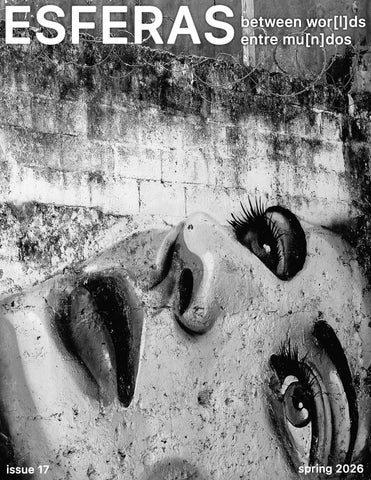
COVER PHOTOGRAPH: Luis Avilés

I took this picture in the Summer of 2014 during a visit to San Juan, Puerto Rico. The mural was part of what is known as Santurce es Ley, a community-based initiative that seeks to improve neglected areas of Santurce, a neighborhood in San Juan. The mural does not exist anymore. When I saw the mural for the first time, it had a strong impact on me as a photographer due to its expressive power. To me, it was an eloquent expression of the strong limitations imposed on female subjectivity. Although the mural was painted in vibrant colors, I still preferred to translate the image in black and white because, from my perspective, it emphasizes even more the restrictions on subjectivity invoked, especially considering the barb wire and the position of the figure in relation to it. I also believe that black and white intensifies the urban decay and abandonment of the wall in which the figure was located, supplementing the connection between subjugation and urban disregard. Can we translate the figure into an emblem for the entire city of Santurce? As an artistic object out in the open, street art is an utterance with a limited lifespan that needs to be not only interpreted but also documented by photographers. It is an urgent and eloquent expression of the power of images when they are located outside protective institutions such as museums.

ESFERAS-ISSUE SEVENTEEN * SPRING 2026 wp.nyu.edu/esferas/

SUBMIT TO esferas.submissions@gmail.com

MANAGING EDITOR Lourdes Dávila

INTRODUCTION TO THE DOSSIER Lourdes Dávila

EDITORIAL TEAM Alessa Alluin, Kiandra Alverio, Regina Cardiel Téllez, Lourdes Dávila, Edgar Gracia, Kendall Hardy, Marín Hirono, Liepa Januškaitė, Camryn Loor, Amy Maldonado, Emilia Suárez Herrero

LAYOUT AND DESIGN Sam Cordell with the Esferas Editorial team

COVER DESIGN Sam Cordell

COPYRIGHT © 2026

ESFERAS & NEW YORK UNIVERSITY’S DEPARTMENT OF SPANISH AND PORTUGUESE

ISBN 978-1-944398-24-8

RIGHTS & PERMISSIONS ALL RIGHTS REVERT TO THE ORIGINAL CONTENT CREATORS UPON PUBLICATION. THE EDITORS WILL FORWARD ANY RIGHTS AND PERMISSIONS CORRESPONDENCE TO THE AUTHORS.

ESFERAS is a student and alumni initiative within New York University’s Department of Spanish and Portuguese.

We are a peer reviewed publication that publishes critical essays, visual art, creative writing, interviews, and translations.

ESFERAS, “sphere” in both Spanish and Portuguese, is a fusion of compelling images, distinctive voices, and multidisciplinary views.

Esferas 17-Spring 2026

Introducción/Introduction

Sonidos

The Fiber of Sound (the Silbo Gomero as Artistic and Pedagogic Axis)

Transformación

La leona/The Lioness

Life Without Her

Y Eva vio que era bueno/Eva-proto-poeta

Instituciones

Farsa de ley. Justicia e [in]traducibilidad

Translation and Procedural Power: Ladinos in a 1647 Extirpation Trial from Maray, Peru

Disciplina moriendi-Entrevista

Between Worlds, Between Wounds:

Translation in the Contact Zone

El protocolo de los desencuentros: traducción e interpretación de textos quechuas

Languages of Mozambique in Tandem: Bilingualism and Spheres of Influence in the Post-Carnation Revolution Era

Límites/Desbordamiento de ciertos desiertos (poemas-selección)

Poema

Lourdes Dávila/ Amy Maldonado

Yapci Ramos/ Jordana Mendelson

Irma Gallo/ Beatriz J. Dávila

Ury Matul Ixlaj

Adriene Garcia/ Manuel Barrós

Gonzalo Ana Dobratinich

Yue Tan Jacques Lezra

Yahir Raúl Bahena

Odi Gonzales

Marília Chiu Desousa

Serôdio

Ana Villalpando

Xul Solar/ Miranda Michael

Fotografía

Cuaderno de Isabela

Translation as Destabilization

Críticas

“La loca de la casa:” The Madwoman [Mad Woman??] in the Attic, or Something Entirely Different? The Challenges of Cross-Cultural

Translation

La traducción como resto. Cortázar, Poe, Baudelaire

Memoria

Identificación en el proceso de traducción Who Killed Marta Ugarte?

Creaciones e investigaciones

Recuerda para quién es: Luis Suárez-Carreño

Tango Born from Masculine Impulse:

Masculinity and Movement in Borges’s “Man on Pink Corner”

La come gente (crónica)

La educación de Fred Murdock

Senior Honor Theses-Spring 2026

Biographies

Eduardo Lalo

Urayoán Noel

Alice (Blumenfeld) Lawhorn

Lilit Thwaites

Lourdes Dávila

Ximena Gómez/ Jeanne Marie Osterman

Brynna Shale

Amber More

César Vallejo

Rachel Wagner

between wor[l]ds ~ entre mu[n]dos

Introducción Introduction

Lourdes Dávila Amy Maldonado

“You will be separated from yourself and yet be alive” Now I too must be transformed.

An Imaginary Life, David Malouf

As the woman’s body, flipper extended, opens her path to water, there is a colossal explosion. Stars pinch the frozen tank. And then, there’s a mute and watery silence of something living, it’s a welcome, a lullaby, a baptism.

Beatriz J. Dávila, “The Lioness” [traducción del cuento de Irma Gallo, “La leona”]

El título del número 17 de Esferas, between wor[l]ds ~ entre mu[n]dos, surgió de una lectura del libro de Mary Jacobus On Belonging and Not Belonging. Translation, Migration, Displacement (2022). Allí, Jacobus se detiene en la lectura del libro de David Malouf, An Imaginary Life y su reescritura, traslación o “traducción” del libro de Ovidio, Tristia. Malouf toma, nos dice Jacobus, la mítica profecía a Atalanta1 en el libro X de Metamorfosis para reinterpretar el lamento de Ovidio en Tristia –sobre su destierro a Tomis por el emperador Augusto– como el inicio mismo de un proceso de transformación, con la promesa de pervivencia que exige una “metamorfosis”.

El escritor Ovidio, nos dice Jacobus, “had dealt with transformations that traverse the boundary between human and natural worlds. For Malouf, language itself initiates these metamorphoses” (28). Y añade: “An Imaginary Life reconciles nature and culture, but only within the pages of a book. Crossing over involves both a flight into fantasy and the ultimate silencing of the writer” (30). El Ovidio de David Malouf es un viajero cuyo viaje le exige transitar entre mundos, moverse entre lenguas y abocarse al silencio. Tiene que aceptar exiliarse de su lugar de origen, de su lengua y de su cuerpo tal como los conoce; tiene que dejar de mirar la naturaleza como un entorno

1.“nil opus est, Atalanta, tibi; fuge coniugis usum. nec tamen effugies teque ipsa viva carebis.” [“De esposo, dijo, no has de menester, Atalanta, tú. Huye del uso de un esposo. Y aun así no le huirás de ti misma, viva tú carecerás” o en inglés “you don’t need a husband, Atalanta: run from the necessity for a husband. Nevertheless, you will not escape, and, still living, you will not be yourself.”] (Ovidio. Metamorfosis. Libro X. Biblioteca Virtual Miguel de Cervantes, [564-566]. Red; “Gaze, Movement and Gender in Ovid’s Story of Atalanta and Hippomenes” [Met. 10.560-707] Letras Clássicas 2(1): 200, mayo 2024.

hostil, para comenzar a integrarse y comunicarse con ese nuevo espacio natural de forma intuitiva, corporal, prelingüística. “‘You will be separated from yourself and yet be alive.’ Now I too must be transformed.” (Malouf, en Jacobus 28).

Volvamos al relato de Atalanta en Metamorfosis, que sirve como eje de la transformación del personaje de Ovidio en An Imaginary Life, ahora también como incitación a la lectura del cuento de Irma Gallo, “La leona”, traducido por Beatriz Dávila para este número de Esferas. Atalanta comienza su relato comunicando con horror su profecía, que la lleva a hacer de su velocidad la fuerza de una negación. Hipómenes, sin embargo, con la ayuda de Venus, logra vencer a Atalanta en su carrera y, juntos en el templo de Cibeles, consuman su unión y profanan el templo. Como castigo y venganza, Cibeles los transforma en leones, incapaces de copular entre sí. Así, perduran ambos y perdura su deseo dentro de la imposibilidad de su nuevo estado. Atalanta, viva, de sí misma carecerá. Como nos demuestra Jacobus, David Malouf lleva la metamorfosis a otro espacio: propone la transformación como la afirmación de un pasaje necesario conjugado entre el cuerpo, la lengua y la naturaleza, respondiendo y cuestionando al mismo tiempo la nostalgia del escritor Ovidio por la Roma imperial a la que anhela regresar. La mujer del cuento en español de Irma Gallo ha sufrido una pérdida devastadora que revive cada vez que va al zoológico del Bronx y se detiene frente a los leones marinos, polígamos y agresivos en su apareamiento según el letrero del zoológico. La mujer se pregunta por qué los leones marinos se llaman así, “si no tenían nada que ver con los felinos de la sabana [...]”. Se acerca al animal del deseo y huye de él, huyendo también de su duelo, aunque sabe muy bien que esa huida es imposible porque el duelo lo lleva adentro y requiere de una transformación para llegar a su término. A lo largo del cuento, el lenguaje oscila del español al inglés, desde las voces de los visitantes al zoológico, hasta el letrero o la canción de cuna que interrumpe la narración y narra, a su modo, la tragedia de lo que sucedió y el deseo implícito en el duelo. La canción de cuna, en lengua extranjera (pero no tan extranjera…), dirige y provoca esa última transformación que puede o no darse al final del relato. Este finaliza suspendido en “el mudo sonido acuoso de algo vivo”, en el momento de una posible metamorfosis en acción. En la traducción del cuento, Beatriz Dávila elige interrumpir el relato en inglés con otra canción de cuna, ahora en español, a pesar de que existe una versión en español de la canción elegida por la autora. Y sin embargo, la “traducción”, traslación o transformación elegida es también una provocación. Es, al igual que en el cuento original, la voz de una nana íntimamente extraña e íntimamente conectada al relato, que interrumpe la lengua de la narración y lleva al lector a una horrorosa revelación. Al mismo tiempo, este gesto nos habla de una nueva aproximación a la lengua y la traducción

que ya se insinúa en el siglo XX en textos diaspóricos como Dictée, de Theresa Hak Kyung Cha (1982): en el siglo XXI, la comprensión de y en la lengua –y su traducción– ocurre no siempre como puente tendido entre lenguas sino como fractura, como una apuesta hacia la opacidad2. ¿A quién le tiende la mano esta traducción del cuento de Gallo? ¿A quién quiere dejar afuera? Sin ser un relato sobre traducción, la narración de Irma Gallo y la traducción de Beatriz Dávila nos remiten (¿a sabiendas, sin saberlo?), al texto de David Malouf, al Ovidio de Tristia y al Ovidio de Metamorfosis y conjugan entre sí, y junto con ellos, definiciones y preguntas clave del proceso de traducción.

between wor[l]ds ~ entre mu[n]dos. ¿Cuál es el espacio de la traducción? ¿Cuáles son sus fronteras? ¿Cómo transcurren su acción y su deseo? ¿Cuáles son los ejes de su transformación? ¿Cuál es su voz y su silencio? ¿Su relación con la ley y el poder? ¿Su violencia, su rastro colonizador, imperial? ¿Su respuesta? ¿Cómo se mide la trayectoria de sus viajes, los hitos en el camino? Estas preguntas son pertinentes para definir nuevos giros conceptuales y prácticas de la lengua y su traducción en el siglo XXI.

En Esferas 17 hay varias propuestas relacionadas con estas preguntas. Primera propuesta: la reflexión sobre lengua y traducción no puede existir sin la historia de los cuerpos y la duración de su tránsito, material y escritural, por los espacios que transitan. Segunda propuesta: la traducción es una exploración que contiene y excede la letra y sus múltiples aristas y referencias. En nuestro número, la lengua contiene una latencia que se mueve hacia los muros de las paredes de la ciudad para hacerse visible en las fotografías de Luis Avilés y Eduardo Lalo; pasa de ser silbido en la naturaleza, el lenguaje sonoro del Silbo Gomero en las Islas Canarias, a articularse y materializarse en el arte y el cuerpo de Yapci Ramos, entrevistada aquí por Jordana Mendelson; se transforma del ritmo poético oral a movimiento y taconeo de flamenco en la obra de Alice (Blumenfeld) Lawhorn. Tercera propuesta: si es cierto que toda traducción es una interpretación y el intento de llevar una lengua a otra, el derecho a la inestabilidad y a la opacidad caracteriza muchas de las traducciones y experimentaciones lingüísticas en el presente y reflejan una nueva ética y estética de la traducción y nuevos modos de pensar el lenguaje.

De ahí la portada de este número, diseñada por Sam Cordell con la fotografía de Luis Avilés “A Wall of Her Own”, realizada en Puerto Rico en el verano de 2014. El título del mural,

2.Utilizamos el término opacidad aquí siguiendo la escritura de Édouard Glissant para hablar de la diferencia irreductible del lenguaje y la inestabilidad lingüística de este texto que simultáneamente traduce, interrumpe y reclama, utilizando la lengua misma como el lugar donde se juega la identidad y el poder. Agradecemos a Lillian Lippold y Beatriz Dávila la referencia al libro de Theresa Hak Kyung Cha.

que formó parte del proyecto Santurce es ley3, es de Avilés, quien transformó los colores vibrantes del mural en gradaciones del blanco al negro para intensificar el estado de decaimiento urbano y abandono de la pared. Este gesto, nos dice Avilés, suplementa la elocuencia –precaria y temporal, porque el mural ya no existe– de la expresión del sujeto femenino ante las limitaciones impuestas sobre su subjetividad y su voz. El “cuarto propio” de la escritura de Virginia Woolf se transforma titular y materialmente en pared propia, en inscripción cuya temporalidad el obturador de Luis Avilés fija para documentar y darle permanencia.

Nos dice Eduardo Lalo, quien generosamente vuelve a compartir con Esferas un portafolio fotográfico:

En las ciudades, las edificaciones, las cosas, la escritura es más material que en los textos. En ellas la escritura se unifica e intercambia naturalezas: la escritura se funde con la materia y la materia “habla”, representa, testimonia. La traducción es también ese intercambio permanente entre escritura y materia, escritura e imagen. Y ese intercambio es visible en muchas de las intervenciones literarias de este número de Esferas. “Poema”, traducido por Miranda Michael, es un sistema fluido del imaginario visual de Xul Solar: en él los mundos flotan, se deforman, se invierten junto a la letra que los “sostiene”; el lenguaje representa el mundo, lo produce y lo transforma. Podemos ver la evolución en la actualidad de ese gesto en los dos poemas de la artista multidisciplinaria Ana Villalpando. Nos dice Villalpando: de ciertos desiertos es una cartografía que, a pesar de su apariencia monográfica, no habla solamente de los elementos que constituyen el paraje, sino de la porosa membrana que les configura como entidades distintas. A lo largo de la colección se encuentran poemas denominados tipo-topográficos, como los de esta muestra, surgidos de la exploración de figuraciones poéticas y de la espacialidad del texto. Estos poemas tienen como finalidad trazar rutas para el encuentro con cuerpos-territorio. Cuerpo y palabra se hacen y deshacen, adquieren y pierden materialidad y corporalidad en los dos poemas “concretos” de Villalpando, donde las palabras se fracturan en el espacio de la página olo sobrevuelan hasta rendirse ante la gravedad y sumirse bajo la superficie del desierto de la página (hecho/lecho de letras). En la selección de Urayoán Noel, que forma parte de Cuaderno de Isabela/Isabela Notebook (2025), la escritura aparece en “muros” de palabras que se contienen en sí mismos y que alternan entre el español y el inglés. Noel contrasta el tránsito y los despliegues

3.“El proyecto proclamó el renacimiento de Santurce, tal como se conocía, a lo que ahora es conocido como ‘Es ley’, Santurce es Ley. La ciudad de la que pocos hablaban ahora era la que estaba en ‘boca de todos’, y fue catalogada como un pueblo que impone “la ley del arte” por la Fundación Nacional para la Cultura Popular (2016), (Moraya en hirino, Alexandra. “El arte urbano en Puerto Rico y su efecto sociocultural”, en Museología y Educación. Magisterio. Revista de la Asociación de Maestros de Puerto Rico, Año 9, no. 1, 2023-24, 128-142.)

de la memoria, su duración temporal, con la espacialidad estricta de los cuadros verbales que se van interrumpiendo entre sí a lo largo del camino. Y, en un momento culminante, se pregunta: “¿por qué nos volvimos escritura y cómo sobreviven las islas de papel?”, para responder de manera poética, haciendo referencia al desplazamiento: “ya no escribo si no es caminando buscando genealogías sumergidas de tierras desaparecidas y parcelas somáticas que resisten cualquier archivo”. Cuando la escritura intenta conservar, el cuerpo en movimiento reabre aquello que se intenta estabilizar. En este caso, escribir y traducir son prácticas que no pueden existir sin el cuerpo en movimiento, y trazan una relación entre lengua, memoria, territorio y pérdida. El movimiento del cuerpo sostiene su materialidad junto a la impermanencia del lenguaje, que va quedando atrás en los hitos del camino, en cada fragmento verbal.

En la presentación de este año de la traducción de No, el poemario de Idea Vilariño traducido por María José Zubieta (2025), Martin Daughtry habló de la traducción como un proceso que no termina nunca, como un acto de lectura amorosa y obsesiva. En “‘La loca de la casa:’ The Madwoman [Mad Woman??] in the Attic, or Something Entirely Different? The Challenges of Cross-Cultural Translation”, la traductora Lilit Thwaites da cuenta de ese proceso. Quien traduce habita un “entre-espacio” que surge en la intimidad de su conocimiento de las lenguas y las culturas con las que trabaja. Al traducir, tiene varias responsabilidades a su cargo: una responsabilidad técnica, de llevar una lengua a otra; una responsabilidad ética, de eliminar la jerarquía entre los lenguajes que traduce; una responsabilidad histórica y cultural, que exige un proceso de investigación y, como vemos en este ensayo, la capacidad lúdica para aceptar los obstáculos en el camino. El ensayo de Thwaites reflexiona sobre su traducción del libro de Rosa Montero, La loca de la casa y, más específicamente, sobre el desafío de traducir esta frase idiomática, muy conocida en español, al inglés. El proceso deviene comedia (¿tragedia?) editorial, basada en parte en cómo el título puede hacer visible el género de su escritura. Thwaites completó la traducción, pero el libro jamás fue publicado, a pesar de que hubo reseñas anunciando su publicación.

¿Cómo manejar el sentido no sólo en el viaje de una lengua a otra sino también a par tir de la duración que transcurre entre la escritura inicial y su traducción? Lourdes Dávila aborda esta pregunta desde su estudio obsesivo de una palabra estratégica del relato de Poe, “Fall of the House of Usher”, su traducción al francés por Baudelaire y más tarde al español por Julio Cortázar. ¿Cómo las traducciones al francés y al español suman y restan significados que reflejan la historia y la cultura? El desplazamiento que va de fragment, a ruines y por último a restos muestra que la traducción puede verse desde una perspectiva semántica de la supervivencia. El resto de Cortázar

no es solamente la manifestación de una pérdida; es la forma en la que la pérdida mantiene su cuerpo y se vuelve legible, perseguible. Puede ser una huella, un rastro, incluso un testimonio de una transformación. Aquello que sobrevive no necesariamente se vuelve idéntico; se altera, carga con el peso de su propia transformación. Leer la traducción como si fuera un resto supone apartarse de la nostalgia de la lengua original y aceptar que aquello que sobrevive lo hace de forma transformada.

La identidad y el proceso de identificación aparecen como ejes conceptuales en los poemas de Adriene Garcia, Ury Matul Ixlaj y Jeanne Marie Osterman, traducidos por Manuel Barrós, Ury Matul Ixlaj y Ximena Gómez. En los poemas de Eva-proto-poeta, la figura apócrifa de Lilith (recordemos que solamente aparece citada en la Biblia como el grito de la lechuza en Isaías 34:14) pasa a ser el eje creativo que deshace las narrativas profundamente arraigadas en nuestra cultura sobre origen, género y poder; ese deshacer aquí trae consigo la entrada al placer femenino y al juego. Para el poeta y traductor guatemalteco Ury Matul Ixlaj, el lenguaje es un medio potencial de sanación. En los poemas para Esferas 17 de La vida sin ella, el poeta busca recuperar su origen en el nombre del que ha huido para encontrarlo en la naturaleza; el peso material de la duda exige la transformación del poeta en guerrero; la historia se espacializa y la voz poética nos sume en la “sombra interminable” de la historia del trauma y la violencia que la palabra misma vence. Por último, el poemario de Osterman, Who Killed Marta Ugarte, se acerca y toca de cerca las cicatrices de la dictadura chilena y se suspende en la cuerda floja de la ética de la escritura. ¿Cómo acercarse poéticamente al reconocimiento y conocimiento de la violencia histórica? ¿Qué tipo de identificación requiere? Ximena Gómez, la traductora, comenta sobre estas preguntas en su introducción a la selección para Esferas 17

Teorizar la traducción, nos dicen quienes escriben para Esferas 17, exige el reconocimiento de la relación intrínseca de la lengua con el poder a lo largo de la historia: el dominio del lenguaje precede a y construye las instituciones que se valen de él. El diálogo entre Inger Flem Soto y Jacques Lezra, producido a raíz de la publicación del libro de Lezra Disciplina Moriendi. Derrida, la mediación hispana (2024, Grapho), gira en torno al hispanismo como campo intelectual. Lezra cuestiona su carácter conservador y autorreferencial, su resistencia a influencias teóricas externas. Como disciplina, “es una forma de normalizar y normativizar modos de mediación o modalidades de mediación” con “lenguajes, dispositivos y prácticas” que lo vuelven “disciplinante e institucionalizante”. Es “una fórmula de dominación [...] [y] busca ser un método que permite el control minucioso de las operaciones del cuerpo”, imponiendo “una relación de docilidadutilidad”. Paradójicamente, nos demuestra Lezra, la tendencia del hispanismo a producir “zonas

de inteligibilidad” revela fisuras que se abren hacia subjetividades marginales, las que “persisten en el seno mismo de esa España para desintegrarla, desplazarla, y hacerla más variable y menos unánime de lo que siempre han querido tanto el nacionalismo falangista como su contrapartida liberal”. Entonces, el movimiento hacia un orden o estabilidad contiene implícitamente un movimiento contrario irreductible. Esta condición doble permite leer la lengua en el campo de la traducción de una manera más compleja. Traducir es habitar el espacio de la ambivalencia entre la rigidez y el desajuste. Y esta condición se refleja en muchas de las exploraciones de los autores de Esferas 17 en las que el lenguaje se plantea tanto como aparato de dominación y como la posibilidad de su crítica.

En “Farsa de ley. Justicia e [in]traducibilidad”, Gonzalo Ana Dobratinich nos dice que la ley, como sistema lingüístico, lejos de garantizar justicia, funciona como un dispositivo autorreferencial y excluyente, cuya pretendida neutralidad contiene relaciones de poder y prácticas arbitrarias. La justicia aparece como una instancia abstracta, incapaz de contener la singularidad y la humanidad de los casos concretos. Así, la ley y la traducción de las leyes, su interpretación, serán siempre procesos conflictivos, incompletos y atravesados por la opacidad y la desigualdad. Como forma institucional del lenguaje, la ley funciona como un sistema cerrado que excluye a quienes no pueden adaptarse a sus códigos. ¿Existe la posibilidad de un acceso efectivo a los derechos pretendidos por las leyes? En este sentido, podemos leer “Translation and Procedural Power: Ladinos in a 1647 Extirpation Trial from Maray, Peru”, como un estudio ejemplar de un caso concreto del siglo XVII. Nos dice Yue Tan que el caso de un proceso de extirpación de idolatrías de 1647 en Santiago de Maray (Checras, Arzobispado de Lima) permite examinar cómo la categoría ladino operaba cuando el tribunal consideraba necesario el uso de intérpretes. Tan sugiere que, en el documento de este caso de extirpación, la traducción constituye uno de los medios procesales mediante los cuales el tribunal gestiona a los ladinos, decidiendo cuándo su bilingüismo autoriza el habla directa en castellano y cuándo sus palabras solo pueden incorporarse al registro escrito por medio de intérpretes. Las leyes y su ejecución dependen siempre de la mediación de intérpretes, incluso cuando se trabaja en un solo idioma, pero más aún cuando se trabaja entre lenguas, haciéndose así aún más visible su farsa.

“Between Worlds, Between Wounds: Translation in the Contact Zone” presenta la traducción como un acto fundamentalmente político y al traductor como un viajero que media entre jerarquías coloniales de poder. A partir del episodio “Deer Lady” de la serie de televisión Reservation Dogs, Yahir Bahena propone una analogía entre la figura mítica de la Mujer Venado y el traductor. Ambos habitan “zonas de contacto” (siguiendo la terminología de Mary Louise

Pratt); nacen del trauma colonial y llevan sus marcas, pero lo transforman en agencia. Nos dice Bahena: “The movement of words across languages is never neutral”; en cada traducción se transporta “a residue of history, the memory of domination, the imprint of worlds forced into contact through colonial violence”. Bahena nos recuerda que tanto el español como el inglés son lenguas colonizadoras; el traductor no es un intermediario pasivo, sino que toma decisiones que afectan qué voces se legitiman (y cómo) y cuáles se silencian. Esta dimensión ética y política es particularmente visible en el contexto actual de la política migratoria de los Estados Unidos, donde el inglés domina, el español se racializa y las lenguas indígenas son invisibilizadas y pierden su voz.

En “Languages of Mozambique in Tandem: Bilingualism and Spheres of Influence in the Post-Carnation Revolution Era”, Marília Chiu Desousa Serôdio subraya el rastro colonizador del lenguaje en todas las esferas sociales y políticas del país, ya que el portugués sigue funcionando como una lengua de poder que estructura el acceso a la educación, la política y la movilidad social. Las políticas estatales apuestan por una estabilidad basada en jerarquías lingüísticas que dependen de la subordinación y/o marginación de las lenguas indígenas. Serôdio sugiere instancias en las que el bilingüismo es clave como modo de intervención, como por ejemplo la cantante mozambiqueña Neyma, que mezcla el portugués y el tsonga en sus canciones. Muestra también cómo el grupo revolucionario nacionalista O Frente de Libertação de Moçambique usa el portugués como un idioma común para unir a miembros de grupos lingüísticos diversos. Para Odi Gonzales, en “Protocolo de los desencuentros: traducción e interpretación de textos quechuas”, la traducción entre quechua y las lenguas europeas plantea la tensión entre “dos códigos en pugna: oralidad vs. escritura”. Gonzales demuestra que este tipo de conflicto no se resuelve buscando equivalencias. La carga semántica y afectiva de los sufijos utilizados en quechua, así como la necesidad de producir, en la traducción al quechua, un lenguaje que pueda ser comprendido tanto por quien lo lee como por quien lo escucha, obliga a ver la traducción como algo más que un reemplazo de palabras; necesita aclaraciones, glosas e incluso apoyos adicionales para ser comprendido. Traducir no debe ser algo que cierre una distancia, sino que debe hacerla visible y trabajar en conjunto con ella sin borrarla. Al igual que Yahir Bahena y Marília Chiu Desousa Serôdio, el autor nos recuerda que desde una perspectiva histórica, la traducción siempre ha sido un instrumento colonial poderoso. En este caso, Gonzales nos da como ejemplo el período de la evangelización, cuando la “extirpación lingüística” de los evangelizadores se llevó a cabo mediante la resemantización de los conceptos andinos bajo categorías cristianas, instaurando jerarquías que aún persisten y que anulan identidades.

Gonzales plantea que traducir desde el quechua no es solo un acto lingüístico, sino una práctica epistemológica y política que exige reconocer la desigualdad entre sistemas culturales y repensar los límites mismos de la traducción.

La lengua atraviesa de distintas maneras los proyectos de tesis de este año y, en muchos casos, se convierte en el eje político de los estudios. Sedona Silvera, ganadora del Sylvia Molloy Memorial Award for Outstanding Thesis, examina cómo los textiles indígenas entran al lenguaje de la moda donde se negocia la identidad, la propiedad y el poder en la cultura mexicana.

Centrándose en la trayectoria del vestido tehuana, analiza cómo una prenda regional zapoteca se convirtió en símbolo nacional de la mexicanidad y se incorporó a los sistemas globales de la moda, donde los textiles indígenas se mercantilizan y son apropiados por otros. Aylin Chalup, ganadora del Zake Morgan Memorial Thesis Award, utiliza cambios lingüísticos para hacer visible la vida entre Brownsville y Matamoros y deshacer la narrativa persistente de una “crisis” en la frontera. Yulianna Acuña, ganadora del Department of Spanish and Portuguese Award for Distinction in the Latin American Field, analiza cómo Costa Rica, tras el lenguaje de la desmilitarización sobre el cual se funda su identidad nacional, construye una lógica operacional de coerción en las instituciones civiles que erosiona progresivamente su esencia democrática. Liepa Januškaitė afirma la relación entre lengua e identidad, y por lo tanto la necesidad no negociable del lenguaje inclusivo, mientras historiza y reflexiona sobre el estado actual del lenguaje inclusivo en Buenos Aires. Shania Ingol se centra en la intersección de las leyes y las políticas de inmigración junto con la responsabilidad humanitaria en el tratamiento de los niños migrantes en la frontera sur de los Estados Unidos, comparando las políticas existentes desde la administración de Obama hasta el presente. Daniela Barreto estudia el período de “La Violencia” en Colombia y reflexiona sobre la entrada de la mujer en espacios fundamentalmente masculinos para crear mercados de trabajo informales, construir comunidades y proporcionar apoyo económico y emocional a sus familias. Y Dominic Baca explora la relación entre el arte y el desarrollo urbano en Santa Fe, Nuevo México y Buenos Aires. between wor[l]ds ~ entre mu[n]dos. La letra interviene en el mundo y lo transforma en palabra. La visualización gráfica de los corchetes no es meramente decorativa; esta pequeña herida tipográfica muestra cómo una letra puede hacer aparecer y desaparecer mundos a simple vista, dándoles voz o negándosela. Los textos reunidos en este número se sitúan en ese espacio del lenguaje; proponen la posibilidad de leer desde esa brecha, desde el riesgo mismo de su potencialidad.

The Fiber of Sound (the Silbo Gomero as

Artistic and Pedagogic Axis)

Yapci Ramos interviewed by Jordana Mendelson

La

fibra del

sonido (el Silbo Gomero como eje artístico y pedagógico)

Jordana Mendelson entrevista a Yapci Ramos

Yapci Ramos is an artist from the Canary Islands. Her practice is grounded in research, and the languages and media she works with are varied, chosen according to the specific needs of each project. Her work engages deeply with the land, its traditions, and the histories that emerge from it, while also entering into dialogue with other artists whose concerns arise from an intense connection to place, context, and linguistic and artistic inheritances. For years, she has researched Silbo Gomero, the whistled language of La Gomera in the Canary Islands— an ancient form of communication across mountainous terrain that has been recognized by UNESCO as Intangible World Cultural Heritage of Humanity.

Over the past year (2025), Ramos was artist-in-residence at NYU’s Espacio de Culturas. During that time, she deepened her research and extended her work as an artist to include workshops on the Silbo Gomero. She has exhibited her work as part of the New York Latin American Art Triennial, among other places, and her current project brings together work and experiences that span her residencies in Cuba, her research in the Canary Islands, and her immersion in the New York art scene.

Because her work actively engages with ideas of translation—from sound to language, from language to culture, from studio practice to pedagogy, and from research to performance—, we wanted to think together in this interview about how Silbo Gomero lends itself to traveling across these different contexts, and what is it in Yapci’s current project that brings together sound, material, and linguistic research.

Yapci Ramos es una artista de las Islas Canarias. Su práctica se fundamenta en la investigación, y los lenguajes y medios con los que trabaja son variados y se eligen según las necesidades específicas de cada proyecto. Su obra dialoga profundamente con la tierra, sus tradiciones y las historias que nacen de ella, pero también conversa con otros artistas cuyas inquietudes surgen de una conexión intensa con el lugar, el contexto y las herencias lingüísticas y artísticas. Durante años ha investigado el Silbo Gomero, el lenguaje silbado de La Gomera en las Islas Canarias – una antigua forma de comunicación a través de montañas que ha sido reconocida como Patrimonio de la Humanidad por la UNESCO. En 2025, Ramos fue artista residente en el Espacio de Culturas de NYU. Durante ese tiempo, continuó su investigación y amplió su práctica artística con talleres sobre el Silbo Gomero. Su trabajo formó parte de la exposición de la Trienal de Arte Latinoamericano de Nueva York, entre otros espacios, y su proyecto actual reúne obras y experiencias que abarcan sus residencias en Cuba, su investigación en las Islas Canarias y su inmersión en la escena artística de Nueva York.

Como su trabajo se relaciona activamente con ideas de traducción –del sonido al lenguaje, del lenguaje a la cultura, de la práctica de estudio a la pedagogía, y de la investigación a la performance–, queríamos conversar juntas sobre cómo el Silbo Gomero, por su misma naturaleza, puede viajar entre distintos contextos, y cómo su nuevo proyecto reúne sonido, materialidad e investigación lingüística.

Let’s start with a bit of an introduction. How did you decide you wanted to be an artist? What were some of your first projects?

Yapci Ramos

From a very young age, I understood the body and memory as places where experiences take shape. I grew up on islands, surrounded by stories passed down from generation to generation, and that taught me that narratives can live in gestures, silences, images, and presences. I began with photography and video because they allowed me to register what moved me in a direct and honest way.

My first projects were intimate and experimental. I worked with self-portraiture, vulnerability, and presence, exploring how a personal experience could open onto something shared. Over time, my practice expanded into installation, performance, and longer research processes, but the body, territory, and identity remain the starting point for everything I do.

My uncle Manolito’s inheritance. One horn, five pipes and two objects more, 1977.

Empecemos con una breve introducción. ¿Cómo decidiste que querías ser artista? ¿Cuáles fueron algunos de tus primeros proyectos?

Yapci Ramos

Desde muy joven entendí el cuerpo y la memoria como lugares desde los que se construyen las experiencias. Crecí entre islas, rodeada de relatos que pasaban de generación en generación, y eso me enseñó que las historias pueden habitar en gestos, silencios, imágenes y presencias. Empecé con la fotografía y el vídeo porque eran lenguajes que me permitían registrar lo que me atravesaba de una forma directa y honesta.

Mis primeros proyectos fueron íntimos y experimentales. Trabajaba el autorretrato, la vulnerabilidad y la presencia, explorando cómo una experiencia personal podía abrirse hacia algo compartido. Con el tiempo mi práctica se fue expandiendo hacia instalaciones, performance y procesos de investigación más largos, pero el cuerpo, el territorio y la identidad siguen siendo el punto de partida de todo lo que hago.

Identity. Bisabuela, 1931–2019. Lenticular photography. 19.7 × 13 in.

When did you begin focusing on the Silbo Gomero as one of the areas of exploration in your work?

Yapci Ramos

My relationship with Silbo Gomero comes from a very intimate place. Since childhood I would whistle intuitively, not in an articulated way, but as a natural form of communication beyond words, connected to something deeper that I couldn’t yet name. I even created a whistled piece before ever studying it. I knew about the Silbo as part of my Canarian heritage, but I had never approached it through practice or research. Later I understood that my Gomeran ancestry was generating a connection, a call I had felt since childhood without realizing it. I began to study it from that instinct, wanting to understand that impulse and, at the same time, care for a memory that belongs both to my family history and to the history of the islands. Since then, the Silbo has become a central axis of my practice, a bridge between body, sound, and heritage.

My first artistic approach to Silbo appears in Freedom (2019), a whistled conversation between two volcanic stones that imagines an alternative dialogue to the official narrative and opens a bridge with precolonial territories. From that piece onward, Silbo began to acquire a symbolic and political weight in my work.

Later, in Monumenta Nine Guanche Incarnations, I question how the precolonial past has been represented through patriarchal lenses. The piece gives presence to the forgotten Guanche, or Indigenous women of the Tenerife island. After studying history, oral tradition, and the territories of the ancient menceyatos, or kingdoms that ruled the Canary Islands, I developed nine female identities that I reimagine from the present. In that work, I incorporate sounds and whistles as resonances that accompany the recovery of these memories.

The turning point came with my piece In Transition (2025). As I mummified my body to explore a state of suspension and rebirth, I understood that the message could no longer remain in whispers or sonic intuitions. I needed to learn Silbo Gomero as a complete and living language. The need to articulate voice with clarity is what guides my current research.

¿Cuándo comenzaste a enfocarte en el Silbo Gomero como una de las áreas de exploración en tu trabajo?

Yapci Ramos

Mi relación con el Silbo Gomero nace de un lugar íntimo. Desde niña silbaba de manera intuitiva, no articulada, como una forma natural de comunicar más allá de las palabras, conectada con algo profundo que aún no sabía nombrar. Incluso llegué a crear una pieza silbada antes de estudiarlo. Conocía el Silbo como parte de mi herencia canaria, pero nunca me había acercado a él desde la práctica o la investigación. Más tarde entendí que mi ascendencia gomera estaba generando un vínculo, una llamada que había sentido desde la infancia sin darme cuenta. Empecé a estudiarlo desde ese instinto, con el deseo de comprender ese impulso y, al mismo tiempo, cuidar una memoria que pertenece a mi historia familiar y a la historia de las islas. Desde entonces, el Silbo se ha convertido en un eje central de mi práctica, un puente entre cuerpo, sonido y herencia.

Mi primera aproximación artística al Silbo aparece en Freedom (2019), una conversación silbada entre dos piedras volcánicas que imagina un diálogo alternativo al relato oficial y abre un puente con territorios precoloniales. Desde esa pieza, el Silbo comenzó a adquirir un peso simbólico y político en mi trabajo.

Más adelante, en Monumenta Nueve Encarnaciones Guanches, cuestiono cómo se ha representado el pasado precolonial desde miradas patriarcales y doy presencia a la mujer guanche olvidada, las mujeres indígenas de mi tierra natal, Tenerife. Tras estudiar la historia, la tradición oral y los territorios de los antiguos menceyatos, desarrollé nueve identidades femeninas que reimagino desde el presente. En esa obra incorporo sonidos y Silbos como resonancias que acompañan la recuperación de estas memorias.

El punto de inflexión llegó con In Transition (2025). Al momificar mi cuerpo para explorar un estado de suspensión y renacimiento, comprendí que el mensaje ya no podía mantenerse en susurros o intuiciones sonoras. Necesitaba aprender el Silbo Gomero como un lenguaje completo y vivo. Esa necesidad de articular la voz con claridad es la que guía mi investigación actual.

Monumenta. Nine Guanche Incarnations, Process documentation, Barcelona, 2022

Monumenta Nueve Encarnaciones Guanches. MUNA Museo de la Naturaleza y Arqueología,

Monumenta Nueve Encarnaciones Guanches. Detalle de la instalación en la Ermita de San Miguel,

Tenerife, 2022.
Tenerife, 2023.

Most recently, your work was included in the New York Latin American Art Triennial. What does it mean for you to be exhibited with artists from Latin America? You and I were speaking about this specifically in relation to island identities. How is your work viewed differently when grouped with other European or Spanish artists, versus when you exhibit with Latin American and Caribbean artists?

Yapci Ramos

Exhibiting at the Triennial was important because it placed my work in a context where my voice fits naturally. Although I come from Europe, my identity is insular and Atlantic. The Canary Islands have always lived between shores, shaped by migrations, mixtures, crossing languages, and bodies in movement. Canarians are also migrants in the Caribbean, and that history has shaped us. We are mestizo, and our memory has been built through displacement.

From that perspective, the Caribbean is not foreign to me. On the contrary, there is an idea that always accompanies me: the Caribbean begins in the Canary Islands. Many of its histories, genealogies, and cultural processes that originate in that journey depart from our islands toward the other side of the Atlantic. That connection is not only historical; it is sensorial. It appears in ways of speaking, the relationship to the land, in how one survives fragmentation, and in the creation of one’s own forms of language.

When my work is presented alongside Caribbean or Latin American artists, it is read from that shared root. Not as something “European,” but as part of a constellation of islands that understand the world through crossing, wound, and mixture. In that space, my work breathes differently. It finds its place.

Recientemente, tu trabajo fue incluido en la Trienal de Arte Latinoamericano de Nueva York. ¿Qué significa para ti exponer junto a artistas de América Latina? Tú y yo hablamos de esto específicamente en relación con las identidades isleñas. ¿Cómo se ve tu obra de manera diferente cuando se agrupa con otros artistas europeos o españoles, en comparación con cuando expones con artistas latinoamericanos y caribeños?

Yapci Ramos

Presentar mi trabajo en la Trienal fue importante porque lo situó en un territorio donde mi voz encaja de forma natural. Aunque provengo de Europa, mi identidad es insular y atlántica. Canarias siempre ha vivido entre orillas, marcada por migraciones, mezclas, idiomas que se cruzan y cuerpos que viajan. Los canarios somos también migrantes en el Caribe y esa historia nos ha moldeado. Somos mestizos y nuestra memoria está construida a partir de desplazamientos.

Desde esa mirada, el Caribe no me es ajeno. Al contrario: hay una idea que siempre me acompaña y es que el Caribe empieza en Canarias. Muchas de sus historias, genealogías y procesos culturales nacen en ese viaje que sale desde nuestras islas hacia el otro lado del Atlántico. Esa conexión no es solo histórica, es sensible. Está en la manera de hablar, de relacionarse con el territorio, de sobrevivir a la fragmentación y de crear lenguajes propios.

Cuando mi trabajo se presenta junto a artistas caribeños o latinoamericanos, se lee desde esa raíz compartida. No como algo “europeo”, sino como parte de una constelación de islas que entienden el mundo desde el cruce, la herida y la mezcla. En ese espacio, mi obra respira de otra manera. Encuentra su lugar.

In Transition, 2025. Sound installation with resin body and reactive light on sand. 5’22”. New York Latin American Art Trienal, Inspiration Point, Bronx, NY.

In Transition, 2025. Detalle de la instalación en la NYLAAT, Inspiration Point, Bronx, NY.

Could you describe the project you undertook in Cuba? I am especially interested in how you gathered fiber from the local vegetation to make paper. Where did that idea come from? How are you using this fiber-based paper now in your work?

Yapci Ramos

The project in Cuba was born from a need to understand the Silbo through another material. I have always worked with the body and sound, but I wanted to find a support that could speak about roots, territory, and transmission. In Cuba, I approached plant fiber almost intuitively. I observed how amate paper was made in an artisan workshop and wanted to learn that process from within: gathering the fiber, boiling it, pounding it, transforming it into a living pulp. That physical and repetitive gesture had something ritualistic that connected with my research on memory and on the languages that survive despite time.

Cuba also has a historical relationship with the Canary Islands that is essential for me. Many Canarians migrated there and brought with them their ways of communicating, their music, their relationship with the land… and also the Silbo. Today it does not survive in Cuba as a complete language, but it persists as a bodily and gestural memory. There are rhythms, ways of calling, uses of the body, and ways of projecting the voice that are not identified as Silbo Gomero, yet clearly descend from that transmission. That trace moved me deeply because it is further proof of how languages travel and transform without disappearing.

The paper I produced in Cuba is now the support for the Códice Silbo project. On it, I create silkscreens based on the signs and rhythms of the Silbo, as if the language that travels through the air could leave a visual imprint. It is a dialogue between islands: Cuban fiber, my Canarian heritage, and a language that unites body, sound, and memory. Cuba allowed me to understand that Silbo is not only heard. It can also be written, touched, and inhabited.

Jordana Mendelson

¿Podrías describir el proyecto que realizaste en Cuba? Me interesa especialmente cómo recogiste fibra de la vegetación local para hacer papel. ¿De dónde surgió esa idea? ¿Cómo estás utilizando ahora ese papel hecho a base de fibra en tu trabajo?

Yapci Ramos

El proyecto en Cuba nació de una necesidad de entender el Silbo desde otra materia. Siempre he trabajado el cuerpo y el sonido, pero quería encontrar un soporte que hablara de raíz, territorio y transmisión. En Cuba me acerqué a la fibra vegetal casi por intuición.

Observé cómo trabajaban el papel amate en un taller artesanal y quise aprender ese proceso desde dentro: recoger la fibra, hervirla, golpearla, transformarla en una pulpa viva. Ese gesto físico y repetitivo tenía algo ritual que conectaba con mi investigación sobre la memoria y los lenguajes que sobreviven a pesar del tiempo.

Además, Cuba tiene una relación histórica con Canarias que para mí es esencial. Muchos canarios emigraron allí y llevaron consigo sus formas de comunicarse, su música, su forma de trabajar la tierra… y también el Silbo. Hoy no se conserva en Cuba como un lenguaje completo, pero sí pervive como una memoria corporal y gestual. Hay ritmos, formas de llamar, usos del cuerpo y maneras de proyectar la voz que no se identifican como Silbo Gomero, pero que descienden claramente de esa transmisión. Esa huella me tocó profundamente porque es otra prueba de cómo los lenguajes viajan y se transforman sin desaparecer.

El papel que produje en Cuba es ahora el soporte del proyecto Códice Silbo. Sobre él realizo serigrafías basadas en los signos y ritmos del Silbo, como si ese lenguaje que viaja por el aire pudiera dejar una huella visual. Es un diálogo entre islas: la fibra cubana, mi herencia canaria y un lenguaje que une cuerpo, sonido y memoria. Cuba me permitió entender que el Silbo no solo se escucha. También se puede escribir, tocar y habitar.

In process: Códice Silbo, Department of Visual Arts, University of the Arts (ISA), Cuba, 2025.
Pruebas en papel amate. Taller Mistake. Facultad de Artes Visuales. Universidad de las Artes ISA, Cuba, 2025.

While you were in residence at Espacio de Culturas, you held several workshops, two of which were held in our auditorium and were developed specifically for students in the translation studies major in Liberal Studies. How did you find that experience? What did you hope the students would gain from learning hands-on with you about the Silbo Gomero?

Yapci Ramos

The experience at Espacio de Culturas was enriching because I was able to work with students who were deeply engaged in thinking about writing, language, and translation. I wanted them to understand Silbo through my work—not as a curiosity, but as a form of communication that emerges from both territory and the body. From there, the Silbo becomes a tool to reflect on how we communicate today.

The Silbo raises essential questions about what it means to translate and what it means to transmit. It speaks about distance, about how to send a message when the voice cannot reach, and about how to reduce a language to its essence. That logic connects naturally with many contemporary systems, including technological ones.

Although today it is associated with Spanish, its str ucture can adapt to and communicate other languages. It originates from the ancient Canarian natives, Berbers from North Africa, who developed it to communicate across the rugged terrain of the island of La Gomera. This showed students that a form of communication born in such a specific context can move into the present, adapt to new environments, and continue transforming.

I also wanted them to reflect on the relationship between ancient communication systems and new technologies—how certain principles survive, are translated, and reappear in other formats. The Silbo allowed them to see that a language can be ancestral and, at the same time, completely contemporary. Not only through art, but as a living practice that adapts, evolves, and persists.

Durante tu residencia en el Espacio de Culturas, impartiste varios talleres, dos de los cuales se celebraron en nuestro auditorio y estaban diseñados específicamente para estudiantes de la especialización en estudios de traducción en Liberal Studies. ¿Cómo fue esa experiencia para ti? ¿Qué esperabas que los estudiantes aprendieran al trabajar contigo de manera práctica en torno al Silbo Gomero?

Yapci Ramos

La experiencia en Espacio de Culturas fue enriquecedora porque pude trabajar con estudiantes que estaban inmersos en reflexiones sobre escritura, lenguaje y traducción. Me interesaba que entendieran el Silbo a través de mi obra –no como una curiosidad, sino como una forma de comunicación que nace del territorio y del cuerpo. Desde ahí, el Silbo se convierte en una herramienta para pensar cómo nos comunicamos hoy.

El Silbo abre preguntas esenciales sobre qué es traducir y qué es transmitir. Habla de distancia, de cómo enviar un mensaje cuando la voz no llega y de cómo reducir un lenguaje a su esencia. Esa lógica lo conecta de manera natural con muchos sistemas contemporáneos, incluso tecnológicos.

Aunque hoy esté asociado al castellano, su estructura permite flexibilizarse y comunicar otras lenguas. Nace de los antiguos aborígenes canarios, bereberes del norte de África, que lo desarrollaron para comunicarse a través del territorio accidentado de la isla de La Gomera. Esa dimensión les mostró que una forma de comunicación nacida en un territorio tan específico puede desplazarse hacia el presente, adaptarse a nuevos contextos y seguir transformándose.

También quería que reflexionaran sobre la relación entre los sistemas antiguos de comunicación y las nuevas tecnologías —cómo ciertos principios sobreviven, se traducen y reaparecen en otros formatos. El Silbo les permitió entender que un lenguaje puede ser ancestral y, al mismo tiempo, completamente contemporáneo. No solo a través del arte, sino como una práctica real que se adapta, cambia y permanece.

You have developed workshops, gatherings, and community-based processes on almost every continent. What role does the pedagogical dimension play in your artistic practice?

York, 2025.

Yapci Ramos

My pedagogical work is a fundamental part of my practice. As an artist, I feel the responsibility to create spaces where we can think, unsettle, and bring together topics that move me. For me, pedagogy is a space where thought is activated and where processes are shared with honesty.

In workshops and encounters, I present my point of view and, from there, I open a dialogue. I am interested in people being able to question, contribute, confront, and expand ideas. It is not about imposing a perspective, but about creating a space for critical thinking where each person can position themselves from their own experience.

I collaborate with universities because I believe that creativity and reflection about language is necessarily part of a student’s development. The pedagogy I practice is not vertical or closed, but a living exchange. For me, the pedagogical dimension is a place of responsibility, listening, and transformation. And it is an inseparable part of my artistic practice.

El Silbo Rompe, NYU Espacio de Culturas, New

Has desarrollado talleres, encuentros y procesos comunitarios en casi todos los continentes. ¿Qué lugar ocupa la dimensión pedagógica en tu práctica artística?

Yapci Ramos

Mi labor pedagógica es parte fundamental de mi trabajo. Como artista, siento la responsabilidad de generar espacios donde podamos pensar, agitar y poner en común temas que me atraviesan. Para mí, la pedagogía es un espacio donde se activa el pensamiento y donde los procesos se comparten con honestidad.

En los talleres y encuentros, planteo mi punto de vista y, a partir de ahí, abro un diálogo. Me interesa que las personas puedan cuestionar, aportar, confrontar y ampliar las ideas. No se trata de imponer una mirada, sino de crear un espacio de pensamiento crítico donde cada persona pueda situarse desde su propia experiencia.

Colaboro con universidades porque considero que es parte del desarrollo formativo de los estudiantes. La pedagogía que practico no es vertical ni cerrada, sino un intercambio vivo. Para mí, lo pedagógico es un lugar de responsabilidad, de escucha y de transformación. Y forma parte inseparable de mi práctica artística.

El Silbo Rompe, NYU Espacio de Culturas, New York, 2025.

Process of investigation of the Silbo, NYU Espacio de Culturas, New York, 2025. A series of 24 images establishing an original correspondence between Libyco-Berber signs and their bodily activation.

In your workshops, you introduce the idea of artistic practice as a form of translation. Can you talk about that? What are you translating from or into when thinking about art making and performance?

Yapci Ramos

Performance is an essential part of my practice because it allows me to work with the body as a language in itself. When I perform, I translate internal experiences—memories, intuitions, emotions, lived moments—into an action that unfolds in real time. I am not trying to represent something, but to embody it. For me, the body is a place where information accumulates, is inherited, and is transformed, and performance allows me to open that archive and share it with others.

In that sense, performance is a living form of translation. What happens inside moves outward through gesture, breath, gaze, and presence. I translate states, tensions, and questions that do not always find space in words. It is an immediate, visceral language, but it is also deeply symbolic.

In my work, performance is not separate from the other media I use. It engages with photography, video, sound, and installation, creating an ecosystem in which each language translates something different. Performance embodies what the image suggests and what the sound evokes. It is the place where the work becomes a body, where a personal experience becomes visible, and where the intimate can open into a collective dimension.

Jordana Mendelson

En tus talleres introduces la idea de la práctica artística como una forma de traducción. ¿Puedes hablar de eso? ¿Qué estás traduciendo y hacia qué, cuando piensas en la creación artística y en la performance?

Yapci Ramos

El performance es una parte esencial de mi práctica porque me permite trabajar desde el cuerpo como un lenguaje en sí mismo. Cuando performo, traduzco experiencias internas —memorias, intuiciones, emociones, vivencias— hacia una acción que ocurre en tiempo real. No busco representar algo, sino encarnarlo. Para mí, el cuerpo es un lugar donde la información se acumula, se hereda y se transforma, y el performance me permite abrir ese archivo para compartirlo con otros.

En ese sentido, el performance es una forma de traducción viva. Lo que sucede dentro se desplaza hacia afuera a través del gesto, la respiración, la mirada y la presencia. Traduzco estados, tensiones y preguntas que no siempre encuentran espacio en la palabra. Es un lenguaje inmediato, visceral, pero también profundamente simbólico.

En mi trabajo, el performance no está separado del resto de los medios. Dialoga con la fotografía, el vídeo, el sonido y la instalación, creando un ecosistema en el que cada lenguaje traduce algo distinto. El performance encarna lo que la imagen insinúa y lo que el sonido sugiere. Es el lugar donde la obra se vuelve cuerpo, donde la experiencia personal se hace visible y donde lo íntimo puede abrirse hacia una dimensión colectiva.

Research is a central axis in your work. How does your research process take shape, and how does it dialogue with material, bodily, or performative experimentation?

Yapci Ramos

Research is a central axis in my work, and I always approach it with rigor and respect. Before beginning any project, I undertake an academic research process. I study, consult archives, look for primary and secondary sources, and establish contact with experts, scientists, researchers, and people who keep certain traditions alive. For me, it is essential to work with precision and responsibility, especially when the work is connected to cultural heritages or knowledge that comes from specific communities.

This process is not fast. My projects can extend over one or two years before taking shape, because I continue researching while I experiment. The material, bodily, or performative dimension does not arrive until the theoretical and contextual foundation is well established. Only then do I begin to work with the body, with sound, or with installation, allowing the research to take form.

Experimentation is the second stage, but it is never separate from academic research. What I learn, I test. What I discover, I bring into the body or into the material. I am interested in that dialogue between rigor and experience, and this process sustains the work. For this reason, although my practice is contemporary, it is also part of history.

For me, researching and creating are one continuous process. And my responsibility as an artist is to honor those sources, learn from them, and translate them into a work that respects their origin while also offering a contemporary perspective.

Jordana Mendelson

La investigación es un eje central en tu obra. ¿Cómo se articula tu proceso de investigación y cómo dialoga con la experimentación material, corporal o performativa?

Yapci Ramos

La investigación es un eje central en mi obra y siempre la abordo con rigor y con respeto. Antes de comenzar cualquier proyecto, realizo un proceso de estudio académico. Me documento, consulto archivos, busco fuentes primarias y secundarias, y establezco contacto con expertos, científicos, investigadores y personas que mantienen vivas ciertas tradiciones. Para mí es fundamental trabajar con precisión y con responsabilidad, sobre todo cuando la obra se vincula a herencias culturales o a conocimientos que vienen de comunidades específicas.

Ese proceso no es rápido. Mis proyectos pueden extenderse durante uno o dos años antes de tomar forma, porque sigo investigando mientras experimento. La parte material, corporal o performativa no llega hasta que la base teórica y contextual está bien construida. Solo entonces empiezo a trabajar con el cuerpo, con el sonido o con la instalación, y dejo que la investigación se encarne.

La experimentación es la segunda etapa, pero nunca se separa de la investigación académica. Lo que aprendo, lo pruebo. Lo que descubro, lo llevo al cuerpo o a la materia. Me interesa que ese diálogo entre rigor y experiencia sea lo que sostenga la obra. Por eso, aunque mi práctica es contemporánea, también es parte de la historia.

Para mí, investigar y crear es un mismo proceso. Y mi responsabilidad como artista es honrar esas fuentes, aprender de ellas y traducirlas en una obra que respete su origen y que, a la vez, proponga una mirada actual.

In Transition, process of mummification, Barcelona, 2024.

In Transition, proceso de momificación, Barcelona, 2024.

Irma Gallo

La Leona

Quisiera estrellarse la cabeza, carne apagada, asesinada, contra esas rocas grises y lisas, casi fieras, deslavadas y tristes, y sangrar y sangrar y sangrar hasta vaciarse. Aunque quizá serían de utilería, como todo en el zoológico del Bronx, y nada más haría un mal chiste de sí misma. De los días malos, hoy es el peor. Un aniversario más. Así era su vida, carcomida. Cuando creyó que venir aquí le ayudaría a calmar el dolor se equivocó, como se equivoca ya con todo. Sólo quedaba el miedo, la tranquila furia.

Caminó hacia ese rincón sin proponérselo, sin r umbo, como hacía muchas cosas, cada vez con más frecuencia. Y apareció, un gozo líquido. Apenas logró verlo porque se volvió a sumergir en el agua dolorosamente azul en unos segundos. Quizá ni segundos fueron, sólo fracciones.

Detrás de él, la cola, plateada también, empapada, metálica, filosa, obscena, se quedó suspendida un poco, un poco más.

Según el letrero que informaba al público de ese extraño domingo de invierno soleado, se trataba de un león marino de California. Siempre se preguntó por qué los llamaban así si no tenían nada que ver con los felinos de la sabana, pero más allá de eso, estos mamíferos acuáticos no le habían provocado ningún otro pensamiento. O eso creía.

Twinkle Twinkle Little Star/

How I wonder what you are

La visión de un peluche que representaba a uno de ellos la golpeó y sintió que algo amargo y viscoso se le trepaba desde las entrañas. De una pequeña mano morena colgaba el juguete con un gesto de aburrimiento y desesperación casi idéntico al de su dueño. Olía a esa mezcla de sudor que todavía no se enrancia, a leche caliente, a un poco de caca y talco, como huelen casi todos los niños pequeños. El chico se colgó, balanceándose, de la reja negra que separaba los espacios, el animal y el humano. ¿A dónde fue, mamá?, ¿va a regresar?, ¿por qué no sale?

Ella no se quedó a escuchar las respuestas. Tenía que salir de ahí. Apenas giró el cuerpo ávido de largarse cuando volvió a sentir la brutalidad del agua del estanque al abrirse. Y ahí estaba otra vez: ahora sí, luciendo su pelaje plateado y café hacia los bordes, algo vivo entre tanta falsa escenografía, latiendo en su belleza, trepado en una piedra, emitiendo un sonido que bien podría ser una palabra, un lamento, una canción o una risotada, algo nasal, un sonido del que escurría el día entero.

Beatriz J. Dávila (Traducción)

The Lioness

She would like to bust her head open against those rocks, gray, smooth, half-washed and pitiful, would like to become dull meat, butchered, and bleed and bleed and bleed until empty. In reality the rocks were probably artificial, much like everything else in the Bronx Zoo, and in doing this she’d only make herself into a lousy joke. Of all her bad days, this one was the worst. Another anniversary. But such was her life, wasted away. She’d gotten it wrong when she thought coming here would help ease her pain, just like she got everything wrong lately. Only fear remained, fear and a quiet rage.

She wandered toward that corner lacking purpose, direction, she did many things this way, it seemed, now with more and more frequency. And then he appeared, liquid delight. She hardly managed to spot him because in a matter of seconds, he’d submerged himself again in the cutting blue water. Or maybe they weren’t even seconds, only fractions. Behind him, the tail— also silver, soaked, metallic, sharp, obscene—he kept suspended a little, a little longer.

As per the public-facing sign on this strange and sunny Sunday in winter, on display was a sea lion from California. She’d always asked herself why they were called that, she couldn’t see any resemblance to the lions of the savannah, and beyond that, these aquatic mammals hadn’t provoked any more consideration from her. Or so she thought.

Una mariposita, que del cielo bajó /

Con sus alas extendidas /

Y en el pico una flor /

The sight of a stuffed sea lion struck her by surprise, and she felt something bitter and viscous creep up her insides. From a small brown hand the toy dangled with a sense of boredom and antsiness almost identical to that of its owner. She smelled a mixture of sweat not yet rancid, of warm milk, a bit of shit and baby powder, that smell almost all little kids have. The boy hung, balancing, on the black fence that separated their spaces, animal from human. ¿A dónde fue, mamá?, ¿va a regresar?, ¿por qué no sale?

She didn’t stick around to hear the mother’s answers. She had to leave this place. She’d barely turned her body, eager to leave, when again she felt the tank waters opening, a cruelty. And there he was once more: yes, flaunting his silver-coffee coat to its extremities, alive amid so much faux scenery, pulsing in his own beauty, perched on a rock, emitting a sound that could have been a word, a lament, a song, a cackle, something nasal, a sound which drained up the entire day.

La insólita presencia del león marino en ese zoológico ruinoso casi le hizo olvidar las náuseas, las ganas de vaciarse, hasta que el niño con el peluche en la mano volvió a hablar, y su voz se volvió una espada rencorosa que le recordó que tenía que irse, que no iba a poder contra la omnipresencia de su dolor, no, otra vez no.

Una arcada precisa y el estómago se vació. Los Oh, my God!, los That’s disgusting, se mezclaban con los Lady, are you ok?, los May I help you?, mientras ella, entrañas reventadas, podredumbre en el aliento, Nikes escarchados de la sustancia glutinosa que todavía le incendiaba la laringe, siguió avanzando como pudo, sin contestar, sin voltear hacia atrás, algo chueca, rota dentro de ese cuerpo oneroso.

Regresó al día siguiente. Tomó el tren C para ir a su trabajo. Como siempre, se bajó en Fulton, pero en lugar de salir a la calle, la línea 2 hacia Uptown se la tragó. Cuarenta y cinco minutos después la expulsó en la estación West Farms Square, demasiado tarde para desandar el camino, así que pagó una vez más los 34 dólares de la entrada y caminó, ahora sí con toda la intención, hacia la escenografía de erguidas piedras manchadas de humedad, cuyas puntas asomaban entre el agua azul sucio, azul derrota.

Estuvo parada delante del espacio de los leones marinos lo que le pareció una eternidad oel más minúsculo de los instantes, hasta que salió del agua, sólo asomó la cabeza redonda, brillante y calva, como una piedra recién raspada.

La miró. Carajo. El sonido de esa voz humana no lo amedrentó. En sus ojos sin esclerótica cabía su inmensa figura, desde los zapatos de tacón que usó por última vez el día del funeral hasta la punta del cabello canoso, recogido en un chongo alto, de esos que llaman space buns. Carajo. Carajo. Al contrario de lo que esperaba, el animal se acercó aún más a la orilla del lago artificial. El espacio entre ambos se acortó y se densificó. Carajo, carajo, carajo. Estaba acorralada, a la víspera de un ataque de pánico. Lo siguiente era que el león marino le hablara, pero no se movió. Siguió mirándola. No tenía intenciones de nadar hacia otro lado, ni de sumergirse. Podían estar ahí el resto del día porque ella tenía los tacones clavados en el cemento.

Estampida, el recuerdo. La contundencia del sol de invierno ya le picaba el cuero cabelludo debajo del peinado que esa mañana se había esforzado por hacerse. Habían pasado dieciocho años pero pudo escucharlo como si estuviera ahí parado, a su lado, lamiendo un helado de chocolate y

The incredible presence of the sea lion in that run-down zoo almost allowed her to forget the nausea, the urge to empty herself, until the boy with the stuffed animal in hand spoke once more, his voice now a hostile blade, a reminder of just how much she needed to escape. And this was an escape she wouldn’t be able to bear when she was battling against the omnipresence of her pain, no, not again.

A precise fit of heaving, and her stomach gave out. The ¡Dios mío!, the That’s disgusting were mixed in with the Señora, ¿está bien?, the May I help you?, while she—guts spent, rot on her breath, Nikes glazed with the glutinous substance still burning in her larynx kept on towards the exit, without responding, without turning back, with something crooked and broken within her burdensome body.

She returned the next day. Took the C train to get to work. Like always, she got off at Fulton, but rather than exiting onto the street, she was swallowed by the uptown 2. Forty five minutes later it spat her into the West Farms Square station, now too late to undo this path she’d created, so she paid the thirty four dollar entry fee again and marched, now with overwhelming resolve, towards the backdrop of erect rocks, which were stained with humidity, whose crags jutted out from the water, dirty blue, defeated blue.

She stood before the sea lion enclosure for what seemed like an eternity, or the shortest of instants, until he leapt out of the water, only his round head surfacing, brilliant and bald, like a just-polished rock.

He looked at her. Carajo. The sound of her human voice didn’t spook him. Her immense figure was captured in his non-sclerotic eyes, from the high-heeled shoes she’d last worn the day of the funeral all the way up to the tips of her graying hair, pulled back in a high bun, the kind they call a space bun. Carajo. Carajo. Against her wishes, the animal bobbed even closer to the rim of the artificial lake. The space between them shortened and thickened. Carajo, carajo, carajo. She’d been corralled, was on the verge of a panic attack. Surely, the sea lion would speak, yes, that’d be the next thing, but he didn’t move. Just went on staring. He had no intention to swim around, submerge himself. They could’ve stayed there for the rest of the day since her heels were also nailed to the cement.

A stampede, the memory. The severity of the winter sun already had begun to make her scalp itch beneath the hairdo she’d forced herself into that morning. Eighteen years had passed, but she could hear him as though he were standing just there, at her side, working on a chocolate

viendo los ojos oscuros del animal. Mamá, ¿por qué no me compras uno? Porque no los venden, mi vida. Además, ¿dónde lo pondríamos? Necesita vivir en el agua. Pues en la tina, mamá. ¡Pero qué poca imaginación!

Cayó de rodillas frente al hábitat artificial. A esa hora no había nadie más que los elefantes; las jirafas, que lamían con insistencia un cielo de cemento; los gatos monteses, apiñados como racimos tristes; todos, dentro de sus jaulas disimuladas con escenografías de safari. Nadie la miraba, sólo el león marino. El cuerpo le encogía y expandía al ritmo de un llanto que había olvidado cómo producir.

Up above the world so high/

Like a diamond in the sky/

Entonces le quedó todo claro: la estaba llamando.

Y decidió que regresaría por él.

Llegó a casa. Se sirvió un vaso de whisky. Empezó a desnudarse mientras el líquido le calentaba las venas. Abrió la llave de la tina y miró cómo se formaban, trémulos círculos concéntricos en el agua que la llenaba sin prisa, con un canto terso al contacto con la porcelana. Mientras se sumergía y la piel se le volvía tornasolada, intentó calcular si el animal cabría ahí. Si estaría cómodo.

¿Cuánto pesa un león marino? Desnuda, dejaba que el agua acariciara todos los pliegues y hendiduras de su ingente cuerpo flácido, azulado por el efecto de la luna pertinaz que entraba por la ventana. Sonrió.

Recordó el letrero del zoológico:

The sea lion is polygamous, aggressive in mating, capable of eating 33 to 44 pounds a day of fish, octopuses, squid and even penguins. The female can weigh up to 200 pounds and measure 5.9 feet long, but if it is a male she could weigh 600 pounds and measure more than 6.56 feet.

La aventura se auguraba mucho más difícil de lo que había pensado. Una vez más las ansias de estrellarse la cabeza para enmudecer el dolor, una vez más los huesos que aullaban, la respiración que no se completaba, el corazón que ya no conocía de riendas.

Respiró. Una, dos, tres. Respiró. Tomó otro vaso de whisky. Y otro. Y otro más. Cuando abrió los ojos los contornos de las cosas se borraban en distintos tonos de azul. A lo lejos, ladraba un perro.

ice cream and looking into the dark eyes of the animal. Mamá, ¿por qué no me compras uno? Porque no los venden, mi vida. Además, ¿dónde lo pondríamos? Necesita vivir en el agua. Pues en la tina, mamá. ¡Pero qué poca imaginación!

She fell to her knees before the artificial habitat. At that hour there was no one but the elephants; the giraffes, who licked their cement sky with insistence; the wildcats, crammed in tragic bunches; all of them, in their cages, concealed by safari scenes. No one noticed her except the sea lion. Her body shrank and expanded to the rhythm of a wail she had forgotten how to produce.

¿Para quién son las flores? /

Si no son para mí /

Then it became clear: he was calling out to her.

So she decided she would return for him.

She went home. Served herself a glass of whiskey. Began to undress while the liquid warmed her veins. She switched on the faucet and watched how the water formed trembling layers of concentric circles in the water which trickled and filled the tub, watched how it released a smooth song as it brushed against the porcelain. As she dipped herself in and her skin turned glossy, she tried to estimate if the animal would fit there also. If he would be comfortable.

How much does a sea lion weigh? Nude, she let the water caress all the folds and openings of her huge, soft body, and turned bluish in the unrelenting moonbeams which peered through the window. She smiled.

She remembered the sign from the zoo:

The sea lion is polygamous, aggressive in mating, capable of eating 33 to 44 pounds a day of fish, octopuses, squid and even penguins. The female can weigh up to 200 pounds and measure 5.9 feet long, but if it is a male she could weigh 600 pounds and measure more than 6.56 feet.

The adventure promised to be much more difficult than she’d first anticipated. Once more, the desire to bust her head and numb her pain, once more her bones howled, the unfinished breaths, the heart that no longer knew restraint.

She inhaled. One, two, three. Exhaled. Downed another glass of whiskey. And another. And yet another. When she opened her eyes, the outlines of the room blurred in various shades of blue. In the distance, a dog was barking.

Los domingos son los días más tristes. Qué ganas de quedarse en cama hasta no soportar la hinchazón de la vejiga. Hasta arrastrarse al baño y obligarse a vaciarla. Y de pronto recordar que era un día importante, que ya todo estaba listo. Que tú me lo prometiste, mami, que sí mi amor.

La velocidad del cuerpo se confunde con las ráfagas de viento helado de otro domingo de invierno. El chico de la entrada advierte: We’re almost closed, ma’am, don’t you want to come back another day? Ella no lo escucha. Traspasa el umbral completamente segura de que esa noche, al ver cumplido su sueño, su hijo tendrá que regresar. Tiene que apurarse para dejar lista su cama, con sábanas olorosas a suavizante, como le gustan. Lo llevará a la tina y le enseñará que tenía razón, que ahí podía vivir el animal que él quería, que ahí lo tiene, sólo para él, que ella lo consiguió. Y él ya no se irá más. No más triste domingo de verano a velocidad infinita llantas luchando contra feroz pavimento frenos que no sirven metálicas máquinas deshechas azules luces rojas luces de patrullas cantos de sirenas sirenas de ambulancias anormales ataúdes demasiado pequeños demasiado para cuerpos demasiado frágiles demasiado blandos demasiado.

El cielo ha dejado atrás el incendio. Un gris borroso empareja los rostros de las últimas personas que salen del zoológico: mujeres exhaustas, empujando carriolas con bebés o perros dormidos; parejas hostiles que hace rato agotaron el repertorio de cosas que decirse; niños sudorosos, con caras pringosas y dosis de azúcar que los mantendrán despiertos hasta que sus madres se pregunten, una vez más, por qué no los abortaron. Es momento de salir del escondite de brotar sin contención de ser viento furioso en dirección del artificial hábitat marino. De liberar.

Escucha con atención, el oído comienza a distinguir. Dicen que los muertos no envejecen. Dicen que tampoco sus voces cambian, se quedan ahí colgadas, como las nubes del último día, como el cepillo de dientes en forma de dinosaurio que sigue en el baño dieciocho años después, como las pijamas de Star Wars que ya no se usaron más.

Up above the world so high/

Like a diamond in the sky/

La está esperando. Ya sabía que vendría por él. Su cabeza de gris plástico es lo único que sobresale del agua podrida, helada. La mira. Se miran. Ven acá, vámonos a casa. Le tiende la mano. Su aleta reluce de lo que escurre. La escucha. En casa, él nos espera.

Twinkle Twinkle Little Star/

Sundays were her lowest days. How easy it would be to hole up in bed until she could no longer ignore her bladder. Until she had to drag herself into the bathroom and empty it. And then, soon enough, she’d remind herself it was an important day, everything was ready. Qué tú me lo prometiste, mami, que sí mi amor.

Her body speeds, confusing itself with gusts of biting wind on another wintry Sunday. The young man at the entrance advises: Casi estamos cerrados, señora, ¿no quiere volver otro día? She doesn’t hear him. She passes through the threshold, sure that on this night, upon seeing through the completion of his dream, her son will come back. She must hurry to get his bed made, to get the sheets smelling of fabric softener, just how he likes them. She’ll bring him to the tub and show him he’d been right, the animal he wanted could live there, in the tub, there he was, just for him, she brought him. And he wouldn’t leave anymore. No more downcast Sundays in summer at infinite speeds tires battling against fierce pavement breaks that are good-for-nothing metal machines wrecked and blue lights red lights of cop cars siren songs ambulance sirens abnormal coffins too small too much for bodies too fragile too soft just too.

Now, the sky has left behind its fire. An erosive gray blends the faces of the last people on their way out of the zoo: exhausted women, pushing strollers with babies or sleeping dogs; bitter couples who exhausted their conversational repertoire hours ago; sweaty kids with sticky faces and sugar highs that would keep them awake until their mothers asked themselves, once more, why they hadn’t gotten abortions. It was time to come out of her hiding place, to emerge with assertion, to direct the furious wind inside her towards the sea lion enclosure. To set free.

She listens with caution, her ear begins to distinguish sounds. They say the dead don’t age. Say their voices don’t change either, they stay hung up where they were, like clouds on the last day, like the dinosaur toothbrush still in her bathroom eighteen years later, like the Star Wars pajamas kept and never used again.

Ay mamita del alma / Yo me muero por ti /

He waits for her. He knew she would come for him. His gray plastic-like head is the only thing that rises from the rotten chilly water. He looks at her. They look at each other. Ven acá, vámonos a casa. She extends her hand to him. His fin gleams with the liquid that drips off him. He hears her. En casa, él nos espera.

Cuando venga papito / Se lo voy a decir /

How I wonder what you are/

¿Cómo no lo supo antes? No hay necesidad de taxis ni sábanas limpias ni chocolate caliente ni peluches baratos ni almohadas sedosas ni pastillas blanco con azul ni batas verdes ni visitas al psiquiatra ni jeringas ni flores en una tumba chiquita. Le dice que está ahí, que es la voz que le canta todas las noches, que es la noche que no acaba, que es el insomnio de noche oscura, que lo siga, que su casa es la suya, que el agua es su casa, es su cama, es alimento, cobija, refugio, brazos que abrazan y no sueltan, labios limpios resbaladizos, olvido, olvido, olvido.

La aleta extendida, la explosión descomunal del cuerpo de la mujer que abre a su paso el agua. Las estrellas pinchando la bóveda helada. El mudo sonido acuoso de algo vivo, es una bienvenida, es una canción de cuna, un bautismo.

Que esa mariposita / No me deja dormir /

How could she have not known this before? There was never any need for taxis or clean sheets or hot chocolate or cheap stuffed animals or silky pillows or white-blue pills or green robes or visits to the psychiatrist or needles or flowers on a small tomb. He tells her he’s there, he’s the voice that sings to her each night, he’s the night that never ends, the insomnia of unending darkness, he tells her to follow him, his house is hers, this water is her home, is her bed, is nourishment, shelter, refuge, arms that embrace and don’t let go, clean slippery lips, oblivion, oblivion, oblivion.

As the woman’s body, flipper extended, opens her path to water, there is a colossal explosion. Stars pinch the frozen tank. And then, there’s a mute and watery silence of something living, it’s a welcome, a lullaby, a baptism.

Ury Matul Ixlaj

La vida sin ella (Selección)

Life Without Her ( Excerpts)

Raíces desvanecidas

El nombre mío del que huí canto extraño en la selva eco de la antigüedad sombra que nunca entendí

Al no verlo iba contento en la oscuridad estaba perdido ¿quién eres? me decían solo les mostraba las ruinas

Dádiva ignorada lucero despreciado melodía olvidada ¿a dónde te has ido?

Te busco por la mañana cuando rayos lanza el sol te llamo por los árboles hasta hallar tu consuelo.

Faded Roots

The name of mine from which I fled strange song in the jungle echo of ancient times shadow I never understood

Not seeing it I was pleased in the darkness I was lost who are you? they would ask I just showed them the ruins

Ignored gift despised star forgotten melody where have you gone?

I seek you in the morning when the sun casts its rays I call you through the trees until I find your comfort.

Dudas

Bajalos de ahí, botalos de la atalayas, tiralos, hacé que ya no puedan subir, construílas, almenas, destruílas, desmoroná cada ladrillo, enterralos, aplastalos, derrotalos, guerrero, tomá el botín, invasor, asolalos, arruinalos, militar, campeón, matalos, hacelo, poeta...

Hacé que no duden más de ti.

Doubts

Bring them down from there, toss them from the watchtowers, throw them, make sure they can’t rise again, build them, battlements, destroy them, crumble every brick, bury them, crush them, defeat them, warrior, take the loot, invader, devastate them, ruin them, soldier, champion, kill them, do it, poet...

Make them never doubt you again.

Risas

Las calles eran nuestras, de los niños que jugaban, de las risas que no callaban. Pero ahora...

Silencio.

Los senderos están pintados de rojo. Mi cuerpo tiembla como si hubiera una tormenta pero esta lluvia no cae del cielo sino de la mano del hombre.

¿Soy yo el fantasma atrapado aquí viendo la muerte andar por la ciudad?

No puedo respirar.

Siento un dolor en el pecho. Mis ojos se nublan. Me falta el aire y quiero llorar.

Veo a un niño sangrando de la cabeza arrastrándose hacia mí. ¿Lo ayudo? No puedo respirar. Un disparo. Un grito. Y luego...

Silencio.

Laughs

The streets belonged to us, to the kids that always played, to the laughs that never stopped. But now...

Silence.

The paths are painted red. My body trembles as if there were a storm but this rain doesn’t fall from the sky rather from the hand of man.

Am I the ghost trapped here watching death wander through the city? I can’t breathe.

I feel a pain in my chest. My eyes cloud over. I’m gasping for air and I want to cry.

I see a boy bleeding from his head dragging himself toward me Do I help him? I can’t breathe.

A gunshot. A scream. And then... Silence.

Liberación

Sale la luna entra la duda

¿cuánto más me quedaré aquí?

¿cuánto más me tendrás preso?

déjame ir, oscuridad abrumadora

Salen las estrellas entra el temor

¿cuánto más mantendré la esperanza?

¿cuánto más esconderé mis llantos?

déjame ir, sombra interminable

Salen las galaxias entra la muerte

¿cuánto más pelearé?

lágrimas, carta, cuerda

Ya me dejaste ir.

Liberation

The moon rises and doubt creeps in how much longer will I stay here? how much longer will I be imprisoned? let me go, overwhelming darkness

The stars rise and fear creeps in how much longer will I hold onto hope? how much longer will I hide my cries? let me go, unending shadow

The galaxies rise and death creeps in how much longer will I fight? tears, letter, rope

You’ve already let me go.

Y Eva vio que era bueno. Seis poemas de Adriane Garcia

Selección1, traducción y presentación de Manuel Barrós

Adriane Garcia (Belo Horizonte, 1973) es una poeta, historiadora y educadora brasileña. Ha publicado los poemarios O nome do mundo (2014), Só, com peixes (2015), Embrulhado para viagem (2016), Fábulas para o adulto perder o sono (2013; 2017), Garrafas ao mar (2018), Arraial do curral del Rei– a desmemória dos bois (2019), Eva-proto-poeta (2020), Estive no fim do mundo me lembrei de você (2021) y A bandeja de Salomé / La bandeja de Salomé (2022). En casi todos estos libros, hay críticas a lo que la religión católica ha hecho con la mujer en sus dimensiones políticas, históricas e ideológicas de dominación. Por mencionar solo dos poemas, “O milagre” de Só, com peixes (2015) y “O senhor tem fogo?” de Garrafas ao mar (2018) son buenos ejemplos de la agudeza y la ironía con las que Adriane Garcia subvierte la legitimidad de las creencias de la iglesia, junto con sus historias y sus símbolos.

En su trayectoria creativa, Eva-proto-poeta (2020) reescribe una de las fuentes literarias más importantes –la Biblia– y ofrece una lectura crítica de uno de sus relatos fundacionales. En el libro, Eva signa la presencia ubicua, provocadora y juguetona de Lilith, mujer y símbolo de la rebeldía, mostrando las tensiones entre ella, Adán y Eva. Así, el Génesis se vuelve un tiempo áspero y el paraíso, la constatación de algo improbable para la mujer. Más que la paráfrasis de una historia, se trata de la resignificación de un mito. En la presentación del poemario, la autora hace explícito lo que le interesa criticar: “Importa la forma cómo [el mito] es usado en los púlpitos, la forma cómo impacta de manera real la vida (y la muerte) de las mujeres en sus significados, en sus sistemas de creencias, en sus simbologías, mientras intenta justificar las teorías y las prácticas misóginas”.

Por eso, la selección de los poemas para esta traducción trastoca algunos de los principales temas y momentos tratados en el libro: la orfandad de los personajes, los símbolos de la culpa, el pecado y la masculinidad, el erotismo irónico y la homosexualidad, la desconfianza de la mujer ante Adán, la convivencia marital, el cuerpo y sus divertimentos, las manipulaciones del dios creador. Como Eva conceptualiza la disidencia misma que subyace en el núcleo del poemario, ella es la interlocutora de Lilith. Precisamente, las distintas relaciones entre ambas son las que estructuran y matizan las aristas del libro que, también, hacen volver los ojos sobre toda la obra poética de Adriane Garcia. Eva es la invocación de los orígenes, la lectora que garabatea la Biblia. Y es Eva quien lee a su lector.

1.Garcia, Adriane (2020). Eva-proto-poeta. Belo Horizonte: Caos e Letras, 1a. ed.

JARDIM

Um deus que cria

Três filhos

Sem infância

ORAL

No princípio

Era a boca de Lilith

Abocanhando o verbo

INTUIÇÃO DE CORUJA

Lilith sonha que Adão

É uma espécie de Serpente DEUSA ESCARLATE

Lilith em fuga

Atravessa o mar

E cria o Vermelho

JARDÍN

Un dios que crea Tres hijos

Sin infancia

ORAL

En el principio

Era la boca de Lilith

Embocando el verbo

INTUICIÓN DE LECHUZA

Lilith sueña que Adán

Es un tipo de Serpiente

DIOSA ESCARLATA

Lilith en fuga

Atraviesa el mar

Y crea el Rojo

EVA-PROTO-POETA

Já havia luz

E já havia treva

Mas não havia

Abismo

A primeira palavra de Eva

MAMÍFERAS

E Lilith brincou

Com os seios de Eva

E Eva viu

Que era bom

EVA-PROTO-POETA

Ya había luz

Y ya había tinieblas

Pero no había

Abismo

La primera palabra de Eva

MAMÍFERAS

Y Lilith jugó

Con los senos de Eva

Y Eva vio

Que era bueno

Farsa de ley. Justicia e [in]traducibilidad

Averroes, ignorante del siríaco y del griego, trabajaba sobre la traducción de una traducción.-

La búsqueda de Averroes (Jorge Luis Borges)

1.Introducción

El mundo moderno, señala Michelstaedter, es puramente retórico, carente de cualquier efecto de persuasión (Michelstaedter 45). Esta condición reduce el sentido y la fuerza sugestiva del lenguaje a aspectos puramente gramaticales. La experiencia vital se empobrece (Benjamin, “Experiencia y pobreza”, 23). Desde esta perspectiva, toda interpelación al lenguaje evidencia el carácter sacramental de las palabras que condicionan nuestra existencia. El conocimiento y el funcionamiento social se sostienen en un fetichismo lingüístico del que, como advierte Nietzsche, no hemos logrado desembarazarnos (Nietzsche 25). Así, la referencia a “algo” no posee una ligazón unívoca y universal, dando como resultado una disposición reduccionista (Agamben 1519).

Si el contacto de las palabras en las cosas alcanza la mera superficialidad, es admisible su relación como significado históricamente condicionado. La cuestión del “ser del lenguaje” lleva a diferenciar y posponer toda representación de sistemas homogéneos que estructuren una forma determinada de comprensión (episteme). Esta carencia no resuelve la intermediación, sino que la instala de modo limitado, pobre y por momentos, preocupante.

2.Del lenguaje a la ley

La reflexión metalingüística contrasta con demandas concretas por parte de lxs individuxs en la vida social. Participar en la palabra implica resolver, a través de ese lenguaje, las condiciones para “hacer justicia” sobre cada una de las experiencias vitales y tangibles. En el contexto actual hay personas privadas de derechos, detenidas ilegalmente y sometidas a procesos judiciales interminables. Cuerpos dispuestos frente a agentes judiciales investidos con poderes arbitrarios, frecuentemente justificados en tecnicismos incomprensibles. A ello se suman los desplazamientos forzados que destruyen espacios identitarios e invisibilizan minorías y grupos vulnerables. Estas experiencias se entrelazan con las complejas tramas del discurso normativo, la gran cantidad de

leyes existentes imposibles de conocer, la opacidad de las reglamentaciones que las respaldan y las barreras para el acceso efectivo a la justicia1.

La ley, como dispositivo de regulación social, es el artefacto que autogestiona capacidades y posibilidades, incluso aquellas que no están previstas en sus postulados (regla de clausura). Con el monopolio de la coacción, el texto positivo interpela a lxs sujetxs que constituye, manteniendo la integridad de su discurso. Se establece una frontera entre quienes pueden participar en el juego y aquellos que “quedan excluidos de hecho, por no poder realizar la conversión de todo el espacio mental y, en particular, de toda la postura lingüística que supone la entrada en este espacio social” (Bourdieu, 186). Desde la mediación (distanciamiento), la ley deja en suspenso construcciones ficcionales, marcos míticos y prácticas extra-discursivas.

El carácter endogámico de la norma no sólo instituye su constitución hipotética, sino también sus funcionamientos y finalidades. Ese origen, “la fundación o el fundamento, la posición de la ley, sólo pueden, por definición, apoyarse en ellos mismos” (Derrida, “Fuerza de ley”, 140). La aceptación de la norma proyecta una imagen acabada, signada por una autoridad rectora que dirige el desarrollo de esa ritualidad2.

3.Eventualidad e indecibilidad

La justicia aparece como una aporía. Instaura el límite al que se enfrenta cada proceso decisorio en su pretensión por aplicar la ley. La subsunción, es decir, la adecuación de un hecho particular a una norma general pone en evidencia su indecibilidad (Derrida, “Fuerza de ley”, 150-152). En efecto, ningún caso concreto se comprende plenamente desde la abstracción normativa. Permanece un resto, una singularidad que desborda el lenguaje normativo. La exigencia de justicia no consiste en una operación mecánica, sino en una práctica interpretativa de tensiones, márgenes de indeterminación y pugnas de poder (Ruiz, “Idas y vueltas”, 113).

1.Véase: ACNUR – Alto Comisionado de las Naciones Unidas para los refugiados, minorías y pueblos indígenas, https://emergency.unhcr.org/es/protection/personas-en-situación-de-riesgo/minorías-y-pueblos-indígenas. OCCA –Observatorio de Conflictividad Civil y Acceso a la Justicia (CEJ Americas), Barreras de acceso a la justicia, https:// occa.cejamericas.org/que-observamos/barreras-de-acceso-a-la-justicia/; Global Migration Data Analysis Centre (GMDAC) – International Organization for Migration, Migración forzosa o desplazamiento forzoso, https://www.migrationdataportal.org/es/themes/migracion-forzosa-o-desplazamiento-forzoso; UNHCR – The UN Refugee Agency, Figures at a Glance, https://www.unhcr.org/figures-at-a-glance.html.

2.Sobre estudios de la autoridad, véase: Kozicki, Enrique. Hamlet, el padre y la ley. Buenos Aires, Gorla, 2004; Lacan, Jacques. Seminario 11 – Clase 3. Buenos Aires, Paidós, 1999. Red.; Lacan, Jacques. Seminario 23 – Clase 1 Buenos Aires, Paidós, 2008. Red.; Legendre, Pierre, et al. El discurso jurídico. Perspectiva psicoanalítica y otros abordajes epistemológicos. Buenos Aires, Hachette, 1982. Red.; Lévi-Strauss, Claude. Las estructuras elementales del parentesco Barcelona, Grupo Planeta, 1981.

La justicia es eventual, en tanto responsabilidad constante e inacabada hacia el otrx, una singularidad. Un carácter inaprensible, que como expone Gorali: No se deja escribir. Cuando digo escribir, digo instituir. La justicia no se deja instituir. Con ello debe lidiar la actividad judicial, con el límite mismo, con la propia imposibilidad. Límite que exhibe oculto que hay algo allí que no hace cuerpo. Que hay algo que el orden de lo simbólico no logra apresar (Gorali, 179).

No existe “una musa de la traducción” que nos permita acceder al lenguaje puro de lo justo (Benjamin, “Filosofía del lenguaje”, 35). Su lenguaje es intraducible en términos universales, no se corresponde con el que utilizan estrictamente las sentencias. La afectación de lo particular supone la construcción de una justicia social fragmentaria. Resulta imposible el traslado pleno del enunciado normativo de la experiencia vivida de lxs sujetxs.

La traducción de leyes por parte del poder institucional (sistemas de justicia nacionales e internacionales) es paradojal. El instrumento normativo es creación y fundamento de los mismos órganos que llevan a cabo su transposición. Dispositivo que reconoce e instaura una forma específica de regulación y organización de cada sistema estatal específico (Ruiz, “El derecho como discurso y como juego”, 2). Consideremos, por ejemplo, la cuestión migratoria por causas políticas. Este movimiento desestabiliza el discurso del poder y expone la miseria del derecho frente a las necesidades humanitarias. Emerge el burocratismo como la cristalización de ese sometimiento técnico-administrativo, donde la abstracción de los textos normativos permite interpretaciones arbitrarias.

Por eso resulta útil observar cómo se interrelacionan los mecanismos de traducción de los órganos decisorios con las experiencias extra-sistémicas. El foco no debe centrarse únicamente en la traducción lingüística que realiza unx magistradx sobre el texto normativo, sino en su capacidad de reconocer los derechos básicos subyacentes en ese postulado. Cualquier instancia de traducción que implique la búsqueda de justicia social requiere la intervención de perspectivas externas al derecho. En caso contrario, limitarse a la letra de la ley daría lugar a formalismos meramente protocolares.

4.Traducción y justicia social

En su obra Sobre la traducción, Ricoeur sostiene que la traducción existe precisamente porque lo extranjero siempre ha sido inquietante (64). Aparece como una respuesta parcial ante esa experiencia que busca ser propia y ajena a la misma vez, y acontece el “deseo de traducir”. Sin embargo, en el ámbito político-legal, este deseo no se manifiesta en términos de acercamiento, sino de delimitación (extrañamiento). En la práctica contemporánea, la resolución de problemas

humanitarios no se lleva a cabo de manera efectiva. Fastuosos intercambios soslayan los acuerdos normativos y dan lugar a una interminable sucesión de intervenciones, alejadas de una perspectiva vinculada a la justicia o, al menos, de una resolución rápida y concreta.

La traducción de normas desemboca en múltiples problemas de aplicación, que no se limitan únicamente a cuestiones idiomáticas o interpretativas. En torno a ello escribe Wolfzun: El juez en su calidad de heredero jamás parte de lo real bruto, sino que va de texto en texto; ‘reescribe’ el nivel episódico, factual, en su sentencia. Los hechos son de naturaleza evanescente a menos que ingresen al orden simbólico. Es decir, los rescata el lenguaje que, por su estructura polisémica, ofrece, del sustrato fáctico, distintas entradas imaginarias y cognitivas. El juez reescribe relatos de otros (partes, testigos, peritos) que a su vez ‘reescriben’ el propio, dado que no existe el traductor primero u original. Podemos decir entonces que todo texto es inter-texto, atravesado por citas, reenvíos y traducciones. (…)

La tarea de la traducción articula una dimensión episódica, su aspecto referencial y una dimensión configurativa que implica convertir lo episódico en una estructura con sentido (10).

La misma problemática de la traducción preserva la farsa de la ley. No es un engaño simple ni una falsedad burda, sino un dispositivo estructural que presenta al derecho de manera neutral, objetiva y autosuficiente. Se ocultan las condiciones históricas y políticas constituyentes sin resolver las demandas de justicia social. Vale retomar la pregunta que Ricoeur postula: ¿cómo actúa el traductor? Y agregar en clave jurídica ¿cómo juzgan quienes juzgan?, ¿cuáles son los criterios para la traducción de los instrumentos jurídicos? (Ricoeur 65)

5.Prácticas sociales y efectos de poder

Al igual que en la parábola kafkiana, nos encontramos ante las puertas de la ley (Salas, 5). No solo deseamos conocerla, sino también ingresar en ella. Guardianes poderosos nos prohíben el acceso y prometen un futuro encuentro que nunca sucederá. La accesibilidad es irresoluble hasta el final, debido al carácter singular atribuido a esa ley (Kafka, 245).

La idea de uniformidad en el significado normativo expone que el discurso jurídico no solo se define por lo que deja fuera, sino también por lo que revela indirectamente mediante esas exclusiones. En los límites del sistema, opera como un lenguaje casi autónomo, con normas que se reproducen por sí mismas, y lo instituyen como “un discurso clandestino” (Legendre et al, 8182).

La farsa legal reside en su capacidad para representar su propia violencia fundacional como racionalidad normativa y su poder de decisión como mera aplicación técnica de reglas preexistentes. La ley escenifica un orden que se auto-legitima y replica sus ficciones en el

imaginario: superioridad de órganos estatales, igualdad ante las reglas, presunción de que el derecho es conocido, acceso igualitario a la justicia (Mari 94). Montajes que no instalan el orden únicamente con “la coerción de los cuerpos por los cuerpos, sino que se requieren fuerzas ficticias” (Valéry 54). Prácticas constitutivas que se plasman en la expulsión de migrantes, la negación de acceso a derechos humanos y la restricción del acceso a la justicia. Situaciones que no responden a la ausencia de ordenamientos, sino a esa traducción arbitraria por parte de sus operadores. Por eso es necesario que cada lenguaje normativo tenga consecuencias performativas, que las instituciones implicadas le otorguen el carácter de ley. El efecto de la palabra legal responde, en última instancia, a un efecto de poder.

6.¿Qué justicia nos ha quedado?

Si la justicia se presenta como una imposibilidad universal, ello no implica una afectación en ese proceso por alcanzarla. La perspectiva diseminada de su concepto exige una construcción constante que no puede evadir la instancia dialógica. En sociedades cada vez más ensimismadas, con fronteras fuertemente controladas, sistemas de vigilancia intensos y normas diseñadas para expulsar personas de sus territorios, no es posible sostener la univocidad en la traducción de términos propios de la justicia. Más bien implica un intercambio constante sobre los sentidos que pueden exponerse y, por lo tanto, materializarse. En esos reclamos particulares, aplicables a otras realidades similares (no iguales), se ganará y se perderá algo. Un proceso de traducción pública donde se deberán hacer valer los derechos reclamados. Si el mundo es puramente retórico, no debemos preocuparnos más que por la organización lógica de nuestros argumentos, pero nadie habla una sola lengua (Derrida, “El monolingüismo del otro”, 2006). Albergamos al otrx en la palabra y, como tal, en ese ejercicio de hospitalidad, reconocemos al menos un aspecto de esa justicia que necesariamente necesita ser referenciada en cada encuentro.

La propuesta misma del ideal no ha hecho más que clausurar la discusión sobre el lenguaje. Si la justicia tiene sentido en instancias humanas, debe, por lo tanto, atender la pluralidad para su aplicación, interpretación y traducción; un acto profundamente subjetivo y relacional (Briggs 251-265).

7.Conclusiones

En El hombre en el umbral de Borges, se relata la historia de una ciudad en la India dividida por conflictos, a la cual el gobierno británico envía a un juez escocés para pacificar. La venida de una justicia extranjera se recibe con mucha esperanza, pero luego rápidamente se transforma en

rechazo colectivo. El magistrado logra el orden mediante métodos violentos hasta que desaparece. Con el tiempo, un anciano relata lo sucedido con un juez que había sido secuestrado, juzgado y condenado a muerte por un jurado compuesto por personas del lugar y cuyo veredicto había sido encargado a un loco.

Nombrar el mundo pone en tensión el reclamo de justicia, revelándose como un proceso situado en la cultura. Por ello, se propone identificar la diferencia, como instancia de emancipación frente a directrices opresivas y la necesidad de reconocer, en esa multiplicidad de voces, los dramas invisibilizados; ya que, como escribe Blanchot, la traducción “no está destinada a hacer desaparecer la diferencia; al contrario, se juega en ella” (Blanchot 30).

Bibliografía

Agamben, Giorgio. El sacramento del lenguaje. Pre-Textos, 2011.

Benjamin, Walter. “Experiencia y pobreza”. En Discursos interrumpidos I, Taurus, Madrid, 1982.

—. Filosofía del lenguaje. Bauplan Books, Madrid, 2025.

—. La tarea del traductor. Ediciones Sequitur, Madrid, 2017.

Blanchot, Maurice. La amistad. Editorial Trotta, S.A., Madrid, 2007.

Borges, Jorge Luis. Cuentos completos. Sudamericana, Buenos Aires, 2012.

Bourdieu, Pierre. Poder, derecho y clases sociales. Desclée de Brouwer, Bilbao, 2000.

Briggs, Kate. Este pequeño arte. Roneo, Santiago de Chile, 2022.

Cárcova, Carlos María. “¿Hay una traducción correcta de las normas?”. Revista Electrónica del Instituto de Investigaciones ‘Ambrosio L. Gioja’, n.º 4, dic. 2009, 33–42.

Derrida, Jacques. “Fuerza de ley: el ‘fundamento místico de la autoridad’”. DOXA. Cuadernos de Filosofía del Derecho, n.º 11, 1992, 129–191.

Derrida, Jacques. El monolingüismo del otro. Manantial, Buenos Aires, 2006.

Gorali, Marina. “El silencio de lo justo: una mirada crítica sobre justicia y democratización.”

En Douglas Price, Jorge (coord..), Primer Congreso Iberoamericano, Ministerio de Justicia y Derechos Humanos de la Nación, Buenos Aires, 2016.

Kafka, Franz. Ante la ley. Debolsillo, Buenos Aires, 2005.

Legendre, Pierre, et al. El discurso jurídico. Perspectiva psicoanalítica y otros abordajes epistemológicos. Hachette, Buenos Aires, 1982.

Marí, Enrique. “Racionalidad e imaginario social en el discurso del orden”. Doxa, n.º 3, 1986. Red.

Michelstaedter, Carlo. La persuasión y la retórica. Editorial Sexto Piso, Barcelona, 2009.

Nietzsche, Friedrich. El crepúsculo de los ídolos. Folio, Barcelona, 2007.

Ricoeur, Paul. Sobre la traducción. Paidós, Buenos Aires, 2005.

Ruiz, Alicia E. C. “El derecho como discurso y como juego”. Revista Jurídica Universidad Interamericana de Puerto Rico, n.º 38, sep. 2003. Red.

Ruiz, Alicia E. C. Idas y vueltas. Por una teoría crítica del derecho. Editores del Puerto, Buenos Aires, 2001.

Salas, Denis. w. Jusbaires, Buenos Aires, 2015.

Valéry, Paul. Variété I et II. Gallimard, París, 1978.

Wolfzun, Nora. “Traducir la ley o el doble fondo del derecho”. XXIX Jornadas de la Asociación Argentina de Filosofía del Derecho sobre “Verdad, Justicia y Derecho”, Ushuaia, oct. 2015. Red.

Translation and Procedural Power: Ladinos in a 1647 Extirpation Trial from Maray, Peru

This essay offers a case study of a 1647 extirpation trial from Santiago de Maray (Checras, Archdiocese of Lima) to examine how the label ladino operated when the court felt the need of interpreters. Focusing on the testimonies of Don Antonio Pomaliviac, the nomination of the interpreter Thomas Guaman, and the confession of Don Thomas Acosta, it traces how ladino could work as a requirement of testifying in Castilian, as a part of a fuller formula that authorizes interpreters to translate for others, or as a status that does not guarantee one’s right to speak Castilian once he becomes a suspect. Rather than proposing a general model for extirpation trials, the essay suggests that in this document translation is one of the procedural means that the court uses to manage ladinos, deciding when their bilingualism authorizes direct speech in Castilian and when their words can only enter the written records through interpreters.

On March 21, 1647, an extirpation visit headed by the visiting judge Thomas de Espinoza reached Santiago de Maray in the province of Checras, about 149 kilometers (≈ 93 miles) northeast of Lima, Peru. Espinoza acted under the authority of Archbishop Pedro de Villagómez of Lima. As part of the seventeenth-century campaign of extirpación de la idolatría, such visitas were designed to eradicate indigenous religions—framed by church officials as idolatry—and replace them with Catholicism. Three days earlier, in the nearby town of San Francisco de Yguari, Espinoza took sworn testimony from two local ladinos—Don Antonio Chupica and Pedro Partanchuquis—who submitted a half-page written text. They stated that the text was written down by Partanchuquis at the dictation of Don Antonio Pomaliviac, cacique of Maray, who intended to file accusations against his half-brother, Don Thomas de Acosta, second-ranking cacique of Checras. In the proceedings that followed, Pomaliviac denounced Acosta for idolatry. However, what drew my attention was a procedural oddity when the involved presented before the judge: Acosta’s confession was translated by an interpreter, his defender, the priest Pedro Ruiz de Garfías, even as the record repeatedly affirmed Acosta’s command of Spanish (AAL, Hechicerías e Idolatrías, leg. II, doc. II:7, fol. 4r). The scribe noted that Acosta took an oath in Spanish and “looked like a ladino” (AAL, leg. II, doc. II:7, fol. 17r). Later, he added that all questions were made in Spanish and that de Acosta “understood each one very well” (AAL, leg. II, doc. II:7, fol.

19r). By contrast, Pomaliviac gave testimony in Spanish “because of being ladino in the Spanish language” (AAL, leg. II, doc. II-7, fol. 6r). Why, then, did Acosta’s speech still need to pass through translation? If his bilingual competence was explicitly affirmed on the page, what else triggers the need for translated speech in court?

This essay offers a case-study reading of the Maray dossier in order to explore the question. Rather than proposing a general model for extirpation trials in colonial Peru, I focus on this file (with brief reference to other comparable cases) to show how the label ladino could function here less as a stable description than as a contingent procedural status. A basic consensus around the extirpación de la idolatría is that without these bilingual experts, any large-scale inquisition or daily indoctrination would be impossible. Scholarship on this campaign has emphasized the indispensable role of these indigenous intermediaries, and has often approached translation as a matter of practice and negotiation. The Maray trial suggests that, at least in this instance, translation also decides who could appear in the written record as a responsible Spanish voice. By tracing how ladino is invoked for different figures in this case, we can see how Acosta’s acknowledged bilingualism did not automatically entitle him to speak directly in Castilian once he became the object of investigation.

Indigenous intermediaries in extirpation trials

In colonial Spanish America, ladino was a common term to judge how non-native speakers of Spanish handled the language, often applied to Hispanized indigenous individuals who speak both Spanish and indigenous languages (Aguilar Moreno 149). Extirpation records draw on this wider usage: when indigenous intermediaries participated in court or pastoral work, they were often marked indios ladinos. In an evangelical context, calling a native person ladino not only describes their bilingualism but also signifies their “acculturation to Spanish ways” (Aguilar Moreno 150). Building on this insight, I review work on ladinos and other intermediaries to clarify what it helps us see about translation in practice, and what remains hard to see on the level of documentation and procedures.

In terms of translation, scholarship has connected the Spaniards’ education policy to the practice of extirpation of idolatry in the seventeenth-century Archdiocese of Lima. Amy Huras shows that extirpating bishops such as Villagómez combined seclusion and punishment of alleged idolaters with the formation of a new cohort of Spanish-speaking, Christianized community leaders trained in institutions (210-212). On the ground, this produced a growing number of Castilianized indigenous leaders: indios ladinos, who occupied “dynamic, ambiguous positions

within and between Spanish and Andean peoples” (Huras 220). This position is named as a status of in-between by Yanna Yannakakis in her work The Art of Being In-between, in which she makes visible the double bind of intermediaries: from the perspective of indigenous villagers, they were betrayers; from the colonial side, they had fulfilled their duties (1-2). This ambiguity is not only a moral dilemma but also a political position. It is because such figures possessed bicultural, bifurcated legitimacy which enabled them to answer at once to colonial institutions and to native communities that they could at times renegotiate the terms of native rule, even as they remained perpetually vulnerable to accusations of betrayal from both sides (Yannakakis 221).

This notion of “in-betweens” provided a useful vocabulary for the Andes as well. There, indigenous intermediaries likewise used the art of manipulation in several ways, as proven by Kenneth Mills’s in his essay “Extirpation” (Idolatry and Its Enemies), where he shows how veteran Andean collaborators learned to steer proceedings. They guided inspectors, remained strategically silent, or offered up shrines that were less important so that the process of extirpation became a field of negotiation (Mills 283). John Charles likewise places indios ladinos at the center of midcolonial conflicts over evangelization and language. Using figures such as the cacique-governor Rodrigo de Guzmán Rupaychagua and the fiscal mayor Agustín Capcha, he demonstrates how indigenous officials could be simultaneously prosecuted for idolatry and use extirpation norms and language legislation to discipline parish priests (“More Ladino than Necessary”, 25, 33). In this way, indigenous intermediaries actively reshaped colonial hierarchies within the ecclesiastical framework (Charles, Allies at Odds, 156-157).

Scholarship on indigenous intermediaries has thus shown that they were essential and politically consequential to colonial justice and ecclesiastical administration, and has emphasized their ambivalent position between communities and authorities. For the purposes of this essay, I build on that work but shift the focus slightly. Rather than asking primarily how intermediaries negotiated what was said, I focus on how the record organized and decided who was able to speak in which language and under which conditions. The Maray case invites this angle because it juxtaposes different uses of the label ladino: some witnesses were identified as ladino and testified in Spanish, while a ladino defendant like Acosta appeared first as a ladino, then as a speaker in his lengua general whose words must be translated by his defender. This small shift suggests that in this file, translation is not only a matter of practice and negotiation but also a way of structuring access to the written record. This focus of the court’s different decisions about one’s bilingualism guides the following case study.

Qualifying ladino interpreters

The Maray file manages language through brief formulas, among which the tag ladino is the most often used. In Pomaliviac’s deposition, this single phrase is enough to launch his testimony in Spanish. The record introduced him as a cacique, and a “ladino in Spanish language,” after which he was able to take an oath directly in Castilian (AAL, leg. II, doc. II-7, fol. 6r). From that point on, language drops out of the view. Across multiple scenes central to the accusation, the testimony did not pause to clarify whether Pomaliviac “understood” the questions made by the visiting judge. Rather, it simply unfolded through questioning and narration. The only moment the record explicitly anticipated an objection is not about language but about position. After the declaration was read back, the scribe noted that “although Pomaliviac is involved in lawsuits with his brother and they have been at odds, that has not stopped him from telling the truth,” and then sealed the statement with signatures (AAL, leg. II, doc. II-7, fol. 8v). This file does not ignore personal entanglements, but registers them in the closing lines and moves to procedural verification, as if that acknowledgement were enough to secure the deposition.

The same pattern holds for other ladino witnesses. Don Antonio Chupica and Pedro Partanchuquis—the two who presented Pomaliviac’s letter of denunciation—as well as other ladino witnesses described as ladino were allowed to take oaths and testify in Castilian without further comments on their understanding of Spanish or the need for interpretation. These depositions seemed to sketch a simple baseline: in the Maray case, the status of ladino appears to be enough to entitle those involved (except Acosta) the right to speak Spanish. Once the witnesses were tagged ladino, the category authorized the oath-taking and allowed their testimonies to be recorded without further procedural justification. In Pomaliviac’s case, even his conflict of interest with Acosta was handled in this way: it was enclosed at the moment of closure, which acknowledges the situation without allowing it to unsettle the statement’s credibility.

These depositions show how the label ladino can be treated as sufficient for a testimony to proceed in Castilian, but it tells us less about what the court required when it had to authorize someone to mediate speech for others. That question comes into view in the nomination of Thomas Guaman, the interpreter of this case, when the file pauses to justify a role rather than simply record an answer. In the Maray proceedings, Guaman appears alongside Pomaliviac and some indigenous witnesses as another indio ladino, but one written into the record in a different capacity. Unlike Pomaliviac or Acosta, he was not merely described as ladino; the file tied his role to his eligibility in office and reputation. Two passages described his social profile as an indio ladino fiscal from the village of Francisco de Yguari (AAL, leg. II, doc. II-7A, fol.

2r). He was “nominated by the said visitador for interpreter and prosecutor in this case” because he was “ladino, and of good opinion and fame” (AAL, leg. II, doc. II-7, fol. 5r). At first glance, this excerpt seems straightforward, yet its very fullness is telling. If ladino alone could let Poma’s deposition run without further comment, what changed when the same label was used to authorize someone to speak for others? The nomination suggests that, for an interpreter, additional qualities were needed to justify it. In Guaman’s case, the label is immediately combined with a bundle of attributes; it is his office, origin, and moral standing included that make his mediation acceptable to the court. This way of writing is consistent with Pierre Duviols’s observation that ladino in the seventeenth-century Peru referred to a more elastic relational category: it had less to do with linguistic skills, but more to do with ecclesiastical affiliation (La destrucción de las religiones andinas, 284). Guaman’s life trajectory illustrates this dimension: in 1646, Espinoza took him out of his home town of Yguari and appointed him as interpreter and assistant in the visits against idolatry (Puente Luna and Martínez Céspedes 66). By 1647, he appeared as an indigenous prosecutor who worked closely with visitadores. The nomination compresses several kinds of authorization in a single sentence: “fiscal mayor” names an office rather than a mere skill; “from Yguari” makes him locatable and accountable. This combination, which also appears in the descriptions of other ladinos (and almost all witnesses), turns them into traceable subjects on the page, as people whose words can be located and held to account.

Yet this dossier does not stop here. What makes Guaman stand out is the extra clause “of good opinion and fame,” as if his mediation required not only a known place of origin, office and bilingual competence, but also a formally attested reputation. As scholars of Andean extirpación have noticed, indigenous priests and prosecutors occupied an in-between position: they were essential to the work of investigation, but their proximity to local communities made them potentially dangerous collaborators, since they could be imagined as people who knew how the procedures worked and could, in principle, shape what was said on both sides. Prescriptive texts make this anxiety explicit. After their creation of the corps, indigenous fiscales should be excluded from the investigation. Arriaga restated this in his 1621 La extirpación de la idolatría en el Perú: “...the prosecutor, who is necessary for everything, should not be Indians, because many problems have been experienced, and I have seen some very serious ones” (qtd. in Duviols, La destrucción de las religiones andinas, 284) In other words, despite their bilingualism and connections to the church, indigenous interpreters were still imagined as particularly capable of manipulating speech, and their loyalty to Spanish authorities was not simply taken for granted. Against this background, it is not surprising that the extirpation trials often linger on the

loyalty and moral character of indigenous intermediaries. In the Maray dossier, the extra clauses describing Guaman suggest that his mediation was not taken as self-evidently neutral. If stating him as ladino intends to qualify his linguistic capability, adding that he is “of good opinion and fame” then recognizes him not only as an in-between that communicated Spanish and indigenous communities, but also as an indigenous official whose subjectivity was reshaped by Christian and Castilian norms. Though this phrase does not abolish the broader distrust that Arriaga expressed toward indígenas fiscales and interpreters, it draws on that familiar legal language to suggest that, in this particular case, Guaman could be treated as sufficiently unproblematic to be employed as an interpreter, even if the structural suspicion surrounding his role remained in place. Read in this way, the description of Guaman suggests that the record is not simply identifying him, but also working to prevent doubts about his trustworthiness.

“Of good opinion and fame” was not universally used in the nomination of translators. The second time I saw the similar expression was when I was reading the 1697 case from Cusco: the two appointed interpreters, Bernardo de Loaisa and Mateo Gutierrez, got the job because they were, besides being experts in Spanish and Quechua, “people of conscience and loyalty” (AAC, Época Colonial, Dogmas Herejía-Superstición-Inquisición, L17, 2, 21, F11, fol. 1r). In fact, the descriptions of the qualifications of interpreters are varied through archives. A relatively smooth appointment, such as the nomination of Ambrosio Villafaña and Juan Puma by Bernado de Noboa in 1656, praised the two interpreters for their “being people of complete satisfaction, Christian faith, and trustworthiness” (Duviols, Cultura andina y represión, 117). In contrast, the appointment of Juan de la Cruz, nominated by Juan Sarmiento de Vivero in June, 1662 in Chancay, was simply because “there was no other person of satisfaction” (Sánchez 19, 29). Three months later, he was described in another case as “junior prosecutor of said visits and interpreter,” and the scribe did not add further justification (Sánchez 82). These scattered examples do not consist of a fixed checklist of criteria, and I do not claim that they reveal a universal rule. Yet they do suggest that the scribe sometimes felt the need to say something about interpreters’ Christian orthodoxy, and the length, tone, and explicitness of these formulas varied with how much reassurance they considered necessary.

On this background, the nomination of Guaman can be read as a small but telling instance of colonial authorization. When ladino is used to describe witnesses like Pomaliviac, it seems sufficient to let them testify in Castilian on their own half. When ladino is used to appoint an interpreter who translates others’ words into Spanish, it is reorganized as a formulaic authorization that eased institutional suspicion: besides being bilingual, the interpreter should

also appear as a good Christian, and a person from a known origin. The appointment of Guaman made this logic visible. By tying his ladino status to a specific office, place of origin, and the claim that he is “of good opinion and fame,” the record identifies him as a suitable Castilian-speaking intermediary whose name and position stand behind his translation and enter the file. This formula presents him not only as a bilingual fiscal ladino but also as an authorized figure whose translation can enter the record under his name.

When ladino is not enough

When it comes to the confession of Acosta, a striking feature is how unevenly it speaks about language: some situations in Pomaliviac’s testimony pass without comments, while the ones in Acosta’s are explained in detail. This section takes that unevenness as its starting point. Returning to the confession, we can now see in detail how becoming a suspect could change the way a ladino was made to speak on the record. After being brought to the court from being “imprisoned in stocks in jail,” he made an oath in front of the visiting judge “to God and the cross in the form of law” in the presence of Garfías, his defender (AAL, leg. II, doc. II-7, fol. 17r). The notary noted that he promised “in Spanish” to tell the truth, in which he appeared ladino. On paper, then, he was initially treated like Pomaliviac: his ladino status was confirmed, and the court proceeded that Spanish could serve as the language of his oath, as if he could continue his confession in Spanish as well. What follows, however, unsettled this expectation. The questions addressed to Acosta were written out at length in Castilian, detailing the scenes of idolatry and sorcery. The record went from the bones of his ancestors in wooden boxes surrounded by coca and chica, to the guaca named Astoricra that he had been said to cut with his relatives and household (AAL, leg. II, doc. II-7, fol. 18v). Yet his answers, by contrast, were brief and repetitive: “he said that he does not know anything about it”; “he said that what this question contains is a lie” (AAL, leg. II, doc. II-7, fol. 17r-18v). Only in the closing sentences did we learn how this dialogue was actually conducted: the notary specified that “the questions have been in the Castilian language,” that “in each one he said that he understood it very well,” and that he “responded to them in his general language, which was interpreted by his defender” (AAL, leg. II, doc. II-7, fol. 19r). Nothing in the record suggests that the Spanish capability of Acosta suddenly became inadequate; rather, the change appears tied to status. As a indigenous cacique closely tied to Checras district, Acosta possessed both language skills and ecclesiastical connection that enabled him to become a translator: in March 25, 1647, he accused don Rodrigo Guamanchaua of idolatry together with Thomas and Martin Guaraca (AAL, leg. II, doc. II-7A, fol. 1r-1v).

However, since he had been denounced earlier on March 18, his credential of being morally adjusted failed. He remained a ladino who understood Spanish very well, but as a prisoner his voice was transmitted by the third person.

At the same time, the assignment of Pedro Ruiz de Garfías as Acosta’s interpreter is also revealing. From a contemporary perspective, this choice looked anything but neutral. In the denunciation letter at the very beginning, Pomaliviac alleged that Acosta had once ordered witchcraft specifically targeted at Garfías, seeking to render him “fooled as simple” (AAL, leg. II, doc. II-7, fol. 1r-1v). It is therefore difficult not to wonder whether a priest who had been the target of Acosta’s ritual aggression could really set aside this history and translate his confession with complete impartiality. The record, however, is silent on this point: it neither registers any concern of the possibility of a conflict of interest nor allows us to measure the fidelity of Garfías’s translation. What it does show is that, despite his prior enmity with the defendant, Garfías was still considered as an acceptable choice of interpreter. Compared to the effort taken to qualify Guaman, the appointment of Garfías suggests an asymmetry. The file added little beyond what his clerical office already implies: he appeared simply as a licenciado and priest, later as Acosta’s defender; no place of origin was given, and no separate claim about his fame was needed. When considered together with later records, this asymmetry becomes even clearer. At the end of April 1647, Acosta filed a legal complaint before Thomas de Paredes, the provisor and vicar of the archbishopric of Lima. De Paredes then denounced a series of irregularities in the idolatry trial in Checras, and condemned the visitador Thomas de Espinoza’s reliance on malicious witnesses (Espinoza Pajuelo 141). These traces do not prove deliberate manipulation of Acosta’s confession, but they do suggest that the Maray extirpation trial was less aimed at securing a neutral translation for Acosta than at ensuring that interpreters’ loyalties lay with the court. In this sense, Garfías can be read as the court’s agent more than as a linguistic mediator, and the Castilian he brings into the record appears as something for which he is answerable chiefly to the judges, not to the accused.

Acosta is not the only ladino questioned with the help of interpreters. When Bartholome Peres, a person “being ladino and knowledgeable in the Spanish language,” was questioned for his suspicion of being an idolater and sorcerer in 1662, the interpreter Juan de la Cruz appeared alongside the visitador to assist the interrogation (Sánchez 32). His further ratification was accompanied by two interpreters: de la Cruz and the bachiller Domingo de Enrique, interim priest of this doctrine (Sánchez 38). A similar redistribution of translation appears in the confession of Francisco de Vegara, another indigenous official turned defendant in 1665. He was

accused by doctor Don Joseph de Lara Galán of possessing charms and material for superstition in a house he detained. Despite being a ladino, the oath was explained to him in both Spanish and Quechua, the latter conveyed to him by the judge (García Cabrera 359). What ties these cases together is that translation is repeatedly mobilized to stage comprehension as procedurally secure. In Vegara’s confession, the formula that the act was read in Spanish, that he was a ladino in the Castilian language, and that the judge “made it understood” to him in the Inga tongue layers one assurance upon another. Likewise, in Acosta’s case, the insistence that he “understood every question very well” coexists with the formal presence of an interpreter, so that his mediated speech can still be presented as fully intelligible to him.

These examples do not amount to a systematic sur vey, but they do show that in several cases involving indigenous officials under suspicion, courts combined two moves. They simultaneously affirmed defendants’ Castilian capability and arranged interpreters in lengua general, mobilizing translation to stage comprehension as procedurally secure. In Vegara’s and Acosta’s confessions, the judges’ insistence that they “understood every question very well” coexists with the formal presence of their interpreters. For them, interpreters function less as intermediaries to break down linguistic barriers than as an additional layer that makes their confessions harder to contest on procedural grounds.

Conclusions

The written record of the Maray case uses ladino repeatedly to frame language competence, but the label’s procedural consequences vary within the same document. In Pomaliviac’s “wellgrounded” deposition (and in most ladinos’ testimonies in this case), it functions as a baseline license. Once it is applied, oaths and interrogations can be organized in Castilian, without any further explanation of language or understanding. In Thomas Guaman’s nomination as interpreter, the same label is expanded to a broader formula, including his place of origin, office, and fame, to prove his reliability. Here the court does not only rely on bilingualism; it also folds social profile and moral reputation into the file, authorizing Guaman’s translation on behalf of others to enter the writing.

Acosta’s confession introduces a different situation. In Acosta’s confession, the text insists he “looked like a ladino” and understands Spanish well when he is speaking, yet he can only answer in his lengua general, and his answers can only be recorded through mediation of others. Here, ladino does not guarantee his right to speak directly in Castilian as a suspect. Instead, his speech is conveyed to the judge through Pedro Ruiz de Garfías, a cleric closely aligned with the

ecclesiastical authorities. His office is treated as sufficient to interpret without the sort of detailed justification like Guaman.

In this case, ladino was presented as a situational entitlement whose practical effects depend on a person’s position in the proceedings. What was at stake was not the truth-value of Spanish, but whether a person’s word could directly enter the file as an accountable Castilian deposition without mediation. The Maray dossier cannot represent all extirpation trials in colonial Peru, yet it does suggest that in this case, certain modes of recorded speech depended on being institutionally trusted to bear the responsibility for the record. In this sense, translation here does not only bridge linguistic differences, but also becomes a procedural means to decide whose voice is recordable. Further work with other extirpation files could test how far this pattern extends, and where it breaks down.

Bibliography

Primary sources

“Causa criminal de idolatría contra don Thomas de Acosta, cacique de segunda persona del repartimiento de Checras, y contra doña María Quillay, su mujer, y doña Maria Pinao, su abuela, y contra Pedro Maiz y Pedro Llaguas y Gonzalo Poma Mondongo, naturales del pueblo de Santiago de Maray.” 1647. Archivo Arzobispal de Lima (AAL), Serie Hechicerías e Idolatrías, Legajo II, II: 7.

“Causa criminal que sigue contra Pasqual Haro del pueblo de Haquira por idolatrías y hechizerías. En la sentencia se le embarga sus bienes al comprobarse idolatría.” 1697.

Archivo Arzobispal de Cusco (AAC), Época Colonial, Dogmas

Herejía-Superstición-Inquisición, L17, 2, 21, F-11.

“Querella que sigue don Thomas de Acosta, curaca de Checras, contra don Rodrigo Guaman Chaua, indio de Santiago de Maray, y otros, acusándolos de hechiceros.”1647. Archivo Ar zobispal de Lima, Serie Hechicerías e Idolatrías, Legajo II, II: 7-A.

Secondary sources

Aguilar Moreno, Manuel. “The Indio Ladino as a Cultural Mediator in the Colonial Society.” Estudios De Cultura Nahuatl, vol. 33, 2002, 149-84. Web.

Charles, John. Allies at Odds: The Andean Church and Its Indigenous Agents, 1583-1671.

University of New Mexico Press, 2010.

Charles, John. “‘More Ladino than Necessary’: Indigenous Litigants and the Language Policy Debate in Mid-Colonial Peru.” Colonial Latin American Review, vol. 16, no. 1, 2007, 23-47. Web.

Duviols, Pierre. Cultura andina y represión: procesos y visitas de idolatrías y hechicerías Cajatambo, siglo XVII. Cusco, Perú: Centro de Estudios Rurales Andinos Bartolomé de las Casas, 1986.

Duviols, Pierre. La destrucción de las religiones andinas: conquista y colonia. 1. ed. México:

Universidad Nacional Autónoma de México, 1977.

Espinoza Pajuelo, Pedro. “La reinstauración de la huanca: formas de la continuidad y el cambio religioso en Maray (valle de Checras, Lima) entre los siglos XV y XXI.” Tesis para optar el Grado Académico de Magíster en Ciencias de la Religión, Universidad Nacional Mayor de San Marcos, 2017. Web.

García Cabrera, Juan Carlos. Ofensas a Dios, pleitos e injurias: causas de idolatrías y hechicerías, Cajatambo, siglos XVII-XIX. Cusco, Perú: Centro de estudios regionales andinos Bartolomé de Las Casas, 1994.

Huras, Amy. “Communicating faith: language and extirpation in the seventeenth-century Archdiocese of Lima.” Colonial Latin American Review, vol. 28, no.2, 28 2019, 197-228. Web.

Mills, Kenneth. Idolatry and Its Enemies : Colonial Andean Religion and Extirpation, 1640-1750. Princeton University Press, 2018.

Puente Luna, José Carlos de la, and Jimmy Martínez Céspedes (eds. lit.). El taller de la idolatría. Los manuscritos de Pablo José de Arriaga SJ. Lima, Perú: Biblioteca Nacional del Perú y Universidad Antonio Ruiz de Montoya, 2021.

Sánchez, Ana. Amancebados, hechiceros y rebeldes : Chancay, siglo XVII. Cusco, Perú: Centro de Estudios Regionales Andinos Bartolomé de las Casas, 1991.

Yannakakis, Yanna. The Art of Being In-between : Native Intermediaries, Indian Identity, and Local Rule in Colonial Oaxaca. Duke University Press, 2008.

Disciplina moriendi

Entrevista a Jacques Lezra por Inger Flem Soto

Inger Flem Soto, en calidad de co-directora de Gráphō Ediciones, realizó esta entrevista en el marco de la publicación del libro de Jacques Lezra Disciplina Moriendi. Derrida, la mediación hispana (Santiago de Chile, 2024).

Inger

¿Cómo surge tu interés en la cuestión del hispanismo? ¿Cuál fue tu proceso de escritura de estos textos, y finalmente del libro como tal? ¿Qué lugar ocupa este libro en tu trayectoria intelectual y autobiográfica? ¿Cómo se cruza con tu vida (académica, pero también personal)?

Jacques

Voy a contestarte combinando preguntas, porque me parece que me va a resultar complicado, si no imposible, abordarlas por separado, ya que mi interés por el hispanismo y la posición ola función, o la cualidad autobiográfica que tiene el libro, van de la mano. Aunque sí que voy a querer hacer una diferenciación que, a lo mejor, resulta interesante entre la cuestión del hispanismo y la de la disciplina. Ésta, aunque me parece que se solapa con la cuestión del hispanismo (que sí, incuestionablemente, es una disciplina o una forma de disciplinar, un disciplinamiento), tiene para mí, y creo que en general también, una historicidad y una cualidad conceptual de distinto orden al concepto de hispanismo. Voy a empezar por el hispanismo y luego volveré a lo de la disciplina.

Mi interés en la cuestión del hispanismo tiene varias fuentes. Te podría decir, por ejemplo, que surge de la experiencia de quien se cría en España en la época de Franco y se educa en un colegio liberal, el colegio “Estudio”, con raíces en la famosa Institución Libre de Enseñanza de Giner de los Ríos, institución de valores progresistas que buscaba la reforma pedagógica. Esta reforma, más que accidentalmente, siempre tuvo un cariz filológico, y siempre estuvo muy apegada a un concepto liberal y abarcador de la España plural, casi americocastrista. Sin embargo, cuando llega el momento de ofrecer una visión contraria a la normativa falangista y fascista de la época en la que yo me crié, necesita apoyarse –como lo haría la propia pedagogía falangista– en mitologías regionales y nacionales. Para mí, pues, el hispanismo empieza, digamos, en esa experiencia

dividida: la del joven español que se cría en un entorno en el que rige una ideología nacionalista empleada con finalidades “patrióticas” por el estado falangista y, por otra parte, una contraideología o una contra-pedagogía o una contra-filología que busca una versión más liberal de la formación del niño y de la niña, del pequeño español o de la pequeña española. Pero que, sin embargo, para llegar a esa versión alternativa y más liberal, por así decirlo, también se tiene que escudar en unas historias vetustas de una España menéndez-pidaliana y, en cierto sentido, cristiana.

Una segunda fuente del interés por el hispanismo nace más tarde cuando, ya investigador, ya joven lector de textos clásicos del canon español, me topo con los paradigmas y los protocolos del hispanismo español, anclado en formas de pensar apenas decimonónicas, enemigas de las influencias extranjeras –las francesas, las angloamericanas, las italianas– volcado hacia dentro, atrincherado en una Universidad y en un dispositivo de publicación, también en la época, provincianas y reacias a toda novedad teórica, filosófica o crítica. Disposición que surge, entiendo, por una parte de la persistencia de una generación de críticos españoles formados durante la dictadura y que han alcanzado posiciones de mérito en la universidad precisamente por su capacidad de repetir lo que el régimen consideraba de interés y legible; y, por otra parte, una situación de la universidad española de falta de recursos y de proyección internacional, que también se debe, no cabe duda, a la economía política de la posguerra española. Estudiar, por ejemplo, Cervantes (que no es un ejemplo entre otros, obvio), o querer publicar una edición del “Suplemento” al Tesoro de Covarrubias (que tampoco es un ejemplo más –el primero, pieza de toque del hispanismo excepcionalista; el segundo, el fundamento de la lexicografía castellana), resultan factibles en la medida que se ajustan a lo que el hispanismo considera legible, y si quien quiere publicar sobre Cervantes o Covarrubias, o sobre Don Juan Manuel, es de fuera, extra muros, pues no es más que eso, un mero hispanista, que nunca un producto de la fábrica: siempre quien no ostenta la marca de origen lleva otra, la del otro, tallada, oculta, secreta, circuncidada. (El otro del hispanismo español: el judío, el retajado, el moro, el negro, el sudaca.)

Por último, el hispanismo llega a interesarme por una razón que se podría decir es más positiva: como lugar en el que se puede dar –aunque a contrapelo y bastante en contra de la corriente general de los estudios filológicos que priman en el sistema universitario– la aparición y el estudio de ciertas subjetividades marginales en España: los moriscos; los judíos conversos; los iluminismos; la heterodoxia católica hacia la que derivan algunas de las órdenes religiosas en

los siglos XVI-XVII; la mística; el marrano. Figuras, es decir, que desde la interioridad misma del cuerpo de cierta España ofrecen contra-ideologías o contra-posiciones, contra-prácticas, identidades no conformes a las prevalentes, y que, muy a pesar de cierta ontología nacionalista española, persisten en el seno mismo de esa España para desintegrarla, desplazarla, y hacerla más variable y menos unánime de lo que siempre han querido tanto el nacionalismo falangista como su contrapartida liberal.

Podría decir también que el interés surge en el momento en el que salgo de España con 13 años, con mi familia, para ubicarnos en Sudamérica, en Caracas concretamente. Allí, por vez primera –o no por las primeras, porque gracias a la familia de mi madre también tenía un pie fuera de España desde muy joven– pero que, probablemente por vez primera como joven, sentí una suerte de exilio, una suerte de distancia respecto de España y de los españoles. Empecé a comprender los atractivos de la nostalgia y de la querencia, de echar de menos un sitio que, en realidad, hasta entonces no había sentido ni padecido, pero que luego me pudo ayudar a comprender más o menos el fenómeno del hispanismo, que pasa por el exilio americano de los intelectuales y los pueblos españoles afectados por el alza de la falange y de la victoria del fascismo en España en el año 1939. Esto, para mí, se constituye alrededor de la conciencia que empiezo a tener de la cualidad de exiliada que tiene mi familia por parte de mi padre: exiliados del franquismo como españoles disidentes de una izquierda vaga, sin compromiso partidista, masónica, judía, internacionalista, y, por lo tanto, perseguidos como tal por el fascismo. Para mí, entonces, el hispanismo es un nudo complicado donde se encuentran estas distintas fuentes, esas distintas historias, estos distintos exilios internos y externos, y que, por lo tanto, no es solamente –aunque también lo es– una preocupación intelectual, sino que es una preocupación vivencial que me persigue desde muy pequeño.

Los textos que componen el libro se escribieron fundamentalmente durante los últimos diez años. Se escriben en castellano y en inglés. Algunos los redacto yo mismo en castellano; otros, en inglés, y luego estos, traducidos por distintas personas, llegan a este libro. Surgen del esfuerzo por confrontar y enfrentar ese hispanismo que, por una parte, parece un fenómeno o una disciplina de clausura casi total. Pero, por otra parte, permite las aperturas que indico hacia posiciones subjetivas abocadas al secreto, modalidades de comportamiento que no casan con ese tipo de clausura. Confrontar, afrontar, enfrentar, digo, esa formación que es de clausura y de aperturas internas, con mi formación filosófica, que parte de trabajos que siempre han sido muy críticos del

fenómeno de clausura, de la clausura intelectual del pensamiento, y que nacen de dos fuentes.

La primera fuente es el trabajo de Jacques Derrida: un trabajo de deconstrucción que tanto se puede decir negativa (o más casada con la dialéctica negativa o con la destrucción de esquemas metafísicos) pero también casada con, y expresada de, modalidad afirmativa, como en los trabajos que ofrece Derrida sobre las subjetividades o los posicionamientos alternativos, entre ellos el marranismo. Precisamente esas son cuestiones muy bien, muy bonita y extensamente estudiadas por Alberto Moreiras, Erin Graff Zivin y Ricardo Forster, a los que yo me sumo como interesado (en los dos sentidos de la palabra).

La segunda fuente de la que nace este interés intelectual por el hispanismo, que no solo es un interés personal sino que también creo yo tiene un contenido conceptual, nace del problema de la mediación que he estudiado y que me ha interesado bastante y sobremanera. Entiendo que el hispanismo clásico –es decir, el que asocio algo burdamente con la figura del cierre y con el esfuerzo por buscar tendencialmente unidades de identidad y nacionales, a la par con una unidad lingüística excepcional propia de cierta raigambre, de cierta “raza” hispana– es un esfuerzo entre muchos por dominar y darle una forma manejable e instrumental al proceso de mediación.

Lo que esto quiere decir es que el hispanismo, como toda disciplina, es una forma de normalizar y normativizar modos de mediación o modalidades de mediación. La mediación, en este sentido, sería el proyecto de instalar los lenguajes, los dispositivos, las prácticas del ser que lo relacionan con otros seres, objetos e instituciones: mediación disciplinante e institucionalizante. Es la que prevalece desde el siglo XVIII por lo menos. Para Michel Foucault, las disciplinas empiezan a adquirir el cariz moderno a finales del siglo XVII y a principios del XVIII. A mí también me sirve este momento, aunque yo prefiero darle una historia o una genealogía un poco más larga.

Pues bien, este proceso de disciplinamiento, de creación de subjetividades dóciles que se remonta a la temprana modernidad, me parece una especie de práctica administrativa que intenta dejar de lado, superar, reinscribir, o fagocitar lo que tiene de fundamentalmente salvaje e irreductiblemente aleatorio el fenómeno o los fenómenos de la mediación. Es decir, los esfuerzos por determinar la relacionabilidad del sujeto con otros sujetos y con otros no-sujetos.

Intentar forzar un enfrentamiento entre, por una parte, la crítica al fundacionalismo filosófico que le debemos, por ejemplo, al trabajo de Derrida; y, por otra parte, la crítica que surge del trabajo

del último Althusser al concepto más bien mecánico de la mediación, me parece una forma de intentar repensar lo que podría ser un disciplinamiento no clausurante.

Porque hay que entender que el aspecto, por así decirlo, positivo, hasta afirmativo, del disciplinar y del disciplinamiento no puede ser eliminado ni debe de ser soslayado. El disciplinamiento produce lo que se podrían llamar sitios o zonas de inteligibilidad que, aunque se protegen demasiado, aunque derivan en fundamentos de ontologías protegidas, no se pueden eliminar.

Porque la pulsión de la inteligibilidad es una pulsión, digamos, mínimamente social; es una de las modalidades de la relación.

Y aunque esta pulsión de la inteligibilidad varía históricamente, de momento en momento, de sociedad en sociedad y de entorno lingüístico-cultural en entorno lingüístico-cultural, en cuanto a los objetos que comprende y que relaciona, y en cuanto a sus condiciones de coherencia y continuidad, la pulsión de la inteligibilidad es, por así decirlo, una invariante antropológica. Para les que buscamos pensar más allá de la disciplina clásica queda la tarea insoslayable de pensar cómo darle una forma radicalmente abierta a estas zonas de inteligibilidad que abre, constituye y, en cierta manera, protege –aunque con el peligro constante de caer en la demasía, en la ontologización, en la identidad– la pulsión de inteligibilidad.

¿Cómo hacer casar la pulsión de la inteligibilidad como invariante antropológica con una crítica a la ontologización de esa pulsión de inteligibilidad? Esa me parece, en realidad, la tarea que abre la crítica a la disciplina.

La disciplina. Recuerdo la definición que ofrece Michel Foucault de “disciplinas”, que, según él, llegan a ser “en el transcurso de los siglos XVII y XVIII unas fórmulas generales de dominación”. “[S]e puede llamar ‘disciplinas’”, escribe Foucault en Vigilar y Castigar, “a estos métodos que permiten el control minucioso de las operaciones del cuerpo, que garantizan la sujeción constante de sus fuerzas y les imponen una relación de docilidad-utilidad”. La traducción es de Aurelio Garzón del Camino.

No cabe duda de que el hispanismo es una fórmula de dominación. No cabe duda de que busca ser un método que permite el control minucioso de las operaciones del cuerpo, un método que garantiza la sujeción constante de las fuerzas del cuerpo y que les impone una relación de

docilidad-utilidad. Ahora bien –y en esto difiero un poco de Foucault– que la disciplina sea un método que permite el control tenue y minucioso, y que busque serlo, son cosas distintas. Se podría incluso decir que lo que hace poco yo llamaba pulsión de inteligibilidad es más bien, o es también, pulsión de método, y que todos los modos, modulaciones, todas las modalidades, incongruencias, incoherencias que señalaba respecto de la pulsión de inteligibilidad se traducen en la pulsión de método: el método es siempre una máquina de producir inteligibilidades.

Si no se llega nunca a instalar, a instituir, una inteligibilidad general, es porque la máquina o instrumento que es la pulsión del método siempre hace más y menos de lo que se le pide a este fin; y porque la finalidad de la pulsión del método, en tanto máquina e instrumento, nunca satura del todo la forma intencional del método. Y lo que hay que pensar –lo que, de hecho, tiene que ser pensamiento– radica en ese doble desajuste entre las pulsiones del método y de la inteligibilidad.

Inger

¿Qué relevancia piensas que tiene el hispanismo en la actualidad? ¿Por qué debemos insistir en este asunto, en términos teóricos, filosóficos y literarios, pero también geopolíticos?

Jacques

Creo que hay que insistir en el tema del hispanismo en la actualidad por dos razones –digamos, una negativa y una positiva. La razón negativa es que el hispanismo, en tanto pulsión de clausura, pulsión de formación de identidades coherentes, obedientes, dóciles (como diría Foucault), es un fenómeno, una serie de prácticas, que casan con las políticas culturales, sociales y económicas de cierre y de clausura con las que el capitalismo, en su modalidad internacionalista-global, busca crear mercados coherentes, inteligibles, capitalizables y sumisos a principios unánimes de extracción, producción, consumición y reproducción. Y si esto es así, es porque el hispanismo es una de las últimas armas (pensando la palabra últimas en el sentido de “más recientes”, pero también en los sentidos de “final” y de “más potentes”). El hispanismo, digo, es una de las armas últimas del internacionalismo capitalista que busca la subsunción de las diversidades globales en un único mercado. Esto significaría que la crítica al hispanismo es también, en su forma más radical, una crítica precisamente al proceso de valoración, de instrumentalización, de entelequización, de clausura que busca el capitalismo en su estadía contemporánea.

Pero el interés por el hispanismo y el interés por la disciplina –atención– tienen también este valor positivo que yo quisiera asociar con la producción de lo que llamaba zonas de inteligibilidad. Conviene insistir en que ese concepto de zona de inteligibilidad no es un concepto geográfico simplemente, ni un concepto cronológico simplemente. No se refiere simplemente a una zona física en un momento concreto, sino que es una serie de deseos de inteligibilidad que atraviesan momentos y lugares y que se expresan como el querer estar con otro en condiciones de una relación legible.

Correlativamente, entonces, en la medida en que el hispanismo y el disciplinamiento ofrecen formas de generar, identificar y entender las posiciones de inteligibilidad, también son necesarias. Es necesario que se conserven, pero en esa forma quiero aclarar que lo que yo entiendo por pulsión de inteligibilidad es, aunque parece una invariante antropológica, también un principio no de clausura, sino de desestructuración del campo social y del campo de relaciones. Precisamente porque las zonas de inteligibilidad y la pulsión de inteligibilidad no se reducen al reconocimiento de la identidad o de la autoidentidad del otro. No se cierran ni se encierran en un espacio o en un tiempo; tienen un valor de defecto y efeméride que impide que esta pulsión de inteligibilidad, y las zonas que surgen de forma aleatoria –y no intencionada– sean clausurantes.

Estas cualidades de efímero y de defecto, propias de la pulsión de inteligibilidad, tienden a producir simultáneamente desclausuraciones y suturaciones. Por ejemplo, el hispanismo mismo, que en su versión más cargada, más reaccionaria, tiende efectivamente a una ontologización de la inteligibilidad de la identidad hispana. Se entiende que esto es lo hispano, y que hay que anclarlo a una historia hispana concreta, específica, y, en el peor de los casos, a una racialización de esa cosa que sería la identidad hispana, afirmada a través del paritario.

Sin embargo, la disciplina, el hispanismo, también produce desde dentro de sí efectos de desclausura, efectos de apertura, como son, por ejemplo, la inevitable constancia de la irreducible heterogeneidad de las identidades ibéricas, o la irreducible violencia que conlleva la clausura de la identidad hispana en tanto identidad que se forma conceptual, física, económica, e históricamente sobre el marco de la colonia y de la trata. Esto, el hispanismo, bien que lo quiera eliminar, bien que lo quiera olvidar, no tiene otro recurso, y no tiene otra posibilidad, sino la de producirlo y reproducirlo. Y esa cualidad que tiene la disciplina de producción, reproducción y análisis de lo peor me parece que forma parte de la necesidad afirmativa de continuar con el

estudio del hispanismo, en tanto disciplina. Con el riesgo, atención, siempre terrible, que la producción-reproducción de lo peor no quede en su producción-reproducción intelectuales, no se enclaustre, no se limite a correr libre al interior de la Universidad, objeto de estudio y crítica, que no quede en el objeto conceptual que puede pensarse –sino que se traduzca en nuevas violencias de hecho, extra muros, las del neoliberalismo, heredero de la trata y de la colonia.

Inger

¿Qué relevancia piensas que tiene publicar este libro en Chile? Pienso, por ejemplo, en el hilo colonial que une Chile y España, pero también una cierta experiencia política compartida más recientemente: la dictadura y –diferente, por ejemplo, de Argentina– la ausencia de una escena de condena de los perpetradores de sus dictaduras.

Jacques Perfectamente se podría publicar un libro con este mismo título en España, o en Venezuela, o en México, o en EEUU (Bueno, no, perfectamente no; de hecho, sería mucho más complicado publicarlo en España, por lo que tiene de vaca sagrada el hispanismo allá.) Ahora, sería otro libro, justamente por lo que tienen de convergentes y de divergentes los entornos académicos, sociales, políticos, etc. de Chile (pongamos) y España. Publicarlo fuera de la peninsula ibérica tiene sentido, y a fortiori publicarlo en Chile, porque fuera de España, y en Chile en concreto, existe la posibilidad de un distanciamiento, a priori, respecto del hispanismo y de la disciplina –ojo, que no son lo mismo. Digo, del hispanismo como disciplina y del disciplinamiento en general. Desde un alejamiento crítico se puede tomar esta perspectiva sobre el hispanismo ibérico, y desde ahí, esta perspectiva novedosa sobre el concepto del disciplinamiento y de la disciplina misma.

Esto último lo digo consciente de que el sistema universitario chileno, neoliberalizado y asediado por fuerzas políticas muy distintas a las que asedian a la universidad española y norteamericana (que son las que yo conozco), ha conseguido mantener una cultura de libros, una cultura de la calle, una cultura en la que la diferencia entre la universidad y la calle se tiende –en pequeña escala– a diluir. Esta forma de interacción entre universidad y calle es algo que en Estados Unidos y en España, como mencioné, se está buscando apuntalar y defender. Es decir, que en los sistemas universitarios y en la sociedad norteamericana y española se está buscando, de una manera brutal y simultánea, crear una barrera entre el conocimiento universitario y la calle, y hacerlo bajo la excusa de que los estudios universitarios no tienen otro fin que servir la profesionalización de las clases. Y, por ende, volver a la calle como sujetos del capital, sujetos neoliberales.

Eso, en Chile, entiendo que todavía no ha pasado a ese nivel. O, por decirlo de otra forma, Chile, gracias a su peculiar historia, gracias a la peculiar historia de la neoliberalización chilena, tan ligada a la dictadura, tan ligada a la violencia, tan explícitamente sujeta a la crítica, desde la calle, de la Universidad como máquina de gestión neoliberalizadora y fascista (que no se da en España, y mucho menos en EEUU, donde el “establishment” universitario se concibe, casi unánimamente, como aparato de profesionalización al servicio del capital), me parece que, por ese mismo retraso respecto de la neoliberalización global, permite un punto de mira, una perspectiva desde la cual ese necesario repensar del hispanismo y de la disciplina, del des-ajuste entre las pulsiones de método y de inteligibilidad, pueden ser fundamentalmente fructíferos.

Between Worlds, Between Wounds: Translation in the Contact Zone

The movement of words across languages is never neutral. In every act of translation and interpretation, something more than meaning is carried over—a residue of history, the memory of domination, the imprint of worlds forced into contact through colonial violence. The translator, positioned between these worlds, becomes a traveler-in-between: a mediator navigating hierarchies of power, racialized histories, and unequal access to rights. In this sense, translation is a paradox. It is a practice born from empire—its very existence made necessary by the imposition of one language over others—yet it also becomes a tool to challenge that domination, to restore voice to those silenced within bilingual and bureaucratic systems. This paradox is made visible in Sterlin Harjo’s Reservation Dogs episode “Deer Lady” (Season 3, Episode 3), which reclaims an Indigenous folklore figure long misunderstood through colonial eyes. Harjo’s narrative reminds us that violence shapes every encounter between worlds, yet survival and resistance emerge from those same wounds. Translation functions similarly; it bears the trace of colonial history while offering possibilities for reasserting cultural sovereignty and linguistic justice. By placing “Deer Lady” in conversation with U.S. linguistic hierarchies and Mary Louise Pratt’s concept of the contact zone, I suggest that Harjo’s Deer Lady operates as a kind of translator—one who travels between violence and survival, revealing how translators likewise bear witness to history as they carve out avenues toward justice.

The Indigenous folklore figure of the Deer Lady tells the story of a vengeful spirit who lures men to their deaths with her beauty, so eyes have come to see her in the framework of colonialism. Also known as “Deer Woman,” her power lies in her doubleness: at once dangerous and restorative, she becomes both a response to colonial trauma and a vehicle for Indigenous survivance. Native authors and creators emphasize this complexity to interrupt the colonial fantasy of Indigenous women as either victims or monsters, instead depicting them as a figure who enforces balance, defends the vulnerable, and reclaims sovereignty. This contemporary “re-visioning” performs what Osborn describes as the creation of “new concepts, new relational paradigms” through rereading old stories “from a new critical direction” (qtd. in Vlaicu 8). Such world-crossing energy closely mirrors the translator’s position within colonial language

hierarchies, where harm and resistance remain in a state of tension. Translators, like Deer lady, mediate power, carry memory, and inhabit liminal spaces shaped by both trauma and possibility.

In the television show Reservation Dogs, Sterlin Harjo frames the Native American boarding school as what Mary Louise Pratt calls an extreme “contact zone,” where colonial power operates through the disciplining of Indigenous bodies, the punishment of Indigenous languages, and the criminalization of Indigenous cosmologies. The episode begins with Deer Lady entering a gas station to wash off her hands of blood. Through a series of flashbacks, we understand that as a young girl she had been taken to the boarding school, where she witnessed the brutal death of her friend Koda. As she escapes, she transforms into the Supernatural Deer Lady and comes back to avenge her death by killing the perpetrator James Minor, now an old man, with her antler. The school’s mandate to “kill the Indian, save the man” beats children into speaking English. At the same time, the priests’ physical abuse exposes assimilation as a project of intimate and structural violence. Harjo roots Deer Lady’s emergence in the very trauma designed to annihilate her, transforming her into both retribution and survival—a spirit who destroys abusers yet protects the vulnerable, carrying the memory of what the children endured. Deer Lady, like translators, moves between worlds. She is sacred and ordinary, violent and protective, a product of the structures of power that exist in the violent thresholds Pratt names as contact zones, the spaces where cultures “meet, clash, and grapple” under unequal power (Pratt 34). Just as the boarding school in Reservation Dogs is engineered to overwrite Indigenous languages and cosmologies, translation itself emerges historically in the Americas as a product of empire, as Jesuits, missionaries, administrators, and colonial bureaucrats all relied on translation to render Indigenous worlds legible to imperial eyes. This legacy does not simply disappear; it imprints itself on every act of translation, leaving what might be called—dare I say—a colonial residue. Translation becomes a practice shaped by the very hierarchies it must navigate, a site where power is both enforced and unsettled. Pratt’s description of the Andean chronicler Guaman Poma—writing bilingually from within domination, yet refusing to be contained by it—captures this tension. He is a mediator “constructing a parodic, oppositional representation” from inside the language of the colonizer (36). The translator, like Deer Lady, emerges from historical trauma but is not reducible to it; they move through languages, as Deer Lady moves through worlds, carrying the memory of violence while refusing to be defined solely by injury.

In this sense, translation becomes a practice of negotiating harm and possibility, a careful stepping through the wreckage left by the empire. Every choice a translator makes—every syntax, every metaphor, every decision about what survives the crossing—echoes Pratt’s insight that

subordinated peoples have always determined “what gets absorbed… and what it gets used for” (36). The translator mediates between unequal powers, deciding whose worldview is centered, what forms of knowledge are legitimized, and which silences remain strategic or imposed. Their work is neither neutral nor passive; it is a form of world-making conducted in the threshold spaces where languages touch. And like Deer Lady, who moves between the sacred and the ordinary, between protection and violence, the translator inhabits the intersectional space where identities shift and meanings collide. Colonial histories shape both figures yet exceed them, becoming agents who read, reinterpret, and reclaim their significance. Suppose Deer Lady rises from the contact zone as a guardian forged from trauma; the translator rises from that same zone as a reader-maker, turns encounter into possibility and transforms imposed boundaries into sites of creative, ethical negotiation. In other words, the translator is a mediator, not just between languages, but also between oppression and survival in a space where one language overpowers another.

In the United States, this dynamic becomes especially complex, especially for translators working within the contemporary bureaucracies of the US as a modern empire. English operates as the dominant colonial language, shaping access to institutions, rights, and recognition. Spanish, despite its own history as a colonial tongue, becomes racialized and subordinated; it is treated not as a prestige language but as a marker of foreignness, “illegality,” or lack of education. Translators/interpreters working between English and Spanish, or between Spanish and Indigenous languages, carry both the imprint of domination and the possibility of decolonial reimagining.

This is especially tr ue to contemporary U.S. translation and interpretation work within immigration, where an even deeper paradox unfolds. Spanish, itself a language forged through empire and baptized in blood, has become within U.S. borders the voice of “otherness,” of “foreigners,” of those imagined as “lesser than,” despite its long history as the language of kings and courts. Tied to shifting immigration policies, Spanish has been racialized, subordinated, and rendered inferior to English under the authoritarian climate of Donald Trump’s America (the U.S.). This dynamic is reflected in the racial profiling legitimized by government kidnappers operating under the name “Immigration and Customs Enforcement.” In September of this year (2025), the nation saw an escalation of “immigration raids”—or, more precisely, kidnappings— after “the Supreme Court [cleared] the way for federal immigration enforcement agents in Los Angeles to use race and other profiling factors [like language] in deciding who to stop and potentially detain.” What makes this even more obscene is that nearly 70% of those housed

in these detention centers, or concentration camps—because we should call them what they are—have no criminal record or conviction (Ryan et al.). This reality crystallizes the paradox mentioned earlier: Spanish, a language that continues to reign with prestige and participated in the violent conquests that claimed countless Black and Brown bodies in the Americas, has been subordinated by English and Anglo supremacy within the United States. It is within this imbalance of power that translators labor, working to give those captured in such systems a voice—a chance to be heard, to access resources, and ultimately to seek survival within institutions designed to dehumanize and erase them.

This subordination of Spanish within U.S. borders becomes even more stark when viewed alongside the treatment of Indigenous languages at the border, where colonial logics deepen into linguistic erasure. As Rachel Nolan illustrates in “A Translation Crisis at the Border,” Mayan interpreter Oswaldo Vidal Martín and other grassroots interpreters confront daily injustices— mistranslations, wrongful detentions, and even deaths—rooted in the state’s refusal to recognize Indigenous languages as languages at all. Nolan notes that “all… Mayan-language cases, when they came from Customs and Border Protection, were listed on the court docket as Spanish” (Nolan). Spanish, once the colonizing language of the Americas, becomes a tool through which Indigenous migrants are misclassified, misrepresented, and silenced. The U.S. renders Spanish “inferior,” and wields it as a blanket category to erase Mayan linguistic sovereignty and other identities alike.

This layering of colonial hierarchies reveals the terrain in which translators must work: a landscape where languages are weaponized, identities are collapsed, and survival hinges on being understood. Spanish speakers, too, become what Pratt might call contact-zone subjects, navigating English hegemony while carrying the long shadow of Spanish colonialism. They inhabit a double colonial position—descendants of an imperial language, yet rendered “inferior” under Anglo-American dominance. In this space of overlapping subordination and resistance, translation becomes essential: a practice capable of interrupting misclassification, restoring linguistic dignity, and asserting the right to be heard across the violent borders of power.

In this fractured terrain, the translator emerges not merely as a mediator but as a storyteller in the contact zone. Just as Harjo reinterprets Deer Lady on Indigenous terms, refusing colonial distortions and restoring her cultural sovereignty, translators, too, can reshape meaning in ways that honor marginalized speakers. Considering the oppressive systems that silence Spanish and indigenous languages, the work of translators becomes a political act: it refuses erasure, challenges linguistic hierarchies, and preserves the worldviews that dominant

languages attempt to overwrite. In this sense, translation is not simply the transfer of words across borders but the creation of narrative possibilities within them, a practice that insists on presence where institutions have long imposed silence.

By placing Harjo’s “Deer Lady” in conversation with U.S. linguistic hierarchies and Pratt’s theory of the contact zone, we can see how both Deer Lady and the translator emerge from histories they did not choose and refuse to be defined by. Translation, like Deer Lady herself, is haunted by colonial violence: it exists because empires demanded linguistic access, demanded that Indigenous and colonized peoples be made legible for conquest, administration, or conversion. In the same way that Deer Lady’s very being is inseparable from the trauma of the boarding school, every act of translation carries the trace of the systems that first made it necessary. Yet—as Harjo’s story insists—haunting is not the end of the story. Deer Lady transforms the violence that produced her into a force for justice, avenging those harmed by white supremacy; likewise, translation holds the potential to reclaim, reframe, and resist. Spanish in the United States illustrates how colonial languages evolve in meaning according to their geopolitical context—prestigious in one era, racialized in another—exposing the instability of linguistic hierarchies and the challenges faced by those who navigate them. Pratt’s contact zone reminds us that translation is always a negotiation with unequal power, a place where survival depends on reading, bending, and rewriting the terms imposed by the empire. Ultimately, translation becomes a site of memory and resistance: a practice that bears witness to historical violence while opening pathways toward justice. Like Deer Lady moving between worlds, the translator carries the past into the present not to reproduce domination, but to dismantle it—to create, within the fractures of empire, the possibility of a different future.

Bibliography

“Deer Lady”, Reservation Dogs, Sterlin Harjo, Season 3, Episode 3, FX on Hulu, August 9, 2023. Nolan, Rachel. “A Translation Crisis at the Border,” The New Yorker, January 6, 2020. Web.

Pratt, Mary Louise. “Arts of the Contact Zone.” Profession, 1991, 33–40. Web.

Vlaicu Cornelia. “Re-Visioning Deer Woman.” Hyper Cultura, vol. 10, April 18, 2022, 11-12. Web.

El protocolo de los desencuentros: traducción e interpretación de textos quechuas

Odi Gonzales

Una traducción del español al inglés, del francés al alemán, del italiano al portugués o viceversa, no presupone graves conflictos porque se cumple entre léxicos fraguados en la misma forja: la escritura. Traducir un texto escritural a una lengua oral como el quechua, o viceversa, conlleva arduas vindicaciones, la tensión de dos códigos en pugna: oralidad vs. escritura.

En efecto, la traducción de cualquier texto al runasimi o quechua oral conlleva un doble desafío: debe ser plasmada para dos receptores: el lector y el oyente. El gran desafío del traductor al quechua es configurar un solo discurso entendible por el lector y por el oyente quechua. Ignorar que buena parte de la comunidad quechuahablante es iletrada no solo es indiferencia, es una capitulación vulgar; muchos no podrán leer, pero pueden escuchar y comprender si alguien les lee en su idioma.

Por otro lado, traducir un texto del quechua a cualquier idioma conlleva sopesar esa suerte de coreografía sincrónica de los arduos sufijos que con laboriosa minuciosidad espacio/temporal, direccionales, verbos performativos, etc. configuran cada detalle del discurso del sujeto hablante. Trasladar esas precisiones cruciales de la lengua 1 a la lengua 2 implica entretejer equivalentes lingüístico-culturales; una conjunción entre lenguaje y pensamiento, que trasciende la mera descripción y, en la mayoría de casos, trasciende la sola traducción y apela a notas explicativas.

Las observaciones del profesor Bruce Mannheim constituyen directivas esenciales para llegar a un destino: la traducción de material quechua: Every translation requires the ethnographer to make substantive claims about Quechuontological commitments, regardless of whether the ethnographer does so explicitly. Every translation requires an alignment to a specific, socially identifiable register of Quechua, again regardless of whether the ethnographer or linguist understands that they are doing so. Relying on translation manuals, as is the customary practice, entails an alignment to the overlay, to its semantics regimented to Spanish, to its ontological commitments, to its pragmatics, and to its networks of cultural practices (2015: 215).

La extirpación lingüística

En los Andes, la primigenia traducción inducida (encauzada), la adaptación y configuración de neologismos y préstamos, fue un cometido sistemático emprendido por los misioneros españoles

durante el proceso de Evangelización (siglo XVI). La campaña de extirpación de idolatrías –iniciada por los jesuitas Francisco de Ávila y Cristóbal de Albornoz– conllevó también una extirpación lingüística, en la que doctrineros y primeros gramáticos –bajo el designio de los concilios limenses– centraron su atención en la traducción y estudio de la lengua andina, pero también en la manipulación del lenguaje, la resemantización y trasplante de ideas europeas en los Andes. La extirpación de idolatrías devino en extirpación lingüística sobre todo durante el periodo del III Concilio Limense (1582-1583), en que, por ejemplo, los términos relacionados al culto y fervor que los andinos profesaban a sus divinidades, ancestros y muertos, terminaron fijados en la escritura con una dicción hispana y con un significado adaptado a la prédica cristiana. Es el caso, por decir, de la locución hucha que refiere la noción de incumplimiento/falta al principio de reciprocidad (categoría esencial andina), y terminó como pecado1. El verbo qespiy abarca dos acciones: refiere la índole de todo ser vivo que posee una fuerza, una energía vital que lo anima y sustenta, y que es inherente a su ser; una suerte de instinto de preservación que hace que este ser supere por sí mismo las dificultades, peligros y amenazas que lo acechan, y trascender, trasuntar, prevalecer y continuar con su desarrollo, proseguir con su evolución. En los primeros diccionarios, qespiy fue reducido al designio ‘salvarse de la tentación y del pecado’2.

La prevalencia de la escritura sobre la oralidad la preludia Doctrina christiana y catecismo para instrucción de los indios, primer libro impreso en el Perú (1584)3. Los diccionarios y tratados de gramática quechua del siglo XVI legitiman –desde la escritura, desde el libro– los procedimientos de redacción del quechua oral, así como las incursiones perpetradas a nivel de formas y contenidos.

Por ejemplo, el término yana, que refiere exclusivamente el color negro, aparece enlazado a una categoría étnica. En la sección “Plática para todos los indios” de Grammatica o arte de la lengua general de los indios de los reynos del Peru (1560)4, Domingo de Santo Tomás prohija las construcciones ‘yana runacona’ que vierte como ‘negros’ ([1994]1560: 151). Asimismo, en su

1.La alocución huchapi kashani que refiere un asunto pendiente, una deuda que debe resarcirse, persiste aún en la comunidad de hablantes. Ver nuestro ensayo: “La extirpación lingüística: Huchallikuy”. En: Nación Anti. Ensayos de antropología lingüística andina, lenguaje y pensamiento quechua, traducción cultural y resistencia (2022).

2. Lexicón o vocabulario de la lengua general del Perú (1560), de Domingo de Santo Tomás; Arte y vocabulario en la lengua general del Perú (1586) de autor anónimo; Vocabulario de la lengua general de todo el Peru llamada lengua Qquichua o del Inca (1608) de Diego González Holguín. La definición del término qespiy asentado en estos tres documentos difiere del de la comunidad de hablantes.

3.Redactado en tres idiomas (español, quechua, aimara), y publicado en Lima, en la imprenta del italiano Antonio Ricardo.

4.El primer libro sobre gramática quechua y el primer diccionario quechua, con trabajo de campo en los Andes, fueron publicados en Valladolid (1560) y pertenecen al dominico Domingo de Santo Tomás.

diccionario Lexicón o Vocabulario de la lengua general de los indios del Peru, llamada Quichua (1560), aparece: “negro. yana runa; negra de guinea. yana guarme (1560: 79). El diccionario Arte y vocabulario en la lengua general del Peru, llamada Quichua, y en la lengua española, del autor

Anónimo, registra: “Yana. color negro, o moreno. Yanaruna. negro Etyope. Yana huarmi. negra Etyopisa” (1586: 160). Desde entonces, en el runasimi discurren términos con dos significados: el que persiste en la comunidad de hablantes y el que le asignaron los misioneros y gramáticos hispanos, que discurre en los diccionarios y tratados del siglo XVI.

Historia de una traducción

En 1996, el antropólogo norteamericano Paul H Gelles tradujo la Autobiografía de Gregorio

Condori y Asunta Quispe al inglés5, traducción que incluye una buena cantidad de notas extensas y explicativas, un glosario extra (aparte del que ya lleva la edición quechua/español 1977), y un epílogo. Gelles justifica la comparecencia de los paratextos que encaminan y explican al lector en inglés sobre aspectos lingüístico-culturales muy propios del discurso andino: “The translations of the narratives into English is a further and perhaps more drastic mediation and refiguration, given the cultural distance between the Quechua-speaking narrators of peasant origin and a North American and European readership” (1996: 6). Sin embargo, la profesora británica

Rosaleen Howard-Malverde, disiente:

La traducción inglesa, preparada para un público lector anglo-norte americano está copiosamente editada mediante el uso de notas de pie de página. Es una estrategia extensivamente utilizada por los traductores Gelles y Martínez, hasta un punto que parece algo desproporcionado: el texto de la traducción inglesa ocupa 115 páginas del libro; a éstas se agregan 33 páginas de notas. Éstas son seguidas por un glosario de 4 páginas donde se glosan aquellas palabras que no han sido traducidas, sino conservadas en la forma que toman en el original, lexemas quechuas en su mayoría […] Por un lado, las notas con las cuales Gelles y Martínez completan su traducción dan información para facilitar la lectura de un texto que se supone ellos consideran difícil (por más que esté traducido a su idioma) para el extranjero inglés hablante sin conocimientos previos del contexto cultural (1997:72)6

Creemos que las notas explicativas que secundan la traducción de Gelles –que habla quechua–

5. Andean lives. Gregorio Condori Mamani and Asunta Quispe Huamán. Paul H Gelles y Gabriela Martínez. En 1977, los antropólogos peruanos Carmen Escalante y Ricardo Valderrama publicaron en edición bilingüe (quechua/español) el testimonio de una pareja andina, que se convirtió en uno de los libros peruanos más relevantes.

6.“Narraciones en la frontera: la autobiografía quechua de Gregorio Condori Mamani y sus traducciones al castellano e inglés” (1997).

son de gran utilidad7. He enseñado durante años la lengua y cultura andina en los Estados Unidos y la sola traducción al inglés de un simple fraseo quechua es insuficiente; requiere de glosas explicativas de la minuciosidad de los sufijos, para su cabal aprehensión. Los sufijos quechuas no son sólo marcas gramaticales; son fuentes de conocimiento: prefijan saberes, categorías culturales, cosmovisión, puestas en práctica diariamente en el nivel del habla. En los arduos sufijos, más que contenidos gramaticales, gravitan índoles culturales; son referentes gnoseológicos; una energía binaria que enlaza lenguaje y pensamiento. Esta correlación, que puede referirse teoréticamente en la academia, en la comunidad de hablantes es un hecho cotidiano, inherente a la cultura y lengua de los andinos. ¿Cómo traducir el afecto, el respeto, la veneración, la sorpresa? El runasimi los expresa no con construcciones retóricas o abstractas sino con sufijos concretos como la marca -cha (afectivo) que la árida traducción del español o inglés lo plasma con el diminutivo. La tendencia a las acciones concretas y no a los conceptos ni abstracciones, proviene de la naturaleza oral del quechua cuyo caudal se prodiga en verbos performativos, y sobre éstos inciden los sufijos más complejos: la sorpresa (sufijo -sqa), el discernimiento y libre albedrío (sufijo –ku), el respeto o veneración (sufijo –yu o –yku), la noción de la muerte como tránsito (sufijo regresivo –pu); la conjunción de dos pronombres personales ‘nosotros’ (ñoqanchis/ñoqayku: exclusivo, inclusivo) que prefija la hegemonía del grupo sobre el individuo, entre otros.

En Signs, Songs and Memory in the Andes. Translating Quechua Language and Culture, Regina Harrison, refiriendo su propia experiencia de traducir narrativas y cantos quechuas al inglés –con el español como lengua filtro– sopesa el aporte de las notas explicativas que, aunque resulten fatigantes, suministran información eficaz; la sola traducción que reporte el orden y la pulsión del discurso quechua es difícilmente viable en su plenitud. Con todo, plasmar el vigor y la dinámica oral es lo que Harrison refiere con “recapturar la exuberancia” de la narrativa quechua: “My concern for my position as translator, in its broadest sense, often weighed me down with footnotes and intricate explanations of the Quechua songs, both ancient and modern. However, to translate fully would be to recapture the exuberance, the sheer energy in the telling of the songs, the myths, the personal narratives” (1989: 4).

Estrangulamiento de fluidos

En nuestro ensayo-reseña “Earth beings: el protocolo de los desencuentros” (2016), incidimos

7.En la época que lo traté en Arequipa, Perú (1995-1997) Gelles hablaba un runasimi casi enteramente fluido.

en los factores que prefijan el inexorable desencuentro entre el investigador y su informante en el trabajo de campo y, después, en el momento del análisis e interpretación del material recopilado, en que persiste la hegemonía de la lengua dominante y las categorías del investigador. Nuestro análisis del libro de Marisol De la Cadena8 sopesa el brío con que la estudiosa acomete esas dificultades, pero también los resultados. La traducción de los diálogos entre la antropóloga y sus informantes quechuahablantes (Mariano y Nazario Turpo) trasluce, por momentos, una colisión de mundos dispares, que De la Cadena reconoce con entereza como un diálogo “partially connected”9. Sobre ese campo tensorial, señalamos:

Secuela de la hegemonía de la escritura sobre la oralidad, un fundamento de los malentendidos es, en nuestra opinión, la predisposición para escuchar lo que el ‘otro’ dice, y no cómo lo dice. Y esto acontece en el trabajo de campo cuando irrumpimos en el territorio de los informantes sin haber salido del nuestro. Allí, los asediamos desde nuestro escritorio, desde nuestra perspectiva, colmados de lemas académicos, blindados por una jerga retórica de conceptos, abstracciones y categorías culturales ajenas a ellos(2016: 268)

La prevalencia de una lengua sobre otra, de una cultura sobre otra, y la hegemonía de la escritura sobre la oralidad, siguen gravitando en las traducciones de material quechua, con honrosas excepciones. La primacía del idioma y las categorías del español sobre el quechua colman los textos traducidos desde el siglo XVI. En el libro The Huarochirí Manuscript (1991)10, el estudioso Frank Salomon señala:

Sometimes the influence of the Spanish norms operates in a hidden fashion by affecting choice between Quechua words. This is especially notable in the sexual lexicon, where the pro-Christian speakers substitute shame oriented, and therefore Spanish-like phrases for plainspoken Quechua ones. For example, in chapter 10, the word ollonchicta ‘our cocks’ has been crossed in favor of pincayninchicta ‘our private parts’ or, more literally, ‘our shame’” (1991: 31).

En efecto, los edictos del III Concilio Limense fueron dictámenes que ningún súbdito de la corona española infringió, y menos un activo extirpador de idolatrías como el sacerdote Francisco de Ávila (1573-1647) que, junto a colaboradores bilingües, recopiló ese espléndido testimonio de

8.Earth beings. Ecologies of practice across Andean worlds. Marisol de la Cadena (2015). Antes que en libro, nuestro ensayo fue publicado en la revista Escritura y Pensamiento. Universidad Nacional Mayor de San Marcos, Lima, 2016. 9.“Those moments in our conversation that slowed down my thoughts as they revealed the limits of my understanding in the complex geometry of our conversations” (Preface, xxiii).

10.El manuscrito de Huarochirí, redactado hacia 1598, es una narración oral quechua de los pobladores de Huarochirí, Yauyos (alturas de Lima), que refiere los orígenes del mundo andino, las reyertas entre las primeras divinidades regionales, y la administración del agua. Este documento, más antiguo que aquél, tiene similitudes con el Popol Vuh

los pobladores de Huarochirí (alturas de Lima) y lo tradujo al español11.

La resuelta predisposición clerical para derogar y redireccionar, por ejemplo, términos vinculados al sexo, emergen asazmente en el manuscrito de Huarochirí. Es el caso de la alocución “sus vergüenzas” referida a los genitales femeninos y masculinos del sujeto andino. Este término, inscrito en los primeros diccionarios y documentos bilingües del siglo XVI, terminó por arraigar en la comunidad de hablantes, y se asentó incluso en el discurso de los propios cronistas andinos Guaman Poma, Santa Cruz Pachakuti, y en el mestizo Garcilaso12. La contribución de su monumental Corónica y buen gobierno de Guaman Poma prefigura magisterio incluso en vicisitudes de esta índole: traslucen las tensiones de un auténtico sujeto oral andino devenido en escritural; la inaprensible bifurcación oralidad/escritura que pugnaban en su ser al momento de escribir.

Los intérpretes de Cajamarca

El encuentro en Cajamarca (1532) no fue sólo la confluencia de dos individuos, de dos mundos, de dos culturas; fue también la comparecencia de dos códigos irreductibles: oralidad y escritura, representada por el emperador Inka, y el sacerdote Valverde –Biblia en mano– respectivamente. Fue, lo que en runasimi se llama tinkuy: un encuentro en términos de pugna, de duelo, de confrontación.

Felipe (denostado como Felipillo) no fue suficientemente entrenado para su labor de traductor/intérprete, como no lo fueron los primeros gramáticos europeos del quechua (Domingo de Santo Tomás, González Holguín, el Anónimo, los doctos en lenguas nativas del III Concilio Limense), no obstante dominar prolijamente el idioma, no llegaron a aprehender las esencias de la lengua andina.

Interpretar en la tensión y el fragor de una emboscada era ya un albur; la verdadera dificultad estaba en el lenguaje, en los contenidos de cada sentencia emitida por el monarca inka y el sacerdote hispano: la colisión de dos códigos dispares. Si Atawallpa profirió nosotros, la traducción de ese solo pronombre genera malentendidos porque la minuciosidad del quechua

11.En 1966, Arguedas lo tradujo con el título Dioses y hombres de Huarochirí; en 1987, Gerald Taylor con el nombre Ritos y tradiciones de Huarochirí; en 1991, Frank Salomon y George L Urioste lo tradujeron al inglés como The Huarochirí Manuscript: a Testament of Ancient and Colonial Andean Religion. 12.En el “Capítulo del corregimiento. Cómo los corregidores abusan de los indios”, Guaman Poma delata: “El corregidor i padre tiniente anda rrondando y mirando la guerguenza de las mujeres”, avalado con dibujo y texto 503[507]. En su descripción del ritual del warachiku, el Inka Garcilaso refiere sobre la vestidura de los jóvenes en tránsito a ser adultos: “ceñían el cuerpo y lo ataban atrás en derecho de los riñones y quedaba el paño delante de las vergüenzas” (Comentarios reales, Tomo I, libro VI, Cap. XXVII, 385).

provee dos pronombres nosotros: ñoqanchis y ñoqayku13. ¿Por cuál de los pronombres debería optar el traductor, si el español tiene un solo pronombre nosotros? Las limitaciones del traductor/ intérprete andino fueron las limitaciones de su tiempo. Si Valverde le conminó al Inka: “Cristo murió por ti en la cruz”, la única manera de verter esa aserción al quechua sería con las formas del pasado del narrador oral (-sqa) y los referentes colectivos o reportativos (-s/-si/dicen que): ‘Cristos wañusqa chakatasqa qan rayku’, pero esta forma conlleva el testimonial colectivo oral dicen que, que en español connota rumor, habladuría (incierto). Si se traduce literalmente ‘Cristo wañuran chakatasqa qan rayku’, se incurre en lo inverosímil: la marca verbal -ra (wañuran/ murió)14 enfatiza que el narrador o hablante consumó la acción que refiere o, al menos, estuvo en el escenario de los hechos (testigo), y Valverde no pudo haber presenciado la agonía de Cristo, porque aquello ocurrió hace dos milenios.

El Inka Garcilaso infiere que la menguada traslación de Felipe fue tal “por faltar vocablos que significasen lo que había de decir”15; la estudiosa peruana Lydia Fossa considera que el traductor/intérprete andino “Tuvo que dar explicaciones ‘teológicas’ para las que no estaba bien preparado” (2006: 250).

En nuestro ensayo “El bizarro heroísmo de Felipe el traductor/intérprete” incidimos en la antinomia oralidad/escritura; quechua/castellano, o la disyunción que Cornejo-Polar llama: “mutua ajenidad y su recíproca y agresiva repulsión”:

En los parlamentos entre el último inka y el sacerdote Valverde, en apenas lo que duró el breve encuentro en la plaza de Cajamarca, emergieron de la garganta de ambos, conceptos y nociones innatas: por un lado, el concepto de un Dios que es uno y tres a la vez, las nociones cristianas de fe, de salvación, la palabra de Dios cifrada en la escritura (Biblia), el pecado, el infierno; la propiedad individual, entre otros. Por otro lado, la noción de la dualidad andina expresada, en principio, por la categoría pacha (tiempo y espacio, magnitudes andinas en las que todo se origina y discurre), la noción de los pares contrarios/complementarios (sufijo –ntin), el libre albedrío (sufijo –ku), la noción de la muerte como tránsito (regresivo –pu), la gravitación de lo colectivo sobre lo individual (dos pronombres nosotros), la propiedad colectiva, el trabajo comunal como ideología, el principio de reciprocidad, etc. (2022: 282)16

Injuriar como ‘traidor’ al traductor/intérprete Felipe es una infamia, una incriminación inducida por la intolerancia, el prejuicio. Felipe trató de interpretar lo que él mismo no entendía; atribuirle

13. Ñoqanchis incluye al hablante, al interlocutor y a todos los oyentes; ñoqayku incluye al hablante, a ciertos oyentes; excluye al interlocutor.

14.Jakobson lo llama evidencial verbal

15. Comentarios reales, Libro 1, XXXVI, 99, 100

16. Nación Anti. Ensayos de antropología lingüística andina….

el estigma del agravio europeo traduttore/traditore no le concierne: el traductor/traidor emerge con la escritura, no proviene de la oralidad. Desde la conquista (siglo XVI), en el Perú, siendo un nombre propio, Felipe devino en Felipillo, un adjetivo equivalente a traidor

El traductor Arguedas

En el Perú, José María Arguedas (1911-1969) es el paradigma cabal: además de su labor de poeta, novelista, investigador, ensayista, cantor, etnólogo y activista, ejerció la traducción habiendo alcanzado hitos en la traslación de la literatura más emblemática del mundo quechua. La temprana traducción de waynos, toriles, trillas y otras canciones, cuyas letras Arguedas consideraba poesía (1938); la traducción de la elegía Apu Inka Atawallpaman (1955); del manuscrito de Huarochirí (1966); las traducciones de las recopilaciones del padre Jorge Lira, y la traducción de su propia poesía, constituyen parte esencial de su legado literario. En la novela Los ríos profundos acomete una traducción mayor: ya no sólo a nivel de textos sino una traducción de culturas, en la que interpola pasajes traducidos del quechua con un castellano quechuizado, en una novela escrita en español. El personaje Palacitos es una suerte de caja de resonancia de la oralidad quechua; su dicción mixta (español/quechua) gravita en la estructura de la novela17. En el libro Elegía Apu Inka Atawallpaman. Primer documento de la resistencia inka sopesamos la vigorosa pulsión quechua que fluye en la versión castellana, traducida por Arguedas; su lealtad a la lengua quechua que, por momentos, limitó logros aún más altos: Es conocida la extrema fidelidad y respeto que Arguedas profesó por los textos quechuas, aunque esa postura le haya vedado alcanzar resultados más óptimos como traductor. Debido a eso, la traducción de Apu Inka Atawallpaman es, por momentos, casi enteramente literal […] Prudente y respetuoso del texto a traducir, Arguedas no siempre arriesga; en muchos pasajes de la Elegía se aferra a lo literal, y no opta por una traducción connotativa; más, cuando lo hace, alcanza resultados de una expresividad y armonía notables como la de los versos 43-44 donde desiste de la literalidad y opta por una traducción más libre y entonces hace alusión a precipicios que tiemblan y cánticos fúnebres que no registra la versión original, pero que el contexto del poema lo insinúa (2014: 108)

En Arguedas, ciertamente, poesía y traducción prefijan una correlación nutricia. Para el poeta Arguedas, la elegía Apu Inka Atawallpaman que tradujo y publicó en 1955, los himnos a las deidades creadoras del mundo andino, recopilados por Santa Cruz Pachakuti, y traducidos por 17.Ver: “El condenado: peregrinaje y expiación entre dos mundos, voz y memoria quechua en la configuración de la novela Los ríos profundos” (Tesis doctoral, Gonzales, UNMSM, Lima, 2013).

Arguedas en 1955 y 195718, el Manuscrito de Huarochirí19 que tradujo en 1966, las recopilaciones de himnos religiosos quechuas del padre y activista cusqueño Jorge Lira20, que igualmente los vertió en parte, así como el relevante libro Taki parwa (1952) de Kilku Warak’a, del que tradujo algunos poemas, constituyen el influjo más gravitante en su poesía. En Arguedas, reiteramos, poesía y traducción son ríos navegables provenientes de la misma cuenca.

La traducción del Quijote al quechua

En el año 2005, se lanzó en el Perú y España la versión quechua de la primera parte de El Quijote, la novela/fundamento de Cervantes21. En el 2007, escribimos una primera reseña (Revista Latinoamericana de Libros); para 2015 ampliamos la reseña que se tornó en un ensayo de 27 páginas (Desde el sur, revista de la Universidad Científica del Sur22), y en el año 2016 añadimos más elementos de análisis para una siguiente publicación (revista Inti, Brown University, Providence). Referimos este recuento para mostrar nuestro interés en uno de los propósitos más audaces en la historia de la traducción, que involucran al quechua y al español. El sólo hecho de que don Demetrio Tupac Yupanqui (1923-2018) haya acometido el intento de traducir o adaptar al runasimi los lances del castizo Alonso Quijano y su escudero que lo acata, es ya de relevante trascendencia. No hay una traducción del Quijote al maya-quiché, al náhuatl, al mapudungun, ni a ninguna lengua nativa de esta parte del continente23.

Los resultados del trabajo de traducción de Tupac Yupanqui fue lo que tratamos de escrutar e interpretar en nuestro ensayo/reseña: “Juicio oral. Los entuertos del Quijote en la

18.Arguedas tradujo 2 de los 7 himnos registrados por Santa Cruz Pachakuti en su Relación de antigüedades deste reyno del Piru (1613). En “La poesía quechua” señala: “La más antigua poesía es religiosa, porque los cronistas no prestaron atención a la poesía profana incaica. Y sólo dos, un español, Cristóbal de Molina, y un indio, Santa Cruz Pachakuti, recogieron textos completos de la poesía religiosa” (1986: 53).

19.Recopilado en el siglo XVI, en Yauyos, Huarochiri (alturas de Lima) el Manuscrito es un documento testimonial sobre los orígenes y primeros dioses del mundo andino. Ver: Gonzales “En las escarpadas y páramos andinos: Huarochirí: la primera dinastía de los dioses andinos” (2008).

20.Párroco de Maranganí (Alto Urubamba, Cusco), el padre Lira fue determinante para que Arguedas decidiera estudiar Antropología. Sacerdote, activista y antropólogo autodidacta, Lira recopiló 100 himnos religiosos, comentados y traducidos por Arguedas. Ver: “El valor poético y documental de los himnos religiosos quechuas” en Indios, mestizos y señores (1987), 181-185.

21. Yachay sapa wiraqucha dun Quixote manchamantan Miguel de Cervantes Saavedra qilqan. Traducción y adaptación de Demetrio Túpac Yupanqui. Primera parte. Lima: Ediciones empresa editora El Comercio, 2005. En muchas entrevistas Tupac Yupanqui aseguró que ya tenía concluida la traducción de la segunda parte, que permanece inédita. 22.En noviembre del 2015, presentamos una conferencia-exposición sobre aspectos puntuales de la traducción en el auditorium King Juan Carlos de New York University.

23.Hay una traducción de ciertos capítulos al guaraní plasmada por el profesor y activista paraguayo Félix Giménez Gómez. Asimismo, el capítulo 55 (Segunda parte) fue transcrito al guaraní para el proyecto Quijote Políglota, promovido por el ayuntamiento de La Mancha.

versión quechua”. Indagamos sobre las secuelas resultantes de trasladar la narrativa de una lengua escritural a una lengua oral, la mengua del runasimi con tendencia a las acciones concretas y verbos performativos, en pugna con las abstracciones y construcciones puramente verbales del discurso literario24. En general, la traducción de Tupac Yupanqui propende a la aprehensión del lector quechua letrado, pero no del oyente. Sopesar el hecho de que una gran mayoría de los quechuahablantes son iletrados, habría propiciado que la traducción fuera más para oyentes quechuas que para lectores; los monolingües (y en menor grado, bilingües) quechuas no podrán leer pero pueden escuchar y entender si alguien les lee en su lengua. La relativa eficacia de la traducción del Quijote al quechua la confirmamos cuando leímos ciertos pasajes a quechuahablantes de diversas comunidades en Cusco (variantes Valle de Urubamba y Alto Urubamba).

Uno de los peculiares momentos en la traducción es la oralización parcial del título de la novela, que se debe no tanto al traductor sino a la índole irreductible del lenguaje andino. La versión quechua del título es: Yachay Sapa Wiraqucha Dun Quixote Manchamantan Miguel de Cervantes Saavedra Qilqan, que equivale a Ingenioso Hidalgo Don Quixote de la Mancha. Escribe Miguel de Cervantes Saavedra. Sobre esta oralización, señalamos: La versión quechua añadió la soterrada concurrencia de una voz otra en la portada: la del sujeto hablante. Así, en el espacio de la carátula del libro, consagrado al título de la obra y al nombre del autor, cunde una voz extra, que comenta o cuenta que alguien (Cervantes) escribe algo (El Quijote). Así, la traducción del título podría ser entendida por un lector quechua bilingüe-aculturado, pero no por un oyente (2016: 299).

No es que no se pueda plasmar la traducción de una obra literaria al quechua; su cumplimiento cabal presupone observancias que exceden una traducción rutinaria, por ejemplo, entre lenguajes que comparten una común afinidad: la escritura. Si bien puede escribirse el runasimi (con caracteres del español), eso no significa que haya perdido su naturaleza oral. El quechua sigue siendo oral; su concisión, su tendencia a las acciones concretas y verbos performativos, su minuciosidad y aguda percepción del entorno natural, no transige con las construcciones diligentemente retóricas como el leve título de la novela de Kundera: La insoportable levedad del ser: en su construcción no hay un solo término concreto; está ensamblado únicamente con conceptos; su traducción al quechua requerirá desmontar ese andamiaje de conceptos y abstracciones hasta reducirlo a sus formas básicas, llanas, y eso hace que la traducción prefigure la dimensión de una proeza, de una gesta. Por el contrario, en el quechua rige lo concreto y llano

24.El discurso básico, llano y popular -proveniente de la oralidad castellana- de Sancho difiere ciertamente de las formas grandilocuentes y ampulosas de Alonso Quijano.

incluso para expresar lo abstracto. El concepto cuidar es qhaway que literalmente es ‘observar’; acordar es rimay o ‘hablar’. El silencio tiene sonido, discurre ch’in; la exactitud se expresa con su sonoridad k’apaq; el verbo phakmiy es fragmentar, dividir; deriva de phak que es la onomatopeya que refiere fraccionamiento o algo que se parte; phakmin es mitad, y el radical pha abarca hasta phaka que es ingle, entrepierna. A los polluelos de las aves se les llama chiwchi porque emiten chiw chiw.

Aceleración centrífuga: las tesis en quechua

No hay nada más opuesto a la naturaleza del discurso quechua que el discurso académico, colmado de abstracciones, conceptos y una jerga de tecnicismos y dialectos retóricos. Armonizar ese fiero contraste es lo que intentan en el Perú las tesis universitarias en quechua.

Relacionar lo ‘culto’ con la escritura, con lo académico; y lo agreste, lo rústico con el quechua, con la oralidad, es un designio deplorable que fragua desde la colonia. Se nos ha dicho que los razonamientos ‘cultos’, ‘complejos’, ‘académicos’ no son viables en el quechua porque su caudal es limitado y ralo; “el quechua cuenta con muy pocos términos que se refieren inequívocamente a formas de discurso o géneros textuales, o a actividades y medios textuales” señala Alan Durston25. En nuestro ensayo “La infecta propagación de neologismo quechuas” señalamos:

El discurso ‘complejo’, ‘culto’, ‘académico’, es un ejercicio configurado por una jerga puramente verbal, artificial (metalenguaje), una suerte de lengua muerta en comparación con el vigor de las lenguas orales que transigen con el lenguaje-objeto (cotidiano). Por naturaleza, las lenguas orales carecen de metalenguaje; su minuciosidad anula el doble sentido, los subtextos y las varias interpretaciones; no tienen un carácter restringido: la disciernen todos; es el paradigma de la comunicación cabal […] El runasimi configura construcciones aglutinantes de tal ensamble que en una sola palabra convergen direccionales espacio/temporales, marcadores de si una acción es voluntaria o involuntaria, si lo realiza un ser humano o animal, hombre o mujer, si es acometida con intensidad o indiferencia, si incluye o excluye al interlocutor, si un término proviene del nivel ritual o cotidiano del lenguaje; todo ello, regido por sufijos concretos y precisos cuya traducción al español u otra lengua requerirá de glosas y acotaciones adicionales (2021)26. Allanado el prejuicio de lo ‘culto’ y lo ‘rústico’ en materia de lenguaje, es admisible el enunciado de que la traducción de un texto otro al quechua es, naturalmente, viable, pero su ejecución conlleva una laboriosidad, y desafíos mayores.

25. El Quechua pastoral. La historia de la traducción cristiana en el Perú colonial 1550-1650 (2019: 328).

26.Reader del curso Antropología lingüística andina. Curso de verano, New York University.

Bibliografía

Anónimo. Arte y vocabulario en la lengua general del Peru, llamada quichua, y en la lengua española. El mas copioso y elegante que hasta agora se ha impreso. Lima: Imprenta de Antonio Ricardo, 1586.

Arguedas, José María. Katatay. Lima: editorial Horizonte, 1984.

——. Katatay Dicen que somos el atraso. Prólogo de Odi Gonzales. Lima: Sarita Cartonera, 2011.

——. Obras Completas. Obra antropológica y cultural. Tomos VII, VIII, IX. Vols. 2, 3.

Lima: Editorial Horizonte, 2012.

Autobiografía. Gregorio Condori Mamani. Recopilación, transcripción y traducción de Carmen Escalante y Ricardo Valderrama. Cusco: Centro de Estudios Andinos Bartolomé de Las Casas, 1977.

De la Cadena, Marisol. Earth Beings. Ecologies of Practice across Andean Worlds. Durham and London: Duke University Press, 2015.

Dioses y hombres de Huarochiri. Narración Quechua recogida por Francisco de Ávila. Traducción de José María Arguedas, edición bilingüe Quechua/Español. Prefacio de Luis Millones y Hiroyasu Tomoeda. Lima: Fondo Editorial Universidad Antonio Ruiz de Montoya, Jesuitas, 2007 (¿1598?).

Fossa, Lydia. Narrativas problemáticas. Los inkas bajo la pluma española. Lima: Instituto de Estudios Peruanos, Pontificia Universidad Católica del Perú, 2006.

Garcilaso de la Vega, Inka. Comentarios reales de los Incas. Tomo I. Edición, índice analítico y glosario de Carlos Araníbar. Lima: Fondo de Cultura Económica, 1991.

Gelles, Paul H; Martínez Escobar, Gabriela. Andean lives. Gregorio Condori Mamani & Asunta Quispe Huamán. Austin: University of Texas Press, 1996.

Gonzales, Odi. “De los prados de La Mancha a los páramos andinos. El Quijote en quechua”. Primera Revista latinoamericana de Libros PRL. Vol. I, issue 1. New York, 2007.

——. “En las escarpadas y páramos andinos. Huarochiri: la primera dinastía de los dioses andinos”. Primera Revista Latinoamericana de Libros. Vol. 1, issue 3. Nueva York, feb, mar zo, 2008, 28-37.

——. “Katatay. temblor y descarga” Prólogo. En Arguedas, José María: Katatay. Lima: Ediciones Sarita Cartonera, 2011.

——. Elegía apu inka Atawallpaman. Primer documento de la resistencia inka (siglo XVI). Lima: Center for Latin American and Caribbean Studies CLACS-NYU, UNMSM, Facultad de

letras y Ciencias Humanas, Pakarina editores, 2014.

——. “Juicio oral. Los entuertos del Quijote en la versión quechua”. Desde el sur. 7 (2): 333-345, 2015. Red.

——. “Earth beings. El protocolo de los desencuentros”. Revista Escritura y pensamiento. Lima: Universidad Nacional Mayor de San Marcos. Año XIX, No. 39, 2016a, 265-293.

——. “Juicio oral. Los entuertos del Quijote en la versión quechua”. En Inti 83-84 (I), 2016c, 294-306.

——. “Money for nothing. La revolución no monetaria de los Andes”. Visitas al patio. Revista de la Universidad de Cartagena,14 (2), Colombia, 2020, 115-127.

——. Reader del curso Antropología lingüística andina. Curso de verano, Center for Latin American and Caribbean Studies CLACS, New York University, 2021.

Guaman Poma de Ayala, Felipe. Nueva coronica y buen gobierno, 1615. Red. Harrison, Regina. Signs, Songs and Memory in the Andes. Translating Quechua Language and Culture. Austin: University of Texas Press, 1989.

Howard-malverde, Rosaleen.“Narraciones en la frontera: la autobiografía quechua de Gregorio Condori Mamani y sus traducciones el castellano e inglés”. Amerindia, 22, 1997, 63-84.

Mannheim, Bruce y Van vleet, Krista. “The Dialogics of Southern Quechua Narrative”. American Anthropologist 100 (2), 1998, 326-346.

Salomon, Frank; Urioste, George L.The Huarochiri Manuscript. A Testament of Ancient and Andean Colonial Religion. Austin, University of Texas Press, 1991.

Santo Tomás, Domingo. Lexicón o vocabulario de la lengua general de los indios del Peru, llamada quichua. Valladolid, 1560. Red.

Yachay Sapa Wiraqucha Dun Quixote Manchamantan Miguel de Cervantes Saavedra qilqan. Traducción y adaptación de Demetrio Túpac Yupanqui. Primera parte. Lima: Ediciones empresa editora El Comercio, 2005.

Languages of Mozambique in Tandem: Bilingualism and Spheres of Influence in the PostCarnation Revolution Era

Woven into every thread of everyday communication, language shapes the foundation of our ability to flourish in our places of work, education, and recreation. In the post-colonial era, the effects of language imperialism persist in Lusophone countries throughout the world. This rings true for Mozambique, which gained its independence from Portugal in 1974 following a decade of guerilla warfare. The sovereignty of the Mozambican nation does not nullify centuries of foreign control over its state and political sphere. Rather, the transformation of its precursory framework can be observed through education and other public policies, where the Mozambican government acts to maintain the status of Portuguese as a lingua franca while encompassing the country’s linguistic diversity. Though movements in Mozambique’s social sphere emphasizing national pride are shifting towards native language elevation, its public language policy has taken on the approach of prioritizing a stable state by building culturally reformist initiatives onto pre-existing colonial policies.

The language policies of Mozambique, where more than 40 distinct languages are spoken, raise the question of how a lingua franca grapples—and whether it should—with the relationship between national pride and language accessibility in a linguistically diverse country (Figueira 187). At the moment, Portuguese is the only official language of Mozambique. As a living remnant of the colonial era, Portuguese assumes the position of a prestige language, associated with the country’s political and financial elite. Consequently, in order to gain social or business influence, those who do not speak it still aim to, and often must, in order to move up the chain of power.

Despite Portuguese’s status as one of the most widespread languages in Mozambique, a majority of the country does not speak it, nor any other single language in particular. According to Mozambique’s National Institute for Statistics, only 39.6% of the Mozambican population speaks Portuguese, and among them, many do not speak it as their mother tongue (Canhanga 16). To prioritize a Portuguese-only education system is to automatically disadvantage nearly 60% of the population’s participation within the system. However, to prioritize any single indigenous Mozambican language

in its education model would also disadvantage a majority of the population, as no one language is shared by a majority of the country’s native speakers. High linguistic diversity throughout the country accounts for the continued official use of Portuguese. The policies surrounding the roles of Portuguese and native languages in the schooling system directly affect and are affected by the status of their learners and speakers.

“Education Language Policy in Mozambique: A Critical View” by Mira de Jesus Varela Canhanga explores the most common approaches to bilingual education in modern Mozambique and what purposes each method serves. The seven most common models, outlined below, demonstrate how certain interplays between students’ first and second languages in an educational environment should be applied in order to achieve certain sociolinguistic outcomes. Following this model, one can examine how the Mozambican government’s education policy addresses (or fails to address) the different language capacities of students in the country.

Table 1. Bilingual Education Main Models and Programme Types Chart Model and Programme Types Description Objectives (Aims to…)

Maintenance/Heritage Language Model

Transitional Model

Enrichment Model

Immersion Programme

Pupils from low-status language are taught in their first language and dominant, second language with emphasis on the first language

Pupils of lower-status language are initially taught in their L1 and then through a L2

A L2 does not replace L1 but it is added to enable the user to function adequately in the second language

Pupils from a higher-status language learn a lower-status language in addition to their language

Strengthen lower-status pupils’ cultur[al] identity and affirm the right of ethnolinguistic groups.

Foster bilingualism and biliteracy in L2. Fosters language

Foster proficiency and academic achievement in L2. Replace the home or minority language entirely by the majority language.

Develop and extend a lower-status language, cultural pluralism and social autonomy

To capitalize on young children’ s language-learning abilities, relative unselfconsciousness and attitudinal openness. Foster bilingualism and biculturalism

Two-Way or Dual Language Programme

Submersion Model

Pupils of a lower-status language learn a higher-status language and pupils of a higher-status language learn a lower-status language but both languages are used as medium of instruction

Minority-groups children learn through majority group children’s language

Foster bilingualism and biliteracy

Foster linguistic assimilation

Source: Table 1 in De Jesus Varela Canhanga, Mira, et al. “Education Language Policy in Mozambique: A Critical View.” International Journal of Humanities, Social Sciences and Education, vol. 4, no. 5, May 2017, 15-16.

Bilingual education models in Mozambique which serve to empower its students politically tend to deprioritize the retention of indigenous languages, specifically regarding attempts to increase Portuguese-speaking capabilities in monolingual indigenous speakers. After the end of the Mozambican Civil War, “restructuration of the educational system included the incorporation of indígena strand of education by the state and its removal from the Catholic Church” through Transitional and Enrichment education models, “now under the title of ensino oficializadoOfficial Education)” (Figueira 142). As of 2017, only 16 schools in Mozambique had adopted the bilingual education model outlined by the Bilingual Education Program, which had been piloted in 1993 (Canhanga 17). Rising literacy rates throughout the country largely concern Portuguese literacy, which simultaneously provides Mozambican citizens with greater political power and obscures the ongoing erasure of native languages long after the country’s independence.

Bilingualism is a vehicle through which Mozambican artists express cultural norms and contexts. Mozambican singer and former UNICEF ambassador Neyma Julio Alfredo, commonly known as Neyma, is known primarily for her musical contributions to the Marrabenta and Kizomba genres; the former is a fusion style of Mozambican dance rhythms with Portuguese folk music (Pisco et al. para. 2). In her lively dance song “Poeira,” which literally translates to dust, she intertwines lyrics in both Portuguese and Tsonga, a Bantu language commonly spoken in Mozambique. Through this example, we can examine codeswitching in an artistic context and the dynamics of these two languages interacting through musical expression.

In “Poeira,” Portuguese is the primary language of the lyrics. Wherever both Tsonga and Portuguese are present, words from both languages are projected onto Portuguese grammar conventions. Following an introductory verse that is entirely in Portuguese, Neyma first incorporates Tsonga into the song by referencing the traditional Mozambican dance styles maningue and xitchuketa – “Olha só tio João wé tá dançar maningue / Olha só tia Marie tá dançar xitchuketa” [Just watch, Uncle Joao is dancing maningue / Just look, Aunt Marie is dancing xitchuketa] (Neyma 1:01-1:07). In traditional Marrabenta music, dance is as central to the performance of a song as its lyrics and instrumental accompaniment; music and dance are intertwined and inseparable. Along with Tsonga and Portuguese, “Poeira” is also expressed through the language of dance. Its lyrics use Portuguese carrier phrases to frame the dance styles, drawing attention to the physical aspect of the song’s performance that cannot be gleaned only from its lyrics. The Portuguese influence on the song is conspicuous in the grammatical frame through which its message is conveyed, yet its rhythm and complementary movement retain the roots from which the Marrabenta genre arose.

In the fifth verse, Neyma continues to reference dance through lines entirely in Tsonga: “Ai mama wé, sekeleka bukila / Ai pápá wé, ungatchave bukila” [Oh mama, move your feet and dance / Oh papa, show us your moves and dance] (Neyma 1:32-1:40). This verse underscores a clear transition in the song from Portuguese to Tsonga as the primary language, alongside a shift in the lyrics from a description of a scene to a call-to-action for characters within the scene. At no point in the song does a pidginization of the two languages occur, reflecting a type of bilingualism that may emerge from a Heritage or Enrichment Model. In order to fully understand the song, a grasp of both languages is required. However, its mainly Portuguese framework suggests that its target audience is comprised of Portuguese speakers, whether they be bilingual speakers of Tsonga or speakers from Lusophone countries abroad—where “Poeira” and multiple of Neyma’s albums have gained popularity throughout her career.

In Mozambican media—especially media with high production values—Portuguese remains the dominant language. Though post-colonial media tends to be openly critical of cultural imperialism during the era of Portuguese reign, the language of colonization itself continues to hold a principal status in cultural expression. The film Terra Sonâmbula, released in 2007, takes place during the Mozambican Civil War. Present alongside the characters’ struggle for safety is a desire to uncover the past, specifically lost family ties. While stuck in a net trap set by another fugitive of the war, the main characters are told by their captor that he is the only one who remains in his village—“Esta é a

árvore dos meus antepassados. Parece morta, mas não está. Vive devagarinho, sem barulho. É como eu” [This is a tree of my ancestors. It seems dead, but it is not. It lives a little slowly, without noise. It is like me] (Terra Sonâmbula 29:11-29:18). In order to evade the fate of his townspeople, the captor resorts to methods of pre-emptive strikes against any prospective enemies who enter the village grounds. Though characters in the film only speak Portuguese, the cultural history of Mozambique is preserved through overt historical context and covert social context.

Regardless of the political status held by the norma-padrão (Standard language), the native languages of Mozambique shape the dialects of Portuguese which are spoken within the country. In Tão Bem Palavra, Calane da Silva examines the linguistic interactions of Portuguese and various Bantu languages in Mozambique, from phonic nativization (changes in languages’ sound systems in the absence of native speakers) to semantic shifts of certain words in the context of post-independence Mozambican politics. By examining these changes, we can better understand the societal contexts in which these languages interact, such as when certain words take on a different meaning in different dialects or are influenced by cultural practices and current events.

The Liberation Front of Mozambique, also known as O Frente de Libertação de Moçambique (FRELIMO), was a nationalist revolutionary group in 1962-74. During the War of Independence, FRELIMO used Portuguese as an official language of communication due to the language diversity of its constituents (Figueira 143). Members of the group spoke a multitude of native languages from all over the country, so they communicated through Portuguese, the language that was being used by the very colonial regime they opposed. Yet, the usage of Portuguese by revolutionary groups such as FRELIMO also reflected their ideology.

In particular, the noun estrutura, meaning “structure [of a building]” in the norma-padrão dialect, can be used polysemously in the Mozambican dialect to refer to a person of strong character. In the following two phrases, (A) demonstrates its usage in the standard Portuguese dialect, while (B) demonstrates its usage in the Mozambican dialect: “A. A estrutura desta casa é boa / B. Este indivíduo tem mais estrutura” [The structure of this house is good / This individual has much [authority]] (Silva 78). The secondary usage of estrutura commonly carries a negative connotation which stems from its origin as a word used to describe a government party member during and after the War of Independence; “a palavra começa ser a largamente disseminada pelos militantes da FRELIMO após o fim do governo colonial” [the word started to be widely disseminated by FRELIMO

militants after the end of the colonial government] (Silva 80). In particular, FRELIMO members used estrutura to describe political enemies of Samora Machel, who would later become the country’s first president. In a politically fraught time, oppositional parties in the country adopted a method of signaling their allegiance to other members of the nationalist movement which appeared inconspicuous to Portuguese speakers outside of the movement. Estrutura reflects the political context in which government officials opposed to the movement for independence held up the structures of political power.

Article 5 of Mozambique’s 1990 Constitution of the Republic declares that “the state shall value the national languages and promote their development and their growing usage as vernacular languages and in the education of citizens” (De Jesus 13). However, despite the proclaimed policy to uphold and strengthen the role of native languages in the country’s education system, there is yet a lack of budgets allocated or proposals enacted to achieve this goal.

Since Mozambique’s independence in 1975, FRELIMO has become the dominant political party in its Assembly of the Republic. Nonetheless, the party’s use of Portuguese as its primary means of conducting political activities remains unchanged, as have the barriers the monolingual system in a multilingual country creates—“still at present there are members of the Mozambican parliament that do not participate in debates or present their ideas due to lack of mastery of Portuguese language” (Figueira 143). With the Portuguese language yet directing government relations, fluency in it is still a requirement—even if not an explicitly stated one—to exert political influence.

Political instability binds Mozambique still to foreign political influence. “‘Mozambique has been a donor darling because of a combination of two factors—subservience to donor policy combined with apparently dramatic falls in poverty’” (Figueira 180). Even as an independent state, its policies and systems are subject to a power-imbalanced relationship between Mozambique and its sources of foreign aid, such as China, the United States, and the European Commission. Though cultural preservation may be a social priority for speakers of indigenous languages, the language competency required for public work in Mozambique depends on “which language the donors are interested in spreading” (Figueira 180).

When a system hierarchizes a language, specifically a prestige language or dialect, it inherently disadvantages those who did not acquire it as their first language. Mozambican students who enter

the education system without previous Portuguese competence may be discouraged from continuing their education due to difficulties acquiring not only the class material, but also the very language used to teach the class material. Language dissemination through education forms the accessibility of public and private spheres within Mozambican society. Past and current efforts to promote national pride through indigenous language precedence conflict with the requirements of those in power to aggrandize foreign languages, especially those imposed by the former Portuguese colonial state and current foreign donors. As Mozambique’s relations to other countries continue to change over time, so does the government’s approach to fostering bilingualism and the status of Mozambican languages on the world stage.

Bibliography

“Bio.” Neyma Official Website. Web.

Da Silva, Raúl Alves Calane. Tão Bem Palavra: Estudos de Linguística Sobre O Português Em Moçambique Com Ênfase Na Interferência Das Línguas Bantu No Português e Do Português No Bantu. 2nd ed., Alcance Editores, 2015.

De Jesus Varela Canhanga, Mira, et al. “Education Language Policy in Mozambique: A Critical View.” International Journal of Humanities, Social Sciences and Education, vol. 4, no. 5, May 2017. Web.

Figueira, Carla. Languages at War: External Language Spread Policies in Lusophone Africa: Mozambique and Guinea-Bissau at the Turn of the 21st Century. Peter Lang Edition, 2013. Neyma. “Poeira.” Marrabenta Produções Lda, 2015.Web.

“Poeira by Neyma.” SonicHits, 2015, sonichits.com/video/Neyma/Poeira.

Prata, Teresa, director. Terra Sonâmbula. Filme de Fundo, Ebano Multimedia, ICAM, Radiotelevisão Portuguesa (RTP), ZDF Arte, 2007.

Ana Villalpando

de ciertos desiertos (Selección)

Tipo-topográfico 2

Estoshuesosdejarán de ser míos

eldía en que alguienmáslos encuentre

Tipo-topográfico 7

quedan residuos en el aire

de lo que aquí estaba

— p e r o l a t i e r r a se tragó

Xul Solar

Poema

Es un Hades fluido, casi vapor, sin cielo, sin suelo, de color bermejo, como el color que se ve con los ojos cerrados debajo del sol, agitado por una tempestad interior, en vértices y ondas y hervor.

En sus grumos y espumas distintas multitudes de hombres flotan pasivamente y destellan de distintas maneras, hay también seres solos, más grandes, en forma de peces, y emiten luz continua y suavemente.

A través de todo esto, apenas se pueden ver fantasmalmente las casas y la gente y el suelo de una sólida ciudad terrestre sin ninguna relación con este Hades que es ahora lo real.

Toda esta densa región bermeja se amontona alrededor de un gran hueco o valle sin fondo, de aire azul grisáceo, donde floto en vientos oscuros, con una polvareda de gente, y otros hombres solos en forma de aves y globos. Aquí se flota más para arriba. Y abajo sigue fantasmalmente la ciudad sólida y su población.

Paso luego a mejor vida de color plata grisácea. Allí van como quieran flotando vagamente muchos grupos, andan en procesiones o piensan reunidos. Allí bogan nubes con kioscos grises –de nácar, metal y fieltro- con pensadores sentados alrededor de ellos.

Paulatinamente me hallo en un cielo celeste claro. Su sensación es de una tarde de verano con niebla.

Las plantas se mueven orgánicamente en un zigzag y canturrean. Su color cambia a voluntad de granate a róseo. Están sobre una loma flotante del mismo aire pero más denso que se esfumina para abajo. Allí al lado vuelan pájaros como huevos pintados, no con alas sino con muchas cintas. En otra parte hay muchas columnas de colores, sin suelo, que sostienen un techo de nubes: es un templo flotante en que rezan muchos. Cuando el dios está con ellos, se exaltan y se hincha, y sus auras irradian vida, de tal manera que alzan el techo de nubes y separan las columnas alrededor de ellos, y todo fervorosamente se agranda y emite luz santa.

Miranda Michael (Traducción)

Poem

It is a fluid Hades, nearly vapor, no sky, no ground, of a bright red color, like the color that one sees through closed eyes in the sun, agitated by an internal storm, boiling in vertices and waves.

In its many lumps and bubbles, groups of men float passively and sparkle in various ways. There are lone beings too, bigger, shaped like fish, and they emit light continually and gently.

Through all this, one can just barely see, in a ghostly haze, the houses and the people and the ground of a solid earthly city with no relation at all to this Hades which is now the real.

All of this dense red region revolves around a great hollow or valley with no bottom, of grayish blue air, where I drift on dark winds, with a dust-cloud of people and other lone men in the shapes of birds and balloons. Here one drifts upwards. And below, the solid city and its population carry on, ghost-like.

Later I move on to a better life of grayish silver. There, many groups float aimlessly as they like, walking in processions or thinking together. There, clouds row by, full of gray kiosks—of mother of pearl, metal and felt—with thinkers sitting around them.

Gradually I find myself in a clear celestial sky. It has the feeling of a foggy summer afternoon.

The plants move organically in a zigzag and softly sing. Their color changes at will from garnet to roseate. They are on a hill floating on the same air but denser and blending downwards. Alongside them birds fly like painted eggs, not with wings but with many ribbons.

Elsewhere there are many colorful columns, on no ground, that hold up a ceiling of clouds: it is a floating temple where many pray. When the god is with them, they are delighted and it all swells, and their auras radiate life, so much so that they raise the roof from the clouds and separate the columns around them, and everything swells with passion and emits a holy light.

En otra parte hay un ancho obelisco o torre, se bambolea por su base flotante y floja. Su primer piso es de libros de piedras, encima hay libros de barro, encima libros de madera, encima libros de rollos y en la cima libros comunes. Es casi como una torre de naipes, enrizadas de cintas de papel y banderolas, con enjambres de letras volando alrededor como moscas, rodeada de seres al lado que son quizás gente humana que vaga estudiosamente. En el poco suelo flotante que hay, muchos sueñan allí sumergidos.

Voy flotando allá lejos. En el fondo, veo una ciudad en una niebla de muchos colores cambiantes. Sus palacios orgánicos y chozas biológicas son de armazón y pensamiento. Se transforman continuamente, se agrandan o se achican; ya son de postes y cimbras y cúpulas, ya de muros lisos de parches fosforescentes, ya pululan en cúmulos orgánicos, ya temblequean como andamios hechos en cúmulos orgánicos, ya temblequean como andamios hechos de un material como vidrio. Se mudan, suben, se hunden, se interpenetran, se separan, y repiten lo mismo.

Hay casas que arden y flamean para arriba, pero no se destruyen, se construyen más. Su fuego es vida, y cuanto mayor es el incendio cuanto más se ensancha y crece el palacio. Hay casas que contagian y encienden a sus vecinas que hacen lo mismo repetidamente, y así se extienden los barrios. La gente allí también, flamea junto con ellas y se abulta a la vez: debe ser ella la causa flamígera, por el ardor de su pensamiento.

Hay casas que hierven fervorosamente hasta que revientan como una bomba o un géiser o humo; pero no se destruyen, se reconstruyen alrededor; sus trozos crecen fervorosamente en sucursales alejadas que al final se juntan por su crecimiento, en un montón distinto que se convierte más y más en una torre sobre el baldío circundante que es cada vez menos.

Hay casas que crecen a su manera para dondequiera, oblicuamente, horizontalmente, para abajo, para arriba, en grosor; y zumban, chirrían, crujen, hablan de distintas maneras.

Hay casas que se atrofian y se encogen hasta no verse más, cuando su gente nace por la muerte a mejor vida en mejor cielo.

Hay casas de ilusión sobre cerros de humo: se pierden en cambios.

Elsewhere there is a wide obelisk or tower, it totters at its loose and levitating base. Its first floor is made up of stone books, above are clay books, above, wooden books, above, scrolled books and at the top, regular books. It’s almost like a house of cards, curls of paper ribbons and banners, with swarms of letters hovering around like flies, encircled by beings that might be human people who wander studiously. Many dream there, submerged in what little there is of the floating ground.

I go floating far away. In the background, I see a city in a fog of many changing colors. Its organic palaces and biological huts are made of frames and thought. They transform continuously, growing or shrinking; now they’re made of posts and arches and cupolas, now of smooth walls with fluorescent patches, now they multiply into organic heaps, now they tremble like scaffolding made of organic heaps, now they tremble like scaffolding made of a material like glass. They move, they rise, they sink, they overlap, they separate, and repeat this.

There are houses that burn and flame upwards, but they are not destroyed, they exapand. Their fire is life, and the bigger the fire the more it spreads and the palace grows. There are houses that infect and ignite their neighbors, who do the same repeatedly, and that is how the neighborhoods expand. The people there flame with them too and they all swell together: it must be them, the blazing cause, for the ardor of their thought.

There are houses that boil fervently until they burst like a bomb or a geyser or smoke; but they are not destroyed, they reconstruct in the surrounding area; their pieces grow fervently, branching farther away, then merging to grow together in the end, into a new mound that becomes more and more like a tower on the barren land surrounding, which is continually shrinking.

There are houses that each grow in whichever way, diagonally, horizontally, downwards, upwards, in width; and they buzz, chirp, rustle, speak in various ways.

There are houses that atrophy and shrink until they can no longer be seen, when their people are born through death into a better life in better skies.

There are houses of illusion on mountains of smoke: they get lost in changes.

Entonces abarco el suelo de esta ciudad, el cual es una nube superior que es varios titanes vagos acostados de manera flotante.

Grandes mangueras o tubos salen de ellos hacia el vacío: serían cloacas o chupadores, no sé.

| Y debajo de esa ciudad hay otra ciudad al revés, hosca, oscura y lenta que vive y crece para abajo, y su gente también. El nadir es hondo, hosco, oscuro, brumoso: quizás es el mundo humano, algún gran yermo.

Veo otra vez la otra ciudad hacia arriba. Columnatas como ciempiés viajan a trancos separados. Son discípulos tiesos, llevan cúpulas que son maestros, de ancho ropaje a manera de techo. Van a tumbos sobre la chusma celeste, feliz a su modo, revuelta como quiera en bruma y coágulos y bocetos de pensamientos: una gelatina mental. Van a lo lejos, hacia el vacío.

Veo que hay algunas pagodas muy macizas sólo de libros que se incorporan a sus tantos lectores –que no leen sino más bien se chupan de manera vital el conocimiento la sabiduría.

Vocerías de todas las lenguas y de muchas otras posibles se expanden y ondulan. Y sus enjambres de letras y marañas de grifos y fonéticas distintas y múltiples acentos y juntos, como muchos humos de deseo, se apartan o se juntan, se contrapuntean o se aquietan, en orden o no forman y reforman sentido y argumento siempre nuevo.

Estrellas, soles pequeños, lunas, lúnulas, luciérnagas, linternas, luces, lustres; dondequiera que se enreden en la vista de la ciudad, forman y deshacen constelaciones, se queman, se apagan, lucen de golpe, llueven, vuelan.

Hay un continuo flujo y reflujo de brisa y fluido y ráfagas y sonido y humos que se pueden oler; la luz cambia continuamente en relámpagos de colores, en claroscuro, en ánimo.

Yo ya cansado de mirar me aturdo y olvido, me falla la vista.

So I traverse the grounds of this city, which is a higher cloud that is various vague titans lying down in a floating manner.

Large hoses or tubes come out of them into the hollow: they could be drains or pacifiers, I don’t know.

| And below that city there is another city upside-down, gloomy, dark, and slow that lives and grows downwards, and its people too. The nadir is deep, dark, gloomy, foggy: perhaps it is the human world, some great wasteland.

I see the other city above again. Colonnades like centipedes travel at varied strides. They are rigid disciples, carrying cupolas that are teachers, in wide robes the shape of a roof. They jolt around the celestial rabble, happy in their own ways, revolting as they please in fog, clots, and sketches of thoughts: a mental gelatin. They go off into the distance, up to the hollow.

I see that there are some very sturdy pagodas made only of books that are absorbed by their many readers—who don’t read but rather suck in vigorously the knowledge, the wisdom.

A racket of voices of all the languages and many more possible ones rise and ripple. And their swarm of letters and tangle of taps and distinct phonetics and multiple accents and together, like many smoke-columns of desire, they separate or come together, they compete or quiet down, in order or not, they form and reform, always in new meaning and argument.

Stars, small suns, moons, lunula, lightning bugs, lanterns, lights, luster; wherever they get mixed up in the sight of the city, they form and disperse constellations, they burn, they go out, light up suddenly, rain down, fly up.

There is a continuous ebb and flow of breeze and fluid and gusts and sound and fumes that smell; the light changes continually in colorful flashes of lightning; in chiaroscuro, with spirit.

I, now tired of watching, get bewildered and forget, my eyesight fails.

Todo palidece y se borra. Ya parece que entro a un cielo mayor que es otra noche, que luego es más noche, que es algo más, noche divina honda, sólida, negra, que temo por ser humano y que amo místicamente; y allí me disolvería en lo exterior.

Pero algo vago e inmenso se interpone entre yo y la noche divina; como un gas de muchos colores. Se define más hasta que es un ser humano divino, indefinido, tan grande como el diámetro del cielo. Su cabeza está detrás de mí, sus pies delante de mí, en el horizonte opuesto, y sus manos sobre mí, con las puntas de los dedos tocándose como ganchos, son anaranjadas; su ropaje revela un indeciso cambio de color en parches.

Sobre su cabeza florece ahora una flor de luz blanca. Su corazón punzó irradia luz rósea, su sexo granate es sólo de luz.

Me siento como si entrara al dios humano, como si allí me extasiara.

Pero ya la llamada de esta Tierra desde abajo me oprime el pecho del cuerpo físico, y vuelvo a mí, muy afligido por mucho tiempo.

Everything pales and fades away. Now it seems I enter a greater sky that is another night, that is then more night, that is something else, divine, deep, solid, black night which I humanly fear and mystically love; and there I would be externally dissolved.

But something vague and immense inserts itself between me and the divine night; like a gas of many colors. It becomes more defined until it is a divine human, indefinite, as large as the diameter of the sky. Its head is behind me, its feet in front of me, on the opposite horizon, and its hands around me, with the fingertips touching each other like hooks, are orange; its robes reveal an indecisive change of color in patches.

On top of their head now flowers a flower of white light. Their bright red heart radiates rosy light, their garnet genitalia is made only of light.

I feel as though I enter the human god, as if I am there entranced.

But now the call of this Earth from below presses down on the chest of my physical body, and I return to myself, very heartbroken for a long time.

Eduardo Lalo

En las ciudades, las edificaciones, las cosas, la escritura es más material que en los textos. En ellas la escritura se unifica e intercambia naturalezas: la escritura se funde con la materia y la materia “habla”, representa, testimonia. A esto se une otra virtud: en las cosas la escritura no tiene autor y, por esto mismo, carece de biografía. Por ello, es enigma. Imágenes que ni son pregunta ni son respuesta.

In cities, in buildings, in things, writing is more material than in texts. In them, writing becomes unified and exchanges nature: writing merges with matter, and matter “speaks,” represents, bears witness. Another quality is added to this: in things, writing has no author and therefore has no biography. For this very reason, it is an enigma. Images that are neither question nor answer.

Muro de los deseos

Figuras

Escucha

Pared en cárcel de menores

Jeroglifos

Honor al trabajo

El sueño del hombre y la escritura

Camisetas

“Yo no sé”

Pentecostés

“No me olvides”

Urayoán Noel

de Cuaderno de Isabela

Mi último domingo en Isabela me encuentro caminando por la autopista rumbo al asilo donde reside mi prima hace apenas unas semanas y me río y suspiro al ver la eterna sucesión de carros que me pasan a ambos lados y considero regresarme al pueblo por el miedo que me da seguir por esta tirita de cemento y me imagino como algún personaje de circo balanceándose en una sucia y microscópica soga y me río de nuevo aun sudando bajo el implacable sol de mediodía porque ni consideré buscar taxi o pon sino que me eché al garete a caminar lo incaminable como tantas veces por razón de mi epilepsia pero en el fondo también por cierto masoquismo y perversidad que me impele a echar a andar por coordenadas imposibles sobre todo a esta hora de fuego y me digo que aunque usualmente caminaría más por la tarde cuando el sol es menos severo el asilo cierra

My last Sunday in Isabela finds me walking along the highway on my way to the nursing home where my cousin is living as of a few weeks ago and I laugh and sigh as I see the endless succession of cars speeding by me on both sides and I consider heading back to town because it’s scary walking along this tiny strip of cement and I imagine myself as a circus performer balancing myself on a filthy and microscopic tightrope and I laugh again even while sweating under an implacable noonday sun because I didn’t even consider taking a taxi or hitching a ride and instead I just headed out willy-nilly and began walking the unwalkable as I so often have due to my epilepsy but deep down also on account of some masochism and a sense of perversity that compels me to amble across impossible coordinates especially in this hour of fire and I tell myself that even if I would usually walk later in the afternoon

temprano o sea que sigo sin parar por casi media hora hasta llegar por fin a una carretera más o menos rural llena de casas algo viejas con vista a un llano verde y seco donde verifico en mi teléfono que ya no estoy tan lejos aunque sí lejos del San Juan que pronto me espera lo cual me anima a seguir así como me animan el mugido de una vaca y los arrullos de tortolitas gárrulas como búhos si bien los perros caseros me ladran al pasar y algunos sueltos me siguen gruñéndome y mostrándome los colmillos y la cosa es que sigo pero el mapa de mi teléfono se desdibuja y me muestra una ruta imposible de forma que cuando me aventuro por donde me mandó y veo que no hay ni asilo ni paso me veo refunfuñando y balbuceando y decido que debo seguir bajando por una cuesta difícil hasta que llego a una carretera principal llena de negocios y me pierdo ante un pequeño centro comercial porque aunque mi teléfono dice que siga directo me hallo en un estacionamiento medio improvisado que da a un parque

when the sun is less harsh the home closes early so I go on without a rest for around a half hour until I finally reach a more or less rural road full of somewhat old houses with a view of dry green plains where I pull out my phone and confirm that I’m no longer that far away except from San Juan which awaits me soon all of which emboldens me as does the mooing of a cow and as do the mourning doves cooing like garrulous owls even as housedogs bark at me and some unleashed ones follow me growling and baring their fangs and the thing is I keep going even though my phone’s map grows blurry and dim and shows me an impossible path forward so that when I venture along the route it sent me on and see no nursing home and no way across I find myself grumbling and babbling and decide I should keep going down a difficult hill until I reach a main road full of businesses and I lose my way in front of a small strip-mall because even though my phone says I should go straight I end up in a halfway improvised parking lot that

inflable hacia donde me dirijo hasta que veo con cara de cansancio y confusión a par de empleados jóvenes al parecer aborrecidos en un quiosco de entrada vacío mientras que un solo niño brinca y rebota y chilla y grita dentro del enorme complejo inflable (¡uno solo aunque es domingo!) y la escena me da risa y desorienta a la vez y entonces retrocedo y paro en una panadería venida a menos donde me compro un refresco y un empleado alto y paciente me explica cómo llegar al asilo (en resumidas cuentas me dice que debo volver a subir la cuesta y seguir unas casas y rápido virar a la izquierda y me advierte que si me despisto un segundo me paso) y yo le agradezco y sigo sus direcciones subiendo la cuesta y en mi paranoia e insolación me convenzo de que una señora me está mirando con desconfianza mientras que un perro vecino me ladra pero sigo subiendo hasta que alcanzo a ver un hermoso valle verde a mis pies y un solitario guaraguao planeando sobre mí (me digo que aquí está mi guía y lo

faces a trampoline park toward which I head until my tired and confused eyes fix upon a couple of young and seemingly bored employees in an empty admissions kiosk while a solitary child jumps and bounces and squeals and yells inside of the enormous inflatable complex (only one even though it’s Sunday!) all of which makes me laugh a disoriented laughter and so I turn back and stop in a rundown bakery where I buy a drink and a tall and patient employee explains to me how to get to the nursing home (basically he says I should go back up the hill following some houses and turn quickly to my left and he warns me if I so much as blink I’ll miss my turn) and so I thank him and follow his directions uphill and in my sun-dazed paranoia I’m sure a woman is looking at me with suspicion while a neighboring dog barks at me but I keep huffing uphill until I can see a beautiful green valley at my feet and a lone red-tailed hawk gliding above me (which I tell myself is my guide and gladly follow) and right next to some green

sigo) y justo al lado de una mata de guineos verdes por fin veo el letrero con el nombre del asilo y me permito un suspiro antes de entrar sabiendo que estoy tarde y al entrar un perrito ruidoso me da la bienvenida con ladridos y gruñidos nerviosos probablemente porque se sorprende de que alguien entre a pie cuando todos siempre llegan en carro y veo que hay quizás diez carros estacionados al otro lado del asilo que está pintado de un color salmón contrastante con el verdor que le rodea y buscando la oficina de admisiones encuentro un abanico de pedestal cerca de un banco y aprovecho un segundo para refrescarme porque sé que mi guayabera de las buenas de lino está empapada de tanto caminar y me huelo las axilas y me alivia el no sentir ninguna peste y entonces pongo el teléfono como para tomar selfies y verifico que me veo presentable (dado el desastre que soy) y en esas llega una señora y me pregunta que si me puede ayudar y le digo que vine a ver a mi prima y me responde que vuelva el

bananas growing wild I finally see the sign for the nursing home and I allow myself a sigh before hurrying inside knowing I’m late and upon entering a yappy little dog gives me a noisy welcome full of nervous growls probably because it’s surprised to see someone come in on foot when everyone always drives in and I see that there are maybe ten cars parked on the other side of the home which is painted a salmon color that contrasts with all the surrounding greenery and looking for the admissions office I come across a pedestal fan near a bench and I cool off for a second because I can feel my nice linen guayabera drenched in sweat from so much walking and I sniff under my arms and I’m relieved I sense no stench and I put my phone in selfie mode and make sure I’m presentable (given the disaster that I am) and right then a woman comes in and asks me if she can help me and I tell her I came to see my cousin and she replies that I should come back on Wednesday since visiting hours are now over and I beg her

miércoles porque las horas de visita han terminado y le ruego para todos los efectos explicándole que vine de Nueva York y que me regreso pronto y entonces la empleada se va a investigar algo y vuelve y me dice que me deja pasar pero sólo por unos minutos y le doy mil gracias y le prometo que no me tardaré hasta que poco después sale mi prima de su cuarto y me estremezco porque se ve tan encantadora como siempre aunque más delgada y veo que aunque ahora camina lentamente su vestimenta y su cabello denotan la misma elegancia y sus ojos nuevamente parecen percibir un mundo más profundo y entonces nos abrazamos y le pido la bendición y me bendice y la ayudo a que se siente y nos acomodamos en un banco de madera y rápido me pregunta que cómo está mi mamá y le digo que bien por no decirle todo lo demás y entonces me pregunta cómo está mi abuela y se me forma un taco en la garganta al tener que explicarle que mi abuela murió hace unos años y siento que han pasado horas cuando mi

for all intents and purposes explaining that I came from New York and will be heading back soon and she leaves to check something and comes back and says she can let me in but only for a few minutes and I thank her profusely and promise I won’t be long and soon enough my cousin arrives from her room and I’m moved because she’s as lovely as always although thinner and I can see that even if she walks more slowly now her hair and clothes convey that same elegance and her eyes once again seem to perceive a deeper world and so we hug and I ask her for la bendición and she blesses me and I help her sit down and we settle down on a wooden bench and she quickly asks me how my mom is doing and I tell her fine so as not to tell her everything else and then she asks me how my grandmother is doing and I swallow hard before explaining to her that my grandmother died a couple of years ago and I feel as if hours have gone by when my cousin lets out a long and high “ay!” and repeats my grandmother’s name

prima suelta un largo y agudo “¡ay!” y repite varias veces el nombre de mi abuela y me da sus condolencias y echándole un vistazo al verdor que nos rodea le pregunto a mi prima que cómo le va en el asilo y ella me responde que está bien el lugar y que lo mantienen limpio y sirven buena comida pero suspira cuando me confiesa cuánta falta le hacen su casa y su vecindario y ahí se me parte el corazón y me pregunto por qué está en un asilo ya que la veo bien y clara de mente aunque algo frágil lo cual no es inusual para alguien de casi noventa años y me enfoco en escucharla y ella comparte conmigo sus hermosos recuerdos que grabo en mi teléfono esta vez y le pido que me vuelva a contar la historia de cómo fundó la compañía de vehículos pesados y me cuenta desde el principio cómo estudió finanzas cuando eso no se veía y lo rápido que aprendió el negocio de los machos que la ninguneaban hasta que aprendió a guiar maquinaria pesada y luego compró terrenos para que no nos desplazaran y la

several times and then offers me her condolences and I take a peek at the greenery surrounding us and ask my cousin how the home is treating her and she answers that the place is fine and that they keep it clean and the food is good but she sighs when she admits how much she misses her house and her neighborhood and that’s when my heart breaks and that’s when I ask myself why she’s here in a nursing home since she looks okay to me and her mind seems sharp even if she’s a little frail which is hardly unusual for someone pushing ninety and I focus on listening to her and she shares with me her beautiful memories which I record on my phone this time around and I ask her to tell me one more time the story of how she started the heavy vehicle company and she starts at the beginning telling me how she studied finance when that was an uncommon sight and how she quickly learned the business of the men who looked down on her and how she learned to drive heavy machinery and then bought land so

escucho tratando de mirarle a los ojos y escudriñar las geografías de su mirada y hay tanto más que quisiera preguntarle (tantos recuerdos de Isabela o algún sentido de cómo nuestras familias se asentaron por ese vecindario al lado de una playa secreta o saber quién se fue para Nueva York o Florida) y quisiera que pudiera compartir conmigo todos los conocimientos de la tierra y toda la sabiduría nativa de su Isabela pero por desgracia una voz familiar nos interrumpe y es la empleada avisándome que ya es hora y que puedo volver temprano el miércoles (al hablar hace hincapié en la palabra temprano como si me acusara de irresponsable por llegar así de tarde) y sin más remedio le doy un beso a mi prima y le prometo que volveré lo antes posible y tras despedirme la veo contemplar brevemente la verde amplitud de Isabela quizás invocando en su memoria la vista al mar desde el balcón de su casa cuya bandera llevo por dentro incluso aquí y ahora y pues no te cuento cómo respiré hondo y comencé la caminata

we wouldn’t be displaced and I hear her while trying to look in her eyes and scan the geographies of her gaze and there is so much more I would like to ask her (so many Isabela memories or some sense of how our families settled in that neighborhood above a hidden beach or finding out who left for New York or Florida) and I wish she could share with me all the knowledges of the land and all her native Isabela wisdom but unfortunately a familiar voice interrupts us and it’s the employee letting me know that our time is up and that I can come back early on Wednesday (when she speaks she stresses the word early as if calling me irresponsible for arriving so late) and I resign myself to giving my cousin a kiss and promising her I’ll be back as soon as possible and once outside I look back and see her briefly gazing out over the green expanse of Isabela perhaps invoking in memory the sea view from the balcony of her house whose flag I carry inside me even here and now and so I will spare you how I took a deep

de vuelta apurándome por el camino mientras mi nuevo amiguito aullaba sin cesar hasta que por fin me perdí por curvas y colinas y en mi sueño convulsivo me topé con una enorme ceiba cuyas ramas sorprendentemente desnudas revelaban un cielo cinemáticamente azul con apenas una nube y en mi sueño me vi de vuelta en la hermosa casa de mi prima viendo desde su balcón cómo ondeaba nuestra bandera en la brisa de febrero ante un océano infinito donde cabe todo mi mar neural y la diáspora sináptica que soy con una verde y densa cordillera a mis espaldas aspirando todo lo asible de nuestra tierra y en un intenso déjà vu pude verme en sucesiones caminando por el casco de Isabela y perdiéndome en este lugar que apenas conozco pero que pareciera hace rato conocerme a la sombra de aleros amarillos o verdes o dando vueltas por el cementerio municipal hasta toparme al azar con la tumba de una tía de mi mamá y llamar a mi mamá para que me contara sobre ella o ir volviéndome la espuma de

breath and began walking back once again huffing my way along while my new little friend howled nonstop until I lost myself among the curves and hills and in my seizure dream I came across an enormous ceiba tree whose surprisingly bare branches revealed a cinematically blue sky with barely a cloud and in my dream I saw myself back at my cousin’s beautiful house watching from her balcony how our flag waved in the February breeze before an infinite ocean that contains all my neural seas and the synaptic diaspora I am with lush green hills behind me taking in all that is knowable of our land and in an intense déjà vu I could see myself as a succession of images walking along Isabela’s downtown and losing myself in this place I barely know but that seemingly knows me from long ago in the shadow of yellow and green ledges or wandering around the municipal cemetery until I randomly come across the grave of an aunt of my mom’s and proceed to call my mom so she can tell me about her or becoming the seafoam of

Villa Pesquera o el montón de quenepas en el piso de la plaza o las lentejuelas de la carnosa draga haciendo piruetas en la pasarela improvisada afuera de la barra en la esquina a medio camino de la playa mientras que el viejo huesudo se ríe y mira a las estrellas agarrando su lata de cerveza y en un banco veo a un muchacho rubio con gafas trabajando en su computadora y enfrente a otro de pelo negro paseando a un perro con una correa color rosa y a una pareja compartiendo un sándwich y a una mujer dormitando a la sombra de un árbol y en un banco más lejano a unos señores riéndose hasta que uno de ellos invoca a alguien que se fue a trabajar a una fábrica en New Jersey y cuando mencionan a los que se han ido la plaza se sume en silencio por un instante y yo quisiera que la voz no se me quebrara cuando nos nombro y que pudiera convencerme de nunca irme de aquí aunque sé que hay genealogías incluso en el escape como la del sinsonte del cementerio cuyos extraños trinos retumban

Villa Pesquera or the bunch of quenepas on the plaza floor or the glitter of the fleshy drag queen joyously twirling on an ad hoc runway outside the corner bar halfway to the beach while the reedy old man laughs and looks up at the stars grabbing his can of beer and on a bench I see a blond guy wearing sunglasses and working on a computer and in front a dark-haired guy walking a dog with a pink leash and a couple sharing a sandwich and a woman snoozing under a shade tree and by a bench farther from me some older men laughing until one of them invokes someone who went off to work in a factory in New Jersey and when they mention those that left the plaza is briefly mired in silence and I wish my voice wouldn’t crack when I name us all and that I could convince myself to never leave this place although I know there are genealogies even in escape as in the cemetery’s mockingbird whose strange songs echo over sunbaked stones until the car goes by selling vegetables over a loudspeaker and all I hear is the

sobre piedras quemadas por el sol hasta que pasa el carro vendiendo verduras por altoparlante y solo oigo el sofoque de la tarde hecho pulsión y siento mis entrañas congelarse en cámara lenta en náusea de agridulces sinestesias donde llevo los restos de ancestros y las ansias que me restan y recuerdo que mi prima me dijo aquella primera vez que tenía copia de las escrituras de la finca del bisabuelo que me dio nombre y a quien nunca conocí allá por las alturas de Llanadas y me pregunto por qué nos volvimos escritura y cómo sobreviven las islas de papel y por eso ya no escribo si no es caminando buscando genealogías sumergidas de tierras desaparecidas y parcelas somáticas que resisten cualquier archivo y me perdonas lo forzado de la rima y lo cursi de admitir que a la sombra del papel busco un camino sin más pergamino que las geografías que alucino al caminar hacinando una ciudad donde podamos nadar al subsuelo del sueño.

pulse of the stifling afternoon and I feel my guts freezing in slow motion in the nausea of bittersweet synesthesias where I carry the remains of ancestors and all hungers remaining inside me and I remember that first time when my cousin told me she had copies of the deed for the farm over by the hillsides of Llanadas that belonged to the great-grandfather I’m named after and whom I never knew and I wonder why our deeds must become writing and how islands of paper are supposed to survive and that’s why now I only write while walking looking for buried genealogies of lost lands and somatic tracts that defy any and all archives and please forgive my forced rhymes and my corny confession that in the shadows of the page I seek a road with no scroll save the geographies I envision in my fever while walking a city I cram us all into where we can swim to the undersoil of our dreamscape.

de Cuaderno de Isabela / Isabela Notebook (La Impresora, 2025)

Translation as Destabilization

Alice (Blumenfeld) Lawhorn

I am a flamenco dancer by trade, by calling. I am also passionate about literature, particularly how words shape movement and how literature puts movement and sensation into words that then are translated into images in the reader’s mind. Most of my choreographic works are inspired by literature in some way.

In 2023, my company, Abrepaso Flamenco, premiered a new full-length work, titled A. Periplum. It was a solo dance performance with live jazz music accompaniment composed by Dominick Farinacci, and co-choreographed by me and contemporary dancer Felise Bagley. One of the pieces that made up the work grew from Hope Mirrlees’ work, Paris: A Poem. In this essay, I will share a bit about the artistic process of creation of that piece and how it continues to affect my artistry today.

You can read more about the poem in much more depth historically, critically, and analytically elsewhere—that is not the purpose of this essay. Here, I want to share some parts of the

Geno Oradini

movement creation process and what translating this poem to my body taught me about flamenco, music, words, and communication.

You can view the dance piece here:

I don’t remember how exactly I came across Paris: A Poem on the Internet. I was in the midst of working on this new show, and an emerging theme of the way landscapes shape one’s journey was coming to the forefront.

As I looked for additional sources of inspiration (on the internet, of course), some search must have led me to Ezra Pound’s made-up word, “periplum,” which captured the emerging themes the movement had been producing. It comes from the Greek periplus, meaning a logbook used by sailors to detail the ports that could be seen on the coast. Pound’s variation is broader: the view of a journey by the person in the midst of said journey, emphasizing that such a view is a distinct perspective. Looking for more on that word, I remember first being led to T.S. Eliot’s The Wasteland, and then back to Hope Mirrlees’ poem.

Mirrlees’ poem immediately struck me. I read and re-read it. From its shape, sounds, images, its seemingly scattered structure, yet the immediacy of the action—it felt so real. I immediately knew the poem needed to figure into the performance somehow. Sounds, sensations, timing, space, action—to me it read like a dance score, directions ripe for translation onto/into the body.

Much of that initially came from the syntax—“the words in their arrangement, and the dynamic energy the arrangement creates—sometimes pauses at a line ending, and sometimes streaks or leaps or strains across it.” (Pinsky 27).

The poem captures a day in Paris, walking the streets, passing the well-known monuments or taking the metro. It is written as a stream of consciousness, so it unfolds with sensations mixed—sounds mixed with sights, jumping from one detail to another, from one sense or place to another. Each phrase or line stands on its own as an image, and when taken as whole, these scattered vignettes create a complete picture of Paris from a single perspective. The disjointedness created by the stream of consciousness style actually paints a more complete picture of time and space than to fully describe the place in a logical order—in which case the natural flow of how we perceive time in relation to visual space would be lost.

So, here I was, in the studio with a printed copy of the poem.

First, my initial tools of translation:

1)Sound

There are many ways Mirrlees’ poem creates a sonic world. There is of course the sound of the words themselves—syllables, consonants, vowels, alliterations, meter, while also capturing the sounds she hears by imitating them in writing. There is even a short melodic phrase written in music notation. Her words create a sonic as much as a visual world, but it is the richness of the sounds of the words that made me jump to footwork primarily as a means of translating the work.

My starting tools then, were flamenco’s five basic footwork sounds, as well as a shuffle that has been adapted from American tap dancing, and a step that is a combination of two sounds at once. See below:

1)Golpe (full footed stomp)

2)Punta (point of the shoe, typically hit behind)

3) Tacón (supporting heel)

4) Tacón (digging the heel into the ground)

5)Planta/media (ball of the foot)

6)Chaflán (golpe with one foot while the other foot slides for ward, but stays on the ground)

7)Látigo (shuffle, adopted and modified from American tap)

Rebecca Aslanis

I can also use body percussion, palmas (handclaps), finger snaps, and scraping or tracing my feet on the ground for additional sounds. And I think of quiet movements as having sounds. For example, swishing my arm through the air implies a sound (and maybe even makes a small sound), or sharply slapping my hand against the air implies a rhythm and sound. In that way, even the silent movements imply sound and even rhythm.

2)Space

When we think of space in dance, it’s three dimensional, even though the video we now view of the piece is two-dimensional. The basic tools for thinking of space are pathways through space (e.g. diagonally from one corner of the stage to the other, that could be a zig zag, swirled, or direct pathway, among others), levels (low, medium, high), facings (where the front of the dancer’s body faces). Since it is a solo piece, the relationship of the dancer to the space itself is the only relationship to consider (as opposed to relationship between dancing bodies).

3)Timing

I will admit I did not think much about timing choreographically. I did not create purposeful variations of timing, such as repeating a phrase more quickly or inserting pauses. Rather, the musicality (both from the rhythm/melody of the poem, and of the music eventually created for the piece) led my timing. I began the piece without any music, and I did not even have a time signature or steady beat in mind, as would be normal for me in a choreographic process. The poem itself was the compás (rhythmic groove & swing underlying flamenco). As Robert Pinsky writes in The Sounds of Poetry, “rhythm is the sound of an actual line, while meter is the abstract pattern behind the rhythm” (52). In flamenco, the meter is the pulse—the steady beat behind a footwork phrase that weaves in and through that pulse. The poem had such clear rhythm and meter in nearly every phrase.

4)Shape

This I think of as how I am sculpting my body—the shape of my own flesh, but also the negative space I create. In many lines of the poem, a clear shape or image is defined, such as “newly furled leaves of the horse chestnuts” or “The Louvre is melting into mist.” And many of these shapes are in motion, which further relates to the next tool:

5)Energy/effort

Perhaps the most direct way to define this is with Rudolf Von Laban’s terminology. He uses four categories for effort:

Direction––direct or indirect

Weight––heavy or light

Speed––quick or sustained

Flow—bound or free

Again, my choices around energy were shaped by the images or how I needed to use my body to produce specific sounds, so the resulting effort of a given gesture was dictated by the result of the translation process, influenced by the sounds, shape, and meaning of the words. Even without taking into account the images described, “The play between pitch and duration, between syntax and line, between like and unlike sounds, becomes a means of art. These are comparable ways to achieve meaning and feeling” (Pinsky 97). As a dancer, effort is directly tied to creating a feeling both in our own body and in the audience.

Which relates to the following notion:

What is rarely addressed in dance criticism or even dance notation is what is actually going through a dancer’s mind while they are dancing. While we can notate the translation of the internal world by transcribing effort/space/time/sound/shape, a dancer’s thoughts in the moment can be difficult to transcribe. And I do think this is an element of dance—while it cannot be seen, it cannot be measured, it affects the use of energy especially, but can also affect how the dancer uses space, time, shape, and sound. While some choreographers may ask a dancer to use more of a specific energy (e.g. drop your weight into your legs, heavier steps), many choreographers rely on planting images in the dancer’s mind to help elaborate the dancer’s movement with the qualities they desire. Hope Mirrlees’ words were present with me onstage as I moved. We can speak of a series of translations, from the poem on the page to the mind of the dancer to the movement and from there to the emotions and sensations within the body. So the meaning in my body and the way in which I used the elements of dance was directly shaped by her words.

To get from words to movement I would extract the rhythm and sounds of the words. I would do this by first speaking out loud a phrase or line from the poem, over and over and over. As I’d say it, I would develop a clear sense of the accents, rhythm, and melody of the words. Then I’d start playing around with footwork sounds, trying to capture the accents, rhythm, tone, and melody of the words with my feet. It was a process of trial and error.

I’d continue to say the words repeatedly as I’d attempt to match footwork sounds to them. Eventually, I’d land on a footwork phrase that captured the essence of the sounds of the words for me. I did this with short phrases—a line, or maybe just a single word or two.

There was quite a bit happening through this process, though maybe I didn’t realize it at the time. In searching for the accents, I was embodying much of what Pinsky explains in The Sounds of Poetry, where he uses dance as a metaphor for poetry throughout the book.

For example, in discussing accent, Pinsky distinguishes between duration and accent, stating “Long-and-short, a matter of duration is not the same as accent” (15). He goes on to explain the concept as follows:

That fact is demonstrated by such words as “popcorn”: the first syllable is stressed. But saying the word aloud a few times, and listening carefully, will indicate clearly that the second syllable is longer—the sound lasts slightly but distinctly longer. In the word “ocean,” in contrast, the first syllable is both stressed and longer (15).

I was discovering these ideas not from a theoretical textbook, but from translating the poem into footwork. Pinsky goes on to write:

I think that if a reader understands that accent is relative, and that it comes in degrees, and understands, moreover, that accent is sometimes reinforced by quantity (a synonym of “duration”), and sometimes not, then the reader will better perceive the attractive, dance-like rhythm in these lines. (18)

What better way to understand the dance-like quality of a poem, than to translate it into dance?

As much as I relied on sounds, I also used the imagery of the words. For example, I created a short footwork phrase for the line, “the Tuileries are in a trance,” but then I added 3 additional walking steps traveling through space. I repeated the Tuileries phrase with the three steps three times, until I had marked out a full rectangle on the stage. Mirrlees had laid out the words of the Tuileries stanza with what is commonly referred to as text “justification”—there is both left and right align, so that the words are evenly spaced on the page. This syntactical choice mimics the precision of the pruned Tuileries gardens as well, so had I not looked up the Tuileries (though I did because I didn’t know what they were).

The image not only of the Tuileries, but “trance” also shaped the phrase. My zig zag geometric path was executed in a way where the focus of my gaze was far off, as if whatever I was staring at was leading me in the new directions. I changed facings throughout the traveling sequence, as if my eyes were being pulled by an outside force to new places. I didn’t use my arms but kept them in a flamenco “neutral” position on my hips with the elbows out to the side. In that manner, only my gaze was reaching or extending a long line.

Some of the lines in the poem are mimicking sounds—translations of the sonic landscape into words on paper. For example:

Brekekekek coax coax we are passing under the Seine

The first half of this line is the sound of a train car on the track. We can hear it going over the seams of the track, and she gives us the further hint of going under the Seine, only possible via metro train.

There is no break, no punctuation, no distinction between the part of the line addressing the sound and the information about where she is. I’d also like to note the present participle—she actively passes under the Seine, not in the past, but a gerund to say it is happening now, it’s going on now, as it unfolds. And, she is not alone, with the use of “we.”

To emulate that line, I did not combine the sound with space—just as she does, the sound comes first followed by a description of where we are in space. “Brekekekek coax coax” implies motion though too—the clicking of the train on the track as it moves forwards. Without even thinking about it, the footwork phrase I created traveled forwards—to make the coax sound, the best translation I could find moved forward, a chaflan traveling forwards as opposed to staying in place or moving backwards as would be standard in flamenco.

After the footwork for the Brek… half of the line, “we are passing under the Seine” was a bit more stationary, a rhythmic translation of the meter and sound of the syllables, followed by a gesture where I quickly dipped down into a crouch and back up.

What resulted from the footwork phrases created in this manner physically was weight shifts that were not “normal” in flamenco and initially felt very inorganic and sometimes awkward to

me. While there are endless ways to combine footwork sounds in flamenco, there are standard phrases, and from those phrases, new phrases are developed by adding or subtracting sounds, changing the rhythm, etc. Like a game of telephone, the phrases evolve over time. Yet, the weight shifts remain relatively standard, so that once a dancer has a command of much of the standard phrases, they can fluidly perform footwork and pick up new steps relatively easily. The musicality also shapes the steps, so that the rhythm is supporting the footwork and the dancer is not creating footwork in a vacuum. But working with the poem as a starting point, I would often shift my weight from foot to foot in awkward ways (or at least they felt awkward initially), since I was emphasizing the sound over the physicality, traditions, or ease of the steps.

In the Tuileries phrase, the “awkward” weight shift is reusing the same foot for two plantas (ball of the foot) in a row. Almost always in flamenco once you do a planta and tacón, you shift your weight onto the foot that made those two sounds, freeing up the other foot. But I do a planta tacón and then repeat planta tacón a second time on the same foot. My body has been trained to always transfer my body weight onto the foot fully after the first planta tacón, so to not do that feels unnatural. And yet, now that I have incorporated that weight shift into my repertoire, it has opened many more possibilities of movements in footwork.

The footwork phrase from “The Tuileries are in a trance” has shown up again and again in my dancing since developing this piece. It has become so embodied in my movements despite its initially awkward weight shift, that working on a new piece, I created what I thought was a novel footwork phrase but kept thinking it sounded familiar. I eventually realized it was the same melody and rhythm as my original Tuileries phrase, but slightly different footwork sounds.

The line itself showcases much of what Pinsky brings up—the sharp t’s both have strong accents, but they are shaped by what comes before or after. I hear a cadence and melody, as well as meter and rhythm. I ended up creating new footwork riffs from this one line of poetry later on in the creative process for the piece.

I could go on and on—how I translated a merry-go-round with a step that made it sort of like I was limping—to create the up and down of the horses as I traveled in a circle. A series of images my collaborator, Felise Bagley, created that I added footwork sounds to and traveled diagonally to capture the sense of a long journey…

It was a very fun process, because there was no right or wrong in the sense of needing to stay en compás or create long movement phrases or have a clear choreographic structure in mind. It was simply the poem as springboard for movement. Just as Mirrlees describes vignettes and moments from all around the city, I journeyed through the landscape of her poem, not translating every line or word, but translating those that stood out and interweaving sounds, images, and emotions. And so, I was freed from the constraints of flamenco structures and norms.

I want a holophrase

Countless scholars have addressed how this line frames the poem—it is the first line. And surely many scholars have written on the concept of holophrase evolutionarily and linguistically. Again, that is not the purpose of this essay. But I kept coming back to this line but did not really understand the definition of “holophrase” from reading dictionary entries and usage examples. Now, with a nearly two-year-old, most of my day is in a sonic world of holophrases. “Up” “Eat” “Go” “Outside.” And now I actually know what a holophrase is because I spend most of my day translating holophrases to meet my toddler’s demands.

So, as I reflect on the concept now, and how this poem fits into my personal artistic/

Geno Oradini

choreographic development three years later, I have a new interpretation of the line.

To want a word that captures everything we want to express all at once—to get away from the subject, object, action structures of grammar that seem to thwart us. I want that in my dancing—a movement that could instantly transmit everything I want to express to an audience.

I found each vignette and line and stanza of Mirrlees to stand on its own, to create a world loaded with possible interpretations, and the accumulation of the sensory world created in these moments. Mirrlees does break from grammar structures and even logic, the poetic structures are mixed and inconsistent, and yet—the sensations of Paris show through clearly.

In flamenco, artistically, what I have always been seeking is freedom onstage—to freely and purely express myself. Not just in the sense of duende, of transcending, but to be purely myself without an intermediary. Is it possible to express directly, without the structures of music and norms of weight shifts, to immediately translate whatever it is I want to say to another person? Or is it those structures that give rise to the moments of transcendence? I do know that only repeating what we’ve learned from others does not allow for that directness and pureness of communication that I seek, but creating one’s own movements, translating the music as one feels it in the moment allows for that. But to have the freedom in my body to have more tools of expression—there I’ve chosen to break from the traditional flamenco structures. And yet, when I do return to flamenco’s traditional settings, I find that I dance more authentically both to myself and the art form than ever before.

I don’t think it’s a coincidence that translating this poem opened new footwork worlds for me. I don’t think any poem could have done this. I didn’t use the T.S. Eliot or Ezra Pound poems I looked at. I didn’t use flamenco lyrics or my usual go-to for inspiration—Federico García Lorca. Other poems I’ve used before and since as inspiration never open new ways of moving my body, of producing movement, at least not in a permanent way as this poem did, where I have more freedom of expression (especially in my footwork) as a permanent shift in my artistry.

It goes back to both the structure of the poem and destabilizing my weight—since one cannot literally pull the ground out from under oneself, I did destabilize myself literally with the new weight shifts and lack of anchored structure and compás that I’m used to as a flamenco dancer.

And in that destabilization, I found myself closer to freedom.

So, while I look back now, three years after creating the piece, I realize that it was this poem that allowed for such nuances and new pathways to expand in my dancing. I think it was the desire for a holophrase, the stream of consciousness play of time and space, and the myriad poetic tools that created a world I could dance through and with.

Bibliography

Abrepaso Flamenco. A. Periplum. Directed by Alice Lawhorn, choreographed by Felise Bagley and Alice Lawhorn. Performed by Alice Lawhorn. Music by Dominick Farinacci. June 2 & 3, Pilgrim Church, Cleveland. Espeland, Todd. “The Eight Efforts: Laban Movement.” Theatrefolk. Web. Ezra Pound | The Poetry Foundation, 25 Nov. 2022. Web. Micir, Melanie, and Anna Preus. Paris: A Poem. Web.

“Paris: A Poem by Hope Mirrlees.” Web. “Periplus.” Wikipedia, Wikimedia Foundation, 1 Sept. 2025, Web. Pinsky, Robert. The Sounds of Poetry. Farrar, Straus and Giroux, 1998.

Taylor-Batty, Juliette. “Hope Mirrlees, the Holophrase, and Colonial Linguistics.” Modernism/Modernity Print Plus, Johns Hopkins University Press, 4 July 2025. Web.

Rebecca Aslanis
“La loca de la casa:” The Madwoman [Mad Woman??]

in the Attic, or Something Entirely Different?

The Challenges of Cross-Cultural Translation

Literary translation interprets and conveys aspects of one culture (in this case, Spanish) into another (English), thereby converting that culture from something peripheral in the minds of the English recipients into something closer to mainstream. (They at least become aware that Spanish literature exists and might even read it!). Cultural translation—and hence, cultural connection—is thus a critical component of any translation and clearly linked to specific language/linguistic issues. These may include an author’s use of idioms, proverbs and sayings which inevitably present a “cultural equivalency” challenge for the translator. The translation into English of the title of Rosa Montero’s La loca de la casa (2003) will be used to illustrate such a challenge—and to highlight the importance of the translator being aware of potential cross-cultural “pitfalls.”

As a literary translator, I believe literary translation and literary translators are located between two different languages and cultures which might seem mutually incomprehensible and perhaps even incompatible to many, but not so to the literary translator undertaking the translation. Or, to put it another way: the inhabitants and speakers of two different languages and cultures each view their own language and culture as “central” or dominant, and the other’s language and culture as “foreign,” peripheral, or “other.” It is this distance or gap which the translator addresses, as someone intimately familiar with both the source and the target languages and cultures, and thus perfectly placed to challenge, modify, and ideally eliminate the very notion of central vs peripheral, dominant vs foreign or “other” languages and cultures. In other words, I see the translator’s task as connecting the two languages and cultures, bridging the gap between them—occupying the in-between space—and thereby enabling each party to learn from and change both themself and the other. For as Milan Kundera suggests in his book-length essay, The Curtain: an Essay in Seven Parts, all literature is world literature; and clearly, world literature would not exist, could not be read, without translation. Is this a pipe dream? I don’t think so. There is no denying that “cross-cultural” and “cross-linguistic” translation is a challenge, and the outcome may not always succeed—but that shouldn’t prevent literary translators from at least having a go!

So, with the help of several expert translators and commentators on literary translation, that’s precisely what I propose to do here, using Rosa Montero’s 2003 work, La loca de la casa and Spanish to illustrate some of those challenges.

***

Eliot Weinberger, the renowned US publisher and translator, clearly understood that challenge when, during an address to the Inter-American Development Bank in Washington, D.C. he said: Translation is movement, the twin of metaphor, which means “to move from one place to another.” Metaphor makes the familiar strange; translation makes the strange familiar. Translation is change. (Weinbrger, 7)

And he provides the following illustration:

The purpose of, say, a poetry translation is not, as it is usually said, to give the foreign poet a voice in the translation-language. It is to allow the poem to be heard in the translation language, ideally in many of the same ways it is heard in the original language. This means that a translation is a whole work; it is not a series of matching en face lines and shouldn’t be read as such. It means that the primary task of a translator is not merely to get the dictionary meanings right—which is the easiest part—but rather to invent a new music for the text in the translation-language, one that is mandated by the original…. a music that is perfectly viable in English, but which—because it is a translation, because it will be read as a translation—is able to evoke another music, and perhaps reproduce some of its effects. (8)

Tim Parks, writing about translation in The Observer, emphasises that:

A translator reads with maniacal attention to nuance and cultural implication, conscious of all the books that stand behind this one; then he sets out to rewrite this impossibly complex thing in his own language, re-elaborating everything, changing everything in order that it remain the same, or as close as possible to his experience of the original. In every sentence the most loyal respect must combine with the most resourceful inventiveness. Imagine shifting [Italy’s] Tower of Pisa into downtown Manhattan—or [Barcelona’s] Sagrada Familia into downtown Melbourne—and convincing everyone it’s in the right place; that’s the scale of the task. (Parks, np)

For, as Anthony Burgess puts it, “Translation is not a matter of words only: it is a matter of making intelligible a whole culture.” (Burgess, “Is Translation Possible”)

One of the challenges that these three experts all have in mind is that bugbear of all translators—idioms, proverbs and cultural sayings—which are rarely identical in any two languages, so for which equivalents must be found, even if the two languages have little in common linguistically. To give one or two examples: the English equivalent of the Spanish saying “las desgracias nunca vienen solas” [“misfortunes never come singly”] is “it never rains but it pours.” The Czech saying “I didn’t suck that out of my little finger” has the same meaning as the English “I didn’t pluck that out of thin air” while the Spaniards say “I didn’t pull that out of my

sleeve” [“no lo saqué de la manga”].

These examples are fairly straightforward, but what happens if the saying in the source language also contains or implies an obvious or hidden “cultural context?” In this case, it is the translator’s task to find a way to make the cultural implications within those few words “intelligible” and understood in the words—and cultural context—of the target language. Not always so simple or straightforward!

This was the challenge I faced with five seemingly simple, seemingly self-evident Spanish words, “la loca de la casa,” which figure prominently as the title on the front cover of Montero’s 2003 book, and which turn out to be “culturally and linguistically loaded” in both Spanish and English. Let me explain.

A straight translation from Spanish into English of the words in the title La loca de la casa would render something like “The Madwoman In or Of The House” (and would that be one word or two for “mad woman?”); OR maybe “The Family Lunatic” (de la casa = home/family) OR “The Resident Crazy/Lunatic.” A bit strange as a title in English, perhaps, but short and snappy, like the original Spanish. And yet, in fact, not culturally (or even, as it turns out, linguistically) accurate. Because in this particular case, “La loca de la casa” is actually part of a figurative expression from which Montero has omitted the first two key words—“la imaginación” or “the imagination.” Why did she omit them, you might wonder? I’ve been told that Montero left them out because every Spaniard (perhaps of a certain age) immediately recognises this figurative expression, erroneously attributes it to Saint Teresa, and knows intuitively that “la loca” refers to the imagination, and not to an actual mad, female person—“una loca”—who just might be the author herself.

But for those of you who, like me, are not native Spanish speakers and/or don’t intuitively know to fill in “la imaginación” at the start of the actual title, allow me provide the background to the original expression, via my translation of the explanation given to me in 2016 by the Spanish academic and publisher, Gregorio Doval:

“La loca de la casa” is popular terminology for the imagination… a figurative expression which does indeed refer to the imagination. Although it is usually attributed erroneously to Saint Teresa of Jesus—who never said or wrote it — it would appear that [the person] who used it for the first time with this meaning was the 17thC French philosopher Nicholas de Malebranche (1638-1715) in a commentary that was, in point of fact, about the work of Saint Teresa. (my emphasis)

That said, the person who actually disseminated it was Voltaire (1694-1778) some fifty years later. The phrase, and its specific meaning or reference to the imagination, became popular in Spain thanks to a play with this title by the Spanish writer Benito Pérez Galdós

(1843-1920), performed for the first time in Madrid in 1893.1

So, Montero is not actually referring to a female person at all—the family lunatic or crazy, or the madwoman residing upstairs, downstairs or wherever in the family home—but rather to a person’s, any person’s, every person’s “imagination,” a feminine noun in Spanish, and hence “la loca” rather than “el loco.” It is, then, a reference to that wild, crazy, unpredictable element which resides in (almost) everyone’s head, and which provides inspiration to writers such as Montero. This becomes clear to any reader who starts reading the book in Spanish, but not at all clear, I would venture, to your average English-speaking reader confronted with a book bearing the title “The Madwoman of the House.” Rather, the latter phrase is more likely to remind the Englishspeaking reader of Bertha Mason, the apparently mad wife of Edward Rochester of Jane Eyre fame, the wife he carefully hid away, locked up in his attic.

And for those readers interested in English women writers more broadly, it will also perhaps bring to mind Sandra Gilbert and Susan Gubar’s bestselling 1979 study of Victorian literature from a feminist perspective, The Madwoman in the Attic, in which the two authors “examine the notion that women writers either embody the ‘angel’ or the ‘monster’, a struggle which they argue stemmed from male writers’ tendencies to categorize female characters as either pure, angelic women or rebellious, unkempt madwomen.” (https://en.wikipedia.org/wiki/The_ Madwoman_in_the_Attic). If you were a writer back then and you were a woman, you were most likely mad; and the only suitable space for developing that madness was the attic.

Interestingly, Gilbert and Gubar’s book does have a subtitle which is not always mentioned—The Woman Writer and the Nineteenth-Century Literary Imagination—an addition which does potentially make The Madwoman in the House OR The Madwoman Upstairs less inappropriate as a translation of Montero’s title, but only for those readers who are not only aware of the existence of Gilbert and Gubar’s book, but also of the book’s subtitle.

So where does all this leave the prospective translator of “La loca de la casa,” who needs to provoke in the English reader the same connection between madness and the imagination which is (apparently) obvious to the Spanish reader, but which the straightforward “The Madwoman in the House” does not necessarily convey?

1. “La loca de la casa” es la denominación popular de la imaginación… una expresión figurada que, efectivamente, se refiere a la imaginación. Aunque se suele atribuir erróneamente a Santa Teresa de Jesús —que nunca la pronunció o escribió como tal—, parece ser que quien la utilizó por primera vez en el sentido mencionado fue el filósofo francés Nicholas de Malebranche (1638-1715), en un comentario, eso sí, sobre la obra de Santa Teresa. No obstante, quien la divulgó realmente fue Voltaire [unos 50 años más tarde] (1694-1778). En España ayudó mucho a su popularidad el título homónimo de una obra de teatro de Benito Pérez Galdós (1843-1920), estrenada en Madrid en 1893. [Gregorio Doval, 2016]

Before I comment on my various “mad” translation suggestions for the English title and the publisher’s responses to them, perhaps this is the moment to say a bit more about the actual book, or collection of essays, or autobiographical novel, or whatever—there does seem to be some difficulty in classifying it—in order to convey why, in this case, “getting it right” is so important, at least from my perspective. First, the brief description of the book which I wrote as part of a pitch to prospective publishers:

In La loca de la casa, Rosa Montero not only examines and displays her own imagination as a writer (including the creation of the fictitious sister to whom she dedicates the book) but discusses how important the imagination is for any writer—and this despite the fact that you never know where your imagination will take you. She gives many delightful examples—both from her own life (supposedly) and from life generally—of how a seemingly ordinary event can turn into a wild adventure with the help of one’s imagination (what if… a grandmother and her grandson waiting in a queue in a bank turned out to be bank robbers carrying out a bank heist). In the process, Montero also looks at how some 17 plus other writers from around the world have made use of their imagination, to their advantage or, in some cases, to their detriment. They include Calvino, Huxley, Salgari, Twain, Stevenson, Yourcenar—and even Lucy the Chimpanzee who was taught sign language by her human “parents,” the Temerlins, and by a postgraduate student of theirs, Janis Carter.

The key word here is imagination, a necessary ingredient according to Montero (and others) if you want to be any sort of a writer.

The next description is the information about the book provided on the relevant webpage of Montero’s literary agency, Agencia Balcells, founded by the famous Carmen Balcells: A book about fantasy and dreams, about madness and passion, about the fears and doubts of writers, but also of readers. And, most of all, the passionate story of love and salvation of the author and her imagination.

An engaging literary essay on the power of the imagination and creative writing comprised of nineteen chapters in which the author discusses many topics in relation to the essential quality a good writer should have: the ability to imagine and create . A mixture of personal reflections, anecdotes, and literary references by one of Spain’s top women writers. (my emphasis) [Personally, I think they should have omitted the word “women” and left it as “Spain’s top writers”].

Fernando R. Lafuente (ABC) describes the book as follows on the same Balcells webpage: “An outstanding work […] in its literary skill to create a hybrid text, a blend of personal experiences and legends, of autobiography and fictionalized essay.” And Sara Kopeczky, herself a writer, sums it up brilliantly in her 2016 review of the book, beginning with the words of Montero herself:

“A writer always writes,” claims Rosa Montero. “That is actually the beauty of being a writer: the never-ending swirl of words inside your head” …

Throughout the collection of autobiographical essays, there is an underlying question: do you become a writer as a consequence of things that happen to you in your life, or do you give meaning to seemingly unimportant events, retrospectively turning them into stories, because you are a writer?

Montero confesses that she’s afraid of shaping her ideas into stories, because everything sounds better in one’s head [read “imagination”]. Putting your stories on paper means trapping them into the limitations of the physical world and making them susceptible to criticism. She fears she might not do justice to what she believes is a great idea.

Montero is writing about her life, and about her writing. The two seem to be inextricably linked, and it appears that, for her, it is impossible to write about one without also writing about the other …

The writer writes about the wonderful, but also about the dangerous aspects of being a writer …

[And finally], “The Madwoman of the House” is not merely an autobiography, neither is it fiction: perhaps the most accurate description would be to call it a metaautobiography. (Kopecky website; again, my emphasis)

These are all excellent descriptions which point to the difficulty of defining La loca de la casa. It’s definitely a book, but we’ve also been told it’s a collection of essays, maybe fictionalized, maybe not; an autobiography; fiction; a novel; a hybrid text; and a meta-autobiography. However, what does come across clearly in all these comments, is that the imagination, fantasy, dreams and stories are all key components for any writer, Montero included, even if they are supposedly writing about their own life. So, given all this information, where does it leave me as far as the translation of the book’s title is concerned?

The first set of suggestions I sent to the publisher and editor at Hispabooks who had contracted me back in 2016 was:

* Mayhem, Imagination and Creativity or Mayhem, Madness and Creativity

* [The] Creative Madness Within

* Creative Madness Lives Here or Imaginative Mayhem Lives Here

The publisher’s response was “We don’t want anything that suggests that the book is an essay, albeit a novelistic, imaginative—not to say imaginary—essay. Can’t we just translate it literally?” I didn’t agree with her view, so the second set of suggestions I sent was:

*Call Me Crazy, Call Me Creative [OR vice-versa, Call Me Creative, Call Me Crazy]; and

two connected options which were completely from out of left field and which I really liked, but which I was prepared to accept weren’t really an option—think Alice in Wonderland:

* Rosa Through the Looking Glass and

* Rosa Down the Rabbit Hole

The publisher’s response to these suggestions back in 2016, when I still thought the translation was going to be published, was: “We’re going to go with the literal The Madwoman of the House but [shades of Gilbert and Gubar] possibly with a subtitle: ‘On the Power of Imagination.’” An improvement, but I still wasn’t convinced. After all, who reads subtitles!

And then disaster str uck—and it is the one and only time thus far that this has happened to me as a translator. Despite the fact that I had finished the translation of the book and fulfilled every requirement of the contract I had signed, I was informed that there would be no translation published and no payment of money or royalties as Hispabooks had run out of money—so the question of the title was now irrelevant.

And yet … if you do a search for “Rosa Montero, translations into English” or “Lilit Thwaites,” up pops The Madwoman of the House, a non-fiction book by Rosa Montero, translated by Lilit Thwaites, published by Hispabooks in 2017/2018, and seemingly still available in English, if various websites are anything to go by. Goodreads (https://www.goodreads.com/ book/show/29633935-the-madwoman-of-the-house) lists it as published by Hispabooks in 2018, and if you check the entry now, it states:

An engaging literary essay on the power of imagination and creative writing comprised of nineteen chapters in which the author discusses many topics in relation to the essential quality a good writer should have: the ability to imagine and create.

A mixture of personal reflections, anecdotes, and literary references by one of Spain’s top women writers.

But when I first checked the website some years ago, it had the following description:

This novel, essay and/or autobiography is a journey through the mystery of fantasies, of artistic creation and Montero’s most secret memories (many fiction or imaginary). She undertakes a trip to her inner self in a narrative game full of surprises. It is a magician’s hat from which she reveals amazing and unexpected [and untrue] events. In this book she mixes literature and life in an aphrodisiacal cocktail of other people’s biographies and semi-fictional autobiography. This is, above all, a torrid story of love and salvation between her and her imagination.

Entropy Magazine (https://entropymag.org/hispabooks-publishing/), in a 2016 interview with Ana Pérez Galván, publisher Managing Director of Hispabooks, also has a description of their

“upcoming Fall/Winter season” including the following comment about the forthcoming translation: “The Madwoman of the House” is also a book we’re really keen on, by a very wellknown Spanish writer and journalist, Rosa Montero. It is a hybrid genre book, half-essay halffiction, in which she reflects on the power of imagination and creative writing.” True as far as the Spanish original is concerned, but definitely not the case in their never-published English translation. And Abe Books (https://www.abebooks.com/9788494496530/Madwoman-HouseMontero-Rosa-8494496530/plp) lists it with a publication date of 2018, but indicates on its website that “this specific ISBN edition is currently not available.” As the Spaniards would say, “así es la vida,” or “such is life”—one idiom which is exactly the same in English as in Spanish!

I must confess that I’m still not convinced that the cultural context contained within the original title has been successfully “evoked,” “reproduced” and “made intelligible” in my seemingly published but non-existent or unavailable English translation. That said, should I manage to find a publisher for the translation down the track, I think I have now found the perfect “culturally equivalent” title—possibly two: What If… and/or The Wild Child Within.

Bibliography

Agencia Literaria Carmen Balcells. Web.

Brontë, Charlotte. Jane Eyre. An Autobiography. London. Smith, Elder & Co., 1847.

Burgess, A. “Is Translation Possible?” In Translation: The Journal of Literary Translation, XII:3–7, 1984. Web.

Doval, Gregorio. Correspondence with Thwaites on potential sources of the expression “la loca de la casa” and the imagination, 2016.

Gilbert, Sandra M & Susan Gubar. The Madwoman in the Attic. The Woman Writer and the Nineteenth-Century Literary Imagination. US: Yale University Press, 1979.

Kopecky, Sarah. Review of La loca de la casa. 2016. Web.

Kundera, Milan. The Curtain: An Essay in Seven Parts. Translated from the original French by Linda Asher. US: HarperCollins, 2007.

Lafuente, Fernando (ABC). Web.

Montero, Rosa. La loca de la casa. Madrid: Alfaguara, 2003. Nelson, Brian. “Why Translation Matters.” Presentation, IFLIT, Melbourne, 2012. Parks, Tim. “Why Translators Deserve Some Credit.” The Observer, 25 April 2010. Books section ( Web).

Weinberger, Eliot. 2000. “Anonymous Sources: A Talk on Translators and Translation.” IDB Cultural Center, No 39, 1-15, Nov. 2000. Web.

La traducción como resto.

Cortázar, Poe y Baudelaire

En la escena final de “La caída de la casa Usher” el narrador, ángel de la historia, detiene su huida aterrada, y, como respuesta a un fulgor insólito, se voltea para presenciar el derrumbe de la mansión momentáneamente iluminada por el resplandor de la luna llena. Todo el clamor, toda la luz (todo sonido, toda imagen), se pierden en el estanque sombrío y silencioso, que se lleva consigo los restos de la casa Usher. Con esta última y fulminante imagen finaliza el famoso cuento de Edgar Allan Poe. Restos, nos dice Cortázar. Ruines, nos dice Baudelaire. Fragments, nos dice el original Edgar Allan Poe, para marcar el instante antes de la desaparición de una edificación que es simultáneamente construcción, cuerpo, lenguaje, luz, sonido, historia.

¿Por qué comenzar a hablar de la filosofía de la traducción desde la traducción que Cortázar hace de Poe, siguiendo de cerca la traducción al francés de Baudelaire? ¿Por qué comenzar hablando desde ese final, esa iluminación previa a la nada, al silencio total y la más completa oscuridad? ¿Por qué, si la traducción es, o debería ser, un aval de la supervivencia de la edificación de la palabra en otra lengua? Nos dice Walter Benjamin que la traducción es una vida después de la muerte, y no podría llamarse así si no fuera una transformación y una renovación, por la cual desde siempre el original se somete a un cambio (73). La transformación que se opera de fragment en inglés a resto en español en este relato es fortuita para mis propósitos, ya que quiero a hablar de la traducción en términos abstractos, pero utilizando la especificidad de la traducción misma que hacen Baudelaire y Cortázar del cuento de Poe como punto de partida. Los cambios realizados por cada traductor nos permiten trazar las transformaciones de sentido que se producen con cada traducción. El fragment de Poe marca, aún en su destrucción, la materialidad intacta de cada una de sus partes. Señala el edificio material, los materiales sólidos de su arquitectura. Y sin embargo, la etimología en latín de fragmento comparte su raíz con el verbo “romper” (frangere); es decir, el término en inglés lleva implícito en sí el concepto de ruptura, “anuncia” la ruptura y el derrumbe del final del cuento. Por otro lado, el concepto de fragmento señala metafóricamente al lenguaje literario, al edificio verbal construido textualmente en el relato. Es decir, metafóricamente el relato se refiere al lenguaje mismo como construcción y hace visible esta relación en los diversos fragmentos literarios que el narrador le lee a Usher la última noche. Se establece así un puente entre arquitectura y literatura, entre la construcción física y

la construcción lingüística, construcciones que se sostienen “intactas” al tiempo que anuncian su inevitable destrucción. Al comenzar el relato, la construcción física, con su grieta, marca su ruptura:

Perhaps the eye of a scrutinizing observer might have discovered a barely perceptible fissure, which, extending from the roof of the building in front, made its way down the wall in a zigzag direction, until it became lost in the sullen waters of the tarn (90).

Asimismo, los textos nombrados y leídos por el narrador aparecen únicamente como fragmentos de su original. En ambos casos, el enfoque del término fragmentos es dual: el fragmento es a un mismo tiempo símbolo de una materialidad intacta y de la destrucción inscrita en su etimología1

Las ruines de Baudelaire conservan etimológicamente el verbo derrumbar, es decir, anuncian la acción de una caída; en este caso la materia intacta del fragmento se transforma en escombro (débris), el término se centra en la pérdida, en el desgaste del edificio2. Esta pérdida real del término contiene sin embargo una ganancia: las ruinas de Baudelaire, al igual que el fragmento de Poe, producen también otro doble sentido, ahora dirigido a la psicología misma de Usher, relación clave del relato3. Porque, como sabemos, el proceso de conversión en ruinas de la mansión es paralelo al proceso de deterioro psíquico del personaje de Usher. Los restos de Cortázar, por su parte, subrayan en el proceso de destrucción aquello que se niega a ser pérdida, aquello que queda, que permanece después del derrumbe. Al mismo tiempo, sorpresivamente, parecen contener una vuelta a la materialidad del fragmento, pero ahora como “cuerpo”: al hablar de restos aludimos a lo que queda, permanece, de una vida. Se trata de la corporización de los fragmentos –de la conversión de los fragmentos en restos de un cuerpo arquitectónico que se juega personificado a lo largo del relato–, de los restos corporales de Usher, el protagonista, y a la vez del cuerpo del relato, de la escritura. Ante una serie de pérdidas efectuadas en la sustitución, el término elegido por Cortázar señala otra ganancia. Afirma lo que queda antes de desaparecer, subrayando así el momento de ser antes de la pérdida final absoluta efectuada en el relato. Al mismo tiempo marca la evolución de los procesos de lectura y escritura, que podríamos resumir como el paso de la arquitectura del texto al cuerpo de la escritura. Observar la progresión de esa transformación semántica que va del fragmento al resto es fijarse también en el proceso que

1. “(fragment). n. 1530s, from L. fragmentum “a fragment, remnant,” from root of frangere “to break” […] The verb is first recorded in 1818 in Keats’ “Endymion.” On Line Etymology Dictionary. Red.

2. “RUINE […] 1180; lat. ruina de ruere “tomber, s’écrouler” […] Débris d’un edifice dégradé par l’âge ou détruit. Le Petit Robert Langue Française, Dictionnaires Le Robert, 1993, 2253.

3. Este sentido se incorpora al vocablo, según el diccionario Le Petit Robert Langue Française, en 1835, cerca del momento de la traducción de Baudelaire, lo cual podría explicar un entusiasmo por el cambio, y la decisión de no utilizar el francés fragment (“Personne dégradée par l’âge, la maladie, les chagrins”, 2253).

evidencia a un mismo tiempo la paulatina erosión y supervivencia del lenguaje como huella. Porque el resto es el fragmento que vive en la ruina. Podemos hablar entonces simbólicamente de la traducción, y del estudio de la traducción, a partir de esa muerte literal y literaria que nos deja un resto como rastro, es decir, un cuerpo, un testimonio de una transformación, una huella de una existencia, una señal que puede ser seguida o perseguida, una pista. En el relato, el estanque profundo y sombrío se cierra sobre los restos de la mansión. Pero, antes de hacerlo, los restos se iluminan en su último acto de supervivencia.

¿Cuál es la intención de volver a iluminar hoy estos restos, de volver a darle una nueva vuelta a la traducción que hizo Cortázar de Poe a poco más de cien años de la muerte del autor? Ciertamente, la reedición de la publicación por la Universidad de Puerto Rico en el bicentenario del nacimiento de Poe ha suscitado un renovado interés en el trabajo tanto de Poe como de Cortázar. Ese interés es el interés por el viaje de la traducción y la tradición literaria, cuya bitácora Andrea Castro, Ana María Morales y José Miguel Sardiñas presentan en la introducción a “Lo fantástico: Norte y Sur”:

Lo “gótico” –surgido de un mundo donde los godos eran románticos– sigue hacia el Norte y reestructura las literaturas de lugares que fueron la cuna de los godos; acude al Sur e instala en Italia o España los escenarios de la nueva frontera del terror o cruza el Atlántico e instaura brumas nórdicas rodeadas de meridionales lloviznas. Un Norte –en más de un sentido– personalizado en Edgar Allan Poe que se convierte en la seña de identidad de escritores que lo llevan –de Oeste a Este– a cruzar el Océano para consagrarlo en Francia y devolverlo a América Latina que lo recibe –directa o indirectamente– con los brazos abiertos y modifica gustosa su literatura para darle cabida (5).

Rastrear ese viaje es rastrear también el viaje de norte a sur a norte, y de oeste a este a oeste, no sólo del género fantástico y el estilo gótico que ocupa a los autores de la edición que citamos, sino también del simbolismo francés y de su influencia en la poesía modernista latinoamericana, oen el desarrollo del cuento latinoamericano de Quiroga a Borges a Cortázar. Andrea Castro, al citar a Borges en su artículo sobre Poe, señala que tras todo ese movimiento es posible observar la potencialidad “del texto de Poe a diseminarse, de seguir produciendo nuevas versiones, nuevas reescrituras, en una continua cadena de sustituciones” (98), y que esta potencialidad se debe, como explica ella misma con la cita de Borges, a que “[…] Poe indisolublemente pertenece a la historia de las letras universales, que no se comprende sin él” (97)4. Tras cuestionar el posible

4. Me parece importante presentar la cita completa de Borges que utiliza Andrea Castro en su ensayo: “Espejo de las arduas escuelas que ejercen el arte solitario y que no quieren ser voz de los muchos, padre de Baudelaire, que engendró a Mallarmé, que engendró a Valery, Poe indisolublemente pertenece a la historia de las letras universales, que no se comprende sin él. También, y esto es más importante y más íntimo, pertenece a lo intemporal y a lo eterno, por algún verso y por muchas páginas incomparables” (Andrea Castro 97).

significado de “universal” en la cita borgeana, Castro decide abandonar la pregunta porque considera que abordarla sería alejarse bastante del tema que quería tratar, es decir, el tema de la traducción al español de la obra de Poe, y específicamente de su cuento “The Oval Portrait”, a lo largo de los años.

A mí me gustaría par tir precisamente de esa alusión borgeana a las letras universales, a la continuidad del texto de Poe y su pertenencia en “lo intemporal” y “lo eterno”, como un punto de partida para jugar con los estatutos filosóficos de la traducción y proporcionar una lectura más del resto de Cortázar en su traducción de Poe. Como una primera lectura, al hablar de potencialidad, podríamos hablar de la potencialidad universal de la escritura misma, que se vuelve palpable en el acto de su lectura estereofónica, con la fuente original y más de una traducción. Potencialidad que se vuelve particularmente visible cuando se trata de la lectura a tres de tres grandes autores: Poe, Baudelaire, Cortázar. Podríamos utilizar todos estos viajes como forma de atisbar la potencialidad infinita y renovable del lenguaje, visible en sus transacciones y transformaciones de un texto a otro, de una generación a otra, de una geografía a otra. Afirmaríamos así su traducibilidad dentro de su intraducibilidad, bajo el supuesto de que ni siquiera la fuente original es capaz de decir todo lo que tiene que decir, de alcanzar su transparencia, y que en los tropos de cada traducción hay un regreso al “lenguaje puro y universal”. Éste es el postulado en que Paul de Man centra su lectura del ensayo de Benjamin, “La tarea del traductor”: Meaning is always displaced with regard to the meaning it ideally intended—that meaning is never reached. Benjamin approaches the question which haunts the problem of translation. […] The faithful translation, which is always literal, how can it also be free? It can only be free if it reveals the instability of the original, and it reveals that instability as the linguistic tension between trope and meaning (de Man 92).

En la lectura que de Man hace del texto de Benjamin, la fuente original no puede decir lo que quiere decir, plantea siempre una carencia que la traducción viene a subsanar no como sentido sino en la forma de un tropo. Esa carencia, nos dice de Man, es lo que pone a la fuente original en un movimiento de desintegración, de fragmentación (92). De hecho, de Man utiliza específicamente la palabra fragmento en función del uso que los traductores de Benjamin le dan a la palabra fragmento en su ensayo. La traducción que hace Carol Jacobs del ensayo nombra a la fuente original, y a sus subsiguientes traducciones, como fragmentos que se articulan entre sí en un patrón sucesivo: “fragments of a Vessel, in order to be articulated together […] must follow one another in the smallest detail” (90).

¿Cómo leer estos últimos fragmentos de Poe utilizando la lectura de de Man como llave hermenéutica de sentido? Podemos leer, debemos leer, la mansión de Usher como la arquitectura

misma del lenguaje, cuyo “rasgo dominante parecía ser una excesiva antigüedad” (233)5. Esta primera impresión que tiene el narrador de la mansión, este impulso visual hacia el pasado arquitectónico, cubierto de hongos como telarañas en el texto en español y en inglés, y de una “estofa bordada de hongos”, en el francés, “nada tenía que ver con ninguna forma de destrucción. No había caído parte alguna de la mampostería, y parecía haber una extraña incongruencia entre la perfecta adaptación de las partes y la disgregación de cada piedra” (233). Imposible, a raíz de todo el relato, no ver en esta visión la visión de la arquitectura del lenguaje, de un lenguaje desde siempre abierto a la erosión, a la destrucción, o como nos dice de Man, abierto desde siempre a un movimiento de desintegración, de fragmentación. La mansión, leída como el edificio del lenguaje, consciente de sus fragmentos individuales, a pesar de la perfecta adecuación de sus partes, señala como principio su propia destrucción. La traducción de Baudelaire y de Cortázar parecerían invocar esas articulaciones benjamianas a las que alude de Man. Porque Baudelaire busca en su traducción la conservación inicial del lenguaje, cambiando la frase “still perfect adaptation of its parts” (90) a “la consistance générale intacte de toutes ses parties” (89), es decir, convirtiendo la adaptación en una consistencia intacta, afirmando con el nuevo tropo la posibilidad intacta del lenguaje. Cortázar, por su parte, vuelve nuevamente al original, le devuelve su “adaptación”, le devuelve el contraste entre la edificación visible y la inminente ruptura de sus fragmentos. La fuente original, y el proceso de sus traducciones, parece aludir a esa articulación de los lenguajes que, fragmentos del recipiente del lenguaje universal, se siguen unos a otros hasta en sus detalles más mínimos, en busca de su propia supervivencia. Y sin embargo, recordemos que la propuesta de de Man parece descansar sobre la inestabilidad del original, su insuficiencia, revelada a través de la traducción. La traducción se acerca, según de Man, a la lengua pura, no en el sentido, sino en “el modo de un tropo”, pero ese acercamiento libre solamente se puede producir tomando como base la inestabilidad de la estructura original. Volvamos a leer a Poe, ahora pensando en nuestro tema del lenguaje y de la traducción: “Beyond this indication of extensive decay, however, the fabric gave little token

5. La fuente original completa nos dice: “Its principal feature seemed to be that of an excessive antiquity. The discoloration of ages had been great. Minute fungi overspread the whole exterior, hanging in a fine tangled web-work from the eaves. Yet all this was apart from an extraordinary dilapidation. No portion of the masonry had fallen; and there appeared to be a wild inconsistency between its still perfect adaptation of parts, and the crumbling condition of the individual stones” (90). La traducción de Baudelaire al francés nos dice: “Son caractère dominant semblait être celui d’une excessive antiquité. La décoloration produite par les siècles était grande. De menues fongosités recouvraient toute la face extérieure et la tapissaient, à partir du toit, comme une fine étoffe curieusement brodée. Mais tout cela n’impliquait aucune détérioration extraordinaire. Aucune partie de la maçonnerie n’était tombée, et il semblait qu’il y eût une contradiction étrange entre la consistance générale intacte de toutes ses parties et l’état particulier des pierres émiettées… (88-89).

of instability” (90). Existen pocas señales de inestabilidad tras el indicio de deterioro evidente en la arquitectura. ¿Por qué esta vacilación entre la superficie del deterioro y la afirmación de una estabilidad, aunque esta estabilidad se evidencie como temporera en una “fisura apenas perceptible”? ¿Por qué afirmar la estabilidad de la estructura frente al obvio proceso que llevará a los fragmentos a separarse y a desplomarse al final? Nuevamente, podemos leer metafóricamente el lenguaje no desde su movimiento hacia otro lenguaje, sino como manifestación o edificación más o menos “estable” en su momento (un momento, que, por otro lado, no niega la inminente transformación en fragmento de la edificación). Leer desde esa estabilidad, sería leer desde la estabilidad del resto cortazariano. Sería afirmar, como postulado último, que si de alguna manera el lenguaje de la traducción apunta a ese lenguaje puro del que habla Benjamin, lo hace como tropo presente y posible. Y esta posibilidad, esta potencialidad, apunta a un deber. El deber del lenguaje de la traducción, en este caso, es buscar llegar a su fin el sentido. Afirmaríamos aquí entonces que no es el lenguaje puro no existente al que se apunta en la traducción, como dirían algunos lectores de Benjamin, sino únicamente el resto, lo que se queda al tiempo que se transforma en cuerpo y que se ilumina fulminantemente en el momento de su lectura antes de su desaparición. Se trataría de dotar al resto de una suma, considerarlo como el vórtice donde finaliza el relato, la escritura, la traducción.

Giorgio Agamben, en “Lengua e historia. Categorías lingüísticas y categorías históricas en el pensamiento de Walter Benjamin”, expone el malentendido al que puede llevar la lectura del problema de la traducción en su ensayo “La tarea del traductor”, siguiendo precisamente el error que puede leerse en el concepto de la lengua pura y del valor mesiánico del lenguaje. Nos dice Agamben:

Otra interpretación contra la cual Benjamin explícitamente nos pone en guardia es aquella que concibe la lengua universal (o la historia universal) como un “ideal”, en el sentido de una tarea infinita, que atraviesa todo el devenir histórico. La palabra inexpresiva sería, en este sentido, una tarea infinita, como tal nunca completable, hacia la que se mueve la experiencia histórica de la humanidad hablante (56).

De acuerdo a esta malinterpretación, cada traducción conlleva una hermenéutica del texto que difiere su sentido, que acepta su no sentido, su no-decir, su imposibilidad de decir como único recurso y como la única posibilidad de la traducción, en el acto de apuntar a un lenguaje puro ideal que espera su destino en el futuro. Y continúa, “Así como la sociedad sin clases deviene aquí aquello que funda y guía todo el devenir histórico, sin que ella sea jamás alcanzada en una experiencia, así la lengua ideal se vuelve –en la perspectiva de la hermenéutica– el fundamento indecible que destina el infinito movimiento lingüístico sin que ella misma alcance a la palabra”

(58). Para Agamben, esta actitud, base de la tradición analítica anglosajona, es precisamente la actitud que niega Benjamin. Y nos dice:

La verdadera hermenéutica de un texto es, para Benjamin, todo lo contrario de lo que propone la hermenéutica contemporánea: si el intérprete observa lo no-dicho y la infinidad del sentido, no es ciertamente para conservarlos, sino para realizarlos, para hacerlos llegar a su fin (58).

Es esa quizá la realización filosófica más importante a la que pretendo llegar con los restos cortazarianos. Se trata de afirmar una teoría de la traducción que no “conciba la lengua universal como un origen inalcanzable y como una tarea infinita” (62), sino como un ejercicio que establezca la demanda de llevar el lenguaje a su término.

En este ejercicio, ¿cuál sería la ética, si podemos hablar de ética, de traducir a Poe con, o desde, o junto a Baudelaire? ¿Cuál sería la ética de mirar el texto desde la traducción de su final? Y menciono la “terrible” palabra, la “ética”, porque para Agamben la acción de producción del lenguaje, al optar por una de estas dos visiones filosóficas del lenguaje y la traducción que hemos observado, lleva inscrita una ética. Nos dice: Porque, una vez más, justamente de la capacidad de pensar esta relación dependerá si la lengua de los nombres y la lengua universal deben ser concebidas como un origen inalcanzable y como una tarea infinita, o si en cambio precisamente en la efectiva construcción de esta relación, de esta región, consiste la tarea del filósofo así como la del traductor, la del historiador así como la del crítico y, en último análisis, la obligación ética de todo hombre hablante (62).

La ética de la que habla Agamben ocupa tanto al traductor como al crítico. Ese decir, ese llevar a un término, es la necesidad y el deber no tan sólo del traductor sino del traductor como intérprete. ¿Es posible establecer una ética cortazariana en sus gestos de traducción? Obviamente, lo primero que tendríamos que observar es su selección de Baudelaire más allá de todos los otros traductores, inclusive los traductores al español anteriores a él. En su conocida entrevista con González Bermejo, Cortázar habla de la increíble afinidad de Baudelaire con Poe, al punto de considerarlo su doble:

Baudelaire se obsesionó bruscamente con los cuentos de Poe a tal punto que la famosa traducción que hizo fue un tour de force extraordinario, ya que no era nada fuerte en inglés y en la época no había diccionarios con modismos norteamericanos. Sin embargo Baudelaire, con una intuición maravillosa, jamás falla. Incluso cuando se equivoca en el sentido literal, acierta en el sentido intuitivo; hay como un contacto telepático por encima y por debajo del idioma. Y todo esto lo he podido comprobar porque cuando traduje a Poe al español siempre tuve a mano la traducción de Baudelaire (Cortázar en Bermejo, Conversaciones con Cortázar).

Baudelaire publicó los cuentos de Poe en su versión francesa entre 1856 y 1857; la obra narrativa

de Poe comenzó a traducirse al español ya en 1850 y las traducciones al español continuaron y cobraron más fuerza a finales del siglo diecinueve (Castro 100-101). Sin embargo, no son las versiones al español, las traslaciones españolas y latinoamericanas, las que utilizó Cortázar, sino que optó, casi cien años más tarde, utilizar la versión de Baudelaire como referencia. Si es cierto que Cortázar es claro sobre la afinidad que observa entre Baudelaire y Poe, su decisión refleja dos juicios sobre el lenguaje. En primer lugar, refleja su juicio sobre los otros traductores al español conocidos, como Carlos Olivera, Alfonso Hernández Catá o Álvaro de Castro. En segundo lugar, su juicio refleja una fluidez temporal con respecto a los usos léxicos, sintácticos y gramaticales del lenguaje. Porque seguir a Baudelaire sería ignorar el paso del tiempo, ignorar un posible “deber” de Cortázar de llevar el lenguaje a su fin actualizando el lenguaje y sus sentidos. Sin embargo, al traducir a Poe, Cortázar no traduce a Poe desde Baudelaire, como muchos han llegado a afirmar, aunque en varias ocasiones parecería ser ese el caso; lo cierto es que Cortázar va y vuelve constantemente del texto de Poe al de Baudelaire, selecciona alternativamente las opciones del inglés y del francés, o inventa las suyas propias, para fijar en el español el sentido final que él quiere darle a su propia traducción, es decir, la actualización de la propia traducción. Lo interesante de analizar la traducción es observar cómo Cortázar marca su preferencia por uno uotro léxico, por una u otra construcción gramatical, y en ocasiones se aleja del sentido literal del inglés y el francés para marcar el lenguaje con una nueva actualización no presente en sus referentes. Entre estos espacios lingüísticos se juega la agencia de los personajes y de los objetos inanimados sobre los personajes, la distinción entre el intelecto de Poe, el alma de Baudelaire o el espíritu de Cortázar, los límites entre el razonamiento lógico de Poe y la locura de Baudelaire y Cortázar, las definiciones del terror o de las patologías biológicas y psicológicas de los personajes, la definición de lo insólito y lo fantástico, de lo no natural en Poe o lo sobrenatural en Baudelaire olo extranatural en Cortázar, de lo vacío en Poe o lo profundo en Baudelaire o Cortázar, de la narrativa en Poe al narrador en Baudelaire o el relator en Cortázar. Se juega, en fin, la diferencia entre la evidencia de Poe y la huella de Baudelaire o la denotación de Cortázar, la diferencia entre los fragmentos de Poe, las ruinas de Baudelaire, los restos de Cortázar.

Valéry, en un artículo de la Encyclopédie Française, escribe una aseveración que, nos cuenta Agamben, Walter Benjamin no puede sino transcribir mientras trabajaba para su ensayo “El narrador”:

La esencia de la prosa es perecer, esto es, ser comprendida, esto es, ser disuelta, destruida sin retorno, enteramente sustituida por la imagen o por el impulso (Valéry en Agamben 64).

La esencia y el destino de la prosa es perecer. En “La caída de la casa de Usher”, ese perecer

culmina en una explosión fulminante de imagen y sonido, en esa chispa de sentido después de la cual no quedará sino el absoluto silencio y la oscuridad. El lenguaje y su final se encuentran allí, en esa visión fulminante previa a la nada, se encuentran allí como fragmento, ruina, resto. Y es a través de ese resto que podemos hablar de la traducción como una ganancia y una absoluta supervivencia.

Bibliografía

Agamben, Giorgio. “Lengua e historia. Categorías lingüísticas y categorías históricas en el pensamiento de Walter Benjamin”. La potencia del pensamiento. Barcelona: Anagrama, 2008, 38-58.

Benjamin, Walter. “The Task of the Translator. An Introduction to the Translation of Baudelaire’s Tableaux Parisiens” (trad. Harry Zohn, 1968). Illuminations. New York: Schocken Books. Red.

Bermejo, Ernesto González. Conversaciones con Cortázar. Red. Castro, Andrea. “Edgar A. Poe en castellano y sus escritores: el caso de “The Oval Portrait”” “Lo fantástico: Norte y Sur,” Anales Nueva Época No. 11 Universidad de Göteborg, Faculta de Ciencias Sociales, Escuela de Estudios Globales, 2008, 97-126. Red.

Castro, Andrea; Morales, Ana María y Sardiñas, José Miguel. “Introducción”. “Lo fantástico: Norte y Sur”. Anales Nueva Época No. 11, Universidad de Göteborg, Facultad de Ciencias Sociales, Escuela de Estudios Globales, 2008, 5-10. Red.

de Man, Paul. “Conclusions: Walter Benjamin’s ‘The Task of the Translator’”. The Resistance to Theory. Minneapolis, Londres: University of Minnesota Press, 2002, 73-105.

Poe, Edgar Allan. “Fall of the House of Usher” en The Short Fiction of Edgar Allan Poe. Urbana y Chicago: University of Illinois Press, 88-106.

Poe, Edgar Allan. “La Chute de la Maison Usher” (trad. 1839, Charles Baudelaire) Bibebook. Red.

Poe, Edgar Allan. La caída de la casa Usher (trad. 1956, Julio Cortázar), tomo 1, Universidad de Puerto Rico, tomo I, tercera edición, 2009, 231-347. Ricoeur, Paul. On Translation. (Trad. Eileen Brennan). Londres: Routledge, 2006.

Identificación en el proceso de traducción

Al traducir Who Killed Marta Ugarte?, el poemario de Jeanne-Marie Osterman sobre las víctimas de la dictadura de Augusto Pinochet y la tortura y asesinato de la maestra, activista politica y escritora, Marta Ugarte, me encontré con los retos de lenguaje que usualmente enfrenta un traductor, pero también con una situación particular. La autora escribe poemas en inglés acerca de una tragedia colectiva que ocurrió en español, en un país latinoamericano. Aunque existe poesía en inglés sobre la dictadura en Chile, este es tal vez el único poemario en dicha lengua sobre ese momento histórico de Chile, que trata sobre personas y sucesos específicos. Esto le dio otra dimensión a mi trabajo de traductora, al encontrar tal empatía en su poemario, no simplemente poesía documental e histórica.

Al leer por primera vez los poemas, tuve la impresión de que la autora hubiera vivido en Chile durante la dictadura, o de que de alguna manera, la hubiera afectado a ella personalmente, ya que sus poemas reflejan con gran intensidad el sufrimiento de las víctimas.

Sin embargo, Jeanne-Marie es estadounidense, ha vivido toda su vida en los Estados Unidos, y sus poemas se gestaron durante un viaje a Chile, después de visitar el Museo de la Memoria y los Derechos Humanos. Su plan era darse una vuelta por el museo, pero su impresión fue tal que su visita se prolongó. Vio videos sobre el ataque a La Moneda, películas sobre discursos de Allende, fotografías, artículos de periódico, documentos sobre la participación de los Estados Unidos en el golpe y su apoyo al régimen de Pinochet. Conoció historias personales y obras de arte realizadas por las madres de los desaparecidos. Se enfrentó a objetos utilizados para torturar: camas de hierro, jaulas en las que se encerraba a los prisioneros y pudo ver casi 2000 fotografías de cada uno de los que habían desaparecido y habían muerto. Siguió investigando cuando regresó del viaje y descubrió la historia de Marta Ugarte y fue entonces cuando empezó a escribir. De esa forma nació Who Killed Marta Ugarte? Poco tiempo después de que se publicara el libro, acordé con ella empezar a traducirlo.

Aunque Jeanne-Marie no fue un testigo de primera mano, sino referencial, la intensidad emotiva de los poemas me hizo sentir como si hubieran sido escritos en la lengua en la que ocurrieron los hechos, por alguien que hubiera vivido en ese país, en aquellos días. Su identificación con Chile me permitió, como traductora y como latinoamericana, identificarme profundamente con los poemas que estaba traduciendo.

La traducción siempre incluye el contexto cultural e histórico. Frecuentemente, un traductor se enfrenta a un mundo más o menos desconocido que hay que expresar en la lengua de destino, pero en este caso, un aspecto importante del contexto de los poemas me era familiar, en la medida en que soy colombiana y he sido testigo en mi país de experiencias como las que describe el poemario: torturas, desapariciones forzadas y ejecuciones extrajudiciales, no por parte de una dictadura, sino de grupos guerrilleros y paramilitares e incluso militares que han mantenido en Colombia una guerra civil por décadas. No eran hechos extraños los que se narraban allí, eran hechos que vi y escuché desde mi infancia, pero sobre todo en la edad adulta. No era extraño ver noticias de una candidata presidencia secuestrada por la guerrilla, mantenida en cadenas, aguantando hambre y sometida a toda clase de atrocidades, o de personas ejecutadas por los paramilitares y arrojadas a un río para no dejar pruebas del asesinato. Los ejemplos podrían ser interminables. Por eso, el mundo que intentaba traducir a mi propia lengua no me era desconocido. Y si la traducción de poesía marcha mejor cuando hay una implicación emocional con el contenido del poema original, mi afinidad con la experiencia cultural e histórica de Chile le dieron a mi trabajo una dimensión personal.

Otro descubrimiento al traducir a la autora fue su voz poética, esa voz que hace peculiar y distingue a un poeta de otros. Para mí, y para muchos poetas-traductores, es inevitable aportar algo de la propia voz al traducir a un poeta y se da una tensión entre esa tendencia ineludible y la meta de lograr que la traducción refleje una voz exterior a la nuestra. Las características de la voz de Jeanne-Marie me ayudaron a alcanzar ese equilibrio, porque reconocí en ella rasgos de mi poesía, como son: la emoción intensa pero contenida, el uso objetos para connotar emociones, la mirada casi con lupa, que se detiene en detalles mínimos, como un botón de nácar, una cuchara de plástico, un pincel que desempolva trozos de hueso, y el uso predominante de los objetos materiales junto con el uso menos frecuente de abstracciones.

Mientras concluía estas notas, descubrí que hubo un elemento nuevo para mí en el trabajo de traducir Who Killed Marta Ugarte? Ese elemento es la identificación con los textos que traducía y en ese sentido con la poeta que los escribió: identificación con la voz poética de la autora, con la emoción de sus poemas y con el contexto cultural de las historias que describe el poemario. Esa afinidad fue un apoyo y una inspiración en mi trabajo. Al traducir a Jeanne-Marie me fue fácil fusionar mi subjetividad con las víctimas, adoptar su identidad y eso me permitió comprender mejor las experiencias descritas en los poemas.

Jeanne-Marie Osterman

Who Killed Marta Ugarte? (Selection)

PROLOGUE

How long and lonely the rocky shore

How blue the sea, an open eye,

where helicopters hovered and dropped the bodies

How each was tied to a length of rail

How one corpse came loose and drifted to shore

How years later divers discovered the rusted rails,

one with a shirt button still attached

Hundreds more found in the Atacama Desert

There are photographs—

Here, a closeup of the pockmarked earth—

PRÓLOGO

Ximena Gómez (Traducción)

¿Quién asesinó a Marta Ugarte? (Selección)

Qué tan larga y solitaria era la costa rocosa

Qué tan azul el mar,

un ojo abierto,

donde sobrevolaban los helicópteros y dejaban caer los cuerpos

Cómo habían atado a cada uno a un tramo de riel.

Cómo fue que se soltó un cadáver y llegó a la orilla

Cómo fue que años después, los buzos descubrieron los rieles oxidados,

uno con un botón de camisa aún pegado

Otros cientos fueron encontrados en el desierto de Atacama

Hay fotografías

He aquí un primer plano de la tierra con picaduras de viruela...

it looks like another planet

Here, a plastic spoon used to search for shards

Here, a man digs with his hands

Here, two diggers lie next to each other showing the camera how two bodies were buried together

In a laboratory in the city, an anthropologist sifts through bags of sand

With a paintbrush she dusts off bits of bone, parts of a puzzle—

a face reimagined through the shape of a skull

parece otro planeta

He aquí una cuchara de plástico utilizada para buscar fragmentos

He aquí a un hombre que cava con las manos

He aquí a dos excavadores tumbados uno al lado al otro, mostrando ante la cámara dos cuerpos que fueron enterrados juntos

En un laboratorio de la ciudad, una antropóloga hurga sacos de arena

Con un pincel desempolva trozos de hueso,

partes de un rompecabezas

Se imagina un rostro a través de la forma de un cráneo

OPEN LETTER TO MARTA UGARTE

Marta Lidia Ugarte Román, a teacher, was one of the many political prisoners kidnapped, murdered, and dropped into the Pacific Ocean by the Pinochet regime.

I wasn’t a believer in afterlives, miracles, till I read about you, desaparecida, appearing to a fisherman at La Ballena Beach. Apologies—I’m late in saying this,

I know: songs, poems, plays written, quilts, murals made in your memory, and you’d probably

just like to rest in peace. But I can’t help myself— want you to know we remember that September day, when Pincetti injected you with pentothal and took you for dead—

were you awake when they tied you to 30 kilos of iron track and bagged you in a potato sack?

Like one of a dozen cocoons stacked at the prison gate, did you feel the other bodies grow cold? And when the guards

CARTA ABIERTA A MARTA UGARTE

Marta Lidia Ugarte Román, maestra de profesión, fue una entre tantos presos políticos que el régimen de Pinochet secuestró, asesinó y tiró al Océano Pacifico.

Yo no creía en la ultratumba, en milagros, hasta que leí acerca de ti, que, desapareciste

y te le apareciste a un pescador en la playa La Ballena. Me disculpo, por contarlo tan tarde.

Sé de canciones, poemas, piezas de teatro, colchas grabadas, murales pintados. en tu memoria, y tú posiblemente

sólo quieres descansar en paz, pero no puedo evitarlo.

Quiero que sepas que recordamos

aquel día de septiembre, cuando Pincetti te inyectó pentotal y te dio por muerta.

¿Estabas despierta cuando te ataron a 30 kilos de rieles de acero y te metieron en un costal de papas?

Como una de una docena de envueltos apilados ante la puerta de la cárcel ¿sentiste que los otros cuerpos

se enfriaban? ¿Y cuando los guardas

saw you were still alive, did they curse you for your strength?

Or themselves, for being unable to kill a woman so small? We remember too, how they used the wire that tied you to the track to strangle you, and how

untied from the track, you didn’t sink when they dropped you into the Pacific.

I think of you as una mariposa, still in your chrysalis— metamorphosis when they pushed you from the helicopter into the sky. How did it feel, Marta, to fly, after days in a cell so small you had to stand while waiting for the next round of torture?

I see you land on ocean surface, and as butterflies are carried on a breath of wind, you were carried by a current to shore.

When the fisherman found you, your eyes were open.

vieron que aún estaba viva te maldijeron por ser tan fuerte?

¿O se maldijeron ellos mismos por ser incapaces de matar a una mujer tan pequeña?

Nosotros también recordamos que utilizaron el alambre que te ataba al riel para estrangularte, y que después de desatarte del riel, no te hundiste cuando te tiraron al Pacífico.

Te imagino como una mariposa todavía en la crisálida, metamorfoseada cuando te lanzaron

desde el helicóptero al cielo.

¿Cómo te sentiste al volar, Marta, después de estar días en una celda tan pequeña?

¿Tenías que esperar de pie hasta la siguiente sesión de tortura?

Te veo aterrizar en la superficie del océano, y lo mismo que un soplo de viento acarrea a las mariposas, una corriente te llevó a la playa.

Cuando el pescador te encontró, tenías los ojos abiertos.

WHICH SANTIAGO DE CHILE DID I LOVE MOST?

City of man playing Miles in Bustamante Park, gingerly and off-key

City of backstreet cafes where bootlegged tapes outlawed by dictatorship were played anyway, 1974–1990

City of La Chascona, Neruda’s house, now a museum, where thousands gathered days after he died, to pay their respects, violating curfew, risking death

City of Rio Mapocho, graffiti along embankments still asking, ¿Dónde están?

City of Estadio Victor Jara, stadium named for folk singer machine-gunned to death for writing somos cinco mil—we are five thousand—the number of political prisoners he was held with there

City of La Moneda Presidential Palace, where Salvador Allende, minutes before ending his own life, said, Go forward knowing that, sooner rather than later, the great avenues will open again where free men will walk to build a better society

City of kudzu-covered house in Lastarria—blacked-out windows like eyes, door a screaming mouth

City of Condorito, cartoon bird symbol of Chile, who in final frame always falls down ¡PLOP! in yet another self-inflicted misfortune

City of Violeta Parra, whose paintings and tapestries sing as brightly as her song, Gracias a la Vida

City of Gabriela Mistral, poet of corn, wine, water, and sand, whose songs of tenderness are sung by Chilean children

¿CUÁL SANTIAGO DE CHILE ME GUSTABA MÁS?

La ciudad del Parque Bustamante, donde un hombre tocaba a Miles con cuidado y se desafinaba

La ciudad de los cafés de las calles de arrabal, donde se ponían casetes de contrabando, a pesar de que la dictadura los había prohibido, 1974-1990

La ciudad de La Chascona, la casa de Neruda, hoy un museo, donde miles de personas se reunieron días después de su muerte para rendirle homenaje, desobedeciendo el toque de queda y arriesgando la vida

La ciudad de Río Mapocho, con grafitis a lo largo de los diques que aún preguntan: ¿Dónde están?

La ciudad del Estadio Víctor Jara, que debe su nombre al cantante folclórico que asesinaron con ametralladora, por escribir: «somos cinco mil», el número de presos políticos con quienes estuvo allí en cautiverio.

La ciudad del Palacio Presidencial de La Moneda, donde Salvador Allende, minutos antes de acabar con su vida, dijo: «Sigan adelante y tengan la certeza de que, más temprano que tarde, de nuevo se abrirán las grandes alamedas por donde pase el hombre libre, para construir una sociedad mejor.»

La ciudad de la casa cubierta de enredaderas kudzú, en Lastarria, con ventanas oscurecidas como ojos, y la puerta, como una boca que grita

La ciudad de Condorito, el ave de dibujos animados, símbolo

City of Iglesia de San Francisco, oldest Catholic church in Chile, its cloister littered with broken mannequins

City of democratically-elected president’s bomb-shattered glasses, left lens missing, displayed in a vitrine

City of stray dogs—hundreds and hundreds of them—walking shoulder to shoulder, sniffing the cobblestones and all who pass, on guard for something only dogs can sense

City, both blood-soaked and beautiful, city that on rare days when smog lifts and the Andes do that thing that happens when sunlight hits snow, fusillade of white light that shouts ¡mírame, mírame! making you look up and think of all she’s survived, and you love her, love her

de Chile, que en el último recuadro siempre se cae ¡PLOP! debido a un nuevo revés que él mismo provoca

La ciudad de Violeta Parra, cuyas pinturas y tapices cantan con la misma claridad que su canción, Gracias a la Vida

La ciudad de Gabriela Mistral, poeta del maíz, del vino, del agua y la arena, cuyos cantos de ternura entonan los niños chilenos

La ciudad de la Iglesia de San Francisco, el templo católico más antiguo de Chile, con el claustro lleno de maniquíes rotos

La ciudad de las gafas del presidente elegido por mayoría, expuestas en una vitrina, reducidas a añicos por una bomba y sin el lente izquierdo

La ciudad de centenares y centenares de perros callejeros que caminan juntos, que olfatean los adoquines y a todo el que pasa, en guardia por algo que sólo los perros sienten

La ciudad bañada en sangre, hermosa a la vez, que en los escasos días en que se disipa la niebla tóxica, los Andes producen que lo pasa cuando la luz del sol cae sobre la nieve: hay una descarga de luz blanca que grita ¡mírame, mírame! nos hace levantar la vista y pensar en todo lo que ha sobrevivido, y la amas, la amas.

Recuerda para quién es: Luis Suárez-Carreño

Brynna Shale

“Um... Okay, I guess my last question is just, what message would you like people today to take away from your experiences?”

“Sorry?”

“What message would you like people today to take away from your experiences?”

“From my experience?”

“Yes, or is there anything else that you’d like to share?”

“No, no, I don’t have any message.”

“No message?”

“Not really, no. I don’t think my life is in any way something that people would learn about. I’m not... On the one hand, I’m not, let’s say, repentant. I don’t regret, or I don’t think I’ve done things I shouldn’t have. No, I mean, I’ve done what I’ve done, you know. But I don’t... I wouldn’t say I think I have any messages or lessons to teach anybody from my life at all.”1

The ancients believed that memory pulsed through the heart. The Romans carved this truth into language itself: cor, heart, beating at the center of recordai, their word for remembrance. This heartbeat echoes still in Spanish recordar, in Portuguese de cor (to know by heart), in every act of recollection that makes the past present again. To remember was never simply to recall, but to return a piece of one’s heart to the moment being remembered.

Luis’s walls are brimful of books, crammed and stacked as if they’re the bricks that hold up this two-bedroom apartment in Argüelles. The pages are tinctured with use, the spines colorful in both hue and title. Restively, he sits on the couch beside me, his hands gesturing as if to pull the past into the present. The books are not just decoration; they are artifacts of a life lived in resistance: Mayakovski, Lenin, Marx. Volumes on art, sculpture, and Spanish women. They are the remnants of a time when reading was a form of defiance. “In prison,” he says, “literature was very, very necessary. We didn’t have music, we didn’t have television, so all we had to open our minds or to

1. All excerpts of dialogue are drawn from an in-person interview conducted by Brynna Shale with Luis SuárezCarreño in Argüelles, Spain, on March 19, 2025.

relax our minds and to get away from the reality was literature.”

3 kilometers away from Madrid’s city center lies 160,000 square meters of rubble. Carabanchel prison, once home to 7,000 inmates and a fortress of repression, was a place where political prisoners like Luis Suárez-Carreño were held during the Franco regime. Today, it is a wasteland of memory, its walls demolished, its history buried under layers of concrete and disquiet. But the debris of memory holds power and history, a silent testament to the lives that passed through its walls and the stories that refuse to be silenced. As we walk through the ruins, dreary and water-coated from the late afternoon rain, Luis pauses to pick up a fragment of granite, turning it over in his hands as if it were a relic. “It really was an impressive structure,” he says. “Very ugly on the outside, but well done inside.” As a retired architect, he feels he must give credit where credit is due.

“So, with all of this being said, with all of what you did deal with in the prison… how do you feel about things like Amnesty 77? Or the fact that Carabanchel is no longer there? I mean, you only have the archway.”

Furrowing his brow and nodding, he replies, “Well, most of the ex-prisoners and many anti-Francoist people, we were very, very against the demolition, because we, and I still believe, of course, that it was a testimony of the past and of things that happened there that shouldn’t be forgotten. And it needed to be, in some ways, like a homage to the past and to what happened there, the struggle of the people.”

The Greeks understood forgetting as a violence to memory. They gave us amnestos - ameaning “without,” mnestia meaning “remembrance” - not the gentle fading of forgetfulness, but the deliberate unmaking of memory. By the time this word crossed oceans to stain American soil under Andrew Jackson in 1865, it had sharpened into something more terrible: oblivion. Not simply forgetting, but eradication. Not passive loss, but active destruction. True amnesty demands this erasure: not that a society forgets its past, but that it murders memory itself, leaving only the ghostly imprint where history once lived.

“You have to know this past and you have to recognize, you have to study it and you have to learn from that past, not just forget it or erase it. No, you need to preserve it and learn from it. You

cannot learn now from the Carabanchel prison because there’s no longer any Carabanchel prison.”

In Carabanchel, time was meant to demoralize them. Each day was regimented—meals, roll call, sleep—designed to make the prisoner docile, idle, undone. Luis leans forward when he speaks about time, his hands moving in slow circles, as if rewinding a reel. His voice drops slightly, like he’s remembering the weight of stillness in those early days. “Because the main issue when you were inside was... they kept me inside prison, so it would be like two, three, four years wasted in my life. So this time is like I haven’t lived. And what you try to do is the opposite.”

Luis was arrested in July 1973: two years before Franco’s death, during the final years of Franco’s nearly four-decade dictatorship, and the twilight of a regime determined to crush dissent at all costs. By this point, Franco’s Spain had become a police state marked by censorship, mass surveillance, and the systematic persecution of leftist activists, labor organizers, students, and regional nationalists. Under Franco, an estimated 100,000 people were murdered and buried in unmarked mass graves, many of them civilians executed during the postwar “White Terror.” Republican children were stolen from their families and placed with loyalist households to be ideologically “reeducated.” Entire villages were subjected to collective punishment: public executions, forced displacements, and years of military occupation meant to crush any memory of resistance.

Luis, a university student and member of a clandestine Trotskyist group, was part of a generation that demanded democracy, social justice, and an end to authoritarian rule. To the Francoists, his activism was treachery; Luis was charged with illegal propaganda and association. These final years of the regime were paradoxical: while Franco’s grip on power was visibly weakening, repression intensified, as if to preempt the collapse. For political prisoners like Luis, resisting Franco did not only mean protesting in the streets. It meant organizing study groups, preserving ideological diversity, and reasserting one’s agency inside a system designed to erase it.

Time wasted is time stolen. Luis learned this his first week in Carabanchel that summer. When he tried to strike up a conversation with a veteran prisoner, the man shook his head with firm refusal, saying, “No, no, I can’t talk now. This is not my time for talking.” There were rules,

unwritten but deeply held. Codes of conduct that turned the prison into something more than confinement—it became a curriculum. Resistance not just in protest, but in construction. If Franco built the walls, the prisoners built a university inside them.

Luis studied economics; they hoarded books like bricks, organized their days like blueprints, and even discussed ideology with Basque nationalists and Carlistas. “You could find there Basque guys of ETA or whatever… I mean, different people for me were kind of funny. Strange more than funny, you know? That you wouldn’t meet in Madrid.”

Prison became a paradox: a place designed to halt growth became the place where they grew most deliberately. They timed their conversations. They exercised to keep their bodies from going soft. They read like their futures depended on it. Because they did.

He gestures vaguely toward the shelves in his apartment, as if they’re still somehow part of that prison classroom. “And you say to yourself, actually, yes, I am doing good because I have read all this, I’ve studied this kind of thing that I never studied... So, I’m learning things and I’m discussing and talking in my time.” At just 24 years old that summer of ‘73, Luis was learning to reclaim stolen time, book by book and conversation by conversation.

This wasn’t resistance through defiance. It was resistance through rebirth. In a space where the regime sought to hide away memory, they instead built a living archive. Each story shared, each memory spoken aloud, became a brick in an unseen monument. The prison’s walls may have been concrete, but the real structure was built through oral historias, passed from cell to cell, remembered de cor.

This architecture of memory stood in direct opposition to the regime’s desired erasure: decay. And what they built, in the end, was more than just survival: it was a collective self, bound by words, laid brick by brick in defiant remembrance.

Luis didn’t waste time. He weaponized it.

Behind bars, political identity became less rigid, more human. Luis moved past reading theories: he met the people behind them. One of the most striking encounters: the Basque

nationalists of ETA.

“Of course, I knew what ETA was, but I never talked with a real ETA guy. Hey, what do you think? How are you? I mean, what is your context and where do you come from? How did you become a nationalist?”

It was a crash course in contradictions. In the leftist bubble of Madrid, ETA, the armed Basque separatist group branded a terrorist organization by the Spanish state, was a headline, a threat, a caricature. In prison, they were just men. Some angry, some idealistic, all shaped by a different story. Luis asked questions. He listened. He learned how history changes depending on where you stand and where you’re born.

“You wouldn’t meet a Carlista, a Nacionalista Catalán, a Nacionalista Gallego in Madrid,” A jocular grin grew on Luis’ face. “I mean, different ideas and different thoughts, you know? People that you wouldn’t have the occasion or the opportunity to talk to in your usual life here in Madrid.”

Carabanchel became a compressed Spain, a nation’s fringe ideologies and regional grievances crammed into one concrete gallery. In a country obsessed with forgetting, prison was a place where people were forced to remember.

For Luis, this was education beyond books. He didn’t have to agree. That wasn’t the point. The point was exposure to new dialects of dissent, to people his world had filtered out. In the authoritarian quiet, voices multiplied. Prison created a space for the conversations Spain wasn’t yet ready to have.

Before Carabanchel, there was Sol. The modern-day epicenter of Madrid’s tourist stops: kilometer zero on the Rick Steves Best of Spain map. But for Luis, it was something else: a holding cell in the belly of the state. La Dirección General de Seguridad, aka the police station.

It starts with a knock. Or a grab. Or nothing at all. It was a sweltering summer, 1973. Luis was walking home. A quiet neighborhood. A metro exit. Then floodlights, uniforms, and a question

he never got the chance to answer.

They already knew his name.

No trial. No lawyer. Just a ride downtown and a door slamming shut.

I don’t ask Luis directly at first. The conversation meanders. Prison routines, Madrid postFranco, and then, because I have to, I ask the question I’ve been circling.

“This documentary called The Silence of Others, it was done by two NYU Madrid professors but,” I hesitate.

“One of the things they talk about is the fact that Billy el Niño, one of the torturers… he lived next to somebody that he tortured. Which is just completely bizarre.”

I see Luis’s jaw tighten. Just for a second. He nods slowly. “Yeah. Chato. He was a friend of mine.”

I freeze. “Really?”

“Sí. Very, very friend of mine,” he says, voice steady. “We were in the same party. We were in jail together sometime. He was a Trotskyist also. I mean, he was my friend before prison. And he has always been my friend. He died in the COVID in 2020.”

There’s a silence. Then, as if adding a footnote:

“And this policeman, Billy, is called Billy el Niño… I don’t like the name, but he tortured me also.”

Even as he hurries through the end of the sentence, the words land with a dull weight. My eyes meet his, but his don’t flinch.

Billy el Niño. Antonio González Pacheco. A sadist with a badge and a nickname out of an American Western. A member of the Brigada Político-Social, the Franco regime’s secret police force. Officially, he never existed. Unofficially, he tortured dozens, maybe hundreds.

“Are you serious?” I replied, dumbfounded.

He nods again, almost matter-of-fact. “Yeah. He lived in Paseo de La Habana. In Madrid. He died three or four years ago.”

No bitterness. No spectacle. Just a line delivered like a police report.

Established in 1941, the Brigada was instrumental in suppressing political dissent through systematic surveillance, infiltration, and brutal repression. Modeled after the Nazi Gestapo, the Brigada’s archives and methods were designed to ensure comprehensive monitoring of perceived enemies of the state.

Their tactics included wiretapping, intercepting private correspondence, and embedding spies within anti-Franco organizations, universities, factories, and even churches. Interrogations often involved severe torture techniques such as beatings with batons and wet towels, cigarette burns, and cuts with razor blades, aiming to extract confessions or information. These practices were not isolated incidents but part of a broader strategy to instill fear and dismantle opposition, with the Brigada operating with impunity under the protection of the regime’s legal apparatus.

This wasn’t a movie. There was no dramatic music cue. Billy el Niño, a man accused of dozens of torture cases, lived out his days in peace. Decorated. Protected. Dead before the law could reach him.

Luis doesn’t give me the details of what happened in that room beneath Puerta del Sol. He doesn’t need to. He’s already told me how it worked.

“We were always interrogated,” he’d said earlier. “And usually tortured.”

The Dirección General de Seguridad had no signs. It didn’t need them. Every dissident knew the address. Interrogations didn’t happen in rooms—they happened in hours. No clocks, no water, no voices you could recognize. Just fists, flat palms, the crack of boots against ribs. And questions.

“Who else was in the party?”

“Where are the documents?”

“What were you printing?”

No clock. No lawyer. Just the echo of boots on stone and a floodlight in the eyes. They didn’t ask questions to get answers. They asked them to break you. To hollow out the voice before it ever reached court.

“I received… a lot of torture in the police station,” he said.

In a good cop show, this is where the detective would light a cigarette. But Luis doesn’t smoke anymore. He reads. He sues the Spanish government. He testified in Argentina because Spain won’t prosecute its past.

And now he’s sitting across from me. Seventy-six. Grandfather. Architect. Recollector. And I realize: the most haunting thing isn’t what he says—it’s how casually he says it.

This wasn’t ancient history. It was down the street.

The same sidewalks. The same subway stops. The same sunny plazas tourists stroll through now with churros and guidebooks.

This is the Spain we inherited. Where the torturer could be your neighbor. Where the victim could be silent. Where the archives are clean, and the wounds are not. Where choosing to forget was an easier choice than interrogating it.

But I’ll never forget the way he said it.

“He tortured me also.”

In this story, justice isn’t a dramatic reveal. It’s the absence of one.

And the records? They’re clean.

The bruises? Not logged. The torturers? Still ghosts. Or worse—neighbors.

Because in Spain, oblivion wasn’t just a side effect. It was policy.

The weight of what came before gave way to something softer. Luis thumbs at a dark brown leather flap bag and hands it to me with a subtle smile. “I knew I had this,” he says, “and I hadn’t opened it for 50 years.”

The carrier held a stack of letters scrawled with the words “Queridísimo Luis” at the top of each page. Luis’ ex-wife wrote to him every week, one page front and back, for two and a half years. He has since remarried but has kept these tangibles of memory– salvaged from the rubble of the fallen regime.

He tells me how the letters had to be left unsealed, passed hand to hand, scanned by the censor known as el maestro. The same man tasked with “reeducating” prisoners was the one who decided what love could look like on the page. Any number of things could be read as republican conspiracy: a metaphor, a nickname, a too-long pause between sentences. Sometimes, sentences were blacked out. Other times, the letters never made it. So, some prisoners found ways to say what couldn’t be said: With lemon juice, heated paper, and gaps between the lines creating an invisible ink hidden away from the poking and prodding.

“And letters were important, but, I mean, a letter is quite cold,” Luis says. “You receive one letter a week.”

Sometimes, he’d recognize that something was off. Not just in the paper, but in the people around him. Loneliness settled like dust in the corners of the cell. You tried not to think about the life continuing without you on the other side of the wall. But it was there.

It was a different kind of confinement: knowing your suffering bled into someone else’s life, and being unable to stop it. And still, the letters came. Still, he kept them. Not to reread. Not to rewrite the past. But to remember that even in a system built to isolate, someone had tried to reach

him.

Maestros were trained skeptics, but what they saw as potential machination was more often than not an attempt to connect through the concrete walls and steel bars. “I don’t think I needed my (ex) wife’s letters to talk about politics. I needed her to tell me about her feelings…” The longing on his face shifted to something of guilt, “and she wasn’t feeling well often. And that was terrible. When you realized she wasn’t feeling well, and you couldn’t do anything.”

They were young. She was seventeen; he was twenty-four. He talks about her gently, his words touched more by respect than nostalgia. Prison changed him. Freedom changed him again. By the time he was released, Spain had cracked open: nightclubs, protests, poetry in the streets. The dictatorship was crumbling and the future was wide and wild. He wanted to live it. She had already spent too long waiting.

They separated soon after.

And yet here the letters are; creased, careful, intact. They signify more than correspondence. They are proof that there was tenderness behind the walls. That connection could survive the regime’s attempt to censor even emotion.

In a country where records were scrubbed and torturers given medals, what’s left is what people chose to keep. His wife decided to let go of his letters, and of him.

In 1975, Francisco Franco passed away in his sleep at La Paz Hospital. And in 1975, a new wave washed over Madrid with his passing. Freedom cried out as the victims lay mute; the price of this newfound liberation was silence.

Madrid erupted. Beginning in La Calle del Pez, the powder keg of La Movida, sweating into the synth pop of Malasaña and the new drag scene in Chueca. The city trembled, glittered, and dislocated itself from what came before. La Movida Madrileña. A wildfire of noise, sex, drag, glitter, heroin, music. Freedom was en vogue, and politics became passé.

“Theoretically, everything was allowed,” Luis explained.

Meanwhile, others turned their rage and release into creation. Pedro Almodóvar picked up a Super-8 film camera and began filming the Madrid no one had dared to show: the queer Madrid, the rebellious Madrid, the absurd Madrid gasping for oxygen after decades underground. His early films, campy and chaotic, captured the messy explosion of freedom in all its joy and cruelty.

Drag queens, heroin addicts, punk bands, and political refugees filled his frames, better than metaphors, protagonists. If Franco’s Spain had taught citizens to fear surveillance and control, Almodóvar’s Spain taught them to flaunt their difference. To make it loud. To make it ridiculous. To make it unforgettable.

Art became memory’s weapon, and laughter its shield. In the vacuum of erasure, filmmakers like Almodóvar made sure that something, anything, would be remembered.

Because to many, it was easier to dance than to dig. Easier to build a new identity than to exhume the old one. The regime’s ruins, both physical and psychological, were inconvenient for the new Spain. So, they paved them over.

As the nearly two-ton slab of granite sealed Franco’s grave at Valle de Cuelgamuros, it also sealed away over 45 years of unresolved trauma. Valle de Cuelgamuros, built by anti-Francoist republican prisoners turned slaves, became Franco’s original resting place, alongside the bones of those who had been forced to construct it. If disease didn’t kill them, exhaustion, torture, or gunfire eventually did.

On June 15, 1977, Spain held its first congressional elections since before Franco’s rule. Just five months later, 296 of 350 members of Congress passed one of the most easily agreed-upon laws in Spanish history: Amnesty ‘77. Pacto del Olvido. The law granted a blanket amnesty for political crimes committed during the dictatorship and the transition, effectively shielding both victims and perpetrators from prosecution.

“I think we didn’t want to look at it. We didn’t want to see it, even though it was obvious,”

Luis said. “I’ve seen papers and documents from that time and it wasn’t a big scandal.” It sounded less like a fact and more like a buried conspiracy.

The law marked the official end of political imprisonment and the unofficial beginning of historical erasure. Amnesty freed political prisoners, but it also forgave the torturers, the censors, and the judges. It compelled amnesia before memory even had a chance to speak.

A democracy born not with an umbilical cord, but with a knife and a quiet nod to move on.

The world kept turning, and Spain sprinted to catch up. From 1977 onward, former political prisoners lived side-by-side with their former torturers. Sometimes, they lived on the same street.

Chato Galante, a former activist, political prisoner, and friend of Luis, lived mere blocks away from Billy el Niño, the policeman who had tortured him during the regime. Spain’s transition to democracy asked victims not only to forget but to coexist. In some cases, to shake hands with the very people who had tried to break them. Chato fought back the only way he could: by refusing silence. Until his death in 2020, he campaigned to overturn el Pacto del Olvido, to name names, to recover the stolen archives, and to force Spain to reckon with the impunity embedded in its foundations.

But memory got left behind. Madrid danced on the ruins. This wasn’t forgetting by default. It was forgetting by design. A democracy was being born, and history was its afterbirth, discarded and forgotten.

Recordar. Luis pauses mid-sentence to resettle in his seat. Recuerda para quién es (Remember who this is for.) He shifts again and reaches into the couch cushion. He pulls out a tiny toy car and smiles.

A rupture. A fold in time. “My grandson’s,” We glance around the room, and I start to see past the political literature. “He comes on the weekends to stay with us… these are all his toys.”

I glance behind me to see a red and yellow tricycle; colors I’ve grown apprehensive of in my time in Spain. But how innocent they look here on a device meant for movement, for joy. This apartment, once lined only with banned books and the quiet urgency of resistance, is now scattered with his grandson’s toys, in the colors of a flag once flown for a Spain “One, Great, Free.”

Life does not pause. It layers. Even in the mundane, history persists.

I picture a child stacking blocks. Un arquitecto, just like his grandfather. The child does not know these stories yet. And perhaps he never will, not fully. That is both the gift and the grief of being born after. He plays freely. But freedom is not the same as distance. He carries the past in his proximity to it, in the softened gaze of a grandfather who has seen what silence can cost.

Spain today moves between remembering and forgetting. The past is not buried; it is often boxed away. The streets still bear names that shouldn’t be there. The state still avoids trials it should have held. And yet, memory returns through subtler channels: in the questions grandchildren ask, in books lent out across generations, in textile codes women once stitched behind prison walls to communicate across silence. Even the tricycle, vibrant and playful, holds the dual weight of color: joy and surveillance, childhood and repression.

What remains, in the end? Luis gives me a book; not one he wrote, but one about someone like him. A woman imprisoned during Franco’s regime, whose son was born while she was behind bars. Her name was Manolita del Arco. Her story was passed on by her child. Luis doesn’t hand it to me like history. He offers it like an heirloom. “You can keep this one,” he says. And I do. In Spain, memory survives not by decree, but by exchange. It lives in conversations, in the generosity of strangers, in toy cars tucked in history, and in the act of remembering: gently, stubbornly, and together.

“Here, this one is from Arizona. Monument Valley.” Luis and I sit flipping through the scrapbook his wife made from their past summer driving Route 66.

“Have you been?” He says, tearing his eyes away from the memories. “Oh no, not yet. But I really want to.”

“Oh, you must! You are young! You must go do these things when you can.”

“Well, so are you! You did it this summer!”

“Yes, yes, but only because my wife is young.”

Luis Suárez-Carreño looks back at the toy car sitting on the table and smiles.

“And I have youth to spend.”

Tango Born from Masculine Impulse: A Comment on Masculinity and Movement in Borges’s “Man on Pink Corner”

Amber More

Though the Argentine tango exists as both music and movement, Jorge Luis Borges’s “Man on Pink Corner” (1933) shows the dance as a gesture of masculinity. Borges doesn’t simply use the tango as an atmospheric backdrop for a knife fight in a Buenos Aires brothel; rather, he constructs the Argentine male identity as he who dances with a woman and fights with a blade; he creates this figure by drawing from the national, historical symbol of the Gaucho.

The stor y opens with movement deferred. When the Yardmaster arrives at Julia’s place to challenge Rosendo Juárez, the confrontation reveals a choreography of stillness and motion. The crowd erupts into activity, “herding the stranger from one end of it to the other, bumping him and shoving him” yet both the Yardmaster and Rosendo remain fundamentally motionless; the former refuses to raise his hands against unworthy opponents, the latter freezes “back against the back wall” in a paralysis that will prove fatal to his reputation (47). The crowd’s frenetic pushing serves a ritual purpose: they are “reserving him for Rosendo” (47) moving the Yardmaster’s body across the floor on his behalf because convention dictates that his actual movement must be preserved for what Borges in his essay “A History of the Tango” calls the “fighting tango,” a dance of swords or fists only to take place between two men of courage. The party performs the spatial choreography to set up the confrontation between Rosendo and the Yardmaster as their stillness awaits a proper gesture of masculinity.

Yet when that moment arrives, Rosendo refuses to move. His challenge to respond requires him to draw his knife and engage in the fighting tango, but instead he takes “the knife in his two hands” and “flung that knife straight through the window, out into the Maldonado” (48). This gesture unmakes him as a man more thoroughly than any wound could. The Yardmaster’s contemptuous response, “The only reason I don’t carve you up for beefsteak is that you make me sick,” acknowledges that Rosendo has proved himself an unworthy opponent, unable to partake in the fighting tango (48).

What happens next confirms Rosendo’s loss of masculinity through the performance of the “sexual tango.” La Lujanera “thr[o]w[s] her arms around this Yardmaster’s neck” and declares

Rosendo “a dog [who] had us thinking he was a man” (48). In doing so, she denounces Rosendo as a worthy tango partner. The sexual tango that follows—Real and La Lujanera dancing “cheek to cheek, like in the drunken dizziness of the tango, like they were drowning in that tango” and “without any daylight between him and her, now that he could get away with it”—becomes possible only because the Yardmaster has demonstrated the masculinity, earning the right to dance intimately by proving himself ready to fight (49). The closeness of the dancing becomes a privilege of courage rather than merely an expression of desire. This represents the conditional nature of masculinity for Argentines, as in this framework, it must be continually performed and validated through movement. Borges makes explicit in his essay what the story dramatizes: “The sexual nature of the tango has often been noted, but not so its violent nature. Certainly both are modes or manifestations of the same impulse” (396). The masculine energy that drives men to fight with knives is the same energy that allows them to dance with women; both require a willingness to move decisively and claim space.

The narrator’s exclusion from both forms of tango drives the story’s hidden architecture. He describes how “the milonga ran like a grass fire from one end of the room to the other” (49), spreading what Borges’ essay calls “the manly joy of combat” (396) to everyone present. Yet the narrator finds himself unable to participate authentically: “I spun around the floor a couple of times with one of the girls and then I just dropped her—on account of the heat and the crowdedness, I told her—and I slunk down along the wall till I got to the door” (49). His dancing fails because he hasn’t earned it through fighting, having been practically tossed aside with the entry of the Yardmaster; he remains outside the music-made masculinity.

In his essay, Borges believes that the music of old milongas and tangos “reveals a personal past which, until then, each of us was unaware of, moving us to lament misfortunes we never suffered and wrongs we did not commit” (397). The music reminds the narrator of a “brave past” he hasn’t personally earned, appropriating Rosendo’s cowardice for his own shame. This is the power of the tango in Borges’s conception: a historical memory embedded in rhythm and movement, calling new generations of men to prove themselves worthy of dancing it.

What Borges withholds from us—the actual killing of the Yardmaster—becomes the story’s most significant gesture regarding masculine movement. We never see the knife fight between the narrator and Real; we discover the narrator’s role only in the final revelation of his guilt: “for the second time I pulled out that short, sharp-edged knife I always carried here” (52). This secrecy matters enormously. While the sexual tango occurs publicly as a spectacle, witnessed by the entire brothel with all its noise and celebration, the fighting tango remains hidden,

obscured in the darkness with no witnesses to validate nor judge it. Borges writes that the tango “guards, as does all that is truthful, a secret” (400-401). The contrast suggests something essential about how these movements function in constructing masculinity: the sexual tango requires an audience to affirm the masculine display while the fighting tango, as the real test of courage, occurs in isolation, only known to the participants and accessible to others in its aftermath.

Borges’s essay explains that Argentines “find their symbol in the gaucho and not the soldier because the courage ascribed to the former by oral tradition is not in the service of a cause but rather is pure” (398). This distinction illuminates what the narrator’s hidden duel means for his masculinity. He doesn’t kill the Yardmaster to defend some abstract principle or to restore social order; he does it because the music and the moment demand it, because failing to do so would mean remaining forever incapable of pure movement, rather than spectacle. The fighting tango, unlike military violence, validates manhood through personal confrontation rather than societal authority. It is movement undertaken for its own sake, as dance rather than duty.

Yet the entire story exists as testimony to that hidden moment, suggesting that masculine movement, even when private, requires eventual narration to complete its social function. At the end of the story, the narrator still takes credit for it to join what Borges describes in his essay as men who “doubtless professed such a manly faith, which in all likelihood was not vanity but an awareness that God may be found in any man” (404). Movement becomes prayer, violence becomes sacrament, and the tango transforms ordinary men into divine myths of masculinity.

Bibliography

Borges, Jorge Luis. “A History of the Tango.” Selected Non-Fictions. Ed. Eliot Weinberger. Trans. Suzanne Jill Levine. New York: Viking, 1999. 394-404.

Borges, Jorge Luis. “Man on Pink Corner.” Selected Non-Fictions. Ed. Eliot Weinberger. Trans. Suzanne Jill Levine. New York: Viking, 1999. 394-404.

César Vallejo

La Come Gente, Pasajes de “Las crónicas de Compañerx.”

Adentrados en un océano de selva esmeralda, la pequeña avioneta que tomamos desde Bogotá pega un remezón parapléjico que nos congela la sangre. Una sacudida de alerta que nos anuncia la llegada a Quibdó, en la mitad de la selva tropical del Chocó. Camila y Lorena, mis compañeras de viaje, se aferran con fuerza a sus sillas. Por las ventanas, vemos platanales que se extienden a lado y lado del río Atrato.

Un golpe de humedad nos roba el aliento cuando ponemos los pies en la tierra. Atravesamos un pequeño puente para peatones que va directo del aeropuerto a un centro comercial donde está el Hotel Mia. Desde la altura se nos presenta una panorámica del pueblo, un caserío con tejados de lata donde los vatios de la música vallenata se mezclan con el zumbido de las motos que se paseaban por la calle principal. Detrás del caserío, la selva se extiende hasta más allá del horizonte, cubierta por esa bruma que acompaña los lugares por donde hay que ir con cuidado.

Agradecemos el aire acondicionado en la recepción del hotel. María Victoria, nuestra anfitriona, nos espera sentada en el lobby. Sonríe apenada mientras termina una llamada. Se pone de pie y ahí quedamos todos mirando para arriba, cautivados con su belleza desprevenida de top model. Altísima, estilizada. Trae unas sandalias planas, unos shorts de jean y una maleta de estudiante colgada en la espalda.

–¡Yenni ya vuelvo, ahí dejo la moto!– le grita María Victoria a la recepcionista. –Tranquila Flaca, yo lecho ojo –. Responde ella.

Un taxi nos lleva por entre el calor pegoteado de un pueblo ajetreado, de calles estrechas y vibrantes. Nos detenemos en una esquina donde las motos y los taxis se aglomeraban alrededor de un mostrador transparente que exhibe patacones con queso, empanadas y arepas de huevo. En frente, la cancha de fútbol de una escuela es el epicentro de una algarabía que grita ¡gol! Mi atención se va directo al grafiti de la pared del fondo: ELN1

1. ELN: Ejército de Liberación Nacional. Grupo armado guerrillero que continúa activo dentro del conflicto armado colombiano.

Con un patacón en la mano, caminamos todas hasta la sede de la Fundación Latidos, la organización comunitaria donde María Victoria (La Flaca), como activista trans, ejerce su veeduría sobre las políticas de igualdad de género y diversidad en su territorio. “En la gobernación me dicen María Tutela2, porque si se me demoran con alguna petición, yo los voy es entutelando de una vez”.

Nos cuenta La Flaca entre risas: “Lo bueno es que ahora el gobernador me quiere y ya no tengo que pelear tanto”.

El estruendo de un relámpago nos hace saltar en las sillas y la electricidad se corta. “Se fue la luz”, dice María Victoria. “We´re not in New York anymore,” digo para mis adentros.

La selva nos cubre con un aguacero tropical que ruge sobre los techos de lámina de la fundación. De regreso al hotel, nos despedimos de María Victoria: “Bueno, mis amores, los dejo porque tengo al niño en la casa con fiebre y mañana cumple años, chao! ¡Chao Yenni!” Se despide de la recepcionista y se va en su motocicleta. Una pregunta vergonzosa se me cruza por la cabeza: “¿Tiene un hijo?”.

A la mañana siguiente nos preparamos para nuestro primer día de trabajo en Quibdó. Maria Victoria nos lleva hacía un salón de belleza donde están las personas que entrevistaremos y retrataremos para el proyecto artístico que nos convoca: Una documentación visual y testimonial de las personas trans y no binarias que desarrollan el primer proyecto de Ley Integral Trans de Colombia. Es una mañana de sábado, las vecinas bandean escobas en los antejardines, entonan los versos despechados de los vallenatos que resuenan dentro de sus casas; de motociclistas que van mosqueando por las calles como abejorros de piernas musculadas. En la peluquería nos esperan nuestros primeros sujetos: Kimberly, una mujer trans recién graduada de Salud Ocupacional, y Yosuar, un chique no binarie estudiante de licenciatura. La peluquería es un solo un bullicio impregnado con perfumes de tónicos capilares. Los secadores de pelo soplan candela mientras el único ventilador del recinto, que es estrecho, abanica, en vano, con sus aspas de plástico, a una algarabía de comadres que se dan cita a esa hora en el salón.

Además de Yosuar y Kimberly, en el salón hay 4 personas más entre clientas y amigas de la dueña. Me acomodo en una silla cerca del ventilador. María Victoria se sienta en frente mío, junto a Yosuar.

2.La Acción de Tutela: Es un mecanismo constitucional en Colombia, que permite a cualquier persona acudir a las autoridades judiciales para obtener protección inmediata de sus derechos fundamentales cuando son vulnerados por una autoridad públibellezaa.

Camila, la fotógrafa que dirige nuestro proyecto, y Lorena, la estilista, salen a caminar por el barrio con Kimberly en busca de la locación para su retrato. Yo me quedo con la intención de iniciar la entrevista a Yosuar.

Estoy listo para despacharme con todas las preguntas ingenuas que traigo guardadas dentro de mi sombrero de investigador inventado. Llego con el aparato del investigador: la grabadora, las preguntas y un marco de teoría queer que he desarrollado a lo largo de mis proyectos personales. No me doy cuenta pero, en nombre del proyecto que nos convoca, pretendo documentar la realidad de las personas trans y no binarias en este territorio y para dicho fin, no traigo otra estrategía más que la del “presente etnográfico” el cual describe Louise Burkhart en The Slippery Earth: una intención inconsciente de situar a las personas del salón en una distancia temporal y espacial que me permita objetivar a mis entrevistados, convertirlxs en elementos de una “cultura”, en puntos de datos que expliquen, de alguna forma, la disidencia queer rural en Colombia bajo algunos términos que se adapten a mi comprensión urbana y académica.

Burkhart escribe sobre los frailes españoles del siglo XVI que intentaban comprender la religión y la moral nahuas para convertir a los pueblos indígenas al cristianismo. Estos frailes se enfrentaban a un problema: ¿cómo comprender categorías nahuas que no se correspondían con las cristianas? Su solución fue imponer sus propios marcos, traducir los conceptos nahuas al lenguaje cristiano y, al hacerlo, transformar aquello que pretendían entender. Como argumenta Burkhart, este “diálogo” nunca fue realmente un diálogo: era el misionero hablándose a sí mismo, utilizando a los informantes indígenas apenas como espejos que devuelven sus propias categorías.

Así entro al salón de belleza de Quibdó, ansioso por escuchar las historias sobre el tráfico de drogas que se mueve de arriba a abajo por el río Atrato y, sobre la posible persecución y discriminación contra los cuerpos trans y no binarios, que según yo, acontecen seguramente en un territorio como Quibdó.

Sobre la antropología colonial, Burkhart dice: “Las sociedades vivas, con las cuales un investigador ha tenido un contacto personal extenso, son presentadas como si estuvieran alejadas en el tiempo y el espacio, objetivadas; el diálogo del investigador con personas individuales se convierte en su monólogo sobre la cultura, ahora presentada como una unidad homogénea”3

3.Burkhart, Louise. The Slippery Earth. University of Arizona Press, 1989, p 5

Comienzo contándole a Yosuar sobre el proyecto, los retratos, las entrevistas. Las personas del salón escuchan también atentas, interrumpen de vez en cuando, hacen chistes y se burlan entre elles. Le pido a Yosuar que me deletree su nombre, lo anoto en mi libreta con mucha atención, luego le pido que me recuerde cómo se identifica, me dice que es “no-binarie” y en ese momento hay risas en la peluquería. “¡Qué pecao!, es que ella está muy joven, todavía está confundida” dice una de las comadres que lava el pelo de una clienta en el fondo del salón. Yosuar me mira, tuerce los ojos y se ríe también. Las risas me causan incomodidad. Las de las comadres que me recuerdan mis propios traumas de niño maricón. Una violencia que se escondió debajo de las risas de mis amigos en la escuela, en el barrio, en mi propia familia; también la risa de Yosuar me da pena, porque puedo verme reflejado en esa complicidad con la que, en ese momento, elle decide negociar la violencia que subyace en la burla de sus comadres.

Pienso lo paradójico de toda la situación: En un salón de belleza que podría presentarse como un lugar seguro para las “disidencias de género”, un dominio feminizado dentro de una cultura machista, un lugar donde el género se construye literalmente (el cabello peinado, el maquillaje aplicado, los cuerpos transformados), pareciese presentarse, ahí mismo, ante la respuesta de Yosuar, como un espacio en el que prevalecen fuerzas represivas del binarismo colonial. Se imponen como risas adopta un término de la teoría queer moderna “Non-binary”, para escapar del “binarismo”, que es igualmente, otro término de la teoría académica de género moderno. Una serpiente que muerde su propia cola.

Sin embargo, es una situación que yo mismo he creado al preguntar públicamente a Yosuar por su identidad de género. Foucault llamaría a esto una incitación al discurso, el imperativo confesional: le estoy pidiendo a Yosuar que me confiese su género, que lo haga legible, que convierta su experiencia vivida en un discurso que el resto de los presentes podamos digerir. Aquí está quizás el primer hallazgo en sintonía con Burkhart: No me encuentro en un salón de belleza con representantes de una sola “cultura” o “comunidad”, los que estamos ahí mismo respirando tónicos para el cabello, por muy LGTBIQ que seamos, estamos lejos de ser una unidad homogénea. Las relaciones que se establecen en ese momento son complejas, contradictorias, cambiantes entre sí y con lo que podríamos definir como “género”.

Las risas se disipan y, ante la continua participación de todes en las preguntas hacia Yosuar, decido hacer partícipe de las respuestas al resto de personas presentes. Mi mala intuición de investigador

inexperto me dice entonces que es el momento para las preguntas fuertes:

—¿Cómo les afecta el conflicto armado aquí en Quibdó? –.

Warner, une de les comadres que poco a poco ha acaparado la conversación, se lanza a responder:

–Pues que te digo, aquí sí hay volanteo a veces, cuando a los de las bandas (criminales) les da por hacer limpieza social y reparten esos panfletos diciendo que a los corruptos, a las maricas y los infiltrados no los quieren ver por el pueblo porque sino los matan –.

Warner se refiere a una práctica común que aplican las organizaciones criminales en Colombia para demostrar su control y poder sobre un territorio por medio de amenazas de muerte. Imprimen panfletos y los reparten por los pueblos para amedrentar directamente a la población civil. Warner continuó:

—Entonces, una sabe que por esos días se va temprano para la casa y no sale más en la noche. Pero no es que a nosotras nos persigan, o que seamos blanco de nada. A la que matan es porque se metió con el que no debía, pero eso le puede pasar a cualquiera, no solo a las maricas o las travestis. Nosotras aquí vivimos sabrositas. El problema real en Quibdó es la falta de trabajo, porque a nadie quieren contratar en ningún lado por ser trans––. Se acomoda y se sienta en el borde de su silla para continuar su intervención:

–Aquí nuestro problema es el estigma que nos tiene condenadas a vivir de la prostitución o en las peluquerías… mire, no más a Kimberly, toda una profesional: hizo sus pasantías en la EPS y no la quisieron volver a contratar. Le dijeron que era que no había trabajo. ¡Mentira! Si a nosotras ya nos contaron que es porque ella es trans y, en cambio, sí contraron a otra pendeja cis que no es ni profesional.

—¡Grosera! —. Le reclama Peter, que lava el pelo de otra clienta en la esquina del salón. —¡Ay, qué pena! Qué va a decir aquí el señor –. Me dice Warner con cara de picardía

María Victoria, que se abanica con una revista, interpela a Warner:

— ¿Y usted por qué le dice señor? ¿Acaso ya le preguntó cómo se identifica?

Un relámpago de pánico me recorre todo el cuerpo. Warner se gira hacia mí y yo veo venir el

proyectil de su pregunta como las pelotas de fútbol que, en mi niñez, volaban directo hacia mi cara sin yo saber qué hacer.

— A ver pues, ¿usted cómo se identifica? —. Me dice Warner arqueando las cejas.

La pregunta de Warner revierte toda la dinámica de mi entrevista: Yo, el misionero secular, con toda la teoría queer detrás, con Butler y Foucault debajo del brazo, me convierto en el objeto de escrutinio cuando la violencia de la mirada etnográfica se vuelve hacia mí.

Si la pregunta me fuese hecha en Nueva York, podría responder que me identifico como queer y saldría bien librado sin mayor explicación; pero ante las risas que minutos antes suscitó el “nobinario” de Yosuar, no sé cuáles son las opciones que se ajustan a la epistemología de aquel salón de belleza. ¿Qué puedo decir que no genere en los demás las risas violentas que ya le dieron a Yosuar minutos antes?

Congelado, busco rápidamente respuestas en mi cabeza. Todas las formas con las que me nombraron en el pasado aparecen enlistadas: Mariquita, maricón, cacorro, rosquete, homosexual, gay, persona queer. Cómo explicar en ese instante que con ninguna estoy completamente cómodo, que incluso la etiqueta de “hombre” hace tiempo que me viene incomodando. Tengo un vacío en el estómago, un hueco existencial que dura la eternidad de un instante y aún no logro “documentar” algo valioso para el proyecto. ¿Por qué es tan difícil no tener un nombre? ¿Por qué estamos tan obsesionados con etiquetar nuestras identidades, nuestros deseos como si fuesen referencias de un gran catálogo al que debemos estar suscritos?

Lo dice Foucault en “The incitement to discourse”4 sobre la tendencia a hablar con detalle sobre nuestra sexualidad. Para él, pasamos de la represión victoriana del siglo XVII a “la tarea casi infinita de contar todo”. El metodo de transformar el sexo en discurso, de “Contarnos los unos a los otros, con la mayor frecuencia posible, todo aquello que pudiera considerarse la interacción de innumerables placeres, sensaciones y pensamientos que, a través del cuerpo y el alma, tuvieran alguna afinidad con el sexo”5, es una maniobra de las mismas instituciones que una vez reprimieron el sexo con contextos estéticos y monásticos, para hoy promover “sociedades confesantes”, donde la

4.Foucault, Michel. The History of Sexuality, Vol 1 An Introduction. New York: Random House, 17.

5.Foucault, Michel. The History of Sexuality, Vol 1 An Introduction. New York: Random House, 20.

verdad de los sujetos debe ser extraida a través del habla y donde parece que no es posible guardar silencio acerca del sexo.

Sin embargo, ahí en la peluquería, Warner, Yosuar, María Victoria y les otres, no son autoridades coloniales, quiero pensar que en su pregunta se esconde la invitación a una epistemología que escapa a mi entendero. Así que barajo las opciones, y como puedo, improviso una respuesta para Warner:

–Usted dígame como quiera, corazón, que para mí, eso cambia con el día.

Warner se emociona con mi respuesta, casi como si la hubiera anticipado y grita:

—¡Ay sí ve! Esta es de las mías –. Le da una mirada a María Victoria, y continúa:

—Yo también soy igual: si usted me ve por la mañana soy Warner, si me ve por la tarde, soy más Stiven pero si me toca la puerta después de las 11 de la noche, soy Vanessa.

Las risas estallan en el salón, Yosuar chasquea los dedos y pronuncia un “amén” mientras María Victoria se cubre la risa ante la intervención de humor sofisticado que Warner pregona. En términos foucaultianos, Warner estaba produciendo discurso en abundancia:

–Es que mi amor, yo ya me recorrí todas estas calles, en tacones, en mini falda. Yo ya fuí travesti, puta, drag. Si usted me viera de pelaíta con mis pelucas largas como una virgen… “Ahí viene La Come Gente”, decían cuando me veían pasar(...) Es que yo ya pasé por todos esos nombres, a mí que me dejen tranquila, que no me vengan a decir que me tengo que llamar así o asa; que tengo que tomarme esto o aquello; o que tengo que ponerme aquí arriba o mocharme allá abajo para ser algo. ¡Faltaba más!

“Por la tarde Stiven y por la noche Vanessa” son significantes que escapan a la trampa de la clasificación. Warner se desborda en ese momento con sus múltiples nombres para evadir cualquier sistema de clasificación y control por medio de su propio discurso. Travesti, Drag, Puta, Virgen, Stiven y Vanessa, se presentan en nuestra conversación como un manojo de posiciones que no aguardan en un único lugar estable para ser luego clasificadas o normalizadas, sino que por el contrario, son una serie temporal de encarnaciones que desafían la noción colonial de una única

identidad coherente que se mantiene en el tiempo. Warner produce demasiada verdad y ninguna al mismo tiempo, una verdad que se niega a quedarse quieta el tiempo suficiente para ser codificada, conocida.

Foucault describe cómo, desde el siglo XIX, la “homosexualidad” dejó de ser un acto (la sodomía) para convertirse en una especie, una identidad estable que define al sujeto a través del tiempo y el espacio: “El homosexual del siglo XIX ha llegado a ser un personaje, un caso, un tipo de vida, con una infancia, una anatomía indiscreta, y quizás una fisiología misteriosa… La homosexualidad aparece como una forma de sexualidad cuando es transpuesta de la práctica de sodomía a una especie de androgenismo o hermafroditismo del alma. La sodomía era unos tipos de actos prohibidos (quien la cometía no era más que el sujeto jurídico). El homosexual, en cambio, es ahora una especie”6

Con su respuesta Warner rechaza esta tipificación moderna y cualquier modelo de identidad como especie. Warner no es una categoria constante. Es Steven cuando conviene ser Steven. Es Vanessa cuando conviene ser Vanessa. La identidad no precede al contexto, sino que emerge del contexto, se adapta al contexto, cambia con el contexto: depende de cuándo toques mi puerta.

La identidad, en el marco de Warner, no es una propiedad interna del sujeto que se expresa hacia afuera. Es una relación entre el sujeto, el contexto y el otro que está tocando (literal o metafóricamente) su puerta. Steven emerge cuando alguien toca en la tarde, probablemente alguien “oficial,” alguien con poder, alguien ante quien es más seguro presentarse como hombre, mientras Vanessa emerge después de las 11 pm bajo sus propias condiciones.

La respuesta de Warner desafía incluso la idea foucaultiana de que el discurso sobre la identidad siempre sirve al poder. Aquí, el discurso excede lo que el poder puede procesar. Warner produce una identidad que es demasiado fluida para ser archivada, demasiado contextual para ser clasificada y, sobre todo, demasiado inteligente para ser capturada. Aquella incitación al discurso con la que llegué al salón esa mañana en Quibdó, es desconfigurada con las abundantes y complejas anti-categorías que se plantean durante la conversación.

Finalmente Yosuar regresa a la conversación para exponer una última cuestión:

6.Foucault, Michel. The History of Sexuality, Vol 1 An Introduction. New York: Random House, 43.

-Al final lo que todes queremos es que sin importar el pronombre o la expresión, nos traten con respeto. Que si yo a usted le trató con respeto, usted haga lo mismo conmigo, ¿verdad?

Todes en el salón asienten, ya con ánimos más tranquilos y reflexivos. La intervención de Yosuar entonces revela una última dimensión a lo dicho por Warner. Los múltiples nombres, las identidades flotantes, ¿son quizás una estrategia de supervivencia? En una sociedad heteronormada, el respeto es un privilegio exclusivo y entonces me pregunto: ¿de cuántas formas hemos tenido que perforar las personas con expresiones de género diversas para obtenerlo? ¿Cuántas veces tuvimos que cambiar de nombre según la hora o el lugar? Y luego, ¿Estoy yo dándole el respeto que corresponde a estas personas que vine a entrevistar?

Pienso en el concepto del Misionero Misionizado7 de Burkhart: el encuentro colonial entre los frailes españoles y los pueblos nahuas en el México del siglo XVI no fue un proceso de evangelización unidireccional. El diálogo que se gestó ahí, aunque se llevó a cabo en condiciones de extrema presión y desigualdad, fue, sin embargo, un diálogo auténtico en el que ambas partes experimentaron una transformación. De igual manera, el diálogo que se gestó en el salón de belleza, el giro que tomó la entrevista con la pregunta de Warner, me llevó a mí, en calidad de misionero, a confrontar los límites de mis propias categorías a la hora de nombrarme. Toda la investigación previa, los años de exploración de la teoría queer, todo el vocabulario sofisticado sobre género y sexualidad, y en ese momento no tuve respuesta. No porque no supiera quién soy, sino porque la pregunta misma asume que la identidad es algo que se puede nombrar estable y completamente en un momento dado. Y esa asunción, esa demanda de coherencia, de clasificabilidad, es precisamente lo que Warner después desmantela con su Steven en la tarde, Vanessa en la noche.

Vine a hacer preguntas pero no pude responder la pregunta más básica cuando me fue devuelta. El entrevistador se convirtió en entrevistado. El investigador se volvió objeto de investigación. El misionero fue misionizado.

Son esos límites de mi marco interpretativo los que nunca esperé que fueran a ser cuestionados, por una pregunta, por una mirada, por una situación que escapa al análisis, al ser procesados como meros datos.

7.. Burkhart, Louise. The Slippery Earth. University of Arizona Press, 1989, 15.

Warner, Yosuar y María Victoria me recordaron lo complejo que es el asunto de las identidades de género y de la sexualidad. El aspecto relacional, temporal, contextual y estratégico que las impacta. En su propia forma de entender el mundo me recordaron lo esencial de nuestra experiencia humana que no se gesta en las bibliotecas ni en los archivos, sino en la necesidad de sobrevivir en un mundo hostil.

Paradójicamente, me recordaron también las violencias epistémicas que interfieren en el archivo de testimonios que pretendo consolidar, ya que seguiré siendo yo, el “investigador” el que interpreta, categoriza, cuenta y da sentido a las vidas de Warner, Yosuar y María Victoria para otras personas que nunca les conocerán. Tal como está sucediendo en este preciso ensayo.

Quibdó fue el primero de muchos territorios que visitamos en Colombia con nuestro proyecto. Las de aquel salón de belleza fueron las primeras entrevistas de un archivo de testimonios que continúa en desarrollo. La intervención de Warner en este proceso de investigación fue crucial. Estableció las bases con las cuales me enfrenté desde ese día a mis propios resabios de investigador. Para entender que tal como el género, las vidas, las identidades de las personas que pretendo documentar son un continuum de transiciones que emergen de sus propios contextos espaciales y temporales.

Poco a poco, después de dejar Quibdó, fui dejando atrás las intenciones antropológicas del archivo de testimonios (como si yo fuera un observador neutral de una cultura distante) y me fui amigando cada vez más con la idea de contar mi propia transformación a través del proyecto. Dejar atrás la premisa de mostrar “cómo son las personas trans y no binarias de Colombia” y más “Cómo fui desnudado, cuestionado y, ojalá, reconstruido después de un encuentro que escapó de mi control”

Ya en la tarde nos despedimos de La Flaca. Pero antes, Lorena trajo un regalo para el sobrino cumpleañero, una camiseta con unos pantalones cortos. “Se va a poner muy feliz” nos dijo María Victoria, y nos dio un abrazo comunal. Descansen, que mañana nos vamos al río.

La educación de Fred Murdock

En el cuento “El etnógrafo” (1969), Jorge Luis Borges nos presenta al personaje de Fred Murdock, un universitario de posgrado norteamericano que estudia lenguas indígenas. Para completar su tesis, su profesor le aconseja vivir un tiempo en la pradera de una tribu del oeste; esta experiencia altera de forma fundamental sus sueños, lógica y hasta el gusto de su paladar. Su estudio concluye después de dos años y al regresar a la ciudad Fred Murdock abandona su tesis y encuentra empleo como bibliotecario. En el cuento, se enfatizan ciertas características literarias, como el concepto del entre-lugar y la selección del diálogo, para darle profundidad a Fred Murdock a pesar de la brevedad del cuento.

¿Quién es Fred Murdock? Es posible que “Fred Murdock” no sea siquiera su nombre correcto. El narrador dice: “se llamaba, creo, Fred Murdock” (Borges 66). Fred Murdock no es “ni rubio ni moreno” y el caso lo conoce el narrador en Texas pero la trama “había acontecido en otro estado” (Borges 66). Una vez que Murdock se va a vivir a la pradera, extraña la ciudad. Cuando está en la ciudad, extraña la pradera. Su educación se lleva a cabo entre la universidad y la vida real. Todos estos “entres” en este cuento son una entrada a la resistencia. Sí, la academia es problemática y la ciencia trabaja en función del colonialismo y el racismo. Pero también es donde comienza la transformación de Fred Murdock. La investigación es la lección y es el problema. Este cuento es breve, de una página más o menos. Pero narra toda una vida –los dos años en que Murdock estudia el secreto de las personas de la pradera y muchos años más en los que “se casó, se divorció” (Borges 67). La mayor parte del cuento tiene lugar cuando él es estudiante pero toda su vida adulta se cuenta en una única frase. En “La reserva del etnógrafo” Kirsten Mahlke se enfoca en la última oración del cuento:

La frase más significativa en ese complejo me parece la última: “Fred se casó, se divorció y es ahora uno de los bibliotecarios de Yale” (368). La relación matrimonial, estructura básica social, está hecha y deshecha sucesivamente sin explicación biográfica añadida. La vida se esconde en el abismo de una coma (Mahlke 220).

La puntuación es importante aquí porque la coma es un secreto también. Como el secreto de las personas de la pradera que se niega a divulgar, nos enfrentamos al secreto del amor (o desamor) de los amantes. El final del cuento es muy rápido, como el cuento en general, pero es un entrelugar también –como bibliotecario divorciado, Fred está investigando en una universidad otra vez. Es un nuevo comienzo. El periodo posterior de “Yale” no es la muerte. Entonces, el fin no es

el fin.

Hay una mezcla de exposición y diálogo en la estructura de este cuento, con un párrafo muy largo en el centro, que contiene la historia del narrador, la historia de Fred Murdock en la escuela y la situación en la pradera. Hay muchos elementos en este párrafo. Entonces, hay una ruptura cuando él regresa a la ciudad. Allí, él tiene una conversación con su profesor, pero la última línea del párrafo es “una mañana, sin haberse despedido de nadie, Murdock se fue” (Borges 67). Se va silencioso y la conversación después es sobre no hablar de su viaje. El silencio, como la coma y el período, es una fuerza que se encuentra entre él y el profesor. El profesor le pide la razón de su silencio. No es esto, no es aquello. Dice Fred: “el secreto es precioso y ahora la ciencia, nuestra ciencia, me parece una mera frivolidad.” Y luego, “Agregó al cabo de una pausa: ‘el secreto, por lo demás, no vale lo que valen los caminos que me condujeron a él’” (Borges 67). La razón se encuentra entre todo –está en la pausa. El pensamiento es el punto.

Aunque “El etnógrafo” es ficción flash, sus entre lugares revelan por omisión no solo la extensión del tiempo sino también cuestionamientos filosóficos sobre la diferencia entre el mundo académico y la experiencia, tema que Borges cubre en muchos de sus otros relatos (“El sur”, por ejemplo, o “El Aleph”). Para Flavio Fiorani, Murdock es buen etnógrafo porque “la apertura hacia el otro ha descentrado al joven en forma radical” (325). Tal vez el relato era sobre Fred Murdock, sobre su vida y su educación. Pero el relato es también una invitación al lector a sumergirse en la radicalidad de esos entre-lugares, entre el mundo académico y la experiencia, entre la teoría y la vida. Conocer verdaderamente al otro, en su cultura, es abrirse fundamentalmente al cambio. Es ese el regalo de la educación.

Bibliografía

Borges, Jorge Luis. “El etnógrafo.” Aproximaciones: al estudio de la literatura hispánica, editado por Thalia Dorwick, The McGraw-Hill Companies, 2004, 66-7. Red. Fiorani, Flavio. “El silencio del testigo: El etnógrafo de Jorge Luis Borges.” Donde no habite el olvidado, editado por Giuliana Calabrese and Emilia Perassi, Ledizioni, 2017, 319-329. Red. Mahlke, Kirsten. “La reserva del etnógrafo (J. L. Borges: ‘El etnógrafo’).” Variaciones Borges, no. 22, 2006, 217–36. Red.

Senior Honors Theses

Senior Honor Theses-Spring 2026

Department of Spanish and Portuguese

Seminar Directors:

PURA VIDA, PURA MUERTE. Costa Rica and the Democratic Costs of Demilitarized Security during the Chaves-Robles Administration (2022–2026)

Yulianna Acuña, International Relations (pre-law), Spanish & Latin American & Caribbean Studies

Mentor: Alejandro Velasco

Department of Spanish and Portuguese Award for Distinction in the Latin American Field

For a country whose national motto is pura vida (lit. “pure life”), and whose constitutional abolition of the military in 1948 remains its most celebrated political act, Costa Rica now confronts a security crisis that the model it built on that abolition was never adequately funded to survive. In 2023, the country recorded 907 homicides, a rate of 17.2 per 100,000—nearly double that of a decade prior—and the years since have offered stabilization at crisis levels rather than recovery. This thesis examines how Costa Rica’s demilitarized security model responded to the expansion of narco-trafficking under the Chaves-Robles Administration from May 2022 through January 2026, and what that response reveals about the democratic costs of civilian governance under sustained organized criminal pressure.

The analysis advances two original concepts: (1) Ticosis names the pathological form of Costa Rican exceptionalism: the collective incapacity to recognize institutional decay because recognition would threaten the national identity built on the very institutions decaying; (2) Invertebrate militarization names the process by which a state without a military constructs the operational logic of coercive dominance within its civilian institutions, which retain their democratic form while progressively losing their democratic substance. Together, these concepts describe a condition that standard frameworks of democratic backsliding were not designed to detect.

Drawing on homicide data, legislative records, and original elite and civilian interviews conducted in San José in January 2026, the thesis identifies four available paths and argues that only one — democratic security modernization — preserves both security effectiveness and democratic substance. The February 2026 election of Laura Fernández, who campaigned on completing the CECOT-modeled CACCO prison and declaring states of emergency in gang-controlled areas, is the democratic system’s own confirmation of the thesis’s central finding: Ticosis did not prevent democratic participation. It determined what democratic participation produced.

Taking the City Back: Examining Urban Transformations and Art

Communities in Santa Fe, New Mexico and Buenos Aires, Argentina

Dominic Baca, Global Liberal Studies and Spanish

Mentor: Jens Andermann and Roxana Julía

This thesis explores the arts’ effects on urban development in Santa Fe, New Mexico, and Buenos Aires, Argentina. In each city’s unique context, I consider how art—an industry that has been leveraged by both community undermining urban development and community empowering urban development— ultimately shapes local communities’ quality of life. The analysis of the thesis’s central question is considered using a combination of the following research methods: interviews, scholarly literature, news articles, and personal insight. In the introduction, I examine the research question’s relevance and how it was formed. In chapter one, the relevant critical terminology is introduced and thoroughly defined as it will be used throughout the thesis. In Chapter Two, I consider Santa Fe, New Mexico, as a case study, and in Chapter Three, I do the same with Buenos Aires, Argentina. After examining each city’s case study on the multidimensional relationship between the arts and urban development, I reach the following conclusions: 1) Profit-oriented private and public sectors are responsible for urban development that undermines communities, not the arts. 2) Robust, community-centered, arts-based networks exist in both cities, and they are actively implementing solutions striving to empower communities. 3) Subjectivity holds the power to prompt both community undermining and empowering urban development.

From Silence to Story: Gender, Displacement, and Community Reconstruction during Colombia’s “La Violencia”

Colombia’s period of armed conflict known as “La Violencia” (1948-1958) is most often remembered through massacres, political unrest, partisan battles, and the overall dismantling of institutions. Less visible in the history of this period are the stories of women who sustained families and communities at large. This thesis argues that women’s labor, both material and emotional, was essential to the reconstruction of Colombian society during a period of upheaval. As partisan violence began to rupture the patriarchal structures that formed rural life, women assumed responsibility in spaces that they were previously not allowed in. They entered informal labor markets, constructed communities with fellow displaced women, and provided economically and emotionally for their families. These women persevered while carrying the weight and grief of what this conflict had stolen from them. By framing women as community builders, rather than passive victims of violence, this thesis challenges the traditional narratives of “La Violencia” that favor the stories and voices of political actors. Women in Colombia endured violence and they also rebuilt what that violence had destroyed.

(956): El tercer país

Aylin Chalup, Politics and Spanish

Mentor: Josefina Saldaña-Portillo

Winner of the Zake Morgan Memorial Thesis Award—Presented for an exceptional thesis that engages histories and practices of social change.

My life has always been a parallel duality, where borders intersect and identity fluctuates. Crecí en las ciudades hermanas Brownsville-Matamoros, cruzando el Puente Viejo desde mi casita en Brownsville hasta mis tacos favoritos en Matamoros — un lujo que nos permitíamos una vez al mes. Mi secundaria y preparatoria eran espacios llenos de estudiantes que cruzaban desde México cada mañana, desde las 5:30 AM, sin importar la lluvia, el frío o el calor extremo.

This thesis investigates the false narratives of criminality that dominate mainstream portrayals of the U.S.-Mexico border, using the Brownsville-Matamoros borderlands as its primary site of inquiry. Drawing on historical and policy scholarship, immigration and crime data, and the theoretical frameworks of Gloria Anzaldúa, Tomás Rivera, and Norma Cantú, it traces how the crisis narrative was manufactured rather than discovered—built through NAFTA’s displacement of rural workers, the militarization of the border under Operation Gatekeeper, and decades of media framing that transformed neighbors into threats. Yet the empirical record systematically refutes these claims: immigrants are incarcerated at significantly lower rates than U.S.-born citizens, and border cities like Brownsville consistently rank among the safest in the country. The narrative persists not because it is accurate, but because it is politically useful. Beyond critique, this project also turns toward recovery, documenting the binational culture of Brownsville-Matamoros, its festivals, language, food, and land as a living rebuttal to crisis-driven representations. Furthermore, personal narrative is not supplementary to this project; it is methodological. Ultimately, the real danger is not immigration, but the persistent misrepresentation of border communities and the selective application of crisis rhetoric to specific bodies while others cross the same bridges freely. The border is not a wound to be managed. It is a living place.

Borders of Compassion: An Analysis of Human Rights Violations Against Child Migrants from Obama to

Trump 2.0

In this thesis, I examine the treatment of migrant children from the Southern Border residing in the United States through legal, humanitarian, and policy frameworks. This thesis focuses on practices such as family separation, detention, and denial of rights by arguing that these practices systematically violate children’s rights under both international and domestic law. By comparing the Obama and both Trump Administrations, it shows that, through these three political periods, human rights violations against migrant children have escalated and expanded. This study examines the intersection of law, policy, and humanitarian obligations in shaping the treatment of children along the Southern Border. Drawing on international human rights frameworks, I evaluate the extent to which U.S. immigration practices constitute systematic violations and neglect of child welfare. I argue that the treatment of migrant children reveals a persistent pattern of dehumanization and disregard for international human rights norms. I also argue that children deserve to be a special group with special protections like “religion,” “ethnicity,” etc. It follows violations from the Obama Administration to the escalation and continuity of violations by both Trump Administrations’ agendas. Ultimately, this thesis calls for the accountability and reform of invasive U.S. Immigration Policies by showing that past policies have failed to recognize human rights laws that benefit migrant children. These administrations have made their legal and political frameworks entirely separate from human rights law, which is the catalyst of the issues seen in this thesis. These policies require stronger enforcement of human rights frameworks and the creation of child-centered humanitarian alternatives to the current practices.

Participantes Actives: Queer Bodies and Lenguaje Inclusivo in Buenos Aires

Liepa Januškaitė, Spanish and Linguistics

Mentor: Lourdes Dávila

With the rise of nonbinary and trans movements over the last decade, Spanish, a gendered language, has been adapted by speakers in Buenos Aires, changing suffixes from -o, masculine, or -a, feminine, to -e or -x, all-inclusive. This gender neutral language that initially built strong cultural and political support has been followed by immense cultural and political opposition. After affirming the necessity of gender inclusive language in Spanish and the theoretical basis for politically and socially motivated linguistic change, the first chapter reviews the legal, political and cultural debates surrounding the use of lenguaje inclusivo, providing an overview of the public policy regarding gender and lenguaje inclusivo from 2006 to the present in conversation with the 2019 debate between vocal academic figures Beatriz Sarlo and Santiago Kalinowski. The second chapter platforms two queer cultural voices in Buenos Aires, Li Kerner, from Casa Brandon, and Mariana Docampo, from Tango Queer, to consider the spectrum of opinions regarding the use of gender inclusive language in queer cultural spaces. The final chapter reviews 23 study responses from visitors of the queer spaces that Li Kerner and Mariana Docampo lead to answer the question: Where, how and why do non-public facing individuals use lenguaje inclusivo? The thesis finds that despite political attempts at erasure and cultural indecision, queer communities continue to use gender inclusive language, treating it as a nonnegotiable part of language.

Woven Tensions: Indigenous Textiles Between Representation, Appropriation, and Reclamation

Sedona Silvera, International Relations and Spanish

Mentor: Paulina Pineda

Winner of the Sylvia Molloy Memorial Award for Outstanding Thesis—Presented for overall excellence and originality in an honors thesis

This thesis examines fashion as a political medium through which identity, ownership, and power are negotiated within Mexican popular culture. Focusing on the trajectory of the Tehuana dress, it traces how a regional Zapotec garment became a national symbol of Mexicanidad in the post-revolutionary period, before entering global fashion systems where Indigenous textiles are commodified and appropriated. Drawing on visual analysis, media representation, and fieldwork conducted in Mexico City and Teotitlán del Valle, this project explores how Indigenous dress circulates across local, national, and global contexts, revealing tensions between visibility and sovereignty.

While figures such as Frida Kahlo, Yalitza Aparicio, and Karen Vega have brought Indigenous aesthetics into highly visible cultural spaces, this visibility often occurs within structures that obscure Indigenous labor, authorship, and community-based knowledge. At the same time, Indigenous artists and artisans actively challenge these dynamics. Through the work of figures like Mare Advertencia Lirika and Lila Downs, as well as the practices of Indigenous weavers today, this thesis highlights how textiles are reclaimed as sites of agency, resistance, and cultural continuity. By situating fashion within broader political and economic structures, it demonstrates that representation alone is insufficient without sovereignty, and that meaningful inclusion requires recognition of Indigenous authorship and control over cultural production.

Biographies

Biographies

Yulianna Acuña is a senior at New York University studying International Relations and Spanish. As the daughter of Costa Rican immigrants, she has cultivated a research agenda at the intersection of state institutions, security, and constitutional identity. Her work is shaped in part by her time at Costa Rica’s Permanent Mission to the United Nations, where she became interested in how Costa Rica manages both domestic and international pressures through diplomacy, law, and civilian institutions rather than military force. Her senior thesis investigates one of the central dilemmas facing contemporary Costa Rica: whether a constitutionally demilitarized state can respond effectively to modern narcotrafficking without eroding the democratic norms and constitutional commitments that demilitarization was designed to safeguard. Focusing on the Chaves-Robles administration, her project examines Costa Rica’s response to escalating violence and its expanding role as a cocaine transit corridor. Ultimately, her work positions Costa Rica as a rare democratic experiment, revealing both the possibilities and the constraints of a nonmilitarized approach to transnational organized crime.

Alessa Alluin is a sophomore double-majoring in journalism and anthropology. As the child of Costa Rican immigrants, she grew up speaking Spanish at home and went to a Spanish immersion school in San Diego for nine years. She is interested in investigative reporting and hopes to put her pen to good use. She’s also a tutor and sometimes translator at an East Village elementary school for America Reads. When she’s not confined to a desk studying or busy working, she likes to sew, swim, thrift, and spend time with friends.

Luis F. Avilés is Emeritus Professor in the Department of Spanish and Portuguese at the University of California, Irvine. He has published the books entitled Lenguaje y crisis: las alegorías del Criticón (1998), and Avatares de lo invisible: espacio y subjetividad en los Siglos de Oro (Iberoamericana Vervuert, 2017). He is co-editor of the edition entitled Representaciones de la violencia en América Latina (Iberoamericana Vervuert, 2015), and a special issue of the journal La Torre. Apart from his work on authors such as Gracián, Garcilaso de la Vega, Antonio de Guevara, and Sor Juana Inés de la Cruz, and his essays on Abencerraje and Lazarillo de Tormes, he has published several articles and book chapters on Cervantes. He has also published essays on critical theory, photography, and photo essays in different venues, as well as short chronicles in Puerto Rican publications.

Dominic Baca is a Senior at New York University. During his time at NYU, he spent two of his four years studying away. After spending his first year in Madrid, Spain, and his third year in Buenos Aires, Argentina, he can confidently say he achieved his goal of learning to speak Spanish. Currently, he serves on the editing team at NYU’s Comparative Literature Journal, BRIO, and he also played for one year on NYU’s Varsity Baseball Team. In his free time, he loves to cook, play sports, and spend time with the ones he holds closest.

Yahir Raúl Bahena is a linguist, activist, and scholar in the field of translation and interpretation. He was nominated for the Albert Borgman Award for the top honors thesis in the humanities in 2025 and is a recipient of the Zake Morgan Memorial Thesis Award, presented for an exceptional thesis that engages histories and practices of social change. Bahena’s intellectual courage and inspiration are rooted in the immigrant communities that raised him—from the humble corners of San Diego and Southeast Los Angeles to the diverse people and neighborhoods of New York City that molded and guided his early adulthood during college. Growing up as his family’s voice in English-speaking contexts meant more than moving words across languages; it required navigating power, responsibility, and life within a racialized society. These formative experiences ground his scholarly work and sustain his commitment to language access, social justice, and higher education at New York University’s School of Professional Studies.

Manuel Barrós is a poet, researcher, and translator. He holds a Master’s degree in Intellectual History from the Universidad Nacional de Quilmes and earned his Bachelor’s degree in Sociology from the Pontificia Universidad Católica del Perú. He has published the poetry collection Tantalizing (La Apacheta Editores, 2022), the essay La luz misma. Traducir a Cecília Meireles en el Perú (Fondo Editorial UCSS, 2023), and is co-author of Un grito a la tierra. Arte y revolución en Chaski (Cusco, 1972–1974) (Instituto de Estudios Peruanos, 2022). As a translator, he has published versions of various writers and poets in journals, as well as A bandeja de Salomé / La bandeja de Salomé (Caos e Letras, 2022) by Adriane Garcia; and, together with Óscar Limache, Doze noturnos da Holanda / Doce nocturnos de Holanda (Ediciones Andesgraund, 2016; 2018) by Cecília Meireles, and Na pata do cavalo há sete abismos / En la pata del caballo hay siete abismos (La Apacheta Editores; Editorial Cronos, 2021) by Clarissa Macedo. He works in the development and implementation of cultural policies related to the book industry and the promotion of reading. Email: mfbarrosa@gmail.com.

Daniela Barreto is a senior at New York University majoring in Public Policy and Spanish. Her senior thesis examines women’s experiences during Colombia’s period of armed conflict known as “La Violencia” (1948–1958), focusing on how violence, displacement, and political upheaval reshaped the everyday lives and social roles of women, as well as how women rebuilt families and

communities in the aftermath of conflict. Her research highlights perspectives that have often been overlooked in traditional histories of political violence. Daniela is broadly interested in Latin American history, gender, and migration, and plans to pursue a career in immigration law and public policy.

Regina Cardiel Téllez is a third year undergrad pursuing a BS in Business and Technology Management with a concentration in Finance. Despite her very numerical background, she enjoys working towards and writing about social causes and working in her native tongue, Spanish. As a Mexican individual, she is really focused in bridging the gap between her English-literate and STEM background with her traditional roots. Whenever she isn’t working on academic duties, she enjoys watching theatrical performances, listening to music, going on walks, and trying new food.

Aylin Chalup is a senior at New York University studying Politics and Spanish, with a minor in Latin American and Caribbean Studies. She is a Mexican American from the U.S.–Mexico border, and her academic interests are deeply shaped by her upbringing between the two countries. Her work focuses on immigration, human rights, and border communities, particularly the everyday realities that complicate dominant narratives about the border. She has conducted research and completed internships related to migrant treatment and legal advocacy, including work with the Office of Congressman Vicente Gonzalez. At NYU, she serves as President of LUCHA, where she works to build community for first-generation and Latiné students. Her thesis, “(956): El tercer país,” explores how life at the Brownsville–Matamoros border challenges conventional understandings of criminality, identity, and belonging.

Marília Y. Chiu de Sousa Serôdio is a third-year undergraduate student at New York University studying Linguistics and Communicative Sciences & Disorders. She is pursuing a career in Speech-Language Pathology, where she seeks to advocate for literacy communicative competence in healthcare. In her free time, she enjoys journaling and exploring the city on skates.

Sam Cordell is an NYU Gallatin graduate, freelance designer, and creative producer based in New York City. He has a life-long passion for aviation. When he’s not at the airport, you can find him in an antique store searching for the perfect peice of vintage design ephemera.

Beatriz Dávila is a writer and translator from Washington Heights. She is currently based in Chicago. Her structure is no structure.

Lourdes Dávila is the managing editor of the journal Esferas, which she founded with NYU students in 2013. She has worked in the Department of Spanish and Portuguese since 2001 and was Associate Director of Undergraduate Studies from 2009 to 2022. As internship director for the department, Lourdes has established significant relationships with NYC institutions—from public schools to theaters to asylum sanctuary institutions—that allow students to engage in learning through practice while acquiring an important toolkit for their future. She has won the CAS Golden Dozen Award for teaching excellence twice and was the recipient in 2019 of the NYU-wide Distinguished Teaching Award. Lourdes started working as a translator in 1988 for Legal Language Services. She was senior editor and translator of financial, medical, legal and commercial documents at YAR Communications, where she elaborated translation guidelines for their Spanish division, and with whom she developed glossaries for medical and legal documents. From 1998 to 2000 Lourdes worked as a translator and content creator in Spanish and English for McGraw-Hill’s Bilingual School Division. Since then, she has worked as a freelance English to Spanish and Spanish to English translator in literary, academic and legal spaces and currently dedicates her translation skills to assisting asylum seekers through the New Sanctuary Coalition. Lourdes teaches courses and publishes articles on Julio Cortázar, photography and writing, and the relationship between movement and literature. Her first book, Desembarcos en el papel. Formas de la imagen en la literatura de Julio Cortázar, was published by Beatriz Viterbo in 2001. She is happily married to Peter Stewart, a baritone singer. Their daughter, Beatriz Dávila, is a writer, translator, and a performer (and an alumna of Tisch in dramatic writing).

Gonzalo Ana Dobratinich is a writer based in New York, currently pursuing an MFA in Creative Writing in Spanish at NYU, where he also teaches. With a background in law, literature, philosophy, and technology, he explores the intersections of language, fiction, justice, and artificial intelligence. He is a postdoctoral researcher in Law at CONICET and holds a PhD in Law from the University of Buenos Aires and the University of Málaga, as well as a Master’s degree in Philosophy of Law from the University of Buenos Aires, where he taught critical theory.

Irma Gallo (Mexico City) holds a Master’s degree in Advanced Studies in Spanish and Latin American Literature from the University of Barcelona and an MFA in Creative Writing in Spanish from New York University, thanks to the NYU GSAS Fellowship 2023-2025. In 2024, she received the Public Humanties Fellowship from The Latinx Project. She is the author of two non-fiction books and two fiction books. Her most recent work is the novel El susurro de las estrellas (Paraíso Perdido, 2023) and has also co-authored four textbooks with Miguel Ángel Gallo Tirado. She has contributed to three anthologies, the most recent being La ciudad sin orillas (CUNY/UNAM, 2025). She received the René Avilés Fabila National Prize for Cultural Journalism in 2018. As a journalist, she was a reporter for the news program Noticias 22 on Canal

22 Mexico for 18 years where she also co-hosted the program “Semanario 22”. Her texts have been published in Mexican media outlets such as Gatopardo, Newsweek en Español, Revista de la Universidad, Laberinto Milenio, and Letras Libres, among others.

Odi Gonzales, born in Peru, is an award-winning poet, translator, researcher in Andean Oral Tradition (XVI-XXI centuries), and professor in Peru and the US. Gonzales is the author of eight poetry collections (Quechua, Spanish). He has also written several scholarly books, and a trilingual Quechua, Spanish, and English Dictionary. In 1992 he received The Peruvian National Poetry Award “César Vallejo.” In 2016, his book La Escuela de Cusco was translated into English by American poet and professor Lynn Levin, and published in a bilingual edition Birds on the kiswar tree (New York, 2Leaf Press).

Since 2008, Gonzales—Clinical Associate Professor—teaches Quechua Language and Culture, Antropología Lingüística Andina, and Introduction to Andean Studies at New York University. He has numerous publications, among which you can find the poetry collections Juego de niños (1989), Valle sagrado (1993), Almas en pena (1998), Tunupa / El libro de las sirenas (2002), La escuela de Cusco (2005), Avenida sol / Greenwich Village (2009), Ciudad [c]oral (2017), and Presente continuo de machihembrar (2023).

Ximena Gómez is a writer and translator. She is the author of Habitación con moscas and Cuando llegue la sequía (Ediciones Torremozas, Madrid); the bilingual poetry collection Último día / Last Day; Conversaciones sobre agua / Conversations About Water, a joint dual-language collection with George Franklin (Katakana Editores) and No sé si escuchas el río, which is forthcoming from Katakana Editores. Her poetry has appeared in World Literature Today, Latin America Literature Today, Cagibi, Ilanot Review, Lunch Ticket, Laurel Review and Interim, among others. She has translated several books for Penguin Random House and other publishing companies and has been selected as a finalist for the Best of the Net prize in 2018, the Gabo prize in translation in 2024, and the Paz Prize for poetry in 2024.

Kendall Hardy is an undergraduate student at New York University studying Global Public Health and Media, Culture, and Communication, with a minor in Spanish. Originally from Baltimore, she is interested in the intersections of health, media, and global communities, with a focus on how communication shapes outcomes and access across populations. She has gained international experience through an internship in Kumasi, Ghana, supporting outreach and research efforts. Outside of her studies, she enjoys traveling, arts and crafts, and spending time with loved ones.

Marín Hirono is an undergraduate student at Waseda University in Tokyo, Japan, studying political science and economics. During her year-long exchange program at NYU, she focuses on American politics and Spanish translation and interpretation, while also immersing herself in New York City’s vibrant cultural scene through visits to museums, galleries, and theaters. She discovered her passion for translation during her study abroad in Madrid, where she translated poetry by Francisco de Quevedo. Since then, she has worked as a translator and interpreter across Japanese, English, and Spanish. Outside of her studies, she enjoys playing card games and traveling the world.

Shania Ingol is a passionate advocate for law and justice. She has spent her last four years at NYU exploring the intersections of migration, human rights, and public policy. Studying International Relations and Spanish, she has developed a strong interest in the legal system that shapes the lives of marginalized communities, with her work connecting linguistic, cultural, and political perspectives. In her senior year, she completed an honors thesis analyzing the human rights violations of child migrants residing in the U.S. Her work reflects a broader commitment to accessibility, equity, and systematic reform.

Liepa Januškaitė is a lover of language. Born a Chicago-Lithuanian, they have spent the last four years bouncing from Madrid to Buenos Aires to New York City studying Spanish & Linguistics, and Creative Writing, at New York University. In his senior year, she completed a culminating thesis on gender inclusive language in Buenos Aires that spans legal, political, cultural and linguistic fields. Liepa is a published poet, an aspiring translingual writer, as well as an editor for the Esferas journal. They spend most of their time thinking about creating art in various mediums and syntax structures in all his accessible tongues: Lithuanian, English, Spanish and most recently, Japanese.

Eduardo Lalo is a Puerto Rican writer and visual artist. He was a professor of Comparative Literature at the University of Puerto Rico and a researcher at its Institute of Caribbean Studies. He is the author of the essay books Los pies de San Juan, donde, El deseo del lápiz, Los países invisibles and Intemperie. Necrópolis brings together about 15 years of his poetry. His novel Simone won the Rómulo Gallegos International Novel Prize in 2013. Many of his works have been translated into English, French, Portuguese, Greek, Italian, and Serbian. In 2018, he published Historia de Yuké in Argentina. His 2018 Intervenciones collects lectures, essays, open letters, and newspaper columns. He is a regular contributor to El Nuevo Día, Claridad, and 80 grados. His most recent essay work is Lo roto, lo mentido, lo abandonado: Textos del bipartidismo terminal.

His artistic work has been shown in more than a dozen solo exhibitions. In recent years, he has presented individual shows at the Point of Contact Gallery (Syracuse University, United States), CELARG (Caracas, Venezuela), Fundación Cortés (San Juan, Puerto Rico), and the Benson Library (University of Texas–Austin, United States). One of his most recent visualliterary-musical works is Deudos. He has also directed two artist videos, donde and La ciudad perdida, which have been presented in galleries, museums, and universities across Latin America, Europe, and North America.

Alice (Blumenfeld) Lawhorn is known for a “fierce presence (her movements seem to arise from several feet beneath the ground)” (Thinking Dance) and “sharp and exhilarating” energy onstage (Philadelphia Inquirer). Her recognitions include: a Fulbright recipient in dance in Spain, a U.S. Presidential Scholar in the Arts, and a two-time Ohio Arts Council Individual Excellence Award recipient in choreography (FY20 & 22). She toured nationally with Flamenco Vivo Carlota Santana, and has been a guest artist with Nélida Tirado, the American Bolero Dance Co., Antonio Granjero, Jácome Flamenco, Dominick Farinacci. She premiered an original show at the Kennedy Center’s Millennium Stage in 2014, and premiered three evening length works at the National Hispanic Cultural Center in New Mexico. She has taught at the Cleveland Museum of Art, Oberlin College & Conservatory, Wayne State University, Children’s Museum of Cleveland, The Kennedy Center, the Museum of Contemporary Art Cleveland, and other institutions. Lawhron holds an MFA in Dance from Hollins University and a BA in Comparative Literature from New York University, graduating summa cum laude, with highest departmental honors, and Phi Beta Kappa.

Jacques Lezra is a Distinguished Professor in the Department of Hispanic Studies at the University of California, Riverside. He has taught at Yale University, Harvard University, the University of Wisconsin, and New York University. His research focuses on the fields of philosophy, literature, and visual culture in the modern era in Spain and Europe, Marx and Marxism, and the theory, philosophy, and practices of translation. His most recent books are Disciplina moriendi: Derrida, la mediación ‘Hispana’ (Santiago: Grapho Ediciones, 2024); Defective Institutions: A Protocol for the Republic (Fordham, 2024); Máquinas Intraductoras (Buenos Aires: Palinodia, 2023); República salvaje: De la naturaleza de las cosas (Santiago: Ediciones Macul, 2019); On the Nature of Marx’s Things (Fordham, 2018; Spanish translation, De la naturaleza de las cosas de Marx: la traducción, Necrophilology, trans. Valeria Campos Salvaterra, Metales Pesados, 2020); Untranslating Machines: A Genealogy for the Ends of Global Thought (Rowman & Littlefield, 2017); Contra todos los fueros de la muerte: El suceso cervantino (La Cebra, 2016); Thinking with Balibar (co-edited with Stathis Gourgouris and Ann Stoler); and Lucretius and Modernity (co-edited with Liza Blake; Palgrave, 2016). His

Wild Materialism: The Ethic of Terror and the Modern Republic (Fordham, 2010) was translated as Materialismo salvaje. La ética del terror y la república moderna (Biblioteca Nueva, 2012).

He has edited collections of essays on Althusser, Balibar, Macherey, and Spanish republicanism, and has published articles on theories and practices of translation, Freud, Althusser, and other topics. He is the co-editor, together with Emily Apter and Michael Wood, of the Dictionary of Untranslatables (2014), the English edition of Vocabulaire européen des philosophies. Dictionnaire des intraduisibles (2004). He translated into Spanish Paul de Man’s Blindness and Insight (Visión y ceguera, EDUPR, 1991), and in 2001 he edited Suplemento al ‘Tesoro de la lengua española’ by Sebastián de Covarrubias (Polifemo).

Camryn Loor is a third year undergraduate student pursuing a double major in Anthropology and Latin American and Caribbean Studies. She is interested in U.S.-Latin American relations, border studies, and environmentalism. In her free time, she draws and paints.

Amy Maldonado is a senior at New York University majoring in International Relations. During her time at NYU, she studied abroad for a semester in Florence and for a full academic year in Madrid, experiences that deepened her interest in language, culture, and international exchange. While at NYU, she also studied Italian and French. Amy has been part of Esferas twice, first in Spring 2024 and again in the current issue. Before her academic journey, she worked as an au pair for two years in Boston, Massachusetts. She will soon move to Spain to pursue a master’s degree. In her free time, she enjoys exploring the city where she lives and baking.

Ury Matul Ixlaj is a Guatemalan-American poet and translator from Lynn, Massachusetts, now based in New York City. Writing primarily in Spanish and English, his work explores themes of mental health, love, and identity. Life Without Her (2024) is a debut poetry collection, originally in Spanish and later self-translated into English with guidance from Mariela Dreyfus and Urayoán Noel. The collection traces a personal journey of healing from depression, exploring the struggle to relearn self-love and the difficulty of extending it to others. Set against the Guatemalan landscape, the figure of ‘her’ shifts between a distant lover and Mother Earth, reflecting both longing and renewal.

Jordana Mendelson is Associate Professor in the Department of Spanish and Portuguese at New York University, where she also directed NYU’s “Espacio de Culturas,” a center that is dedicated to developing events and programs related to Spain, the Iberian Peninsula, and the Americas from 2020-2026. Her research focuses on visual, exhibition, and print culture in 1930s Spain. She is the author of Documenting Spain: Artists, Exhibition Culture and the Modern Nation, 19291939 (Penn State UP, 2005), co-editor of Postcards: Ephemeral Histories of Modernity (Penn State

UP, 2010), and curator of Magazines and War 1936-1939 (Madrid, Reina Sofía Museum, 2007) and Encounters with the 1930s (Madrid, Reina Sofía Museum, 2013). She co-edits the Journal of Spanish Cultural Studies. She is currently working on a book manuscript tentatively called Paper Routes: The Power of Design in 1930s Spain.

Miranda Michael is a recent graduate of NYU’s Gallatin with a minor in Spanish. She grew up in Queens and continues to live in NYC. She has been writing for years but recently gained a new appreciation for the art of translation in the wonderful course for which she translated the piece “Poema” by Xul Solar.

Amber More studies Politics and Art History at NYU. Amber is interested in how bodies, images, and texts become sites of political meaning in expressions across mediums and cultures. In her free time, she studies Spanish, French, and Italian, viewing language as essential to engaging with diverse traditions of heritage. Amber is from the Bay Area, California, and is the Social Media Coordinator at The Drawing Room, an art gallery in San Francisco.

Urayoán Noel is an Associate Professor of English and Spanish and Portuguese at NYU, where he serves as Director of Graduate Studies for the MFA in Creative Writing in Spanish and as editor-in-chief of Intervenxions, the digital publication of The Latinx Project. Noel is the author of the award-winning critical study In Visible Movement: Nuyorican Poetry from the Sixties to Slam (University of Iowa Press, 2014) and of 10 books of poetry, including Transversal (University of Arizona Press, 2021), which was named a Book of the Year by the New York Public Library and longlisted for the PEN Open Book Award. Noel is a National Translation Award finalist whose translations of Latin American poetry include adjacent islands/islas adyacentes by Nicole Cecilia Delgado (Ugly Duckling Presse/DoubleCross Press/La Impresora, 2022) and the forthcoming transfers/traslaciones by Wingston González (Ugly Duckling Presse), for which he received a NYSCA Support for Artists grant. Noel has been a fellow and faculty member at the Macondo Writers Workshop and CantoMundo, serving on the latter’s board, and has also received a Letras Boricuas fellowship in poetry from the Mellon and Flamboyán foundations as well as fellowships from the Ford Foundation, the Schomburg Center, and the Howard Foundation. His work has been published in the New York Times and exhibited at the Museum of the City of New York and he has performed internationally at Poesiefestival Berlin and Barcelona Poesia. Urayoán Noel lives in the Bronx and serves on the board of the Clemente Soto Vélez Cultural and Educational Center and its Historias project.

Jeanne-Marie Osterman is the author of four collections of poetry. Her most recent, Who Killed Marta Ugarte? Poems in memory of the victims of Augusto Pinochet, was translated into Spanish and published in a bilingual edition in Chile by Notebook Poiesis & CCC Press. Her book, Shellback (Paloma Press), was named by Kirkus Reviews a top 100 indie press book of 2021, and in 2025 won the American Legacy Book Award for Contemporary Poetry. Jeanne-Marie has received three Pushcart nominations, and in 2018 was a finalist for the Joy Harjo Poetry Prize. A native of Everett, Washington, she holds a degree in Italian Studies from Gonzaga University, and a Master of Arts in Linguistics from San Francisco State. A long-time resident of New York City, she is poetry editor for Cagibi, a journal of poetry and prose. Visit her at www.ostermanpoetry. com.

Yapci Ramos (Tenerife, 1977) lives and works between the Canary Islands, Barcelona, and New York. She holds a Bachelor’s Degree in Advertising and Public Relations from the Universidad Europea de Madrid (UEM), trained in photography at the Central Saint Martins College of Arts and Design in London (CSM) and received a Master’s Degree in Creative Documentary at Universitat Pompeu Fabra in Barcelona (UPF). Her artistic expression focuses on exploring identity, sexuality, and territory through the creation of multimedia installations. Her work is emotional, physical, and introspective. She uses her own body to channel the taboos, rituals, and catharsis that construct the experience of being. Ramos’s work has been exhibited in international biennials in the Caribbean, Latin America, and Africa: 8ème Rencontres Africaines de la Photographie in Bamako, 2nd Triennial of Luanda, 1st Biennial Encounter of Contemporary Caribbean Art in Aruba, 7th Biennial of São Tomé and Príncipe, 5th Biennial of Honduras in Tegucigalpa, IX Biennial of Visual Arts of the Central American Isthmus (BAVIC, its acronym in Spanish) of Guatemala; Biennale for Visual and Sonic Media in Düsseldorf; 15th Havana Biennial; 5th Bienal MAV, NYLAAT New York Latin American Art Triennial. Her artistic residencies include The Watermill Center, New York; The Fountainhead Residency, Miami; Art Omi, New York; The Kaimera Lab, Belloy-Saint-Léonard. Some remarkable spaces where she has had exhibitions are Instituto Cervantes NY, New York; Arts Santa Mònica, Barcelona; Museo Nacional de Bellas Artes de Cuba, Arte Universal, Cuba; Catinca Tabacaru Gallery, New York; The Delaware Contemporary, Delaware; TEA Tenerife Espacio de las Artes, Santa Cruz de Tenerife; Centro Atlántico de Arte ModernoCAAM, Las Palmas de Gran Canaria; Mario Mauroner Gallery, Vienna; EAC Espacio de Arte Contemporáneo, Montevideo; Casa África, Las Palmas de Gran Canaria; CCET Centro Cultural de España, Tegucigalpa; Musée d’Histoire de la Médecine, Paris; and Solyanka Gallery, Moscow. Her work can be found in permanent collections such as CAAM Centro Atlántico de Arte Moderno, Gran Canaria; TEA Tenerife Espacio de las Artes, Tenerife; Casa África, Gran Canaria; or Museos de Tenerife, Tenerife. Reviews on her work have been published in The Observer, El

País, Forbes, Paper Magazine, Wall Street International Magazine, Cools, La Vanguardia, among others.

Brynna Shale is an undergraduate student at New York University studying Business, Computer Science, and Data Analytics, with minor in Art History, and a strong interest in cultural memory, urban history, and Spanish literature. She spent a semester studying in Madrid, where her coursework in Global Spain and Letters from Afar shaped her research on political memory and personal narrative. Her work often explores the intersections of place, identity, and historical remembrance. She is from Utah.

Sedona Silvera is an International Relations and Spanish major whose studies focus on the history and culture of Spain and Latin America. Her semester abroad in Madrid deepened both her academic interests and her immersion in the Spanish language. Outside the classroom, Sedona is passionate about environmental advocacy as an active member of Citizens’ Climate Lobby, and she has a strong interest in fashion and the arts. Bringing her interest in fashion and culture together, her thesis in the Spanish and Portuguese department at NYU explores fashion in Mexico, examining the tensions between visibility and sovereignty.

Yue Tan holds an M.A. in Latin American and Caribbean Studies from New York University. Her works focus on colonial Latin America, especially early modern Peru and the Andes, with interests in religion, law, language, and everyday workings of imperial power.

Lilit Žekulin Thwaites is an award-winning Australian literary translator, an Adjunct Professor (Hispanic Studies) at La Trobe University, and current President of Australian Association for Literary Translation Inc (AALITRA). Her book-length translations include Luisa Etxenike’s Crossing Waters (2025 SUFTA Translation Award; 2024 Sundial Literary Translation Award) the bestselling, prize-winning The Librarian of Auschwitz (A. Iturbe, 2017 & 2019), The Prince of the Skies (A. Iturbe, 2021), Australian Connection (multiple authors, 2019), Rosa Montero’s Tears in Rain (2012, critically acclaimed), and its sequel, Weight of the Heart (2016), and The Immortal Collection (Eva García Sáenz). Translations of short stories, essays and the occasional poem have been published in various journals and anthologies. She has been the recipient of several prizes, travel grants and residencies associated with her translation work. In 2016, she was awarded the Spanish Cross of the Order of Civil Merit for her promotion of Spanish literatures & cultures in Australia, and in 2020, was recognised by the Association of Iberian and Latin Studies of Australasia [AILASA] with the inaugural Lifetime Achievement Award for her contribution to Iberian Studies. She presents sessions at writers’ festivals, gives lectures on Spanish-related and translation topics, organises visits to Australia by Spanish-speaking writers, and features as a

commentator on matters Spanish in the media. https://zhuktranslations.com/; https://scholars. latrobe.edu.au/lmthwaites

César Vallejo is a Colombian queer writer and artist based in New York with a background in economics. His work seeks to reshape the cultural and social landscape by pursuing an authentic representation of society, delving into themes of decolonization and gender identities.

Ana Villalpando is a fronteriza researcher and artist born in Tijuana, Mexico. She holds a bachelor’s degree in philosophy from Universidad Autónoma de Baja California and a master’s degree in Social and Cultural Analysis of Education from California State University, Long Beach. Ana is currently pursuing a Ph.D. in Literatures in Spanish with a specialization in Critical Gender Studies at the University of California, San Diego. Her art pieces have been exhibited at The Front, The Woo and Centro Cultural La Raza in San Diego, California. Her poems have been published by UCLA’s Párrafo magazine.

Rachel Wagner is a writer from New Jersey. She is currently a PhD student at University of Louisiana. She also runs an online bookstore called Ten Dollar Books. More of her work can be found at Rachel-Wagner.com

Photography Credits

Luis Avilés: Pages 3, 61, 89, 115, 176, 192, 222.

Sam Cordell: Page 231

Turn static files into dynamic content formats.

Create a flipbook