Ibecame a nurse because I saw a need in my community for nurses who looked like me. I had spent my childhood translating and mediating between family members and medical professionals and realized I needed to be on the other side. However, when I became a nurse, I realized patients weren’t the only ones who needed advocates — nurses did as well. While we are the ones who know our patients best, hospital management routinely sidelines our voices and ignores our needs. I became active in NYSNA very early on as a nurse at Maimonides Hospital. We fought for the same issues we fight for today — safe staffing, a voice on the job and respect. When NYSNA nurses launched our contract campaign at Maimonides in 1998, our employer wanted to take away our medical coverage and pension. We were on strike for four weeks. They were long and hard, but the longer we were out there, the stronger we got. After several weeks, we became more resolute and less willing to compromise. In the end, it became about respect. We went back into the hospital only after showing the hospital that we weren’t playing around. Maimonides nurses secured the first wall-to-wall ratios, created labor-management partnerships, and held monthly meetings to review every Protest of Assignment complaint. The strike was never about pay; it was about safety and respect. Going back to the hospital was very emotional. We learned our power, showed the hospital that we would never back down, and improved care. We inspired other workers, like our residents, to fight for their rights as workers.
es on Dec. 22, showing hospital executives that they were willing to strike if management didn’t get serious about bargaining. The safety net hospitals heard our demands and decided to invest in safe patient care rather than push their nurses out, likely remembering our relentlessness from decades before.
Safety Net Nurses Break Through
The safety net nurses won staffing improvements, a guarantee to continue our health benefits, and some groundbreaking protections from workplace violence and artificial intelligence and for our immigrant patients that helped raise the bar for other local bargaining units. These were all things that the richest hospitals refused to do.
Nearly Three Decades Later, The Fight Is Still About Safety
In 2023 and 2026, NYSNA New York City nurses went on strike again. From the very beginning, nearly 20,000 nurses at 12 private sector hospitals shared the goal of winning great contracts that deliver for nurses and our patients. Nurses at all 12 hospitals gave strike notic-
enforceable staffing standards. Not only did we beat back any takeaways, we succeeded in achieving enforceable, make-whole staffing standards in every New York City private sector hospital! We won groundbreaking protections for patients and nurses that can be the model for the rest of the country and improved standards throughout the city. Nearly 30 years later, at the end of the day, nurses are still willing to do whatever it takes to protect patient and nurse safety.
What
was different this time around?
Our employers are stronger. While almost every sector in America is shrinking, healthcare is growing. That means we aren’t just going up against healthcare institutions; we are going up against hedge funds, private equity firms, big PR firms and some of the greediest executives in the state who spend more than any other industry to lobby state-elected officials every year.
But as a union, we are also much stronger. We have a larger voice and more elected and community allies, and we can use the media to wield power in ways that were unavailable to NYSNA members in 1998.
I’m proud to be a leader who isn’t afraid of strikes. Unlike so many unions in the country, we don’t just talk the talk; nurses walk the walk. And this past winter, we showed the entire world that we are a labor force to be reckoned with. People did not expect us to stand up in 1998, and 30 years later, the world is still shocked that the mighty nurses can hold the line longer and harder than anyone else. I want nurses to remember this: So many workers look up to you, see your actions as inspiration for their own advocacy and try to match the power that NYSNA nurses have.
Nurses at Montefiore Medical Center, Mount Sinai Hospital, Mount Sinai Morningside and West, and NewYork-Presbyterian faced some of the wealthiest, largest private employers in the city. These bosses dragged their feet at the table, launched vicious public relations (PR) and union-busting campaigns, and consistently showed that they prioritized profit over their patients. These hospitals came after our health benefits, our wages and our
While there were many moments that left me disgusted over the past few months — including the millions that hospitals spent to replace and degrade us and the constant return to wages in the public narrative — ultimately, I’m endlessly proud of what we achieved. Despite our bosses’ coordinated fight against nurses, after nearly 1.5 months on the picket line, nurses achieved contracts that will improve care for New Yorkers. We earned respect, and we showed the world what is possible.
Advocating for patients. Advancing the profession.SM
BOARD OF DIRECTORS
At the press conference and picket line at Mount Sinai
Together We Rise
NYSNA has been at our best and most powerful since we voted to transform our union over a decade ago. We broke down the artificial divides that separated our union work from our nurse practice work — divides that only limited nurse power. NYSNA members now make sure that our work to win great contracts that improve conditions for nurses and our patients is inseparable from our policy and political advocacy, our community engagement, and our practice resources and support for all members — public and private sector — in every part of the state. With so many local issues in our workplaces, negative trends impacting healthcare and our practice, and even global issues that affect our lives, we work tirelessly in every part of our union to build upon our wins in one area to make progress in others.
Whatever work we do at one facility or in one campaign is for the benefit of the entire union. If we win groundbreaking contract language at one facility, we immediately replicate that success in other contracts. Being organized in a union means we combine our experience, learning and power in numbers to lift all boats. If NYSNA nurses win laws for safe staffing or workplace violence, we then implement, organize around and enforce these new laws to improve nurse and patient safety. We educate our members so they can use new tools to the fullest extent. We continue to strategize about how to strengthen and build upon the laws we have in place so that they have the greatest impact for the greatest number of nurses and healthcare professionals. Indeed, our wins have reverberated beyond our members — helping to lift standards and empower all nurses in New York.
We Are in This Together
One of my favorite Convention themes was “Together We Rise,” because coming out of the trauma of the COVID-19 pandemic, it was a reminder that as a union we can raise each other up. By joining together, we are powerful enough to overcome challenges, including a global pandemic.
It also perfectly describes to me what being in a union is all about. We are all in this together. Our goal is to ensure that whatever fights we take on will have broad benefits for all members. In a large and diverse state like New York, NYSNA members won’t all face the exact same challenges. But we can work together to apply the lessons we have learned to collectively benefit one another.
Building On Our Wins
I saw this firsthand during the New York City nurse strike. Coordinating with nurses from 12 different hospitals, from struggling safety net hospitals to the wealthiest academic medical centers, was a challenge. Each local bargaining unit had slightly different priorities, although we shared a common platform and strategized together.
We were able to build on the wins and lessons learned from previous contract cycles and other labor bargaining units. The major wage gains that Westchester Medical Center nurses won in the aftermath of the COVID-19 pandemic set the stage for New York City private sector nurses’ market correction wage increases later in 2022. Those wins further built momentum for New York City Health+Hospitals/ Mayorals nurses’ fight for pay parity in 2023. Against the odds and the wage pattern that the larger municipal unions set, our public sector nurses won the largest wage increase in NYSNA history, bringing their pay on par with that of their private sector siblings and stemming the hemorrhage of nurses leaving public hospitals for the private sector.
In the most recent New York City private sector campaign, NYSNA nurses may not have been able to beat back takeaways and make progress in our contracts without building on the momentum from the last cycle and the December contract victories in the Northwell Long Island facilities. We achieved what we did by working together to win fair contracts that respected our differences while
also setting some common goals. Striking a balance between honoring local priorities and the common good was challenging throughout the campaign and involved a lot of conversation and negotiation. I see that as a worthwhile challenge, because nurses are truly at our best when we learn from one another.
More Work Ahead
The history of the labor movement tells us that being in a struggle together is always a challenge, because we are going up against more powerful forces that want to divide us and limit worker power. It tells us that we make progress toward social, economic and racial justice through building upon our wins to achieve even more — and not just for one type of worker but for all workers and even for future generations.
I feel incredibly proud when I think about how far nursing has come as a profession and the role that NYSNA nurses have played in that. I know we have a lot of work ahead of us to reach our long-term goals, but I feel privileged to be working with you all to keep on achieving more.
By Pat Kane, RN, CNOR(E) NYSNA Executive Director
On day 4 of the strike, leaders from several prominent unions joined NYSNA nurses on the picket line at Mount Sinai Morningside.
‘‘
New York state has the opportunity to step in and do the right thing to safeguard care by ensuring that your care is not determined by your ZIP code, nationality, gender identity and more”
– NYSNA President Nancy Hagans, RN, BSN, CCRN
NYSNA Members Kick Off 2026 Legislative Session in Albany
The 2026 New York state legislative session is underway, and NYSNA members from across the state have been working hard to ensure that healthcare workers’ voices and demands are heard in the halls of our state capitol. From marching and rallying in support of taxing the rich to demanding that legislators fix Tier 6 pension benefits to lobbying lawmakers to pass a state budget that prioritizes safe, quality patient care, NYSNA members won’t stop advocating for the needs of the working families and communities we serve every day.
Paying Their Fair Share
On Wednesday, Feb. 25, NYSNA nurses joined labor and community allies and elected officials, including former NYSNA member and current New York State Assembly Member Phara Souffrant Forrest, for an Albany Takeover to demand that New York state tax the rich. After rallying at the Armory, attendees marched to the state capitol to demand New York state invest in public goods that benefit working families. NYSNA nurses are proud to have joined in the action and spent the day fostering new connections with advocates from across the state.
Fix Tier 6
On Sunday, March 8, public sector NYSNA nurses were back in Albany for a rally calling on New York state legislators to fix Tier 6. Tier 6 is the retirement plan for New York state’s public employees
who joined the program after April 2012. Tier 6 makes enrollees pay into the program for their entire careers at higher rates than previous tiers and prevents enrollees from retiring before age 63 without facing heavy penalties. This system leads to significantly reduced pensions and, as such, disincentivizes New Yorkers — including nurses — from working in the public sector.
NYSNA Executive Director Pat Kane, RN, was one of the keynote speakers at the rally, addressing thousands of union members from across New York. Everyone was united by their belief that all workers deserve to retire with dignity and respect, especially those who serve New York. Legislators must do everything possible to help public sector hospitals recruit and retain enough nurses to safely care for the New Yorkers who need it most!
Nurses Take Over the Capitol
On Tuesday, March 10, NYSNA members made the trip to Albany once again for our annual Lobby Day! Members made sure that elected officials heard nurses’ and healthcare workers’ voices with a press conference for safe, quality patient care at noon and a day of meetings with legislators. This year, members are calling on the state to protect New Yorkers and:
l Ensure that all New Yorkers have high-quality healthcare by passing the New York Health Act.
l Raise revenues to fund healthcare.
l Improve safe staffing levels and
enforcement of our state’s staffing laws.
l Protect nursing practice standards and patient safety.
l Fix Tier 6.
Speaking at the rally, NYSNA President Nancy Hagans, RN, BSN, CCRN, said, “After winning a historic strike in New York City that secured strong contracts that improve patient care, we’re taking our call to the halls of power at the state level to ensure that patients are defended and nurses are able to give the best care possible. The federal attacks on healthcare will strip coverage from more than a million New Yorkers. But New York state has the opportunity to step in and do the right thing to safeguard care by ensuring that your care is not determined by your ZIP code, nationality, gender identity and more. The moment to take action is now!”
What’s Next?
The 2026 New York state legislative session runs through June, and as such, NYSNA members will continue to call on Albany to prioritize spending and policies that improve access to quality healthcare! Nurses are patient advocates, and that work must continue beyond the bedside. With nearly 1 million New Yorkers set to lose healthcare coverage this year, rampant attacks on trans and immigrant New Yorkers, and the rapidly increasing presence of AI in healthcare settings, our New York state legislators must meet the moment and enact policies that prioritize safe, quality patient care and New York working families’ needs.
NYSNA members held a rally calling on New York State legislators to invest in safe, quality patient care during the 2026 Lobby Day.
Honoring Black New York Nurses and Carrying Forward the Fight for Healthcare Justice
This Black History Month, we honored some of the trailblazing Black New York nurses who advanced racial justice in healthcare and opened doors for generations to come. Their courage and dedication set up a foundation for nurses today who continue to fight for fellow nurses, patients and our communities.
History is full of examples of Black nurses who fought for racial and healthcare justice. During the 1958 assassination attempt on Dr. Martin Luther King Jr., Harlem Hospital nurse Goldie D. Brangman rose to the occasion. As part of the emergency surgery team, she completed Dr. King’s anesthesia and helped save his life. She went on to co-found the School of Anesthesia at Harlem Hospital and later broke barriers by becoming president of the American Association of Nurse Anesthetists.1
Black Nurses at the Forefront
Adah Belle Thoms, another pioneer, served as supervising surgical nurse and acting director of Lincoln Hospital for decades. Though systemic racism denied her a permanent promotion, she did not let that stop her. She co-founded the National Association of Colored Graduate Nurses, leading the fight for full integration of Black nurses into the American Red Cross and the American Nurses Association.2
Let’s not forget Seaview Hospital’s Black Angels on Staten Island. When no one would care for tuberculosis patients in the 1930s to 1960s, Black nurses played a pivotal role in combating the disease. These nurses broke racial barriers and risked their lives to care for tuberculosis patients and administer clinical trials that made medical history.
These historical milestones remind us that Black nurses have always been at the forefront. During the New York City nurses strike, Mount Sinai West nurse and NYSNA Director at Large Denash L. Forbes, MSN, RN, reflected Dr.
King’s famous quote, “Of all the forms of inequality, injustice in health care is the most shocking and inhumane.” She said, “Nurses today continue that fight, believing that healthcare is a human right, that every patient is a VIP, and that ZIP code should never determine access to quality care.”
The Fight for Health Equity Continues
In New York, systemic inequities persist. Black mothers are five times more likely to die from pregnancyrelated complications than their white peers.3 Nurses continue to see hospitals such as Montefiore Health System divest vital services in low-income communities of color while investing in high-tech equipment and expanding care in wealthier, whiter neighborhoods. Nurses are standing up against these injustices. Forbes continues, “We are fighting for a healthcare system that is just and humane, just as healthcare should be.”
This Black History Month, NYSNA celebrated the legacy of Black nurses in New York and the
ongoing fight for healthcare justice. From the courage of Goldie Brangman, Adah Belle Thoms and the Black Angels to New York City nurses striking for healthcare justice, the fight for equity and quality care continues, and nurses will not stop until every patient receives the care they deserve.
Get to know NYSNA’s new Director at Large Christina Evans, RN, a nurse at Vassar Brothers Medical Center in Poughkeepsie. Christina currently works in the Nephrology Care Unit (NCU).
Why did you become a nurse?
Nursing is a second career for me, but I feel like being a nurse chose me. I’d always wanted to work in a medical field, and when I had the opportunity to go back to school after my children were grown, nursing just made sense. I’ve always been a caregiver and nurturer in my family, and nursing gives me the opportunity to share that with my patients.
What’s your favorite thing about being a nurse?
The most rewarding aspect of my work is the opportunity to care for patients and build meaningful connections with them. I work in the NCU, where many of my patients are medically complex, managing
multiple comorbidities. Supporting them through challenging moments, fostering trust and contributing to their overall wellbeing is what motivates me and reinforces my commitment to high quality, compassionate care.
What are your priorities as a board member?
Like many of my union siblings, I’m passionate about safe staffing and ensuring that all my patients have access to safe, quality healthcare. I joined NYSNA when I first started at Vassar, and one of my first ways of getting involved was by being a staffing captain. At the time, NCU had extremely poor nurse retention, and we were getting assignments with seven and eight patients. I became a staffing captain because I saw how much burnout that was causing, even with brand new nurses, and I wanted to change
Meet New NYSNA Board Member Simone Way, RN
Get to know NYSNA’s new Director at Large Simone Way, RN, a cardiac cath lab nurse at Mount Sinai Morningside.
Why did you become a nurse?
When I was growing up, I always wanted to work in medicine. But at the time, young Black girls weren’t told to follow our dreams or that we could have whatever career we wanted. I remember mentioning it to a doctor, and his answer was a bit discouraging. I never lost the feeling of wanting to go into medicine, and by the time I got to college, I had settled on being a nurse. I’ve been a critical care nurse for 36 years now, and I wouldn’t change anything about it.
What’s your favorite thing about being a nurse?
I always wanted to work in medicine because of my affinity for taking care of and helping the people around me. I’ve always been a caregiver, and the opportunity to care for patients day
in day out is my favorite part of nursing. We all know how difficult this work is, but seeing patients getting better, seeing them leave the hospital healthy — those are the things that keep me coming back every day.
When did you become active in the union, and why?
I’ve been a NYSNA member since I started my nursing career at Mount Sinai Morningside (formerly St. Luke’s-Roosevelt Hospital Center) 36 years ago! But I would say that I first got active about 15 years ago, when I was on our Contract Action Team (CAT) for the first time. I’ve been on a number of CATs, including during our 2023 contract campaign. After that, I joined our Executive Committee, so I’ve been getting increasingly involved in our union ever since.
What are your priorities as a board member?
As a nurse of 36 years, I care deeply about advancing our profes-
that for both the nurses and our patients.
Do you have a message for NYSNA members?
To my union siblings, I’d like to say that I’m very excited about this position and the impact I can have on New York’s nurses and patients. I’m passionate about safe staffing, and I’m also passionate about ensuring that all New Yorkers have access to the quality healthcare they need. I’m looking forward to the advocacy I can provide as a member of the board to pass the New York Health Act; fight against Hospital-at-Home legislation; and the various other ways I can support NYSNA members, our patients and our profession.
sion. Some of our members have 20 or 30 years of nursing experience, and we have so much knowledge to offer our patients, our communities and our union siblings. And I’d like us to receive the respect that we deserve. Right now, the Trump administration is trying to remove our “professional” degree status, and that just isn’t right. Nurses need to push back on this — and the other injustices the federal government is carrying out against our patients and our communities.
Simone Way, BSN, RN
Christina Evans,RN
Nurses and the Fight for Immigrant Justice
Nurses are first and foremost patient advocates. That means ensuring that ALL patients have access to care, regardless of immigration status, race, income ... simply regardless. It also means advocating on behalf of our communities outside of hospitals.
The Trump administration’s assault on human rights and vicious terrorizing of immigrant communities raises the stakes for our perennial fight for immigrant justice. This battle has taken to the streets across the country. When fellow registered nurse Alex Pretti, RN, was brutally killed, nurses were outraged and disgusted. Intensive care unit nurse Pretti, like so many of the nurses in NYSNA, was a fighter for his immigrant patients and neighbors and took his role as patient advocate seriously. Brutally murdered while putting his body on the line, his last words to the woman he was protecting were, “Are you OK?”
An Escalation of Violence
So far, 23 people have died at the hands of U.S. Immigrations and Customs Enforcement (ICE) since October 2025, the beginning of the fiscal year. Far too many more have died within federal detention. Experts point to the inadequate or full denial of medical care as the cause of many of these deaths. Healthcare is being held hostage and weaponized against our immigrant communities and patients
who need it most. The escalation of violence follows the Trump administration’s drastic cuts to Medicaid funding and new restrictions that make caring for all immigrants — documented and undocumented — more difficult. Instead of ensuring access to care, the government has redirected these funds toward financing violence and the deportation machine.
Keeping ICE Out of Our Hospitals
We are not only concerned about our patients but also about our fellow nurses and healthcare workers. Many of us are immigrants and carry the anxiety of living in Trump’s America into our workspaces, places that once used to be protected. While New York state has historically prevented federal immigration officials from entering sensitive locations like hospitals, schools and churches, the Trump administration’s recent rescinding of these Biden-era rules means that hospitals are also under threat. Now more than ever, we have to bring our fight for immigrant justice into our contract fights. Although not all hospitals have agreed to improve protections for immigrant New Yorkers, the majority of the contracts that NYSNA nurses have achieved over the past year have included some safety provisions that address federal immigration officials’ presence in healthcare settings. Nearly all of the 12 New York City private sec-
tor hospital nurses who just won contracts also won language that protects nurses and patients from having to interact with federal immigration officials.
NYSNA President Nancy Hagans, RN, BSN, CCRN, said: “As an immigrant nurse who began her career because of the racism and injustice that my community experienced, it’s sickening to see the clocks turned back and the terrorization increase. NYSNA nurses are horrified by this violence and will keep raising our voices because our immigrant patients, colleagues and communities deserve dignity and respect.”
Protecting Our Immigrant Communities
NYSNA members will continue to push for strong language in our contracts to protect immigrant patients and support our immigrant colleagues. We will also continue to hit the streets and use our legislative power to lobby for the state to protect access to care for our immigrant communities. And we will continue to partner with community and labor allies to defend New Yorkers — no matter their country of origin — from violence and discrimination. Labor leaders and healthcare advocates across the country have a responsibility and are uniquely positioned to take a stance against immigration violence and use our voices to demand a better world for ourselves and our patients.
On Jan. 29, nurses joined a candlelight vigil at the VA NY Harbor Healthcare System to honor Alex Pretti, RN.
NYSNA President Nancy Hagans, RN, BSN, CCRN addressed thousands who attended the vigil.
‘‘Nurses at Sinai West had not gone on strike for decades, and we were hoping we wouldn’t have to go on strike this year, but hospital administration gave us no option.”
–NYSNA Director at Large Denash Forbes, RN, MSN
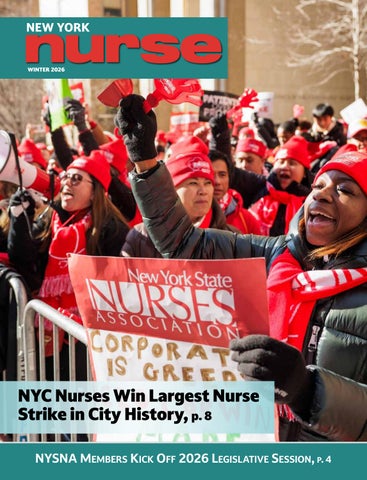
New York City Nurses Win Largest Nurse Strike in City History
On Feb. 26, the last striking New York City nurses walked back into the hospital for the first time in 41 days. The largest and longest nurse strike in New York City history officially ended with hugs, tears, cheers and reunions.
Anatomy of the Strike
The road to win fair contracts for all 20,000 New York City private sector nurses, including all 15,000 striking nurses, was long. Three years ago, NYSNA nurses at the same 12 hospitals — from the large, rich academic medical centers to the small, struggling safety net hospitals — came together for the first time to win groundbreaking contracts that lifted up all nurses and set a new standard for enforceable safe staffing standards and wages in New York City and beyond. That contract campaign involved a three-day strike at Montefiore and Mount Sinai that delivered
precedent-setting staffing enforcement language that has benefited NYSNA nurses around the state.
This time around, the richest hospitals were ready for us. Not only did they hoard cash to fight against their own nurses, they bragged about having weeks and months of reserves to fight us. Before the strike began, the president of the Greater New York Hospital Association told reporters that these hospitals already spent $100 million on expensive replacement nurses and were ready to spend more. These bosses launched vicious public relations (PR) and union-busting campaigns.
At the bargaining table, the richest hospitals moved the least. They dragged their feet on nurses’ contract priorities, threatened to discontinue or drastically cut our health benefits, asked for givebacks on safe staffing and refused to propose percentage-based wage increases.
Mount Sinai West nurse and NYSNA Director at Large Denash Forbes, RN, MSN, said: “Nurses at Sinai West had not gone on strike for decades, and we were hoping we wouldn’t have to go on strike this year, but hospital administration gave us no option. They refused to budge on even small noneconomic items and they hit us with the bombshell that they wouldn’t continue our health benefits.”
Safety Net Hospital Nurses Reach the First Agreements
Meanwhile, nurses at the eight safety net hospitals were making slow but steady progress at the table. Those hospital executives let members know they couldn’t afford — and didn’t want a strike. Just days before the strike deadline, safety net hospital nurses at BronxCare,
Flushing Hospital Medical Center, Maimonides Medical Center, One Brooklyn Health Interfaith Medical Center and One Brooklyn Health Kingsbrook Jewish Medical Center, Richmond University Medical Center, The Brooklyn Hospital Center and Wyckoff Heights Medical Center were able to win strong language to protect nurses from workplace violence, protect nursing practice from artificial intelligence (AI), and protect immigrant and trans patients and nurses. Those bosses agreed to fully fund NYSNA Plan A benefits without having the new health insurance rates and to pay an average of whatever wage increase nurses at the wealthy academic hospitals won.
Eileen Fitzgerald, RN, and Richmond University Medical Center Executive Committee Vice President said: “We knew nurses at the wealthy hospitals could win better pay increases than we could at our struggling hospital. But we were so proud to win make-whole staffing remedies, new workplace violence protections and other common priorities that the other hospitals could build on.”
Escalating to Win
The tentative agreements that safety net hospital nurses won did not come easy. Twenty thousand New York City NYSNA members
Montefiore nurses on strike.
Wyckoff Heights Medical Center nurses delivered their strike notice.
had been escalating their campaign to build public awareness since August. Nurses at all 12 hospitals voted overwhelmingly — 97% — to authorize a strike, letting employers know they would strike starting Jan. 12 if hospitals failed to negotiate fair contracts.
After dropping strike notices, nurses began bargaining daily as the deadline loomed. Safety net nurses broke through on Jan. 6, reaching tentative agreements on major issues and a commitment from employers to continue health benefits. Two days later, four of those hospitals reached full tentative agreements, and all but BronxCare nurses rescinded their strike notices.
The richest hospitals continued stalling. On Jan. 9, NYSNA nurses marched and rallied outside the League of Voluntary Hospitals, the trade group for New York City’s private hospitals. Unions added their support, sending an open letter from 45 unions calling on the remaining hospitals to settle fair contracts and avoid a strike. Despite the pressure, hospital executives delayed, held health benefits hostage and still asked for givebacks — pushing 15,000 nurses out on strike.
Nurses on Strike
Before the sun had even risen on Jan. 12, nurses at Montefiore, Mount Sinai Hospital, Mount
Sinai Morningside and West, and NewYork-Presbyterian streamed out of their hospitals, holding signs; packing the sidewalks in front and around the sides of their hospital buildings; and filling the morning air with chanting, music and horns. The strike was on.
For the next few weeks, nurses showed up and spoke out for patient and nurse safety and fair contracts. Hospital executives refused to return to the bargaining table until a week into the strike, instead escalating their PR campaign against NYSNA nurses. When they finally returned to the table, the bosses barely budged. Despite the coldest winter in a generation
Continued on page 10 On the line
On Jan. 9, nurses held an emergency action outside the League of Voluntary Hospitals to demand the city's wealthiest hospitals bargain in good faith.
On the line
Nurses Win Largest Nurse
Continued from page
and hospital executives’ disrespect, NYSNA nurses held the line.
Members received tremendous support daily from labor, community and elected allies as well as patients, other union members and everyday New Yorkers. Thousands of supporters came to the strike line, donated generously to the NYSNA Strike Hardship Fund and expressed their solidarity on social media.
NYSNA members at all of the hospitals spoke out at a dozen press conferences with powerful supporters, including Mayor Zohran Mamdani, Senator Bernie Sanders and Attorney General Letitia James; dozens of Congress members, state legislators and City Council members; and key labor and community allies. Nurses did creative actions on the picket line, including hosting a candlelight vigil with the parents of pediatric patients; holding a family day of community service on Martin Luther King, Jr. Day; and holding a fun run between picket lines.
Nurses also took the action from the picket line directly to the door of greedy hospital executives’ homes and businesses. On Jan. 29, they participated in a vigil to honor Minnesota nurse Alex Pretti, RN, whom U.S. Immigration and Customs Enforcement (ICE) agents killed. The crowd of more than 1,000 protesters joined NYSNA’s call to keep ICE out of hospitals. On Feb. 5, nurses returned to the League of Voluntary Hospitals and engaged in civil disobedience to demonstrate
the lengths they are willing to go to protect patient and nurse safety. Contract Action Teams at all four hospitals organized rolling actions to engage members and keep the pressure on hospital executives and elected officials. Actions included a march across Brooklyn Bridge, a march to Times Square and a march to Governor Kathy Hochul’s New York City office.
The nurses’ strike was omnipresent in local and national media, earning more than 3,500 press hits and bringing greater public awareness to safe staffing, workplace violence, the threat of AI in healthcare, attacks on our most vulnerable patients, the importance of good health benefits to frontline nurses and hospital greed. While nurses waged a campaign outside, we continued to fight for fair contracts at the bargaining
table. Nurses agreed to return to four separate tables under one roof to expedite negotiations on Jan. 22. Although the bosses signaled they would immediately commit to continue our health benefits and finally put forward a straight-forward wage offer, it took days of negotiation and calling an emergency press conference to get them to follow through.
After several more days working through mediators at the bargaining table, nurses at Montefiore, Mount Sinai, and Mount Sinai Morningside and West reached tentative agreements on Feb. 9 and returned to work on Valentine’s Day, Feb. 14. Nurses at NewYorkPresbyterian voted down the mediator’s proposal, continuing the strike. They ultimately headed back to the table and reached a tentative agreement on Feb. 20, returning to work on Feb. 25, ending the historic strike after 41 days.
NYSNA President Nancy Hagans, RN, BSN, CCRN, brought high profile allies to the picket line, including Rev. Al Sharpton, Mayor Zohran Mamdani, AG Letitia James and Sen. Bernie Sanders.
9
The Massachusetts Nurses Association was one of more than a dozen unions that joined NYSNA on the picket line.
Strike in City History
Wins That Set a New Standard
Once again, NYSNA nurses tied their fate to one another in this contract campaign and worked in coordination to raise the standards for everyone. New York City nurses fought for and won contracts that:
l Achieve enforceable safe staffing standards with make-whole remedies in every hospital and increase the number of nurses to improve patient care at all hospitals.
l Protect their health benefits, with no additional costs to nurses.
l Protect nurses from workplace
violence. Safety improvements include additional weapons detection systems at entrances, additional visitor screening, wearable panic alarms, steps toward implementing behavioral health rapid response teams, and additional paid time off to appear in court for nurses affected by workplace violence.
l Protect immigrant and trans patients and nurses, including clear guidelines for protecting patient care and interacting with ICE at Mount Sinai Morningside and West and Montefiore and
new protections for trans workers at Mount Sinai Hospital.
l Safeguard against AI in all contracts for the first time.
l Increase salaries by more than 12% over the life of the threeyear contract to recruit and retain nurses for safe patient care. Salaries will increase by approximately 4% in each year of the three-year contracts.
l Beat back aggressive takeaways on healthcare and safe staffing enforcement.
l Return all nurses to work after ratification.
More Challenges Ahead
Although nurses returned to work holding their heads high, there are more challenges ahead. The work of enforcing our contracts now begins. Many members had issues returning to work, including delays and retaliation, and NYSNA is taking hospital administration to mediation and arbitration to address these issues.
Nurses at The Brooklyn Hospital Center are locked in a battle with
hospital executives over nonpayment of their benefits (read more on page 13). Maimonides Medical Center will soon merge with New York City Health+Hospitals to stabilize its finances. Overall, struggling safety net hospitals will face even greater financial strains as federal healthcare cuts take effect. NYSNA members and other healthcare advocates must continue advocating to increase funding for public and safety net hospitals to
prevent hospital closures and protect access to care for low-income New Yorkers.
Nurses must also continue to hold hospitals accountable for how they use their resources to ensure that all hospitals, including safety net hospitals, are putting patients over profits — and over their outrageous executive pay. This contract campaign and strike showed us that it’s possible. We showed the power of nurses.
the line
NewYork-Presbyterian members walk back to work, celebrate the end of the strike. On
NYSNA Members Continue Fight to Protect Patient Care in the North Country
For months, NYSNA members in New York’s rural North Country have been fighting to protect patient care in their communities. Over the last decade, bed closures, service reductions, hospital consolidation and systemic disinvestment in the region have severely eroded access to care in the region. As a result, healthcare services have become increasingly difficult to access in the region; distance, lack of public transportation and providers who don’t accept Medicaid also present additional challenges for
wages and benefits necessary to recruit and retain nurses in the North Country.
Additionally, nurses at Carthage and Claxton won entry into the NYSNA Benefit Fund for the first time; the fund will provide health benefits to nurses and their families at a greatly reduced cost.
Speaking on the contract victory at her hospital, Ciera Talbot, RN, from Samaritan Medical Center, said, “Samaritan nurses are proud of what we were able to achieve during this contract campaign — for ourselves and for the people in
residents trying to access healthcare services.
In response to this ongoing patient care crisis, this fall, NYSNA members at seven North Country Hospitals came together for a joint campaign to secure the fair union contracts necessary for North Country nurses to provide the safe, quality healthcare their communities deserve.
Victory in Carthage, Ogdensburg and Watertown
In early February, after months of negotiations, NYSNA members at Carthage Area Hospital, ClaxtonHepburn Medical Center and Samaritan Medical Center settled fair contracts that protect patient care in the communities they serve! Members voted overwhelmingly to ratify the new contracts, which include safeguards against artificial intelligence, protections from workplace violence, and the respectful
our community who depend on us for care. Maintaining our health and pension benefits and securing protections against workplace violence were key victories in this contract. Nurses, like all workers, should be able to come to work knowing that there are measures in place to keep us safe. Every hospital should be a place of safety and healing for nurses and patients alike.”
A New Fight Emerges
Though nurses in Carthage, Ogdensburg and Watertown are excited about their new, strong union contracts, a new challenge has presented itself in recent weeks. Earlier this year, North Star Health Alliance — the hospital group that owns Carthage Area Hospital and Claxton-Hepburn Medical Center, among others — filed for Chapter 11 bankruptcy, putting care in the North Country at risk. Nurses at Carthage and Claxton are now
preparing to push back on any potential staff or service cuts at the facilities. Speaking on their new contract, Jessica Thornton, RN, at Claxton-Hepburn, said, “We’re glad to have settled such a strong contract, but we recognize the fight continues. For too long, North Country communities and hospitals have been underresourced, and we see the impact that has on our patients every day. Now that we’ve settled a fair contract for nurses, we can continue to do what we do best: advocate for our patients. That begins with fighting to make sure every North Country resident has access to the safe, quality patient care they deserve.”
On March 18, nurses from Claxton-Hepburn, Carthage and Samaritan spoke out in front of Carthage, demanding that the New York State Department of Health stabilize hospital funding to save the essential staff and services our communities need.
What’s Next?
Across the North Country, NYSNA nurses and healthcare professionals at Adirondack Medical Center, UVM-Alice Hyde Medical Center, UVM-Champlain Valley Physicians Hospital and UVM-Elizabethtown Community Hospital remain in active bargaining, fighting for the fair contracts their communities deserve.
NYSNA members are excited about the victories they’ve achieved so far but recognize that strong union contracts are just the first step in protecting access to care in the North Country. For too long, the region has been underresourced, and while strong union contracts can help to recruit and retain qualified nurses, real work must be done at the state level. New York state must work to keep Carthage and Claxton open and work to restore the services and beds that have been eliminated over the last decade. As we brace to feel the impacts of the Trump administration’s One Big Beautiful Bill Act, New York must find a way to ensure that all New Yorkers have access to the safe, quality healthcare they deserve — without traveling hours away from home to get it.
North Country members spoke out on March 18 to save staff and services at Carthage Area Hospital and ClaxtonHepburn Medical Center
Brooklyn Nurses Restore Health Benefits
Nurses at The Brooklyn Hospital Center have been taking action to demand the immediate reinstatement of their health coverage. Their coverage was cut on Feb. 1 after the hospital failed to make required payments to nurses’ health funds for months. This loss of coverage came just as nurses were preparing to ratify a contract that protected their healthcare and pension benefits.
Nurses immediately organized and held speak-outs, distributed
leaflets, and met with lawmakers to share how losing coverage forced many to delay critical care, from routine checkups to lifesaving treatments. Elected officials, including Senator Jabari Brisport, Assembly Members Phara Souffrant Forrest and Jo Anne Simon, and Council Members Mercedes Narcisse, Lincoln Restler, and Crystal Hudson, stood with nurses and urged hospital leadership to act.
When hospital executives received millions in state funding but made only partial payments, nurses escalated their efforts. They marched and brought their demands directly to CEO Gary Terrinoni’s residence. Together, their collective action worked. The hospital finalized the payments and restored coverage! The work is not done yet. Nurses will continue fighting to ensure past medical costs are covered, benefits never lapse again, and pension obligations are fully met! When we fight, we win!
Erie County Medical Center Nurses Speak Out Against Layoffs
On Jan. 27, NYSNA nurses at Erie County Medical Center (ECMC) in Buffalo learned that the hospital will lay off about 3% of the hospital’s workforce. The layoffs will not only impact nurses but nonclinical healthcare workers across the
board. Management cited financial pressures and reimbursement shortfalls for the cuts, but NYSNA released a statement warning that cutting frontline staff, including experienced nurses and nurse educators, threatens patient care at the region’s only Level 1 trauma
center. Thanks to nurses’ advocacy, nurses were able to reduce by half the number of NYSNA members impacted. Nurses stand in solidarity with all workers affected and will continue pushing back against any threats to safe patient care.
Long Island Northwell Health Nurses Ratify Contracts
NYSNA nurses ratified strong contracts that invest in safe patient care at Northwell/ Plainview, Northwell/Huntington and Northwell/Syosset! Nurses stood united and determined, and despite Northwell’s resistance to safe staffing standards, they secured important improvements. At Huntington Hospital, nurses won staffing ratios for the first time ever. There is still more work ahead, but Long Island nurses showed that when we join together, we can improve patient care across the region. Now the work of enforcing these contracts begins. Congratulations, Northwell nurses!
Another Year, Nurses Voted Most Trusted Profession
For the 24th year in a row, in an annual Gallup poll, Americans have ranked nurses as the most trusted profession! This comes as no surprise to the nurses who put everything on the line to care for patients and who are the first to speak up for their communities’ safety and care. Congratulations, nurses!
National Nurses
United (NNU) Celebrates
NIOSH Staff Reinstatement
NYSNA joins NNU in celebrating the reinstatement of National Institute for Occupational Safety and Health (NIOSH) staff who have been essential to workers’ safety across the United States. When the Trump administration made a series of disastrous cuts in early April 2025, nurses spoke up by calling members of Congress, signing petitions and writing letters. Alongside other unions that rely on NIOSH guidance, we fought hard to demand these staff members’ reinstatement and ultimately succeeded!
BronxCare Nurses Ratify Their Contract!
After months of determined organizing, BronxCare nurses have ratified a strong new
contract. Building on the momentum of recent victories at several safety net and striking hospitals,
nurses pushed hard for improvements that strengthen workplace violence protections and safe staffing standards.
The agreement secures improved staffing levels and enforcement, access to the NYSNA health plan at no cost, and meaningful wage and experience pay increases.
The emergency department will have four additional staff members per shift; psychiatric floors will have equalized day and night staffing ratios; and a mixed acuity unit will operate with tighter ratios. Nurses also won additional paid time off and improved differentials.
Congratulations, BronxCare nurses! Now the work of enforcing the contract begins.
NYSNA Nurses Celebrate at Cultural Parades
NYSNA nurses and their families celebrated New York City’s vibrant communities by participating in cultural parades this winter. Nurses marched in Manhattan’s Chinatown for the
Lunar New Year Parade, celebrating the Year of the Horse and sharing the message that nurses are proud to care for all communities. Staten Island nurses also brought the energy! They marched
and danced in their lucky green at the Staten Island St. Patrick’s Day Parade. Together, they spread the message “Safe Staffing Brings Good Luck.” NYSNA members are excited for more parades in 2026!
Northwell/Putnam Nurses Continue Fight for a Fair Contract
For months, NYSNA nurses at Northwell/Putnam Hospital have been negotiating their first contract with their new employer, Northwell Health. Putnam Hospital and Vassar Brothers Medical Center joined the Northwell system in 2025 following a merger between Northwell Health and Nuvance
Health, their previous health system. While early bargaining sessions have been productive, safe staffing remains a major issue. Management has refused to revise the current staffing language, which conflicts with New York’s safe staffing law and could limit nurses’ ability to enforce safe staffing standards.
Despite the challenges, Putnam nurses won’t stop until they win a fair contract. Recent victories by NYSNA nurses at Northwell hospitals on Long Island have shown that it is possible to take on New York’s largest private employer and win improvements for nurses and patients. Keep up the great work, Putnam nurses!
Big Health and Safety Wins in Recent Bargaining
Workplace violence and other health and safety issues were a hot topic in recent NYSNA contract bargaining in New York City, Long Island and the North Country. From bargaining tables to the picket lines and into the media, NYSNA members made sure that safety was front and center. This resulted in numerous improvements in contract language. It also raised community awareness about hazardous conditions that NYSNA members face day in and day out.
Wins occurred around several important issues:
l Weapon screening requirements
l Behavioral health response teams
l Deployment of personal panic alarms
l Patient and visitor access control systems
l Pre-construction consultation with NYSNA members
Prevention Is Key
A total of 10 NYSNA bargaining units won weapon screening language in this latest round of contract negotiations in New York City. Weapon screening is now mandated at six hospitals where it did not exist before, with another four hospitals agreeing to prioritize it.
Expanded behavioral health resources were another key bargaining priority. NYSNA has been pushing for a range of measures that would make more behavioral health staff available, make more beds available, and provide a better and safer response when crises
occur. Eight NYSNA hospitals agreed to establish specialist behavioral health response teams that will respond to violent or potentially violent incidents related to behavioral issues on all units, not just on behavioral health units. Two others agreed to study the establishment of these teams.
In another win related to incident response, six facilities secured language on the use of personal alarm devices for staff. When implemented properly, these devices can save lives and prevent or reduce the severity of assaults.
For NYSNA members at the Mount Sinai health system, controlling access through a patient and visitor access system was a priority issue, especially in light of a near-miss with an active shooter at Mount Sinai Hospital last November. Hospital administration will now address this issue in the new contracts.
Enhancing Our Voice and Our Rights
Hospital construction and renovation can often result in major health, safety and clinical problems for NYSNA members. A half dozen of our hospitals agreed to notify and meet with NYSNA well in advance of projects going live. This will be a chance for frontline staff to assess plans and raise specific concerns ahead of construction or renovation.
Nurses won additional paid time off from work to attend court proceedings stemming from assaults in a number of new contracts. Unfortunately, successful imple-
mentation of the “felony assault law” is very difficult due to systemic roadblocks, including law enforcement, assistant district attorneys and judges who are often resistant to bringing charges against patients.
Nurses also won language on several issues related to health and safety, foremost around the introduction of new technology. Technological changes in how work is done can create safety hazards, which makes NYSNA member input extremely important in this area.
At Montefiore, nurses also secured language related to emergency department (ED) overcrowding; the placement of patients in hallways on units; as well as new protections for home health nurses, including escorts upon request and unsafe conditions alerts in patient files.
Two members at Mount Sinai Hospital worked with NYSNA Health and Safety to file Occupational Safety and Health Administration (OSHA) complaints over retaliation they received from management. They had spoken out about concerns around the November shooting threat that began in the ED lobby and then moved outside near the campus. These OSHA cases likely helped ensure that these nurses’ disciplines were reversed as part of the final agreement.
A special shout-out to Carthage and Claxton-Hepburn nurses for winning language that requires the employer to provide blood-borne pathogen prophylaxis within two hours of exposure. Well done!
Congrats, Safety Advocates
Congratulations to members and bargaining committees for taking on and making gains around these important health and safety issues. Contact your executive committee or NYSNA representative for more details on this language. Contact NYSNA Health and Safety to discuss any health and safety hazards and solutions at healthandsafety@nysna.org
Nurses made signs about health and safety for the picket line.