NY Nurse Fall 2025

Page 1


President Nancy Hagans, RN, BSN, CCRN nancy.hagans@nysna.org

First Vice President Judith Cutchin, DNP, RN judith.cutchin@nysna.org

Second Vice President Bill Schneider, BSN, RN, CCRN bill.schneider@nysna.org

Secretary Michelle Jones, MSN, RN, ANPC michelle.jones@nysna.org

Treasurer Petar Lovric, BSN, RN, CPEN, CCRN petar.lovric@nysna.org

Directors at Large Marie Boyle, BSN, RN marie.boyle@nysna.org

Marion Enright, RN marion.enright@nysna.org

Christina Evans, RN christina.evans@nysna.org

Denash Forbes, MSN, RN denash.forbes@nysna.org

Flandersia Jones, MPH, BSN, RN flandersia.jones@nysna.org

Sonia M. Lawrence, BSN, RN sonia.lawrence@nysna.org Ari Moma, MSA, RN ari.moma@nysna.org

Aretha Morgan, MSN, RN aretha.morgan@nysna.org

Pauline Wallace, BSN, RN pauline.wallace@nysna.org Simone Way, BSN, RN simone.way@nysna.org

Regional Directors

Southeastern Christopher Honor, RN, BSN, CAPA christopher.honor@nysna.org

Southern Alizia McMyers, MSN, MHA, BSN, RN alizia.mcmyers@nysna.org

Central Catherine Dawson, MSN, RN, CNOR catherine.dawson@nysna.org

Lower Hudson/NJ Mary Lynn Boyts, RN MaryLynn.Boyts@nysna.org

Western John Batson, RN john.batson@nysna.org

Eastern Victoria Davis Courson, MSN, RN Victoria.Davis-Courson@nysna.org

Editor Kristi Barnes

Executive Editor

Pat Kane, RN, CNOR

Editorial offices located at: 131 W 33rd St., New York, NY 10001

Phone: 212-785-0157

Email: nynurse@nysna.org

Website: www.nysna.org

Subscription

Fighting for Equity Means Saving New York’s Healthcare

NYSNA is a union of nurse leaders who fight tirelessly for communities that are healthy and thriving. This past year has altered the nature of our battles, rolling back the clock on progress we’ve made in increasing access to healthcare, the safety of immigrants and the power of organized labor. In the face of federal attacks, we must fight to protect what we’ve worked so hard to achieve while keeping an eye on the future we want to create.

As a country, we’re facing an unprecedented healthcare crisis, which takes its own shape in New York. Over the past 25 years, New York has lost nearly four dozen hospitals.1 We have some of the longest emergency wait times in the country,2 with many New Yorkers delaying care altogether because of cost or fear. In New York, a Black mother3 is five times more likely to die from pregnancy-related complications than her white peer, a fact that is almost too shameful to repeat. Soon, Medicaid and other federal healthcare cuts will make tackling these problems much more challenging.

Affordability and Equity

However, we also have an extreme amount of wealth circulating through this state. Although our hospitals are all nonprofits, we have some of the highest hospital executive pay in the country, and hospitals are investing millions in Silicon Valley-like artificial intelligence startups, which pose yet unknown threats to patient care.

Patients are facing an affordability crisis. Hospital prices in New York have increased at a rate significantly faster than the national average, despite efforts to rein in costs. Between 2017 and 2021, healthcare costs nationwide rose by 14%; in New York, they rose by over 18% 4 These increases have not coincided with commensurate investments in patient care as revenue per patient is rising. For example, between 2011 and 2022, at NewYork-Presbyterian, the operating profit per adjusted discharge nearly doubled, rising from $3,780 to $6,854 5

And that’s why across the state, from the North Country to Long Island, nurses have demanded that hospitals protect healthcare. Because we know they can.

In addition to private wealth, we have some of the largest public budgets in the country. In New York City alone, we have a budget of over $104 billion. Despite having an anti-healthcare national administration, a lot is possible in New York; we have the power locally to enact change. New York has been a national leader in providing access to high-quality care.

We need to ensure that in the face of these healthcare cuts, hospitals prioritize patient care over executive compensation when they look at their budgets. We need to ensure fair funding for our public and safety-net hospitals. We need to make sure that immigrants who need care feel comfortable walking into our hospitals, because no one should fear that seeking care might jeopardize their family’s place in this country. We need to protect reproductive care and genderaffirming care and ensure that ALL New Yorkers get the care they need.

A Better Way

We are at a pivotal moment, and it’s time to think expansively about how New York could provide more for New Yorkers. With the right resources, we could expand maternal health services and increase access to midwives and nurse practitioners. Harnessing our political will, we could invest in mental health services and crisis infrastructure and help alleviate the overcrowding in our hospitals. We need to do everything in our power to make sure New Yorkers don’t lose any more maternal or pedi-

atric beds. By addressing the inequities in the healthcare system, we ensure that New Yorkers can thrive, because a person’s ZIP code should not determine their life span.

A New York for All

As an immigrant and a woman, I’ve fought battles in which my very existence in this city has been called into question. And as a union, NYSNA has fought to have a seat at the table. It’s through these battles that we’ve shown that we deserve to be here — and we’ve lifted up thousands of others in the process. Our wins aren’t just for nurses; they are for our patients, our communities and our collective futures. Our values — protecting patients and ensuring equity — energized our 2025 contract fights and will continue to shape our strategy as a union.

We’ve made it clear to our employers and our communities that we need bold and courageous action to meet the historic challenges we face. By working together, we can shape a future where all New Yorkers get the care they deserve.

SOURCES

1 https://www.nysna.org/resources/ hospital-closures-2000 https://www.cbsnews.com/newyork/ news/new-york-hospital-closures/

2 https://comptroller.nyc.gov/reports/ audit-report-on-the-evaluation-ofthe-efforts-to-manage-emergencydepartment-wait-times-by-kings-countylincoln-and-elmhurst-hospitals/

3 https://www.health.ny.gov/press/ releases/2025/2025-04-11_black_ maternal_health_week.htm

4 https://nyhpa.org/wp-content/ uploads/2023/06/HealthInsurance-101-06-22-23.pdf?utm_ source=chatgpt.com

5 https://tool.nashp.org/

Advocating for patients. Advancing the profession.SM
BOARD OF DIRECTORS
Maimonides Medical Center in Brooklyn, NY

Let’s Resolve to Fight for Workers’ Rights

As we approach the end of 2025 and look back over the last year, it’s incredible how much has changed — and how exhausted many of us feel. We have spoken out against cuts to Medicaid and other safety-net funding all year. President Donald Trump and the architects of Project 2025 promised to implement major changes once he was elected. Indeed, the Trump administration has been busy taking away our rights as workers.

Union Busting and Pink Slips

Although so much of NYSNA’s member education and advocacy this year was to stop the devastating federal healthcare cuts, we cannot ignore the Trump administration’s other sweeping changes.

One of the administration’s first actions was to strip collective bargaining rights from more than 1 million federal public sector workers, or about 7% of all union workers in the U.S.1 Trump signed an executive order in March that cancelled collective bargaining agreements and stopped dues collection for the first wave of federal agencies.2 In August, the administration stripped collective bargaining rights from 360,000 healthcare workers at the Department of Veterans Affairs (VA).3

VA nurses have had a union for decades. Their collective bargaining agreements have helped them improve working conditions, staffing ratios, workplace safety and more. The administration swept away these contract gains and workers’ rights, leaving VA nurses sounding the alarm that conditions will worsen for nurses and our nation’s veterans.

The attack on workers’ rights extended to an attack on workers’ jobs and livelihoods. In December, the Trump administration announced it was eliminating 35,000 more VA jobs, including nurses and doctors who largely avoided the VA job cuts earlier this summer.4

The administration also took away union rights from federal workers in agencies such as the Centers for Disease Control and

Prevention, the Environmental Protection Agency, the Agriculture Department’s Food Safety and Inspection Service, and the Weather Service.5 Having union rights and strong whistleblower protections has helped workers in these agencies protect the public health and public good. The government has laid off approximately 317,000 federal workers or eliminated their jobs in 2025.6

Nurses Marched

Labor Rights Under Attack

Since 1935, the National Labor Relations Act has spelled out workers’ rights and established the right to collective bargaining in the private sector.7 The National Labor Relations Board (NLRB) has overseen enforcing labor law — settling disputes between labor and management. Although the board moves too slowly at times, especially when it comes to protecting workers from retaliation and other enforcement responsibilities, NYSNA nurses depend on the NRLB for scheduling union elections, settling arbitration disputes, ruling on unfair labor practice charges and more.

Since January 2025, when Trump unlawfully fired NLRB Board Chair Gwynne A. Wilcox, the federal NLRB has been nonfunctional because it does not have a quorum to hear cases. Although New York’s regional NLRB offices are still operating, some deep-pocketed employers like NewYork-Presbyterian have

learned that they can appeal local NLRB decisions, invest in expensive lawsuits and leave nurses waiting in limbo for arbitration awards.

On Dec. 18, the Senate approved Trump’s pro-boss and anti-union NLRB appointees, putting prounion rulings and precedents at risk as the federal NLRB restarts its work and begins hearing a backlog of cases.9

Ready for 2026

Nurses and our union allies must continue to fight back for our rights in 2026 — whether that’s in our workplaces, in the halls of power, at the ballot box or in the streets. The administration’s sweeping actions in 2025 have helped ensure that the halves continue to grow their wealth and influence over our democracy and the have-nots — the working- and middle-class people in this country — lose their power and fall further behind.

We’re not going to sit back and let that happen. We saw what happened when the administration tried to limit opportunities and increase costs for nurses and other professionals trying to advance their education and careers. Nurses around the country spoke out to denounce the proposal to our “professional” status. Read more about the issue and our fight against this on page 11.

There are already some bright spots. The Protect America’s Workforce Act, which would restore collective bargaining rights for federal public sector workers, is one step closer to passing in Washington.[10] Working people are beginning to speak out and blow the whistle on the flat-out dangers of having too few people care for veterans, test the safety of our water, and protect our health and rights. I know I can count on NYSNA nurses to be among them in 2026.

A surefire way to shake off the exhaustion of last year is to organize, take inspiration from what we accomplished in 2025 through our solidarity, and get ready to take action in 2026. At a time of year that we are making resolutions, let’s resolve to continue to unite and fight for worker justice!

SOURCES

1 https://prospect.org/2025/09/03/ trump-federal-union-contracts-nlrb-afge/ 2 https://news.va.gov/press-room/ va-terminates-union-contracts-for-mostbargaining-unit-employees/

3 https://nurse.org/news/va-terminatesunion-contracts-nurses-united/

4 https://www.washingtonpost.com/ politics/2025/12/13/va-veterans-affairsjob-cuts-trump/

5 https://federalnewsnetwork.com/ unions/2025/08/draft-here-are-theagencies-that-have-canceled-collectivebargaining-so-far/

6 https://www.npr.org/2025/12/18/ nx-s1-5626822/trump-federal-workersfiring-civil-servants

7 https://www.nlrb.gov/guidance/ key-reference-materials/national-laborrelations-act

8 https://www.nytimes. com/2025/12/15/business/labor-lawnlrb-trump.html

9 https://www.reuters.com/world/us/ us-senate-confirms-trump-nomineeslabor-board-paralyzed-after-membersfiring-2025-12-19/

10 https://www.afge.org/article/moveto-restore-federal-workers-union-rightsturns-to-senate-following-house-victory/

on No Kings Day, Oct. 18, for Good Union Jobs.

New York City Nurses Fight to Protect Patient Care

Three years ago this January, 7,000 members of NYSNA held a historic three-day strike and won what previously seemed impossible: enforceable safe nurse-to-patient staffing ratios at two of New York City’s largest hospital networks, Mount Sinai and Montefiore. Nurses also won historic pay increases and improved safe-staffing standards at hospitals across New York City.

Now, 20,000 nurses at 12 New York City private-sector hospitals are back at the bargaining table once again mobilizing for safe patient care.

Nurses Have Not Forgotten

Hospital executives may have forgotten, but nurses haven’t: We know that when we stand together and fight for our patients, there’s nothing we can’t win.

NYSNA members are calling on New York City’s wealthiest hospitals to do their part to protect vulnerable patients and the safety-net facilities that will bear the brunt of Trump’s looming healthcare cuts. But instead of listening to frontline caregivers, wealthy private hospitals are using Trump’s cuts as an excuse to roll back the safe staffing victories that nurses won when we flexed our power three years ago.

While nurses fight to save healthcare for our patients and their communities, New York City’s private hospitals have cut frontline staff and services and invested in outrageous executive pay and untested artificial intelligence (AI) technologies.

CEOs at three of New York City’s wealthiest hospitals — Montefiore1, Mount Sinai2 and NewYorkPresbyterian3 — now make, on average, nearly 12,000% more than the registered nurses who are on the front lines caring for patients. And Mount Sinai recently shelled out a

whopping $100 million on just one AI facility.4 The bottom line: New York City’s private hospitals can afford to put patients first.

Nurses Escalate Campaign to Protect Patient Care

With union contracts expiring on Dec. 31, nurses are turning up the pressure to demand that hospitals prioritize patients over profits.

From Brooklyn to the Bronx, hundreds of nurses at New York City private hospitals held two solid weeks of action with rallies and speak-outs in October and November. Dozens of community allies and elected leaders joined nurses.

On Nov. 18, the New York City Council held an oversight hearing on the state of nursing. Over 200 nurses and allies packed the steps of City Hall for a press conference and rally ahead of the hearing, where dozens of NYSNA nurses testified to sound the alarm on the current conditions at New York City’s private hospitals.

Nurses urged lawmakers to support their demand that New York City private sector hospitals invest in safe patient care rather than executive pay and risky speculation on AI. More than 20 nurses testi-

fied about the need to enforce safe staffing, defend our patients’ access to care, protect nurses and patients from workplace violence, create safeguards on AI, and negotiate fair wages and benefits to recruit and retain nurses.

Whatever It Takes

After months of bargaining, hospital management is still refusing to settle fair union contracts that protect nurses and patients. In fact, management has been dragging its feet, and several hospitals have refused to put forward serious economic proposals. Hospitals have refused to guarantee our health benefits, have proposed to cut corners on safe staffing and weaken enforcement, and have retaliated against nurses speaking out for safer conditions.

NYSNA nurses are fed up. That’s why, across New York City, NYSNA nurses authorized a strike, with 97% voting yes, to send a clear message to management that they won’t back down until they win the fair contracts that nurses and patients deserve.

Now, as the three-year anniversary of the historic New York City strike approaches, NYSNA nurses at all 12 hospitals are ready to strike to protect patient care.

1 https://www.nychospitalgreed. com/montefiore

2 https://www.nychospitalgreed. com/mount-sinai

3 https://www.nychospitalgreed. com/newyorkpresbyterian

4 https://www.crainsnewyork. com/health-care/new-yorkslargest-hospitals-race-learn-andprofit-ai

As of publication, all eight safetynet hospitals have made major progress in securing health benefits, staffing improvements, workplace violence protections, and our other bargaining priorities. However, none of the nurses who work at New York City’s richest hospitals have secured tentative agreements on new contracts as the strike deadline looms. Striking is always a last resort, but nurses are demonstrating they are ready to do whatever it takes to protect patient and nurse safety.

NYSNA nurses Announce Strike Authorization Vote on Dec. 22.
Mount Sinai Morningside and West nurses, including Directors at Large Denash Forbes, MSN, RN, and Simone Way, BSN, RN, rally on Nov. 12.

October 22 Week of Action

Nurses from NewYork-Presbyterian, Montefiore, and BronxCare speak out for safe staffing, October 2025.

November 10 Week of Action

10 Day Notice Drop

nurses from 12

delivered their 10-day strike notices on Jan. 2! The Brooklyn Hospital Center, Maimonides, Mount Sinai Hospital, Mount Sinai Morningside, Mount Sinai West, and Wyckoff Heights Medical Center RNs held rallies and speak-outs to defend safe, quality patient care, November 2025.

More than 200 nurses rally at New York City Hall on current conditions at New York City’s private hospitals and demand hospitals do more to protect healthcare for New Yorkers.

Maimonides Brooklyn Hospital Center
Wykoff Mount Sinai West
Siani Main
NYSNA Secretary and Flushing Medical Center nurse, Michelle Jones, MSN, RN, ANPC.
Flushing Hospital Medical Center
Montefiore Medical Center
The Brooklyn Hospital Center
Mount Sinai Morningside & West
Wyckoff Heights Medical Ceter
Maimonides Medical Center
NewYork-Presbyterian
Mount Sinai Hospital

Whitepaper Highlights

KEY FACTS

1. Over the last decade, North Country has lost nearly half of its pediatric hospital beds. Over half of children under age 18 live more than one hour away from a hospital with inpatient pediatric beds.

2. North County hospitals have reduced maternal health beds by 13% — three hospitals reduced beds, and four completely closed maternity units.

3. Half of the North Country’s hospitals are now considered “Critical Access,” earning a higher Medicare reimbursement rate for services but also meaning the loss of 226 beds.

NYSNA SOLUTIONS

1. Strengthen oversight of hospital bed closures.

2. Secure fair hospital funding.

3. Preserve healthcare coverage.

4. Invest in the healthcare workforce.

North Country Healthcare Workers Fight to Defend Patient Care

Over the last decade, hospital closures and service reductions have created a crisis in New York’s North Country; access to safe, quality patient care has seen a significant decline. In some parts of the rural North Country, New Yorkers are prevented from accessing care from healthcare providers that don’t accept their health insurance or Medicaid. In other parts, few healthcare professionals exist at all. To address this ongoing crisis, NYSNA members from across the North Country are using their ongoing contract campaigns to demand that hospitals and healthcare systems reverse course and invest in expanding access to safe, quality patient care for their communities.

Healthcare Workers Take Action

members in the North Country are calling for safe staffing ratios and the fair wages and benefits necessary to recruit and retain the nurses their communities need.

In late November, North Country members also held a roundtable for community allies and elected officials. At the roundtable, attendees heard testimony from four NYSNA nurses in the North Country who spoke about the state of care in their communities; the lack of access to critical healthcare services across the North Country; and the undue burden this lack of access places on nurses, patients and entire communities.

“Protecting Rural Patients and Communities: Access to Care and Hospital Consolidation in the North Country,” which analyzes hospital bed closures and service reductions over the last decade.

Cuts Will

Exacerbate the Crisis

SOURCE

1 https://www.nysna.org/resources/ protecting-rural-patients-andcommunities-access-care-and-hospitalconsolidation-north

NYSNA members at Adirondack Medical Center, Carthage Area Hospital, Claxton-Hepburn Medical Center, Samaritan Medical Center, University of Vermont (UVM)-Alice Hyde Medical Center, UVM-Champlain Valley Physicians Hospital (CVPH) and UVM-Elizabethtown Community Hospital are all hard at work at the bargaining table. In November and December, members at Alice Hyde, Carthage/Claxton-Hepburn, CVPH and Elizabethtown all marched on the boss to deliver bargaining platform petitions. While each local bargaining unit has demands specific to its facility, all NYSNA

To spread their message even further, in early December, NYSNA members from across the state also held a virtual town hall meeting with labor and community allies to discuss the access to care crisis. Members spoke about hospital consolidation and the closure of essential services as well as how hospitals can protect access to healthcare and preserve these services amid impending healthcare cuts. They also discussed how negative trends affect frontline staff, patients and North Country communities, particularly in pediatric, maternal and trauma services. Additionally, members used the town hall to preview a new whitepaper that takes an in-depth look at hospital consolidation and service closures in the region.

A New Analysis of Care in the North Country

On the heels of the town hall, NYSNA released a new whitepaper,

The report confirms what North Country healthcare workers already know: Over the last decade, accessing safe, quality patient care has become increasingly difficult in New York’s North Country, and the cuts to federal healthcare funding will only exacerbate the ongoing crisis. In particular, the whitepaper takes an in-depth look at four essential hospital services — pediatric, trauma, maternal and behavioral care — and assesses the availability and challenges facing each service as well as provides recommendations to preserve access to quality care.

Read the report in full.1

What’s Next?

As of publication, NYSNA members at all seven facilities are still in the midst of bargaining. In the new year, North Country nurses and healthcare professionals plan to escalate their contract fight to protect the safe, quality patient care that their communities need. Hospitals and healthcare systems must invest in the communities they claim to serve by prioritizing patients over profits — and NYSNA members won’t stop fighting until they do.

Members from the North Country, including NYSNA Second Vice President Bill Schneider, BSN, RN, CCRN, gather at the 2025 NYSNA Convention.

Nurses Flex Their Union Power in Local Elections and in Albany

Nurses and healthcare professionals are advocates by nature.

At the bedside and on the streets, NYSNA members speak up for our patients, our colleagues and our profession. We know that decisions made in Albany and at the municipal level shape the care we provide and the conditions we work under. In 2025, NYSNA members brought that energy to the voting booth to help elect labor and healthcare champions in cities across the state.

We Got Out the Vote

Simply put, when nurses vote, patients and communities win! We knocked on nearly 20,000 doors and made 50,000 live phone calls to labor households around the state, encouraging union members to vote in local elections. NYSNA members and staff had thousands of conversations with other union members and their families about the importance of voting and supporting pro-worker candidates. We partnered with other unions in the AFL-CIO to run strong programs in the Hudson Valley, on Long Island, in New York City and upstate.

Elected officials and candidates were also eager to connect with union members and healthcare professionals. Days before Election Day, Zohran Mamdani visited nurses at NYC Health+Hospitals/ Elmhurst during a shift change to talk about affordability and caring for all New Yorkers. NYSNA Director at Large Petar Lovric, BSN, RN, CPEN, CCRN, stood beside Mamdani and community allies, saying, “We need a mayor like Zohran Mamdani who cares about the people of New York, wants to improve the lives of our patients and wants to invest in healthcare.”

The New York City labor movement and healthcare professionals not only showed up strong for Mamdani; NYSNA members also helped elect Shirley Aldebol and Kayla Santosuosso for City Council. On Long Island, we helped elect Rebecca Sanin

for Suffolk County Legislature and Cynthia Nunez for Nassau County Legislature. In upstate, we helped elect Dorcey Applyrs for Albany mayor, Sean Ryan for Buffalo mayor and Michael Cashman for State Assembly in the North Country.

We contributed to more incredible victories with Jenn Puja elected to the Westchester County Legislature and Yvette Valdes Smith reelected to the Dutchess County Legislature. These are just some of the electoral wins that will help nurses fight for patients and our communities in 2026 and beyond.

Legislative Updates

NYSNA members successfully advocated for several bills during the legislative session that Governor Kathy Hochul recently signed into law. They are:

Workplace Violence Prevention Program (S5294A/A203A)

Workplace violence remains a serious and ongoing concern for nurses and healthcare professionals across New York and the country. Recently, Mount Sinai nurses spoke out and called on hospital administrators to address urgent contract proposals and take immediate action to better secure hospital entrances after an active shooter threatened to shoot up the hospital.

On Dec. 12, Hochul signed legislation S5294A/A203A, sponsored by State Senator Luis R. Sepúlveda and Assembly Member Catalina Cruz. The bill aims to protect nurses and other frontline healthcare workers from violence on the job. The bill requires hospitals and certain other health facilities to establish workplace violence-prevention programs and provide security in Emergency Departments. NYSNA nurses look forward to working with hospitals to implement these much-needed programs.

Medical Aid in Dying/Dignity in Dying (S138/A136)

In 2025, New York lawmakers also passed the Medical Aid in Dying Act, sponsored by State

Senator Brad Holyman-Sigal and Assembly Member Amy Paulin. The legislation would allow adults (18 or older) diagnosed with a terminal illness or condition to request and self-administer medications to end their life and avoid the prospect of a slow and painful death if that is their personal preference. NYSNA also recognizes and supports patients’ right to refuse treatment and make their own decision to end their suffering when faced with a terminal condition.

On Dec. 17, Hochul signed the bill into law with additional guardrails to ensure the integrity of a patient’s decision and healthcare facilities’ preparedness. Unfortunately, the governor closed the year without signing the Local Input in Community Health Act (A6004/S1226), which would prohibit the Department of Health from approving closures of hospitals or reductions or closures of psych, maternity and emergency room services without prior public notice, public hearings, and posting health and equity impact statements. NYSNA members intend to continue advocating for this important law to improve hospital accountability and prevent hospital closures in the 2026 legislative session.

Ready to Continue Wins in 2026!

NYSNA members know that improving our workplaces and our healthcare system requires making our voices heard at the ballot box to elect worker and healthcare justice advocates to office and in the halls of power in Albany and our local cities and towns. When nurses show up, our patients are healthier and our profession is stronger!

‘‘We need a mayor like Zohran Mamdani who cares about the people of New York, wants to improve the lives of our patients and wants to invest in healthcare.”

– Petar Lovric, BSN, RN, CPEN, CCRN

On Oct. 30, Mamdani met with NYC Health+Hospitals/Elmhurst nurses.

NYSNA Members

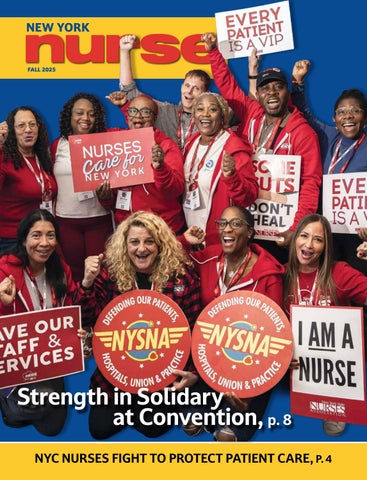
n Oct. 28-29, NYSNA nurses and healthcare professionals from across the state gathered in Monticello for the 2025 NYSNA Convention to organize, learn and gear up for some of this year’s biggest fights, inspired by this year’s theme, “Strength in Solidarity: Uniting for Our Patients, Practice, and Union.”

This Convention was the largest in NYSNA history, with more than 1,000 delegates, member observers and guests in attendance. With contracts expiring at the end of 2025 at hospitals across Long Island, New York City and the North Country, NYSNA members reflected on some of the biggest wins of the past year and prepared for a winter of serious worker action. Nurses spoke about the threat of impending healthcare cuts and their demands on hospitals to protect healthcare for New Yorkers across the state in upcoming contract fights. In a decisive moment for the union and our healthcare system more broadly, nurses came together to brainstorm how organizing, policy and contractual wins could build toward a shared vision of healthcare justice.

Growing Our Solidarity

Convention attendees continually returned to the Convention’s theme — “solidarity” — as they discussed the challenges they face and how potential solutions could best improve safe patient care. Roseanna Florentino, RN,

an oncology nurse at NewYorkPresbyterian said that the convention was “very empowering” and that she felt it gave nurses “that drive to fight for your patients’ rights.” She also noted that this Convention felt much bigger than the last one she attended when her hospital was bargaining three years ago, showing how our power as a union had grown and that Convention was a testament to “how much members are really fighting for patients.”

Digging Into Tough Problems

This Convention was a time to dig into some of the biggest issues facing healthcare in New York.

NYSNA President Nancy Hagans, RN, BSN, CCRN, kicked off the Convention, reminding members of the importance of solidarity to our union and to the political and contractual wins across the state. These victories included our historic win at Albany Medical Center, which leveraged our state staffing law, securing more funding and legislation to protect patients and fighting to protect staff and healthcare services when they were under attack. She then set the scene for the upcoming year: “I know many of you share my concerns about the challenges we face. But I also know that we are a union of action. This is the time to choose our battles wisely, to unite and fight for what really matters.” NYSNA members know that together anything is possible.

Show Strength

At lunch the first day, NYSNA members listened to a crucial panel discussion on the impact of federal cuts to healthcare funding, featuring the Fiscal Policy Institute’s Michael Kinnucan; Juanita Lewis, executive director of Community Voices Heard; and Jen Metzger, Ulster County executive. The panel outlined how federal cuts would affect healthcare on a number of different levels, from hospital pricing to job cuts, and discussed potential solutions and priorities.

During dinner, Executive Director Pat Kane, RN, CNOR(e), offered inspiring words and introduced the evening’s speakers,

National Nurses United officer and Department of Veterans Affairs (VA) nurse Ketsia Saint-Fort, RN, and Mario Cilento, president of the New York State AFL-CIO. Saint-Fort spoke about cuts to VA funding, which nurses have been fighting against for months. Cilento closed the night with a personal story and explained how essential organized labor is to this political moment. Together, the speakers left nurses inspired to continue to fight for healthcare and worker justice.

Preparing to Claim Power in the Workplace

NYSNA nurses took a variety of classes over the course of the two days and learned a number of lessons to take back to their facilities, including how to organize around the threat of artificial intelligence and how to organize new workers. These courses addressed every level of nursing, from practice to political. Meagan Rouse, RN, an oncol-

Roseanna Florentino, RN, at NewYork-Presbyterian
VA nurse Ketsia Saint-Fort, RN

Strength at 2025 Convention

ogy nurse at Alice Hyde Medical Center, said she really enjoyed meeting nurses from around the union. She started her day attending “Nurses Rights: Organizing, Member Representation, and Contract Enforcement.” She said the course made her feel “empowered to fight back” and noted that attending while in a contract fight made “everything feel fresh.”

Jaimie Zajac, RN, who works in the emergency room at Erie County Medical Center, was a first-time Convention-goer. She noted that the wealth of knowledge came from both the courses attendees took and the knowledge that nurses at other facilities shared. She attended the workplace violence course and learned about a variety of tools to bring dangerous situations to light. “You realize it’s not just us facing these issues, that we all have the same concerns. But when you’re talking to other nurses, you learn about the tools that they use and

how you can incorporate them into your own fight.”

In addition to learning about new tools to implement in her own facility, she learned about how long some nurses had been engaged in their fights around safe staffing, which gave her motivation to be consistent in her documentation of unsafe staffing. “You learn that it’s not a sprint, it’s a marathon, and that you have to be persistent.”

Our Union, Our Votes

On the second day, Convention delegates gathered to hear and discuss proposed resolutions. While some proposals spurred discussion and debate, others moved with almost unanimous support. To read the full list of approved Convention resolutions, visit the NYSNA website.1

The resolutions showed that NYSNA nurses and healthcare professionals are continually adapting their vision of the future to meet the

moment. NYSNA’s extensive legislative and policy platform which meets the moment and will guide the advocacy work of our members next year, was passed almost unanimously.

After hearing and discussing proposals, members voted on whether to adopt them. For a union of over 42,000 members, every resolution means time, resources, and delegates’ and members’ energy to implement, so members take voting very seriously. To read the “Report on NYSNA 2024 Approved Resolutions,” visit the NYSNA website.2

NYSNA members are readying ourselves for another year of fights as well as victories to protect healthcare across the state. Missed the Convention? Check out the video and photo highlights on NYSNA’s social media3 and our photo gallery.4 And save the date for next year’s Convention: Oct. 26-27, 2026, at the New York City Hilton Midtown!

SOURCES

1 https://www.nysna.org/resources/ approved-convention-resolutions

2 https://www.nysna.org/resources/2024convention-resolution-report

3 https://www.facebook.com/nynurses/ posts/pfbid031QxFmmwVZBQhMPnVQhp KkttY4NXXfLQrooFEFVRogMpJTYkN9Kgs cpHvdi8PF2ZAl

4 https://nysna.photoshelter.com/embed/ I0000wvWSWMLWdvs?type=slideshow &G_ID=G0000SzUysl78Fso

Jaimie Zajac, RN, and Loretta Palermo, RN, from Erie County Medical Center

Let’s Tackle the Healthcare Crisis Head On

Passing the New York Health Act must be a priority for anyone concerned about the healthcare crisis we are living through. By now, many of us have seen the statistics detailing the projected human costs of the One Big Beautiful Bill Act (OBBBA). In New York, early projections estimate that 950,000 people will be without coverage in 2026, meaning that thousands will delay care or avoid it altogether.1 The OBBBA’s healthcare cuts will undoubtedly harm patient care as well as nurses’ jobs. Employers are already talking at the bargaining table about the cuts and the rising cost of healthcare and uncompensated care as the reason that they cannot afford to give nurses raises.

A Solution Has Been There

However, the fight for the New York Health Act, a solution that gets at the heart of a lot of these issues, preceded the federal healthcare cuts. For years, NYSNA nurses and allies have been advocating for changes that will address a healthcare industry designed to sponge as much profit from patients as possible. The profits are distributed among several actors — hospitals, insurance companies and pharmaceutical companies — but at the end of the day, it’s the patients who lose.

The U.S. needs a universal singlepayer healthcare system where everyone gets the quality care they need, regardless of work status, because our futures depend on it.

The New York Health Act addresses one part of this system — our health coverage — but has the potential to transform the entire system.

Prevention is Key

What we need is a shift in our philosophical approach to healthcare, and that starts with making sure that patients are able to get the care they need when they need it to prevent issues before they arise. I often share this story about my mother who lives in Ireland. The local government recently came into her house and renovated her bathroom to make it more accessible. The government figured that these preventative measures were less expensive than treating her after a fall. This is the type of thinking that many health systems are based off of — but not ours. Instead, in the U.S., where we purportedly have some of the best technology and well-trained specialists, we have the worst patient outcomes when compared to peer countries. Our maternal mortality rate is the highest among highincome nations.

The Time is Now

For us as a union, it’s essential that we tackle the healthcare crisis head on because this system is not serving anyone well. Patients’ conditions are worsening, and that’s creating huge strains on hospital systems. Hospitals are likely to see more people in their emergency rooms. The elderly work their entire lives expecting to enter their golden years, only to watch their savings quickly dwindle because of healthcare’s exorbitant costs.

Not enough of the public know that alternatives to our broken healthcare system exist, even within our union. The U.S. needs a universal single-payer healthcare system where everyone gets the quality care they need, regardless of work status, because our futures depend on it. The devastation that the impending healthcare cuts will bring make fighting for the New York Health Act a priority.

SOURCE 1 https://www.crainsnewyork.com/ politics-policy/new-york-warns-950kpeople-lose-health-coverage-undertrump-cuts

Seasonal Flu Alert and Resources

FSOURCE

1 https://www.nysna.org/resources/ seasonal-flu-update-dec-2025

2 https://www.nysna.org/resources/ its-respiratory-virus-season-yourfacility-prepared

lu season in New York state has started early and more severely this year. Flu cases and hospitalizations are surging throughout the state. Combined with rising RSV and COVID-19 cases, many hospitals are overwhelmed. In addition to the expected A and B strains, an additional flu strain mutation (influenza A H3N2 mutated from a “J” subclade to a “K” subclade) has emerged recently. Subclade K has quickly become the dominant strain in the U.S. and a number of other countries. It is not unusual for mutations like this to happen,

but because the flu vaccine must be produced many months in advance, this type of change can result in a mismatch between the seasonal flu

vaccine and the currently circulating flu strains. While this means the vaccine’s effectiveness may be lower, it can still decrease the incidence of severe disease, hospitalization and death.

Read the full December seasonal flu update,1 and download and share the latest factsheet2 that helps members assess the preparedness and response at their hospital. If you have any questions or concerns regarding flu activity and infection control in your facility, please contact the NYSNA Occupational Health and Safety Representatives at healthandsafety@nysna.org.

Nurses Are Professionals

Nursing is a demanding — and in-demand — profession. Nurses are highly trained professionals who rely on their education and clinical judgement to deliver quality patient care in a variety of healthcare settings, including hospitals, ambulatory care, birthing centers and long-term care facilities.

In November, nurses around the country felt a gut-punch when the U.S. Department of Education proposed new federal loan rules that would remove nursing from “professional degree” loan programs. Master of Science, nurse practitioner, certified registered nurse anesthetist, midwifery and other graduate degree programs would not be in the $200,000 cap “professional” category and would instead be capped at the generic graduate school level of $100,000.

Proposed Rule Would Limit Opportunity, Raise Costs

The proposed rule would make nursing students pursuing advanced practice degrees ineligible for maximum federal loan borrowing opportunities — putting advanced degrees for nurses further out of financial reach. Federal student loans are lower cost, more flexible and have more borrower protections than private loans to pay for education.

Dania Munoz, RN, NP, from Mount Sinai Hospital, spent over $200,000 on a graduate nursing degree at Columbia University — funded entirely by federal loans. Munoz grew up in Section 8 housing, raised by immigrant parents in The Bronx who stressed the importance of education. She initially dreamed of being a doctor before she discovered nursing and a more affordable pathway to becoming a clinician. If this rule goes through, Munoz worries that students with backgrounds like hers will be shut out of advanced degree programs, saying, “People like me who grew up low income and dream about going to an Ivy League probably won’t be able to afford that higher education.”

Nurses are not the only professionals who will be excluded

from the professional designation. Physical therapists, dental hygienists, occupational therapists and social workers, as well as professions outside of healthcare such as architects, educators and accountants, will be left out.

Broader Attack on Worker Advancement and Patient Care

The proposed rule comes out of President Donald Trump’s One Big Beautiful Bill (OBBBA), which passed this summer. The OBBBA also eliminated the Grad Plus Program for new borrowers that allowed lower-cost federal loans to be used to cover expenses beyond tuition like housing and childcare.

Ashley Cota, RN, NP, from UVM-Champlain Valley Physicians Hospital, said: “My education cost over $100,000, and if it wasn’t for the support of my parents and now-husband, I don’t know how I could have done it. I moved to New York from Massachusetts and used loan forgiveness programs to work in the rural underserved North Country. This proposal won’t do anything to lower the costs of a nursing education; it will just put an advanced degree out of reach for more people and reduce access to care for the patients who need it most.”

New Limits on Loan Forgiveness

In March, Trump signed an executive order restricting public service loan forgiveness programs on political and ideological grounds under which public sector and nonprofit workers, including nurses, could be found “unpatriotic” and ineligible for loan forgiveness for advocating for or working in settings supporting immigrants, gender-affirming and reproductive healthcare, or diversity programs. The introduction of ideological tests for public loan forgiveness is in direct contradiction to the nursing code of ethics to do no harm and care for every patient, regardless of immigration status, gender identity or expression, or any protected category. Because the final rule enforcing this executive order was announced in October, a

coalition of state attorney generals led by New York’s Letitia James filed several lawsuits against the Department of Education.

The Fight Is Not Over

At a time when New York and the nation need more nurses in the profession and for education to be more affordable and accessible, this rule would cause significant damage. It would lead to economic hardship for nurses, fewer nurses and advanced practice nurses in the workplace, and worse outcomes for patients.

The federal government should be enacting policies that get more nurses in the profession, advance their practice to meet the demands of our aging population, and help them serve in underserved communities. This rule is a step backward and deeply insulting to all of the nursing and other professionals who use their training and clinical judgement and work hard every day to care for patients.

NYSNA released a statement1 vehemently opposing the Department of Education’s proposed rule. The department still needs to post the proposed rule on the Federal Register and allow for public comment before formal adoption. NYSNA is monitoring this process closely and intends to advocate aggressively against these proposed rules. Stay tuned for ways you can raise your voice in opposition to this proposed rule!

This proposal won’t do anything to lower the costs of a nursing education; it will just put an advanced degree out of reach for more people and reduce access to care for the patients who need it most.”
–Ashley Cota, RN, NP

SOURCE 1 https://www.nysna.org/press/nysnastatement-does-proposed-rule-excludenursing-professional-degree-programs

NYSNA nurse Dania Munoz, RN, NP, talks to News 12 about the impact new loan limits will have on nurses.

Northwell Nurses Unite to Protect Patient Care on Long Island

NYSNA members at Northwell/ Huntington, Northwell/Plainview and Northwell/Syosset have been at the bargaining table for months, fighting for the fair contracts that Long Island nurses and patients deserve. But at every turn, their employer — the largest private employer in New York state — has been stalling and disrespecting nurses. Northwell Health operates two dozen hospitals and 900 outpatient care centers and employs 104,000 people across New York and Connecticut, thanks to its recent merger with Nuvance. To take on the healthcare giant, Northwell nurses from across Long Island are uniting to demand that hospital management not leave behind their communities and patients.

Disrespect at the Bargaining Table

SOURCE

1 https://patch.com/ new-york/plainview/ nurses-speak-out-sendletter-northwell-ceodemanding-fair-contract

2 https://act.nysna.org/ page/91052/action/1

(below) On Dec. 12, NYSNA nurses from Huntington, Plainview and Syosset hospitals, along with NYSNA board members Honor, Franks, Boyle and Forbes, joined forces to demand a fair contract for nurses and patients.

More than 1,000 NYSNA nurses at Huntington, Plainview and Syosset Hospitals have been bargaining for months and are still without a contract. This isn’t for lack of trying—management has attempted to stall every phase of negotiations. Northwell has come to the bargaining tables late and unprepared; left negotiations early; refused to make bargaining accessible to nurses; and hasn’t made serious or meaningful counterproposals to what NYSNA nurses have put across the table. Northwell management has even prevented NYSNA nurses from attending bargaining via Zoom, which would ensure that every nurse has equitable access to bargaining and the ability to make their voice heard. Management is also seeking major concessions that

roll back important gains that nurses have fought for and could erode quality care on Long Island.

Northwell Nurses United

On Friday, Dec. 12, nurses from all three facilities joined forces to hold a speak-out at Northwell Headquarters to demand a fair contract for nurses and patients. Nassau County Legislator Arnold Drucker; Long Island Federation Labor President John Durso; and Diane Cantave, an organizer with Long Island Jobs with Justice joined nurses at the speak-out. On the morning of the speak-out, the Long Island Federation of Labor also sent a letter of solidarity to Northwell management, urging it to set the right example, work cooperatively with NYSNA nurses, “show real respect for the healthcare workers who carry our communities” and settle a fair contract.

At the speak-out, nurses were fired up by their drive to protect patient care on Long Island — and because they’ve had enough of management’s games at the table. Chris Coburn, RN, a NYSNA member at Plainview Hospital, said, “What we want more than anything is to take care of patients safely, and Northwell management is making that very difficult. Right now, we struggle to keep up with patients’ needs and demands. As nurses, we want to provide the best care possible, but we can’t possibly do that when we are as understaffed as we are now.”

NYSNA board members in the Northwell system and on Long Island spoke at the event in solidarity. NYSNA Southeastern Regional Director and Northwell/

Peconic Bay Medical Center nurse Christopher Honor, BS, BSN, RN, CAPA, emceed the speakout. Margaret Franks, BSN, RN, MEDSURG-BC, Marie Boyle, BSN, RN, and Denash L. Forbes, MSN, RN, all spoke out in solidarity with the Northwell NYSNA nurses.

In addition to the speak-out, nurses from Plainview and Syosset Hospitals also released an open letter1 to Northwell Health President and CEO Dr. John D’Angelo, calling on him to help get bargaining back on track and protect patient care on Long Island.

Northwealth

In tandem with the speak-out at Northwell Headquarters, NYSNA also launched “Northwealth,”2 a new website and advertising campaign in support of Long Island nurses and patients. The campaign calls attention to Northwell’s outrageous executive pay, investment in expansion through mergers and acquisitions, investment in union busting, and history of hiking up patient prices after acquiring smaller community hospitals. Nurses are hopeful that this public education campaign will help build support for their ongoing contract campaigns. The campaign launched on Dec. 12 with a mobile billboard that circled Northwell headquarters during nurses’ speak-out as well as Huntington, Plainview and Syosset throughout the day.

What’s Next?

In late December, NYSNA members at Huntington, Plainview and Syosset all held successful strike votes, with a super majority of nurses voting to authorize their bargaining committees to call for a strike, if necessary. The successful votes show management that nurses are ready and willing to do whatever it takes to win the fair contract that Long Island nurses and patients deserve.

As of publication, Northwell nurses at Huntington, Plainview and Syosset have all reached tentative agreements, averting a strike! Now nurses will vote on whether to ratify their contracts. Congratulations, Northwell Nurses United — when we fight, we win!

VICTORY: St. Anthony’s Community Hospital Nurses Ratify Contract!

NYSNA nurses at St. Anthony’s Community Hospital ratified a new contract on Sept. 16, with an overwhelming majority of nurses voting yes on the ratification. All nurses will see wage increases up to 29% over the life of the contract! Nurses also won increases to preceptor and charge pay, educational differential, certification bonuses and a new uniform allowance. Additionally, health insurance costs will remain frozen for the duration of the contract. Way to go, NYSNA nurses at St. Anthony’s Community Hospital!

Margaretville Hospital Nurses Ratify Their First Contract!

Congratulations to NYSNA members at Westchester Medical Center’s Margaretville Hospital who voted over-

whelmingly to approve their first contract. Nurses won significant pay increases in their new contract, making Margaretville Hospital

Albany Med Nurses Win Grievance in Pediatric Emergency Department

NYSNA nurses at Albany Medical Center continued their string of victories in 2025 by winning a grievance in the pediatric emergency department (ED). The pediatric ED is a standalone unit, which means nurses within the unit are not required to float to other units in the hospital, according to their contract. Despite this, management has been making them float to the adult ED.

After attempting to escalate the grievance and being ignored for months, nurses brought it to the human resources department with the support of their NYSNA union representative. Albany Med admitted that it had been violating the contract by forcing nurses to float and needed to change its practices to adhere to the contract. Congratulations, Albany Med pediatric ED nurses!

President Nancy Hagans Presents at AFL-CIO Women’s Committee Meeting

On Sept. 21, NYSNA

competitive in its region. The new contract also improved retirement benefits, staffing, education and shift differentials.

NYSNA Nurses Join No Kings Marches Across New York

On Saturday, Oct. 18, NYSNA nurses joined the nationwide No Kings Day March in New York City and across the state. From Buffalo to Mount Kisco to Manhattan, NYSNA nurses and healthcare workers marched with labor unions and working families to remind the federal government that there are no kings in the United States of America and that the power belongs to the people. Nurses proudly held signs that said, “Defend Healthcare, Defend Democracy!,” “Protect Good Union Jobs!” and “Some Cuts Don’t Heal” to remind the public that nurses are at the forefront of organizing against the federal attack on healthcare and workers’ rights!

President Nancy Hagans, BSN, RN, CCRN, spoke at a meeting of the New York State AFL-CIO’s Women’s Committee, highlighting the human impact of Medicaid cuts and draconian immigration policies and the role that labor can play in fighting back. Hagans affirmed that nurses will never abandon their patients and will continue to fight because an attack on one is an attack on all. Hagans affirmed that nurses will never abandon their patients and will continue to fight because an attack on one is an attack on all!

NYSNA Nurses Push Back on AI Adoption at Hospitals

NYSNA nurses have been pushing back on New York City hospitals that are rushing to implement untested artificial intelligence (AI) technologies in healthcare settings. Newsweek1 covered the issue of AI technology in nursing and Mount Sinai’s investments to increase profit margins instead of patient safety. “We’re here to say enough is enough. The wealthiest hospitals need to stop playing games with artificial intelligence and invest in care for those who need it most,” said NYSNA President Nancy Hagans, BSN, RN, CCRN.

We know that hospitals need improved working conditions and better staffing standards, not artificial care!

SOURCE 1 https://www.newsweek.com/nursesai-adoption-new-york-hospitals-accesshealth-11137032

ECMC Nurses

Continue Fight to Secure Paid Family Leave

NYSNA nurses at Erie County Medical Center (ECMC) successfully advocated for access to New York’s groundbreaking Paid Family Leave Program, which offers job protection and paid time off after the birth of a child, when a member of their household is sick or if a family member is overseas on deployment. After convincing management to offer the program, nurses organized their colleagues, educating them on the program’s benefits. Members voted overwhelmingly to opt in to Paid Family Leave.

Several months after the vote, ECMC still has no concrete plan to implement the program, citing costs and the need to also offer short-term disability insurance. In response, members at ECMC launched a letter campaign, targeting ECMC leadership and asking leadership to make good on offering this life-changing program. In just a few days, nearly 300 members participated in the action, and ECMC nurses have no plan to stop until they have access to Paid Family Leave. Keep up the great work, ECMC nurses, and don’t stop fighting until hospital leadership honors their commitment!

NYSNA President & Executive Director Recognized as 2025 Power Players

NYSNA President Nancy Hagans, RN, BSN, CCRN, and NYSNA Executive Director Pat Kane, RN, were recognized in City & State magazine’s list of the top 100 women leaders in New York state. The City and State’s Women Power 100 list1 highlights the powerful women who run and shape New York. PoliticsNY and amMetro also featured Hagans and Kane as 2025 Health Care Power Players! This list honors the elected, community and business leaders in the healthcare industry who dedicate themselves to all New Yorkers’ health and wellness. Congratulations!

SOURCE 1 https://www.cityandstateny.com/ power-lists/2025/11/2025-womenpower-100/409495/

NYSNA First Vice President Judith Cutchin Helps Shape the Legislative Agenda to Address Maternal Mortality

On Oct. 29, the New York City Council passed a package of legislation to confront the ongoing maternal mortality crisis and advance policy solutions that emerged from the Council’s Maternal Health Steering Committee.

NYSNA is proud of First Vice President Judith Cutchin, DNP, RN, for her work on the steering committee. The report marks a critical step toward addressing the deeply entrenched, systemic inequities that continue to unnecessarily claim the lives of mothers.

Onondaga County Nurses Ratify New Contract

On Sept. 5, Onondaga County NYSNA nurses ratified a new contract. The contract includes across-the-board wage increases; new shift, education, weekend and charge differentials; and new holiday, floating holiday, vacation and sick-time language! Congratulations to Onondaga nurses on organizing, bargaining and fighting for the fair contract that nurses and patients deserve!

The Joint Commission Recognizes Safe Staffing as a National Performance Goal

The Joint Commission is finally listening to what nurses have been saying for years: Safe staffing saves lives! NYSNA applauds the Joint Commission’s 2026 National Performance Goals, which recognize nurse staffing as a critical component of patient care and healthcare quality. This requirement that acknowledges that nursing is deeply connected to quality care and not just a line-item expense is a step in the right direction.

meetings throughout October, November and December.

Nurses celebrated recent contract victories, reported on the progress and challenges of ongoing negotiations, and discussed the power of union solidarity among nurses! Members left with renewed energy to fight for their patients and the nursing profession in New York state!

YSNA nurses from Brooklyn, Central New York, Long Island, North Country, Capital Region, Queens, Manhattan, Staten Island and NYC Health+Hospitals organized and hosted interregional
Long Island
Staten Island
North Country
Brooklyn/Queens

Agency Fee Objection Policy

NYSNA’s agency fee objection policy, which w ill be published annually in the January edition of New York Nurse, works as follows:

To become an objector, a non-member who is represented by NYSNA shall notify NYSNA. Such objection must be in writing, signed by the non-member and mailed to the NYSNA Dues & Membership Department at 131 West 33rd Street, New York, NY 10001. The objection must be postmarked within 30 days of resignation of membership, or, if the non-member did not resign within the prior twelve months, in the month of February. A non-member employee who initially becomes a bargaining unit member after February in a particular year and who desires to be an objector must submit written signed notification to the NYSNA Membership Department within thirty ( 30) days after the employee has become subject to union security obligations and been provided with notice of these procedures. Public sector empl oyees may revoke their dues deduction authorization and resign membership in accordance with applicable law and the terms of any signed dues deduction authorization card.

Agency fees payable by non-member objectors will be based on NYSNA’s exp enditures for those activities undertaken by NYSNA to advance the employment-related interests of the employees the Union represents. These “chargeable” expenditures include: preparation for and negotiation of collective bargaining agreements; contract administration including investigating and processing grievances; organizing within the same competitive market as bargaining unit members; mee tings, including meetings of governing bodies, conferences, administrative, arbitral and court proceedings, and pertinent investigation and research in connection with work-related subject s and issues; handling work-related problems of employees; communications w ith community organizations, civic groups, government agencies, and the media regarding NYSNA’s position on workrelated matters; maintaining membership; employee group programs; providing legal, economic, and technical expertise on behalf of employees in all work-related matters; education and training of members, officers, and staff to better perform chargeable activities or othe rwise related to chargeable activi ties; and overhead and administration related to or reflective of chargeable activities. Non-chargeable

expenses are those of a political nature. The term “political” is defined as support for or against a candidate for political office of any level of government as well as support for or against certain positions that NYSNA may take, which are not work-related. The following are examples of expenditures classified as arguably non-chargeable: lobbying, electoral or political activities outside of areas related to collective bargaining; litigation expenses to the extent related to non-chargeable activities; and member-only activities.

NYSNA shall retain an independe nt auditor who shall submit an annual report verifying the break- down o f chargeable and arguably non-chargeable expenditures and calculating the percentage of arguably non-chargeable to chargeable expenditures (the “fair share percentage”). The auditor’s report shall be completed promptly after the conclusion of the fiscal year. The report shall be provided to any non-member who submits an objection.

Non-members and new employees will be given the foregoing explanation of the basis of the reduced agency fees charged to them. That explanation will include a list of the major categories of expenditures deemed to be “chargeable” and those deemed to be arguably “non-chargeable.”

The fees paid by non-member objectors shall be handled as follows.

Newly-Hi red Non-Members. NYSNA will place or ma intain in an interestbearing escrow an amount at least equal to the agency shop fees remitted by newly-hired non-member(s) (or by an employer on behalf of newly-hired non-member employee(s)). A newly hired non- member employee will be mailed a copy of this Policy. The nonmember will have the later of the date he/she is subject to the obligations of the union security clause or thirty (30) days from the date of mailing to remain a non-member, object or to join NYSNA. If the non-member employee joins NYSNA, then the full agency shop fee remitted on his/her behalf is credited from the escrow account to the Association’s general treasury. If the newly-hired employee does not join NYSNA and does not file an objection within the thirty-day objection period, then the escrowed amount will be credited to NYSNA’s general treasury. If the newly-hired non-member timely objects, an amount at least equal to the fair share percentage shall continue to

be escrowed pending resolution of a challenge (if any) by the objector. Once the challenge is resolved, the amount of the non-chargeable balance plus interest will be returned to the non-member from the escrow.

Resignation. In the case of an employee who resigns NYSNA membership (or who continues in non-member status) and who timely objects, NYSN A will place or maintain in an interest-bearing escrow account an amount at least equal to the fair share percentage of the agency fees received from the nonmember or employer on behalf of the non-member and the non-member is permitted to challenge the fair share fee percentage during the thirty (30) day period noted in the annual publication of the Association ’s objection procedure. If the non-member files a timely challenge, amounts at least equal to agency fees collected from the non-member employee or employer will continue to be placed or maintained in the escrow account pending resolution of any challenge. If the non-member does not file a challenge within the challenge period, then the fair share fee amount will be credited to NYSNA’s general trea sury and the balance (if any) paid to the non-member from the escrow plus interest.

A non-member objector may file a written challenge to the calculation of the fair share fee and percentage, challenging any of the items of the expenditures as chargeable. Such a challenge must be submitted within thirty (30) days of

the date the non-member objector is provided an explanation of the basis of the reduced agency fees and initiation fees charge to them. Such a challenge must be in writing, signed by the nonmember and sent to the NYSNA Dues & Membership Department at 131 West 33rd Street, New York, NY 10001. If NYSNA does not agree with the challenge either as to the expenditures or as to the percentage of amount of dues to be paid, it will notify the timely objecting non-member in writing that he/ she has thirty (30) days thereafter to request arbitration; and if he/she fails to do so wi thin that time, then such non-member waives the right to arbitration. A request for arbitration must be in writing, signed by the person filing the request, and sent to the NYSNA Executive Director, 131 West 33rd Street, New York, NY 10001.

If more than on e challenging nonmember objector timely requests arbitration, NYSNA will consolidate all such challenges into one annual arbitration proceeding. NYSNA will provide an i mpartial arbitration proceeding throug h the American Arbitration Association and will pay the administrative costs and the arbitrator’s fees. The challenger will be responsible for any fees associated with his or her representation at the hearing.

NYSNA will administer this po licy in a manner that is consistent with the objectives of the policy and the applicable federal and state law to provide a fair and equitable procedure regarding nonmemb er employees. NYSNA reserves the right to change the policy set forth above.

Beck Notification

If you are represented for collective bargaining by NYSNA, you have the right to be or stay a nonmember and pay an agency fee equivalent to dues. If you choose to be a non-member, you are entitled to object to paying for activities unrelated to the association’s duties as a bargaining agent and to obtain a reduction in fees for such activities. If you submit a timely objection, the agency fee that you will be required to pay will include costs incurred by the union for expenditures related to collective bargaining, contract administration, grievances and arbitration, and other matters affecting wages, hours, and other conditions of employment. In 2025, the most recent calendar year for which a calculation was done, the agency fee charged to timely non-member

objectors represented 84.26% of the dues amount for that year.

If you choose to be a nonmember, please be aware that you will deny yourself the opportunity to exercise the full rights and benefits of union membership. Full membership rights include, among other things, the rights to: (1) vote on acceptance or rejection of proposed contracts covering your wages and working conditions, thereby ensuring your input on issues central to your working life; (2) participate in development of contract proposals; and (3) vote for your union officers.

A copy of NYSNA’s agency fee objection policy is published annually in the January edition of the New York Nurse. You can also request a copy from NYSNA’s Membership Department.

North Country Members Take Action, p.6
Northwell Nurses Unite, p. 12
Nurses Are Professionals, p. 10

Turn static files into dynamic content formats.
Create a flipbook
Issuu converts static files into: digital portfolios, online yearbooks, online catalogs, digital photo albums and more. Sign up and create your flipbook.