September 2026 • Vol. 32 • Issue 7
From Professional Treatments to Consumer: Procedure-Inspired and Post-Procedure Skincare
P
… Jinseob Shin
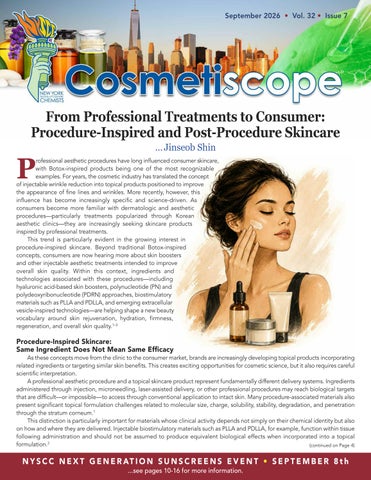
rofessional aesthetic procedures have long influenced consumer skincare, with Botox-inspired products being one of the most recognizable examples. For years, the cosmetic industry has translated the concept of injectable wrinkle reduction into topical products positioned to improve the appearance of fine lines and wrinkles. More recently, however, this influence has become increasingly specific and science-driven. As consumers become more familiar with dermatologic and aesthetic procedures—particularly treatments popularized through Korean aesthetic clinics—they are increasingly seeking skincare products inspired by professional treatments. This trend is particularly evident in the growing interest in procedure-inspired skincare. Beyond traditional Botox-inspired concepts, consumers are now hearing more about skin boosters and other injectable aesthetic treatments intended to improve overall skin quality. Within this context, ingredients and technologies associated with these procedures—including hyaluronic acid-based skin boosters, polynucleotide (PN) and polydeoxyribonucleotide (PDRN) approaches, biostimulatory materials such as PLLA and PDLLA, and emerging extracellular vesicle-inspired technologies—are helping shape a new beauty vocabulary around skin rejuvenation, hydration, firmness, regeneration, and overall skin quality.1–3
Procedure-Inspired Skincare: Same Ingredient Does Not Mean Same Efficacy
As these concepts move from the clinic to the consumer market, brands are increasingly developing topical products incorporating related ingredients or targeting similar skin benefits. This creates exciting opportunities for cosmetic science, but it also requires careful scientific interpretation. A professional aesthetic procedure and a topical skincare product represent fundamentally different delivery systems. Ingredients administered through injection, microneedling, laser-assisted delivery, or other professional procedures may reach biological targets that are difficult—or impossible—to access through conventional application to intact skin. Many procedure-associated materials also present significant topical formulation challenges related to molecular size, charge, solubility, stability, degradation, and penetration through the stratum corneum.1 This distinction is particularly important for materials whose clinical activity depends not simply on their chemical identity but also on how and where they are delivered. Injectable biostimulatory materials such as PLLA and PDLLA, for example, function within tissue following administration and should not be assumed to produce equivalent biological effects when incorporated into a topical formulation.3 (continued on Page 4)
N Y S C C N E X T G E N E R AT I O N S U N S C R E E N S E V E N T • S E P T E M B E R 8 t h ...see pages 10-16 for more information.
2026 NYSCC EXECUTIVE BOARD & COMMITTEE Chair Anushka Nadkarni chair@nyscc.org Chair-Elect Afam Okoro chair-elect@nyscc.org Secretary Anne Young secretary@nyscc.org Treasurer Diane Dabkowski treasurer@nyscc.org Treasurer-Elect Brian Ecclefield treasurer-elect@nyscc.org Advisor John Carola advisor@nyscc.org Program and Special Events Alexis Piterski program@nyscc.org At Home Live Series Susanna Fernandes Susanna.Fernandes@tri-k.com Scientific Committee Chair Michael Anthonavage manthonavage@vitaquest.com
I
Letter from the Chair
…Anushka Nadkarni
hope everyone had an opportunity to recharge and enjoy some downtime this summer. The NYSCC certainly didn’t slow down! We kicked off the summer with an inspiring educational event, “Translating Cosmetic Science into Real-World Performance,” held on June 18th at Fairleigh Dickinson University and featuring speakers from the NYSCC’s prestigious Scientific Committee. In addition, our annual Golf Outing and Fishing Trip were once again great successes, bringing members together for networking, camaraderie, and some summer fun. Now, as summer winds down, we’re jumping into a busy fall season filled with education, unique experiences, and opportunities for industry engagement. We kick things off September 8th with “Next-Generation Sunscreens,” focused on one of the most dynamic areas in our industry. The program will explore how advances in science, testing, and formulation are reshaping the future of sun care. On September 23rd, we shift from formulation to flavor with our Culinary Program, featuring a new venue, new pricing options, and a celebration of diversity through food. Attendees will experience dishes and culinary traditions from around the world while connecting with colleagues in a fun, interactive setting. Our educational calendar continues October 8th with “The Skin Barrier as a Living Interface: Biology, Disruption, and Repair,” followed on October 14th by a full-day cross-chapter symposium in Stamford, CT with the CTSCC, LISCC, and NESCC, “What Touches Your Skin: The Role of Laundry and Personal Care Products.” Our reach also extends well beyond the New York area. NYSCC Suppliers’ Day will be supporting our SCC colleagues and industry partners at the SWSCC Suppliers’ Day in Texas, FLSCC Sustainability Summit, Carolina Chapter’s Naturally Kiawah Symposium in South Carolina, and IFSCC Congress in Australia, as well as CEW’s Beauty Expo and Innovator Awards. These collaborations strengthen relationships and connect our members with the broader cosmetic science and beauty community. And while fall is just beginning, we are already building momentum for NYSCC Suppliers’ Day 2027. Exhibitor sales are open and space is going quickly! The early enthusiasm is a great reminder of the important role Suppliers’ Day plays in bringing together the people, science, ingredients, and technologies driving product development. I’m excited to reconnect with so many of you this fall at NYSCC programs, industry events, and around the world. Here’s to breaking beauty boundaries with an inspiring and innovative season ahead!
2026 NYSCC Events Calendar
• For updated NYSCC information, visit us on the web at: www.nyscc.org • For National SCC information: www.scconline.org
Social Media Dejour Waite, Revathi Nair, and Gabriella Yankovich socialmedia@nyscc.org
September 23
House Chair Arielle Nausieda house@nyscc.org Cosmetiscope Editor Roger McMullen roger.mcmullen@gmail.com Cosmetiscope Advertising Bret Clark rbclark@ashland.com
October 8
The Skin Barrier as a Living Interface: Biology, Disruption, and Repair – The Legacy Castle, Pompton Plains, NJ
October 14
Area 1 Educational Seminar: What Touches Your Skin: The Role of Laundry and Personal Care Products – Seafresca, Stamford, CT
November 12
Innovations Event – Bell Works, Holmdel, NJ
November 19
NYSCC Education Night – Capitale, New York City, NY
Nov. 30 – Dec. 2
2
NYSCC Culinary Event – The Legacy Castle, Pompton Plains, NJ
SCC Scientific Meeting & Showcase – JW Marriott LA Live, Los Angeles, CA
N YS CC Co s metis c op e
|
www.nys c c .org
September 2026
|
Vol. 32
No. 7
3
Procedure-Inspired and Post-Procedure Skincare
(continued from Page 1)
Therefore, using the same—or a similar—ingredient does not guarantee the same efficacy. For procedure-inspired skincare to be scientifically meaningful, the technology must be appropriately adapted and evaluated for topical use. This may involve selecting an appropriate form or molecular size of the ingredient, optimizing its concentration and stability within the formulation, and evaluating delivery technologies such as liposomes, nanoparticles, polymer complexes, or other encapsulation systems where they provide a demonstrated benefit.1 Most importantly, performance should ultimately be established at the finished-product level through appropriate safety assessments and well-designed clinical studies. Ingredient familiarity alone should never substitute for evidence.
Post-Procedure Skincare: Caring for Compromised Skin
A second, related category is post-procedure skincare: products used following professional dermatologic or aesthetic procedures. Unlike procedure-inspired skincare, these products are not intended to mimic the procedure itself. Their primary purpose is to support skin during the recovery period following treatments such as lasers, chemical peels, microneedling, radiofrequency procedures, or injectables. In this context, professional guidance is essential. Dermatologists and other appropriately qualified aesthetic professionals should remain the primary source of postprocedure care recommendations because the condition of the skin—and the appropriate skincare regimen—can vary considerably depending on the procedure, its intensity, and the individual. Nevertheless, several general principles are important. Following many barrier-disruptive procedures, skin can become temporarily more vulnerable, reactive, dry, inflamed, or sensitive. Post-procedure skincare should therefore prioritize simplicity and tolerability, with an emphasis on gentle cleansing, appropriate moisturization and barrier support, and photoprotection when indicated. Recent literature and expert recommendations emphasize relatively simple peri-procedural regimens incorporating mild cleansers, moisturizers, and broad-spectrum sunscreen while temporarily avoiding exfoliants and potentially irritating active ingredients following procedures that disrupt the skin barrier.4 Barrier-supportive and humectant ingredients—including ceramides, cholesterol, fatty acids, glycerin, hyaluronic acid, panthenol, and beta-glucan—may be useful depending on the type of procedure, the condition of the skin, and the stage of recovery. Botanical ingredients may also have a role, although their inclusion should be guided by evidence, formulation quality, and tolerability rather than simply by their perception as “natural” or soothing. Post-laser studies have additionally investigated technologies including thermal spring water, antioxidant systems, peptides, growth-factor-containing products, recombinant epidermal growth factor, silicone-based gels, and beta-glucan formulations. While several approaches have shown promising results, the available clinical evidence remains limited, and stronger comparative studies are needed before definitive recommendations can be made.5
Inspiration Is Not Equivalence
The central challenge for both procedure-inspired and post-procedure skincare is responsible scientific communication. A topical product may be inspired by skin booster injections, polynucleotide treatments, biostimulatory injectables, or other regenerative aesthetic procedures, but it should not imply equivalence to those procedures unless such claims are supported by appropriate evidence. The route of administration, concentration, formulation, bioavailability, tissue exposure, and mechanism of action may all differ substantially. 4
N YS CC Co s metis c op e
|
www.nys c c .org
Similarly, products intended for use after lasers, peels, microneedling, or other barrier-disruptive procedures should not be positioned simply as trendy “recovery” products. They must be formulated with the needs of temporarily compromised and highly sensitive skin in mind. As professional aesthetic treatments become increasingly mainstream, both procedure-inspired and post-procedure skincare will likely continue to grow. Their long-term credibility, however, will depend on science rather than marketing language. The same ingredient does not mean the same delivery, and the same inspiration does not mean the same efficacy. For cosmetic scientists and formulators, this trend represents an opportunity to thoughtfully translate insights from professional aesthetics into well-designed topical products. The most successful innovations will combine appropriate ingredient selection and delivery strategies with formulation stability, safety evaluation, finished-product clinical validation, and clear consumer communication. Ultimately, procedure-inspired and postprocedure skincare should not be about making topical products sound like professional procedures. It should be about translating relevant scientific insights from professional aesthetics into skincare that is safe, stable, well-tested, and responsibly communicated.
n References
1. Ma H. “Nucleic Acid Technologies in Skin Science: From PDRN to Precision RNA Actives.” NYSCC Scientific Blog. March 16, 2026. 2. Lee KWA, Chan KWL, Lee A, et al. “Polynucleotides in Aesthetic Medicine: A Review of Current Practices and Perceived Effectiveness.” Int J Mol Sci. 2024;25(15):8224. doi:10.3390/ijms25158224. 3. Lee KWA, Chan LKW, Lee AWK, et al. “Poly-d,l-lactic Acid (PDLLA) Application in Dermatology: A Literature Review.” Polymers. 2024;16(18):2583. doi:10.3390/polym16182583. 4. McDonald C, Yip L, Sullivan J, et al. “A Guide to Peri-Procedural Skin Care Regimen for Injectable and Non-Energy Cosmetic Procedures Based on a Consensus of Six Aesthetic Practitioners.” Aesthet Surg J Open. doi:10.1093/asjof/ojaf121. 5. Angra K, Lipp MB, Sekhon S, Wu DC, Goldman MP. “Review of Post-laser-resurfacing Topical Agents for Improved Healing and Cosmesis.” J Clin Aesthet Dermatol. 2021;14(8):24–32. _____________________________________
n About the Author: Jinseob Shin
Jinseob is Vice President of Americas Research & Innovation at Amorepacific North America, where he leads Scientific Valorization, Consumer Research, Regulatory Affairs, and Open Innovation across the Americas. With nearly two decades of experience in K-Beauty skincare science and innovation, he translates scientific insights into consumer-relevant technologies and product strategies. Previously, he served as Chief Researcher at Amorepacific R&I Center in Korea and as General Manager of a luxury skincare brand within Amorepacific, gaining cross-functional experience across R&I, brand strategy, consumer engagement, and market execution. His research and publications span transdermal delivery, high-performance skincare formulations, and functional ingredients. Jinseob is an active member of the Society of Cosmetic Chemists, serves on the NYSCC Scientific Committee, and chairs the U.S. Council of the Korea Cosmetics Association.
September 2026
|
Vol. 32
No. 7
5
6
N YS CC Co s metis c op e
|
www.nys c c .org
September 2026
|
Vol. 32
No. 7
7
Z m Ƭ_* Ƭ _ Ƭ Ƭ
Q[JJ4( MQō p 1[: ĖńėĪ ĐĎĐĕ 1 i(VQ @:i :V(@: :V M : j p@M2 (Vp
:pQ į@M"ĵQ[JJ4( MQń p
QÝËË´¦ ÎÒij ò ĐĎĐĕ Î ØÝÎºÒ ØÀ ؤ 1 ë¦ØÒ ºØ Î ¦º : ì pÀβ ¦Øò Àº 1ݺ ĖńėĪ Àº ¦º Φº ¦º ØÀ ؤ Πؤ ´À ´ ÝØò º ÀÒ¹ ئ Ò ¦ º À¹¹Ýº¦Øò ÀÎ ¦Ò Àë ÎòĪ Àºº ئÀº º ¦ºÒ˦ΠئÀºį QØ ò Øݺ ØÀ :pQ įÀÎ ĵQÝËË´¦ ÎÒń ò º À´´Àì ÝÒ Àº ÒÀ ¦ ´ ¹ ¦ ÀÎ ÝË Ø ÒĪ ººÀݺ ¹ ºØÒĪ º ë Îòؤ¦º òÀÝ º ÀÎ QÝËË´¦ ÎÒij ò ĐĎĐĕĬ
Save the Date...
Innovation Event November 12th
8
N YS CC Co s metis c op e
|
www.nys c c .org
V¤ QÀ ¦ Øò À ÀÒ¹ ئ ¤ ¹¦ÒØÒ ¦Ò ² ˦º òÀÝ Àë Î ÎÀݺ ؤ ´À Ĭ Ò ÒËÀºÒÀÎ À ؤ Ò ë ºØÒĪ :pQ QÝËË´¦ ÎÒō ò ¦Ò ¦Î¹´ò ÒØ ´¦Ò¤ Ò Ø¤ ØÀËĪ ººÝ ´ :ÀÎؤ ¹ Φ º ë ºØ À ¤À¦ ÀÎ ÀÒ¹ ئ ¤ ¹¦ÒØÒĪ º ¦º ÎÒ º ´´ ؤÀÒ ¦ºëÀ´ë ¦º ËÎÀ Ý Ø ë ´À˹ ºØ ì¤À Î Ò Î ¤¦º ÀÎ ¦ººÀë ئÀºĪ Ý Ø¦Àº º Àºº ئÀºį
Q[JJ4( MQō p 1[: ĖńėĪ ĐĎĐĕ 1 i(VQ @:i :V(@: :V M : j p@M2 (Vp
:pQ į@M"ĵQ[JJ4( MQń p
&) ľ!D
=jU ĝĝZ ľ=jDQ6U ôòôø
8¼Îĝľµ ® Î ĝ
U ĝĝúòÕ ĝĝľµµÙu®ĝ= Õ µ ĝ ĝ ĝĝ ĝ ĝ >¼äĝõòĝĖĝ ĝôĀĝôòôø
> jĝmDQ6ĝ ĝ ĝ )Zm U^OO8) QUĊĝ ľmĝôòôù ĝ ĝ 4Ùµ ĝúĖûĀĝôòôù ĝ ĝ ĝ 6)ľjľ&ĝ)U8ľ> ĀĝU ĝ
>uÕÙÊu®®èĝ6 uåu ĝUè´Ç¼Î Ù´ ĝ ĝ D Õ¼ ÊĝøĖúĀĝôòôø ĝ ĝ
OľQ)UĀĝĝ Qľ>
OÊ ÎÎĝĪĝ ĝ ĝ Ê µ Îĝĝ Ê u« uÎÕĝĖĝ !®¼ u®ĝ Õ ¼µ ĝ ôòôø
ľ88ľU
UjU ĝĝUÙÇÇ® ÊÎěĝ uè ĝ U ÇÕ ´ Êĝó÷Āĝôòôø ĝ ĝ
ľ^UZQľ8)ľ ) U ĝ ¼µ Ê ÎÎ ĝĝ U ÇÕĝôúĖD ÕĝóĀĝôòôø ĝ
:pQ įÀÎ ĵQÝËË´¦ ÎÒń ò
September 2026
|
Vol. 32
No. 7
9
NYSCC Next Generation Sunscreens: Innovation in UV Filters, Testing Methodologies, and Photoprotection September 8, 2026 • 9:00 a.m. – 6:00 p.m. Pleasantdale Château
757 Eagle Rock Avenue, West Orange, NJ 07052
T
Symposium Chair: Eduardo Ruvolo, Ph.D.
(Head of Clinical and Scientific Affairs, Beiersdorf, Inc.)
his symposium will explore the next generation of sunscreen innovation, highlighting advances in UV filter technology, new and evolving SPF testing methodologies, and broader approaches to photoprotection. Topics will include new ISO-based methods, formulation opportunities with newly approved UV filters such as Bemotrizinol, challenges and opportunities with inorganic sunscreens, and the growing need for extended protection beyond traditional UVB and UVA claims, including visible light. The program will bring together scientific and industry experts to discuss how innovation in testing, formulation, and protection strategies is shaping the future of sun care. To register for this event, visit the Events section of the NYSCC website (nyscc.org).
Event Agenda 9:00 – 9:55 a.m.
Registration and Breakfast
10:00 – 10:30 a.m.
What in the World is Going on with SPF Testing Anyway? – Brian Ecclefield (Validated Claim Support)
10:30 – 11:00 a.m.
The New ISO Test Methods: How Can I Use Them? – Curtis Cole, Ph.D. (Sun & Skin Consulting, LLC)
11:00 – 11:30 a.m.
Beyond UV: Redefining Photoprotection Across the Solar Spectrum – Eduardo Ruvolo, Ph.D. (Beiersdorf)
11:30 a.m. – 12:00 p.m.
12:00 – 1:00 p.m. 10
The Untold Story of Sunscreen Efficacy: Designing a Sunscreen You Want to Wear – Brian Bodnar, Ph.D. (L’Oréal) Lunch
N YS CC Co s metis c op e
|
www.nys c c .org
1:00 – 1:30 p.m.
The Parsol Shield Journey: Unlocking the Next Era of Photoprotection Innovation for American Consumers – Carl D’Ruiz (DSM-Firmenich)
1:30 – 2:00 p.m.
Bemotrizinol (BEMT) in the U.S.: Formulation Strategies, Combinations, and Innovation Opportunities – Luciana Uttembergue D’Elia (DSM-Firmenich)
2:00 – 2:30 p.m.
Maximized Protection: Your Roadmap for Sunscreen Optimization – Diane Tom, Ph.D. (BASF)
2:30 – 3:00 p.m.
Formulating with Inorganic Sunscreens – Chris Boone (Evercare)
3:00 – 3:30 p.m.
Coffee Break
3:30 – 4:00 p.m.
Roundtable Discussion and Audience Q&A
4:00 – 6:00 p.m.
Cocktail Reception
Speaker Abstracts and Biographies
_____________________________________
What in the World is Going on with SPF Testing Anyway?
T
Brian Ecclefield (Founder/CEO, Validated Claim Support)
his presentation will demonstrate real-world SPF data and describe in layman’s terms how to get to the bottom of an in vivo clinical report. We will review trends in data along with industry events over the last decade that have shaken up the industry, breaking both consumer and institutional trust. Rather than a basic introduction to SPF testing, this is a retelling of the story behind how the industry got to where it is now, and how we can do better together as a collective industry, assessing trends in mineral and inorganic filter studies, instances of clinical fraud and negligence, marketed products with “unlikely” SPF values, and best practices for working with third-party clinical labs. The goal is to empower the industry to get more value out of clinical reports and partnerships, ensuring products are safer for consumers and as effective as they claim to be.
n Brian Ecclefield
Brian Ecclefield is the founder/CEO of Validated Claim Support, a Clinical Research Laboratory (CRO) in Teaneck, NJ specializing in personal care and cosmetic research. He has spent the last 17 years working behind the scenes with products from brands both large and small. Prior to launching his own lab, Brian worked with two different CROs that later made international news headlines over cited ethical issues. He has served as an expert witness defending consumers against misleading product claims (particularly in the SPF field) and as an official whistleblower for improper lab practices. In his free time, Brian enjoys NYSCC educational and networking events and serves as Treasurer-Elect of the NYSCC chapter. _____________________________________
T
The New ISO Test Methods: How Can I Use Them? Curtis Cole, Ph.D. (Principal, Sun & Skin Consulting, LLC)
he development of new validated, non-invasive ISO test methods for sunscreen testing enables new opportunities for research. While the U.S. currently does not recognize these new methods, nor any ISO method for sunscreen evaluations, these new methods can be very useful tools to gain insights into product behavior as well as consumer behavior, in ways that could not be evaluated with conventional SPF and UV-PF test methods. The advantages and disadvantages (continued on Page 12)
September 2026
|
Vol. 32
No. 7
11
NYSCC Next Generation Sunscreens: Innovation in UV Filters, Testing
(continued from Page 11)
of each of these tests will be reviewed, as well as possible applications for their use beyond simple label claims.
n Curtis Cole, Ph.D.
Dr. Cole is a globally recognized expert in sunscreen science, photobiology, and ultraviolet protection standards, with more than four decades of leadership across academic research, global corporate R&D, and regulatory innovation. As Principal Member of Sun & Skin Consulting, LLC, he provides scientific and technical guidance to sunscreen manufacturers, clinical testing laboratories, and photoprotection researchers worldwide. Dr. Cole has served as a U.S. delegate to ISO TC217 WG7 since 2007 and was Project Leader for several cornerstone international standards, including ISO 24444:2019, ISO 24443:2012, and ISO 24442:2010. Inventor and developer of polychromatic hybrid diffuse reflectance spectroscopy (HDRS), he has helped develop the newly published ISO 23698 HDRS SPF and UVA test method. Before consulting, Dr. Cole spent more than 27 years at Johnson & Johnson, ultimately serving as Vice President of Research & Development for the global skincare franchise, where his contributions included stabilized retinol technologies and the invention of Helioplex photostabilized sunscreens. Earlier in his career, he conducted foundational research at Temple University, publishing the first definitive ultraviolet action spectrum for squamous cell skin cancer induction. He has more than 70 scientific publications, 28 granted U.S. patents, and multiple industry honors, including two Johnson Medals and a Lifetime Achievement Award. _____________________________________
Beyond UV: Redefining Photoprotection Across the Solar Spectrum
F
Eduardo Ruvolo, Ph.D. (Head of Clinical and Scientific Affairs, Beiersdorf, Inc.)
or decades, sunscreen innovation has been driven primarily by the prevention of ultraviolet (UV)induced erythema and the achievement of higher SPF values. While these endpoints remain fundamental to reducing sunburn and skin cancer risk, advances in photobiology have demonstrated that the biological effects of sunlight extend well beyond the traditional UVB and UVA paradigm. This presentation will explore how our understanding of solar radiation has evolved from a UV centric model toward a more comprehensive view of the entire solar spectrum. Evidence accumulated over the past two decades has shown that long wave UVA and visible light contribute to oxidative stress, persistent pigmentation, inflammation, and photoaging through biological mechanisms distinct from those associated with UVB-induced DNA damage. These findings challenge the conventional definition of photoprotection and suggest that protecting skin health requires addressing multiple pathways of solar induced damage. Recent international expert consensus on visible light photoprotection has further reinforced the clinical importance of visible light exposure, particularly for individuals prone to pigmentary disorders and skin of color. The consensus highlights the need to expand our approach to photoprotection beyond traditional SPF and UVA metrics by considering biological endpoints and protection strategies that address the broader effects of solar radiation. Drawing on mechanistic research, clinical investigations, and emerging consensus recommendations, this presentation will review complementary approaches that extend beyond conventional UV filters, including antioxidants that reduce oxidative stress, ingredients that support the skin’s endogenous defense systems, and pigments such as iron oxides that mitigate visible light-induced pigmentation. Together, these strategies represent a more comprehensive framework for protecting skin across the solar spectrum. Finally, the presentation will discuss how these scientific advances may influence the future of sunscreen development, efficacy testing, and consumer communication. As photoprotection evolves from preventing sunburn to preserving overall skin health, the next generation of sunscreens will require products, test methods, and claims that better reflect the full biological impact of solar radiation. 12
N YS CC Co s metis c op e
|
www.nys c c .org
n Eduardo Ruvolo, Ph.D.
Eduardo Ruvolo is currently Clinical and Scientific Affairs Director at Beiersdorf, Inc. in the U.S. Eduardo earned a Bachelor’s and Master’s degree in Theoretical and Applied Physics at University of São Paulo in Brazil. Trained as a Biophysicist, he has expertise and experience in the physical and life sciences areas. Eduardo has developed and delivered scientific substantiation for new claims in the OTC medicine and cosmetic arena by developing innovative clinical study designs and proving the mechanism of action of new active ingredients along with compelling communication to many different professionals across diverse areas of expertise. He has extensive research experience and publications in cosmetics, OTC medicine, skin bioinstrumentation, medical devices, and photoprotection. He served as a member of the U.S. Sunscreen Task Force and Sunscreen Committee Chair for the Personal Care Products Council (PCPC). _____________________________________
The Untold Story of Sunscreen Efficacy: Designing a Sunscreen You Want to Wear
S
Brian Bodnar, Ph.D. (Principal Scientist, Photoprotection Application Domain, L’Oréal USA)
unscreens only offer their advertised protection if they are applied correctly, which means that cosmetic elegance is just as important as UV protection when formulating sunscreens. This presentation highlights the critical role of cosmetic elegance in sun care formulation and explores modern strategies for characterizing and optimizing sunscreen aesthetics. We review the current state of the art in instrumental testing alongside core formulation principles that guide the development of optimal sensory properties. To demonstrate these methodologies in action, we present a case study of a new mineral sunscreen that overcomes the classic challenges of inorganic UV filters, delivering high photoprotective performance in a formula that is highly transparent and exceptionally pleasant to wear.
n Brian Bodnar, Ph.D.
Brian Bodnar is a Principal Scientist leading the Photoprotection Application Domain at L’Oréal USA. Since joining the company in 2011, he has spent the last nine years leading the team toward advancing the fundamental science of sun care and driving cutting-edge sunscreen innovations for the U.S. and global markets. Brian’s diverse expertise spans liquid foundation formulation, designing customized automated chemistry solutions at Chemspeed Technologies, and developing novel materials at SiGNa Chemistry. He holds a B.S. from The College of New Jersey and earned his Ph.D. in Organic Chemistry from the University of Notre Dame, where his doctoral research focused on the synthesis of mycobactin analogs and nitrosocarbonyl hetero Diels Alder chemistry. _____________________________________
The Parsol Shield Journey: Unlocking the Next Era of Photoprotection Innovation for American Consumers
F
Carl D’Ruiz (DSM-Firmenich)
DA’s approval of Parsol Shield (Bemotrizinol, BEMT) as the third GRASE UV filter on the OTC Sunscreen Drug Monograph marks a defining moment for U.S. photoprotection science. As one of the world’s most trusted and extensively studied broad-spectrum UV filters, its long-awaited entry into the U.S. market reflects years of rigorous scientific validation, safety stewardship, and persistent regulatory engagement. This presentation will trace that journey, illuminating the toxicological, environmental, clinical, and formulation data that ultimately supported its acceptance. By unpacking the key learnings behind this milestone, the session will show not only how BEMT achieved approval, but also why its pathway now serves as a template for future (continued on Page 14)
September 2026
|
Vol. 32
No. 7
13
NYSCC Next Generation Sunscreens: Innovation in UV Filters, Testing
(continued from Page 13)
innovation. The depth and transparency of its safety dossier, the collaborative regulatory approach, and the scientific rigor of its performance evidence collectively establish a new benchmark for introducing next generation UV technologies in the U.S. This talk will highlight how BEMT empowers formulators to deliver stronger UVA coverage, enhanced photostability, improved daily wear aesthetics, and broader visible light protection. Most importantly, its availability opens the door for a more modern, flexible, and globally aligned photoprotection toolbox, setting the stage for U.S. consumers to benefit from the same level of innovation long available internationally.
n Carl D’Ruiz
Carl is currently the Senior Manager, NA Beauty & Care Advocacy and Business Development at DSM-Firmenich Personal Care. He has 40 years of experience in providing strategic scientific, regulatory compliance, and pre-market approval advice and direction for the successful commercialization and marketing of numerous OTC drug, cosmetic and personal care products, ingredients, and brands. He served as Chair of the PCPC Sunscreen Consortium, championing industry’s efforts to substantiate the safety and efficacy of existing sunscreens and paving the innovation path for the inclusion of new sunscreen ingredients under the FDA’s OTC sunscreen monograph. He holds a Master’s degree from Yale University and a Bachelor’s degree from Fordham University. He also has executive business certificates from The Darden and Wharton Business Schools. He is a full member of the Society of Toxicology, Photodermatology Society, and Society for Cosmetic Chemists. _____________________________________
Bemotrizinol (BEMT) in the U.S.: Formulation Strategies, Combinations, and Innovation Opportunities
T
Luciana Uttembergue D’Elia (Director of Technical and Marketing, Beauty and Care, North America, DSM-Firmenich)
he recent FDA approval of Bemotrizinol (Parsol Shield, BEMT) marks a historic milestone as the first new UV filter introduced in the U.S. in more than 25 years. Beyond regulatory progress, this innovation enables brands to meet growing consumer expectations for high-performance sunscreens with lightweight, elegant textures and superior wearability. As formulators face increasing challenges in balancing efficacy, aesthetics, and inclusivity, Parsol Shield provides a powerful new tool to drive brand growth through next-generation sun care innovation. This presentation explores how formulators can leverage Parsol Shield to design advanced sun care systems that deliver both technical excellence and meaningful consumer benefits. We will discuss combinations with existing UV filters, strategies to optimize SPF and UVA performance, and formulation approaches that create lightweight, inclusive textures that encourage daily use and improve real-world compliance. Evidence demonstrates that Parsol Shield not only provides robust broad-spectrum UV protection but also enhances the efficacy and photostability of other UV filters, enabling high-performance formulations at optimized concentrations while maintaining desirable sensory properties. Crucially, this approval represents more than a technical advancement, it is a confidence signal to both the industry and consumers. Supported by extensive global use, a strong safety profile, and modern regulatory standards, BEMT helps bridge the long-standing innovation gap between the U.S. and global sunscreen markets, bringing proven technology to American consumers. Ultimately, the arrival of BEMT has the potential to transform sunscreen from a compliance driven product into a desirable, high-performance daily skincare essential. By enabling superior protection, elegant sensorial experiences, and new product formats, BEMT opens the door to stronger consumer trust, improved adoption of sun protection habits, and sustainable growth opportunities for brands in the evolving sun care category. 14
N YS CC Co s metis c op e
|
www.nys c c .org
n Luciana Uttembergue D’Elia
Luciana is the Director of Technical and Marketing for DSM-Firmenich Beauty and Care with 19 years of experience in the cosmetics and personal care industry. A Brazilian national, she holds an Executive MBA from INSPER, and dual degrees in Chemistry/Cosmetics Technology and Pharmacy/Biochemistry. She has spent 14 years at DSM-Firmenich, progressing from Technical Manager in Brazil to Senior Technical Manager leading the North American Regional Application Center, and since 2022 serving in a combined Technical and Marketing leadership role. Prior to DSM-Firmenich, Luciana worked in R&D at International Flavors & Fragrances (IFF). She has extensive experience designing high-performance sunscreen systems and was part of the team that brought Parsol Shield, the first new UV filter in over 25 years, to the U.S. market.
Maximized Protection: Your Roadmap for Sunscreen Optimization _____________________________________
S
Diane Tom, Ph.D. (Senior Distribution Technical Account Manager, BASF Personal Care)
unscreen manufacturers face the challenge of improving SPF performance while balancing the use levels of currently approved UV filters. As a result, they are actively seeking new approaches to enhance UV protection, a trend observed across all regions. Beyond UV filter selection, optimizing sunscreen performance involves multiple formulation strategies, including improving photostability, enhancing UV filter efficiency, optimizing film formation, and selecting the appropriate formulation vehicle. A well-designed UV filter system should provide adequate UVA protection, as UVA radiation contributes to erythema, photoaging, and other forms of skin damage. However, considerably fewer UVA filters are available than UVB filters, and one globally registered UVA filter exhibits significant photostability challenges, both alone and in combination with other UV filters. As a result, photostability is a critical consideration when designing sunscreen formulations, making the selection of a photostable UV filter combination essential for achieving optimal protection. In addition, formulation excipients can play an important role in enhancing sunscreen performance. Scattering particles, such as calcium carbonate, increase the optical path length of UV radiation, thereby improving the effectiveness of surrounding UV filter molecules. Film-forming agents, such as dicocoyl pentaerythrityl distearyl citrate, improve the uniformity and integrity of the sunscreen film on skin, thus boosting UV protection. While many commonly used enhancing agents are synthetic, both materials offer sustainable alternatives for maximizing sunscreen efficacy without relying solely on increased UV filter loading. This presentation will also highlight findings from in vivo studies demonstrating how sunscreen vehicle type (such as oil-in-water, water-in-oil, or anhydrous systems) and its viscosity (whether creamy or lotionlike) can significantly impact film thickness distribution and ultimately affect UV protection performance. Attendees will gain practical insights into developing high-performing, photostable sunscreen formulations by leveraging multiple formulation strategies to maximize protection.
n Diane Tom, Ph.D.
Diane Tom is a Senior Distribution Technical Account Manager for BASF Personal Care, where she supports the technical and innovation needs of BASF’s distribution partners across the U.S. and Canada. In this role, she helps drive business growth by providing scientific guidance that accelerates customer innovation, formulation development, and product commercialization through customer collaborations, technical training, industry events, and BASF’s applications and testing capabilities. Serving as a key liaison between R&D, marketing, sales, and distribution, Diane helps bring innovative personal care ingredients and technologies to market while enabling customer success across a broad range of applications. Throughout her 12-year career at BASF, Diane has provided technical and analytical expertise across multiple business segments, including pigments, coatings, and personal care. She holds a Ph.D. in Chemistry from the University of Washington and a B.A. in Chemistry from Barnard College, Columbia University. (continued on Page 16)
September 2026
|
Vol. 32
No. 7
15
T
Formulating with Inorganic Sunscreens NYSCC Next Generation Sunscreens: Innovation in UV Filters, Testing
(continued from Page 15)
Chris Boone (Technical Sales Manager, Evercare)
his presentation reviews the historical development of sun protection with a focus on the evolving role of zinc oxide in sunscreen formulations. Beginning with early human adaptation to ultraviolet (UV) exposure and ancient cosmetic practices, the discussion follows key scientific milestones including the discovery of UV radiation, its link to skin damage, and the emergence of regulated sunscreen actives in the 20th century. Zinc oxide, recognized in the 19th century as a skin protectant, became a critical sunscreen ingredient due to its broad-spectrum UVA and UVB protection and favorable safety profile. Advances in particle engineering, including micronization, enabled improved aesthetics and expanded consumer acceptance, leading to renewed interest in mineral sunscreens. Current trends driving zinc oxide use are reviewed. The presentation concludes with a forward-looking perspective on formulation innovation and the future role of zinc oxide in global sun care markets.
n Chris Boone
Chris Boone is Technical Sales Manager at EverCare, where he combines extensive research and development experience with a strong background in chemistry to provide technical support and solutions to customers across the cosmetics, personal care, and home care industries. Throughout his career, Chris has led successful research and product development initiatives, helped build global product portfolios, and established collaborations with strategic partners. His work has also contributed to multiple patents and publications in the field of cosmetic formulation. With expertise spanning product development, process engineering, and technical problem-solving, Chris brings a practical, science-driven approach to addressing formulation and performance challenges. He has a particular interest in identifying innovative technologies and translating them into solutions that meet the evolving needs of customers and consumers.
A
NYSCC Employment Section
re you looking for a candidate that loves the personal care industry, who enjoys the thrill of designing a makeup product or shampoo? Or perhaps you are seeking someone with expertise in raw materials. Maybe you need some help around the lab and could use a tenacious intern who wants to start their career in the personal care space. The NYSCC Chapter supports you and your business with FREE postings to our webpage. Contact employmentadmin@nyscc.org to have passionate candidates apply to your roles. Recent postings include companies such as Lucas Meyer Cosmetics, Kenvue, Olaplex, and Symrise for roles in sales, marketing, formulations, and regulatory. Below are some positions in the personal care industry that are currently posted on the NYSCC website. For a full description of the jobs, visit https://nyscc.org/jobs. • Sourcing and Package Development Specialist – Garrett Hewitt International (Fishkill, NY) • Technical Marketing Manager – Kobo Products, Inc. (South Plainfield, NJ) • Digital Sales Specialist (Chemical) – Croda (Princeton, NJ) • Application Chemist – Symrise (Teterboro, NJ) • Senior Chemist – Applications Lab – Kobo Products (South Plainfield, NJ) • Account Manager – Business Development Agent – Katonah Chemical (Northeastern U.S.) 16
N YS CC Co s metis c op e
|
www.nys c c .org
NYSCC History Project
T
The Time Capsule – An Interview with Paul Thau
...Steve Herman
he Wayback Machine (web.archive.org) preserves archived versions of websites dating back decades, including pages from the NYSCC websites of the 1990s. Beginning in 1998, the Cosmetiscope launched a series known as The Time Capsule, which featured interviews with four influential industry leaders discussing the state of the cosmetic industry: Ken Klein, Henry F. Maso, David C. Steinberg, and Paul Thau. Thanks to the preservation efforts of the Wayback Machine, these interviews remain accessible today. In the March, April, and Summer issues of Cosmetiscope, we republished interviews with Ken Klein, Henry F. Maso, and David Steinberg. This month, we present the interview with Paul Thau.
n About the Interviewee
Paul Thau served in key R&D roles during the formative years of the cosmetics industry, including positions at Revlon and L’Oréal, and made significant contributions to the development of water-in-oil emulsion technologies. He was an SCC member for over 60 years, gaining Emeritus and Fellow membership status. He served as the Chair of the SCC’s New York Chapter in 1971, and as SCC National President in 1988. Paul won the Maison G. deNavarre award in 2005, the Society’s highest honor. Even into his late eighties, Paul was still enthusiastic about cosmetic science education, regularly attending the latest SCC Webinars, and continuing to write for the New York Chapter’s Cosmetiscope publication.
n Remarks by Paul Thau
The most significant changes which have occurred in the cosmetic field since I entered it over fortytwo years ago have been within the scientific and technical domains. These advances have provided us with a more fundamental understanding of skin physiology and biochemistry, hair structure, and emulsion science. The introduction of functional raw materials combined with the development of methodologies to assess product performance has made it possible for cosmetic chemists to produce many innovative products with strong technical dossiers. With advances in cosmetic art and science, our field has gained recognition and attracted scientists from diverse disciplines. • Education The availability of both certificate and degree programs in cosmetic science within the past twenty years has made it possible for young scientists to acquire the historical background and learn the specialized technologies and sciences associated with our industry in a systematic manner. This resource has enabled them to make their own contributions to the field with fewer years of apprenticeship. Since 1989, our national society has developed an extensive array of applied courses to meet the needs of entry-level and experienced researchers and at least three universities have offered Master’s degree programs in cosmetic sciences. • Sun Protection I consider the most important advances in our industry within the past twenty years to be our greater understanding of photobiology, sunscreen chemistry, and the methodology of formulating effective, water-resistant, and cosmetically elegant vehicles. It will be necessary for our industry to continue refining and improving these products with broader spectrum sunscreens and additives to diminish free-radical damage and to further enhance methodologies to substantiate sunscreen protection. • Teamwork I sincerely believe that most companies in our industry would benefit from improved innovation and productivity by encouraging their researchers to participate in multidisciplinary teams when approaching difficult formulation assignments or research tasks. It is not necessary to eliminate healthy competition between researchers; however, the development of constructive inter-departmental collaborations will improve morale, creativity, performance, and profits.
September 2026
|
Vol. 32
No. 7
17
18
N YS CC Co s metis c op e
|
www.nys c c .org
Save the Date...
NYSCC Education Night November 19th
September 2026
|
Vol. 32
No. 7
19