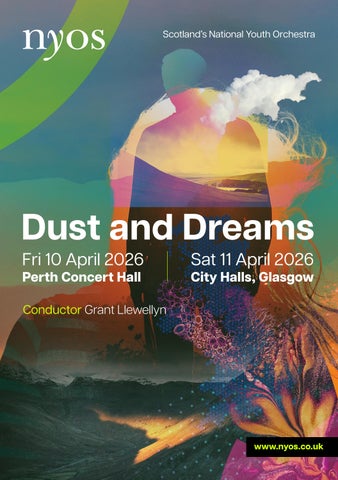
NYOS presents Dust and Dreams

Page 1


Dust and Dreams

Fri 10 April 2026

Perth Concert Hall

Conductor Grant Llewellyn

Sat 11 April 2026

City Halls, Glasgow

Dust and Dreams 26

Conductor

Grant Llewellyn

Sarah Lianne Lewis

Creatures of Dust and Dreams

Peter Maxwell Davies

Orkney Wedding, with Sunrise

Ralph Vaughan Williams A London Symphony

Welcome

Eirene Cai, Violin

Thank you for joining us for NYOS: Dust and Dreams. We’re thrilled to be sharing this performance with you all tonight.

Across the world, people connect with music because it speaks to us in a language we can all understand; it has the power to unite us, bringing us together despite our differences. It’s for this reason that performing with the NYOS orchestra means so much to me, especially since I’ve been doing it for quite some time now. It has enabled me to perform music with people that love it as much as I do, make memories that will last a lifetime, and access incredible opportunities. I’m grateful to be part of such a fun and supportive community that’s built on a deep appreciation for music – it’s like being part of a huge family.

Pieces such as Sarah Lianne Lewis’ Creatures of Dust and Dreams remind us how important connection is. It is a composition which puts our teamwork to the test as we bring our individual voices together as an ensemble. As musicians, we relate to each piece differently, contributing our unique perspectives and learning from one another; I’m looking forward to seeing how the audience responds to the picture that emerges from this process. I am most excited to perform Ralph Vaughan Williams’ A London Symphony, it is a bold and colourful piece and I enjoy every moment of it. It’s also worth keeping an ear out for the highland bagpipes which make a grand entrance midway through the concert – I expect it will be a real highlight for the audience!

On behalf of the orchestra, I’d like to take this opportunity to thank you once again for joining us for tonight’s performance, we hope you enjoy the concert.

NYOS Orchestra

VIOLIN I

Lucy Hanson, Leader

Rhea Fitzgerald

Ryan Chan

Zoe Drysdale

Becca Ye

Sophie Guo

Kirsty Kitchin

Theo Arkinstall

Nellie Heinrich

Samuel Jones

Emlyn Jones

Jenna Wong

Caitlin Ke

Rebekah Bullivant

Amelia Mashwani

VIOLIN II

Rebecca Greig, Principal

Andrew Irvine

Emily Yang

Eirene Cai

Robert Hutchinson

Joseph Knapper-Hirst

Leah Bullivant

Rebecca Digger

Suri Tang

Talitha Williamson

Hannah Nicholson

Charlotte Vermeren

Sandra Janiszewska

VIOLA

Laura Lau, Principal

Adeline Boulet

Victoria Abbey

Annina Fourie

Daniel Snee

Adam Bishop

Seona McKendrick

Matteo Caridà

CELLO

Paul Oggier, Principal

Gogo Boumpouna

Laudika Monaghan

Daniel Armstrong

Gemma Gowans

Magnus Holden

Nicholas Cheung

DOUBLE BASS

Euan Coyle, Principal

Lillian Boyle

Glynnis Chan

Andrew Watson

Alexander Smith

FLUTE

Phoebe Jones, Principal

Emily Gow

Cora Preda

Olwenn Stewart

OBOE

Ellie Digger, Principal

Nicholas Howard

Eleanor Alford

Lucas Ryan

CLARINET

Lewis Sutherland, Principal

Maria Ludkin-Finnie

Oliver Cairns

Benjamin Bradshaw

BASSOON

Freya Liles, Principal

Emily Crump

Lachlan Timar

Chris Johns

HORN

Ada Biernacka, Principal

Magnus Graham

Ellie Wilson

Thomas Brotchie

Eilidh McLean

TRUMPET

Nadia Bedwell, Principal

Beth Harby

Rona Campbell

Julia Hyder TROMBONE

Lorna Rae, Principal

Reuben McFarlane

Marcella Haldane

Tom Lamb

TUBA

Eleanor Gaskell, Principal

PERCUSSION

Denholm Owens, Principal - Timpani

Kerr Donaldson, Principal - Percussion

Emma Dunn

Ellie Smillie

Kenzie Robertson

Ruaridh Docherty

Annabelle Nordmann, Principal

Genevieve Nordmann

BAGPIPES

Hamish Martindale,

National Youth Pipe Band of Scotland NYOS presents: Dust and Dreams

HARP

Grant Llewellyn

Grant Llewellyn is internationally renowned for his exceptional charisma, energy, and effortless authority in music of all styles and periods. He was born in Tenby, South Wales, and won a Conducting Fellowship to the Tanglewood Music Center in Massachusetts, where he worked with Leonard Bernstein, Seiji Ozawa, Kurt Masur, and André Previn.

Llewellyn maintains a close relationship with the BBC National Orchestra of Wales, whom he led on tour to South America, joined their 90th anniversary celebrations, conducted their Proms in the Park in September 2018, and led a broadcast in the 2025/6 season. His extensive experience across Europe includes guest engagements and previous conducting positions with the Antwerp Symphony Orchestra, BBC Symphony Orchestra, Helsinki Philharmonic, Philharmonia Orchestra, Royal Philharmonic Orchestra, Royal Scottish National Orchestra and Stavanger Symphony, amongst others.

In North America, after a distinguished seventeen-year tenure as Music Director of the North Carolina Symphony, Llewellyn returned last season for a symphonic programme and an education project. His conducting portfolio spans many of the continent’s leading orchestras, including those of Atlanta, Boston, Houston, Milwaukee, Montreal, Philadelphia, St. Louis, and Toronto, as well as an appearance at the Caramoor Festival with the Orchestra of St. Luke’s. During his time as Music Director of the Handel and Haydn Society, America’s premier period orchestra, he earned a formidable reputation as an interpreter of Baroque and Classical repertoire. He is also an accomplished opera conductor with repertoire ranging from Handel to contemporary music. Under his direction, Mathieu Bauer’s production of Stravinsky’s The Rake’s Progress, performed by the Opéra de Rennes, earned the Claude Rostand prize for ‘Best Opera Outside of Paris.’

He regularly leads education and outreach projects; in 2017, he led the first ever “relaxed” BBC Prom with the BBC NOW, a concert specially designed for those with autism, sensory and communication impairments, and learning disabilities.

Image © Laurent Guizard
NYOS presents: Dust and Dreams

Grant Llewellyn

Q. Vaughan Williams once wrote: “I always wish I had been an orchestral player myself. I am sure it would have taught me a lot.” What do you think young people can take away from playing in an orchestra?

A. I think that playing in a symphony orchestra is the most creative discipline possible and one of the greatest challenges we face, both intellectually and technically as a young musician. It is also one of the most thrilling experiences.

I vividly remember my first rehearsal with the Pembrokeshire school’s orchestra. From the back of the cello section in Schubert’s Rosamunde Overture and Ballet Music, it was utterly bewildering. I was suddenly surrounded by all these different instruments, each playing their own lines, together with which I was supposed to coordinate, tune, blend and balance, whilst watching the conductor, and fitting in with my section, oh, and remembering how to play the cello. Jumping ahead a couple of years to the National Youth Orchestra of Wales and Tchaikovsky’s 4th SymphonyI was totally out of my depth technically, but was carried along on the sheer wave of a large orchestra playing its heart out. This is what the members of NYOS have to look forward to, and frankly I’m a bit jealous.

Q. What do you think the audience might like to listen out for during the concert?

A. I’m looking forward to the effect in Sarah Lianne Lewis’ piece of her use of microtones and multiphonics, bending our ears to a unique sound world which will be new to many.

Anyone new to Orkney Wedding, with Sunrise and A London Symphony will immediately be struck by each composer’s ability to transport you to a place, time, and occasion. I haven’t been to Hoy on Orkney, yet having conducted Peter Maxwell Davies’ music, I feel I know it intimately. I do know London (my mother is an authentic Cockney), but this symphony takes us back to London circa 1914 and immerses us in the sights and sounds of the time.

Q. You’ve spoken about your experiences as a stroke survivor - it’s clearly something you’ve taken in your stride, learning and growing from it. What drives you as an artist, and how have you adapted your conducting technique?

A. The desire to communicate the music is always my main motivation. To share this art form with others is a privilege, but also a great responsibility. I am very fortunate that my stroke 6 years ago has not significantly affected my ability to realise this responsibility. However, I cannot meaningfully use my right arm, so batons are out, and turning pages, as well as directing proceedings, with my left is sometimes a tall order. Therefore, I will be using a screen attached to an iPad attached to a foot pedal to conduct.

Wish me luck.

Creatures of Dust and Dreams

Year of composition 2021

Duration 10 minutes

The world in 2021

The first malaria vaccine is approved by the World Health Organisation.

Joanne Anderson is elected Mayor of Liverpool, becoming the first Black woman to lead a major UK city.

Notes on Composition

Sarah Lianne Lewis is a contemporary Welsh composer known for bold work that moves fluidly between acoustic and electronic sound. Her music unfolds as fine-grained, layered sound worlds, often reflecting the deep-rooted connections between the natural environment and human experience.

She writes: Creatures of Dust and Dreams is a playful, exuberant piece, with spinning, whirling figures throughout the orchestra, with microtonality (pitches outside of the 12-tone equal temperament) featuring throughout. The use of quarter-tones creates a forced brightness during the opening section, and a descent to –subsequently – a warmer yet mysterious tone within the middle section.

unravelling of musical motifs. The best analogy I can make is that it’s like going for a walk with the music; you can stop to look at a certain view, or occasionally wander away from the path, but you always have the end point in mind, a destination to guide the purposeful meandering. Whilst this piece feels different in nature, the compositional approach is the same.

There’s a playful curiosity to the way the material is explored. Each musician becomes a soloist within the larger body of the orchestra - if only for a few seconds at a time.

Further listening

Sarah Lianne Lewis | L’ile des jamais trop tard

A symphonic tale for narrator, solo piano and orchestra which follows Lise, a ten-year-old islander for whom the threat of climate catastrophe is an immediate reality. Its premiere performance was led by Grant Llewellyn who conducts the NYOS orchestra tonight.

Floating Points and Pharoah Sanders with the LSO | Promises

Transcendent, dream-like sonic portraits mingle with expansive orchestral tableaus and synthesiser motifs in this highly acclaimed collaborative work, which adeptly integrates contemporary classical music with electronic and jazz stylings.

The initial idea for this piece can be found in the middle section. There are certain multiphonics played on the clarinet (where two or more notes sound from using non-standard ways of playing). Chords in the strings emerge cloud-like from these multiphonics. To either side of this section, the musical material whirls, building and collapsing in on itself.

On the surface this piece could be seen as a departure from my earlier work. A lot of my work over the last few years has been spent exploring the smaller details and sounds of individual instruments, and the slow, focused

The work reflects on our inevitable human frailty and vulnerability, of falling and failing, and the choice to reach out and not only seek help from - but also offer help to - those around us in order to grow and achieve more together than we could have achieved individually. For a piece whose idea - and indeed title - was imagined in Spring 2019, with the initial sketching of ideas and structure taking place well prior to a world-wide pandemic, the title remains apt particularly in light of what we have collectively experienced over the last few years.

In the initial sketches for the piece, I had written the following lines:

“…but if I must first fall, then let me do so gently; my bones are fragile, for we are made only of dust and dreams.”

Sarah Lianne Lewis © Yusef Bastawy

1 in 2 NYOS participants receive bursaries to support their attendance.

Thanks to the generosity of our donors, approximately 1 in 5 orchestra members will be enabled to attend entirely free of charge.

It is vital that no young person misses out on their place in NYOS due to financial circumstances. That is only possible with your help.

Your donation, whatever the size, will help a brilliant young musician to enjoy the life-changing experience of playing in Scotland’s national youth orchestra.

Please support the NYOS bursary programme today!

www.nyos.co.uk/support-us

The Impact of Your Support

Ellie’s Story

Ellie is a percussionist from Glasgow currently studying Music Education at the Royal Conservatoire of Scotland as part of the BEd programme. Ellie’s bursary support made her participation possible; as a young carer for her mum, she emphasised that the financial assistance and break from caring responsibilities were life-changing. She is passionate about widening access to the arts and challenging stereotypes around orchestral music, particularly for young people from deprived backgrounds and for women in percussion.

“I have never been abroad; my family has never been able to afford it. The NYOS Bursary I received made this trip possible for me. There are many hidden costs to playing an instrument; with the NYOS bursary covering course fees, this is one less worry when having to buy new sticks for the course. It’s really nice to feel supported by the NYOS Community, without whom I would not have access to these amazing, high-quality learning experiences. Thank you!”

Feedback from Ellie

Ellie Smillie © Sally Jubb
NYOS presents: Dust and Dreams

Orkney Wedding, with Sunrise

Year of composition 1985

Duration 13 minutes

The world in 1985

The wreckage of the RMS Titanic is discovered 400 miles off the coast of Newfoundland, Canada.

The first mobile phone call in the UK is made to the Vodafone network.

Further listening

Ida Moberg | Soluppgång

This luminous work by Finnish composer Ida Moberg envisages a new dawn breaking over a resilient Nordic landscape. You may remember that the NYOS Development orchestra performed the opening movement from this radiant orchestral suite at Caird Hall in Dundee last summer.

Notes on Composition:

Between its jagged cliff faces, heatherblanketed meadows and restless shores, Orkney is at once unforgivingly elemental and abundantly lyrical. The poetic quality of the landscape – its wildness and antiquity – had a profound impact on composer Peter Maxwell Davies. “It is Orkney,” he remarked, “which has given me a sense of space in my music … a sparse landscape where the smallest detail becomes monumental.” Maxwell Davies moved to Orkney in the early 1970s, renovating a small derelict cottage that had sheltered sheep for thirty years. Inspired by a neighbour’s wedding in 1978, Orkney Wedding, with Sunrise is one of several “light pieces” he composed whilst living on the windswept island of Hoy.

At its opening, we arrive, weatherbeaten, on an Orcadian island: chromatic flourishes lash us like squalling wind, agitating the water’s surface and beating round the rocky headlands. Soaked to the skin, the guest’s spirits begin to lift once stiff drinks meet their blue lips. The band strikes up; the reel and strathspey inspire feverish dancing. Day slips into night and night creeps towards morning. The dancing grows wilder; the musicians grow drunker – there’s little the lead fiddle can do to hold the line. We leave the whisky-soaked wedding party in the wee hours of the morning, emerging into unshapen Orcadian darkness. As we pick our way across the island, highland bagpipes herald the first rays of sunlight. Their brilliance illuminates our path home.

Unlike his resolutely expressionist compositions of the 1950s and 60s, Maxwell Davies’ Orcadian pieces draw on a more open, tonal palette, shaped by folk modality, ritual, and the rhythms of island life. Completed in 1985, Orkney Wedding bears the hallmarks of a composer who had absorbed the rhythm and character of island life: its rough-hewn humour and tonal exuberance stand in marked contrast to the angular austerity of his earlier output. This shift was initially charted by his First Symphony (1976), a piece which retains his modernist idiom but tempers the acerbic bite of his atonal expressions with intricate, meditative passages. Some critics interpreted this stylistic shift as a veiled attempt to court success, which Maxwell Davies dismissed as a cynical misinterpretation of his intentions.

Despite some critics’ detractions, it is little wonder that Orkney Wedding remains one of Maxwell Davies’s most beloved pieces. It unravels a story that is equal parts unruly and tender, from tempestuous opening to luminous close. We hope that the NYOS performance of Orkney Wedding whisks you away to the craggy shores that inspired this singular piece.

Paul Maxwell Davies © Martin Lengemann

Ralph Vaughan Williams (1872 – 1958)

A London Symphony (Symphony

No. 2)

Year of composition 1920, rev. 1933

Duration 45 minutes

The world in 1933 King Kong premieres, captivating movie audiences around the world.

The first stereo recording is cut to a wax disc by British engineer, Alan Blumlein. Inspired by a trip to the “talkies”, Blumlein’s stereo technology aimed to make audio recordings more realistic and immersive.

Further listening

Vaughan Williams | Symphony No. 3 ‘Pastoral’

A restrained and elegiac work, shaped not by rural idyll but by Vaughan Williams’ wartime experience and the altered emotional landscape it left behind.

Stravinsky

| The Rake’s Progress

A modern Faustian fable in operatic form which pairs a tale of ambition and temptation with Stravinsky’s characteristically bright, ironic neo-classical language. The main character, Tom Rakewell, betrays his love for the seductive draw of London, in the company of Nick Shadow, who (spoiler alert) turns out to be the Devil.

Notes on Composition:

Ralph Vaughan Williams stands apart as one of Britain’s most influential symphonists; his nine symphonies chart nearly sixty years of artistic evolution. A pupil of Ravel, a close friend of Gustav Holst, and a mentor to emerging talents such as Welsh composer Grace Williams, he forged a musical identity rooted in English song and coloured by cosmopolitan craftsmanship. A London Symphony, his second, occupies a lustrous place in his output. Despite a title that might suggest patriotic pageantry, this is a work of introspection rather than pomp – a kaleidoscopic musical portrait of a city glimpsed through atmosphere, memory, and the composer’s own wandering imagination.

The symphony’s origins are as dramatic as the city it evokes. Completed in 1914 and premiered shortly before the outbreak of the First World War, it underwent a series of substantial revisions that continued well into the 1930s. The early manuscript was famously lost in transit, failing to make its way to conductor Fritz Busch in Germany. Vaughan Williams painstakingly reconstructed the score from surviving orchestral parts, revising and refining in the process. Whether driven by necessity or by an evolving artistic vision, these changes resulted in a work of leaner proportions but heightened atmospheric power. Its title derives from the final chapter of H. G. Wells’ Tono-Bungay, a novel whose primary narrator and protagonist

is London itself. The Thames bears witness to the passing of empires which haunts the epilogues of both Wells’ and Vaughan Williams’ works. This sense of impermanence pulses beneath the surface of the symphony, portraying pre-war London as it anticipates its own transformation.

In the years leading up to the symphony’s composition, Vaughan Williams travelled the country, collecting over 800 songs from traditional singers, preserving a heritage on the brink of disappearance. The composer’s fascinating relationship with English folksong formed the bedrock of his own musical language; the modal contours and candid immediacy embedded in the English musical tradition seep into the symphony – not as direct quotations but as a stylistic undercurrent shaping harmony, phrasing, and colour. At the same time, his studies with the French composer Maurice Ravel imparted a clarity of texture and finesse of orchestration that animate the work’s bold sonic palette. Together, these influences create a work that is both grounded in English soil and shaped by European modernism.

Performing the symphony is a richly rewarding challenge: its atmospheric subtleties demand precise ensemble playing; its long-breathed melodies require both stamina and sensitivity; its shifting urban tableaux call for an orchestra capable of rapid character changes. The resulting sound world

Ralph Vaughan Williams © E.O Hoppe

of A London Symphony is rich with evocative detail. In the opening bars of the piece, nocturnal solace is roused by Westminster’s chimes which glimmer briefly in the harp before the orchestra surges into life, conjuring the sweep of a bustling metropolis.

The Lento movement offers a nocturnal panorama: the plaintive cry of a lavender seller, led by solo viola, mingles with the delicate, pattering trills of horsedrawn hansom cabs, suggested by soft percussion. Later, in the scherzo, echoes of street musicians emerge: the wheeze of harmonicas and accordions, reimagined through strings and muted horn, replace the folk melodies tumbling out of a nearby London pub. These scenes are impressions rather than literal depictions: blurred, shifting, and suffused with the ‘grey skies and secluded byways’ that George Butterworth – Vaughan Williams’ friend who would soon perish in the trenches –admired in the original slow movement.

In its final pages, we approach the banks of the Thames. As the light begins to fail, the river seems to carry time itself onwards, the endurance and fragility of the world represented by its steady passage. Ending our journey on its banks, consider how this great river remembers a city under Roman rule; a London conquered and reconquered; a time when it choked glowing embers; when it swallowed ash and blood.

‘The last great movement in the London Symphony in which the true scheme of the old order is altogether dwarfed and swallowed up ... Light after light goes down. England and the Kingdom, Britain and the Empire, the old prides and the old devotions, glide abeam, astern, sink down upon the horizon, pass – pass. The river passes – London passes, England passes.’

H.G. Wells, Tono-Bungay

Tonight’s performance invites listeners into Vaughan Williams’ London: vibrant, elusive, and already in the shadow of the coming war.

NYOS Academy

Ready to take the next step in your musical journey?

13 & 14 July 2026

Perth 15 & 16 July 2026 Aberdeen 17 & 18 July 2026

NYOS Trusts & Foundations

Leverhulme Trust

National Youth Orchestras of Scotland

Endowment Trust

ABO Sirens Fund

A M Pilkington Charitable Trust

AMW Charitable Trust

A Sinclair Henderson Trust

Baird Educational Trust

Bransford Trust

Brownlie Charitable Trust

Cockaigne Fund, administered by Foundation Scotland

Countess of Dunmore’s Charitable Trust

Cruach Trust

Cruden Foundation

The Daphne Hamilton Trust

Dunclay Charitable Trust

Forteviot Charitable Trust

Hinshelwood Gibson Trust

Hope Scott Trust

H R Creswick’s Charitable Trust

Hugh Fraser Foundation

Jennie S Gordon Memorial Trust

Jimmie Cairncross Charitable Trust

John Mather Trust

JTH Charitable Trust

Leng Charitable Trust

Len Thomson Charitable Tryst

Martin Charitable Trust

McGlashan Charitable Trust

MEB Charitable Trust

Misses Barrie Charitable Trust

Miss Jean R Stirrat’s Charitable Trust

Mrs Rowena Goffin’s Charitable Trust

Nancie Massey Charitable Trust

Pear Tree Fund for Music

P F Charitable Trust

Radcliffe Trust

Ronald Miller Foundation

Scops Art Trust

Sir Iain Stewart Foundation

Stevenson Foundation

Talteg Ltd

Tay Charitable Trust

Thomson Charitable Trust

Tillyloss Charitable Trust

Turtleton Charitable Trust

Vaughan Williams Foundation

W A Cargill Fund

William Grant Foundation

NYOS Donors & Sponsors

Conductors’ Circle

Ms Lindsay Pell and Professor Chris Morris

Professor Marjorie and Dr David Rycroft

Principal Chair Sponsors

Mr and Mrs Michael Pell, Bassoon

Alistair Allan, Cello

Sue Strudwick, Clarinet

Mrs A M Bennett, Double Bass

Dr Myra Soutar, Horn & Second Violin

Graeme and Ella Wilson, Percussion

Mr and Mrs Timothy Laing, Piano & Celeste

Chair Sponsors

Kirsty Adam, Cello

Charles Arbuthnot

Tim and Sally Barraclough, Percussion

Mrs Isabella Brown

Lord and Lady Cameron of Lochbroom, Violin

Andrew Hadden, Violin

Professor David Hamilton Lawson, Oboe

Fabienne Harrison, Cello

Duncan and Sarah McIntyre, Second Violin

Mr and Mrs Thomas McCreery

Mr Robin Pagett

and Mrs Kate Longworth

In memory of Ian Robertson, Bassoon

Mr and Mrs Mark Seymour

Maureen Simpson, Viola

Mr A L Stewart, Horn

Graham Taylor MBE, Trombone

Mrs Ann Verney, Cello

Mr and Mrs R M Williamson

Dr and Mrs Paul Wilson

Honorary Chair Sponsors

Sarah Chester, in memory of Richard Chester MBE

We are grateful to all our funders and sponsors listed above, to those who wish to remain anonymous, and to the Friends of NYOS for their continued support.

Please contact jackjohnson@nyos.co.uk

if you would like to amend or add a supporter credit to future programmes.

INSPIRING MUSICAL FUTURES

A full-time, specialist Music and Academic education in the heart of Edinburgh for talented young musicians. Day and boarding places available.

Applications open for instrumentalists, singers, composers and choristers

www.stmarysmusicschool.co.uk

admissions@smms.uk | +44(0)131 538 7766

SETTING THE STANDARD FOR EDUCATION

From our classrooms to national stages. Our exceptional Music Department gives pupils the skills - and the spotlight.

Find out more highschoolofglasgow.co.uk

NYOS Team

NYOS Board of Trustees

Dr Samuel White, Chair

Alistair Allan

Francis Cummings

Caroline Dooley

Ken Fairbrother

Marianna Hay MBE

Kenneth Law

Adam Lee

Roger Wilson

Pastoral Team

Yla Garvie, Head of Pastoral

Stella Beckley

David Cumming

Isabella Gonzales-Diaz

Rebecca Goodwin

Duncan Hughes

David Paterson

Emily Stokes

NYOS Staff

Dr Kirsteen Davidson Kelly, Chief Executive

Neil Fox, Director of Engagement

Jack Johnson, Head of Development

Susanne Richardson, Head of Finance

Nicola Pickavance, Fundraising Consultant

Natalie Brayshaw, Orchestra Projects Manager

Isaac Holden, Engagement Projects Manager

Kate Fitzgerald, Marketing and Communications Manager

Carrie Connelly, General Manager

Marcus Cork-Keeling, Communications Officer

Haley Hartle, Executive Assistant

Steven Lamb, Stage Manager

Max Todes, Assistant Conductor

Richard Dill, Graphic Designer

Tutors

Meesun Hong-Coleman, Violin I & String Ensemble

Bernie Docherty, Violin II

Felix Tanner, Viola

Niamh Molloy, Cello

Nikita Naumov, Double Bass

Fiona Fulton, Flute

Amy Turner, Oboe

Joe Pacewicz, Clarinet & Wind Ensemble

Luis Eisen, Bassoon

Chris Gough, French Horn

Mark O’Keeffe, Trumpet

Alexander Kelly, Trombone

Andy Duncan, Tuba & Brass Ensemble

Sharon Griffiths, Harp

Calum Huggan, Percussion

NYOS presents: Dust and Dreams

Turn static files into dynamic content formats.

Create a flipbook