
NYOS Development | Spring 2026

Page 1


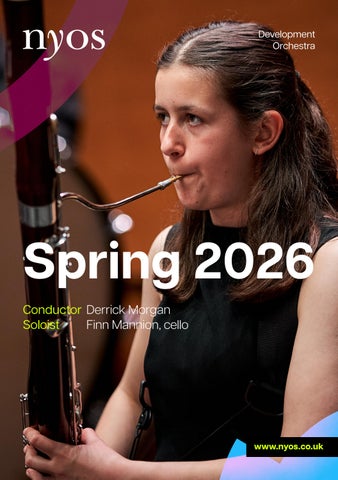
Spring 2026

Conductor Derrick Morgan

Soloist Finn Mannion, cello

Programme Development Spring Concert 26

Conductor

Derrick Morgan

Soloist

Finn Mannion, cello

Dora Pejačević

Overture in D Minor, Op. 49

Henriëtte Bosmans

Poème for Cello & Orchestra

Francis Poulenc

Les Biches

Maurice Ravel

Boléro

Welcome

Alex Layberry NYOS Development | Leader

Good evening and thank you for joining us tonight for the NYOS Development spring concert. We’re excited to share this performance with you all, uniting people from different backgrounds across the country, and I am very proud to lead the orchestra as first violin tonight.

During my time with NYOS, I’ve learned that commitment really is the key to success. Everyone works hard and dedicates time to practising, learning from one another, and working together as a team. It’s a fun, engaging and inclusive environment where we can grow as musicians and as people. It’s helped me to build confidence performing under pressure, especially since the pieces can be quite challenging.

I remember that, ahead of my first concert, I was very nervous because we were performing a difficult piece and I often struggled to get the ending right. When the time came to perform it as an encore, I got it all right! I am thankful for that moment. Moments like these remind us that we can succeed when we face up to challenges together.

Tonight, I’m particularly looking forward to performing Francis Poulenc’s Les Biches. It’s a vibrant piece and I cannot wait for the audience to experience the swell of the orchestra as we build from quiet moments to dramatic climaxes. It is a special feeling when our hard work and dedication pay off, when everything falls into place and comes together. It is a pleasure to share this experience with you and I hope that you enjoy tonight’s performance.

NYOS Development orchestra

VIOLIN I Local Authority

Alex Layberry, Leader East Lothian

Alice Reid Comhairle nan Eilean Siar

Amy Spears Stirling

Anna Coste Aberdeen

Carina Cai Edinburgh

Eliana Williamson Highlands

Fiona Wei Dundee

Jayden Chen Moray

Jessie Ke East Renfrewshire

Joanna Gui Angus

Lucas Chan Highlands

Olivia Ren East Renfrewshire

Stephanie Kitchin Glasgow

VIOLIN II

Local Authority

Thomas Peel, Principal Midlothian

Alice Newlands Dundee

Bernadette Kho East Renfrewshire

Beth Deighton Edinburgh

Emily Millard Clackmannanshire

Eric Mitchell East Dunbartonshire

Eshon Ray Glasgow

Evgeniya Dultseva Edinburgh

Man Wai Isabelle Lee Edinburgh

Nesta Goodacre Perth & Kinross

Olivia Singh Highlands

Rebecca Macaskill

Highlands

Roslyn Reid Glasgow

VIOLA Local Authority

Hazel Davies, Principal Scottish Borders

Disha Gondal Glasgow

Maddalena Di Emidio Edinburgh

Millie Cooke Aberdeenshire

Murray Nichols Perth & Kinross

Nirvana Balideh Glasgow

Tadhg Hegarty Edinburgh

CELLO Local Authority

Elena Sciaretta, Principal Fife

Adah East Stirling

Aldyth Tierney-Hynes Edinburgh

Ava Zhang East Renfrewshire

Clara Yearley Edinburgh

Hailey Gao Glasgow

Jonathan Leung Glasgow

Noah Knapper-Hirst Glasgow

Victor Lim Midlothian

BASS Local Authority

Harry Brady, Co-Principal Scottish Borders

Imogen Collins, Co-Principal Edinburgh

Charlie Clark Edinburgh

Joseph Baguley Aberdeenshire

Natalie Mulvihill Edinburgh

FLUTE Local Authority

Jemma Grosse, Principal East Lothian

Justine Davies Scottish Borders

Rachel Kelly Edinburgh

Luke Xu East Renfrewshire

DOUBLE

NYOS Development orchestra

OBOE

Esther Kallow, Principal Falkirk

Luke Macdonald Edinburgh

Eilidh Fisher Highlands

Catriona Ke East Renfrewshire

CLARINET

Ellie Whitelaw, Principal Dumfries & Galloway

Agnes Newton Edinburgh

Aaron Rae East Dunbartonshire

Lily Brannigan East Ayrshire

SAXOPHONE

Carys Conway, Soprano Renfrewshire

Aaron Rae, Tenor East Dunbartonshire

BASSOON

Anna Brady, Principal Scottish Borders

Rhona Kallow Falkirk

Eva Forsyth East Renfrewshire

Reece Hussar Stirling

SOPRANO

Carys Conway Renfrewshire

TENOR SAXOPHONE

Aaron Rae East Dunbartonshire HORN

Cat Polson, Principal Edinburgh

Beatrice Elliott Fife

Mia Lin Edinburgh

Katie Rourke Stirling

Martha Ellis Edinburgh

TRUMPET

Oliver Livingston, Principal East Renfrewshire

Hannah Black Glasgow

Oscar Korfker Moray

Jude Nugent East Dunbartonshire

TROMBONE

Patrick Summers, Principal East Renfrewshire

Max Wardrope East Dunbartonshire

Rebecca Madsen East Dunbartonshire

Tess Mary Devlin East Lothian TUBA

Stuart Rae South Lanarkshire

PERCUSSION

Brianna Ayanouvi, Principal Fife

Gregor Chalmers East Ayrshire

James Yu Glasgow

Michael Nordmann East Renfrewshire

Tytus Plonczkier East Dunbartonshire

Carys Conway Renfrewshire

CELESTE

Eshon Ray Glasgow

Jessie Ke East Renfrewshire

Derrick Morgan

Derrick Morgan’s conducting portfolio includes work with the BBC Scottish Symphony Orchestra, Scottish Ensemble, Hebrides Ensemble, Red Note Ensemble, The Assembly Project, and the BBC Singers. Outside of the UK, he has worked with the Norwegian Radio Orchestra, Auckland Philharmonia, and the Hungarian National Symphony Orchestra Szeged.

Derrick is a committed advocate for contemporary music. He led the Scottish Ensemble on the opening night of the 2025 Nordic Music Days festival, the very first time Scotland was represented at the festival. He has conducted numerous new works in both concert and educational settings and collaborated with the Assembly Project and Red Note Ensemble to present student compositions and adjudicate composition competitions at the University of Edinburgh.

Education and audience engagement are central to Derrick’s work. At the RSNO, he leads the orchestra’s partnership with Scotland’s Sistema programme, Big Noise, and conducts NYOS’ Engage programme. He was formerly Assistant Artistic Director of the RPS-nominated Nevis Ensemble, working with communities across Scotland, and subsequently supported the training of their Ensemble Fellows.

Derrick has assisted many of the world’s leading conductors, including the late Sir Andrew Davis, John Wilson, Karina Canellakis, Andrey Boreyko, Joanna Carneiro, and Sir James MacMillan.

Image © Martin McCready

Derrick Morgan

Q. What do you most enjoy about working with young musicians?

A. I really enjoy working young musicians as everything feels so fresh and exciting. Everything feels ‘new’. There are no expectations – just hunger to learn and create. I think one of the great joys of working with young musicians is their passion and curiosity. You can work in a way that is so much more exploratory and playful than other ensembles. You never know how things are going to end up!

Q. Are there any especially interesting or exciting aspects of the pieces that our audiences should “look out” for?

A. These works are so different from each other and really highlight the variety of different styles present in the 1920s. I think our audiences should look out for the swing in Pejačević’s overture. It dances along and makes me think about some sort of long lost dance hall. Bosmans’ Poème is such a bold work that totally wears its heart on its sleeve. Keeping with the dance theme I think everyone should listen out for the jaunty 5/4 dance that appears (maybe even try and clap along!?).

I think one of the most exciting things as a conductor is meeting a work for the first time and getting to know a completely new sound world. It’s also exciting watching an orchestra tackle an unfamiliar work and watching them fall in love with it too!

Q. Bosmans and Pejačević have only recently started to receive due recognition. What do you think is significant about performing works by lesser-known artists?

A. I think it’s a core aspect of our job as performers to give light to these voices. We can’t change history but we can give these works and artists the voices today that they were denied in their own time. Otherwise they are just forgotten and the old narrative will continue. The same goes for today, where we should be celebrating all voices and not just the ones who can push their way to the front more easily!

Q. Are you excited to be working with cellist and NYOS alumnus, Finn Mannion?

A. I have been really looking forward to working with Finn for some time and can’t wait to work with him. Working with a soloist for the first time or on a piece for the first time always has challenges. But it’s through those that we get the reward - music making! It’s such a wonderful process where we’ll both have our ideas on the work, and we will come out on the other side with something much better than what either of us imagined.

(1885 – 1923)

Overture in D Minor, Op.

Year of composition 1919

Duration 6 minutes

The world in 1919

Nancy Astor becomes the first woman to take her seat in the House of Commons.

The Bauhaus movement is founded in Weimar, Germany by Walter Gropius.

Further listening

Grażyna Bacewicz | Overture

A natural successor to Pejačević’s work, Bacewicz’s overture is a taut and thrilling piece, composed in the shadow of the Nazi occupation of Poland.

Notes on composition

Countess Maria Theodora Paulina ‘Dora’ Pejačević was born in Budapest to a Croatian count and a Hungarian countess and spent her early years in Našice in present-day Croatia. Something of a child prodigy, she mastered the violin and piano at a young age and began composing music at the age of twelve. By pursuing a professional career in music, she defied the conventions of her aristocratic background and the gender expectations of her time.

Having studied in Dresden and Munich, Pejačević was shaped by German late Romanticism while also embracing more progressive currents. Her modernist leanings drew the admiration of Arnold Schönberg, who – despite his notoriously prejudiced attitudes towards female composers – encouraged performances of her orchestral work Verwandlung (1915).

Pejačević became a pioneering figure in Croatian music; she introduced the concerto form to Croatia, and her Symphony in F-sharp minor (1917) is widely regarded as the first modern Croatian symphony. The first Croatian woman to publish orchestral works, she achieved significant recognition during her lifetime, yet much of her music fell into neglect after her death at just 38. The Overture in D minor was composed in 1919 following the First World War and balances Romantic expressiveness with Impressionistic colour.

Shadowed by Pejačević’s experiences nursing the wounded during the war, the work unfolds from sombre horn calls and low string tremolos into restless, driving timpani rhythms, evoking a nation searching for direction in the aftermath of conflict.

Pejačević’s legacy was finally unearthed in the 1980s, thanks to a comprehensive biography published by Croatian musicologist Koraljka Kos. A Croatian feature film, Kontesa Dora, followed in the 1990s and helped to spark national consciousness of the late composer. In more recent years, her works have become increasingly well-known and in 2023, the centenary of her death, BBC Radio 3 named Dora Pejačević ‘Composer of The Week’, with several of her works performed at the BBC Proms.

Dora Pejačević © Museum of the City of Zagreb

INSPIRING MUSICAL FUTURES

A full-time, specialist Music and Academic education in the heart of Edinburgh for talented young musicians. Day and boarding places available.

Applications

www.stmarysmusicschool.co.uk

admissions@smms.uk | +44(0)131 538 7766

Glasgow

13 & 14 July 2026

Perth

15 & 16 July 2026

Aberdeen 17 & 18 July 2026

Ready to take the next step in your musical journey?

Henriëtte Bosmans (1895 – 1952)

Poème for Cello & Orchestra

Year of composition 1923

Duration 15 minutes

The world in 1923

The iconic Hollywood sign is inaugurated in Los Angeles.

Tutankhamun’s burial tomb is unsealed by Egyptologist Howard Carter.

Notes on Composition

In the early 1920s, Amsterdam-born composer and pianist Henriëtte Bosmans emerged as one of the most distinctive musical voices in the Netherlands. She completed Poème in 1923, aged 28, having developed a deep, personal connection to the cello. Bosmans’ father, the cellist Henri Bosmans, died shortly after her birth –yet the instrument remained central to her musical identity and she composed six works for cello between 1919 and 1926. A celebrated concert pianist and outspoken nonconformist, Bosmans was a formidable musician whose artistic circle was as rich as her life.

The decades that followed cast a long shadow. As a bisexual woman with a Jewish mother, Bosmans’ existence was threatened under Nazi occupation. Her music was banned; she survived through private, illegal performances and in 1944 risked everything to plead personally with the Gestapo, the Nazi secret police, for the release of her 83-year-old mother from Westerbork transit camp. Against all odds, her mother was freed.

Further listening

Alexander Glazunov | Melodie for Cello

Another showcase of the cello’s incredible lyricism, a small jewel of late Russian Romanticism.

Poème was written in an early, joyous chapter of Bosmans’ life. It is her first major orchestral work – a concise, lyrical score that showcases her instinctive understanding of the cello’s expressive range. Having recently studied with Dutch modernist Willem Pijper, Poème features clear, glassy textures and suspenseful harmonies. Opening with a surge of late-Romantic warmth, the music grows from simple ideas that transform organically, unfolding in long, impassioned lines for the cello against a radiant orchestral backdrop featuring harp, a large wind section and warm brass.

Today, Poème stands as a vital contribution to early 20th-century Dutch music and a poignant testament to a composer of rare sensitivity and resilience. As cellist Gemma Rosefield has remarked, playing Bosmans’ music feels like encountering ‘an overwhelming force’. Though composed in her youth, the piece offers an artistic voice that is mature, unmistakably personal, and long overdue for wider recognition.

Henriëtte Bosmans © Jacob Merkelbach

Finn Mannion, cello

Born into an Irish family and raised in Scotland, cellist Finn Mannion began playing at a young age through regular exposure to the folk tradition of his homelands. He enjoys a colourful career as a soloist, recitalist, and chamber musician. Finn has performed all over Europe in major venues such as Wigmore Hall, Tivoli Vredenburg, Palau de la Música, Stadtcasino Basel, and Perth Concert Hall.

As a member of Trio Archai, he won First Prize and Beethoven Prize at the 2025 Schoenfeld International String Competition in China, and First Prize at the 2024 Royal Over-Seas League Competition in London. Increasingly recognised for his solo work, Finn is a 2026 BBC Scotland Young Classical Musician semi-finalist; a prize-winner of the Orpheus Swiss Chamber Competition and Tunnell Trust Concert Scheme; and recipient of the Beatrice Huntington and Vontobel LYRA Awards. Since 2023, he has been Associate Artist of the Aboyne Cello Festival. Finn collaborates with pianist Ke Ma and is regularly invited to give recitals at festivals including the Swiss Chamber Music Festival, Brighton Festival, Volta Kammermusikfest, Edinburgh Fringe, Mendelssohn on Mull, Whittington Festival, and Schaffhausen-Klassik.

Named a Royal Philharmonic Society Isserlis Scholar in 2019, Finn studied at St Mary’s Music School in Edinburgh before moving to Switzerland to join the class of German-Japanese cellist Danjulo Ishizaka at the Musik-Akademie Basel. He remains deeply grateful for the mentorship of Céline Flamen and for the dedication of his former teachers, Ruth Beauchamp, Alison Wells, and the late David Watkin. With a strong interest in Early Music, Finn continues to immerse himself in Baroque cello with Petr Skalka at the Schola Cantorum Basiliensis. In recent years, Finn’s musicianship has been influenced by working closely with Rainer Schmidt, Gordan Nikolic, Claudio Martinez Mehner, and Philip Higham. Further impulses stem from Alexander Lonquich, Nicolas Altstaedt, Steven Isserlis, and Thomas Adés at IMS Prussia Cove.

Finn has been generously supported by the Countess of Munster Trust, Caird Trust, Scandinavian Cello School, Cross Trust, and DOMS Stiftung. He plays a fine Italian cello by Giulio Cesare Gigli, c. 1788, kindly loaned by a private individual. Aside from music, Finn is an avid hillwalker, lover of dogs, and passionate street photographer.

Finn Mannion, cello

Q. I understand you were involved in NYOS yourself not so long ago –how does it feel to appear with the NYOS Development Orchestra as a soloist?

A. That’s correct, I was! I have strong memories from my first years in Training Strings (as it was called back then I think) aged 9 or 10, right through the Junior and Senior Orchestras and eventually into Symphony. NYOS was one of the first places that I met other young people who love music as much as I do and, although I’m returning in a different capacity this time, I’m still just as excited to experience that again.

Q. Have you met or worked with Derrick before? What do you think will be the challenges and rewards of working together?

A. I have not met or worked with Derrick, but I’ve heard great things… I’ve been to some concerts he conducted, so I’ve literally heard great things.

Derrick will have an interpretation of the Bosmans just as I do, so I’m really looking forward to exchanging ideas with him. It’s not every day that you get to work on non-standard repertoire with an orchestra, so I’m sure it will be a rewarding process. Challenges will definitely arise in the first rehearsal (I’d be worried if they didn’t!) but it’s so exciting and fulfilling to have to think on your feet in the moment. I hope to remain fluid and open with all my ideas.

Q. You’ll be performing Henriёtte Bosmans’ Poème for cello and orchestra. Had you come across this piece / Bosmans’ work in general prior to this? What were your first impressions of the piece?

A. Yes, I knew Bosmans’s Poème and had heard recordings of this piece prior to being asked to play it. I stumbled upon it when going down a YouTube rabbit-hole… There’s a pretty ancient recording from 1925 in which one of Bosmans’s cellist friends - Marix Loevensohn - performs Schubert’s Arpeggione Sonata. It’s absolutely stunning, like he has all the time in the world. Basically, this recording caused me to Google him. Bosmans was mentioned, so I then listened to her works.

Honestly, it took a while for me to get into it. I had had no other exposure to Bosmans’ music, so I made a point of listening to her other works. It wasn’t until I heard her string quartet live in Basel that it really clicked. Hearing these things live makes all the difference for me…

Q. Bosmans’ works were banned during the Nazi occupation –what do you feel is the significance of performing works from underrepresented artists and marginalised groups?

A. First of all, Bosmans’ music absolutely deserves the recognition it has recently started to receive and I think it’s significant that we perform her work just for that reason alone. There’s a demand for it, and programming marginalised composers can attract a more diverse audience. Performing her music today celebrates her artistic achievements and gives power to a voice that was deliberately silenced… I like the sense of purpose that it brings to performances.

Q. You’ve accomplished a great deal! Some of our young musicians may be looking to emulate you and pursue a career in music. Knowing what you know now, is there a piece of advice you might have offered yourself when you were starting out?

A. I think if I had to choose one word, it would be “exposure”. Almost any form of exposure to art is going to inspire you in some way if you are curious and open-minded - even if you don’t like it! It’s important to know what you gravitate towards, what you enjoy doing, and what you want to discover more of in future. Stay curious!

1 in 2 NYOS participants receive bursaries to support their attendance.

Thanks to the generosity of our donors, approximately 1 in 5 orchestra members will be enabled to attend entirely free of charge.

It is vital that no young person misses out on their place in NYOS due to financial circumstances. That is only possible with your help.

Your donation, whatever the size, will help a brilliant young musician to enjoy the life-changing experience of playing in Scotland’s national youth orchestra.

Please support the NYOS bursary programme today!

www.nyos.co.uk/support-us

The Impact of Your Support

Ellie’s Story

Ellie is a percussionist from Glasgow currently studying Music Education at the Royal Conservatoire of Scotland as part of the BEd programme. Ellie’s bursary support made her participation possible; as a young carer for her mum, she emphasised that the financial assistance and break from caring responsibilities were life-changing. She is passionate about widening access to the arts and challenging stereotypes around orchestral music, particularly for young people from deprived backgrounds and for women in percussion.

“I have never been abroad; my family has never been able to afford it. The NYOS Bursary I received made this trip possible for me. There are many hidden costs to playing an instrument; with the NYOS bursary covering course fees, this is one less worry when having to buy new sticks for the course. It’s really nice to feel supported by the NYOS Community, without whom I would not have access to these amazing, high-quality learning experiences. Thank you!”

Feedback from Ellie

Ellie Smillie © Sally Jubb NYOS Development 2026

Francis Poulenc (1899 – 1963)

Les Biches

Year of composition 1923

Duration 15 minutes

The world in 1923

The BBC’s first radio broadcasts begin from stations in Cardiff and Glasgow.

The first dinosaur eggs are discovered in the Gobi Desert, Mongolia.

Further listening

Darius Milhaud | Le Boeuf sur le toit

Originally conceived as incidental music for a Charlie Chaplin silent film, but destined to become a ballet staged by Jean Cocteau, more 1920s Parisian glamour with a surrealist edge.

Notes on Composition

Composed in 1923 for Serge Diaghilev’s prestigious Ballets Russes, Les Biches announced the arrival of a new voice in French music: the witty, refined brilliance of Francis Poulenc. Poulenc’s score embodies the spirit of 1920s Paris – playful and mischievous, yet also stylish and graceful. The ballet’s title (literally meaning ‘the does’ or female deer) references a Parisian slang term for charming young women, setting the tone for a work that delights the listener. Poulenc’s music captures this attitude with sparkling orchestration and crisp rhythms. Echoes of Mozart and Stravinsky mingle with café-concert cheekiness, creating a style that feels at once nostalgic and unmistakably modern.

Although conceived for the stage, Les Biches thrives as an orchestral suite. Its sequence of movements – ranging from the swaggering Rondeau to the smoky, blues-tinged Adagietto and buoyant Rag-Mazurka – invites listeners into a series of scenes rather than a fixed narrative. What binds them is Poulenc’s signature voice: an artful blend of flamboyance and elegance in equal measure. In performance, the piece becomes a celebration of orchestral character and colour. Beneath its glittering surface lies a composer with a keen ear for detail who refuses to take himself too seriously.

“I’m done with wrong notes, Schoenberg and everything that calls itself modern”
– Francis Poulenc
Francis Poulenc

Maurice Ravel (1875 – 1937)

Boléro

Year of composition 1928

Duration 16 minutes

The world in 1928

Paleoanthropologist Davidson Black reports the discovery of “Peking Man” in Beijing, now known as Homo erectus.

Women are granted equal voting rights to men in the UK.

Further

listening

Steve Reich | Runner

Like Boléro, the sophistication of Steve Reich’s Runner underlies its simplicity. A theme repeated at a constant tempo unfolds over five uninterrupted movements, each yielding a subtle rhythmic alteration. The propulsive effect produced is utterly compelling.

Notes on Composition

Few works for orchestra are as instantly recognisable – or as deceptively simple – as Boléro. Written in 1928 for dancer Ida Rubinstein, the work was considered highly experimental even by Maurice Ravel’s standards; the composer famously described it as ‘seventeen minutes of orchestration and no music.’ That modesty, however, conceals a masterpiece of control, colour, and tension.

At its core, Boléro consists of a single, unchanging snare-drum rhythm and two repeated melodies. What transforms these minimal ingredients into something hypnotic is Ravel’s command of the orchestra. One by one, instruments enter the spotlight – flute, clarinet, bassoon, saxophone, trumpet – each adding a new hue to the musical line. The effect is like watching a sculpture slowly turning on a pedestal: each rotation reveals a new feature, though the object itself never changes.

The steady crescendo builds subtly at first, gathering momentum as the orchestra swells to full force. In its final, thunderous restatement, the onceinnocent tune has become immense and thrillingly inevitable. For all its apparent simplicity, Boléro is a feat of discipline for performers; its relentless pulse demands unwavering precision, while its long, arching phrases call for lyrical finesse. It is music that draws the listener in through repetition and gradual transformation.

Nearly a century after its premiere, Boléro remains a unique experience –a demonstration of how one small idea, painstakingly crafted and patiently unfolded, can hold an audience’s undivided attention – from the first soft tap of the snare drum to the explosive final chord.

Maurice Ravel © Bibliotheque nationale de France

NYOS Trusts & Foundations

Leverhulme Trust

National Youth Orchestras of Scotland Endowment Trust

ABO Sirens Fund

A M Pilkington Charitable Trust

AMW Charitable Trust

A Sinclair Henderson Trust

Baird Educational Trust

Bransford Trust

Brownlie Charitable Trust

Cockaigne Fund, administered by Foundation Scotland

Countess of Dunmore’s Charitable Trust

Cruach Trust

Cruden Foundation

The Daphne Hamilton Trust

Dunclay Charitable Trust

Forteviot Charitable Trust

Hinshelwood Gibson Trust

Hope Scott Trust

H R Creswick’s Charitable Trust

Hugh Fraser Foundation

Jennie S Gordon Memorial Trust

Jimmie Cairncross Charitable Trust

John Mather Trust

JTH Charitable Trust

Leng Charitable Trust

Len Thomson Charitable Tryst

Martin Charitable Trust

McGlashan Charitable Trust

MEB Charitable Trust

Misses Barrie Charitable Trust

Miss Jean R Stirrat’s Charitable Trust

Mrs Rowena Goffin’s Charitable Trust

Nancie Massey Charitable Trust

Pear Tree Fund for Music

P F Charitable Trust

Radcliffe Trust

Ronald Miller Foundation

Scops Art Trust

Sir Iain Stewart Foundation

Stevenson Foundation

Talteg Ltd

Tay Charitable Trust

Thomson Charitable Trust

Tillyloss Charitable Trust

Turtleton Charitable Trust

Vaughan Williams Foundation

W A Cargill Fund

William Grant Foundation

NYOS Donors & Sponsors

Conductors’ Circle

Ms Lindsay Pell and Professor Chris Morris

Professor Marjorie and Dr David Rycroft

Principal Chair Sponsors

Mr and Mrs Michael Pell, Bassoon

Alistair Allan, Cello

Sue Strudwick, Clarinet

Mrs A M Bennett, Double Bass

Dr Myra Soutar, Horn & Second Violin

Graeme and Ella Wilson, Percussion

Mr and Mrs Timothy Laing, Piano & Celeste

Chair Sponsors

Kirsty Adam, Cello

Charles Arbuthnot

Tim and Sally Barraclough, Percussion

Mrs Isabella Brown

Lord and Lady Cameron of Lochbroom, Violin

Andrew Hadden, Violin

Professor David Hamilton Lawson, Oboe

Fabienne Harrison, Cello

Duncan and Sarah McIntyre, Second Violin

Mr and Mrs Thomas McCreery

Mr Robin Pagett

and Mrs Kate Longworth

In memory of Ian Robertson, Bassoon

Mr and Mrs Mark Seymour

Maureen Simpson, Viola

Mr A L Stewart, Horn

Graham Taylor MBE, Trombone

Mrs Ann Verney, Cello

Mr and Mrs R M Williamson

Dr and Mrs Paul Wilson

Honorary Chair Sponsors

Sarah Chester, in memory of Richard Chester MBE

We are grateful to all our funders and sponsors listed above, to those who wish to remain anonymous, and to the Friends of NYOS for their continued support.

Please contact jackjohnson@nyos.co.uk

if you would like to amend or add a supporter credit to future programmes.

Cosmic Sounds

Fri 10 July 2026

Perth Concert Hall

Sun 12 July 2026

Usher Hall, Edinburgh

NYOS Team

NYOS Board of Trustees

Dr Samuel White, Chair

Alistair Allan

Francis Cummings

Caroline Dooley

Ken Fairbrother

Marianna Hay MBE

Kenneth Law

Adam Lee

Roger Wilson

Pastoral Team

Eleanor MacQueen, Head of Pastoral

Simon Fullarton

George Hillier

Alison Hutchinson

Dan Kempsell

Annabelle Pizzey

Rachel Thain

Kirsty Thomson

NYOS Staff

Dr Kirsteen Davidson Kelly, Chief Executive

Neil Fox, Director of Engagement

Jack Johnson, Head of Development

Susanne Richardson, Head of Finance

Nicola Pickavance, Fundraising Consultant

Natalie Brayshaw, Orchestra Projects Manager

Isaac Holden, Engagement Projects Manager

Kate Fitzgerald, Marketing and Communications Manager

Carrie Connelly, General Manager

Marcus Cork-Keeling, Communications Officer

Haley Hartle, Executive Assistant

Steven Lamb, Stage Manager

Ammal Bhatia, Assistant Conductor

Richard Dill, Graphic Designer

Tutors

Roddy Long, Violin I & String Ensemble

Aisling O’Dea, Violin II

Shelagh McKail, Viola

Jessica Kerr, Cello

May Halyburton, Double Bass

Eilidh Gillespie, Flute

Fraser Kelman, Oboe

Andy Langford, Clarinet & Wind Ensemble

Bec Roberts, Bassoon

Steve Cowling, Horn & Brass Ensemble

Andy Connell-Smith, Trumpet

Tom Smith, Trombone

JP O’Hagan, Tuba

Zuzanna Olbryś, Harp

Tom Hunter, Percussion

Image

Turn static files into dynamic content formats.
Create a flipbook