CON V ERGING CA MPUS & COMMU NIT Y
NORTHWEST MISSOURIAN
THURSDAY, AUGUST 27, 2026
MARYVILLE, MISSOURI
NWMISSOURINEWS.COM
VOL. 115, NO. 1
@THEMISSOURIAN
Maryville officials address meeting concerns DAKOTA OSWALT Editor-in-Chief | @doswalt_NWMSRN
“I’ve gotten to the point where…I know this is going to be a battle that we’re gonna have to keep fighting for a while until we can get, like, people who represent our state to start fighting for us and helping us out with this issue,” Strauch said. He said he doesn’t plan to give up on fighting for Nodaway County, even if a data center does come to fruition. Strauch hopes to get younger people interested in advocacy. He noticed that many people signed his petition, but some aren’t speaking out or showing up to protests. “There’s people from a bunch of different generations that don’t really have the courage to speak out against these issues, because they’re afraid that they’re going to lose their status in Nodaway County…I’ve had some people in my family tell me, ‘Oh, you probably should just let everybody else do this,’” Strauch said. “If people in my generation don’t start doing something, like, we’re gonna have a lot of issues in the future.”
Amid the chaos of a potential data center coming to Nodaway County, The Maryville Forum reported on the Maryville City Council’s closed meeting regarding the project. Since then, The Forum also reported on numerous closeddoor meetings held by Council in the past couple of years, which possibly violated meeting laws. After The Forum published this, Maryville officials released a response on the city’s page. The statement said the city takes its obligations under Missouri’s Sunshine Law seriously. Sunshine laws require government agencies to make their meetings, records and activities open to the public, according to Cornell Law School. The goal of these laws is to ensure the government stays transparent, corruption-free and ethical. Missouri’s Sunshine Law only allows closed meetings with strict exceptions. Despite The Forum’s reports, city officials said in their statement that they “respectfully disagree” with the notion that Council inappropriately abused closed meeting laws. The Missourian reached out to City Manager Ryan Heiland, Mayor John McBride and the city’s general counsel Taryn Henry for an interview. They opted to respond to interview questions in a collective written statement sent by Heiland. “First and foremost, our city government operates in an open and transparent manner, and we conduct the people’s business in accordance with state laws,” the statement to the Missourian said. “We fully and carefully consider those legal requirements in consultation with the city attorney before holding closed sessions. That’s why we strongly dispute any accusations to the contrary.” The statement said Council only holds closed sessions when allowed under the Missouri Sunshine Law or other applicable law. Since every situation varies, city officials say they seek legal opinion to understand their obligations.
SEE DATA CENTERS | A4
SEE MEETINGS | A4
MICAH STOLLEY CONTRIBUTING WRITER
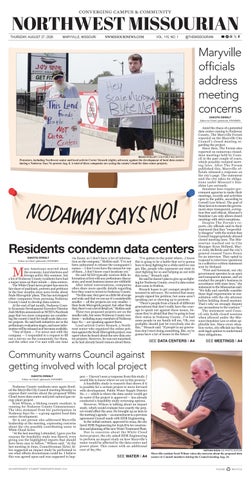
Protesters, including Northwest senior and local activist Carter Strauch (right), advocate against the development of local data centers during a Nodaway Says No protest Aug. 8. A total of three companies are eyeing the county’s land for data center projects.
Residents condemn data centers DAKOTA OSWALT Editor-in-Chief | @doswalt_NWMSRN
M
any Americans worried about the economy, local elections and foreign policy this summer, but a lot of Nodaway County residents have had a major issue on their minds — data centers. The White Cloud Acres project has seen its fair share of pushback, protests and petitions in the four months since news broke about Scale Microgrids’ plans. This has not stopped other companies from pursuing Nodaway County’s land to develop data centers. At the end of last month, Nodaway County Economic Development Executive Director Josh McKim announced on NCED’s Facebook page that two more companies are considering the county’s land for small-scale data center projects. He said both initiatives are in the preliminary evaluation stages, and more information will be released as it becomes available. “One of them — I’ve never met with the company — I responded to a request to fill out a survey on the community for them, and the other one I’ve met with one time
via Zoom, so I don’t have a lot of information on the company,” McKim said. “I’ve not been authorized to release the (companies’) names — I don’t even have the names for one of them…I don’t know exact locations yet.” He said NCED typically receives little information at first with any preliminary discussions, and most business names are withheld. After initial conversations, companies often share more specific details regarding how they want to invest in Nodaway County. “On this case, they gave us a little bit of scope and scale and that we can say it’s considerably smaller — all the projects are way smaller — than Scale Microgrids project, but other than that, there’s not a lot of detail yet,” McKim said. These two proposed projects are on the smaller side, but some Nodaway County residents — including many members of Nodaway Says No — are speaking against them. Local activist Carter Strauch, a Northwest senior who organized the online petition against the Scale Microgrids project, was upset when he heard about the new data center projects. However, he was not surprised, as he had already heard rumors about them.
Community warns Council against getting involved with local project DAKOTA OSWALT Editor-in-Chief | @doswalt_NWMSRN
Nodaway County residents once again flooded the Maryville City Council meeting Monday to express their worries about the proposed White Cloud Acres data center and joint natural gas energy plant project. Scott Wilson, a lifelong county resident, is running for Nodaway County Commissioner. The idea stemmed from his participation in Nodaway Says No — a group against local data center development. He is one person who addressed Maryville leadership at the meeting, expressing concerns about the city possibly contributing water to White Cloud Acres. “At the last meeting I attended, I gave you the reasons the feasibility study was flawed, even giving you the highlighted reports that should have been easy to follow,” Wilson said. “At the last meeting in June, Councilwoman (Erin) Allen suggested an impact study be performed to see what effects downstream could be. I believe this was agreed upon and was supposed to hap-
AN INDEPENDENT STUDENT NEWSPAPER SINCE 1914.
pen — I haven’t seen a response from this study. I would like to know where we are in this process.” A feasibility study is research that shows if it is possible for a certain project to move forward with development. Public Water Supply District No. 1 — which is where the data center would get its water if the project is approved — has already conducted a feasibility study reviewing options. However, Wilson is talking about an impact study, which would evaluate how exactly the project would affect the area. He brought up an item in the meeting’s agenda — an amendment to a previous agreement Council made with HDR Engineering. In the initial contract, approved in 2024, the city hired HDR Engineering for $156,879 for construction and planning of the new Water Treatment Plant. Due to concerns about the White Cloud Acres project, the city asked HDR Engineering to perform an impact study on how Maryville’s water would be affected by the data center and power plant. This comes with an additional cost of $9,780.
SEE WATER | A4
NATHAN NODA CO-PHOTO EDITOR
Maryville resident Scott Wilson voices his concerns about the proposed data centers to Council members during the Council meeting Aug. 24.
PLEASE
RECYCLE