Fifth Nature
Editor
MARSHALL Victoria Jane
GUO Lehana
Editoral Assistant
DU Xinyang
KARTHIKEYAN Shruthakeerthi
Graphic Design and Layout
GUO Lehana
DU Xinyang
© National University of Singapore, 2026
E-Magazine ISSN: 978-981-94-6690-0
Title: Fifth Nature: The Enclosed Garden
Co-designing Singapore’s Future Urban Form from Nature-Society Ecologies and Reserve Lands/Seas
Design Studio Report
AY 2025/ 2026
Semester 1
Landscape Architecture
Department of Architecture
College of Design and Engineering
Studio Coordinator
MARSHALL Victoria Jane (Dr)
Studio Instructors
GU Tiantong
GUO Lehana
TUNG Janice
THAM Waihon
Teaching Assistant
DU Xinyang
Guest Lectures
Zarina Muhammad
Since 1965, nature has been central to urban policy in Singapore. What nature? is an important question, for there have been various interpretations on the topic, each with powerful spatial outcomes and roles for landscape architects. Given the variety of interpretations, it might be reasoned that ideas of nature and society are not stable here. Might this be a positive trait? For it offers an opening for imagination. Learning from and with the nature-society ecologies that have been mobilised so far, the Fifth Nature studio will explore what other nature practices are needed for the immediate present and future.
Acknowledging that there is creativity and simplification in any act of categorisation, the Fifth Nature studio narrates four nature-society ecologies of independent Singapore; The Garden City 1971; City in a Garden 2004; City in Nature 2012; and Go-Green 2023. These four ecologies are distinct and form a useful comparative basis for discussion. As you will learn, each nature-society ecology is a state-led campaign that is imagined in relation to power, the lived landscape at a certain moment in time, and toward an aspirational future. Unlike those stateled campaigns, your fifth nature-society ecologies will explore expanded definitions of power (including nonhuman agency), it will be situated in your historic present, and arc toward a mode of practice that you wish to explore in your landscape architecture career. It is a creative research project.
Each state-led nature-society campaign has generated landscape design projects for landscape architects, making them more than just social ideas and more like lived ecologies. This linear statement – from urban policy to landscape design – might also be imagined the other way. Landscape architects not only respond to urban policy, but urban policy is informed by place. Meaning that everyday settlement ecologies and certain innovative landscapes created by residents, artists, and landscape architects can be prescient – and inspire novel ideas of nature-society relations, that are then formalised by the state. The Fifth Nature studio is positioned in this productive dialog between design and policy. Might you be open to the fact that your creative research project can have impact in ways that you cannot yet know?
While we are often told that Singapore is small, you will not be searching for a one size fits all solution. Supported by an assignment dedicated to theory development, each student will generate an individual project (paired projects are allowed with permission) on a given study area. Your project will demonstrate a distinct, locality-level transformation in urban form with a clearly articulated and spatially defined expression of emplaced nature-society ecologies. An important motivation for your designed transformation is the old-fashioned concept of “place” and the notion of designing with and for “incremental change” – you will not be creating a masterplan for a fixed future.
Overall, the studio emphasis is to function as a creative research hub that produces many scenarios. That is, the fifth nature studio is a space of multiplicity – a shared container full of many possibilities. Fifth nature(s), plural.
That is, the fifth nature studio is a space of multiplicity – a shared container full of many possibilities. Fifth nature(s), plural.
It is helpful to summarise the existing four nature-society ecologies. While they are presented here chronologically, they all coexist. Your fifth nature study area will surely interact with all these in emplaced ways.
The first nature-society ecology in independent Singapore is embedded within the Garden City. The Garden City is an urban model which was introduced in 1898 by Sir Ebenezer Howard (1902) in the United Kingdom and later interpreted into the Singapore context. In Singapore, the Garden City is first expressed in the 1971 concept masterplan, which has since undergone revisions in 1991, 2001 and 2011. Described by urban designers Peter Rowe and Limin Hee (2019, p. 43), the Garden City of Singapore in 1971 included many of the tropes from Howard.
First, there is the division of land into zones, particularly separating industry from the other uses. Second, there is the large catchment areas at the centre and both eastern and western sides of the island, which provide for extensive natural conservation areas, as well as public parks and recreation areas. Third, there are the major expressway and transit corridors that form the armature of connection between and among satellite communities and new towns. Fourth there is the idea of self-contained communities and in a manner similar to the Garden City ward and centre arrangement proposed by Howard in 1902.
It is important to grasp that the Garden City urban model was thought to solve the supposed problem of the congested and polluted city. The Garden City urban model as proposed by Howard is not to be confused with an image making campaign also entitled Garden City launched in 1967 by then Prime Minister Lee Kuan Yew.
In the initial phase, the Garden City image campaign launched by Lee Kuan Yew was implemented in with a vision of “clean and green”. It was expressed in the form of annual treeplanting, which is a practice that continues today. According to landscape architect Edmund Waller (2001, p. 53), the tree planting campaign was used to promote Singapore’s image abroad - to show foreign investors that the new government could “get things done”. Later, from 1971-1991, the garden city focused on residents through the development of small parks and landscaped pedestrian malls. These early aesthetic campaigns
were considered a success, which resulted in their scaling up as part of the vision of the Garden City Action Committee in 2004 and rebranded as City in a Garden policy.
City in a Garden is our second nature-society idea. Again, the summary by Rowe and Hee (2019, p. 45) is helpful for understanding the various dimensions to this policy and its designed landscape outcomes. The first goal was to “establish world-class gardens”. The Singapore Botanical Gardens and the Gardens by the Bay we created at this time. The second goal was to “rejuvenate urban parks and enliven the streetscape”, which is later seen in a Green and Blue Plan that focuses on networked landscape infrastructure. The third goal was to “optimize urban spaces for greenery and recreation” and fourth, to “enrich biodiversity in an urban environment”. As such, Bukit Timah Nature Reserve, the Water Catchment Area, the Labrador Nature Reserve, and Sungei Buloh were all created within this policy. The fifth goal was to “enhance competencies of the landscape and horticultural industries”, for example the Pasir Panjang Nursery, located adjacent to HortPark. The final goal was to “engage and inspire communities to co-create a greener Singapore”, which we will see later in the Go-Green initiative. The City in a Garden is thus an ambitious, multifaceted policy.
The landscape outcomes of The City in a Garden have been reflected upon. Geographers Lily Kong and Brenda Yeoh (1996) outline three “social constructions of nature” in Singapore that exist concurrently. On the topic of “salubrious nature, aesthetic landscape, and public playground” they argue that the language adopted to describe a pleasing “natural landscape” of The City in a Garden include “colour, variety and orderliness” (1996, p. 413). They state, while colour and variety were introduced into the city through natural vegetation, this was done with a clear objective of “order and system, and specifically, of not encouraging an indiscriminatory profusion of foliage and verdure”. This orderliness is seen to be “a form of nature acceptable to urban living, one in which there is no unruliness, and one which is managed by human hands”.
This maintained orderliness of the “natural landscape” of The City in a Garden is an intense experience of contrasts. For instance, landscape architect Joshua Comaroff and architect Ong Ker-Shing (2012, 2024) reflect upon the dual landscape practices of clearing “greening” so that it can appear like a garden and importantly, does not form “jungle” on the
one hand. And on the other hand, producing secondary forest “jungle” as reserve land through benign neglect. They argue that landscape construction (the clearing, “jungle”, and the garden) in Singapore of the early 2010’s is “a form of warfare” and an example of “paramilitary gardening”. The next nature-society ecology can be seen as an extension of the “environmentality” analysis by Comaroff and Ong (2024, p. 174; Also see Foucault, 1970), for the “return to nature” in the next nature-society idea is also highly prescribed.
The third nature-society ecology is entitled City in Nature, which was introduced in 2020 by NParks (2024). In this scenario, as Rowe and Hee (2019, p. 37) argue, the usual dominance of constructed over “natural” environments in city making is inverted. They state,
More recently, more of a convergence into a “city in nature” is emerging, with greater emphasis strongly on the identity aspect of an altogether tropical landscape in which living takes place befitting Singapore’s geographic and otherwise natural location. This latest “turn” on “garden” and “city” also argues for greater complementarity of green and blue aspects of Singapore’s intrinsic environment. It involves efforts to intensify the planting of more native and more diversified plant species; and through multi-layered heights of plants to emulate the forest structure and to create more ecosystems providing niches for different fauna species. The plantings are thus carefully curated in the beginning but will be left to grow and evolve naturally to produce a naturalistic rather than garden-like setting.
Thus, “tropical”, “intrinsic”, and “naturalistic” nature is given new value in the City in Nature. As Kong and Yeoh (1996, p. 416) note, nature as an economic resource is an idea that has been present in Singapore since the Colonial era. In the City in Nature campaign, mimicry of “primary” nature is an economic resource and “[tropical] nature is hence heritage”. It is conserved as part of “the nation’s consciousness of its own unique identity” and as a “magnet to draw tourists [and residents] who seek to escape the press of urban life to find the pure and pristine”. Such nature is now quantified digitally, for the City in Nature also brings with it technological optimism and environmental finance schemes. The (anthropocentric) biophilic approach and nature-based solutions are all present in the Active Beautiful, Clean Waters Program sites, Park Connectors, Nature Ways, the old Rail Corridor re-wilding, and the greening of many building facades and rooftops.
The fourth model is entitled Go-Green SG, which is led by the Ministry of Sustainability and the Environment and is championed by the new prime minister Lawrence Wong. Go Green is defined as a “whole-of-nation movement” to rally the community to take collective action for cleaner and greener Singapore experiences, based on individual lifestyles, personal interests and goals (Ministry of Sustainability and the Environment, 2024). Designed landscape projects in this nature-society ecology include tours, workshops and talks, volunteering, dining experiences, and events. GoGreen is thus, distinctly different than the previous nature-society ecologies. With its focus on personal responsibility, it marks a shift from the state-led construction of a scenic, orderly nature (City in Garden) and a tropical, heritage nature (City in Nature).
The curated, environmental action experiences of GoGreen can be thought of within a post-political frame, and as such critiqued as superficial. As geographer Harvey Neo (2021, p. 111) explains, postpolitics presents an “aura” of political openness without necessarily ceding political ground and political legitimacy to non-state elements, both in the way political issues are identified and defined, and in how they might be resolved. Thus, he argues that “there are limits to which environmental engagement as seen in Singapore can bring forth an emancipatory societynature relationship in the age of the Anthropocene”. Another way to learn about the critique of a campaign like Go Green (and city in Nature) is to look at what sociologist Alexander Stoner claims. He says, the “autonomous ecoconsumer” is an environmental subjectivity prefigured by neoliberal environmentalism (2020, p. 6). That is, while individualistic market actions can appear in opposition to environmental unsustainability, such “happy consciousness” (2020, p. 9) instead reproduces the social order of capitalist societies.
In order ground your fifth nature(s) creative research and have a productive engagement with the above four nature-society ecologies, we offer two prompts. The first prompt is the enclosed garden. Rather than the more often used spatial types of park, infrastructure, or “greening” our studio will relook at the earliest, spatial type of the enclosed garden. An enclosed garden is approached, entered, something happens that is an expression of an idea of nature, and one then exits, different. As the name describes, it is enclosed, which may be formed by a wall, but enclosure might also be shaped by vegetation, topography or a sensed condition like shade or sound. Importantly, an enclosed garden is open to the sky.
The second prompt is an introduction to critical nature-society theory, which might assist you to imagine anew within the present post-political impasse. You will read a book entitled More-than-Human by geographers Jamie Lorimer and Timothy Hodgetts (2024). More-than-human is an approach to critical environmental research that asks, “what happens to geographic thought when the separation of humans from the natural world is rejected”? Although more-than-human work is diverse, three shared concerns are identified in the book.
- First, an interest in the power of nonhuman organisms and material things to shape worlds, alongside actions by human beings.
– Second, an assertion that knowledge is not universal but is situated in time and place and therefore that different forms of knowledge are possible, and that these might conflict.
– Third, a close attention to the relations and processes through which worlds come together.
The studio is an individual and a collective research endeavour. Morethan-human geography is an emerging body of scholarship from cultural geography not landscape architecture, meaning that it is an analytical approach rather than a projective tactic. Thus, there are few intentionally built, “more-than-human landscapes” that we can point to as precedents. You must make the leap from analysis to projection in your own way, and in relation to your study area. In our exploration of the multiplicities of the fifth nature society-ecology we ask that you have an open mind and take your design research methods seriously. We also ask that you to trust in an interactive and collaborative design process across the whole five-studio collective. On the completion of the course, we will reflect as a group and see what we have made. Maybe there are some design outcomes, tactics, or practices that emerge as thematic? We do not know yet, and so all we must do is try and see what we can create together. This studio is the second of a three-year pedagogy project. Your projects form the middle-phase of a 2024-2026 community of practice on the topic of Singapore’s fifth nature-society at the Department of Architecture.
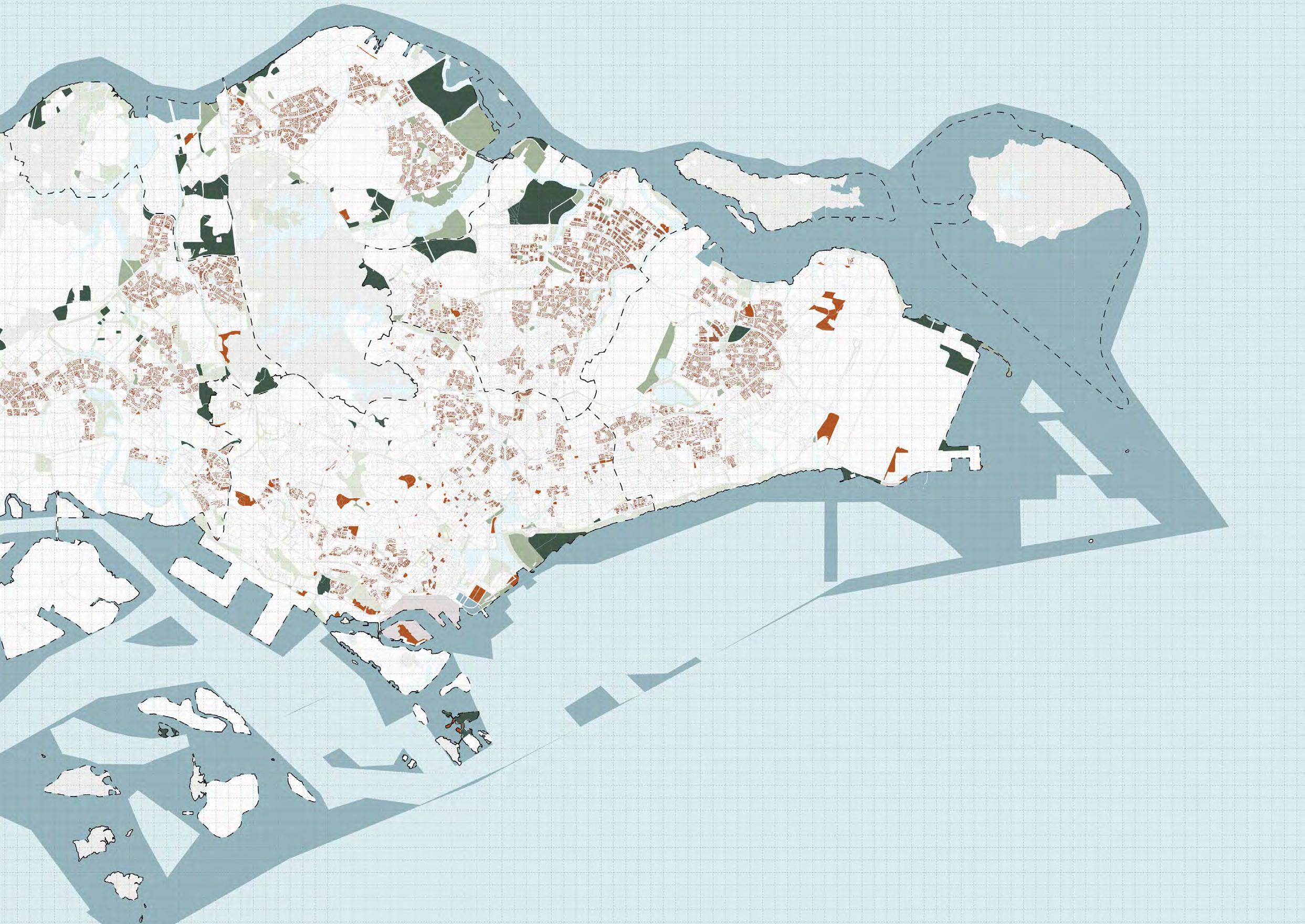
The reserve lands of Singapore can be thought of as “wooded” reserve land, “mowed” reserve land, “voided” HDB reserve land, “tidal” reserve sea. All these lands are in flux in the historic present and will be thought about in playful flux in our studio. They are in “reserve” for what nature-society ecologies? For instance,
• Since the 1800’s, “primary” forest land has been removed in Singapore, but some small patches remain (in conserved land and military land) and humans are (mostly) excluded.
•
• “Wooded” reserve lands have grown and might stay in place (as “jungle”), be cultivated as “park” or “enclosed garden” or might be cut down and become “mowed” reserve land or buildings with “voided” HDB reserve land (for example, Dover Forest).
•
• Future (“third forest”?), wooded reserve lands might be cultivated on “mowed” reserve land or on “voided” reserve land in HDB estates, or in parks (for example, “wilding” initiatives that “mimic” primary forest ecology). In such instance humans might be included or excluded.
•
• “Mowed” reserve land might stay in place or become buildings with “voided” reserve land, or as above, might by cultivated as (“third forest”?) wooded reserve lands. In such instance humans might be included or excluded.
•
• Similarly, “mowed” reserve land might stay in place or be cultivated as “park” or “enclosed garden”. Again, humans might be included or excluded.
•
• HDB buildings and “voided” HDB reserve land might get demolished, becoming “mowed” reserve land or be cultivated as “park” or “enclosed garden”. Again, humans might be included or excluded.
•
• Alternatively, “voided” HDB reserve land might be imagined as being cultivated as (“third forest”?) wooded reserve lands with HDB buildings being partially demolished, retrofitted, or relocated on site with increased verticality. Again, in such instance humans might be included or excluded.
•
• Lastly, who knows what will happen with our remaining sea?
Overall, your creative research project will be prompted by these guiding questions:
What if future urban form at the locality level is arranged in response to secondary (or third?) forests reserve land and place, rather than hard infrastructure like roads and MRT?
How might an enclosWed garden shape reserve land flux in an incremental way, rather by masterplan? Who or what does what, when, and how?
What spaces and practices does your enclosed garden afford? And how might surrounding incremental reserve land change shape such spaces and practices as “place” in time?
What modes of creative research are needed to explore such future imaginaries of garden, nature, society, and urban form? For instance, what fieldwork might you undertake, what archives might you explore, what exploratory drawings might be made, for whom or what?
What modes of representation are needed to communicate such future imaginaries of nature and urban form? For instance, what drawings, objects, or digital media might best express your project? What narratives might best orient a diverse audience?
How might an enclosed garden shape reserve land flux in an incremental way rather by a master plan? Who or why does what when and how?
Comaroff, J., & Ong, K.-S. (2012). Paramilitary Gardening: Landscape and authoritarianism. City Axioms: Urban (In)security, Department of Social Anthropology, Sweden.
Comaroff, J., & Ong, K.-S. (2024). Paramilitary Gardening: Landscape and authoritarianism. In A.-S. Springer & E. Turpin (Eds.),
Seeing Forest: Robert Zhao Renhui (pp. 160–176). K. Verlag & Singapore Art Museum.
Foucault, M. (1970). The Order of Things: An archaeology of the human sciences; Tavistock Publications.
Howard, E. (1902). Garden Cities of Tomorrow. S. Sonnenschein & Co., Ltd.
Kong, L., & Yeoh, B. (1996). Social Constructions of Nature in Urban Singapore. Southeast Asian Studies, 34(2), 402–423. Lorimer, J., & Hodgetts, T. (2024). More-than-human. Routledge. Ministry of Sustainability and the Environment. (2024). Go Green SG [Government]. Go Green SG. https://www.gogreen.gov.sg/
Neo, H. (2021). The post-politics of environmental engagement in Singapore. In Jobin, M. Ho, & H.-H. M. Hsiao (Eds.), Environmental movements and politics of the asian anthropocene (pp. 109–137). ISEAS Publishing.
Rowe, P., & Hee, L. (2019). A city in blue and green: The Singapore story. Springer.
Stoner, A. (2020). Things are Getting Worse on Our Way to Catastrophe: Neoliberal Environmentalism, Repressive Desublimation, and the Autonomous Ecoconsumer. Critical Sociology, 47(3), 1–16.
Waller, E. (2001). Landscape Planning in Singapore. NUS Press.
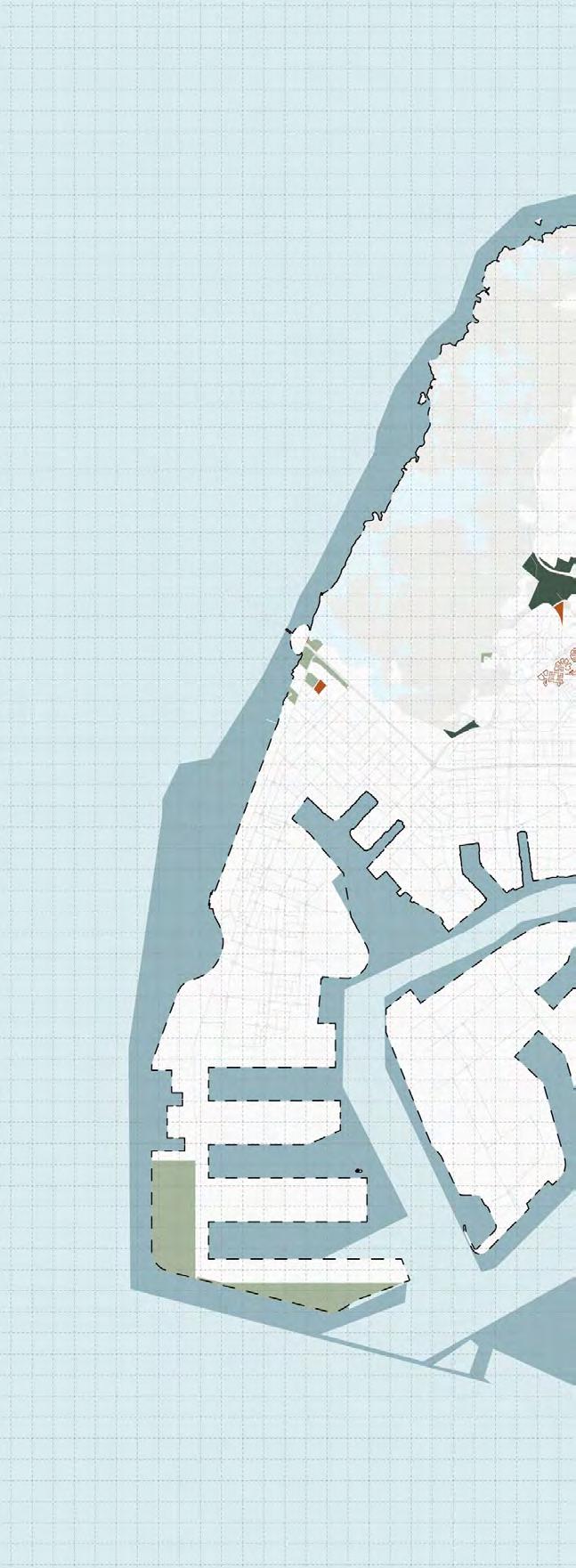
LEGEND
Housing Development Board
Reserved Sites with Trees (WoodedDominant Human Management)
Reserved Sites with Trees (WoodedLimited Human Management)
Reserved Sites without Trees (Mowed)
Reserved Seas (Tidal)
Open Spaces (Voided)
Waterbodies
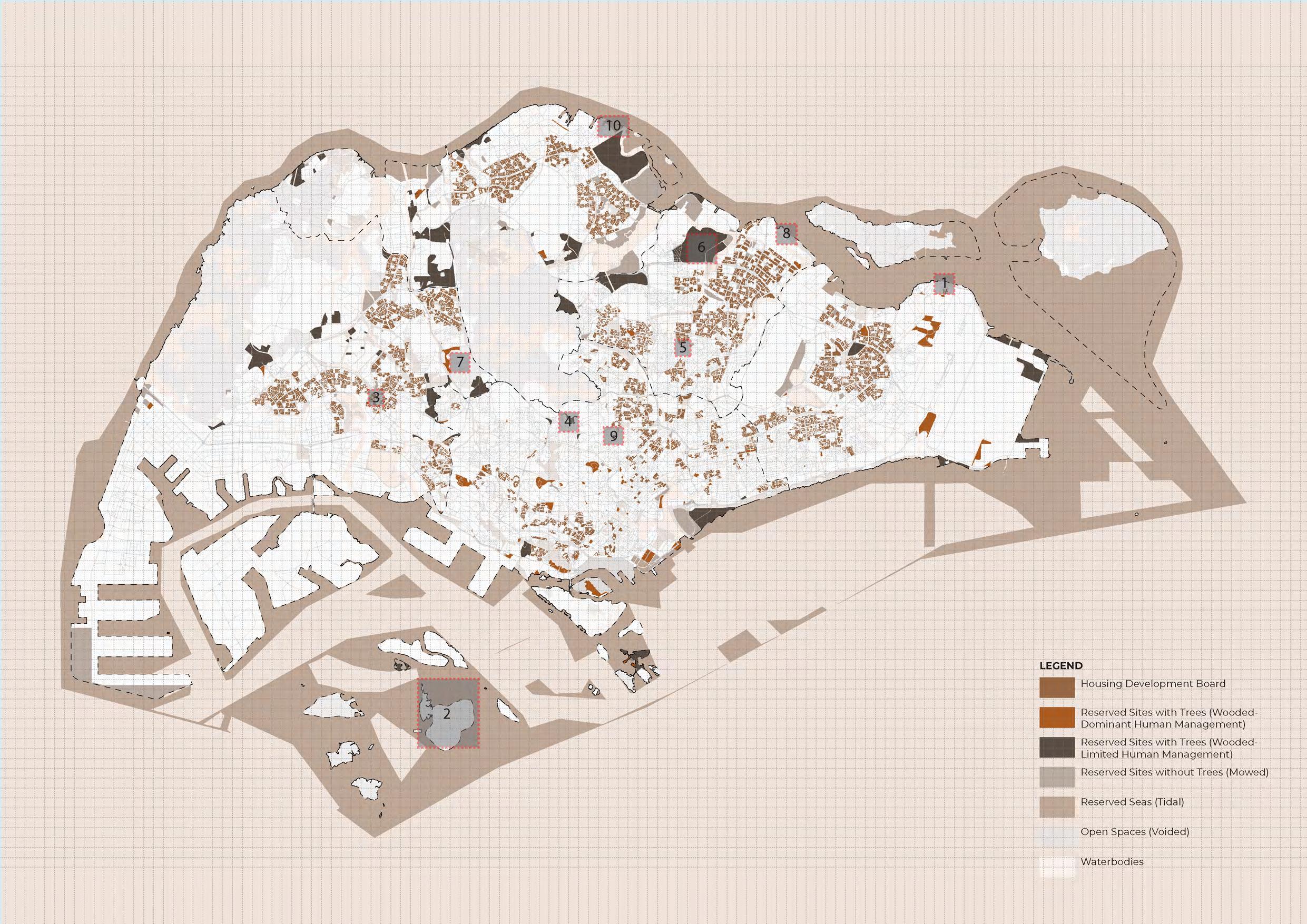
Projects:
1. Arunachalam Kothai – The Living Memory
2. Cai Jiaheng – Hacking into Semakau
3. Dang Van Trang – Earthing
4. Dong Yukun – Refracted Organism
5. Melissa Tang– Remembering / Forgetting
6. Ong Qin Hui – Shifting Grounds
7. Tan Jiayi Joey– Forest Beyond Fear
8. Wang Mu Qing – Living Shores: Reclaiming With Nature
9. Wu Han – Caring Portal: A Multispecies World
10.Lee Luyi – The Anatomy of the Intertidal
Projects in this chapter foreground the ways in which fifth nature produces spatiality through process rather than form. Here, fifth nature is not understood as an additional layer superimposed onto earlier concepts of nature, but as a dynamic field in which ecological, social, legal, and temporal forces are continuously translated into spatial expressions. The enclosed garden operates as the primary device through which these often-intangible processes are made perceptible, framed, and experienced.
Situated under the shared theme of the “Garden of Spatialised Processes,” the projects in this chapter engage with abstraction as a generative condition. Cycles of life and death, legislative boundaries, ecological rhythms, and social practices are not merely represented, but operationalised within space. Through spatial design, these processes are given form without being fixed, allowing landscapes to emerge through ongoing negotiation rather than static composition.
Projects such as The Living Memory Garden, Refracted Organism, Remembering/Forgetting, and Caring Portal: A Multispecies World translate the social rituals of care, mourning, and gathering into spatial patterns that are continuously inscribed and reworked over time. In these works, landscape becomes a medium through which memory, loss, and relationality are both held and reconstituted.
Other projects turn to processes of accumulation and material transformation. Earthing reframes maintenance as an active ecological and geological practice, revealing the often-unseen systems that sustain urban environments. Shifting Grounds traces the movement and redistribution of sand, exposing the fluid ecologies embedded within extraction and stockpiling while speculating on new forms of landscape that arise from such flux. Similarly, The Anatomy of the Intertidal repositions human activity within a broader metabolic system, where development is no longer conceived as an external imposition, but as a shared process of exchange between human and non-human agents.
Taken together, these projects articulate fifth nature as a condition of continuous becoming—where landscape is not designed as a finished object, but as an evolving interface shaped by the interplay of multiple, often invisible, processes.
Student Name: Arunachalam Kothai
Tutor: Wai Hon Tham
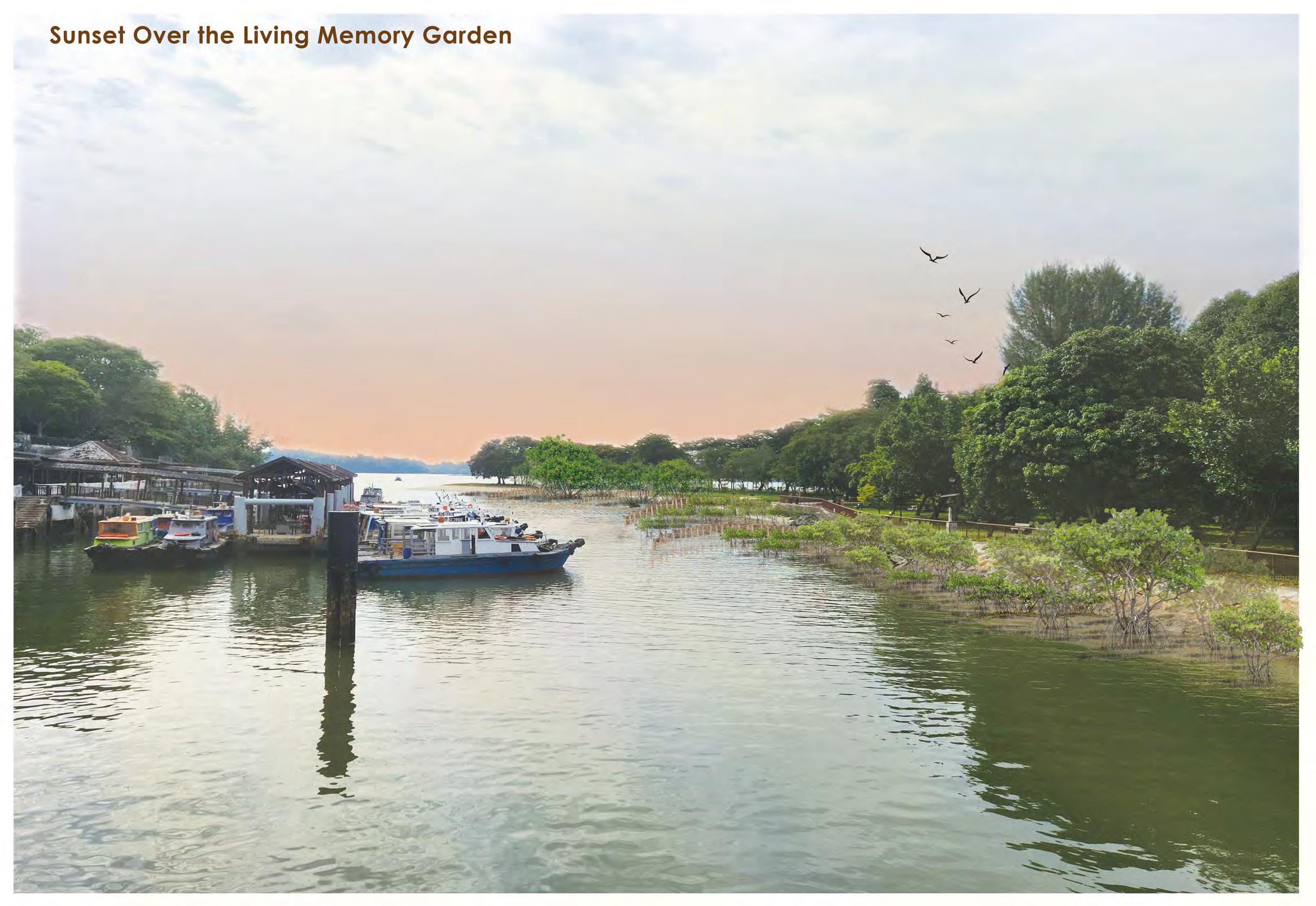
Nestled at Singapore’s eastern edge, Changi Village stands as a rare enclave where history and modernity coexist. Established during the British colonial era to house Royal Air Force personnel, the area gradually evolved from a quiet military settlement into a vibrant coastal community. The shoreline remains one of the few places where the coast still feels human in scale -green, slow, and open to the sea. Yet beneath its recreational calm lies a quieter, forgotten layer of meaning. Until recently the coast was the Hindu sea-burial ground, where ashes were released into the tides as a final act of return.
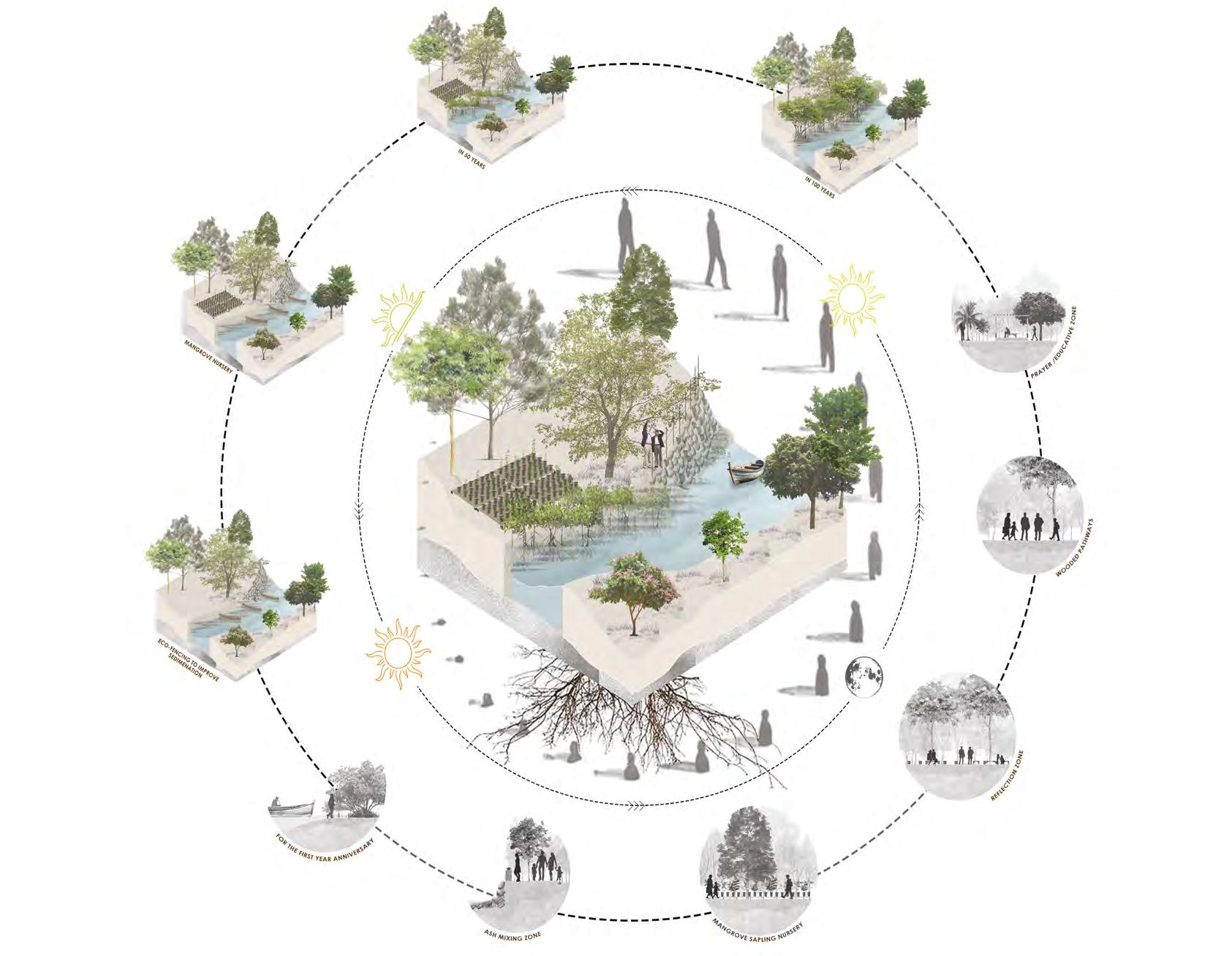
Reimagining this ritual in an ecological way, The Living Memory Garden envisions the Changi River as a contemporary Ganga, where the sacred act of release becomes an act of renewal. Human ashes are no longer scattered into the water but merged with soil and seedlings, forming biodegradable pods that give life back to the coast. The project transforms remembrance into regeneration a landscape that heals through time.
Within the garden sits a multifunctional prayer court, a quiet, shaded space that serves both practical and reflective roles. It provides a place for visitors to pause, gather, and learn about the ecological processes that shape the site how tides, sediment, and roots sustain this living memorial. From here, the path meanders toward a reflection zone where small ceremonies can take place beneath the trees, in the dappled shade of the living landscape.
A meandering path then leads through the mangrove nursery, where young saplings grow in carefully nurtured soil. At the edge, an ash-mixing zone opens toward the river—its gravel surface embedded with raised stone blocks for placing and mixing the ashes of loved ones into the earth. The act is intimate yet grounded, reconnecting human life with the material of land and water.
Beyond this threshold, a field of ecological sediment fences from bamboo stakes, brushwood bundles, and coir ropes extends into the tidal flats. These permeable structures slow the flow of water, allowing fine silt to settle and new land to emerge. Over decades, as mangrove roots take hold, the biodegradable fences will gradually decay, leaving behind a self-sustaining landscape shaped by nature itself.
After a year, families return by boat from the Changi jetty to outplant their saplings at the river’s edge completing the ritual of remembrance. Each visit becomes both an offering and a reunion, where grief quietly transforms into growth._ Ultimately, The Living Memory Garden envisions a living coastline where death nourishes life and memory becomes forest. Through the union of ashes, soil, and tide, Changi becomes not only a place of mourning but a breathing archive of people and place a fifth nature where love, loss, and landscape intertwine.
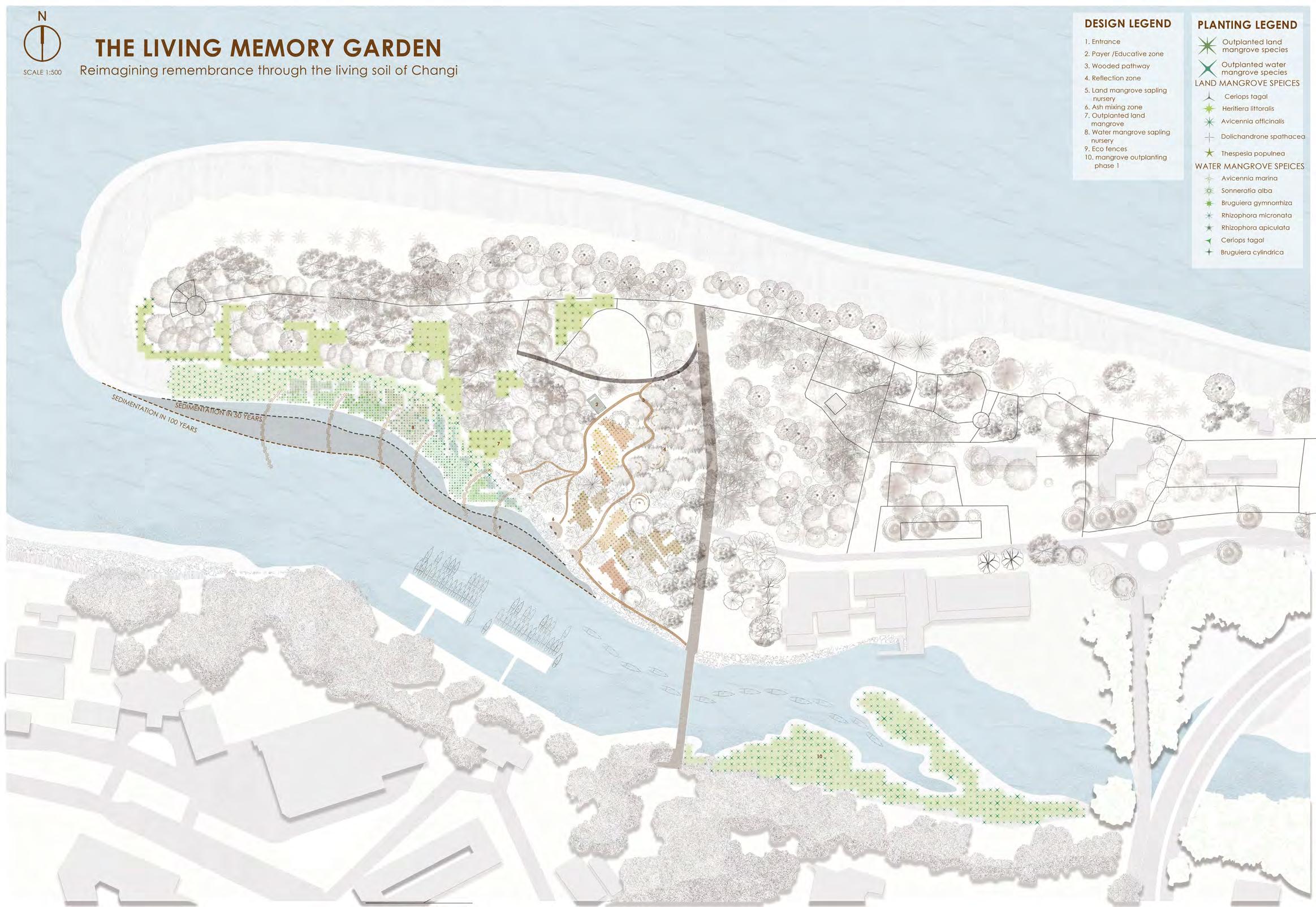
This plan maps the spatial choreography of prayer courts, nurseries, eco-fencing, and outplanting banks. A connected system where hydrology, planting, and human ritual form one continuous landscape.
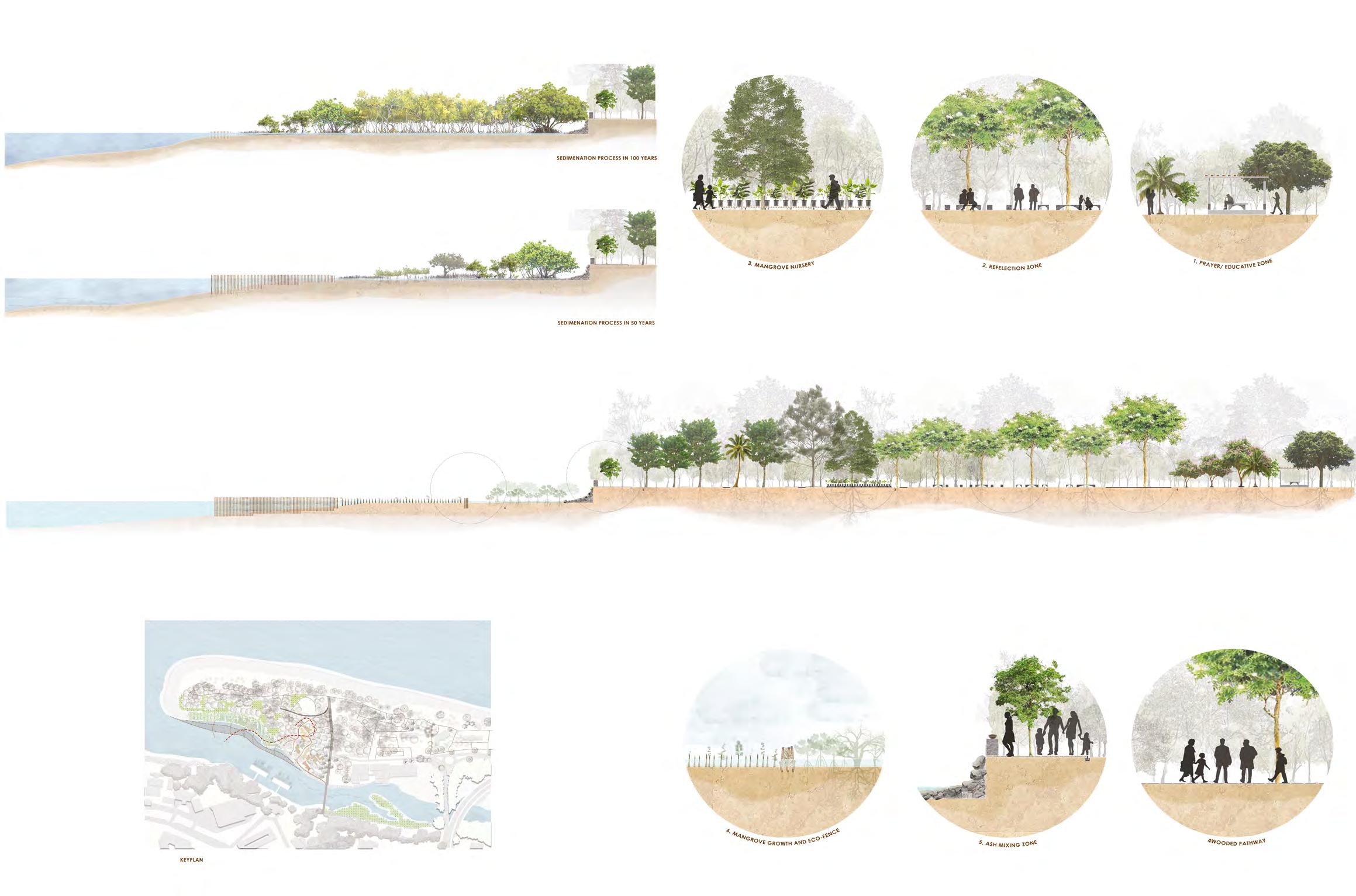
These sections map the intertwined processes of sedimentation, replanting, and ritual practice. Together, they shape a landscape where ecological repair and human memory unfold as one
Student
Name:
Cai Jiaheng
Tutor: Janice Tung
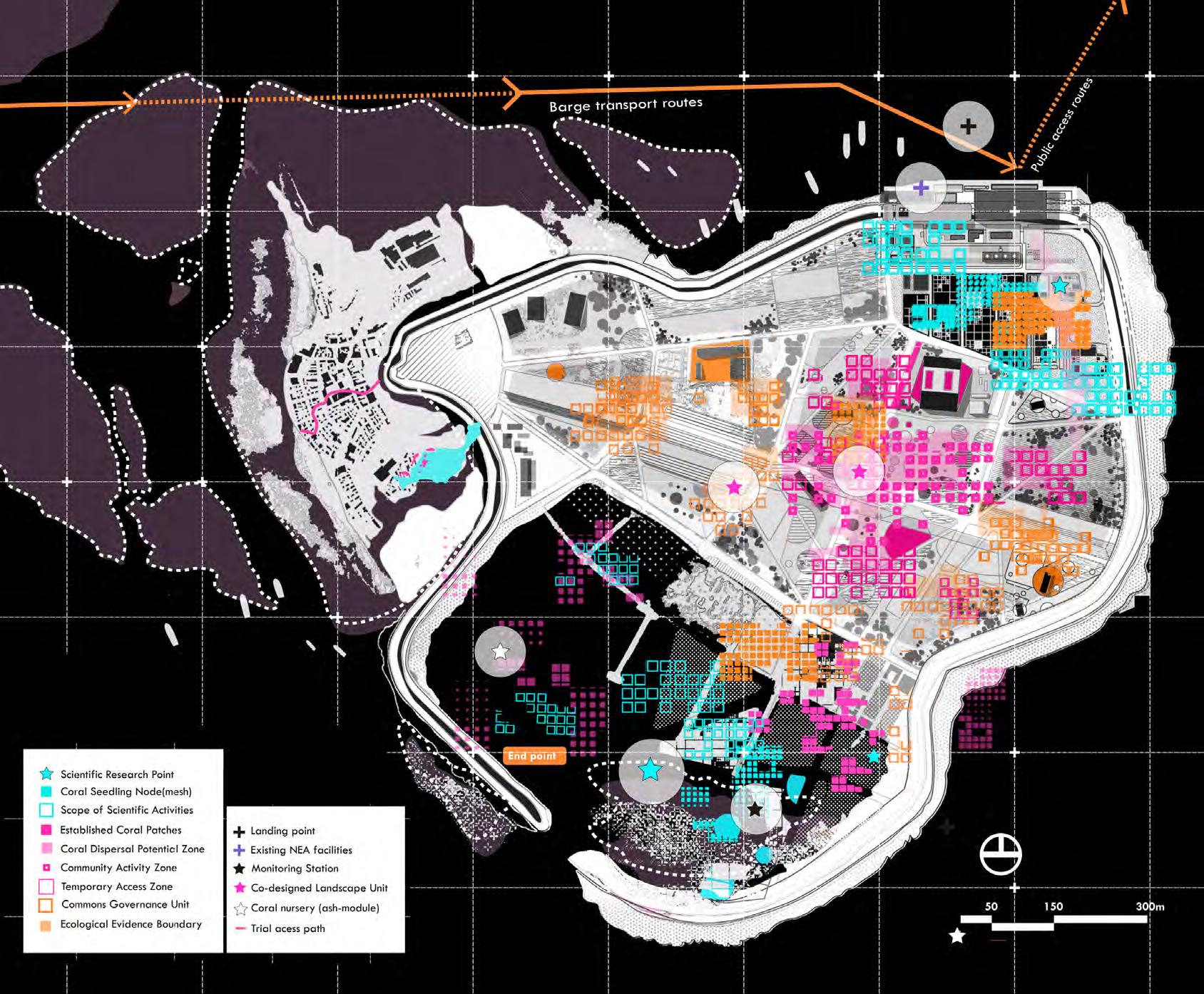
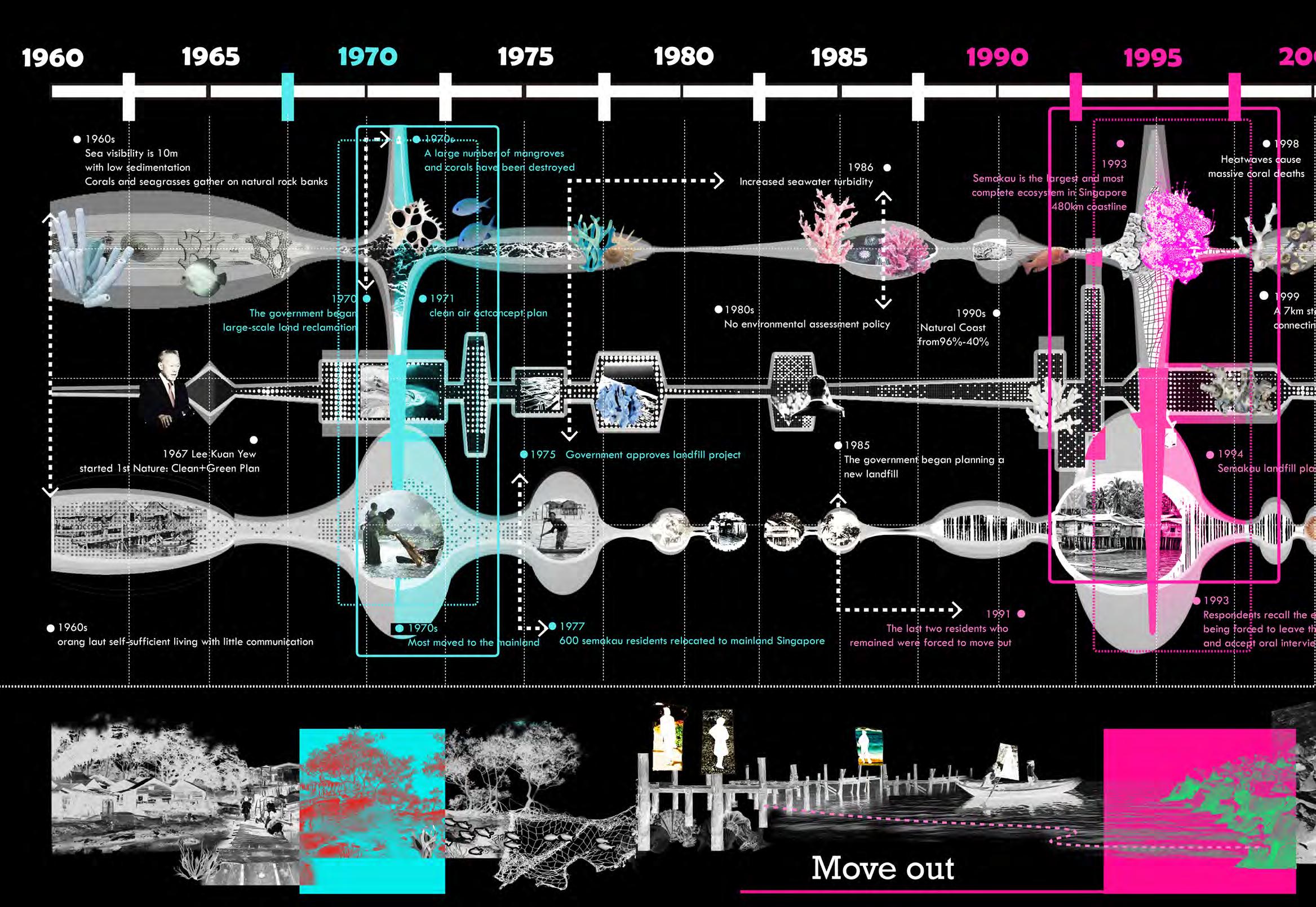
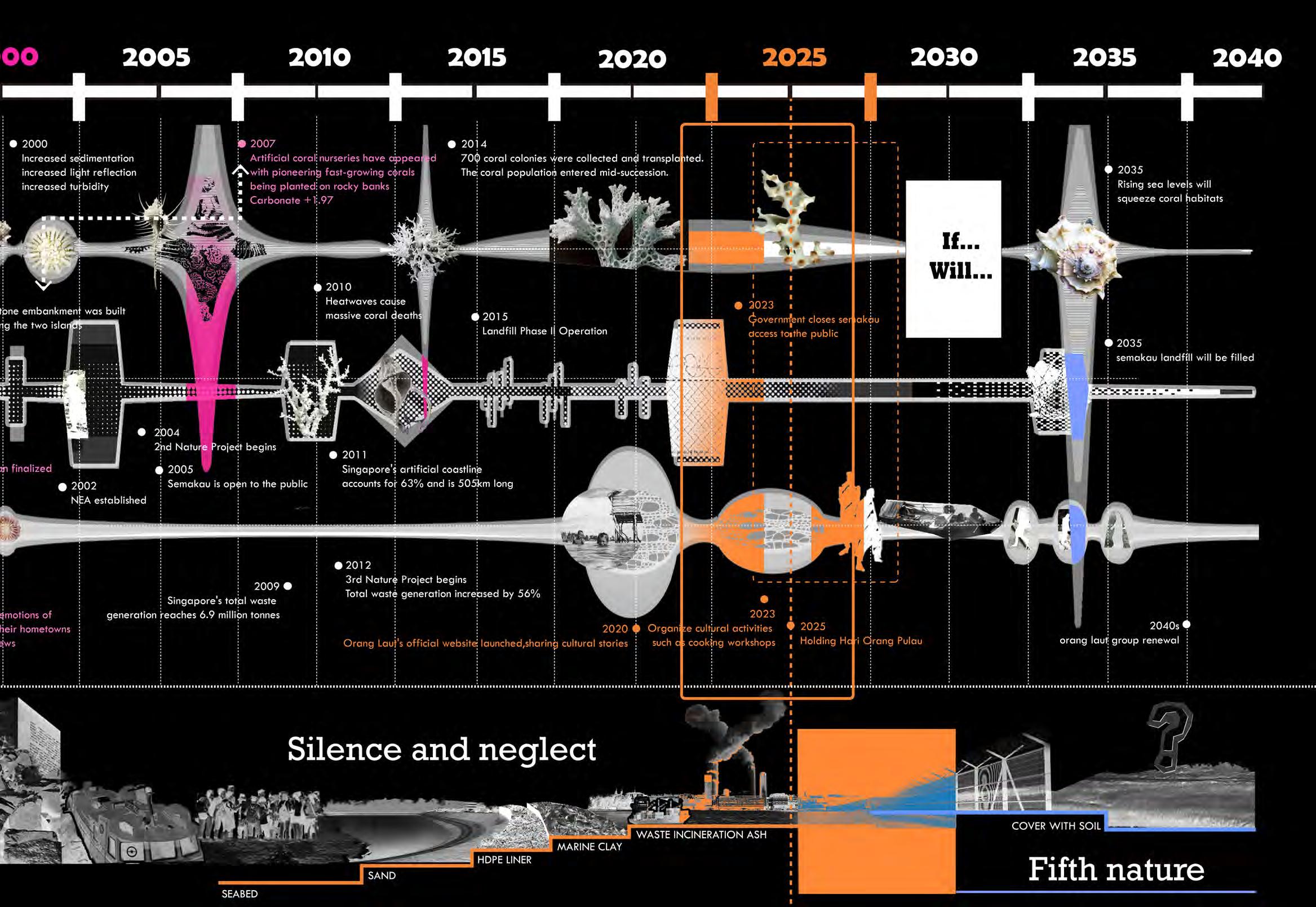
Semakau is Singapore’s only offshore landfill, where coral ecologies, landfill engineering, and the erased maritime culture of the Orang Laut intersect, overwrite, and contradict one another. The island remains highly restricted under the National Environment Agency (NEA), preventing any long-term ecological or cultural practice from external actors. Therefore, the project does not start from formal design, but a negotiation of access.
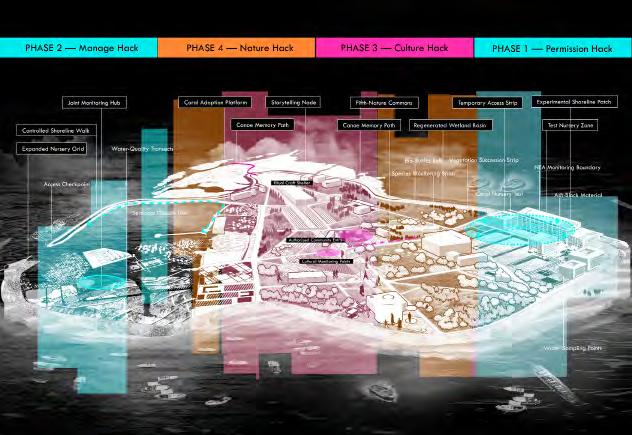
Drawing from the idea of legal grey area in Post-Growth Planning, the project proposes a sequence of institutionally permissible actions that use research permits, temporary authorizations, and monitored activities to gradually shift how Semakau is managed.
Through incremental and reversible interventions, new forms of shared ecological and cultural agency can emerge from within the existing governance structure.
Permission Hack (2025-2027):
A temporary NUS research studio operates inside the NEAcontrolled zone. Coral nursery units are installed, and stabilized incineration ash is tested as marine substrate, justified through research necessity. Ongoing NUS studies that already use Semakau ash and cultivate corals provide scientific grounding.
Ecology Hack (2027-2030):
As corals grow, an online platform invites involvement. Orang Laut descendants adopt corals for free and gain priority access to monitoring data; the public participates through paid adoption that funds research. Corals become operational mediatorsshifting management from ownership to shared care.
Cultural Hack (2030-2035):
Ecological results strengthen the negotiation for timelimited access under the research permit. A tri-party charter (NEANUS-Orang Laut) establishes spatial use, cultural rights, and ecological thresholds. Orang Laut conducts workshops and temporary programmes on Semakau, transforming symbolic acknowledgement into physical presence and cultural agency.
Commons Hack (2035-2045):
Stabilized ash transitions from waste to co-designed materialpaths, platforms, and certified marine modulesdeveloped with the Orang Laut. Coral outplanting scales up; ash reuse slows landfill expansion and forms a circular ecological system. Semakau shifts from a terminal infrastructure to a shared ecology-culture-governance commons.
Fifth Nature is not a state but a negotiated order produced through reopening access, decision-making, and proving that institutional constraints can be reshaped through situated interventions.
Tutor: Janice Tung
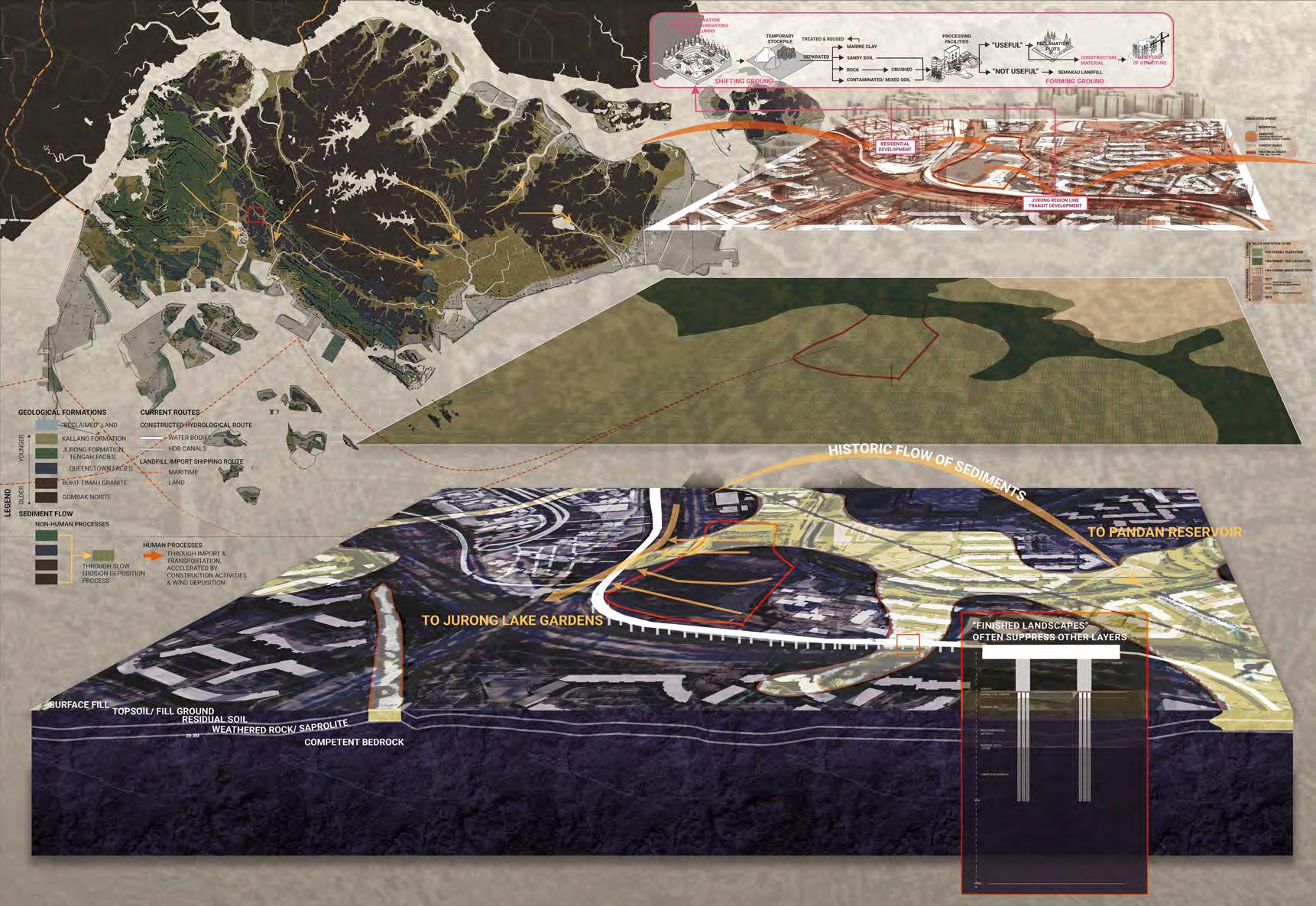
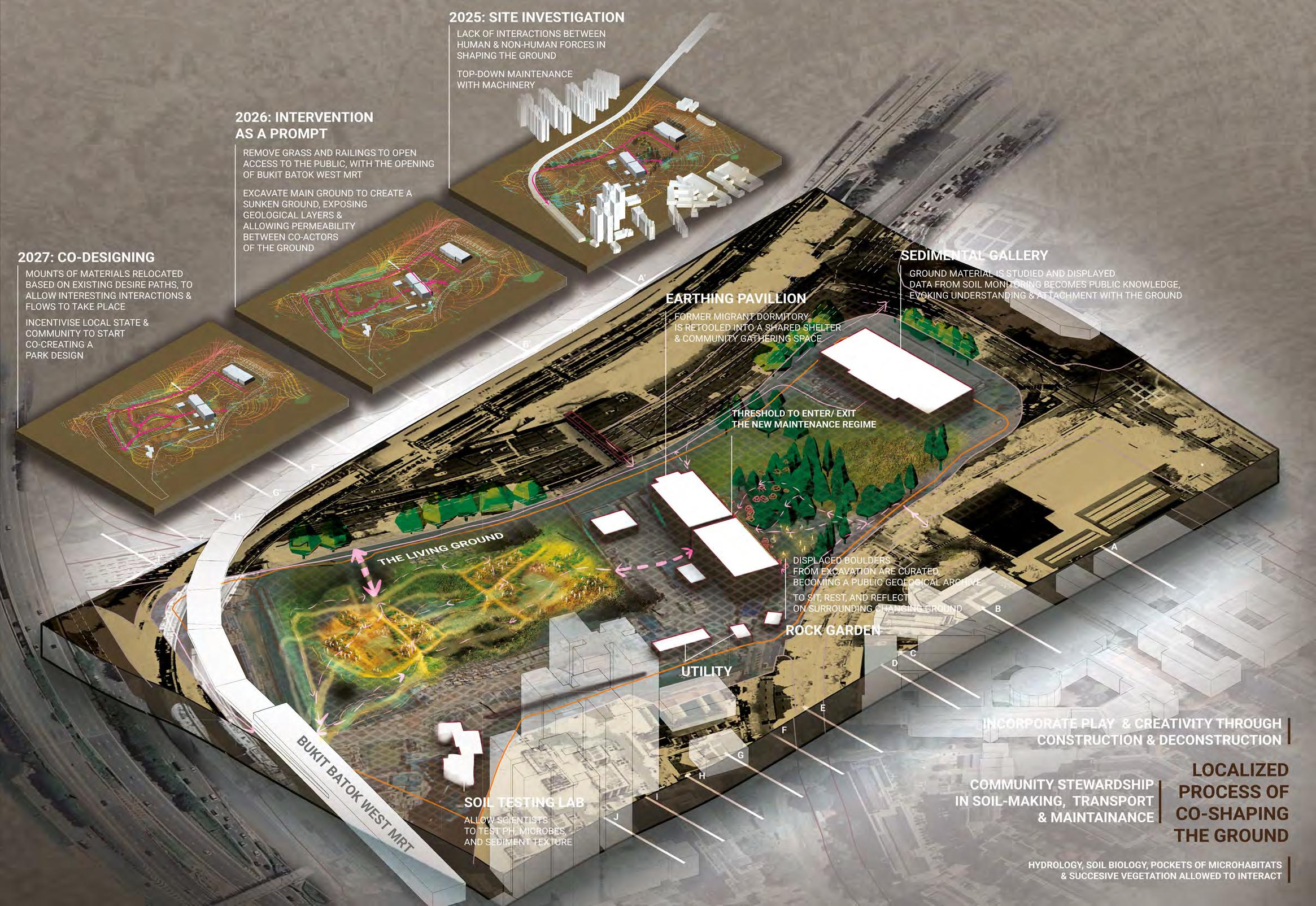
Earthing. proposes a rethinking of Singapore’s longstanding culture of “finished” landscapes - spaces perfected through decades of nation-building and the four Nature–Society ecologies. Such landscapes produce more than an aesthetic of perfection; they reinforce the belief that land must remain stable, predictable, and easily maintained. Yet beneath this manicured surface lie restless geological layers - old formations weathering quietly into soil. At the same time, extractive practices such as sand importation, earth relocation, and construction accelerate erosion–deposition cycles while distancing people from the material processes that shape the nation.
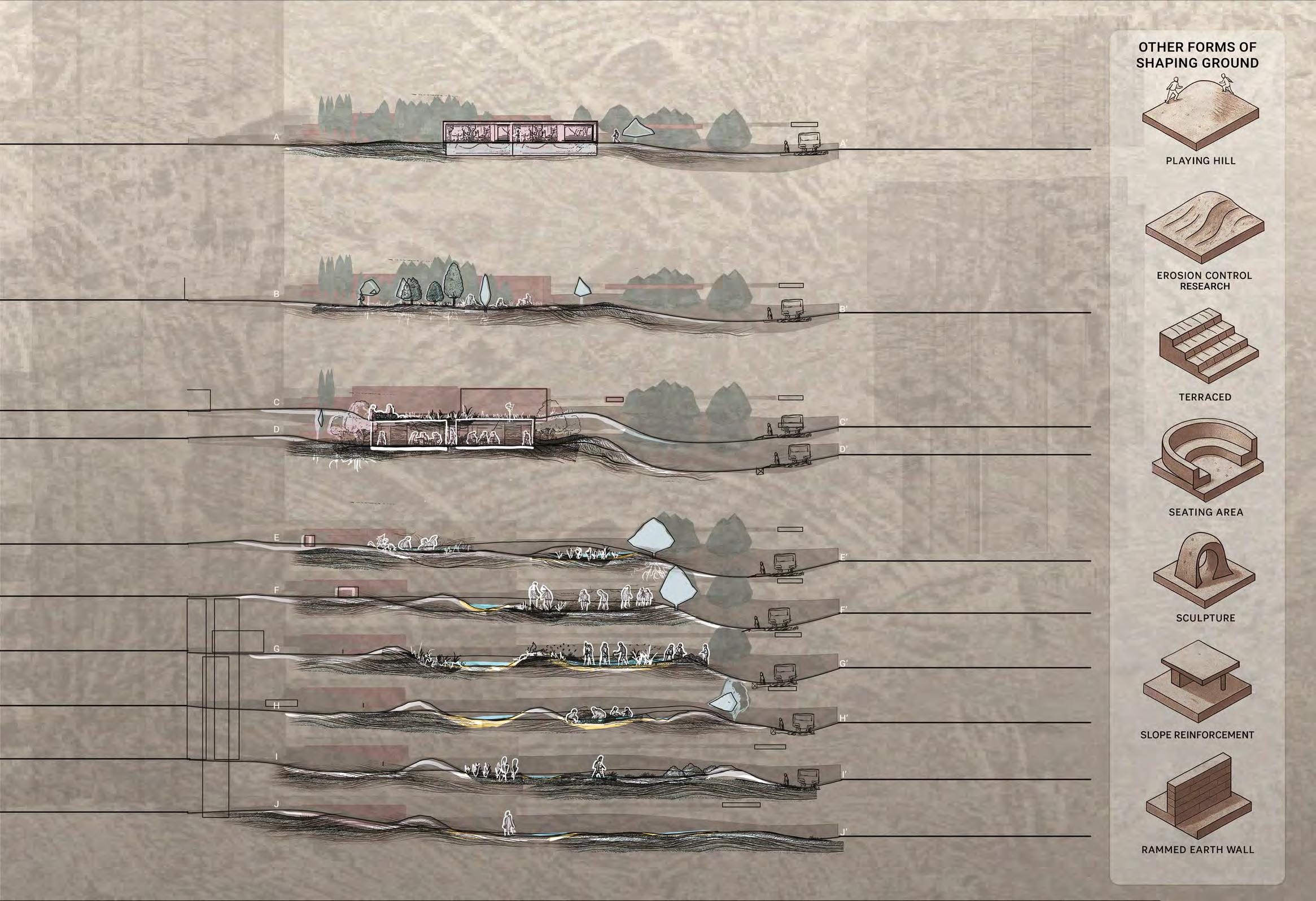
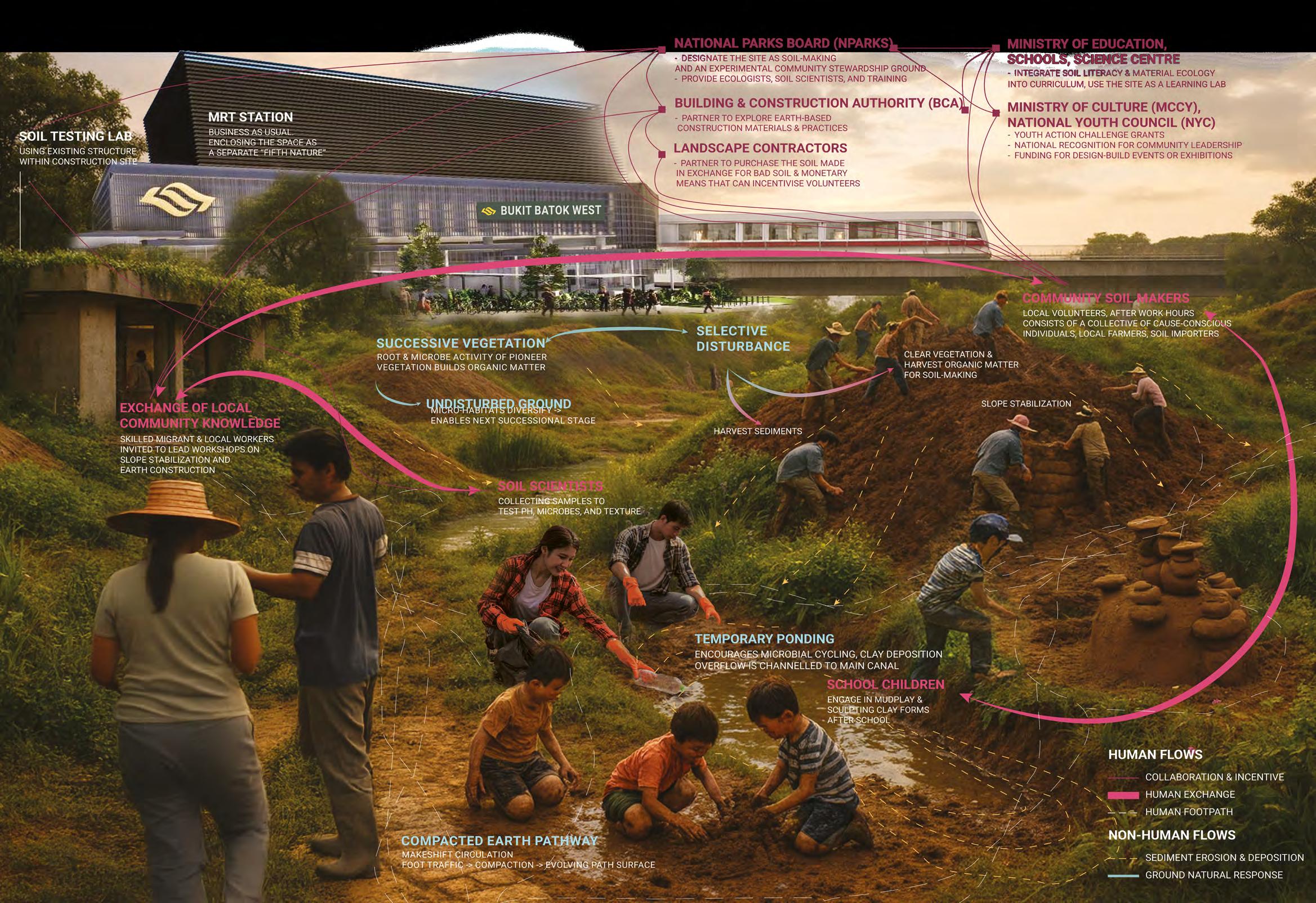
Earthing. reframes maintenance as relational and participatory. The design brings hydrology, human disturbance, soil health, microbial activity, and habitat niches into dialogue, treating them as co-shapers of the ground. The intervention begins with a sunken ground: a deliberate cut where grass is selectively removed to reveal textural, hydrological, and ecological variability. Rainfall and upstream runoff gather in this depression, forming a temporary sedimentation basin where material settles in shifting, legible layers. In this shared space, human and nonhuman movements intertwine. Micro-erosion channels, sediment fans, and spontaneous vegetation patches emerge as both indicators and agents of ongoing change.
A simple spatial framework - slopes, mounts, shallow pools - guides how water, organisms, and people redistribute material across the site. Different groups take on overlapping roles: residents carve desired paths; scahool groups observe and document soil cycles; community gardeners test compost–soil amendments; migrant workers share tacit knowledge of shaping earth; microbes and invertebrates continually restructure the substrate. Maintenance becomes a shared choreography of harvesting sediment after rains, forming earthen structures, redistributing biomass, and responding to ecological cues.
The title earthing. stands for the practice of grounding in my Fifth Nature - of being with the soil, responding to its changes, and recognising it as a living partner in shaping urban space. By embracing disturbance, impermanence, and co-creation, the project imagines a new social-ecology of maintenance for Singapore. Resilience emerges not from holding the ground still; similar to how a rock is, it is from allowing human and non-human to shift, respond, and learn new ways together.
Student Name: Dong Yukun
Tutor:
Victoria Jane Marshall
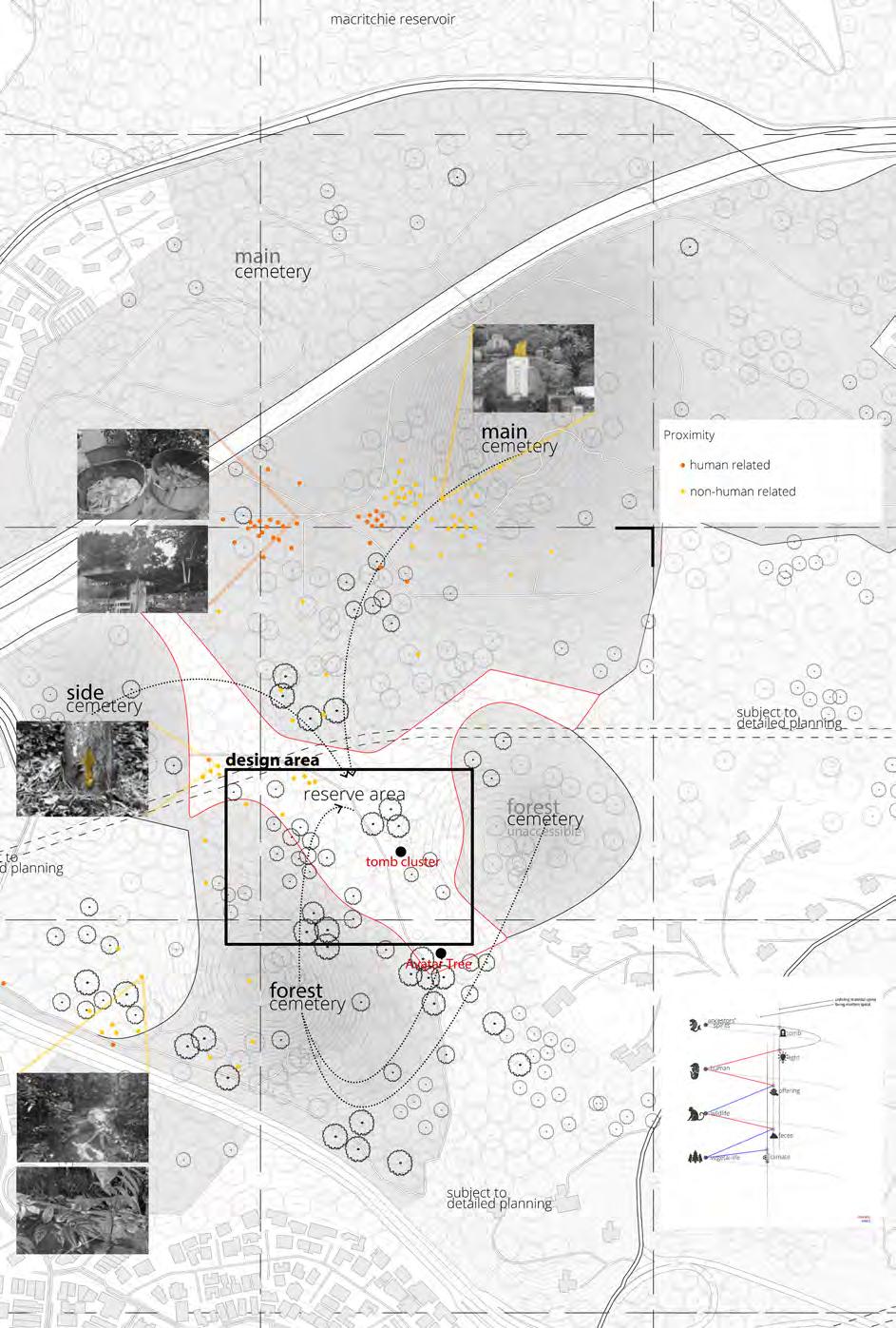
Originally a Chinese burial ground established in the early 20th century, Bukit Brown Cemetery is located on a hill beside Macritchie Reservoir. After the official closure of the cemetery in 1973, over decades, as many ancestor worship practices continue, the forest vegetation has woven through the graves, nurturing a dense and complex web of nonhuman nature agencies. Following a more-than-human approach, these intertwining and coexisting processes form a mutually beneficial connection between all of the living and the dead, what I term bizarre vitality.
However, as the last remaining Chinese cemetery in Singapore, it continues to face an uncertain future of possible erasure, just as other similar burial grounds have undergone. My project renders its bizarre vitality that are values, but easily overlooked and even to be forgotten—visible and clear— through the concept of a Refracted Organism garden. In doing so, the enclosed garden becomes a refractive medium that invites residents, visitors, and even policymakers to recognize Bukit Brown’s value.
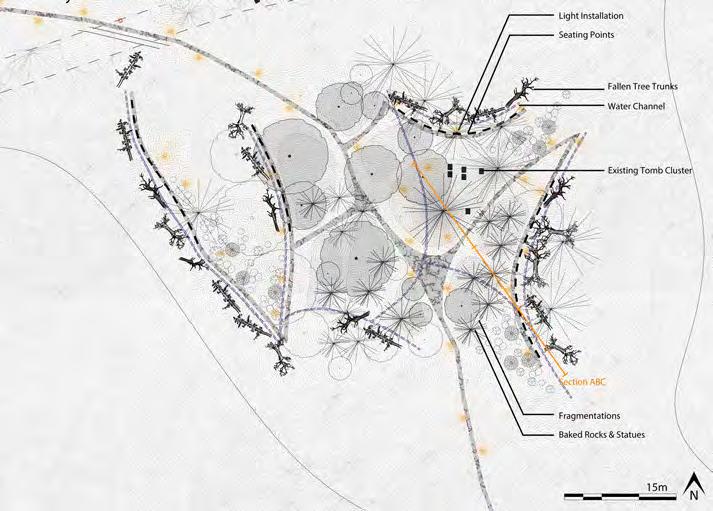
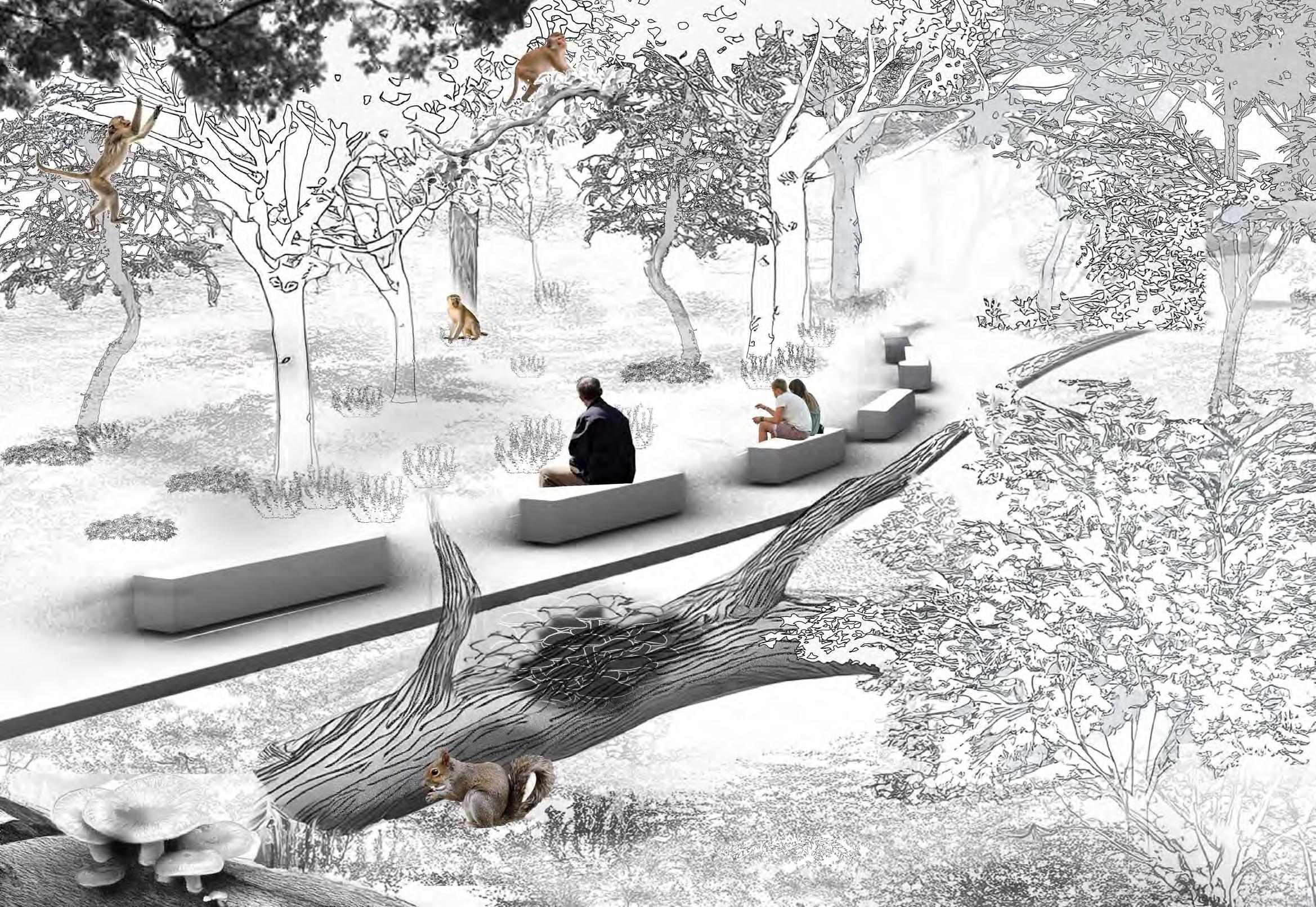
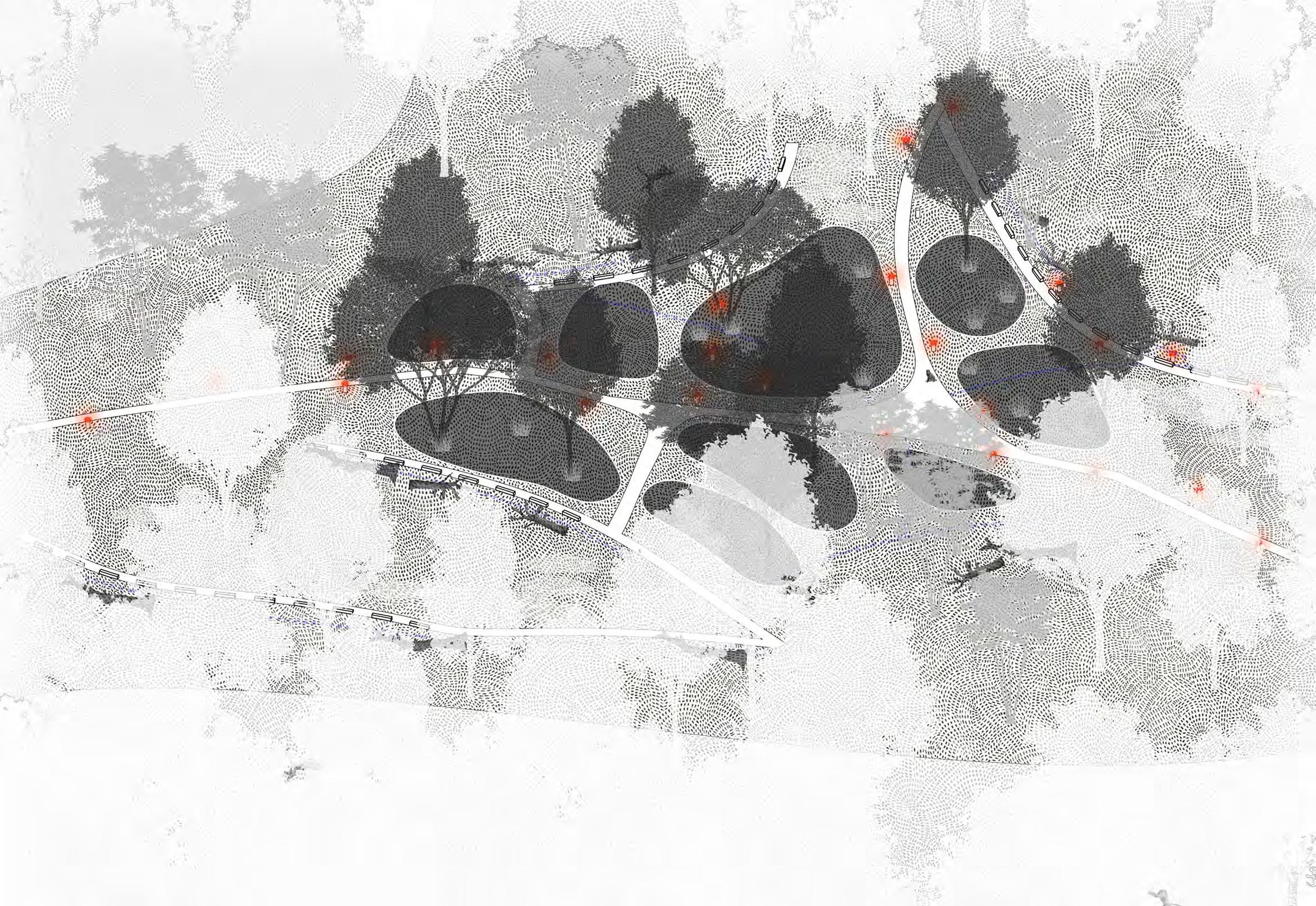
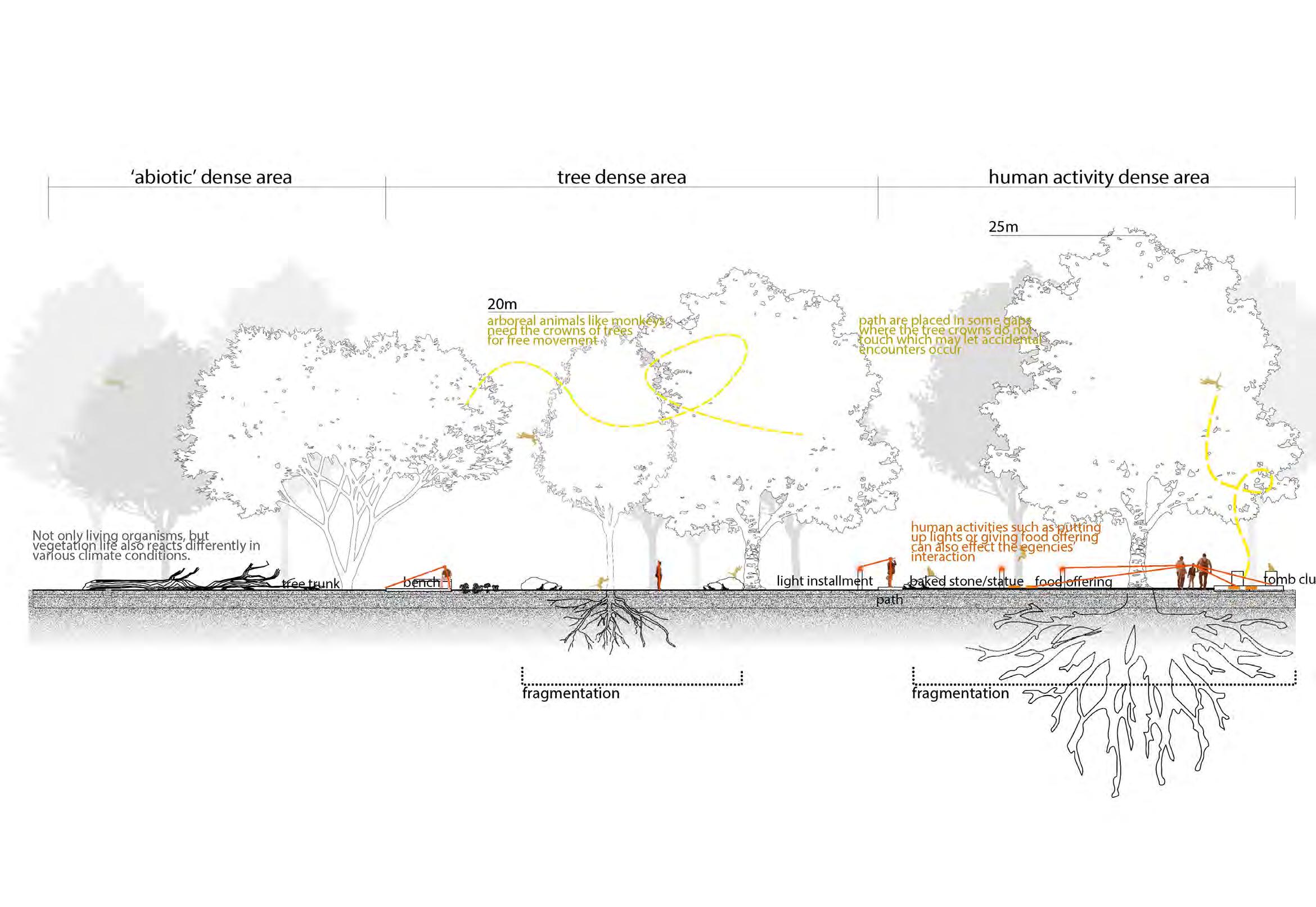
The main design strategy, clarifies and reconfigures bizarre vitality’s agencies and present them within a multi-perspective ecological field (a space with many designed viewpoints for human and non-human natures). Their designed, spatial fragmentation and their emergent relationships mirror the broader dynamics across this cemetery-in-a-secondaryforest. For example, I first used rocks and found statues to mark the fragmentations from existing trees. Using the monkeys’ habitat of moving through connected canopies, some paths are placed in gaps where the tree crowns do not touch. When monkeys come down to the ground to cross these gaps, visitors are more likely to encounter them. These designs encourage rich, predictable or potentially accidental encounters to occur. Within this magnified kaleidoscope, people can sense the multi-layered, bizarre vitality of Bukit Brown.
The site’s spiritual meanings are brought back into physical space. By doing so, it turns intangible beliefs into visible, experiential elements that help sustain cultural and spiritual continuity. For example, in ancestral rituals, light serves as a vital bridge between humans and spirits, guiding the departed to see the offerings and the paths before them. Yet, in the context of future urban life, these connections will be severed or forgotten. Borrowing from this symbolic act, light installations are placed to guide both the visibility of human movement, the direction of spirits, and to convey spiritual presence and transmission within contemporary space.
Overall, as a refracted organism, my project intensifies the bizarre vitality of Bukit Brown. This intensification will make Bukit Brown more visible, and perhaps more recognized. In the present, the garden is designed to be a destination for observation and to bring recognition of Bukit Brown.
Student Name: Melissa Tang
Tutor: Gu Tiantong
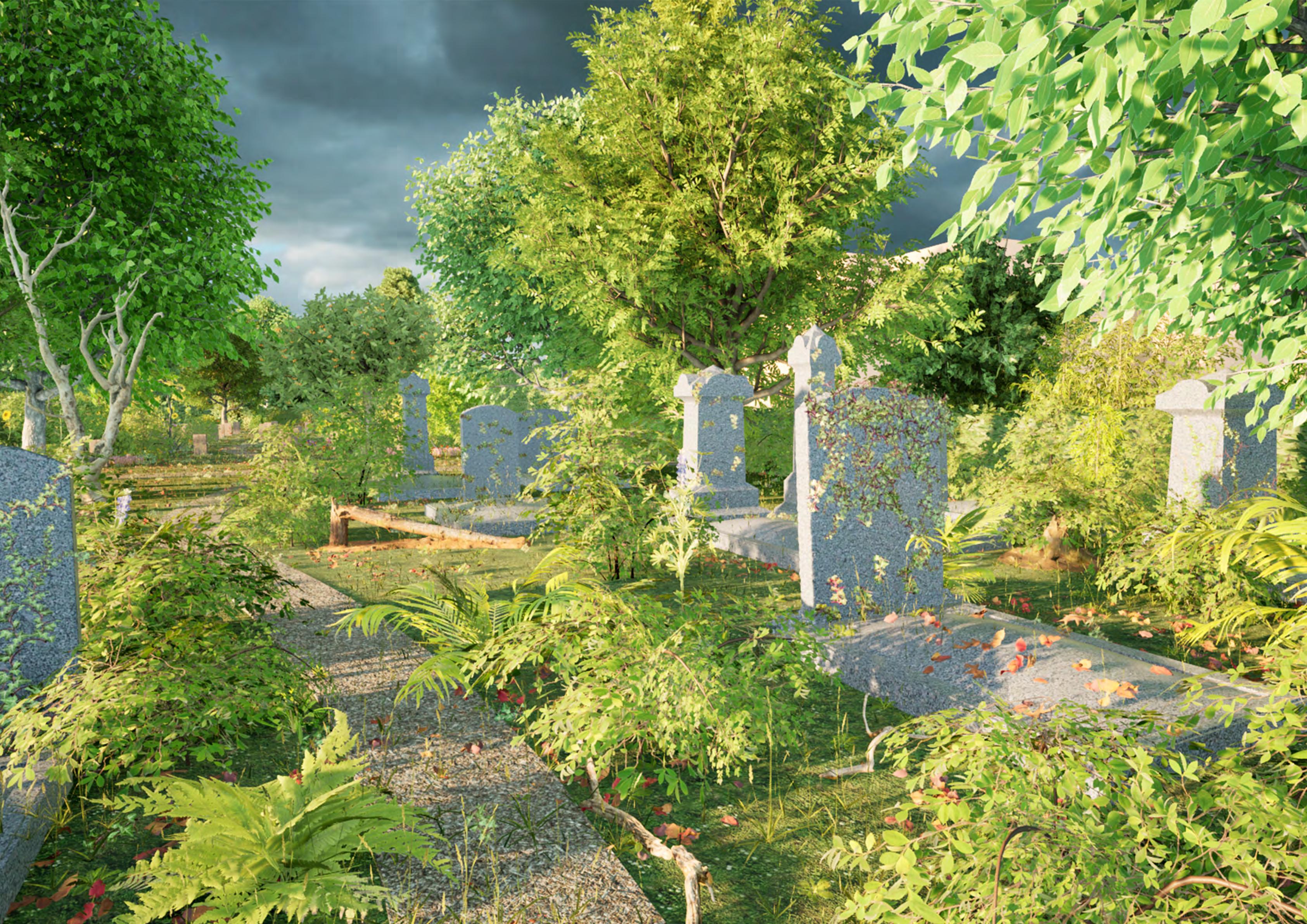
This project proposes forgetting as another way of remembering, using the Japanese Cemetery Park as both a site and a teacher. The cemetery has lived through cycles of care and neglect: from its origins as a burial ground for Japanese prostitutes and soldiers, and later to its restoration as a heritage park. Today, the site holds visible unevenness, where some tombs preserved and tended, others softened by vines, moss, and time. The site itself already demonstrates how memory is held, released, and transformed.
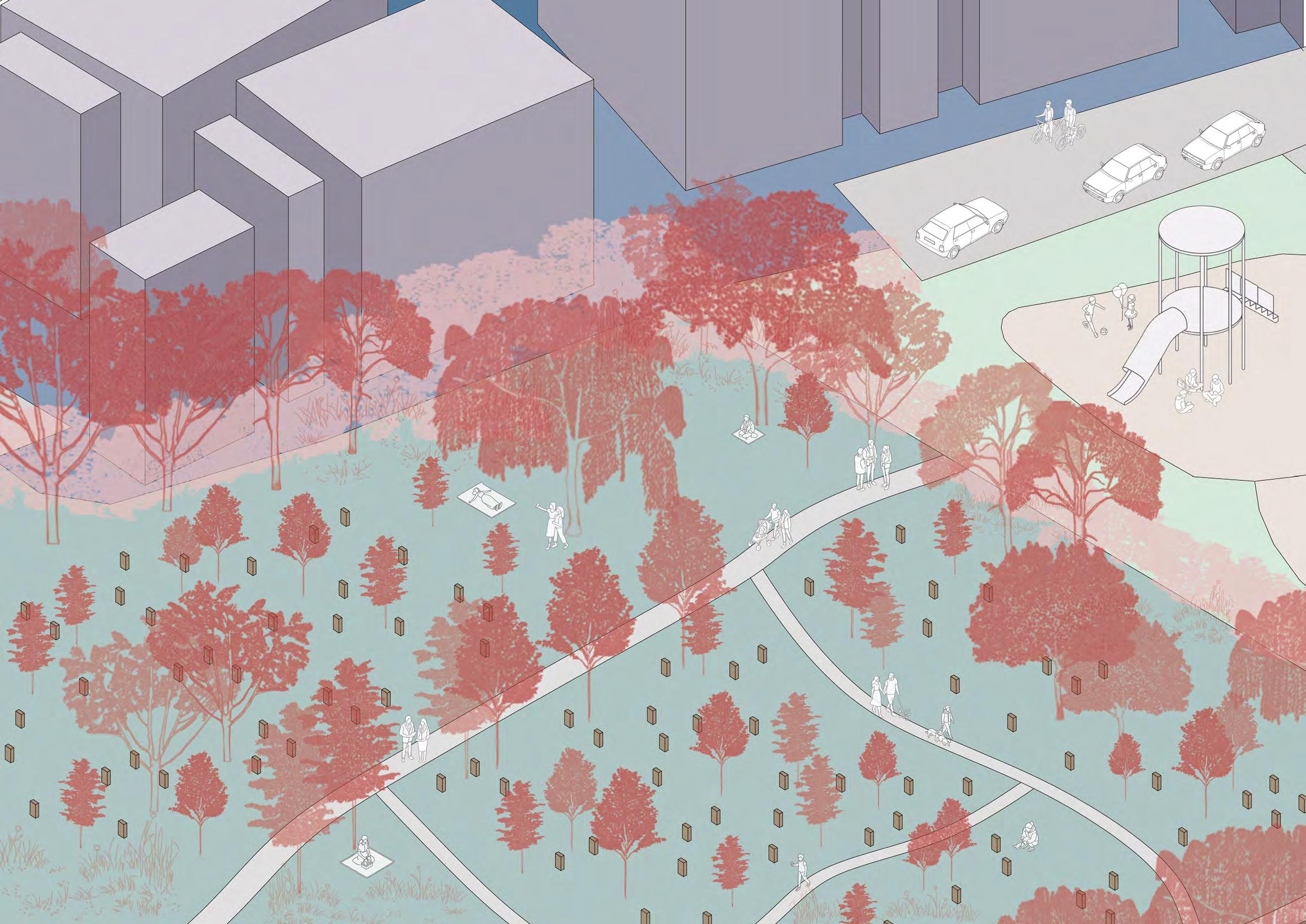
The proposal does not aim to freeze the cemetery in one era or restore an original state. Instead, it treats the park as a living archive, where time, climate, and vegetation continue the work of remembrance. The park is neither a leisure park nor a museum; it is a slow memorial landscape, where visitors participate quietly as caretakers, observers, or simply passers-by who allow memory to surface at its own pace.
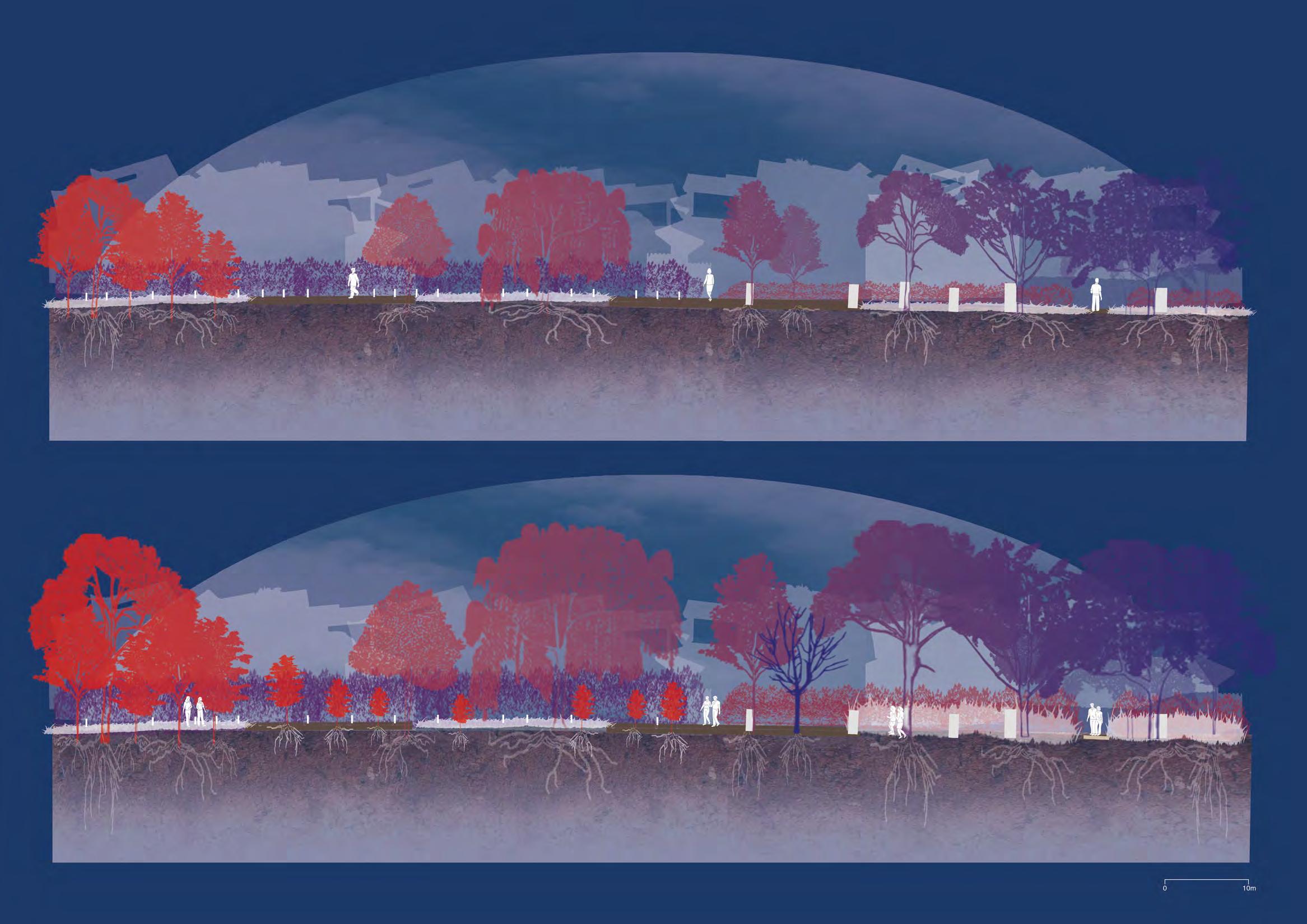
Three spatial strategies shape the design. Layers of soil, stone, and planting are revealed and reshaped to express memory over time. Where tombs remain intact, the ground is open and legible. Where inscriptions have faded, vegetation is encouraged to gather and settle. Caretakers and community volunteers maintain certain paths, while other areas are left to self-seed. The enclosure is formed not by walls, but by shifts in density, from tree canopies overhead to groundcovers at the feet.
Planting expresses states of remembering. Clear, airy canopies and spaced understory planting mark places of active remembrance. Dense, layered vegetation, including ferns and climbing vines, marks zones of forgetting, where memory is allowed to blur. Visitors choose their movement through these gradients rather than being directed.
Stone tombs record slow time through weathering. Wooden markers and seating decay faster, returning to soil and nurturing plant growth. Material change becomes a visible timeline of remembrance.
The Fifth Nature here is not a monument, but a relationship: humans, plants, climate, and materials co-produce memory. In this cemetery, remembering and forgetting are not separate acts, they are ongoing exchanges between people and the more-than-human world, shaping one another across time
Student
Name:
Ong Qin Hui
Tutor: Gu Tiantong
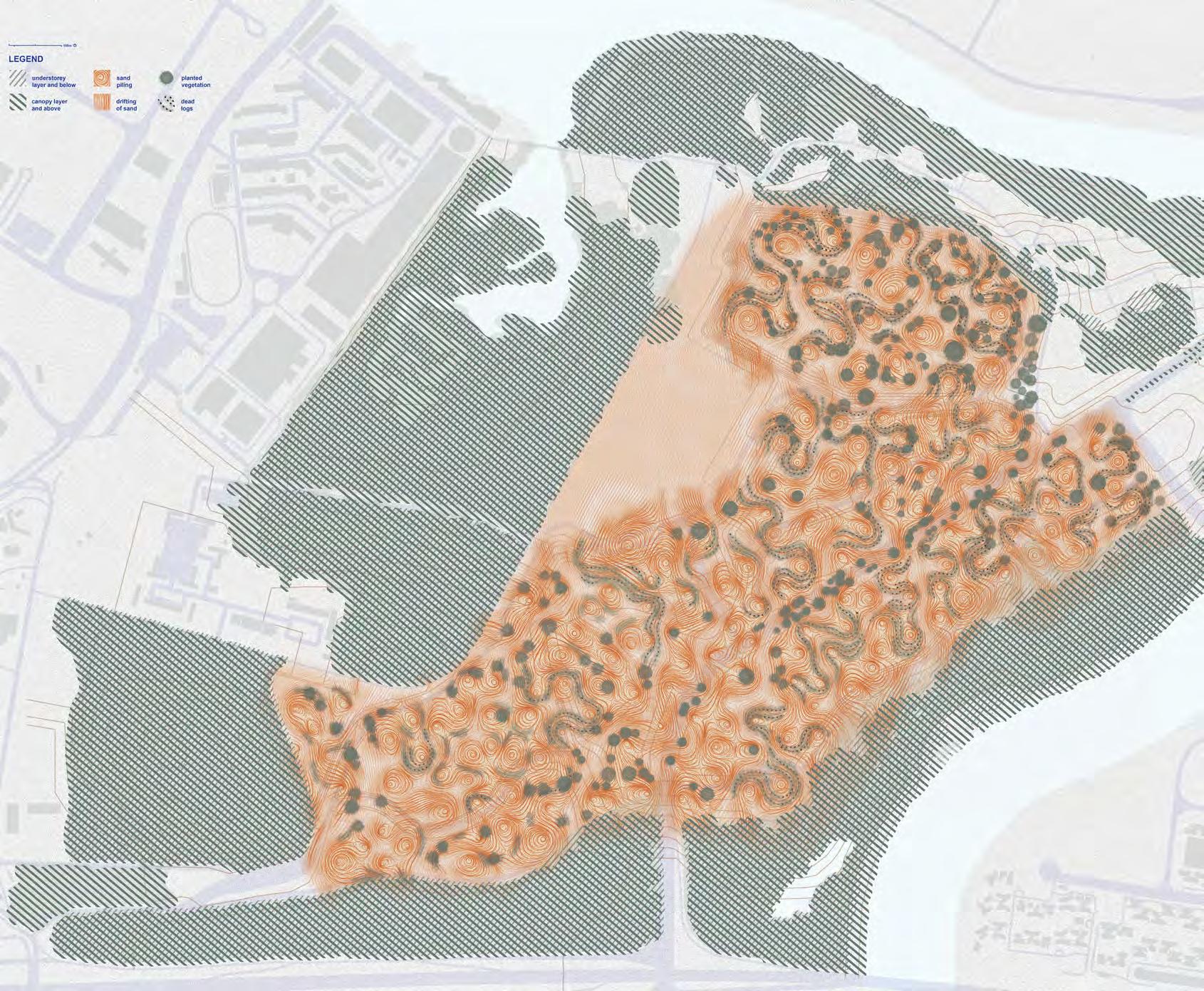
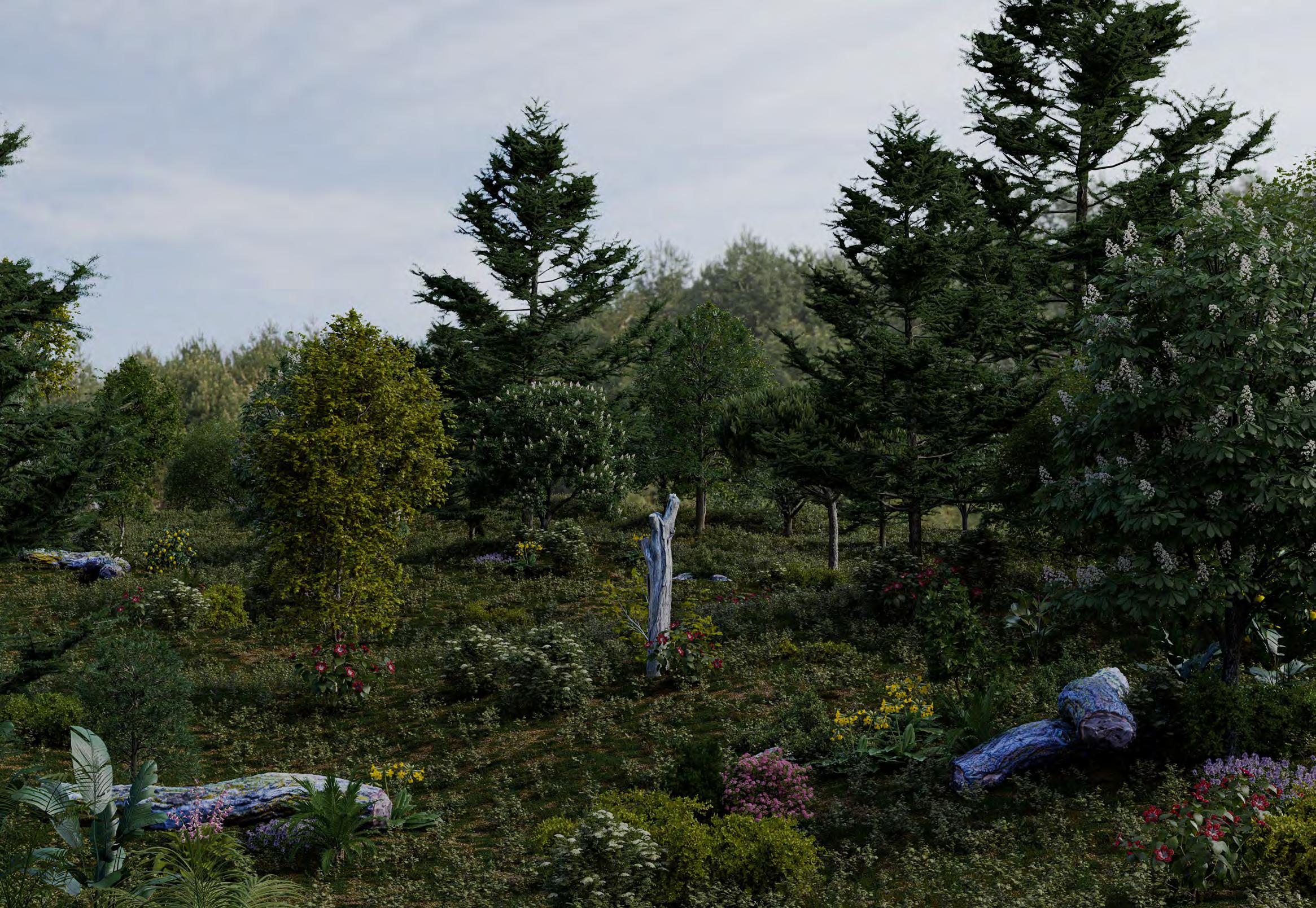
This project transforms Seletar’s sand stockpiles into a landscape where invisible forces become visible. The quiet piles appear static, waiting for future reclamation, their form reveals traces of movement shaped by wind, water, and labour. Each pile holds an unspoken journeys where grains carried by rivers, extracted from distant beds, transported across borders, and finally rested on Singapore’s shore. These piles reveal Singapore’s expansionist ambition and the parallel erasure of ecologies and communities both abroad and at home.
The project acknowledges extraction as irreversible and asks how new ecologies might now emerge from its ground. The enclosed garden is defined by a shifting field of sand in constant flux, animated by atmospheric, biological, and human forces that make it continuously reconfigure over time.
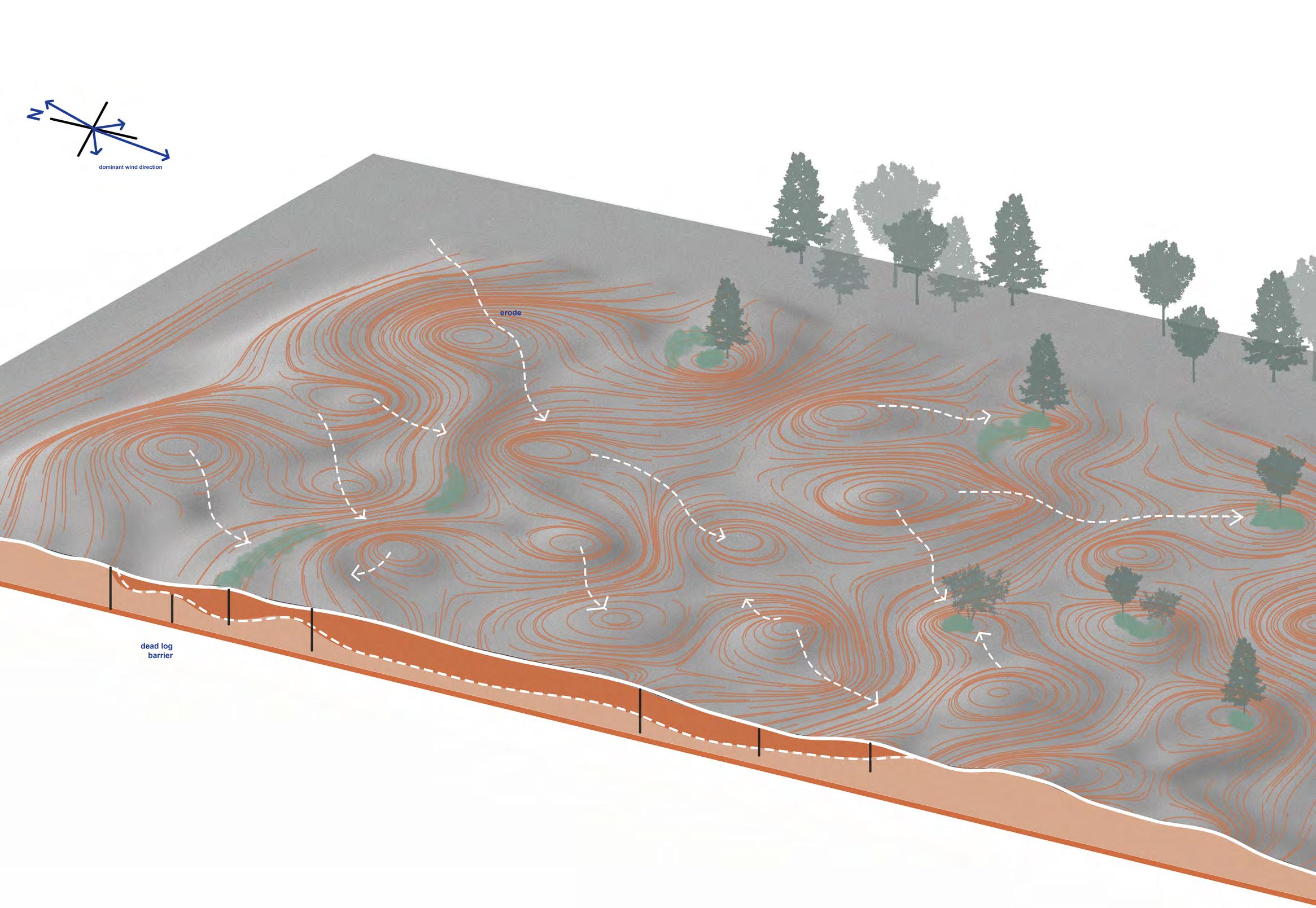
Wind becomes a key collaborator that sculpts and redefines the sand surface. By studying the dominant wind direction and speed in Seletar, the project identifies potential zones where sand can shift naturally to form dunes, ridges, and depressions. These changes occur slowly over time, making erosion itself part of the design’s intent. The barriers made from dead logs are setup to allow micro-topography formation that will take decades to form. These structures serve as nutrient sources, contributing to future soil layers. The sand surface becomes a live archive capturing the negotiation of planned intervention and natural drift.
Nitrogen-fixing vegetation is introduced to stabilise shifting ground by trapping sediment and begin soil formation as mycorrhizal fungi bind grains and enhance nutrient cycles. Fungi emerges as vegetation establish, supported by inoculated mulch and leaf litter introduced by hand. These living agents grow, decay, and regenerate, they enrich the sand with organic matter, enabling succession. Over time, the piles evolve into habitats that support greater biodiversity.
In sum, the project foregrounds wind, vegetation, fungi, and humans as co-workers, framing Seletar’s dunes as a fifth-nature landscape where design collaborates with evolving processes. Neither pure wilderness nor a controlled garden, it is an adaptive field of relations that embraces instability, reveals interdependence, and allows renewal to unfold through time. Within this landscape, care takes form from human intervenes such as introducing vegetation, scattering organic mulch, and creating conditions for fungal networks to thrive. Here, regeneration emerges not from dominance, but from co-production where humans and the more-thanhuman world act with distinct agencies while shaping the landscape together.
Student Name: Tan Jiayi Joey
Tutor: Janice Tung
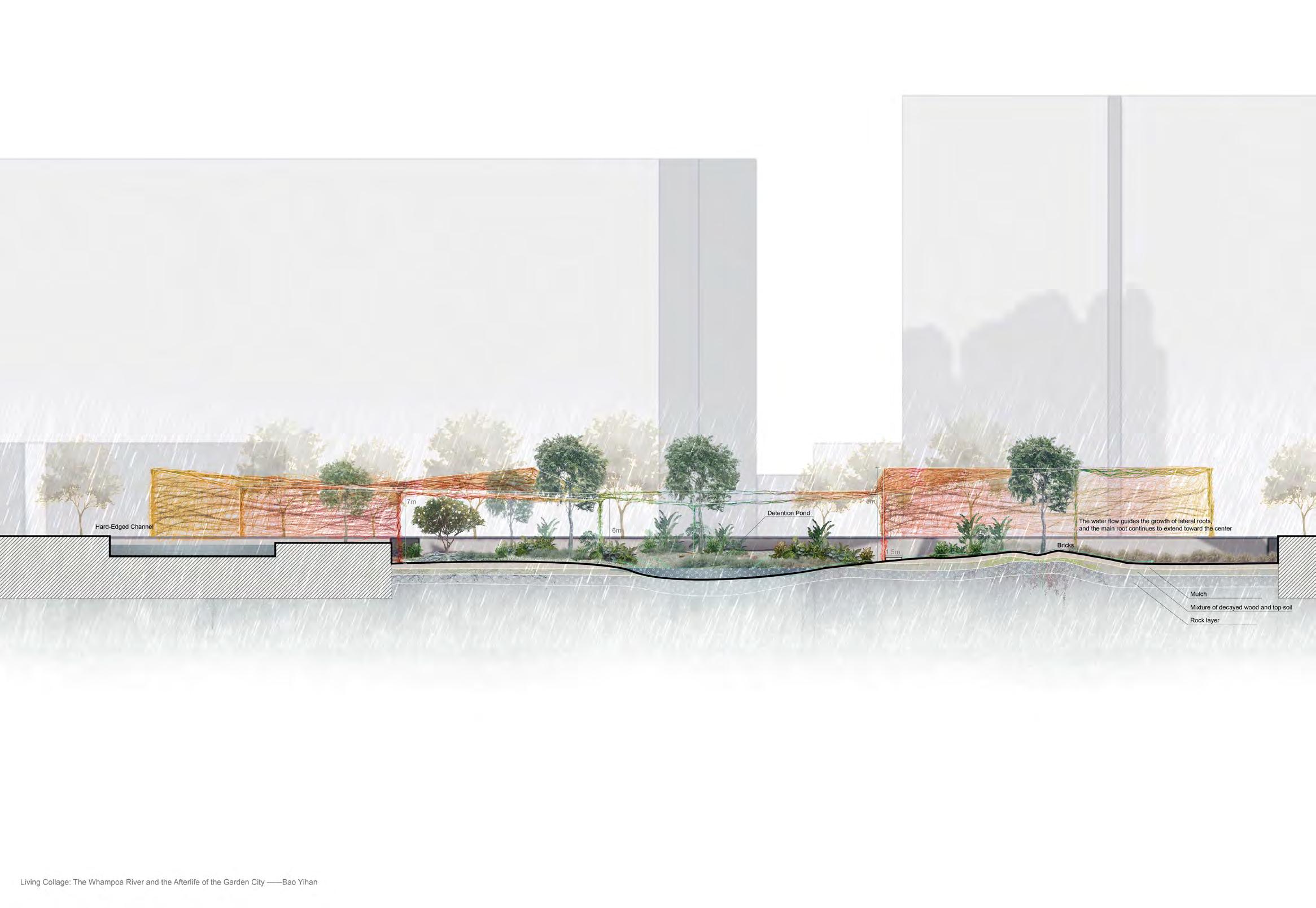
Landscape in Singapore has historically been shaped by forms of fear. In the pre-colonial period, nature was understood as a spiritual force, respected and feared for its power. Under colonial administration, fear shifted towards wilderness, where forests were cleared for plantations and economic gain. Following independence, the fear of disorder led to the restructuring of landscapes into controlled plantings and infrastructure. Later, the fear of detachment produced curated gardens and park connectors that aimed to mediate the relationship between citizens and green spaces. Today, the fear of loss dominates, as Singapore faces the continued decline of biodiversity and primary forests. These shifting fears demonstrate how policy and design have been shaped by human anxieties rather than a shared relationship with the living world.
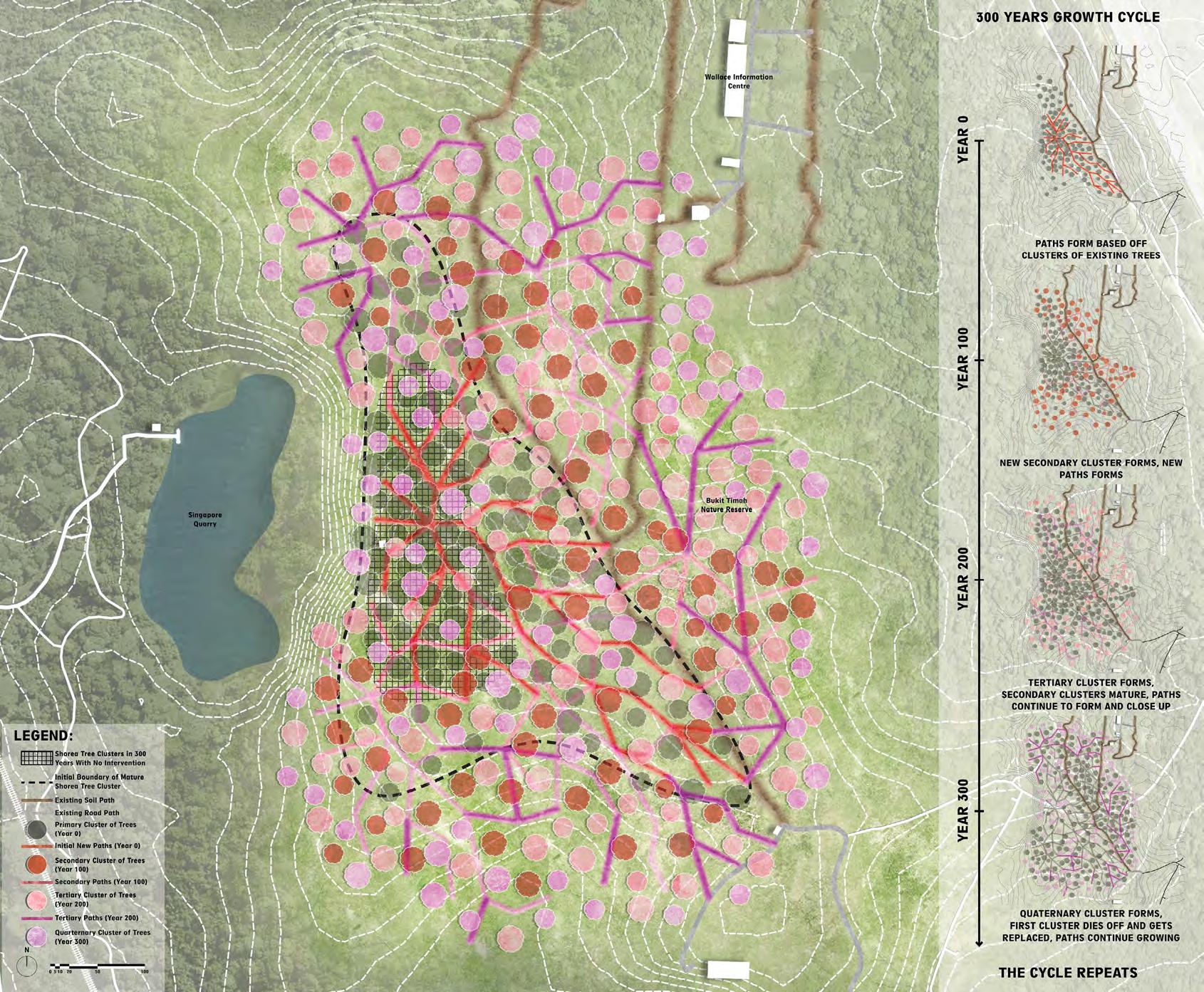
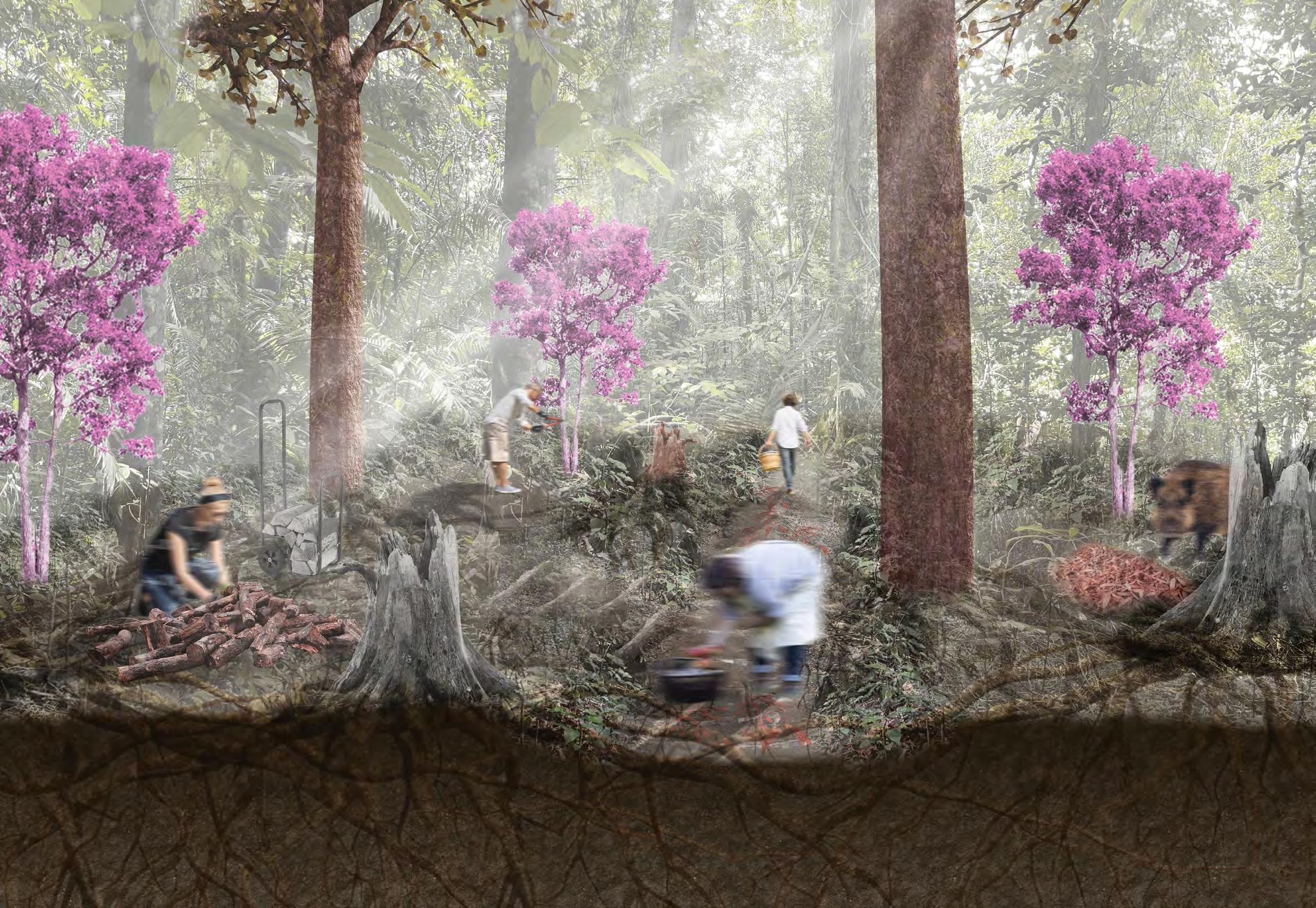
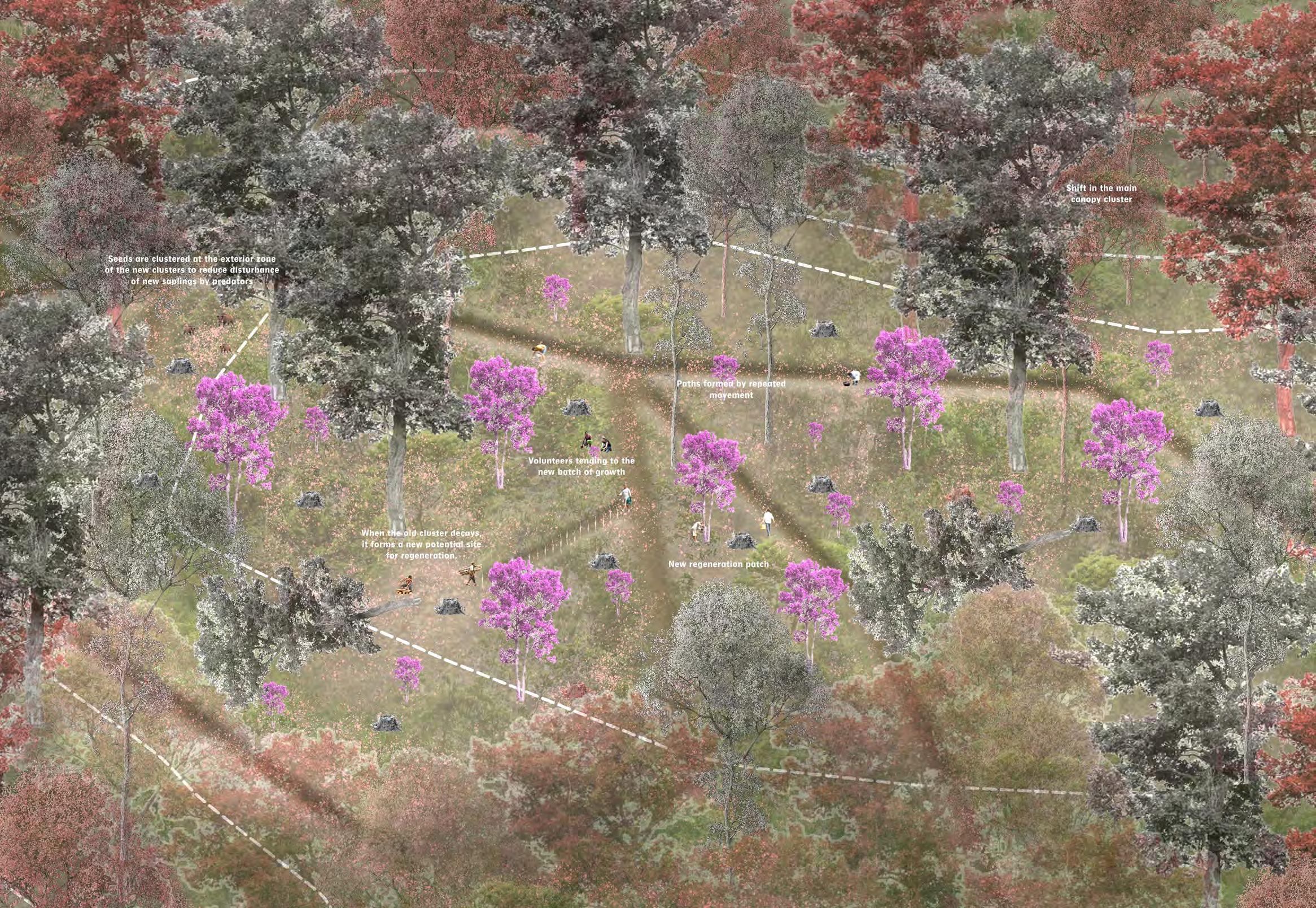
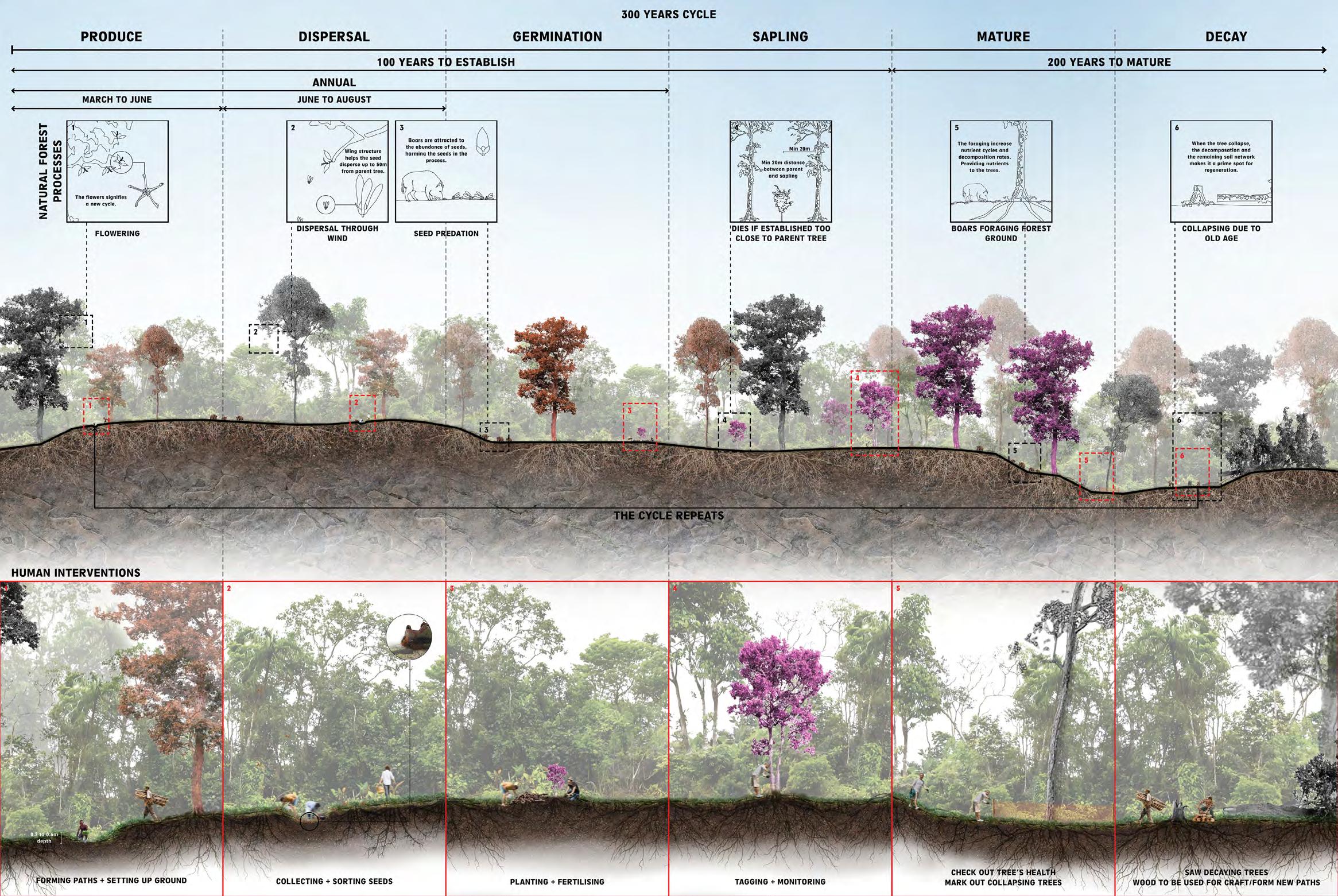
Forest Beyond Fear, explores what it means to design landscapes without letting fear dictate action. Rather than seeing humans as separate from nature, it positions them as active participants in forest processes. The project is situated in Bukit Timah Nature Reserve, one of Singapore’s last remaining primary forests. Within it, Shorea curtisii, a keystone dipterocarp species, faces regeneration failure . Its seeds are large, dispersed only by gravity and shortrange wind, and often predated by wild boars and small mammals present in the forest . As a result, seedlings rarely establish beyond the parent crown.
It proposes a community-based system of forest participation, where volunteers become part of the forest’s ongoing life cycle: production, dispersal, germination, sapling growth, maturity, and decay. During the production stage, participants identify potential regeneration sites and prepare the soil while setting markers and access paths. During dispersal, which overlaps with the monsoon season, rainwater collects along sunken paths, creating muddy areas that trap fallen seeds. The mud allows seeds to stick to shoes and animal fur, spreading them farther. Volunteers collect the seeds, planting healthy ones and clustering damaged ones to redirect predators.
During germination, participants monitor sapling survival and improve soil with decomposing logs and leaf litter. As the trees mature, they are tagged and documented. When they decay, the fallen trunks are repurposed for craft workshops that raise awareness and funds for conservation, while leftover wood is used to mark new regeneration zones, restarting the cycle.
Ultimately, Forest Beyond Fear transforms fear into understanding. It acts as a portal for re-learning coexistence, shifting from controlling the forest to moving with it, where humans become allies in the ongoing life of the land.
Student Name: Wang Muqing
Tutor: Gu Tiantong
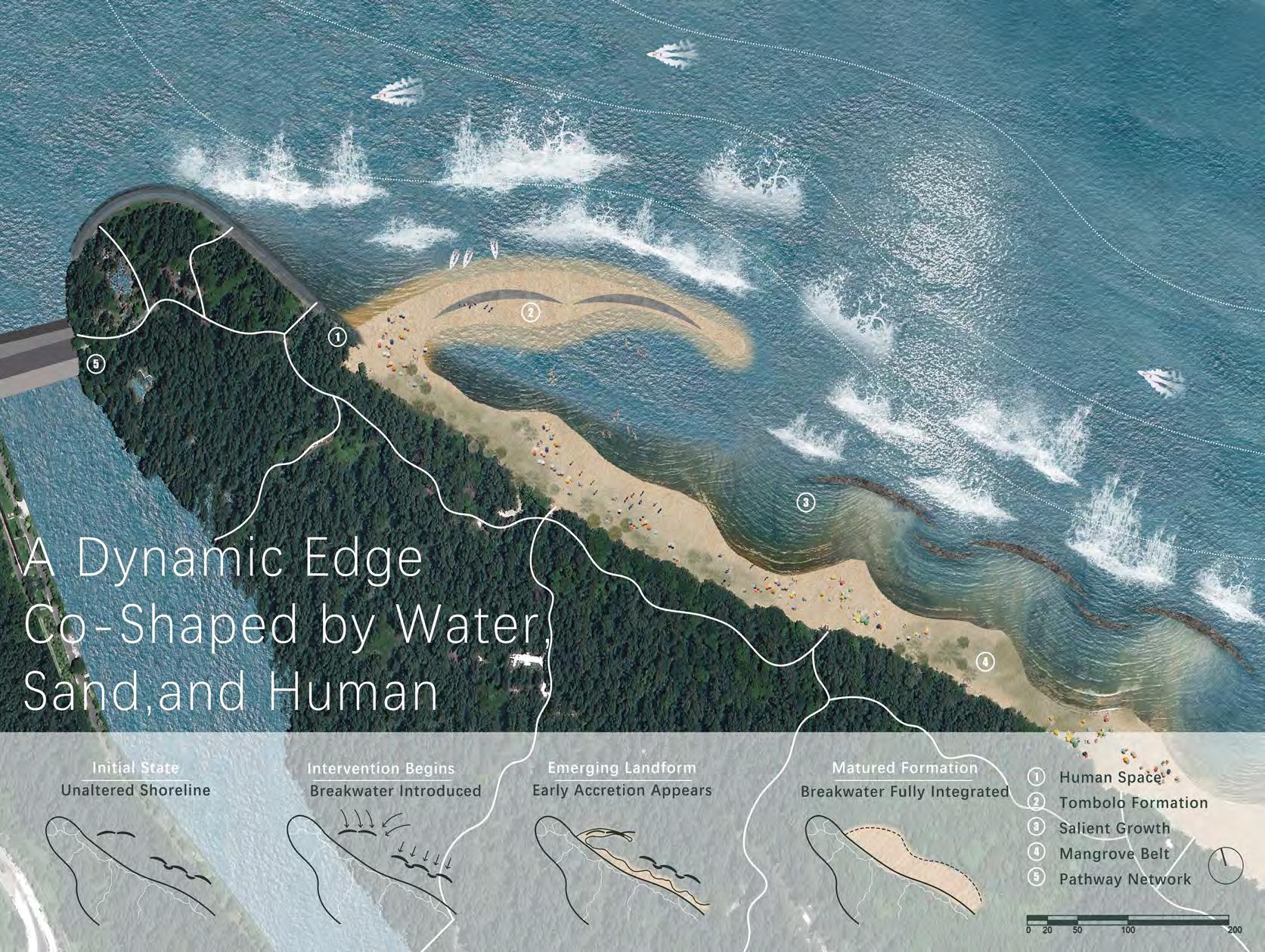
Over the decades, Coney Island’s shoreline has been continuously reshaped-initial large-scale reclamation replaced the mangrove-dominated, tide-responsive natural coast with rigid artificial boundaries of concrete seawalls. Traditional land reclamation relies heavily on imported sand and local hill excavation, using dredged sediment and foreign aggregates to harden the coastline into rigid, immovable concrete embankments. While this approach allowed rapid land expansion, it disrupted natural sediment transport, erased intertidal habitats, and left shorelines more vulnerable to sea-level rise. As sand resources become increasingly scarce and expensive, the environmental and economic sustainability of this model are being seriously questioned.
This project asks: What if we let the tides lead? What if we open a dialogue with water, sediment, and vegetation? What truly matters now is not how to control nature, but how humans can become part of its process-shaping the coast together with tides, sediment, and time. This project proposes an alternative—a nature-based reclamation srategy in which tidal forces carry sediment while human design guides its movement and deposition, allowing the shoreline to grow and transform over time.
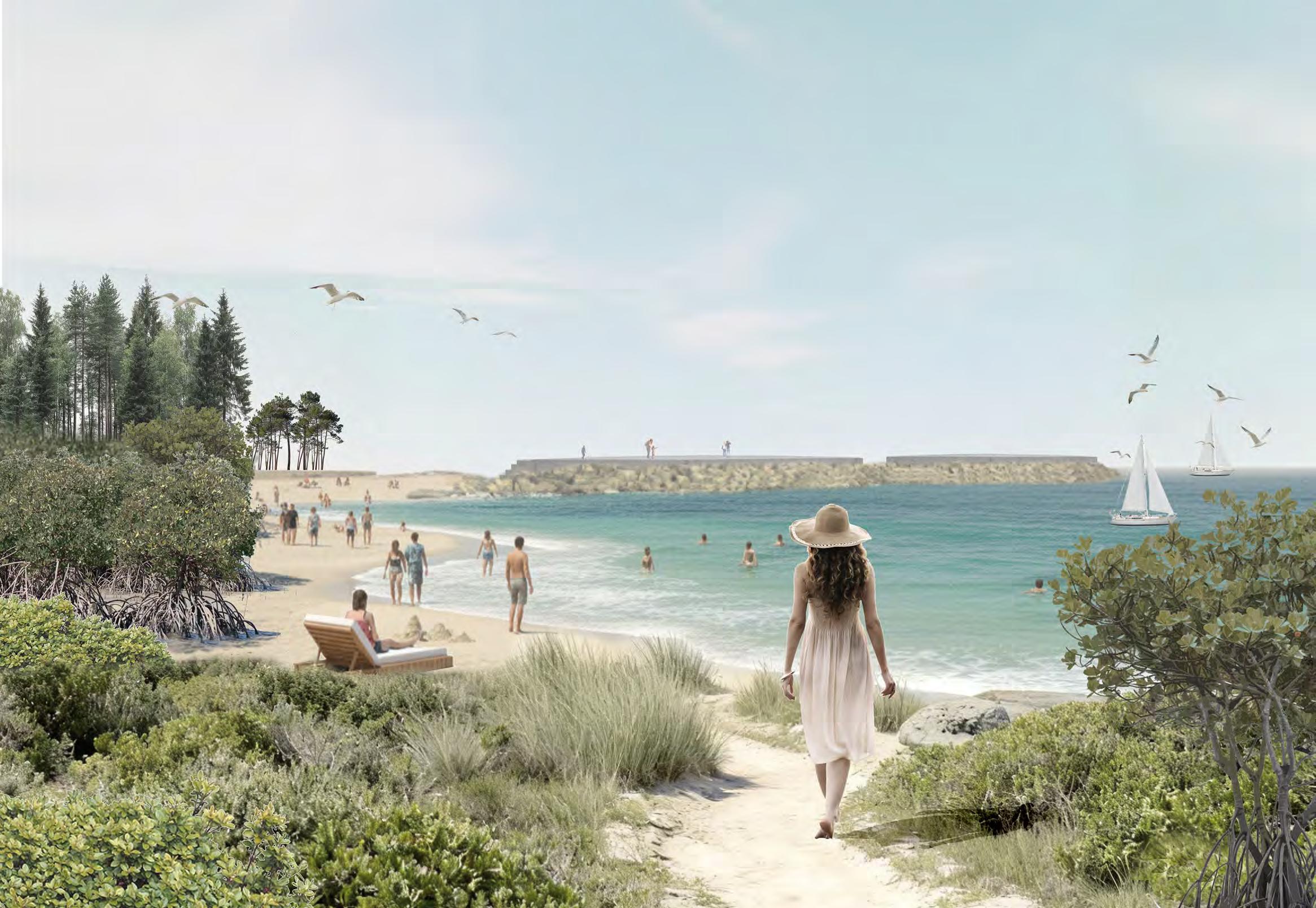
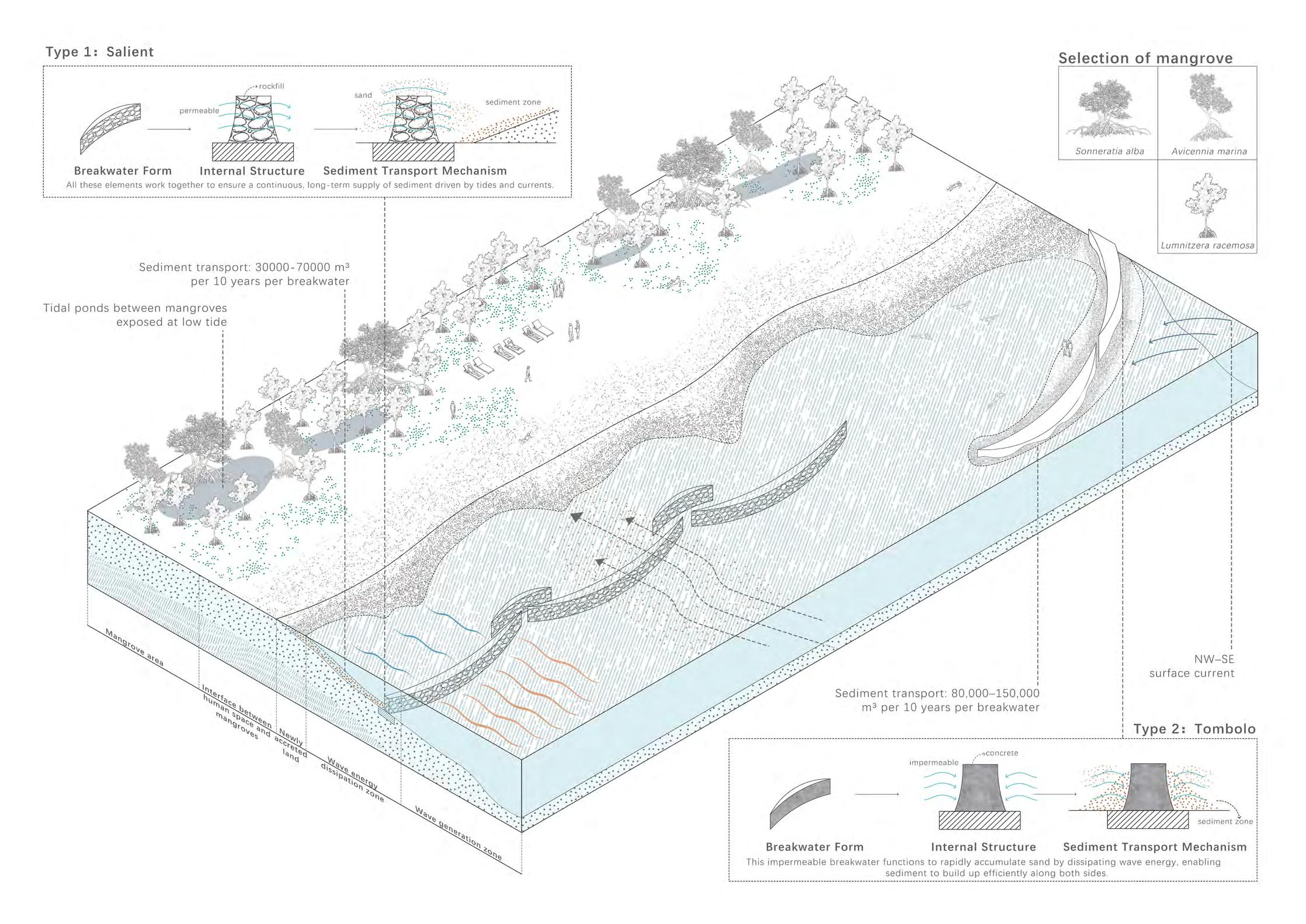
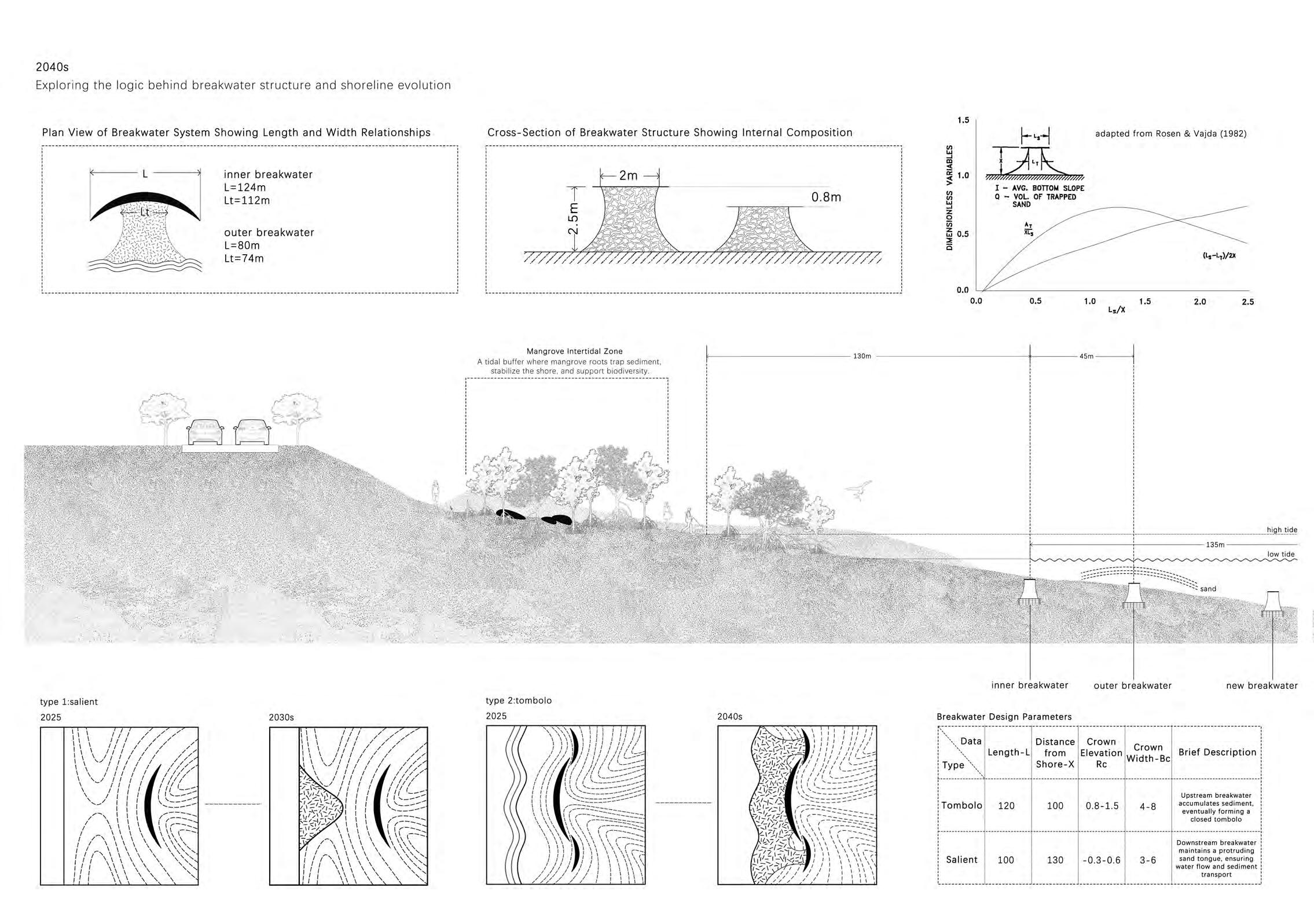
Phase 1 :Instead of building large, impermeable seawalls, low offshore structures are placed near the breaking waves. These structures dissipate wave energy, allowing sand carried by the sea to gradually settle and form tombolos—curved sandy extensions that redefine the coastline. Mangroves, as native species, stabilize the sediment, reduce erosion, and absorb wave energy through their intricate root systems.
Phase 2 :As tides and vegetation interact, the shoreline becomes more stable, with beaches and mangrove belts interwoven. The gradual rise of the land and the shifting water depth push mangroves to expand outward, while older mangroves near human zones decay naturally and are replaced by other species, creating transitional spaces for human access and recreation.
Phase 3 :Over time, the earlier-formed land evolves into stable terrain, while new mangrove buffers continue to grow outward, forming a dynamic and living shoreline. Human and ecological systems coexist and evolve together, merging natural sedimentary processes with intentional design. Through this ongoing interaction, the shoreline remains resilient and continuously renewed by both nature and human guidance.
The sea is never still. Its tides pull sand from one place, release it in another, reshaping the edge of land with each rise and fall. Yet for decades, Singapore’s reclamation projects have sought to silence this movement-straightening shorelines with walls of sand and stone, fixing the coast into rigid lines. The result is a boundary that resists change, but also resists life relations.
The axonometric drawing illustrates the sediment transport and deposition process, revealing how sand gradually accumulates behind the offshore structures.
Student Name: Wu Han
Tutor: Victoria Jane Marshall
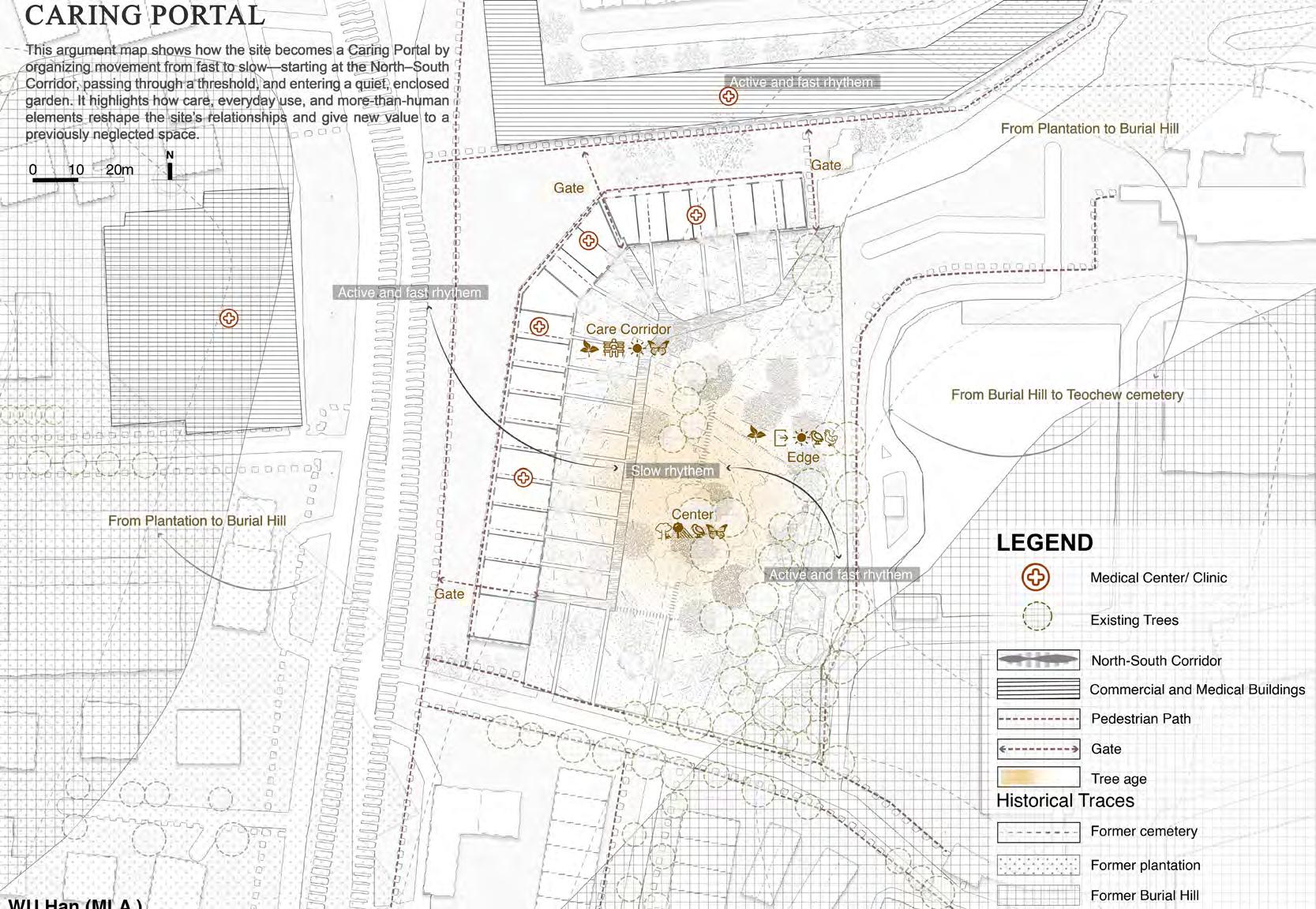
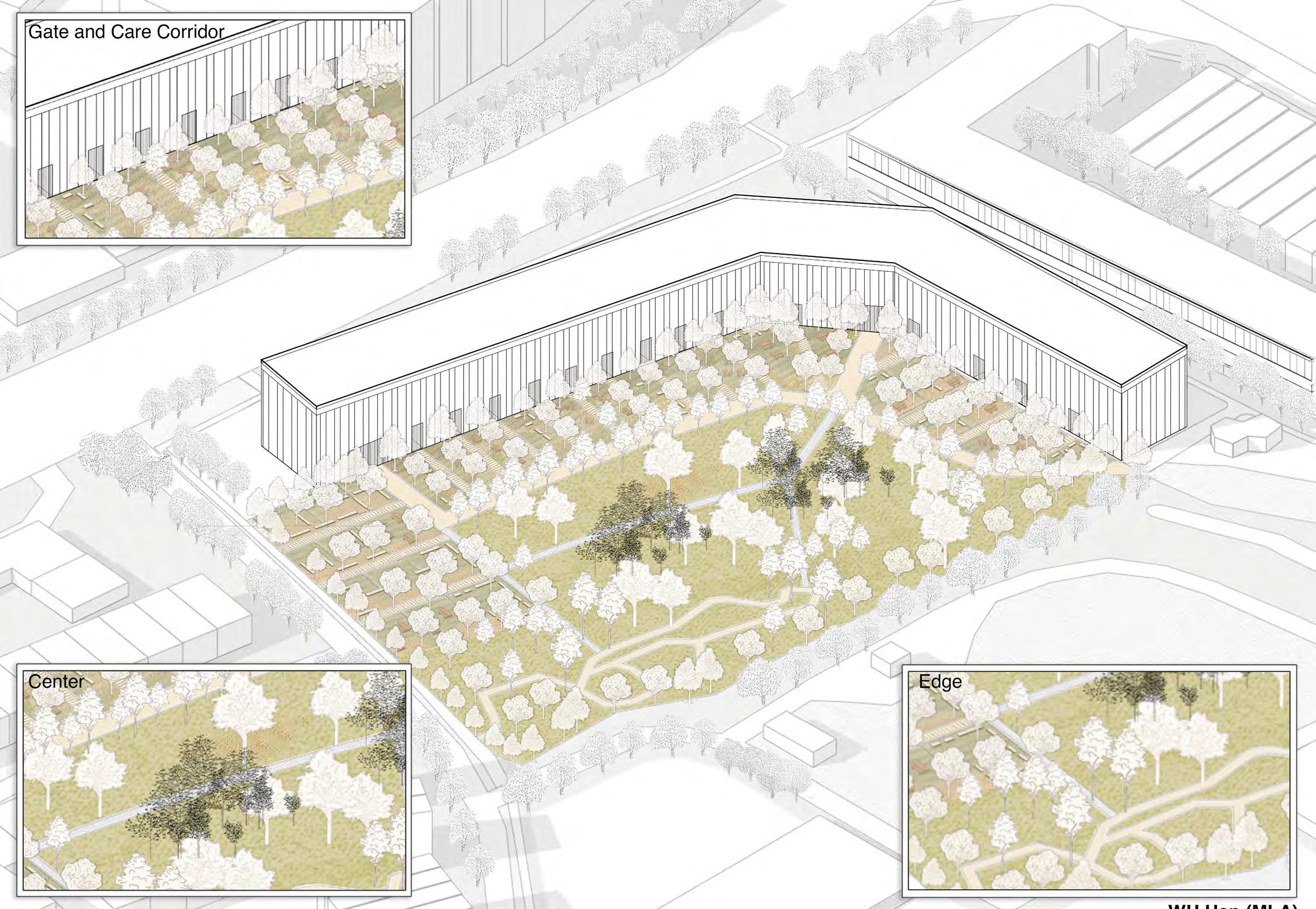
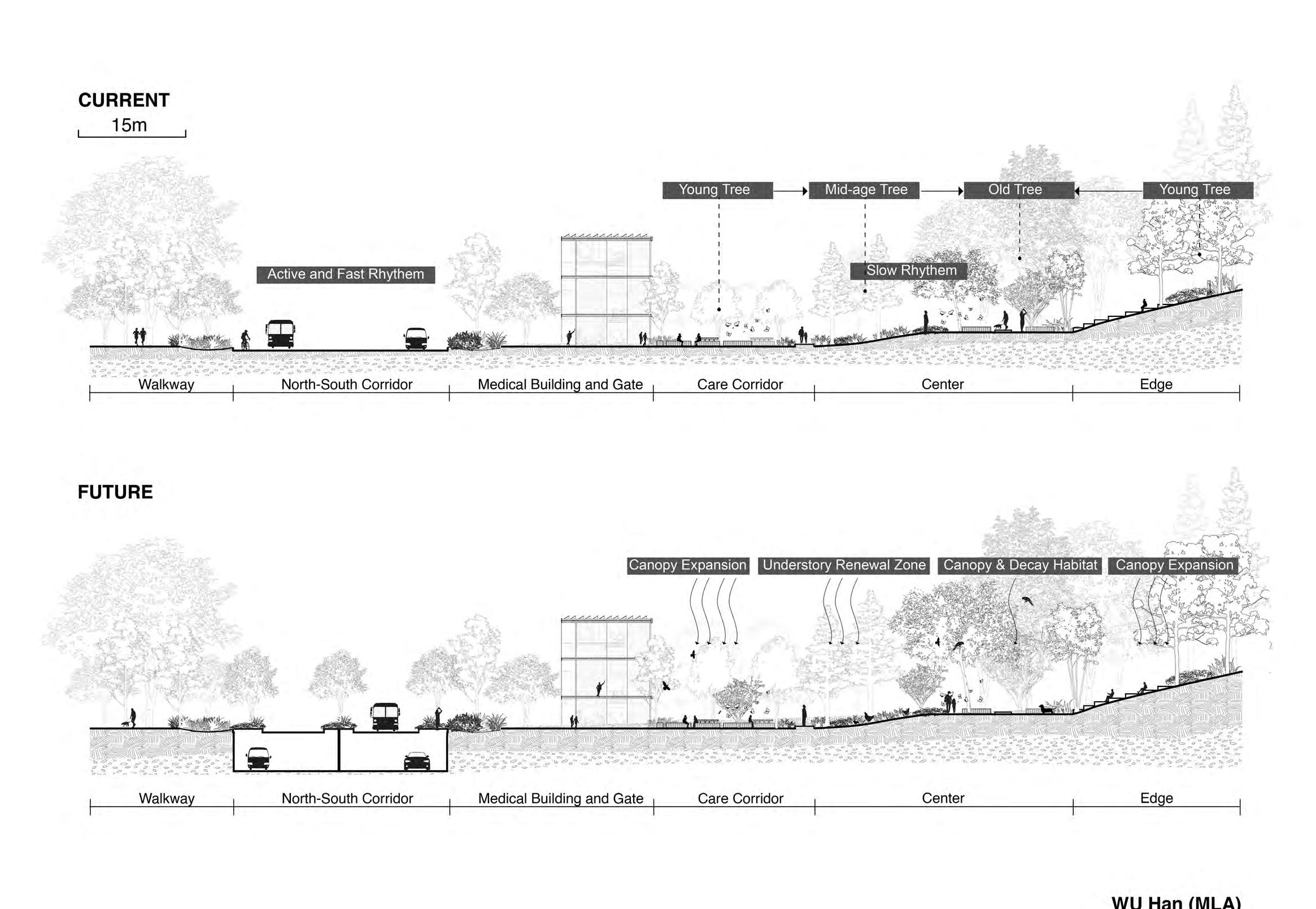
My project, entitled Caring Portal transforms the sloping area, parking lots, and building edges of a reserve site in Novena Rise Park in Singapore into an enclosed garden of care. Historically, the reserve site transitioned from a cemetery to a slope surrounded by medical buildings. Past “cleaning” efforts created a clean, manageable space but also made it marginalized and neglected, lacking potential for rest and care. According to Ivanova (2016), in Care in Place, care keeps a place alive and connected to everyday life. Following a more-than-human approach, I add plants and animals into the mix. Surrounded by medical buildings, the site’s quiet and enclosed setting allows it to be reimagined as a place for care. In contrast to the city’s fast and active rhythm along the North–South Corridor - a green infrastructure promoting efficiency and mobility - the garden offers a slower, caring pace. Based on this “fast and slow” relationship, I propose my fifth nature as a transformation of site relations that prioritizes care. My spatial strategy is garden-as-portal, where the rhythms of plants, animals and people meet, allowing care to unfold as a multispecies relation. My portal expands care from medical practices to daily interactions, enabling neglected sites, such as this, to regain social importance, cultural meaning, and ecological importance, especially in supporting plant growth, renewal and small habitats on this site.
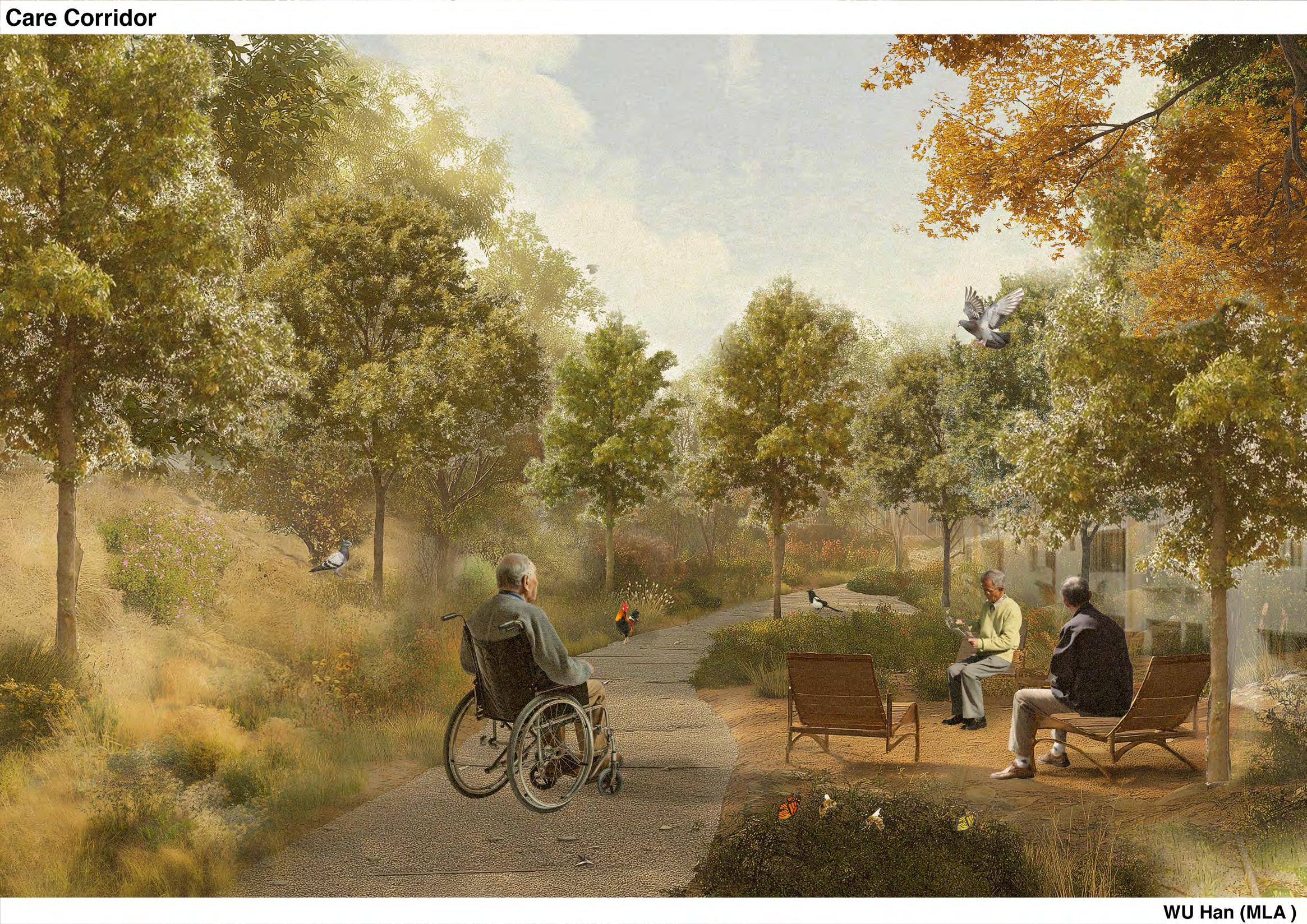
My enclosed garden has four spaces: a gate, a corridor, a center, and an edge. First, the gate at the building’s entrance separates the garden from the traffic and commuters along the North–South Corridor. Passing through, visitors slow their pace and enter a quieter space. Second, I transform the parking lot into a care corridor, providing shaded seating that supports rest and interaction among patients, doctors, and residents. Third, the slope’s flat area utilizes existing trees to create a restful, enclosed center for sensory experience. The final edge removes fences to reconnect the slope with the park. This transition promotes the flow from a restful care garden to an active park, transforming isolation into connection while acknowledging the different roles of the adjacent public spaces.
In the care corridor and the center, layered planting and seating create a rich care experience and a multispecies world. The planting strategy is based on tree age - older trees are preserved in the center, while younger trees are distributed outwards. This layering creates varying canopy heights and microclimates, forming transitional spaces from shady to bright areas, reflecting concern for plant growth and time. Additionally, diverse seating caters to varied user needs, including animals and plants. These rest areas encourage habitat formation as well as inviting people to stay, observe, and interact, turning care from a routine service into a shared, daily experience.
Student Name: Lee Lu Yi
Tutor: Lehana Guo
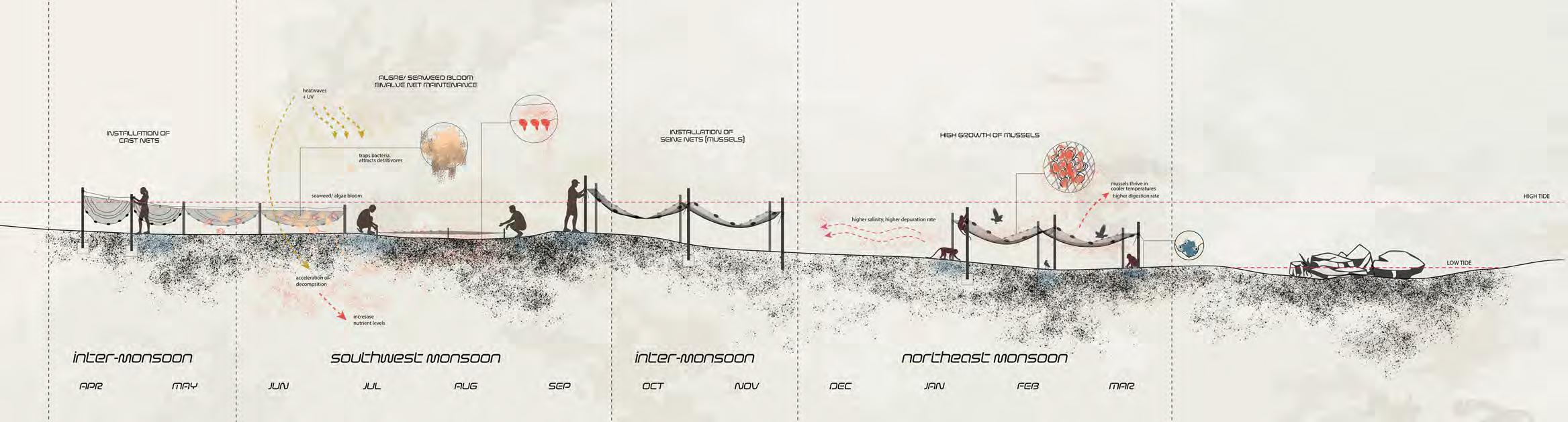
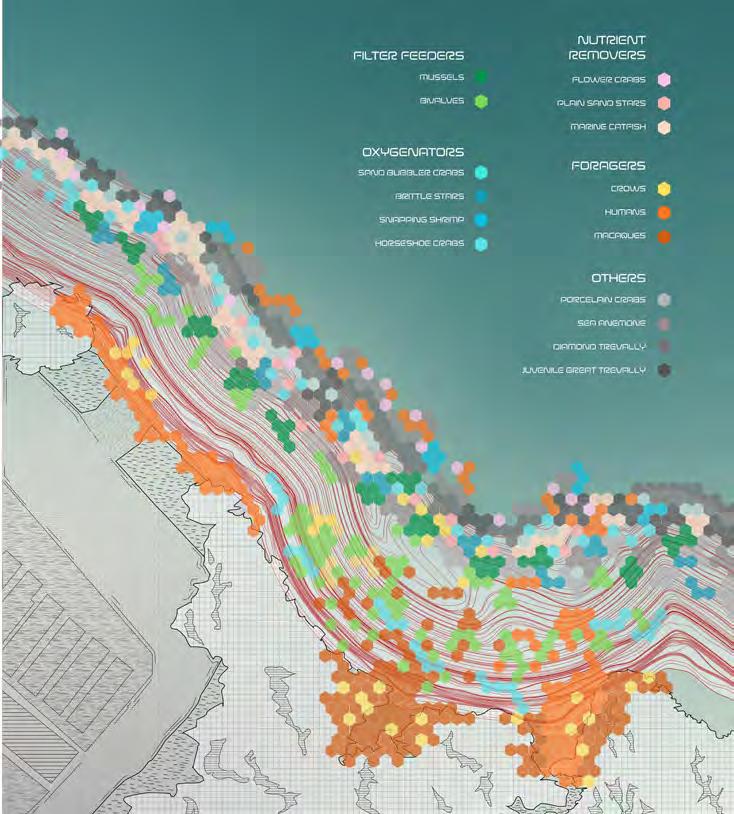
This project reprograms human participation within the environment, redefining development as a collective metabolism shared between human and nonhuman systems. Together with the adjacent Sembawang Park, Eagle’s Point endures as one of the last natural beaches in Singapore. More than just a fishing zone for humans, the shore sustains a network of terrestrial, intertidal and microscopic communities, interconnected by temporal rhythms of shifting tides and monsoons.
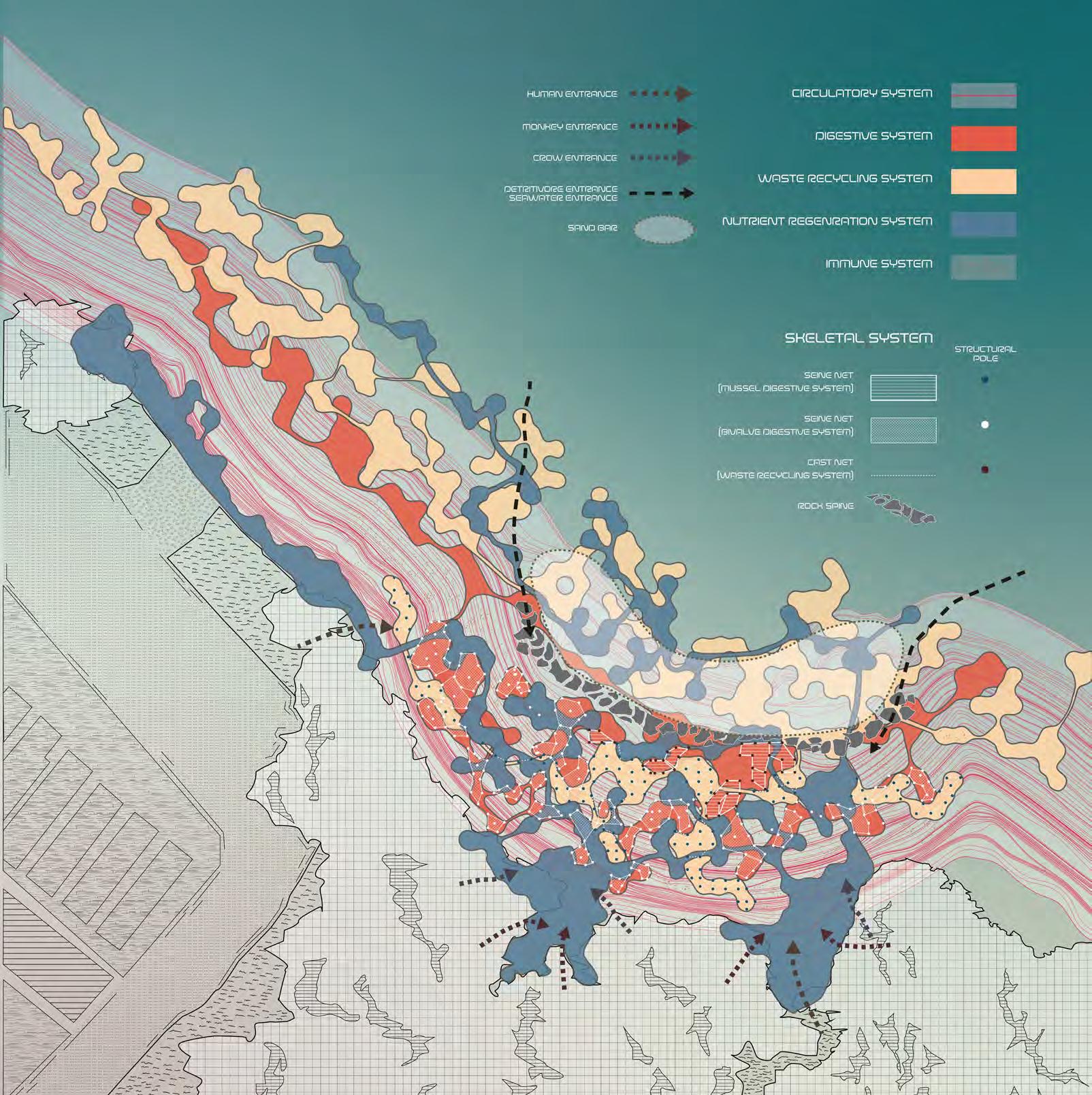
By connecting the functional systems of the intertidal participants, the project repositions the zone as an organism, where human and nonhuman actors form interdependent networks that sustain its metabolism. Prescribing agency to nonhumans and magnifying their processes serves to dampen anthropocentric ideals that privilege human dominance in national planning.
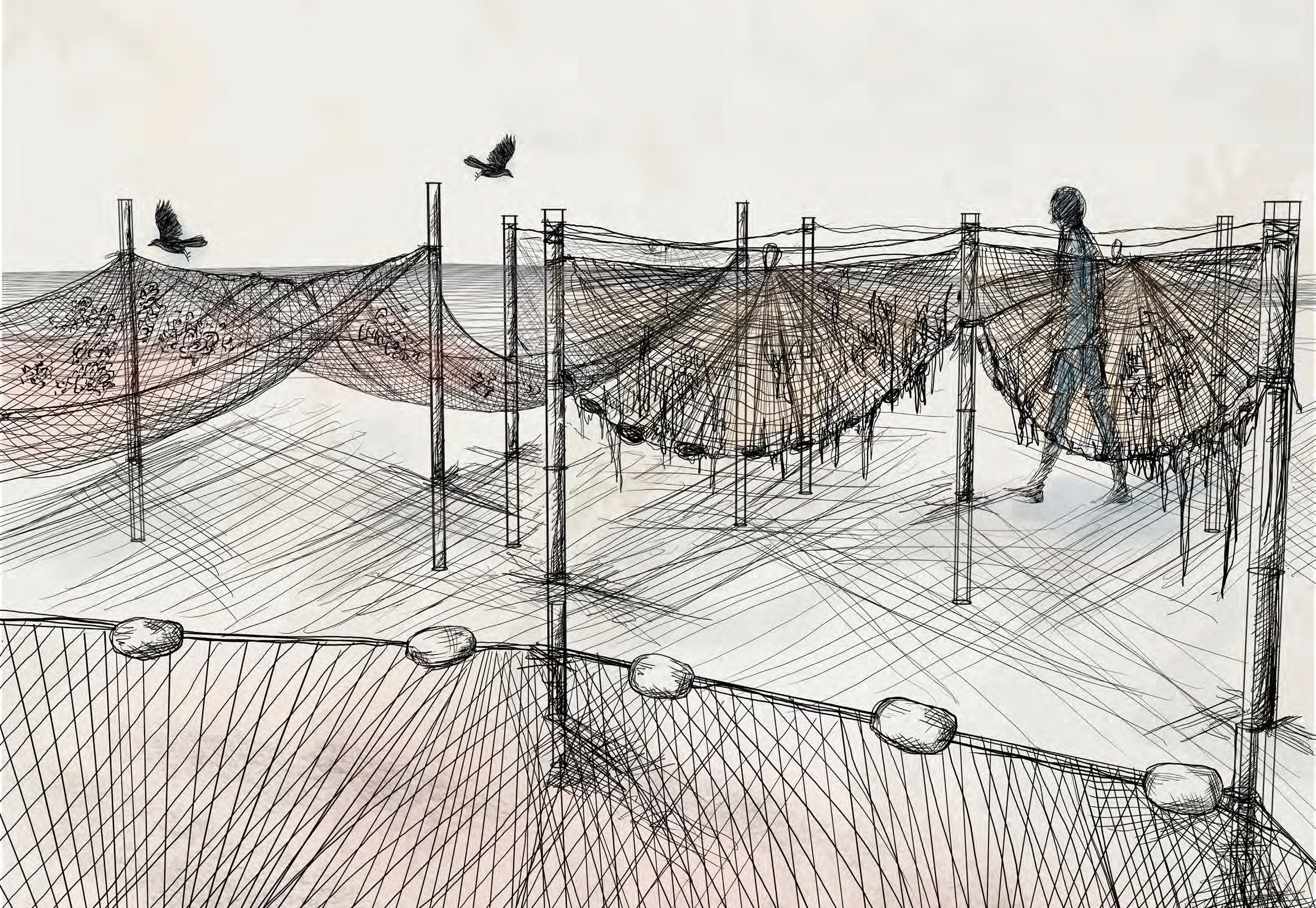
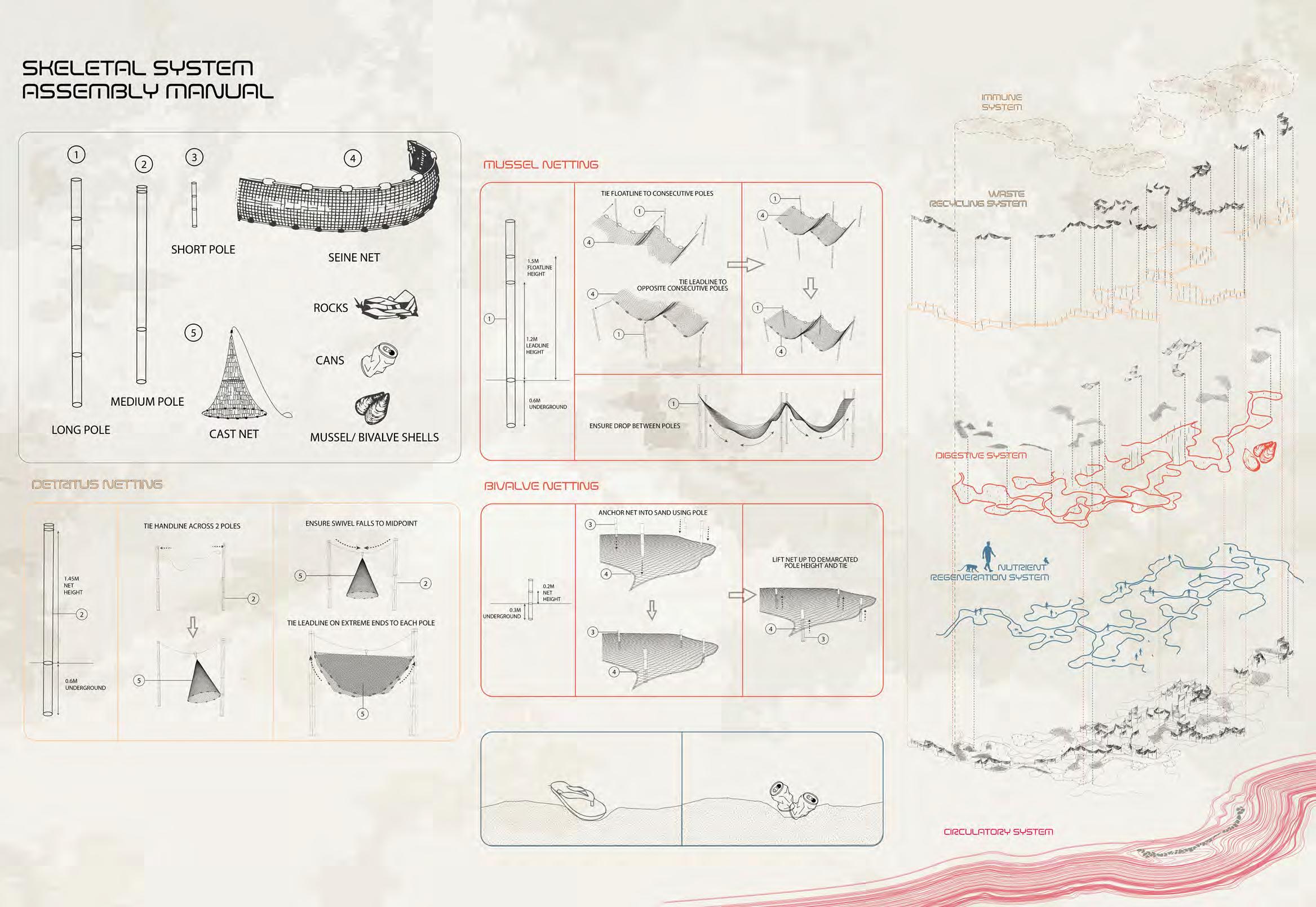
The Anatomy unfolds through various bodily systems magnified by a skeletal system built from fishing gear. Framed as an instructions manual for fishermen, the project transforms ghost nets into intertidal infrastructure by inviting fishermen to anchor unwanted seine and cast nets onto fixed poles along the shore. These structures form the stable framework that hosts the different systems of the organism:
A. Skeletal system: formed by abandoned fishing gear that lend structure to the body.
B. Circulatory system: shifting tides circulate nutrients and sediments between ocean and shore.
C. Digestive system: bivalves and mussels growing on thick seine nets ingest and depurate microbes.
D. Waste recycling system: bacterial waste attach to plankton, seaweed and algae, which are then consumed by detritivores; thin cast nets accumulate and trap this suspended matter.
E. Nutrient regeneration system: concave pockets formed by footpaths of foragers trap debris, forming microhabitats where bacteria decompose organic material and release nutrients.
F. Immune system: alternating sunlight and shade regulate UV exposure across the sand, sterilising exposed bacteria.
As the organism assembles, we observe its responses to the surrounding environment through shifting patterns of the monsoon, tide, sun and moon, revealing the temporality of the landscape as a living pulse.
As state policies continue to write and rewrite boundaries between the human and nonhuman, The Anatomy of the Intertidal dissolves this dichotomy, uncovering the hidden networks that binds species, materials and systems together. It positions the human not as the centre, but as one organ within a larger ecological body, where national development is understood as an ecological process rather than a human endeavour.
1. Southeast Asia and Singapore: pre-colonial, colonial
Cantley, R. (1883). Report on the forests of the Straits Settlements. Singapore Printing office.
Dobby, E. G. H. (1940). Singapore: Town and Country. Geographical Review, 30(1), 84–109. https://doi.org/10.2307/210451
Noor, F. A. (2003). The cult of wood. In F. A. Noor, E. Khoo, & D. Lok (Eds.), The spirit of wood: The art of malay woodcarving—Works by master carvers from kelantan, terengganu and patani. Periplus.
Reid, A. (1993). Southeast Asia in the age of commerce, 1450-1680. Yale University Press.
Reid, A. (1999). Charting the shape of early modern southeast Asia. Silkworm Books.
Zakaria, F. (2023). The camphor tree and the elephant: Religion and ecological change in maritime Southeast Asia. University of Washington Press.
Auger, T. (2014) Living in a Garden: The Greening of Singapore. Singapore: Editions Didier Millet, pp. 20–37.Barnard, T.P. and Heng, C. (2014) ‘A City in a Garden’, in Barnard, T.P. (ed.) Nature Contained: Environmental Histories of Singapore. Singapore: National University of Singapore Press, pp. 282–293. https://doi.org/10.2307/j.ctv1nth2d.23
Barnard, T. P. (Ed.). (2024). Singaporean creatures: Histories of humans and other animals in the Garden City. National University of Singapore Press. Barnard, T.P. and Heng, C. (2014) ‘A City in a Garden’, in Barnard, T.P. (ed.) Nature Contained: Environmental Histories of Singapore. Singapore: National University of Singapore Press, pp. 283–306. https://doi.org/10.2307/j.ctv1nth2d
Chee, L. (2023) ‘The Ruled and the Unruly: Animality, Anecdotes and Storytelling’, in Architecture and Affect: Precarious Spaces. 1st edn. London: Routledge, pp. 29–63. https://doi.org/10.4324/9781315604565
Comaroff, J., & Ong, K.-S. (2012). Paramilitary Gardening: Landscape and authoritarianism. City Axioms: Urban (In)security, Department of Social Anthropology, Sweden. DesignSingapore Council (ed.) (2010) 1000 Singapores: A Model of the Compact City. Mostra Internazionale di Architettura. Singapore: DesignSingapore Council, Ministry of Communications and Information.Rekittke, J. (2010) ‘Bottom-up Landscape versus Top-down City’, in Khoo Peng Beng et al., 1000 Singapores, pp. 157–168.
Hee, L. (2017) Constructing Singapore Public Space. Singapore: Springer Singapore (Advances in 21st Century Human Settlements), pp. 47–49, 80. ISBN: 978-981-10-2387-3
Jalais, A. (2021). The Singapore “Garden City”: The death and life of nature in an Asian city. In A. Rademacher & K. Sivaramakrishnan (Eds.), Death and life of nature in Asian cities (pp. 82–101). Hong Kong University Press. Kong, L., & Yeoh, B. (1996). Social constructions of nature in urban Singapore. Southeast Asian Studies, 34(2), 402–423.
Lee, S.K. and Chua, S.E. (1992) More Than a Garden City. Singapore: Parks and Recreation Department.Yuen, B. (1996) ‘Creating the Garden City: The Singapore Experience’, Urban Studies, 33(6), pp. 955–970
Neo, B.S., Gwee, J., and Mak, C. (2013) ‘Growing a City in a Garden’, in Gwee, J. (ed.) Case Studies in Public Governance: Building Institutions in Singapore. Abingdon: Routledge, pp. 11–63. https://doi.org/10.4324/9780203124840
Rinaldi, B.M. (2015) ‘Post-colonial Strategies: Open Spaces in Twentieth and Twenty-first-Century Singapore’, Die Gartenkunst, 27, pp. 151–164.
Rinaldi, B.M. (2023) ‘Botanic Nations: The Aesthetic of the Forest in Chandigarh and Singapore’, Journal of Landscape Architecture, 18(1), pp. 40–53. https://doi.org/10.1080/18626033.2023.2258724
Rowe, P., & Hee, L. (2019). A city in blue and green: The Singapore story. Springer.
Schneider-Mayerson, M. (2017) ‘Some Islands Will Rise: Singapore in the Anthropocene’, Resilience: A Journal of the Environmental Humanities, 4(2–3), p. 166. https://doi.org/10.5250/resilience.4.2-3.0166
Schneider-Mayerson, M. (2020). Eating chilli crab in the Anthropocene: Environmental perspectives on life in Singapore. Ethos Books.
Waller, E. (2001). Landscape planning in Singapore. Singapore University Press. Yee, M. (2024). Wild Worlds, Patch Planet. In A.-S. Springer & E. Turpin (Eds.), Seeing forest: Robert Zhao Renhui (pp. 235–261). K. Verlag & Singapore Art Museum.
Yeoh, B., & Kong, L. (1996). The notion of place in the construction of history, nostalgia and heritage in Singapore. Singapore Journal of Tropical Geography, 17(1), 52–65.
Blaut, J. M. (1953). The economic geography of a one-acre farm on Singapore island: A study in applied micro-geography. The Malayan Journal of Tropical Geography, 1, 37–48.
Bunnel, T., Ong, C. E., & Sidaway, J. (2013). Editorial: Jim Blaut and the trajectories of tropical geography. Singapore Journal of Tropical Geography, 34, 285–291.
Clammer, J. (1983). Village communities and the development process in Singapore: A review of village studies and their methodological and socio-economic implications. Southeast Asian Journal of Social Science, 11(1), 92–103.
Lim, K. S. (1996). A leaf from my nature diaries. Nature Watch, 4(3), 10–13.
Nallari, A., & Poorthuis, A. (2021). Rethinking ‘kampung’ or ‘village’ in the (re)making of Singapore and Singaporeans. Singapore Journal of Tropical Geography, 42(3).
Templeman, G. J., & Suykerbuyk, F. J. J. (1983). Agriculture in Singapore: Problems of space and productivity. Singapore Journal of Tropical Geography, 4(1), 62–72.
Teo, S. E., & Savage, V. R. (1985). Singapore landscape: A historical overview of housing change. Singapore Journal of Tropical Geography, 6(1), 48–63.
Ang, S. L. (2021). Nature Conservation in Singapore [Government]. Biblioasia. https://biblioasia.nlb.gov.sg/vol-17/issue-1/apr-jun-2021/nature/
Brook, B. W., Sodhi, N. S., & Ng, P. K. L. (2003). Catastrophic extinctions follow deforestation in Singapore. Nature, 424(6947). http://dx.doi.org.libproxy1.nus.edu.sg/10.1038/nature01795
Chee, Lilian, and Toby Fong. “Tracing the Last Tiger.” In Architecture and Affect: Precarious Spaces, edited by Lilian Chee, pages. London: Routledge, 2023. https://doi.org/10.4324/978131560456
Chisolm, R. A. (2023). Two centuries of biodiversity discovery and loss in Singapore. Proceedings of the National Academy of Sciences of the United States of America, 120(51). https://doi.org/10.1073/pnas.2309034120
Corlett, R. T. (1991). Plant succession on degraded land in Singapore. Journal of Tropical Forest Science, 4(2), 151–161.
Corlett, R. T. (1992). The ecological transformation of Singapore, 1819-1990. Journal of Biogeography, 19(4), 411–420.
Hill, D. H. (1977). The vegetation map of Singapore: A first approximation. Journal of Tropical Geography, 45, 26–33.
Loh, K. S. (1998). Within the Singapore Story: The use and narrative of history in Singapore. Crossroads: An Interdisciplinary Journal of Southeast Asian Studies, 12(2), 1–21.
Wee, Y. C. (1986). The city and the forest: Plant life in urban Singapore. Singapore University Press.
Wee, Y. C. (2018). Wee Yeow Chin (Dr) (Accession Number 004272; Vol. 3). https://www.nas.gov.sg/archivesonline/oral_history_interviews/record-details/09038934-4e67-11e8-b81e-001a4a5ba61b
Yeoh, B., & Kong, L. (1996). The notion of place in the construction of history, nostalgia and heritage in Singapore. Singapore Journal of Tropical Geography, 17(1), 52–65.
Zoe, E. Y. (2023, March 10). S’pore photographer documents “last eaglet” at Dover Forest East, which will be cleared for housing. Mothership. https://mothership.sg/2023/03/dover-forest-last-eaglet/
Hwang, Y. H. (2010). Observation of urban spontaneous vegetation as landscape material. Journal of Landscape Architecture in Asia, 5, 61–71.
Hwang, Y. H. (2020). Rewilding urban landscapes: Attributes, types, and application as a greening policy. In I. Douglas, P. M. L. Anderson, D. Goode, M. C. Houck, D. Maddox, H. Nagendra, & P. Y. Tan (Eds.), The Routledge Handbook of Urban Ecology (pp. 762–772). Routledge.
Hwang, Y. H. (2024). Rewilding Singapore [Education]. https://blog.nus.edu.sg/urbanwildlab/rewilding-singapore/
Hwang, Y. H., Endo, K., & Lum, S. (2020). Rewilding singapore: Exploring landscape design strategies that bring forest ecology into the urban context. City Green, 18, 34–41.
Hwang, Y. H., & Yue, Z. E. J. (2019). Intended wildness: Utilising spontaneous growth for biodiverse green spaces in a tropical city. Journal of Landscape Architecture, 14(1), 54–63.
Hwang, Y. H., Yue, Z. E. J., Ling, S. K., & Tan, H. H. V. (2019). It’s ok to be wilder: Preference for natural growth in urban green spaces in a tropical city. 2019, 38, 165–176.
Hwang, Y. H., Yue, Z. E. J., & Mayura, P. (2019). Urban wild initiative: Rewilding urban green spaces to enhance biodiversity. City Green, 17, 34–39.
Hwang, Y. H., Yue, Z. E. J., & Tan, Y. C. (2016). Observation of floristic succession and biodiversity on rewilded lawns in a tropical city. Landscape Research Journal, 42, 678–694.
Birksted, J.K., Aben, R. and De Wit, S. (2002) ‘The Enclosed Garden: History and Development of the Hortus Conclusus and Its Reintroduction into the Present-Day Urban Landscape’, Garden History, 30(2), p. 268. https://doi. org/10.2307/1587264.
Crandell, G. (2013) Tree gardens: architecture and the forest. 1st ed. New York, NY: Princeton Architectural Press.
Girot, C. (2016) The course of landscape architecture: a history of our designs on the natural world, from prehistory to the present. London: Thames & Hudson.
Wit, S. de (2018) Hidden landscapes: the metropolitan garden as a multi-sensory expression of place. Amsterdam: Architectura & Natura.
De Meulder, B., & Shannon, K. (Eds.). (2024). Forest urbanisms: New non-human and human ecologies for the 21st century. Leuven University Press.
De Meulder, B., Shannon, K., & Nguen, M. Q. (2019). Forest urbanisms: Urban and ecological strategies and tools for the Sonian Forest in Belgium. Landscape Architecture Frontiers, 7(1), 18–33.
Shannon, K., Cavalieri, C., & Konijnendijk, C. (2023). Urban forests, forest urbanisms and global warming: Developing greener, cooler and more resilient and adaptable cities. Journal of Landscape Architecture, 18(1), 8–13.
Davis, L. (2024). Migrant Ecologies Projects [Art]. Migrant Ecologies Projects. https://www.migrantecologies.org/
NTU Center for Contemporary Art Singapore. (2024). Climates Habitats Environments [Education]. Climates Habitats Environments. https://climateshabitatsenvironments.art/
Zhao Renhui, R. (2024). Institute of Critical Zoologists [Art]. Critical Zoologists. https://www.criticalzoologists.org/
Cairns, S., Jacobs, J. M., Jiang, Y., Padawangi, R., & Tan, E. (2014). Singapore’s Void Decks. In W. S. W. Lim (Ed.), Public Space in Urban Asia (pp. 80–89). World Scientific.
Chang, S. (2000). A High-Rise Vernacular in Singapore’s Housing Development Board Housing. Berkeley Planning Journal, 14(1), 97–116. https://doi.org/10.5070/BP314112985
Chee, L. (2017). Keeping cats, hoarding things: Domestic situations in the public spaces of the Singaporean housing block. Routledge, 22(6), 1041–1046.
Chua, B. H. (1997). Modernism and the vernacular: Transformation of public spaces and social life in Singapore. In B. H. Chua, Political Legitimacy and Housing: Stakeholding in Singapore (pp. 70–89). Taylor & Francis Group.
Wong, A. K., & Yeh, S. H. K. (Eds.). (1985). Housing a nation: 25 years of public housing in Singapore. Maruzen Asia for Housing & Development Board.
Yeh, A. G. O., & Yuen, B. (2010). Tall building living in high density cities: A comparison of Hong Kong and Singapore. In Y. K. Cheung & W. Chau (Eds.), High-rise living in Asian cities (pp. 9–23). Springer.
Yuen, B. (2005). The shifting paradigms of high-rise living. In Tall Buildings: From Engineering to Sustainability (pp. 33–38). World Scientific.
Yuen, B., & Yeh, A. G. O. (2010a). In the march of high-rise. In B. Yuen & A. G. O. Yeh (Eds.), High-rise living in Asian cities (pp. 179–186). Springer.
Yuen, B., & Yeh, A. G. O. (2010b). Liveability of tall residential buildings. In B. Yuen & A. G. O. Yeh (Eds.), High-rise living in Asian cities (pp. 129–147). Springer.
Crone, B., Nightingale, S. and Stanton, P. (eds) (2024) Fieldwork for future ecologies: radical practice for art and art-based research. Second edition. Eindhoven: Onomatopee (Onomatopee, 225).
Girot, C. and Truniger, F. (eds) (2012) Landscape vision motion: visual thinking in landscape culture. Berlin: Jovis (Landscript, 1).
Rose, G. (2014) ‘Visual Culture, Photography and the Urban: An Interpretive Framework’, Space and Culture, India, 2(3), pp. 4–13. https://doi.org/10.20896/saci.v2i3.92.
Rose, G. (2016) Visual methodologies: an introduction to researching with visual materials. 4th edition. London: SAGE Publications Ltd.
Tolia-Kelly, D.P. (2016) Visuality/Materiality. 0 edn. Edited by G. Rose. Routledge. https://doi.org/10.4324/9781315547930.
Barua. (2023). Lively cities: Reconfiguring urban ecology. University of Minnesota Press.
Bauer, U. (2019). The Posthuman City. Climates. Habitats. Environments [exhibition catalogue]. Nayang Technical University, Center for Contemporary Art. https://ntu.ccasingapore.org/exhibition/the-posthuman-city-climates-habitats-environments/
Dwyer, C., Perry, C., Salomon, D., & Velikov, K. (2021). Ambiguous Territory: Architecture, landscape and the postnatural. Actar Publishers.
Haraway, D. J. (1991). Simians, Cyborgs, and Women: The reinvention of nature. Routledge.
Haraway, D. J. (2016). Staying with the Trouble: Making kin in the Chthulucene. Duke University Press.
Kirksey, E. (2014). The Multispecies Salon. Duke University Press.
Leveratto, J. (2021). Posthuman architecture: A catalogue of archetypes. ORO Editions.
Springer, A.-S. (2024). Hidden in plain sight: On ruderal trajectories and the formation of alter-ontological possibilities. In A.-S. Springer & E. Turpin (Eds.), Seeing Forest: Robert Zhao Renhui (pp. 41–67). K. Verlag & Singapore Art Museum.
Tsing, A. L. (2012). On Nonscalability: The living world is not amenable to precision-nested scales. Common Knowledge, 18(3), Article 3.
Tsing, A. L. (2014). More than human sociality: A call for critical description. In K. Hastrup (Ed.), Anthropology and nature (pp. 259–259). Routledge.
Tsing, A. L., Mathews, A. S., & Bubant, N. (2019). Patchy anthropocene: Landscape structure, multispecies history, and the retooling of anthropology: An introduction to supplement 20. Current Anthropology, 60(S20), 186–197. Vincent, E., & Poon, A. (Eds.). (2021). Making Kin: Ecofeminist essays from Singapore. Ethos Books.