A smarter way to stay cool

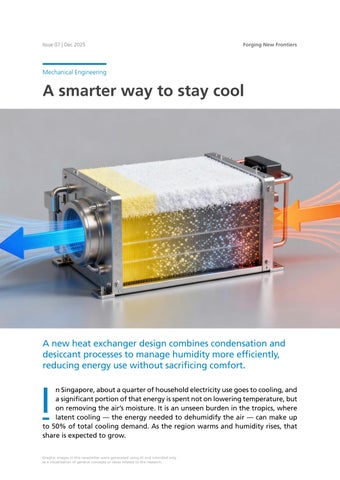
A new heat exchanger design combines condensation and desiccant processes to manage humidity more efficiently, reducing energy use without sacrificing comfort.
In Singapore, about a quarter of household electricity use goes to cooling, and a significant portion of that energy is spent not on lowering temperature, but on removing the air’s moisture. It is an unseen burden in the tropics, where latent cooling — the energy needed to dehumidify the air — can make up to 50% of total cooling demand. As the region warms and humidity rises, that share is expected to grow.
Most air-conditioning systems deal with moisture by overcooling the air until water condenses on chilled coils, then reheating it to a comfortable temperature. It is also very wasteful as too much energy is lost in the cycle of cooling and reheating. Associate Professor Ernest Chua from the Department of Mechanical Engineering at the College of Design and Engineering, National University of Singapore, wondered whether there might be a smarter balance. One that could tame the tropics’ moisture without driving temperatures so low.

His team turned to desiccant-coated heat exchangers, or DCHEs. These devices can remove moisture in two ways: by condensation, as in conventional systems, and by sorption, where a desiccant layer chemically locks in water vapour from the air. “Conventional systems depend almost entirely on condensation, which means the coils have to run much colder than necessary,” says Assoc Prof Chua. “If we can harness both condensation and sorption, we can achieve the same level of comfort at warmer coil temperatures — and that’s a big step toward greater efficiency.”
The team’s study, published in Energy, investigates how DCHEs behave under below-dew-point conditions — a regime where condensation and sorption occur together. Most prior studies examined only sorption, leaving a gap in understanding how the two processes interact and how to select desiccant materials that remain stable when condensation is present.
A new guide for below-dew-point cooling
To fill that gap, the researchers developed a three-step guide for evaluating desiccant materials and operating conditions below the dew point.
The first step tests stability, exposing a coated heat exchanger to long cycles of extreme, condensation-heavy conditions to see if the material breaks down or dissolves. The second step identifies the transition temperature — the point at which dehumidification shifts from being dominated by condensation to being driven primarily by sorption. The final step examines how factors such as inlet humidity, air contact time and switching time affect system performance.
To demonstrate the process, the team used a composite superabsorbent polymer–lithium chloride (SAP–LiCl) coating. It proved highly stable even in the presence of water, maintaining its structure and dehumidification ability after extended testing. The researchers determined that the transition between condensationand sorption-dominant behaviour occurred around 15°C, a temperature range suitable for air-conditioning systems operating just below the dew point.
“This transition temperature is critical,” explains Assoc Prof Chua. “It tells us exactly when a desiccant begins to contribute meaningfully to dehumidification. If the operating temperature sits on the right side of that boundary, the system can work more efficiently without sacrificing comfort.”
The findings showed that the DCHE could remove nearly four times more moisture from air than a conventional condensation-only coil. It could also match or surpass a conventional coil’s dehumidification performance using coolant roughly 5°C warmer. That difference, though small, translates into large energy savings, as warmer coils raise evaporator efficiency and reduce chiller load. Under optimised conditions, the researchers estimate an improvement of about 20% in energy use.