
Degree Project in Urban Planning and Design
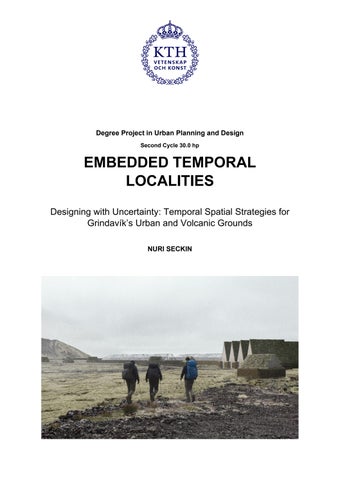
Designing with Uncertainty: Temporal Spatial Strategies for Grindavík’s Urban and Volcanic Grounds
NURI SECKIN
![]()

Degree Project in Urban Planning and Design
Designing with Uncertainty: Temporal Spatial Strategies for Grindavík’s Urban and Volcanic Grounds
NURI SECKIN

This project employs a comprehensive and layered methodology that combines conventional urban research methods with speculative and design-driven approaches. The aim is to balance practical, analytical tools with creative explorations, ensuring the project is both grounded in reality and open to innovative possibilities.
.01 Abstract
.02 Project
.02.1 Reading the Project
.02.2 Project Panels
.02.3 Experimental Modelling
.03 Thesis Booklet
.03.1 Challenge & Background
.03.2 Area
.03.3 Project
.03.4 Methodology
.03.5 Theoretical Framework
.03.6 Reference Projects
.03.7 Reference Literature
.03.8 Timeline
.03.9 References
What happens when the ground beneath us moves, not just physically, but existentially? When permanence fractures, and a place once inhabited becomes terrain of uncertainty? In the aftermath of the 2023 volcanic disruptions in Grindavík, Iceland, this project embraces uncertainty as a condition of design. Rather than restoring what was lost, it proposes new forms of inhabitation shaped by temporality, ecology, and collective agency.
Working across territorial, infrastructural, and local scales, the proposal introduces temporal protagonists: spatial actors tied to different durations, from days to weeks, months, or even years. These protagonists sustain presence in absence. They hold space when people cannot and gradually return it when conditions allow. Each intervention responds to a temporal rhythm, yet together they preserve the possibility of locality.
At the territorial scale, the project draws from Icelandic turf-building traditions, not as nostalgic form, but as method. Clusters of sacrificial, turf-informed structures are placed across the lava field. Designed to burn, erode, or be reclaimed by soil, they preserve ecological imprints for future flora and fauna. These dispersed architectures form a network for gathering, research, and ritual that reweaves the lava landscape into shared experience.
The infrastructural scale speculates on geothermal systems embedded in volcanic rock. Elevated pipelines and modular platforms span the terrain, enabling movement, energy transfer, and research access. These light interventions reveal the fragility of the surface while allowing new encounters with deep time.
Locally, protective berms are reimagined as four spatial typologies: inhabited, embedded, untouched, and speculative. Some hold communal programs, others are hollowed into introspective chambers, one is left to regenerate, and one anticipates future burial. Together, they confront solastalgia and reconnect the territory with urban life.
This is not a project for stability, but for cohabiting uncertainty through time, care, and the possibility of return.
This project takes place in the shadow of geological unrest, in a town displaced not by war or policy, but by the slow violence of the earth itself. Set in Grindavík, Iceland, the work navigates the fragile threshold between natural cycles and human continuity. The project neither romanticizes risk nor erases it. Instead, it asks: how can design remain present when permanence is no longer possible?
At its core, the work is a spatial response to uncertainty. It proposes an architectural and urban grammar calibrated to temporality, flux, and interruption. Rather than relying on static forms of resilience, it develops typologies that adapt, embed, and eventually relinquish control. Through a sequence of drawings and spatial strategies, the project addresses three operative scales: territorial, infrastructural, and local, each corresponding to different temporal durations and actor rhythms. These interventions do not aim to rebuild what was lost, but to seed frameworks for cohabitation with an unstable ground.
This is also a project of cultural care. It engages with vernacular knowledge, particularly the endangered practices of turf house construction, not as nostalgia but as systems of shared authorship and ecological logic. It recognizes that survival in such towns is not just technical, but symbolic. These settlements carry identity, memory, and attachment, all of which are slowly fractured under the weight of solastalgia, the psychic distress caused by the loss of familiar environmental anchors. In this context, place attachment is not sentimental, but infrastructural. To protect it is to protect the continuity of communal life itself.
As a theoretical proposition, the project situates itself within discourses of design for rupture, postdisaster urbanism, and the architectural agency of planning for destruction. It treats uncertainty not as a limit, but as a generative condition. It asks how architecture can operate without mastery, how urban form might hold space for recurrence, transformation, and loss. Grindavík becomes a case not only for Iceland, but for any community on unstable ground, negotiating the future with limited control yet deep-rooted presence.
panel 1
This panel introduces the project’s conceptual ground: the town of Grindavík, suspended between evacuation and return in the wake of tectonic disruption. It traces the emergence of a design agenda rooted in uncertainty, where architecture becomes a tool not for resolution, but for negotiation. The proposal unfolds across three spatial scales: territorial, infrastructural, and local, each activating a different temporal rhythm. At its core lies a recognition that coexisting temporalities are often revealed only in moments of crisis. The project seeks to embed locality, resilience, and care into a landscape marked by rupture, anchoring a future that is necessarily uncertain.
panel 2
Here, the eruption’s trajectory is spatially unpacked, from the first vent openings and lava flows to the improvised defensive act of constructing a 30-meter-wide, 10-meter-high soil wall. The panel maps the cascading disruptions to flora, infrastructure, and the urban edge, including critical thresholds like the harbor and Blue Lagoon. What emerges is a reactive geography, a townscape shaped by urgency rather than design. The protective wall, though born from necessity, is re-read here not just as boundary but as a latent spatial typology reimagined.
panel 3
This panel delves into the soil types and bedrock formations that structure both the eruption’s impact and the ground’s capacity for recovery. Excavated soil for the protective wall is traced back to its geological source, moraine and brown soil, each carrying different ecological affordances. Elevated zones, often spared by lava, are revealed as potential sites for flora-fauna succession. The drawing does not merely map geology, it identifies the ground as a living archive, where past flows, material capacities, and future ecological strategies converge.
Zooming into Grindavík’s urban grain, this panel exposes the spatial logics that predate and persist through disruption. The harbor, both as economic engine and cultural anchor, frames the town’s growth. Yet planning missteps, like proposed expansions toward the eruption zone, underscore a disconnect between projected urbanism and geological reality. Here, the protective wall becomes a new urban edge, and with it, a site of tension. The drawing charts a city pulled between its historical attachments and its speculative futures, between what was and what could be.
Temporality moves from concept to method in this panel. Geological cycles, infrastructure lifespans, human evacuation patterns, and ecological succession are drawn as overlapping but asynchronous rhythms. Architecture’s challenge becomes one of orchestration, introducing spatial strategies that operate across temporal scales. The project introduces three actor-types: shortterm (days to weeks), medium-term (weeks to months), and long-term (months to years). These actors inhabit different parts of the system: the lava field, the infrastructural grid, the urban edge. The drawing becomes a timeline woven into geography, designing with time as material.
panel 6
Inspired by the Icelandic turf house tradition, this panel presents architectural clusters that intervene lightly but meaningfully. Built collaboratively by communities, these structures offer both spatial refuge and ecological function. When lava arrives, they may burn, but what remains is a footprint, a shielded patch of flora, a mark of care. Situated strategically on brown and rocky soil, clusters like the wayfinding shelter and horticultural refuge enact a dual logic. They create inhabitable nodes while enabling future ecological regrowth. The architecture here is not permanent. It is purposeful, temporal, and memoried.
panel 7
This panel articulates the infrastructural scale of intervention, introducing a light-touch network that hovers above the lava field with minimal environmental impact. Geothermal pipes, modular platforms, and recyclable structural systems form a connective tissue across the terrain. These platforms support energy extraction and research activities while leaving only trace anchors behind, future markers of geological, ecological, and human presence. The network extends into Grindavík itself, where the project transitions into the local scale. Here, the new edge condition formed by the protective wall is reimagined through a series of interventions. The temporal commons become a transitional urban void between residential life and the territory. The embedded passage cuts through the protective wall to host programs and reflection. The regenerative margin transforms soil into a substrate for dormant ecologies. Architecture is deployed not as object, but as passage, ritual, and infrastructural memory.
panel 8
Zooming into the local scale, this panel focuses on two critical typologies situated along the protective wall. First, the embedded passage is a sequence of spatial experiences cut into the wall, hosting daily life, rituals, and collective reflection. From its elevated interior, views unfold toward the town and the dynamic lava field beyond. Second, the prospective line anchors the future of Grindavík’s outer edge, a planned zone for cooperative living and communal functions designed to be buried under soil in the next volcanic cycle. These programs, positioned to be both protected and protectors, are intended to be excavated and reactivated when reinhabitation becomes feasible. The accompanying image of the temporal commons captures the town’s new spatial threshold, a collective landscape of transition, pause, and possibility.
panel 9
The final panel integrates all interventions into a territorial strategy. The clusters, infrastructural lines, and local insertions form a dispersed but coherent network across the lava-impacted landscape. New hiking routes trace ecological gradients, infrastructural stations punctuate flows, and protective walls become hosts rather than boundaries. What emerges is not a masterplan in the traditional sense, but a choreography of resilience. Temporality, uncertainty, and locality are spatialized to enable future return, continuity, and coexistence.


This section presents two physical experiments using magnets and iron shavings to simulate the spatial logics of lava in relation to built and territorial conditions. These models do not replicate volcanic activity in a scientific sense but operate as speculative instruments that reflect, abstract, and react. In doing so, they offer insights into how architectural and territorial configurations might engage with volatile geologies not through domination, but through dialogue. The material agency of lava is explored as both threat and designer. Its resistance, accumulation, and redirection become tools to rethink site planning, spatial porosity, and the temporal footprint of architecture.

In this model, a territorial lava landscape is constructed from magnetic base material. Iron shavings are used to simulate the movement of lava across this topography. The experiment tests how lava-like particles respond to various edge conditions: sharp, uninterrupted lines versus fractured, porous boundaries. As the iron filings settle, certain patterns emerge. Convex voids accumulate mass, crevices redirect flow, and irregularities create points of pause or protection. These reactive geometries suggest where architectural clusters may be sited, not to impose order but to negotiate with the flow itself. This becomes not only a spatial study but a relational map, a way to understand the logics of encounter between volatile ground and human intent.

Here, the lava field is reimagined at architectural scale. Buildings made from magnets are placed as analogs for the proposed turf clusters. Lava, again simulated through dispersed iron shavings, is introduced gradually from one direction. The filings resist open spaces, catch on corners, accumulate along edges, and begin to form a crust around the structures. As the flow is redirected, micro pockets emerge between built forms, creating zones of shelter, potential ecological patches, and delayed destruction. This model speculates on the defensive poetics of massing, where the act of clustering is not simply programmatic but performative. It asks how architecture can shape risk without denying it, and how buildings can become instruments of deflection, resistance, and care.
Designing with Uncertainty: Temporal Spatial Strategies for Grindavík’s Urban and Volcanic Grounds
Degree Project in Urban Planning and Design Second Cycle 30.0 hp
Nuri Seçkin / 2025

This project addresses the inevitable consequences of Iceland’s geological features due to its location and the adverse effects these consequences have on the ecology, cities, and communities. Although Iceland benefits from these unique features through energy production and touristic activities, both historically and today, the ecology has been damaged, cities and the infrastructures that serve them have been severely damaged, and communities have had to abandon their places for a while or leave them behind forever.
Although Iceland is experiencing adverse effects due to its unique geological characteristics, it also faces the impacts of global climate change during the Anthropocene process. While climate change does not create immediate and direct results as noticeable as seismic activity and volcanic eruptions, effects such as melting glaciers, landslides, and constantly rising water levels threaten Iceland’s life.
Although the abovementioned situations threaten Iceland, paradoxically, they also create a dilemma in which the communities here are of great importance for their continued existence. Thanks to these unique qualities, Iceland produces energy with geothermal energy, meets regional heating needs, and the energy consumption of particular industrial sectors. Close to 75% of Iceland’s energy consumption is also met with hydroelectric power plants, rest is covered by geothermal energy with minial contribution from wind, solar and fossil energy (Hreinsson et al., n.d.; Sveinsson & Hettiarachchi, 2016). Meeting these needs with sustainable resources reduces external dependency, creates new job opportunities in the national market, and, due to the locational diversity of these energy production infrastructures, prevents the population decline trend seen in some places and indirectly helps preserve local existence, identity, and culture. However, another critical aspect that needs to be reminded of these infrastructures is their adverse ecological effects on both a regional and global scale and their contribution to the worldwide climate crisis.
While these qualities of the energy production image in Iceland are an essential part of the backbone for the sustainability of the economy and existence, another vital part of the backbone is tourism. Like the energy sector, tourism is criticized for its adverse effects and results. Still, it is an integral part of the economy and existence, creating positive economic and local opportunities. Tourism is fed by Iceland’s unique nature, energy production facilities, the opportunities it offers, and the cities in Iceland.
In short, energy production and tourism sector dependency are significant in Iceland. However, extreme natural conditions in Iceland make these systems quite brittle and easily affected by Iceland’s harsh environmental conditions. Periodic or momentary natural events can affect tourism, which is critical in sustaining the economy or resources that remote or small settlements are fundamentally dependent on. Sometimes, people living in those areas may be relocated temporarily or permanently. The uncertainty of how long this relocation will take adds a temporal aspect to the situation. In Iceland, events that cause such situations are controlled mainly by reactive responses rather than preventive interventions. This situation creates a long-term planning and economic vulnerability for those settlements, the communities’ identities, the belongings and cultures they associate with the place, and, in general, planning and financial vulnerabilities.
This project aims to focus on all these issues, the displacement of communities, the risk to their cultural assets, the change in the urban realm, and the change in energy production and tourism areas which put the local economy and existence at risk. It also aims to go a step further and focus on how these natural events can be evaluated and how a response can be produced through urban design.
In line with this purpose, this project puts the following research on focus;
“How can design preserve the irreplaceable while preparing for the inevitable?”

In line with all the above-mentioned issues and situations, this project will focus on a settlement and the region where recent volcanic activity has occurred and where these events can be observed rather than a specific location. This focus will be on the town of Grindavik, located in the Reykjanes peninsula in the southwestern part of Iceland.
Grindavik is a coastal town located approximately 50 kilometers from Reykjavik, Iceland’s capital city. With a population of nearly 3,000, it is, therefore, very accessible and attractive for locals, tourists, researchers, and fishermen(Andrésdóttir, n.d.) (De Michele et al., 2024) .
Grindavik’s place in history is closely related to the discovery of Iceland and is parallel to it (Jackson, 2023). This is due to its coastline and its naturally formed harbor. It is also one of the first fishing settlements, crucial for Iceland’s economy and existence (Andrésdóttir, n.d.).
Throughout history, Grindavik has maintained its significance due to its location and economic contribution through fishing (Andrésdóttir, n.d.). However, today, it is also an important settlement due to its proximity to tourist attractions such as the Blue Lagoon, geothermal spa locations, and unique landscapes and conservation areas (Geirsson et al., 2021, p. 202).
The area where Grindavik is located is known for its lava fields, hot springs, volcanic formations, and rugged landscape. Therefore, the geothermal energy production infrastructures in the area are essential for both the local community and tourists. In addition, it is an important stop on the tourist routes extending east with the UNESCO-recognized Reykenes Geopark and its connection to many hiking routes. In addition, its port and fishing activities are still relevant and vital (Andrésdóttir, n.d.; De Michele et al., 2024; Geirsson et al., 2021).
November 2023, Grindavik was affected by extreme seismic activities. In the following process, this seismic activity caused the formation of surface magma fissures, and some of these fissures occurred in very close areas to the town (De Pascale et al., 2024). The lava that emerged from these fissures was seen as a significant risk due to the uncertainty of its progress after a while, and the town was evacuated. Additionally, berms were quickly built to direct the lava flow. However, some houses were still damaged, much of the infrastructure became unusable, and other effects of natural activity in the urban area were revealed.

In line with all these qualities, this project aims to impact different levels of this multifaceted system rather than focusing solely on Grindavik itself. These are;
Urban Settlement
-Focus on the town of Grindavik, which is under threat from volcanic activity and other natural events.
-The relationship between urban formation, lava flow, and the intersection areas where this relationship occurs.
Infrastructural Landscape and Nature
-Areas that serve energy production, provide tourism, and contain nature.
-Volcanic fields and lava deposits that threaten the existence of pre-existing elements and cause sudden change or their destruction.
Energy-Extractive Infrastructures
-Infrastructures that enable energy extraction, production, and the areas under their influence.
-Areas that are extensions of energy production and affected by volcanic activities.

This project examines the effects of inevitable natural events in urban design and architecture from environmental, cultural, and socio-economic perspectives; it will bring the moral angle of these events back to light and produce an answer to prevent or live with them. This answer is developed through the intersection of tectonic activity with the urban realm, nature, communities, and infrastructure. The project’s objectives are as follows:
-Highlight the intersections of tectonic activity with the urban realm, nature, communities, and infrastructures.
-Produce design strategies that have both local and global relevance.
-Provide a model for integrating natural phenomena into urban and architectural planning.
In light of these goals, the project aims to serve as a framework for sustainable and adaptable design. With its design strategies, it will establish both local and global relevance and set an example.
The focus of the project will be on:
Developing a set of tools and strategies to identify landscape and urban vulnerabilities and prevent the adverse effects that may arise. Also, making design suggestions can be an example of evaluating unavoidable natural activities as a tool or a new element in urban design and turning them into a potential element of the planning process and thinking about how these design suggestions can both be an input to the city and serve as a preventive design function.
Focus on the potential uses of volcanic materials and speculate and suggest how these materials can be used in architectural and urban design. Also, suggestions should be made on reimagining and rethinking the landscapes where these materials are found. For example, making the process of these volcanic lands changing over time and becoming a part of nature a part of the tourist attraction.
Reconsideration and speculation of energy production facilities negatively affected by natural events and their extensions. Suggestions on acquiring an adaptive feature at different stages of the process.
Reducing the impact of relocation on local identity and culture and ensuring the preservation of existing values through strategy and design recommendations are also important.
Examining the temporality of the concepts mentioned and revealing how this creates a cycle. Developing strategy and design suggestions to be applied before, during, and after naturally developing events per this cycle. This ensures that both the settlement and the surrounding areas can continue to exist. Ensuring that it becomes a more attractive area when it is safe to return to the settlement. Until this is secure, make suggestions on how safe times and programs can be used to ensure the city’s survival during the process, making a daily city proposal.
This project employs a comprehensive and layered methodology that combines conventional urban research methods with speculative and design-driven approaches. The aim is to balance practical, analytical tools with creative explorations, ensuring the project is both grounded in reality and open to innovative possibilities.
A desk study will be conducted to review relevant literature on Iceland’s geological features, urban resilience, energy infrastructures, and community adaptation strategies. This will help build a solid theoretical framework for the project.
A field visit to Grindavík will be undertaken to gather firsthand insights into the town’s spatial and environmental conditions. This will include documenting key infrastructures, landscapes, and vulnerable areas to better understand the context.
Interviews with local residents, municipal authorities, geologists, and urban planners will be conducted to gather qualitative data. These conversations will help understand local perceptions of risk and opportunities for resilience.
Mapping will be used to visualize geological risks, urban vulnerabilities, and the spatial relationships between energy infrastructures and settlements. This will involve both GIS and handdrawn maps to explore different scales.
Physical models will be developed to explore the architectural and urban design responses to natural disruptions. These models will help visualize adaptive design strategies using volcanic materials and temporal urban transformations.
The project will explore the potential use of volcanic materials in architecture and urban design. This will involve testing their properties and speculating on their use in creating adaptive structures.
Speculative mapping will be employed to illustrate possible future scenarios and the hidden relationships between natural phenomena and human settlements. This creative approach will offer new perspectives on resilience.
Narrative cartography will document lived experiences and project future stories of Grindavík, focusing on adaptation and resilience. This will integrate community narratives with spatial data to create a richer understanding of the place.
Design strategies will be developed to address different phases of natural events, before, during, and after. These strategies will focus on creating adaptable urban frameworks that respond to the cyclical nature of volcanic activity.
Foucault’s concept of heterotopias refers to spaces of otherness that exist alongside conventional spaces, often disrupting established social and spatial orders. In the context of Grindavík, this theory will help frame how volcanic landscapes and the disruptions they cause can be understood as heterotopic spaces that challenge traditional notions of urban stability and permanence.
Lefebvre’s theory explores the socio-political dimensions of spatial production, arguing that space is socially constructed through everyday practices and power relations. This framework will help analyze how communities in Grindavík interact with their environment and how design interventions can challenge or reinforce existing spatial structures.
The architecture of care emphasizes designing with empathy and attention to vulnerable environments and communities. This approach will shape the ethical dimension of the project, framing adaptive interventions as acts of care that respond to displacement, cultural loss, and environmental change.
Resilience theory emphasizes the capacity of systems to adapt to change and recover from disruptions. This framework will inform the project’s focus on creating adaptable urban and architectural solutions that respond to the cyclical nature of natural events in Grindavík.


By: Arnhildur Pálmadóttir (Design March)
Location: Iceland
Type: Speculative Urbanism / Experimental Design
Description:
Lava Cities envisions a future where volcanic lava flows are harnessed as a building material for new settlements in Iceland. The project challenges conventional notions of urban planning by proposing adaptive design strategies that work with the unpredictable natural landscape, rather than against it.

By: Lateral Office
Location: Arctic Regions
Type: Speculative Urbanism / Climate Adaptation
Description:
This project explores new urban typologies for Arctic communities facing climate change and resource depletion. It proposes adaptive settlement strategies that work with the natural landscape, focusing on local resource flows and self-sufficient infrastructures.
By: KCAP
Location: Reykjanes Peninsula, Iceland
Type: Urban Design Framework / Territorial Planning
Description:
This territorial-scale urban framework addresses the future of coastal towns on the Reykjanes Peninsula, including Helguvík and Bergvík, near Grindavík. The project proposes energy resilience, coastal protection, and integration of industrial and residential areas to create sustainable urban settlements.

By: KCAP
Location: Canada
Type: Regional Planning / Adaptive Settlement
Description:
Renewing the Remote is a regional planning project for remote communities in Northern Canada that aims to rethink urbanism in isolated regions. The project integrates renewable energy, local resource management, and adaptive infrastructure to address the unique challenges of remote living. It also explores new governance models for community-led development.

Frichot, H., Carbonell, A., Frykholm, H., & Karami, S. (2022). “Infrastructural Love: Caring for Our Architectural Support Systems.”
This book explores how infrastructures are more than functional networks, they are deeply intertwined with human relationships, care, and maintenance practices. It frames the argument that infrastructures (like energy systems) are cultural artifacts that embody care and coexistence in extreme environments. The concept of “infrastructural care” aligns with the focus on local knowledge systems and community adaptations to hostile environments, relevant for adaptive settlements in Iceland. (Frichot et al., 2022)

Carlow, V. (2016). “Ruralism: The Future of Villages and Small Towns in an Urbanizing World.”
This book challenges the conventional ruralurban dichotomy and highlights the critical role of rural areas in global systems. It provides insight into how rural settlements, like Grindavík, are deeply connected to urban and global flows of energy, resources, and labor. Carlow’s work offers a fresh perspective on rural spaces as active sites of production, resilience, and transformation, aligning with the thesis focus on adaptive settlements. (Björling et al., 2019)

Brenner, N. (2014). “Implosions/Explosions: Towards a Study of Planetary Urbanization.”
This book examines how urbanization processes extend beyond cities, shaping rural and peripheral landscapes in profound ways. Iceland’s renewable energy infrastructures are part of a planetary urbanization phenomenon, where global systems influence local landscapes and communities. It provides a critical framework for positioning the thesis within broader planetaryscale transformations while focusing on localized adaptations in fragile landscapes like Grindavík. (Brenner, 2017)

Fitz, A., & Krasny, E. (2019). “Critical Care: Architecture and Urbanism for a Broken Planet.”
This book explores care in architecture and urbanism within the context of a damaged planet. It presents various case studies on postdisaster rebuilding and community resilience, which directly relate to the thesis focus on Grindavík’s transformation after seismic disruptions. The book introduces a critical care approach, emphasizing community-led rebuilding efforts, aligning perfectly with the project’s emphasis on local knowledge and adaptive infrastructure systems in fragile landscapes.(Fitz et al., 2019)
Research & Site Selection: (Week 1-6)
-Finalize research questions, desk study, manifesto drafting.
-GIS analysis, case studies, site narrowing.
-Site analysis presentation, confirm site selection, preliminary sketches.
5-11)
Midterm Presentation
-Schedule site visit, document site, develop initial models.
-Refine design approaches, draft manifesto, start midterm prep.
-Midterm presentation.
-Urban fabric patterns, housing typologies, material flows.
-Physical/digital models, artistic interventions.
-Site plans, sections, elevations, visualizations.
Greenlight Presentation
Final Presentation
-Continue visualizations, prepare Greenlight materials.
Final Proposal & Visualizations: (Week 17-22)
-Finalize manifesto, detailed diagrams, renderings, presentation boards.
-Allocate buffer time for revisions.
De Michele, M., Raucoules, D., Pinel, V., & Belart, J. (2024). Shallow Bathymetry from Pléiades Data: The
Case Study of the Grindavik Volcanic Crisis. IGARSS 2024 - 2024 IEEE International Geoscience and Remote Sensing Symposium, 1043–1045. https://doi.org/10.1109/IGARSS53475.2024.10640668
A Power Plant in Iceland Has Turned Its CO2 Into Stone WIRED. (n.d.). Retrieved January 3, 2025, from https://www.wfoqfashion.shop/?path=page/ggitem&ggpid=698115
Alvarez, C., & Gabriela, M. (2024). When the Earth Breathes: An Anthology of Volcanic Urbanism [Thesis, Massachusetts Institute of Technology]. https://dspace.mit.edu/handle/1721.1/157366
Andrésdóttir, Þ. B. (n.d.). Volcanic hazard and risk assessment at Reykjanes, vulnerability of infrastructure Architecture Depends. (n.d.). MIT Press. Retrieved February 24, 2025, from https://mitpress.mit. edu/9780262518789/architecture-depends/
Ariyanti, V., Gaafar, T., De La Sala, S., Edelenbos, J., & Scholten, P. (2020). Towards liveable volcanic cities: A look at the governance of lahars in Yogyakarta, Indonesia, and Latacunga, Ecuador. Cities, 107, 102893. https://doi.org/10.1016/j.cities.2020.102893
Arnalds, O. (2015). The Soils of Iceland. Springer Netherlands. https://doi.org/10.1007/978-94-017-9621-7
Arnhildur Palmadottir proposes building cities from lava. (n.d.). Retrieved January 3, 2025, from https:// www.dezeen.com/2022/05/09/lava-cities-arnhildur-palmadottir-design-march/
Baron, N., Heidenreich, S., & Kokorsch, M. (2024). To relocate, or not? The future of small and remote communities in the Nordic Countries facing natural hazards. Fennia - International Journal of Geography, 202(1), Article 1. https://doi.org/10.11143/fennia.145701
Björling, N., Bruun Yde, M., Carlow, V. M., Carlow, V. M., Giraldo Arias, L., Institute for Sustainable Urbanism ISU, Kvorning, J., Langner, S., Lüder, I., Majgaard Krarup, J., Mumm, O., Neumann, D., Oltmanns, C., Randelovic, R., Richter, R., Richthofen, A. von, Schmidt, V., Simbürger, W., Steinführer, A., … Wha Hong, Y. (Eds.). (2019). Ruralism: The Future of Villages and Small Towns in an Urbanizing World. JOVIS. https://doi.org/10.1515/9783868599350
Björnsson, H. (2017). The Glaciers of Iceland. Atlantis Press. https://doi.org/10.2991/978-94-6239-207-6
Brenner, N. (Ed.). (2017). Implosions - explosions: Towards a study of planetary urbanization. Jovis. CIRCUMPOLAR DOMESTICS 2021, LATERAL OFFICE. (n.d.). Retrieved January 3, 2025, from https:// lateraloffice.com/filter/Housing/CIRCUMPOLAR-DOMESTICS-2021
De Michele, M., Raucoules, D., Pinel, V., & Belart, J. (2024). Shallow Bathymetry from Pléiades Data: The Case Study of the Grindavik Volcanic Crisis. IGARSS 2024 - 2024 IEEE International Geoscience and Remote Sensing Symposium, 1043–1045. https://doi.org/10.1109/IGARSS53475.2024.10640668
De Pascale, G. P., Fischer, T. J., Moreland, W. M., Geirsson, H., Hrubcová, P., Drouin, V., Forester, D., Payet‐‐Clerc, M., Da Silveira, D. B., Vlček, J., Ófeigsson, B. G., Höskuldsson, Á., Torfadóttir, H. K., Valdimarsdóttir, I. K., Blöndal, B. D. J., Jónsdóttir, I., Jónsson, S., & Thordarson, T. (2024). On the Move: 2023 Observations on Real Time Graben Formation, Grindavík, Iceland. Geophysical Research Letters, 51(14), e2024GL110150. https://doi.org/10.1029/2024GL110150
Figure 1: Index map of Iceland showing place names, lithospere plates,... (n.d.). ResearchGate. Retrieved January 3, 2025, from https://www.researchgate.net/figure/ndex-map-of-Iceland-showing-placenames-lithospere-plates-and-plate-boundary-structures_fig1_251815271
Fitz, A., Krasny, E., & Architekturzentrum Wien (Eds.). (2019). Critical care: Architecture and urbanism for a broken planet. The MIT Press.
Frichot, H., Carbonell, A., Frykholm, H., & Karami, S. (Eds.). (2022). Infrastructural love: Caring for our architectural support systems. Birkhäuser.
Geirsson, H., Parks, M., Vogfjörd, K., Einarsson, P., Sigmundsson, F., Jónsdóttir, K., Drouin, V., Ófeigsson, B. G., Hreinsdóttir, S., & Ducrocq, C. (2021, March 4). The 2020 volcano-tectonic unrest at Reykjanes Peninsula, Iceland: Stress triggering and reactivation of several volcanic systems. https://doi. org/10.5194/egusphere-egu21-7534
Hadač, E. (1969a). Mire communities of Reykjanes peninsula, SW. Iceland (Plant communities of reykjanes peninsula, part I.). Folia Geobotanica et Phytotaxonomica, 4(1), 1–21. https://doi.org/10.1007/ BF02854573
Hadač, E. (1969b). Mire communities of Reykjanes peninsula, SW. Iceland (Plant communities of reyk-
janes peninsula, part I.). Folia Geobotanica et Phytotaxonomica, 4(1), 1–21. https://doi.org/10.1007/ BF02854573
Helguvik-Bergvik Framework, Iceland, KCAP. (n.d.). Retrieved January 3, 2025, from https://www.kcap.eu/ projects/194/helguvik-bergvik-framework-iceland
Hreinsson, E. B., Sophusson, F., & Helgason, T. (n.d.). Planning and Utilization of Geothermal and Hydroelectric Resources in Iceland.
Jackson, T. (2023). Icelandic Volcanoes in Medieval Sagas, Chronicles, Annals and in Modern Scholarly Literature. ISTORIYA, 14(8 (130)), 0. https://doi.org/10.18254/S207987840027707-6
Milne, R. (2023, November 12). Iceland declares state of emergency as it braces for volcanic eruption. Financial Times. https://www.ft.com/content/71f3e333-850a-478d-9f17-4664813443de
Mt.Hekla Volcanic Museum by EON architecture / Architect, Designer. (2015, March 17). Architizer. https:// architizer.com/projects/mthekla-volcanic-museum/ (PDF) Soils of Iceland. (2024). ResearchGate. https://www.researchgate.net/publication/298259254_Soils_ of_Iceland
RENEWING THE REMOTE 2015-16, LATERAL OFFICE. (n.d.). Retrieved January 3, 2025, from https:// lateraloffice.com/filter/urbanism/RENEWING-THE-REMOTE-2015-16
Sæþórsdóttir, A. D., & Hall, C. M. (2019). Contested Development Paths and Rural communities: Sustainable Energy or Sustainable Tourism in Iceland? Sustainability, 11(13), 3642. https://doi.org/10.3390/ su11133642
Sci-fi Eco-Architecture: Science fiction, sustainability and design studio | Request PDF. (2024). ResearchGate. https://doi.org/10.1017/S1359135513000201
Skynews-lava-grindavik-volcano_6422041.jpg (1600×900). (n.d.). Retrieved January 3, 2025, from https:// e3.365dm.com/24/01/1600x900/skynews-lava-grindavik-volcano_6422041.jpg?20240115092327
Sveinsson, O. G. B., & Hettiarachchi, H. (2016). Energy in Iceland: Adaptation to Climate Change. United Nations University Institute for Integrated Management of Material Fluxes and of Resources (UNUFLORES). https://doi.org/10.53325/ADWY8262
Taylor, A. (n.d.). Lava Flows Into an Icelandic Town, The Atlantic. Retrieved January 3, 2025, from https:// www.theatlantic.com/photo/2024/01/lava-flows-into-icelandic-town/677141/
Troiani, I. (2013). Eco-topia: “Living With Nature” in Edilia, Iceland. Journal of Architectural Education, 67(1), 96–105. https://doi.org/10.1080/10464883.2013.767129
Volcanic urbanism: An investigation into the role of public open spaces as disaster relief areas in order to make a city more resilient. (n.d.). Retrieved February 24, 2025, from https://www.researchbank. ac.nz/items/5d3d4114-a94f-474d-bc72-0fe7f9f192e3
Wyatt, I. (2004a). The Landscape of the Icelandic Sagas: Text, Place and National Identity. Landscapes, 5(1), 55–73. https://doi.org/10.1179/lan.2004.5.1.55
Wyatt, I. (2004b). The Landscape of the Icelandic Sagas: Text, Place and National Identity. Landscapes, 5(1), 55–73. https://doi.org/10.1179/lan.2004.5.1.55
TRITA – ABE-MBT-25150
Stockholm, Sweden 2025
www.kth.se