Britain’s Nuclear Moment Nuclear Week in Parliament
Powering UK Healthcare Apprenticeships at Hinkley Point C
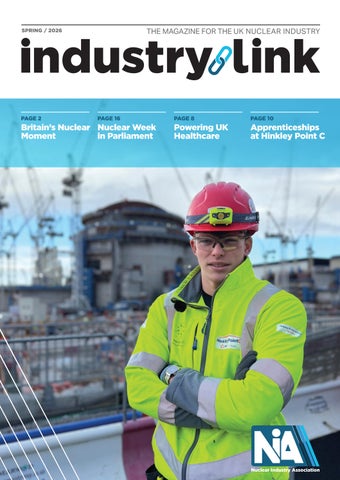
Welcome to the Spring 2026 edition of Industry Link. Momentum across our sector continues to build. With major decisions now translating into real progress on the ground, the UK’s nuclear programme is entering a period defined by delivery, confidence and growing political support.
In this edition, Tom Greatrex sets out why this truly is Britain’s nuclear moment—and why the challenge now is turning firm commitments into construction, jobs and long-term energy security. Alongside this, our coverage of Nuclear Week in Parliament captures a sector increasingly aligned behind a simple message: build, build, build.
We also look to the past to inform the future. Lincoln Hill’s conversation with veteran Torness construction manager David Morris offers timely lessons on leadership, collaboration and project discipline—insights that resonate strongly as the UK prepares to deliver its next wave of new nuclear. Lincoln also challenges the whole sector to match political ambition with faster, more proportionate and more disciplined delivery.
Elsewhere, you’ll find powerful examples of nuclear’s wider impact. From the vital role of medical radioisotopes in modern healthcare to the record-breaking performance of Heysham 2, the case for reliable, lowcarbon nuclear power has rarely been clearer.
As ever, people remain at the heart of our industry. Our feature on apprentices at Hinkley Point C and the Young Generation Network’s visit to the UAE both highlight the talent and international outlook that will shape the sector’s future.
The opportunity ahead is substantial. The task now is to maintain momentum and deliver at the scale the country needs.
Iolo James Head of Communications
Editor - Iolo James
Art Editor - Dan Powney
Press & Advertisement Enquiries - press@niauk.org
Membership Enquiries - membership@niauk.org
Contributors - Tom Greatrex • Lord Iain McNicol • Lincoln Hill • Millie Beaver • Joseph Ridding • Ella Ashdown • Mark Jenkinson, Nuvia UK • Hinkley Point C Media Team • George Caliment, YGN • with additional thanks to World Nuclear News
Nuclear Industry Association is a company limited by guarantee registered in England No. 2804518
Registered Office - 4th Floor, York House, 23 Kingsway, London WC2B 6UJ
TEL +44(0)20 8629 4200
EMAIL info@niauk.org
Cover image - Courtesy of EDF edfenergy.com/about/nuclear
Britain’s nuclear moment
Britain’s energy debate has entered a new phase. After years of hesitation, delay and false starts, the country has finally begun to make firm decisions about its energy future. As parliamentarians and industry figures come together for this year’s Nuclear Week in Parliament, the central question is no longer whether the UK should invest in new nuclear power, but whether it can now deliver it at the pace and scale the moment demands.
That shift matters. For too long, nuclear policy has been caught between ambition and inertia: widely acknowledged as essential for decarbonisation and energy security, yet repeatedly deferred in practice.
In 2025, that logjam began to clear. The UK moved from extended debate to concrete commitment, signalling that nuclear power is once again being treated as core national infrastructure rather than a distant aspiration. The task for 2026 is to demonstrate state capacity in action—turning approvals into construction, investment into jobs, and longterm strategy into tangible public benefit.
The clearest signal of that change was the government’s final investment decision on Sizewell C, putting the UK’s next large-scale nuclear power station firmly on track after years of drift. Alongside this came the conclusion of Great British Energy— Nuclear’s small modular reactor (SMR) competition, with Rolls-Royce SMR selected as the preferred technology, and Wylfa in north Wales chosen as the site for Europe’s first fleet of SMRs.
Progress in 2025 extended beyond newbuild. The government reached a final decision on plutonium disposition at Sellafield, advanced decommissioning with a major contract award at Trawsfynydd, and extended the operating lives of Heysham 1 and Hartlepool to 2028.
Taken together, these decisions marked a decisive break from the stop-start approach that has characterised UK nuclear policy for much of the past two decades.
Equally important was a shift in how government is thinking about delivery. The independent review of nuclear regulation led by John Fingleton set out practical, evidence-based recommendations to
reduce duplication, shorten timelines and cut costs, while preserving the UK’s world-leading safety standards. Its conclusions reinforced what has long been clear: regulation must support delivery as well as assurance if major infrastructure is to be built efficiently and affordably.
None of this will endure without public confidence, which means continuing to be honest about cost, transparent about waste management, and clear that new nuclear is being pursued not despite past lessons, but because they have been learned.
The effects of renewed policy clarity are already visible in the workforce. More than 98,000 people are now working in the UK nuclear sector—an increase of more than 11,000 in a single year and a 55 per cent rise over the past decade.
These are long-term, highly skilled, well-paid roles, overwhelmingly unionised and spread across the country. At a time when many communities are searching for durable economic opportunities, nuclear is once again offering precisely that.
This matters because the energy debate itself has changed. Decarbonisation remains essential, but it is no longer the sole test of energy policy.
Security, resilience and affordability now carry equal weight, shaped by recent price shocks and geopolitical uncertainty. Nuclear power—firm, domestic and low-carbon—speaks directly to all three. Each new reactor reduces exposure to volatile global gas markets and strengthens Britain’s control over its own energy system.
That contribution is not theoretical. Heysham 2 has recently been confirmed as the most productive and most valuable green electricity asset in UK history, underlining what long-lived nuclear infrastructure can deliver when it is allowed to operate at scale.
Nowhere is this more apparent than in Scotland, where the implications of nuclear policy will come sharply into focus in 2026. Scotland has a deep nuclear heritage, a highly skilled workforce and a supply chain with global reach, yet new nuclear development has effectively been off the table for years. That position is increasingly difficult to reconcile with Scotland’s climate ambitions, industrial strategy and rising electricity demand.
The opportunity on offer is substantial. New nuclear projects in Scotland could support tens of thousands of skilled jobs over decades, anchor advanced manufacturing and engineering capability, and provide the clean, reliable power needed to underpin electrification, hydrogen production and energy-intensive industries.
For young people in particular, it could mean apprenticeships and careers rooted in their own communities, rather than opportunities that require leaving them behind.
There is also a hard systems reality. Scotland’s renewable resources are rightly celebrated, but an electricity system dominated by intermittent generation requires firm capacity to keep costs down and maintain security of supply.
Nuclear power provides that backbone. Far from competing with renewables, it enables them to operate at scale without imposing ever-higher balancing and network costs on consumers. Embracing nuclear would strengthen, not weaken, Scotland’s clean-energy credentials.
As 2026 unfolds, the challenge ahead is unmistakeably one of delivery. Decisions have been taken; the test is whether they are implemented with the urgency and discipline that major infrastructure demands. That means converting consent into construction, embedding regulatory reform, and planning decisively for the replacement of an ageing nuclear fleet, most of which will retire by the end of this decade.
This is ultimately a question of political will and institutional follow-through. Long-term assets like nuclear power cannot be built on short-term politics or intermittent commitment. They require sustained cross-party support, clear lines of accountability, and a recognition that national infrastructure is a public good, not simply a market outcome.
Britain has made a strategic choice about its energy future. The foundations are now in place. What matters next is whether the country can move from decision to delivery—and show that it still has the capacity to build for the long term.
ARTICLE FIRST PUBLISHED IN THE NEW STATESMAN
Scottish nuclear workers urged to rally behind petition to end ban on new nuclear
Scotland’s nuclear workers—past and present—are being urged to make their voices heard and challenge what campaigners describe as a damaging and outdated block on new nuclear power.
Trade Unionists for Safe Nuclear Energy (TUSNE) has launched the Scottish Nuclear Workers Petition, calling on everyone connected to Scotland’s nuclear sector to stand up and be counted. You do not need to be in a union, currently employed, or even living in Scotland. If your livelihood has been supported by Scotland’s nuclear industry, your voice matters—and it is needed now.
TUSNE plans to present the petition directly to the First Minister at Holyrood in March, sending a clear message that nuclear workers and their communities refuse to be ignored any longer.
The call to action comes amid rising momentum from the Scotland For Nuclear Energy coalition, launched in Glasgow in February. The alliance unites campaigners, businesses, community leaders, local authorities and energy specialists behind a shared conviction: Scotland’s blanket opposition to new nuclear is holding the country back. Members of the Nuclear Industry Association (NIA) are being invited to join the campaign and help drive change.
The cost of inaction is already stark. Since 2014, England has added around 43,000 nuclear jobs. Scotland has added just 490. Had Scotland kept pace, supporters say the country could have
secured roughly 5,000 additional skilled jobs— thousands of careers, apprenticeships and familysupporting wages that never materialised.
NIA Chief Executive Tom Greatrex wrote in The Scotsman that while England and Wales push ahead with new nuclear and the high-quality jobs that come with it, Scotland is effectively exporting its talent and denying its own companies the chance to compete. The human impact is real. As one former apprentice put it: “If new nuclear were developed in Scotland, I’d return in a heartbeat.”
Backers of the petition say this is about fairness, energy security and economic common sense—and about finally giving nuclear workers the political voice they deserve after decades spent cutting carbon, keeping the lights on and powering the country.
If you believe Scotland should seize the jobs, investment and clean energy that new nuclear can bring, now is the time to act. Current and former nuclear workers—in Scotland and across the world—are encouraged to sign and share the petition widely with colleagues, friends and family.
Those who want to play a bigger role in the campaign can contact externalaffairs@niauk.org. Learn more at www.newnuclearenergy.scot
The New Civil Engineer featured NIA Chief Executive Tom Greatrex arguing that the UK’s nuclear “rebirth” depends on delivering both large-scale plants such as Hinkley Point C and Sizewell C and a standardised fleet of small modular reactors. He highlighted nuclear’s role in providing firm low-carbon power to stabilise a renewables-heavy grid, and stressed to civil and geotechnical engineers that repeatable nuclear-grade design, modular construction and long-term skills pipelines will be central to successful delivery.
The Scotsman reported NIA analysis that Scotland has missed out on around 5,000 nuclear jobs due to the Scottish Government’s opposition to new nuclear. The article highlighted the widening gap in sector employment growth across the UK and featured NIA commentary on the economic and industrial opportunities available if policy were to change.
In further Scottish coverage, The Scotsman reported calls from the NIA for ministers to rethink Scotland’s climate strategy over the continued exclusion of nuclear power. The piece reflected growing pressure from the industry arguing that firm low-carbon generation should play a larger role in Scotland in meeting long-term energy security and net zero goals. The article underscored the view that excluding nuclear risks limiting Scotland’s options as electricity demand rises and the energy system becomes more reliant on intermittent renewables.
The Financial Times examined the UK’s evolving nuclear landscape and investment outlook, reflecting continued national focus on how new projects will be financed and delivered at pace. NIA perspectives featured in the wider discussion around the role of nuclear in strengthening energy security, supporting economic growth and underpinning a more resilient clean power system. The coverage highlighted sustained investor and policy interest in the UK’s programme as major projects move from planning into delivery.
WalesOnline highlighted the scale and workforce behind the Hinkley Point C construction programme, describing the project as one of the UK’s most significant infrastructure undertakings. NIA commentary reinforced the project’s importance for regional jobs, skills development and supply chain growth, with thousands of workers now engaged on site. The coverage pointed to Hinkley Point C as a visible example of how new nuclear can drive economic activity while delivering long-term clean electricity for the UK.
BusinessGreen reported that discussions are under way about extending the operating life of Sizewell B. NIA reaction underlined the strategic importance of the existing fleet in maintaining reliable low-carbon generation while new nuclear capacity is developed. The article noted that life extensions for proven assets can provide vital system stability, helping to bridge the gap as the UK moves to deliver its next generation of reactors.
Impact assessment for Norwegian SMR
The Norwegian government gave Norsk Kjernekraft approval to begin work on an impact assessment for a nuclear plant in Aure and Heim municipalities, the first step in the licensing process for nuclear power in Norway.
According to the preliminary plan, the plant will be located in a common industrial area. The plant is planned to consist of several SMRs, which together will produce around 12.5 TWh of electricity annually, if the plant is realised in its entirety.
Copenhagen Atomics pump testing milestone
Copenhagen Atomics has completed two years of continuous operation of a molten salt pump and test loop. The system has been running without issues under high-temperature molten salt conditions, marking one of the longest continuous durability tests of its kind worldwide.
Molten salt reactors rely on pumps to circulate liquid fuel or coolant at temperatures exceeding 600°C for years at a time.
The pump that has been tested is part of Copenhagen Atomics’ pumped
molten salt loop platform, a fully integrated test system designed to replicate the thermal, chemical and mechanical conditions found in future reactors, but without nuclear fission.
The company designs and builds its pumps, control electronics, sensors and test loops in-house, and produces highly purified molten salts at tonne scale.
US campaign puts case for disposal
The Nuclear Scaling Initiative’s Scale What Works campaign says that direct disposal of used nuclear fuel in the US is the “safest, most secure and least expensive pathway for the country” as nuclear energy capacity is expanded.
The initiative a collaboration of the Clean Air Task Force, the EFI Foundation and the Nuclear Threat Initiative—aims to build a new nuclear energy ecosystem that can quickly and economically scale to 50+ gigawatts of safe and secure nuclear energy globally per year by the 2030s.
Reprocessing of used fuel from commercial reactors has been prohibited in the USA since 1977, with all used fuel being treated as highlevel waste.
The US Department of Energy noted that less than 5% of the potential energy in the USA’s nuclear fuel is
extracted after five years of operation in a commercial reactor. It says recycling used nuclear fuel could increase resource utilisation by 95%, reduce waste by 90%, and decrease the amount of uranium needed to operate nuclear reactors. Additional benefits to nuclear fuel recycling include the recovery and extraction of valuable radioisotopes for medical and industrial purposes.
Contract win for Curtiss-Wright
Cold functional tests have been completed at unit 3 of the Sanmen nuclear plant in China.
Such tests are carried out to confirm whether components and systems important to safety are properly installed and ready to operate in a cold condition. The main purpose of cold functional tests is to verify the leak-tightness of the primary circuit and components and to clean the main circulation pipes. The tests mark the first time the reactor systems are operated together with the auxiliary systems. China National Nuclear Corporation (CNNC) said the completion of cold tests at Sanmen 3 on Tuesday is a key turning point in the nuclear power plant commissioning process, laying a solid foundation for subsequent tasks.
Redefining Powering nuclear progress
Upscaling UK nuclear manufacturing for the modular revolution. Make it happen with MTC.
The UK’s path to net zero by 2050 depends on a new generation of advanced nuclear power stations. Modular reactors offer the opportunity to deliver reduced carbon emissions, enhance energy security, and unlock substantial economic benefits. But to realise this vision, we must scale up manufacturing capability and strengthen the supply chain.
Large-scale Nuclear Expertise
MTC’s experienced team is ready to assist with large-scale reactor projects, providing digital and advanced manufacturing solutions that reduce lead times and costs. Our innovative modular approach ensures consistent quality while minimising operational risks.
SMRs & AMRs
By utilising modular approaches, we reduce construction timelines and expense, deliver projects faster and ultimately minimise the risk associated with SMRs.
Scan to register
Fusion Component Manufacturing
Our Component Manufacturing Technology Programme and Fusion Futures Programme are equipping the industry with the skills and processes needed for mastering digital engineering and delivering high-quality fusion components.
Talent For Tomorrow
The nuclear sector’s future depends on a skilled workforce. Our advanced training centre works with industry to develop training programmes that prepare engineers for next-generation technologies, ensuring resilience and long-term capability.
Partner with us to accelerate your journey to success. Scan to discover more or visit www.the-mtc.org
National Nuclear Manufacturing Conference
Empowering the golden age of nuclear Thursday 9th July 2026 | MTC Coventry
MTC combines hands-on engineering expertise with cutting edge technology to solve manufacturing challenges for businesses of all sizes - all delivered by one independent organisation that feels like part of your team.
MARK JENKINSON • KEY ACCOUNT DIRECTOR • NUVIA
Powering UK Healthcare: Securing the Future of Medical Radioisotopes
Medical radioisotopes are central to modern medicine. They enable faster, more accurate diagnosis, power highly targeted cancer treatments, and underpin some of the most advanced clinical research taking place today.
As demand grows across the UK and internationally, the conversation is shifting. It’s no longer just about preventing shortages, it’s about creating a resilient, radioisotope supply chain that can keep pace with rapidly evolving healthcare needs.
To explore how the UK can get there, Mark Jenkinson, Key Account Director at NUVIA UK, talks about the current landscape and how NUVIA is helping bring the sector together to build a stronger national capability.
NUVIA’s nuclear medicine expertise
NUVIA has been supporting nuclear medicine for decades, working across the full lifecycle of radioisotope use. Our teams help design new facilities, support radiopharmacies with safety and quality, and supply the specialist instruments that the NHS use to measure and manage radioactive material every day.
This end-to-end involvement gives us more than technical expertise—it gives us a real-world understanding of how radioisotopes move through the system, and the pressures hospitals face when supply becomes unpredictable.
Why the UK must strengthen its radioisotope pipeline
The UK currently relies on imported medical radioisotopes, mainly from European reactors, for 100% of therapeutics and 80% of diagnostic procedures. Because these materials have very short shelf lives, even small delays at the border can impact availability.
For the 700,000+ NHS patients who rely on radioisotopes each year, those delays matter. They can directly influence treatment decisions and clinical
outcomes. This is why building a long-term, strategic approach to radioisotope supply is becoming a priority for the UK.
A cross‑sector approach
Medical radioisotopes sit at the crossroads of healthcare, science, nuclear technology, logistics, regulation and national security. No single organisation holds all the answers, which is why a crosssector, coordinated approach is essential.
Recognising this, NUVIA and Astral Systems, a company at the cutting edge of fusion technology, brought together experts at the House of Lords in 2025, for a major discussion on the future of isotope supply. The message from healthcare leaders, researchers and industry experts was clear: the UK needs a coordinated national strategy with clear leadership and direction.
At the session, three key recommendations were proposed:
1. Recognise medical isotope supply as a national strategic priority
2. Establish a UK Medical Isotope Security Taskforce to drive collaboration and investment
3. Appoint a National Director for Medical Isotope Supply Security—an ‘isotope Tsar’—to shape and deliver a long-term strategy
These recommendations are now helping guide the next phase of work.
Introducing the Medical Radionuclide Taskforce
Building on this momentum, NUVIA and Astral Systems are now establishing the Medical Radionuclide Taskforce (MRNT), a unified, authoritative body designed to align the sector and accelerate progress.
During Nuclear Week in Parliament 2026, NUVIA and Astral Systems convened a roundtable lunch with leaders from industry, academia, healthcare, NGOs and public policy to discuss the Taskforce’s first steps.
Rather than framing medical isotopes as a challenge, the discussion explored their potential as a strategic enabler for innovation in nuclear medicine, supporting diagnostics, personalised cancer treatments, and long-term resilience in healthcare supply chains.
The roadmap to radioisotope resilience
Its first major output will be a Strategic Roadmap and Sector Report, outlining the UK’s current vulnerabilities, identifying pathways to domestic production, and setting out clear recommendations for government departments, including DHSC, DESNZ and DSIT. The Taskforce will also support engagement with Parliamentarians and facilitate technical discussions to inform future policy.
Organisations across academia, pharmaceuticals, cancer research and public policy have been invited to contribute—reflecting a strong shared commitment to strengthening national resilience.
As demand for medical radioisotopes continues to grow, coordinated action from across sectors will be essential.
Through its partnership with Astral Systems and its leadership in developing the Medical Radionuclide Taskforce, NUVIA is helping build a secure, resilient and future-ready isotope capability for the UK.
Find out more: www.nuvia.com/nuvia-offers/healthcare
Hinkley Point C’s commitment to apprenticeships sits at the centre of a range of training routes that are accessible to all.
The apprenticeship programme is exceeding expectations—surging past its initial 1,000 apprentice target to over 1,500 apprentices having been trained to date. This significant achievement reflects the projects’ strong commitment to developing skills in the local community and across the wider region.
Engagement with 80 schools in Somerset during 2024 and a relationship with local training providers has resulted in 70% of apprentices coming from across the South West.
The apprenticeship programme welcomes individuals of all backgrounds and ages and offers over 70 different disciplines, from welding and nuclear engineering to pipefitting and catering. Some of these apprentices will be instrumental in Hinkley Point C’s 60-year operational life, ensuring a legacy of expertise that will be vital in running the operational power station.
ANABELLA ANDISON From Bridgwater, Somerset
Anabella’s first contact with Hinkley Point C was at a Young HPC event at school with the experience and support leading her to take on an apprenticeship in maintenance and operations. Eager to explore the opportunities, she signed up to the Young HPC programme, and with her family’s support, her experience has led to the start of a career.
“Seeing the site and learning how the reactor worked was fascinating, it really helped me understand the scale of the project and EDF’s role.”
Apprenticeships at Hinkley
Point C
Beyond the technical knowledge, she says the programme really helped her learn great practical skills and solidified Anabella’s ambition to pursue an apprenticeship.
“The Young HPC team helped me work on my CV and cover letter and I gained information about the apprenticeships on offer which inspired me to be part of this incredible project.” For Anabella, Young HPC wasn’t just an educational experience; it was a catalyst for her career. “It equipped me with communication skills, knowledge, which helped me secure an apprenticeship at the National College for Nuclear.”
HPC MEDIA TEAM
STAN TAYLOR
From Minehead, Somerset
Stan is in his third year of a four-year electrical apprenticeship with Balfour Beatty. He comes from a family with a strong tradition of working in trades.
Stanley was encouraged to pursue an apprenticeship by his family—especially his uncle, who also did an electrical apprenticeship. He sees it as a valuable opportunity for growth and development, allowing him to learn from experienced electricians and earn qualifications.
“Being one of the apprentices building Hinkley Point C gives you a great sense of achievement. Here we are learning from skilled professionals, and you get great qualifications at the end. Choosing an apprenticeship is a great choice—you learn and earn at the same time, plus you’re part of a project with a great sense of community.”
LETTY SMITH
From Wedmore, Somerset
Letty’s journey is an example of how apprenticeships can pave the way for a successful and fulfilling career.
At 16, she chose to bypass the traditional route of sixth form and university. Letty discovered an apprenticeship opportunity at Hinkley Point C through the government website. “Being local, I’d known about Hinkley since the beginning, and I could see it developing from the bottom of my road. When I saw the apprenticeship, I thought I’d give it a go and I got it.”
Letty has excelled in her Level 3 apprenticeship in project controls and recently embarked on a second apprenticeship, a Level 6 degree apprenticeship, also in project controls.
“By the time I finish, I’ll have my degree and six years of experience behind me, and I won’t have any student debt and crucially I’m pretty much guaranteed a job at the end of my apprenticeship with endless possibilities.”
A transformative year: One year as NIA Chair
IT’S AN HONOUR TO SERVE AS CHAIR DURING THIS PIVOTAL PERIOD OF THE NIA AND FOR THE SECTOR.
When I accepted the position of Chair of the Nuclear Industry Association in January 2025, I knew I was stepping into a pivotal moment for British nuclear energy. Twelve months on, I have witnessed extraordinary progress and experienced firsthand the passion that drives our sector.
Growing Up with Nuclear
My connection to nuclear is deeply personal. Growing up in West Kilbride, I witnessed the profound impact that Hunterston Nuclear Power Station had on our community. My father worked at Hunterston for seventeen years, and I saw how nuclear provided not just electricity to power Scottish homes, but jobs, economic stability, and community pride.
That formative experience shaped my future view of the sector and my understanding that nuclear is fundamentally about people, their energy security and cost, their livelihoods, and their future.
After a career in politics, including my time as General Secretary of the Labour Party and as National Political Officer of the GMB Union, I have maintained this connection to the nuclear sector. I was an active member of the All-Party Parliamentary Group on Nuclear Energy and have advocated for nuclear in the House of Lords.
A Year of Milestone Moments
When I took on the role of Chair, the civil nuclear industry was at an inflection point. We had ambition, we had talent, and we had the backing of a government committed to a “golden age of nuclear.” What we needed was momentum.
Looking back over 2025, I’m struck by how much has been delivered. A major announcement came in June, when the government confirmed Rolls-Royce SMR as its preferred partner for the small modular reactor (SMR) programme. For the first time in more than two decades, Britain will design and build a new generation of nuclear power stations using British technology. The Rolls-Royce SMR represents everything our sector can be—innovative, exportready, and capable of creating thousands of highly skilled jobs. Visiting Rolls-Royce’s facilities and seeing the dedication of their teams reinforced just how world-class our capabilities are.
Beyond these announcements, 2025 saw extraordinary supply chain activity. Rolls-Royce
SMR announced a multi-million-pound partnership with Curtiss-Wright to deliver safety systems; a collaboration is estimated to create 200 jobs in Dorset. The government designated Wylfa on Ynys Môn in North Wales as the first site for SMR deployment, with construction expected to begin in 2026. The SMR is now progressing through the final stage of assessment by the UK regulators, further ahead than any other SMR in a European regulatory process.
There have been private sector partnerships emerging too, X-Energy and Centrica collaborating on advanced modular reactors in Hartlepool, and innovative projects like SMR-powered data centres being developed in Nottinghamshire.
At the end of the year, we held Nuclear 2025, our industry’s flagship annual conference. The calibre of speakers and the energy in the room underscored that nuclear is an industry on the move. A month before, Sizewell C reached financial close with a £14.2 billion government investment. This is the largest energy infrastructure commitment the UK has made in a generation. The decision was validation that the industry had been heard.
The Board and Strategic Direction
One of my early priorities as Chair was appointing an NIA Board that reflects the breadth of our sector. We appointed seven exceptional individuals who bring expertise spanning new build, operations, decommissioning, fuel cycle, major projects, engineering, and workforce representation. Their leadership is invaluable in helping the NIA serve all parts of our membership, from large industrial players to innovative startups. The NIA now represents over 320 companies across the UK’s nuclear supply chain. Nuclear is a rich ecosystem of businesses, all essential to a functioning, thriving sector.
Challenges and Opportunities Ahead
Despite these achievements, I remain realistic about the challenges. Deploying SMRs at scale will require sustained investment and ongoing government commitment. Sizewell C’s success will set the tone for future large-scale projects. Our supply chain must continue to develop. We need specialist skills, manufacturing capacity, and the confidence to invest for the long term.
As a collective, we must continue to make the
case for nuclear to the public, particularly young people who will inherit the energy system we build today. There are also regulatory hurdles to navigate, international competition to stay ahead of, and the challenge of recruiting and retaining the highly skilled workforce that modern nuclear demands.
RCK Partners
Alongside the supply chain challenges faced by many businesses in this sector, particularly ensuring the right people with the right skills are in the right roles, there is also the ongoing issue of funding. My involvement with the NIA doesn’t exist in isolation. I also serve as a Non-Executive Director to RCK Partners, a London-based financial consultancy specialising in R&D tax relief.
My role at both the NIA and RCK has highlighted the importance of collaboration. To address the challenge of funding nuclear projects, I have seen first-hand the role that R&D tax credits can play in turning an innovative idea into a viable project.
For companies across the nuclear supply chain, whether you’re innovating on materials science, testing new manufacturing processes, or developing SMR-related technologies, to name a few, R&D tax credits can enable a business to continue to invest in innovative projects. In the nuclear sector, where R&D is fundamental to maintaining competitive advantage, particularly as we scale new technologies, this capability matters enormously.
Looking Forward
As I reflect on my first year as Chair, I’m filled with optimism. The fundamentals are sound: demand for energy is growing, decarbonisation needs are imperative, and nuclear’s capacity to deliver stable, affordable, low-carbon electricity is being recognised.
Our membership is diverse, capable, and committed. Our government is engaged and supportive. The work ahead is significant, but so too is the opportunity. Over the next decade, we will help build an industry that doesn’t just power Britain cleanly and securely, but exports British nuclear expertise and technology to a world seeking solutions to energy security and climate change.
It’s an honour to serve as Chair during this pivotal period of the NIA and for the sector. My task is to ensure our voice is clear and our members have everything they need to thrive.
Heysham 2 breaks UK Clean Power Record
Heysham 2 achieved a record-breaking generation milestone over the Christmas period. The EDF-owned station, which was first connected to the grid in 1988, is now the UK’s most productive nuclear power station.
Over its 37-year lifetime it has generated almost 311 TWh of low carbon electricity, enough to power every home in Lancashire for more than 180 years. By reaching this milestone, Heysham 2 has overtaken Hinkley Point B in Somerset, which previously held the record and stopped generating in 2022 on 310.7 TWh.
Heysham 2 is one of seven Advanced Gas-Cooled Reactor stations in the UK, the first of which, Hinkley Point B, came online almost 50 years ago. For decades, the fleet has delivered reliable baseload electricity and helped maintain grid stability, which has become increasingly important as the UK’s energy system decarbonises and traditional thermal plants, such as coal and gas, are replaced by renewable sources.
Since the Heysham sites became operational in the 1980s, they have been a cornerstone of employment in the region, providing stable, long-term careers for local people. Its continued operation not only provides hundreds of skilled roles every year but also supports the wider economy in the area through apprenticeships, training opportunities, and partnerships with local businesses.
It is estimated the station has saved over 108 million tonnes of CO2 from entering the atmosphere, which is equivalent to taking every car off the UK’s roads for almost two years.
When EDF took over the nuclear fleet in 2009, Heysham 2 was due to stop generating in 2023 after 35 years of operation. Its current end-of-generation date is March 2030, with an ambition to generate further, subject to plant inspections and regulatory approvals.
“KNOWING THAT THIS AMOUNT OF ENERGY IS ENOUGH TO POWER EVERY HOME IN LANCASHIRE FOR MORE THAN 180 YEARS REALLY BRINGS HOME THE SCALE OF WHAT WE’VE DELIVERED FOR THE REGION AND THE COUNTRY OVER THE YEARS.
“THROUGH CONSTRUCTION AND GENERATION, THE STATION HAS BEEN PART OF THE COMMUNITY FOR MORE THAN 45 YEARS, PROVIDING THOUSANDS OF JOBS AND, ALONG WITH HEYSHAM 1, CONTRIBUTING MORE THAN £28 BILLION TO THE UK ECONOMY.”
Martin Cheetham, Heysham 2 Station Director
Nuclear Week in Parliament: building momentum for a pivotal year
Nuclear Week in Parliament continues to grow in scale, confidence and influence. Now in its fifth year, the NIA’s flagship parliamentary engagement programme has firmly established itself as a cornerstone of the sector’s calendar, bringing together policymakers, industry leaders and the supply chain to take stock of progress and focus minds on what comes next.
There was a great deal to live up to. Nuclear Week in Parliament 2025 is widely regarded as a moment that set both the tone and the expectations for what became one of the strongest years in recent memory for the UK civil nuclear sector. With that in mind, the ambition for 2026 was clear: to build on that momentum and demonstrate that nuclear’s role at the heart of the UK’s energy system is no longer theoretical, but increasingly tangible.
Across 72 hours, 18 official fringe events and with the support of 21 sponsors, Nuclear Week in Parliament 2026 delivered exactly that. The programme served both as a celebration of the achievements of the past year and as a rallying point for an industry preparing for what promises to be a decisive period ahead. The NIA’s core message remained consistent with previous years: build, build, build. This was underpinned by a clear checklist of priorities the sector must secure in the year ahead.
That context matters. With Rolls-Royce SMR and Great British Energy–Nuclear progressing plans for the first small modular reactors in the UK—and Europe—at Wylfa in North Wales; devolved elections taking place in May; Sizewell C continuing to create thousands of jobs; and the implementation of the Nuclear Regulatory Taskforce’s recommendations under way, 2026 is shaping up to be another pivotal year for civil nuclear.
This sense of alignment is what makes Nuclear Week in Parliament distinctive. Companies from every part of the supply chain travel to Westminster to demonstrate how their work underpins delivery across the sector. Individually, each organisation plays a specific role; collectively, they illustrate the scale, capability and readiness of the UK nuclear industry.
The week opened with the All-Party Parliamentary Group on Nuclear Energy Welcome Reception on Monday evening, where Lord Vallance, the Minister responsible for nuclear, delivered his first industry address since taking up the role. His message struck a confident and timely note, describing nuclear as a
central pillar of the UK’s future energy system and a key contributor to reducing reliance on imported fossil fuels in favour of clean, homegrown power. For many in the room, it was a clear signal of the political intent now underpinning the sector.
Tuesday brought one of the most anticipated events of the week: the Skills and Apprenticeship Fair at Portcullis House. More than 100 apprentices attended to explore the breadth of opportunities available across the nuclear sector, reinforcing the message that delivery depends as much on people and skills as on policy and projects.
Contributions from Josh MacAlister MP, Minister at the Department for Education, NSAN 2025 Apprentice of the Year Keeley Salter, and Jacq Longrigg from the Nuclear Decommissioning Authority helped underline the sector’s longterm commitment to developing talent. The day concluded with an informal drinks reception for apprentices and parliamentary staff at Old Queen Street Café, continuing conversations well into the evening.
Later on Tuesday, the Executive Dinner brought together parliamentarians, civil servants, trade union representatives and senior industry figures for a more reflective discussion. Contributions from Andrew Bowie MP, Shadow Minister for Nuclear and Shadow Secretary of State for Education, and John Fingleton CBE, Chair of the Nuclear Regulatory Taskforce, focused on both the progress made and the remaining challenges that must be addressed if the sector is to move at pace.
As events drew to a close on Wednesday, the turnout at the Great British Energy–Nuclear Reception made one thing clear: there was no shortage of appetite for continued engagement. The conversations that took place over the course of the week reflected a shared sense of purpose and an understanding that the decisions taken in the coming months will shape the sector for decades to come.
Perhaps most encouraging was the number of clear intentions set by parliamentarians and industry alike for the year ahead. If the trajectory established in 2025 is any indication, 2026 has the potential to be another landmark year for the civil nuclear sector. Nuclear Week in Parliament has become an essential forum for turning ambition into action, and the industry will reconvene once again in 2027 to take stock of how far that momentum has carried us.
What Torness Got Right: Leadership, Contracts
and Collaboration
Torness was hardly set up to be a great success. Its design changed significantly from Hunterston B and Hinkley Point B, requirements escalated in several areas, and construction began four years after those stations were complete amid Government debate over whether or not to pursue the Advanced Gas-cooled Reactor (AGR) design at all. The delivery organisation was newly merged to avoid the build failures of Dungeness, Hartlepool and Heysham I. This was not fleet-build replication. On top of that, repeated protests on the eve of construction saw thousands of people occupy the site on the East Lothian dunes.
Remarkably, however, the station remains the best build of any British-designed reactor technology, coming in at 7 years, 10 months from first concrete to first power on Unit 1, with a budget overrun of just 12%. David Morris, the station’s construction manager for the South of Scotland Electricity Board (SSEB), now 93, explained how it was achieved.
What stands out about Morris is that he is a construction man, not a nuclear operations man. A mechanical engineer with time in the merchant navy, he worked on Rogerston coal-fired power station in Wales, on the 2,000 MW Ferrybridge coal-fired power station in Yorkshire as a Central Electricity Generating Board planning engineer, on the Hinkley Point B AGR as an engineer planning construction, and then as construction manager of Lynemouth Power Station and as construction site manager for Peterhead Power Station in Aberdeenshire.
Morris sees clear advantages in that background. The first was that he and his staff had all worked with all the main contractors on Torness many times already. He recalls working with “Babcock and Wilcox (boilers) more than four times, GEC (turbo-generators) three times, Parsons three times, Balfour Kilpatrick (cabling) twice, McAlpines (civil construction) twice, and Howdens (gas circulators) four times.” There were, he says, “always faces and individuals involved that you knew and that you had a rapport with…outside of the very strict contractual attitudes that people might take.”
The second advantage was that the project never really suffered any skills shortages that afflict the industry today. Britain had been building thermal power stations in big numbers since the 50s, and so “we had built up a big pool of skilled people that really ran on to the 1980s.”
That infrastructure programme brought a third advantage of transferrable practices in site management. Morris notes that apart from nuclear site licence requirements particularly around site security and access, “management of the site was as previously used on conventional stations.”
Morris joined the nuclear field again in 1979 during preliminary earthworks and credits strong leadership, incentives to involve the main contractors in overall project delivery, and adept management of the workforce and site working practices for its success. The project also benefited greatly from the introduction of the National Agreement for the Engineering Construction Industry (NAECI) in 1981 which helped address the common project interests of contractors, unions and clients more clearly. From the earliest stages, the project enjoyed strong backing from Roy Berridge and Sir Donald Miller, the successive Chairmen of the SSEB, ensuring that political support did not waver. That backing was matched by the “very forceful personality and methodical character” of Robin Jeffrey, the SSEB’s project director and de facto leader. Morris recalls that Jeffrey “didn’t really let anything stand in the way of the needs of the project,” and counts his greatest strength as “recognising the best way to bring all the different parties together” in service of what Jeffrey described as “building the cathedrals of the twentieth century.”
Under Jeffrey’s leadership, the SSEB established a site staff of 40 to mirror the National Nuclear Corporation (NNC) across the main construction areas. Great care was taken to involve the principal contractors—Babcock and Wilcox, Howden’s, GEC and McAlpine—in the overall site plan. As Morris puts it, “they weren’t just contracts to provide their bit of machinery or whatever bit of plant they were putting in.”
Contracts were fixed price with escalation clauses, payments tied to carefully defined key dates, and clauses requiring contractors to coordinate with one another. “The civil man had to construct something,” Morris explains, “but he also had to give access to another contractor on a key date. If he missed the date, it would only be a part payment.”
Morris also brought over a practice from Peterhead: weekly 20–30 minute meetings with each main contractor to review progress and ensure control of subcontractors. “As far as we were concerned, we had one contractor: he was responsible for all aspects.” The NNC adopted a similar approach, which Morris credits with keeping the project close to schedule throughout construction.
Morris points to another contractual innovation: whichever contractor was largest on site at any one time chaired the site safety committee. Previously, he recalls, “the client would chair that and sit at the top of the table. It became a bit of a battle, with all the contractors sniping at the client.” At Torness, responsibility for safety was shared. “We had a tremendous safety record,”
Torness Nuclear Power Station was not destined to be an easy build, yet it became Britain’s most successful. David Morris, its construction manager, explains to the NIA’s Lincoln Hill how leadership, discipline and pulling contractors into the heart of the project made the difference—with lessons for today’s nuclear programme.
Morris says. “We had over 7,000 people on site at one point, but no fatalities during construction.”
With such a large workforce, site layout was also critical to welfare and productivity. On earlier projects, Morris had found that compounds were too remote, eroding working time. “From a normal working week of 38 hours, we were probably only getting around 30 hours at the workface.” At Torness, the SSEB and NNC established changing and mess facilities in forward areas to minimise lost time.
To support skilled labour from outside the area, the SSEB built a 640-bed camp with full catering and recreational facilities. Managers using the camp sat on a Camp Management Committee, and Morris required senior contractors to visit unannounced each month. “That way,” he explains, “when employees raised issues, managers had first-hand knowledge to help resolve them.”
The project team also worked to standardise working practices, addressing demarcation issues that had troubled Hinkley Point B. Contractors reviewed safety equipment, bonus arrangements and working conditions monthly to ensure consistency and fairness across the site.
Morris sums it up: “The great trick is to draw these main contractors into a situation, where they are part of the overall management of the site.”
In reviewing Torness’ success, Morris is adamant that the main contractors “cannot stand aside from the overall objects of the project. They’ve got to be made to be part of the project, and the management of the project. You then don’t get senior people wandering around saying ‘oh I didn’t know that. You have to suck them in and make them be aware.’”
It was that practical focus on the details of making a huge site, workforce and project team work efficiently that made Torness a success—and that daily effort to improve performance that makes Torness a monument to Britain’s industrial heritage and a riposte to the anti-nuclear critics. In one pamphlet, pompously entitled Torness Nuclear Power Station: From Folly to Fiasco, campaigners claimed a lifetime load factor of 63% was too high and could not be achieved. After 37 years of operation, Torness stands at 75%. It has produced enough clean electricity to power every home in Scotland for three decades and saved more carbon emissions than any other station in the history of the nation.
All of that rests on the work Morris and his colleagues did to learn, practically and rigorously, from experience, to control time, control costs, and drive efficiency. As Morris puts it, “we were learning all the time for years. That worked well for us.” It has worked well for the nation too.
▲ Torness welcomes group of retirees (left to right): Gordon McKenzie (plant manager), Frank Hill (Dunbar), Dave Bertram (Haddington), David Morris (Haddington), Keith Burns (East Linton), Sandy Mackay (Dunbar), Robert Makin (East Linton), Ronnie Pearman (Haddington), Mick Starr
The NIA’s annual conference has a reputation for bringing the best of the industry together just before the year draws to a close.
Nuclear 2025 welcomed over 400 attendees, who welcomed the Secretary of State for Energy Security and Net Zero, Ed Miliband MP, at the start of the day for the keynote speech, who stated “this is a brilliant industry… I’m so excited about everything we’ll continue to achieve, as we build this golden age of nuclear together”, before highlighting Sizewell C’s financial close, Wylfa selected as the site for SMR development, and £2.5 billion invested in fusion. The Secretary of State also promoted the NIA’s 2025 Jobs Map, quoting our figure of just shy of 100,000 nuclear jobs supported across the country.
The rest of the packed agenda for the day saw likes of EDF Sizewell C, Rolls Royce SMR, the Nuclear Regulatory Taskforce, the NDA, the NEI and many more take to the stage, discussing the new build programme, innovation in decommissioning, STEP fusion, and the US-UK nuclear deal. The Nuclear 2025 conference showed, more than ever, that we are an industry on the move, doing big things for the country. globe.
YGN International Trip 2026
Back in January, a cohort of young nuclear professionals travelled to Abu Dhabi as part of the YGN International Trip 2026. The purpose of the trip was to strengthen global connections, share best practice and deepen our understanding of the UAE’s world-class nuclear sector.
With the UAE being home to one of the world’s only large-scale nuclear power stations delivered on schedule and on budget, the visit was a valuable opportunity to learn lessons that could support the UK’s new nuclear projects.
On Day 1, we visited the headquarters of the Emirates Nuclear Energy Company (ENEC), where we met members of the Barakah Youth Council, which is the UAE’s equivalent of the YGN. We also explored their full-scope simulator, giving us insight into how operations are managed at the Barakah Nuclear site and the processes they have in place.
Throughout the day, we heard presentations from our sponsoring companies, Urenco and Westinghouse. Urenco provided a detailed overview of their enrichment process, their global sites, how they work with customers worldwide and their capacity programme. Lloyd Woodhouse from Westinghouse shared an overview of their global products and services, as well as their advanced reactor technology offerings.
We also received presentations from the YGN and the Barakah Youth Council. This helped us understand the similarities and differences between the two organisations, including their shared focus on supporting young people at the start of their careers in nuclear and their commitment to gender equality.
We then travelled to the Federal Authority for Nuclear Regulation (FANR), the UAE’s equivalent of the ONR, to learn about their regulatory practices. This gave us a useful perspective on how their approach differs from our own in the UK. They
provided a high-level overview of the country’s 2008 policy on peaceful nuclear energy and explained how FANR operates as an independent authority to ensure the highest standards of safety.
Later, we visited the British Embassy and met the British Ambassador, Edward Hobart, who spoke about the strength of the UAE and UK relationship. We also spoke with several nuclear experts who had moved to the UAE and shared their positive experiences of working in the region.
Our first day ended with a guided tour of the Sheikh Zayed Grand Mosque, the largest mosque in the UAE. After removing our shoes, we explored its hand-crafted interiors and its vast hand-knotted carpet, which is one of the largest in the world. With 82 domes, white marble and intricate floral designs, the mosque was a stunning place to learn more about Islam and daily prayer practices.
On Day 2, we travelled four hours west to the Barakah Nuclear Power Plant. After security checks, we settled into the guest house and listened to presentations from several Barakah employees. They spoke about topics including waste management, their fuel supply strategy, public engagement and plans for new fuel storage facilities.
They described how learning from previous lessons has been crucial to their success and explained that a “copy and paste” approach, using proven models and processes, has helped them deliver new projects effectively. They highlighted the importance of establishing organisational culture early, building equipment reliability processes and identifying vulnerabilities from the outset.
On waste disposal, they shared their aim to develop a deep geological repository by 2110 and a dry spent fuel storage facility by 2035. They also outlined their fuel supply strategy, which focuses on price competitiveness, on-time delivery and zero defect fuel quality. In terms of research and
GEORGE CALIMENT • YGN INTERNATIONAL TRIP LEAD • EC&I ENGINEER, ASSYSTEM
development, they described their newly launched advanced research programme, which sets out plans to expand partnerships, drive standardisation and increase funding for early-stage innovation.
They also discussed SMRs, explaining that although the UAE has no current plans to develop them, they are exploring several models for potential future consideration. Finally, they spoke about the Emirati cultural value of welcoming others to share from their plates, reflecting their commitment to sharing expertise and learning from other nuclear nations.
On our final day in Abu Dhabi, we visited the Zayed National Museum, which opened in December 2025. The museum is dedicated to the life and legacy of Sheikh Zayed bin Sultan Al Nahyan and showcases the history, culture and development of the Emirates from ancient times to today. Its exhibitions explore the values Sheikh Zayed championed, including unity, education and cultural preservation, and how these values shaped the modern UAE.
After the museum, we travelled into the desert, where we spent the afternoon dune bashing, camel riding, quad biking and sand boarding, followed by traditional entertainment. It was an incredibly fun end to a remarkable trip. These cultural activities helped us build a deeper understanding of Emirati culture and strengthened our appreciation of the country we had spent the week exploring.
“A highlight for me was seeing how political, economic and cultural factors come together to enable the effective development of the UAE’S nuclear programme. I was struck by the strong sense of national pride associated with the programme, and by how ENEC attracts some of the country’s best talent. I also learnt the importance of keeping both eyes and mouth closed while sandboarding, an insight that stayed with me for several days”
“My biggest takeaway is the UAE’s commitment to empowering young professionals is something we must mirror here in the UK. Structured pathways and meaningful opportunities for early career talent are essential if we’re to accelerate capability right across the civil nuclear sector.”
Jon Woodburn, Public Affairs Manager, NDA
NEWS FROM THE HUB.
Third STIM rail campaign begins
Nuclear Waste Services (NWS), which manages the disposal of the UK’s low level radioactive waste, is carrying out important work on the final capping of legacy disposal trenches and vaults to permanently dispose of radioactive waste safely.
NWS is currently replacing the protective membrane (liner) over the southern part of the legacy waste disposal trenches at the Repository site. This is known as the Southern Trench Interim Membrane (STIM) project and needs to be done before capping of the northern trenches. The liner will remain in place for up to 100 years.
The project involves bringing a large amount of aggregate materials to site by rail (using our existing rail sidings on the site), and stockpiling the materials ready for use in STIM and the construction of the final engineered cap.
From 27 January until September, NWS is preparing for approximately 200 trains to transport over 175,000 tonnes of aggregate to the Repository site.
To date, by using 161 trains instead of lorries, 7,037 lorry journeys and 914,781 road miles have been avoided, reducing traffic and minimising disruption for the local community. As the third round of deliveries gets underway—scheduled to finish in September 2026—this number is set to increase again.
Over the four-year contract, a total of 280,000 tonnes of aggregate will be delivered to the Repository—a huge logistical achievement made possible through close collaboration with GRAHAM, specialist transport provider Nuclear Transport Solutions (NTS) and our construction quality assurance contractor SLR.
Collaboration with Nuclear Transport Solutions’ rail division has played a pivotal role, with the launch of a new rail service for this project yielding significant environmental benefits.
Cyclife UK and Cyclife Aquila Nuclear merger
Cyclife UK and Cyclife Aquila Nuclear have merged, bringing together their complementary expertise and strong industry reputations to form a single, unified UK entity.
Operating under Cyclife UK Ltd, the combined organisation aims to become the UK leading provider of integrated nuclear engineering and waste management solutions.
As part of Cyclife, a 100% subsidiary of the EDF Group, Cyclife UK Ltd is committed to supporting the evolving needs of global customers across nuclear decommissioning, new build, medicine and sustainable waste management.
End‑to‑End Delivery Across the Nuclear Lifecycle
The merger of Cyclife UK and Cyclife Aquila Nuclear enhances the combined entity’s ability to deliver comprehensive, turnkey solutions decommissioning and waste management but also across all phases of the nuclear lifecycle when it comes to finding solutions for handling or containing radioactive materials.
Their unified expertise offers customers streamlined access to advanced engineered systems, nuclear waste management services, and specialist equipment design.
Cyclife UK Ltd will deliver high‑quality engineering solutions across:
● Decommissioning & Waste Management
● Containment & Shielded Facilities
● Transport & Packaging
● Equipment Modification
From large-scale decommissioning programmes to the design and manufacture of bespoke hot cells, the integrated company will leverage the full strengths of the Cyclife Group, including access to cutting-edge technology, best-in-class operational experience, and proven innovation.
Proven Expertise in Waste Management and Decommissioning Support
Based in Cumbria and employing 170 people, Cyclife UK has played a central role in the UK’s strategy for managing low-level radioactive waste. Its Metal Recycling Facility provides strategic support to decommissioning programmes, and the company delivers key project implementation services to a wide range of customers across the nuclear sector.
The Nuclear Decommissioning Authority (NDA) has published its latest strategy, setting out its long term roadmap for the safe and secure decommissioning of the UK’s legacy nuclear sites.
The strategy, which was subject to extensive public consultation, sets out how the next phase of this mission will be delivered through greater integration and collaboration across the NDA group, sharper prioritisation and a continued focus on reducing the highest hazards.
Decommissioning the UK’s earliest nuclear sites is one of the most complex environmental and engineering programmes in the world, spanning generations, so establishing a clear strategic direction is crucial. You can download a copy of the strategy from the NDA website.
NTS co-CEO’s prestigious Chair appointment
Nuclear Transport Solutions’ (NTS) co-CEO, Ben Whittard, has been appointed Chair of the World Nuclear Transport Institute (WNTI) Board.
Ben is an experienced nuclear sector leader with a career spanning nuclear operations, regulation and commercial growth. Before becoming co-CEO of NTS, in March 2025, he served as Chief Development Officer and Managing Director for the organisation’s solutions and shipping business lines, where he oversaw the delivery of complex, highly regulated programmes across global markets.
Ben brings a unique combination of operational, regulatory and advisory expertise. He has supported governments, regulators and clients worldwide in managing and delivering major nuclear projects, and is known for forging strategic partnerships across government, industry and NGOs to drive collaboration, problem-solving and innovation.
“It is a privilege to take on the role of Chair of the WNTI Board. I am thrilled to be chairing such an important organisation at a crucial time for the nuclear industry.
“NTS is at the forefront of nuclear transport safety and security, and I can’t wait to share our knowledge and expertise to further develop the whole industry.”
Ben Whittard, NTS co-CEO
In addition to his new role as Chair, Ben continues to serve as a Director on the WNTI Board, contributing to international policy development and best practice in safe, secure and reliable nuclear logistics. He was also previously a Working Group Chair and has worked with WNTI for over a decade.
LTi Metaltech awarded Sellafield contract
Leading UK pressure vessel manufacturer LTi Metaltech Ltd has been awarded a contract in excess of £45 million by Sellafield Ltd to manufacture and supply SRP Products for Sellafield’s Product and Residue Store Retreatment Plant (SRP).
Once commissioned, the SRP will safely receive special nuclear material packages from existing storage locations across the Sellafield site before re-treating them into new 100-year packages for safe storage. The SRP facility will enable all special nuclear materials to remain safe and secure in its store into the next century and beyond, playing a key role in delivering Sellafield’s purpose to create a clean and safe environment for future generations.
Under the contract, LTi Metaltech will deliver products designed to support the re-packaging of special nuclear materials to nuclear quality requirements, with rigorous inspection and full material traceability embedded throughout manufacture. The team will work closely with Sellafield and project stakeholders throughout mobilisation and delivery to ensure all items meet technical, regulatory and schedule expectations. LTi Metaltech was selected for its high-integrity manufacturing approach, specialist capability and a delivery model designed to ensure consistent, repeatable supply over the life of the contract. Sellafield’s evaluation recognised LTi’s strong production capacity, robust material traceability and inspection controls, and a structured development pathway aligned to SRP requirements. The tender also demonstrated added value through resilience of supply and support for Net Zero aims.
As part of the SRP contract, LTi Metaltech has also committed to delivering social and economic value in Cumbria. This includes addressing local skills gaps by offering places at its welding school in Oxfordshire, partnering with local SMEs on manufacturing and quality initiatives, and establishing a Cumbrian facility to support warehousing, assembly and logistics. The contract will also create new apprenticeship opportunities, target disadvantaged groups for employment, and dedicate staff time to volunteering within the local community.
Across the contract term, SRP will require multiple product types, with projected demand ranging from approximately 4,500 to 9,500 units, depending on product category. Delivery will be split into two phases: an initial three to four year development phase, followed by a 10-year volume production phase aligned to programme needs.
NEW MEMBERS
BILFINGER NUCLEAR bilfinger.com/en
Bilfinger Nuclear has successfully supported and advised customers from the nuclear industry for decades and have built up comprehensive practical knowledge over these 60 years. Its products and services support the entire life cycle of nuclear facilities, components and systems.
NUPACE
nupace.co.uk
NuPace is a UK-based programme design and delivery excellence partner specialising in complex, highly regulated environments, with a core focus on civil nuclear and close adjacency to energy, utilities, and defence infrastructure.
3D 360
3d360printer.co.uk
3D 360 is a specialist training provider developing and delivering government funded and B2B skills programmes for the UK nuclear sector and its supply chain. It focuses on critical skills for nuclear gaps and enabling capabilities, with strengths and established training programmes.
Not a member? To find out about the NIA and benefits of membership scan the QR code. To discuss membership options available to your company email membership@niauk.org
EKIUM UK ekium.eu/en
Ekium is a multidisciplinary engineering company with substantial international experience in the nuclear sector. A key contributor to the energy transition and industrial decarbonisation, It supports clients across the full project life cycle.
FIRST LIGHT FUSION firstlightfusion.com
First Light Fusion, the UK’s only inertial fusion company, is pioneering novel approaches to Inertial Fusion Energy target design that seek to simplify the engineering for practical fusion power.
RULLION
rullion.co.uk
We create workforce solutions for critical infrastructure companies. Whether it’s finding or training new talent, delivering end-to-end projects with on-demand teams, or managing your outsourced recruitment processes, we’re here to help you get work done and build a diverse, future-proof workforce.
OCULAR INTEGRATION ocularintegration.co.uk
Ocular is an Independent Security Systems Integrator, with expertise built over four decades delivering security solutions for high-security, public space, transport, and infrastructure projects throughout the UK.
FIVE STAR PRODUCTS fivestarproducts.com/uk
Five Star Products are an independant family owned company now with manufacturing and disitribution in the UK. One of only two companies in the USA licenced to sell grout and other speialised concrete products into the US Nuclear Industry, NC1 approvals.
SYNOPTIX synoptix.co.uk
Synoptix is an engineering company providing solutions and services across three key capabilities: systems, cyber & infosec and technology. It engages in the crossover areas between these disciplines, combining its strengths to provide a truly bespoke, market leading approach.
NIA and WiN UK Parliamentary Networking Event
I’ve attended lots of events over the three years I’ve been with the NIA. They have varied in size, focus, and attendance levels, but experiencing the buzz at Portcullis House in February felt different.
We welcomed approximately 100 delegates, all with less than five years’ experience in the civil nuclear sector, the majority of whom were young women, and all excited to connect with, listen, and learn from those experienced members in the room. After 30 minutes of initial networking and a quick group photo for International Women’s Day, Lizzi Collinge MP welcomed one and all to an afternoon of sharing stories, advice, and experiences.
Lizzi exuded pride about her constituency, Morecambe and Lonsdale, and began by pointing to our NIA Jobs Maps saying, “You can see Morecambe and Lonsdale there on the map in a lovely dark colour because we have lots and lots of nuclear jobs. We’ve got these long term, highly skilled, well paid, unionised jobs and there’s just so many fantastic careers that this sector can offer and I want those opportunities to be available to everyone with the talent and the drive to take advantage of that.”
Her enthusiasm didn’t stop there either. After recognising that nuclear, like many industries, has always been very male dominated, she gave us hope that this is slowly changing and that the government has set a target for the nuclear workforce to be 40% women by 2030. A target we all hope to see come to fruition.
Given the purpose of the day was to encourage these women to make connections and build their network, I particularly resonated with Lizzi’s point about one’s network being “an integral part” of our industry’s community, but also an integral part of one’s own professional journey, particularly in nuclear where everyone knows everyone. She finished her welcome by imploring us to know that; “you do have advocates here in Parliament, of all parties, who are pushing for your future.”
What set this event apart from the countless other networking events I’ve attended, was the Social Bingo cards we distributed to every attendee when they arrived. These cards had nine conversation prompts ranging from something as simple as “Meet someone who has visited a nuclear power station” and “Exchange LinkedIn profiles”, to “Discuss the public perception of nuclear power” and “Ask a senior representative for one piece of advice about working in the nuclear industry.”
At first, I wasn’t sure how popular they would be as an ice breaker, but how wrong I was! The room
was a buzz with conversation and everywhere I looked, people were clutching their bingo cards and scribbling notes, names, contact details, and LinkedIn handles. As the afternoon progressed, I noticed people deliberately moving on to new conversations with someone they’d not yet spoken to, so they could fill their cards, rather than stay talking to the same person or group for the duration of the event, a tactic often applied at networking events because it provides a sense of security and belonging. For those new to this sector, the industry can be an intimidating place, particularly as a young woman trying to make their mark on a maledominated field. So, it was an encouraging sight to say the least, knowing everyone was there for the same reason—to learn, share, and connect.
For the two speedy networkers who completed their bingo cards first, a dedicated 121 mentoring session with our two industry speakers Tilly Spencer, Technical Director at Sizewell C, and Esther Barratt, Group Director at Amentum, were won.
Our speakers shared a key point in their respective addresses and that was; it’s okay not to have a plan for your career. Tilly opened by stating “I have got no useful advice about careers for anybody” and then proceeded to give a profound piece of advice I believe is invaluable in an industry that is so driven by results and order. She said, “you don’t know what’s behind the door of a job and you don’t know what’s behind the door of an industry” until you step through it. This resonated with me because it’s exactly how I ended up in the position I’m in today.
I joined this sector because I was tired of working seven jobs on zero-hour contracts for minimum wage. Six years later I’m well on my way to building a career in an industry I never thought would have a place for an English Literature graduate working in a theatre and moonlighting as an actor, but here I am!
This event was an invaluable networking opportunity for early career women, but also midcareer women who have changed industries and joined the nuclear sector. Everyone expressed to me just how good the event was as they handed in their badges and left, with one woman taking the time to say how useful it was for her as she had only very recently joined the sector and hoped to come to another event like this soon.
So, yes, I’ve attended a lot of events in this job, but I left this one feeling more optimistic than ever about the rise of women in this industry and confident the networks we have in place are supporting women in nuclear the way they should be.
The country looks to this industry to provide energy security, environmental sustainability and economic development through civil nuclear power. Most of the funding that this industry receives comes from the country, through the public purse. Both of those things impose a great obligation upon us to ensure that we are delivering as swiftly, efficiently and safely as possible.
It is in this context that we should see the Nuclear Regulatory Taskforce led by John Fingleton, and the Government’s plan for implementation. By the time you read this, the Government will hopefully have published a bold implementation plan that will help us reset the tolerability of risk, enshrine proportionality as our guiding light, reform population restrictions, make commonsense changes to planning and permitting processes, and introduce a new framework for incorporating the strategic interest of the country into regulatory decisions.
We have been clear from the very start that we have a generational opportunity, indeed a once-ina-lifetime opportunity really, to reduce costs and times of nuclear deployment by changing the way we do regulation.
We should not see this, however, as an exercise simply in what the regulators, the government, and the country can do for us. It is also what we can do for the country. That is the challenge to all of us in the Fingleton review, to change our own approaches and our own culture.
Within that, the challenge is to understand that every delay and every extra cost from cumbersome and disproportionate regulatory approaches—from industry as well as from regulators—hurts the country’s energy security, net zero drive, and our economy. It means higher bills, fewer jobs, and fewer opportunities. It means an opportunity cost: every pound spent on unnecessary regulatory process is a pound that cannot be spent promoting the safety, health and prosperity of the nation in some other way.
Our Chief Executive Tom Greatrex poses the question in the context of continued, unreasonable demands on Hinkley Point C to increase fish protection measures: “In a world where the NHS will not routinely fund a medicine costing more than £30,000 per life-year saved, we should at least be willing to ask the question: is spending £700 million, or still more, on marginal additional fish protection proportionate, especially when slowing clean power rollout worsens climate damage to ecosystems everywhere?”
This is one example of the questions we have to ask ourselves and our regulators when we come to spend resources, and to spend the public’s money. We are discharging a vital duty to the nation in what we provide as an industry, but we are not the only ones doing that. All across the public services and the economy, people are doing things that demand resources, but that are saving lives, protecting lives, protecting people’s health, and improving people’s prosperity.
Those resource are finite, and we have to make choices about where they are best used. It may be in nuclear safety or environmental mitigation, but it may not be. Everyone involved in nuclear— regulators, government, and industry—should be open to that, and be aware of the effects our choices have on the country.
Opportunity cost, in some ways, should be our watchword. The nuclear industry makes a unique and irreplaceable contribution to the country’s energy mix, but unique and irreplaceable contributions come in many different shapes and sizes across our whole economy. Each one needs its resources, all in proportion.
Every decision involves tradeoffs. Often it is easier to accept tradeoffs that are too conservative, that protect ourselves or our industry, but every choice like that involves costs which the country must then shoulder. It is essential for us to have the judgement and the courage to know when that is not the right answer. That is the essence of our duty to the country.
Sponsorship & exhibition opportunities available now