Your staff health and wellbeing guide for all your physical health, mental wellbeing, financial and spiritual needs
Health
and
Wellbeing
Issue 12 August 2026
CONTENTS
Welcome
3
A tale of two libraries
4
Your drop-in breast screening service
6
parkrun life for me
7
A manager’s approach to team wellbeing
8
Swim like a fish, run like the wind
10
Using MECC to promote staff wellbeing in the workplace
11
More than a run
12
Highlight Active Wellbeing Hub
14
Bess of Clara Vale
15
Chaplaincy - From Teesside to the World
16
Your 2026 wonder women
17
Snapshot
18
Health and wellbeing support
19
Want to contribute to the magazine? Do you have an experience, review, picture or story you would like to share that contributes to your health and wellbeing? To get involved contact nth-tr.communications@nhs.net or stees.public.relations@nhs.net
WELCOME
Dear colleagues, I am delighted to welcome you to your new issue of our Health and Wellbeing magazine. We’ve certainly had a mixed bag of weather this summer, but I hope you’ve all been able to enjoy some time off in the sun. The summer is now beginning to give way to autumn – a time to recognise the fruits of our efforts, reflect on our achievements and prepare for what’s ahead. Within the pages of this magazine, you can read more about our book clubs at our Friarage and North Tees, as well as articles written by members of staff about various running groups across the Tees. They show that there’s something for everyone whatever the weather. We must not forget our driving force behind this magazine – the health and wellbeing of our staff. This issue contains information about our new breast screening service for staff, exclusive staff discounts for Highlight – our new partnered active hub in Hartlepool – and a wonderful story about staff wellbeing check-ins at Redcar Primary Care Hospital. In June, we held our annual Health and Wellbeing Festival events. It’s a pleasure to see these events grow year-in-year-out across our hospital sites, and they were once again a roaring success. If you couldn’t make the events, scan the QR code on our back cover to visit our online brochure. Here, you’ll find support for all things health and wellbeing – finances, mental health, carer support, and more. (And a few cheeky discounts and staff perks as well.) Of course, it would be fit and proper for me to mention our flu vaccination programme while we’re on the subject of staff health. Appreciating winter is far from most people’s minds this summer, our occupational health teams are already gearing up for a busy season. Keep an eye out on our staff channels for more information as we kick off our 2026 programme over the coming months. For now, take a breather and have a flick through these pages. I’ll admit this magazine is always a pleasure to read and I’d like to thank our colleagues who open up and share their hobbies and stories with our workforce across University Hospitals Tees. Happy reading,
Stacey Hunter Chief Executive
Your magazine was ‘highly commended’ at NHS Communicate 2022 for communications team health and wellbeing award.
3.
WELLBEING CLUBS
A tale of two libraries Reading has been proven to reduce stress levels, lower heart rate, and ease tension. In fact, research carried out at the University of Sussex found that reading for just six minutes a day can reduce stress levels by 68%. It’s one of the reasons Melissa Solway and Molly Thomas-Chivers, two of our library assistants, set up staff book clubs at the Friarage and North Tees. Taking place once a month, they provide staff with a space to take time out of their busy day and catch up on a good book. We sat down with Melissa and Molly to find out more... Can you tell us a little bit about our book clubs at Friarage and North Tees for starters? Molly: At our North Tees club, we choose one book each month, read it in our own time and then come together to chat about it. But actually, it’s really relaxed – there’s no pressure to finish the book, you can listen to the audio book or just choose a different book entirely. It’s more about having a space to come together. You can tell that everyone who attends just loves books. It’s really nice to talk to other people that are passionate about it. We’ve just received a grant from the hospitals’ charities for both clubs so we’re going to use that to create our own book collection. These books can also be shared with hospital wards after they have been read in the book clubs, which means that patients as well as staff will benefit from the grant.
4.
Melissa: Friarage club is currently just a space to come and chat about any books you’re reading. But a lot of members say they actually really liked getting recommendations from other people. With the new collection from the grant, we want to start setting a book – so every three months, we’ll all read the same book and share our thoughts about it. We also have a Teams channel for members of the club. People can give book recommendations, write a little review, share their Goodreads, and just stay in touch with each other. What impact are you seeing on staff? Melissa: People don’t always take a full lunch break. You might have lunch at your desk and catch up on admin, reply to an email, answer the phone. Everyone’s told us the club has made them actually take their protected time for lunch and they feel lighter for taking that time for themselves. It makes a massive difference just having half an hour where you’re not tempted to pop on your emails quickly.
Molly: And it’s been a great way to make friends with other staff in the hospital that otherwise you’d never talk to. We’ve got such a mix of people in the group. When they arrive, we start discussing books but we usually end up talking about family, holidays or just catching up. It’s not about work at all. And if you’re having a busy day or a bad day at work, its nice to just come and talk about something that’s completely different. What other benefits do you see? Molly: I’ve always seen it as an escape, ever since I was young. And it’s really fun to talk to other people who are also excited about books. Melissa: I agree, definitely an escape. I feel like you get to live so many different lifetimes by just sitting and reading. And it’s cheap. Libraries are at your disposal – use them. We don’t just have medical textbooks in the hospital libraries, we’ve got a lot of James Patterson, Sarah J. Maas – there’s something here for everyone.
Finally, recommend a book to help destress after a long day. Melissa: All Systems Red by Martha Wells – the first in her Murderbot Diaries series. It’s about a security robot trying to navigate through having feelings for the first time in his life. It’s really funny, but it does have deeper meaning if you want to dig into it. Molly: You Are Here by David Nichols. It’s a romance book about two people on a coast-to-coast walk through Richmond, Robin Hood’s Bay and through the area. A really relaxing read and it’s nice to read something that’s a bit local. Join our book clubs: Our book clubs are open to all staff and students across University Hospitals Tees – just get in touch: Friarage Book Club Email: stees.medicallibrary@nhs.net Call: 01609 762525 North Tees Reading Remedies Email: nth-tr.knowledge@nhs.net Call: 01642 624789
5.
WELLBEING HEALTH
Your drop-in breast screening service Staff at University Hospitals Tees are now able to attend their routine breast screening mammograms more easily thanks to new in‑house drop‑in appointments designed around busy work schedules. Any staff member who receives their breast screening invitation letter can have their mammogram at a weekly drop‑in session. Paula Wood, programme clinical administrator, said: “Some of our colleagues have previously struggled to arrange their mammograms around demanding work patterns, particularly those working on wards or out in the community. “The new drop‑in session provides a convenient and consistent timeslot, making it much easier for staff to attend these important screening appointments.” Breast screening aims to detect breast cancer at an early stage - often before any symptoms are noticeable. Detecting cancer early gives the best possible chance of successful treatment and can significantly improve outcomes. Attending screening when invited is one of the most effective ways to protect long‑term breast health. If you notice any of the following changes, please contact your GP - even if you’ve recently had a mammogram:
6.
•
A new lump or thickening in the breast or armpit
•
A change in the size, shape or feel of the breast
•
Skin changes such as puckering, dimpling or redness
•
Any changes to the nipple (such as inversion, discharge, or rash)
•
Persistent discomfort or pain in one breast that is unusual
Paula continued: “Most breast changes are not cancer, but it is always important to have them checked as soon as possible. If you have any concerns or notice any changes, please contact your GP straight away. “Regular self-examination is really important. So is attending your screening appointment. Please take up the offer of the breast screening mammogram when the invite drops through your door.”
Drop-in information Date: Every Tuesday
Time: 10.30am to 2pm Place: Breast screening unit, University Hospital of North Tees
HOBBIES
parkrun life for me Free, weekly and timed
By Vicky Richardson, surgical care practitioner in upper GI and general surgery
Like many others, I was initially put off by the term ‘run’. I had never been a runner and was very hesitant to give parkrun a go. But after a lot of persuasion from my husband, I eventually decided to go and attend my first ever parkrun whilst visiting family in Devon in 2014. I went with no preconceived idea about this event, only knowing that I wanted to get round and complete 5KM or 3.3 miles. From the moment of starting, I got the feeling of how inclusive this event was. I jogged and walked and finally got round. The encouragement from all the volunteers was welcoming and I finished with a sense of relief but also a sense of achievement. To go from “I’m not running” to “I quite like running” was a big step forward for me at this particular time in my life. Health problems – physical and mental – were taking their toll. parkrun lifted me from a dark place and opened a whole world of opportunities that I could only dream of. I got fit, I did Couch to 5K and when I wasn’t working on Saturday, my husband and I would go to parkrun. I have just come back from Japan, meeting new people and cultures has piqued my travel bug and most of our holidays are now based around “which parkrun(s) do we visit?” But it’s not just my physical health that’s improved with running. My mental health has improved significantly, the endorphins and dopamine have kept me focused and led to fab working opportunities, including doing the job that I love doing now, being a surgical care practitioner in general surgery. Lastly, parkrun wouldn’t be here without its volunteers. Both my husband and I are volunteers at Hemlington junior parkrun, both in a run director capacity. The sense of being a community and giving back is fulfilling and rewarding. The best bit is seeing kids growing up and coming back to parkrun as volunteers too. It’s a family and one I’m proud to be part of.
Join parkrun parkrun is every Saturday at 9am. Junior parkrun is every Sunday at 9am. Please visit www.parkrun.org.uk for further details.
7.
WELLBEING WELLBEING
“It’s about opening up the conversation”: a manager’s approach to team wellbeing With Callum Johnson, therapy lead
When therapy lead Callum Johnson first stepped into a management role, it wasn’t part of his long-term career aspirations. In fact, becoming a manager had never really been on his radar, but first-hand experience of returning to work following a fatal car crash with friends changed everything. Being a big advocate of supporting his colleagues’ health and wellbeing, stepping into leadership meant he could help support his team by being able to promote healthy culture and wellbeing from the top down. We caught up with Callum so he could share how he’s opened up the wellbeing conversation with his team.
How did you end up in your current management role? After being involved in a fatal car accident with friends, I found myself having to recover both physically and mentally. I returned to work really quickly, using routine and distraction as a way of coping. It was a really tough time and my colleagues understood what I needed and rallied around me to help support my recovery. However, being unable to work clinically when I first returned really gave me space to focus on professional development. I threw myself into training, completing leadership and management courses with Pro Noctis and attending sessions run by the psychology team, whose training was incredibly valuable. The courses helped me to process what had happened and aided my recovery. I was always naturally someone who would check in with colleagues and look out for them. It’s something I’ve always thought deeply about, shaped in part by my own experience. So I took on a leadership role in 2020. Then over the past few years, several members of the team have faced challenges both in and out of work. While formal support routes like occupational health and therapy referrals are essential, they often come with waiting times. I began to feel there was something more I could do in the meantime to support my team.
How did this experience shape the wellbeing tools you’ve introduced? I realised quite quickly following my own experience and the training that I’d taken part in, that my leadership style leaned heavily into a supportive, savant approach. It made sense to build on that.
8.
I wanted to help create a space to nurture colleagues and to encourage honest conversations. This led to the development of a simple but effective idea: a wellbeing check-in document designed to help start conversations earlier. The document acts as a gentle screening tool, giving staff a way to reflect on how they’re feeling and, importantly, a structured way to talk about it. Rather than waiting for issues to escalate, it helps bring them into the open sooner. I want to ensure I’m being proactive and not just reactive – opening up dialogue before things come to a head.
How have you incorporated this screening tool into your daily jobs? I initially trialled formal drop-in sessions, but they didn’t quite land as they were a bit too formal. I definitely think that people are more comfortable raising things in a space that feels familiar and safe. So, we had the check-in built into monthly supervision sessions that we already had in place within the team. It made it easy to integrate wellbeing checks into day-today practice. We have staff use a simple scale to rate how they’re feeling, with lower scores prompting a more in-depth wellbeing conversation. It also asks what I can do as a manager to support them. But everyone’s different and it’s definitely about understanding boundaries and what works for each individual.
What other changes have you made to build that positive team culture? I think it’s all about small changes with meaningful impact – being conscious of ensuring there is no token gestures and that you’re continually having those regular check ins and taking the temperature of the team. It’s all about consistency. Alongside the document, I’ve also tried to introduce a few smaller initiatives to build a positive team culture – small activities such as having a walking group and a team jigsaw on a lunch time. The consistent approach is making a difference and we can definitely see that sickness levels across the team have reduced. More importantly, issues are being identified earlier so that we can support our staff more effectively.
What would you say to other managers wanting to better support their staff wellbeing? Don’t be afraid to have a framework. It actually makes it easier to ask the questions that matter. My own approach has never been about complex systems or grand gestures. It’s about creating space, regularly and consistently, for honest conversations about how people are really doing. I’m also happy to share my wellbeing document, and to chat with other teams if they feel they might learn from it and find it useful.
“
Feedback from staff “Felt able to be honest during the conversation… have worked in the team for a long time and have always felt supported by managers and colleagues alike.” “Found the screening tool moderately helpful… helped them reflect on how they were feeling, as well as making it easier to talk about wellbeing.” “Found it helped structure wellbeing conversations, made it easier to raise wellbeing as a topic, helped identify emerging concerns earlier and normalised wellbeing within supervision.”
9.
WELLBEING HOBBIES
Swim like a fish, run like the wind ICT applications team leader Sarah Taylor is a master swimmer. Literally. She joined a Masters swimming club back in 2017 after her love of the activity resurfaced in her 30s. Since then, she has competed in national competitions and won over 100 medals, including 10 national medals. Now she’s taking on a new challenge – the aquathlon. The event takes on both swimming and running, typically back-to-back without a break. A little like a triathlon without the cycling leg. Here’s more about Sarah’s latest venture...
How did you get into aquathlons? With my background in swimming, I was keen to find something that would push me in a new way. Aquathlons felt like a natural step, giving me the chance to build on my strengths while developing my running. The opportunity first presented itself when my children had joined a local swimming club, Eston ASC. As part of a fundraising event, they organised an aquathlon which involved a 5.5k run followed immediately by a 72-length swim at Eston swimming pool. The event was open to both children and adults across different age categories, and to my surprise I won the over-16 ladies’ section that day. Since then, I’ve taken part in an aquathlon every year ranging from larger events like the Castle Race series to smaller local ones such as the Helmsley Aquathlon summer series.
10.
After finishing third and second overall female in the last two years at the Castle Race series, I decided to take it a step further and I have now been accepted to compete for Team GB age group.
We know you’re a master swimmer, how does an aquathlon compare? Aquathlons are quite different from Masters swimming. They typically involve an open water swim in a lake, river or the sea, followed immediately by a run – usually around 5k. The transition itself can be challenging as there’s no rest between disciplines. Masters swimming, on the other hand, is usually poolbased with shorter, individual events, so aquathlon requires a different kind of endurance and adaptability.
Seems like you’re always up for a new challenge – what’s next? I do like to keep things interesting and I am always open to new challenges. In recent years, I’ve completed the Great North Run and Yorkshire Three Peaks in aid of North Tees and Hartlepool Together. I’m always on the lookout for what to take on next!
How can people get involved? There are some great local opportunities for anyone interested in giving it a go. U Prevail: U Prevail runs a range of triathlon, aquathlon, and aquabike events at Bishopton Lake. It’s ideal for beginners as the lake is standing height throughout. Helmsley Open Air Swimming Pool: For those who prefer not to start in open water, Helmsley Open Air Swimming Pool hosts a series of aquathlon events on Tuesday evenings.
WELLBEING WELLBEING
Using MECC to promote staff wellbeing in the workplace By Tobi Daniels, personalised care coordinator
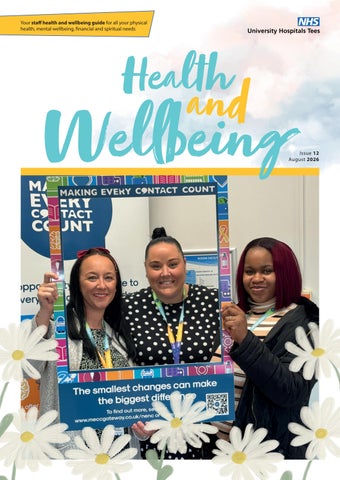
What is MECC? Making Every Contact Count (MECC) is a national approach that empowers NHS staff to turn everyday conversations into opportunities to promote physical and emotional wellbeing. Whether it’s encouraging a colleague to take a break, supporting healthy lifestyle changes, or simply listening – MECC is about making the small moments matter.
Sarah’s story When information analyst Sarah Cawkwell joined the first wave of MECC trainees, she quickly saw the opportunities this could have on staff health and wellbeing and how she could involve her colleagues in the process. With a background in IT and personal development training, she volunteered to become a MECC trainer, tailoring her sessions specifically for non-clinical staff. Sarah said: “Even though we’re not on the front line, we all know someone who could benefit from a little signposting. One colleague told a friend about our stop smoking service – and they took it up!” MECC works. People really want to change – they just need that nudge and moral support. So far, Sarah’s trained around 70% of her team, creating space for reflection, learning, and even laughter. She’s even added her own ironic self-care slide to the training – “It’s a ‘do as I say, not as I do’ kind of message!” – to remind colleagues to care for themselves too.
Why MECC matters for staff wellbeing By making every contact count, we are: • Opening up conversation on mental health, lifestyle and stress • Fostering connection between colleagues who might not otherwise interact • Encouraging signposting to services like occupational health or stop smoking services • Promoting self-care in small, sustainable ways It’s not about being a wellbeing expert – it’s about noticing, listening and acting with compassion.
Feedback from staff “After MECC, I started asking how people really are – and it’s made a big difference.” “I use MECC with my team during our morning check-ins. It keeps wellbeing on the radar.” “MECC is the first part of our supervision template. We focus on staff wellbeing first, before performance.”
Let’s make every contact count – together Every hello, every chat in the kitchen, every “how are you?” could be a moment of support. MECC isn’t just training – it’s a culture shift. Let’s create a workplace where wellbeing is everyone’s business, one conversation at a time. To read more about MECC, visit: www.meccgateway.co.uk/nenc
11.
WELLBEING HOBBIES
By Matt Harper, clinical coder
“I don’t even like running.” Unfortunately, my alarm clock doesn’t accept that as an excuse, even at 6am on a Sunday morning. The last time I did a 5K was back in 2012. It was only pure stubbornness and the promise of new Lego that got me through it without stopping. I crossed that line so exhausted and breathless that a paramedic had to check I was okay. So no, I’m not a runner by any stretch of the imagination, but once a month I’m stuffed into the back of my mam’s car, nursing a travel mug of coffee, and sleepily listening to my grandad’s guided tour of North Ormesby from his youth, on the way to marshal at the Ormesby10 run. My mam is the one who roped us all into this way back in 2019. Me, my stepdad, my grandad, my brother. Even a cousin at one point. So, when I say the marshals of the Ormesby10 run are like an extended family in high-vis, for me that’s literally true.
Greeting the newcomers, you meet people who are recovering from strokes, heart attacks or cancer. Or maybe this is their first 10k. They cross the line exhausted, sweating and bright red but ask them if they’ll be back next month and they’ll breathlessly reply, ‘of course!’. Among the marshals stationed across the fields and trails of Ormesby Hall are people like David. He found himself in a dark place after a hard retirement, but he told me: “Volunteering fills that void. It gives you another identity, which I think you badly need at that time.” Then there’s Derek. A stroke might’ve ended his days running the Ormesby10, but he refused to stay at home. Now he’s bringing us into the 21st century by automating our results system.
The registration table is my domain. I help people sign up, hand out numbers, and offer what I’ll admit are terrible directions to the toilets. Normally ‘peopling’ can be a struggle for me and when runners talk about Strava or trail shoes, I just nod along cluelessly. But I’ve discovered that runners are a warm and generous lot and it’s easy to have a laugh with them.
Our marshals are out, come rain, come shine
12.
My grandad, Geoff
Pamela setting some ground rules at the starting line
He laughed and shook his head when I asked him for ‘Derek’s words of wisdom’ but I think “the body’s failing, but the brain’s still there” should be a good contender. When I’ve marshalled in the past, people go past completely breathless, half-dying, but they still take the time to gasp out, “Thanks, marshal!” or clap for you as you’re clapping for them. I’ve always just stood there thinking: “I don’t know why you’re thanking me, I’m just standing here pointing at a gate. A stick with an arrow could do my job!” Carole, a marshal who, like most of the others, is actually a runner too, soon puts me right. She tells me it’s incredible how much runners come down and slow down when you haven’t got marshals there. Julie T put it more simply: “You just don’t feel alone when they’re there.”
Pamela, who knows what she’s talking about since she founded More Than a Run (the CIC which organises the Ormesby10) and has never missed a run in our entire eight years, told me: “You should never underestimate the power of what a marshal can do. A smile, a clap, or a ‘well done’. That little interaction lifts you when you feel like you’re dying.” From my spot at the finish line, I see plenty of runners who probably feel like they’re dying. But they crossed the line because marshals along the route clapped, told them they were doing well, promised they didn’t have far to go, rang a bell, or even just offered a friendly smile. Between scribbling down numbers of the finishers and checking the time my mam has on the stopwatch, I can look around to watch runners cheering club mates and strangers passing the line, marshals catching up with the regulars, and my grandad finding a fresh audience for his jokes in the first timers. It can be grey, miserable and absolutely bucketing it down, but you never have to look far to find a warm smile around here. It’s the same warmth that helped David find his new identity. It’s the warmth that told Derek his value didn’t falter just because his legs did. It’s the warmth that Pamela radiates to every runner and volunteer who comes along, and keeps us all coming back month after month, even when we would much rather press the snooze button!
Pamela and Carole
Me and Julie T
13.
WELLBEING HEALTH
Highlight Active Wellbeing Hub Dust off your trainers and dig out your swimwear. UHT staff can now enjoy a reduced membership rate at the brand new Highlight Active Wellbeing Hub in Hartlepool. Located in a prime spot on the Marina, the state of the art centre includes a 100 station gym, three swimming pools, fitness suites, spinning studio, soft play and party areas. There’s also a café and a stunning outdoor seating area – perfect for unwinding after a workout. Modern, accessible and open to all, Highlight is designed to make a lasting, positive impact on the health and wellbeing of the local community. The hub will also host referral based NHS services, bringing UHT expertise in physiotherapy, pain management, maternity services, cardiac rehabilitation, and asthma care directly into the heart of the community.
Our facilities will be operated from the Alan Bolton Suite, named in honour of our late colleague who was instrumental in developing the partnership between University Hospitals Tees and Hartlepool Borough Council. So please say ‘hello’ to any colleagues if you see them! As a local NHS employee, you are entitled to join in the fun at Highlight on reduced Active Business membership rate. If you are interested in saving pounds while working out, visit: www.activehartlepool.co.uk/memberships Highlight is being funded by Hartlepool Borough Council, Tees Valley Combined Authority and Sport England and will be managed by the council’s Active Hartlepool service.
Better Health at Work University Hospitals Tees was awarded the prestigious Ambassador Status at the latest Better Health at Work Award event, in addition to Maintaining Excellence. This dual recognition marks a significant milestone, celebrating employers who demonstrate a profound, long-term commitment to workplace health and wellbeing. To earn ‘Ambassador Status’, organisations must consistently exceed expectations at every assessment stage, showcasing outstanding internal practices. As ambassadors, University Hospitals Tees will serve as a public champion for employee wellness, mentor other employers and share our best practices.
14.
WELLBEING BOOKS
Bess of Clara Vale Nurse turns her autism story into children’s book A nurse has published a children’s book, inspired by her own journey to self-acceptance as a woman with autism. Lin Fidgin, wrote and illustrated ‘Bess of Clara Vale’. The story draws on Lin’s personal experience of autism and describes what it feels like to be a little ‘out of sync’ with the world around her. Lin’s book introduces Bess, a Labrador with autism. It explores Bess’s sensory differences, her comfort in repetition and routine, social misunderstandings, and the development of her confidence and self-acceptance along the way. Published in March, Lin has gifted copies to local schools, libraries, autism services and other organisations, including the children’s ward and children’s emergency department at North Tees. We sat down with Lin to find out a little more about the inspiration behind Bess and why it’s so important…
What first inspired you to write ‘Bess of Clara Vale’?
Explaining the difference can be difficult. If I can help make education about autism and neurodiversity accessible to those who need it most, then it can only be a good thing. I want to make a difference.
I also wanted to write the books I wish I had had as a child, when I felt so different to everyone else around me, but had no mirror to see myself reflected or to help me understand why I was not like my peers.
Have you had any feedback yet?
I wanted to say thank you to the multidisciplinary team of clinicians at Autism North East who diagnosed me, as it was life changing.
Has your own life and experience influenced Bess’s story?
Yes, the story’s core concepts reflect some of my own differences and mirror the fact that, with kindness, understanding and adaptation, I have managed to start enjoying things I thought I never could. For example, just as Bess can go to yoga with her friends’ support, I now go to the theatre with my wife’s support and a few adaptations to help me manage the sensory environment.
I’ve been overwhelmed by the response and cried a lot. I have had some beautifully affirming messages and emails, and one particularly beautiful video from two young children who have a book and wanted to share with me how they felt while reading it, because I would understand them.
Any final remarks?
Just thank you to colleagues in North Tees for always being willing to learn about and understand autism, for the betterment of colleagues and patients alike.
Why is Bess’s story so important?
Being different can be a lonely place, always trying to fit in but always feeling like an outsider. Understanding who you are and why can lighten the load. It can help others to understand, too, and hopefully bring empathy and awareness. No one deserves to feel broken or excluded just because they are different.
15.
WELLBEING HOBBIES
W From Teesside to the World
Hospital chaplain David Russon has had a varied career supporting the health and wellbeing of people across the globe as well as the spiritual health of patients at North Tees and Hartlepool hospitals and within the community. Health and Wellbeing magazine sat down with Dave to discuss his interesting career and some of his current projects: DAVE: In 2012, I joined North Tees and Hartlepool to become a full time chaplain, but prior to that I’ve had a varied life that has led to projects that have supported people having equal access to healthcare, education, and faith across the world. Back in 1999, I found myself appointed as director of the internationalisation of mission for the Assemblies of God. My job was to look after several projects around the world and to identify areas in the world in extreme poverty and distress.
We asked village chiefs at the time what they felt was most needed to improve the infrastructure in their villages, first and foremost came healthcare, before education and the church. In 2024, we got to visit again for the first time in over ten years. We got to see the amazing progress that has been made in building infrastructure to the planting of 300,000 trees over ten years to improve irrigation and to enable the growing of crops in an otherwise dry Sahara desert landscape. We have supported the building of a school which now has five classrooms and has already been ranked fifth best across the whole of Burkina Faso.
Our aim was to look at ways to support and enable them to develop their own infrastructure and get themselves out of trouble. It was about understanding that they already have the natural resources at their disposal and just needed help in utilising their own entrepreneurial skills to get projects off the ground.
More recently, we have been out to Japan to support in opening rehabilitation clinics and there are more projects in Columbia and South America.
In 2006, I was then appointed as word ministries director and found myself looking after 1,200 projects all around the world – having oversight of all of our projects and workers.
It’s incredible really – I was a minister in a local church and taking on these kinds of projects wasn’t something I was interested in doing at first. But I’ve met some incredible people and I’m led by a passion to look after people.
Six years later, I had decided to leave my roles and to move full time into chaplaincy within healthcare but my role within chaplaincy hasn’t stopped me from continuing to independently support projects around the world alongside my wife.
16.
In particular we have continued to support projects (first set up over 25 years ago) in one of the poorest countries at that time, Burkina Faso.
I’ve been told that I see the world from the moon. In other words, as part of a bigger whole.
I’m passionate about wanting to redress the world balance and for everyone having equal opportunities and equal access to things that improve their health and wellbeing regardless of where they are in the world.
WELLBEING AWARDS
Your 2026 wonder women As part of our International Women’s Day celebrations in March, we once again held our Wonder Woman Awards – recognising just some of the inspiring women we’re proud to call colleagues. Our dedicated women’s staff network asked staff to put forward their ‘wonder woman’ - someone who is full of passion, has inspired changed and advocated for those around them. Our virtual celebration event honoured all 90 nominees – each joining our ranks as a wonder woman. Here’s a little of what makes some of our wonder women so special...
Join our women’s network Our women’s network meets to discuss gender inequalities and develop creative solutions. It is open to all colleagues across University Hospitals Tees – including male allies who would like to help tackle issues in the workplace. For more information about the network, including upcoming meetings, please email: nth-tr.womensnetwork@nhs.net
Lois Williams, housekeeper Lois has been described as “one of the most helpful, kind and caring members of staff” on the critical care unit at North Tees hospital - where she has worked for the past 11 years. Lois’ nomination also describes her as “an integral cog in our team, a friend to most on the department and without her we would certainly be lost”.
Helen Keen, legacy mentor and neurodiversity staff network lead Nurse Helen Keen is a legacy mentor by day, but she also leads our neurodiversity network which has more than 100 members. Her dedication and enthusiasm have earned her more than one nomination for this year’s awards. One nomination read: “She continues to advocate, see the potential, and empower so many people, in a way that we have always needed but not always had.”
Aimie Newcombe, colorectal specialist nurse Amy joined the ranks of University Hospitals Tees aged 16 and credits her Nana’s experience with cancer as motivation for a career in healthcare. Her nomination read: “Aimie is a hugely valued and vital member of the colorectal team. She is always happy to help and willing to speak to patients to reassure and alleviate their worries and concerns – nothing is ever too much trouble for her.”
Viv Horton, highly advanced clinical pharmacist Viv has been part of the Parkinson’s advanced symptoms unit team at James Cook hospital for more than 10 years, developing her role from a specialist pharmacist to a highly advanced clinical pharmacist whilst working full time. Part of her wonder woman nomination said: “Viv brings her clinical expertise to every appointment, but beyond this she is true example of ‘Making Every Contact Count’.”
17.
SNAPSHOT
SNAPSHOTS FROM STAFF FACEBOOK If you haven’t joined our University Hospitals Tees staff Facebook group yet, here’s what you’re missing...
Wellbeing Friday The dermatology outpatient squad enjoying ‘Wellbeing Friday’. The team enjoyed a team lunch and were given awards as appreciation for all they do.
A little seed for me to sow North Tees’ new seed library The North Tees library team has teamed up with health and wellbeing advisor Helen Waller to launch a new seed library for staff, based in the hospital’s library. Take some seeds and grow your own flowers, fruit and veg. Or donate some seeds and encourage a colleague to try out their own green fingers.
TGIF
Dietitians Week 2026 As part of Dietitians Week in June, members of the team held stalls at the James Cook site, offering advice and support for staff, patients and visitors.
Domestic assistant awarded
The theme for Dietitians Week 2026 was “More Than Just a Job” - reflecting a career that is a true vocation – grounded in empathy, science, and service.
Congratulations to domestic assistant Dave Hopper who has been named Hartlepool urgent care’s first ever ‘star of the month’.
Tonight I’m an urgent care star
How to join the staff Facebook group... Joining the group is easy. Simply scan the QR code with your device or search ‘University Hospitals Tees staff’ on Facebook. Answer the membership questions, agree to the group rules and start posting!
Food for thought
SUPPORT
HOW AM I? The toolkit Improve and maintain your psychological health with our ‘How Am I’ toolkit. The toolkit contains a range of help within four zones (Red, Yellow, Green and Blue) which relate to the way you are feeling right now – your ‘emotional temperature’. Just scan the QR code or visit: www.southtees.nhs.uk/staff/how-am-I
EXTERNAL SUPPORT CONTACTS Recovery college online
ICS TEWV staff wellbeing hub
A range of online courses to support with aspects of wellbeing and mental health.
Confidential advice and support helpline. 7am - 9pm (7-days a week)
Access online: www.recoverycollegeonline.co.uk
Contact: 0191 223 2030
Able futures
IMPACT on Teesside - talking therapy
Available from 8am - 10.30pm weekdays or refer online.
Talking therapy, counselling and alternative therapies. Available 9am - 5pm (weekdays) and online referrals can be made anytime.
Contact: 0800 321 3137
Contact: 01642 573924
Access online: able-futures.co.uk/individuals
Access online: www.impactonteesside.com
INTERNAL SUPPORT CONTACTS
Occupational health
Chaplaincy
STH
James Cook: 01642 854802 Friarage: 01609 763275
01642 282482
STH
Staff psychology support hub
01642 383138 jim.wright@nhs.net
01642 383211
STH
STH
07789 392871 annalisa.short1@nhs.net
stees.psychology.training@nhs.net
NTH
NTH
Independent domestic violence advisors
NTH
NTH
01429 522049
07827 330086 claire.williamson33@nhs.net
ET Y
SAF SEXUAL
STH
NTH
NHS SARC
Everyone who works, trains and learns within our organisation has the right to be safe and feel supported at work. If you do need to report something, you will be supported. For more information about support available, please scan the QR codes.
19.
Post-festival offers If you missed our staff Health and Wellbeing Festival this year, or just want to see what sort of offers and support is still available, our wrap up brochure is out now. Scan the QR code to find out more: