THE JOURNAL OF THE
VOLUME 47 NO.2 2025
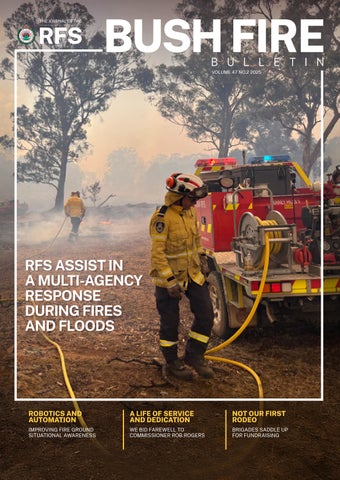
RFS ASSIST IN A MULTI-AGENCY RESPONSE DURING FIRES AND FLOODS
ROBOTICS AND AUTOMATION
A LIFE OF SERVICE AND DEDICATION
NOT OUR FIRST RODEO
IMPROVING FIRE GROUND SITUATIONAL AWARENESS
WE BID FAREWELL TO COMMISSIONER ROB ROGERS
BRIGADES SADDLE UP FOR FUNDRAISING
2 NSW DEPLOYMENTS RFS assist in flood affected areas
Contents FOREWORD
1
FEATURES Down the wire in the NSW floods
10
2
Torrential rain causes trail of destruction in North Queensland
6
RFS assist in clean-up after ex-Cyclone Alfred
8
RFS deployed to remote areas of Tasmania
10
Strike teams descend on Victoria’s National Parks
14
Robotics and automation: improving fireground situational awareness
19
The age of the drone
22
Historic RFS memorabilia has a new home
24
TASMANIAN FIRES
Commissioner Rob Rogers – a life of service
28
Remote Area Firefighters deployed
Not our first rodeo
32
Community spirit at its finest
36
Cultural burning supported by two bush fire trucks
39
Generosity and hope after the smoke has settled
44
IN FOCUS
18
LIFTOUT
26
EVENTS Volunteers shine at shows
40
19
Iftar dinner banquet at Casula Brigade
42
RFS dances to the sound of inclusivity
46
RFS representatives join Mental Health Frontline event
52
ROBOTICS ON THE HORIZON
AWARDS
A game-changer in bush fire response
Australian Fire Service Medals 2025
48
St Florians Day – Bravery and Service Awards 2025
50
BUSH FIRE B U L L E T I N Acknowledgement of Country The NSW Rural Fire Service (RFS) acknowledges the Traditional Custodians of this country and their continued connection to land, sea and culture. We pay our respects to the resilience and strength of Elders past, present and future generations of Aboriginal and Torres Strait Islander peoples. Dissemination of content The RFS encourages the availability, dissemination and exchange of public information. You may copy, distribute, display, download and otherwise freely deal with this material for personal, in-house or non-commercial use, on the condition that you include the copyright notice © State of New South Wales through the Rural Fire Service [plus year of creation or first publication] on all such uses. In the event that you wish to copy, distribute, display, download, store, or use this material for a purpose other than personal, in-house or non-commercial use, you must obtain permission from the RFS by writing to the following address: Commissioner NSW Rural Fire Service Locked Bag 17, Granville NSW 2142 You must also obtain permission from the RFS if you wish to: • charge others for access to the work (other than at cost); • include all or part of the work in advertising or a product for sale; • modify the material; or • use any trade mark from this publication, including the NSW Rural Fire Service crest.
Disclaimer Statement While the material in this Bush Fire Bulletin is current at the time of writing changes, in circumstances after the time of publication may impact on the accuracy of the material. Individuals are responsible for ensuring they have the most current version of this publication. The information and material contained herein is general in nature and is intended for your use and information. The NSW Rural Fire Service (RFS) disclaims, to the extent permitted by law, all warranties, representations or endorsements, express or implied, with regard to the material contained herein. The RFS does not warrant or represent that the material contained herein is free from errors or omissions, or that it is exhaustive. Users should exercise their own skill and care in respect to its uses. You must not assume that this material will be suitable for the particular purpose that you had in mind when using it. The RFS disclaims any liability (including but not limited to liability by reason of negligence) to the users of the material for any loss, damage, cost or expense whether direct, indirect, consequential or special, incurred by, or arising by reason of, any person using or relying on the material and whether caused by reason of, any error, omission or misrepresentation in the material or otherwise. Users of the website will be responsible for making their own assessment of the material and should verify all relevant representations, statements and information with their own professional advisers. All photos, unless otherwise stated, taken and owned by the NSW Rural Fire Service. The views expressed in articles in the Bush Fire Bulletin do not necessarily reflect the views or the policies of the NSW Rural Fire Service.
In February and March, Tasmania and Victoria both saw catastrophic fire conditions which threatened remote areas of protected National Parks. The RFS sent crews to assist, such as Remote Area Firefighting Technicians, who are winched down into hard to reach locations. During the Queensland and NSW floods, hundreds of our members assisted the NSW SES in their flood response. We are proud to offer our ongoing support to the NSW Reconstruction Authority (RA) through providing Incident Management Teams. Our collaboration involved setting up base camps, providing vital aviation support, carrying out evacuations and offering community services such as sandbagging, clearing debris and cleaning up. As I write my first Foreword as the new Commissioner, I would like to say how honoured I am to lead such a wonderful organisation. Your dedication and service to the community is to be admired, and I look forward to working with you over the coming years. In July, the Service said farewell to Commissioner Rob Rogers, after more than 45 years with the RFS and five years leading the organisation. During his time, he delivered many pivotal initiatives such as building a world class aviation fleet and introducing new standards of safety in the way of protective clothing and helmets. Rob’s legacy as Commissioner will be as a leader who set out to ensure the RFS was delivering for its volunteers and the community.
The RFS’s assistance during these incidents highlights the strong collaboration between emergency services in NSW and interstate, working together to support communities during natural disasters. Heading into another fire season, we have been focusing on important hazard reduction burning, to mitigate the risk of serious fire activity. As the weather keeps warming up, we have seen an increase in grass fires, as fuels across the state continue to dry out and cure. Thank you once again to all our members for their efforts, and please ensure you take care of yourselves and each other during the coming fire season.
We also bid Assistant Commissioner Stuart Midgley farewell after more than five decades of service. He played a major role in Incident Management, risk mitigation and reform operations and was known for his level-headed approach to problem solving and his positive attitude. On behalf of the organisation, I would like to wish them both all the best for a long and happy retirement.
Regards,
As I read through this issue of the Bush Fire Bulletin, I would like to take this opportunity to thank our members who have been involved in the many deployments over the last six months. Our organisation has proudly assisted other emergency services in both fire and floods, here, interstate and overseas.
Trent Curtin Commissioner
BUSH FIRE bulletin | FOREWORD
1
DOWN THE WIRE IN THE NSW FLOODS In May, the RFS played a significant role in responding to the severe floods that affected NSW. Assisting the NSW State Emergency Service (SES) in the flood response, hundreds of our members provided crucial support in rescue operations, community services and recovery efforts.
2
BUSH FIRE bulletin | FEATURES
The NSW floods impacted several regions along the coast, particularly the Mid North Coast and parts of the Hunter Valley, including the towns of Taree, Kempsey, Nambucca Heads, Sawtell, Dorrigo, Port Macquarie and Coffs Harbour.
Triggering a huge multi-agency response, the RFS and NSW SES, Fire and Rescue NSW, Surf Life Saving NSW, NSW Police, NSW Ambulance, Marine Rescue NSW and VRA Rescue NSW, worked tirelessly to protect and support impacted communities.
Caused by a slow-moving low pressure system, it was the worst flood disaster the Mid North Coast region had seen in many years, with access to disaster funding being activated at both state and federal levels. Floods in some areas were the highest ever recorded, including in Taree, where the Manning River exceeded a century-old record.
This collaboration ensured that resources were effectively deployed to areas in need and that communities received vital support during the crisis.
‘DOWN THE WIRE’ TECHNICIANS
With major flooding affecting the MidCoast areas, our Aviation Rescue Crews (ARC’s) completed hundreds of rescues.
Further rainfall around the Hunter and Northern Tablelands areas left many people trapped and needing emergency assistance. The RFS utilises ‘Down the Wire’ technicians for flood rescues, deploying them from helicopters to rescue people trapped by floodwaters. These technicians are winched down wires or cables, allowing them to reach rooftops or into floodwaters to safely rescue individuals.
LEFT: The Manning Valley River flooded vast areas of the Mid North Coast. Photos courtesy of the RFS.
RFS INVOLVEMENT IN THE NSW FLOODS • Rescue operations: Our aviation crews conducted rescues in challenging weather conditions and provided vital logistical support. RFS boats were utilised for flood rescues and other emergency responses to reach isolated communities
• Support to NSW SES: RFS provided personnel, aviation assets, communications, logistics, transport, heavy plant, base camps and Incident Management expertise to help during the flood response
• Community assistance: Members were involved in numerous flood-related tasks, including sandbagging homes, debris removal, tarping damaged roofs and clearing downed trees
• Damage assessments: Our teams provided Rapid Damage Assessments (RDAs) to help determine the extent of damage to properties and infrastructure, identifying where to prioritise clean-up efforts, allocate resources and provide appropriate support to residents
BUSH FIRE bulletin | FEATURES
3
Aviation Helicopter Rescue Officer, Rick Ott was part of an RFS helicopter rescue crew who set up base in Taree to provide emergency flood support.
Service Volunteer of the Year, and a Commissioner’s Certificate of Commendation for his service during the Lismore floods.
Currently based out of the Coffs Harbour area, Rick began volunteering for the RFS in 2005. In 2014 he was selected to become one of the first qualified ‘Down the Wire’ technicians. His accolades include being named the 2018 Emergency
There are many emergency situations where Rick’s skills have been put to the test. “One story that stands out involved three dogs inside a roof northeast of Taree,” says Rick. “Approaching, I could
see floodwaters right up to the ceiling height of the home and the residents huddled in the space above that. They had removed some roof sheets and were sheltering to stay dry.” Rick describes how after performing a dynamic risk assessment, the helicopter team determined the safest method to rescue the family was to winch down. The assessment identified tall trees, wires and the possible dislodgement of loose roof sheets and roof insulation, so caution was necessary. “The pilot successfully positioned the helicopter to allow me to get close,” says Rick. “Landing on a slippery surface is not ideal, so I was careful to winch down and maneuver into the open roof void with the survivors. “I got the woman out first, followed by two dogs together, then came the challenge – the last dog, it was almost cartoon-like with legs kicking in every
4
BUSH FIRE bulletin | FEATURES
UNPRECEDENTED DEVASTATION TO LIVESTOCK IN THE AREA
direction and intent on getting out of the restraint. I’m not sure it was so happy to be in a specially designed bag for rescuing infants, but I managed to get it up into the air. After securing the dog in the helicopter, we went back down for the male occupant.” The rescue was a huge success and the relief on everyone’s face remains imprinted in Rick’s mind. By the end of the first day alone, they were involved in more than 30 winches. As the days progressed, further rescues and relocations were carried out and critical medical and food drops were delivered.
With several large dairy farms situated in and around the Manning Valley on the Mid North Coast, tragically many animals were severely impacted by the floods. TOP LEFT, CLOCKWISE: A woman and her dogs are airlifted to safety. A pilots view during a mission. The township of Taree covered in water. Rick Ott observes the flood from the sky. ‘Down the Wire’ Technicians during a rescue mission. Photos by Rick Ott and courtesy of the RFS. References: Singleton Council website.
Devastated farmers lost a significant portion of their livestock when sadly their cows and cattle were killed or washed down the Manning River and out to sea. Much of the farming community in floodaffected areas are now facing immense challenges, including loss of pasture, damage to infrastructure like dairies and difficulties in feeding remaining animals.
“There were full days of pulling people out of homes and off roofs,” says Rick. “All the emergency services personnel and the pilots and aircrews were key to the operation – they all did an amazing job. “Being able to help people is an incredible experience and makes me proud to be part of the RFS.”
BUSH FIRE bulletin | FEATURES
5
TORRENTIAL RAIN CAUSES TRAIL OF DESTRUCTION IN NORTH QUEENSLAND In February, the RFS deployed three contingents of personnel to Northern Queensland to assist in floodaffected areas. Part of a larger deployment involving both NSW SES and RFS, our members worked alongside Queensland emergency services to support local crews and communities. Nick Moir of Ingleside Brigade was in Townsville assisting in the region.
a certain amount of resilience, they were isolated without fuel for generators to power their phones.
I was in the first deployment of nine RFS members to Northern Queensland on 6 February. After the first night, we travelled three hours on a boat to the little town of Lucinda, which has a jetty for sugar cane loading several kilometres long. The villages and towns of Halifax, Lucinda, Taylors Beach and Macknade were close to the Herbert River, which was experiencing major flooding. They had been without power and running water for about a week. On arrival, we borrowed council equipment and vehicles to start the clean-up. First stop was the local
6
BUSH FIRE bulletin | FEATURES
Halifax pub, which was a community meeting point. Our job was to clean the thick mud out of much of the building, in steaming 35 degrees and 98 percent humidity. After acquiring our second vehicle, we split the team and five were sent to Taylors Beach where they were involved in a medivac of an elderly patient with leg wounds. Having a team of highly varied skill sets made us quite flexible, particularly with a paramedic available to us. Although the community were no strangers to cyclones and possessed
Much of our time during the week was spent wet and dripping but we remained in good spirits trying to access people in need, doing welfare checks and removing mouldy furniture, carpets, rotting food and fridges. A lot of our work revolved around flood rescue requests, such as delivering water, collecting and distributing fuel and administering supplies brought in by Army Chinook helicopters. The community were emotional, although happy to see us and incredibly grateful that we had come all the way from Sydney to help them. Some of the older residents were willing but unable to take on the physical task of sandbagging and the immense job of cleaning up, so we offered our assistance.
From an operations perspective, many useful lessons were learned, particularly in information gathering and coordination in an area with little to no communication.
Ingham and Halifax CBD. In those conditions we were told it’s a good idea to look over your shoulder for any apex predators, who’ve been known to ambush their prey in floodwaters.
PREDATORS IN SHALLOW WATER
We spoke to an elderly woman in Taylors Beach who had seen a huge four-metre saltwater crocodile in her backyard while cleaning up her property from the flooded creek behind her house.
The heavy raining and flooding allowed crocodiles a much wider area to patrol, with sightings in and around
OPPOSITE PAGE: A RFS member assesses the damage to low lying areas. ABOVE: Floodwaters spread across the landscape. RIGHT: Locals and RFS members stand next to a sign warning against crocodiles in the area. Photos by Nick Moir and courtesy of the RFS.
DEPLOYMENTS February 6-10, February 9-13, and February 12-16
Number of RFS members assisting: 37 Early 2025 saw significant flooding that impacted the northeast of Queensland. From late January to April, the sheer volume of water prompted mass evacuation orders in Queensland’s coastal regions. Additionally, western Queensland experienced widespread torrential rainfall and flooding throughout the southwest. The RFS personnel deployed to Queensland included highly qualified volunteers with expertise in chainsaw operations, height work and community support. The crews assisted with flood resupply, debris clearance, tree removal and community support efforts.
BUSH FIRE bulletin | FEATURES
7
RFS ASSIST IN CLEAN-UP AFTER EX-CYCLONE ALFRED
With severe weather and flooding from ex-Cyclone Alfred starting on 4 March, the Australian Defence Force (ADF), the National Emergency Management Agency (NEMA) and emergency authorities in Queensland and NSW came together to form one of the largest multi-agency responses to a single weather event in years. Ex-Tropical Cyclone Alfred crossed the mainland just north of Brisbane at 9pm on 8 March, bringing with it heavy to locally intense rainfall across southern and southeastern Queensland, causing significant flooding, fallen trees and roof damage. The impact on communities was substantial, with Queensland SES responding to more than 10,000 tasks for this event alone.
DEPLOYMENTS
March 14-18, and April 6-12
Number of RFS members assisting: 27 RFS members were deployed to Queensland as part of a multi-agency contingent to assist with the huge clean-up following the disaster.
8
BUSH FIRE bulletin | FEATURES
As ongoing flooding affected several parts of southeast Queensland and the north coast of NSW, our members assisted NSW SES with sandbagging, removing downed trees and clearing debris from roads. On a logistics front, the RFS deployed three search and rescue helicopters, assisted in setting up a large base camp, supplied communications equipment for Incident Control Centres and distributed bedding and food for the Wollongbar evacuation centre. Operational Officer Tim Cassar was part of the initial team who took part in the cleanup. “Ex-Tropical Cyclone Alfred brought areas of heavy rainfall causing significant
LEFT: RFS members assist the NSW SES in removing fallen trees. BOTTOM LEFT: Tim Casser and his team work to remove debris from yards. BELOW: RFS assist in removing damaged furniture and personal belongings during the floods.
OVERVIEW • Local brigades assisted with 950 flood and storm tasks • A 180-person base camp was established and managed by the RFS • Bedding and logistics support was provided to a 1,000-bed Mass Evacuation Centre (MEC) established at Lismore • Logistics delivered more than 1,500 bedding items to around 20 evacuation centres • 4,000 ready-to-eat meals were delivered • Assisted transporting SES equipment (including flood barriers and high clearance vehicles) flooding. The impact on communities was enormous,” says Tim. “Our crews were faced with complex jobs, such as removing large trees from houses and roads and protecting homes with damaged roofs that required tarping. “Over three working days, our crews successfully completed 55 storm recovery tasks, many of which were extensive, taking up to three-quarters of a day to complete. This was a significant undertaking, demonstrating the dedication and resilience of our teams.” Numerous members of the public expressed their gratitude and
appreciation for the crews’ hard work and professionalism throughout the deployment. Former Commissioner Rob Rogers praised all those involved in the cleanup. “I would like to thank our members who were part of this huge multi-agency deployment. I received very positive feedback about the skill and professionalism of our volunteers.” After the water receded, RFS teams worked with other emergency services to conduct rapid damage assessments, which included the use of drones to reach inaccessible areas.
EX-CYCLONE ALFRED Cyclone Alfred was a powerful and erratic weather event that brought heavy rainfall and winds to southeast Queensland and the NSW North Coast. Originating in the Coral Sea on 20 February, Alfred prompted watches, warnings and evacuations in an area that has rarely seen direct impacts from tropical cyclones. Although reduced to a tropical low shortly before making landfall on 8 March, the ex-cyclone brought severe flooding to the region.
• Positrack crews assisted with sandbagging and initial clean-up operations • Starlink communications systems were deployed to FCCs, the Goonellabah ICC, the Lismore MEC and SES stations. RFS radio technicians were deployed in support of operations • Remotely Piloted Aircraft Systems with live streaming and thermal imagery were deployed • RFS aircraft were tasked for search and rescue, camera and night operations • The RFS State Air Desk was activated to coordinate arrangements • The RFS heavy lift aircraft in cargo configuration and RFS boats (including flood rescue boats) were forward staged
BUSH FIRE bulletin | FEATURES
9
RFS DEPLOYED TO REMOTE AREAS OF TASMANIA During February and March 2025, 136 RFS members were deployed to Tasmania. More than 40 of those were Remote Aerial Firefighting Team (RAFT) members sent to assist with large fires burning in the state’s west. Operating out of a RFS base camp, the firefighters tackled the physically demanding work of extinguishing fires burning deep within the ground.
10
Michael Cook, of Woronora Brigade was deployed to Tasmania from 4-10 March as a Helicopter Insertion Techniques (HIT) qualified Remote Area Firefighter. What was your role in Tasmania? I was deployed as part of a rotation of 20 RFS members alongside NSW National Parks and Wildlife Service. We formed part of the IMT and ran the base camp accommodation, as well as RFS-contracted Bell 412 helicopters and aircrew. Where were you sent? We were deployed to rugged and remote terrain in Tullah on the West Coast to work on the Northwest Complex fires. Dry lightning had ignited 13 fires that spread over
98,000ha of bushland before combining into around five large fires. The fireground stretched from the Overland Track and Cradle Mountain in the east, to the shoreline on the West Coast. The fires were cutting off small towns, as well as threatening cultural sites and sensitive vegetation such as Huon, King Billy and pencil pines, which are protected ancient pines in the area. The NSW crews, alongside local Tasmanian Fire Service and Tasmania Parks and Wildlife Service crews, were spread across the various fires, with the primary mode of transport being helicopters. I was assigned to a mixed Tasmanian and NSW crew working on the Canning Peak fire in the vicinity
BELOW: Michael Cook and members look out over the landscape. RIGHT: A Tasmania Parks and Wildlife Services Ranger watching a helicopter on a drop. Photos by Michael Cook and courtesy of the RFS.
of Cradle Mountain and the Overland Track in the highlands. What was the experience like? Firefighting in this area of Tasmania is very different to back home. Being part of the Woronora Brigade – a marine brigade on the southern edge of Sydney – I’m use to steep, rugged terrain. But the highlands of Tasmania are another scale. The distances and the terrain meant that we were reliant on aircraft. A makeshift airbase was established that saw upwards of six helicopters operating most days. Many RAFTs were working each day, being deployed across vast distances. The coordination of many people, equipment and machines was a significant undertaking.
BUSH FIRE bulletin | FEATURES
11
The nature of the landscape and vegetation means that most large fires are almost impossible to fully extinguish. The fire works its way into peat, which covers most of the landscape and requires either drowning through endless hose-lays or the equally hard work of manually digging up and waterbombing every smouldering pocket. With a fire edge of more than 1,200km (about the distance from Canberra to Brisbane), the idea of controlling or blacking out the entire perimeter is out of the question. Instead, local crews rely more on line-scans and aerial reconnaissance to identify the areas that present the most significant risk of break out and target their precious resources accordingly. For me, it meant using line-scans to identify areas of significant hotspots, winching into these locations through sometimes 50m high canopy, using Pulaskis to manually dig-up hot spots and guiding in aircraft to perform what would often be multiple precision drops to adequately extinguish them. We would hike through incredibly dense scrub and fallen timber to get between hotspots. Covering 1km in this terrain was considered a good day, as the density of some of the unburnt areas meant you could walk a hundred metres without your feet ever touching the ground, while tangles of vines and tea tree had to be cut through. Often it was easier to winch back out and ‘bump over’ to the next location (even if it was only a few hundred metres away) rather than try and make our way by foot.
WEST COAST OF TASMANIA The west coast of Tasmania is renowned for its remote, rugged, pristine wilderness. With much of it isolated, the area is part of the Tasmanian Wilderness World Heritage Area, boasting stunning natural landscapes including forests, mountains, rivers and lakes. The area is home to the Huon, King Billy and pencil pine trees that are rare living relics of Gondwana, the ancient supercontinent that eventually broke up into Africa, South America and Australia some 180 million years ago.
WHAT IS A PULASKI? The Pulaski is similar to an axe and was developed for constructing firebreaks, able to both dig soil and chop wood.
12
BUSH FIRE bulletin | FEATURES
A few key experiences stood out from the deployment: 50m winches in and out of dense old growth forests and mountain ash, the views of Cradle Mountain as we flew in and out of the fireground each day, the easy bond formed with the Tassie crews and their generous sharing of local knowledge and the occasional words of thanks from members of the public for coming over to lend a hand. Ultimately, the most rewarding aspect was what we achieved on the fire. Over the period of the week the crew I was
part of managed to work the edge of a breakout of the Canning Peak Fire, which presented the most significant risk to further spread. The fire had reached the edge of a yet unknown cluster of rare King Billy Pines and Mountain Ash. It was incredibly rewarding to be able to successfully contain that area of the fire and prevent further irreparable damage to these old growth areas. Did you learn anything while away? Requiring intensive core skills, I was able to strengthen my knowledge in navigation, mapping, aircraft communications, winching and guiding in waterbombing aircraft. By the end of the week, it felt like we could winch in as a team or guide water bombers in with our eyes closed. I also learned to pack light when working in difficult terrain, and that it’s essential to take a few key pieces of remote area equipment, such as a small strobe light for guiding aircraft through dense vegetation, a splat mat made of parachute material than you can fold into your pocket and your phone with a portable battery pack to ensure you can navigate and map the fire.
CLOCKWISE FROM OPPOSITE PAGE: Burnt landscape on the West Coast of Tasmania. Helicopter Insertion Techniques (HIT) qualified Remote Area Firefighters descending into the bush. Michael Cook and the crew in Tasmania. RFS helicopter on a mission. Photos by Michael Cook and courtesy of the RFS.
BUSH FIRE bulletin | FEATURES
13
Cat 9 from Maroota parked in the foreground. INSET: RFS members deployed to Victoria assessing the fires. Photos by Craig Whiteman.
14
BUSH FIRE bulletin | FEATURES
STRIKE TEAMS DESCEND ON VICTORIA’S NATIONAL PARKS In February 2025, the RFS deployed two strike teams to Victoria to support the Country Fire Authority (CFA) during catastrophic fire conditions. These deployments recruited RFS firefighters with specific skills to assist with fires in the remote areas of the Grampians National Park and Little Desert Fire. Andrew Bronier, Deputy Captain of Muogamarra Brigade, was part of that contingent.
Ku-ring-gai 9 with a fellow member from the Hornsby/Ku-ring-gai District for the week.
Which deployment were you a part of? With fires in Victoria starting in 2024, the RFS had already sent several members. I was part of the team deployed on 9 February 2025 to Horsham in Western Victoria. The Grampians National Park fire region was about 30 minutes southeast of Horsham.
Where were you sent? The first tasking was the Grampians complex, where further ignitions had occurred west and south of the original ignitions in late December 2024. Our second tasking over the remaining days was to the Little Desert National Park fire, further west near Kaniva.
How many were in your team? There were approximately 20 in our team, split across nine Cat 9s and the Strike Team Leader’s vehicle. I shared
What were your tasks? Our tasks were based on containing the spread of fire to neighbouring towns. Utilising Cat 9s, we were able to undertake direct attack on fast moving
STRIKE TEAM’S ROLE RFS strike teams form part of the response to large and complex fires. Often consisting of out-of-area firefighters, strike teams are deployed to specific areas or sectors of an incident, working together under a designated leader. A strike team is made up of at least five units of the same type, in this case nine Cat 9s. Maintaining a common communication channel, strike teams ensure coordinated action and information sharing and can be deployed for various tasks, including structure protection, fire suppression and water delivery. Each strike team has a Strike Team Leader who is responsible for overseeing the group of firefighting resources and directing them during a fire incident. The Leader acts as a tactical commander, providing guidance and support to their team, ensuring safety and efficiency.
15
RECOVERY IN NATIONAL PARKS Listed on the National Heritage List in 2006 for its incredible natural beauty, the Grampians has some of the best examples of Aboriginal rock art in southeastern Australia. The impact of the 2024/25 summer fires in the Grampians and Little Desert National Parks was widespread, affecting an estimated 230,000ha. This led to the closure of many popular visitor sites, a large network of roads and walking tracks such as the Grampians Peak Trail. Parks Victoria is now progressing with large scale fire recovery works across the areas. To complement these, a staged re-opening of visitor sites is being implemented.
grass fires, and in dense vegetation we undertook backburning ahead of changing weather conditions. How long did you stay? Our deployment was 1-5-1, however some members stayed for a second rotation. What was required of you? Although the work wasn’t arduous, it required the skills and experience of Advanced Firefighters. We had to work with a high degree of autonomy, navigating and mapping in rapidly changing conditions and in new terrain, such as sandy soils, that would have been unfamiliar to most members. What was the outcome? We managed to contain the Grampians fire within the first day and then we were re-assigned to Little Desert, the season’s largest fire to date, burning more than 95,000 ha – most of that in a single day. Thankfully, it only took
16
BUSH FIRE bulletin | FEATURES
two days to contain and strengthen the containment lines, while undertaking mapping of the contained edge for the incoming crews. Our mission was a success, and we departed with the knowledge that our help was appreciated. The deployments demonstrate the importance of interstate cooperation between fire services in managing large bush fires. Memories or take aways from the trip? I will certainly remember the experience as my first time working from, and driving, a Cat 9. We were faced with some incredibly challenging situations as the weather deteriorated several times and resulted in red flag warnings. I also really enjoyed the challenge of driving on sandy soils where the risk of bogging was quite high – it didn’t take long for the team to realise that early on!
CLOCKWISE FROM OPPOSITE PAGE: The Grampians National Park. RFS Strike Teams inspect a fire on the edge of the National Park. Crews in Cat 9’s extinguishing a fire. Photos by Daniel Barwick and courtesy of the RFS.
BUSH FIRE bulletin | FEATURES
17
IN FOCUS ABORIGINAL AND TORRES STRAIT ISLANDER MEMBERS NETWORK The RFS has committed to establishing and supporting member networks that will provide a platform for members to connect with each other. Although initiated by the Service with support provided, these networks will be run and governed entirely by members. In the spirit of Reconciliation Week, we are proud to launch our first member network – the Aboriginal and Torres Strait Islander Network. This group is open to all members of the RFS who identify as Aboriginal and Torres Strait Islander. It will be initially a closed group with network members to vote to open to other members of the RFS. Confidentiality is prioritised, therefore names of members will not be published or be known beyond those who join the group. If you identify as an Aboriginal and Torres Strait Islander member of the RFS and are interested in joining a Culturally safe space to connect with other Aboriginal and Torres Strait Islander members, contact your local District for more details, or email jamie.bertram@rfs.nsw.gov.au
18
BUSH FIRE bulletin | INFOCUS
NEW EMERGENCY HUB TO STRENGTHEN SNOWY MONARO DISASTER RESPONSE The NSW Government is investing $15 million in the protection of Snowy Monaro communities, with work to begin on a new state-of-the-art bush fire and emergency management centre in Cooma. The facility will be located on a site adjoining the existing Fire Control Centre (FCC) and the Cooma/Polo Flat Aerodrome. The centre will enable faster coordination and enhance frontline capabilities as emergency management experts are brought together under one roof during times of disaster. The Snowy Monaro FCC is being developed in response to the 2020 NSW Bushfire Inquiry, which identified
the need for upgraded emergency management infrastructure in the region. Former Commissioner Rob Rogers praised the new development. “This new centre will not only support day-to-day operations, but also better equip our personnel to manage multi-agency responses to a range of hazards,” he said. “The inclusion of a secure helicopter hangar and crew accommodation will also boost our aerial firefighting and rescue capability across the region, enabling faster deployment and more effective response during critical incidents.”
RFS INCLUSION STRATEGY 2025-2028 The RFS is proud to launch our first Inclusion Strategy (2025-2028), designed to support the inclusion and representation of all members – staff and volunteers. It outlines the development of new structures, processes and policies that support a stronger, more effective Service. We want a culture where our members feel they belong. We understand that can be determined by a number of factors such as leadership and individual brigades.
the sustainability of our membership, opportunities for our leaders to strengthen their non-operational or technical capabilities and opportunities for our members’ opinions to be heard.
Our Inclusion Strategy contains action items that directly address issues raised by our members, providing opportunities for connection where isolation is felt, opportunities to increase
If you have any questions, please contact the Workforce Strategy and Analytics team by email at workforcestrategyandanalytics@rfs. nsw.gov.au
ROBOTICS AND AUTOMATION:
IMPROVING FIREGROUND SITUATIONAL AWARENESS The use of robotics is set to play a crucial role in the future of Australian emergency services, by enabling safer and more effective response to disasters and hazardous environments. By Niklaus Schuler, RFS Firefighting Advancement Coordinator.
NETWORK-CENTRIC A Network-centric environment is a concept that emphasises the use of information technology (IT) and networking to enhance operational effectiveness by improving data sharing and situational awareness.
In June 2023, the RFS embarked on a journey to explore and conceptualise the use of robotics and automation within its core business of bush fire response in partnership with the Australian Centre for Robotics (ACFR), a research body within the University of Sydney’s Faculty of Engineering. As part of the Research, Knowledge and Technology grant funding stream administered by the NSW Reconstruction Authority, a twoyear project was developed to investigate a network-centric style of firefighting. The focus was on how robotics and automation could provide frontline firefighters, incident controllers and incident management teams with instantaneous situational awareness on the fireground and improve firefighter safety. With five separate subprojects including field robotics, tethered drones, wearable devices, vehicle telemetry and helicopter network integration, the project seeks to explore concepts in automation not yet implemented within RFS systems.
BUSH FIRE bulletin | FEATURES
19
TETHERED DRONE
With the ability to be deployed under continuous power without the need for batteries, a tethered drone system developed by the ACFR utilising off the shelf products was installed on an RFS Category 7 tanker to explore the concept of first response aerial intelligence gathering.
FIELD ROBOTICS
As an industry leader within field robotics, the ACFR was well-placed to provide the resources, knowledge, and skills to develop robotic systems for an RFS use case. Utilising ‘Swagbot’, a repurposed agricultural robot, the ACFR (in consultation with the RFS) were able to bring a suite of sensors and software to controlled fireground environments for field testing and subsequent consultation with RFS stakeholders. Through the utilisation of light detection and radar cameras (LiDAR), GPS, thermal and high-resolution cameras, Swagbot can autonomously navigate fire trails with the intent to: • • • •
Map vegetation and fuel loads Identify hazardous trees Map and track trail condition and accessibility Patrol containment lines and firegrounds after the path of fire
Inspector Simon Herring, Manager of Firefighting Advancement and Research, feels the new technology could be a game-changer. “The intent of the Autonomous Patrolling robot is to remove our crews from hazardous environments where there is no significant operational requirement to be deployed into,” says Simon.
WEARABLE DEVICES
A new wearable device has been developed by the ACFR to investigate the benefits of tracking firefighter telemetry in the field. Though these devices are still large and in the development phase for ease of modification, the Biometric and Environmental Monitoring Unit (BEMU) combines GPS, impact/fall detection, particulate/volatiles identification, heart rate monitoring and relative humidity sensors. This new technology has the potential for crew leaders or incident controllers to locate firefighters in distress on the fireground, understand the environments they are entering into and enable leaders to make more informed tactical decisions. “This has the potential to detect hazards early and remove our members from the fireground should they be in harm’s way,” says Simon.
20
BUSH FIRE bulletin | FEATURES
The tether allows the drone to take off from the appliance to a ceiling height of 40 metres and provide an eye-in-the-sky with thermal and high-resolution colour imagery and laser range finding, with a snap-to feature when a duress alarm has been activated. The unit also carries a BEMU device repeater payload, allowing for wearable device and asset signals to be received and sent both over and through vegetation. This allows the network centric environment to have multiple paths for devices to link, ensuring continuous data transfer and redundancy.
VEHICLE TELEMETRY
Understanding the status of our appliances in the field gives us the ability to maintain situational awareness on the whereabouts of trucks and crews, along with the vehicle specific information needed to develop firefighting strategies. Though telemetry is existing technology within the vehicle manufacturing industry, the ability to contextualise the concept provides opportunity to track many different facets of firefighting appliances. Tilt and roll sensors can display the movement of the vehicle, and other functions can be tracked through remote water level sensors, a fuel monitor and radiant heat sensing. As a result of all this data, the end user can instantly see the status of units in the field, with extra operational information and the added ability of linking the other technologies. “As the hub of the fireground, it was a no brainer that the firefighting appliance be the font of knowledge for this network-centric environment,” says Simon. “Engineering 7B was retrofitted with an onboard computer that was able to collect the data from the tethered drone, wearable devices and Swagbot before sending it back to the network through the new Vehicle as a Node (VaaN) technology currently being deployed on RFS appliances.” RFS Firefighting Advancement and Research and the ACFR recently conducted a field exercise within the Royal National Park, south of Sydney, where a demonstration of the integrated technologies was provided to former Commissioner Rob Rogers and Channel 10 News.
HELICOPTER NETWORK INTEGRATION
Much like the tethered drone providing an eye-in-the-sky, the aviation wing of the RFS provides an opportunity for integration of these technologies into remote area operations. The BEMU technology has been adapted and tested on rotary aircraft to integrate Remote Area Firefighting Teams (RAFT) and Rapid Aerial Response Teams (RART) into the network. Through development of a BEMU payload on the aircraft, wearable devices are held by RAFT Operators and linked back to the common operating picture through the LTE (Long Term Evolution) wireless broadband network.
With the assistance of local RFS volunteers, several scenarios were conducted including a simulated ‘firefighter down’ and smoke sighting where the technologies were deployed to identify the whereabouts of the immobilised firefighter and locate the source of smoke. “The potential use of robotics is extremely exciting,” said Rob. “This project is about developing new and innovative ways to equip our emergency service agencies with the information they need when it matters most.” Though these technologies are conceptual and not currently being installed on RFS appliances, feedback from volunteers and stakeholders throughout the project period has shown significant appetite for further research and development of a network-centric fireground to occur. We are looking at options for next steps based on the feedback we have had from volunteers and staff.
“This has the potential to provide a new situational awareness and safety of remote operations and allow remote crews to have greater focus on tasking,” says Simon. “With ranges tested up to 10 kilometres, this technology was well received by RAFT crews who provided feedback and potential next steps for the concept after testing it.”
BUSH FIRE bulletin | FEATURES
21
THE AGE OF THE DRONE With the increasing use of drones in emergency services to more efficiently assess situations, provide real-time information and respond to incidents, this new technology is set to become a game-changer when applied in remote or dangerous areas. Remotely Piloted Aircraft System (RPAS) Capability Officer in Field and State Operations, Cassie Lock, was recently involved in the first operational uses of a drone in the RFS, at fires in the Hunter, Hawkesbury and Lake George.
22
BUSH FIRE bulletin | FEATURES
How many drones does the RFS have? The RFS currently operates a fleet of 17 drones, comprising of seven Matrice 30 Thermals, seven Mavic Mini 4 Pros, one Mavic Mini, one Mavic 2 Enterprise and one Matrice 210. The Operational Field Support Team is actively exploring opportunities to expand the fleet in the near future to further enhance operational capabilities. Why have they been introduced? RPAS have been integrated into the RFS to enhance safety, improve operational efficiency and strengthen the overall effectiveness of firefighting, search and rescue and recovery operations. What were they used for in the fires? During the Hunter, Hawkesbury and Lake George fires, drones played a crucial role in aerial surveillance and situational awareness. They effectively identified hotspots, monitored fire movement and detected crowning trees, providing real-time intelligence to the Incident Controller and Incident Management Team. This timely information supported informed decision-making and enhanced overall operational effectiveness.
How effective were they? The deployed RPAS successfully carried out their assigned tasks and missions, demonstrating their effectiveness in operational roles. Any other ways that they could have been used? Equipped with thermal cameras, the drones are not only effective in detecting hotspots but also in locating individuals who may be trapped, making them a valuable asset in search and rescue operations. Beyond active firefighting, drones support post-fire assessments, recovery efforts and fire investigations. Additionally, the Matrice 30 Thermal drones have the capability to livestream video feeds directly to Fire Control Centres and other key personnel, ensuring timely access to crucial operational data. What are their limitations? The primary limitations currently faced by RPAS in RFS operations are flight distance restrictions and charging-on-the-go capability. RFS RPAS pilots are authorised to operate under visual line of sight (VLOS) regulations, requiring them
to maintain direct visual contact with the drone during flight. For the Matrice 30 Thermal, this equates to a maximum operation range of 1,000 metres. Efforts are underway to explore options for extending this range to enhance operational flexibility. Another ongoing challenge is maintaining reliable internet connectivity on the fireground, which is critical for livestreaming and data transmissions. To address this, we are utilising Starlink to improve connectivity and support real time decision making. Is training and accreditation necessary to use drones within the RFS? Members who wish to operate drones must be accredited by the Civil Aviation Safety Authority (CASA) and undergo specific RFS training. This accreditation is required for both flying and supervising others in drone operations. The RFS also provides additional training beyond CASA requirements to ensure members are equipped to use drones effectively.
OPERATIONAL CAPABILITIES Equipped with a variety of sensors such as infrared and thermal imaging cameras, drones can provide valuable information about terrain and environmental conditions, identifying potential hazards on the fireground. ABOVE, FROM TOP LEFT: View from the drone assessing the landscape. Remotely Piloted Aircraft System (RPAS) Capability Officers and team test the new operational drones in the field. Photos courtesy of the RFS.
THE FUTURE OF DRONES A new breed of drones have a smelling capability and can be used to detect 12 different chemicals in the air including chlorine, carbon dioxide and a range of flammable gases. This new technology allows firefighters to gain prior knowledge of potential threats in the air and maintain a safe distance.
BUSH FIRE bulletin | FEATURES
23
HISTORIC RFS MEMORABILIA HAS A NEW HOME On the Ulan Road near Mudgee Airport, the Cudgegong District’s new Community Education Centre houses an impressive display of RFS memorabilia, showcasing the history of the Service.
During the mid-1990s, a dedicated group of members started collecting obsolete equipment and appliances, and as their reputation grew, they became known as the Cudgegong District Heritage Committee. In 2007, after a display at the Rural Fire Service Association (RFSA) Conference in Mudgee, the RFSA offered formal sponsorship for the maintenance costs of the growing heritage vehicle fleet. By 2013, already housing a substantial collection, the ‘Heritage Group’, as they had become known, were taking donations of both appliances and equipment from distant districts, members and private individuals. The large collection was stored at various members’ homes, until the stations of two disbanded brigades and a storage shed at the Mudgee Rural Education Centre became available.
CLOCKWISE FROM LEFT: Display of old service vehicles in the tanker bay. NSW RFS Community Education Centre. Uniformed mannequins in the cabinets in the RFSA room. Historic photographs and memorabilia in the RFSA room.
24
BUSH FIRE bulletin | FEATURES
FOUNDING HERITAGE GROUP MEMBERS Initially the Heritage Group were collecting and preserving vehicles and larger equipment, while Alan Brinkworth collected uniforms and the smaller memorabilia. Group Captain Alan Selman AFSM (President) and Senior Deputy Captain Bill Burns (Secretary), both founding members of the Heritage Group, are still responsible for rotating the displays and keeping the collection interesting for visitors. They have been able to do this via the generous support of the RFSA and our active membership from across NSW, who have contributed to the vast collection of historical items in the Centre. On St Florians Day 2024, the founding members of the Heritage Group, and those who have contributed significantly, received the Commissioner’s Unit Citation for Service.
Gaining interest from afar, the Service soon realised that this unique collection of RFS historical artefacts and appliances needed to be properly stored and preserved, as well as accessible to the public. The Mid-Western Regional Council allocated the land at Mudgee Airport in 2015, and although there were some delays, the building was finally completed last year. In June, 2024 the Minister for Emergency Services, Hon Jihad Dib MP was accompanied by former Commissioner Rob Rogers to officially open the Cudgegong District Fire Control Centre (FCC) and the Community Engagement Centre which was part of the overall FCC development. Retired Chief Superintendent, Alan Brinkworth AFSM OAM, has overseen part of the collection for many years. “Providing a public place to view the RFS’ historic memorabilia, allows current and future generations to visit and appreciate our long-standing commitment as an emergency service, and ongoing service to the community,” says Alan. The Community Engagement Centre at 6 Goodger Place, Eurunderee (Mudgee) is open to the public on Saturdays from 10am to 4pm. For more information go to the RFS Heritage Facebook page.
FROM TOP: RFS members and officials at the opening of the Cudgegong District Fire Control Centre. The former Commissioner and Minister Jihad Dib inspect the old appliances. Photos courtesy of the RFS.
BUSH FIRE bulletin | FEATURES
25
COMMISSIONER ROB ROGERS A LIFE OF SERVICE
After more than 45 years with the RFS and five years leading the organisation, Commissioner Rob Rogers retired this year. We look back at his history in the RFS and the legacy of his time as Commissioner.
In 1979, having left school at the age of 14 years and nine months, Rob Rogers was walking past an oval in Belrose when he noticed a Belrose Brigade display. Not knowing anything about the Service, he stopped and started talking to a member who suggested he come up to the station for a chat. Not long afterwards, Rob was invited to attend a hazard reduction and then called to attend a major fire with little to no training. He wore blue overalls until his uniform arrived. One of his first memories of the RFS was at a fire in St Ives in Sydney’s northern suburbs, where he was responsible for protecting a property. Rob remembers the intense feeling being alone with the fire roaring up the hill and he was hooked from then on.
By his mid-twenties, he was spending more and more time at the Brigade. Rob flourished – through serving the community he found direction, which he’d lacked at school. The next ten years were instrumental towards shaping his personal growth and confidence and he went from strength to strength, first as a volunteer and then as a staff member. Appointed Deputy Fire Control Officer for the Greater Taree District in 1995, Rob would go on to hold various senior executive roles in the areas of Regional Management, Community Safety and Operations. He was awarded the National Medal in 1995 and the Australian Fire Service Medal in 2004. Rob was appointed Deputy Commissioner in 2011 and held that position for nine years. The 2019/20 Black Summer fire season was one of the most devastating on record, with many communities suffering an enormous toll. As Deputy Commissioner and Executive Director of Operations, Rob oversaw the RFS response to the more than 11,400 bush and grass fires that became known as Black Summer. Catastrophic conditions brought out the best in our people, but the scale of the destruction was enormous. During that season, fires burnt more than 5.5 million hectares, destroyed 2,476 homes and tragically took 26 lives. Following the resignation of Commissioner Shane Fitzsimmons in early 2020, Rob was formally appointed the new RFS Commissioner in July 2020.
28
BUSH FIRE bulletin | FEATURES
CLOCKWISE FROM TOP: Former Commissioner Rob Rogers and Minister Jihad Dib welcome the Chinook. Rob speaking to the media about the RFS aerial fleet. Rob and Minister Jihad Dib attend the Iftar Dinner. Photos courtesy of the RFS.
Since then, he has represented the RFS on national and state bodies including as Chair of the Australian Fire Danger Rating System Board, the National Aerial Firefighting Centre Strategic Committee, the Bush Fire Co-ordinating Committee and the Rural Fire Service Advisory Council, and as Co-chair of the Fire Services Joint Standing Committee. He has been a member of the State Emergency Management Committee, the NSW State Rescue Board, Emergency Services Board of Commissioners, the NSW Telecommunications Authority Advisory Board, the Higher Risk Weather Season Preparedness Summit Steering Committee (2023/24), Fire and Emergency Service Authorities Council (AFAC) Board and AFAC’s Commissioners and Chief Officers Strategic Committee. Building on the successful rollout of the RFS Strategic Direction in 2019, and in response to the 2020 NSW Bushfire Inquiry and Royal Commission, Rob launched nine priority projects to guide the future of the RFS. The focus of the priority projects was to make a real difference to members – allowing them to operate safely and effectively and connect and work together to best serve the community. The funding for many of these projects was made possible by the generosity of the global community in response to the Black Summer fires, donating more than $100 million to the NSW Rural Fire Service and Brigades Donations Trust. Some of the priority projects spearheaded by Rob included:
BUSH FIRE bulletin | FEATURES
29
“Over the last five years, the Service has delivered so many great initiatives, and I am grateful to those who helped put our frontline members, first.”
Other priority projects included supplying RFS brigade stations with free internet through the Station Connectivity project, the creation of the RFS ACTIV member availability and response system, the delivery of the One RFS member website, the launch of the first RFS Mental Health Strategy and many more.
Head and Respiratory Protection – In a two-pronged initiative to improve personal protection for volunteers, new BR9 helmets were issued to every RFS firefighter and half-face and full-face respirators were rolled out to all firefighting appliances across the state.
Rob’s legacy as Commissioner will be as a leader who set out to ensure the RFS was delivering for its volunteers and the community. The Service needs to be ready to meet the challenges of the next decade, and this meant focusing on the things that mattered most to our people and the community and enabling frontline service delivery.
Benevolent Fund – With a $10 million foundation grant from the NSW Rural Fire Service and Brigades Donations Trust, the RFS Benevolent Fund was established to distribute money to injured or deceased firefighters and their families and support families in distress. Computer Aided Dispatch (CAD) – A new integrated dispatch system was developed to improve our response time to incidents by automatically ensuring the closest and most appropriate resources are dispatched. Mobile Data Terminals (MDTs) – MDTs have been rolled out to all RFS firefighting vehicles, allowing members to receive and transmit vital operational information directly to and from RFS systems. While on the way to an incident, members now have access to live incident information including crew information, navigation, incident mapping incident details.
30
BUSH FIRE bulletin | FEATURES
During this time, the organisation invested significantly in fleet and equipment, with more than $100 million committed to fleet investment and renewal. Rob’s focus was on upgrading firefighting appliances, particularly in areas outside of the city, with 85% of new appliances being deployed to regional areas. We saw exciting new developments in the skies, taking delivery of several new aircraft to enhance our aerial capabilities. The investment in aviation included the opening of the new Aviation Centre of Excellence in Dubbo, which houses simulators and training rooms, designed to enhance fire-related aviation training. Passionate about Indigenous membership and inclusivity, Rob’s time as Commissioner saw the RFS release our first Reconciliation Action Plan (RAP) in 2023. Endorsed by
LEFT: Former Commissioner Rob Rogers at a Memorial Service held at Mrs Macquarie’s Chair. BELOW: Rob at the new BR9 helmet handover, 2022. Photos Courtesy of the RFS.
TIMELINE
1979 Reconciliation Australia, the Plan set out to help bridge the gap and build a strong working relationship with Indigenous Australians into the future. During Rob’s time as Commissioner, his focus was always on listening to our members to ensure we delivered the best services to the community in the best possible way. “I thank Commissioner Rob Rogers for his service to the RFS and to the NSW community, not only during his time as the leader of an iconic volunteer emergency service, but also throughout his public service career,” said Emergency Services Minister Jihad Dib. “The RFS and its volunteers are crucial to our bush firefighting efforts and for 45 years Rob Rogers has been dedicated to the Service. He has stood with firefighters through some of the most challenging bush fire seasons the state has seen.” Former Commissioner Rob Rogers said: “It has been a privilege to spend 45 years serving in the RFS alongside such dedicated members and witnessing their unwavering commitment to protecting our communities,” says Rob. “I have a deep sense of gratitude for having had the opportunity to contribute to the safety and wellbeing of our state. “The resilience and spirit of our 70,000-plus members have inspired me every day and I am confident that they will continue to uphold the values of courage and service that define the RFS.”
joined the Belrose Brigade
1995
appointed Deputy Fire Control Officer for the Greater Taree District awarded the National Medal
2002
Team Manager, Cessnock and Maitland (Superintendent) held executive roles in Regional Management and Planning, Risk Management, Community Safety and Operations
2004
awarded the Australian Fire Service Medal (AFSM)
2011
appointed Deputy Commissioner
2019/20
played a key role in coordinating NSW’s response to the Black Summer fires
2020
appointed RFS Commissioner
2025
retired as Commissioner BUSH FIRE bulletin | FEATURES
31
NOT OUR FIRST RODEO In March, the Manton and Goodhope Brigades saddled up to feed thousands of hungry spectators at an action-packed day of bull riding at the annual Yass Bucking Bulls Rodeo event. Manton Brigade Captain Clayton Jones expressed his excitement about the event’s success.
32
BUSH FIRE bulletin | FEATURES
Is this the first time the RFS has had any involvement in a rodeo? No ‘pun intended’, but it’s not our first rodeo! One of our members in the Manton Brigade is also a committee member on the Yass Region Rodeo Association and invited the RFS to provide catering for the Professional Bull Riders rodeo in March 2024.
LEFT AND ABOVE: Bucking bulls in the Yass Rodeo event. The rodeo saw over 100 bulls compete. Photos courtesy of The Chute Shooter, Yass Region Rodeo Association and Manton Brigade.
This was a significant day for Yass because we hadn’t had a rodeo here for five years, and it generated a huge amount of interest and support in the community. Southern Tablelands Group 2 (to which Manton belongs) and Group 4 have been providing catering to the Murrumbateman Field Days for more than 20 years, so catering for the Yass Rodeo was an extension of our Field Days experience. Had you ever been to a rodeo before? Yes, I grew up on a horse stud in regional NSW. We had significant involvement in rodeos, cutting and camp draft events. Our cattle providers were friends and family,
so we used their cattle for our events, and provided supporting horses and riders to control the cattle for rodeo events. Why did your Brigade decide to get involved? As we were invited to provide catering at the first rodeo, we were keen to support this one. With the endless help of our Group Captain, last year we set up three gazebos, five barbeques, a bain-marie, cool room and a till system I put together within my own business. Since then, the Rodeo has expanded, and we now operate out of the canteen building on the Yass showgrounds and have added a commercial chip fryer and drinks fridge to our repertoire. What did you do there? We provided steak and sausage sandwiches, and then progressively added water, soft drinks and hot chips to our menu. We always provide banter for the masses – our members are always up for a chat and a laugh.
BUSH FIRE bulletin | FEATURES
33
TOP, FROM LEFT: Scenes from the Rodeo.RFS volunteers at the Yass Rodeo. More than 2000 spectators came to watch the Yass Rodeo event. Photos courtesy of The Chute Shooter, Yass Region Rodeo Association and Manton Brigade.
We work with a large local supplier of high-grade meat that cooks quickly and is very tender (who also provides us on the Murrumbateman Field Days). We get constant comments about the quality of our steak sandwiches, and the brigade members are far from disappointed if some of the meat ends up in freezer for training. Did your Brigade and Goodhope take on the same roles at the rodeo? Initially the Yass Rodeo was a Manton venture, however we came together this year. Running the canteen shed together, our crews shared cooking and ‘front of house’. Goodhope and Manton have always worked closely together – we train together each month, and when callouts get bigger than one brigade can handle, Goodhope and Manton always back each other up. Our members often work together in their day jobs, and we are good mates in our personal lives. It’s common to give each other a call on the phone and the conversations will wander from RFS to general life and back seamlessly.
34
BUSH FIRE bulletin | FEATURES
Where will the money raised be spent? The intent was always for fundraising. Goodhope was hoping funds could go towards modernising their ancillary equipment, and we’ve just put large LED flood lights over our hose drying racks, which were very much appreciated after a recent long mid-night incident on the Hume Highway. The recent rodeo fundraising will pay for that install, plus some modernisation of our facilities within Manton Station. Was it a fun day, and would you do it again? Yes, even though these events are hard work and outside of what a lot of us do in the Brigade. Afterwards, the stories that come up (without fail), provide us with a laugh at our efforts on the barbeques and counters. With Goodhope’s involvement, the banter and bonding are priceless.
effectively as a single unit and it has assisted in bringing new members into the Brigades.
LASTLY
A huge thank you to Corey, from the Yass Region Rodeo Association, for providing Manton the opportunity to be involved. As Manton Captain (and on behalf on Goodhope Captain), I would also like to thank everyone in the Brigades. We ask a huge amount of our volunteers, often with little-tono warning. In very trying and difficult
conditions they consistently give whatever they can without question. Our members sacrifice considerable time and effort away from their families for the good of the community. It always amazes me how a relatively small group of people will pull together and make big things happen, whether it’s a catch-up among mates, a community event or an emergency. We are very privileged to have such great teams behind us!
The fun stuff helps immensely – at multi-agency incidents we work RIGHT: Group shot of the Manton Brigade’s first Rodeo (March 2024)
BUSH FIRE bulletin | FEATURES
35
COMMUNITY SPIRIT AT ITS FINEST An hour north of Sydney on the Bouddi Peninsula, the Killcare/ Wagstaffe Brigade has the wholehearted support of their small Central Coast community behind them.
For more than 70 years, locals have been protecting their own little slice of heaven on the edge of the Bouddi National Park. The sleepy historic towns of Wagstaffe, Pretty Beach, Hardys Bay and Killcare are surrounded by a stunning beach on one side and the Brisbane Water inlet on the other.
Being a relatively isolated area, a unique sense of community has developed over time. Whether descendants of original families or new buyers who now call the area home, one thing is certain, the locals hold enormous admiration for their Killcare/Wagstaffe Brigade members.
Over the last 30 years, property values in the area have reached into the millions of dollars as the area has become a prime location for holiday homes and retirees, like many other coastal areas within close proximity of a major city.
From 7-10:30am, on the first Saturday of every month throughout the year, the Brigade sets up a stand outside the General Store in Hardys Bay, selling locally made tomato relish, jams and home baked cakes to raise money for the station.
36
BUSH FIRE bulletin | FEATURES
Supported by many in the community, including local businesses, the Brigade is never short of donations in the form of good old fashioned ‘country fair’ treats to sell. Killcare/Wagstaffe Brigade Captain Michelle Biddulph has lived in the area for 27 years, is passionate about her area and has helped drive a recruitment boom for the Brigade. What brought you to the area? I moved to the area from Sydney in 1998. I was drawn to its beauty, location and the wonderful community.
MAIN IMAGE: Hardys Bay on the Central Coast. LEFT: Community sign outside the RFS station. BELOW: Seventy years anniversary for the Killcare Wagstaffe Brigade
What makes the area unique? Its location, surrounded by Bouddi National Park, the ocean and Brisbane Water. There are only two roads out of the area – Wards Hill and The Scenic Road. Tell us about your Brigade? We currently have 58 members, which is more than double the number we had 20 years ago. Our members are well trained and actively seek new opportunities to better themselves as firefighters. Just recently we had four complete the BA course with three of these being women.
BUSH FIRE bulletin | FEATURES
37
ABOVE: RFS members at the RFS stand, Hardys Bay. ABOVE RIGHT: Cakes and treats for sale at the RFS stand, Hardys Bay. LEFT: Jams and relishes for sale.
“We are all so proud of how far we have come from our humble beginnings, but we couldn’t have done it without the support of our amazing community.”
What is the demographic of members? We hope that the Brigade membership reflects the makeup of the local community. To successfully achieve this goal, we encourage inclusivity and flexible membership, and as a result in recent years, we have had an influx of both women and non-operational members into the Brigade. What types of incidents does your Brigade respond to? We attend a range of incidents such as bush fires, structural fires, road accidents, storm damage, flood events, search and rescues, ambulance assists, campfires on the beach, hazard reductions and many other emergencies throughout the year. What are your Brigade’s strengths? We’re heavily involved with community engagement and through these
38
BUSH FIRE bulletin | FEATURES
relationships, we have created a Community Resilience Group with an action plan for a variety of emergencies. Our Brigade has pre-incident plans for a variety of scenarios, to ensure we are ready. Has a fire ever threatened the area? Yes, there has been a long history of bush fires in the area. The most recent significant fires started from Lobster Beach in 2012 and 2018 and threatened homes in Pretty Beach. RFS Brigades, NSW Fire and Rescue and National Parks and Wildlife Service all worked together to protect properties and extinguish the bush fire through backburning and helicopter operations.
CELEBRATING THE 70-YEAR ANNIVERSARY
The Killcare Wagstaffe Brigade recently celebrated its 70th Anniversary on 12 April 2025. Known in 1955 as the South Brisbane Water Volunteer Bush Fire Brigade, the original fire station was officially opened in 1958, with the opening ceremony commencing when the fire siren (located on the Hardys Bay Post Office store) sounded the alarm. The station was renovated, expanded and officially re-opened in November 2003.
CULTURAL BURNING SUPPORTED BY TWO BUSH FIRE TRUCKS Regional Aboriginal communities have received a boost in their work carrying out important cultural burns and bush fire mitigation, with the delivery of two firefighting vehicles.
A HEARTFELT HANDOVER ON THUNGGUTTI COUNTRY In April, the Thunggutti Community on the NSW Lower North Coast proudly accepted the keys to a firefighting tanker from Deputy Commissioner Peter McKechnie. The tanker was gifted to the community by the RFS and will be an asset for cultural burning and engagement activities.
The local Bellbrook Brigade has a proud history, as the first allindigenous firefighting crew in Australia. At the handover celebration, Thunggutti Elders and older members spoke about days gone by, where their local crews fought fires on Country to protect their sacred lands.
BELOW: Thunggutti Country on the Lower North Coast. Deputy Commissioner, Peter McKechnie hands over the key to the new fire truck. Photos courtesy of the RFS.
WINANGAKIRRI ABORIGINAL CORPORATION CARING FOR COUNTRY In May, Deputy Commissioner Kyle Stewart handed over the keys to a firefighting vehicle to the Winangakirri Aboriginal Corporation (WAC), in a ceremony at the Murrumbidgee Irrigation Area Fire Control Centre. A new home for the appliance was found after the Corporation approached the RFS in 2024, having heard of similar occurrences in other parts of the state. “The RFS is proud to strengthen our partnership with WAC, recognising their critical role in protecting Country and preserving cultural heritage,” said Kyle. The vehicle is fitted with a dedicated pump, lockers and a 600-litre water tank and will support bush fire safety management in the Mawonga Indigenous Protected Area by facilitating the community practice of cultural burns. By providing firefighting assets, the RFS is helping ensure that the work of caring for Country, preserving culture and protecting community continues.
BUSH FIRE bulletin | FEATURES
39
VOLUNTEERS SHINE AT SHOWS RFS volunteers have been a familiar and welcome presence at community events across NSW, from bustling agricultural shows in Sydney and the Central Coast to heartfelt gatherings in regional towns like Gilgandra. By Todd Burns, Community Engagement Coordinator. Recent events – such as the Sydney Royal Easter Show, Camden Show, The Hawkesbury Show, The Gosford Show and the Give Back to Gil event in Gilgandra – brought RFS volunteers together to extend their knowledge and passion for community safety. These rural shows and local events reinforced the Service’s strong commitment to regional communities.
Camden
Whether under the shade of a marquee or beside a fire truck display, volunteers engaged in meaningful conversations with residents about crucial safety topics. The focus was on engaging, educating, enabling and empowering communities to be better prepared for fire and emergency situations. Popular topics discussed were farm fire safety, particularly relevant for primary producers navigating seasonal risks, and Bush Fire Survival Plans, which help families prepare and act decisively during a fire emergency. Residents were encouraged to ‘Know Your Fire Risk’, a vital step in understanding the local hazards unique to each area. Volunteers also took the opportunity to promote digital
Sydney Easter Show
Camden
Easter Show
40
Gilgandra
Gilgandra
Hawkesbury
Hawkesbury
tools that can help keep communities informed and safe, such as: • The Hazards Near Me app, which provides real-time updates on nearby fires and incidents • The Emergency Plus app, a critical tool for sharing precise location information with emergency services • The BOM Weather app, helping people stay alert to changing weather conditions • The Live Traffic app, crucial for planning safe evacuation routes and staying updated on road closures during emergencies
Wearable trucks
In addition to safety education, RFS members were involved in promoting school programs, like Project Firestorm, that encourage curiosity and awareness in young minds and help to foster a culture of preparedness from an early age. We would like to thank all the volunteers who gave their time, energy and heart to these events. Your dedication to engaging with the people in city centres, regional towns and rural paddocks alike is a shining example of community spirit in action. Through your efforts, more people now understand their fire risks, are better prepared and know exactly where to turn for help when it matters most. Yanco School display
SWSZ marquee
BUSH FIRE bulletin | EVENTS AND AWARDS
41
IFTAR DINNER BANQUET AT CASULA BRIGADE On 21 March, the Casula Brigade in Western Sydney invited members of the RFS to join them for a traditional Iftar dinner during the month of Ramadan. An Islamic tradition, Iftar is the evening meal that occurs at sunset every day to mark the end of daily fasting during the holy month of Ramadan. A symbol of devotion and self-discipline, Muslims consider it a time for reflection, unity and coming together as a community. Former Commissioner Rob Rogers and Emergency Services Minister, The Hon. Jihad Dib, MP attended the dinner with members of Casula and other brigades.
42
BUSH FIRE bulletin | EVENTS AND AWARDS
District Co-ordinator, Cumberland Macarthur, Justin Pinson, explained its significance. “The event was designed to embrace the multi-cultural backgrounds of many of our members across the Sydney Basin,” he says. “We’ve been very fortunate to have the opportunity to celebrate Ramadan and to be able to learn about a different culture through our organisation.” The whole month of Ramadan is a 30-day period, which changes every year, due to the moon. It’s a month of
fasting from sunrise to sunset. Iftar is the breaking of the fast, when the sun goes down, with the Prophet traditionally breaking the fast with a prayer, a date and some water. Casula Captain, Benjamin Graham, praised the evening. “Our Iftar Dinner was about bringing everybody together and appreciating our community. It’s a great event where we can experience some culture and sit down and enjoy some good food and wonderful company.”
LEFT FROM TOP: RFS members at the Iftar Dinner. Members pray before the feast. A speaker welcomes the guests. Emergency Services Minister Jihad Dib and members helping themselves to the banquet. Photos by Victoria Quested.
Samosas and spring rolls – fried snacks, mainly consisting of samosas filled with either meat or vegetables, are popular dishes in South Asia and the Middle East.
Soups – lentil or chickpea soup forms an important part of hot dishes after the fast is broken. Fruits and nuts – fruits such as bananas, apples, and oranges Sweets – the Middle Eastern Iftar is often ended by conventional sweets like kunafa, qatayef, or basbousa, while in South Asia sheer khurma sweetly finishes the meal. Each region has its specialities. Main course – the main course differs from region to region. Many areas have rice and meat dishes, which include biryani, kabsa, or makloubeh.
POPULAR MODERN IFTAR DISHES Salads – fattoush or simple green salads offer a wholesome side meal.
BUSH FIRE bulletin | EVENTS AND AWARDS
43
GENEROSITY AND HOPE AFTER THE SMOKE HAS SETTLED In January, artist Suzie West donated a newly completed sculpture to the North Bellingen RFS Brigade, in recognition of their hard work and ongoing support since the 2019/20 fires. During the devastating Black Summer fires, artist and retired teacher Suzie West lost her house, farm and all her animals in an out-of-control blaze near Wauchope. Losing everything in the bush fires, Suzie soon realised that during and after such events, the generosity and support of local communities and RFS members can be vital to assisting those who are left to rebuild their lives. At a council function arranged for the victims of the fires, she was approached by a man who asked her how she was coping and what she missed the most. Suzie explained that as an artist having lost all her materials, she probably most missed her stick welder. Without that, she hadn’t been able to work on her passion creating sculptures. Several days later Suzie received a message to say there was something for her to collect at the town’s CO-OP, and waiting there, to her surprise was a new metal inert gas (MIG) welder with a note.
WHAT IS A MIG WELDER? Metal inert gas welders are a type of gas metal arc welding (GMAW) machine that use a consumable wire electrode and an inert gas (like argon or helium) to shield the weld from atmospheric contamination.
44
BUSH FIRE bulletin | FEATURES
ART THERAPY Art therapy can be a valuable tool for processing trauma, offering a way to explore and express experiences, thoughts and emotions that may be difficult to articulate through words. It assists in reducing avoidance and developing coping mechanisms.
“Our brigade is honoured to be part of Suzie’s healing journey and it reminds us all that the scars of the fires last well beyond when the smoke has settled.” The man she had recently spoken to was part of a group, who had recently been released from a correctional facility and were trying to assist those in the area. They had all generously contributed to buy Suzie a new welder. At the time, Suzie didn’t know how to use a MIG welder, so she set about to learn, enrolling into an art therapy course for those dealing with trauma. Camp Creative, a week-long celebration of creativity, arts, family and friendship has been running in Bellingen for 40 years. Through this course, Suzie was able to gain the knowledge to use the welder and continue to create all forms of her art.
these acts of kindness that have allowed people like Suzie to rebuild their lives and go on to creating something amazing like this sculpture of an emu, which will forever be a symbol of hope and strength,” says Simon. “Our Brigade is honoured to be part of Suzie’s healing journey, and it reminds us all that the scars of the fires last well beyond when the smoke has settled.”
Camp Creative is a non-profit organisation in Bellingen which holds workshops led by artists, designers and musicians and offers courses in art therapy that assist with trauma processing.
For information on Suzie’s work go to her website, artbysuziewest.com
A GIFT TO SAY THANK YOU
In January this year, in recognition of her healing journey, Suzie donated a sculpture of an emu to the community and the North Bellingen RFS Brigade. It now proudly sits at the entrance to the station. North Bellingen Senior Deputy Captain, Simon Borgert praised how far Suzie had come, and the incredible generosity he has seen since the fires. “This story has shown us all, that through the ashes, so many rural communities have been outstanding in their support of each other. It’s
TOP: North Bellingen Senior Deputy Captain, Simon Borgert, artist Suzie West and members of the Camp Creative Committee (Michelle Stockton, Pru Borgert and Eva Wright). ABOVE: Simon Borgert and Suzie West. LEFT AND OPPOSITE PAGE: Suzie’s emu sculpture.
BUSH FIRE bulletin | FEATURES
45
RFS DANCES TO THE SOUND OF INCLUSIVITY On Saturday 2 March, RFS members proudly participated in the 47th annual Sydney Gay and Lesbian Mardi Gras.
Proudly marching down Oxford Street, our contingent of 60 RFS staff and volunteers, many having travelled across the state, danced to the sounds of Chappell Roan’s song, ‘Hot To Go’. Led by a tanker adorned with rainbow love hearts and complete with an inflatable boot, the RFS float was well received by the crowd as members were met with cheers and clapping. The theme for 2025, ‘Free to Be’ allowed for our own RFS version; ‘Free to be me, whoever I want to be’ – a glitter covered message of support and unity for our LGBTQIA+ community. The RFS has participated in the parade for the past 17 years, showcasing our inclusive message to all members. Photos by Victoria Quested.
46
BUSH FIRE bulletin | EVENTS AND AWARDS
SYDNEY MARDI GRAS FAIR DAY: A FIRST FOR OUR MEMBERS On a beautiful sunny day in February, several members took part in their first Sydney Mardi Gras Fair Day. Fair Day is a free community event held in Victoria Park, Camperdown on 16 February, with multiple entertainment areas featuring live music and food vendors, and more than 300 stalls. Natalie Francis, RFS Inclusion and Belonging Lead, took part and helped to run the RFS stand on the day. “It was a great opportunity to show our support and help celebrate Mardi Gras,” she says. “With more than 70,000 people flocking to Fair Day each year, it’s an opportunity to discuss bush fire prevention and preparedness, while demonstrating our commitment to being an inclusive volunteering service.” The RFS participation on the day was supported by members of the Workforce Strategy and Analytics, Community Engagement, Ministerial Services and Committees teams, and Burrawang, Loftus, Eastern Creek, Milsons Passage and Cherrybrook Brigades. “The best part about Fair Day was the sense of community,” says Natalie. “The glorious weather combined with the positive energy and electric atmosphere made for a memorable day, celebrating with members of the LGBTQIA+ community.” Overwhelmingly, Natalie and the team believe the highlight was the many interactions with members who visited the RFS stall and shared their gratitude for the Service’s involvement.
TOP: The RFS stall at the Fair Day. ABOVE: Members of the RFS alongside NSW Ambulance, NSW SES, Fire and Rescue NSW and NSW Police. Photos courtesy of RFS.
BUSH FIRE bulletin | EVENTS AND AWARDS
47
The Australian Fire Service Medal (AFSM) is awarded to a member of an Australian fire service for distinguished service. Congratulations to the nine RFS members who received an AFSM as part of the 2025 King’s Birthday Honours, recognising their commitment to the community.
GROUP CAPTAIN ANDREW CAMERON
with other executive roles and has been a driving force behind many RFS activities.
Andrew Cameron joined the Elouera Brigade in 1980 and helped re-establish the Hornsby Brigade in 1989 as the Senior Deputy Captain and Captain for 12 years before his appointment as a Group Officer in 2002.
Instrumental in establishing the cadet program in Tenterfield, Wayne has coordinated the program since its inception, as well as serving on the District Senior Leadership Team, Council Service Level Agreement Committee and other committees over many years.
Hornsby Brigade (Hornsby/Ku-ring-gai)
Andrew has led strike teams across NSW and interstate, most significantly during the 2003 Canberra and 2019/20 Black Summer bush fires, where he helped to fight the Gospers Mountain, Green Wattle Creek and Currowan fires. A member of the Greater Sydney Command Leadership Group, Andrew has been Chair of the District Bush Fire Management Committee for a decade. He is dedicated to training and developing Crew Leaders within the district, committing many years as part of the Crew Leader Training and Assessment Team. Assisting members who have suffered as the result of critical incidents has been an area in which Andrew has demonstrated both compassion and skill.
GROUP CAPTAIN WAYNE HALLIDAY
Sandy Flat/Bolivia Brigade (Northern Tablelands) Wayne joined the RFS in the Tenterfield area in 2002, becoming a Group Captain in 2006. In the Sandy Flat/Bolivia Brigade, he has served as a Deputy Captain and also been a Permit Officer for 21 years, along
48
BUSH FIRE bulletin | EVENTS AND AWARDS
Wayne’s local knowledge and calm demeanour were vital to ground crews working in the area during the 2019/20 Black Summer bush fires, and he has provided countless hours of diligent service to his community and district.
DEPUTY GROUP CAPTAIN PHILIP HURST Kurrajong Heights Brigade (Hawkesbury)
Philip joined Kurrajong Heights Brigade in 1981 and has served as Senior Deputy Captain, Permit Officer and Treasurer for 25 years. In 2012 he was appointed Deputy Group Captain for the Hawkesbury District. An integral part of the Hawkesbury District’s Learning and Development Team for many years, Philip has contributed to various operational training courses and coordinated the district’s School Cadet Program. He has led numerous operational deployments across the state and interstate, serving as Operations Officer and Operations and Divisional Commander during major fires and floods. During the 2019/20 fire
season, Philip played an integral role in the Gospers Mountain and Three Mile fires. He is well-respected in the local community and highly regarded in the RFS.
DEPUTY CAPTAIN MARK LEWIS
North Arm Cove Brigade (Mid Coast) Mark joined North Arm Cove Brigade in 1972. He currently serves as Deputy Captain, having previously held the roles of Captain, Deputy Group Captain and Group Captain. He has served as Acting Fire Control Officer for the Great Lakes District and State Instructor for the initial chainsaw and Rural Fire Driving Instructor Courses. Mark designed, drafted plans, prepared specifications, consulted affected residents, managed projects and assisted the council in seeking tenders and quotes for the construction of the Port Stephens Fire Control Centre. He drafted comprehensive standard operating procedures for the district, updated them and promoted their use to the brigades, which were used until the introduction of the RFS Service Standards. As District Manager for the Great Lakes District and Port Stephens, Mark maintained the rank of Superintendent until retiring as a staff member in 2010. Continuing to volunteer for the North Arm Cove Brigade, he has demonstrated an outstanding
professional attitude and duty for more than five decades and is wellrespected by members and staff.
CAPTAIN JOHN NARDI Federal Brigade (Far North Coast)
John joined the former Goonengerry, Nashua and Eureka Brigade in the Byron Shire hinterland in 1971 and has continually served as an operational member for 54 years. Serving as Deputy Captain, Training Officer and Captain, he has also held the role of the Deputy Group Captain for the District and served as a Permit Officer for 15 years. Assisting in significant campaign fires in the Clarence, Northern Rivers and Far North Coast areas, and assuming senior roles as Sector and Divisional Commander, John has led crews in community recovery for numerous events, including the 2022 North Coast floods and ex-Tropical Cyclone Debbie in 2017. John represented the RFS on the local Bush Fire Management Committee from 2015 to 2022 and contributed his local knowledge to the development of the Far North Coast Fire Access Fire Trail Plan in 2021. Despite weathering drought and personal hardship, John has continually prioritised the RFS, brigade and community before his own interests, with unwavering dedication and commitment.
DEPUTY GROUP CAPTAIN NEIL SHEPHERD Wallaroo Brigade (Southern Tablelands)
Neil has been a member for 20 years in the roles of Deputy Captain, Senior Deputy Captain, Captain and Deputy Group Captain. During the 2019/20 bush fires, he led strike teams outof-area, both in NSW and interstate. He also led firefighters to Victoria in early 2025. Demonstrating an ongoing passion and dedication to the field of training, Neil has delivered the full spectrum of RFS courses during his career and has been a strong advocate and leader of the Village Firefighter program, mentoring
a generation of new instructors. He spends countless weekends each year delivering and assessing courses across the Area Command. Most recently, Neil led the training program in support of the operational adoption of breathing apparatus capability in the Southern Tablelands, and is a volunteer representative on reference groups for breathing apparatus and village firefighting course development.
A coordinator of the district Crew Leader Course, and coordinator and a member of the Remote Area Firefighting Team (RAFT), Andrew is part of the Area Command and Leadership Team, providing a vital and effective link between the staff and volunteers. Andrew demonstrates dedicated leadership. As an authorised wildfire and structural fire investigator, he conducted numerous investigations during the 2019/20 Black Summer bush fires.
GROUP CAPTAIN ANDREW SOUTHWELL
Andrew is widely respected and consistently promotes the RFS with genuine pride and enthusiasm.
Andrew joined the Rye Park Brigade in 1977. He has displayed extensive leadership in the roles of Deputy Captain, Permit Officer, Vice President, President and Captain, and was elected as Group Captain in 2005.
SUPERINTENDENT STEPHEN WALKER
Rye Park Brigade (Southwest Slopes)
Andrew has shown distinguished service in the area of community risk management. He was heavily involved in the development of the recently approved Southwest Slopes’ next generation Bush Fire Risk Management Plan. As a long-serving member of the Bush Fire Management Committee and Community Risk Workgroup, Andrew has played a pivotal role in planning for hazard reduction burns while holding leadership roles in several community engagement activities. Andrew has undertaken multiple Divisional Commander roles at fires over the past 20 years and led strike teams on out-of-area deployments.
GROUP CAPTAIN ANDREW SWEENEY Gerringong Brigade (Illawarra/Sutherland)
Andrew held the role of Captain of Gerringong Brigade before becoming a Group Captain of the Illawarra District. He is a member of the Illawarra/Sutherland leadership team, the Illawarra Senior Management team, and the Bush Fire Risk Management Committee.
Lower Western District
Joining the RFS in 2000 as an Operations Officer, Stephen is currently District Manager of the RFS Lower Western District. He promotes membership in the community and continues to support recruitment and training across the district in remote areas and townships. Stephen has spent countless hours consoling those in their time of need and he continues to provide support to those that need him. His diligence and dedication to his role is admired among staff and volunteers and he is held in extremely high regard by other emergency services, land managers and local government. Within his role, Stephen assists Forensic Police and detectives in determining the origin and cause of bush and structural fires locally and across the state, including the devastating Canberra fires in 2003. He has trained and mentored investigators across NSW and assisted the management of large, prolonged and complex bush fire events, as well as coordinating the strategic fire trail network across Wentworth and Balranald shires to protect remote communities. He supports brigade initiatives such as the Police and Fireman’s Charity Golf Day, for which he works tirelessly to promote, source sponsorship and manage.
BUSH FIRE bulletin | EVENTS AND AWARDS
49
BRAVERY AND SERVICE AWARDS 2025
COMMENDATION FOR BRAVERY
Deputy Captain Phillip Beath, Schofields Brigade, Cumberland/ Macarthur
COMMENDATION FOR SERVICE
Communications Captain Kathryn McKay, Clarence Valley Communications Brigade, Clarence Valley Group Captain Anthony Reed, Delegate Brigade, Snowy Monaro
Operational Officer Level 1 Adrian Butters, Adaminaby Brigade, Snowy Monaro
Support Senior Deputy Captain Steve Robinson, Gosford Operational Support Brigade, Central Coast
The Late Group Captain (Retired) Colin Humphries, Perthville/George Plains Brigade, Chifley Lithgow
Catering Senior Deputy Captain Adam Rutter, Hawkesbury Catering Brigade, Hawkesbury
50
BUSH FIRE bulletin | EVENTS AND AWARDS
UNIT CITATION FOR SERVICE
2019/20 Joint Agency Fire Investigation Taskforce, State Operations, Field Operations
CERTIFICATE OF COMMENDATION (INDIVIDUAL)
Operational Officer Level 3 Jason Booth, Capability, Area Operations North Support Senior Deputy Captain Alan Finch, Tamworth Support Brigade, Tamworth
The fourth of May is the Feast Day of St Florian, Patron Saint of Firefighters, and International Firefighters’ Day. On this day each year, the RFS holds an internal awards ceremony to recognise the bravery and outstanding service of members. This year, Commissioner Rob Rogers AFSM was joined by Minister for Emergency Services the Hon Jihad Dib MP at the RFS State Training Academy in Dubbo to honour our RFS volunteers, salaried members and teams for their bravery and service.
Firefighter Ashley Greenhalgh, Marrangaroo Brigade, Chifley Lithgow Acting Captain Stephanie Lazzaro, Bermagui Brigade, Far South Coast Chief Superintendent Christopher Ryder, Aviation, State Operations
South Eastern Area Command Strike Team Alpha, Lake George, Area South Eastern
BELOW AND OPPOSITE PAGE: Distinguished guests, RFS members and staff at the St Florians Day Awards ceremony.
Splitters Creek Brigade, Southern Border, Area South Western Tamworth District Chainsaw Team, Tamworth, North Western
Captain Adam Sharwood, Marrangaroo Brigade, Chifley Lithgow Group Captain Owen Sharwood, Marrangaroo Brigade, Chifley Lithgow Firefighter Harmandeep Sidhu, Bonville Brigade, Coffs Coast
CERTIFICATE OF COMMENDATION (UNIT)
Bombowlee and Tumut Brigades, Riverina Highlands, Area South Eastern Forest Fire Management Victoria, Upper Murray District Learning Design and Assurance, People and Strategy Mulloon Brigade, Lake George, Area South Eastern North Eastern Mitigation Crew, Armidale, Area North Eastern Operational Communications Centre, State Operations, Field Operations Shoalhaven District and Fire and Rescue NSW Region South 1, Shoalhaven, Area South Eastern
BUSH FIRE bulletin | EVENTS AND AWARDS
51
RFS REPRESENTATIVES JOIN MENTAL HEALTH FRONTLINE EVENT Four of our RFS Peer Support Officers and four of our RFS Psychologists had the privilege of attending the Mental Health Frontline event, held on 3-4 March 2025 on the Gold Coast.
If you or anyone you know is suffering from mental health challenges, please reach out to:
PEER SUPPORT OFFICERS Peer Support Officers are members of the RFS who are specially trained to assist and support their peers facing traumatic or everyday stressors, including mental health challenges. They offer non-judgmental conversation and emotional support to members including information, education and guidance on stress, resilience and recovery. They are also able to refer individuals to the appropriate professional services when needed. Contact: 1800 049 933
AREA-BASED PSYCHOLOGISTS The RFS offers confidential mental health services through Areabased Psychologists, who provide prevention, promotion, response and recovery support to RFS staff and volunteers. No medical referral is needed, and there is no cost to members. Contact: mental.wellbeing@rfs. nsw.gov.au
CHAPLAINCY/FAMILY SUPPORT The Mental Health Frontline conference featured a range of expert speakers, interactive workshops and discussion panels focused on the evolving role of community-based services, mental health crisis response and peer support initiatives. The event aimed to empower those on the frontlines of mental health care with the knowledge and tools needed to better support individuals in need.
strategies to enhance their support for individuals facing mental health challenges.
For the RFS team, the opportunity to participate in this event was a significant step in strengthening our commitment to mental health advocacy and service delivery. Our Peer Support Officers and Psychologists were able to engage with industry leaders, exchange experiences with peers from various organisations and learn about new
The insights gained from the event will undoubtedly have a positive impact on how the team continues to support the mental health of individuals within the RFS community. The knowledge shared will help inform future initiatives, enhance peer support training and contribute to the broader conversation about mental health in Australia.
52
BUSH FIRE bulletin | EVENTS AND AWARDS
“It was an eye-opening experience that reinforced the importance of the work we do every day,” says Damian Pearce, RFS Peer Support Officer. “The workshops and discussions gave us the tools to approach mental health support with a more holistic and compassionate perspective.”
The RFS Chaplaincy and Family Support Service is available to all members and their immediate families, offering confidential support in various settings. This includes crisis intervention, hospital visitation, spiritual support and on-scene assistance. Contact: 1800 049 933
MAP COUNSELLING The Member Assistance Program (MAP) provides free, confidential counselling, coaching and wellbeing services to all RFS staff, volunteers and their immediate family members. MAP helps with managing work and life experiences, personal and family goals, and any issues or concerns that arise. Contact: 1300 360 364 (24 hours, 7 days a week)
BUSH FIRE B U L L E T I N on The RFS has joined forces with the National Library of Australia to digitise the entire collection of the Bush Fire Bulletin dating back to September 1952.
All editions of the Bush Fire Bulletin are available online. The collection brings to life the important work our members have undertaken over the years.
How to search for Bush Fire Bulletin on Trove On the Library page of the RFS website, you will find links to browse the various collections of the Bush Fire Bulletin. You can search place names, brigade names, dates and fire-related topics such as ‘fire trails’ or ‘large air tanker’.
T H E
J O U R N A L
O F
T H E
N S W
R U R A L
F I R E
S E R V I C E
VOL27#02 2005
BULLETIN
IN THIS ISSUE 06
14
25
BRIGADES HELP TSUNAMI VICTIMS
HANDLING FOOD SAFELY
A CLOSER LOOK AT LOWER HUNTER
32 12 NEW COMMUNITY EDUCATION UNITS
44 RAIN, HAIL AND FIRE AT GLENHAVEN
to: Bush Fire Bulletin NSW RURAL FIRE SERVICE Reply Paid 67059 CREATE YOUR SUBSCRIPTION Mail Locked Bag 17 Granville NSW 2142 (No stamp required)
Subscribe to the print edition or update your details by emailing bush.fire.bulletin@rfs.nsw.gov.au. Alternatively you can fill out the form below and send it in. Name: ............................................................................................................................................................................................................................................... I am a RFS member Address: ........................................................................................................................................................................................................................................ ................................................................................................................................................................... Postcode: ................................................................
If you would prefer to view the magazine online, please tick ‘Online Only Subscription’ and provide your email address. Alternatively, scan the QR code at right and follow the prompts. ONLINE ONLY SUBSCRIPTION Name: ..............................................................................................................
PLEASE SUBSCRIBE ME TO THE PRINT VERSION
(Please include any post-nominals)
I am a new subscriber
Update my current details
eBulletin (email required) Email address: .......................................................................................
Email address: .......................................................................................................................................................................................................................
BUSH FIRE B U L L E T I N ISSN: 1033-7598 Publisher: NSW Rural Fire Service I Produced by RFS Media and Communications. Editor: Lyndal Sayer. Layout and design: Ana Heraud. Printed on Monza Gloss; FSC (CoC), ISO 14001, IPPC, ECF environmental accreditation. Cover photo: RFS members during the Victorian deployment, by Daniel Barwick.
Postal address
Street address
NSW Rural Fire Service Locked Bag 17 GRANVILLE NSW 2142
NSW Rural Fire Service 4 Murray Rose Ave Sydney Olympic Park NSW 2127
T F W E
(02) 8741 5555 (02) 8741 5550 rfs.nsw.gov.au Bush.Fire.Bulletin@rfs.nsw.gov.au
Social Media www.facebook.com/nswrfs/ @NSWRFS @NSWRFS
PP100003459