WWW.NSVFA.ORG The Official Publication of the Nebraska State Volunteer Firefighters Association
REACHING MORE THAN 8 , 50 0 NEBRASKA FIREFIGHTERS EACH MONTH September 2026 • Vol. 19 - No. 11
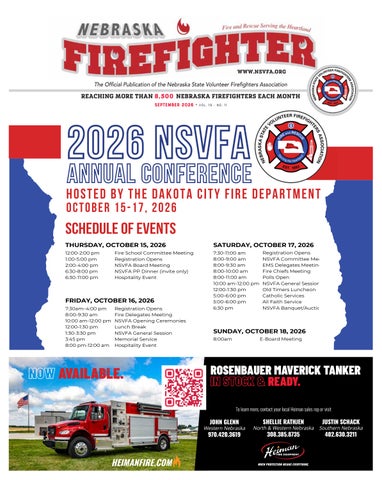
2026 NSVFA Annual Conference
South Sioux City Marriott Riverfront
THURSDAY, OCTOBER 15, 2026
385 E. 4th St. South Sioux City, NE 68776 $119.00 per room (402) 494-4000
Fire School Committee Meeting Registration Opens NSVFA Board Meeting NSVFA PP Dinner (invite only) Hospitality Event
12:00-2:00 pm 1:00-5:00 pm 2:00-4:00 pm 6:30-8:00 pm 6:30-11:00 pm
2026 2026 NSVFA NS VF A
Cottonwood Inn
4402 Dakota Ave, South Sioux City, NE 68776 King: $80.74 or 2 Doubles: $84.00 (402) 494-4114
Annual Conference
FRIDAY, OCTOBER 16, 2026 Annual Annual Conference C onf e re nc e Registration Opens 7:30am–4:00 pm
JOIN US IN OCTOBER!
Connect with volunteer firefighters from across the state at the 2026 NSVFA Annual Conference on October 15-17, 2026 in Dakota City, NE!
The 2026 NSVFA Annual Conference is once again the place to be for volunteers involved in the fire service. The conference will feature EMS and Fire educational sessions requested by firemen and women that will draw members from across the state.
Be sure to mark October 15-17, 2026, on your calendar now. The deadline for early registration is September 15th, so take a few minutes today to complete the registration form in this brochure. ecnerefnoC launnA
We look forward to seeing you in Dakota City!
A room block has been secured for conference attendees. Room reservations must be made by September 15, 2026. Please indicate you are with the NSVFA conference.
vfa.org on the
AFVSN 6202
Be sure to mark October 15-17, 2026, on your calendar now. The deadline for early registration is September 15th, so take a few minutes today to complete the registration form in this brochure. ecnerefnoC launnA
The 2026 NSVFA Annual Conference is once again the place to be for volunteers involved in the fire service. The conference will feature EMS and Fire educational sessions requested by firemen and women that will draw members from across the state.
Connect with volunteer firefighters from across the state at the 2026 NSVFA Annual Conference on October 15-17, 2026 in Dakota City, NE!
3.look EMAILforward registration staff@nsvfa.org SATURDAY, OCTOBER 17, 2026 We to to seeing you in Dakota City!
We look forward to seeing you in Dakota City! Registration 7:30-11:00 am 4. MAIL registration with check Opens payment to: NSVFA Committee Meetings 8:00-9:00 am 521 First Street EMS Delegates Meeting 8:00-9:30 am PO Boxam 10 Fire Chiefs Meeting 8:00-10:00 Polls Open 8:00-11:00 am Milford, NE 68405 10:00 am-12:00 pm NSVFA General Session Old Timers Luncheon 12:00-1:30 pm Catholic Services 5:00-6:00 pm All Faith Service 5:00-6:00 pm NSVFA Banquet/Auction 6:30 pm
SUNDAY, OCTOBER 18, 2026 8:00am
E-Board Meeting
We look forward to seeing you in Dakota City!
registration form registration form in in this this brochure. brochure. 2. FAX registration to 402.761.2224
NOW AVAILABLE.
ER:
JOIN US IN OCTOBER!
4 WAYS TO REGISTER: O CT OB E R 1 5- 17 , 20 26
or conference ust be made by te you are with the
NS
AFVSN 6202
y, NE 68776
2026 NSVFA
68776
801 Riverview Dr., South Sioux City, NE 68776 THURSDAY, OCTOBER 15, 2026 SATURDAY, OCTOBER 17, 2026 (402) 494-7531 Registration Opens 7:30-11:00 am Fire School Committee Meeting 12:00-2:00 pm NSVFA Committee Meetings 8:00-9:00 am Registration Opens 1:00-5:00 pm Hard Rock & Casino EMS Delegates Meeting 8:00-9:30 am Board Meeting 2:00-4:00 pm HotelNSVFA 111 3rd St., Sioux IA 51101 PP Fire Chiefs Meeting 8:00-10:00 am NSVFA Dinner (invitefrom only) across the 6:30-8:00 pm City, Connect with volunteer firefighters state at the 2026 NSVFA Connect with volunteer firefighters from across 8:00-11:00 the state 2026 NSVFA (844) 222-7625 Open amat thePolls Hospitality Event 6:30-11:00 pm Annual City, Annual Conference Conference on on October October15-17, 15-17,2026 2026in inDakota Dakota City,NE! NE! 10:00 am-12:00 pm NSVFA General Session Stoney Creek Inn Old Timers Luncheon 12:00-1:30 pm rd Catholic Services 5:00-6:00 pm 300 3 St., Sioux City, IA 51101 The 2026 NSVFA Annual Conference the totobe The 2026 NSVFA Annual Conferenceisisonce onceagain again theplace place befor forvolunteers volunteers FRIDAY, OCTOBER 16, 2026 All Faith Service 5:00-6:00 pm (712) 234-1100 involved in fire service. EMS and Fire involved in the the service.The Theconference conferencewill willfeature feature Fireeducational educational Banquet/Auction 6:30 pm EMS andNSVFA Registration Opens 7:30am–4:00 pm fire sessions requested by firemen and women that will draw members from Fireby Delegates Meeting 8:00-9:30 requested am sessions firemen and women that will draw members fromacross across 10:00 am-12:00 pm NSVFA Opening Ceremonies the state. the state. 12:00-1:30 pm Lunch Break SUNDAY, OCTOBER 18, 2026 1:30-3:30 pm NSVFA General Session Be sure to mark October 15-17, 2026, on your calendar deadline for 8:00amnow. Meeting 3:45 pm to mark October Memorial Service Be sure 15-17, 2026, on your calendar now.The TheE-Board deadline forearly early 1. REGISTER ONLINE at www.nsvfa.org on the 8:00 pm-12:00is am Hospitality Event registration September 15th, so take a few minutes today to complete the registration is September 15th, so take a few minutes today to complete the annual conference page
Annual Conference
Riverfront
2026 NSVFA
JOIN US IN OCTOBER! OCTOBER! Scenic Park Campground
Annual Conference
OTHER LODGINGOF OPTIONS SCHEDULE EVENTS
Fire Delegates Meeting NSVFA Opening Ceremonies Lunch Break NSVFA General Session Memorial Service Hospitality Event
H OSTE D B Y TH E DAKOTA C ITY FI RE DEPART MENT
OCTOBER OC TO BER 15-17, 1 5 - 17 , 2026 2 0 26
8:00-9:30 am 10:00 am-12:00 pm 12:00-1:30 pm 1:30-3:30 pm 3:45 pm 8:00 pm-12:00 am
O C TO B ER 15 -1 7 , 2 0 2 6
H OS TED BY THE DAKOT A C ITY FI RE DEP AR TM EN T
HOSTED H OSTE D BY BY THE THE DAKOTA DAKOT A CITY C ITY FIRE F IR E DEPARTMENT DEPARTM ENT
ON
y, NE 68776
SCHEDULE OF EVENTS
HOTEL INFORMATION
MEMBERSHIP MEETING
ROSENBAUER MAVERICK TANKER IN STOCK & READY. The Association’s annual membership meeting provides not only an opportunity to conduct official business but a chance to obtain important information that will make your membership investment more valuable and help your fire department. The meeting on Friday morning and afternoon will provide a chance for both insight and input.
To learn more, contact your local Heiman sales rep or visit
JOHN GLENN
Western Nebraska
970.420.3619
SHELLIE RATHJEN
North & Western Nebraska
308.385.8735
JUSTIN SCHACK
Southern Nebraska
402.630.3211
DAVE BRUNNETTE Southeast MN
612.875.1103
2 • Nebraska Firefighter • September 2026
Generous financial support benefits Pierce Fire and Rescue
With the help of outstanding financial support and generous donations by the residents, property owners and businesses of the Pierce fire district and surrounding area, Pierce Fire and Rescue recently purchased a new set of e-draulic battery operated extrication tools and accessories. Pierce fire and rescue will now operate with all battery powered extrication equipment with the addition of these new tools. This eliminates the need for a hydraulic gas-powered pump and hoses running to each tool to effortlessly conduct an extrication scenario. They will now be able to push a start button and operate the tools quickly and more efficiently than ever before. Time is of the essence and seconds count when responding to accident scenes. Eliminating starting a hydraulic pump, stretching hoses and switching tools out saves valuable time. The addition of these new tools will expedite our extrication time and allow us to transport our patients sooner. From the Pierce Fire and Rescue Facebook page.
Upcoming Events
Email your Upcoming Event by the 10th of the previous month (ex. Aug. 10 for the September issue) to jeff@nebraskafirefighter.com . There is no charge.
SEPT. 20, 2026: NSVFA Memorial Service, Nebraska Firefighters Museum and Education Center, Kearney, at 2 p.m. OCT. 8, 2026: Scotts Bluff County Mutual Aid Association Meeting, Bayard. OCT. 15-17, 2026: NSVFA Annual Conference, hosted by Dakota City Fire Department in South Sioux City. JAN. 15-16, 2027: Leadership in Supervision: Creating Environment for Professional Growth, Hastings Fire Department. JAN. 26-27, 2027: Decision Making Initial Company Operations, Fremont Fire Department. OCT. 14-16, 2027: NSVFA Annual Conference, hosted by Battle Creek Volunteer Fire and Rescue in Norfolk.
Train fire closes county roads between Potter and Brownson Cheyenne County Roads 87, 89, 91 impacted
WILDLANDUNITS. READY AND AVAILABLE. CONTACT YOUR SALES PARTNER FOR MORE INFORMATION
JOHN GLENN
Western Nebraska
970.420.3619
SHELLIE RATHJEN
North & Western Nebraska
308.385.8735
JUSTIN SCHACK
Southern Nebraska
402.630.3211
FOR PRICING AND INFO VISIT:
Firefighters responded to a reported train fire at 6:49 a.m. today. The second locomotive in a train experienced an engine malfunction resulting in a fire. Potter Fire Department Public Information Officer Robert Hilpert said the call came in about 6:45 a.m. "We had a train fire, the second locomotive The call came into the fire station at 6:45," Hilpert said. Firefighters arrived within minutes. The fire was extinguished by 7:25 a.m. he said. "We totally used all fire extin-
guishers because of the nature of the fire. The motor had blown up and it was an oil fire," Hilpert said. He said the only way to contain the fire was with their all-purpose fire extinguishers. "Traffic on the Union Pacific has been stopped in both directions at this time. Until they get an engineer or maintenance guy down to figure out what they want to do with this train, the train traffic will be stopped at this time," he said. Because of the disabled train, Cheyenne County Roads 87, 89 and 91 are closed at U.S. Highway 30. (Written by Forrest Hershberger, NCN, August 11, 2026)
September 2026 • Nebraska Firefighter • 3
Fire Prevention Nebraska Style September: The Perfect Time to Put Prevention Into Action September is a month of transition across Nebraska. School is back in session, harvest is getting underway, evenings are becoming cooler, and before we know it, October and Fire Prevention Week will be here. For Nebraska fire departments, September is also the perfect time to ask an important question: WHAT ARE WE DOING TO PREVENT THE NEXT EMERGENCY BEFORE THE CALL EVER COMES IN?
We spend countless hours training to respond when the pager sounds. We practice pulling hose, operating pumps, performing rescues, providing emergency medical care, and working safely on the fireground. Those skills are essential. But there is another important part of our responsibility to our communities—preventing the emergency in the first place. Fire prevention does not have to be complicated or expensive.
Sometimes the simplest efforts make the greatest difference. September is a great time to contact your local school and begin planning a Fire Prevention Week visit. Check with daycare centers, preschools, senior centers, assisted living facilities, businesses, and community organizations. Ask if your department can provide a short fire safety presentation or participate in an upcoming community event. Take a few minutes to look at your department’s fire prevention materials. Are they current? Do you have working smoke alarms available for families who may need them? Are your handouts appropriate for different age groups? Is your department sharing fire safety information through social media, local newspapers, community newsletters, or school communications? MOST IMPORTANTLY, REMEMBER THAT EVERY FIREFIGHTER CAN BE A FIRE PREVENTION OFFICER.
You don’t need a special title to talk with a family about smoke alarms. You don’t need a class-
Rhonda Cerny, NSVFA Fire Prevention
room to remind someone to have two ways out of their home. You don’t need a formal program to talk with a child about never hiding from firefighters. And you don’t need to wait until October to encourage someone to create and practice a home escape plan. SEPTEMBER SAFETY REMINDERS SMOKE ALARMS SAVE LIVES.
Encourage families to test alarms regularly and make sure alarms are installed where they are needed. HAVE TWO WAYS OUT. Every household should know at least two ways out of each room whenever possible and have a designated meeting place outside. PRACTICE THE PLAN. A home escape plan only works if everyone in the household knows what to do. TALK WITH CHILDREN ABOUT FIREFIGHTERS. Firefighters wear-
ing protective gear can look and sound frightening. Help children understand that firefighters are there to help.
PREPARE FOR HEATING SEASON. Cooler Nebraska weather
“Fire prevention does not have to be complicated or expensive. Sometimes the simplest efforts make the greatest difference.”
will soon bring furnaces, fireplaces, space heaters, and other heating equipment back into use. Now is the time to begin sharing heating safety reminders.
REMEMBER HARVEST SAFETY. Rural Nebraska departments
can help reinforce fire prevention around combines, tractors, grain handling operations, fuel storage, and other agricultural equipment. Fire prevention is not measured by the number of coloring books we hand out or the number of presentations we give. Its true success may be something we never see—a fire that never starts, an injury that never happens, or a family that safely escapes because someone took the time to teach them what to do. As we prepare for Fire Prevention Week in October, let’s use September to get ready, reach out, and become more visible in our communities.
Whether your department has a large prevention program or is just beginning, do something. Visit one classroom. Check one smoke alarm. Share one safety message. Talk with one family. Those small efforts add up. Across Nebraska, volunteer and career firefighters have always answered the call when our neighbors need us. Fire prevention gives us another opportunity to serve them—before they ever need to make that call. Prevent the fire. Educate the community. Protect Nebraska. The NSVFA Fire Prevention Team encourages every Nebraska fire department to make fire prevention and public education a year-round part of serving their community. RHONDA CERNY, NSVFA Fire Prevention
Ponca Volunteer Fire & Rescue honors two longtime Assistant Chiefs Ponca Volunteer Fire & Rescue recently recognized two dedicated leaders for their years of service and commitment to the department by presenting them with custom engraved wooden American flags. The department honored First Assistant Chief Mark Cook for 31 years of service and Second Assistant Chief Brian Scollard for 15 years of service as Assistant Chief. Each handcrafted flag features the recipient’s name, rank, years of service, and the Ponca Volunteer Fire & Rescue Maltese cross, creating a lasting tribute to their leadership and dedication. In the fire service, leadership extends far beyond responding to emergency calls. It means mentoring new firefighters, sharing knowledge, and preparing the next generation to carry on the tradition of serving their community. Throughout their careers, Cook and Scollard have exemplified those values by guiding countless firefighters and helping strengthen the department. “One of the greatest things a firefighter can do is pass the torch to the next generation,” said Fire Chief Brad Krohn. “Brian and Mark have done exactly that. Their leadership, mentorship, and commitment have helped ensure Ponca Volunteer Fire & Rescue will continue serving our community with pride for years to come.” Although these awards rec-
Ponca Volunteer Fire & Rescue recently honored First Assistant Chief Mark Cook (31 years of service) and Second Assistant Chief Brian Scollard (15 years of service) with custom engraved American flags in recognition of their outstanding leadership, dedication, and commitment to serving the Ponca community. ognize their years of service as Assistant Chiefs, both Cook and Scollard will continue serving as valued members of Ponca Volun-
teer Fire & Rescue. Their experience, knowledge, and dedication remain an invaluable asset to the department and the community.
Ponca Volunteer Fire & Rescue extends its sincere gratitude to both men for their decades of service, leadership, and sacrifice.
Their legacy will live on through the firefighters they have mentored and the lasting impact they have made on the department.
4 • Nebraska Firefighter • September 2026
Training Division Part-time instructor Spotlight The Training Division of the State Fire Marshal’s agency Part-Time instructor spotlight is Justin Staab who is currently with the Offutt Fire and Rescue Department where he holds the position of Engineer. Justin began his involvement with the fire service starting in 2003 with Kearney FD and has also been a member of the Southwest, Gretna, US Army Reserve and Nebraska Air guard fire departments. During his time with these various agencies he has held
the positions of firefighter, EMT, engineer, crew chief, fire inspector and training chief. Staab has served our nation and state as a member of the Nebraska National Guard and the US Army Reserves for 21 years. While with the Offutt FD Staab has been recognized as Firefighter of the Quarter on two different occasions. Staab began working for the Training Division in 2018 under the supervision of Darin Lintner in the East Region. He enjoys helping to teach various technical
Smokey Sez sez By BOB HECKMAN
So far in 2026, Nebraska had an unprecedented outbreak of major wildland fires; four massive blazes on March 12th burned 930,000 to one million acres, while hundreds of smaller fires (local grass fires) were managed by volunteer fire departments, state and emergency tracking centers. Another large Morrill fire burned 643,361 acres across Morrill, Garden, Arther, Brant, and Keith Counties. Road 203 burned 35,912 acres in Blaine
and Thomas Counties. Anderson fire burned 17,400 acres in Cherry County. Last year 930,000 plus burned, shattering the previous annual records. As of August 2026, approximately 92 percent of the state is under drought, with 11% abnormally dry. Only a small fraction of the state is free of drought or drought stress. The sad part about this report, the year is not over...... Fireman Bob, Plattsmouth Fire
For ADDRESS CHANGES CONTACT: 402-761-2211 Fax: 402-761-2224 staff@nsvfa.org
Published monthly by Blaze Publications Inc. NEWS & ADVERTISING DEADLINE: 15TH DAY OF EACH MONTH Email: jeff@nebraskafirefighter.com PO Box 122, Humboldt, IA 50548 Advertising Rate Card available upon request. We welcome your views, opinions, news tips and questions. Letters to the editor must be accompanied by a name and daytime telephone number, and may be edited for space.
rescue specialties including vehicle extrication, heavy and trench rescue, forcible entry technics, airport firefighting and structural fireground operations. During his time away from the fire department Justin enjoys spending time with his wife and children fishing or hunting. When asked to share a satisfying moment in working for the Training Division and Justin shared the following: “staying engaged with evolving firefighting techniques, emergency response practices, and instructional methods and knowing that my work has a lasting impact because the knowledge that I help deliver is carried into real emergency situations”. Justin shared the following of an experience in teaching at fire school; “for the past 6 years I have been involved in teaching the basic and advanced ropes course at fire school, and every year I have one or more of the students from previous classes approaching me and telling me how something that I taught them helped on an emergency scene”. This type of confirmation that skills taught by the instructors of the Training Division validate the value and importance of the impact the Division has on the fire service of Nebraska. The TD would like to thank Justin for his continued efforts in training the fire service of our great state.
Justin Staab
September 2026 • Nebraska Firefighter • 5
6 • Nebraska Firefighter • September 2026
NSVFA Officer Directory President BRENDA JENNY 1767 Colfax Street, Blair, NE 68008 402.639.9647 bgolf2560@yahoo.com 1st Vice President TROY SHOEMAKER 1433 Grove Ave Alliance, NE 69301 308-760-7682 tshoemaker@cityofalliance.net 2nd Vice President KENNY KRAUSE 1229 D St. Fairbury, NE 68352 402-300-0097 krausechief@gmail.com Secretary/Treasurer MARK MEINTS 502 E H St, Wymore, NE 68466 402-806-7451 meints2@windstream.net NSVFA Lobbyist RYAN K. MCINTOSH PO Box 13 Nebraska City, NE 68410 ryan.mcintosh@stilmockmcintosh.com NSVFA Legal Advisor SCOTT SMITH P.O. Box 186 Syracuse, NE 68446 scott.smith@bhhslawfirm.com Past President SCOTT SCHREMMER 815 W 6th, Chadron, NE 69337 308-430-1494 buffhater@gmail.com
District Directors
#1 DARRELL VANCE 1415 Q St, Gering, NE 69341 308-631-0053 DarrellVance1230@gmail.com #2 JOHN BOMAR P.O. Box 222, Battle Creek, NE 68715 402-992-1560 JBomar1970@gmail.com #3 RON CHADA 1721 N Sheridan North Platte, NE 69101 308-520-2828 rmchada@winnelson.com #4 KATELYNN LOVELL 515 E H St., Wymore, NE, 68466 402-806-5627 katelynn.lovell0916@gmail.com NSVFA Representative National Vol. Fire Council JUSTIN SCAMEHORN 202 Hidas Ave. Waco, NE 68460 402-366-1939 jscamehorn@yahoo.com Appointed NVFC Director JOEL CERNY 1618 Denver St. Schuyler 68661 402-720-4100 cerny_j@hotmail.com Chaplain MATTHEW MAU Cell: 402-363-1540 E: pastormattwaco@gmail.com
NSVFA Officer OFficer Reports Honoring Our Fallen, Strengthening Our Future They say not all heroes wear capes, and this rings especially true for the brave men and women who serve as volunteer firefighters and EMS providers. Across Nebraska, dedicated volunteers answer the call when their communities need them most. They put others before themselves, often leaving their families, jobs, and daily lives behind to respond to emergencies and help those in need. While they may not have superhuman abilities, their courage, compassion, and commitment are truly extraordinary. Sadly, our firefighter and EMS heroes are not immortal. Each year, we pause to remember those who have passed away and to honor the lives they lived and the difference they made in their communities. The Nebraska State Volunteer Firefighters Association’s annual Fallen Firefighters Memorial Service provides an opportunity for departments, families, friends, and fellow firefighters to come together and pay tribute to those who have given so much in service to others. The memorial service serves an important purpose. It allows us to honor our fallen, keep their memories alive, support their families and departments, strengthen the bonds within the firefighting community, and remind future generations of the dedication and sacrifice that define the volunteer fire service. By honoring the bravery, dedication, and sacrifice of those who came before us, we help ensure that their legacies continue. Their names represent more than a line in a memorial—they represent lives of service, friendships, families, and communities forever changed by their contributions. I hope you will join us on September 20, 2026, at 2:00
p.m. at the Nebraska Firefighters Museum and Education Center in Kearney, NE, as we come together to honor and remember these courageous individuals. It is an opportunity to stand together as an association, support one another, and ensure that the sacrifices of our fallen heroes are never forgotten. Our 2026 Annual Conference is just around the corner, and this year’s conference will include elections for several open NSVFA Board positions. The positions up for election include: • President • 1st Vice President • 2nd Vice President • Secretary/Treasurer • District 2 Director • District 4 Director In addition, the appointed NVFC Director position is open. Members interested in being considered for this appointment must meet the following qualifications: • Be an active member of the NSVFA in good standing. • Have been a member of, or currently serve on, an NSVFA committee. • Be an active volunteer or paid-on-call firefighter with five or more years of service; or • Be a chief officer of a volunteer, paid-on-call, or combination fire department; or • Be a volunteer or paid-on-call EMS provider with five or more years of service. Those interested in the appointed NVFC Director position are asked to submit a letter of interest to our Executive Director, Taylor Moore, by sending it to the NSVFA office at PO Box 10, Milford, NE 68405, faxing it to 402-761-2224, or emailing it to staff@nsvfa.org. Strong leadership comes from members who are willing to step forward and serve. If you have
Lobbyist Report This month I’d like to discuss the Volunteer Emergency Responders Incentive Act (“Act”) and potential legislation as we approach the 110th Legislature, which will convene in January. The NSVFA intends to once again seek legislation raising the tax credit under the Act from its current $250 to $1,000. The credit, created to recognize the service of Nebraska’s volunteer firefighters, emergency responders, and rescue squad members, has not kept pace with the growing demands placed on our volunteer departments, and NSVFA believes it is time for state senators to revisit the amount. Alongside this effort, we have also received a number of inquiries from members and departments about whether the point system used to qualify for the credit needs to be modernized or updated. The point system is found in Neb. Rev. Stat. § 77-3103. The point system awards up to 100
points a year across calls, training, drills, meetings, office-holding, and other qualifying activities, but a volunteer needs at least 50 points to qualify for the $250 tax credit. The single biggest factor is the calls category: a volunteer must respond to at least 10% of the emergency calls dispatched from their station to earn the 25 points available, and falling short of that 10% threshold means zero points in that category no matter how many calls they actually ran. Because that one requirement is tied to a percentage of total call volume, it hits volunteers in highcall departments and low-call departments very differently, even though it’s worth a full quarter of the points needed to qualify. Departments running well over a thousand calls a year and departments running only a dozen or so operate under the same 100-point framework, and questions have
Brenda Jenny, President “I hope you will join us on September 20, 2026, at 2:00 p.m. at the Nebraska Firefighters Museum and Education Center in Kearney, Nebraska.”
ever considered becoming more involved in the NSVFA, I encourage you to consider running for one of these positions or supporting those who are willing to serve. Your experience, involvement, and commitment can make a meaningful difference in the future of our association and Nebraska’s volunteer fire service. I also want to share with you that I will be a candidate for the open Secretary/Treasurer position. It has been an honor to serve you as President, and I am truly grateful for the friendships, experiences, and opportunities I have had over the past several years. Serving as President has given me an even greater appreciation for the dedication of our members and the important work being done by volunteer firefighters and EMS providers across Nebraska. While my role may change, my commitment to the NSVFA and the volunteer fire service remains the same. I understand the responsibility that comes with this three-year commitment, and if elected, I look forward to continuing to serve our members, working alongside our Board of Directors, and helping move our association forward. Thank you for your continued support of the Nebraska State Volunteer Firefighters Association. Whether you attend conferences, serve on committees, volunteer at events, support association pro-
grams, or simply take the time to vote, your involvement is what makes this association successful. Every member has a role in helping strengthen our organization and ensuring that the voice of Nebraska’s volunteer fire service remains strong. I look forward to seeing many of you at the October Conference as we continue working together to strengthen the NSVFA and support Nebraska’s volunteer fire service. The deadline for early registration is September 15, 2026. Please take a few minutes today to complete your online registration at https:// www.nsvfa.org/conference. As always, if you have a meeting or event you would like me to attend, please reach out. I will make every effort to be there and support your department and members. Here are upcoming events you don’t want to miss: • NSVFA Fallen Firefighters Memorial Service, September 20, 2026, 2:00 p.m. Nebraska Firefighters Museum and Education Center Kearney, Nebraska • 2026 NSVFA Annual Conference, October 15–17, 2026, Hosted by the Dakota City Fire Department Until next time, stay safe and healthy. BRENDA JENNY President, NSVFA
Ryan K. McIntosh, Lobbyist “The NSVFA intends to once again seek legislation raising the tax credit under the Act from its current $250 to $1,000. The credit, created to recognize the service of Nebraska’s volunteer firefighters, emergency responders, and rescue squad members, has not kept pace with the growing demands placed on our volunteer departments, and NSVFA believes it is time for state senators to revisit the amount.”
been raised about whether that system still works fairly for everyone. To better understand these concerns, a survey was recently sent out to volunteer departments across our membership asking about experiences with the point system and gauging support for possible changes. I want to extend appreciation to everyone who took the time to complete that survey. Your responses will be invaluable as we bring this issue to our state senators, giving us real, department-level data to support the
case for updating both the incentive amount and the point system behind it. As this legislative effort moves forward, we will continue to keep members informed and will welcome further input along the way. Thank you for all you do to help in this effort. Stay engaged and don’t hesitate to reach out with any questions. RYAN K. MCINTOSH, Lobbyist
September 2026 • Nebraska Firefighter • 7
NVFC Reports Who Will Answer the Call Tomorrow? VOLUNTEERISM, RECRUITMENT, RETENTION, AND THE FUTURE OF NEBRASKA’S FIRE SERVICE
As always, I hope this article finds everyone healthy and safe. Hopefully everyone has had a chance to enjoy some of the summer with family and friends between calls, trainings, meetings, and everything else that seems to fill our calendars. Especially as school starts back up. Now, back to the usual bimonthly ramblings. This is a particularly long one but very important. The volunteer fire service is on the brink of a crisis in Nebraska and across the nation. For generations, the volunteer fire service has been part of the foundation of communities across Nebraska. When the siren sounds or the pager goes off, people leave dinner tables, jobs, farms, ball games, birthday parties, and warm beds because somebody in their community needs help. Nobody makes them do it. THEY VOLUNTEER.
But across Nebraska and throughout the country, finding people willing and able to make that commitment has become increasingly difficult. Talk to almost any volunteer fire chief and eventually the conversation turns to the same subject: We need more people. We need firefighters. We need EMTs. We need younger members. We need people willing to train. We need people willing to become officers. And, maybe most importantly, we need people willing to stick around. Recruitment and retention are not new problems in the volunteer fire service, but I believe we have reached a point where we need to quit simply talking about the problem and start asking some difficult questions about what the future of volunteer emergency services is going to look like. THE VOLUNTEERS ARE STILL OUT THERE
The National Volunteer Fire Council recently completed new research looking at why people volunteer, why they don’t, and why some eventually leave the fire service. One of the findings really caught my attention. More than half of the people surveyed didn’t know they could volunteer as a firefighter, and nearly two-thirds weren’t sure whether their local fire department was even looking for volunteers. Think about that for a minute. We spend a lot of time saying, “Nobody wants to volunteer anymore.” Maybe sometimes we need to ask ourselves: Have we actually asked them? There may be someone living three blocks from the fire station
who has thought about joining but doesn’t know how. There may be someone who thinks they need previous firefighting experience. Someone else may believe they have to be available for every call. Maybe they don’t realize there are roles they can fill besides going through the front door of a burning building. Sometimes our biggest recruitment problem may simply be that we haven’t told our story well enough. WE HAVE TO MEET PEOPLE WHERE THEY ARE
The world has changed, and the volunteer fire service has to recognize that. People have demanding careers. Families are busy. Kids have activities almost every night of the week. Many people commute farther for work than they did years ago. Asking someone to volunteer today means asking them to give us something that may be more valuable than money—their time. That doesn’t mean people don’t care about their communities. It means departments may have to become more flexible in how people are allowed to serve. Not everyone can make every call. Not everyone can attend training every Tuesday night. Not everyone who walks through the door is going to become a 30-year firefighter. That’s okay. If someone can give us five good years, let’s make those five years count. If somebody can answer daytime calls but not evenings, let’s find a place for them. If someone wants to help the department but isn’t interested in interior firefighting, maybe there is another role they can fill. The question shouldn’t always be, “Can they fit into the way we’ve always done things?” Sometimes we need to ask, “How can we give this person an opportunity to serve?” RECRUITMENT GETS THEM IN. RETENTION KEEPS THEM THERE.
Getting someone to fill out an application is only the beginning. The NVFC’s recent research found that volunteers want to serve in departments where they feel valued and supported. Mentorship, family involvement, and social and emotional support can all play an important role in keeping members. That shouldn’t surprise any of us. Think back to when you joined. Somebody probably showed you where your gear went. Somebody taught you how to pull hose. Somebody answered the questions you were embarrassed to ask. Somebody probably gave you a hard time around the firehouse, too. But hopefully somebody also made you feel like you belonged there. We cannot expect a new mem-
Justin Scamehorn, NVFC Director ber to walk into a firehouse with decades of traditions, friendships, personalities, and unwritten rules and automatically understand how everything works. We have to bring them into the family. And sometimes we also need to look in the mirror. If new members repeatedly walk through our doors and then disappear six months later, maybe the problem isn’t always the new members. Department culture matters. Leadership matters. How we treat people matters. There is nothing wrong with honoring the traditions of the fire service. I hope we never lose them. But “that’s the way we’ve always done it” cannot become the reason we lose the next generation of firefighters. THE NVFC IS TRYING TO HELP
Recruitment and retention have become major priorities for the National Volunteer Fire Council. The Make Me A Firefighter campaign provides departments with recruitment resources, customizable materials, and tools to help connect potential volunteers with departments that need them. Research conducted by the NVFC is helping us better understand what motivates people to volunteer and, just as importantly, what causes them to leave. But recruitment is only part of the equation. The NVFC provides training through its Virtual Classroom and Training Summit to help volunteers and department leaders develop the skills needed to build stronger departments. Programs such as Share the Load provide behavioral health resources for responders and their families. The NVFC First Responder Helpline provides members and their household family members access to confidential assistance for the stresses that come with emergency response and everyday life. The National Junior Firefighter Program helps departments introduce young people to the fire service and begin building the next generation of volunteers. Fire Corps provides opportunities for community members to support departments in non-operational roles. Health and safety initiatives, leadership development, wildland fire resources, equipment programs, and department support tools are all designed around the same basic goal: HELPING VOLUNTEER DEPARTMENTS SURVIVE AND SUCCEED.
The NVFC also continues advocating in Washington for programs such as AFG and SAFER that provide funding for equipment, training, recruitment, and retention. None of these programs alone will solve the volunteer shortage. But they give departments tools
“We need firefighters. We need EMTs. We need younger members. We need people willing to train. We need people willing to become officers. And, maybe most importantly, we need people willing to stick around.”
to fight back. OUR COMMUNITIES HAVE A RESPONSIBILITY TOO
There is another part of this conversation that sometimes gets overlooked. The volunteer fire department belongs to the community. A fire department cannot operate indefinitely because the same 10 or 15 people continue carrying the load year after year. Eventually those firefighters get older. Their health changes. Their families need more of their time. Their careers change. After 20, 30, or 40 years, eventually they have earned the right to hang up their gear. Someone has to be standing behind them ready to take their place. Communities need to understand that. Supporting your volunteer fire department isn’t only writing a check at the annual fundraiser or waving when the trucks go through the parade. Sometimes supporting the fire department means walking through the station door and asking: “How can I help?” Maybe you’re the next firefighter. Maybe you’re an EMT. Maybe you can help with fundraising, public education, maintenance, bookkeeping, or community outreach. Maybe you’re a business owner who can allow an employee to leave work when the pager goes off. There are many ways a community can support its volunteers. But somebody has to step forward. THE FUTURE IS STILL OURS TO DECIDE
I don’t believe the volunteer fire service is dying. I believe it is changing. And change has never been particularly easy for the fire service. There are still people who want to serve. There are still young men and women who want to make a difference. There are still people
who want to belong to something bigger than themselves. Our job is to find them, welcome them, train them, support them, and give them a reason to stay. The NVFC can provide resources. The NSVFA can advocate here in Nebraska. Chiefs and officers can build strong departments. Communities can support their firefighters. But ultimately, volunteerism comes down to people. People willing to give a little bit of their time for somebody else. That idea has kept Nebraska’s volunteer fire service alive for generations, and I believe it can keep us going for generations to come. We just can’t assume someone else will do it. So, to those of you who have served for 30 or 40 years, find someone to take under your wing. To the firefighter who has been around for five years, remember what it felt like when you were the new person walking through that door. To our chiefs and officers, ask yourselves whether your department is giving new members every opportunity to succeed. To our communities, don’t wait until the trucks don’t roll to realize how important your volunteers are. And to the person who has driven past the fire station a hundred times and wondered whether you could do it: STOP IN. ASK THE QUESTION. YOU MIGHT JUST BE THE PERSON WE’RE LOOKING FOR.
As always, stay safe out there, take care of one another, and remember why we volunteered in the first place. I pray that God continues to watch over all of you and your families and brings everyone home safely after every call. God Bless and Stay Safe JUSTIN SCAMEHORN NVFC Director, State of Nebraska
Action Fire Photos Needed! Please send them to jeff@nebraskafirefighter.com along with information to explain the photo.
8 • Nebraska Firefighter • September 2026
Legal Advisor’s Report Firefighters, I’ve started receiving calls about a recent change to the Open Meetings Act and how it applies to rural fire boards. The change in statute will make it significantly easier for boards to lawfully publish notice of meetings. LB 596 was passed by the Unicameral and signed by the Governor this past legislative session. Among changes to other statutes, LB 596 changed the prescribed method for publishing notice in advance of rural/suburban fire board meetings in Neb. Rev. Stat. § 841411(1)(a) which now reads in relevant part: “…each public body shall give reasonable advance
publicized notice of the time and place of each meeting by a method designated by each public body and recorded in its minutes. Such notice shall be transmitted to all members of the public body and to the public.” Prior to this change, you’ll recall that rural/suburban boards were required to post notice in three (3) locations within the district or publish in a newspaper of general circulation in the district. The new language simply requires the board to designate a method to post notice of its meetings and record such designation in their minutes. The method here can be anything that’s practical for that particular
board. Among endless options, notice of meetings could be posted to Meta (Facebook) or X (Twitter). If there is a village or county website, notice of the rural/suburban fire district board meetings could be posted to that website. The important part is to designate where notice will be posted during a meeting, so that such designation will go into the minutes of the meeting to be part of the public record. It’s also important to make sure that the method designated is readily accessible to members of the public. For example, publishing notice to a Facebook page that members of the public must request to join in order to see posts probably fails
under this statute. An important note…notice for a rural or suburban board’s annual meeting for elections and budget is still subject to the public notice requirement found at Neb. Rev. Stat. § 35-507 which reads, “…Notice of a meeting (referring to annual election/budget meeting) shall be given by the secretary-treasurer by one publication in a legal newspaper of general circulation in each county in which such district is situated. Notice of the place and time of a meeting shall be published at least four calendar days prior to the date set for meeting.” While the publication requirement is relaxed for regular month-
ly meetings, if your board meets that often, the statutorily required meeting to hold elections and set the budget each year must still be noticed by publishing notice in a legal newspaper at least four (4) days before the meeting. As always, if you have any questions on this change to the Open Meetings Act or anything else, don’t hesitate to call or email me. Thank you for the work you all do! Respectfully submitted,
Norfolk rappelling training
SCOTT G. SMITH NSVFA Legal Advisor
On July 27, Norfolk firefighters trained on rappelling and using the ladder truck as a high-point.
September 2026 • Nebraska Firefighter • 9
Fort Calhoun, Blair training
On July 23, Fort Calhoun Fire Department firefighters trained with Blair Volunteer Fire & Rescue last evening. Firefighters worked on advancing hose lines into a structure, pump operations and tower ladder positioning.
Leadership in Supervision Course SFM – TRAINING DIVISION COURSE ANNOUNCEMENT
The Training Division of the State Fire Marshal’s Office will be hosting the following National Fire Academy direct delivery course: LEADERSHIP IN SUPERVISION: CREATING ENVIRONMENT FOR PROFESSIONAL GROWTH: (F0646) WHEN: January 15 – 16, 2027 WHERE: Hastings Fire Depart-
ment, 1145 S Hastings Ave (Station #2) COST: No cost for National Fire Academy Class COURSE DESCRIPTION: This 2-day course presents the supervisor with the basic leadership skills and tools needed to perform effectively in the fire and emergency medical services (EMS) environment. The course includes concepts related to a successful transition to supervisory and leadership roles, including concepts of adaptive leadership; change management; active followership; effective communication, including difficult conversations and advocacy-inquiry-based dialogue; ethics; authority; power; decision-making; and active engagement through development of a personal plan. To register click the following link and register on the Training Divisions webpage: https://nebraskasfmtd.ne.gov/Courses/Courses_Avail.aspx Once on this page, click on NFA-DD at the top and then click on “register” for the course you are interested in. PLEASE REMEMBER: The NFA has a policy that there must be a minimum of 15 students registered for a course 40 days in advance of the start of the class in order to give the class approval so please register EARLY.
Don’t need it?
SELL IT! Nebraska Firefighter Classifieds...
jeff@nebraskafirefighter.com
10 • Nebraska Firefighter • September 2026
Beatrice garage fire
Beatrice firefighters were summoned to battle a garage fire at 9:08 p.m. on Sunday night, Aug. 2. A fire broke out at the rear of a two-stall garage along the west side of 13th Street. A fire engine and ladder truck were dispatched to the scene, with firefighters tapping a hydrant about a block west of the fire, to fight the flames. The garage was not attached to any residence or other buildings, and it did not appear that other structures were damaged. Firefighters had the flames extinguished, at around 9:40 p.m., about a half-hour after being sent to the scene. City electric and gas company crews were summoned to the scene. The garage that caught fire is located next to an alley, with homes nearby to the north and south. Beatrice Fire Captain Jeremy Seggerman says the fire was discovered by a passerby who alerted the homeowners. There were no injuries to residents, but two Beatrice firefighters had minor injuries that did not require medical attention. An investigator from the Nebraska State Fire Marshal’s office determined that the fire was accidental in nature but has not determined an exact cause at this time. Total property damage was estimated at $80,000.
ACTION FIRE PHOTOS NEEDED! Please send them to jeff@nebraskafirefighter.com along with information to explain the photo.
Crews battle rapidly spreading grass fire near Sutherland A fast-moving grass fire that ignited northeast of Sutherland on Tuesday afternoon burned more than 120 acres and is believed to have started from pickup exhaust along a trail road, Sutherland Fire Chief Wacey Campbell told News 2. In a social media post, Sutherland Fire and Rescue said it was paged out around 3:30 p.m. Crews were notified while en route that the fire was spreading rapidly, and mutual aid was requested. All crews cleared the scene by 8 p.m. Central Time, the department said.
Assisting agencies included Hershey, Paxton, Keystone-Lemoyne, Ogallala, North Platte, Wallace, Maxwell and Tryon, along with numerous ranch rigs and Simplot semi tankers. Air support was also requested and used from Wallace Aviation, according to the department. Keith County EMS responded with command and provided medical support on scene, as well as coverage for additional calls, the department said. (KNOP-TV NBC 2 North Platte, NE, July 30, 2026)
Fire crews paged to several grass fires in Lincoln County Lightning is blamed for sparking at least one of three fires that kept crews busy northwest of North Platte on Tuesday morning, according to the North Platte Fire Department. Crews were first dispatched to Foothill Road shortly after 10:15 a.m., where lightning struck a cottonwood tree. The strike ignited a nearby hay bale, containing that portion of the fire to a single bale. However, while working to extinguish the burning hay, firefighters noticed a second blaze had broken out at a homestead across the road. Officials determined the lightning strike had smoldered inside the cottonwood tree before roaring up and spreading to a near-
by old shed. The shed was destroyed, burning completely to the ground. Firefighters were able to contain the flames to the surrounding trees and remained on scene Tuesday afternoon to overhaul the area and extinguish remaining hotspots. Additionally, lightning sparked two fires simultaneously in southwest Lincoln County Monday, one on Fear Road and one on Knoll Road. Crews contained the Fear Road fire in 30 minutes after it burned approximately 20 acres. The Knoll Road fire burned a quarter of an acre and was extinguished in 15 minutes. (KNOP-TV NBC 2 North Platte, NE, August 5, 2026)
September 2026 • Nebraska Firefighter • 11
READING SMOKE: A THREE-STEP SIZE-UP By COLE KLEINWOLTERINK
In December 2024 and January 2025, we examined the four attributes of smoke: velocity, volume, density, and color. Understanding each attribute is important, but firefighters must also know how to combine those observations into a quick, repeatable size-up. When reading smoke, I have found the greatest success using the threestep process I learned from Captain Rob Backer in his class, The Art of Reading Smoke. The process is fast, practical, and repeatable, giving firefighters a consistent framework for organizing what they see instead of relying on a single smoke attribute or first impression. With practice, it helps crews move from simply observing smoke to interpreting what it reveals about the fire’s location, intensity, direction of travel, and rate of change. STEP 1: INVENTORY THE SMOKE
Begin with a complete scan of the building. Identify every location where smoke is visible, note areas where it is unexpectedly absent, and evaluate the number and size of the openings through which it can escape. Do not become so focused on visible flames that you fail to examine the rest of the building. Flames attract attention, but smoke from windows, doors, eaves, roof openings, vents, seams, and utility penetrations provide a more complete picture of what is happening inside. Avoid describing the entire building as simply having “light smoke” or “heavy smoke.” Instead, evaluate the four smoke attributes (volume, velocity, density and color) at each opening. STEP 2: IDENTIFY WHAT IS INFLUENCING THE SMOKE
Account for outside factors that may distort what you see. Begin with the building itself, then consider how current weather conditions may be affecting the smoke’s movement and appearance. Consider the building’s size, construction, layout, contents, and ventilation openings. Smoke conditions that appear significant in a small bedroom may look less dramatic in a warehouse, even when the warehouse fire is producing considerably more smoke simply because the container is much larger. The building can also filter and redirect smoke. Hallways, closed doors, stored contents, wall cavities, floor systems, and attics create resistance, which may slow the
smoke, lighten its color, or cause it to appear far from the actual fire. Opening size also affects velocity. A small opening may create a concentrated, high-velocity stream, while a larger opening allows pressure to escape with less visible speed. For that reason, it’s best to compare smoke coming from similar sized openings when possible. The second influence is weather. Wind may push smoke back into the building, increase its velocity on one side, or hide conditions on another. Cold air can cause smoke to fall and remain near the ground. Humidity may keep smoke together in a defined column, while dry air may allow it to disperse more quickly. In freezing conditions, the smoke’s appearance may change almost immediately after it reaches the exterior air. Condensation can lighten its visible color, so firefighters should evaluate what is occurring at the opening rather than relying only on the color seen farther away. STEP 3: DETERMINE THE RATE OF CHANGE
Reading smoke is not a single observation made on arrival. Conditions must be reassessed throughout the incident, especially after firefighters open doors, break windows, begin ventilation, or apply water. Continually evaluate whether the smoke is increasing or decreasing, whether laminar flow is becoming turbulent or turbulent flow is becoming laminar, whether the smoke is growing darker or denser, and how quickly those changes are occurring. Continually size-up the smoke profile throughout the incident. Changes in visible fire may be misleading when smoke, heat, and pressure continue to build. Flames may disappear when a fire becomes ventilation-limited, while heat and unburned fuel continue accumulating inside. Less visible fire does not always mean conditions are improving. Consider a two-story residence with dense, turbulent black smoke with bi-directional flow pushing from a first-floor window and dirty white smoke exhausting from the entire opening of the second floor window. Over several seconds, the upstairs smoke becomes darker, denser, and faster. Conditions on the first floor suggest that the main body of fire is nearby. The lighter appearance upstairs should not be mistaken for cooler or less dangerous smoke; its characteristics may have changed as it moved through the structure. The worsening conditions described
on the second floor indicate that the fire is intensifying below and extending upward. Without timely water application, fire involvement on the second floor is likely. The three step process should leave firefighters with an operational picture: where conditions are most severe, which areas are being threatened, whether the problem is expanding, and how urgently tactics must be applied. MONTHLY DRILL
Find several structure-fire arrival videos and pause each one shortly after the building becomes visible. Have each firefighter verbally go through steps 1 and 2 by identifying the likely fire location, the direction it’s likely to travel, the conditions affecting the smoke, and the potential for a hostile fire event at that moment. Then continue playing the video and complete step 3 by evaluating how conditions change over the next 30 to 60 seconds.
FIRE UP YOUR CAREER AT MCC Fire Science courses offered:
The more often crews practice this process, the faster and more accurately they will be able to apply it during an actual size-up. Cole Kleinwolterink is a member of the Waukee Fire Department, Van Meter Fire Department, and Fire Science instructor at Des Moines Area Community College. Feel free to reach out to him atkleinwolterinkc@gmail.com with any questions, comments or inquiries.
The Fire Science Technology program at Metropolitan Community College can make your firefighting dream a reality.
Fire Science courses offered: Emergency Medical Services • Firefighter I & II offerings: • program Hazardous Materials Awareness/Operations/Technician
• Hazardous Materials Chemistry • Hazardous Materials Operations • Company • EMTOfficer/Instructor and paramedic courses • Rapid Extraction Modulethe Support (Wildland RIT) and Technician • Courses from National • Rope Rescue and Repelling Awareness/Operations/ • Fire Investigation I and II Association of EMT (PHTLS, AMLS) Technician • Fire Protection Systems • Tactical EMS courses • Confined Space Rescue/Trench/Grain Bin Rescue • Firefighter I and II • Courses from the American Heart • Certified Emergency Vehicle Operations (CEVO) • Incident Command System Association (BLS, ACLS, PALS) • Annual Weekend Fire School, continuing education • Legal Aspects of opportunities Emergency Services To learn more, call 531-MCC-2400 • MCC also offers refresher courses or visit mccneb.edu/fist. Website: mccneb.edu/fist
Contact 531-622-5800 • Email: jgstrawn@mccneb.edu
FESHE Recognized by the National Fire Academy
SKILLED TRADES AND TECHNICAL SCIENCES
12 • Nebraska Firefighter • September 2026
Blair training day
On July 25, members of the Blair Volunteer Fire Department spent the day sharpening their skills during live fire training alongside our partners from Kennard Fire Rescue and Fort Calhoun Fire and Rescue! Training like this gives our firefighters the opportunity to practice realistic fireground operations in a controlled environment, helping ensure we’re prepared when real emergencies happen. We greatly appreciate the opportunity to train together and strengthen the partnerships that make all of our communities safer. A huge shoutout to our very own fire department photographer, Joe Burns for capturing these incredible moments throughout the day! Thank you for helping showcase the dedication, teamwork, and hard work of our volunteers. From the Blair Volunteer Fire and Rescue Facebook page.
September 2026 • Nebraska Firefighter • 13
Fairbury trains for ag emergencies
In early August, Fairbury Rural Fire Department spent drill night going over agriculture emergencies.
Decision Making Initial Company Operations Course SFM – TRAINING DIVISION COURSE ANNOUNCEMENT
The Training Division of the State Fire Marshal’s Office will be hosting the following National Fire Academy direct delivery course: DECISION MAKING INITIAL COMPANY OPERATIONS (F0457) WHEN: January 26 – 27, 2027 WHERE: Fremont Fire Depart-
ment, 415 East 16th St., Fremont, NE COST: No cost for National Fire Academy Class COURSE DESCRIPTION: This 2-day course is designed to develop the decision-making skills needed by Company Officers
(COs) to accomplish assigned tactics at structure fires. All activities and scenarios used in this course are based on structure fires. With the real possibility of being the first to arrive at an incident, the CO’s initial decisions will have an impact throughout the entire incident. It is vital that COs be able to make good management decisions that have a favorable impact on the eventual outcome. In addition to a possible role as the initial Incident Commander, the CO may well be assigned a subordinate position within the Incident Command System (ICS) organization. COs need to have a clear understanding of the system, the position that they are assigned to, and their role in the organiza-
tion if they are to function effectively and help make the system work. To register click the following link and register on the Training Divisions webpage: https://nebraskasfmtd.ne.gov/ Courses/Courses_Avail.aspx Once on this page, click on NFA-DD at the top and then click on “register” for the course you are interested in. PLEASE REMEMBER: The NFA has a policy that there must be a minimum of 15 students registered for a course 40 days in advance of the start of the class in order to give the class approval so please register EARLY.
Proud Sutphen & Spencer Fire Apparatus Dealer Talk to Us About Your Next Apparatus Contact Mark Riddle
(316) 204-9639 www.flinthillsfirerescue.com flinthillsfire@yahoo.com
Flint Hills Fire & Rescue
Spencer Fire Trucks
Sutphen Fire Trucks
14 • Nebraska Firefighter • September 2026
Information Released Regarding Grain Bin Fatality in Sherman County In a media release, the Sherman County Sheriff shared information regarding a grain bin fatality that occurred in Sherman County. On July 28th Region 26 Emer-
gency Management and 911 Dispatch received a 911 call at 5:07 p.m. requesting grain bin extrication equipment at a location south of Ashton, NE. Several local fire
departments were paged to assist with manpower and equipment. Departments responding included the following fire departments: Ashton, Loup City, Rockville, Ar-
cadia, Farwell, and Boelus as well as the Ashton-Rockville-Loup City Coop Ambulance, and AirCare. The release stated that the individual was located and recovered
from the grain bin. The name of the individual was not released pending notification of next of kin. (By Brent Apperson, Sandhills Express,July 29, 2026)
September 2026 • Nebraska Firefighter • 15
Mission firefighters respond to apartment fire At approximately 5:35 p.m. on Saturday, August 1, Mission Volunteer Fire & Rescue was paged for a report of a structure fire involving two apartment units at Sunrise Apartments in Mission. Firefighters arrived at the 700-numbered block of apartments and found heavy fire pushing from two apartment units, along with smoke coming from the roof and adjoining apartment units. Information indicated that the block was abandoned. With limited initial staffing and a heavy volume of rapidly spreading fire, Incident Command ordered searches of the adjoining apartment units before transitioning to a defensive strategy, which pulled all crews back from the building for safety. Incident Command requested mutual aid from the Valentine Volunteer Fire Department, which responded across the state line with an engine, aerial ladder, and manpower to supplement the Mission crews. At the height of the incident, both the Mission and Valentine departments had aerial master streams in service, prompting the City of Mission Maintenance Department to boost municipal water pressure to support firefighting efforts. Firefighters remained on scene
throughout the evening, mopping up and managing hotspots with the assistance of a backhoe from
the city’s maintenance department. The last fire department unit was back in service at 10:09 PM. Agencies that responded to this incident include Mission Volunteer Fire & Rescue, Valentine (Nebraska) Volunteer Fire Department, Rosebud Sioux Tribe Ambulance Service, Mission Police Department, Todd County Sheriff’s Office, Rosebud Sioux Tribe Law Enforcement Services, City of Mission Maintenance Department, and Cherry-Todd Electric. The incident followed an active day for Mission Volunteer Fire & Rescue. Firefighters responded to Sunrise Apartments around 2 a.m. Saturday to a different apartment block for two separate fires, which firefighters quickly extinguished. Later, at around 4 p.m. Saturday, crews responded to assist the ambulance service with an extrication at serious crash involving a passenger vehicle and a semitruck at the junction of US Highways 18 and 83 two miles west of Mission. One firefighter was injured at that scene and self-transported to the hospital.
Barn fire reported near Doniphan Fire crews in Hall County responded to a barn fire north of Doniphan early Thursday. According to the Doniphan Volunteer Fire Department, the fire started just before midnight in the 400 block of Lowry Road, the Doniphan Fire Department said. The homeowner was away when the fire started. Crews extinguished the fire in about five minutes. Damage was limited to the roof. The Doniphan Volunteer Fire Department, Grand Island Rural Fire Department and Southwest Public Power District all responded to the scene. The cause of the fire is unknown. No injuries were reported. (Written by Andrew Collins, Local News 4, KSNB, Hastings, NE, July 20, 2026)
What’s an inch tall and can move a fire truck? A classified ad in the Nebraska Firefighter! Email jeff@nebraskafirefighter.com to get your truck moving fast!
16 • Nebraska Firefighter • September 2026
Controlled burn provides training opportunity for Tekamah Fire and Rescue Pictures from Tekamah Fire and Rescue training during a controlled house burn in late July. This hands-on opportunity gave everyone involved valuable experience in fire behavior, search techniques, hose operations, ventilation, and teamwork in a realistic environment.
OUR RESPONSE
SUPPORTS YOURS MacQueen delivers comprehensive fire and EMS solutions.
September 2026 • Nebraska Firefighter • 17
Nebraska Fire Departments Receive $10,000 Grant Through the State Farm® Good Neighbor Firefighter Safety Program
“Volunteer firefighters are there for their communities no matter what the emergency, from structure and wildland fires to vehicle crashes and medical emergencies to natural disasters and hazardous materials incidents,” said NVFC Chair Steve Hirsch. “Yet many local departments lack the funding to purchase the resources and gear they need, forcing them to rely on outdated or insufficient equipment. We thank State Farm for taking action to address this need by helping local departments secure critical equipment so they can do their jobs more safely and effectively.” “At State Farm, we are committed to helping people manage everyday risks and building safer, stronger communities,” said Rasheed Merritt, State Farm HR&D Exec-Corporate Responsibility. “We are proud to support volunteer firefighters with equipment needed to enhance safety.” The announcement of the 2026 recipients was made on August 18, a date many celebrate as Volunteer Firefighters Recognition Day. Grants will be used to purchase a wide variety of department necessities, including personal protective equipment, EMS and rescue tools, communication devices and much more. In addition to the 150 grants, State Farm provided complimentary NVFC memberships to the first 2,000 eligible applicants to provide more responders with access to an array of benefits, includ-
ing free training, support services and more. The NVFC is the leading national nonprofit association serving the volunteer fire, emergency medical, and rescue services. Learn more about the Good Neighbor Firefighter Safety Program, including the full list of departments receiving the grants, on the NVFC website at www.nvfc. org/statefarm. ABOUT STATE FARM
For over 100 years, the mission of
State Farm has been to help people manage the risks of everyday life, recover from the unexpected and realize their dreams. State Farm and its affiliates are the largest providers of auto and home insurance in the United States. Its more than 19,200 agent offices and 65,000 employees serve over 96 million policies and accounts – including auto, fire, life, health, commercial policies and financial services accounts. Commercial auto insurance, along with coverage for renters,
business owners, boats and motorcycles, is also available. State Farm Mutual Automobile Insurance Company is the parent of the State Farm family of companies. State Farm is ranked No. 36 on the 2025 Fortune 500 list of largest companies. For more information, please visit http:// www.statefarm.com. ABOUT THE NATIONAL VOLUNTEER FIRE COUNCIL
The National Volunteer Fire Council (NVFC) is the leading nonprofit
membership association representing the interests of the volunteer fire and emergency medical services. The NVFC unites and supports volunteer and combination fire and EMS organizations through education, advocacy, leadership development, and collaboration. Guided by professionalism and innovation, we provide the tools and resources needed to protect communities, advance responder health and safety, and prepare leaders for the future. Learn more and join at www.nvfc.org.
Rooted in tradition. Designed for the future. Built on the proven “wireframe” SCBA backframe and pneumatics platform, the 3M™ Scott™ Air-Pak™ XD SCBA focuses on today’s firefighter who requires an extreme duty SCBA, while maintaining cleanability, comfort, and connectivity. Integrated Drag Rescue Loop provides a horizontal pull strength of 1,000 lbs. to assist with rescuing a downed firefighter.
Low-profile SCBA designed to help minimize snag points when working in tight spaces.
Redundant Safety Features including the dualredundant pressure reducer are designed to help the SCBA perform, while also providing firefighters peace of mind.
“Buddy” Lights help enable a 360° view of the firefighter’s air pressure and PASS status.
Contact Feld Fire for a demo of the new 3M Scott Air-Pak XD! FeldFire.com YOUR S1NGLE SOURCE APPARATUS / SERVICE / EQUIPMENT
GRAIN VALLEY | 1330 NW Jefferson St. · Grain Valley, MO 64029 · P800-568-2403 ST. LOUIS | 10403 Baur Blvd., Ste. E · Olivette, MO 63132 · P314-396-9745 CARROLL | 113 N. Griffith Rd. · Carroll, IA 51401 · P800-568-2403
26-0847
Six volunteer fire departments in Nebraska were among 150 nationwide recipients of a $10,000 grant through the State Farm® Good Neighbor Firefighter Safety Program. The program, in collaboration with the National Volunteer Fire Council (NVFC), helps local fire departments purchase needed equipment to enhance responder safety and better protect their communities. Eighty-two percent of U.S. fire departments are comprised entirely or mostly of volunteer firefighters. Many of these departments operate on limited budgets that leave them struggling to fund equipment that enables them to more effectively and safely do their jobs. Recognizing this need, State Farm and the NVFC teamed up to provide $1.5 million to local fire departments in 2026. Since the program began in 2024, a total of $4 million has been distributed to support volunteer fire departments with their equipment needs. In Nebraska, the following volunteer fire departments will receive grants this year: • Decatur Volunteer Fire and Rescue Department • Fordyce Volunteer Fire Department • Gering Volunteer Fire Department • Gurley Volunteer Fire Department • Oconto Volunteer Fire Department • Syracuse Volunteer Fire Department
18 • Nebraska Firefighter • September 2026
Nebraska Traffic Incident Management (TIM): More Than Just Crash Response When most people hear about Traffic Incident Management, called TIM, they think about major highway crashes. But TIM is much more than that. It’s a practical approach that helps emergency responders stay safe when working on or near roadways. For Nebraska firefighters, roadway incidents are part of the job. Whether you’re responding to a crash, vehicle fire, water shuttle operation, or hazardous materials incident, working near traffic introduces risks that can change in an instant. TIM provides tools and training to reduce risks and protect responders and the communities they serve. TIM is a planned and coordinated multidisciplinary approach to detect, respond to, and clear traffic incidents so that traffic flow may be restored as safely and quickly as possible. TIM brings together fire and rescue, law enforcement, EMS, towing and recovery, transportation partners, emergency communications, and other partners to improve responder and motorist safety, achieve safe, quick incident clearance, and enhance communication. Nebraska’s TIM program is a statewide effort led by the Nebraska Department of Transportation (NDOT), the Nebraska State Patrol (NSP), and numerous public safety partners. The program is available to responders from all disciplines and emphasizes the importance of interagency coordination, roadway safety, and effective incident management practices. Through training, outreach, and collaboration, Nebraska TIM helps agencies work together more effectively during routine and complex roadway incidents. MULTI-DISCIPLINARY TRAINING
The foundation of the program is the free National TIM Responder Training. Training can be com-
pleted online through the Federal Highway Administration (FHWA) National TIM Training website. You can also request a four-hour classroom-based course in your area. Topics include safe vehicle positioning, temporary traffic control, unified command practices, responder safety techniques, and support provided by NDOT on traffic incidents. The program also offers two Train-the-Trainer courses each year, allowing agencies to develop local instructors and expand training opportunities across the state. Training participation provides additional benefits for your de-
partment. Agencies that achieve at least 60% participation in in-person TIM training may qualify for free safety equipment such as high-visibility safety apparel, traffic cones, and warning signs. These resources support responder and motorist safety while reinforcing a culture of safety. STAY CONNECTED
TIM training is just the beginning. Nebraska’s TIM program offers several opportunities for you to stay connected. A monthly TIM newsletter shares training announcements, best practices, success stories, and updates on new technologies. Sign up for the newsletter by visiting our website https://dot.nebraska. gov/safety/tim/ Coalition meetings are held in each NDOT district twice per year to discuss challenges, share ideas, and strengthen relationships between agencies and disciplines. Quarterly statewide virtual meetings feature speakers and topics from every responder discipline. After-action reviews (AARs) allow agencies to collaboratively
evaluate incidents, identify lessons learned, and improve future response effectiveness. TIM AND MUTUAL AID
TIM principles are especially valuable during mutual aid responses. Discussing them at mutual aid meetings helps agencies refine procedures and strengthen coordination before incidents occur, leading to safer, more effective multi-agency responses. How can you discuss TIM at mutual aid meetings? Water tender operations on rural roads often expose fire personnel to moving traffic, limited visibility, and distracted drivers. TIM practices such as advanced warning, safe vehicle positioning, traffic control, and coordination with law enforcement can significantly reduce these risks. Vehicle fires on high-speed roadways require responders to work near moving traffic. Proper apparatus positioning, blocking techniques, protected work areas, and coordinated scene management improve safety while reducing the potential for secondary crashes.
These same concepts can be applied to hazmat incidents, medical emergencies, weather-related incidents, and any situation that places responders near active traffic. LEARN MORE
Interested in learning more about the Nebraska TIM program? Visit our website at https://dot.nebraska.gov/safety/tim/ and/or contact NDOT Highway Emergency Program Specialist Bobbi Brooks at bobbi.brooks@nebraska.gov or (402) 479-3878 for additional information and program resources.
Don’t need it?
SELL IT! Nebraska Firefighter Classifieds...
jeff@nebraskafirefighter.com
September 2026 • Nebraska Firefighter • 19
Industrial fire reported in McCook
The McCook Fire Department responded to an industrial fire that occurred late Friday night, July 31, at Booe Machinery & Salvage in McCook’s Industrial Park. Firefighters arrived to find heavy smoke and established a water supply to begin extinguishment. Additional alarms were requested within minutes, including mutual aid from the Red Willow Western Rural Fire Department. The fire involved a large pile of scrap metal, building components and other salvage materials, requiring large amounts of water and several hours to extinguish. Employees from Booe Machinery & Salvage and Chris Maris/ Maris Construction assisted by operating heavy equipment, while the City Street Department helped keep fire apparatus fueled during the extended response. The cause of the fire remains undetermined. Because the material involved was scrap metal, there was no reported dollar loss. A total of 21 firefighters responded. Crews were on scene for nearly four hours.
PUMPER
BUILT TO PROTECT.
ALEXANDRIA , NE ALEXANDRIA RURAL FIRE DIST.
Four cats rescued after south Lincoln home catches fire Four cats were rescued from a south Lincoln home after it caught fire Tuesday afternoon. First responders were called to the area of South 56th Street and Pine Lake Road at 4:56 p.m. LFR said the fire started on the back end of the building and spread into the home and attic. Crews were able to quickly put the James out. LFR said the fire was accidental and caused by a propane grill. Four cats were rescued from the home. Their status is unknown at this time. Lincoln Animal Control will be caring for them. LFR said there was $100,000 done in property damage and $40,000 in contents lost. (KOLN-TV CBS 10/KGIN-TV CBS 11 Lincoln-Grand Island, NE, August 12, 2026)
ACTION FIRE PHOTOS NEEDED! Please send them to
Gallon UPF Tank
WHELEN
Warning Lighting
1250 GPM
Waterous CS Pump
Fit to Fight. YOUR AUTHORIZED TOYNE DEALER:
Fyr-Tek, Inc.
jeff@nebraskafirefighter.com
along with information to explain the photo.
1000
•
800.648.3358 • Toyne.com
Chad Sitorius · 308 529 3499 · chads@fyr-tek.com Bill Grossnicklaus (Western NE) · 308 962 4266 · billg@fyr-tek.com Paul Tigges (Eastern NE) · 308 529 5670 · paul@fyr-tek.com 26-2337