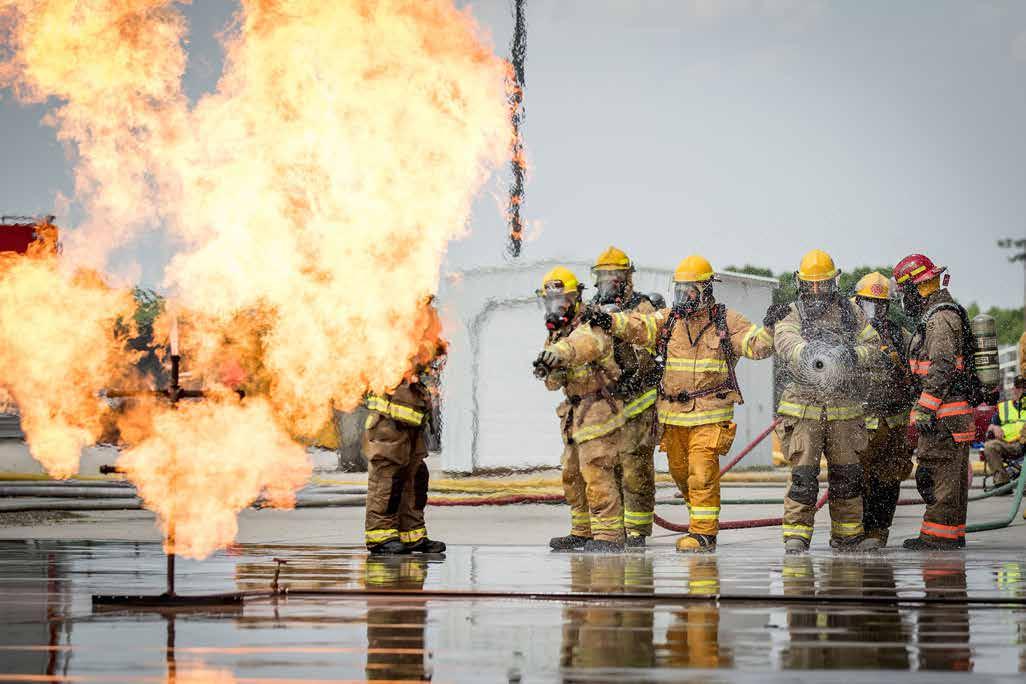

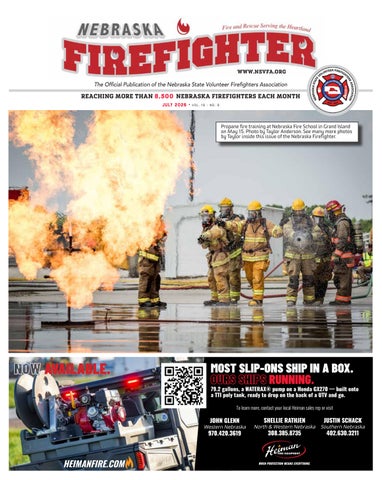
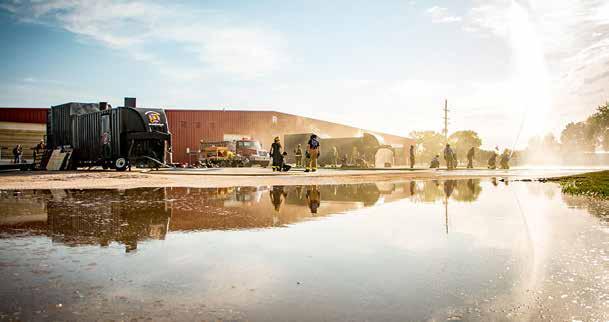
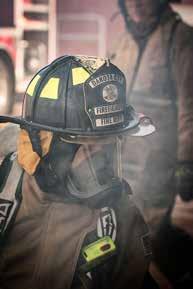
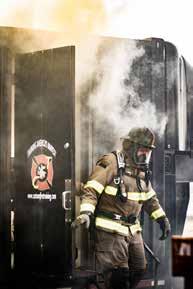
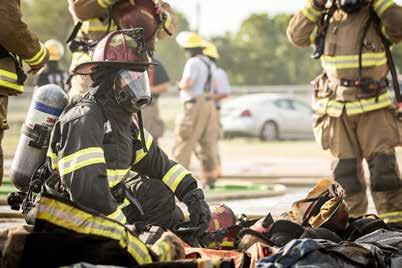
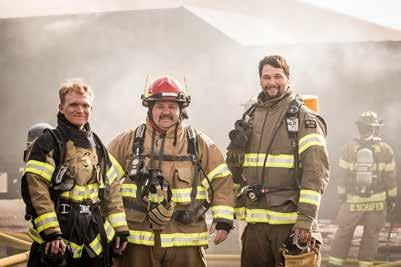
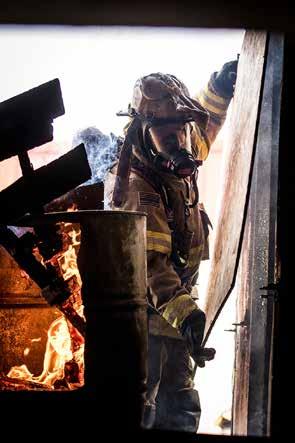
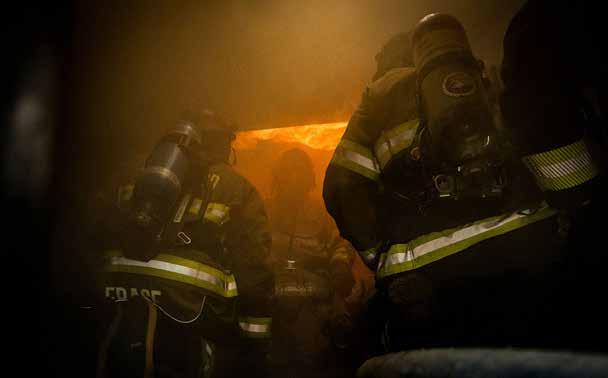
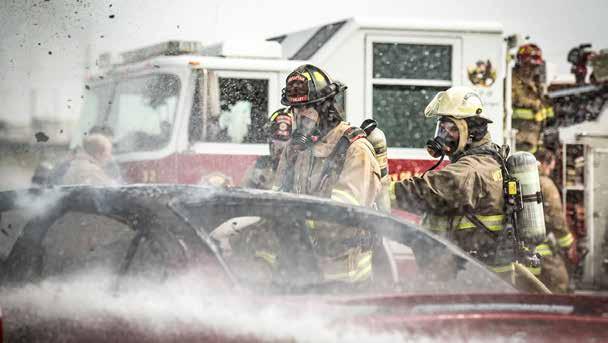
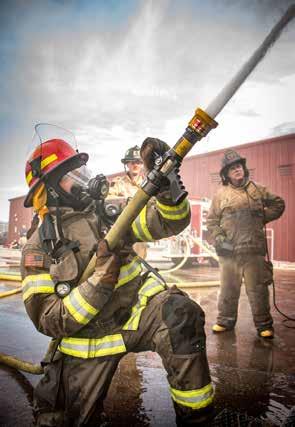
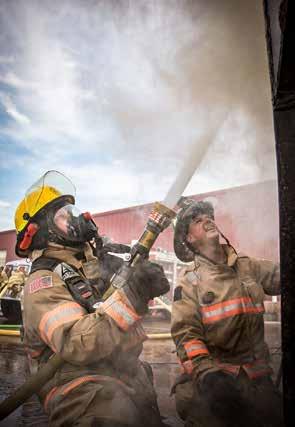
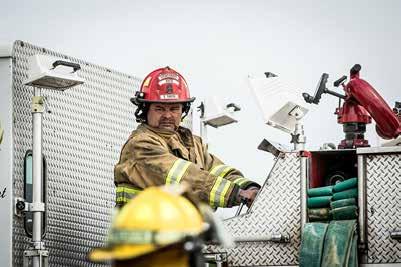
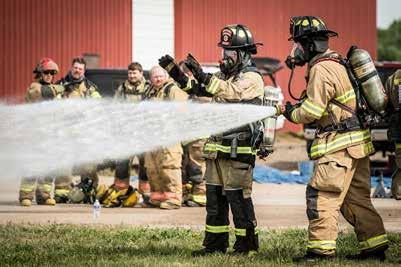
Propane fire training at Nebraska Fire School in Grand Island on May 15. Photo by Taylor Anderson. See many
photos by Taylor inside this issue of the Nebraska Firefighter.
July in Nebraska brings family gatherings, vacations, cookouts, county fairs, camping trips, and Independence Day celebrations. It is a wonderful time of year, but it is also a season when firefighters see an increase in preventable fires and injuries. As members of the fire service, we know that prevention is always better than response.
The NSVFA Fire Prevention Team continues to promote a simple message:
“After the fire starts, it is too late for fire prevention.”
Taking a few moments to identify hazards and make safe choices can prevent tragedies from occurring in the first place.
The Fourth of July is one of America’s favorite holidays, but fireworks cause thousands of fires and injuries every year. Even sparklers burn at temperatures hot enough to melt some metals and can cause severe burns, especially to chil-
dren.
Whenever possible, enjoy community fireworks displays conducted by trained professionals. If consumer fireworks are legal in your area and are used, remember:
• Keep children under close supervision.
• Never relight a “dud.”
• Keep a bucket of water or garden hose nearby.
• Never use fireworks while impaired.
• Soak used fireworks before disposal.
• Keep spectators a safe distance away.
Summer cookouts are a Nebraska tradition. Before lighting the grill:
• Keep grills away from siding, decks, and overhanging branches.
• Never grill inside a garage or enclosed area.
• Check propane connections for leaks.
• Establish a “kid-free zone” around the grill.
• Keep a fire extinguisher nearby.
CAMPFIRE AND OUTDOOR FIRE SAFETY
Whether camping at the lake or enjoying an evening in the back-
• Build fires only in approved areas.
• Keep fires small and manageable.
• Never leave a fire unattended.
• Keep water and a shovel nearby.
• Drown, stir, and feel the ashes before leaving.
Remember, if it is too hot to touch, it is too hot to leave.
VACATION SAFETY
Summer travel often takes us away from home. Before leaving:
• Test smoke alarms.
• Unplug unnecessary appliances.
• Arrange for mail and packages to be picked up.
• Lock doors and windows.
• Make sure someone knows how to contact you.
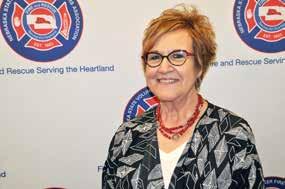
Rhonda Cerny, NSVFA Fire Prevention
“July provides countless opportunities for Nebraska firefighters to engage with the public. County fairs, parades, community celebrations, and National Night Out events are excellent venues for sharing life-saving messages.”
gage with the public. County fairs, parades, community celebrations, and National Night Out events are excellent venues for sharing life-saving messages.
Never underestimate the impact of:
• A friendly conversation.
• A smoke alarm reminder.
• A coloring book handed to a child.
• A social media post.
• A visit from Smokey Bear or Sparky.
Sometimes the smallest efforts produce the biggest results.
our ability to respond when emergencies happen. Yet our greatest success stories are the incidents that never occur because someone took the time to practice fire prevention.
This summer, let us continue working together to build stronger, safer Nebraska communities—one family, one conversation, and one prevention message at a time. Because after the fire starts, it is too late for fire prevention.
The NSVFA Fire Prevention Team wishes everyone a safe and enjoyable summer.
As firefighters, we are proud of yard:
When staying in hotels or vacation rentals, locate exits and review the escape plan with your family. Summer safety campaigns emphasize the importance of knowing two ways out wherever you stay.
A GREAT TIME TO PROMOTE PREVENTION
July provides countless opportunities for Nebraska firefighters to en-
Prevention Is Everyone’s Responsibility
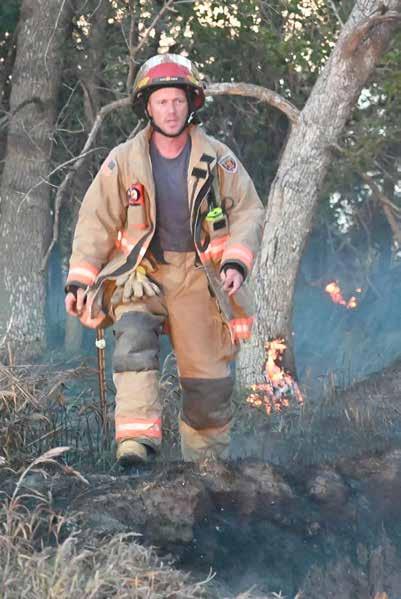
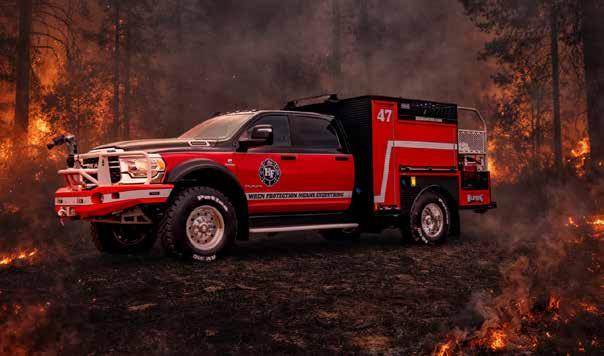
Strong southerly winds whipped sparks from a burn pit fire into a nearby grove Thursday night, June 4, touching off a small but fast-moving fire in the trees and brush. The Hartington Volunteer Fire Department was called to the scene five miles east of Hartington, as flames crept through the dry undergrowth and smoke drifted across the area. Firefighters moved quickly to keep the blaze from spreading deeper into the grove, bringing the fire under control before it could threaten nearby property. Kellyn Dump | Cedar County News
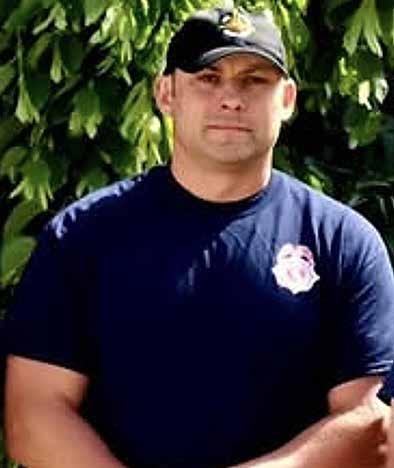
The Training Division of the State Fire Marshal’s agency would like to spotlight Ryan Sabata with the Columbus Fire Department. Ryan begin his fire service journey in 2000 with the David City Volunteer Fire Department and continued his journey with several other agencies including Raymond VFD, Midwest Medical, Rural Metro and Union County EMS. Ryan still is involved with David City while working full time with Columbus FD. In addition to these
agencies Sabata is also a member of Nebraska FEMA Task Force 1. Sabata has held various positions with his different agencies; firefighter/paramedic with David City, Fire Captain/paramedic with Columbus and a Rescue Specialist with Nebraska Task Force 1. As a Rescue Specialist, Ryan is skilled in ice rescue, swift water, structural collapsed, heavy rescue, hazardous materials and agricultural rescue. Ryan began working for the Training Division in 2018 in
By BOB HECKMAN
This month’s article is dedicated to the memory of Roland Butch Frahm, Plainview Volunteer Fire Dept. Gone but not forgotten. According to the S.F.M. office 165 injuries were reported to them. This was an increase from 2024. At Plattsmouth Fire we hand out information to all fireworks booths. I carry it a step further by spending several hours handing
out information. It seems like in Nebraska we can have three seasons at the same time. With parts of the state in a severe drought, fire can cause disasters and cause millions of dollars in damage. If your community has newspapers, work with them and ask for their help in printing articles, or if you are lucky enough to have radio stations see what they can do to help prevent fires......Fireman Bob


the East Region with Training Coordinator Darin Lintner. Ryan has helped with the annual fire school since he began with the Training Division in various classes.
During his time with the City of Columbus Sabata has been recognized with the City of Columbus-Standout Award and the American Legion Hartman Post # 84 Firefighter of the Year. When not working at one of his agencies or the Training Division, Ryan enjoys outdoor hobbies including hunting, fishing and boating.
When asked what he finds most satisfying in working for the Training Division Sabata says; “having the opportunity to participate in training with fire departments from across the state. Every department has its own culture, challenges, strengths, and innovative ways of providing service to its community; this makes us all better-rounded and broadens my perspective”.
When asked when he felt like he made difference Ryan shared the following; “every time a trainee goes out of their way at the end of a class to shake my hand and acknowledge the hard work and time they just gave makes it all worth it”.
The Training Division appreciates that excellent work that Ryan provides to the fire service of the State of Nebraska.
CLASSIFIED ADS FOR THE NEBRASKA FIREFIGHTER NEWSPAPER
Classified ads run $10 for the first 10 words, and 25 cents a word after that. A photo is $10 additional. Rates are the same in each state (Iowa, Minnesota, South Dakota, Nebraska and Kansas). Email the ad to jeff@nebraskafirefighter.com to place your personal or departmental ads.




President
BRENDA JENNY 1767 Colfax Street, Blair, NE 68008 402.639.9647 bgolf2560@yahoo.com
1st Vice President
TROY SHOEMAKER 1433 Grove Ave Alliance, NE 69301 308-760-7682 tshoemaker@cityofalliance.net
2nd Vice President
KENNY KRAUSE 1229 D St. Fairbury, NE 68352 402-300-0097 krausechief@gmail.com
Secretary/Treasurer
MARK MEINTS 502 E H St, Wymore, NE 68466 402-806-7451 meints2@windstream.net
NSVFA Lobbyist
RYAN K. MCINTOSH PO Box 13 Nebraska City, NE 68410 ryan.mcintosh@stilmockmcintosh.com
NSVFA Legal Advisor
SCOTT SMITH P.O. Box 186 Syracuse, NE 68446 scott.smith@bhhslawfirm.com
Past President
SCOTT SCHREMMER 815 W 6th, Chadron, NE 69337 308-430-1494 buffhater@gmail.com
District Directors
#1 DARRELL VANCE 1415 Q St, Gering, NE 69341 308-631-0053 DarrellVance1230@gmail.com
#2 JOHN BOMAR P.O. Box 222, Battle Creek, NE 68715 402-992-1560 JBomar1970@gmail.com
#3 RON CHADA 1721 N Sheridan North Platte, NE 69101 308-520-2828 rmchada@winnelson.com
#4 DANIEL CHAPEK 1491 County Road 30 Weston, NE 68070 402-430-7859 dchapek@dc-ww.com
NSVFA Representative National Vol. Fire Council
JUSTIN SCAMEHORN 202 Hidas Ave. Waco, NE 68460 402-366-1939 jscamehorn@yahoo.com
Appointed NVFC Director
JOEL CERNY 1618 Denver St. Schuyler 68661 402-720-4100 cerny_j@hotmail.com Chaplain
MATTHEW MAU
Cell: 402-363-1540
E: pastormattwaco@gmail.com
Did you know that Nebraska volunteer firefighters have access to free training opportunities through the National Fire Academy (NFA)?
While visiting with firefighters at this year’s fire school, many were surprised to learn that the National Fire Academy offers a wide range of educational programs at little or no cost to participants. For volunteer departments across the state—many of which operate with limited budgets and rely heavily on local fundraising and community support—these programs can provide significant value at little or no cost to participants.
Nebraska is served primarily by volunteer firefighters. From the Sandhills to the Missouri River, volunteer departments protect our rural communities, small towns, and agricultural areas while responding to a wide range of emergencies. These dedicated men and women balance family responsibilities, full-time careers, and community service while remaining ready to answer the call at any hour. As emergency incidents continue to grow in complexity, access to high-quality training becomes increasingly important.
The National Fire Academy, located in Emmitsburg, Maryland, offers training in leadership, incident command, fire prevention, community risk reduction, emer-
gency medical services, disaster preparedness, and many other critical areas. Courses are available through resident programs, online learning, and regional delivery options, making them accessible to firefighters throughout Nebraska regardless of department size or location.
For Nebraska volunteer departments, the benefits extend far beyond the individual firefighter attending a course. Participants return home with new knowledge, practical skills, and proven strategies that can be shared with fellow members. One firefighter’s experience at the National Fire Academy can strengthen an entire department and improve service to the community.
Leadership development is especially important for Nebraska’s volunteer fire service. Departments across the state depend on strong leaders to recruit and retain members, mentor the next generation of firefighters, manage resources, and prepare future officers. National Fire Academy courses provide valuable tools to help firefighters develop these leadership skills and support the long-term success of their departments.
Another valuable benefit is the opportunity to connect with firefighters from across the country. Nebraska firefighters often discover that departments in other states face many of the same challenges, including recruitment, retention, training, and resource limitations. These professional connections can provide ideas, support, and lasting relationships that continue long after the course is completed. Most importantly, Nebraska communities benefit when their firefighters are better trained and better prepared. Enhanced knowledge
Recently many of you were recently contacted as part of a joint effort between the Nebraska State Volunteer Firefighters Association and the Nebraska Fire Chiefs Association regarding ongoing budget issues with the State of Nebraska, and the potential adverse effects on the Nebraska State Fire Marshal’s Office. I want to provide you some current background on where we are with the state budget as part of those efforts.
Nebraska’s tax revenues came in lower than expected for March and April 2026, creating an estimated $129 million budget shortfall and raising concerns about how the state will balance its finances in the coming years. April receipts alone were about 8.2% below projections, or roughly $57 million less than anticipated, in addition to a $72 million shortfall in March. The main reason was a sharp drop in individual income tax collections, which fell more than 45% below forecasts, largely
“While visiting with firefighters at this year’s fire school, many were surprised to learn that the National Fire Academy offers a wide range of educational programs at little or no cost to participants.”
and skills contribute to safer operations, more effective emergency response, stronger prevention efforts, and improved service to the public.
• Many National Fire Academy courses are available online and can be completed from home, making them especially convenient for firefighters in rural Nebraska.
• NFA training opportunities are available for firefighters at every level, from new members and emerging leaders to chief officers.
• Volunteer firefighters can earn nationally recognized professional development credentials through NFA programs.
• Departments benefit when trained members bring new ideas and share their knowledge with fellow firefighters.
• The skills gained through NFA courses can improve firefighter safety, operational effectiveness, and community preparedness throughout Nebraska.
I encourage Nebraska firefighters and fire department leaders to explore the educational opportunities available through the National
Fire Academy. The investment required may be minimal, but the return to your department and your community can be substantial. The National Fire Academy course catalog can be found at: https:// www.usfa.fema.gov/nfa/courses/ Knowledge remains one of the most valuable tools a firefighter can carry. Through the National Fire Academy, that tool is available to every Nebraska firefighter willing to invest in their professional growth and the future of their department.
As always, if you have a meeting or event, you would like me to attend, please reach out and I will make every effort to be there. Below are the upcoming events you don’t want to miss:
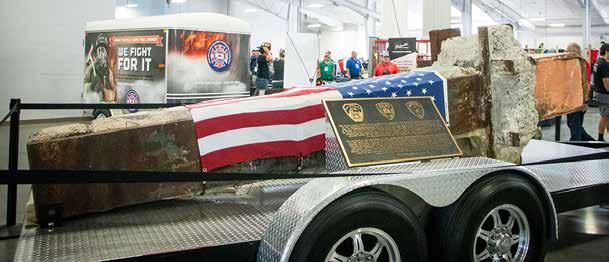
• NSVFA Fallen Firefighters Memorial Service: September 20, 2026, Kearney, NE at Nebraska Firefighters Museum and Education Center
• NSVFA Annual Conference: October 16-18, 2026, hosted by Dakota City Vol. Fire Department
Until next time, stay safe and healthy.
BRENDA
because tax refunds were significantly higher than expected. State leaders say these higher refunds reflect ongoing tax cuts and policies aimed at letting Nebraskans keep more of their income, but they also mean less revenue available for state services. While sales tax collections were stronger than expected, overall decline in revenue means lawmakers will need to examine spending cuts or other budget adjustments. Officials emphasize there is no immediate crisis, but they expect tough decisions ahead as they work to balance the current budget and prepare for the 2027 Legislative Session, with “everything on the table” as they evaluate priorities.
I encourage all of you to take a few minutes to contact your state senator and share their firsthand experiences about how critical the State Fire Marshal’s Office is to daily operations, training, and community safety. With state revenues coming in below forecast

Ryan K. McIntosh, Lobbyist
“I encourage all of you to take a few minutes to contact your state senator and share their firsthand experiences about how critical the State Fire Marshal’s Office is to daily operations, training, and community safety.”
for the second straight month and lawmakers signaling that budget adjustments will be necessary, it is more important than ever to ensure they understand the real-world impact any additional cuts to the State Fire Marshal would have on emergency response across the state. Your voice can help highlight that more than 90% of Nebraska’s fire service depends on these essential services, and that funding issues must be addressed to maintain readiness and public safety. By reaching out, you reinforce that investing in the Fire Marshal’s Office is not only criti-
cal for protecting communities but also a cost-effective way to sustain Nebraska’s volunteer fire service model.
Thank you for all you do to help in this effort. Stay engaged and don’t hesitate to reach out with any questions.
RYAN
MCINTOSH, Lobbyist
I just want to take a quick second of your time and write about professional development. This was a question that was asked of me earlier in June. What area of professional development have you concentrated on in the last year or so? What is professional development, or more specifically, what is professional development in the fire service? For me, it refers to the ongoing process of improving a firefighter’s or fire officer’s knowledge, skills, and leadership abilities throughout their career. It typically includes areas such as:
• Operational training – fire suppression, rescue, EMS, hazmat, and incident command
• Leadership development –supervising personnel, decision-making, communication, and conflict resolution
I know this is something that I wrote about, not long ago, but it’s the only topic that comes to mind as the article deadline approaches.
We recently spent the weekend at the Fremont State Lakes. While we were there, we got to attend some local fire department events. We actually traveled to Fremont on Wednesday, which made it possible for me to attend the tri-mutual aid meeting in Yutan. It’s always interesting to attend mutual aid meetings to see what projects and business they are tending to. I was happy to find this mutual aid is very involved with the NSVFA, and are actively working to make the Nebraska fire service better, not only within their department but all across the state. A couple of agenda items were trying to better EMS training across the state with thoughts of developing a possible training activity held in Grand Island, the other item was that the State Fire Marshall office may have cuts in funding and how it would impact Nebraska firefighters and that its important for us to
• Certifications and education
– state certifications, officer development, instructor training, and higher education
• Safety and wellness – risk reduction, mental health awareness, physical fitness, and cancer prevention
• Technology and policy updates – new equipment, reporting systems, standards, and legal requirements
WHY IT MATTERS:
• Keeps personnel competent and current.
• Improves department readiness and safety.
• Supports career advancement.
• Help agencies meet state and national standards.
• Strengthens leadership and succession planning.
My answer to that question was
contact not just our own senator of our district, but any of the senators to make them aware of the impact it would have on fire departments.
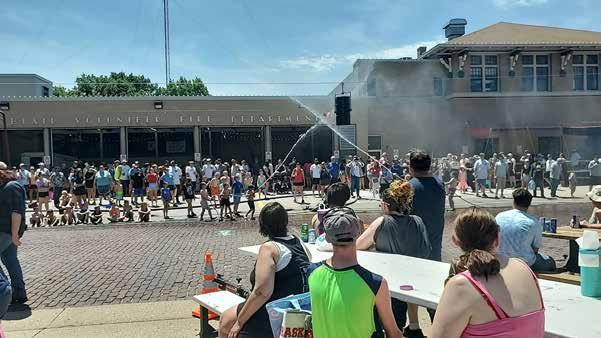
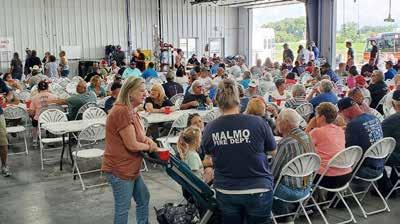
I was able to attend the Gateway to the West celebration in Blair, and saw a high level of local VFD’s participating in the parade. Let me tell you, these departments know how to create some excitement with their flashing lights and sirens. They even sprayed water along the parade route. We attended the water fights in front of the fire station and enjoyed the lunch that the fire department provided. I know I said several times that I couldn’t believe how big this event was. On Saturday, we traveled to Malmo for their mountain oyster feed and fish fry. This community supports their fire department in a big was, the crowd was large here also.
I believe that these events lead to us receiving help when we need it. If you look at all the wildfires this spring and into summer, our communities all step up and fill our need without us asking. They do so well
that I have been focusing on my leadership development. Specifically, obtaining my Chief Fire Officer designation from the Center of Public Safety Excellence. What a great process that was to take an internal look at myself. A process that was not necessarily the prettiest, but it allowed me to see myself as a leader and to do course correction and reflection. I had great mentors who assisted me in this process and a great peer reviewer, a Deputy Fire Chief from New Jersey. I am extremely happy that I pushed myself through this process.
Shortly after, I applied for the Fire Service Chief Executive Officer program with the Texas A&M Engineering Extension Service. This was another program that required a selection process. Just submitting the application did not automatically mean I would be se-
that often times we are overwhelmed by the donations we receive. Out at the South Fork fire the had to ask for donations to cease, because they couldn’t handle any more water or snacks. Recently the NSVFA was able to award all departments that applied for the wildfire assistance program, all but five got what they applied for. The other five got a substantial amount. All this money came from donations that the NSVFA received when a request was put out to help the departments that responded to the spring wild fires.
Community involvement is worth your while.
As always, stay safe,
KENNY KRAUSE 2 nd Vice
(Photos by Roseanne Scurto)
Troy Shoemaker, 1st Vice President
“the pursuit of our individual development should not stop once we reach a certain point in our careers. We must continue to push ourselves into the uncomfortable and continue to learn and develop not only as members of the fire service, but as normal everyday humans. Our staff, community members, family, and friends are watching us.”
lected to participate in this executive leadership program at Texas A&M University. I was selected to participate in this weeklong course with other fire chiefs from around the country. Talk about developing and increasing your network of highly intelligent fire service leaders. This was an amazing program, and I would recommend it to anyone looking to continue developing their leadership. My point is, the pursuit of our individual development should not stop once we reach a certain point
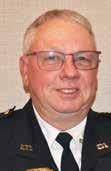
Until next time, stay safe,
TROY SHOEMAKER
Kenny Krause, 2nd Vice President
President
“I believe that these events lead to us receiving help when we need it. If you look at all the wildfires this spring and into summer, our communities all step up and fill our need without us asking. They do so well that often times we are overwhelmed by the donations we receive.” in our careers. We must continue to push ourselves into the uncomfortable and continue to learn and develop not only as members of the fire service, but as normal everyday humans. Our staff, community members, family, and friends are watching us. Let us continue to be positive influencers just like Scotty!



Firefighters, I routinely receive calls about bylaws, Standard Operating Procedures (SOPs), and Standard Operating Guidelines (SOGs) — and more importantly, the confusion between them. This confusion causes real problems for Departments and Rural Boards, especially when discipline, membership issues, or operational safety questions arise. I wanted to briefly review their basic differences and give some best practices on the subject.
The Rural Fire Protection District does not have bylaws. The Rural Board is a political subdivi-
sion of the State of Nebraska and its governing rules are the Nebraska Statutes themselves. These can be found at Neb. Rev. Stat § 35501 to 35-540. These can be accessed online via the Legislature’s website at: https://nebraskalegislature.gov/laws/browsechapters. php?chapter=35.
The Volunteer Fire Department does have bylaws, and these bylaws govern the internal structure of the Department. Department bylaws do not govern operations. They are intended to govern structural, long-term practices. Bylaws should be short, simple, and focused on governance. They
should address membership qualifications, officers and their duties, meetings, discipline procedures, voting for officers and members, training and continuing education expectations (general, not operational), and other internal functions of the Department. Bylaws are and should be relatively difficult to change, so they should contain big picture governance ideas that won’t need continual updates. When contemplating bylaw changes, think about someone arguing the Department “did not follow its own bylaws” in a complaint. It is much easier to follow your bylaws if they’re simple and
The name of this organization shall be THE NEBRASKA STATE VOLUNTEER FIREFIGHTER’S ASSOCIATION. (Amended 10/19/02)
The objectives of this organization shall be:
1. To formulate and make known programs useful to the Fire/Emergency service of the State of Nebraska;
2. To represent the interests of the State of Nebraska Fire/Emergency organizations in the Legislature of the State of Nebraska and with other agencies involved with the preservation of lives and property of the citizens of the State of Nebraska, thereby fostering good will and fellowship among the members of the Fire/Emergency services in the State of Nebraska.
SECTION 1. This organization shall be non-discriminatory, non-sectarian, non-partisan, and nonprofit.
SECTION 2. No part of the net earnings of this organization shall inure to the benefit of, or be distributed to its members, directors, officers, or other private persons, except that the organization shall be authorized and empowered to pay reasonable compensation for services rendered and to make payments and distributions in furtherance of the purposes set forth in Article TWO.
SECTION 1. Any Volunteer Fire Department, EMS or Company of any County, City, Town or Village or any Suburban Fire Protection District or Rural Fire Protection District, organized under the laws of the State of Nebraska, or any Industrial Plant Fire Brigade in the State of Nebraska may become a member of this organizationAssociation by making application to the Secretary/Treasurer Executive Director/Management Firm of the organizationAssociation and paying in advance the annual dues as established from time to time. Combination Departments that have paid personnel and Volunteer personnel may become members of this organizationAssociation (Amended 10/16/04)
SECTION 2. Any Volunteer Firefighter or paid firefighter who is a member of any such entities as listed in Article Four Section 1 and such entity is in good standing with this organizationAssociation may become a member of this organizationAssociation upon payment of annual dues for such individual membership as set from time to time. This individual member will receive a membership card and be entitled to all rights and privileges of this organizationAssociation (Amended 10/16/04)
SECTION 3. Any member of the Board of Directors of a Suburban Fire Protection District or Rural Fire Protection District whose District is in good standing with this organizationAssociation may become a member of the organizationAssociation upon payment of annual dues for such individual membership as set from time to time. The individual member will be issued a membership card and be entitled to all rights and privileges of this organizationAssociation
SECTION 5 4. Any past member of the Association who left his or her respective department in good standing, whether due to job transfer, illness, retirement, or other such circumstances, with less than twenty (20) years
SECTION 1. Any Volunteer Fire Department, EMS or Company of any County, City, Town or Village or any Suburban Fire Protection District or Rural Fire Protection District, organized under the laws of the State of Nebraska, or any Industrial Plant Fire Brigade in the State of Nebraska may become a member of this organizationAssociation by making application to the Secretary/Treasurer Executive Director/Management Firm of the organizationAssociation and paying in advance the annual dues as established from time to time. Combination Departments that have paid personnel and Volunteer personnel may become members of this organizationAssociation (Amended 10/16/04)
straightforward, only containing what’s necessary. To the contrary, operational rules change constantly — new equipment, new standards, new risks, new training requirements. Operational matters belong in SOPs and SOGs. These documents are flexible, easily updated, and designed to guide how the Department actually performs fire and rescue work. SOPs and SOGs should cover response procedures, apparatus operation, PPE requirements, incident command, radio use, alcohol and drug readiness rules, driver qualifications, scene safety, mutual aid procedures, and
any other operational rules that may need frequent updating. Overall, it is best practice that departments keep bylaws minimal and place the bulk of operational expectations in SOPs and SOGs. Departments should review and update their bylaws every three to five years. SOPs and SOGs should be reviewed annually, or whenever equipment or standards change. If you have any questions or would like help going through bylaws or SOPs/SOGs, please don’t hesitate to reach out.
SECTION 2. Any Volunteer Firefighter or paid firefighter who is a member of any such entities as listed in Article Four Section 1 and such entity is in good standing with this organizationAssociation may become a member of this organizationAssociation upon payment of annual dues for such individual membership as set from time to time. This individual member will receive a membership card and be entitled to all rights and privileges of this organizationAssociation. (Amended 10/16/04)
Respectfully submitted,
SECTION 3. Any member of the Board of Directors of a Suburban Fire Protection District or Rural Fire Protection District whose District is in good standing with this organizationAssociation may become a member of the organizationAssociation upon payment of annual dues for such individual membership as set from time to time. The individual member will be issued a membership card and be entitled to all rights and privileges of this organizationAssociation
SCOTT G. SMITH NSVFA Legal Advisor
SECTION 1. Any Volunteer Fire Department, EMS or Company of any County, City, Town or Village or any Suburban Fire Protection District or Rural Fire Protection District, organized under the laws of the State of Nebraska, or any Industrial Plant Fire Brigade in the State of Nebraska may become a member of this organizationAssociation by making application to the Secretary/Treasurer Executive Director/Management Firm of the organizationAssociation and paying in advance the annual dues as established from time to time. Combination Departments that have paid personnel and Volunteer personnel may become members of this organizationAssociation (Amended 10/16/04)
SECTION 5 4. Any past member of the Association who left his or her respective department in good standing, whether due to job transfer, illness, retirement, or other such circumstances, with less than twenty (20) years of membership with the Association, may apply for an “Associate Membership.” Such individuals will be required to pay dues as set by the Board of Directors from time to time. Associate Members will receive a membership card, a one-year subscription to the official Association monthly newspaper, access to attend the Annual Conference, and shall receive the membership discount if attending Fire School. Associate Members will not be eligible to seek elected office, vote on Association matters, nor serve as an appointed member on any committee.
SECTION 2. Any Volunteer Firefighter or paid firefighter who is a member of any such entities as listed in Article Four Section 1 and such entity is in good standing with this organizationAssociation may become a member of this organizationAssociation upon payment of annual dues for such individual as set from time to time. This individual member will receive a membership card and be entitled to all rights and privileges of this organizationAssociation (Amended 10/16/04)
SECTION 545- Any past member of the Association who left his or her respective department in good standing, whether due to job transfer, illness, retirement, or other such circumstances, with twenty (20) or more years of membership with the Association, may apply for an “Gold Badge
Membership.” Such individuals will be required to pay dues as set by the Board of Directors from time to time. Gold Badge Members will receive a membership card, a one-year subscription to the official Association monthly newspaper, access to attend the Annual Conference, and shall receive the membership discount if attending Fire School. Gold Badge Members will not be eligible to seek elected office, but may vote on Association matters. Gold Badge Members are eligible for appointment to serve on a committee. (Amended 10/21/23)
SECTION 3. Any member of the Board of Directors of a Suburban Fire Protection District or Rural Fire Protection District whose District is in good standing with this organizationAssociation may become a member of the organizationAssociation upon payment of annual dues for such individual membership as set from time to time. The individual member will be issued a membership card and be entitled to all rights and privileges of this organizationAssociation
SECTION 6. Any company with interest in fire prevention, firefighting or being in contact with fire departments for sale of fire equipment may become a guest member in this organizationAssociation upon payment annually of a sum set from time to time payable in advance of the annual conference of this organizationAssociation and shall be entitled to a guest card for one (1) of its members, but shall not be entitled to vote and shall not be entitled to participate in discussions of this organizationAssociation
SECTION 5 4. Any past member of the Association who left his or her respective department in good standing, whether due to job transfer, illness, retirement, or other such circumstances, with less than twenty (20) years of membership with the Association, may apply for an “Associate Membership.” Such individuals will be required to pay dues as set by the Board of Directors from time to time. Associate Members will receive a membership card, a one-year subscription to the official Association monthly newspaper, access to attend the Annual Conference, and shall receive the membership discount if attending Fire School. Associate Members will not be eligible to seek elected office, vote on Association matters, nor serve as an appointed member on any committee.
SECTION 67. The annual dues established from time to time for those listed in Article Four Section 1 are due and payable July First (1st) of each calendar year. Failure to pay the annual dues established for those listed in Article Four Section 1 by August First (1st) of each calendar year will result in automatic suspension being dropped from the membership of this organizationAssociation.from the organizationAssociation. However, any of those listed in Article Four Section 1 may be reinstated within one (1) year from the date of suspension upon payment of all dues in arrears since the time of suspension plus a reinstatement fee set from time to time and upon such payments will be reinstated as a member in good standing. (Amended 10/21/23)
SECTION 545- Any past member of the Association who left his or her respective department in good standing, whether due to job transfer, illness, retirement, or other such circumstances, with twenty (20) or more years of membership with the Association, may apply for an “Gold Badge
SECTION 8. This organizationAssociation shall have the power at its annual conference to elect such person or persons as honorary members as the organizationAssociation may see fit and proper, and said honorary members shall be exempt from the payment of dues but shall have no rights or privileges of this organizationAssociation unless specifically granted by this organizationAssociation as if such person or persons were dues paying members.
SECTION 978 At the annual conference of this organizationAssociation all members of this organizationAssociation who have belonged to this organizationAssociation for a period of twenty-five (25) or fifty (50) years shall be entitled to an award fitting for their years of service. (Amended 10/21/06)
SECTION 1. Dues for those desiring membership in this organization pursuant to ARTICLE FOUR SECTIONS 1, 2, 3, 4, or 5 shall be set by the Board of Directors. at its annual meeting and the same will take effect at the start of this organization’s fiscal year. (See History of Annual Dues filed in E Board Officer’s Policy Manual) (Amended 10/21/23)
SECTION 2. Guest membership fees for those desiring such membership pursuant to ARTICLE FOUR SECTION 6 shall be set by the Board of Directors at its annual meeting and the same will take effect at the start of this organization’s fiscal year. (Amended 10/21/23)
SECTION 23. The Board of Directors will present at the annual conference of this organization the proposed dues structure that will take effect at the start of this organization’s fiscal year with an explanation of the reasons for any increase in dues and with those qualified to attend the annual conference of this organization having the opportunity to comment and discuss any increase in dues contemplated by the Board of Directors of this organization.
SECTION 1. The governing body of this organizationAssociation shall be the Board of Directors, which shall be nominated, elected and constituted as described in these BylawsBy-Laws
SECTION 2. The Board of Directors shall consist of the Executive Committee as outlined in Article Eight Section 1,Officers of this organizationAssociation and four (4) District Directors, and two NVFC Directors of this organizationAssociation. Said District Directors shall serve no more than two (2) consecutive two (2) year terms on the Board of Directors in such Board of Directors capacity. Two District Directors shall be elected each year with District Directors 1 and 3 elected in alternate years from District Directors 2 and 4. Alternating terms of election will assist with maintaining continued experience and capability to transfer acquired knowledge between the four District Director positions. District Directors shall represent the district of which their department is located, not of their residence. (Amended 10/16/04 and 10/18/08 and 10/22/11)
SECTION 3. A quorum for a meeting of the Board of Directors shall be sixfive (65) of its teneight (108) members. (Amended 10/16/04)
SECTION 4. The Board of Directors shall have the authority to fill vacancies within the Board and also that of the Directors of the National Volunteer Fire Council and to transact any and all necessary business of this organizationAssociation between annual conferences. If a member of the Board of Directors leaves their position following the annual conference, the member shall be replaced by the Board as stated above, with the exception of except for a member leaving three (3) months prior to the annual meeting, at which time, the Board will not act on a replacement, however, will seek nominations at the annual conference to fill the remainder of the term (if a year remains). If the memberDirector was in their last year of the term, standard election policies shall be followed. (Amended 10/16/21)
SECTION 5. The Board of Directors shall meet on call by the President or any four (4) of the Board of Directors for the consideration of special matters between annual conferences of this organizationAssociation. (Amended 10/16/04)
SECTION 6. The Board of Directors will schedule and hold an annual meeting on the day prior to the first day of the annual conference of this organizationAssociation and shall recess during the time of this organizationAssociation’s annual conference and shall finish its annual meeting on the day after the final day of the annual conference of this
organizationAssociation. At this meeting, the Board of Directors may appoint a Chaplain, appoint Legal Counsel, appoint a Lobbyist, appoint a second Director to the National Volunteer Fire Council, and employ an Executive Director or hire a Mmanagement Ffirm, for the betterment of the organizationAssociation and transact such business as may regularly come before it. (Amended 10/22/16)
SECTION 7. The Board of Directors shall prepare the annual budget of this
the organizationAssociation and transact such business as may regularly come before it. (Amended 10/22/16)
SECTION 7. The Board of Directors shall prepare the annual budget of this organizationAssociation for the next succeeding year following the annual conference of this organizationAssociation. The budget will be published in the official publication of this organizationAssociation within one hundred twenty days (120) of the annual conference. (Amended 10/18/08 removing Nebraska Smoke Eater as “official publication”).
SECTION 8. Any member of the Board of Directors who ceases to be an active volunteer firefighter during the term of office shall relinquish the Office and the position shall be filled by the Board of Directors, unless otherwise covered by these Bylaws.
SECTION 8. Any reference to the Board of Directors and / or the Executive Board shall be considered to one and the same reference within this organizationAssociation
SECTION 1. The fiscal year shall commence on the 1st day of July and shall end on the last day of the following June.
SECTION 2. The Secretary/Treasurer shall make a full annual report to the Board of Directors at its annual meeting. The Secretary/Treasurer will prepare a summary annual report to be presented at the annual conference. of this Association held the third (3rd) week of October of each year.
SECTION 3. The Board of Directors will secure an independent compilation/review of the financial records by a competent accountant or auditor within thirty (30) days after the close of the Fiscal Year. The independent reviewer will report to the Board of dDirectors at its annual meeting.
SECTION 4. All disbursements of funds greater than $300 and any expense report for the continuation of the NSVFA business are to be signed by two (2) of the four officers of the Executive Committee (President, 1st Vice- President, 2nd Vice- President or Secretary/Treasurer) or their authorized designee The Executive CommitteeE-Board will allow the Mmanagement Firmassociation to disburse funds for less than $300 as required. Any funds disbursed by the management association shall be approved at the next E-Board meeting. (Amended 10/20/18)
SECTION 1. The Executive CommitteeOfficers of this organization shall consist of the following elected officers be: President; First (1st) Vice- President; Second (2nd) Vice- President; Secretary/Treasurer.
SECTION 2. Section 2. The term of the Executive Committee Officers being elected shall be one (1) year; Officers shall include the President, First {(1st) Vice President, and Second (2nd)} Vice- President. The Office of Secretary/Treasurer shall be elected to a term of three (3) years.
SECTION 3. No elected or appointed Board of Director Officer of this Association, nor shall the appointed delegate to the National Volunteer Fire Council shall serve in any other elected position within this Association. If elected into a second position, saidthis Officer must submit their resignation ofto the office of which they currently hold prior. to accepting their new position. Once their resignation has been approved, their replacement will be appointed by the Board of Directors as prescribed in ARTICLE SIXBOARD OF DIRECTORS Section 4.
No member of the Board of Directors or Officer of this Association shall serve in any other elected position within this Association. If elected into a second position, the member of the Board of Directors or Officer must resign the office he or she currently holds prior to accepting the new position. Such member of the Board of Directors’ or Officer’s replacement shall be appointed by the Board of Directors as prescribed in Article Six, Section 4.
SECTION 1. PRESIDENT:
The President shall be the principal officer of the Board of Directors and shall:
(a) Preside at all meetings of the Board of Directors and conferences of this organization;
(b) Appoint Standing Committees as provided in the Bylaws of this organization;
(c) Form Special Committees and appoint Special Committee Chairpersons with the consent of the Board of Directors;
(d) Serve as ex-officio member of all Committees;
(e) Serve as liaison between the various organizations associated with Fire/Emergency services in the State of Nebraska and elsewhere, the Standing Committees, and Special Committees;
(f) Bring to the attention of the Board of Directors of this organization all pertinent information pertaining to this organization;
(g) The President co-signs checks as needed for the continuation of NSVFA business PER Article 7, Section 4 All Checks for disbursement of funds greater than $300 and any expense report of the organization are to be signed by (2) of the four officers (President, 1st Vice President, 2nd Vice President or Secretary/Treasurer). The E-Board will allow the management association to disburse funds for less than $300 as required. Any funds disbursed by the management association shall be approved at the next E-Board meeting. per Article 7, Section 4 added 10/22/11. (Amended 10/20/18)
(h) Co-sign all awards and certificates; and,
(i) Shall perform such duties customary to such office.
SECTION 2. FIRST (1st) VICE- PRESIDENT:
The First (1st) Vice-President shall:
(a) Perform all duties of the President in the absence of the President;
(b) In conjunction with the President, work with Standing Committees and Special Committees but not be a member of any Standing
funds disbursed by the management association shall be approved at the next E-Board meeting. per Article 7, Section 4 added 10/22/11. (Amended 10/20/18)
The Secretary/Treasurer shall provide primary oversight of the Executive Director/Management Firm on all of the following duties:
(a) Take and record accurate minutes of the proceedings of all conferences of this organization and meetings of its Board of Directors, and shall present them for approval at the following conference or meeting;
(b) Provide all records, files, letters of value to the Office of the Executive Director / Mmanagement Ffirm, to be placed with all other official records of the this associationAssociation
(c) Assist the President with the correspondence of this organization;
(d) Have charge of all monies of this organization and shall report thereon at all meetings of the Board of Directors;
(e) Secure all invoices and vouchers submitted from the Office of the Executive Director / Management Ffirme for payment.
(f) Pay all bills of this organization as directed and/or approved by the Board of Directors of this organization;
(g) The Secretary - Treasurer co-signs checks as needed for the continuation of NSVFA business per Article 7, Section 4 All Checks for disbursement of funds greater than $300 and any expense report of the organization are to be signed by (2) of the four officers (President, 1st Vice President, 2nd Vice President or Secretary/Treasurer). The E-Board will allow the management association to disburse funds for less than $300 as required. Any funds disbursed by the management association shall be approved at the next E-Board meeting. per Article 7, Section 4 added 10/22/11. (Amended 10/20/18)
(h) Keep an itemized record, in a permanent file, of all receipts and expenditures and shall make a true inventory of the property of this organization;
(i) Give an annual report in writing of the finances of this organization at the end of the fiscal year for presentation to its Board of Directors at their annual meeting and for presentation to the organization’s annual conference;
(j) Deliver to the succeeding Secretary / Treasurer within thirty (30) days of the expiration of term of office all books, records, and papers relating to this office;
(c) Organize and ensureinsure continued membership in this organization within the State of Nebraska. The First (1st) VicePresident shall act as the direct contact for the District Directors and their appointed Area Representatives. A report of such activities for membership and membership growth shall be given by the First (1st) Vice-President at the annual conference of this organization; (Amended 10/18/08)
(d) Shall perform such duties as customary for such office.
(e) The 1st Vice-President co-signs checks as needed for the continuation of NSVFA business per Article 7, Section 4 All Checks for disbursement of funds greater than $300 and any expense report of the organization are to be signed by (2) of the four officers (President, 1st Vice President, 2nd Vice President or Secretary/Treasurer) The E-Board will allow the management association to disburse funds for less than $300 as required. Any funds disbursed by the management association shall be approved at the next E-Board meeting. per Article 7, Section 4 added 10/22/11. (Amended 10/20/18)
SECTION 3. SECOND (2nd) VICE-PRESIDENT:
The Second (2nd) Vice-President shall:
(a) Perform all duties of the President in the absence of the President and in the absence of the First (1st) Vice- President;
(b) Survey the members of this organization at least ninety (90) days prior to this organization’s annual conference to determine areas of concern of its members, to determine the needs of the members and the needs of this organization, and to determine goals for this organization. This report will be presented at the annual conference of this organization; and,
(c) In conjunction with the President and First (1st) Vice-President, work with Standing Committees, Special Committees, and Area Representatives but not be a member of any Standing Committee and not be an Area Representative EXCEPT, the Second (2nd) Vice-President shall be a member of the Education and Fire School Committee.
(d) The 2ndst Vice-President co-signs checks as needed for the continuation of NSVFA business per Article 7, Section 4 All
Checks for disbursement of funds greater than $300 and any expense report of the organization are to be signed by (2) of the four officers (President, 1st Vice President, 2nd Vice President or Secretary/Treasurer). The E-Board will allow the management association to disburse funds for less than $300 as required. Any funds disbursed by the management association shall be approved at the next E-Board meeting. per Article 7, Section 4 added 10/22/11. (Amended 10/20/18)
SECTION 4. SECRETARY/TREASURER: Committees EXCEPT the Education and Fire School Committee, and shall not be an Area Representative;
(k) File a surety bond in favor of this organization in an amount to be fixed by the Board of Directors of this organization. The bond premium will be paid by this organization; and,
(l) Work closely with the Office of the Executive Director and or Mmanagement Ffirm, to furnish for elections a complete list of those members of this organization who have paid their dues and who are entitled to a seat at the organization s annual conference no later than 9:00 P.M. of the day before the annual conference of this organization.
SECTION 5. DISTRICT DIRECTORS:
The District Directors shall:
(a) Report to the NSVFA First-Vice President.
(b) Be responsible for all Area Representatives in their area which shall include appointment and filling of vacancies of Area Representatives in their respective District areas and assurance of effective and timely communications to the Area Representatives in their area. Email is an effective tool of communication and it will be necessary for every Area Representative appointed to have a working email address.
(c) Coordinate and ensureinsure NSVFA representation at as many fire/rescue meetings in their area as possible.
(d) Attend NSVFA Board of DirectorsExecutive Board meetings and help set policy for the NSVFA.
(e) Attend Area Representative semi-annual meeting at the Nebraska Fire School.
(f) Be in full compliance with their responsibilities per the NSVFA Constitution and BylawsBy-Laws, Article Six- Board of Directors.
(g)(f) Shall attend annual conference and present a report to the membership.
(h)(g) District Directors shall be eligible to serve on any of the Association’s committees and have the same authority as any other committee member. District Directors may also serve as mentors on any committee as approved by the Board of Directors. If serving as a mentor, and not a member to a committee, District Directors shall not be eligible to vote on such committee matters
SECTION 6 EXECUTIVE DIRECTOR/MANAGEMENT FIRM: (Directors)
The position of the Executive Director of the NSVFA shall be an employee or / and or a mmManagement fFfirme, hired by the Board of Directors of this organizations Association. from which time the directors feel the need for such a position is warranted. The said Executive Ddirector / Mmanagement Ffirm, shall report directly to the Board of Directors of the NSVFA. The Executive Ddirector / Mmanagement Ffirm, shall take direction from the President of NSVFA and be a non-voting member of this organizations Association’s Board of Directors.
SECTION 6 EXECUTIVE DIRECTOR/MANAGEMENT FIRM: (Directors)
The position of the Executive Director of the NSVFA shall be an employee or / and or a mmManagement fFfirme, hired by the Board of Directors of this organizations Association. from which time the directors feel the need for such a position is warranted. The said Executive Ddirector / Mmanagement Ffirm, shall report directly to the Board of Directors of the NSVFA. The Executive Ddirector / Mmanagement Ffirm, shall take direction from the President of NSVFA and be a non-voting member of this organizations Association’s Board of Directors.
The Executive Ddirector / mManagement Ffirm shall:
(a) Manager the day -to- day business of the NSVFA.
(b) Manager office staff and hire an Administrative Assistant if deemed necessary (of which will require the approval of the Board of Directors).
(c) Set office policies and procedures with the approval of the Board of Directors.
(d)(c) Maintain financial management of the Aassociation (i.e.) receipts and disbursements. (Forward payment of bills to the office of the Secretary / Treasurer, make deposits, control payroll, payroll taxes, membership receipts and the management of grant monies of which the organization may have from time to time). All payments of bill and vouchers shall be done by the Secretary / Treasurer.
(e)(d) Help develop and adhere to a budget.
(f)(e) Keep an open line of communication between the office and the Board of Directors of the NSVFA, and work closely on all NSVFA matters with this Aassociation’s President.
(g)(f) Attend Board of Directors meetings and provide them Board with an Executive Directors / Mmanagement Ffirm report aswhen requested
(h)(g) Attend Fire School Ccommittee meetings and attendmay need to attehdn other NSVFA Committee meetings as deemed necessary.
(i)(h) Attend major events of this Association of which will include the Legislative Breakfast, Nebraska State Fire School, Nebraska Fallen Firefighters Memorial Service, Annual Conference and any other major events of which the Board of Directors may deems necessary.
(j)(i) Assist with the development of the organizations Association’s goals, education of its membership, and recruitment of new members., the strategic planning of the Association, the education of it’s membership and the recruitment and retainment of itsour membership.
(k)(j) Maintain all official records and documents of this Association.
(k) Promote the Nebraska State Volunteer Firefighters Association.
(l) Take and record accurate minutes of all Board of Directors meetings and all proceedings at Annual Conference and Fire School. The Executive Director/Management Firm shall present the minutes of previous meetings for approval at the next conference or Board meeting.the proceedings of all conferences of this organization and meetings of its Board of Directors, and shall present them for approval at the following conference or meeting.
SECTION 1: COMMITTEE APPOINTMENTS:
(a) At the annual conference of this organization, prior to the installation of Officers, tThe President-elect shall appoint the committees herein listed, however, no Fire/Emergency service shall have more than a total of four (4) persons serving on the committees, with the exception of the Area Representatives who are appointed by the 1st Vice-President-elect of this organization. The committee list and area rep list will be submitted for board approval at the next Board of Directors meeting(Amended 10/19/02)
(b) The following will be the Standing Committees:
I. Legislative Committee, which shall consist of five (5) members. (Amended 10/18/08 from 3 to 5 members)
II. Fire Prevention Committee shall consist of no less than five (5) and no more than eight (8) members. (Amended 10/21/23)
III. Constitution, Bylaws, and Rules Committee, which shall consist of three (3) members.
IV. Education and Fire School Committee, which shall consist of eleven (11) voting members of which shall be selected members of this organization’s membership in good standing, and the First (1st) Vice-President, the Second (2nd) Vice-President, and the President of this organization, none of whom shall serve as chairperson. The chairperson of the Education and Fire School Committee shall have the ability to appoint two (2) special advisors for the week of fire school to assist the committee.
(c) The President-elect of this organization shall name the chairperson of each Committee. Each member shall serve one (1) year or until their successor is appointed. Each Committee member shall be a member of this organization in good standing and shall be an active member of his or her respective department or a Gold Badge Member.
(d) Each Standing Committee chairperson shall be responsible for preparing a written report of the Chairperson’s Standing Committee’s activities to the Board of Directors of this
organization and the membership of this organization at their annual conference.
(e) Members appointed to serve on the Association’s standing committees, shall serve on no more than two (2) committees.
(f) No more than one (1) department member shall serve on the same committee.
SECTION 2: LEGISLATIVE COMMITTEE:
It shall be the duty of the Legislative Committee to monitor activities of the Nebraska Unicameral and the Governor of the State of Nebraska and actively lobby for legislation which is for the betterment of this organization Association as directed by the President and the Board of Directors of this organizationAssociation This Committee shall report their activities at the annual conference of this organization Association and may do so through this organization’s Association’s lobbyist.
SECTION 3: FIRE PREVENTION COMMITTEE:
It shall be the duty of the Fire Prevention Committee to conduct and direct fire prevention programs and activities as deemed necessary and appropriate. (Amended 10/21/06)
SECTION 4: CONSTITUTION, BYLAWS, AND RULES COMMITTEE:
It shall be the duty of the Constitution, Bylaws, and Rules Committee to report in writing on the first (1st) day of the annual conference of this organization Association such amendments to the Constitution and Bylaws and Rules as may in its judgment seem proper and sSuch amendments shall be submitted as per ARTICLE SEVENTEEN SIXTEEN of these Bylaws. (Amended 10/19/02)
SECTION 5: EDUCATION AND FIRE SCHOOL COMMITTEE:
The Education and Fire School Committees shall:
(a) Direct all Fire Schools sponsored by this organization;
(b) Secure and obtain personnel and equipment deemed necessary for the conduct of all Fire Schools of this organization;
(c) Select and appoint a Fire School Planning Committee composed of representatives from sponsoring agencies.
(d) Call all Committee conferences at such times and places as the Committee may deem necessary for Fire School purposes. The expenses of such conferences shall be paid from a Special Fire School Fund.
(e) The Executive Director/Management Firm, with oversight from the Secretary/Treasurer, of this organization is delegated to receive all monies contributed to or belonging to the Special Fire School Fund and disburse said funds under the authority of this Committee.
(f) It shall have the authority to collect or cause to be collected all monies for educational and Fire School purposes and all monies so collected shall be placed in a Special Fire School Fund. A proposed budget will be submitted to the Board of Directors for publication by February 1 of the fiscal year. The committee shall expend and supervise the expenditure of money from said fund for Fire School purposes.
This organization’s Directors to the National Volunteer Fire Council will consist of one position elected to a four (4) year term by the members of the Association and one position appointed by the Board of Directors to a four (4) year term. one being an elected position for a four (4) year term, with the election as other Officers of this organization are elected, and the second being appointed by the Board of Directors for a four (4) year term. The current elected Director’s term shall be extended to be a four (4) year term. The appointment of second Director to the National Volunteer Fire Council shall occur two (2) years following the next election of the elected director, with elections or appointments continuing every two (2) years thereafter. Each such Director shall serve in an equal status and will be recognized as members of hold a seat on the Board of Directors (Amended 10/21/23)
To qualify as a Director to the National Volunteer Fire Council, the candidate must fall within the respectivemust meet the following guidelines criteria as prescribed by the National Volunteer Fire Council Board of Directors and the NSVFA: which shall include:
• An active mMember of the NSVFA, in good standing,
• Must have been a member, or currently serving Current or previous service on a NSVFA committee, and.
• An aActive member of a volunteer, or paid-on-call, or combination fire departmentfighter with 5 or more years of service,: or
• And at least one (1) of the following:
• A cChief officer of a volunteer, paid-on-call, or combination fire department,: or
• A vVolunteer or paid-on-call EMS provider with 5 or more years of service. (Amended 10/16/21)
SECTION 1. The election of Oofficers shall be donetake place at the annual conference of the organization Association separately by ballot Names being considered Candidates for any elected position shall be nominated by the general membership. To be eligible to hold elected office, a candidate must be a member of the Association, in good standing, for at least the previous five (5) years. Only members of this organization in good standing shall be eligible to hold an elected office and who have been a member of this organization for at least five (5) consecutive fiscal years of this organization. Gold Badge membersmembers and, Associate Members, and Guest members are not eligible for elected office.
SECTION 2. Each successful candidate for the offices of President, 1st Vice-President and 2nd Vice- President office shall hold office for one (1) year or until their successor is elected and qualified; the successful candidate for Secretary/Treasurer office shall hold office for three (3) years or until their successor is elected and qualified. District Director positions shall meet the same qualifications for officers in Section 1.as per all candidates for office However, their elected terms shall be that of two (2) years and their positions will be determined by the voting members within their own districts, which follow county lines (see district map). Names being considered for District Director shall be nominated by the general membership, including those within the Past President’s District. The successful candidate must receive a plurality of the total vote cast for the particular office. Each successful candidate for office shall hold office for one (1) year or until their successor is elected and qualified. Only members of this organization in good standing shall be eligible to hold an elective office and who have been a member of this organization for at least five (5) consecutive fiscal years of this organization. Guest members are not eligible for elective office. The election of the Director of the National Volunteer Fire Council will be every fourthree (43) years and will be subject to the foregoing conditions for election and conditions of holding office applicable and consistent with a fourthree (43) year term. (Amended 10/16/04 and 10/22/11 and 10/19/13)
SECTION 3. District Directors shall serve no more than two (2) consecutive two (2) year terms on the Board of Directors in such Board of Directors capacity. Two District Directors shall be elected each year with District Directors 1 and 3 elected in alternate years from District Directors 2 and 4. Alternating terms of election will assist with maintaining continued experience and capability to transfer acquired knowledge between the four District Director positions. District Directors shall represent the district of which their department is located, not of their residence.
SECTION 4. The appointment of the second Director to the National Volunteer Fire Council shall occur every two (2) years following the election of the elected Director, with elections and appointments continuing every two (2) years thereafter.
SECTION 52. To qualify as an elector to vote in the elections of the Association,for elective Officers, on amendments to the Constitution or Bylaws, of this organization, or to vote on any matter placed before theis members of the organizationAssociation, one must be a member in good standingstarting of this organization Association as provided defined in Article 4.Four, Sections 1, 2, and 5.FOUR SECTIONS 1, 2, 3, and 4 of these Bylaws. (Amended 10/19/02)
SECTION 1. There is created a FIRE HOUSE OF DELEGATESFire House of Delegates to be in session during the organization’s Association’s annual conference. Theis FIRE HOUSE OF DELEGATESFire House of Delegates is created for the purpose of discussing matters of policy and general welfare of this organization Association and to suggest changes or other action for the membership of the Association to act upon. for the annual conference of this organization to act upon. At the FIRE HOUSE OF DELEGATES the roll will be called and only designated delegates and alternates will be seated and recognized.
SECTION 2. Each entity designated in ARTICLE FOUR SECTION 1Article Four, Section 1, being a member in good standing of this organizationAssociation, may be represented at the conferencesmeeting of the FIRE HOUSE OF DELEGATESFire House of Delegates by its saiddesignated Ddelegate or Aalternate, as Delegate selected by such entity. The Ddelegate and Aalternate must be members of this organizationAssociation, in good standing, and registered for the annual conference of this organizationAssociation
SECTION 3. At the meeting of the Fire House of Delegates, Tthe First (1st) VicePresident shall act as presiding Oofficer. The roll will be called and only delegates, their alternates, and those recognized by the presiding officer
entity. The Ddelegate and Aalternate must be members of this organizationAssociation, in good standing, and registered for the annual conference of this organizationAssociation
SECTION 3. At the meeting of the Fire House of Delegates, Tthe First (1st) VicePresident shall act as presiding Oofficer. The roll will be called and only delegates, their alternates, and those recognized by the presiding officer will be allowed to participate in the meeting. Members of the Association, in good standing, may attend and observe the meeting. Each entity is allowed one (1) vote to be cast by the entity’s delegate or alternate.
The First (1st) Vice-President shall act as presiding Officer. The designated Delegate and the designated Delegate’s Alternate may be both seated with just one (1) vote per entity being allowed on each issue brought before the FIRE HOUSE OF DELEGATES. The Delegate and Alternate must be members of this organization in good standing and registered for the annual conference of this organization. Each entity designated in ARTICLE FOUR SECTION 1 being a member in good standing of this organization may be represented at the conferences of the FIRE HOUSE OF DELEGATES by its said Delegate or Alternate Delegate selected by such entity. The Delegate and Alternate Delegate may be the Chief, Assistant Chief, Officers or active member of the said entity who is also a member in good standing of this organization and registered for the annual conference of this organization.
SECTION 2. The Secretary of the entities listed in ARTICLE FOUR SECTION 1 of these Bylaws on or before October 1 of this organization’s fiscal year, shall notify the Executive Director/Management FirmSecretary/Treasurer of this organization of the name of the Delegate and Alternate Delegate to sit in the FIRE HOUSE OF DELEGATES. No Delegate or Alternate Delegate shall be entitled to represent said entity unless the name of said Delegate or Alternate Delegate has been sent to the Secretary/Treasurer of this organization as provided herein.
SECTION 1. There is created an EMS HOUSE OF DELEGATESEMS House of Delegates to be in session during the organization’s Association’s annual conference. This EMS HOUSE OF DELEGATESEMS House of Delegates is created for the purpose of discussing matters of policy and general welfare of this organization Association as it relates to EMS (Emergency Medical Services) and to suggest changes or other action for the membership of the Association to act upon. for the annual conference of this organization to act upon. At the EMS HOUSE OF DELEGATES the roll will be called and only designated delegates and alternates will be seated and recognized. The Second (2nd) Vice-President shall act as presiding Officer. The designated Delegate and the designated Delegate’s Alternate may be both seated with just one (1) vote per entity being allowed on each issue brought before the EMS HOUSE OF DELEGATES. The Delegate and Alternate must be members of this organization in good standing and registered for the annual conference of this organization. Each entity designated in ARTICLE FOUR SECTION 1 being a member in good standing of this organization may be represented at the conferences of the EMS HOUSE OF DELEGATES through its said Delegate or Alternate Delegate selected by such entity. The Delegate and Alternate Delegate may be the Chief, Assistant Chief, Officers or active member of the said entity who is also a member in good standing of this organization and registered for the annual conference of this organization.
Expanded by 2 pt
SECTION 2. Each entity designated in Article Four, Section 1, being a member in good standing of this Association, may be represented at the meeting of the EMS House of Delegates by its designated delegate or alternate, as selected by such entity. The delegate and alternate must be members of this Association, in good standing, and registered for the annual conference of this Association.
SECTION 3. At the meeting of the EMS House of Delegates, the Second (2nd) VicePresident shall act as presiding officer. The roll will be called and only delegates, their alternates, and those recognized by the presiding officer will be allowed to participate in the meeting. Members of the Association, in good standing, may attend and observe the meeting. Each entity is allowed one (1) vote to be cast by the entity’s delegate or alternate.
SECTION 42 The Secretary of the entities listed in ARTICLE FOUR SECTION 1 of these Bylaws on or before October 1 of this organization’s fiscal year, shall notify the Executive Director/Management FirmSecretary/Treasurer of this organization of the name of the Delegate and Alternate Delegate to sit in the EMS HOUSE OF DELEGATES session. No Delegate or
Alternate Delegate shall be entitled to represent said entity unless the name of said Delegate or Alternate Delegate has been sent to the Secretary/Treasurer of this organization as provided herein.
SECTION 1. Any member of this organization Association in good standing, EXCEPT Associate Members, who have registered for the annual conference of this organization, shall be entitled to a vote at the annual conference of this organizationAssociation (Amended 10/21/23)
SECTION 2. All dues for membership in this organization Association shall be paid to the Executive Director/Management FirmSecretary/Treasurer of this organizationAssociation. The Secretary/Treasurer of this organization Association shall certify to the annual conference of this organization Association the names of those who have paid their dues and are in good standing.
SECTION 3. The annual conference of this organization Association shall be held during the third (3rd) weekmonth of October of the fiscal year of this organization at such place as voted on by the membership of this organizationAssociation, unless changed by order of the Board of Directors of this organization to such place and time as the Board of Directors may designate in the best interests of the Association.as determined by the Board of Directors to be in the best interest of the organization Only current members under, as per Article Four4; Section 1, are qualified to bid for the annual conference. Bids to host the annual conference must be submitted in writing to the Secretary no later than July 15th each year. The Board of Directors shall approve the bids and cause the bids to be placed on the ballot for the membership. They must do so by submitting a written letter to notify the Secretary of this Association of their intentions, no later than July 15th of the fiscal year of this organization. The Board of Directors must approve of the department, or departments requesting to be host/s before their names can be placed on the ballot. In the event, no qualified bids have come forwardare received by the July 15th due date, the Board of Directors may exercise their rights as to approach qualified member departments, in search of a host. The annual conference of this organization Association will be called to order the first day of said annual conference at a time determined by the Board of Directors, with consideration given to the hosting department, and will remain in session from day to day until the business of this organization Association is completed In case of emergency, the Board of Directors may dispense with the annual conference of this organizationAssociation, but in such event shall call in lieu thereof a special meeting of the Board of Directors and such others as the President and Board of Directors may deem advisable. (Amended 10/19/02; 10/22/05; and 10/18/25)
SECTION 4. A quorum, except for the Special Meeting in lieu of an annual conference stated in Section 3 herein, shall be thirty (30) members in good standing of
this organization Association and registered for the said annual conference.
SECTION 5. The President of this organization Association shall be the presiding officer of the annual conference and shall preserve order and decorum; all questions of order shall be directed decided by the President., SUBJECT to an appeal to this organization.
SECTION 6. ROBERT’S RULES OF ORDER shall govern all deliberations of this organization not otherwise provided for herein.
SECTION 7. The words “VOLUNTEER FIREFIGHTERS” as used in these Bylaws shall mean those firefighters who volunteer their time to the performance of their duties as firefighter or emergency medical services (EMS) personnel.
SECTION 8. Any Officer ofr the Board of Directors member who shall ceases to be an active volunteer firefighter during the term of office shall relinquish the Office and the position shall be filled by appointment of the Board of Directors, unless otherwise covered by these Bylaws.
SECTION 89. The registration fees for the Annual Conference shall be set by the Board of Directors.
SECTION 910 ORDER OF BUSINESS OF THE ANNUAL CONFERENCE
The annual conference of this organizationAssociation shall be called the first day designated for such conference, or such other time as the Board of Directors shall determine. After appropriate opening, the order of business shall be as follows:
SECTION 1: Amendments to these Bylaws may be proposed by the Board of Directors or the Constitution, Bylaws, and Rules Committee. The Constitution, Bylaws, and Rules Committee, being a committee under the authority of the Board of DirectorsExecutive Board, and appointed by the President, shall present any proposed Constitution or Bylaw amendments for review to Association Legal Counsel. Legal Counsel shall approve the form of the such proposed amendments or revise the language of such proposed amendments, and forward the proposed amendments to the Board of DirectorsExecutive Board for review. Any such proposed amendments shall be presented to the Board of DirectorsExecutive Board no later than the scheduled Board of DirectorsExecutive Board meeting held during Fire School for review and approval to the membership. All proposed changes will be reviewed and either approved or rejected by the Board of DirectorsExecutive Board. District Ddirectors will be given an opportunity to discuss and present any proposed Constitution or Bylaw amendments with the members of their respective districts. District Directors may provide comments from membership to the Board of DirectorsExecutive Board, Legal Counsel, and Constitution, Bylaws, and Rules Committee for consideration prior to final presentation to the membership of the Association at the Annual Conference. (Amended 10/21/23)
SECTION 2: All proposed amendments shall be published in the Association’s official publication at least sixty (60) days prior to the annual conference at which they are to be voted upon. (Amended 10/19/13)
SECTION 3: Amendment to these Bylaws requires a two-thirds (2/3rds) majority vote of the members in good standing, voting at this organizations Association’s annual conference. Proposed Bylaw amendments may be further amended from the floor so long as such primary and secondary amendments do not exceed the scope of the notice of such proposed Bylaw amendments. Approved amendments will become effective November 1st of the year they are voted upon. (Amended 10/19/02, 10/19/13, & 10/21/23)
SECTION 1.The registration fees for the Annual Conference shall be set by the Board of Directors. (Amended 10/22/11)
The annual conference of this organization shall be called at 10:00 o’clock A.M. of the first day designated for such conference, or such other time as the Executive Board shall determine. After appropriate opening, the order of business shall be as follows:
1. Call to Order
2. Presentation of Credentials
3. Reading of the Minutes of the previous Annual Conference
4. Reports of Officers and Committees
5. Unfinished Business
6. Election of Officers, and Host Communities
7. Miscellaneous Business, and Delegation Reports
8. Good of this organization
9. Adjournment
Members of the National Volunteer Fire Council (NVFC) have made changes to the way we conduct our Spring committee meetings by gathering virtually in late April and early May for a series of committee meetings. I will cover the three committees I serve on in this article.
During the NVFC Wildland Committee meeting on April 27, Committee Chair Steve McClintock highlighted concerns regarding participation in the Wildland Fire Assessment Program (WFAP). A recent training session scheduled in Copperopolis, California, was canceled after only two participants registered through the program’s online enrollment system. If someone in Nebraska would like to host a WRAP program feel free to reach
out to me.
The committee also received an update from Mike Marusic and Rebecca Haley of Anheuser-Busch’s Community Affairs team regarding the Emergency Drinking Water for Wildland Firefighters Program. Now entering its eighth year in partnership with the NVFC, the program will distribute approximately 1.5 million cans of emergency drinking water to more than 600 volunteer fire departments across 49 states in 2026. The NVFC received 2,285 applications this year and those chosen should be receiving their water soon. The wildland committee also heard from Brad Simpkins and Tim Melchert of the U.S. Forest Service providing updates on federal funding and agency restructuring efforts. Fed-
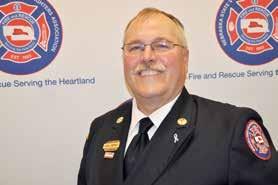
eral appropriations remain un changed at $76 million for State Fire Assistance (SFA) and $21 million for Volunteer Fire Assis tance (VFA). However, 2026 marks the final year of the addi tional $4 million in VFA funding provided through the Infrastruc ture Investment and Jobs Act. Committee members learned that the proposed Fiscal Year 2027 federal budget would eliminate funding for both the SFA and VFA programs. Congress will ultimately determine funding levels, and the NVFC has requested $82 million for SFA grants and $23 million for VFA grants in FY27.
The Forest Service also announced a major reorganization effective March 31, 2026. Agency headquarters will relocate
J oel Cerny, NVFC Director
“If you know any firefighter battling cancer and need assistance in finding more information about this again, please let me know. I need to also remind you if you have not registered with the National Firefighter Registry for Cancer, you need to do so soon. You can find the site at National Firefighter Registry (NFR) for Cancer | Firefighters | CDC.”
from Washington, D.C., to Salt Lake City, Utah. The current regional office structure will be replaced by state director offices staffed by approximately five to six employees each. Wildland fire operations will continue to be managed through geographic area coordination centers. Separately, the administration continues to pursue a proposal to consolidate federal wildland fire

resources under a single agency within the Department of the Interior. Congress did not provide funding for full implementation during FY26, instead directing a feasibility study to examine potential organizational, financial, and operational impacts. Results of that study are expected this fall.
We did get some great news from NVFC staff member Lori Shirley who announced an upcoming partnership with Ricochet Gear that will provide equipment grants to volunteer fire departments. This fall, five departments in each of three categories will receive either technical rescue gear, wildland firefighting gear, or a dual-certification kit designed for both technical rescue and wildland operations.
Program details are still being finalized, but committee members were invited to participate in the review process. The initiative marks the first time the NVFC has offered equipment grants specifically focused on wildland firefighting.
The NVFC Recruitment and Retention Committee met April 28. Tiger Schmittendorf provided an overview of Mission CIT, a Connecticut-based training organization specializing in volunteer recruitment and retention. The company’s flagship course, “R&R Officer’s Role in Organizational Success” (RRO), builds upon the NVFC’s online Essentials of Volunteer Retention and Recruitment course, which is now a prerequisite. The training emphasizes a retention-first approach focused on organizational culture, recognition, incentives, and departmental processes. Mission CIT also provides participants with a 30-page implementation guide designed to help departments apply course concepts locally.
Committee members also received an update on the NVFC’s Make Me A Firefighter (MMAF) campaign. According to Caroline Stachowiak, the program continues to show steady growth, with more than 20,000 portal users and participation from over 11,000 departments nationwide. Since January 2026, the portal has generated more than 22,000 clicks on department listings and nearly 2,900 inquiries or applications. Currently, 44 percent of volunteer and combination fire departments nationwide have users registered in the system, up from 42 percent one year ago. A rede-
signed MMAF portal is expected to launch in May with improved navigation and user experience.
The committee members discussed several ongoing recruitment and retention initiatives funded through the NVFC’s SAFER grant. Recent accomplishments include the release of 10 recruitment and retention microlearning videos on YouTube and the launch of the new Essentials of Volunteer Recruitment and Retention course in the NVFC Virtual Classroom.
The committee also highlighted the availability of the NVFC Family Guide in both English and Spanish. If you weren’t able to pick up a copy during fire school. Again, let me know and I will work to get them to you.
Preparations continue for the upcoming NVFC Training Summit scheduled for June 26-27 in Arlington, Virginia. More than 160 participants from 37 states have already registered. Plan on hearing more about this great event in my article next month.
One of the meeting’s most anticipated discussions centered on a recently completed national training study conducted by the NVFC in partnership with the NFPA Foundation and the North American Fire Training Directors. The study examined whether training requirements create barriers to volunteer recruitment and retention.
Researchers concluded that training itself is not a significant barrier when it meets four key criteria: it is relevant to local community needs, delivered in flexible and modular formats, includes immersive hands-on ex-
periences, and is offered locally whenever possible.
R & R Committee member Joe Maruca provided an update on the NVFC’s developing strategic plan. The board has approved the organization’s strategic objectives and will review proposed tactics and stakeholder assignments during the May conference.
One key objective call for the NVFC to strengthen its role as the leading source of data, research, and information for the volunteer and combination fire service sector. Committee members emphasized the importance of clearly distinguishing the needs and challenges of volunteer and combination departments from those of career fire departments. Maruca stressed that the NVFC must continue serving as the primary thought leader and advocate for volunteer and combination fire departments nationwide.
The NVFC Health, Safety and Training Committee also met on May 6. Health items we discussed include. Brian McQueen informed us that the Sylvester Cancer Center wants to collaborate with the NVFC to develop the NVFC Center for Excellence for Volunteer Firefighter Cancer. The partnership would include an on-site comprehensive cancer center, collaboration and support, feasibility assessment, and cancer survivorship program. There would be no cost to the NVFC. They already have an 800 number that has access to every national cancer care center in the U.S. The partnership would be for volunteers and would not compete with either the Firefighter Cancer Support Network or the
On May 19, a fire broke out on Main Street in Creighton, burning and destroying multiple buildings.
Ten area fire stations assisted, including the fire force from Crofton. Officials are still actively investigating the cause of this large fire. According to the Creighton Volunteer Fire Department, the original call came to the department at 2:30am to a massive fire on Main Street. It got to a point where surrounding stations needed to be called in. Crofton Volunteer Fire Department was one of the local agencies to respond to the call.
“The call came in at 4:04 a.m. on Tuesday May 19 for mutual aid of water tankers to assist from the Crofton Volunteer Fire Dept,” commented Crofton Fire Chief Brett Luebbe, “We sent 6 firefighters and three fire trucks to the call.” The crew remained at the site of fire until 6 pm.
The day was deemed to be long for all departments as the fire continuously burned throughout the day, using many gallons of water and putting a water advisory on the city of Creighton.
Three buildings were destroyed directly by the fire, with other nearby buildings being indirectly damaged through smoke and water. Over 1 million gallons of water were used with some crews using 4,000 gallons a minute per the Creighton Fire Department reports. The Crofton Fire Department alone hauled 30,000 gallons for them.
Over eight pumper trucks were used during the fire in addition to 25 tanker trucks, and 17 additional tankers that hauled water from 11 different locations.
It was no doubt this fire was a challenge for the community. The fire roared on for 16 hours, maxing out the city’s water supply, and instilled fear of nearby businesses being destroyed, including a nearby firework business that was only a couple storefronts down. Creighton Community Schools called off school for the day in order to conserve water.
No one was injured in the fire. The fire started on 816 Main Street and spread to other buildings from there. The tenants in one of the buildings had to evacuate but there were no reports of injury. Wind and proximity were the main reasons why the fire spread to multiple buildings. The roof ended up collapsing on the burned building, but the cause of the fire is still being investigated.
(Plainview News, Plainview, NE, June 2, 2026)
First Responder Center for Excellence. Kevin Quinn said there is a big gap in cancer screenings across the country. He suggested working with other organizations to come up with national screening standards for firefighters. If the pilot with the Sylvester Cancer Center works out, maybe that is another track we can pursue since they are research-based. Discussion then moved to Cancer Prevention Education for Junior Firefighters. Brian McQueen asked that if anyone has information to share on what their states are doing to inform junior firefighters about cancer prevention, please share it with him. Tom Miller said West Virginia will be doing something at their fire camp this year, and Rodger Sansom said Ohio is also putting it in their junior program. Quentin Cash said starting the conversation with juniors makes them more prepared. Brian McQueen suggested the NVFC may want to incorporate this into the National Junior Firefighter Program down the road. Tom Miller noted that SAFER allows more money for comprehensive physicals for recruits under age 21 than over. If you know any firefighter battling cancer and need assistance in finding more information about this again, please let me know. I need to also remind you if you have not registered with the National Firefighter Registry for Cancer, you need to do so soon. You can find the site at National Firefighter Registry (NFR) for Cancer | Firefighters | CDC Safety items discussed included the Safety Stand Down Rebranding. A suggestion was made
at a Safety Stand Down planning group meeting to rebrand Safety Stand Down starting in 2027, possibly as Stand Up for Safety. Quentin Cash noted that for those who are used to using the Safety Stand Down, the website would reroute to the newly branded site. On the training side of things, the HST Committee voted to approve the final draft of the 2026 training plan. The plan went before the full board at the spring conference, where it passed. We reviewed the timeline for putting together the 2027 training plan. The final draft will be ready before the fall board conference. Dave Bryson, NVFC’s new Director of Education, provided updates on emerging trends in fire service. He noted that topics still in the works are: Working with VFIS, ESIP, and Provident to schedule webinars on liability trends and significant topics. Working with Brian McQueen and Ryan Woodward to plan a webinar on recent cancer bill passage and implications for the fire service. Tom Miller said that when a grant is awarded to the NVFC, those involved in the development of the deliverables need to get the full scope and expectations up front. There have been last-minute changes in scope recently, making it difficult for course developers to deliver in a timely manner. We also need to keep NVFC courses updated and relevant for our audience. Dave Bryson said he will be mindful of sharing new details with relevant people as they are received. He also noted that our instructionally designed in-person courses will be delivered in a format that allows us to make updates to keep
content current. Dave also gave us an NVFC Instructor Update and said three sessions were held and all current NVFC instructors attended one of the sessions. Those who did not attend were removed from the instructor lists and email groups. Brian McQueen noted the feedback from instructors has been very positive. Tom Miller said there is an issue with the instructor form that was required, so if you didn’t upload a photo in the correct format, the form will not go through. This led some instructors to get a warning email that they would be dropped if they didn’t submit the form. The suggestion came up that photos of instructors can be taken at train-the-trainer events. Brian McQueen said there are going to be four train- the-trainer courses taking place in conjunction with the Training Summit. Tom Miller noted two additional issues. One is that federal grants have a requirement that only citizens or legal residents can participate in grant-funded programs. The other is that NVFC instructors may be approached by law enforcement for information or as an expert witness in an investigation, as happened to him during an EV training in Arizona. One last training session we talked about is the Website/Social Media ADA Compliance training that I’ve been working with NVFC staff on. Hopefully this will be completed this summer.
As always, stay safe, and if there is anything that Justin and I can help you with on the National level, let us know.
JOEL E CERNY
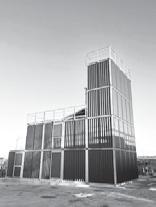
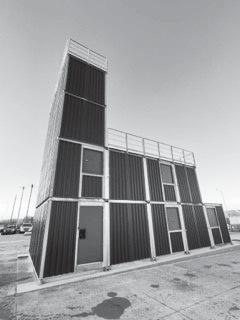

Multiple fire departments were called to a house fire located just southeast of Minden on 34 Rd.
Minden Fire Chief Tom Brown said they were called out at 9:25 Tuesday morning.
Brown said the home was not occupied at the time of the fire, so no injuries were reported. Crews were able to get the blaze fully under control within 35 minutes of
their arrival, despite what he said was a “heavy, active fire” upon arriving.
Brown credited their “tactical and aggressive attack” on the fire as a major factor in extinguishing the flames so quickly. He called it a “winnable fire,” and said the first steps they made were the correct ones allowing them to save the home.
The ensuing investigation showed the fire to have started in the attic. The cause of the fire was determined to be electrical and fortunately stayed on the second floor. As a result, the majority of the damage was in the attic, and the home will be livable once again following some repairs.
Chief Brown said that mutual aid through the Quad Cities Mu-
tual Aid Group is always called to help with structure fires. He noted that in most cases, there is no time wait for an assessment of each call. The quicker-than-normal response has played a key role in saving other structures, and Tuesday’s fire was no exception. “One call, you get us all,” Brown said.
The Quad Cities Mutual Aid Group consists of volunteer fire
departments from Axtell, Hildreth, Minden, Wilcox, Campbell, Franklin, Naponee, Riverton, and Upland. Brown said all departments were on hand during Tuesday’s fire and thanked them for their quick response. He also said they received good help from neighbors and the Kearney County Sheriff’s Office.
(By Jon Schilling, KRVN, June 3, 2026)

For several years now, my wife and I have traveled across this state numerous times to attend not only our annual conference, but to attend local departments fundraising events and annual awards ceremonies. I enjoy going out to departments not for only the great food, but also to see and congratulate their award winners. It also gives me a chance to see just what all they give out as awards. Sure, most all departments give out the “Firefighter of the Year,” that also “EMT of the Year.” But as you reach out to other departments you get to see other awards given to those most deserving. Gering and Alliance both name their “top 10 firefighters” and I’m sure other departments do just as well. Alliance also promotes their firefighters during their banquet. Badges are given out to new officers (with a special hand move) by Chief Shoemaker. And a reminder, make sure you wear black socks! What makes these banquets special, it gives the local department a chance to “show off their departments accomplishments of the past year.” It gives me a chance to see what it is that keeps these department at full roster. I know when we suffered through COVID, department rosters fell off. Was it just because of COVID? Or was it because we never got together as a fire family? Both could be true, depending on which department you’re on. Recruitment and Retention are still a problem in many departments, mine included, however, we did find a department that seems to have this problem figured out. A community of just 1800 people seem to have this under control. Pierce Chief Steve Dolesh has an active firefighter roster of 40 active, 4 reserves, and 6 cadets. Of these members, 32 are Firefighter 1 certified, 20 of them are Firefighter 2, 31 are Haz-Mat Operations
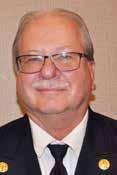
level, 1 is Haz-Mat Technician, 8 are Instructor 1 Certified, 1 has complete Instructor 2 certification, 3 are certified as Pump operations, 23 have completed Ice Rescue, 10 are Swift Water Rescue 1, most of his department has completed ICS 100, 200, 700, 800, and 13 members are ICS 300 compliant. They also have 24 EMS members, all of which are EMT or EMR certified, this includes 2 EMS Instructors. He also has a CERT team of 15 members of which have numerous certifications, and a Drone Pilot 107 class of 4 members. So why is this department ahead of a lot of us? Because they have grown up around the fire service. Sure, several families are involved (grandad, dad, and so on). But they spend time offering classes to 4th grade students (Jr. Fire Patrol), they have a cadet program, that once they complete it, they join up. Sure, they lose a few when they complete school, and/or college, but then again, some return home and the department. Why are they still on? Have you seen their wall at the station? I would refer to it as the “Wall of Flame.” It’s covered with certificate after certificate showing the department members accomplishments. Does your department show off your accomplishments? We all should. I would love to see other departments, large or small, who do this for their memberships. If yours does, take a picture and show them off. If your department has a success story like this, I’m sure many of us would like to hear from you as well. Send your story into the “The Nebraska Firefighter Newspaper” and show some pride!! Until next time, stay safe and have a great summer.
RON CHADA District 3 Director
Ron Chada , District 3
“Does your department show off your accomplishments? We all should. I would love to see other departments, large or small, who do this for their memberships. If yours does, take a picture and show them off. ”
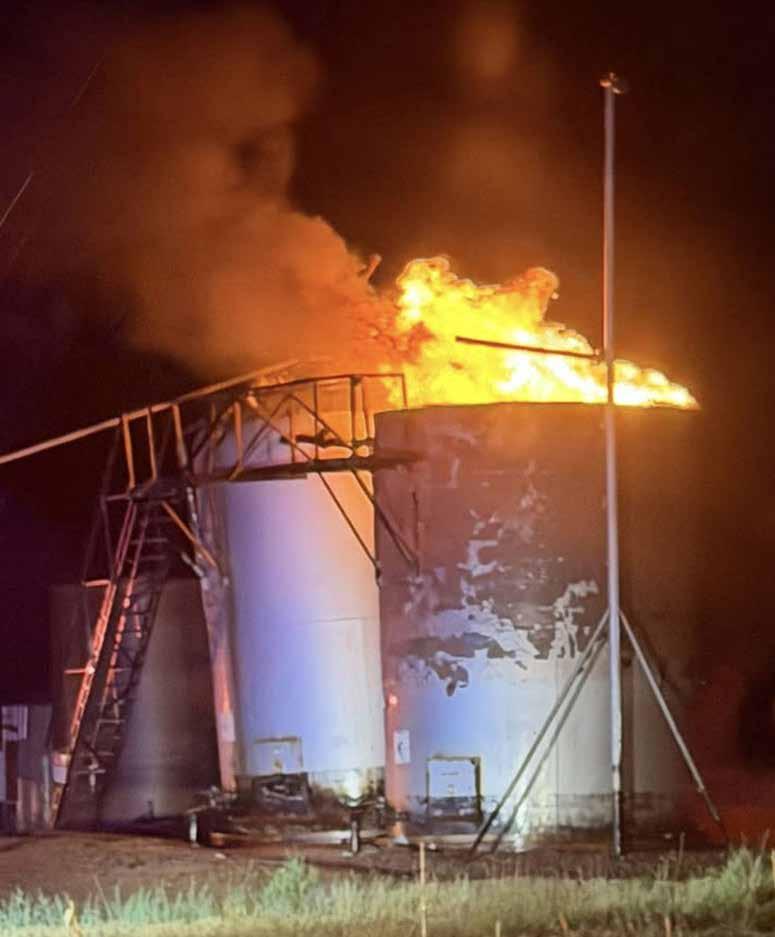
along
At approximately 4 a.m. on June 9, the Sidney Volunteer Fire Department responded to a reported fire near the intersection of County Road 109 and County Road 28. Upon arrival, crews found an oil-filled tank actively burning. A local operator on scene was able to safely shut down the system prior to fire department operations. Firefighters then deployed foam to suppress and extinguish the fire. Crews remained on scene until approximately 5:30 a.m., conducting overhaul operations to ensure the fire was fully extinguished and the tanks were adequately cooled. No injuries were reported. The cause of the fire is believed to be lightning associated with a storm system that moved through the area earlier in the morning. The Sidney Volunteer Fire Department would like to thank the assisting operator on scene for their quick actions in helping mitigate the incident. From the Sidney Fire Department Facebook page.
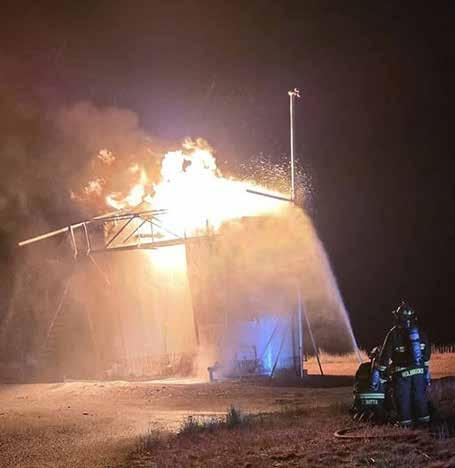
By COLE KLEINWOLTERINK
Carbon monoxide responses are easy to treat like routine calls. Most of the time, we are dispatched for an alarm activation, a beeping detector, or a vague report of someone “not feeling well.” There is no smoke showing, no visible hazard, and no obvious emergency from the street. That is exactly what makes these calls dangerous. Carbon monoxide is odorless, tasteless, and colorless. It gives us very few warning signs until occupants become symptomatic or our meters tell us something is wrong.
PRE-RESPONSE: SET THE INCIDENT UP FOR SUCCESS
Dispatchers should instruct occupants to evacuate and leave the building as-is when safe to do so. One common mistake is allowing occupants to open every window and door before the fire department arrives. While their intention is understandable, it can make the investigation more difficult by releasing the accumulated gases before crews can locate the source. If occupants can safely leave without opening windows, shutting off appliances, or changing the environment, that gives firefighters a better chance of identifying the problem.
While responding, crews should begin building their investigation plan. CO is produced by incomplete combustion, so firefighters should start thinking about anything in or around the home that burns fuel or produces exhaust. Furnaces, water heaters, stoves, fireplaces, generators, vehicles, small engines, and blocked vents can all create a hazardous environment. Cold weather, power outages, recently started heating systems, attached garages, and exterior vents covered by snow or debris should immediately be on the radar. CO calls are investigations, and the best investigations start before the crew ever steps through the door.
The meter should also be prepared early. The most important tool on a CO call is the meter, but only if it is used correctly. Meters need time to work. They must pull in air, analyze the sample, and display the reading. Firefighters should turn meters on early, allow them to complete their self-check, and perform a fresh air zero in known clean air before entering the structure. This should not be done inside the building or near apparatus exhaust.
ARRIVAL AND INITIAL ACTIONS
On arrival, the first priority is occupant assessment. Occupants should be assessed for signs and symptoms of CO exposure, including headache, dizziness, nausea, weakness, confusion, shortness of breath, chest discomfort, or flu-like symptoms. Another red flag would be any symptoms that improve after leaving the structure. If anyone reports symptoms,
an ambulance should be added, and SpCO monitoring should be utilized when available.
Crews should pay special attention to children and pets. Kids and pets can experience carbon monoxide symptoms before adults. Because children have faster metabolic rates and smaller bodies, they inhale more air relative to their size, causing oxygen-depleting toxins to build up much faster in their bloodstreams. Pets may also show signs before adults because they are often smaller as well. If the family says the dog was acting strange, the child was unusually tired, or multiple people in the home “just do not feel right,” take that information seriously.
Full PPE and SCBAs should be donned on all CO calls. These calls can change quickly. A false alarm may be a false alarm, but that decision should be based on investigation findings and meter readings. Depending on the department’s SOGs and the initial readings, crews may not need to be breathing air the entire time, but the SCBA should be on their back and ready.
Before entering, crews should confirm the 4-gas meter has been turned on, completed its selfcheck, and has been fresh air zeroed in a known clean environment. If the meter alarms during entry or investigation, crews should exit, mask up, and return to locate the problem.
SLOWLY AND SEARCH METHODICALLY
Metering should be slow and deliberate. A quick walk-through with the meter held out in front of the firefighter is not an investigation. Meters need time to sample the atmosphere, process the information, and display an accurate reading. Crews should pause approximately 30 seconds in each area before moving on. If firefighters move too quickly, they can essentially outrun the meter and miss the hazard, only to later claim the building is clear.
Because carbon monoxide has a specific gravity very close to air, it mixes easily throughout the structure. It does not always rise or settle in a predictable way. Crews should check the entire building, not just the room where the detector was sounding. This includes all levels, attached garages, mechanical spaces, and possible exposure areas. While metering, remember one simple rule of thumb: once inside the structure, do not press buttons on the meter.
If crews arrive and windows are already open, they should consider that the readings may no longer reflect the original hazard. If the meter does not immediately show dangerous levels, closing windows and doors during the investigation may help recreate conditions and locate the source. This must be done with judgment. If the meter immediately shows a hazardous
atmosphere, exit, mask up, and operate accordingly.
When investigating, start with the likely sources. The basement is a priority because it often contains mechanical equipment. Check the furnace, water heater, boiler, fireplaces, stoves, dryers, and any other fuel-burning appliances. Check attached garages for vehicles, generators, or small engines. Monitor near the ceiling, mid-level, and near the floor. Even though CO mixes with air, checking different levels helps ensure a more complete investigation and may reveal other hazards.
Crews should also inspect the home’s CO detector for age, dust, battery condition, and proper function. A bad detector does not automatically mean there is no problem, but it is part of the investigation. The detector is the reason we were called, and it should be evaluated just like any other piece of evidence on scene.
Do not forget the exterior. In a three-firefighter company, this is a good assignment for the engineer. Blocked or restricted exhaust vents are a common cause of CO issues, especially during snow events or cold weather. Walk the perimeter of the structure. Look for snow-covered vents, blocked appliance exhausts, damaged vent pipes, or items stored against the home that may interfere with ventilation. A fuel-burning appliance may be operating correctly but still create a CO problem if the exhaust is being pushed back into the home.
Remember to investigate exposures as well. In apartments, townhomes, and other attached occupancies, this means checking adjoining units — not just to the left and right, but also above and below. CO can travel through shared walls, utility chases, HVAC systems, attic spaces, basements, and other common voids. Expand the investigation until the affected area is identified, the entire exposure concern has been addressed, or meter readings confirm there are no signs of CO in the adjoining spaces.
If CO is detected, the crew should attempt to identify and secure the source. If the source is an appliance, it should be shut down or isolated if possible. This may include shutting off a furnace, water heater, stove, fireplace, generator, or vehicle. If the source involves a generator or vehicle, make sure it is moved or shut down in a way that prevents continued exposure. The utility provider should be contacted when appropriate, especially when CO is detected and the source involves gas appliances or cannot be confidently identified. The fire department should attempt to remain on scene until the utility company arrives when applicable. The officer in charge and the utility representative should determine when the structure is safe to occu-
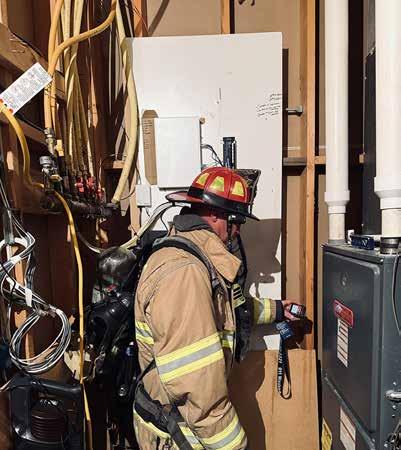
Ventilation is required when readings are elevated. A practical action level is anything above 9 ppm. Natural ventilation is preferred when possible. Open windows and doors to allow the structure to clear. If fans are needed, use battery-powered or electric fans. Do not use gas-powered positive pressure fans for CO ventilation because they can introduce exhaust into the environment you are trying to make safe. After ventilation, close all openings to the structure and allow the building to sit for a few minutes. Then recheck the structure with the meter. If CO is detected again, crews should consider the possibility of an additional source, an improperly secured source, or an incorrectly identified source. Ventilation without re-monitoring is an incomplete investigation. During the second monitoring, crews should confirm that readings have dropped to the department’s accepted threshold and remain there after ventilation has been completed and the structure has been returned to normal conditions.
If CO is suspected but not detected, crews should not immediately dismiss the call. A zero reading does not always mean there is absolutely no gas present. It means the meter is not detecting CO above its threshold. That distinction matters when speaking with occupants.
When no source is found, firefighters should continue the investigation methodically. Check all levels of the home. Recheck the mechanical room, attached garage, fireplace, stove, and exterior vents.
Consider whether the building was ventilated before arrival. Consider whether an appliance was running earlier but has since shut down. Consider whether a vehicle was recently running in the garage. Consider whether a generator had been operating but was moved or turned off before arrival. If the cause is unclear or the reliability of the detector is questionable, the occupants should be advised to contact a certified technician to evaluate the appliances, detector, and air quality. If there is any doubt, the utility company should be requested or consulted. It is better to slow the call down than to leave occupants in a potentially unsafe environment.
Be accurate with occupants. Do not overpromise. A better explanation is, “Our meters are not detecting hazardous levels at this time,” rather than, “There is nothing in the house.”
Re-occupancy should not be treated casually. Occupants should not return until the cause has been identified and secured, or the alarm has been confirmed false. The structure should be ventilated to below the department’s accepted threshold. All detectors should be reset and functioning properly. Occupants should be educated about CO hazards, detector maintenance, and the importance of calling 911 again if the alarm reactivates or symptoms return. They should understand that CO is invisible and that symptoms may be vague. They should also understand their responsibility to maintain working CO detectors and
have appliances serviced when needed.
If the cause is uncertain, the safest answer is to involve the utility company or a certified technician before normal occupancy resumes. The officer in charge should not feel pressured to declare a building safe when the investigation does not support that decision. We have a responsibility to make a
It is again time to start to plan on attending the Annual Northeast Nebraska Volunteer Firefighters Association Annual Meeting, which will be held on Sunday, August 2, in Ponca, NE, at the Ponca State Park. Registration will be from 2 p.m. to 3 p.m. The meeting will start at 3 p.m.
The program is being finalized at this time.
There will also be something planned for the ladies.
After the program there will be a social hour and the banquet will follow.
Items of importance for the day are:
• Association business,
• Election of officers,
• Host departments for the coming year,
• Finances for the Association,
• Goals for the upcoming year.
Consider running for an office or hosting one of the quarterly meetings. We will also be awarding the years of service awards and the presentation of the Cox (Bill and Kreg) Award for the most members from a department attending this meeting. If you have sent a member or members in for the years of service awards, please have them in attendance if possible.
Your dues must be paid to vote, run for an office, or host a meeting. Send your department dues now if you have not done so already. The social hour allows time to reflect on the present and the good old times of the past.
If you have never attended one of the meetings, please consider getting some of your department members together and attend. It is a way of meeting other department members and having a great time. Keep in mind that together we can build a stronger association.
The social hour and banquet will complete the day’s activities.
Please mark your calendars and plan to attend the Northeast meeting on Sunday, August 2, in Ponca at the Ponca State Park.
MARLENE BOMAR Secretary/Treasurer
reasonable determination based on our equipment, our findings, our SOGs, and the resources available to us.
Documentation is the final piece of a quality CO response. The fire report should clearly describe the actions taken, the meter readings found, the areas checked, the suspected or confirmed source, whether the utility company was contacted, how the structure was
ventilated, and what information was provided to the occupants before leaving.
The report should include initial readings, readings during the investigation, readings after ventilation, and the location where those readings were found. If the detector was checked, document its condition. If the utility company was requested, document that. If occupants were advised to contact a certified technician, document that.
Good documentation protects
the officer in charge, and the department. It also shows that the call was handled as a real emergency, not a nuisance alarm. Carbon monoxide calls require discipline. They are not fast calls. They are not “just alarms.” They are investigations into an invisible hazard that can injure or kill occupants and responders. The best practice is simple: slow down, wear your SCBA, use the meter correctly, search for the source, ventilate when needed, confirm the atmosphere is safe, educate
the occupants, and document what you did. The danger may be invisible, but our response to it should be deliberate, professional, and thorough.
Cole Kleinwolterink is a member of the Waukee Fire Department, Granger Fire Department, and Fire Science instructor at Des Moines Area Community College. Feel free to reach out to him at kleinwolterinkc@gmail.com with any questions, comments or inquiries.
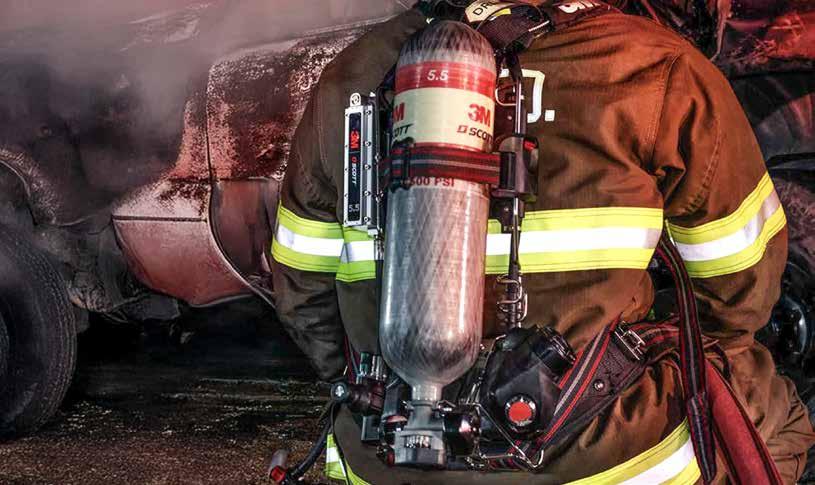
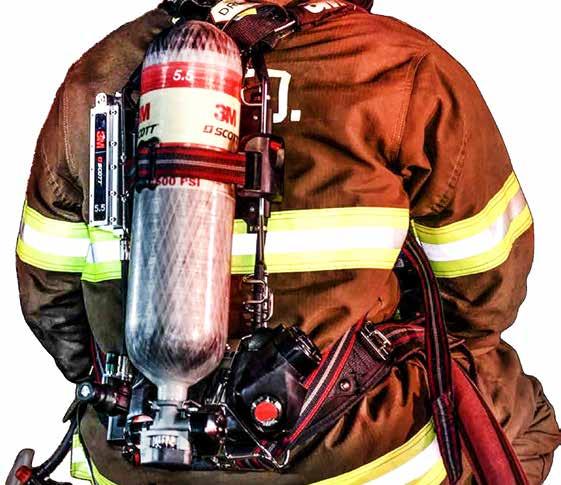
Integrated
Redundant Safety Features including the dualredundant pressure reducer are designed to help the SCBA perform, while also providing firefighters peace of

B y JERRY KNAPP
Dispatch reported multiple calls, heavy fire and people trapped in the house. As soon as the rigs arrived on scene your members came off with tools, fully geared up and headed toward the house. They asked occupants on the lawn “Is everyone out?” Forcing the door they chocked it open and advanced in for the search. As they disappeared crawling into smoke vent point ignition flashed jets of flames out the front door and over a couple second floor windows. The hoseline seemed to take forever but review of the videos taken by civilians showed the stretch was quick, but not quick enough. The flashover was sudden. In about 80 seconds the fire raced up the stairs, trapping your search team as their gear was saturated with heat and they burned to death. One member was able to bail out a second floor window one was not and suffered horrible burns that took his life. House fires are our most important alarm and often our most deadly. This same basic scenario has been replayed multiple times in our recent Fire Service history resulting in many LODDs: Cherry Road, Washington DC, Diamond Heights, San Francisco and Boston, Back Bay fire. Read these fire reports, learn from them the critical details, some are 25 years old and we must learn from them to honor our fallen. The purpose of this article is to familiarize you with a few key fire dynamics facts to help prevent similar scenarios in your department. Think of the modern house fire described above as your wood stove or charcoal barbeque grill. Air is coming in the bottom (the open front door members forced and chocked open) providing oxygen for combustion of the wood or charcoal in the grill or in this case oxygen for the burning con-
tents of the house. Flames gobble up the air and race up the stairs. Like our stove, in the house, super heated gases, in the 2000F range is boiling, racing up the stairs to kill your members. Flammable gases in the smoke will ignite when it consumes some more air.
What do you do when you want to increase the rate of burning in your stove? Add more air and sure enough you get more fire. We have all done it, it is not a secret. Fire in a stove, grill or house…fire will follow the conditions it is given…. more air more fire. Yes, it is that simple.
SO
So what can we do on the fireground to prevent this from progressing to rapid flashover? Make some strategic and tactical changes based on live burn testing and fireground experience.
1. Limit the air, control the door, close it if you can. If you cant kill the fire with water, choke it out. Don’t take windows or cut the roof until water is on the fire or very close.
2. Fast water. Getting water on the fire as quickly as possible will make conditions better quickly for both trapped occupants and searching firefighters. Decisive amounts of water on the fire prevents conditions necessary for rapid fire growth. Relentlessly train your members to stretch, flow and operate aggressively from inside or outside (if you cant get in).
3. Use VEIS when applicable as an aggressive search tactic. Remember to close the door to buy yourself some time. Remember if you are trapped on an upper floor and the fire has cut off your escape route, find a room, get inside and close the door.
Learn and adjust your strategy and tactics for search, ventilation and fire attack from the recent (and not so recent) research by UL and NIST. Search for, study and understand this world class fireground and live burn based research that will save civilian and Firefighter’s lives if you embrace it. It is far too much to try to explain in this short article. It is however expertly summarized by Deputy Chief George Healy from FDNY in the 1st Issue 2026 of WNYF magazine in a brilliant article titled “Low Intake, High Exhaust and Its Deadly Consequences.”
Chief Healy states, “As a result of multiple research projects conducted with NIST and UL, the FDNY has translated these findings into practical, common-sense tactics that have been tested and validated in the laboratory and refined on the fire floor for more than 2 decades. These tactics emphasize controlling the fire environment rather than reacting to it and include door control performed by the first due ladder company—tactical ventilation, strict coordination of suppression and ventilation through the 3 Cs—Control, Communicate and Coordinate: and the use of exterior fire control guided by the 4 Ss—Straight, Steep, Steady, Sprinkler.”
The advances in strategy and tactics briefly described above have been paid for in blood by many LODDs in our recent past. Honor their memory by learning from their sacrifice, it is what they would have wanted. These modern tactics are made possible by the world class live fire testing, research and tactical refinements of organizations like UL, NIST and FDNY. We must honor our Fallen Fire Service members by learning from their experiences to provide a better future for those we serve and those we servie with.
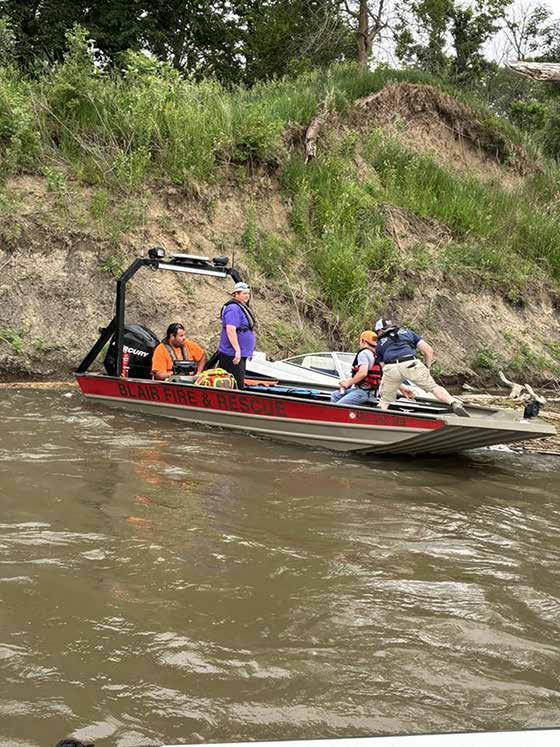
On May 28, Blair Fire Department conducted joint training with their awesome neighbors Fort Calhoun Fire and Rescue on the Missouri River. Great opportunity to sharpen our skills, strengthen teamwork, and prepare together for whatever comes our way. We’re proud to work alongside such a dedicated group of first responders. Teamwork makes the dream work! From the Blair Volunteer Fire Department Facebook page.
Please send them to jeff@nebraskafirefighter.com along with information to explain the photo.
GRAND ISLAND · PHOTOS BY TAYLOR ANDERSON
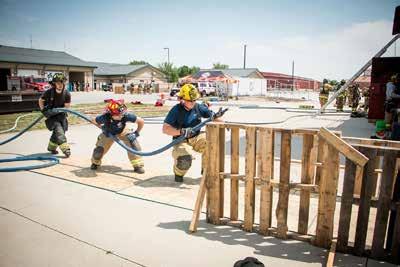
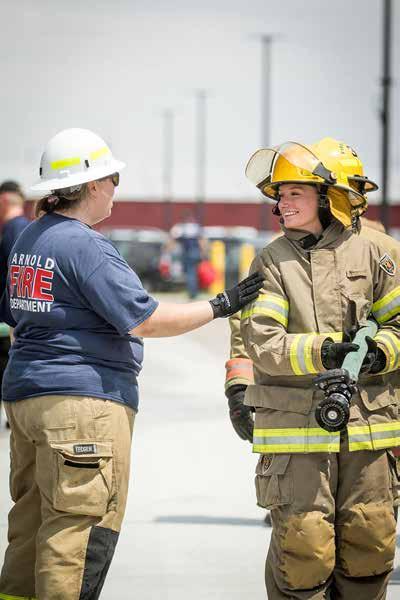
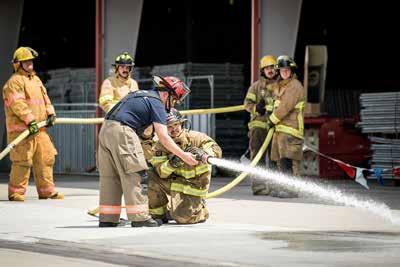
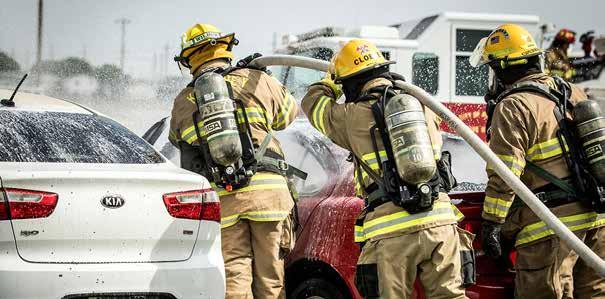
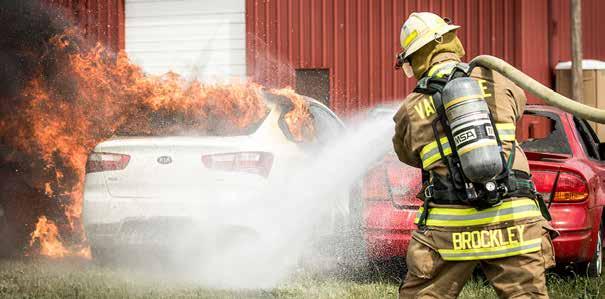

Maximum durability means maximum readiness. MacQueen delivers comprehensive fire apparatus solutions backed by expert service and support.


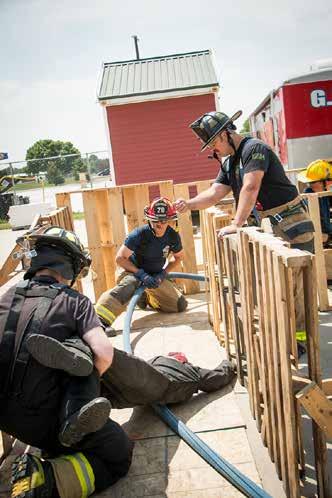
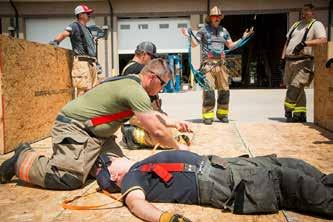
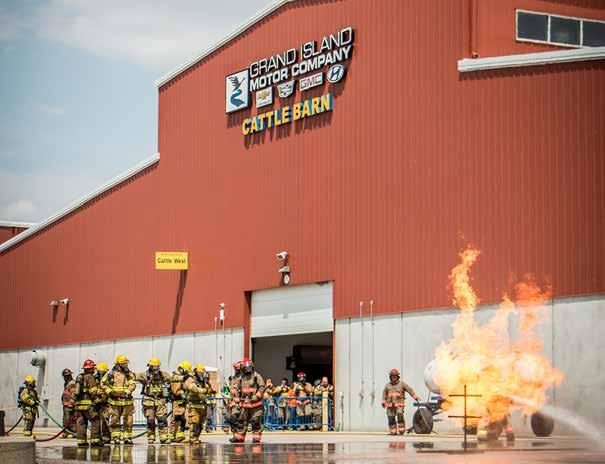
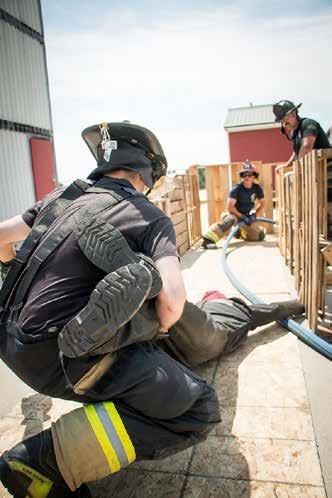
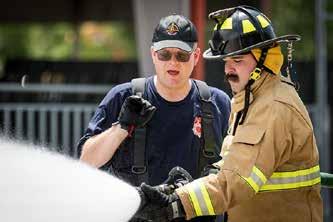
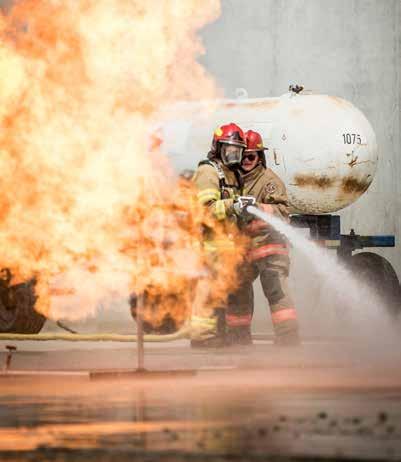
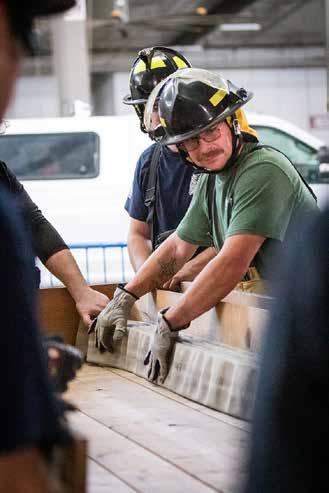
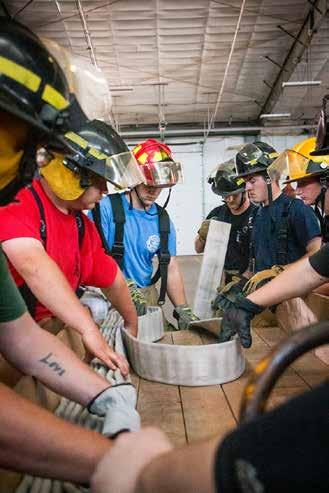
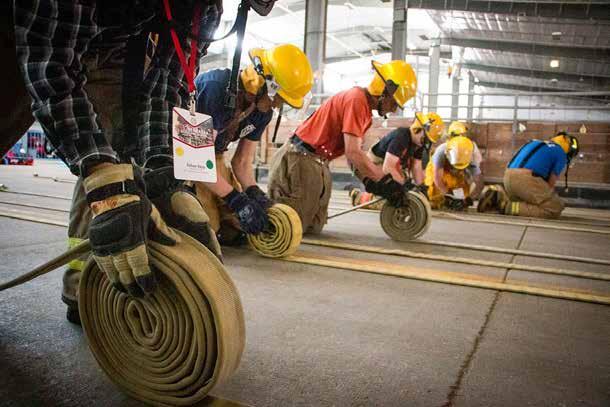
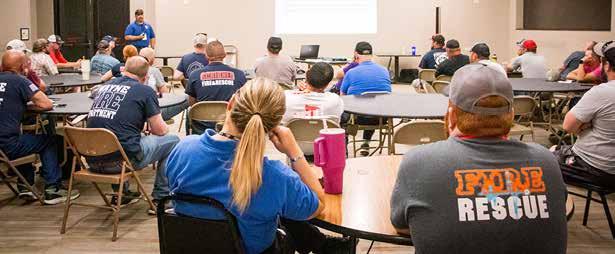
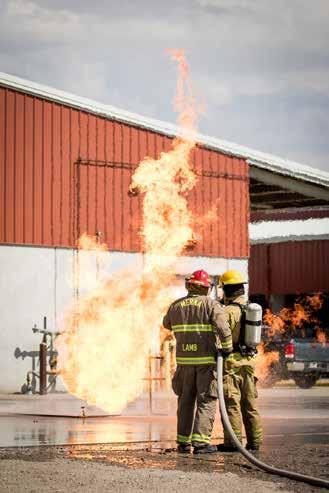
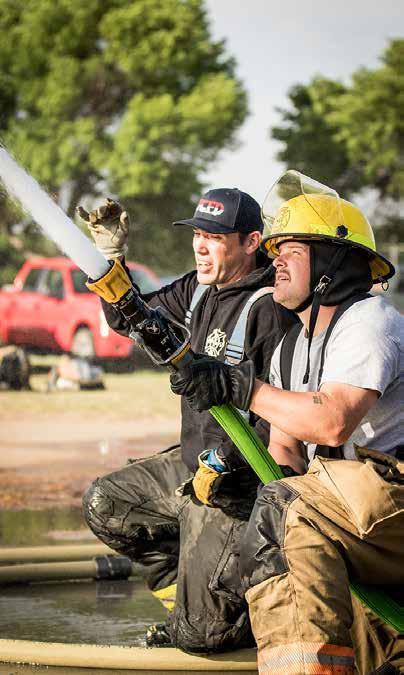
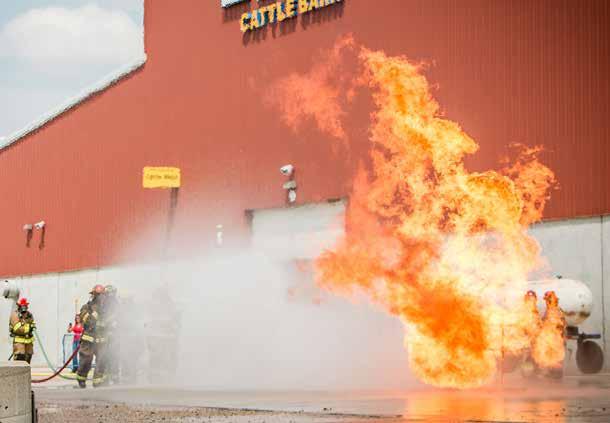
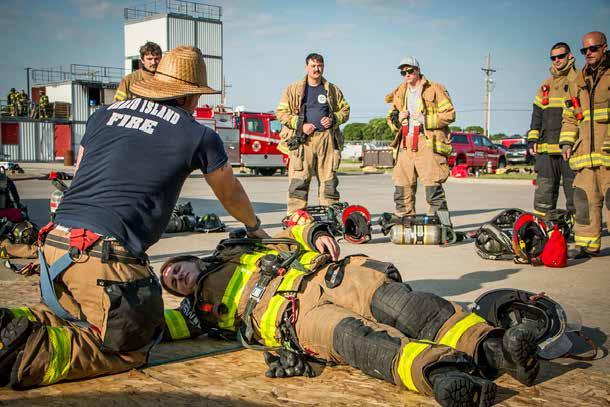
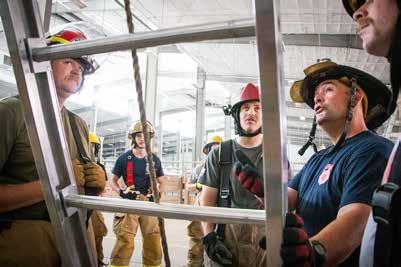
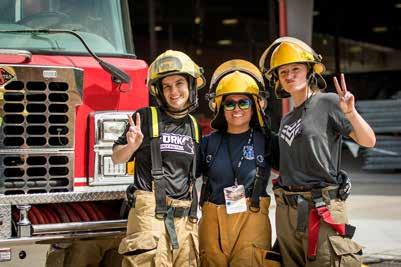
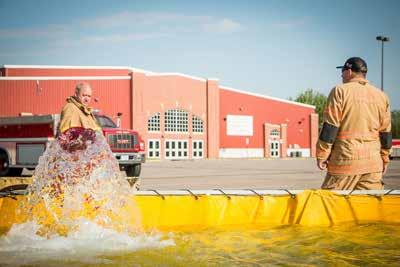
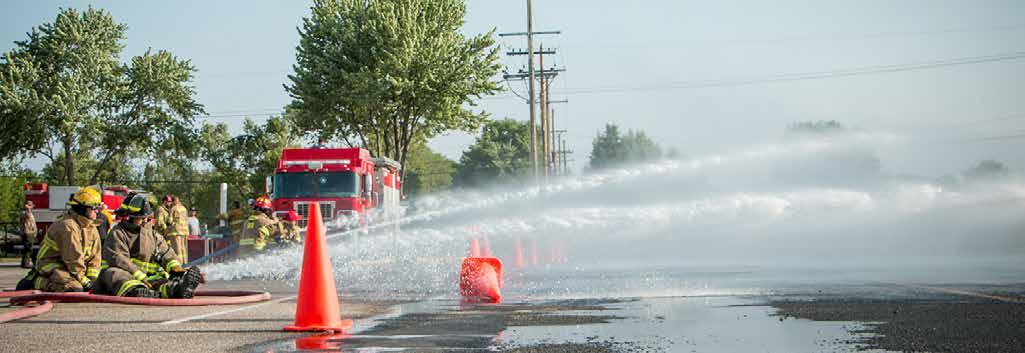
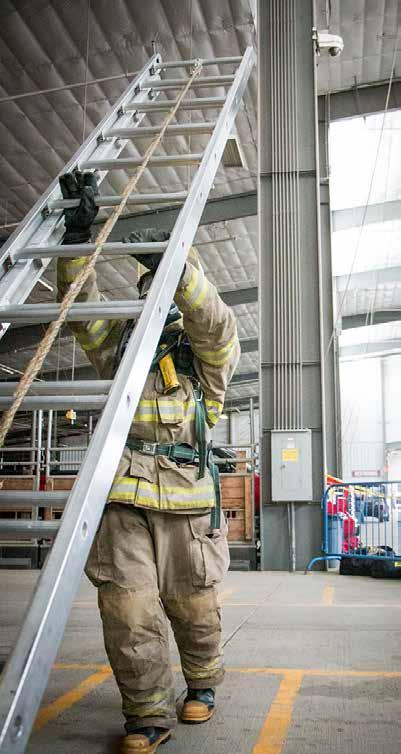
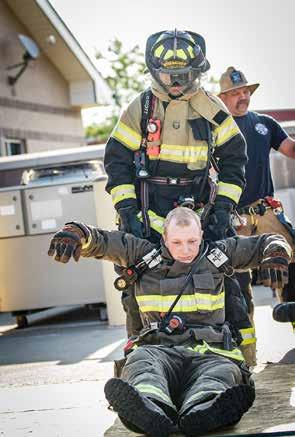
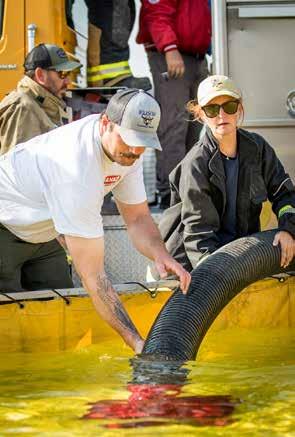
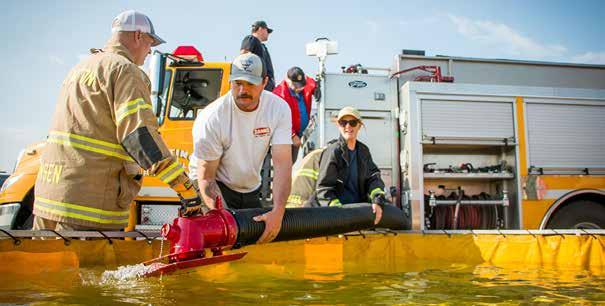
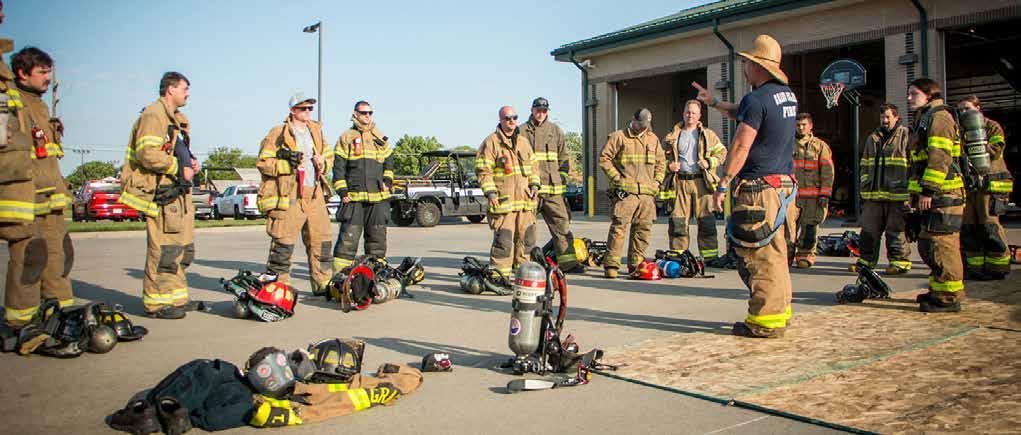
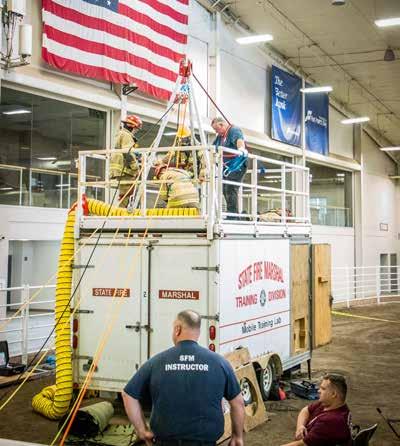
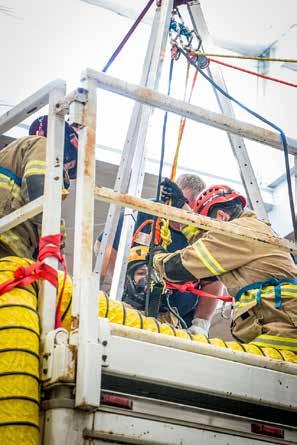
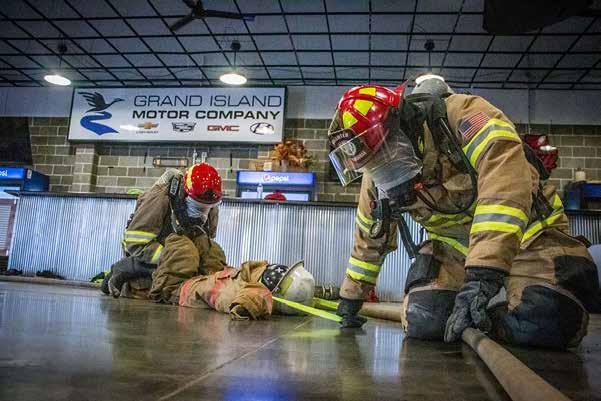
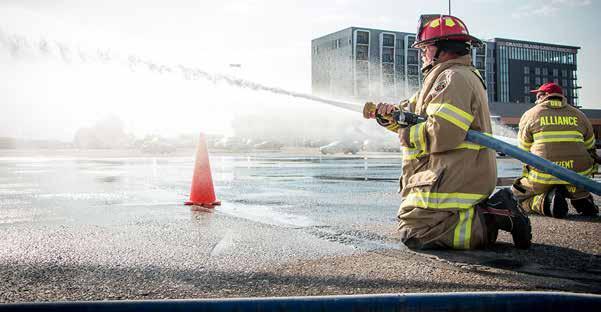
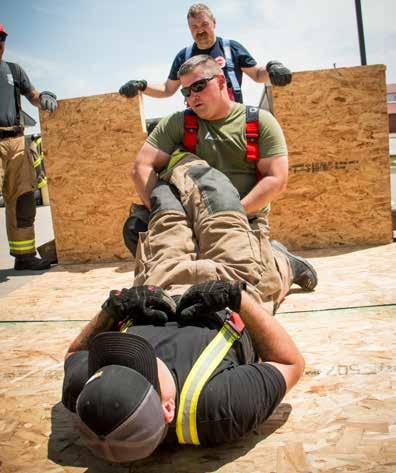
Ralston Fire Department Honor Guard presents the colors at College World Series



On June 17th, the
Indianola retired members honored
had the
Please send them to jeff@nebraskafirefighter.com along with information to explain the photo.
for
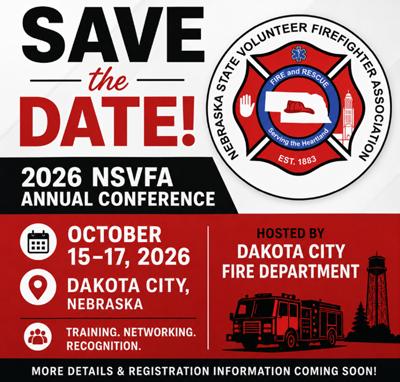
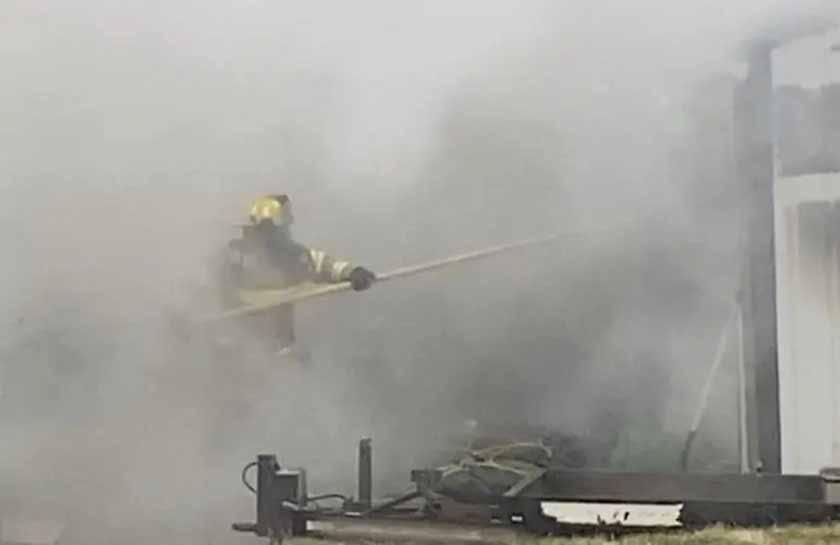
Falls City firefighters were called to a trailer house on fire Sunday night.
A press release says trailer owner Donald Murphy was on a front porch when a neighbor alerted him that his back porch steps were burning.
Sixteen firefighters and four units responded forming two attack lines. Firefighters removed metal skirting in two locations and part of the bathroom floor to investigate. The cause of the fire is undetermined.
Richardson County Emergency Management assisted the occupants with temporary shelter.
HERE IS THE PRESS RELEASE 2nd Structure Fire Call this week

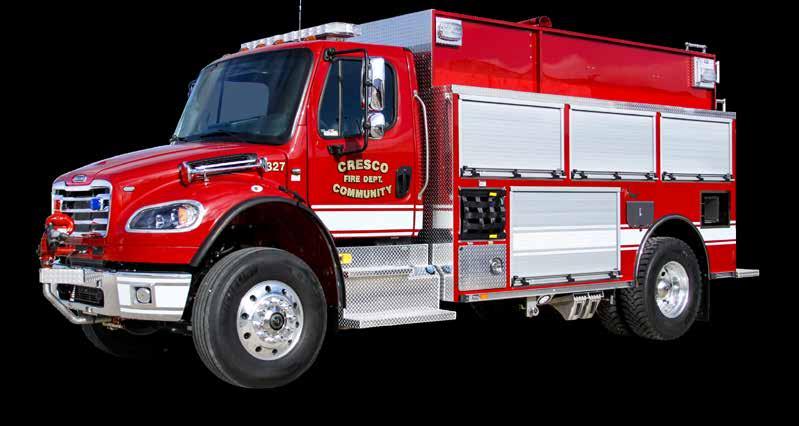
The Falls City and the Falls City Rural Fire Departments were called out to a structure on fire a little after 8:00 p.m. Sunday night. When they arrived at 1102 Wilson Street to a trailer house owned and occupied by Donald Murphy, who was on the South front porch when a neighbor called in that his North back-porch steps were on fire and alerted him. The automatic Mutual Aid call brought 4 fire trucks with 16 firemen responding with the Falls City Ambulance, Falls City Police and Falls City Utilities to assist. Two attack lines were deployed to knock down the fire quickly and an exhaust fan was used to pull the smoke out of the trailer. Firemen removed metal from its skirting in two locations and part of the bathroom floor to investigate the fires travel. While talking with the owner who remained on scene it has been declared as undetermined. The Richardson County Emergency Management who also was on scene assisted to find housing for the resident overnight at a friends and provided his transportation. The first responders appreciate local citizen’s cooperation to stay back and give them room as large supply hoses are used to supply water and the many units need to get close to the fire scene and cannot have people driving into the area.
As submitted by: Jon McQueen, Public Information Officer F.C.F.D.
Lincoln Fiire and Rescue crews got some assistance from an 11-year-old boy when fire broke out at a home near 9th and Irving Monday afternoon. LFR Public Information Officer MJ Lierman says the boy who mows the lawn noticed the house on fire around 3:30.
Lierman says the boy called 911, notified the elderly residents, and helped get them out of the house. She says the fire started in the garage and got partially into the attic space. LFR says there is heavy smoke damage to the house. “Firefighters went in for two dogs and a cat and all pets were safely removed and appeared to be fine.” A car inside the garage was destroyed. The cause of the fire is still not known.
(By Tom Stanton, KLIN, June 15, 2026)