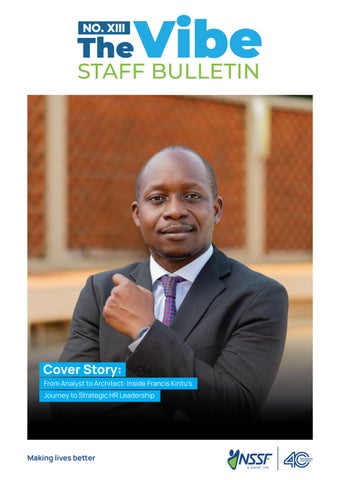
Cover Story:
From Analyst to Architect: Inside Francis Kintu's Journey to Strategic HR Leadership
![]()

Cover Story:
From Analyst to Architect: Inside Francis Kintu's Journey to Strategic HR Leadership


Pg. 3 From Analyst to Architect...
Pg. 9 Vibe coding 101: An Accountant's Non-Technical Journey
Pg. 15 Practicing Wellness
Pg. 18 Ready for the Next Voyage?
Pg. 20 The Queen of Sheba: A Journey Fuelled...
Pg. 23 Taking Advantage of Inflation
Pg. 26 The Green Reign Restored...


Dear Colleagues,
I am delighted to welcome you to the 12th edition of The Vibe Staff Bulletin.
This edition comes at a significant moment for the Fund, following the successful conclusion of our recent HR roadshows across the branch network. These engagements brought HR leadership closer to our people, creating space for open, candid, and constructive conversations on issues that matter most to our staff. They provided a valuable platform not only to share key updates and priorities, but— more importantly—to listen.
Such meaningful dialogue is essential in strengthening trust, deepening alignment, and reinforcing a culture where every employee feels heard, valued, and empowered. This remains central to advancing NSSF’s employee engagement agenda, a key pillar of our broader organisational strategy. I extend my sincere appreciation to all colleagues who participated and contributed so thoughtfully to these engagements.
As we continue to build a high-performing and future-ready organisation, we remain firmly committed to investing in the growth and development of our people. The Fund offers a wide range of opportunities to support both professional and personal advancement, including competitive e-learning programmes, structured learning and development initiatives, and diverse career growth pathways. I encourage each of you
to take full advantage of these resources as you shape and progress your career within the Fund.
To our new staff members, a very warm welcome to NSSF. You are joining an organisation that values excellence, collaboration, and continuous learning. I encourage you to actively engage, explore opportunities for growth, and make the most of the support systems available to you. Your contribution is vital to our continued success.
The Vibe remains an important platform for sharing knowledge, celebrating achievements, and strengthening our organisational culture. I encourage all staff to contribute articles, insights, and experiences that can inspire and inform others. In the same spirit, I extend my appreciation to all colleagues who have contributed to this edition— your voices and perspectives are what bring this bulletin to life.
I trust you will find this issue engaging, insightful, and a true reflection of the vibrant culture we are building together.
Makubuya Abdul Kigozi Senior Manager Organisational Development


InBy Remigious Kaggwa Employee Engagement Specialist
this edition of The Vibe, we feature an insightful conversation with Francis Kintu, the Head of Human Resources at Uganda Clays Limited, whose career journey reflects a powerful blend of strategy, resilience, and purpose. From his early beginnings at the Fund to his evolution into a strategic HR leader, Francis shares valuable lessons on career growth, leadership, and the courage to navigate uncertainty.
In this interview, conducted by Remigious Kaggwa, Francis reflects on the defining moments that shaped his career, the importance of aligning people strategy with organisational performance, and what it truly means to grow beyond titles. He also offers practical advice to staff at different stages of their career journeys, drawing from his diverse experiences within and outside the Fund.
1. Please shade for us a picture of how you started your journey of working with the Fund.
When I finished university, I wanted to be an auditor. I applied to all the ‘Big Five’ audit firms and did interviews, but I never got an opportunity. Eventually, I chose to practice the statistics and economics I had studied. I got an opportunity in a manufacturing company, starting as the company statistician. I did many things, including company market research.
However, I didn’t like the environment. I soon realized that many people were ‘stuck’ there for many years, with many of them earning less than what I was earning. I felt the culture in the organization wasn’t going to suit my career ambitions, so I started looking for a new employer and a new environment.
After three months, I happened to get a short-term data cleaning job in NSSF. Like many staff within the Fund, I started as a temp on a three-month
contract, which eventually turned into a six-month extension. Before those six months ended, the Fund advertised for a Research Assistant. I applied and was one of the five people appointed.
I became an established staff member as a Research Assistant in Marketing. Shortly after, a new unit under Strategy, called the Performance Intelligence Unit, was created, and my role became Performance Intelligence Officer. That is how my journey working with the Fund started.
2. Looking back at your early days at the Fund, what initially shaped your interest in HR, and what foundational lessons from that period still influence you today?
I worked in this strategy or performance intelligence unit for about a year. At the time the unit was founded, the heads of departments were given one year to build internal capacity to manage their own performance. During the course of that year, the unit was supposed to help them build that capacity, so we monitored performance working with department heads and senior managers.
I was allocated the HR and Legal departments, and it was through interaction with both departments that I came to understand what HR and Legal are really about. Most importantly, I had long been interested in human psychology—how humans reason, empathise, and the emotions that surround people. I started picking up an interest in HR, and at the end of that year, the Head of HR created a more senior role in the HR department and invited me to take it up.
The role was tailored to suit my analytical skills and my background in statistics and economics. I was handling payroll, rewards, salary surveys, and the provident fund (SPF). It triggered my quantitative instincts and created a nice balance. However, I took up that role just as I had enrolled for my postgraduate degree in statistics. At the end of my first three-year contract, I faced challenges deciding what I really wanted to be, which eventually led to a three-year sabbatical.
The most foundational lessons I picked up while making those tough decisions were:
Credibility is built through competence. You have to know your work. No matter what you are doing, you need to understand your numbers and ground your
decisions in the evidence those numbers present. I realized that essential HR requires dealing with numbers to make decisions. It became exciting for me to blend numbers with people management using available data.
Empathy is a strategic skill, not just a soft skill. People respond to fairness, transparency, and consistency. As a leader, you must be deliberate in how you approach and handle people. Being fair, transparent, and consistent is the only way to unlock sustainable relationships and emotions in others.
3. At what point in your career did you begin to see yourself not just as an HR practitioner, but as a strategic leader? What triggered that shift?
So, right from the onset, when I was a strategy officer (or a performance intelligence officer), I was able to appreciate the role HR has as a strategic partner. Because I was attending strategy retreats with EXCO and the Board and was in charge of monitoring the performance of HR, I was able to appreciate, even at that analyst stage, the role that HR plays at a strategic level.
“ Empathy is a strategic skill, not just a soft skill. People respond to fairness, transparency, and consistency. As a leader, you must be deliberate in how you approach and handle people.
Even when I crossed over to HR, I continued to work with strategy to ensure that our performance as a department, as well as the alignment between organisational (Tier 1) and individual (Tier 3), was maintained. I was lucky to have that appreciation at an early stage. Later on, as I progressed to Reward and Benefits Manager, I designed the total rewards framework for the organization, which is key to motivating staff and ensuring they perform beyond expectations—one of the core roles of HR as a function. Later at Uganda Clays, I was able to cement that by running more organisation-wide change programs.
Along the way, the more I appreciated the role HR plays in strategy, the more I realized it’s equally important to participate in cross-functional initiatives that directly influence organizational performance. While I was in HR at the Fund, I was involved in most cross-functional projects that required HR’s input, such as:
• Project Kuboresha
• Product development committee
• The Hi-Innovator steering committee
I believe it’s important that everyone participates in these kinds of projects outside their core roles to appreciate their contribution toward organizational performance.
To summarize, the trigger was realizing that HR is most impactful when it is shaping culture, driving performance, and enabling strategic execution. Once you realize that, irrespective of your function, it helps you map out the role you play as an individual and as a department toward becoming a leader who has a strategic view rather than just an operational one.
4. You made the bold decision to transition away from the Fund at one point. What informed that decision, and what did that season of your career teach you about growth and risk-taking?
It’s critical to make intentional decisions about your career. Right from when I finished University, I have been very intentional about the direction I want my career to take.
To take you back, I left my first job to join NSSF because, despite it being a full-time role, I didn’t see growth within that environment. When I joined
NSSF, I was essentially looking for an environment that would enable me to pursue my career goals. When my first three-year HR contract elapsed, I chose not to renew it. At that point, I had just completed my postgraduate studies in statistics, yet I had been doing HR and receiving significant training within that field. I left because I wanted to find my "career compass."
During the three years I was away from the Fund, I explored several things to test my analytical skills. For instance, I was lucky to get a fellowship to go to the UAE to study and do Forex trading. When I came back, I did quite a bit of it before facing other disruptions. During that time, I realized that as much as I was trying to run away from HR, it was pretty much my destiny. I got involved in HR consulting with two top firms in Uganda, where I built skills, resilience, and a focus on contemporary HR management.
By the time I returned to the Fund, I was very focused and knew what I wanted for my career growth journey. I remember my head of department challenging me, saying she wanted me to be a manager within the next five years; I actually achieved that in less than five years.
That period taught me several critical lessons around personal resilience and risk-taking:
i. There is life away from the Fund. This is very important for people pursuing growth because every organization is a pyramid with limited room at the top.
ii. Growth doesn’t necessarily mean growing from within the same organization. You must be able to challenge yourself to move through different environments to learn new lessons and face different challenges.
iii. Stepping into discomfort is often a requirement for growth. Individuals who thrive in their careers do so because of continuous learning, but sometimes you must uproot yourself to discover your full potential.
Taking the risk to move out expanded my perspective and helped me evolve into a more rounded professional.
“ It’s critical to make intentional decisions about your career. Right from when I finished University, I have been very intentional about the direction I want my career to take.

5. Many professionals struggle with stepping out of familiar environments. What helped you navigate uncertainty and remain competitive outside the Fund?
There are about three things I can speak to that I personally believe have helped me navigate uncertainty in all the environments I’ve operated in:
1. Having a learning mindset
Irrespective of what I do, I’ve always approached every opportunity with humility and, most importantly, curiosity. Curiosity allows you to not just learn, but to appreciate life in general. Reflecting on how human beings think, interpret,
and react to situations requires you to be curious, but also to read and adapt. Approaching opportunities with humility and curiosity is critical, and it has really helped me.
2. Transferable skills and foundation
The Fund gave me a very strong foundation, especially through the training and exposure I received. This gave me the confidence that I could transfer these skills elsewhere. You never know how good you are until you explore different environments. The Fund is one of the few organizations that invests a lot in training its staff, but you cannot notice how much you can contribute to society if you don’t experience and
interact with different environments that require your skills.
I challenge every Fund staff to try themselves out there, whether on Boards or mainstream work; that way, you realise how you've been equipped to handle more challenges than you might currently be handling. When I left the Fund the first time, the knowledge I carried enabled me to handle many challenges. When I came back, I was very deliberate about what I wanted to study, what training support I wanted from the Fund, and how the Fund’s goals were to align with my personal goals. Even when I moved again, carrying those experiences and that exposure helped me create change in my current environment.
We must be mindful of the relationships and reputations we build along the way. I’ve had to be deliberate in consistently demonstrating professionalism and integrity. Those two things always open doors, as does having no fear to challenge what is not right. When you do that, the other party builds trust around you; they know you can handle challenging situations without being compromised.
So, the three things again are: having a learning mindset, having transferable skills, and building relationships and reputations in all that we do. Staying competitive is not about knowing everything; you just have to ensure that you learn fast, stay relevant, and maintain your own personal discipline.
6. You later returned to the Fund for another impactful stint. How did your external experience reshape your perspective and leadership approach upon your return?
Returning to the Fund felt like coming back home, especially based on how I was welcomed. Most importantly, I returned with "sharper lenses". My external experience working with different firms and environments exposed me to various cultures, leadership styles, and institutional models.
For instance, in one of the firms I worked with while I was away, I reported directly to a Briton who exposed me to work cultures that demanded a focus on timely delivery and high-quality output. She was very strict on the small things. That exposure
helped me focus my outlook and approach to my work. We worked for big clients both locally and outside Uganda, and that experience shaped an approach to work that I have replicated in many of the things I do now.
I returned to the Fund with:
• A deeper appreciation of systems thinking
• A more strategic approach to people management that goes beyond day-to-day operational tasks
• A stronger belief in the power of culture to accelerate or hinder performance
This belief in the power of culture is something I picked up while I was away, and it has become very important in my current work. It ensures that I interact with people and understand their situational state of mind to determine their ability to deliver on targets.
In all, this allowed me to contribute more meaningfully, especially in:
• Refining the total reward strategy that we had to develop as the Fund
• Strengthening our HR systems
• Supporting cross-functional initiatives that required my department’s participation
7. What did you do differently the second time around that you might not have done earlier in your career?
One of the things I learned while working with consultants and firms is that it’s not enough to be technically good; to be able to grow, you have to firm up your influencing skills. Consequently, I became more intentional about influencing—most importantly, influencing through collaboration rather than position.
I understood the importance of building coalitions in teams, engaging stakeholders, and aligning people behind a common purpose. This is critical for achieving results.
Later on, when I became a supervisor and a manager, I invested more time in developing the people under me rather than just focusing on delivering results. It is very critical, especially as a
manager, to invest in others to be able to achieve results faster. In fact, the Fund was able to second me and later release me, knowing that I had a capable successor.
It’s important to note that leadership is not what you achieve alone, but what you enable others to achieve.
8. Now serving as Head of HR at Uganda Clays Ltd, what does leadership mean to you at this stage of your career, and how has your leadership philosophy evolved over time?
After almost 6 years leading the HR function at Uganda Clays, I’ve learned that leadership is about creating clarity, enabling performance, and building a culture where people can do their best work. It is very interesting to see how people’s performance thrives once you've provided an enabling environment and improved leadership at all levels, especially supervisory.
“ I challenge every Fund staff to try themselves out there, whether on Boards or mainstream work; that way, you realise how you've been equipped to handle more challenges than you might currently be handling.
I spend a significant number of hours in group meetings trying to see how to improve work and create change. However, I also spend hours having one-on-ones with staff at all levels—whether they are having challenges at home, planning to resign, or simply needing to see change in their workspaces. That time spent can have a ripple effect, for a satisfied staff member who is then going to engage others and create improvement in their own respective work areas.
My philosophy has evolved from focusing on operational efficiency to emphasizing transformation and sustainability in work. Together with my team at Uganda Clays, we’ve led a culture change program and have been able to:
• Improve performance management and monitoring
• Cascade the Balanced Scorecard at all levels
• Manage an OD exercise that led to a downsizing of the organization by about 63 staff, with zero litigation
• Automate several processes
All this has reinforced my belief that leaders must be both strategic and human. Today, leadership means shaping the future while supporting people through change.
9. Career growth is often viewed in terms of promotions and titles. In your experience, what does holistic career growth truly look like?
Indeed, many people view career growth in terms of promotions and titles, perceiving growth as moving from one position to a higher one. In my opinion, holistic career growth is more about what you become. When you focus on becoming a different person, you cease to see growth through the lens of moving from one position to another.
The Fund, for instance, has opportunities through diverse strategic projects. However, many people do not see participation in those projects as an opportunity to actually grow. When you engage in these projects and diverse activities beyond your usual work horizon, you grow your competence. You are also able to develop your emotional intelligence by interacting with diverse people— those who don’t necessarily speak about what you do. Interacting with complicated or hard-to-deal-

with people, especially those in customer-facing roles, helps build your emotional intelligence and resilience. Furthermore, these interactions help expand your horizon of influence as you engage with different people at different levels.
We often face setbacks in whatever we do, both at work and outside of work. These setbacks are critical in shaping your career and your growth in general; your ability to navigate them with resilience is essential.
Throughout this process, you must stay aligned with your own values, especially integrity. Titles may change, but who you become in that process is what really determines your long-term success in your career growth journey.
10. For staff currently navigating their own career journeys—whether they feel stuck, ambitious, uncertain, or ready for change— what practical advice would you offer them?
Irrespective of where you are or how you feel about your current career journey, I would offer four pieces of advice:
1. Stay curious and seek learning relentlessly
It keeps you relevant. Whether it’s about learning new skills, improving your current work, or gaining awareness about the current geopolitics, you must seek knowledge holistically. This will keep you relevant in all spheres of your future path. As you grow in your career, you realise that you are able to excel if you have an integration of knowledge. For instance, I am a statistician, economist, HR
“
Don't wait for opportunities to come your way; you must prepare for them.
practitioner, business administrator, and now reading extensively about farming and agroprocessing. I am inclined to believe that Fund staff are benefiting and achieving through initiatives like Financial Literacy, The Book Club, and others. I wouldn’t be surprised as well that some are yet to embrace them.
2. Embrace discomfort
Rarely does growth happen while in your comfort zone. Growth may mean taking on a new challenging role in another department or even another organization. You must be able to step out of your comfort zone to progress.
3. Own your narrative
Don’t wait for opportunities to come your way; you must prepare for them. There is a saying that luck is actually opportunity meeting adverse preparation. To be "lucky," you must have prepared yourself to be in that position.
4. Build formidable relationships
Your network will shape your opportunities. As the saying goes: "Your network is your net worth." For the Boards that I serve on, I have been referred by someone who has experienced my work or interacted with me.
Wherever you are in your journey, remember that careers are marathons, not sprints. You have to keep moving, keep learning, and most importantly, keep becoming an improved version of yourself in whatever you do.


YBy Lyndah Namubiru Cost Accountant
ou know that feeling when you’re just vibing?
Maybe you’re listening to music that hits just right, or you’re in a conversation that flows effortlessly, or you've found your rhythm in a project and everything just... clicks. You're not overthinking. You're not forcing it. You're in the zone, and things are happening naturally.
Now imagine bringing that same energy to coding!
Sounds impossible, right? Coding is supposed to be precise, technical, unforgiving. One misplaced semicolon and the whole thing crashes. But what if I told you there’s a way to code that feels less like memorizing a foreign language and more like jamming with a really talented musician who knows exactly what you’re trying to play?
Welcome to vibe coding.
The Discovery
I’m an accountant who lives spreadsheet. Then I enrolled in a master’s program in statistics and social sciences at the University of Manchester, and suddenly I was expected to learn “R”, a programming language I had never touched and use it to produce actual research.
I knew some Python basics, enough to understand the concept of coding but not enough to feel remotely confident. The first module’s assignment was straightforward in theory: find an authentic public dataset, analyze it deeply using “R”, and write a research paper. Oh, and do all this within tight deadlines while juggling other coursework.
I went through the practical sessions on R fundamentals, picked up the basics, but the assignment needed deep analysis. The kind where you’re wrangling messy data, running complex statistical tests, creating meaningful visualizations. I didn’t have months to become an “R” expert.
That’s when a friend introduced me to Claude, and that’s when I discovered vibe coding.
Think about when you vibe with someone. You're not translating every thought into formal language. You're reading the room, catching the energy, responding naturally. There’s an intuitive flow. You focus on the feeling and the intent, and the right words come.
Vibe coding works the same way.
Instead of getting bogged down in syntax, function names, or the "proper" way to structure code, you focus on what you’re trying to achieve. You think about the outcome, the story you want the data to tell, the question you’re trying to answer. You're vibing with the problem, feeling out the solution, letting your creative instincts guide you.
Then and here’s the magic you have a collaborator who speaks both your language and the language of code.
When something didn’t look right, I'd describe what felt off "this visualization isn’t showing the relationship clearly" or "I think we need to group this data differently" and we'd iterate.
It felt like vibing with a brilliant study partner who happened to be fluent in R.
The research paper I produced genuinely amazed me. Not just because it worked, but because it was good. The analysis was solid. The visualizations told a clear story. The conclusions were meaningful. I'd tapped into something I didn’t know was possible: maintaining my creative flow while producing technical work.
As an accountant, I'm trained to be methodical, detail-oriented, maybe a bit skeptical of anything that sounds too easy. But vibe coding isn't about taking shortcuts or bypassing the work. It's about recognizing where your value actually lies.
The Vibe Coding Experience
I started describing what I wanted in plain English. Not "use the dplyr package to filter rows where X exceeds Y," but "I need to remove the outliers from this dataset because they're skewing my results." Not technical instructions just the vibe of what I was going for.
Claude would translate that into working R code. Clean, functional, often with helpful comments explaining what each part did.
I wasn’t mindlessly copying code I didn’t understand. I was learning through the process, seeing how my creative ideas translated into technical execution.
From the podcasts i binge on, one of Claude’s developers said something that completely reframed how I think about this: "If the plan is good, the code will be great."
That’s the essence of vibe coding. Your job isn’t to memorize every function or become a syntax expert. Your job is to think clearly, plan thoughtfully, and maintain your creative vibe. The code follows from that.
And here’s what really blew my mind: Claude’s own collaboration feature, CoWork, was built using vibe coding within Claude itself. Professional developers are using this approach to build real products. If they're vibing their way through software development, what does that mean for the rest of us?
“ Vibe coding is here, but vibe research is next.Naval Ravikant
“
The future isn't about who can write the most elegant code. It's about who can think creatively, plan strategically, and vibe their way through problems with the right tools at their side.

That resonated deeply because what I experienced wasn’t just coding it was genuine research. I analyzed real data, drew meaningful conclusions, contributed something new to the conversation. All while maintaining that flow state, that vibe, that keeps creativity alive.
As an accountant, I’m trained to be methodical, detail-oriented, maybe a bit skeptical of anything that sounds too easy. But vibe coding isn’t about taking shortcuts or bypassing the work. It’s about recognizing where your value actually lies.
Learn the fundamentals? Absolutely. Understand the principles? Essential. But spending months cramming syntax and memorizing obscure functions? That’s optional now. What’s not optional is creative thinking. Knowing what questions to ask. Understanding what good analysis looks like. Being able to plan effectively and communicate clearly about what you’re trying to achieve.
These skills the human skills, the vibe are now the differentiator. The technical execution can be collaborative. The vision? That’s all you.
If you've been intimidated by coding, or if you have ideas but lack the technical confidence to execute them, consider this your invitation to start vibing.
You don’t need to become an expert programmer. You need to think clearly, plan well, trust your creative instincts, and be willing to collaborate. Whether you’re conducting research, analyzing data, automating tedious tasks, or building something entirely new, the barrier isn’t technical skill anymore.
It’s imagination. It’s clarity of thought. It’s your ability to maintain your vibe while bringing ideas to life.
The future isn’t about who can write the most elegant code. It’s about who can think creatively, plan strategically, and vibe their way through problems with the right tools at their side.
So get in your creative zone. Find your flow. Start vibing.
The coding? Well, there’s probably a Claude for that.


WBy Anna Nanvuma Account Manager
ellness isn't just about occasional selfcare—it's a lifestyle that nurtures your mind, body, and spirit in harmony. By combining simple daily habits with intentional practices, you can build resilience, reduce stress, and enhance your overall quality of life.
Here’s how to practice wellness meaningfully and sustainably.
Wellness is a holistic approach to health that focuses on physical, mental, emotional, and social well-being—not merely the absence of illness. It encourages mindful living, stress management, emotional resilience, and balanced relationships as essential parts of a thriving life.
Rather than striving for perfection, wellness is about creating balance. It’s about tuning in to your needs and making choices that support long-term well-being.
Mindful Practices for Mental & Emotional WellBeing
Meditation & Mindfulness
Meditation helps calm the mind, reduce anxiety, and strengthen emotional regulation. Simple techniques—such as guided meditation or gratitude meditation—can uplift mood and build resilience over time. Even five to ten minutes a day of mindful breathing or stillness can make a noticeable difference.
Intentional breathing exercises, such as box breathing or diaphragmatic breathing, activate the body’s relaxation response. These practices reduce stress, lower heart rate, and ease emotional overwhelm. Just a few focused minutes daily can restore a sense of calm and clarity.
Writing about your thoughts, emotions, or daily gratitude deepens self-awareness and promotes emotional balance. Journaling provides a safe space to process experiences, shift perspective, and cultivate a positive mindset.
Physical activity doesn’t have to be intense to be effective. Walking, stretching, dancing, or practicing yoga connects movement with breath and presence. Regular movement enhances cardiovascular health, boosts mood, improves flexibility, and sharpens mental clarity.
The key is consistency—choose activities you enjoy so movement becomes something you look forward to.
A balanced diet rich in whole foods—vegetables, fruits, lean proteins, whole grains, and healthy fats—supports energy levels, brain function, and mood stability. Hydration is equally important. Drinking enough water throughout the day keeps the body energized and alert.
Aim for balanced meals rather than restrictive eating patterns. Nourishment should feel supportive, not stressful.
Quality sleep is foundational to wellness. During sleep, the body repairs tissues, regulates hormones, and restores mental focus.
While individual needs vary, most adults benefit from around 7–9 hours of sleep per night. Establish a calming nighttime routine, limit screen exposure before bed, and aim for consistent sleep and wake times—even on weekends—to maintain a healthy internal rhythm.
One of the cornerstones of wellness is recognizing the powerful mind-body connection—how thoughts and emotions affect physical health, and how physical habits influence mental well-being.
These practices combine breathing, movement, and focus to strengthen both body and mind.
We have access to fitness facilities, group classes, or wellness spaces, we should take advantage of them. Participating in dance or movement classes can improve physical fitness while boosting confidence and joy.
Creative & Expressive Activities
Creative outlets—art, music, writing, or expressive movement—support emotional release and selfdiscovery. Engaging in creative practices can reduce stress, increase self-awareness, and promote a sense of fulfillment.
Human connection is essential to overall well-being. Strong relationships, meaningful conversations, and emotional support reduce loneliness and promote psychological health.
Intentional social engagement can strengthen bonds. For example, following a simple connection routine—such as reaching out to different people weekly, having deeper conversations monthly, and making time for daily social interaction—helps nurture relational well-being.
Healthy communication, empathy, and shared experiences form the foundation of emotional wellness.
“
Mind-Body Practices
Activities such as yoga, dance therapy, or mindful movement cultivate awareness and integration.
Aim for balanced meals rather than restrictive eating patterns. Nourishment should feel supportive, not stressful.
Stress is a natural part of life, but chronic stress can negatively affect both mind and body. Managing it effectively is essential.
You can reduce stress by:
• Practicing relaxation techniques like meditation or breathwork
• Setting healthy boundaries and prioritizing rest
• Engaging in enjoyable activities that calm the nervous system
• Seeking support when needed
• Wellness also involves building emotional resilience—the ability to understand your feelings, adapt to challenges, and respond in healthy, constructive ways.
• Simple Daily Habits to Practice Wellness
• Here are practical habits you can incorporate into everyday life:
• Drink enough water to stay hydrated and focused.
• Move your body daily—even short walks count.
• Maintain consistent sleep routines and reduce screen time before bed.
• Practice mindfulness during routine activities like eating or walking.
• Express gratitude or reflect daily to cultivate positivity.
Small, consistent actions often create the most lasting impact.
Wellness is a personal and ongoing journey—not a one-time achievement. By adopting small but intentional practices that nourish your mind, body, and spirit, you build a strong foundation for longterm health and fulfillment.
It’s not about doing everything perfectly. It’s about
creating balanced routines that feel sustainable, supportive, and meaningful for your life.

“Regular movement enhances cardiovascular health, boosts mood, improves flexibility, and sharpens mental clarity.


TBy Irene Doreen Ankunda Service Quality Officer
here are moments in life when we find ourselves standing at the edge of possibility, watching something we hoped for drift slowly out of reach. It might be a job we longed for, a relationship we prayed would last, or a dream we had carefully mapped out in our minds. And in that still, quiet moment—when reality settles—we feel the weight of loss. The ship has sailed. The moment has passed. And we are left wondering whether we missed our one and only chance.
But here’s the truth that anchors and uplifts those who dare to believe again:
The ship sailing is not the end of your story. It is the beginning of a new chapter.
Life is not a single opportunity. It is an ocean of them. Every wave brings another possibility, another path, another chance to rise.
Picking up the pieces after disappointment is not a sign of defeat. It is an act of courage. It is the brave decision to choose reflection over regret, growth over guilt, and purpose over panic. It is acknowledging what was lost without losing sight of what remains: your strength, your wisdom, and your capacity to begin again.
When life doesn’t go as planned, the most powerful
response is to turn inward and care for the whole self. This is where holistic well being becomes not just a concept but a compass. It guides you gently back to alignment—emotionally, mentally, physically, and spiritually.
Allow yourself to feel what you feel. Disappointment, sadness, confusion—these emotions don’t make you weak. They make you human. When you give yourself permission to feel, you also give yourself permission to heal. Emotional well being is not about suppressing your feelings; it’s about honoring them without allowing them to define your future.
Your inner dialogue shapes your reality. Shift your self talk from blame to possibility. Replace “I failed” with “I learned.” Replace “It’s over” with “Something better is on its way.” A mind anchored in hope becomes a fertile ground for new opportunities.
Your body holds your experiences. It carries your stress, your excitement, your fears, and your resilience. Nourish it with rest, movement, and
mindful presence. Restore your energy so you can meet the next opportunity with vitality and strength.
“ Picking up the pieces after disappointment is not a sign of defeat. It is an act of courage. It is the brave decision to choose reflection over regret...
Ground your heart in gratitude, faith, or stillness— whatever connects you to something greater than your immediate circumstances. Spiritual wellness reminds you that timing, alignment, and purpose often unfold beyond what the eye can see.
Holistic well being is not about perfection. It’s about alignment. And alignment prepares you for abundance.
As you heal and rebuild, take time to honor your journey in all its complexity. Celebrate every turn, every loss, every win, and every lesson. Your life is a mosaic of experiences—each one adding depth, color, and meaning to your story.
Your path is unique, rich, and beautifully diverse. The places you’ve been. The challenges you’ve overcome. The people who have influenced your journey. The cultures, environments, and emotions that have shaped you. They have all woven resilience into your character—resilience that no missed opportunity can erase.
Your diverse experiences are not detours. They are building blocks. They are the very foundation that has made you adaptable, empathetic, courageous, and ready for the opportunities ahead.
And here’s another truth that breathes hope into the heart: The ship that left wasn’t the only one. Life is generous. It rarely closes a door without opening a window—or an entire horizon. Another opportunity—one that aligns with your growth, your timing, and your purpose—is already on its way. Sometimes the next voyage isn’t visible from where you stand. But that doesn’t mean it’s not coming.
So pick up your pieces with grace. Realign your well being with intention. Celebrate the chapters that shaped you. And prepare yourself—whole, grounded, and hopeful—for the next ship that approaches your shore.
It may not look like what you expected. It may arrive quietly or boldly. It may look like a fresh start, a new idea, a different path, or an unexpected blessing. But it will be yours—uniquely, unmistakably, and powerfully aligned with who you are becoming.
And this time, when the next voyage calls your name, you will step aboard with clarity, with confidence, with readiness, and with a heart strengthened by every experience that brought you here.
So, stand tall at the shore. Breathe deeply. Hold your head high. Because the horizon is wide, the future is open, and your next voyage is already on its way. And this time…you’ll be ready.

“
...So
pick up your pieces with grace. Realign your well being with intention.


FBy Olivia Newbold Senior Relationship Manager
ar away, across scorching deserts and long, dangerous roads, lived the Queen of Sheba — a woman of power, beauty, wealth, and influence. She had everything most of us dream of a throne, riches, respect. -Yet her heart was restless.
Stories reached her palace — stories of a king whose wisdom was unlike anything the world had seen. His name was Solomon. They said his insight solved impossible problems, that his understanding came from God himself. Many would have dismissed the rumors. -She didn’t.
She prepared a caravan, Gold, Spices, Precious stones and obviously- Questions — hard ones. Then she did the unthinkable for a queen- she left her comfort.
Day after day, night after night, her caravan cut through the desert- Not for conquest, not for trade but for wisdom.
When she finally stood before King Solomon, she didn’t posture or perform. She asked, listened, and tested every word — and what she discovered took her breath away.
The Bible says she was overwhelmed. “However, I did not believe the words until I came and saw with my own eyes; and indeed, the half had not
told me. Your wisdom and prosperity exceed the fame of which I heard.” 1 Kings 10:7 (NKJV) -Not just by Solomon’s answers — but by his order, his leadership, his peace, his fine dining and the unmistakable hand of God on his life. In that moment, a queen bowed — not in weakness, but in recognition of true greatness.
She left Jerusalem changed- Still a queen — but wiser, humbler, and richer in understanding than when she arrived.
“ Don’t go empty handed when meeting someone you want to learn from. — carry a gift, buy the meal, pay for the coffee!
And here's the miracle of her story:
She reminds us that the greatest people are not those who have arrived — but those who are still willing to leave their comfort zone, ask, learn, and grow. She had a throne — but chose a journey, she had riches — but sought wisdom and because she did, her story still speaks.
Here are Lessons I learned from the Queen of Sheba.
The story of the Queen of Sheba (1 Kings 10; 2 Chronicles 9) is short, but rich with wisdom. She was powerful, wealthy, and respected — yet still willing to travel far to grow.
Though a queen, she came to learn, not to show off. She listened, tested wisdom honestly and acknowledged what she did not know. — “Everything I heard in my country about your achievements and wisdom is true.” True humility is not thinking less of yourself but being open to more.
2. Mentorship: Seek Wisdom
Everything we need in life or desire- someone out there has done it or gone before us- She intentionally sought out Solomon, known for Godgiven wisdom. — She asked hard questions, valued counsel over comfort and learned from someone ahead of her.
“Walk with the wise and become wise.” Growth accelerates when you sit at the feet of wisdom.
The person that you look up to, won’t find you where you are- you must seek them. Growth Requires Movement- She left her palace, crossed deserts, and took risks, Comfort stayed behind- growth was ahead. You don’t grow by staying where it’s easy. Everyone we have seen succeed has sacrificed something- what are you willing to sacrifice?
4. Gifts will open extra ordinary doors — “She Didn't Come Empty-Handed”
When the Queen of Sheba set out to meet Solomon, she did not come empty-handed. She arrived with gold, spices, and precious stones — gifts fit for a king. But more than their value, her gifts carried honour, humility, and wisdom.
Don’t go empty handed when meeting someone you want to learn from. — carry a gift, buy the meal, pay for the coffee!
Proverbs 18:16 says: “A gift opens the way and ushers the giver into the presence of the great.”
Her gifts opened palace doors, granted her access to Solomon’s presence, and created space for deep conversation and learning. The gifts were not bribes — they were keys. Keys that unlock opportunity, Favor, and connection.
The Queen of Sheba teaches us that humility opens doors, mentorship sharpens vision, leaving comfort zones unlocks transformation and great Gifts will open extra ordinary doors.


WBy Teddy Agudo Mugeni Financial Literacy Trainer
alking back to our cars, we kept smiling and could hardly wait to enter a convenient space to laugh out loud.
“Wait! What was that that the sales lady talking about? Who even buys a house before the foundation is completed? What do you mean by $250,000 for a two-bedroom apartment? Does it come with an assured live-in nanny?” My friend and I wondered.
We agreed that clearly, we were not the target market, and laughed it off. Later that evening, as I lay on my couch, I pondered who and why one would buy an apartment at that price.
Walk with me as I share with you where the search led me.
According to the Uganda Bureau of Statistics Report of 2025, the annual inflation as measured by the consumer price index for Uganda for the 12 months to August 2025 was 3.8 % and at 3.1% in December 2025, the lowest since November 2024.
This was despite the mid-year rise of 3.9%-4.0 %, driven by food crops. Summarily, it’s below the
Bank of Uganda 5% target. While inflation stayed below the target of 5%, consumers experienced increased expenses due to seasonal food price fluctuation.
Inflation is the sustained, general increase in prices of goods and services across an economy over time. This results in a reduction of the purchasing power.
The implication is that the same amount of money
“ Today, it’s possible to earn up to UGX 4 million monthly and still fail to fully cater for the needs of 4 children from a two-working-parents household.
buys fewer items, conclusively leading to an increased cost of living.
Frequently, while engrossed in constructive peer conversation, one loaded question always comes up: How come our parents, who used to earn much less than we earn now, managed to take care of way bigger families than ours? For one to be a millionaire 20 years ago, it was such a big deal. It was unfathomable to be attained by anyone less than 40 years old unless born with a silver spoon in the mouth.
Today, it’s possible to earn up to UGX 4 million monthly and still fail to fully cater for the needs of 4 children from a two-working-parents household.
How did our parents do it then? Inflation. That’s it. That’s the only logical answer. The money we are earning now is of almost similar value to what our parents earned.
While queuing at a supermarket, it’s common to overhear someone say, “This Uganda money has lost value. You get change from UGX50,000, and it disappears in thin air.”
In the early 2000s, while in boarding school, if your parents or guardian gave you UGX50,000 as pocket money, you were among the richest students in the class and that usually implied that you were not expected to be seen fighting for posho and beans at lunch time like the rest of us. Today, a child needs at least UGX 200,000 to be able to have a relatively easy term.
Inflation reduces the value of money. The government, through the Bank of Uganda, has instituted fiscal policies to curb inflation and protect citizens from the ripple effects, including higher consumer prices and a higher cost of living.
There is a common saying on Uganda social media pages, “omwaavu wa kufa”, loosely translated as “the common man is damned by the high cost of living and struggling to meet basic needs.”
Increase in market prices wipes out the purchasing power of private and public savings, distorts the economy in favour of the holders of real assets. It triggers capital flight and raises skepticism amongst investors, who swiftly take their funding elsewhere.
Ever wondered why the cost of real estate in Uganda is getting higher over the years?
According to UBOS, house and residential property prices increased by 9.2% in the year ending June 2025. This is nearly double the 4.7% increase recorded in the previous quarter. Houses are more expensive much faster than before in and around Kampala, according to the Residential Property Price Index (RPPI) Q2 2025/26
As the demand for residential property increases in the city, buying or renting a house becomes more expensive as landlords adjust to higher property values. The growing middle class is driving demand for quality housing, while urbanization continues to put pressure on existing housing stock, creating opportunities for developers to meet the housing need.
There, right there, I got my eureka moment. That’s it! That’s why many investors are developing highrise residential buildings to cater for the growing middle class who want to live near the central business district.
“ Venezuela has the highest inflation rate on the planet at 682% in 2026 from 269.9% in 2025. Panama is lowest at -0.45%, indicating that prices were falling in the country.
These developments offer convenience, efficiency, and catering to the lifestyle needs of the urban dwellers. As more money gets into the economy, real estate developers take advantage by increasing the rates. Real estate dealers usually benefit when there is a lot of money in the economy, as more people are willing to spend more on luxurious homes.
For $250,000, I would build myself a luxurious home with similar amenities, but that would have to be in a place at least 25 km from the city centre. Is that a commute I was willing to take daily?
The other beneficiaries from inflation are the stock, bonds and equity brokers, and debtors who repay their debt with money that is of less value than the money borrowed. The full year average inflation rate for Tanzania is 3.3%, Kenya is at 3.3%(the Central bank’s target was 2.5%- 7.5%), 8% in Rwanda.
Venezuela has the highest inflation rate on the planet at 682% in 2026 from 269.9% in 2025. Panama is lowest at -0.45%, indicating that prices were falling in the country. How do prices reduce?
A while back, in the early 2000s, there was a joke going around that in Zimbabwe, you needed a wheelbarrow of money to purchase a loaf of bread.
How can one protect their savings from inflation? Is inflation a Tax? Is Smart Life one of the ways the government uses to control inflation in the country?
This leads me to a deeper rabbit hole in search of more answers. Let me dive into the sea of knowledge in search of these answers by the next call for articles.


By Remigious Kaggwa Employee Engagement Specialist
There are moments in sport that refuse to fade—moments that linger in conversations, resurface in jokes, and quietly fuel a hunger for redemption. For many within NSSF, the 2025 Annual Sports Day remains one such moment.
It was the year of the robbery.
A year when the eventual winners themselves looked almost apologetic, as if fully aware that somewhere in the chaos of competition, a more deserving champion—the Titans—had been denied their rightful crown. The murmurs were loud, the disbelief louder. But if history has taught us anything, it is this: true champions do not argue for long—they respond.
And in 2026, the Titans responded with authority. Not just to reclaim what they believed was theirs,
but to leave absolutely no room for debate.
From the moment the teams assembled, there was something different about the Titans. It wasn’t just the colour green - t was the presence. A quiet confidence. A sense of unfinished business.
Led by the composed yet commanding duo of Edison Kakitahi and Dorcus Nakiyemba, the Titans adopted what many have now fondly termed a “gumite” formation—disciplined, strategic, and devastatingly effective. Every movement felt intentional. Every contest, calculated.
Where other teams warmed up, the Titans prepared. Where others competed, the Titans executed.

What unfolded over the course of the day was less of a competition and more of a carefully orchestrated takeover.
Event after event, the Green Army surged ahead, collecting points with a consistency that bordered on clinical. By midday, the writing was already on the wall. By the final whistle, it had been carved in stone.
A staggering 90+ point lead over second-placed Spartans! To put that into perspective, this wasn’t just winning - it was domination at a level that forces the rest of the field to pause and rethink everything.
To their credit, the Spartans refused to be spectators in someone else’s story.
Improving significantly from third place in 2025 to a strong second-place finish in 2026, they showed resilience, determination, and flashes of brilliance. They fought hard, pushed boundaries, and, on another day, may have been the headline act.
But this was not just another day. This was the Titans’ day.
“ From the moment the teams assembled, there was something different about the Titans. It wasn’t just the colour green - t was the presence. A quiet confidence. A sense of unfinished business.
For the defending champions, Legacy Legends, the 2026 edition proved to be a humbling chapter.
Gone was the dominance of the previous year, replaced instead by a series of tough outings across multiple disciplines. Yet, in true champion fashion, they refused to go quietly.
Their performance in the tug of war was nothing short of… extraordinary.
With an intensity that raised eyebrows and laughter in equal measure, the Legends displayed a level of strength that left spectators jokingly questioning whether some “external motivation” might have been involved. Whatever the source, it worked—at least in that one event.
Unfortunately, beyond that, the day proved challenging, and they settled for third place.
And then, there were the Mavericks.
Bold in name, confident in spirit, and dressed in what can only be described as immaculate white kits—kits they seemed determined to protect at all costs.
Nicknamed “Team Jayden” for their apparent commitment to staying spotless, the Mavericks may have mistaken a sports competition for a fashion showcase. From the outset, their trajectory was… predictable.
Despite arriving equipped with what appeared to be futuristic vision goggles (closer inspection suggested welding shades), they struggled to see—let alone match—the pace set by the Titans.
By the end of the day, their position at the bottom of the table felt less like an outcome and more like a foregone conclusion.
No NSSF Sports Day would be complete without its fair share of unforgettable moments.
From dramatic finishes to light-hearted banter, the day had it all. But perhaps none stood out quite like the Legacy Legends’ “Dikuula” mascot—a bold, unconventional choice that left many amused, others confused, and a few quietly concerned about its symbolic implications.
Sometimes, as the saying goes, you can see defeat coming from a distance.

Yet beyond the laughter, the rivalries, and the theatrics, the 2026 Sports Day revealed something deeper—something more significant than a single win. The Titans are evolving.
What we are witnessing is not just a team enjoying a good year. It is the emergence of a culture—one built on discipline, preparation, leadership, and an unrelenting desire to win.
An establishment. And establishments are not easily shaken. If this trajectory continues, future competitors may find themselves not just preparing for a sports day, but bracing for a system—a welloiled, highly motivated, and deeply cohesive unit that knows exactly how to deliver results.
As celebrations continue and the green banners are raised high, one message quietly echoes across the field:
The Titans are not done. For those planning to challenge in 2027, the task ahead is clear—but far from simple. Because beating the Titans will require more than participation.
It will require belief. Preparation. And perhaps… something extraordinary. Until then, the crown sits firmly—and deservedly—with the Green Army.
Champions of 2026. Undisputed. Unmatched. Unforgettable.