

EVERY THING YOU NEED TO KNOW
WITH LOCAL ELECTIONS APPROACHING THIS YEAR, IT ’S INDEED HANDY TO KNOW HOW LOCAL GOVERNMENT ACTUALLY WORKS BY INA PACE, LOCAL JOURNALISM INITIATIVE REPORTER
Be aware, because it’s Local Government Awareness Week this May 10 to 16. In reading this article, we hope you will come away more aware about local government.
Focusing on local government elections, (this year is set for Oct 17), everyone has the opportunity to vote for their community’s new mayor new council and new regional district directors, as well as school trustees, just like they do every four years.
So what do these terms mean, and what do these people do? How do they affect you, and what can you do about it?
Let’s dig in.
MUNICIPAL COUNCILS
Firstly let’s clarify “municipality;” this means any defined administrative area of local government, and that could be a city a town or a small village. There are 161 municipalities across B.C.
Running each municipality is an elected council consisting of five to 11 councillors depending on the municipality’s population size.
● A community with a population of more than 50,000 must have a mayor and eight councillors
● A city or district with a population of 50,000 or less must have a mayor and six councillors
● A town or village must have a mayor and four councillors
Squamish Mayor Armand Hurford explained that the council primarily provides the framework and operation of public services; think things like fire safety road maintenance, land use, business licensing and even clean drinking water In other words, services many people use day-to-day
REGIONAL DISTRICTS
As well as a municipal council, there are also regional districts, 27 of which operate across B.C. Regional districts are federations composed of municipalities, electoral areas (areas which don’t have their own municipalities), and sometimes Treaty First Nation communities.
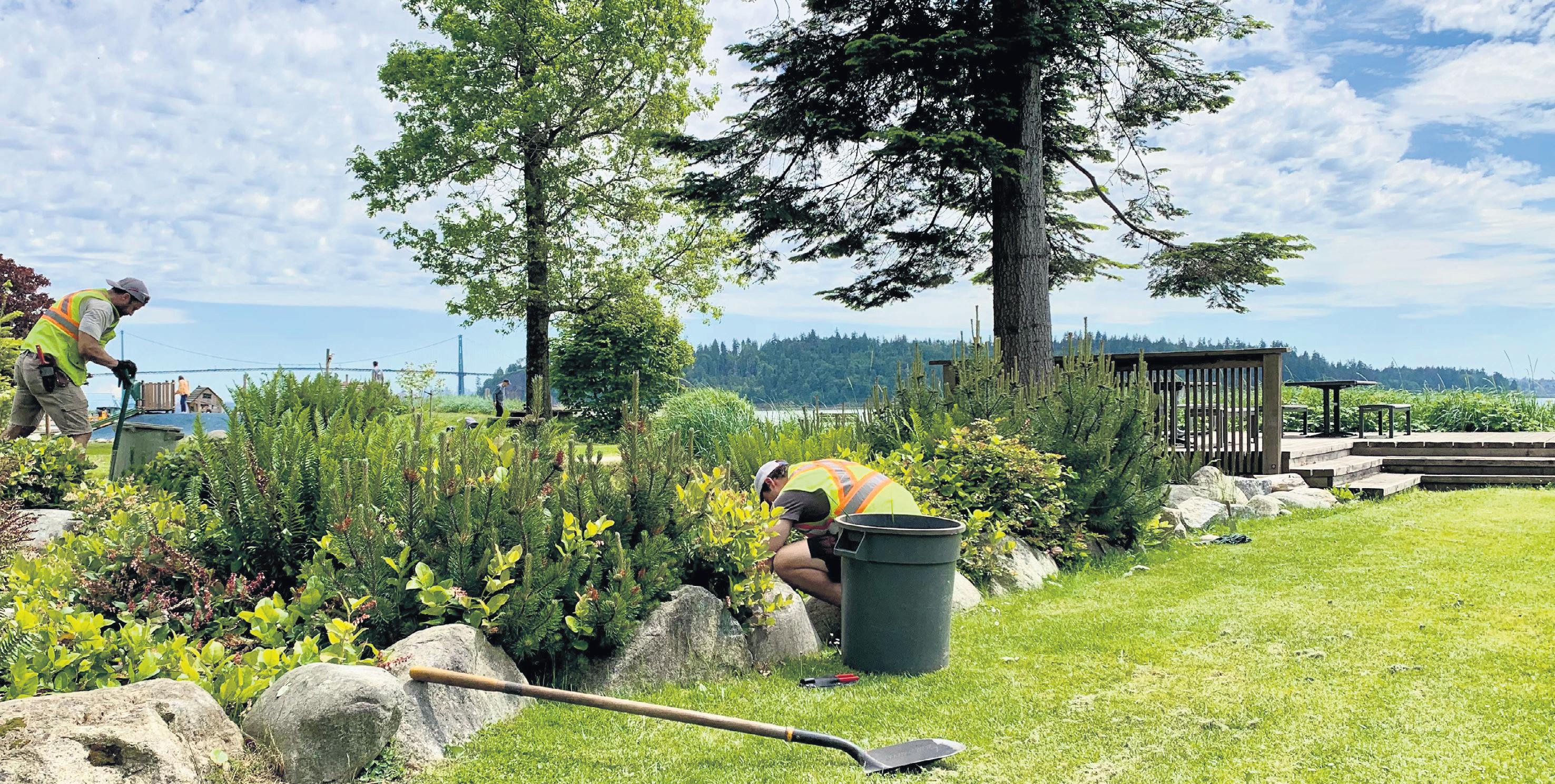




What does local government do in West Vancouver?












Continued from page A21


Regional districts oversee and provide services for each area within their region, bringing representatives from each community together on a board.


Regional districts are entirely separate entities from municipalities with some different rules.
MUNICIPALITIES VS. REGIONAL DISTRICTS
According to the province, regional districts were created as a result of development into urban areas in the 1950s, with residents commuting to urban centres for work.
“Development in the rural areas increased demand for services such as water, sewage and zoning,” reads a provincial webpage.
“By 1965, the B.C. government amended the Municipal Act to enable the creation of regional districts.”
Hurford who also serves on the Squamish-Lillooet Regional District board, helped to explain their differences as well as their overlap.
“In the context of the SLRD, there are three seats from Squamish council on the


regional district board It really is about providing a lot of municipal services in those areas that are not inside a municipality or don’t have a lot of population,” he said.
Hurford said that decisions are made in both governing bodies through “an open and transparent process:” council and regional board meetings are available to watch online via their respective websites, for example.
Municipal councils and regional districts, however operate differently especially when it comes to budgeting.
“Each service provided to the residents is its own cost centre,” Hurford said of the SLRD.
“As an example, if you live in an unincorporated area [not within a municipality], you could advocate to have a cost centre started just to provide street lights Each service is a budget unto itself
“[Whereas in] a municipality we make decisions more broadly by moving funds around It’s a bit more nimble.”
SCHOOL DISTRICTS
B.C. is also divided into school districts, each headed by local school boards, who work with the Ministry of Education and Child


Care to support and improve all student learning.
These boards are separate governing bodies from municipal councils and regional districts though senior school district staff engage with local government processes.
The boards are composed of locally elected trustees who engage with their respective communities, and oversee the work of their school district Their work includes the establishment of policies, and setting their annual budgets.
WHO HAS THE LAST WORD?
All municipal councils and regional districts operate under provincial legislation
This legislation affects only the respective province, covering matters related to education health care social welfare and highways
“The province created local government, so therefore they have ultimate ability to impose themselves onto local government, Hurford said.
The province usually steps in depending on the project, such as health-care investment, which according to Hurford can cause issues with accountability within local government branches, though the Community Charter

WHAT DOES AFEDERAL MEMBEROFPARLIAMENT (MP) DO FOROUR COMMUNITY?
YourMPrepresents youand fellowconstituents in thefederal government by debating and voting on national issues in Ottawa.Justasimportantly, our constituencyoffice is heretohelp younavigate federal services, whether you need assistancewithCPP benefits,the CanadianDentalCarePlan (CDCP), immigration applications throughIRCC, or resolving issues with theCRA Wealso bring your concerns andpriorities forwardtoensure your voiceis heardatthe federal level.
WHY SHOULD IREACH OUTTOMYMP’S CONSTITUENCY OFFICE –AND
WHEN?
Your MP’sconstituencyoffice is your direct link to federal support and representation in your community. Youshouldreach out if you’re experiencing delays with federal services, need help understanding governmentprograms, orhaveconcerns that require escalation. We canadvocateonyourbehalf, provide clarity, and ensure your case is being properly addressed, helping you navigate thesystemwithgreater confidenceand ease. Youmay also communicatedirectlywithyourMPthrough theoffice,and tapintoinformation andprogramsofinterest to you.


LOCAL GOVERNMENT AWARENESS WEEK
does make provisions for accountability of ethical ethical conduct
“The answers often feel like a hot potato. ‘Oh, that’s not my responsibility that’s someone else’s responsibility.’ We do have a shared responsibility to have the needs of our community met,” Hurford said.
“It is important to distinguish between what is a direct decision for the [municipal or provincial] table, and what is an advocacy role for a decision that happens somewhere else.
“Our role is to make sure that when those decisions are being made [by the province], they understand where we are currently and where we’re going for the community.”
FEDERAL OVERLAP
Generally speaking, the federal government oversees nationwide policies such as banking, criminal law, national defence and citizenship. There is some overlap with the province, however known as concurrent jurisdiction (legal powers). Taxation, agriculture, pensions and natural resource extraction are under the jurisdiction of both levels of government
The federal government, Hurford said,
WHA T’ S WI TH TH E BL ING ?
LOCAL GOVERNMENT AWARENESS WEEK
MAYORS EXPLAIN THE LORE BEHIND THEIR CHAINS OF OFFICE
FOR LOCAL GOVERNMENT AWARENESS WEEK, B.C. MAYORS HELP EXPLAIN A TRADITION THAT DATES BACK TO THE MIDDLE AGES
BY ABBY LUCIANO, LOCAL JOURNALISM INITIATIVE REPORTER
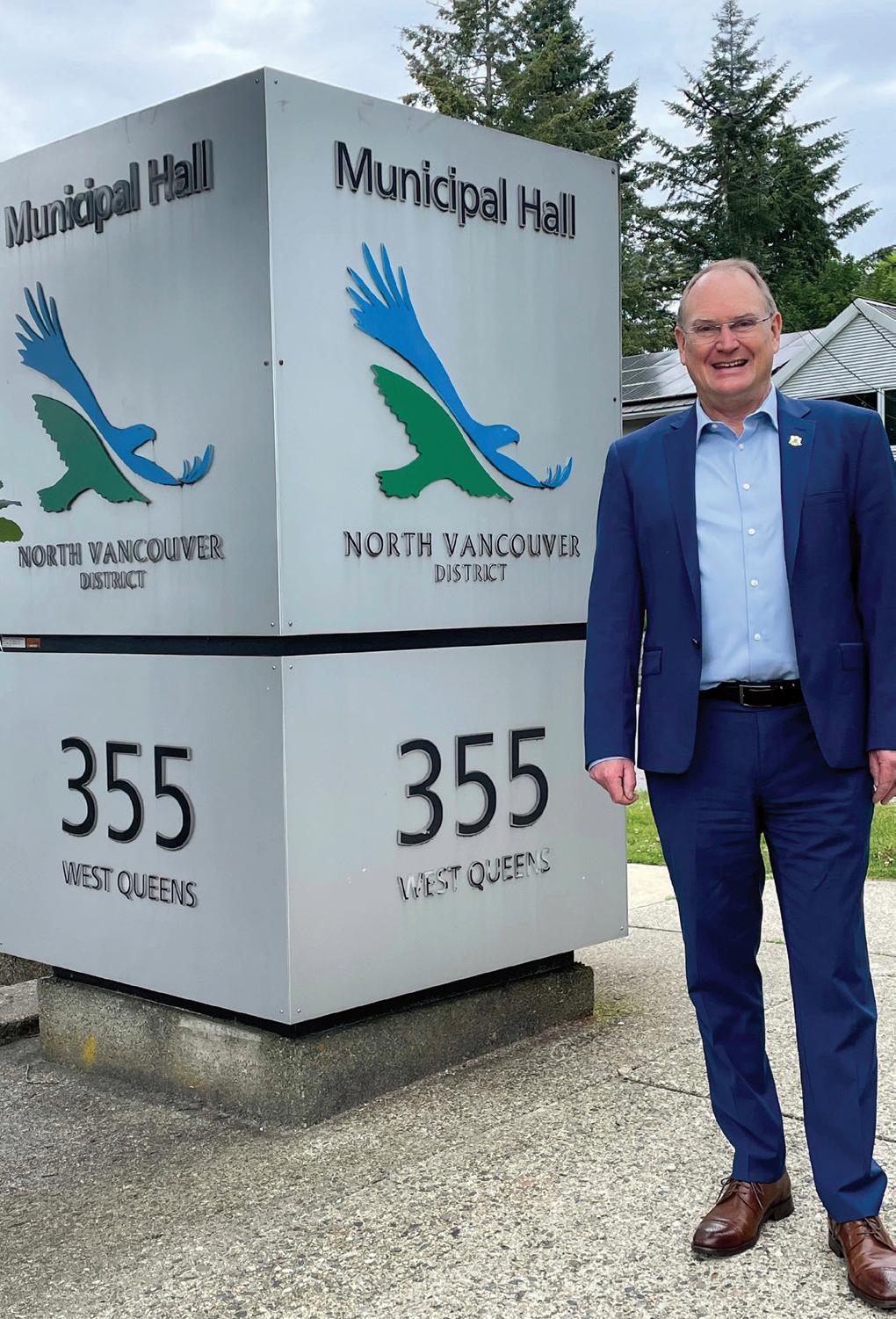
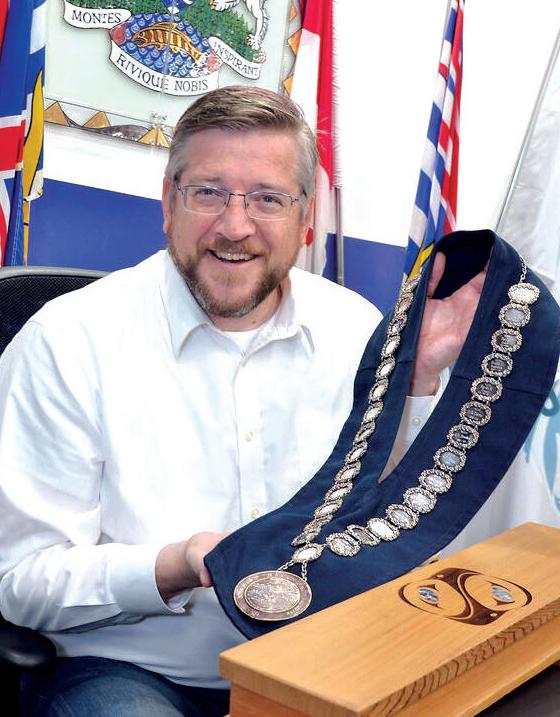
It’s some serious bling that is hard to miss Every council meeting, District of North Vancouver Mayor Mike Little wears a silver metal chain with a medallion around his neck. At a glance, it’s a curious detail you might not even notice during council discussions, but its significance has a lot more weight to it
Since 1981, each mayor in the District of North Vancouver has worn the chain of office a piece of regalia that marks the leadership position but also includes details about the municipality’s history.
“For local governments, this is a well recognized way to represent the office,” Little said Mayors or other higher officials wearing a chain of office, also called a livery collar, is a tradition that dates back centuries. The heavy chains were typically made of gold and carried an official seal to symbolize the wearer’s
authority. The Collar of Esses, one of the oldest and best-known livery collars, has been in continuous use in England since the 14th century
The chains have evolved into the modern chain of office we see today worn by many municipal leaders in England, Wales, Ireland, Scotland, Canada, New Zealand and Australia. The practice has also been adopted in other non-Commonwealth countries such as Germany, Norway and the Netherlands. North Vancouver’s chain of office is a lot newer going back just over 40 years. Little said the Derek Inman family donated the chain to the district Inman was known for civic initiatives in the community He was named to the Order of Canada for his work with various North Shore organizations.
Today, the chain of office is made up of
leaf-shaped tokens around the neck, with each one ingrained with a mayor’s name and years served. A gold and silver medallion hangs from the bottom, with a logo of the District of North Vancouver sketched in showing tall ships in the Vancouver Harbour with the scenic North Shore behind, all sewed together on a cloth backing.
Little has been wearing the chain of office in council meetings since he was elected in 2018. His name is in the chain along with other names including Charles Phibbs and James Cooper Keith, two of the district’s earliest mayors, as well as City of North Vancouver Coun. Don Bell, who served as district mayor in the 1970s and ‘90s.
“So it’s a big part of our history,” Little said. “It’s great to be a part of such a long relationship with the community.”
CEREMONIAL OCCASIONS AND TRADITIONS
For City of Richmond Mayor Malcolm Brodie, his municipality’s chain of office comes out on special occasions, including Remembrance Day.
“I would rather wear it where it’s a really important solemn occasion then it’s kind of special,” he said.
Brodie has been mayor for more than 24 years. “M. Brodie, 2001” is marked on Richmond’s chain of office
The municipality’s chain of office dates back to the early 1980s, he said. Gilbert Blair was the first to wear the chain who served as mayor from 1973 to 1990. A group of residents rallied together to raise funds to bring Richmond’s chain of office to life, he said.
Continued
WhyVote in Your Local GovernmentElections?
In the Montreal-area riding of Terrebonne,asingle vote separatedthe winning Liberal candidate from the defeatedBloc Quebecois incumbentinthe 2025 federal election -while 28,604 eligible voters stayed home.Given thatthe Carneygovernment needed this seattosecureamajority, anyone of those non-voters could have decided the balance of powerinParliament
Neverlet it be said thatyourvotedoesn’t matter Closer to home,only 22% of DistrictofNorth Vancouvereligible voters cast ballotsinthe 2022 municipal election -the lowest since 2011 -meaning 48,802 people letothers choose their council. What doesCouncil actually decide?Tax ratesand increases. User fees.How your taxdollarsare spent. Land use- whether your neighbourhood getsagrocerystore or avape shop,whether parking is free or pay, whether new amenitiesserve
soccer players or pickleball enthusiasts.Roads or bikelanes. Parks or policing. Firehalls or recreation centres.Evenwheretolocateachlorine plantor whether to allowfireworks.
In 2022, 48,802 Districtresidents let others make all those decisions forthem.
In 2026, don’t be one of those non-voters. Familiarizeyourself with the issuesand candidates, and vote fora council thatreflects your values. Voting iseasy:anyone 18 or older who is aCanadian citizenliving in or owning property in the Districtis eligible
Election dayisSaturday, October17, 2026. Thereare polling places across the District with advance polls andmail voting also available
It matters. It’s easy. Please vote.

LO CAL GO VE RNME NT AWARENE SS WEEK
The chain’s body is gold, interlocking small separator bars and medallions together and behind a blue cloth. The medallions bear an anchor representing the municipality’s fishing industry, dogwood marking the provincial flower and the maple leaf representing Canada. The names of Richmond mayors are on the gold bars giving a historical record of municipal leaders.
“I think that every city should have a chain of office as the official symbol of the office,” Brodie said. “It’s a symbol of the position of the mayor you’re the chief executive officer of the city and so it’s symbolic of that kind of position in public life.”
A REMINDER OF COMMUNITY DUTY
District of Squamish Mayor Armand Hurford said the chain of office serves as a reminder of the weight of responsibility that comes with the role.
“Both physically and metaphorically,” Hurford said “The role of mayor I think is something very few people get to experience, and it does come with a lot of responsibilities.”
Squamish’s chain of office came into the district in 2005, a relatively young piece compared to other municipalities. Hurford said the chain cost $2,000 at the time. Squamish’s chain has a dark blue cloth with a silver chain. It carries a similar style to other municipal chains, with maple leafs and dogwood flowers on it, along with the names of previous mayors and their dates in office
Squamish’s chain lives mostly in a display case at municipal hall, as Hurford takes a different approach to the chain. The Squamish mayor has only worn it once when he was sworn into the role in 2022
“These chains of office and so on are
“is quite a bit more removed” from local government.
Local governments often collaborate with the federal government over grant programs, paid directly to municipalities or through joint agreements. The federal government may get involved in matters about transport and infrastructure, such as the building of bridges and operating on navigable waters.
POTENTIAL PUBLIC MISUNDERSTANDINGS
Misunderstandings can be common when representation appears imbalanced to the public, or when legal processes get delayed.
Neither the regional district’s nor the municipality’s jurisdiction is a matter of opinion, Hurford said.
Sometimes, folks get confused and come to council members about things that are provincial or federal.
“For land use decisions, we often have a high degree of control over what happens,”
probably the epitome of colonial practices,” he said. “Even in our procedure bylaw, we’ve removed references to the mayor being refered to as your worship…. There’s a lot of aspects to consider as you’re governing, not just what you’re doing but how you’re doing it.”
It’s still a piece to celebrate though, he said, as it’s brought out for the district’s annual mayor for a day event, where students are invited for a municipal hall tour and can try on the chain of office
“It’s my favourite day of the year,” he said. “There’s a quiet that comes over when that comes out and they get to put it on. It definitely has an impact and I think it’s appreciated.” ◆
he said.
“Sometimes the council receives correspondence around all sorts of ‘asks’ that are just not quite [within municipal jurisdiction].”
Hurford also said that, in his experience, local governments collect significantly less tax revenue than other levels of government, which is primarily used to provide day-to-day services, so it can be “incredibly challenging to meet the expectations of the community.”
Rather fittingly, this year’s Local Government Awareness Week theme is financial resiliency
GENERAL LOCAL ELECTIONS
Each local government is responsible for running its own general local election, meaning it is responsible for running the voting, counting, reporting results and accepting candidate nominations.
Elections BC is responsible for administering the campaign financing and election advertising rules.
More information about how to vote can be found on the Elections BC website. ◆






Continued from page A24
District of North Vancouver Mayor Mike Little holds the municipality’s chain of office
PAUL MCGRATH / NORTH SHORE NEWS