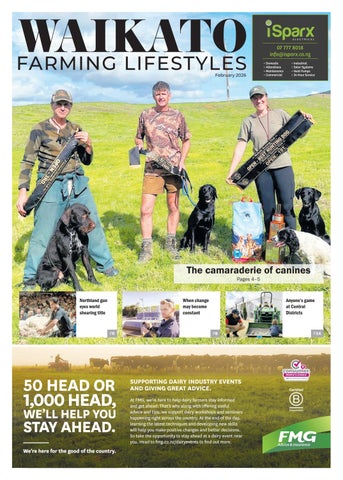
Waikato Farming Lifestyles, February 2026

Page 1


Phone: 0800 466 793 Email: info@rml.nz

Postal Address: PO Box 474, Dargaville Physical Address: 107 River Road, Dargaville

Editor: Andy Bryenton

Journalists: Amy Fifita | Andy Bryenton

Advertising: Donna Eves 027 525 8223

Production: Gavin Bainbridge | Marnie Fuller | Daniel Foster | Liz Clark

Accounts: accounts@rml.nz

Distribution: Laurie Willetts Printed by: NZME

Website: farminglifestyles.co.nz

Opinions

19,200 copies DELIVERED FREE to every rural delivery address in Waikato and King Country.

MIDAS DIAMOND JEWELLERS

Cheaper, easier, safer: a win for rural youth

For many young people in rural areas, a driver’s licence isn’t just a piece of plastic — it’s their lifeline. It’s how they get to work, training, school and healthcare, often over long distances with little or no public transport.

That’s why the recently announced improvements to the driver licensing system will be warmly welcomed by rural communities.

From January 25 2027, the government will overhaul New Zealand’s Graduated Driver Licensing System (GDLS) to make it cheaper and easier to get a driver’s licence. The changes are expected to deliver particular benefits for rural areas, where being able to drive is often essential for daily life.

Under the new system, the total cost of getting a Class 1 car licence will drop by $80, from $362.50 to $282.50. This saving comes largely from removing the full licence practical test for car drivers, cutting not only fees but also the time and travel costs involved in sitting tests, a real bonus for people who currently must drive long distances to reach a testing centre.

Young drivers under 25 will spend longer on a learner licence — 12 months instead of six — but they can reduce this to six months by logging supervised practice hours or completing an approved practical course. The aim is to give young people more real-world driving experience,

including on rural roads where conditions can be more demanding, while still allowing motivated drivers to move through the system more quickly. Will safety be compromised? No. The restricted period will be 12 months for under-25s and six months for those 25 and over. Restricted drivers who receive demerit points will stay on their restricted licence for an extra six months, reinforcing safer driving habits. A zeroalcohol limit will apply to all learner and restricted drivers, an important safeguard on rural roads where serious crashes can have devastating impacts on tightknit communities.

In short, these licence changes aim to make life easier and safer for rural drivers: cutting costs, reducing long trips for tests, and encouraging more real- world driving experience, especially for young people.

With tougher expectations around safety and ongoing reviews built in, the new system is designed to open work and training opportunities while helping keep rural roads, and rural communities – safer and stronger.

by Barbara Kuriger, MP for Taranaki/King Country

Red sector hits highs and cuts deep

Members of the agricultural red sector, meat producers and exporters, met with Agriculture Minister Todd McClay at a special celebratory barbecue on February 15, celebrating two milestones.

The first is the anniversary of the first frozen shipment of sheep meat to the UK, a turning point in local agriculture. The second was the announcement that the lamb export tally had cracked the important $4 billion mark for the first time in 2025.

“As we honour the legacy of the pioneers behind the first shipment of frozen sheep meat to the United Kingdom, we also celebrate lamb exports exceeding $4 billion for the first time last year,” said Mr McClay.

“Today, we acknowledge the red meat sector and its significant economic contribution to New Zealand, as well as the hard-working men and women behind that success.

“Agriculture is the backbone of our economy. Meat and wool export revenue alone is forecast to increase seven per cent to $13.2 billion in the year to June 30 2026.”

Trade agreements were touted as a major series of victories for the incumbent government, angling to showcase its positive leadership in the rural sector during this important election year.

However, while sheep farmers were feted at parliament, those who advocate for them had some cutting words for the most important piece of legislation affecting them this year; the replacement to the Resource Management Act.

While Beef + Lamb New Zealand supports the need for change, the organisation’s submission on the new laws, which will replace the RMA, raised red flags for the red sector.

“We welcome the intent to enable primary sector growth and development, reduce the need for consents, make more activities permitted and reduce litigation,” said B+LNZ chair Kate Acland. “However, as we have said since it was released, the way the legislation is currently written is missing the mark.”

“The language is more stringent around setting and managing limits and would

likely see the need for more consents, not less. There are more onerous requirements on permitted activities.

“The lack of appropriate guardrails on the exercise of ministerial and council powers in many areas and the lack of requirement to consider costs and benefits could result in significant economic impacts.”

That’s a stern warning from an industry, which by the government’s own admission, contributes billions to an economy still in recovery. Singled out for special scrutiny in the submission were freshwater farm plans, and the

introduction of the market-based allocation or levies for resource use. This submission is based on farmer feedback from hundreds of voters. With input from this and other sources pulling the RMA replacement in a variety of directions, it’s now up to the ministers in charge to chart a line between what the public wants, what stewardship demands, and what will continue to stoke the engine room of the economy on farms.

The full submission on the RMA replacement by Beef+Lamb NZ is available on their website (pictured, B+LNZ chair Kate Acland)

OF CANINES

When Helen Sansome retired from horses, she looked to gun dogs as an alternative. Twentyfive years on, and she enjoys the trial days and camaraderie that the gun-dog community brings.

“I have had gun dogs for about 22 years. When I decided I was too old for falling off horses, I thought training a gun dog would replace that part of me,” said Helen.

“My husband and I both hunt. I train our labradors and also enjoy running them in trials. I am not overly competitive, but we go home with a ribbon regularly, and I love the camaraderie. Everyone wants their own dogs to do well and also enjoys watching their friends’ dogs do well, too.”

With three main gun dog breed categories, spaniels, retrievers and pointers, each has its own purpose when hunting or trialling.

THE CAMARADERIE

Run by volunteers, the Waikato Gundog Club is a place for both dogs and handlers to grow, hunt and compete through training, trialling and friendship.

“Spaniels work close to their handler, flushing ground game or birds from cover at a range of up to 20 metres for their handler to shoot. The dog must be trained to work close by.

“Retrievers were bred to retrieve shot game animals or birds. Initially staying close to the handler, when they see a bird going down, they mark it from over a hundred metres away.

“The handler can then send their dog to retrieve the game. They can also be trained to follow accurate directions to game they have not seen.

“Many people enjoy duck shooting, and we should all hunt ethically, meaning nothing is left injured or dying, and well-trained dogs help with that. Duckshooters and hunters should either hunt for pest control or the pot, and a dog with a soft mouth can retrieve a duck or a rabbit, so it’s suitable for you to eat.

“If you shoot a duck that lands on the other side of the river from you, a welltrained dog has no issues crossing

• Suppliers of distinctive door handles and fittings

• Consult us for hardware to enhance your home

www.handlesandbrass.co.nz Visit our showroom: 12 Somerset Street, Hamilton

07 846 1235 e. sales@handle.co.nz

A bird being delivered to Helen by one of her gundogs
the river to retrieve it for you.

2025 Roughshooter Trial — (from left) third-place open winner Jake and Scotty, second-place winner Paul and Bee and first-place

“A pointer’s function is to indicate the game it can smell and stand in a locked position, showing the handler where the game is.

“Pointers can work a long way from the handler and can stand and point for minutes until the handler arrives. They will try to hold the game in a static position until the handler gets there to flush the bird or shoot the rabbit.”

Like sheepdogs it can take years to train a gun dog to its best ability, although, for some, it’s about training a well-behaved dog and not the competitive nature of the sport. Helen says the club draws people with hunting breeds together.

“The club’s function is to bring people together who have these hunting breeds.

Some people want to hunt, while others prefer the trials. With the trials, we set up simulated hunting conditions with an article, an item representing a bird for the dog to retrieve.

“Half of the fun is in training a dog to understand how to do the job well, and the other half is competing against your friends to see whose dog is the best. It’s a tight-knit sporting community, so everyone who travels to trials considers each other friends and colleagues, as well as rivals.”

Trials are run throughout the country, hosted by many gun-dog clubs, and some

members travel throughout New Zealand competing. For the Waikato club, helping novice handlers and owners train their dogs is a big focus.

“We encourage people with young gun dogs, who don’t know what to do with a dog which has other ideas than just walking on a lead and being a pet. It’s up to the owner to find the time and knowledge to give the dog the training and the enrichment it needs.

“Each individual dog is different, even if they are the same breed or from the same litter. That is where our experience comes in. Being able to work out what makes a dog tick is like finding

a key to unlocking what is inside your dog’s head.”

The club also puts on events and occasions for people to socialise with others in a similar position to themselves.

“People volunteer their time to run the club. I invite people to email us at waikatogundogclub@gmail.com or the Waikato Gundog Club Facebook page.

“We enjoy helping the dog and owner to enjoy each other. It’s hugely rewarding when you see the smile on a handler’s face when their dog achieves something they’ve been struggling with.”

winner Isabel and Indy and the best hunting dog Mira

NORTHLAND GUN EYES WORLD SHEARING TITLE

Northland shearer Toa Henderson will be shearing for the ultimate dream when he represents New Zealand at the 20th Golden Shears World Championships in Masterton on March 4–7.

Winning the Golden Shears and New Zealand Shears Open finals in Masterton and Te Kūiti respectively last year, Henderson dominated Shearing Sports New Zealand’s near year-long, eight-round machine shearing selection series, winning four of the first five events and finishing runnerup in the other, to secure one of the two berths with a round to spare.

“A team of two machine shearers, two blade shearers and two wool handlers will represent New Zealand with the goal of restoring the black-shirt pride after New Zealand, for the first time in world championships’ history dating back to 1977, filed to win any of the titles in Scotland in 2023,” says SSNZ spokesman, Doug Laing.

“New Zealand also missed out on the glamour open shearing individual

and teams titles in Scotland, and four years earlier in France, and also has an old score to settle from when veteran Scotland international Gavin Mutch won the individual title the last time the championships were held in Masterton in 2012.”

Kaiwaka shearer, Henderson, a top senior shearer around 2007–2008, has had a dramatic rise in the open ranks since returning eight years ago from a stint in Australia. He is now closing in on a total of 50 wins in the top grade in New Zealand, and showed his relent in top international class in winning the open title at the Royal Welsh Show in July last year. His victories have been highlighted by the long journeys to get to the events, sometimes over 1,000km return trips by road in the North Island, and he will be out to emulate the feat of Northland’s other

WAIPA HEATPUMPS

champion, Rowland Smith, from Ruawai but based in Hawke’s Bay, and who won the 2014 title.

The championships in Masterton have attracted entries from 28 countries, and hundreds of others from overseas as either entrants in the supporting annual Golden Shears events or as supporters.

In addition to the six world titles, more than 20 other regular titles at the annual Golden Shears will be decided, including the Golden Shears open shearing and woolhandling events.

In all, about 600 competitors will take part, bolstered by about 150 chasing the world titles. Tickets for the major Friday and Saturday night events in Masterton’s War Memorial Stadium, where the Golden Shears international championships have been held annually since 1961, sold out quickly several months ago.

Spectators will also be accommodated in a marquee across the road in Queen Elizabeth Park, while thousands around the world are expected to watch the live-stream, covering all events over the four days.

hailing from Ruawai has won the open title in the past
world

Woolhanding will show shed support skills in Golden Shears competition

It was back in 1958 that members of the Wairarapa district Young Farmer’s Club proposed a shearing competition at the annual Agricultural and Pastoral show. With advertising and special invitations, the stage was set for a new sporting spectacle that would impact Masterton in the future.

The competition was a huge success and organisers, Laurie Keats, Iain Douglas and Graham Buckley approached Federated Farmers’ then chairman, Mr Roy O’Hara, and president, Mr Bob Chamberlain, to ask if an annual contest could be staged in more appropriate premises — the War Memorial Stadium.

Golden Shears was the agreed title and from this point in 1960, the world’s greatest shearing competition was conceived. The inaugural Golden Shears of 1961 surpassed all expectations, with crowds so great that the local army was called upon to help with control.

Through the 1960s and 70s, before the impact of live sport on TV, the fascination and excitement of Golden Shears became a household name with seats booked from year to year.

Many shearing greats including Ivan Bowen, Snow Quinn, Roger Cox and

Martin Ngataki to mention a few — engraved their names in the record books.

In the late 1970s and early 80s many minor shearing competitions sprang up throughout New Zealand. Shearing had entered the world of professionalism.

Prize money for competitions became larger by the year, with many shearers adopting professional attitudes such as training programmes and fitness courses never heard of in the early days of the 1960s.

For the voluntary organisers of Golden Shears, the rate of change was difficult to keep pace with. There were many rule

changes, major sponsors were required, inter-challenge events between Australia and New Zealand were implemented and a World Shearing Championship held in 1980.

Golden Shears became more than just a simple shearing competition. It became a foundation, a centre point and arena, where many constitutional meetings were held and our world champions were founded.

Shearing competitions throughout New Zealand and the world established their presence as a major sporting code in the late 80s and early 90s.

Provincial competition sets the stage for world champs

WHEN CHANGE MAY BECOME CONSTANT

Regional Council says the region’s ability to manage growth, climate risk and infrastructure relies on strong regional leadership supported by a clear and accountable local democratic voice.

This follows the government’s proposal to replace regional councillors with a board of mayors responsible for regional level decisionmaking. Wellington bureaucrats are currently undertaking work to determine which regional council functions this new proposed board would oversee.

Council chair Warren Maher acknowledged that reform is needed but emphasised that any changes must strengthen — not sideline — regional leadership and the democratic representation to take a whole-of-system, catchment-based approach to planning, investment and advocacy.

The government’s proposal represents the largest reform of local government in New Zealand for decades, and could eventually lead to fewer mayors, and fewer councillors, if district councils agree to amalgamate during this process.

However, it will be a years-long reform process, with ministers admitting that it’s likely this law change won’t pass until after next year’s election. The ministers in charge of this work, Chris Bishop and Simon Watts, expect that regional councils could be gone within two years.

The plans could involve councils merging, or councils setting up jointly-owned organisations that manage water, transport or rubbish collection, across districts.

Regional Development Minister Shane Jones has previously compared regional councils to Russia’s Kremlin, and that their time was coming to an end citing too much “duplication” and too much confusion in the current system.

Bishop said change could save ratepayers money, in the long run. “Forcing councils to make plans for their own wider reforms, by finding smarter ways of working together, sharing back office services, or forming joint agencies for roading and recycling, this can cut duplication and could unlock economies of scale and make ratepayer dollars go further,” he said.

A suggestion of having ministerial appointees on the panels was “an option” put out for discussion.

“It’s not a power grab. This is about making local government fit for purpose and delivering values for ratepayers,” he said.

Cr Maher says the Waikato is one of New Zealand’s fastest-growing regions, “home to major urban centres, productive

rural communities, nationally significant infrastructure and some of the country’s most important assets.

“At its heart is the Waikato River Catchment, New Zealand’s largest and most complex, which shows why coordinated, region-wide oversight is essential. Land use, waterways, flood protection, infrastructure and community wellbeing are all interconnected.”

He pointed out effective flood protection, for example, requires decisions that consider whole catchments, from headwaters to coasts, and across the many communities and land uses they support.

“Regional council oversight is essential for coordinating across district boundaries, aligning investment, and ensuring that development remains productive, sustainable and resilient for generations,” he said.

“This strategic function is particularly important in the Waikato, where flood protection, river management, transport networks and growth-related development all intersect across our river systems and catchments.”

Cr Maher also highlighted the strong working relationships between the regional council and territorial authorities, which have enabled aligned planning, delivery and investment.

Warren Maher, Waikato Regional Council chair

“Our work is strongest when regional and territorial authorities operate as complementary partners,” said Cr Maher. “Reforms should build on those relationships, not fragment them.”

At its February Strategy and Policy Committee meeting, councillors expressed concerns that reforms, which centralise decision-making or fragment regional responsibilities, could weaken the ability to manage complex systems, such as large catchments, and reduce accountability to the communities most affected.

Committee chair Ben Dunbar-Smith said councillors engaged deeply with the implications for local voice, regional oversight and its partnerships with territorial authorities and iwi.

“That discussion reflected our shared commitment to ensuring any changes strengthen outcomes for Waikato communities,”

Councillors noted the importance of governance stability during any reform process. They were elected to serve their communities through to the 2028 local elections and maintaining that mandate provides certainty for long-term planning and delivery, and community representation.

“Continuity matters,” said Cr DunbarSmith. “Our communities deserve stable leadership and accountable representation as we navigate growth, climate pressures and future investment decisions.”

united councils, Waikato, Thames Valley and part of Tongariro, 12 noxious plant authorities, 11 pest destruction boards and a dozen drainage boards. The Land Transport Act 1998 added transport to WRC’s responsibilities.

It leaves the question for this writer if, in the words of another “few things are more important during a change event than communication from leaders who can paint a clear and confidence-inspiring vision of the future.” So in a look at the history of Waikato governance in the past, change may become a constant?

Waikato Regional Council has said it remains committed to working with the central government, territorial authorities, iwi and communities as the reform process progresses, and contributing regionallyinformed perspectives that reflect the interconnected nature of the Waikato region’s catchments, infrastructure and communities.

While the current change proposal still has a way to go, change itself is no stranger to Waikato’s administration in the past. In November 1989, the Waikato Regional Council was established by the Local Government (Waikato Region) Reorganisation Order 1989 from 40 former authorities, two catchment boards, Hauraki and Waikato, three

innovation came with EV buses Flood protection with work scheme unit lead Hayden McGregor

RGT Hustle delivers high-protein, homegrown feed when animals need it most.

RGT18 endophyte provides protection against key pests, helping pastures persist with proven animal safety. ORDER YOUR RGT HUSTLE RGT18 HERE

Lime and fertiliser mix hits the spot

A long-time fourth-generation Northland farming couple is encouraging farmers to look carefully at their fertiliser mixes after a switch to Avoca 15 years ago, which has significantly boosted production and animal health on their Towai sheep and beef unit.

Despite decades farming, Gordon and Vivienne Priest took the plunge to step away from traditional thinking around fertiliser, and it has paid dividends — not just in their pockets.

The beauty of working with Avoca is that farmers can mix critical nutrients with lime at Avoca’s various plants around Northland, Port Albert and Waikato. If the fertiliser trucks are not quite full, a bit more lime can be mixed in to make the transportation more cost-effective.

The couple said they appreciate Avoca taking the time to come to them, take multiple soil tests and then sit down and go through the tests thoroughly to map out a fertiliser plan that fits their budget.

As a result, the Priests have significantly reduced their annual fertiliser spend, saying it makes sense to put the products on that feed the soil. In their case that includes lime, dicalcic phosphate and an elemental slow-release sulphur, both being especially suitable to Northland soils.

It’s 15 years ago that the Priests went to an Avoca farm field day where they learnt about getting the balance of fertiliser inputs right for the benefit of the land and stock.

Shortly after, Avoca director Bryce Manderson first paid a visit to the then 433ha property, the couple has since downsized to 303ha, including 99ha area of native bush, he lent the Priests a book on nutrients and offered to map out

a fertiliser plan, combining lime and the correct nutrients their soils needed.

“We had a near-vertical learning curve to recalibrate what was needed. The biggest thing with Northland soils is the number of different soil types on one property. We have seven different soil types on one property, so our fertiliser mixes must be right. It is a tactical approach and so we have two different mixes for autumn and spring,” the Priests said.

They say productivity has clearly gone up and they can see the faster growth in their

animals by using their ‘eye-ometer’ before they even contemplate weighing.

Manderson says Gordon and Vivienne have done a great job building up their nutrient structure and farm productivity, and he really appreciates their loyalty and openness.

“You can see it in the health of the pasture and the quality of their stock. You do not get that if you have low pH because that has major detrimental effects on soil structure, soil biology and the availability of soil nutrients to the plant. The ideal on-farm pH is 6.2–6.3.

Vivienne and Gordon encourage other farmers to look at the Avoca model to target what they need.

“We are certainly carrying more stock on the property than 15 years ago, and we have fertiliser and stock records going back to 1975, so we can make good comparisons.

“We carry 170 sheep to help with weed control and 440 beef, including 115 purebred Murray Grey breeding cows. From the progeny, we sell approximately 40 yearling Murray Grey breeding bulls annually.”

From left: Avoca sales consultant Angela Irwin, Towai farmers Gordon and Vivienne Priest, Avoca director Bryce Manderson and Avoca sales and marketing manager Neil Crowson

Avoca’s Agricultural Lime (AgLime) and Limestone are manufactured at our three lime quarries at Rarewa (Whangarei), Pokapu (Bay of Islands), and Port Albert (Wellsford). Both are also available at bulk stores in Dargaville and Te Kauwhata (Waikato). From all of these locations, we’re well placed to deliver Agricultural Lime products Northland and Waikato wide. Avoca also provide soil fertility testing and consulting as well as lime and fertiliser products and custom mixes.

NORTHLAND LIME

10

reasons to apply lime to your soils:

1

2

3

4

Increases nutrient availability; raising soil pH with lime to ~6.3-6.5 releases and balances soil nutrients for plant uptake, maximising return on your fertiliser spend.

Improves pasture yield. Trials have shown pasture production increases up to 68% and corresponding live weight gains.

Reduces need for N-fertiliser; lime stimulates N-fixation by legumes, and N-release from organic matter into plant available forms.

Improves P availability through a ‘phosphate sparing effect’ - trials in Northland showed 50-60kg more P available consistent over 3 years after applying 5t/ha of lime to a pH 5.8 soil. Optimal P availability occurs when soils are limed to pH 6.3-6.5.

Improves pasture palatability allowing for more even grazing of pasture and better pasture utilisation. 5

6

7

Increases soil biological activity and diversity; key to nutrient availability, good soil structure & porosity, and ultimately pasture/crop yield.

Increases resilience to droughts, floods, and runoff/erosion, reduced greenhouse gas emissions, and greater root penetration for pasture/crop growth by flocculating (loosening) your soil to improve soil structure and porosity.

Increases water holding capacity in the dry and water drainage in the wet. Lime drives down magnesium in ‘tight, high Mg’ soils such as estuarine soils found in the Hauraki Plains. 8

9

Reduces elemental toxicities evident at low pH levels, e.g. Al, preventing subsoil acidification and improving root growth, root development, and reduces P-fixation.

Provides calcium which is essential for both plant and animal growth and health. 10

A field days’ welcome

Central Districts Field Days is a highlight in the Manawatū calendar with tens of thousands of people coming through the gates at Manfeild in Feilding.

From farmers and foodies to techheads and townies, New Zealand’s largest regional field days has something for everyone. As well as deals and new products to experience, there is also a wealth of entertainment for young and old.

Sprawling across more than 33 hectares at Manfeild, there will be more than 500 exhibitors with so much to showcase. It’s big, but it’s not too big.

You may be coming for the latest in the agriculture arena, or the new AI tool everyone is talking about. There will be great deals to be had for your time off the farm, too — with a range of products to make your farmhouse a home.

The Central Districts Field Days has been part of the rural calendar and the local community for three decades, evolving from a small gathering of farmers and their supporting businesses

to become a giant celebration. Each year this event welcomes more than 26,000 guests through the gates, boosting the local economy and empowering the rural sector with new knowledge, innovations and networking opportunities.

In those thirty years the event has gone from 230 sites to more than 500, adding massive components such as the National Excavator Operator Competition, the NZFC Central Districts Doubles fencing competition, and the SNIWC Golden Loader Competition.

If you are hankering for some quality downtime, there’s a huge array of entertainment and some delicious treats to offer you, too. As you plan, your first bargain will be to save money by prepurchasing your ticket; you save money, and you save time queuing at the ticket kiosk, too. Visit cdfielddays.co.nz.

Trace elements for human health

I recently spoke to a sheep farmer who told me that his lambs were 1kg heavier than the previous year after supplementing with trace minerals.

Farmers know that New Zealand soils are deficient in selenium and other trace minerals and the benefits of adding these for animal health and productivity. It is a pity that the human health system essentially ignores most trace elements leading to many health problems.

Minerals are critical for the health and development of every cell in our body. Insufficient trace minerals can weaken immune response and leave people feeling tired and run down. Addressing trace minerals is my first step for those who are tired with no medical cause.

The major minerals are calcium, magnesium and potassium. Of these, it is usually magnesium that is insufficient in many diets. Low magnesium can cause many health problems, including cramp, restless legs and heart rhythm problems.

We use zinc, copper, boron, selenium and manganese to make a group of antioxidant enzymes. The two most important are superoxide dismutase (SOD)

and glutathione peroxidase (GPx). We make SOD from zinc, copper, iron and manganese, while boron increases SOD and GPx activity. We make GPx from selenium. These antioxidant enzymes are the front line of our cell defences against free radical damage and are important for immune defences.

While people often respond quickly to antioxidants and vitamins, the benefits of minerals can be significant over time. This is why any good multi-nutritional will have these minerals at the right levels and in a form our body can absorb. Over the years, I have seen profound health improvements by adding a multi that is a true multimineral. Try a good multi mineral/vitamin and antioxidant for three months and see what you have been missing.

John Arts ( Adv.Dip.Nut.Med) is a nutritional medicine practitioner and founder of Abundant Health Ltd. For questions or advice contact John on 0800 423 559 or email john@abundant.co.nz. Join his newsletter at abundant.co.nz.

“CelleXtrahasessentialmineralsandvitaminsneededforthe thousandsofenzymesthatmakeourbodyfunction.Insufficient mineralsandvitaminscanpreventhealingandcausedisease. Damagefromfreeradicalscausesmanyhealthproblems. CelleXtracontainssomeofnature’smostpotentantioxidants tohelpbuildyourantioxidantdefencesagainstfreeradical damagetobodytissues.TryCelleXtrafor3monthsandsee whatyouhavebeenmissing.CallmetoseeifCelleXtrais rightforyou.”

CelleXtracontainsnature’smostpotentantioxidantstoprotectfromfree radicaldamageincludinggrapeseedOPC,Greentea,NZBlackcurrant, Hesperidin,Lutein,Lycopene,BetaCaroteneandnaturalVitaminE. CelleXtraisamulti-vitaminwithVitaminsD,EandBcomplex. CelleXtraisamulti-mineralincludingcalciumandmagnesiumwithtrace mineralsselenium,zinc,copper,boron,manganese,molybdenum,chromium, vanadiumanda50+tracemineralextractfromseawater.

Protectsjointsagainstfreeradical damage

Supportsimmunefunctionand optimumenergylevels

Supportshearthealthand circulation

Includesaspecificeyehealth formula

The Central District Field Days gates await to welcome visitors and exhibitors into New Zealand’s largest regional field days

ANYONE’S GAME AT CENTRAL DISTRICTS

time for buying machinery, watching or getting involved in craftsmanship and enjoying the event, the field days brings various competitions to the fore for people to celebrate and cheer on.

“It’s back after seven long years. The hugely popular Tractor Pull, powered by Brandt, will pull in the crowds at this year’s Central Districts Field Days,” said spokesperson Hayley McLarin.

Central Districts Field Days is back, promising yet another year of exhibitors, rural competitions, displays, food and entertainment all at Mansfield Park, Feilding, from March 19–21.

“There are also regular competitions that will be a drawcard for spectators: Southern North Island Wood Council Golden Loader Championship, Central Axemen’s Association Grade Championships, CCNZ Cable Price National Excavator competition, Central Districts Doubles Power Fencing Competition and the Manawatū Strongman.

“Enter your tractor and test your machine’s grunt as it pulls a sled as far as possible down a 100-metre track, or watch tractors large and small battle it out. The Tractor Pull competition will run over three days at Manfeild in Feilding.

“The competitions kick off on Thursday, March 19, with the CCNZ Cable Price National Excavator Operator Competition and Tractor Pull. Both allday events, the excavator operator contest is the national final for the 2025–2026 season.”

Many family-oriented sites are there to amaze and excite children visiting the event with their families.

“For the young at heart, there will be free Dungeons and Dragons sessions at Gamersphere NZ. They specialise in board games and hobby products and will be providing free gameplay tables where

attendees can sit, relax, and enjoy a board game or two — site H20.

“Teaching children about the importance of trees, the New Zealand Farm Forestry Association will be promoting alternative species, giving seedlings away to kids so they can plant them and watch them grow in the years to come.

“There will also be a Waratah Simulator used by train operators of forestry machines to fell trees, for people to try out — site AG15/16.”

While there is plenty of competition on the stage, exhibitors will also be wanting attention, especially with so many farming and lifestyle options available.

“These field days have more than the latest machinery, tech and farm tools. There is also a wide offering of lifestyle brands, too.

“Designed and handmade in New Zealand, Fantail’s Nest has an ideal solution to chilly pram walks in wintertime and peace of mind when on the farm or out and about. Their pram nest sleeping bags adjust to the length of your pram and are designed for three months up to three years of age. After they outgrow the pram, they can be used as a sleeping bag and snuggle sack — site M44A.

“Don’t follow the crowd, be the coolest kid on the block with original, handmade designs from Rockabilly. This Hamilton company has agricultural, hunting and fishing gear for ‘cool cats and cool kitties’ — from warm polar fleece to tees, shorts and onesies, your little tike will rock at site L49.”

For those with an appreciation for art and style, be it garden art, jewellery or fashion, rest assured, the field days have everybody’s needs covered.

“Goat Point specialises in designing and manufacturing corten steel garden art, and will have those and other outdoor in-

ground or wall-mounted garden art at CDFD.

Wellington-based business owner, Aaron, will be there to chat about ideas you may have, as he also does commissions — site LC4.

“Febuleux Vous (fabulous you) has a range of yellow and rose gold, and silver jewellery, even an equestrian-themed selection — think stirrups and horse charms. Some purchases also include a donation to Equestrian Sports NZ — site RL54

“Sixteen-year-old Jess Hindry admits to having a full-blown obsession with farming, fashion and horses. She wanted clothes that could handle a bit of chaos, look sharp in the years and still get a few

smirks at the local dairy. So she designed them herself.

“The Tararua teen offers shorts, stubbies and rugby jerseys that she designs, ‘usually on the back of a feed sack or while plaiting a horse’s tail’. They are then made in Pakistan and tested, she says, on real-life farm days ‘where you spill your drink, lose your dog and still call it a win’.”

As always, the Central Districts Field Days has an abundance of exhibitors, activities and entertainment for anyone walking through its gates. For more information, visit cdfielddays.co.nz.

76% of us ignore online ads

RURAL CONTRACTORS & SUPPLIERS

Plastic revolution on farms

While the debate surrounding carbon credits, methane measurements and other environmental issues continues in the rural sector, there’s a broad consensus on one ecological measure that’s fundamental.

Recycling plastics used on farms is not a new concept, and it’s been supported by schemes such as Agrecovery and Plasback. Some have been in place and developing in tandem with farmers’ needs for two decades.

Now, these two initiatives will be rolled into one, forming the basis for a single, unified nationwide plastic recycling scheme on farms. Parliamentarian Penny Simmonds, speaking at the announcement of the new programme, said that this industry-led push for recycling will be free to use, simple and accessible.

“This initiative is about fixing the basics while building the future with practical

solutions that protect the environment, support our farmers and ensure a productive, sustainable primary sector,” Ms Simmonds said.

The key to implementing a nationwide rural plastics recovery scheme is a new set of regulations covering agrichemical containers and farm plastics.

“We consulted on these regulations earlier this year and received strong support from the rural sector. Farmers and growers have been working towards this for a long time. Today, we’ve made it happen.

“Plastic products are essential to New Zealand’s world-leading agri-economy, but

Planting & Re-Vegetation

581 Pyes Pa Road, RD3, Tauranga

Email: nznativeflora@gmail.com

Web: www.nznativeflora.co.nz

rural communities know that waste like containers, plastic bags and bale wrap can pile up.”

The new scheme, announced in the first week of December, will share the responsibility for recovery and recycling between sellers, producers and end-users of farming products that use plastic for packaging. It won’t just benefit farmers. Forestry, manufacturing, hospitality, tourism and local authorities will also have access to national take-back services, making safe disposal easier for all New Zealanders.

“Key industry stakeholders support the scheme because it offers a better alternative to burning or burying plastics, reducing environmental risk and supporting cleaner, safer rural communities.”

Nadine Tunley, CEO of Horticulture New Zealand, and DairyNZ general manager David Burger both expressed support for the initiative.

“It is a simple and efficient way for growers to optimise environmentally positive growing practices,” said Ms Tunley.

“New Zealand dairy farmers are committed to reducing their environmental footprint, including minimising plastic waste. The green farms product stewardship scheme offers a solution to enable our farmers to progress further along this journey,” said Dr Burger.

THE BEST SOLUTION FOR YOUR DAIRY FLOOR RESURFACING

Now there is an extremely cost effective and easy to use product that will bring back your damaged concrete floors to an approved standard.

COLOURCRETE DAIRY FLOOR RESURFACER has been specially formulated for the repair of worn or damaged concrete in the dairy industry. Dairy Floor Resurfacer is a two pack system combining a Portland cement, fine aggregate based micro concrete and sophisticated binders that provide superior, compressive, tensile and flexural strength as well as a very high level of abrasion resistance and adhesion. This product is suitable for repairing worn or pitted areas or to provide a non-slip surface where necessary.

A two pot clear epoxy sealer can be supplied to reduce the wearing effects of milk and acid.

COLOURCRETE DAIRY FLOOR RESURFACER can be supplied as a ‘do it yourself kit’ and delivered anywhere in New Zealand or applied, in most areas, by contractors.

COLOURCRETE DAIRY FLOOR RESURFACER

Part A is supplied in 20kg bags and covers approximately 3m square. Part B modifier is supplied in both 10litre and 20litre containers and approximately 4litres per 20kg bag would be required. After trowelling, the surface can be broomed or sponge finished.

Sharon, Wayne & Brett Thompson
Environment Minister Penny Simmonds has announced a new, free-to-use nationwide farm plastics recycling plan

RURAL CONTRACTORS & SUPPLIERS

Resurrecting a giant

The first tractor sold at the Northland Field Days was a Case IH, a 1985 model, which will return to the hallowed ground of the agricultural show this year to celebrate the event’s 40th birthday.

However, this vintage farm machine is not the genesis of the Case name; the company was involved with tractors long before the reign of diesel and turbochargers. Perhaps the crowning achievement of Case in those early years was a tractor so huge and imposing that it gained the name ‘the road locomotive’ — the colossal Case 150hp.

Every metric confirmed it as a giant, and its job was to mechanise agriculture on the great plains of the US in the days of steam. Even the modern Case IH tracked tractor units only approach its massive size; 35 tons of hand-crafted iron and steel, driven by 180psi of boiler pressure chugging to spin a 1.27-metre flywheel. The road locomotive was more than eight metres long, as tall as a house, and could reach a top speed of just 10km/h. That sounds unimpressive, until you realise that it could hit this speed while drawing 40 giant plowshares through the soil.

The pinnacle of steam technology and might, only nine of the huge machines were ever made back in 1905. There

was a limited need for such a huge and powerful steam tractor. The wide-open fields of the midwest were its natural home, and with most farms in those days being smaller than the big mechanised operations of the present day, the Case 150hp was ahead of its time. Sadly, all nine machines were destroyed as they became seen as outdated and inefficient, replaced by fleets of smaller tractors using internal combustion.

Then came Kory Anderson, a visionary engineer who grew up with steam traction engines. His parents took him to his first steam engine show when he was only five days old, and his parents Kevin and Donna supported his passion for the preservation of agricultural machinery heritage with their own. At the age of ten he met a man named George Hedtke, who owned the boiler of a very special machine; the prototype Case 150hp. It became Kory’s ambition to rebuild the giant.

From the age of 16 he embarked on his plan, talking to veteran fabricators, learning old techniques, building his skills

and aiming to remake the big 150hp from scratch. By the age of 22 he’d founded a metalworking company that could help fund and accomplish his dream. In 2016, he hand-picked a team of friends and began the task, completing the rebuild in

just 16 months. It was the culmination of an idea sparked when he was still in primary school, and it worked. The new Case 150hp is a huge attraction today, and holds the record for the biggest steam tractor on earth.

Mitch van Dam

Ph: 027 841 8055

E: gandmfencingnz@gmail.com

Rural, lifestyle and residential fencing - Waikato wide.

WHY CHOOSE SHOTCRETE?

Shotcrete is a specialised concrete application technique where concrete is sprayed onto surfaces at high velocity. Ideal for creating durable silage bunkers, retaining walls and structural overlay, this method ensure a seamless finish.

DURABILITY

Creates a strong, long lasting surface ideal for heavy duty use.

EFFICIENCY

Saves time and reduces material waste compared to traditional methods.

FLEXIBILITY

Perfect for the irregular shapes, vertical wall or are with difficult access.

The massive Case 150hp, with a vintage car for scale

Future fuel ready to flow

Hydrogen fuel has been described as the ‘logical step beyond EVs’, and is slowly gaining momentum as an alternative to fossil fuels for road freight, generators, maritime applications and tractors.

The issue with hydrogen is not its scarcity; it’s the most common element in the universe. There’s also no problem with emissions, and the hydrogen fuel process generates water as its output. The real problem is the infrastructure needed to deliver it to the pump for motor vehicles, a supply chain from producing hydrogen to its delivery and sale.

Part of that chain is being forged in Taranaki this year, with construction starting soon on a sustainable green hydrogen facility in the region, supported by a $19.9 million government investment. The project includes supplying renewable electricity to the Ballance Agri-Nutrients’ Kapuni facility in South Taranaki for their site operations and producing green hydrogen for emissions-free transport at Hiringa Energy’s refuelling operations.

“We’ve waited more than five years for this project to begin, after it was delayed by years of red tape and appeals under the previous Resource Management Act consent process,” said Regional Development Minister Shane Jones.

“A delay like this, for a project so important to a regional economy, shouldn’t have happened. I welcome the economic benefits, jobs and alternative energy source this initiative will bring to Taranaki.”

The impact will be felt beyond the borders of the Taranaki region too. Proof that green or renewable hydrogen fuel can be made at scale in New Zealand is important, as it means that the nation is a step closer to offering hydrogen as an alternative to diesel or petrol in suburban fuel stations and farming and industry. The machines exist, and are far from experimental; big names in tractors such as New Holland, Fendt and Kubota all offer hydrogen models.

“This will be one of the first projects in New Zealand to integrate wind, industrial renewable electricity supply and zerocarbon green hydrogen fuel production at scale,” said Mr Jones.

“The initiative unlocks significant local investment and will be a vital contributor to long-term development in the region, and will help diversify the Taranaki economy by supporting new, innovative clean energy industries.”

Hydrogen tractors like this one by New Holland could be a major force in future agriculture, but the key to unlocking this power is the infrastructure to let hydrogen fuel flow

RURAL CONTRACTORS & SUPPLIERS

Keeping the sting out

Radio-tracking technology has now enabled the detection of 10 yellow-legged hornet nests as the eradication response effort on Auckland’s North Shore continues to accelerate.

Biosecurity New Zealand’s commissioner north, Mike Inglis, says the technique of attaching tiny radio transmitters to worker hornets and tracking them back to their nests has quickly become a core tool in the response programme.

“Our capability with the equipment is growing rapidly, helped by practical advice from visiting experts in hornet management from the United Kingdom,” Mr Inglis says.

“Once we have a transmitter attached to a hornet, we are typically locating the nest within a few hours.

“The trackers, which complement on-the-ground surveillance and public notifications, will become increasingly useful as summer progresses and hornets begin building larger secondary nests high up in trees where they’re less visible to ground searchers.

“We have located three secondary nests so far and, after comprehensive planning, have successfully treated and removed them.

“We always expected to find increasing numbers of hornets, and we have

scaled up our surveillance and tracking programme accordingly. Finding hornets and their nests is a sign that our response is working as intended.”

Using tracking, trapping and ground surveillance, along with public notifications, the team has located and destroyed 49 queens, 51 nests and hundreds of workers to date.

The team was able to locate three small nests. One is located in Takapuna, and two are in Forrest Hill. These finds are well within zone B of the intensive surveillance and trapping area, with zone C extending to 11km.

A network of more than 1,080 traps is operating. The zones reflect the density of traps, and there have been no detections outside the 11km area.

“Public support continues to be vital to our response, with more than 11,060 notifications to date.

“We encourage anyone who has a suspected hornet specimen, has located a possible nest, or has taken a clear photo to report it to us online at report. mpi.govt.nz or by calling 0800 809 966,” Mr Inglis said.

MPI is asking people to keep a lookout for the yellow-legged hornet and to report it if they see any

RURAL CONTRACTORS & SUPPLIERS

Harvested by pros — developed in antiquity

When European sailors came to what they called the ‘new world’, they found that maize was a staple crop; mahiz, as the Taino people called the early form of corn, literally means ‘the giver of life’

• Organic granular slow release fertiliser

• Weed free - 67% organic matter

• Will not burn plant roots or foliage

• Can be incorporated when planting or used as a top feed

• Fantastic for ALL lawns, flowers, vegetables, roses, trees, shrubs, & container plants

• Bioboost is available from: Selected Garden Centres, Commercial Horticultural, Agricultural & Turf Service Centres

Contact Bioboost Ltd for further information by E mail office@bioboostdistribution.co.nz or Phone 06 7548454/ 0274431809 www.bioboost.co.nz

As harvesters driven by contracting professionals cut a swathe through the maize fields this year, it’s interesting to reflect that 10,000 years ago, this valuable resource began with a nomadic Central American tribesperson taking note of an unusually ripe-seeded sprig of grass. It was called teosinte, and when it was discovered by nomadic tribes who had walked down from North America before the last Ice Age, it was unimpressive and small. Each stalk held only a few kernels, and these were hard and tough. Humans made maize, and the white corn cobs still colloquially known as Indian corn in the US, by careful selective breeding.

Centuries before European peoples even invented the plough, or China the seed drill, the ancestors of the Aztecs and the Caribbean Taino people were engaged in genetic engineering. They didn’t know about the DNA coiled up in every cell of the teosinte, but they did know about pollination and crossing the plants with the best kernels to make a more edible crop. Some of this knowledge came down as near-mythical stories, but it had the

We deliver water throughout the Waikato area to residential, farms and business customers. We can cart up to 28,000 lt with truck and trailer. We can fill anything from your house water tank, through to swimming pools, and farm tanks. We also do water tank cleaning and sterilizing.

waikatowatersupplies.co.nz 027 417 9195 waikato@4water.co.nz

same effect as today’s advanced seed science, given enough time.

One of the clues pointing to this deep history comes from a corn cob found in a cave in Tehuacan, Mexico, at about the time the pyramids were being built. Someone long ago didn’t finish their dinner, and threw the three-centimetre cob with eight rows of kernels on the floor. Dry conditions kept it preserved until it was discovered in modern times.

“Based on archaeological evidence and modern DNA evidence, we know that maize was domesticated in Mexico some time between about 10,000 and 6,000 years ago,” says Nathan Wales of the Natural History Museum of Denmark in Copenhagen. That puts thousands of years of careful selective pollination and planting between the first discovery of teosinte and the cob found in that cave in Tehuacan. Our forebears may not have had the harvesting machines or tractors we deploy today to make maize a major part of agriculture, but they definitely had the will to persevere, and turn an unassuming kind of grass into a crop that feeds millions.

Quality based arboriculture tree services. Our passion for Tree Care and our involvement in the industry is paramount with what we do.

Maize is such an important part of Kiwi agriculture that it’s often forgotten its origins lie half a world away and 10,000 years in the past

Dairy industry in good shape

New Zealand dairy farmers are achieving more with fewer cows, shown through record milk production each cow and continued genetic progress according to industry icon DairyNZ.

Statistics shared with the Livestock Improvement Corporation show that milk solids production rose 2.9% in 2024/25 to 1.94 billion kilograms, despite a 0.5% fall in cow numbers to 4.68 million.

The lift was driven by record-high productivity for each cow, with the average animal producing 414 kilograms of milksolids, which is up 14kg from last season.

DairyNZ chief executive Campbell Parker says the results reflect farmers’ strong focus on performance and adaptability despite a range of challenges over the past few years.

“Farmers continue to focus on doing things smarter and driving productivity, including managing their herds more efficiently, improving feed use, and leveraging science and technology to lift production per cow, while also responding to higher milk prices last season,” he said.

“The trend towards fewer, larger herds is continuing, but the focus on highperforming, healthy animals remains strong, with fewer cows producing more milk. It’s a real credit to farmers’ skill, resilience, and ongoing investment in herd improvement and farm management. That

combination of efficiency and innovation keeps New Zealand dairy farming at the forefront internationally.”

Meanwhile, herd improvement activity strengthened notably in 2024/25, with farmers continuing to invest in data and genetics to support long-term gains.

A total of 3.84 million cows were herdtested, which is a five per cent increase from the previous season, with 82 per cent of the national herd tested in 2024/25. The proportion of cows mated to artificial breeding (AB) also increased slightly to 81.5 per cent.

Dairying has a long history in Northland with the first dairy cows introduced in

1814 by missionary Samuel Marsden for mission stations in the Bay of Islands. The cows came from the New South Wales Crown herd. Shorthorns were useful draught animals, which gave good milk and provided excellent meat.

Shorthorn herds were established by the early 1840s, and for a long time were New Zealand’s most popular cattle breed. The dairying process of course has evolved in leaps and bounds into mass factory production but it was all very simple to start with. The milk was strained through fine mesh, then allowed to settle so the cream rose to the top. This was skimmed off with a ladle and made into butter in a small churn.

Dairy products added protein and fat to the limited pioneer diet of bread, meat, some fish, and a few fruits and vegetables. Butter, cheese and yoghurt stayed fresh and edible a lot longer than raw milk or cream.

Today’s dairy cows are an economic cornerstone

Tuatara’s

When we talked to Tuatara Machinery’s director, Geoff Hill recently, we cut right to the chase and asked him why people should buy a Tuatara off-roader. His response was immediate.

“They’re built of steel, not plastic — they will go where other ATVs won’t,” said Geoff. “They’ll carry more, tow more, and they are cheap and easy to service. Many customers service them themselves, thus avoiding the $150 hourly rate that many dealerships charge.

“The Tuatara is not a recreational vehicle, like many of the competition, it’s a commercial vehicle that is designed to work and one that has extreme versatility in uses.”

Instead of being based on a lineage that goes back to motorcycles, Tuatara’s stable of hard-working UTVs come from a design ‘blank slate’, totally informed by the needs and wants of New Zealand’s farmers.

“Our design comes from talking to farmers,” says Geoff. “I’m always listening to feedback from our customers in the field, and we incorporate that knowledge into our design. Tuatara is designed for hard work.”

This leads to some unique points of difference, hardwired into the DNA of the whole range, petrol and electric. It starts with a solid steel construction for strength, foregoing plastics for more rigidity and toughness. Then the Tuatara is powered up with either a modern water-cooled threecylinder, 69-horsepower petrol engine or a

choice of two electric options delivering up to 175km of range — all hardened against the elements. Like any serious off-roader, it’s equipped with locking diffs to deliver superior traction when it’s needed.

The petrol engine comes from the lineage of motor cars, not bikes, meaning that it’s quiet, economical and extensively tested.

The electric motor gets water cooling too, to make sure that it ticks one of the biggest boxes Kiwi farmers demand — total reliability. Geoff reckons that farms are a good fit for electric vehicles, which are used during the day and charged overnight. They also have the benefit of greatly reduced maintenance and running costs and improved ease of use.

The overall design of the Tuatara emphasises the ability to go anywhere, and feedback from customers bears this out. Geoff has been sent videos of his machines towing two-tonne utes out of sticky situations, pulling 1,000 litre calf feeders, and getting to places where other UTVs fear to tread.

The Tuatara boasts an over-all carrying capacity of 750kgs, which it manages with ease. It also comes with a winch with a twotonne pulling capacity, just one of the many standard accessories supplied.

The versatile Tuatara has been designed from first principles to work hard in real New Zealand conditions
Prolan New Zealand

DAIRY & LIVESTOCK

No bull — they’re the biggest ever

Before domestication, the giant aurochs, great-great-grandsire of modern cattle, was a fearsome beast, growing up to 1.8 metres tall and tipping the scales at 1,500kg.

Scientists now think that this huge prehistoric cattle beast was domesticated twice, once in the Middle East and once in India, giving rise to the many varied traits typifying modern cattle breeds. The main aim of those early humans was to turn the ferocious wild aurochs into a more docile farmyard animal. However, one aspect of the aurochs farmers have longed to recover for thousands of years is their titanic size.

Breeding for good traits, such as resistance to disease, mild temperament and muscle mass went on through the Middle Ages, but it was not until the rise of agricultural societies and a scientific look at bloodlines that huge progress began toward the giant cattle of the present day.

From the 1700s onwards, the principles of natural philosophy were applied to livestock, delivering breeds such as the Belgian Blue, which was developed in the low countries in the 19th century. At the time, farmers would not have known that a genetic mutation affecting the musclegrowth chemical myostatin was responsible for these cattle’s powerful physique, but they did know how to breed for it.

Other big examples arose at a similar time, as the potential of what could be done with crossbreeding of regional cattle breeds was realised. In Italy, the publication of the Libro Genealogico in 1933 led to the development of the already-powerful Chianina breed.

By 1955, despite the ravages of the second world war on local agriculture, the Chianina breed had become worldleading giants. In that year, a bull named Donetto was shown in Siena, with a weight of 1,745kg. His home town of La Fratta became famous, and his owner reported that he kept growing until he hit a whopping 1,800kg.

In older times, one had to physically introduce a big bull to an equally hefty cow to blend bloodlines and breed for size. Modern techniques have added flexibility to selective breeding, and the size of modern bulls on show reflects this. However, the happy outcome of a cross-channel match in the 1880s has led to the biggest bull ever taken to a livestock show.

The Durham cattle of England were crossbred with the Mancell of France, creating the Maine Anjou breed by 1909. These large and characterful cattle are to be found here in New Zealand, too, but it was in Paris that the biggest ever specimen of their kind became a legend.

Presented to the 2016 Paris International Agriculture Show, Fetard was a true giant, weighing in at 1,950kg. He was raised by Earl Frédéric Jaffré, and may have achieved the landmark figure of 2,000kg had he not perished in an accident not long after his show day triumph.

The world’s biggest bull, nearly 2,000kg of powerful Maine-Anjou bovine

W e m i g h t b e U r b a n b y

n a m e , b u t w e ’ r e c o u n t r y

b y n a t u r e .

T h i n k i n g o f b u i l d i n g , b u t

d o n ’ t k n o w w h e r e t o s t a r t ?

C o n t a c t U r b a n H o m e s , y o u r d e s i g n

a n d b u i l d s p e c i a l i s t – a n d b o o k y o u r

F R E E S i t e A p p r a i s a l a n d D e s i g n

C o n s u l t a t i o n . u r b a n . c o. n z

Turn static files into dynamic content formats.

Create a flipbook