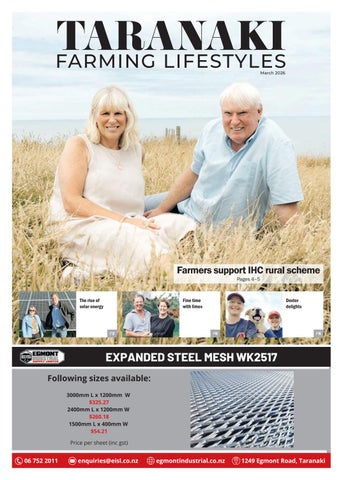
9,074 copies DELIVERED FREE to every rural delivery address in Taranaki.
The rise of solar energy
Solar energy is becoming an increasingly practical and valuable option for rural communities across Aotearoa New Zealand.
With many farms and small settlements located far from urban centres, solar offers a way to reduce power bills, improve reliability and support local resilience.
One of the biggest advantages is cost savings. Rural households and farms often face higher electricity prices, particularly where long lines and low population density increase distribution costs. By installing rooftop or groundmounted solar panels, landowners can generate a significant share of their own power.
Over time, this can reduce monthly bills and protect against future price rises. For farms with high daytime electricity use, such as milking sheds, irrigation, refrigeration and pumps, solar can be especially cost-effective.
Solar also strengthens energy security. Rural areas are more vulnerable to power outages caused by storms, fallen trees, or network faults. When solar is paired with batteries, homes and farms can keep essential systems
running even when the grid goes down. This resilience is crucial for protecting livestock, crops and food storage, as well as maintaining communication and safety during emergencies.
Environmental benefits are another key factor. New Zealand already has a relatively clean electricity mix, but adding more renewable generation close to where it is used reduces transmission losses and reliance on fossil fuels. Rural communities can play a leading role in climate action by cutting their carbon footprint while showcasing practical, landbased solutions.
Finally, solar can support regional development. Local installation and maintenance create jobs, while community solar projects can generate shared income and foster collaboration. For many rural New Zealanders, solar energy is not just a technology choice, but an investment in greater independence, sustainability and longterm prosperity.
I always love seeing what’s possible in provincial New Zealand; this was taken a few years ago at a solar farm down in Canterbury with Pete Saunders from Solagri Energy
by Barbara Kuriger, MP for Taranaki/King Country
By Paul Campbelll
World titles fall close to home
The international shearing world has celebrated at the Golden Shears event in Masterton where a supporting cast of thousands and 600 shearers and woolhandlers saw Te Kūiti’s Jack Fagan, familiar face Toa Henderson and three other Kiwis win top world rankings.
On top of that New Zealand won all three teams titles, the first country ever to do so, with the treble of machine shearing, blades and woolhandling titles.
Toa Henderson successfully defended the Golden Shears open shearing title in Masterton. He is a familiar face, after his same-day marathon 900km drive from Kaiwaka to Stratford and back last year to win his event at the A&P show, and watch as Jack Fagan made it three in a row in show competitions, winning the Taranaki Shears open final at the age of 33.
“The Golden Shears meant more as the black singlets dominated when New Zealand scored an unprecedented five wins in six events at the World Shearing and Woolhandling Championships,” said Shearing Sports New Zealand official, Doug Laing. “The only event not won by the Kiwis went to perhaps an appropriate southern hemisphere rival in South African Bonile Rabela’s successful defence of the blades shearing title.
“In the final events of the four days of competition Toa successfully defended the Golden Shears open shearing title, with 2014 winner Roland Smith, from Hawke’s Bay sneaking through to be second.”
Jack Fagan, of Te Kūiti, won the National Shearing Circuit final to secure a place in the 2026–2027 New Zealand trans-Tasman shearing and woolhandling
team. It was clearly a dream for Fagan as his father, Sir David Fagan, won several times from 1986 to 2008. Jack Fagan shore in the 2024–2025 series, after finishing third in the circuit final.
“The whole four days of the championships was a sell-out with the venues jam packed with families, supporters and fans. A post-event
gathering in Masterton saw accolades of the past recalling Taranaki shearing luminaries, including Paul Avery’s shearing in 16 of the 20 Golden Shears open finals from 1990 to 2009. He also won three New Zealand open finals, five North Island Shearer of the Year titles, and was the SSNZ’s Bowen Trophy holder as the country’s top-ranking
open-class shearer in 1999–2000 and 2005–06.”
The next world championships will be held in Geelong, Victoria, Australia, in 2029, and is expected to be in the first week of November. The championships have been previously held in Australia in Perth, Western Australia, in 1986, and Toowoomba, Queensland, in 2005.
A sell-out crowd at the Masterton Golden Shears
series
The long-time supporters first heard about the scheme when they began farming together around 40 years ago. Jo was raised with an intellectuallydisabled brother, and her parents and family were involved with IHC.
“Therefore, the calf scheme was something we naturally wanted to get involved in,” said Jo.
Launched in 1982, the IHC Calf and Rural Scheme raises funds to support people with intellectual disabilities, their families and volunteers in rural New Zealand. Calves or lambs can be pledged and when sold, the sale price goes to IHC. Virtual calves can also be donated, or donors can make monthly monetary gifts.
FARMERS SUPPORT IHC RURAL SCHEME
BY DENISE GUNN
For more than 30 years, South Taranaki dairy farmers Alaister and Jo Murdoch supported the IHC Calf and Rural Scheme through donating calves each year.
Alaister and Jo initially started out donating one calf each season. They later increased this to two calves. Since the outbreak of M bovis in New Zealand, the couple switched to making a monetary donation.
The Murdochs own two dairy farms in Taranaki. Their home farm is a 214ha property in Manaia, milking a herd of 600 to 620 Friesian and Friesian-cross cows. A 20ha support farm is just one and a half kilometres away.
“This farm is run by ourselves, and our equity partner/manager son Kody and his wife Sarah.”
Kody is supported on-farm by two other staff members, Joshua Cribb and Jade Torpey.
The couple bought their smaller second farm, located three kilometres from the home property, 30 years ago. A herd of 300 to 310 Friesian cows are
• Organic granular slow release fertiliser
• Weed free - 67% organic matter
• Will not burn plant roots or foliage
• Can be incorporated when planting or used as a top feed
• Fantastic for ALL lawns, flowers, vegetables, roses, trees, shrubs, & container plants
• Bioboost is available from: Selected Garden Centres, Commercial Horticultural, Agricultural & Turf Service Centres
The Murdoch family
milked on the 99ha property, which is operated by the Murdoch’s other son Josh and his partner, Jacinta Kete. Jacinta has a young son, Arlo.
“Our daughter Ashlee and her husband Daniel, and two children Charlie and Maddie, live in Melbourne,” said Jo.
Jo and Alistair progressed up the dairy farming ladder through the contract milking and 50/50 sharemilking route, purchasing their first farm when they were both 30. Since then, they have bought surrounding farms as they’ve come up for sale.
“We have taken up the challenges these have involved.”
As calving starts at the end of June on the Murdoch’s coastal Taranaki farm,
Alaister and Jo always picked out wellmarked Friesian bull calves early. This gave the calves optimum time to reach their growth potential.
“Our calves were fed colostrum milk, then milk from the vat for a total of 12 weeks, plus hay and calf meal.”
The selected calves ran with the Murdoch’s replacement heifer calves before being weaned at around 120kg. Calves, around five months old, were sent to the PGG Wrightson weaner sales, along with other donated IHC calves from around Taranaki.
Jo said as a farmer, it’s not difficult to rear a few extra animals.
“They slot into any system very easily and we would encourage other farmers to help out. It really does make you feel good knowing you have been able to contribute.”
The scheme is on track and expected to raise $43 million by the end of this financial year.
“One of the most rewarding aspects of the IHC calf scheme is our ability to be able to help people that are in a less
fortunate position than ourselves, through no fault of their own,” said Jo.
“It may only be small, but it is nice to know that it potentially can put a smile on someone’s face and make their day.”
Further information on the IHC Calf and Rural Scheme can be found at ihc.org.nz/ calf, emailing calf@ihc.org.nz or phoning 0800 442 500.
“Our IHC coordinator Lennie is a great guy, always loves a catch-up every year, and he does a fantastic job for the scheme each year.”
PA S TURE
Cutter tetrapioid Italian ryegrass is our own top quality brand of annual ryegrass - which sells out very quick. Well known ryegrass sold nationwide for over 30 years. Performing well above producing 264 bales from 4ha 22 tonne dry matter per ha.
Farmers very impressed!!
Stock find it hard to keep up with in spring.
Please view our website for more photos and prices. Phone Nick 022 083 3579, Julie 027 324 4431 or 0800 4 SEEDS Next day dispatch - Easy to order - www.cridgeseeds.co.nz
Comprehensive Services: From full servicing and engine repairs to WOF and COF pre-inspections. We also have a VTNZ testing station and an on-site auto electrician.
24/7 Support: We offer a round-the-clock emergency breakdown service to keep you on the road.
Expect the Best. We are Taranaki’s authorised agents for:
Jo and Alaister began farming together around 40 years ago
Alaister and Jo
supporters of the IHC Calf and Rural Scheme
FINE TIME WITH LIMES
After discovering the taste sensation when limes were added to their food and the zesty splash or wedge in their gin, Gerard and Andrea considered growing the citrus fruit on their lifestyle block.
“We have an old grapefruit tree and we thought we could grow limes here really well,” said Andrea.
Their 120-year-old family block of land covers eight acres on the edge of Hāwera. Gerard’s great-grandfather JF Pease had the original homestead built, which is surrounded by a long-established garden. Gerard’s mother, Diana, grew up on the property.
“We know the soil and what’s gone on here,” Andrea. “It’s well established, but too small to run a lot of livestock.”
BY DENISE GUNN
A holiday in Rarotonga led Gerard and Andrea Rowe on a new journey,
Five years ago, the Rowes planted 200 lime trees by hand, selecting two varieties; Bearss lime also known as Persian or Tahitian lime, and Lime Sublime. Both varieties are packed with juicy flavour.
A microclimate on the property offers ideal growing conditions. Trees are grown in blocks and as wind is the biggest challenge to deal with, windbreaks have been set up in each area.
“We prune them, check for bugs, and we use an organic spray to help with the usual citrus pests,” said Andrea.
“We have Peking and Mallard ducks for bug patrol, and they keep things quite tidy. Our pet sheep grazes alongside the ducks.”
A couple of years ago, the couple established The Fine Lime Company, balancing the home-based
around their family and careers.
business
Gerard is
a landscape contractor and Andrea works as a planner.
Gerard and Andrea Rowe grow limes on their property near Hāwera
“We work well together, navigating different things and balancing work, family life and The Fine Lime Company. Our logo means family above everything else.”
Andrea said coming up with the business name was a fun twist on words. “It’s a play on words about having good limes.”
Initially, the Rowes thought they would just sell the fruit, but with consistently huge crops they needed to come up with another stream of products.
In addition to selling limes, the Rowes sell a selection of products, including prize-winning chilli and lime salt, juice, beverages and a zesty berry sugar. All their products are sold through several retail stores, online and through Upstock.
“We are fairly new and are establishing our product range. We’re about to release our one-litre frozen pouches.”
The picking season, which runs from April to August, with another flush from October through to December, keeps the family busy.
“I think we have a longer season than our counterparts in New Zealand. We start a bit later and go a bit longer.
“We prune the trees back to encourage new growth. Thinning the trees might be the next challenge.”
So far, the Rowes have attended the Wellington Food Show, Kāpiti Food Fair, WOMAD and a few farmers’ markets in New Plymouth.
Andrea said standing in front of people who want to try their products is one of
the business highlights. “People liked what we were offering.”
In addition to their lime products, Gerard and Andrea have paired with other food-producing companies to create artisan blends. Apples are sourced from an Ōtaki orchard for a lime and apple juice.
Other food producers, Marcel’s Pancakes and Aoraki Salmon, have also paired with The Fine Lime Company to develop unique products and recipes.
“We’ve also done one recipe with Egmont Honey,” said Andrea.
The Rowes would like to spread their business further afield and find more outlets.
“We are in it to have a good time, balancing family life and making the most of our property.”
MDEXTER DELIGHTS
BY DENISE GUNN
Finding a breed of cattle to suit a lifestyle block market led Michelle Goodwin to establish a stud breeding Dexters.
ichelle researched various cattle breeds before deciding Dexters would best suit the conditions on her 22-acre lifestyle block near Whanganui.
“My goal from the beginning was to breed beef cattle, and the idea of helping preserve a rare breed deeply resonated with me. I also wanted the option of hand-milking one day, so choosing a dualpurpose breed was important.
“Dexters stood out for their calm temperament, compact size and impressive hardiness. Traits that suit our land perfectly.”
Together with her daughter Elizabeth, the pair began to build their foundation herd with the purchase of four purebred
Transform your home with Taranaki Kitchen Specialists
Taranaki Kitchen Specialists is a locally owned business operating independently as part of Arthur Brown Construction in Hawera.
At Taranaki Kitchen Specialists, we don’t just create stunning kitchens - we help bring your entire home renovation vision to life. From modern kitchen makeovers to stylish bathroom upgrades, custom laundry fit-outs or seamless wardrobe and storage upgrades, our expert team delivers craftsmanship you can trust and results you’ll love.
Whether you’re refreshing one room or redesigning your whole home, Paul and his team provide personalised service, quality materials, and smart design solutions that suit your lifestyle.
Dexter cows, each with a calf at foot, and one heifer.
“We were fortunate to find a nearby seller offering beautiful Dexters with strong heritage lines. They were just a short drive away, and even better, they offered delivery.
“It was a smooth and exciting start to our journey with Dexters,” she said.
Soon afterwards, Michelle purchased two more cows and a bull from Otago, marking the official start of their breeding programme.
“Our first breeding season was in 2015, and so this makes 10 years of breeding for us.”
Michelle said since then, they’ve bred their own bulls, and now have a thirdgeneration bull on the property.
lease to several breeders. Feedback received describe him as an absolute gentleman
Some of Michelle’s herd on her Pearson Dexter Stud
“He’s a two-year-old purebred, homozygous polled bull with a wonderfully quiet temperament. His calm nature makes him ideal for lifestyle block breeders.”
This bull has already been out on
Breeding a homozygous polled bull was one of Michelle’s goals with her operation breeding, so she doesn’t have to continue dehorning calves.
“I have achieved that with Pearson Hanley. So now I’m just content to keep my two lovely boys, Pearson Hanley and Pearson Imperial Prince. Careful breeding selection means that I have two lovely quiet bulls, one red and one black, that I can utilise over my herd to keep my genetics clean.”
The breed is known for its easy-calving ability. Newborns typically weigh between 15–25kg, which means Michelle can comfortably carry a calf to shelter if needed.
“The milk they produce rivals Jersey cows in fat content, helping calves grow rapidly. They have a high bone-out ratio and their meat is beautifully marbled.”
After the herd expanded to 35 breeding animals, Michelle decided to reduce the headcount to make way for some Wiltshire sheep and more horses.
Currently, the herd is made up of 20 breeding stock, along with eight steers destined for the market.
“It’s been a rewarding progression, built on careful selection and a deep respect for the breed.”
Michelle grew up with a farming background. Her grandfather was a stock and station agent during the 1960s and 1970s, driving cattle on horseback from the east coast to Waikato.
It was through her grandfather that she inherited a love of horses and cattle.
“He continued farming well into my childhood. I spent countless days on
his property helping with the cattle, and soaking up the atmosphere at the sale yards chatting with farmers.
“That’s where my understanding of what makes a good cow was shaped. I knew I wanted to breed cattle one day.”
Michelle said her mother also played a part in shaping that dream.
“Mum raised bobby calves, and we milked a house cow to feed them. I’d often be up early to milk before school. Our Jersey cow produced enough milk to supply our household with milk and butter, plus feed five calves and two pigs.
“Those early experiences instilled in me a deep appreciation for farm life, and a strong preference for being outdoors, working with animals rather than sitting behind a desk.”
All of Michelle’s cattle are purebreds and registered with the Dexter Cattle Society of New Zealand. As a tribute to her grandfather, Michelle named her stud Pearson Dexter Stud.
“Our animals are registered with the Pearson stud prefix, which is after my grandfather’s middle name,” she said.
With a breeding focus putting temperament first, followed by carcass weight, Michelle’s homebred cattle are naturally quiet and well-handled.
She said lifestyle block owners value cattle that are calm, easy to manage, and yield a solid hook weight with a good bone-out ratio, but don’t yield so much meat that it doesn’t fit in a big freezer. Read part two in next month’s Taranaki Farming Lifestyles.
Pearson Dexter Stud has now clocked up 10 years of breeding Michelle and her daughter Elizabeth with one of their foster dogs
Meet the dynamic duo of dair yRGT Hustle with RGT18 endophyte
PERENNIAL RYEGRASS
RGT Hustle delivers high-protein, homegrown feed imals need It’s the al ryegrass ly kicks grass.
homegro when an it most I perennia that real RGT18 en provides against k helping p persist w animal sa R Y S
ndophyte s protection key pests, pastures with proven afety.
D OUR T TLE RGT18 HERE
ADVERTORIAL
Ryegrass that builds pasture resilience
For farmers in Waikato and Taranaki, pasture resilience is essential. Between pest pressure, unpredictable seasonal conditions and the ongoing need to maximise homegrown feed, resilience is everything; that’s where RGT Hustle with RGT18 endophyte is making its mark.
Backed by science and proven in paddocks around New Zealand, RGT Hustle is a highperforming diploid perennial ryegrass bred for persistence, feed quality and reliable seasonal growth. When paired with RGT18 endophyte, it provides built-in protection against some of the toughest pasture pests impacting North Island farming systems, including black beetle and Argentine stem weevil.
In Waikato and Taranaki in particular, where black beetle can compromise pasture longevity, that protection is significant. RGT18 supports plant persistence while developed with animal safety in mind, with a lower risk of ryegrass staggers compared to some other endophyte options.
RAGT New Zealand commercial director James White says the focus is on delivering practical, on-farm outcomes, not just great trial data.
“Farmers in Waikato and Taranaki face real challenges around pest pressure and pasture persistence. RGT Hustle with RGT18 is about giving them a solution that performs consistently under those conditions.”
With robust insect protection, reliable seasonal growth, and a balanced animal safety profile, RGT Hustle with RGT18 reflects
the growing importance of genetics and endophyte selection in modern pasture systems. It’s a pasture solution designed to perform no matter the conditions, giving farmers the confidence to trust it.
As regional farming systems continue to evolve, the role of genetics and endophyte selection will remain central to pasture performance. For farmers planning their next renewal, those decisions could make all the difference in long-term productivity.
To learn more about RGT Hustle with RGT18 endophyte and how it could support your farm system, visit ragt.nz or speak to your local seed supplier.
Make the right call
If you’re feeling unwell and need to talk to a medical professional outside of normal hours, there’s no need to wait; you can reach informed help over the phone.
Kā Ora Telecare is an after-hours phone and video health service for people in rural Aotearoa - New Zealand. The service is open between 5pm and 8.30am for evening and overnight contact with a medical professional on weekdays. It’s also available around the clock, any time during weekends and public holidays. You can connect with the Kā Ora Telecare team calling 0800 2 KA ORA (0800 252 672).
You will first be greeted by a kaiāwhina (helper) or a nurse. The team will assess your health needs, and you can either see a clinician directly or you may also choose to schedule an appointment later in the evening. This means that there’s no need to put off consulting someone who can help if you feel sick.
You can also visit kaora.co.nz and book an appointment online. You will then have a specific appointment time to connect directly with the medical team over phone or video. If you need an urgent appointment after 10pm, please directly call the 0800 2 KA ORA number to connect with the overnight team.
Ka Ora offers free access to care navigators and nurse consultations. Fees apply for consultations with a clinician (nurse practitioner, general practitioner or emergency doctor), but consultations for children under 14 years of age are free. Whether you’re at home or on holiday, Kā Ora makes it easier to get the care you need, when you need it. Learn more by visiting kaora.co.nz
Kã Ora Telecare provides after-hours phone and video health services for people in rural areas
by Andy Bryenton
FROM THE GROUND UP
Granny flat rules meet building reality
The law regarding so-called granny flats, secondary dwellings of less than 70 square metres, changed in January, but what does this mean in real terms when it comes time to pick up timber and concrete to start a build?
While there’s now no need to seek resource consent or building consent when you wish to build a granny flat with a small footprint, that does not mean that all the rules have gone out the window. There are still conditions that must be met in order to expand your living space, and the first and foremost of these involves advising the council that you’re doing it.
It’s also noteworthy that your local council may at its discretion charge development contribution costs. In urban areas this could be a steep fee in excess of $10,000, levied to help pay for the upgraded infrastructure greater population demands. This cost must be discussed with your local council before construction, say industry experts.
While building consent is gone, there are still forms to fill in, notably for a Project Information Memorandum or PIM. This informs the council of your intent, and should be followed up by a form from the licensed building practitioner you’ve hired to get the job done, proving their credentials. As there’s likely to be plumbing going in the ground alongside the build, there’s at least a third point of
communication when a licensed plumber makes this connection, and a fourth for your chosen electrician. Needless to say, these tradies must all be properly qualified to ensure a safe and legal build.
There are rules, too, around the design of granny flats allowed under the new law. As well as being 70 square metres or less in size, structures built under the new rules must be at least two metres away from the property boundary and from any other buildings; they have to stand alone. They must be single-storey only, so no upstairs rooms or granny flat basements are permitted. Additionally, there are rules about internal plumbing to check out. For example, a tiled, level-entry shower is not allowed; you must have one with a step-up floor tray. The frame of the building must be lightweight timber or steel. This means that pre-existing designs, of a kind that have proliferated since the law change, through established small building providers, may be your best bet.
A very definitive guide is available at building.govt.nz, including all the forms you need to lodge with your local council,
links to the web presence of professional tradespeople’s organisations, and even tips on design and build practices to keep within the rules. Cutting consenting out
Building: Your local Taranaki crew, ready to build your dream home anywhere
of the small building process is a major bonus for those who need more living space, but it’s just the beginning, not the end of the construction story.
LC
There has never been a better time to build a granny flat, but consulting with professionals is definitely still a must
The heat is on
by Andy Bryenton
By taking ambient heat from the air and then transferring it where it needs to go with a heat exchanger, heat pumps can generate five kilowatts of warmth for every kilowatt of electricity they consume.
That’s great for heating your home, and the long slimline box shapes of heat pumps have become ubiquitous in Kiwi living rooms and bedrooms. As an added bonus, home heat pumps can work in reverse, too, cooling the home in summer. However, there’s more to this technology than just a pleasant environment, as clever minds have been scheming on other ways to use heat pump technology around the house.
Foremost for big savings on electricity bills is the use of heat pumps as water heaters. The old-fashioned hot water cylinder uses a big coil like one inside a kettle to heat hundreds of litres. It’s the equivalent of the old three-bar electric fire compared to a modern heat pump, and equally wasteful. Hot water heat pumps can slash the cost of heating water by up to 70 per cent, they take less time to get the water up to temperature, and are usually situated outdoors, meaning that valuable storage space can be unlocked indoors.
Another area of the home where heat is needed but power bills need to be
driven down is in the laundry. Heat pump technology has been widely adopted by the manufacturers of tumble dryers, and early high prices to invest in one of these power-saving devices have come down dramatically as whole factories switch to the new standard. Drying clothes indoors used to be a grim necessity in winter, with power bills to match. Now, heat pump dryers offer not only more affordable convenience, but are also easier on fabrics.
Heat pump efficiency has even made one of the most luxurious options for a modern home a little bit more affordable to maintain. While there’s an initial investment cost, heat pump spa pools take away one of the most daunting aspects of owning a hot tub; the ongoing cost of keeping the water warm. Spa pool manufacturers say that a standard spa pool upgraded to a heat pump water heater repays the cost in two to three years.
Heat exchanger technology isn’t new. It’s what makes your fridge work, and has been used for air conditioning in cars for
nearly 100 years. Making the best use of this concept and utilising it to drive down electricity bills is all about innovation.
Take a look and see if there are ways you can use it to make your own home more affordable and energy efficient.
Efficient energy and sustainable solutions
Corrigan Electrical has been serving South Taranaki since 1987, carrying out electrical work for homes, businesses and rural properties across the region.
Corrigan Electrical has a dedicated team of skilled professionals to help with your solar, energy, appliance, SmartVent and heat pump needs
With a reputation built over decades, this locally-owned company combines deep industry experience with a refreshed and modern ownership team.
Owners Brett Werder, Reece Furness and Shelton Symes bring more than 40 years of combined industry experience to the business, leading a team known for its capability across a wide range of electrical work.
Corrigan Electrical provides general electrical services, including new builds and alterations across residential, commercial and rural projects. The team also specialises in appliance servicing and repairs, SmartVent and heat pump installation, alongside solar energy systems.
Solar energy is an increasingly important part of the company’s work, with installations
completed on residential properties, rural sites, businesses and organisations region-wide.
The company installs solar systems for residential, commercial and rural properties across Taranaki, where solar can significantly reduce energy demand, support long-term business continuity and reduce exposure to rising electricity costs.
For ALL Your Electrical Requirements - at Home, at Work and on the Farm!
With a positive outlook for the farming sector, the team sees solar as an opportunity for landowners to invest in infrastructure while improving long-term energy efficiency. Many farmers already place strong emphasis on sustainability and caring for their land, and solar offers a practical way to support those goals while also managing power costs.
Working in residential and rural areas, the team has installed various solar projects in the region
FROM THE GROUND UP
Corrigan Electrical works with customers to design systems tailored to each property and operation. Every installation considers factors, such as energy demand, system size and whether battery storage is appropriate.
For many rural installations, the majority of the return comes from the solar panels themselves, meaning batteries are optional depending on the customer’s energy needs.
Solar systems can significantly reduce the load on major electrical infrastructure, such as vats, cooling systems and other high-demand
equipment. Systems can also be configured so more electricity is used during the day when generation is highest, helping reduce overall power costs.
While early morning operations may still rely on grid power, properties are able to export electricity back to the grid during the day to offset energy use.
For some customers, battery storage forms part of the system design, allowing energy generated during the day to be stored and used later. Corrigan Electrical uses specialised software to model system performance and provide customers with
clear information on expected savings and payback periods.
Taranaki’s weather conditions are also carefully considered when designing installations. With high winds and coastal conditions across the region, systems must be mounted securely and engineered to perform reliably long term.
Mounting systems are carefully tailored to suit each site and its conditions, with the team taking an innovative approach to ensure installations perform well in Taranaki’s challenging environments.
This approach has allowed Corrigan Electrical to successfully deliver solar solutions
for customers whose properties require more specialised mounting systems.
Corrigan Electrical is a Sustainable Energy Association of New Zealand (SEANZ) approved and accredited solar installer, meeting national industry standards for solar system design, installation and safety as well as being suitable for banks to lend under their low or no deposit green loan schemes.
For all your electrical and solar requirements contact Corrigan Electrical on 06 278 3098, email admin@corriganelectrical.co.nz or visit our website corriganelectrical.nz/.
Operations manager Reece Furness, foreman Shelton Symes and managing director Brett Werder lead the operation to ensure clients have successful result
A new era for rural secondary dwellings
by Richard Williams, Partner Govett Quilliam
For decades, building a small secondary dwelling on a rural property often meant navigating both building consent and resource consent processes, even where the intention was to house ageing parents or provide accommodation for adult children working the farm.
As of January 2026, that landscape has changed in a meaningful way. New national rules that came into force in January 2026 allow a standalone granny flat of up to 70 square metres to be built without a building consent in many circumstances, provided specified criteria are met.
At the same time, amendments to the planning framework under the Resource Management Act 1991 and related national direction now limit when councils can require resource consent for these small secondary dwellings.
In practical terms, this means a compliant granny flat, sometimes referred to as a minor residential unit or secondary dwelling, can often be established on an existing property without triggering the full consenting pathway that previously added cost, delay and uncertainty.
The reforms are aimed at improving housing supply and enabling more flexible living arrangements. While much
of the public discussion has focussed on urban sections, the implications for rural landowners are significant.
On many farms, intergenerational living is not just cultural, it is practical. Retired parents can provide childcare or seasonal support, while younger family members contribute labour and ensure succession continuity. The new rules make it easier to formalise those arrangements in a safe, compliant dwelling without the time and expense traditionally associated with additional units in rural zones.
That said, ‘consent-free’ does not mean ‘rule-free’. To rely on the new exemption, the granny flat must meet defined size and design limits, comply fully with the Building Code, and satisfy infrastructure and servicing requirements.
Councils still retain oversight of matters such as setbacks, access, natural hazards, wastewater disposal, stormwater management and potable water supply.
On lifestyle blocks and working farms alike, on-site effluent capacity is often the decisive constraint.
There are also wider property considerations. Adding a secondary dwelling can affect farm succession planning, future subdivision potential, and financing arrangements. Lenders may assess properties with multiple dwellings differently, and councils may treat the unit as a separate rating component depending on how it is configured and used.
The bottom line for rural New Zealand is positive; the regulatory tide has turned
in favour of modest, well-designed granny flats. The January 2026 reforms provide materially greater flexibility than previously existed.
However, before pouring a slab, landowners should seek legal, accounting, planning and lending advice to ensure the new opportunity supports the long-term future of the farm, not just the immediate housing need.
Disclaimer: This article is general in nature. It should not be used as a substitute for legal advice.
by Paul Campbell
Tiny House rules OK
The growing popularity of tiny house accommodation has probably been a reaction to the ever-rising cost of building generally, and it’s proving a viable first home option and even retirement living as singles downsize in later life.
Like everything in life though, regulations apply and this article looks at the red tape governing tiny house regulations in New Zealand, which are actually determined by mobility. In other words, wheels and whether it is legally a building or a vehicle, often assessed by local councils using a Ministry of Business, Innovation and Employment’s Tiny House Guide.
Accordingly, the structure is classed as a building If it is fixed to the ground, connected permanently to services, or intended for long-term occupation. In this case it is under the Building Act 2004 and as a result must comply with the New Zealand Building Code and usually requires a building consent.
However, wheels make a difference and it is classed as a vehicle if it is on a wheeled chassis, road-legal with a Warrant of Fitness sticker and registration and easily movable when disconnected from flexible hoses and power cables.
However, if used for permanent accommodation, some councils may still treat it as a building under specific regulations.
There are some new rules though, because as of January 2026 reforms have introduced significant exemptions for small, standalone dwellings.
This is where downsizing comes in because of something called a Granny Flat Exemption. Small homes up to 70 square metres can be built without a consent if they are single-storey, built by licensed professionals, and meet building codes.
Then there’s a 30m² sleepout rule, meaning that structures between 10–30 square metres do not require building consent if they do not contain cooking or sanitary facilities and are the work of a registered builder. These exemptions do not typically apply to tiny houses on wheels or structures used for shortterm accommodation.
If a building consent is not required it may still need a resource consent. Some councils have different rules for minor or secondary dwellings with height-to-boundary ratios and setbacks. Requirements for wastewater disposal and proximity to boundaries must be adhered to, and a building consent is
almost always required to connect a tiny house to council water or sewer networks. All 240v electrical work must be certified by a qualified professional, and mobile units usually require an electricity certificate.
• Special on septic tank installs
• Beat the price rise on all Infinity gas installs
• No job too big or too small • We work anywhere within the Taranaki region
Tiny houses prove popular
by Amy Fifita
FROM THE GROUND UP
A place to put your feet
When renovating or building a home, choosing the right flooring can create comfort or chaos for homeowners, so it pays to stop and think about what works best. Of course, some smart choices, like using rugs, can make a wooden floor softer and warmer to the feet during winter.
Creating a spacious appearance, hardwood floors are easy to clean. This flooring option is reasonably affordable, but as people living in old villas know, durable and simple to maintain with a broom and mop.
Many people enjoy the look of timber floors and can change the look with a fresh varnish or stain. When choosing what wood should be laid, there are endless options to select from, from geometric patterns, wood grain, patterns and textures. Musicians can appreciate the acoustic effect that hardwood floors add to any home.
Carpet can add colour, patterns and warmth to spaces. Great for lounges and bedrooms, it is soft to the touch, making it a cushioned space for children, and it can also reduce noise and keep in heat by acting as insulation on the ground.
For many, carpet is more affordable than other options. These days, carpets can offer those seeking to be eco-friendly
with natural, sustainable fabrics, lowering the property’s carbon footprint.
Vinyl, on the other hand, is a practical flooring option. Easy to clean from most messes, this option is often used for bathrooms, kitchens, mud rooms, dining spaces and other wet areas.
Like carpet, vinyl comes with various styles, tones and patterns, including a wood-look aesthetic. The flooring option is water-resistant, making accidental spills easy to wipe up, and if a vinyl plank is damaged, it can be replaced.
Also in the realm of wet areas is tile. Tile is durable and made to last, plus unlike vinyl, is harder to scratch while still creating a waterresistant and wipeable space. Once always a cool surface in summer or winter, modern technology tiles can come with underfloor heating, providing comfort all-year round.
Flooring is very much a personal choice and reflects the style of the property owner, from practical to comfort or a mixture of both — every option has a benefit to enjoy.
GUN +BOOM SPRAYING
The floor is a blank canvas for homeowners who want to add style, comfort and practicality to the place they put their feet
by Andy Bryenton
time for a solution.
Number eight wire thinking
It’s not just sheep and cattle that can make a mess of fence lines, either; sometimes, they are too difficult to get at for routine maintenance. Enter Lloyd, a lifestyle farmer, with a past career in engineering and the fastening industry. He’d spent years working on nuts, bolts, screws and other hardware, before he turned his mind to the problem of unruly battens.
His concept was to devise a product that could be applied without expensive equipment, and could be kept in a tool kit along with the very popular battery drills that most farmers have ready access to. It would need to be a product that could grip the popular 2.5mm HT fencing wire, without damaging the plating on the wire, but applying a substantial grip.
It took several years and many prototypes to develop a product that goes on quickly and easily, and stands the test of time in a rural environment. The clips are made from the same steel used for the manufacture of roofing washers. The screws are galvanised, then coated to withstand the harsh Kiwi elements.
“Yes, you can hammer the staples back into the same place, only for them to work loose again,” says Lloyd.
“With a Batten Buddy you won’t have any concerns about cattle pushing through the fence. The Batten Buddy is also particularly handy on sheep fencing on the lower-level wires.
“It is also a great alternative to what some farmers do; installing barbed wire to keep their battens in place.”
Cattle escaping on to roads or neighbouring properties is the stuff nightmares are made of, says Lloyd, and the Batten Buddy concept can provide peace of mind. Although it’s new to the marketplace, some early adopters have found other uses for the handy product, too. Batten Buddies work well on vine wires and mesh for orchardists, for example.
Lloyd’s pleased to have solved a problem that’s had farmers scratching their heads since the invention of fencing wire, and he’s also pleased to deliver a new example of Kiwi ingenuity at its finest.
Lloyd Altham has put on his thinking cap and devised a way to stop livestock from battering the nation’s battens
by Andy Bryenton
A polarising prospect for glass
It’s a long-standing science fiction trope that any high-tech problem can be fixed by ‘reversing the polarity’ of a futuristic machine’s inner workings.
From Captain Kirk to Doctor Who, polarity-reversing antics have saved the day across time and space, but now there’s a real application of this principle on the market, designed to protect you from harsh and dangerous radiation. That’s not more sci-fi; we’re talking about the rays of the sun.
Electrochromic glass is the latest trend in windows, adding the ability to tint the windows of your home with the flick of a switch. It’s down to the miracle element lithium, used in batteries and also a vital part of our own biological
processes. By sandwiching five layers of ceramic material on a very thin pane of glass between two other glass layers, it’s possible to make lithium ions jump between the layers by using a very small electrical charge. Reversing the polarity turns it back.
The result is that the glass tints, becoming darker in the same way that some spectacles change with the intensity of the sun. In this case, however, it’s your choice as to how tinted your windows become. You can even go fully opaque when privacy is a priority.
This technology was initially only viable on smaller pieces of glass, which meant that early adopters were often automotive manufacturers, looking for a technological edge. Mercedes, Polestar and other luxury brands kicked off the trend, and it reached new heights in the VW ID Buzz, a replacement for the venerable Kombi Van, where the whole panoramic moon roof is able to tint by wire.
In home design, electrochromic glass can provide excellent protection from UV for both people and artworks, furnishings
and carpets. An example is a home with massive picture-window beach views; as the sun beats down at noon, heat and light can be filtered, but the windows can become crystal clear to capture the full glory of a west coast sunset. Alternatively, there’s the option of automating electrochromic glass, to ensure that it works in harmony with your home’s heating and cooling systems.
Visual sensors and a computer control module can allow a suite of smart windows to track the sun, allowing warmth when it’s wanted in the winter and stopping a percentage of thermal loss in shade. Conversely, a home which tints up to reflect heat and help air conditioning bills stay low as the sun tracks across the sky and strikes different glazed surfaces is a smart idea.
Electrochromic windows are a new technology, but they can be retrofitted into existing homes
by Amy Fifita
An elevated position
Farmers know too well the deluge that rain can bring, just another reason why flood-proofing your home could save a lot of time, money and clean-ups.
Having already experienced the forces of nature this year, before winter comes, it might pay to flood-proof your home. While we can’t stop the weather pressures from their downpours, people can consider ways to prevent an unwanted water feature from going through their living room.
If you are doing a new build, making wise decisions may be easier. You can build on a hill, put the structure on pylons or cleverly design the downstairs to be a garage and storage space and not a living area.
Consider the materials used in construction. Steel frames, bricks, hardwood and polished concrete floors are durable and easier to clean in the event of a flood. Water-resistant insulation is also an option.
Existing homes may have more challenges, especially if you are on lowlying land, but rest assured, there are deterrents. Digging drains and installing catchpits around the property can help divert and manage water.
While with drains you dig down, it may pay to build up. With breakaway and flood walls, homeowners can prevent damage to foundations and deflect water.
Using permeable surfaces for your driveway and outdoor areas helps, too.
Porous pavement, open-jointed or grass pavers or gravel allow water to soak into the ground, rather than having no place to go. Installing flood vents can relieve the pressure. While allowing water to enter your crawlspaces may sound strange, it actually equalises hydrostatic pressure,
making stormwater less of a force of nature.
It always pays to be safe. So, heading inside, what can people do to decrease the impact if the house does flood? Elevate your devices like televisions, stereos and so on, and if your wallet allows it, have electrical outlets raised to protect the integrity of your wiring.
Large gutters and downpipes are another deterrent. The more water they catch and divert to the drains, the better. With these small considerations covered, the next time we get heavy downpours, people can have a moreconfident sleep knowing they have done all they could to flood-proof their home.
An elevated home can protect your house and your possessions from the chaos of flooding
Boost growth. Lock in your N-Protect today.
Now’s a great time to spread, and an even better time for N-Protec t It ’s smar t- coate d, so more nitrogen get s to the root s for stronger grow th and le s s waste. Together we’ll make a plan to help you get the fe e d you ne e d (and mayb e even a lit tle ex tra)
C all 0800 100 123 o r talk to your ag ri ma nage r today.
by Denise Gunn
AUTUMN TO WINTER PREP
Customer service a top priority
Three new staff members have joined the team at Eltham Farm Supplies.
Store manager Stephen Vince stepped into his new role in early December. He previously worked for the Stratford A&P Showgrounds as event manager for three seasons.
“I was also working for Joe part-time,” said Stephen.
Stephen joins the team with 11 years of experience in farm supplies service, with the majority of that being in on the road customer support.
Two new sales assistants joined the team in recent months. Joe’s daughter Tessa left her position at Tegal in New Plymouth to work at Eltham Farm Supplies. Rachel Roguski took on the other sales assistant role after working in the laboratory at Fonterra.
All of the team work well together and go the extra mile to meet the needs of their customers.
Since its establishment in 2019, Eltham Farm Supplies continues to provide top-quality customer service and stock a wide range of brands.
Eltham Farm Supplies is one of three businesses operated by Joe Menzies. Together with Eltham Timber and Supplies, and Eltham Construction, the requirements of Taranaki’s rural,
commercial and residential markets are covered.
Joe said Eltham Farm Supplies is an independent farm store.
“Our partnerships with suppliers are key to our survival. It hasn’t always been easy for our suppliers to be able to supply us due to outside forces. This has changed over time and we now have a vast range of stockists.”
Eltham Farm Supplies continues as one of Taranaki’s distributors of Harvest Grains premium quality horse and poultry food. The business is a commission agent for Fertco in the Taranaki and Whanganui regions, too.
Several additional top brands are now stocked in-store with Purina Pro Plan, a range of Canterbury clothing, Kaiwaka clothing, and Topflite bird seed.
The farm store team enjoys working in with other independent stores and manufacturers, including Wanganui Farm Supplies and Sharpes Stock Foods.
“Swazi clothing is stocked as well,” said Stephen.
If customers are searching for a unique item, Eltham Farm Supplies will source it and arrange delivery.
direct at www.battenbuddy.co.nz Inquiries call Lloyd 021 0295 9167
info@battenbuddy.co.nz
nation-wide
their convenience, and deliveries will be made as soon as possible.
Joe said service to customers comes first.
“Service is number one, whether it’s the farm store or my boys out on a job.
“We order in what customers require as we have relationships with suppliers and get it in as soon as required. Anything not in stock can be ordered.”
The business continues to offer great deals to save their customers money.
“We do farm deals with Tux and Pro Plan products. Buy 6, 12 or 24 bags and get them at a special price. It’s a great way to stock up,” Stephen said.
With the option of local deliveries from Eltham Farm Supplies and the timberyard, shopping has been made easier without even taking a trip to town. Customers can simply place an order over the phone at
From left: Rachel Roguski, Stephen Vince and Tessa Menzies recently joined the team at Eltham Farm Supplies
by Andy Bryenton
VEHICLES & MACHINERY
Tank reloaded for victory
Test driving the GWM Tank 300 late in 2025, we were impressed by its presence, its clever attention to detail, its design homage to some of the greatest ever 4x4 machines and, of course, the amount of vehicle on offer for a very sharp price.
Driving on crowded urban streets and navigating the maze of one of Northland’s busiest supermarkets during the hours after school got out was one big test. Hitting the winding country lanes in a full-sized SUV was another. The Tank 300 passed both, thanks to a battery of cameras and smart little helpers, and a steering and handling profile
FOR
ALL YOUR AGRICULTURAL
REQUIREMENTS
Call Gary and Kim Nickel 027 448 3574 or Daniel Nickel 027 503 7747
• Pasture Renovation
• Round Bales: Hay/Silage
• Bulk Silage
• Digger Hire
• Truck Hire
• Metal Supplies
• New & Upgraded Tanker Tracks/Races
which makes this large, voluminous and capable machine seem smaller than its apparent footprint.
Underneath, it was well worth noting the proper, adventure-grade underpinnings of the Tank, with its underbody protection, locking differentials, chunky tyres and serious suspension. IT was obviously not made for posing, but for getting things done. Under the hood, we were impressed with the unfussy, easy delivery of torque from the two-litre petrol turbo motor, and equally pleased with the intuitive interior layout.
It was all good news for this characterful addition to the Kiwi SUV market. Smarter looking than most, a savvy buy and a machine with real abilities when the tarmac came to an end. In a world of front-wheel-drive faux 4x4s, this stood out almost as much as the endearing styling.
Since that time, GWM has engineered another reason to take a look at the Tank 300. A hybrid was already part of the range, but now there’s a plug-in hybrid variant, able to deliver 115 kilometres of range on electric power alone, or blend power sources for exceptional fuel economy. They’re calling it a Hi4T system; Hybrid Intelligent 4WD Technology in longhand. The upshot is a plug-in still boasting a 3,000kg towing capacity, and
with all vehicles soon to face road user charges, the plug-in segment is about to get attractive.
If you’re not sold on voltage, there’s that excellent petrol turbo and a 2.4-litre diesel turbo to choose from as well, all wrapped up in the same bodywork, which we called ‘endearing and tough at the same time’.
Add in some peace of mind from a five-star ANCAP rating for safety, and seven years of warranty coverage, spanning however many kilometres you care to drive, and you’ve got a pretty neat formula. The GWM Tank 300 is being released this month, so you can get a closer look at this surprising 4X4 machine.
The Tank 300 still looks fresh on a closer second look; a new plug-in hybrid option is on the cards to entice new drivers
by Andy Bryenton
Generation nine pushes boundaries
In December last year, excitement began to build about the new Toyota Hilux, following a test drive by Toyota New Zealand representatives in Australia. Now it’s here.
While the classic ute certainly had big boots to fill, it acquitted itself with honour across the ditch. However, by Toyota’s own admission, Kiwi terrain is a whole other paradigm, despite having less spiders and snakes.
“New Zealand is one of the most challenging environments we have evaluated. After seeing the conditions here, I am confident the new Hilux will serve customers well,” said Hilux project chief engineer Anyarat Sutthibenjakul.
Fast-forward to the Northland Field Days, and the chance to take the new Hilux for a drive. Sitting next to its old stablemate from 1985, the hex-mesh grille makes sense; it’s a nod to the front treatment of that venerable ancestor. All the rest, though, is totally new. We’ve looked at the aesthetics and the comfortable cab of the 2026 Hilux in previews, however; so down to the main course.
This was the turbo-diesel automatic variant, and the first thing you’ll notice is that it’s quiet for all its on-tap torque. Part of that is the cabin itself; a place of more comfort and luxury than in previous generations, though none of the utility has been sacrificed. Power delivery is linear and smooth, seemingly unfazed by either stop-go traffic or rural hills. The revmatching tech of the six-speed box has
garnered praise, but this automatic was silent, effective and effortless.
Out on to the highway and then some twisty rural byways, and the new Hilux proved the case for its electric power steering, which felt predictable and very capable. The whole sensation made the voluminous big ute feel like a much smaller car to command, and the tweaks made to the suspension system underneath also made this Hilux feel more stable and planted, even with nothing in the tray. Kiwi drivers will spend a lot of time on the back roads, and a measured, confident steering response just feels better in these conditions.
Driving the 2026 Hilux was a lesson in why the name Hilux sits right at the top of the premium ute leaderboard for all time.
For many people, it’s either the Hilux or its big blue rival which takes the crown when they think of the best buy in the segment. This iteration proves why; it’s the culmination of decades of refinement. It delivers the legendary Toyota build quality, fit and finish with no wild gimmicks, just more stability, space, power and comfort than the previous generation, and it does it without inflating the price.
You know what else is a classic recipe? Chocolate cake. The new Hilux is proof that you can have it, and eat it too.
The 2026 Toyota Hilux will come in a variety of variants, including a hybrid
COMMUNITY
Red sector hits highs and cuts deep
by Andy Bryenton
Members of the agricultural red sector, meat producers and exporters, met with Agriculture Minister Todd McClay at a special celebratory barbecue on February 15, celebrating two milestones.
The first is the anniversary of the first frozen shipment of sheep meat to the UK, a turning point in local agriculture. The second was the announcement that the lamb export tally had cracked the important $4 billion mark for the first time in 2025.
the hard-working men and women behind that success.
“Agriculture is the backbone of our economy. Meat and wool export revenue alone is forecast to increase seven per cent to $13.2 billion in the year to June 30 2026.”
“The language is more stringent around setting and managing limits and would likely see the need for more consents, not less. There are more onerous requirements on permitted activities.
“As we honour the legacy of the pioneers behind the first shipment of frozen sheep meat to the United Kingdom, we also celebrate lamb exports exceeding $4 billion for the first time last year,” said Mr McClay.
“The lack of appropriate guardrails on the exercise of ministerial and council powers in many areas and the lack of requirement to consider costs and benefits could result in significant economic impacts.”
“Today, we acknowledge the red meat sector and its significant economic contribution to New Zealand, as well as
Trade agreements were touted as a major series of victories for the incumbent government, angling to showcase its positive leadership in the rural sector during this important election year. However, while sheep farmers were feted at parliament, those who advocate for them had some cutting words for the most important piece of legislation affecting them this year; the replacement to the Resource Management Act.
While Beef + Lamb New Zealand supports the need for change, the organisation’s submission on the new laws, which will replace the RMA, raised red flags for the red sector.
“We welcome the intent to enable primary sector growth and development, reduce the need for consents, make more activities permitted and reduce litigation,” said B+LNZ chair Kate Acland. “However, as we have said since it was released, the way the legislation is currently written is missing the mark.”
That’s a stern warning from an industry, which by the government’s own admission, contributes billions to an economy still in recovery. Singled out for special scrutiny in the submission were freshwater farm plans, and the introduction of the market-based allocation or levies for resource use.
This submission is based on farmer feedback from hundreds of voters. With input from this and other sources pulling the RMA replacement in a variety of directions, it’s now up to the ministers in charge to chart a line between what the public wants, what stewardship demands, and what will continue to stoke the engine room of the economy on farms.
BY PROFESSIONALS IN YOUR COMMUNITY NOT “EXPERTS” ONLINE
by Andy Bryenton
Resurrecting a giant
The first tractor sold at the Northland Field Days was a Case IH, a 1985 model, which returned to the hallowed ground of the agricultural show this year to celebrate the event’s 40th birthday.
However, this vintage farm machine is not the genesis of the Case name; the company was involved with tractors long before the reign of diesel and turbochargers. Perhaps the crowning achievement of Case in those early years was a tractor so huge and imposing that it gained the name ‘the road locomotive’ — the colossal Case 150hp.
Every metric confirmed it as a giant, and its job was to mechanise agriculture on the great plains of the US in the days of steam. Even the modern Case IH tracked tractor units only approach its massive size; 35 tons of hand-crafted iron and steel, driven by 180psi of boiler pressure chugging to spin a 1.27-metre flywheel. The road locomotive was more than eight metres long, as tall as a house, and could reach a top speed of just 10km/h. That
sounds unimpressive, until you realise that it could hit this speed while drawing 40 giant plowshares through the soil.
The pinnacle of steam technology and might, only nine of the huge machines were ever made back in 1905. There was a limited need for such a huge and powerful steam tractor. The wide-open fields of the midwest were its natural home, and with most farms in those days being smaller than the big mechanised operations of the present day, the Case 150hp was ahead of its time. Sadly, all nine machines were destroyed as they became seen as outdated and inefficient, replaced by fleets of smaller tractors using internal combustion.
Then came Kory Anderson, a visionary engineer who grew up with steam traction engines. His parents took him to his first
steam engine show when he was only five days old, and his parents Kevin and Donna supported his passion for the preservation of agricultural machinery heritage with their own. At the age of ten he met a man named George Hedtke, who owned the boiler of a very special machine; the prototype Case 150hp. It became Kory’s ambition to rebuild the giant.
From the age of 16 he embarked on his plan, talking to veteran fabricators, learning old techniques, building his
skills and aiming to remake the big 150hp from scratch. By the age of 22 he’d founded a metalworking company that could help fund and accomplish his dream. In 2016, he hand-picked a team of friends and began the task, completing the rebuild in just 16 months. It was the culmination of an idea sparked when he was still in primary school, and it worked. The new Case 150hp is a huge attraction today, and holds the record for the biggest steam tractor on earth.
With over 50+ years building sheds, we can design a shed to match your needs, and stand up to Taranaki’s harsh conditions. From haysheds to implement sheds, workshops to storage, Lifestyle and American barns we
BATHROOM, TOILET, LAUNDRY INSPIRATION
Check out our fabulous showroom for more renovation inspiration, showcasing products from NZ’s most trusted and respected brands.