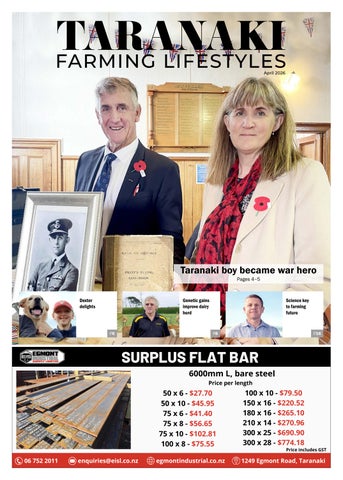
Taranaki Farming Lifestyles, April 2026

Page 1


Phone: 0800 466 793

Email: info@rml.nz

Postal Address: PO Box 474, Dargaville Physical Address: 107 River Road, Dargaville

Editor: Andy Bryenton

Journalists: Denise Gunn | Andy Bryenton | Amy Fifita

Advertising: Debra Seymour 027 525 8217

Production: Gavin Bainbridge | Marnie Fuller | Daniel Foster | Liz Clark

Accounts: accounts@rml.nz

Distribution: Laurie Willetts Printed by: NZME

Website: farminglifestyles.co.nz

9,074 copies DELIVERED FREE to every rural delivery address in Taranaki.

• Organic granular slow release fertiliser

• Weed free - 67% organic matter

• Will not burn plant roots or foliage

• Can be incorporated when planting or used as a top feed

• Fantastic for ALL lawns, flowers, vegetables, roses, trees, shrubs, & container plants

• Bioboost is available from: Selected Garden Centres, Commercial Horticultural, Agricultural & Turf Service Centres

Contact Bioboost Ltd for further information by E mail office@bioboostdistribution.co.nz or Phone 06 7548454/ 0274431809 www.bioboost.co.nz

First to help — last to leave

When emergencies hit New Zealand, such as floods, cyclones,

earthquakes, farmers are often the first to respond

Some people are unaware of this, and surprised by it. I’m not. As a farmer and a Member of Parliament, I’ve seen how the rural community acts. I admire it, I applaud it, but I’m not surprised by it.

When things go wrong, farmers invariably step in. They bring practical skills, local knowledge, and heavy machinery that suddenly turns into emergency gear. Tractors, diggers and quad bikes become tools for rescue and recovery, clearing slips, hauling debris, and reopening tracks. Most farmers are trained in animal welfare and biosecurity, so they can safely manage and care for livestock during and after a disaster.

In small rural communities, people look to farmers for steady, familiar leadership. Farmers often belong to local Federated Farmers branches, the volunteer fire brigade, Land Search and Rescue, the school board, and the sports club. When a crisis hits, farmers bring everyone together, share information, and determine who needs help first.

Farm sheds, woolsheds and community halls quickly turn into drop-off points for supplies, meeting places and rest areas for tired volunteers.

Equally important is how farmers support each other. After a significant storm, a flood or a disease outbreak, someone fires up the barbecue. Soon, there’s a fundraiser, a community meal, or a working bee to fix fences, clear silt and replant pasture. These gatherings break the isolation that can creep in behind the farm gate.

In short, in a country where rural communities are spread out and emergency services are often stretched thin, New Zealand farmers carry a heavy load, often at personal risk to themselves and their properties.

Yet their local knowledge, their equipment, and their willingness to help mean that when crises arise, the response is faster, more practical, and rooted in a simple truth: neighbours helping neighbours, and farmers supporting their communities.

Country

Trade missions look to South America

New Zealand’s trade missions to secure export market opportunities have proven successful in recent months, as the world navigates a new paradigm of tariff threats and seeks trade with stable partners.

The stated aim of the coalition government is to double exports by 2034, and trade arrangements are the way to make this possible. The Middle East and India have proven fruitful when it comes to forging trade alliances, and on the back of good deals, industries like the lamb and kiwifruit sectors are seeing robust export revenue.

In early March, Agriculture Minister Todd McClay inked an agreement with Chile to boost agricultural cooperation, cementing a bilateral trade figure in excess of $340 million.

“Agriculture is at the heart of the New Zealand and Chilean economies. We have similar farming systems, similar geographies, and both advocate for open rules-based trade,” Mr McClay said.

“The new Strategic Agricultural Arrangement 2026–2030 signals our strong commitment to working together and strengthening our agricultural relationship.”

Mr McClay and Chile’s Minister of Agriculture Dr Ignacia Fernández signed for their respective nations, committing to developing skills for the rural sector workforce in both countries, promoting and advancing sustainable agricultural development, and undertaking

of Brazil. Foreign Affairs Minister Winston Peters delivered a keynote opening speech to the New Zealand Innovation Showcase.

“Latin America represents the world’s fourth-largest economy, US$6.34 trillion, almost twice that of India. Latin America is home to 660 million people with high education levels; large middle classes; sizable youth populations; and an abundance of natural resources,” said Winston Peters at a mid-March diplomatic symposium.

He noted Latin America is a crucial part of plans to double Kiwi export value by 2034, and a 2024 trade mission to Sao Paulo saw this goal come a step closer, with 13 new arrangements signed to the value of $100 million.

A practical example of how Kiwi ingenuity can benefit South American farmers was also given. New Zealand invested in the Kiwi Group dairy farm in Goiás state in 2007, with the aim of adapting New Zealand pasture-based sustainable production systems to Brazil’s climate conditions.

Meanwhile, the importance of forging stronger ties with the entire South American region has been highlighted by a top-level delegation to Brasilia, capital

“The operation has since gone from strength to strength,” said Mr Peters. “The farm is now the largest milk producer in the state and will shortly inaugurate a new modern farm.” THANK YOU FOR CHOOSING LOCAL BUY,EAT, WORK , PLAY

Winston Peters and Todd McClay have both played a part in a push to strengthen trade and diplomatic ties with nations like Chile and Brazil in recent weeks
research and innovation to tackle mutual challenges.

TARANAKI COUNTRY BOY BECAME WAR HERO

Charles, known as Alan, was born in 1910. His early years were spent on the family farm that his parents, Albert and Lena bought in 1900, opposite Petch Road at Alton.

Albert and his father originally leased a farm in Mangere, Auckland until 1895. Drawn to Taranaki’s fertile volcanic soils, the Washers hired a coastal steamer, the Gairloch, to sail to New Plymouth Harbour where they swam 66 Jersey cows, six horses and four dogs ashore at Port Taranaki. A long walk followed as the group made their way to south Taranaki.

While Albert and Lena farmed at Alton, Alan attended Alton School. Albert also served as chairman of the Alton School committee for 10 years. During the second world war, he encouraged the community to help out with the war effort.

After farming at Alton for 18 years, the Washer family sold their farm and moved to a smaller property east of New Plymouth. Alan was later a student at New Plymouth Boys’ High School.

In 1929, Alan travelled to England and joined the RAF. Alan’s relation John Washer said the young pilot, stationed in

was

and friendly

“Soon Alan’s flying ability was noticed and he was headhunted by the Bristol Aeroplane Company as a

test pilot handling important air testing assignments. He soon became the instructor of the instructors.

“Not bad for a country boy from Alton,” said John.

Alan’s name is inscribed on the Alton district war memorial
Malta,
described as a natural flyer with a warm
personality.
Among the many Taranaki men who volunteered to serve in New Zealand’s armed forces overseas during the second world war was Charles Alan Washer, the son of Alton farmers.

The British and Colonial Aeroplane Company was a forerunner of the Bristol Aeroplane Company. Its establishment in 1910 by Sir George White, his son Stanley and his brother, Samuel, followed a chance meeting with Wilbur Wright in France. The Bristol Aeroplane Company produced several successful aircraft, including the Beaufighter and Beaufort Bomber.

As a test pilot, Alan piloted dozens of different makes of aircraft, clocking up thousands of hours in the air to ensure aeroplanes and flying was safe. While he was test-flying a Beaufort Bomber in 1939, the aircraft caught fire. Fortunately,

Alan was able to safely parachute to the ground.

Alan’s successful bail-out from a disabled aircraft, earned him membership to the Caterpillar Club. This informal association, founded by Leslie Irvin of the Irvin Airchute Company of Canada, acknowledges those airmen whose lives were saved through the use of a parachute. The name Caterpillar Club gives credit to the silk threads produced by the silkworm used to make the original parachutes.

On June 12 1940, Alan flew another Beaufort Bomber to India to test the aircraft’s performance in tropical conditions. On the final leg of his return

trip from India to Bristol, the aircraft caught fire over Oxford.

An English newspaper reported the heroism of the New Zealand pilot staying at the controls of his aircraft after his two companions had jumped with parachutes to safety. He prevented a blazing aircraft crashing into houses in an Oxfordshire town by putting the eight tonne plane down on an empty school playground in the middle of town. Alan was killed on impact.

The 29-year-old flight lieutenant was buried in St Mary’s churchyard cemetery in Berrow, Somerset. His grandmother had played the organ at this church 75 years prior to Alan’s death and burial.

An inscription on Alan’s headstone includes the words ‘Who bravely gave his life that others might live’. His name is also inscribed on the Alton district war memorial.

John Washer and his cousin Paula Pardington whose grandmother was Alan’s sister
Alton farmers Lena and Albert Washer with their children Florence and Alan

Michelle’s property has a pumice base, providing a solid foundation for her cattlebreeding operation.

“I also lend a hand to the neighbouring farmer with his herd of 10 cows, and together we make good use of his 10-acre paddock by running drystock there. It’s a system that works well for both of us as breeding cows stay on our property, while the drystock winters next door.”

She’s found that Dexter’s gentle nature really shines when it comes to calving.

“If I ever need to assist, the cows are relaxed enough to let me help right there in the paddock. No need to yard them or confine them in a chute.

We continue with the story of Michelle Goodwin’s Pearson Dexter Stud near Whanganui.

DEXTER DELIGHTS

“It’s far less stressful for everyone, and much easier to manage in the moment.”

All of Michelle’s cattle are sold directly off the farm, with many buyers purchasing sight unseen.

“Thanks to clear photos and video footage, people feel confident choosing animals remotely. We offer delivery throughout the lower North Island.”

She sells her calves as weaners when they’ve reached around four to five months of age, although heifers are weaned a few months later.

“I’ve found they develop into stronger, more resilient cows when given that extra time. Timing can vary depending on seasonal conditions and feed availability.

“The market also plays a big role. Some years, demand is so strong I could sell the same calves three times over.”

Michelle said flexibility is the key to balancing animal health, pasture

One of the stud’s former bulls Pearson Gilreath

Daily interaction pays off with some of Michelle’s cows gentle enough to hand-milk in the paddock. The cows also happily allow Michelle to check on their newborn calves without any fuss.

“One of the true joys of the breeding season is watching the calves play and race around in the evening light. It’s a moment that never gets old.”

As the smallest and one of the oldest British cattle breeds, the Dexter developed from native Irish cattle. The breed’s developer, Mr Dexter of Ireland, achieved success producing well-performed compact cattle, ideal for smallholdings.

Renowned for its milk productivity and quality of beef, Dexter cattle are also surefooted and do well on rugged country.

The dual-purpose breed first arrived in New Zealand in 1904, and a small herd was established. However, it wasn’t until

the 1990s that the Dexter experienced a surge in popularity, particularly among smaller block owners.

“There is growing popularity amongst dairy farmers for the use of Dexter bulls across the Jersey cows and for heifers due to the naturally low birthweight, short gestation period, and easy calving of Dexter progeny.”

Michelle has found Dexters to be a low maintenance, hardy breed with a natural resistance to worms.

“They have strong, healthy feet and rarely require intervention. I haven’t faced many of the challenges that other cattle breeders often encounter, which speaks volumes about the breed’s resilience and temperament.”

She said her cattle are on the larger size but still well within the breed standard, true to type, robust and versatile.

“Often people think that Dexters are miniatures, but they are not. The breed standard for cows’ preferred height is between 96cm and 108cm at the rump. For bulls, the preferred height is between 100cm and 114cm at the rump.

“One of the hardest parts of breeding them though is letting go of the replacement heifers or cows I’ve grown attached to, particularly those that are second or third generation. It’s never easy to part with animals you’ve raised and watched develop over time.”

Michelle’s involvement with the breed extends to her role as herd registrar for the Dexter Cattle Society of New Zealand (DCSNZ). She oversees all

registrations, transfers and culls within the national herd.

“It’s my responsibility to maintain the integrity of the herd registry by ensuring animals are correctly recorded to their sire and dam, and that all DNA testing confirms they are disease-free.

“I also manage the transfer process, making sure new breeders receive the correct animals under their assigned breeder number.

“Beyond the administrative duties, I provide guidance and support to new members, helping them understand their responsibilities when it comes to breeding and registering Dexter cattle. It’s a role that combines precision, care and a deep commitment to the breed’s future.”

Michelle has found Dexters to be a low maintenance, hardy breed

GENETIC GAINS IMPROVE DAIRY HERD

Growing up and working on his parents Kaupokonui dairy farm fostered Tony Landers’ interest in the genetics of purebred Jersey dairy cattle, from a young age.

“I’ve always been interested in the breeding side, even as a kid. I recorded all the matings, calves and ancestry going back to the early 1970s. I still have the exercise book,” said Tony. His farming background also led to his decision to pursue a dairy farming career. Following graduating from Massey University with a Bachelor of Agriculture, Tony worked for a local farmer for a year. An opportunity to go on a 12-month international farm exchange trip then led Tony to work on dairy farms in Canada and Ireland.

“The farm in Canada was on the outskirts of Winnipeg. Their cows were housed 365 days of the year. I was over there in the summer and the cows could only go outside in a small yard.”

Tony worked for six months through the winter on an Irish farm where the cows were inside the entire time. “It was very interesting,” he said.

More travel followed before Tony returned to the family farm to work for his parents as a contract milker.

“After three years I bought the herd, and was 50/50 sharemilking for my parents. I also started herd-testing when I came home, and started using AB to improve the herd as fast as I could.”

Tony and his wife Lesley bought the neighbour’s farm in 2009. They built a rotary shed and farm the two properties as one big block. The last title of the family farm was purchased in 2024.

The 120ha effective coastal property receives an average annual rainfall of around 1,100mm.

“It was down last year and up this year,” said Tony.

Due to its coastal location the farm tends to dry out over summer, making it the toughest time of the year.

“Our soil is quite free-draining, so it dries out really quickly, but that’s a plus in the winter. It’s swings and roundabouts.” Silage is grown on-farm, and sometimes hay is brought in. The recent addition of an in-shed feed system enables Tony and Lesley to add minerals, and zinc for facial eczema, in their herd’s feed.

Tony is the vice president of Jersey New Zealand

Calving and seeing which cows have produced heifers or bulls, is Tony’s favourite time of year on the farm. “We also have new genetics coming in with the two-year-olds.”

Tony is a long-standing member of Jersey New Zealand, joining prior to heading on his OE. He graded-up his herd in the early 1990s, and all of the couple’s cows are now registered with years of ancestry behind them.

“Around 2016, I was asked to become an independent director of Jersey New Zealand, and became an elected director around three years ago.”

In his current role as vice president, Tony supports the president and is on

committees focussing on genetics and Jersey Genome. “We have a couple of joint ventures with LIC and CRV.”

Tony said his biggest achievement is the genetics of their Glenui Jersey herd.

“When I bought my parents’ herd, it was genetically poor; now, it’s in the top four or five herds in New Zealand. We are consistently able to sell bulls to LIC and CRV.”

Last year, the Landers took out top honours winning the 2025 JT Thwaites Sire of the Season award with Glenui Zambesi Lincoln ET.

“Glenui Zambesi Lincoln ET (BW 457) is one of three full brothers from Glenui Baltic Laconia ET, two of which were

Tony and his wife Lesley built a rotary shed on their property after buying the neighbour’s farm

in by LIC. His full brother, Glenui

Linden ET is a joint venture Jersey Future bull whose BW is 275. They descend from Glenui Integrity Lace ET, who was the result of the first-ever ET work we did, and the matriarch of the well-known L family.

“The connection with the Thwaites family and this award is very special; more so, as they are family friends and mentors, and live five minutes from our farm.”

This year, six bulls out of the 40 bought nationwide by LIC were bred by Tony and Lesley.

“The genetics side is the big thing for me,” said Tony. “I’m constantly improving the herd.”

Youngstock on the Landers’ Kaupokonui farm
The Landers’ Glenui herd is now in the top four or five herds in New Zealand
taken
Zambesi

Long-term benefits of chondroitin

Research shows that chondroitin supports cartilage health and inhibits enzymes that break down cartilage delaying joint degeneration.

I have the privilege of speaking with clients who have taken chondroitin combined with glucosamine and curcumin (from turmeric) for years.

These report three stages of improvement. There are the initial improvements noticed over 2–6 months. This is important as it is usually the first relief they have had without pain medication. Over 6–12 months the rate of improvement usually slows but there are still noticeable improvements. The rate of improvement slows further but is still noticeable for years.

Today I had a phone review with a client who had been taking my high-chondroitin supplements. After just two months she said that her hips and ankle were much more comfortable. I have no doubt she will continue to improve.

I have one such client who contacted me over five years ago with moderate knee osteoarthritis. He noticed significant short-

term improvements. He noticed definite improvements as the years passed and after five years, he stated he had effectively no knee discomfort.

This is confirmed by a six-year study into the benefits of using chondroitin with glucosamine for those with knee osteoarthritis. It showed that those who used this for six years had maintained cartilage and slowed cartilage loss.

The outcome was these long-term participants had much better results than would have been expected. The study showed that those who took chondroitin with glucosamine long term had less joint space narrowing than expected.

A study, however, does not guarantee that you will get the same results. This is why I am much more interested in how individuals respond. It is one thing to read a study; it is another for you to be more comfortable living with osteoarthritis.

What is Bettaflex?

• Bettaflex is a joint support formula to promote healthy joint cartilage function.

• Bettaflex has 400mg (per capsule) of high-grade avian chondroitin, 400mg of glucosamine and 100mg of BioSolve® bioavailable Curcumin (from turmeric).

• Try Bettaflex for 3 months and see for yourself.

How can Bettaflex help?

• Chondroitin and glucosamine are building blocks of cartilage.

• Supplementation with correct levels can support healthy cartilage function and cartilage repair processes.

• New BioSolve® bioavailable curcumin helps joint function while gentle on the stomach.

• Research indicates that chondroitin is highly effective at 800mg daily.

John Arts comments:

“My latest Bettaflex formula includes BioSolve® bioavailable curcumin for faster results. The normal dose is 2 capsules daily but I recommend an initial higher dose for 1-3 bottles to saturate joint tissue.”

(John Arts, Founder, Abundant Health)

Not suitable during pregnancy or lactation.

Save ED for emergencies

Our Emergency Departments at Taranaki Base and Hāwera hospitals are open 24 hours a day, 7 days a week, 365 days a year.

Our EDs are for life-threatening or limb-threatening emergencies that may include:

• active bleeding

• chest pain

• difficulty breathing

• stroke symptoms

• choking

• loss of consciousness

• clearly broken or dislocated bones

Healthify is a fantastic website for anyone looking for free, easy to understand information and tips on treating common health conditions. Alternatively, call Healthline for free on 0800 611 116 where nurses, paramedics and doctors are available 24/7 for free medical advice.

Community pharmacies are another great option for health advice on common health issues and medications. Your general practitioner (GP) or Māori healthcare

provider is the best option for your nonurgent, long-term health issues as they can provide ongoing care appropriate to your specific needs.

Children under 14 receive free healthcare and there are low-cost GP clinics in New Plymouth, Stratford, Ōpunakē, Hāwera and Pātea. A Community Services Card can lower the cost of some health services and prescriptions.

For out of hours or urgent treatment when your GP isn’t available, there are a number of urgent care clinics in Taranaki. These include Medicross and Carefirst (Westown) in New Plymouth, and South Taranaki Rural Health General Practice (the Practice) in Hāwera.

To find pharmacies, GPs and urgent care clinics open near you, visit healthpoint.co.nz. This website also provides information on practices in the region currently enrolling new patients.

Election issues manifested

With the goal of doubling export revenue in mind, and following a year of successes around the trade negotiations table and in fiscal returns, the government seems well placed to tick all the boxes in Horticulture New Zealand’s recently released election priorities report.

Every time the nation goes to the polls, the HortNZ manifesto focusses on what’s of vital importance to this big sector of the rural economy, and this year is no different. The top points on the list include matters of growth, resilience and the massive part the horticultural sector plays in local food security. Added to that is the sheer fiscal power of horticultural exports, and the potential for even more global recognition.

“The horticulture sector is essential to the health of New Zealanders and contributes significantly to our economy,” said HortNZ chief executive Kate Scott, as the manifesto went out for public discussion, and the inevitable scrutiny of parliamentarians.

“The Ministry for Primary Industries’ latest Situation and Outlook for Primary Industries (SOPI) report forecasts horticulture export revenue will rise five per cent to $9.2 billion in the year to 30 June 2026. Together with government, industry, Māori and science partners, the sector aims to double the farmgate value of horticulture production by 2035.”

It’s a lofty goal, but one which is in sight, and the sector’s leadership have a plan to achieve. What’s needed, says Ms Scott, is a commitment by lawmakers to facilitate efficiency amid Kiwi orchards, groves and fields.

“To achieve this, we need practical policy settings including strengthening biosecurity and crop protection access, cutting red tape, ensuring sustainable water security, building a skilled workforce, supporting fair grocery markets and investing in critical infrastructure,” Scott said.

That means strengthening biosecurity, for swift and effective responses as recently seen with the prompt eradication of invasive fruit fly in Papatoetoe, Auckland. It means cutting red tape and bureaucratic duplication, with an emphasis

made on water security; two factors tied inextricably with the replacement to the Resource Management Act. There’s also a strong emphasis in the manifesto for fair and competitive grocery markets. Something highlighted as problematic during the Ardern administration and still a sore point with many producers and consumers.

“A future-focussed horticulture sector underpins New Zealand’s longterm economic goals, from increasing productivity and diversifying exports to building a low-emissions economy with

strong international competitiveness,” says Ms Scott.

“With consistent policy, fair markets, secure water and workforce settings, and access to modern tools, horticulture can remain one of New Zealand’s standout sectors.”

It’s now up to parliamentary hopefuls, in what is shaping up to be an election defined by the cost of living, to decide if the horticultural export powerhouse deserves their full attention.

Two of more than seven million avocados, which bolster a growing export market in horticulture each year

Expert menopause care — at your place

Menopause Wellbeing is a private online clinic operated by Sexual Wellbeing Aotearoa: you might know us as Family Planning. We’re experts in sexual and reproductive health.

Through our private menopause clinic, we offer dedicated, expert and tailored menopause treatment — all without you having to leave home.

With longer appointments, we can investigate your symptoms in more detail and provide tailored treatment plans and advice, including hormone therapy and other medications. Time is precious. That’s why we’re offering virtual appointments, held in the late morning, afternoon, and evening, to fit in with your busy life.

Our services

Hormone therapy, sometimes called menopause hormone therapy (MHT) or hormone replacement therapy (HRT) is the most-effective treatment we have for relieving many symptoms of perimenopause and menopause. It’s not for everyone though, and there is a range of other medications that have been found to help menopausal symptoms.

Our appointments

All our appointments are online. Your first appointment will be 45 minutes long. You’ll see the doctor or nurse practitioner you booked with. They’ll discuss your physical symptoms and other relevant medical conditions, as well as your psychological wellbeing

and any concerns you may have, and come up with a treatment plan tailored to you. Follow-up appointments and prescription repeat appointments are also available.

Bristol Stool Chart

1–2

Separate

Sausage-shaped but lumpy

Like

Like a sausage or snake, smooth and soft

Soft blobs with clear-cut edges (passed easily)

Fluffy pieces with ragged edges, a mushy stool

Watery, no solid pieces. Entirely Liquid

Booking options

You can book using our online booking system. Check out our website for more details at menopause.sexualwellbeing. org.nz, or you can call us on 07 810 6823. Doing good, while doing you good By coming to us for menopause treatment, you’re also supporting our

valuable work across New Zealand. All proceeds from this clinic are reinvested in Sexual Wellbeing Aotearoa, enabling us to continue to promote health, advance education and benefit the community. PS Menopause Wellbeing and Sexual will be in the Health Hub at the 2026 Fieldays — stop by and say hello.

Order direct at www.battenbuddy.co.nz

Inquiries call Lloyd 021 0295 9167

Email info@battenbuddy.co.nz

Delivered nation-wide

If your midlife is making you miserable, make an appointment for an online menopause consultation. At Menopause Wellbeing we offer dedicated, expert and tailored menopause treatment.

visit www.menopause.sexualwellbeing.org.nz to book or you can call us on 07 810 6823.

Dr Suzie Evason: “I’m interested in health and wellbeing at menopause, and I look forward to treating and working with women at a time when they can often feel alone and unsupported.”
Nurse practitioner Rachell Webb: “Having worked in sexual and reproductive health for over 12 years, I understand the impact perimenopause and menopause can have on a woman’s life, particularly when not recognised or given the appropriate care.”
Nurse practitioner Katie McCullough: “There’s a significant gap in accessible, evidencebased support for people navigating menopause, and I’m eager to draw on my clinical background to contribute to improving menopause care across Aotearoa.”

CROP & PASTURE PREP

A pair of eights wins for John Deere

Thirty years from the inception of the John Deere 8 Series of tractors, the big green machines have evolved into consummate platforms for seeding, tilling and planting, as evidenced by the release of the new generation alongside some serious new farming tools.

The new 8R and 8RX tractors from Deere offer 440, 490 and 540 horsepower options, making them capable of utilising some of the biggest and most efficient implements for crop and pasture management tasks. All have at their heart the new JD14 engine, which delivers its peak power at low rpm, and can max out at a big 634 horses at just 1,700 revolutions.

That’s in line with customer demand for more potent PTO power on tap, as well as electrical offboarding, a growing need in the modern farming environment. The hydraulic systems of the 8 Series have also been beefed up, with more capacity, and separate steering and braking pumps to ensure smooth operation.

“Whether you are seeding, tilling or planting, these tractors have the power, technology and functionality to increase productivity and efficiency,” said John Deere marketing manager for production and precision agriculture, Royce Bell, when the new 8 Series broke cover in Australia last month.

“Similar to the impact of the HHP 9RX, the HHP 8R and 8RX are expected

to increase productivity and efficiency in customer operations while providing the versatility of a rigid chassis tractor. Horsepower, ballasting, lift capacity, size and functionality all increase with these models.”

That high horsepower and high capacity has been matched up with a push for more manoeuvrability. Features like reactive command steering to bring the wheels back to centre automatically during pasture operations are coupled with smart chassis design to deliver a turning radius that’s got to be seen to be believed.

With the option of a front hitch and PTO, and equipped with a rear hitch that boasts a capacity close to 11 tonnes, this new brace of John Deere machines is set to work with some large and efficient tools, leveraging maximum economies of scale.

That’s no mistake and no coincidence. At the same time as the big green and yellow brand launched the newest 8 Series generation, they also debuted their modelyear 2027 planters, packed with new tech for parallel fertiliser application, digital connectivity and accuracy of placement.

windows,

Pastoral Improvements can help you get the right seeds and fertilisers for your farm.

Pastoral Improvements can help you get the right seeds and fertilisers for your farm.

Pastoral Improvements can help you get the right seeds and fertilisers for your farm.

Pastoral Improvements can help you get the right seeds and fertilisers for your farm.

We are an established New Zealand-based agricultural supplier providing high-performance seeds and fertilisers designed for local conditions, at great prices. We have highly efficient foliar fertilisers in stock now that are 90% efficient, ideal for an autumn boost

We are an established New Zealand-based agricultural supplier providing high-performance seeds and fertilisers designed for local conditions, at great prices. We have highly efficient foliar fertilisers in stock now that are 90% efficient, ideal for an autumn boost

We are an established New Zealand-based agricultural supplier providing high-performance seeds and fertilisers designed for local conditions, at great prices. We have highly efficient foliar fertilisers in stock now that are 90% efficient, ideal for an autumn boost.

We offer:

We are an established New Zealand-based agricultural supplier providing high-performance seeds and fertilisers designed for local conditions, at great prices. We have highly efficient foliar fertilisers in stock now that are 90% efficient, ideal for an autumn boost

We offer:

We offer:

We offer:

Grass seeds& pasture premixes

Grass seeds& pasture premixes

Avocado& kiwif ruit orchard mixes

Grass seeds& pasture premixes

Avocado& kiwif ruit orchard mixes

Grass seeds& pasture premixes

Tailored custom seed mixes

Avocado& kiwif ruit orchard mixes

Tailored custom seed mixes

Avocado& kiwif ruit orchard mixes

Legumes, herbs, brassicas

Tailored custom seed mixes

Tailored custom seed mixes

Legumes, herbs, brassicas

Cereals and cover crops

Legumes, herbs, brassicas

Legumes, herbs, brassicas

Cereals and cover crops

Cereals and cover crops

Cereals and cover crops

Fertilisers& growth promoters (biostimulants)

Fertilisers& growth promoters (biostimulants)

Fertilisers& growth promoters (biostimulants)

Fertilisers& growth promoters (biostimulants) Tailored advice on custom mixes, nutrient requirements for pasture and crops

Tailored advice on custom mixes, nutrient requirements for pasture and crops

Tailored advice on custom mixes, nutrient requirements for pasture and crops

Tailored advice on custom mixes, nutrient requirements for pasture and crops

Our high quality seeds are often better priced than competitors, and our knowledgeable team is ready to help you!

Our high quality seeds are often better priced than competitors, and our knowledgeable team is ready to help you!

Our high quality seeds are often better priced than competitors, and our knowledgeable team is ready to help you!

Our high quality seeds are often better priced than competitors, and our knowledgeable team is ready to help you!

Phone 03 302 7909, email enquiry@pastoralimprovements.co.nz or visit www.pastoralimprovements.co.nz

Phone 03 302 7909, email enquiry@pastoralimprovements.co.nz or visit www pastoralimprovements.co.nz s, ents

Phone 03 302 7909, email enquiry@pastoralimprovements.co.nz or visit www.pastoralimprovements.co.nz

Phone 03 302 7909, email enquiry@pastoralimprovements.co.nz or visit www.pastoralimprovements.co.nz

The John Deere 8R series has enjoyed a long period of popularity due to successive generations of innovation and power
A new air cart, the C1100, boosts the capacity of grain growers who want to tackle more pasture during tight seeding
while the 2027 sprayer range was also unveiled, once again focussed on improved precision.

Boost growth. Lock in your N-Protect today.

Now’s a great time to spread, and an even better time for N-Protec t It ’s smar t- coate d, so more nitrogen get s to the root s for stronger grow th and le s s waste. Together we’ll make a plan to help you get the fe e d you ne e d (and mayb e even a lit tle ex tra)

C all 0800 100 123 o r talk to your ag ri ma nage r today.

Autumn sowing, soil health and pasture recovery

“The 2026 season began with wet, cool conditions, and in some areas, flooding. These conditions have already influenced nutrient availability, seedbed preparation, and early crop establishment,” says agronomist Michael Osborne of Pastoral Improvements.

Michael is a New Zealand agronomist with more than 30 years of farming experience; 20 years of soil-testing expertise, and decades working with farmers.

“Autumn helps set up winter feed and spring performance. Fertiliser, seed, freight and spreading all need to be coordinated tightly. Soil testing, correct seed selection and timely fertiliser application can lift performance from average to exceptional,” says Michael.

Autumn is one of the best times to repasture because warm soil temperatures support pasture establishment.

How will the wet summer affect autumn sowing?

Wet, cool conditions and summer flooding can mean highly mobile nutrients such as nitrogen, sulphur, boron, and potassium may have leached.

This means:

• Standard NPK blends may not address the real deficiencies

• Crops may start strong but stall due to nutrient gaps

• Pasture recovery may be slow

“Carrying out soil testing before you sow or top dress helps you understand what nutrients have been lost,” Michael said. Wet weather in late summer can affect autumn growth. What to look for:

• Yellowing or pale leaves may indicate nitrogen or sulphur deficiency

• Purpling may indicate phosphorus stress

• Patchy growth may indicate waterlogging or root damage

• Uneven colour may indicate micronutrient imbalance

• Fungal risks increase in humid, wet conditions

“Inspect crops every few days. Deficiencies caught early can often be corrected with a granular fertiliser. If it’s left later foliar applications or topdressing may be needed.” What should farmers consider when selecting seed?

• Think three months ahead. What feed is needed in winter? And in early spring for lambing or calving?

• Match seed to soil. Soil testing can help determine the correct

seed based on factors like pH and nutrient levels.

• Match fertiliser to seed. Correct pairing avoids the risk of fertiliser burning seed or inhibiting germination.

• Consider animal nutrition — some crops can create mineral deficiencies.

Consider tailored seed mixes

Custom mixes can be designed for wet soils, orchards, dairy grazing, lamb finishing or other needs. Pastoral Improvements can design custom mixes and ship them nationwide.

Assess fertiliser priorities for autumn Nutrients such as lime, elemental sulphur, slow release nitrogen, SOA, humates, boron and potassium may be some of the nutrients that may be depleted in autumn soils, or which are beneficial to apply in autumn. Pastoral Improvements has highly efficient foliar fertilisers in stock, which are 90% efficient, offering an autumn pasture boost.

INDEPENDENTLY & LOCALLY OWNED

Agronomist Michael Osborne

Science key to farming future

Outside of New Zealand, agriculture is often imagined as mixed farming or cropping-heavy, but here it is overwhelmingly animal-based.

“Production animals, from pigs and poultry to sheep and dairy cows, drive our primary output and underpin much of our national prosperity and animal production science helps keeps the system thriving,” says Professor Paul Kenyon from Massey University.

“Most of our farmland is grazing land; our landscapes and climate aren’t suited to large-scale grain crops.

That means decisions about animal nutrition, genetics, reproduction, health and welfare are not peripheral considerations for us.

“They are fundamental to how most farms operate and succeed. Understanding the animal is essential to understanding the farm.”

Dr Kenyon says animal production science has been one of the most powerful drivers of productivity in modern agriculture. Research into genetics, nutrition, growth, reproduction, meat science and health has enabled farmers to produce more food with fewer resources.

science, agronomy, soil science and farm management if we are to manage our ruminant production systems and environments effectively.”

Animal production science underpins many of New Zealand agriculture’s biggest challenges, from reducing greenhouse gas emissions and nutrient losses to improving productivity, animal welfare and climate resilience.

“Encouragingly, the next generation is recognising this, with strong demand for agricultural and animal science programmes. We’ve seen a significant increase in students enrolling in these subjects at Massey University this year.

Richard 027 510 9667

Every day is a growing day

“Productivity for each animal and a hectare has increased in all our ruminant systems and our understanding and management of animal health has improved dramatically. These gains are the result of decades of sustained investment in applied animal production science, grounded in real farming systems.

“Postgraduate demand is particularly strong, with over 290 students pursuing diverse research projects that reflect the complexity of modern farming systems and a strong appetite for practical, onthe-ground solutions.

“You cannot reduce emissions without understanding animal nutrition. You cannot improve welfare without evidencebased insights into behaviour and health. You cannot design resilient farming systems without integrating the animal, the pasture and the environment.

“More students are choosing flexible, distance-based study options, providing a cost-effective way into higher education while continuing to work in the regions and industries they want to be part of. They don’t have to step away from agriculture to study it; they are studying while living it.

“Animal production science needs to work alongside the disciplines of pastoral

“We have also designed professional development courses for secondary school teachers, recognising that

agricultural capability must be built not only on farms and in universities, but throughout the education system. Providing teachers with the tools to foster interest and passion for agriculture early will help develop the next generation of agricultural leaders and problem-solvers.”

Professor Paul Kenyon, Massey University

A mandate for dairy leadership

Once every six years Kiwi dairy farmers are asked to vote on whether to keep up payment of a levy funding the work of DairyNZ, the sector’s voice of advocacy and scientific advancement.

This year was a polling year, and farmers were encouraged to make their voices heard, amid a time of generational governmental legislation change and technological innovation. The result, released mid-March, was a resounding mandate for DairyNZ, with two-thirds of eligible voters saying ‘yes’ to another sixyear tenure for the levy. That equates to a 72 per cent vote for the affirmative when the ballot is weighted by milk solids. For a ‘yes’ vote to take effect, both of these metrics must be over 50 per cent.

“Over the last year farmers gave clear feedback on the areas they want DairyNZ to focus on,” said DairyNZ chair Tracy Brown.

“They’ve shown support for our strategy of applying DairyNZ’s strong engine of dairy science to deliver tools and resources that drive productivity, strengthen farm systems, and support farmers to compete on sustainability.

“I would like to sincerely thank every farmer who took the time to participate in the vote. Farmers have given us a clear mandate to get on with the job.

“With the levy vote confirmed, DairyNZ will be putting all its energy into delivery of its work programme, including advancing genetic gain, harnessing data and insights to strengthen farm systems, and contributing to improved water quality across New Zealand.”

An example of the benefits provided by DairyNZ is the EconTracker, a tool

which breaks down complex economic forecast data into figures that can help guide farm investment and infrastructure choices. It’s up to date. The March precis from EconTracker has analysis of how geopolitical factors, such as war and disrupted shipping routes, could counterbalance a high dairy price in the short to mid-term.

Then there’s also the fact that DairyNZ weighs in with input into government programmes such as the recently announced Dairy Beef Opportunities initiative. This partnership between Dairy

NZ, Beef + Lamb NZ, the Meat Industry Association, members of the Dairy Companies Association of New Zealand and the government has more than $20 million unlocked to improve cattle genetics, breeding programmes and the exploration of new supply chains within the sector.

“We’re proud to stand alongside our sector partners in driving this next step for dairy beef. This is about creating real

opportunities for farmers and ensuring the beef and dairy sectors continue to grow in a way that supports long-term sector success,” said Beef + Lamb NZ chair Kata Acland.

“The programme also reflects the strong level of collaboration across the sector, bringing together organisations from across the value chain to help dairy and beef farmers lift productivity and profitability.”

A positive vote on the levy supporting DairyNZ promises another six years of leadership and advocacy for the sector

Hunting season shows promise

Waterfowl find plenty of places to hang about in Taranaki with an abundance of rivers, streams, creeks and ponds that provide good habitats and birds are expected to be easily found as hunters head out in the countryside.

Fish and Game New Zealand has set a provincial 10-bag limit and also the conditions that go with the hunting privilege. While experienced bird hunters will already be conversant with these, newcomers should consult all the rules and regulations available online or from booklets that are free guides for game bird hunters. This includes firearms and ammunition rules and overall safety regulations.

Once you are all prepared, with perhaps some sports store camouflage gear, some soup and sandwiches and appropriate firearm, Taranaki Fish and Game reckon local hunters are among the most successful in the North Island.

good evening shooting can be found on farm dams, stubble fields and in paddocks where supplements are being fed to stock.

“Targeting mallards in these areas using some overhead cover, a camo net and a few decoys can be a very successful approach. The key is to locate the birds beforehand but leave them undisturbed – then return to set up at dawn before the birds meander back from feeding.”

Areas A&B comprise Waimarino and Whanganui sub regions, Area C is Taranaki extending down to the Waitotara River.

“Mallard duck is the leading game species, with smaller numbers of grey duck present in backcountry areas and traditional maimai enclaves are well established,” rangers say.

“Streams, rivers, drains and farm oxidation ponds are usually bird busy while

Fish and Game rangers also say conditions this year have favoured upland game populations with late broods of both pheasant and quail seen around the region. While there are few public hunting areas in the Taranaki region, there are plenty of places to hunt waterfowl on private land— it’s simply a matter of asking landholders for access. Once a hunter establishes a record of responsible behaviour, there’s usually no problem obtaining permission to hunt in following seasons.

TARANAKI

This one means business

In these days of geopolitical madness, fuel price shocks and busy schedules, flexibility, fuel economy and practicality top the list for those seeking a hard-working vehicle.

When it’s time to get down to business, the ability to haul tools and equipment is often balanced by the need to bring along a whole crew. All too often, there’s the need to do both in one day, which makes it hard to settle on the right van for the job. Add in running costs, and bigger is not always better; a nimble, smaller, more flexible solution is in hot demand.

As a bit of a detour, let’s think back to the last time the situation in Iran led to oil headaches. In 1979, the Shah was out and petrol was up. Back then, tradespeople found a solution which meant they didn’t have to drive a full-sized truck or even a big van to get the most out of their day. That answer came from Ford, in the form of the Escort panel van.

Now a beloved classic, with examples going for major dollars online, the ‘esky’ was a familiar sight, painted up in the livery of your local plumber or builder and out there getting on with business. Fastforward to the present day, and you’ll see an echo of that cheeky little snub-nosed shape in the new Ford Transit Courier, the little brother of the big Transit Custom.

Ford calls it a double cab in van form, and that’s quite true. There are two full rows of seats on offer if your task involves shuttling a team to where they need to go. Then again, it’s a snap to fold up

Ford calls it a double cab in van form, and that’s quite true.

those rear seats and turn the back of this machine into a voluminous cargo hold.

Like its classic ancestor, the Transit Courier has the driving position and layout of a passenger car, and a small footprint to dominate city driving and parking. Unlike anything else this shape, that rear deck will take a pallet, and comes with an adjustable cargo protecting grille. This utility and small footprint combined have seen it become one of the bestselling vans in the UK.

Then there’s the fuel economy, and it’s in a league of its own right now when you’re at the pump. With Ford’s acclaimed 1-litre ecoboost engine under the hood, the Transit Courier is equipped with a seven-speed automatic transmission and a truly frugal appetite. Added to this practicality is the fact that it’s a goodlooking little machine too, with plenty of big, flat spaces on which to emblazon your company’s logos and colours.

The Ford Transit Courier is a new member of the Transit family, a small but mighty double-cab van with versatile load space

VEHICLES & MACHINERY

The first diesel mechanic

Diesel technicians and mechanics keep the rural sector running: as we’ve seen in recent weeks with fuel price scares and supply worries, it’s this form of fuel keeping the tractors and trucks, harvesters and telehandlers working.

While it’s a hard-working fleet of diesel specialists who ensure the machines of the present day are ready to roll each day, once upon a time there was only a single diesel mechanic in the world. Aptly, Rudolf Diesel was his name. Most people know that he developed the first compression-combustion engine in 1897, but few are aware that Rudolf was born in France, educated in Britain and he helped invent air conditioning before he turned his colossal mind to building motors.

Born in Paris in 1938, Rudolf was forced to go to work early, despite being the third most-accomplished student in France. Pushing a heavy barrow of his father’s leather goods through the streets, Diesel reasoned that something had to replace horses and barrow-lads like himself.

He later continued his education in London, and ended up in Germany, where he studied under the tutelage of Carl von Linde, the inventor of refrigeration. Another inspiration came to Diesel. The big steam engines used to power industrial freezers were horribly inefficient, and a smaller, more potent motor would allow refrigeration for the home, food and cooling the air in hot climates.

Diesel’s first idea was to make a steam engine, which ran on ammonia vapour, but the prototype exploded, nearly killing

him. This, and the fact that steam engines could only achieve 10 per cent efficiency in turning their fuel to power, led to young Rudolf ripping up his plans and starting afresh. He had time to think and design; the explosion had put him in hospital.

By 1893, he had a theory, and then a patent. However, it would not be until 1897 Diesel unleashed a 25-horsepower four-stroke, compression-ignition motor, which boasted a 75 per cent improvement of fuel-to-power ratio over steam. The world was waiting for just such an engine. Industries worldwide could now switch out steam for diesel in their excavators, mining machines, transport solutions, ships and, more chillingly, military applications.

Rudolf Diesel did not get to enjoy the fruits of his genius or his labours for long. On September 29 1913, as Europe stood on the brink of the first world war, Diesel boarded a ship to London to talk to investors there. He never made it. Following his disappearance, it was revealed that he’d cleared out his bank accounts and taken plans with him for next-generation engines. In early October 1913, he was confirmed dead by drowning, but speculation was rife that he had been assassinated, to prevent Germany’s enemies from gaining his knowledge to use in two new inventions — the submarine and the tank.

Rudolf Diesel: so respected by his peers that Japanese engine builder Magokichi Yamaoka, founder of Yanmar, travelled to Germany in the 1950s to build a monument to his legacy

Double Cab Wellside 4WD

The Right Tools for the Road Ahead

We know that life on the land doesn't stop when fuel prices rise or the weather turns Whether you're hauling a trailer across a muddy paddock or heading into town for the school run, you need a vehicle that works as hard as you do without breaking the bank

At W R Phillips Mitsubishi, we’ve hand-picked a lineup designed to tackle today’s challenges head-on:

The Powerhouse: The Next-Gen Mitsubishi Triton is back and tougher than ever With a 3.5-tonne towing capacity and a bi-turbo engine, it’s the ultimate partner for the heavy lifting

The Fuel-Savers: Tired of the petrol pump? The Outlander PHEV and Eclipse Cross PHEV allow you to run your daily errands on 100% electric power, saving the hybrid engine for those longer trips across the region

The Value King: If you need a reliable, fuel-efficient SUV right now, the Mitsubishi ASX is your answer We have stock available for immediate delivery, so you can skip the waitlist and get back to business

Finance Built Around You - Need Finance?

We have onsite Finance Managers who work directly with you to provide competitive rates and flexible plans whether you’re looking for a comprehensive business package for the fleet or a tailored personal loan for the family car

Every new Mitsubishi also comes with our 10-year Diamond Advantage Warranty, giving you total peace of mind for the decade ahead

Come see the team at W.R Phillips today Let’s find the right fit for your farm, your business, and your family

$43,470 from +gst +orc

$44,990 +orc

IMPROVED EV RANGE from

$64,990 +orc

from $28,990 +orc

The fire of the fabricators

Watching a metal fabricator work is a process as fascinating as that employed by any sculptor or painter, and sometimes it seems, just as mysterious to the layperson.

Metal is a medium which has been vital to human civilisation for thousands of years. Those who know how to shape and fuse it into the right forms for work and warfare have always been professionals in high demand.

There’s a good reason for this respect. Metalworkers and those who can turn a plan on paper into a working tool or machine part are responsible for our capacity to feed billions, our ability to travel all over the world and into space, and even the machines that build our cities.

The word weld comes from an old Saxon term meaning ‘to make red hot’, and for good reason. Before Sir Humphry Davy discovered the electric arc in 1800, forge welding was the only way to bond metal to metal in a way we’d recognise as welding. Even so, the feats of the late medieval and renaissance armourers are testament to a sublime level of skill.

Davy created the electric arc as part of his experiments in isolating elements like potassium and calcium. Also the father of nitrous oxide, inventor of photographic enlargements and the editor of Wordsworth, Davy didn’t immediately think of welding when he created the arc, but a Russian scientist named Vasily Petrov did. It would take 80 years until fellow Russian Nikolai Benardos and his

Polish colleague Stanislaw Olszewski introduced carbon electrodes to build the arc welder. Three-phase welding was also a Russian invention, but the revolution in that nation saw innovation stall until a great leap forward in welding technology came in 1914.

The first world war was a war of manufacturing and engineering as much as it was a war of brutal attrition. The British, who relied on a strong navy, adopted arc welding to attempt to speed up production of what until then had been riveted ships. The Fullagar was the first vessel to come out of the UK with an entirely welded hull, and it changed the game. Meanwhile, German aircraft were being made using welding, as wood and canvas planes were superseded.

By the 1920s, auto-feeding electrode wire and the use of shielding gases to prevent oxygen and nitrogen in the atmosphere from affecting welds were in wide use. The second world war saw the rise of TIG welding, using a gas tungsten arc method, and aluminium could now be welded for the aircraft industry. By this time riveted ships like the ill-fated Titanic were resigned to history, and welding allowed feats of production like the US liberty ships programme, turning out large vessels in a matter of days each.

COMMUNITY NEWSPAPERS

A welder uses an electric arc to turn plans into reality: one of the core skills enabling modern civilisation to operate

BATHROOM, TOILET, LAUNDRY INSPIRATION

Check out our fabulous showroom for more renovation inspiration, showcasing products from NZ’s most trusted and respected brands.

Turn static files into dynamic content formats.

Create a flipbook