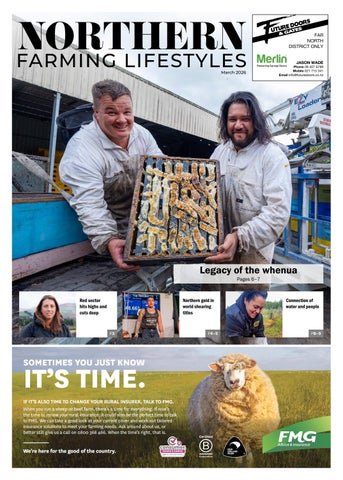
Northern Farming Lifestyles, March 2026

Page 1


Phone: 0800 466 793 Email: info@rml.nz

Postal Address: PO Box 474, Dargaville Physical Address: 107 River Road, Dargaville

Editor: Andy Bryenton

Journalists: Amy Fifita | Andy Bryenton | Paul Campbell

Advertising: MJ Te Whata 027 343 2636

Production: Gavin Bainbridge | Marnie Fuller | Daniel Foster | Liz Clark

Accounts: accounts@rml.nz

Distribution: Laurie Willetts Printed by: NZME Website: farminglifestyles.co.nz

25,093 copies DELIVERED FREE to every farm and rural delivery address from Albany to Cape Reinga.

Benefits from KiwiSaver shake-up

Farmers and other rural workers will be pleased to hear that the government is removing barriers that have stopped many of them from using their KiwiSaver accounts to buy their first homes.

Since 2010, other New Zealanders have been able to withdraw from their KiwiSaver accounts to help purchase a first home, provided they live in the homes they buy.

However, for workers in service tenancies, like farm workers, rural teachers, police officers in country towns, and defence personnel, that’s been almost impossible. Their jobs often require them to live in employer-provided housing, effectively locking them out of first-home withdrawals.

KiwiSaver balances towards buying a farm through a commercial entity they majority own, where it will be their principal place of residence.

Right now, KiwiSaver rules only allow the purchase of a farm in a member’s own name (if they intend to live on it). In practice, though, most farms are bought through a company or trust, which has stopped many would-be farmers from using their hard-earned savings.

These targeted, practical changes back rural New Zealand all the way. They remove unnecessary barriers and recognise the commercial reality of how farms are owned today.

So, we are now making a technical change to the KiwiSaver Act so that workers in service tenancies are no longer denied the chance to get a foot on the property ladder. This change will allow these workers to use their KiwiSaver for a first-home purchase without having to live in the property themselves.

The act will also be amended to allow first-time farm buyers to put their

Legislation to implement these changes will be introduced to parliament in the middle of the year.

Once in place, the changes will help more rural families turn their long-term commitment to their communities into a real stake in the land they work on and call home.

Red sector hits highs and cuts deep

Members of the agricultural red sector, meat producers and exporters, met with Agriculture Minister Todd McClay at a special celebratory barbecue on February 15, celebrating two milestones.

The first is the anniversary of the first frozen shipment of sheep meat to the UK, a turning point in local agriculture. The second was the announcement that the lamb export tally had cracked the important $4 billion mark for the first time in 2025.

“As we honour the legacy of the pioneers behind the first shipment of frozen sheep meat to the United Kingdom, we also celebrate lamb exports exceeding $4 billion for the first time last year,” said Mr McClay.

“Today, we acknowledge the red meat sector and its significant economic contribution to New Zealand, as well as the hard-working men and women behind that success.

“Agriculture is the backbone of our economy. Meat and wool export revenue alone is forecast to increase seven per cent to $13.2 billion in the year to June 30 2026.”

Trade agreements were touted as a major series of victories for the incumbent government, angling to showcase its positive leadership in the rural sector during this important election year.

However, while sheep farmers were feted at parliament, those who advocate for them had some cutting words for the most important piece of legislation affecting them this year; the replacement to the Resource Management Act.

While Beef + Lamb New Zealand supports the need for change, the organisation’s submission on the new laws, which will replace the RMA, raised red flags for the red sector.

“We welcome the intent to enable primary sector growth and development, reduce the need for consents, make more activities permitted and reduce litigation,” said B+LNZ chair Kate Acland. “However, as we have said since it was released, the way the legislation is currently written is missing the mark.”

“The language is more stringent around setting and managing limits and would likely see the need for more consents, not less. There are more onerous requirements on permitted activities.

“The lack of appropriate guardrails on the exercise of ministerial and council powers in many areas and the lack of requirement to consider costs

and benefits could result in significant economic impacts.”

That’s a stern warning from an industry, which by the government’s own admission, contributes billions to an economy still in recovery. Singled out for special scrutiny in the submission were freshwater farm plans, and the introduction of the marketbased allocation or levies for resource use.

This submission is based on farmer feedback from hundreds of voters. With input from this and other sources pulling the RMA replacement in a variety of directions, it’s now up to the ministers in charge to chart a line between what the public wants, what stewardship demands, and what will continue to stoke the engine room of the economy on farms.

The full submission on the RMA replacement by Beef+Lamb NZ is available on their website (pictured, B+LNZ chair Kate Acland)

Northern gold in world shearing titles

The international shearing world has celebrated at the Golden Shears event in Masterton where a

shearers and woolhandlers saw Northland gun Toa Henderson and four other Kiwis win top rankings.

“Black singlets dominated as New Zealand scored an unprecedented five wins in six events at the World Shearing and Woolhandling Championships,” said Shearing Sports New Zealand official, Doug Laing. “The only event not won by the Kiwis went to perhaps an appropriate southern hemisphere rival in South African Bonile Rabela’s successful defence of the blades shearing title.

“In the final events of the four days of competition, Northland shearer Toa Henderson successfully defended the Golden Shears Open shearing title, with 2014 winner Roland Smith, from Hawke’s Bay via Northland’s Ruawai, sneaking through to be second.”

Jack Fagan, of Te Kūiti, won the National Shearing Circuit final to secure a place in the 2026–2027 New Zealand trans-Tasman shearing and woolhandling

series team. It was clearly a dream for Fagan, as his father Sir David Fagan won several times from 1986 to 2008. Jack Fagan shore in the 2024–2025 series, after finishing third in the circuit final.

In other Golden Shears shearing title finals, senior honours went to Taylor Tarrant, of Taumarunui, the new intermediate champion is Joseph Scahill, of Ireland, the junior title was won by Sreffan George, of Wales, and the novice

was won by Sam Lawson, of Ongaonga. Lucy Elers, of Mataura, retained the senior woolhandling title, the junior woolhandling winner was Leah Tamainu, of Nūhaka, and the novice title was won by Isabelle Joiner, of Canada.

The North Island Woolhandling Circuit final was won by Ngaio Henson, of Eketāhuna, retaining her place in the trans-Tasman series team. Jeremy Goodger, of Masterton, won the Golden

A weary Toa Henderson after the 20-sheep Golden Shears open final
Roland Smith on his way to a second world individual shearing championship

Shears Men’s woolpressing title for a 14th time, and the women’s title was won for the first time by Mollie Moffett, of Fernhill, Hawke’s Bay.

The next world championships will be held in Geelong, Victoria, Australia in 2029, and is expected to be in the first week of November.

New Zealand became the first nation to win all three teams titles at a world shearing and woolhandling championships.

Bouncing back from not a single win in either teams or individual events at the last championships in Scotland in 2023, the SSNZ team scored a historic treble of the machine shearing, blades shearing and woolhandling titles.

None of it was easy, as was shown in the machine shearing win by Rowland Smith, and Toa Henderson winning by just 0.277 points from the England team of Smith’s brother, Matt Smith, a Cornwall farmer, and Nick Greaves, a Devon shearer who works each New Zealand summer.

South Canterbury blades shearers Allan Oldfield and Tony Dobbs won shearing’s version of an All Blacks—Springboks test match with victory by just 1.228 points from South African shearers Bonile Rabela, the reigning individual champion, and Teboho Nyatsa.

In the woolhandling, the New Zealand team of Joel Henare, from Gisborne, and international rookie Marika Braddick, of Eketāhuna, the margin was more decisive, with victory by more than 52 points from the New Zealand-based Cook Islands team of Keryn Herbert, of Te Kūiti, and Tina Elers, of Mataura.

The blades final had the near-capacity crowd in Masterton’s War Memorial

Stadium enthralled as Rabele fought back on the last of the six sheep.

The woolhandling was run as a twoheat final, with New Zealand facing the England pair of Jess Parkhouse and 2014 individual champion Hilary Bond-Harding, and the Alexandra mother-and-daughter Gabriela Schmidt-Morrell and Charis Morrell, representing Schmidt-Morrell’s native Switzerland.

In the second, the Cook Islands faced challenges from the strong Australian pairing of Racheal Hutchinson and Alexander Schoff. Matt Smith set a cracking pace against his brother in the first half of the machine shearing final of 16 sheep a team. While Henderson worked hard to close the gap in the latter stages, there was still about 44 seconds in at the end as England clocked a time of 15min 28.93sec. The Kiwis had the better quality and regained a title New Zealand last won in 2017, in Invercargill.

SSNZ’s Doug Laing says In the woolpressing competition, an apple orchardists’ daughter who reckons she entered the industry by accident in a school holiday job has become the Golden Shears women’s woolpressing champion.

“Mollie Moffett, who grew up on the orchard near Fernhill in Hawke’s Bay, won the final on the second day of the event, beating defending champion Savannah King, of Masterton. The win came alongside the 14th men’s title success for Jeremy Goodger, also of Masterton, who made a rushed trip home from Australia, where work had been disrupted by wet weather.”

While the rarified air of international competition attracted huge attention, the

Golden Shears also had the future in mind with two boarders at Napier Boys’ High School having a win in the first event that was decided in Masterton.

Sam Lawson and Sam Whiteside, farmers’ sons from Ongaonga and Te Pōhue won the MKM Originals Student Challenge. It was the first time the school

had won the event, which was first held in 2018, and has been dominated by the tertiary farm cadet training farms. Two boarders from Hastings school Lindisfarne College, claimed second place, and Pukemiro, a training scheme based just east of Dannevirke and a former winner, was third.

Joel Henare winning the woolhandling title

Legacy of the whenua

PART ONE

A story that started even before its establishment in 1974, the Ngāti Hine Forestry Trust is representing Northland after becoming Ahuwhenua Trophy finalists.

“There were a series of meetings and Māori Land Court hearings in the years leading up to the establishment of the trust,” said trust CEO Heidi Mackey.

“About 72 land blocks of ancestral lands within the Ngāti Hine rohe were amalgamated, and our board is currently governed by seven trustees representing the interests of the beneficial owners, of which we currently

have about 6,000 registered at the Māori Land Court.”

More than just the trust’s CEO, Heidi has ties to the land and the trust through her great-grandmother and has led the team for three years now.

“I’ve also worked previously here for a year on specific projects, but my background is in law, previously being a practising lawyer specialising in trust law, asset planning and commercial

before I came here,” Heidi said. The amalgamation of these ancestral lands has led to various projects throughout Northland. Heidi oversees the forest leases, kiwifruit orchards, honey and pollination operation, dairy farms, carbon crops and native nursery operations.

“Our lands make up about 6,000 hectares, with approximately 3,500 hectares that have productive pine forestry, subject to a Crown forestry right.

“We also have two farms. The first one was purchased in 2022, and the second in 2024; both were acquired using carbon credits.

“The trust had pre-1990 carbon credits, which sat dormant on the balance sheet for many years. They weren’t generating any income, so we looked for better ways to maximise those assets and ended up converting them into other assets — the two farms.

Norton Lemon, orchard kaimahi (worker), works in the trust’s kiwifruit orchards, one of the many operations in Northland
Photo: Alphapix.nz
Ngāti Hine Forestry Trust are bringing attention to Northland by becoming Ahuwhenua Trophy finalists
Photo: Alphapix.nz

“We’ve planted small carbon crops on those farms, and over time, we will get back the credits that we used to purchase the farm. They also returned some annual lease income.

“We leased one of the farms to a dairy farmer who has his own herd and dairy operation there. On the other farm, we have a sharemilker on a 50/50 arrangement, although soon, we will likely be transitioning to a lease arrangement.”

A big part of the operation, the trust has six Sungold G3 kiwifruit orchards in Kerikeri. The first orchard was purchased in 2004, and by 2020, five more were acquired.

“Three of the orchards were converted between 2019 and 2020 from Hayward Green kiwifruit to Sungold. They’ve now reached full maturity and production, and we had our best season ever last year. This season is projected to be the same, if not better.

“We’re happy with how those are performing, particularly in light of the cyclical nature of forestry, with harvest returns and stumpage often having a 30-year cycle. We still need to be able to keep everything going in the meantime, so kiwifruit has enabled us to fund our other activities in the trust.”

One such project benefitting from the kiwifruit orchards is the honey and pollination operation. Now fully in-house, the honey production also helps the kiwifruit orchard.

“We’ve about 1,000 hives. The trust has had an interest in honey for the last decade, and over the last two years, we’ve brought the operation in-house with our own apiculture manager, Sean Laybourn.

the trust bringing the honey operation in-house, Sean Laybourn, apiculture head, and William Tae, beekeeper, play a

and kānuka honey

“He has established the operation from the ground up and started with 500 hives. It runs pretty lean, and he has done a fantastic job. We got about 800 kilograms of high-quality mānuka this season and 14 tonnes of kānuka honey.

“In addition, we produce further quality mānuka honey, which is currently supplied to a global industry leader via a profit share arrangement. We’re now exploring options for directly securing higher-value markets ourselves.

“Sean also uses the hives to pollinate the kiwifruit orchards, so it’s a cool way of integrating different parts of the trust’s activities into serving the best overall interests rather than outsourcing.”

While the Ahuwhenua Trophy field day approaches in April, one event looms

closer for the trust and the community; the annual harvest karakia on March 13 at the Pukerau Orchard in Kerikeri.

“Every year before harvest starts, the trustees, kaimahi, our Seeka partners, shareholders and the community come together. We bless the season ahead and give thanks for the opportunity and the people who work the land.

“This year, our chairman, Pita Tipene, has encouraged Zespri International to hold an annual national harvest karakia, to be hosted by us here in Te Tai Tokerau. Coming together in gratitude and reflection in hope for an abundant season, this year, it’s more special because we’re a finalist in the Ahuwhenua Trophy.”

Read part two in next month’s Northern Farming Lifestyles.

Prinni Livingstone, rau tautoko, Joe Marsh orchard manager, Maxine Shortland, trustee, and Heidi Mackey, CEO are just some of the team that make the trust’s farming operation a success
Photo: Alphapix.nz
With
significant role when producing mānuka
Photo: Alphapix.nz

Connection of water and people

Having been raised alongside the clean waterways of the Hokianga, Michelle Wilson-Astle and her husband, Tamati Astle, began Te Hokinga Tuna to encourage landowners to care for their waterways.

What began as a journey into genealogy and whakapapa soon revealed a deeper connection between the health of freshwater ecosystems and the wellbeing of the people who live alongside them.

“There is a whakataukī (proverb) that guides much of our thinking. Ko te oranga o te wai, ko te oranga o te tangata — the health of the water is the health of the people,” said Michelle. “When waterways suffer, so do our communities, so we

started looking at ways we could support the waterways and make an impact that benefits both the people in our rohe (region), and the environment.”

As farm owners themselves, Tamati and Michelle understand the important role farmers play in caring for the land and waterways.

“When you make conscious changes that improve your waterways and plant native species, you are not only protecting the environment, you are also adding

value to your land. Riparian planting and shelter belts can improve pasture conditions, stabilise banks and provide shade for livestock. It is about creating long-term solutions that support both the farm you are running today and the environment that will sustain it in the future.

“In Tāheke, we are still able to source mahinga kai (to work the food) like kēwai or kōura (freshwater crayfish), and we still have tuna (eels) in our streams. Unfortunately, we cannot say the same for all awa (rivers) across our region. We want to maintain swimming safety and the ability to use our rivers with confidence.

Protecting waterways also supports freshwater life.”

With councils offering assistance for water restoration through fencing and native planting, there are real benefits. It improves the value of the land, protects water quality and supports biodiversity.

“It also helps relieve long-term regulatory pressure while restoring native species and reinforcing the conscious green Kiwi attitude we pride ourselves on. We must advocate for and utilise the environmental funding opportunities available to support this work.” The couple focusses on helping landowners move

Follow in Claud Switzer’s footsteps almost 70 years after this generous bequest in 1954. You, too, can leave your mark in the form of a legacy that helps us continue his good work beyond your lifetime. Your gesture of kindness and generosity means a great deal to the people we care for and will help ensure our service remains accessible to families in the Far North for years to come.

Talk to us about how your name and legacy might live on (as a memorial tribute in our beautiful Switzer gardens/grounds).

Tamati with a hīnaki (trap) going out to collect tuna from the local waterways
Freshwater eels can move between waterways by doing a grass transfer
Kēwai (freshwater crayfish) are but one of the freshwater species that inhabit waterways

from intention to action, and supports practical on-the-ground solutions.

“Through our work, we provide people with practical information, teach within our communities, and help establish support networks and funding pathways to restore and protect waterways.

“This includes guidance around riparian planting, fencing, stabilising stream banks and reducing erosion, so farms remain productive while waterways recover.

“We assist with pest management such as culling turkeys and possums without the use of toxic bait. We also help collect tuna during drain maintenance or small dam work, relocating them from unfavourable habitats back into natural waterways so they can continue their migration pathways.

“Many of these improvements are achievable when people understand what support is available and how to access it. You would be surprised how many local initiatives are already underway throughout Northland.”

Much of their knowledge has come through both lived experience and the sharing of knowledge from elders within their communities.

“Our understanding has grown through years of research and learning directly from our communities in Tāheke and Ōtaua, where water depth and quality were once clearly evident.

“Our local waterways once supported abundant kai and clean drinking water. Today people buying water and swimming in pools confirms how environmental changes have affected what is available.”

In parts of the Hokianga and Ōtaua communities, access to clean water remains an ongoing challenge.

“In some areas, people still collect water from streams or springs when rainwater tanks run dry. For some households, it can cost up to $700 to refill a tank, placing pressure on whānau.

“People must understand how to test their drinking water. I often encourage whānau to regularly deworm their whānau, as untreated water sources can carry parasites and make people sick.”

Deeply embedded in their community, Michelle and Tamati continue to advocate for the restoration of waterways for the wellbeing of both the environment and the people who depend on them.

“Our involvement in the community comes through a shared lens. Culturally, we support people with mātauranga (knowledge) about native plants, trees and species that contribute to restoration. We also provide information about invasive species and offer wrap-around services for pest control.

“Our mahi is broad and touches many areas, but everything comes back to the same idea. If something can make a positive difference for our waterways and our people, we will continue to advocate for it.”

For farmers and landowners interested in restoring waterways, support is available through local initiatives and organisations. The Northland Regional Council Environmental Fund, Trees That Count and similar initiatives can assist with planting, fencing and waterway protection or engage with Te Hokinga Tuna.

Michelle Wilson-Astle and Tamati Astle take part in pest management, such as culling turkeys and possums
Tuna (eels) need healthy waterways to live in their natural habitats

Loyal to community spirit

Balls, meetings and gatherings have been a common occurrence at the Parakao Hall since it was opened in 1926, and the community still uses it as a hub.

Christening the hall with a grand ball in 1926, the Parakao Entertainment Committee put on a well-attended event by not just locals, but people from as far as Whangārei. Local ladies had spent the afternoon decorating the hall with greenery and flowers, to the praise of ballgoers.

Complete with Mr Conaghan’s orchestra, the very first public event was enjoyed by the local and surrounding communities. The hall not only turns 100 this year, but holds memories of

and encores. Not forgetting the younger folk of the locality, 1938 saw children in fancy dress flock to the hall, decorated in festive spirit, including a Christmas tree. With men offering the young ones lollies and a spread of ice cream and fruit salad, children enjoyed their fill of sweet treats.

When Santa Claus finally arrived with a sack of presents, no child was left without. The occasion was followed by a supper put on by the women. When tragedy struck in 1946, and the Parakao

The hall not only turns 100 this year, but holds memories of people who have come and gone through its doors

people who have come and gone through its doors.

The hall has been the location of many dances throughout its history, be they for farewells or celebrations. Like many rural communities, the town hall is a stalwart of the community, with the Parakao Hall Society celebrating the building’s 10 decades in mid-March.

In 1933, a Māori concert and dance was held on the premises. Large crowds gathered for the event and welcomed the show with loud clapping, feet stamping

Post Office was burnt down, the hall acted as a temporary exchange. With plenty of rugby players in the area, that hall was also a place for the Mangakahia Football Club to hold its annual general meeting.

Card parties were also a pastime for Parakao residents, with 500 tournaments being held at the hall. Overall, the hall is a place for residents to gather and celebrate the vibrant community that lives there.

A celebration is at the hall on Saturday, March 14 at 10.30am. For tickets, go to the Parakao Hall Facebook page.

S

S

G

The Parakao Hall turns 100 this year, with locals celebrating the centennial in mid-March
Photo: Bruce Ringer — Auckland Libraries Heritage Collections

Avoca’s Agricultural Lime (AgLime) and Limestone are manufactured at our three lime quarries at Rarewa (Whangarei), Pokapu (Bay of Islands), and Port Albert (Wellsford). Both are also available at bulk stores in Dargaville and Te Kauwhata (Waikato). From all of these locations, we’re well placed to deliver Agricultural Lime products Northland and Waikato wide. Avoca also provide soil fertility testing and consulting as well as lime and fertiliser products and custom mixes.

NORTHLAND LIME

10

reasons to apply lime to your soils:

1

Increases nutrient availability; raising soil pH with lime to ~6.3-6.5 releases and balances soil nutrients for plant uptake, maximising return on your fertiliser spend.

Improves pasture yield. Trials have shown pasture production increases up to 68% and corresponding live weight gains. 2

3

4

Reduces need for N-fertiliser; lime stimulates N-fixation by legumes, and N-release from organic matter into plant available forms.

Improves P availability through a ‘phosphate sparing effect’ - trials in Northland showed 50-60kg more P available consistent over 3 years after applying 5t/ha of lime to a pH 5.8 soil. Optimal P availability occurs when soils are limed to pH 6.3-6.5.

Improves pasture palatability allowing for more even grazing of pasture and better pasture utilisation. 5

6

7

Increases soil biological activity and diversity; key to nutrient availability, good soil structure & porosity, and ultimately pasture/crop yield.

Increases resilience to droughts, floods, and runoff/erosion, reduced greenhouse gas emissions, and greater root penetration for pasture/crop growth by flocculating (loosening) your soil to improve soil structure and porosity.

Increases water holding capacity in the dry and water drainage in the wet. Lime drives down magnesium in ‘tight, high Mg’ soils such as estuarine soils found in the Hauraki Plains. 8

9

Reduces elemental toxicities evident at low pH levels, e.g. Al, preventing subsoil acidification and improving root growth, root development, and reduces P-fixation.

Provides calcium which is essential for both plant and animal growth and health. 10

Trekking with a Hospice heart

Supporting Hospice Kaipara and North Haven Whangārei, the Pakōtai Parakao Community Group is hosting the She’s a Ripper Horse Trek this year in the Tangowahine Valley.

Always delivering an adventure with stunning views, this year the trek honours one of their own, and is fundraising for both the Kaipara and Whangārei areas to be allocated evenly.

“After the passing of one of our founding committee members in 2024, we’re proud to support Hospice. Honouring her wish, we’re recognising the vital care and compassion they provide to families in our community and beyond,” says coorganiser Diane Vuletich.

This year, the trek will feature views from the Tangowahine Valley, with four landowners offering access to their farms.

“We’ll be riding from the corner of Karaka and Sommerville Roads in the Tangowahine Valley across four farms of approximately 4,000 acres.”

There’s fun to be had even off horseback with reel horse racing, a pink fancy dress contest, a surprise celebrity chef and a best bold bra competition. Apparel is also available in a special pinkprint design.

“We’re having two live auctions, and are honoured to have Fullers and Dive Tūtūkākā sponsor fabulous excursion prizes to support Hospice.”

There’s a raffle for a two-night stay at SkyCity in Auckland, dinner for two at Depot Eatery and breakfast at the Federal Delicatessen. Tickets cost $20.

Registrations will remain open until capacity is full. If you’re interested in doing the trek, sponsoring the cause or buying apparel or a raffle ticket to the hospitality package sponsored by Al, contact Diane

on 027 291 4777 or ppeventinfo@gmail. com.

“We’ve had amazing support from the community, including the Far North. We are incredibly grateful for the help people and businesses have provided, and their generosity allows us to support Hospice more.

“Northland has pushed the boat out for us, and I hope anybody who is part of the event can support our lovely sponsors who have generously given to us.”

Together with generous sponsors, participants, marshals, landowners and ground crew, the three-day event has been made possible by the Northland community.

“Thank you to all of the participants who make the ride possible, the marshals and ground crew who go above and beyond, and the landowners who give us their amazing farms to explore. A massive thank you to all our sponsors for the event.”

With the support of various Northland businesses and volunteers, Pakōtai Parakao Community Group is putting on She’s a Ripper to raise funds for Hospice in Whangārei and Kaipara

A dog trials adventure

Sheepdog trials are iconic to rural New Zealand, and they are also alive and well locally with the Ōtamatea Sheep Dog Trials Club planning this year’s trials on March 21 and 22.

Club president Tony Commins says the gathering has been going since 1919, with this year’s event at its base on Quentin and Tracy Robinson’s property at 104 Marohemo Road, Maungatūroto. Spectators are welcome.

“Our facilities include a judges’ box, liberation pens, and we have slightly updated an office and administration block allowing for two-day trials for competitors from all over the north, and as far as upper Waikato,” says Tony.

how to train fully,” says John. “I have since attended training days with my dog and helped organise this event over the last few years.

“This journey has been one of the hardest, yet most enjoyable, things I have done. It is very much a steep learning curve but seeing others compete with ease inspires me to continue and eventually compete.

“I am grateful to the club for accepting a novice in and looking after me. I

“I joined this club because I ended up with a heading dog that I didn’t know how to train fully”

“The biggest hurdle is getting the number of sheep to run four different events as they have to be trucked in from a helpful source and trucked out again.”

Local support from businesses and sponsors is a big part of the trials and includes real estate firm Barfoot & Thompson with the company’s Mangawhai manager, John Davy, hoping to take part with his heading dog Ace.

“I joined this club because I ended up with a heading dog that I didn’t know

have been in the real estate industry for more than 30 years. My interest in dog trials comes partly from playing an active role and giving back to our community and that is part of my team’s daily life.

“We also enjoy supporting Mangawhai Golf Club, Mangawhai Activity Zone, Te Whai Community Trust, Mangawhai Beach School, Tomarata Junior Rugby Club and surf lifesaving, amongst other local organisations, charities and fundraisers.”

John Davy — sheepdog triallist in waiting

TO BUILD OR RENOVATE

Number eight wire thinking

The problem of stopping livestock from pushing battens along fence lines is as old as farming itself, and Lloyd Altham has decided it’s high time for a solution.

It’s not just sheep and cattle that can make a mess of fence lines, either;

K P Dreadon Ltd

sometimes, they are too difficult to get at for routine maintenance. Enter Lloyd, a lifestyle farmer, with a past career in engineering and the fastening industry.

He’d spent years working on nuts, bolts, screws and other hardware, before he turned his mind to the problem of unruly battens.

His concept was to devise a product that could be applied without expensive equipment, and could be kept in a tool kit along with the very popular battery drills that most farmers have ready access to. It would need to be a product that could grip the popular 2.5mm HT fencing wire, without damaging the plating on the wire, but applying a substantial grip.

It took several years and many prototypes to develop a product that goes on quickly and easily, and stands the test of time in a rural environment. The clips are made from the same steel used for the manufacture of roofing washers. The screws are galvanised, then coated to withstand the harsh Kiwi elements.

“Yes, you can hammer the staples back into the same place, only for them to work loose again,” says Lloyd.

“With a Batten Buddy you won’t have any concerns about cattle pushing through the fence. The Batten Buddy is also particularly handy on sheep fencing on the lower-level wires.

“It is also a great alternative to what some farmers do; installing barbed wire to keep their battens in place.”

Cattle escaping on to roads or neighbouring properties is the stuff nightmares are made of, says Lloyd, and the Batten Buddy concept can provide peace of mind. Although it’s new to the marketplace, some early adopters have found other uses for the handy product, too. Batten Buddies work well on vine wires and mesh for orchardists, for example.

Lloyd’s pleased to have solved a problem that’s had farmers scratching their heads since the invention of fencing wire, and he’s also pleased to deliver a new example of Kiwi ingenuity at its finest.

Lloyd Altham has put on his thinking cap and devised a way to stop livestock from battering the nation’s battens

TO BUILD OR RENOVATE

Granny flat rules meet building reality

The law regarding so-called granny flats, secondary dwellings of less than 70 square metres, changed in January, but what does this mean in real terms when it comes time to pick up timber and concrete to start a build?

While there’s now no need to seek resource consent or building consent when you wish to build a granny flat with a small footprint, that does not mean that all the rules have gone out the window. There are still conditions that must be met in order to expand your living space, and the first and foremost of these involves advising the council that you’re doing it.

It’s also noteworthy that your local council may at its discretion charge development contribution costs. In urban areas this could be a steep fee in excess of $10,000, levied to help pay for the upgraded infrastructure greater population demands. This cost must be discussed with your local council before construction, say industry experts.

While building consent is gone, there are still forms to fill in, notably for a Project Information Memorandum or PIM. This informs the council of your intent, and should be followed up by a form from the licensed building practitioner you’ve hired to get the job done, proving their credentials. As there’s likely to be plumbing going in the ground alongside

the build, there’s at least a third point of communication when a licensed plumber makes this connection, and a fourth for your chosen electrician. Needless to say, these tradies must all be properly qualified to ensure a safe and legal build. There are rules, too, around the design of granny flats allowed under the new law. As well as being 70 square metres or less in size, structures built under the new rules must be at least two metres away from the property boundary and from any other buildings; they have to stand alone. They must be single-storey only, so no upstairs rooms or granny flat basements are permitted.

Additionally, there are rules about internal plumbing to check out. For example, a tiled, level-entry shower is not allowed; you must have one with a stepup floor tray. The frame of the building must be lightweight timber or steel. This means that pre-existing designs, of a kind that have proliferated since the law change, through established small building providers, may be your best bet. A very definitive guide is available at

building.govt.nz, including all the forms you need to lodge with your local council, links to the web presence of professional tradespeople’s organisations, and even tips on design and build practices to keep

within the rules. Cutting consenting out of the small building process is a major bonus for those who need more living space, but it’s just the beginning, not the end of the construction story.

There has never been a better time to build a granny flat, but consulting with professionals is definitely still a must

TO BUILD OR RENOVATE

Setting the benchmark in new homes

In an increasingly competitive housing market, leadership is not claimed — it is earned.

For more than four decades, Builtsmart has set the benchmark in transportable homes by combining affordability, craftsmanship and family-driven values that many larger corporations simply cannot replicate.

Price matters — but value matters more. Builtsmart has consistently delivered the best prices in the industry without compromising on structural integrity, design quality or longterm durability. In a time when building costs continue to rise, their streamlined processes, trusted supplier relationships and decades of expertise allow them to provide cost-effective solutions that genuinely benefit homeowners. Customers are not paying for inflated overheads or corporate bureaucracy — they are investing in smart construction done right. Yet, pricing alone does not define industry leadership. What truly separates Builtsmart is its team. With over 40 years of continuous operation, the company has cultivated a knowledgeable, skilled workforce that understands every stage of transportable home construction. Experience at this level cannot be rushed or replicated. It shows in the details: precise finishes, efficient project management, and homes delivered on time and to specification.

Being family-run for more than four decades also means something powerful — accountability. Decisions are made with long-term reputation in mind, not short-term shareholder returns. Clients are treated as partners, not project numbers. That commitment fosters trust, repeat business, and word-of-mouth referrals that money cannot buy. In an industry where trends come and

go, longevity speaks volumes. Builtsmart’s sustained success is proof of consistent performance and customer satisfaction. Leadership is not about the loudest marketing campaign; it is about results delivered year after year.

If you’re seeking quality, affordability and reliability in transportable housing, the choice is clear — it’s Builtsmart.

CUSTOMISABLEPOLESHEDS

Whetheryouneedastraightforwardlayoutorafullycustombuild,we’vegotapole

TO BUILD OR RENOVATE

A place to put your feet

Vinyl, carpet and wooden timber floors can look stunning, but each has a purpose, so what are the benefits of each?

When renovating or building a home, choosing the right flooring can create comfort or chaos for homeowners, so it pays to stop and think about what works best. Of course, some smart choices, like using rugs, can make a wooden floor softer and warmer to the feet during winter.

Creating a spacious appearance, hardwood floors are easy to clean. This flooring option is reasonably affordable, but as people living in old villas know, durable and simple to maintain with a broom and mop.

Many people enjoy the look of timber floors and can change the look with a fresh varnish or stain. When choosing what wood should be laid, there are endless options to select from, from geometric patterns, wood grain, patterns and textures. Musicians can appreciate the acoustic effect that hardwood floors add to any home.

Carpet can add colour, patterns and warmth to spaces. Great for lounges and bedrooms, it is soft to the touch, making it a cushioned space for children, and it can also reduce noise and keep in heat by acting as insulation on the ground.

For many, carpet is more affordable than other options. These days, carpets can offer those seeking to be eco-friendly with natural, sustainable fabrics, lowering the property’s carbon footprint.

Vinyl, on the other hand, is a practical flooring option. Easy to clean from most messes, this option is often used for bathrooms, kitchens, mud rooms, dining spaces and other wet areas.

Like carpet, vinyl comes with various styles, tones and patterns, including a wood-look aesthetic. The flooring option is water-resistant, making accidental spills easy to wipe up, and if a vinyl plank is damaged, it can be replaced.

Also in the realm of wet areas is tile. Tile is durable and made to last, plus unlike vinyl, is harder to scratch while still creating a water-resistant and wipeable space. Once always a cool surface in summer or winter, modern technology tiles can come with underfloor heating, providing comfort all-year round.

Flooring is very much a personal choice and reflects the style of the property owner, from practical to comfort or a mixture of both — every option has a benefit to enjoy.

The floor is a blank canvas for homeowners who want to add style, comfort and practicality to the place they put their feet

A quarter century of sowing

Pöttinger celebrates 25 years of seed drill innovation this year, and as the calendar turns to autumn, the

labour can be seen in hundreds of Kiwi fields.

Pöttinger may have 25 candles on its cake when it comes to seed drills, but the firm has been in the business of building agricultural machinery for one and a half centuries. Much of that time was spent developing better machines for grassland farming, but in 1975, Pöttinger bought out the Bavarian Plough Factory, a massive industrial powerhouse in the city of Landsberg am Lech. That’s just down German Highway 96 from Munich, the home of BMW, so this part of the world knows its engineering.

The development of arable land became a priority at Pöttinger. It became apparent that mechanical and pneumatic seed drills were the way of the future, and in 2001, Pöttinger made a move similar to that which had seen it take command of the Bavarian Plough Factory. The Rabe seed drill plant in Bernberg joined the company, and a mighty weight of engineering know-how was bent toward innovating the seed drill into the precision implement Pöttinger offers today.

Sometimes, you can look back on a long history, such as that of the motor car,

and watch it evolve toward the modern era. With Pöttinger’s leap into seed drills, that evolution was put into top gear. By 2003, two years after first entering the market, Pöttinger released the Terrasem, a mulching seed drill which threw down the gauntlet to competitors with fresh technology. In 2009, the firm was confident enough to launch its Vitasem drill at Agritechnica, the world’s biggest implement and tractor show, highlighting precise seed metering.

Pöttinger engineers may not have won machine of the year in the fierce competition of that year’s Agritechnica, but in 2013, just 12 years after first getting into seed drills, the Pöttinger Aerosem pneumatic drill took the gold. In the years that followed, higher precision, bigger capacities, front hoppers and lowdraft, high-output options hit the market. Pöttinger took over Italian manufacturer MaterMacc in 2022, and last year it was back at Agritechnica with the prototype of the Puro precision planter, debuting next-level precision close to home in Hanover.

As farms combine automation with information to boost efficiency, the company’s focus on precision looks like a

The Pöttinger 3002 taking care of business in partnership with a Fendt tractor Pöttinger’s stated mission is to make farmers’ lives easier, and it’s delivered some popular innovations in the past quarter century to achieve this goal.
smart move for the next one.

Boosting farm soil health for 79 years

The Avoca team was proud to be part of the 40th Northland Field Days in Dargaville in late February — the very year Avoca will turn 79 years old!

In fact, it has been a busy time for the Avoca team, having just taken part in the NZ Dairy Expo in Matamata. It was another iconic agricultural event, and a great chance to catch up with like-minded rural folk and remind them of the importance of lime in their business model if they are wanting to maximise productivity.

The Northland Field Days is a prime opportunity for the Avoca team to check in on their farmer mates, say thanks for their support and let people know just how many community groups the company helps with sponsorship each year.

It was back in 1947 that Jim Manderson, a 23-year-old farm boy, took a punt on establishing Avoca at Tangowahine, just a stone’s throw from Dargaville.

He saw the need for the use of bulk lime and fertiliser if farmers wanted solid profitability and as the decades have rolled on, it has become evident that Jim was well ahead of his time with his vision.

In the early days of Avoca, farming was subsidised and thousands of hectares of native bush and scrub land was being broken

in throughout Northland. However, the land had very low pH and phosphate levels, and that’s where Jim spotted the opportunity for producing lime.

When Jim passed away in 2010, his son Bryce took over as managing director. He has recently added sales and marketing manager Neil Crowson, who also has plenty of experience in the agriculture sector in his own right, to the Avoca team.

There are now 30 full-time Avoca staff and the business has a strong presence beyond Northland, with locations and fertiliser advisers dotted around Port Albert, Pukekohe, Te Kauwhata, Waikato and Bay of Plenty. Avoca remains a leading provider of lime and fertiliser mixes throughout those regions.

Bryce and Neil say it is reassuring to know just so many farmers realise how critical lime is to soil health. Maintaining an ideal pH of 6.2–6.3 keeps the soil sweet and allows the release of major and minor nutrients, which improve soil structure, soil biology and the availability of soil nutrients to the plant.

However, they believe there are plenty more farmers across the North Island who

could drastically reduce their annual fertiliser bills and improve productivity and animal health by adding significant applications of lime to the mix.

“Some might see lime as old school but it works, and the old timers knew this. Lime has certainly helped put Northland farming on the map over the decades, so I am

thankful for the part dad played in that,” says Bryce.

“There is no doubt that adjusting soil pH through applications of lime is a big opportunity, and we need to work towards a less intensive farming system by reducing high levels of nitrogen and water-soluble phosphates,” say Bryce and Neil.

Avoca managing director Bryce Manderson (left) and Avoca sales and marketing manager Neil Crowson

Looking out for our rural community

As I mentioned in my last column, we were at grave risk of the current

measure that could financially force farmers off the land.

Thankfully the government has heard us and agreed to scrap that component, which sat under the Water Conservation Order, within the Natural Environment Bill.

While we appreciate them hearing our concerns, we still need to be on guard and ensure no hooks are left in legislation giving them wriggle room to unfairly regulate farmers on their most critical on-farm tool — water.

Such a measure would be a tax on current and future generations of Kiwis and potentially ruin farming as a viable business. As it currently stands, it is a fraught business model for many with the challenges of rising input costs and regulatory burdens — unfortunately, too many to list in this column.

Rest assured, my team will continue to monitor and lobby for the common sense and ethical treatment of rural New Zealanders.

I am heavily involved in rural health through a role with Hauora Taiwhenua and I urge men to pay attention to their health.

That’s because I want them to talk about prostrate, skin and cardiac checks. Far too many blokes take these issues for granted but if you act early and be proactive, you can nip things in the bud before a lifetime of ill-health or even death.

I encourage the women and children in families to push dad to check in with his doctor and see what help and guidance is available. “Don’t be a pain; if you have a pain — see your doctor.”

On another issue, I am very concerned about the ongoing use of cocaine and meth in Northland. The levels are among the highest in New Zealand and that is only based on what is monitored in urban wastewater.

If you have concerns about someone, please act and seek assistance through Health New Zealand, Mental Health and Addictions – Alcohol and Drug services, Te Tai Tokerau — along with several other support agencies which are available to assist. That too could save a life and prevent a family unit being ruined.

Now to the weather.

What a start to 2026 for many in rural New Zealand with the wild weather that has been experienced.

I recall farmers in Hawke’s Bay and Canterbury fearing a drought back in December, and how things have changed. We have had extreme weather events in quick succession.

Hay crops have been wiped out in Northland and grain crops hammered in Canterbury. So, my message to Northland farmers is to plan now for winter feed and take no risks.

just now because that landscape could change very quickly.

While I can’t remember a summer for grass growth like it in the north, don’t be sucked in by a situation that looks great

Lastly, I extend my heartfelt sympathies to those who have lost loved ones in these terrifying weather events of recent times.

Transforming the land

After working outdoors in many of the Far North’s forests, Bernard Coogan set his eyes on the future and bought Land Clearing Northland to continue his passion for getting rid of weeds.

“Previously, I was doing Department of Conservation contracts, doing track cutting and pest control work. I had a crew of chainsaw and scrub bar workers under my leadership,” said Bernard.

“I bought the business in September last year, and am committed to continuing to do the same great work the previous owners did, and we have upgraded the fleet for more precision and safer technology.”

Wanting to ensure the safety of his workers, Bernard has upgraded the outdated machine with the Robocut T600 remote-controlled mulcher. The device allows operators to clear areas of land on slopes up to 65 degrees.

“The Robocut T600 can mulch overgrown weeds of most sizes, and it is our point of difference. Being remote-controlled, it is much safer and more efficient at clearing vegetation because nobody is on top of a digger, tractor

or other machine going up steep hills and rough terrain.

“I have a team of six friendly, easygoing and professional people, who pride themselves on working diligently. We have chainsaw operators to help when needed, and we are training up an operator at the moment.”

It is Bernard’s goal to increase his fleet to owning two to three remote-controlled mulchers and mowers in the next two years. Since beginning his business journey last September, the business owner has found joy in working outdoors and creating happy customers.

“I enjoy transforming land that often looks like an eyesore, overgrown with weeds, into something nice for my clients. My customers are always stoked with the work, and it feels good to do a useful job for people. We go above and beyond to do

Bernard Coogan bought the business last September and has been upgrading the fleet for safety and precision an awesome job for the client, and no one is ever unsatisfied at the end of a job — it hasn’t happened yet.”

Rural towns — a special place

While many travellers flock to the tourist traps, Django Luvon, JManGo on social media, and Elliott Irvine have opted for the road less travelled by visiting all the small towns in New Zealand.

From the Waitematā Harbour town to the Far North and everywhere in between, some say Django and Elliott are seeing more of NZ than many Kiwis have in their lifetime.

“Arriving in New Zealand three months ago to make content documenting an interesting travel style, I hitchhiked and backpacked through NZ. I started doing the challenge of travelling through the South Island, from Cape Farewell to Stewart Island, with no maps, apps or bookings,” said Django.

Out of people’s comfort zone for some, Django says the venture put him in a position where he had to rely on people he met along the way and gave him amazing experiences.

“Flying to Auckland for business opportunities with Hallensteins, I met Elliott there, where we decided to set out on that quest and have been making a video in every town.

“We never know what town we are staying in, and it has been a mix of staying in motels and our followers’

houses along the way — a unique and fun experience.”

Elliot and Django met during high school, where they grew up in Washington State. While Django is the face of the adventures, Elliot is often found behind the camera.

“Learning from my dad, I have done filmmaking and videography in Seattle for the past five years,” said Elliott.

“When Django reached out for me to help him with his content creation skills and my video skills, it was the perfect combo. We have a goal to visit every town and make a video. I am focussed on exploring and also have a purpose.”

Not just in it for exploring or the content, the pair want to give back to the local towns that he visits through collaboration or donations. Django says he resonates most with youth mental health support.

“We are about to start selling some merchandise, with all of it being from NZ designers, and supporting NZ youthbased non-profits. The first one will be Youthline,” said Django.

1 Sammaree Place, Kerikeri Ph: 027 447 2322 info@techtreat.co.nz www.techtreat.co.nz

“Right now, we are spontaneous, and seeing how many towns we can visit in a day, but we are hoping to get a sponsorship from a NZ motorhome or van company. I love the small-town local vibe, and the community is so strong here. We have places like that in the US, but it is a lot rarer.”

Elliott says it is special, and people probably don’t realise how much happier everyone in the towns is, because that’s how everybody is.

DOES YOUR PIPE SIZE MATTER?

YES - because of pipe friction.

CAN YOU PUT ANY BORE PUMP DOWN?

NO - you must have a bore log. This is to specify the correct pump.

IF YOU HAVE ECOLI IN YOUR WATER, DO YOU NEED PROTECTION?

YES - you require a UV Filtration system.

WOULD ANY HOUSEHOLD PUMP BE SUFFICIENT TO RUN YOUR HOME?

NO - it all depends on usage required.

IS IT GOOD TO HAVE A PRESSURE TANK INSTALLED WITH YOUR PUMP?

YES - it saves power and short cycling.

Django Luvon and Elliott Irvine have been travelling the north, going from town to town, experiencing the wonders of rural communities and making content as JManGo

In the 1980s, two important cultural icons got behind the wheel of a Toyota Hilux.

The first was Marty McFly, Michael J Fox’s character from the movie Back to the Future. He had a DeLorean time machine to drive already, but what he wanted, and eventually got, was an old-school SR5 Extra Cab Hilux in gloss black. The other, more important to Kiwi audiences, was author and ‘good keen man’ Barry Crump, who teamed up with Lloyd Scott to define his role as a spokesman for Toyota’s goanywhere ute.

“It became a perfect match,” said former Toyota New Zealand head Bob Field.

“I’d like to say it was the result of a lot of detailed research and analysis, but basically he [Barry Crump] rang us out of the blue and put a proposition on the table, which when we looked at it, made a lot of sense.”

The vehicle was the star of Barry and Lloyd’s iconic series of advertisements, and it delivered what the duo promised in their onscreen adventures. The third and fourth generations of the Hilux didn’t just become legendary; they remain so. Check out the prices for examples with up to half a million kilometres on the

clock, and they’re north of $12,000. The term ‘indestructible’ gets thrown about, but the proof is in how many of these utes are still on the road, still on the farm, still working and quietly becoming appreciating classics.

Of course, time does not stand still. The people who make new Toyota utes have had 40 years since Marty and Barry blazed onto the screen, and they’ve evolved the Hilux into a modern reimagining of those qualities that made the 1980s edition

so well loved. The new 2026 Hilux has been four years in development, but it’s got the feedback of decades of driver experience folded into its DNA. Under the bold ‘cyber sumo’ styling is the same Hilux heart, and a whole lot of clever engineering as well. The Hilux has defined itself through the years as a ute for all seasons, so the 2026 model has been optimised for farmers and tradies, boat-towing holidaymakers and off-road adventurers, project managers, hunters and suburban families.

“For generations, Kiwis have trusted Hilux to deliver strength, reliability, and near-unbreakable performance through the toughest conditions this country can throw at it,” said Toyota New Zealand CEO Tatsuya Ishikawa.

“The new generation proudly carries that legacy forward as we approach a milestone — 50 years of Hilux in New Zealand in 2026. This evolution is more than a celebration of heritage; it’s a statement of Toyota’s vision for the future, with a multi-pathway approach that includes a BEV and a hydrogen fuel cell Hilux variant scheduled for 2028.”

The new 2026 Toyota Hilux

Tank reloaded for victory

Test driving the GWM Tank 300 late in 2025, we were impressed by its presence, its clever attention to detail, its design homage to some of the greatest ever 4x4 machines and, of course, the amount of vehicle on offer for a very sharp price.

Driving on crowded urban streets and navigating the maze of one of Northland’s busiest supermarkets during the hours after school got out was one big test. Hitting the winding country lanes in a full-sized SUV was another. The Tank 300 passed both, thanks to a battery of cameras and smart little helpers, and a steering and handling profile which makes this large, voluminous and capable machine seem smaller than its apparent footprint. Underneath, it was well worth noting the proper, adventure-grade underpinnings of the Tank, with its underbody protection, locking differentials, chunky tyres and serious suspension. IT was obviously not made for posing, but for getting things done. Under the hood, we were impressed with the unfussy, easy delivery of torque from the two-litre petrol turbo motor, and equally pleased with the intuitive interior layout.

It was all good news for this characterful addition to the Kiwi SUV market. Smarter looking than most, a savvy buy and a machine with real abilities when the tarmac came to an end. In a world of front-wheel-drive faux 4x4s, this stood out

almost as much as the endearing styling.

Since that time, GWM has engineered another reason to take a look at the Tank 300. A hybrid was already part of the range, but now there’s a plug-in hybrid variant, able to deliver 115 kilometres

of range on electric power alone, or blend power sources for exceptional fuel economy. They’re calling it a Hi4T system; Hybrid Intelligent 4WD Technology in longhand. The upshot is a plug-in still boasting a 3,000kg towing capacity, and with all vehicles soon to face road user charges, the plug-in segment is about to get attractive.

If you’re not sold on voltage, there’s that excellent petrol turbo and a 2.4-litre diesel turbo to choose from as well, all wrapped up in the same bodywork, which we called ‘endearing and tough at the same time’.

Add in some peace of mind from a five-star ANCAP rating for safety, and seven years of warranty coverage, spanning however many kilometres you care to drive, and you’ve got a pretty neat formula. The GWM Tank 300 is coming to the Northland Field Days, so you can get a closer look there at this surprising 4x4 machine.

The Tank 300 still looks fresh on a closer second look; a new plug-in hybrid option is on the cards to entice new drivers

Lucky number seven

An observation from a friend, as happy off-road drivers in their modified utes and SUVs poured north across the Auckland border for summer; “petrolheads below a certain age all want trucks, because there are no more interesting, affordable cars like the ones we got.”

On reflection, growing up in the crossover SUV age must seem dire indeed, compared to the golden elysium of the 1990s, when Japan produced so many fun, pretty, modifiable sedans, coupes and hatches. Of course, there’s nothing at all wrong with wanting to build a great off-roader, either. It’s just that nobody’s dream car is a front-wheel-drive faux SUV in resale silver or white.

So, it’s a wonderful surprise to see that there’s a new sedan in town, and it’s not a pricey European model. It’s a smart, trim four-door that looks like something Jaguar might have made, if they hadn’t apparently lost their glasses recently. Of further note; this is a two-litre turbo fourpot with 227 horsepower, quad exhausts and an automatic rear spoiler.

All right, you might ask, what badge has Toyota brought back this time? Is this a new Chaser or a Celica with extra seats?

Aha. There’s the trap, because despite their new mantra of ‘no more boring cars’, this new sedan is a competitor to the Camry, not its stablemate.

It’s called the MG7, and it’s being called the MG company’s ‘Stinger’ moment. MG has a long history, but its rebirth in modern times has seen

the brand start off with practical and inexpensive offerings. Kia, maker of the Stinger that gives the turn of phrase its name, dropped a blisteringly quick grand tourer, which beat the big V8s, right at the turning of the tide of public perception for their brand. The MG7 might well do the same for the artists formerly known as Morrie.

Again, there’s the looks. On a street full of econo-boxes and crossovers this thing will stand out like fully costumed

is back, and it’s still got two rows of seats — the MG7 Ziggy Stardust-era Bowie at a village church service. You can have it in metallic, beetle-wing green with a green leather interior, or white with red leather. It’s a bit special in there, too, and looks sporty and retro-futuristic.

It sits on Michelin tyres. It’s packed with Bose speakers. They even talk about the MG7 being inspired by the brand’s racing heritage. It’s not coming to the market with the pitch that it’s frugal or quirky or electric.

It’s a proper two-litre turbo like they used to make, back when all cars aspired to frameless doors like a hot Subaru. Oh, yes. It’s got those, too.

The Aussies have already got a hold of the MG7, and the reviews are good. Even better, across the ditch this sporty medium-sized sedan can reignite the fun of driving for you, for less than A$50,000. When will it arrive here? Only time will tell. When it does, expect some serious attention.

Fun

Northern Rural Marketplace

Two-year fishery closure in the Hauraki Gulf

Under section 186A of the Fisheries Act 1996, notification is given of the Fisheries (Ōmaha Bay, Kawau Bay, and Whangaparāoa Peninsula Temporary Closure) Notice 2026.

The notice closes the Ōmaha Bay Kawau Bay and Whangaparāoa Peninsula coastlines from 12 March 2026 until 11 March 2028. The closure was requested by the Ngāti Manuhiri Settlement Trust.

The temporary closure includes these fisheries waters:

• Ōmaha Bay: between the Cape Rodney-Okakari Point Marine Reserve and the Tāwharanui Marine Reserve extending offshore to 200 metres. This closure also includes a 200-metre radius around Panetiki Island/The Outpost and the island in Te Kohuroa/Mathesons Bay

• Kawau Bay: between the Tāwharanui Marine Reserve and the Kawau Bay High Protection Area, extending offshore to 200 metres.

• Whangaparāoa Peninsula: between the mouth of the Ōrewa River and the Long Bay-Okura Marine Reserve extending offshore for approximately 200 metres. This area also includes all of Ōkoromai Bay and Te Haruhi Bay

The temporary closure prohibits the taking of all seaweeds and invertebrates. An invertebrate means any aquatic life that is a multicellular animal without a backbone or a dorsal spinal column. This includes but is not limited to barnacles cat’s eyes, chitons, cockles, crabs, jellyfish, limpets, mussels, octopus, oysters, pāua, pipi, sea anemones, sea cucumbers, sea snails, sea squirts, sponges, squid, star fish, and tuatua

The closure does not apply to spiny rock lobster and scallops as there are already closures in place for these species Kina (sea urchin) is also excluded from the closure and can still be taken within the current recreational fishing limits.

Further information about temporary closures, including a map of this temporary closure is available on the Ministry for Primary Industries website (www.mpi.govt.nz/fishing-aquaculture/) or by contacting Fisheries New Zealand

Turn static files into dynamic content formats.

Create a flipbook
Northern Farming Lifestyles, March 2026 by Rural Matters - Issuu