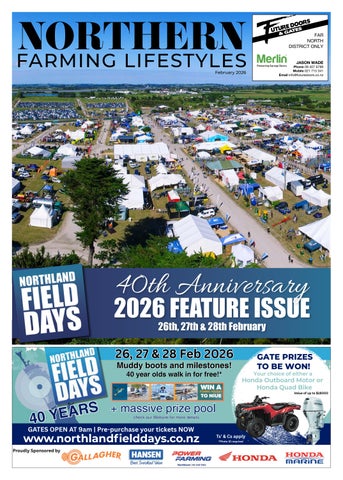
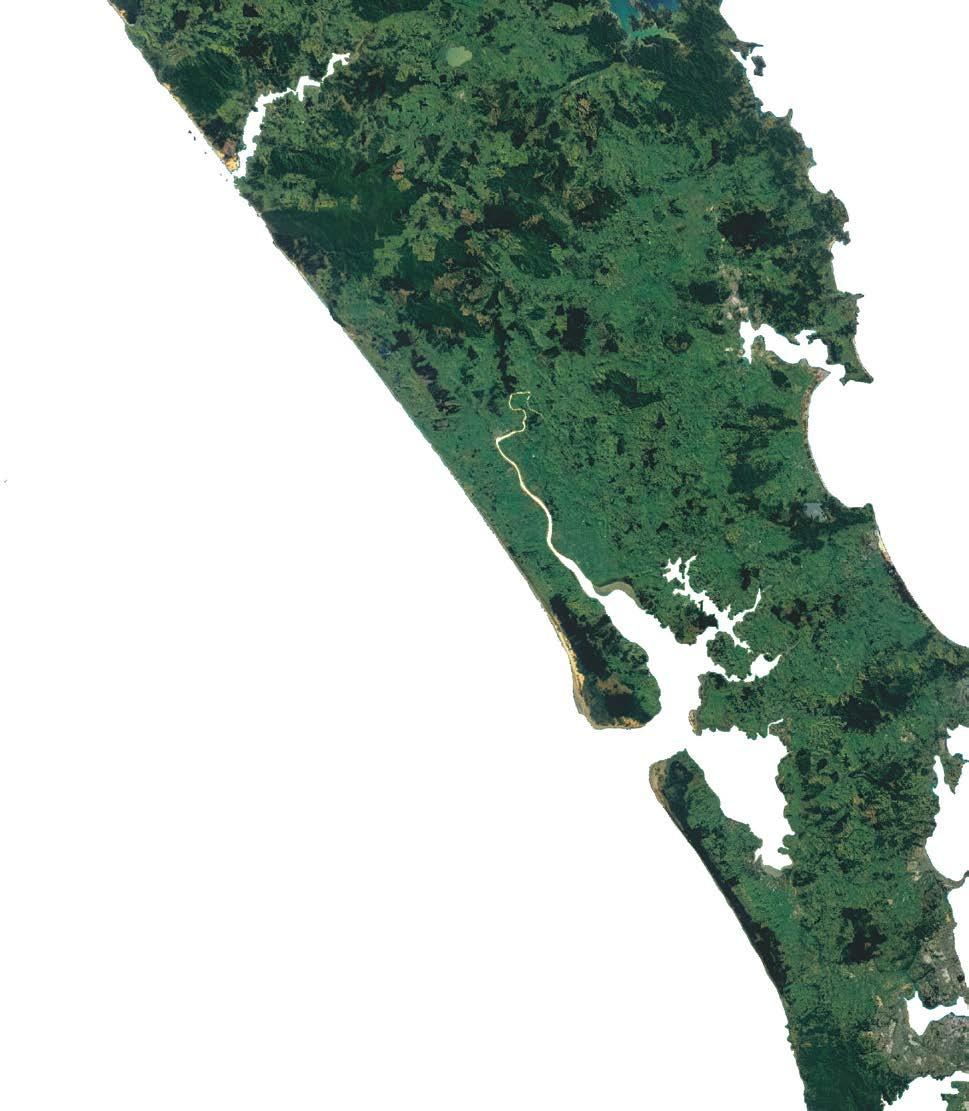
25,283 copies DELIVERED FREE to every farm and rural delivery address from Albany to Cape Reinga.
Mayor’s message of congratulations
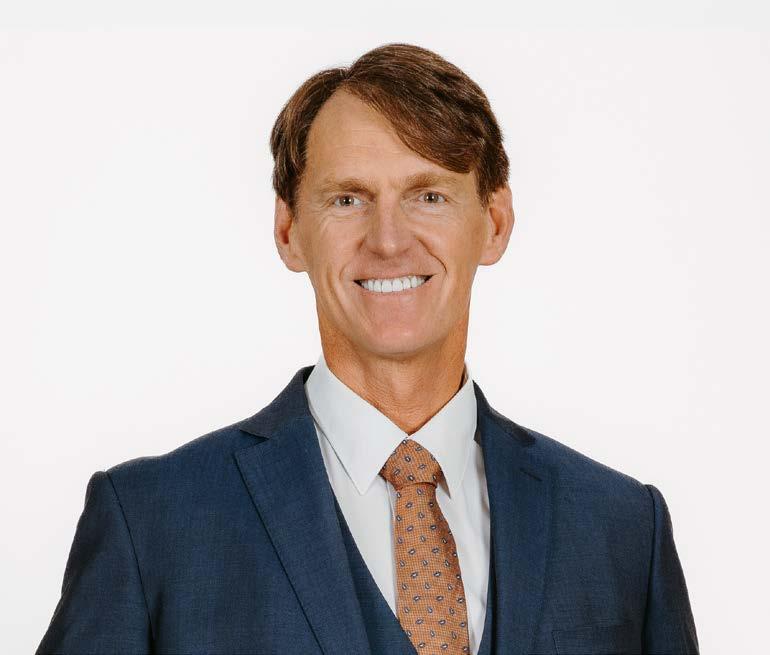
A message from Jonathan Larsen, Mayor of Kaipara, on the 40th anniversary of the Northland Field Days.
Forty years is a memorable occasion when it is the birthday of a family member or friend, but when it is a celebration for one of the most significant annual events held in Kaipara, it is even more special.
The Northland Field Days came from humble beginnings to rise in prominence, becoming the second-largest agricultural showcase of its kind, second only to the National Fieldays at Mystery Creek, Hamilton.
Just as the mayor and elected councillors who are my colleagues in Waikato governance must feel immense pride at hosting that colossal event, so too have successive mayors of Kaipara been proud to see the continued growth and importance of our own Northland Field Days. It is a highlight of my tenure to be the one to offer congratulations to the president and committee, and to all of those who have made the field days possible, at this important milestone.
The Northland Field Days contributes more than a sense of civic pride, however.
This is the largest and most significant outdoor event in the north, the most significant gathering of our hard-working Northland farming community, and the most significant display of technological and agricultural innovation the entire region sees each year.
To have it hosted here, in Dargaville, reflects the heritage of our farming ancestors, and the contribution to the local economy of our farming citizens today. Farming has been called the engine room of our economy, and this three-day festival shows that it is more powerful than ever.
If you are a visitor to Kaipara for the 40th birthday Northland Field Days, welcome! Enjoy your stay and the hospitality of the district. If you live here and have helped in some way to build the tremendous legacy of the field days through your sponsorship, support, volunteer hours, hard work or innovative ideas, your fellow citizens thank you. Happy birthday, Northland Field Days. May there be many, many more.
Kaipara mayor Jonathan Larsen
At Dementia Tai Tokerau, we walk beside all people affected by dementia.
with dementia
Welcome to the 40th Northland Field Days
This year we are here not only to celebrate this great agricultural event that is held annually in Dargaville, but to celebrate everyone who has been involved in making it happen for the past 40 years.
Firstly, I would like to acknowledge the Dargaville Jaycees, who started this event back in 1985 at the Dargaville Racecourse. The original event was a dream that has become a reality. It is now a successful annual event that has seen changes and much growth over the last 40 years.
To the many exhibitors that have been attending the Northland Field Days since the beginning, to the ones that have been coming for a while and to the new ones that are giving it a go for the first time, we celebrate you — you being here makes the Northland Field Days!
It takes hundreds of volunteers annually to bring such a huge event to Northland, and we are very thankful to everyone who gets involved. Many of you hold down full-time jobs, and you spend your time both after work and on your weekends to help make this all possible. We on the field days committee acknowledge and thank you sincerely for your help. We wouldn’t be here without your help and commitment to the event.
The lifestyle sector has grown a lot in our region since the Northland Field Days first started, and we can’t leave this important part of our event out. So be sure to check out the lifestyle exhibitors and the many different events that are happening throughout the event site.
We would like to wish all event visitors, exhibitors and volunteers three great days of Northland Field Days. We hope that you can enjoy what many exhibitors have on
offer, with the newest innovations in the agricultural sector, along with their technological expertise, support and plenty of deals to be had over the next three days.
Thank you once again for making us the Friendly Field Days.
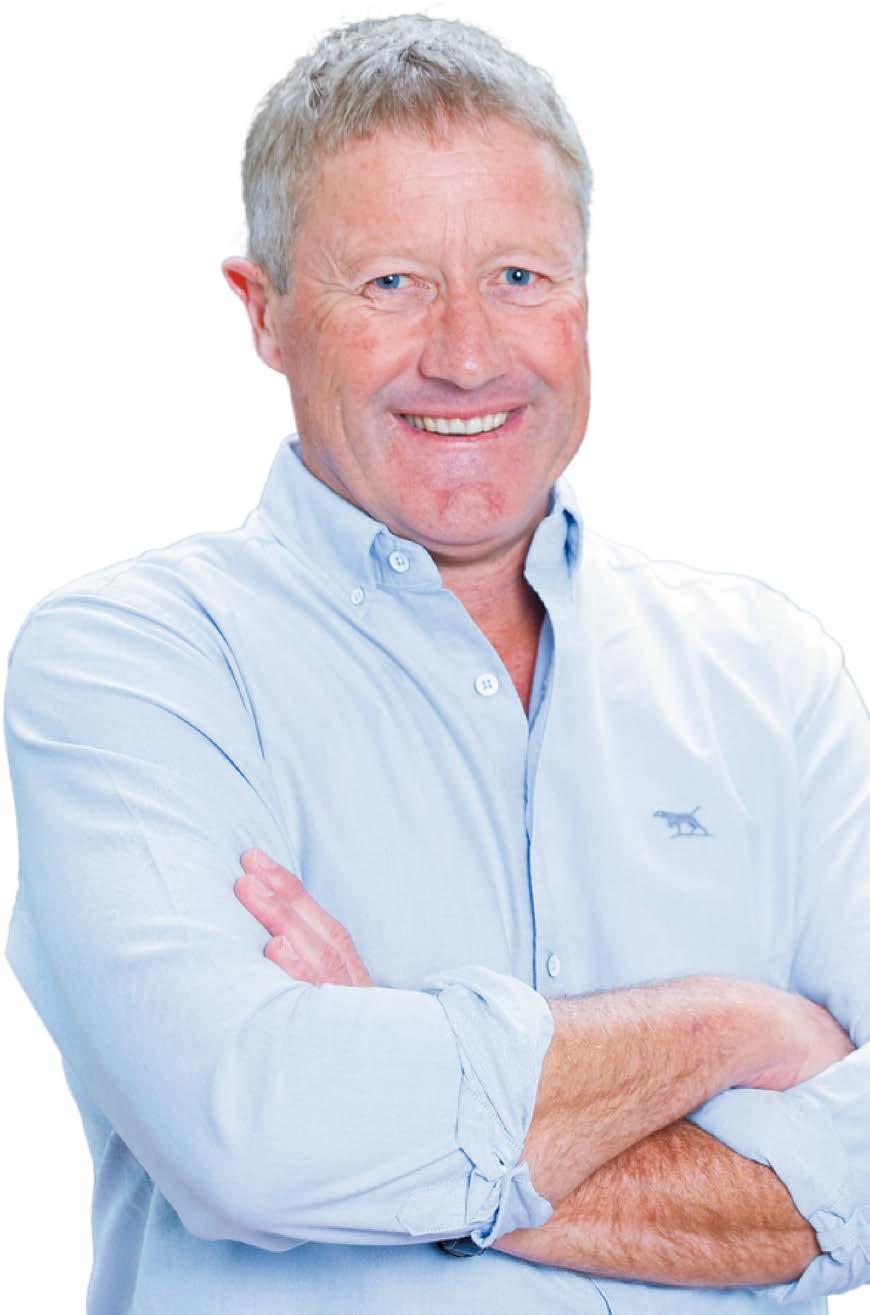
Northland Field Days president Mr John Phillips welcomes exhibitors and guests to a very special 40th anniversary event
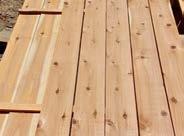
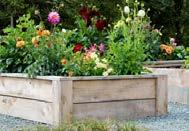
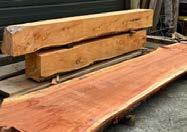
Suppliers of quality timber in Northland. Specialising in Macrocarpa, Japanese Cedar, Poplar & Redwood.
by Andy Bryenton
Origins of a local favourite
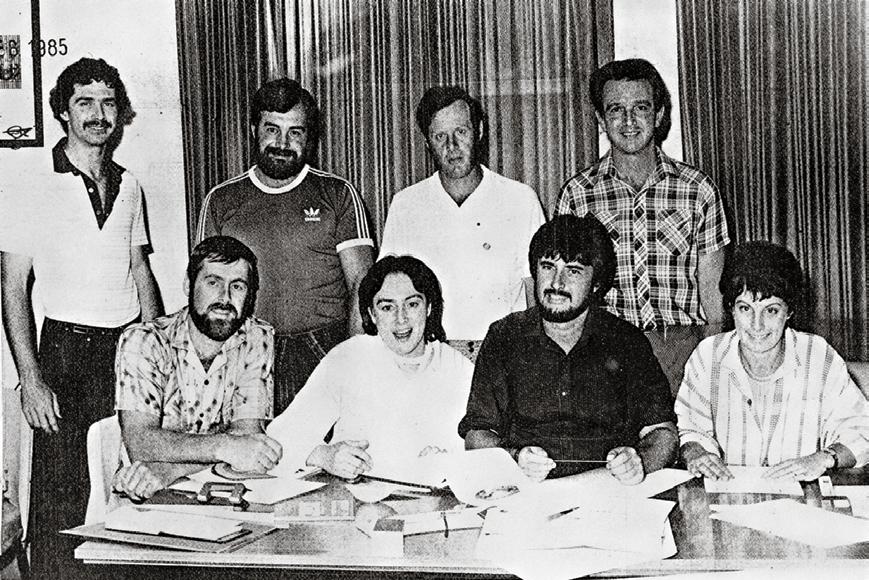
In the beginning it was a small committee, made up of members of Dargaville’s Jaycees club, who laid the foundations for the Northland Field Days.
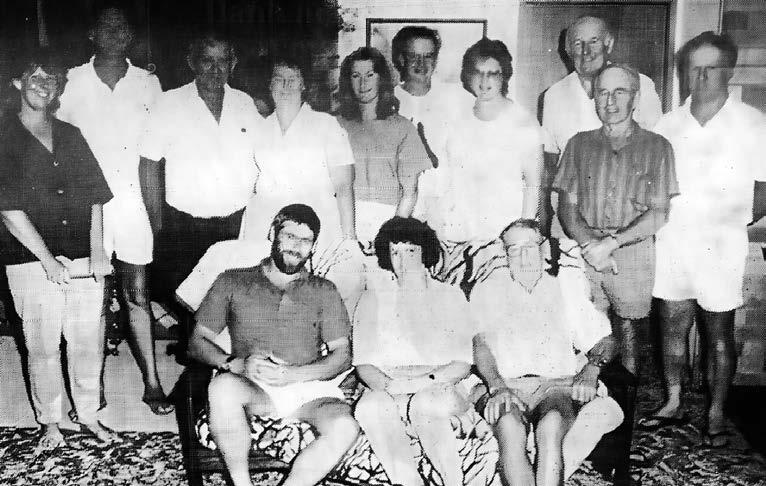
It was 1985. Madonna and Dire Straits were in the charts, David Lange led the charge on anti-nuclear policy, and mullet haircuts were having their first time around. While Kiwis enjoyed Georgie Pies and a booming share market, Athol Frost, Lex Gilmour, Murray Bruce, Colin Finlayson, Roger Gillat, Lyn Fenwick, Bruce Stallworthy and Dot Huggins made plans
for an agricultural festival in west Kaipara.
The Jaycees were part of an international movement promoting civic service, and what they came up with certainly fit the bill of that organisation’s pro-social charter. They also knew they were making history.
The first-ever advert for the NW Agricultural Field Days acclaimed it as the ‘first annual’ running of the event, stating that the idea was built to last.
The committee had an idea of what was popular, too. They touted not just a celebration of agriculture, as was already common to local A&P Shows with their prize livestock and giant veggies, but live displays of new technology, machinery and innovation. It was a trade show and symposium for farmers, and an acknowledgement that farming is a technical, skilled and multidisciplinary profession.
There was even a prize in that first year for the best agricultural invention, a concept still enjoying prominence each
year at the national field days as the innovation award.
“We organised it because it hadn’t been done before, and to create
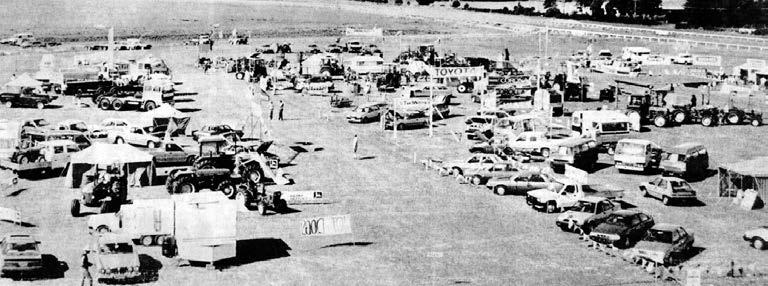
the mud didn’t slow down the tractors and utes on display in the slightest.
“We organised it because it hadn’t been done before”
enthusiasm among our members. Our chapter membership has grown from 10 to 20 in three months because we are doing something,” said Roger Gillat.
The site chosen for the first Northland Field Days was the Dargaville racecourse, an equestrian centre with ample room in the midfield for machinery displays, tents and stalls. While the venue was a great fit, the weather was not; a deluge soaked the event, but did not dampen spirits. Swandris and gumboots won the day, and
The Northern Farming World publication called the first field days ‘a great hit’, and while it erroneously predicted that it would ‘never reach the standard of the National Fieldays at Mystery Creek’, the Jaycees were recorded as ‘mightily pleased’.
The mud of that first event became a bit of a local legend, recounted with typical Dargaville good humour, and plans were afoot for the second event before the ground was dry.
By the time that next show rolled around, machinery and equipment
Also
Roger Gillatt, Lyn Fenwick, Bruce Stallworthy, Dot Huggins, (back) Athol Frost, Lex Gilmour, Murray Bruce and Colin Finlayson were all involved in planning the first Northland Field Days
demonstrations were queued up and ready to go. Kubota, Land Rover, Yamaha, Kuhn, Lely and Claas are all names familiar to field days’ visitors down through the years. Also making a debut was a staple of Northland Field Days fun; helicopter rides to view west Kaipara from the air.
By 1989 there were 75 sites at the event for exhibitors of machinery and farming technology, and an area with bouncy castles and entertainment for youngsters was a fixture, too. There was even a tractor skills contest, just like the one soon to test the mettle of show patrons this year. The bounds of the racecourse were starting to be stretched, and as the rural sector led the charge back from the late 1980s stock market crash, options were being considered for a move to wider pastures. In 1994, as 10 years of Northland Field Days approached, there were 240 sites in total.
heating up. This was the year that tractor pull prizes topped $3,000, and Barry Townshend of Waikato made his third trip to the north to take a three-year run as champion.
taken up with three days of farming action each February. It was time for an expansion, but it would take a decade for it to finally fall into place, when in 2006 the society, which had taken over
“We’re just about booked out, but we are trying to squeeze them in,” said Dave Philips, the president of the show. That year, more than 15,000 people came through the gates, and it was estimated that the number was growing by an order of thousands every year. The sports section of the event was also
“We’re just about booked out, but we are trying to squeeze them in”
When 1996 came around, Saturday visitor numbers smashed through the 10,000 mark, exhibitors’ numbers 400, and the whole central racecourse was
from those original Jaycees, purchased a large plot of land in Awakino Point, and established the site that has since played host to this massive rural showcase.
Follow in Claud Switzer’s footsteps almost 70 years after this generous bequest in 1954. You, too, can leave your mark in the form of a legacy that helps us continue his good work beyond your lifetime. Your gesture of kindness and generosity means a great deal to the people we care for and will help ensure our service remains accessible to families in the Far North for years to come.
Talk to us about how your name and legacy might live on (as a memorial tribute in our beautiful Switzer gardens/grounds).
Young Farmers’ Club tractor contest winners in the first year of the field days: George Brockett, Graeme Powdrell, Freddie Olsen, Barry Underwood and Alex Alison
by Andy Bryenton
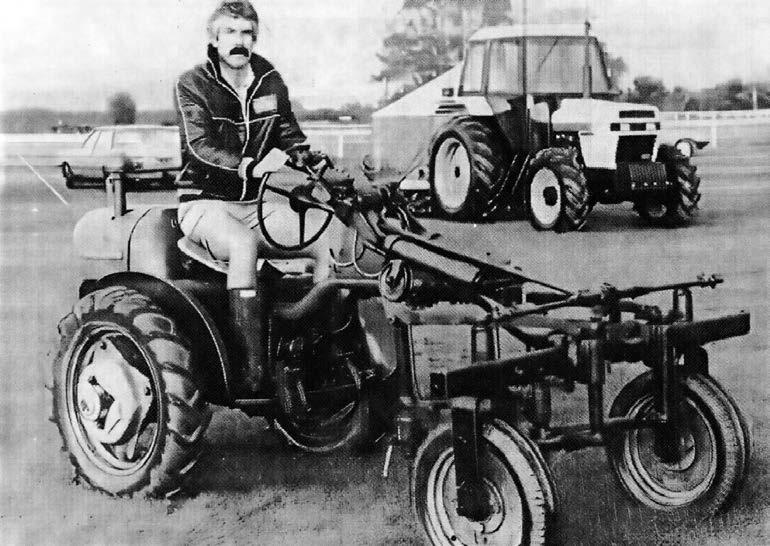
John Mawson drove this tractor into the first-ever Northland Field Days; it was a vintage machine in 1985, but still going strong
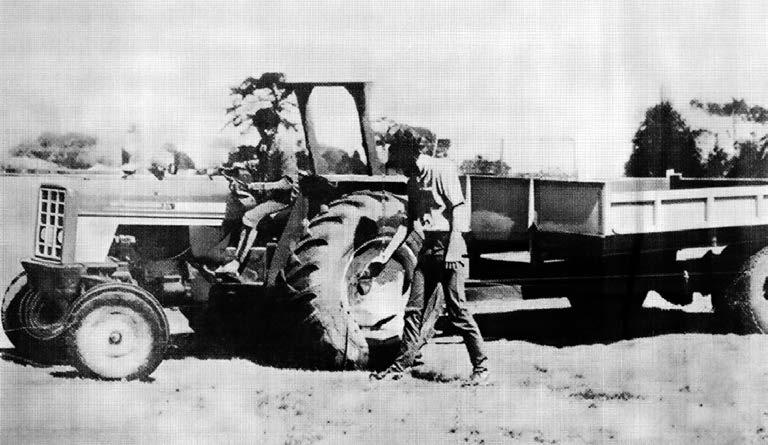
The Young Farmer of the Year contest was hotly contested in 1987, and featured a tractor skills component; an event that’s returning for 2026 and open to all comers
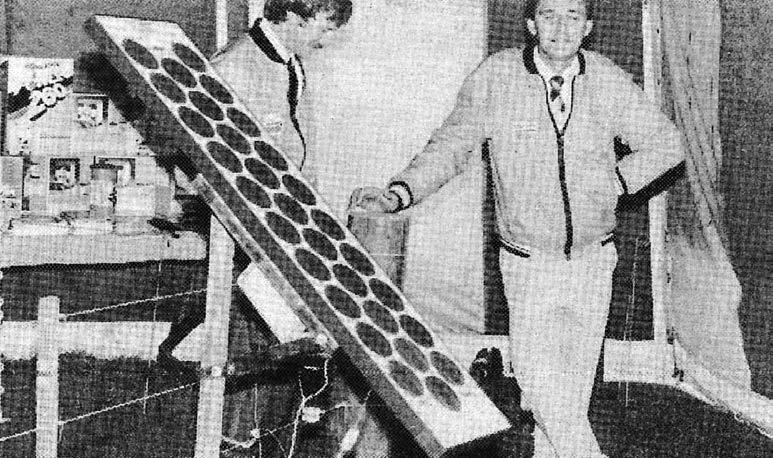
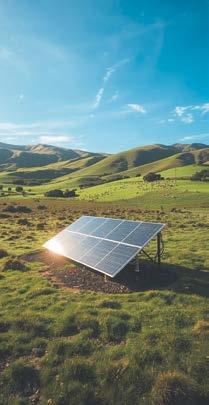
A demonstration by the Gallagher electric fence company in 1985 showed off a possibility for the future; solar panels to harvest voltage from sunlight
By 1991, the committee had grown to encompass many more willing helpers; front row Roger Gillatt, Janice Williams and Les Rowland, back row Harry Lendrum, David Phillips, Terry Leslie-Ellis, Ian McKay, Jenny Finlayson, Colin Finlayson, Rosemary Sanford, Yvonne Gilberd, Ronm Gilberd and Christine Appleton. Barbara Gillatt was absent from the photo, but another big contributor
Celebrating 40 years of family fun
by Paul Campbell
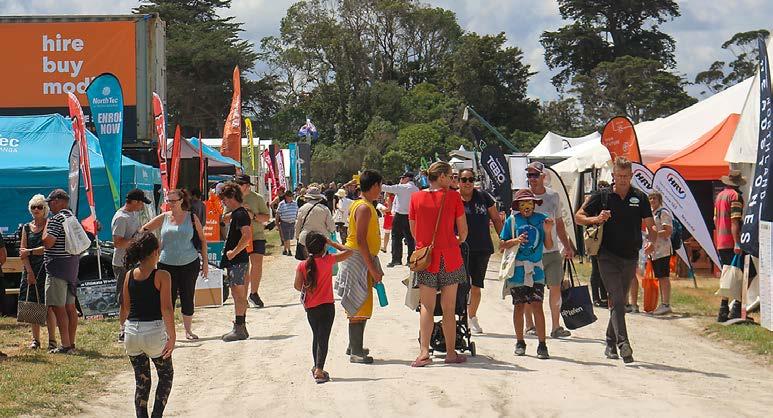
It’s not just for the rural community, our farmers and their supporting industries; it’s a series of days out for complete family fun when town meets country at the Northland Field Days on Thursday, February 26 to Saturday, February 28.
Awakino Road showgrounds will once again celebrate, this time the 40th anniversary of the event and if you have your proof of being 40 years old, too, you may get free entry to the biggest agri-event in the north.
“There will be entertainment galore in rides and competitions, food and refreshments, and for the more serious minded, of course, there’s a showcase of the latest in farming technology, machinery and innovations that will attract visitors from across the country and overseas,” says
Northland Field Days event coordinator Luciana Schwarz.
The expertise and products for the rural industry are a magnet across the world, so field days 2026 invites the whole family to come together to celebrate the Northland region and inspect the offerings of more than 300 exhibitors. There are two large lifestyle pavilions and many outdoor lifestyle sites bringing to you the highest-quality products and services, from home, garden and leisure to food, wine and gadgets — there is something for everyone. There’s a chance to go home
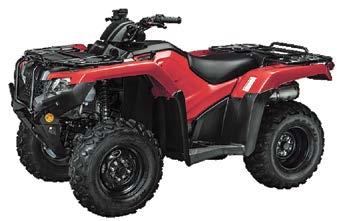
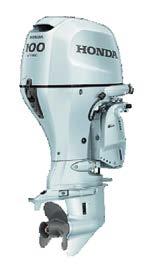
with prizes, including an outboard motor and a quad bike from Honda. There will certainly be the show staples that always attract crowds from the sheepdog trials to the tractor pulls, lawn mower racing and more. There’s a chance of a big bonus, too; you can go in the draw to win a North Travel trip to Niue. Live music keeps things bouncing along with Dave Ewart and his blend of country rock, rock ‘n’ roll and easy-listening. There are three food court areas clearly marked throughout the event with many food vendors, coffee, refreshments, ice cream
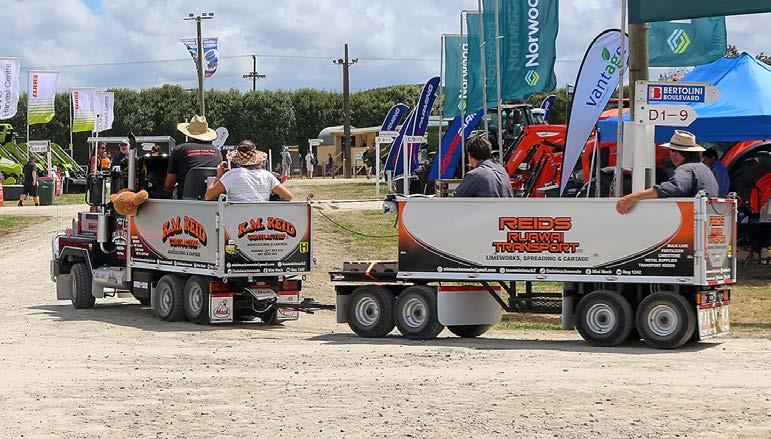
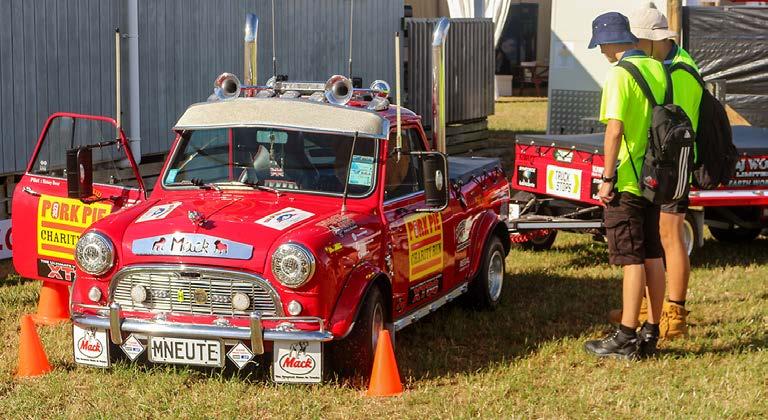
and plenty of food product samples. For the petrol heads and enthusiasts, lawn mower racing allows people of all walks of life to get involved, compete and have a lot of fun or just be a spectator. If energy flags, there’s always time to sit and just enjoy the parade riding on the Mack replica for truck fanatics of all ages; it’s a great way to get around the field days. Although technically not a truck, the converted Mini is a crowd favourite. Its powertrain is a 1,275cc four-cylinder engine (the British Leyland Mini’s original A-series motor), and it’s
THURSDAY 26 - SATURDAY 28 FEBRUARY 2026
The mighty mini Mack is a popular attraction, cruising the field days byways with youngsters on board
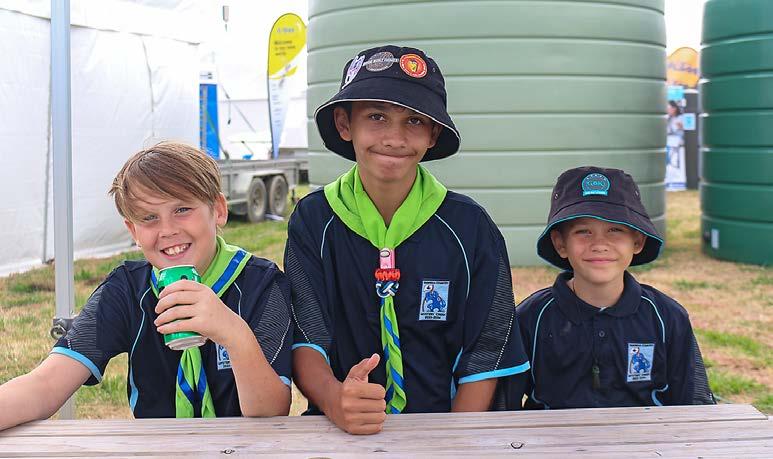
Dargaville Scouts pitched in for 2025, welcoming guests to a field days full of fun
armed with discs on the front and drums on the back. The vehicle does about 20 events a year, usually for charity, using the Mini’s pull-trailer to give event patrons a unique ride.
A time-honoured event is the longrunning tractor pull competition on the 100m track for novices, experienced drivers and spectators to enjoy on Power Farming Road and experience the fun and thrill of rural racing that tests brute strength, skill and technique. The popular sheepdog trials are part of DNA for both town and country, and all ages are captivated by the best sheepdogs from around Northland in competition.
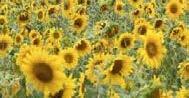
If time out is needed, head off to the sunflower rest area between Power Farming Road and Norwood Road or cool off in style with all-day water fun near Norwood Road. There’s still plenty of fun to go in the all-day Laser Clay Shooting at
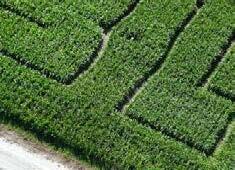
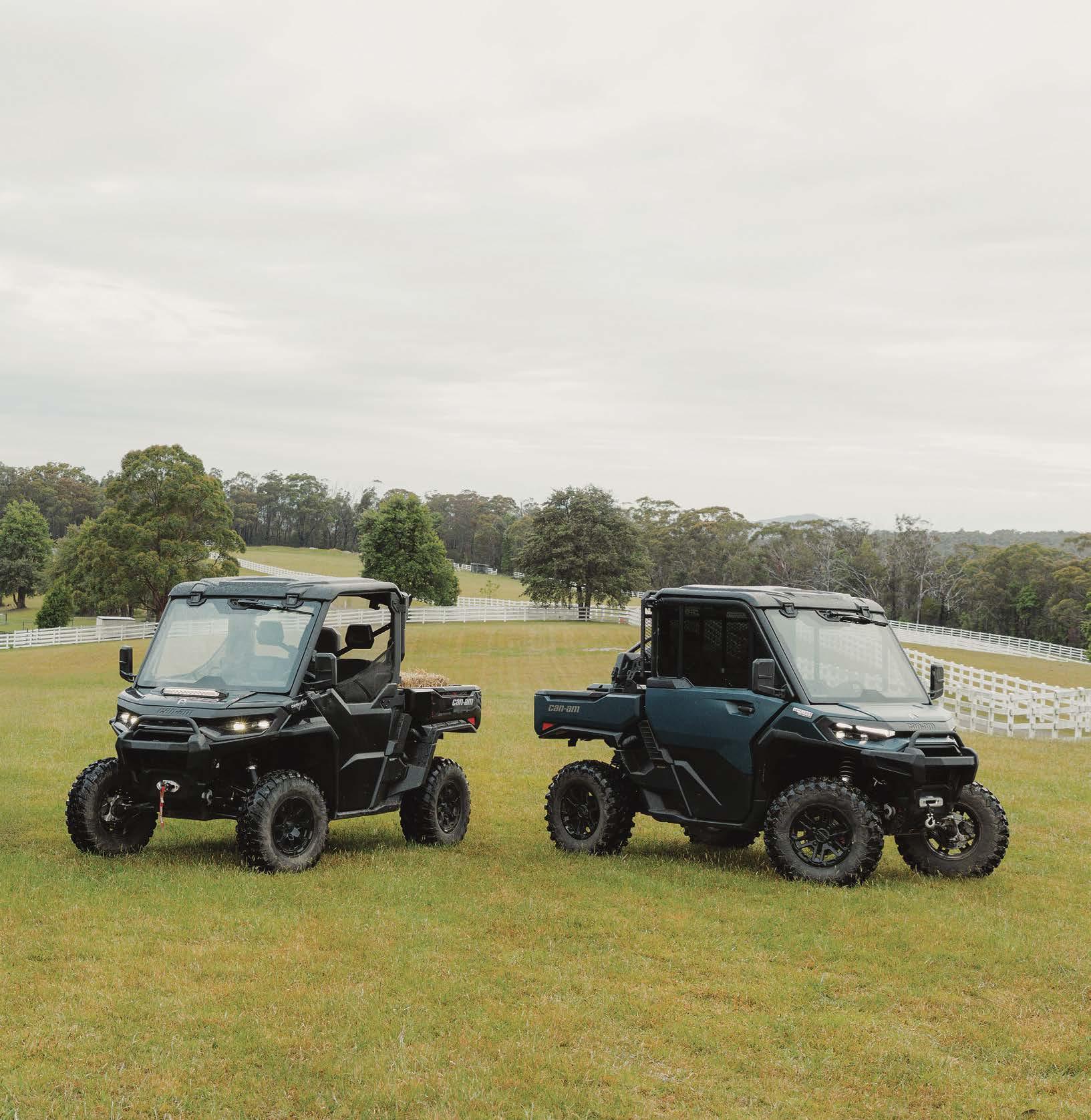
sites A19 to A22 on Rowland Road as well as the all-day Maze in the Maize between Norwood Road and Can-Am Off-Road.
Community support will be well represented with the Northern Rescue helicopter team on-site, and also available will be HeliNorth scenic helicopter rides on Gillat Lane. The volunteers from the Dargaville Fire Brigade will be there with firefighting equipment, displays and information. They will have activities throughout the day.
For more petrol enthusiasm activity take in the Kauri Coast 4WD competition on Gillat Lane and Northern Lane or the motocross drag competition demonstration area on Rowland Road. While the field days are family fun, the exhibitors are not forgotten. The committee behind the scenes takes steps to facilitate the comfort of all stakeholders, including exhibitors and
CONSTRUCTION SPECIALISTS
usage by other community organisations to host their own events. More permanent toilet blocks, shade, safe pedestrian access and walkways remain high on the priority list.
In addition, field days organisers continue to financially support many community organisations and clubs with fundraising opportunities and affordable sites to charitable groups to help them with their existence and goals. It reinvests back into rural Northland with provision of other community funding in the form of study grants and awards for individuals and organisations to assist. Each year people from the public, who are not associated with the Northland Field Days Committee, judge exhibitor sites for the Best Outdoor Site, Best Indoor Site and Best New Site. Along with a trophy, winners will get their site free in next year’s event.
This converted classic Mini stole the spotlight from some of the huge tractors and new utes in 2025 — but only momentarily
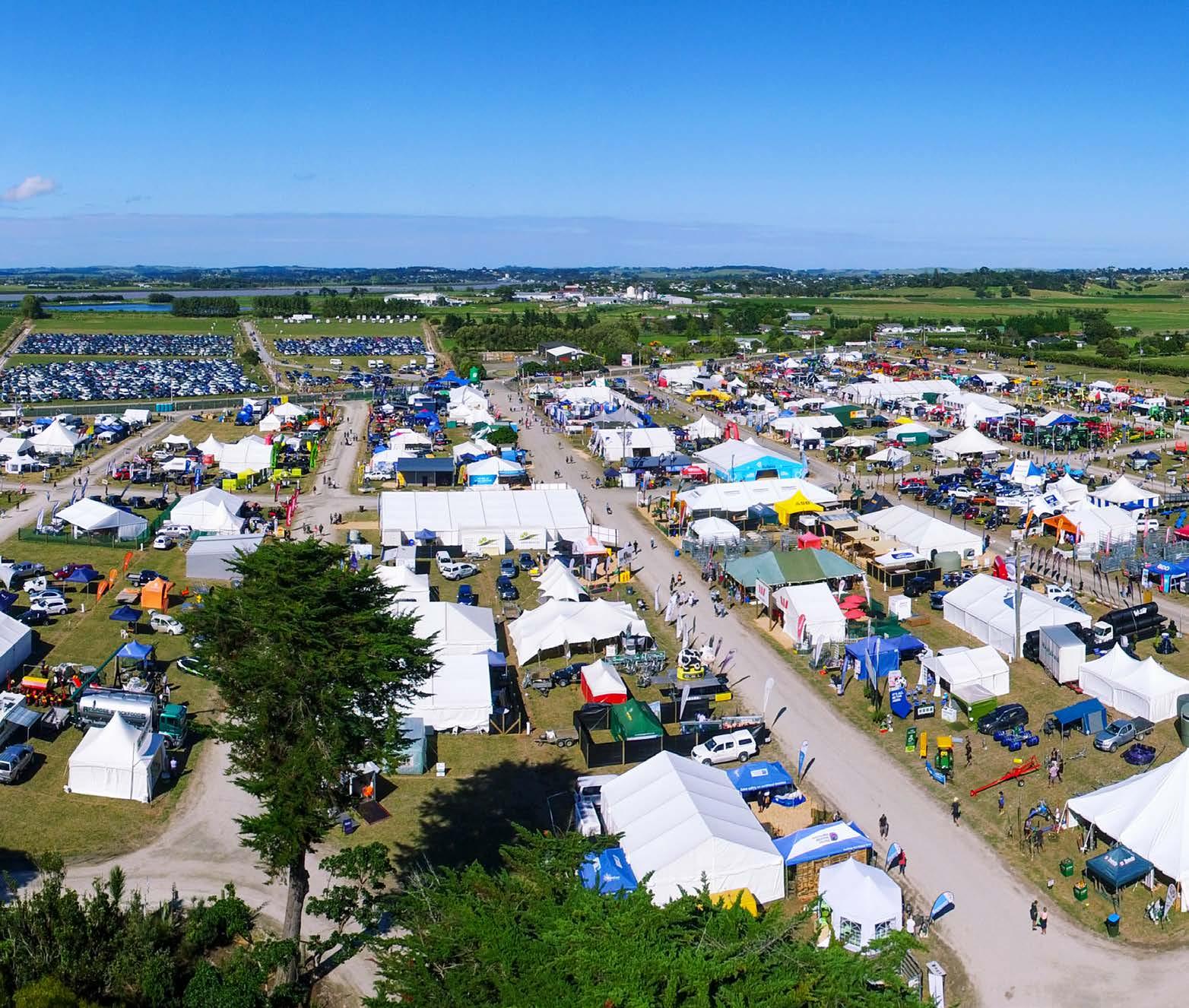
The 2026 Northland Field Days promises to be the biggest and best event of its kind ever held in Dargaville
by Paul Campbell
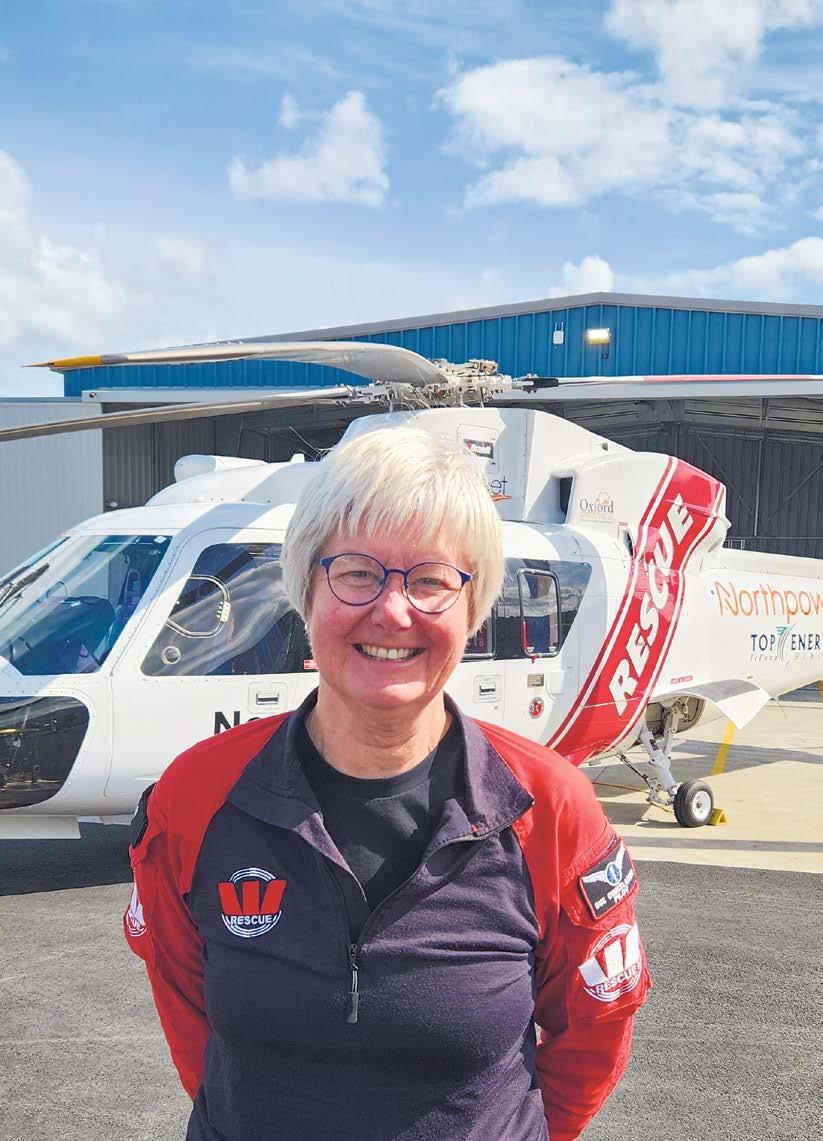
Rescue helicopters at the show
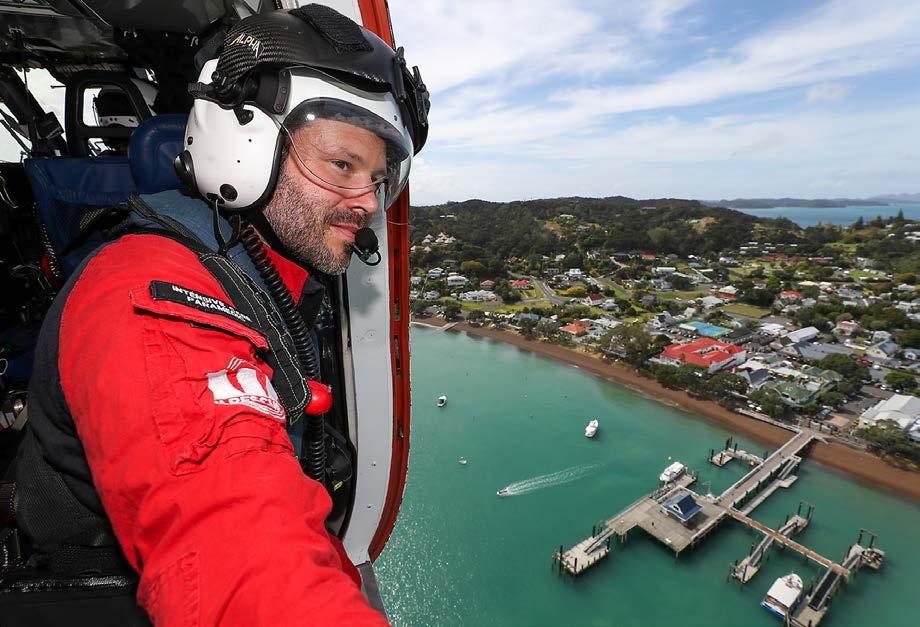
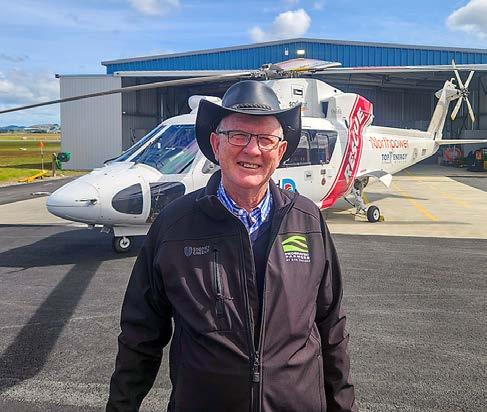
Provided they are not out on a mission of mercy, one of the Northern Rescue Helicopters will be landed at the field days near the main car park on Friday and Saturday.
“So swing on by and say hello to our pilots and paramedics,” says NEST spokesman, Steve Macmillan.
“Our good mates and Northland Federated Farmers will again be hosting us at sites H12 and G12 — next door to our friends and major sponsor Westpac, and just a stone’s throw from Northland Field Days HQ. We will also be sharing the site with Grant Shaw from Northland Farm Services and Prostate New Zealand.
“Remember to check out our awesome raffles, where you can win some great prizes worth hundreds of dollars, including a $500 voucher from Paparoa’s Bulbs Direct — one of our loyal sponsors.
“NEST has three Sikorsky S-76 emergency rescue helicopters. We’re the only service in New Zealand using this model of emergency helicopters providing worldclass capabilities, and we have worldclass pilots to fly them. “
to hospital quickly is critical to the wellbeing and safety of locals and visitors to our region. We can’t do that without everyone in the chain playing their part in providing care in a person’s time of need.
“That only happens thanks to the passion of all first responders, community volunteers and support networks who work together as a team with the crews on board our Northern Rescue Helicopters.
“We need the speed of the Northern Rescue Helicopters to get us to a place of safety quickly because that greatly improves patient outcomes and saves lives.
Northland Federated Farmers president Colin Hannah has called on businesses across Northland to support the helicopter service saying the region is “blessed to have a world-class air ambulance service providing extremely high levels of care.
businesses can use some of those profits to pay it forward and help others.”
“However, the Northern Rescue Helicopters need ongoing financial support from businesses in the agricultural sector and in general. Farmers spend a lot of money throughout the north every day, and I would like to think those
Hannah says Northland Federated Farmers supports the service annually, as do a lot of its members on an individual basis.
“Given there are so many remote pockets around Northland, getting people
“That’s why it is critical we all support Northland’s communityowned air ambulance service that was established by locals, for locals in 1988. You just never know when you or a loved one might need one of our helicopters. Donating is like a form of insurance and paying it forward to help yourself or others.”
Westpac NZ has joined as an associate sponsor of Northern Rescue in Northland, in a joint venture bringing a new level of capability to emergency air services in the upper North Island.
Rescue service airborne in action over Northland
Photo: Michael Cunningham
by Andy Bryenton
The taste of field days
The Northland Field Days offers more than just things to see and do; there’s plenty to taste and savour as well. Check out this list of culinary options to look out for when you visit the field days food courts in 2026.
Food Court One
You’ll find Turkish and Kiwi fusion food from Surmeneli, American-style street food and coffee from J and J Catering, real fruit ice creams by Camkiwi Trading, salad bowls and hot bread roll sandwiches from Nothing Fancy Streetfood. Classic gourmet burgers, hotdogs, fish and chips, loaded fries and fruit ice cream by the Blue Lady, Donutlicious doughnuts, pāua and cream and mussel fritters from Missy’s Kai Kart, and hot and ice coffees and brownies by Bean on the Scene.
Food Court Two — the ITM-sponsored food court
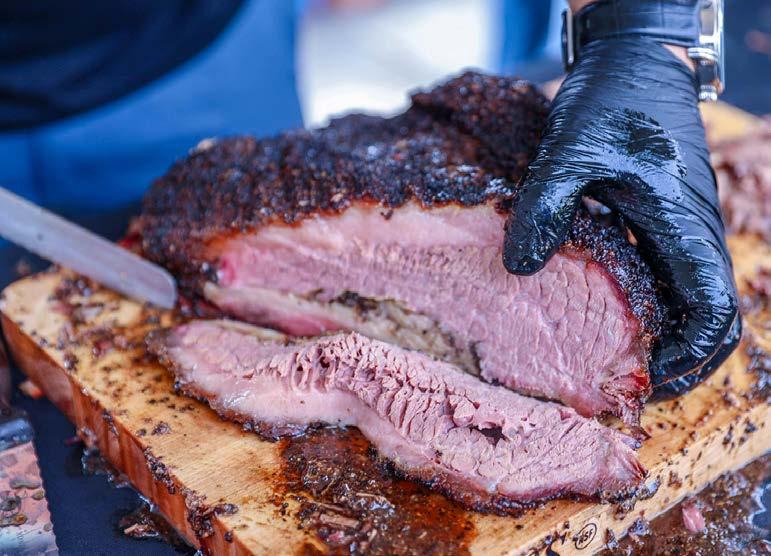
Fresh pasta, loaded fries, chicken bites and ragu from Pasta Lovers joins New Zealand Whitebait Fritters with their signature dish as well as bacon and egg sandwiches, delicious seafood, chowder and cream paua by Tasty Tucker. The serious taste sensation of Grownup Donuts, slow and low and smoked meat deliciousness from the BBQ Pitstop, Nepali-style momo dumplings from NZ Momo, fresh strawberries and desserts from the Strawberry Lady, and the classic selections right out of the van by Mister Whippy.
Food Court Three — the Kaipara Refuse sponsored food court
Mister Whippy will deploy a van here too, for ice-cold treats, right next door to Churro Loco with their delectable churros, fresh wraps with a choice of fillings by Wraps and More, woodfired pizza creations by Missoni Woodfired Pizza. Snow cones, mini doughnuts, steak and egg rolls and chips by Jax N All, fresh watermelon juice, fruit smoothies and tropical trifles from Tropical Sunrise. Mouthwatering butter chicken, burgers, wings, prawn skewers, calamari and lamb nachos by My Kitchen On Wheels, mussel and whitebait fritters, hot rolls and hot dogs from Ka Pai Kai. Barbecue meals with steak, loaded fries and creamed pāua by Munchies Kai Kart, and ice cream with chocolatecovered strawberries at Kiwi Berries.
The market zone
Stop while you shop to enjoy hot coffee, candy floss, chowder with frybread, hot rolls and toasties at Mauri Kai, the barista coffee cart. Cool down with a sweet treat by Shaved Ice Real Fruit Ice Cream.
COMMUNITY NEWSPAPERS NEWS YOU CAN TRUST
Contact us today to learn how
www ablesolar co nz 09 267 7065
Carnival treats and international flavours sit side by side at the Northland Field Days
Enjoyment of adventure
by Amy Fifta
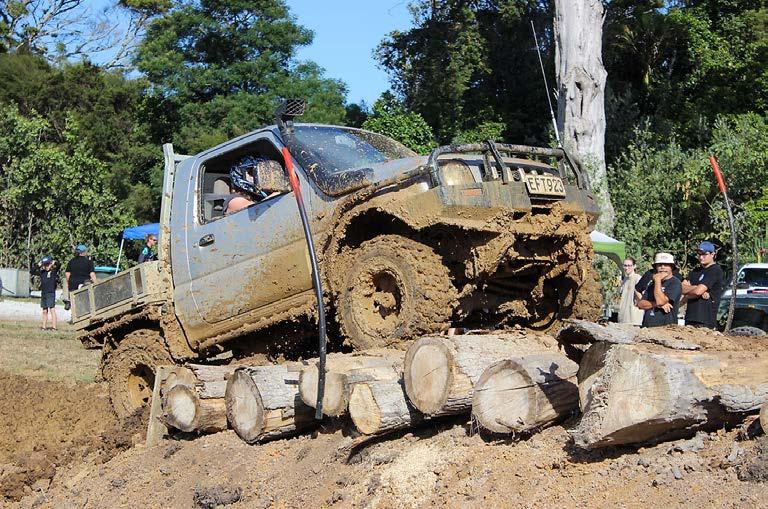
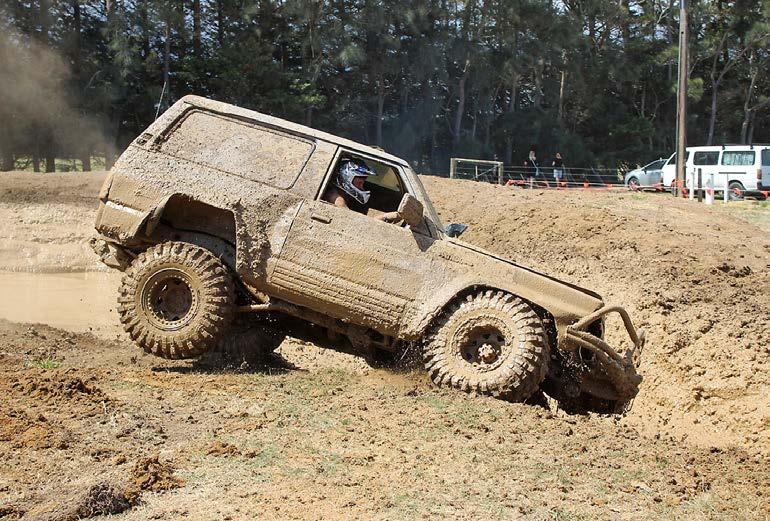
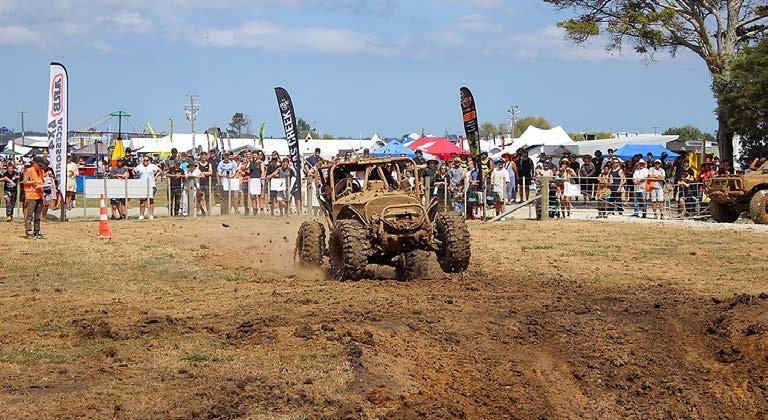
The Kauri Coast Mud Drags is making a second appearance this year at the Northland
about, challenging terrain, fun and family.
For Kauri Coast 4WD Club president Sam Whalley, the sport is not just an activity that brings excitement to faces — it represents adventure and family.
“For me, four-wheel-driving has always been about adventure and community. I love that a 4WD can take you places you simply can’t get to otherwise, beaches, forests and parts of New Zealand that most people never see,” said Sam.
“I was lucky enough to grow up around it, tagging along with my dad on trips in his Suzuki. Those early experiences really stuck with me.”
The club is part of the New Zealand Four Wheel Drive Association, created to draw people to mud sports and to work towards accessible off-roading together.
“The association has been around since the 1970s. It was formed to bring clubs together, advocate for fair access to
public land, promote safety, and create a national voice for off-roaders.
“Over the decades, the association has played a key role in conservation projects, emergency response work, land- access negotiations, and building a nationwide community of people who enjoy responsible off-road recreation.
“Today it’s made up of three regional zones, dozens of clubs, and thousands of members, all volunteers
who put in countless hours to support the sport.”
Northland Field Days’ visitors will be getting a glimpse of the excitement of driving. With logs, deep dips and rough terrain part of last year’s track, this year there are hopes to improve it even more.
“This is still a fairly new event for us, and this year is only our second time running it. It’s proving to be a great learning experience for the club as we
Call Garry Wilson on 021 569 661 or email gea.midnorth@gmail.com
Glen Newlove, Sam Whalley, Vicky Hilton and Annette Olsen at the club’s Fundraiser Safari event last year
Sam says that for him, four-wheel-driving is about adventure and community
figure out what works well for both the entrants and spectators.
“While there’s definitely some fierce competition, it’s not a formal competition or part of a series. The whole idea is getting out there and having a good time in all sorts of vehicles.
“The focus is really on enjoyment and the community side of being in a club, rather than who takes home a trophy.
“It is more than just vehicles on display. It’s an opportunity to talk to real people who use their four-wheel drives for family trips, club events and exploring New Zealand’s back country safely.”
A showcase of the mud sport, the event allows newcomers to ask drivers about the fun behind the wheel. “Newcomers can ask anything they want to know
without feeling judged. We’re always happy to help. The question I’m asked most often is, ‘How do I get started?’ My answer is always to join a club. You’ll learn safely, meet great people, and avoid expensive mistakes.
“A lot of people assume four-wheeldriving is just jumping in and giving it a go, but there is a safe, environmentally responsible way to do it. That’s what clubs help people learn.
“The easiest way is to connect with a local four-wheel-drive club. We’re based in Dargaville, but there are clubs right across the country, and people are welcome whether they’re brand new or experienced.
“Clubs offer trips, beginner training days, social events and plenty of
opportunities to learn how to use a fourwheel-drive responsibly off-road. Anyone interested can chat to us at the stand, or find us on Facebook under Kauri Coast 4WD Club.”
People wanting to witness the excitement of the mud drags and explore what the sport is like can find the local club exhibition across from the kids’ entertainment area on Gillatt Lane.
“We’re a small club, so it takes a lot of organising to pull everything together, and we simply couldn’t do it without our volunteers. Each year, the event gets a bit more polished as we learn what people enjoy and how to make the course fun, safe and engaging.
“At the heart of all this, the most important part is the friendships you make and the fun you have getting out there together. That’s really what fourwheel-driving is all about.”
Volunteers and club members put work into making the course for contestants to traverse
The first competition drew crowds of eager spectators wanting to see drivers take to the track
Northland gun eyes world shearing title
by Paul Campbell
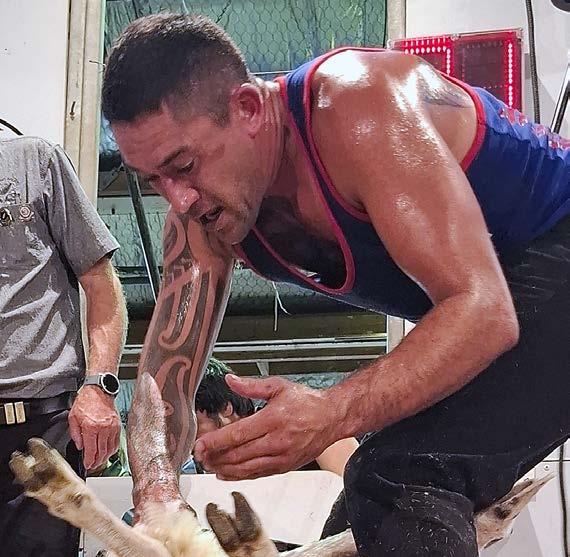
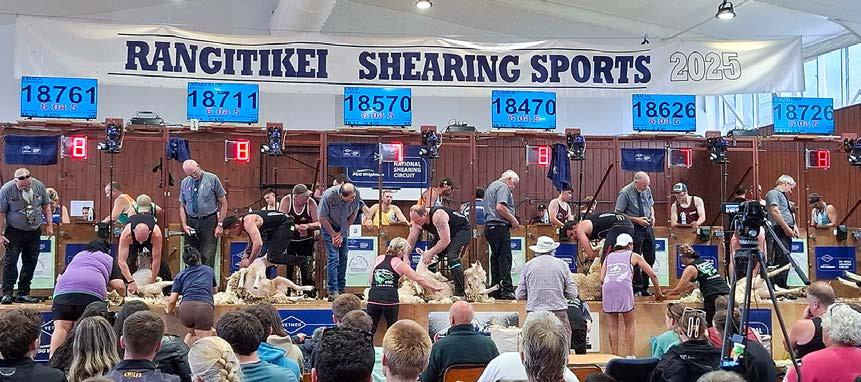
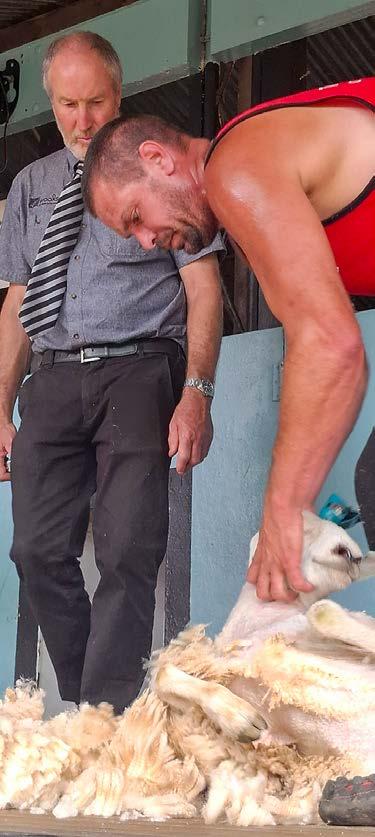
Northland shearer Toa Henderson will be shearing for the ultimate dream when he represents New Zealand at the 20th Golden Shears World Championships in Masterton on March 4–7.
Winning the Golden Shears and New Zealand Shears Open finals in Masterton and Te Kūiti respectively last year, Henderson dominated Shearing Sports New Zealand’s near year-long, eight-round machine shearing selection series, winning four of the first five events and finishing runnerup in the other, to secure one of the two berths with a round to spare.
“A team of two machine shearers, two blade shearers and two wool handlers will represent New Zealand with the goal of restoring the black-shirt pride after New Zealand, for the first time in world championships’ history dating back to 1977, filed to win any of the titles in Scotland in 2023,” says SSNZ spokesman, Doug Laing. “New Zealand also missed out on the glamour open
shearing individual and teams titles in Scotland, and four years earlier in France, and also has an old score to settle from when veteran Scotland international Gavin Mutch won the individual title the last time the championships were held in Masterton in 2012.”
Kaiwaka shearer, Henderson, a top senior shearer around 2007–2008, has had a dramatic rise in the open ranks
since returning eight years ago from a stint in Australia. He is now closing in on a total of 50 wins in the top grade in New Zealand, and showed his relent in top international class in winning the open title at the Royal Welsh Show in July last year.
His victories have been highlighted by the long journeys to get to the events, sometimes over 1,000km return trips
Kaiwaka’s Toa Henderson is heading for glory in Masterton
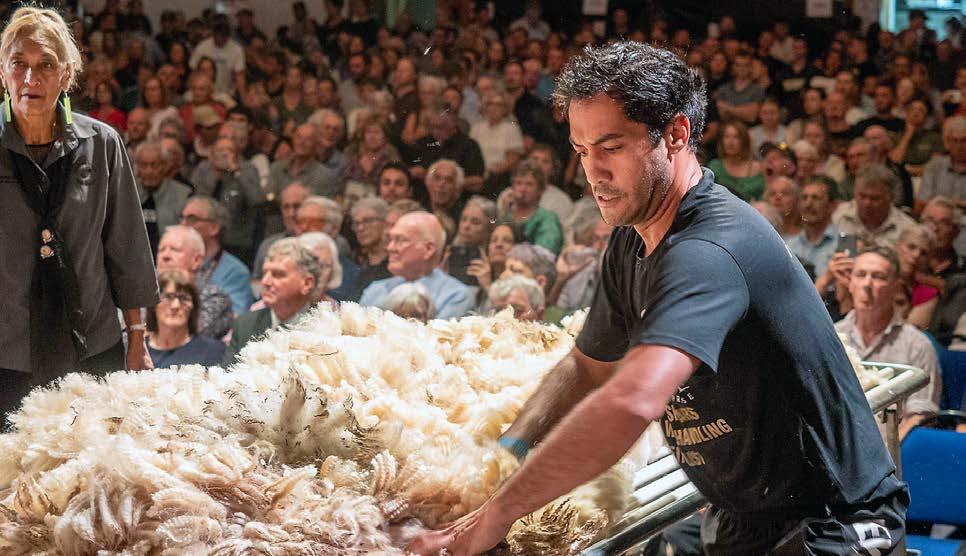
Woolhanding will show shed support skills in Golden Shears competition
by road in the North Island, and he will be out to emulate the feat of Northland’s other world champion, Rowland Smith, from Ruawai but based in Hawke’s Bay, and who won the 2014 title.
The championships in Masterton have attracted entries from 28 countries, and hundreds of others from overseas as either entrants in the supporting annual Golden Shears events or as supporters.
In addition to the six world titles, more than 20 other regular titles at the annual Golden Shears will be decided, including the Golden Shears open shearing and woolhandling events.
In all, about 600 competitors will take part, bolstered by about 150 chasing the world titles. Tickets for the major Friday and Saturday night events in Masterton’s War Memorial Stadium, where the Golden Shears international championships have been held annually since 1961, sold out quickly several months ago.
Spectators will also be accommodated in a marquee across the road in Queen Elizabeth Park, while thousands around the world are expected to watch the live-stream, covering all events over the four days.
It was back in 1958 that members of the Wairarapa district Young Farmer’s Club proposed a shearing competition at the annual Agricultural and Pastoral show. With advertising and special invitations, the stage was set for a new sporting
spectacle that would impact Masterton in the future.
The competition was a huge success and organisers, Laurie Keats, Iain Douglas and Graham Buckley approached Federated Farmers’ then chairman,
Mr Roy O’Hara, and president, Mr Bob Chamberlain, to ask if an annual contest could be staged in more appropriate premises — the War Memorial Stadium.
Golden Shears was the agreed title and from this point in 1960, the world’s greatest shearing competition was conceived. The inaugural Golden Shears of 1961 surpassed all expectations, with crowds so great that the local army was called upon to help with control.
Through the 1960s and 70s, before the impact of live sport on TV, the fascination and excitement of Golden Shears became a household name with seats booked from year to year.
Many shearing greats including Ivan Bowen, Snow Quinn, Roger Cox and
SCORCHING HOT DEAL!!
Martin Ngataki to mention a few — engraved their names in the record books.
In the late 1970s and early 80s many minor shearing competitions sprang up throughout New Zealand. Shearing had entered the world of professionalism.
Prize money for competitions became larger by the year, with many shearers adopting professional attitudes such as training programmes and fitness courses never heard of in the early days of the 1960s.
For the voluntary organisers of Golden Shears, the rate of change was difficult to keep pace with. There were many rule changes, major sponsors were required, inter-challenge events between Australia and New Zealand were implemented and a World Shearing Championship held in 1980.
Golden Shears became more than just a simple shearing competition. It became a foundation, a centre point and arena, where many constitutional meetings
were held and our world champions were founded.
Shearing competitions throughout New Zealand and the world established their presence as a major sporting code in the late 80s and early 90s.
Rowland Smith hailing from Ruawai has won the open title in the past
Provincial competition sets the stage for world champs
by Andy Bryenton
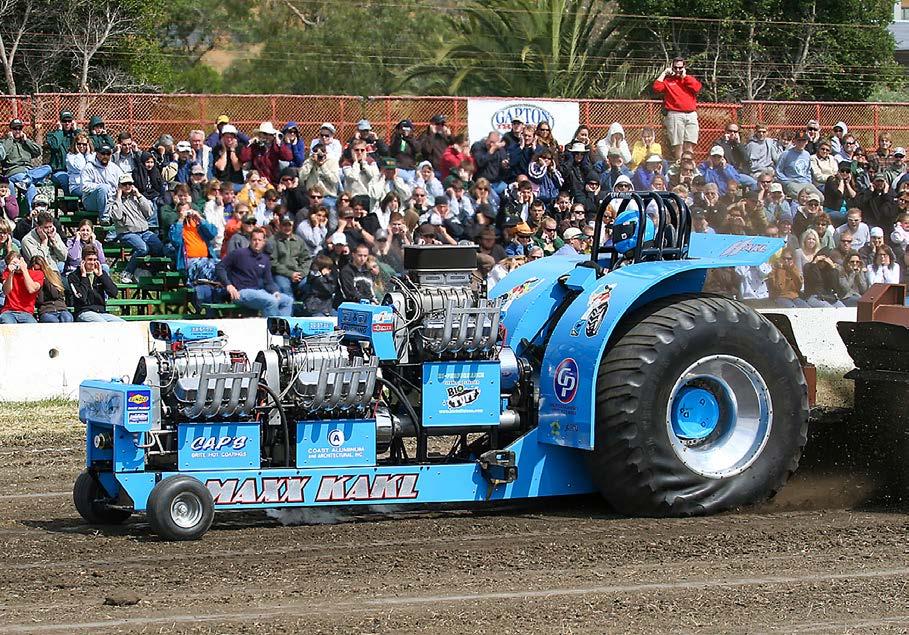
Thunder in the dirt
The world’s most powerful motorsport doesn’t take place on tarmac or involve sleek racing cars with millionaire drivers.
With its origins in the goodnatured boasting and rivalry of wagoneers and ploughmen in the early days of farming in the US, the sport of tractor-pulling has a big following worldwide. It also boasts some of the biggest figures when it comes to horsepower.
Originally, it was literal horsepower which drove the sport. The strongest teams got more than just a celebratory beer or two. Each victory was well-watched by local farmers, and winning was the best form of advertising. As motorised tractors began to take over in the 1920s, many traditional horsedrawn plough teams took on the new machines in contests between animal muscle and internal combustion. While the writing was on the wall for the horses, eventually, they paved the way for contests between tractors.
Horse pulling is still a big drawcard at many US A&P shows. Still, its offspring, the tractor pull, has advanced to levels almost absurd in their power and noise. The very first competitions used normal tractors and the same rules employed for horses; records state that the first time mechanised tractors went head-to-head was in Vaughnsville, Ohio, in 1929.
The National Tractor Pullers Association was founded in 1969, as tractors got increasingly powerful, and a set of rules covering the entire US was needed. The organisation supported mainly stock tractors and had the motto ‘pull on Sunday, plough on Monday’. Then, in the mid-1970s,
Back in 1963, hot rod maverick Ed ‘Big Daddy’ Roth had crafted a car called the Mysterion with two Oldsmobile big-block V8s. Inspired by this feat of engineering, the Bosse Brothers from Ohio created a high-power ‘crossbox’ gear train which
could pump the torque from more than one tractor engine out through the back wheels. Carl and Paul deployed a twin-mill tractor and smashed the competition. Then Bruce Hutcherson upped the ante with a triple-V8 tractor called Makin’ Bacon. Tim Engler put the capstone on this mad brilliance with his Mission Impossible machine, mounted with no less than seven alcohol-powered big blocks.
Things only got more brutal in the race for power. Tractor builders took the motors from Russian military helicopters, navy torpedo boats, the giant V-12s from vintage warplanes, and more. One tractor packed the engine from an M103 battle tank. Another used a 54-litre, 18-cylinder bomber engine. Rules were reframed to prevent literal rocket and jet tractors from being fielded. Today, there are multiple classes of tractor, from vintage and stock machines to absolute monsters with multiple turbochargers and methanol fuel. In New Zealand, most tractor pulls use the kind of machines farmers use, though watching the mad spectacle of the US championships is an eardrum-shattering thrill ride.
The 1970s and 1980s saw tractor pull machines become absolute monsters; some with multiple 1,000-horsepower engines working at once something happened that changed the sport forever.
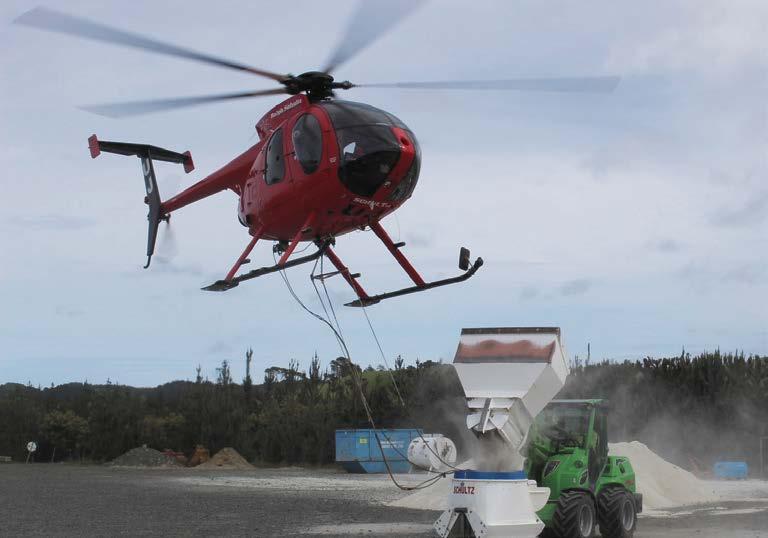
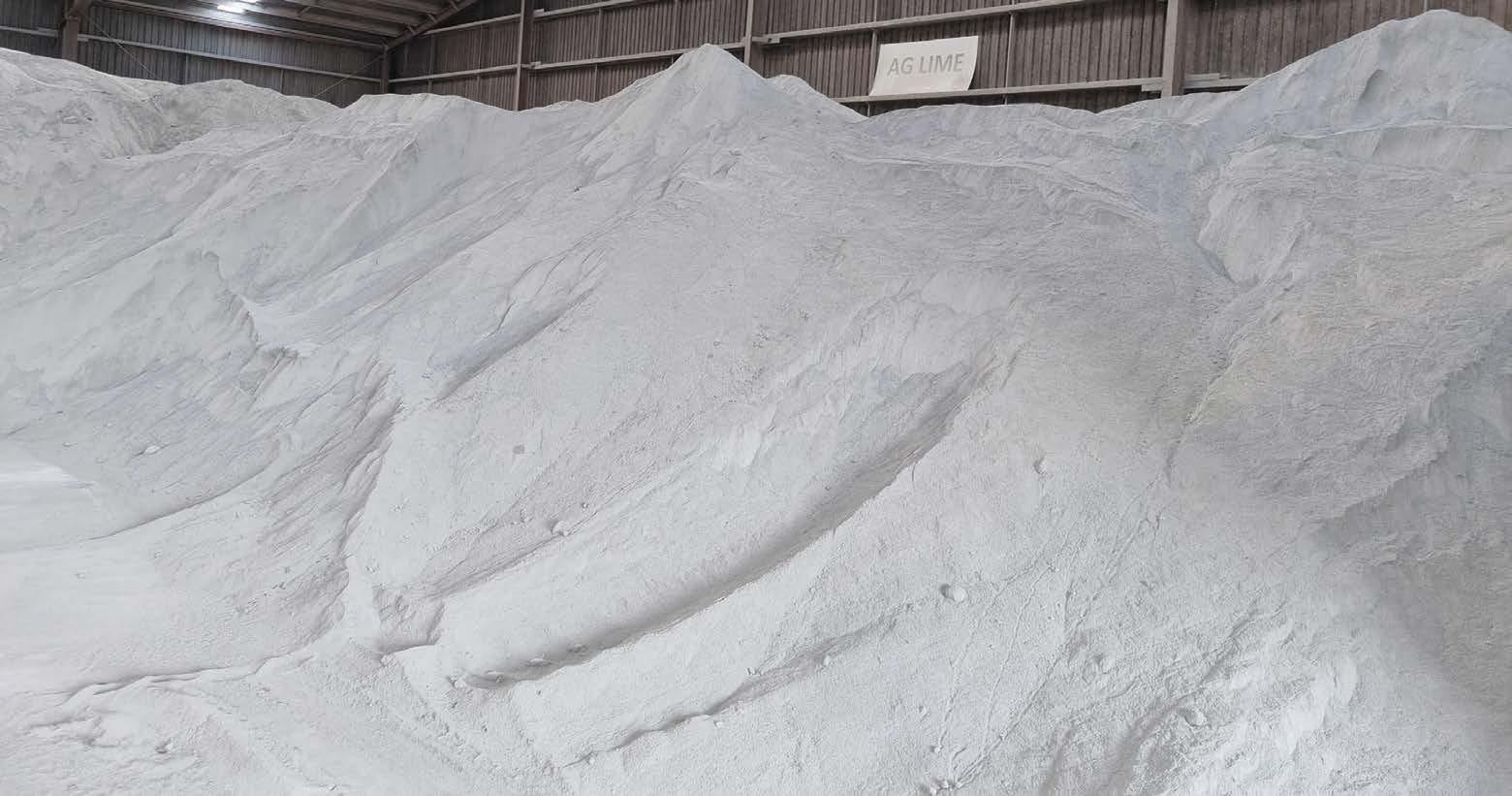
Avoca’s Agricultural Lime (AgLime) and Limestone are manufactured at our three lime quarries at Rarewa (Whangarei), Pokapu (Bay of Islands), and Port Albert (Wellsford). Both are also available at bulk stores in Dargaville and Te Kauwhata (Waikato). From all of these locations, we’re well placed to deliver Agricultural Lime products Northland and Waikato wide. Avoca also provide soil fertility testing and consulting as well as lime and fertiliser products and custom mixes.
NORTHLAND LIME
10
reasons to apply lime to your soils:
1
2
3
4
Increases nutrient availability; raising soil pH with lime to ~6.3-6.5 releases and balances soil nutrients for plant uptake, maximising return on your fertiliser spend.
Improves pasture yield. Trials have shown pasture production increases up to 68% and corresponding live weight gains.
Reduces need for N-fertiliser; lime stimulates N-fixation by legumes, and N-release from organic matter into plant available forms.
Improves P availability through a ‘phosphate sparing effect’ - trials in Northland showed 50-60kg more P available consistent over 3 years after applying 5t/ha of lime to a pH 5.8 soil. Optimal P availability occurs when soils are limed to pH 6.3-6.5.
Improves pasture palatability allowing for more even grazing of pasture and better pasture utilisation. 5
6
7
Increases soil biological activity and diversity; key to nutrient availability, good soil structure & porosity, and ultimately pasture/crop yield.
Increases resilience to droughts, floods, and runoff/erosion, reduced greenhouse gas emissions, and greater root penetration for pasture/crop growth by flocculating (loosening) your soil to improve soil structure and porosity.
Increases water holding capacity in the dry and water drainage in the wet. Lime drives down magnesium in ‘tight, high Mg’ soils such as estuarine soils found in the Hauraki Plains. 8
9
Reduces elemental toxicities evident at low pH levels, e.g. Al, preventing subsoil acidification and improving root growth, root development, and reduces P-fixation.
Provides calcium which is essential for both plant and animal growth and health. 10
Tourism and travel careers take flight
The International Travel College (ITC) invites students to take their careers further, without leaving Northland.
Travel and tourism are a burgeoning industry with many opportunities to both advance a prosperous career and to visit exotic places. It all begins in July this year, with the ITC’s second annual intake. Could this be the sign you’ve been looking for to take the step into tourism and travel?
New Zealand’s tourism and aviation industries are thriving, and skilled Northland talent is in strong demand. Due to overwhelming interest and industry support, the International Travel College is pleased to open a second full-time tourism intake at its Whangārei campus in July 2026, after the February intake filled faster than expected.
As the only provider of full-time tourism study in Northland, ITC is committed to helping locals build exciting, global careers without leaving the region. Delivered in partnership with NorthTec, ITC programmes are industry-led and focussed on practical, real-world skills. Graduates are recognised for their professionalism, strong work ethic and job readiness.
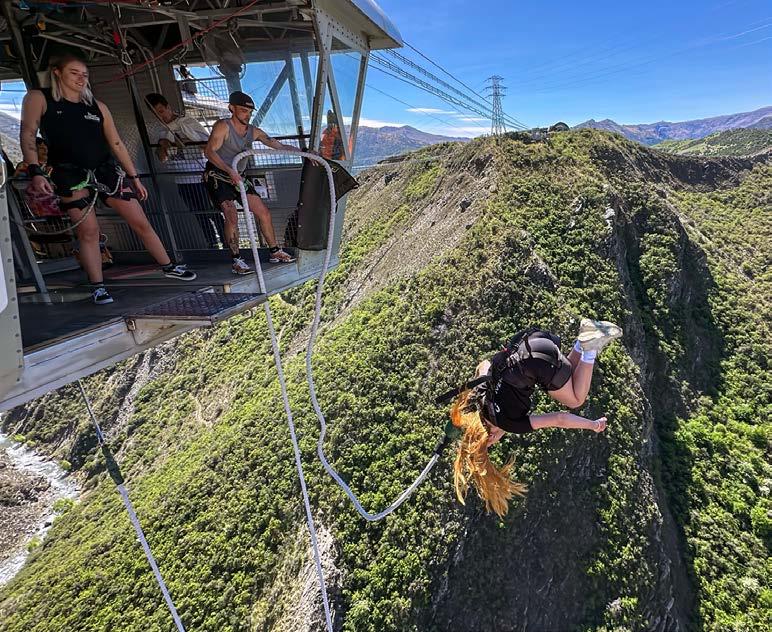
ITC graduates are now working in tourism, aviation and hospitality roles around New Zealand and overseas, with many selected for the prestigious Disney Cultural Exchange Programme. Closer to home, Whangārei graduate Fleur recently became the youngest Site Controller at AJ Hackett — proof that Northland talent can go far with the right support.
Tourism offers more than a job — it offers leadership, travel, and long-term career progression. ITC has a strong track record of working alongside industry leaders, to impart the knowledge, skills and confidence to make a rewarding career in this thriving sector possible.
If you want to embark on the journey of a life that’s less ordinary, more engaging and all about positive experiences, then the time to call and talk to ITC is now.
Enrollments are open for July 2026, so don’t hesitate to get in touch and learn more. The world is waiting!
Fleur, an ITC graduate from Whangārei, jumping off the Nevis site, which she manages in Queenstown
Fortieth birthday presents
by Andy Bryenton
By now it’s no secret that the Northland Field Days will hit the fourdecade milestone when gates open in February.
As a quirky bonus, the organisers of the big three-day event have decreed that anyone who is 40 years old will walk in free of charge this year, but this is not the only present which is on offer as the ‘friendly field days’ in Dargaville celebrates the big four-oh.
Seeking to overtop last year’s gate prize, which consisted of a literal trailerload of goodies (including the trailer), the committee that hosts the biggest outdoor event in Northland has found considerable generosity among its supporters. Consequently, there will be another valuable hamper of prizes up for grabs on the gate, with everyone who visits the Northland Field Days eligible to win.
The big news, however, is that this year the prize hamper is only number three on the podium. Prizes one and
two are staggeringly big and colossally covetable.
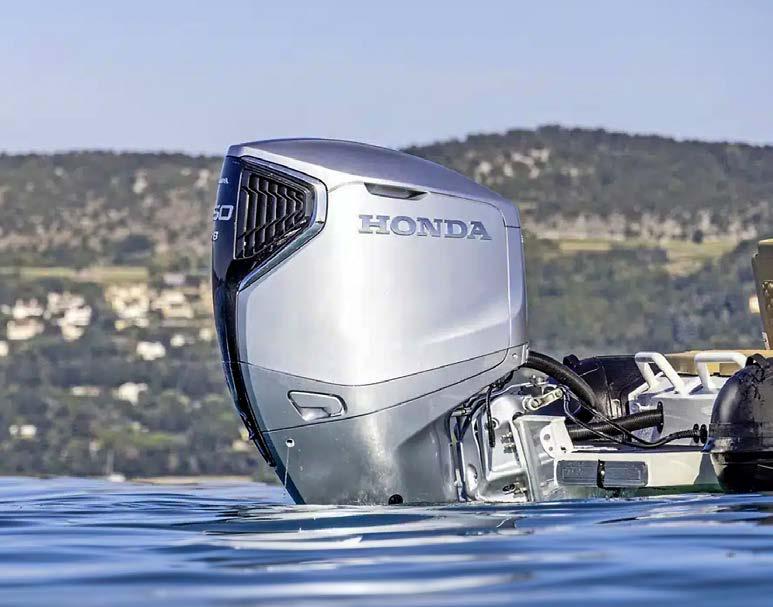
Dargaville Honda has been a solid supporter of the Northland Field Days throughout its rise to forty-year prominence, and this year they’ve decided to give the top prizewinner a choice. One lucky person will be able to pick between a brand new Honda outboard motor or a brand new Honda quad bike to take home with them.
Equally impressive is a freshly announced prize from North Travel: a week-long tropical holiday at the scenic Matavai Resort in Niue, with car rental, breakfasts and flights via Air New Zealand included. There’s also a fishing charter and a tropical safari tour included in the package, which will allow for both adventure and relaxation in this idyllic part of the Pacific.
Trace elements for human health
by John Arts
I recently spoke to a sheep farmer who told me that his lambs were 1kg heavier than the previous year after supplementing with trace minerals.
Farmers know that New Zealand soils are deficient in selenium and other trace minerals and the benefits of adding these for animal health and productivity. It is a pity that the human health system essentially ignores most trace elements leading to many health problems.
Minerals are critical for the health and development of every cell in our body. Insufficient trace minerals can weaken immune response and leave people feeling tired and run down. Addressing trace minerals is my first step for those who are tired with no medical cause.
The major minerals are calcium, magnesium and potassium. Of these, it is usually magnesium that is insufficient in many diets. Low magnesium can cause many health problems, including cramp, restless legs and heart rhythm problems.
We use zinc, copper, boron, selenium and manganese to make a group of antioxidant enzymes. The two most important are superoxide dismutase (SOD)
and glutathione peroxidase (GPx). We make SOD from zinc, copper, iron and manganese, while boron increases SOD and GPx activity. We make GPx from selenium. These antioxidant enzymes are the front line of our cell defences against free radical damage and are important for immune defences.
While people often respond quickly to antioxidants and vitamins, the benefits of minerals can be significant over time. This is why any good multi-nutritional will have these minerals at the right levels and in a form our body can absorb. Over the years, I have seen profound health improvements by adding a multi that is a true multimineral. Try a good multi mineral/vitamin and antioxidant for three months and see what you have been missing.
John Arts ( Adv.Dip.Nut.Med) is a nutritional medicine practitioner and founder of Abundant Health Ltd. For questions or advice contact John on 0800 423 559 or email john@abundant.co.nz. Join his newsletter at abundant.co.nz.
Gate prizes bigger than any seen before are up for grabs at the forthcoming Northland Field Days
Lime and fertiliser mix hits the spot
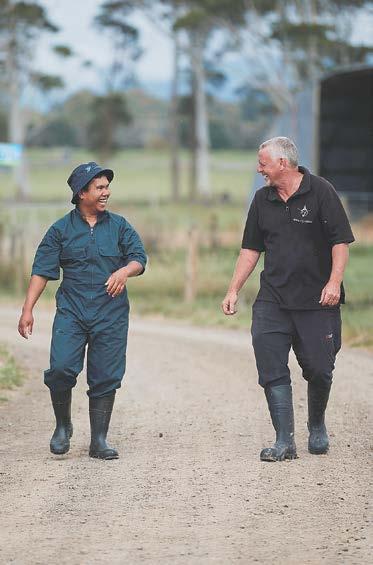
Despite decades farming, Gordon and Vivienne Priest took the plunge to step away from traditional thinking around fertiliser, and it has paid dividends — not just in their pockets. The beauty of working with Avoca is that farmers can mix critical nutrients with
A long-time fourth-generation Northland farming couple is encouraging farmers to look carefully at their fertiliser mixes after a switch to Avoca 15 years ago, which has significantly boosted production and animal health on their Towai sheep and beef unit. lime at Avoca’s various plants around Northland, Port Albert and Waikato. If the fertiliser trucks are not quite full, a bit more lime can be mixed in to make the transportation more cost-effective.
The couple said they appreciate Avoca taking the time to come to them, take multiple soil tests and then sit down and go through the tests thoroughly to map out a fertiliser plan that fits their budget.
As a result, the Priests have significantly reduced their annual fertiliser spend, saying it makes sense to put the products on that feed the soil. In their case that includes lime, dicalcic phosphate and an elemental slow-release sulphur, both being especially suitable to Northland soils.
It’s 15 years ago that the Priests went to an Avoca farm field day where they learnt about getting the balance of fertiliser inputs right for the benefit of the land and stock.
Shortly after, Avoca director Bryce Manderson first paid a visit to the then 433ha property, the couple has since downsized to 303ha, including 99ha area of native bush, he lent the Priests a book on nutrients
and offered to map out a fertiliser plan, combining lime and the correct nutrients their soils needed.
“We had a near-vertical learning curve to recalibrate what was needed. The biggest thing with Northland soils is the number of different soil types on one property. We have seven different soil types on one property, so our fertiliser mixes must be right. It is a tactical approach and so we have two different mixes for autumn and spring,” the Priests said. They say productivity has clearly gone up and they can see the faster growth in their
animals by using their ‘eyeometer’ before they even contemplate weighing.
Manderson says Gordon and Vivienne have done a great job building up their nutrient structure and farm productivity, and he really appreciates their loyalty and openness.
“You can see it in the health of the pasture and the quality of their stock. You do not get that if you have low pH because that has major detrimental effects on soil structure, soil biology and the availability of soil nutrients to the plant. The ideal on-farm pH is 6.2–6.3.
Vivienne and Gordon encourage other farmers to look at the Avoca model to target what they need.
“We are certainly carrying more stock on the property than 15 years ago, and we have fertiliser and stock records going back to 1975, so we can make good comparisons.
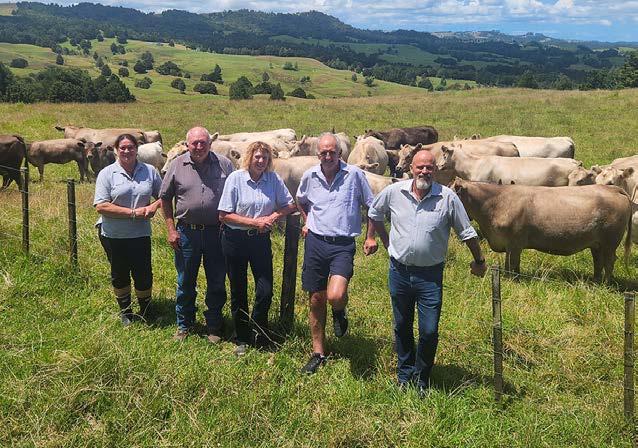
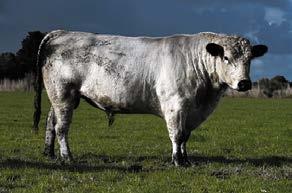
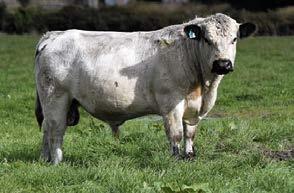
“We carry 170 sheep to help with weed control and 440 beef, including 115 purebred Murray Grey breeding cows. From the progeny, we sell approximately 40 yearling Murray Grey breeding bulls annually.”
From left: Avoca sales consultant Angela Irwin, Towai farmers Gordon and Vivienne Priest, Avoca director Bryce Manderson and Avoca sales and marketing manager Neil Crowson
Travelling planters turned nursery owners
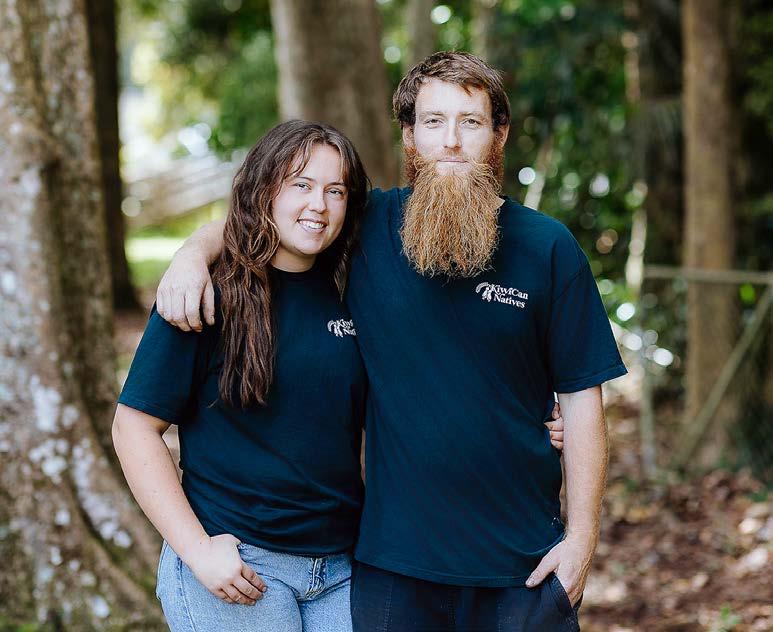
For KiwiCan Natives directors Megyn Cordner and Lucas Malone-Prince, Covid
career of planting natives throughout Northland.
Megyn, a backpacker and Lucas, a cotton farm manager, met in the Australian outback. Upon travelling to New Zealand to meet Lucas’s parents, the couple were left with limited options.
“When I got stuck here, I couldn’t go back to Australia because I wasn’t a citizen, so I got a working visa in New Zealand when we decided to stay here. We started tree planting with a pine crew,” said Megyn. “The pine crew were given a couple of native treeplanting jobs, and we thoroughly enjoyed them — we didn’t like planting pine trees.”
Deciding to become independent, the couple began planting natives by themselves. “It was just me, Lucas and our dog Boof travelling around Northland in a caravan picking up jobs through Facebook posts.”
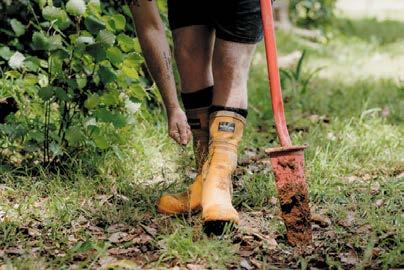
With farmers reaching out for the pair to plant trees on their property, the business eventually expanded into the native nursery industry. The couple now lead a team of nine planters and two nursery staff.
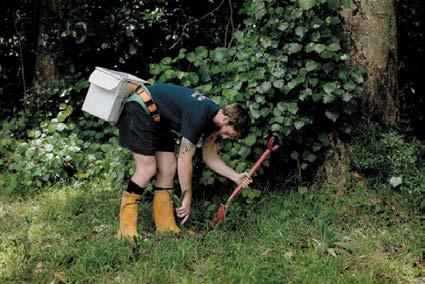
“We are a tree planting business and native nursery, and we do lots of different projects from council consent planting to people looking to regenerate native bush on their property, landscaping and anything to do with native trees.
Fulfilling projects, from small landscape architect plans for new builds to large-scale subdivision projects that need thousands of trees, the team services from Kumeū to Cape Rēinga.
“People often ask why to plant native trees, and want to plant fruit trees and plants with a direct benefit. We plant native trees because they help the environment, the farm with riparian ways, and the land, which helps their crops. Natives are beautiful and attract the likes of native birds and lizards.
“Depending on how big the job is and whether it’s worth the travel, we do stay away, and our staff have accommodation for us to get the job done.”
Northland Field Days’ guests can meet Megyn and Lucas, where they will have an activity encouraging children to get involved in native plants.
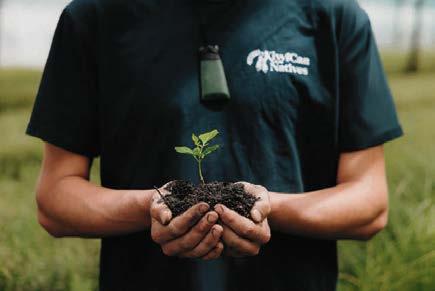
“This will be our first time at the field days, and we are excited to be there. We will have little seedlings for the children to pot up their own native tree. I love working with plants and being out in nature and the fresh air. Meeting so many local farmers and every job we do, people are so kind and show appreciation for what we do.”
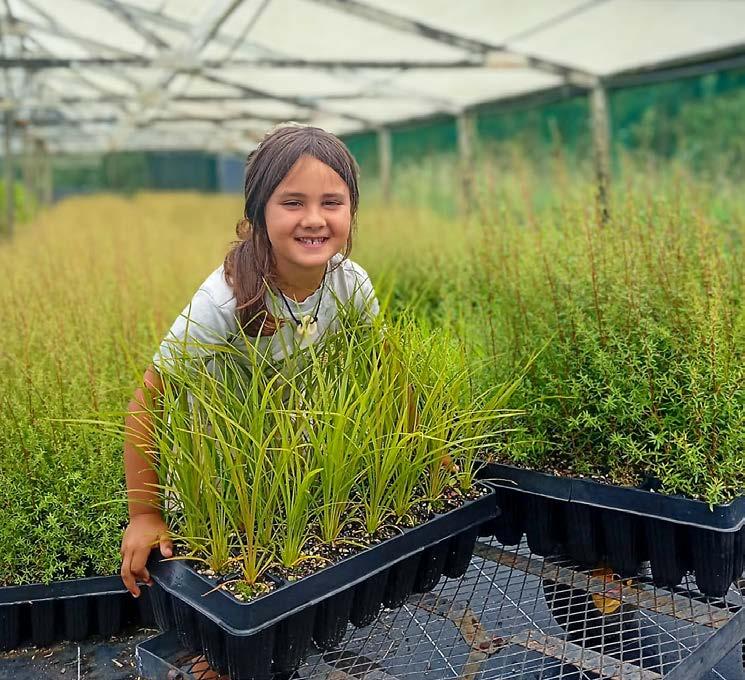
“We grow native trees, bushes, grasses, sedges, ground covers, and often grow a mānuka and kānuka mix for revegetation.”
COMMUNITY NEWSPAPERS – NEWS YOU CAN TRUST
Megyn Cordner and Lucas Malone-Prince began KiwiCan Natives, a business that started with the pair travelling from site to site to plant trees, to owning a nursery and managing staff
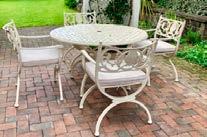
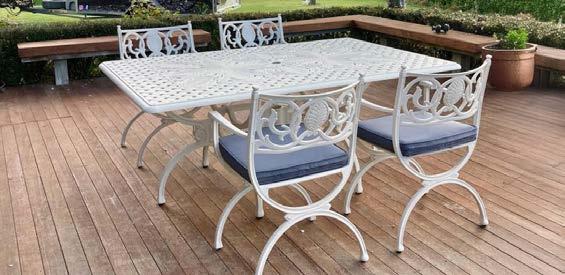
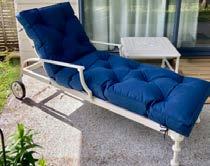
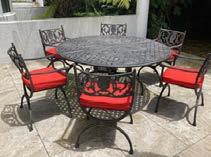
A need for tough outdoor furniture
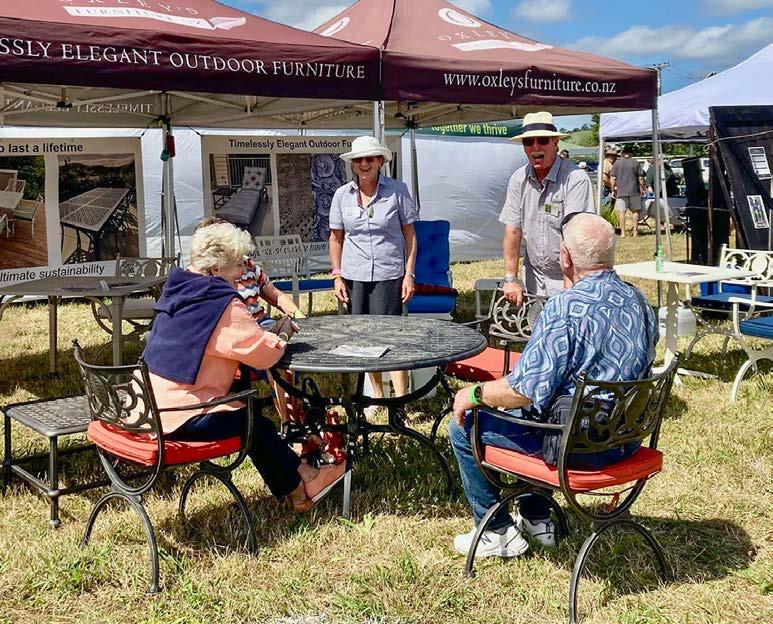
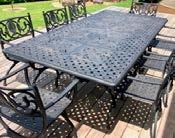
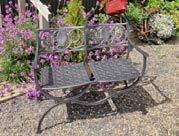
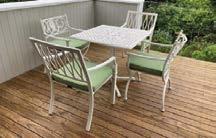
When Pam and Martin Shead first settled on the edge of the Kaipara Harbour, they realised that outdoor living was far easier when your tables and chairs don’t blow away in the wind or rust away in a salty sea breeze.
Coming from the UK, in 2004, the couple was accompanied not only by their three children but, amongst other things, their favourite trusty set of Oxley’s outdoor furniture made from recycled aluminium.
They had already owned the furniture for 10 years and it had withstood the wet and cold of English winters, and now, it was being subjected to the extremes of the New Zealand climate, too. Fast-forward another 15 years and the furniture had survived a coastal environment, complete with Kaipara winds and summer sun.
“We came to realise that our Oxley’s furniture was pretty unique here in NZ, and many friends and neighbours were keen to know where they could buy some.
“That’s when we realised that there was a real market for tough outdoor furniture that would withstand our climate. We decided to contact Oxley’s UK and, to cut a long story short, in 2020 we became the sole importers of Oxley’s Furniture into New Zealand.”
Roll on another five years, and Oxley’s NZ has supplied over 150 sets of furniture to clients far and wide.
“We have delivered to pretty much every part of the country from Dunedin, Christchurch, New Plymouth and Wellington to the Far North,” says Pam.
“Although being based in Kaiwaka, the majority of our clients are between Auckland and Whangārei. We enjoy delivering ourselves to most places as it gives us a
chance to explore other parts of the country while we are working.”
“A great measure of the success of our range is that many clients buy a set of furniture and then add to it with extra items year after year,” says Martin. “You can never have too much of a good thing.
“We are both extremely proud to supply a product that really lives up to its reputation of being tough, durable and long-lasting.
“The furniture is produced in the UK and sustainably made using 100% recycled aluminium, which is also highly sustainable as you are not replacing it every two or three years. This furniture is made to last generations.”
Sustainable outdoor furniture is not a trend — it’s the future.
BUY,EAT, WORK , PLAY
Noble history of the farmer’s best
by Andy Bryenton
As you watch the dog trials at this year’s Northland Field
has brought man and canine together in a
THANK YOU FOR CHOOSING LOCAL
New Zealand’s unsung heroes of farming, working dogs can often run 60–100 kilometres every day. At any time, there may be 200,000 purpose-bred dogs helping farmers in the livestock industry, fulfilling a pact between humans and canines made more than 9,000 years ago when dogs, sheep and cattle became domesticated.
The help of a smart and loyal dog has been a benefit to herders and drovers since time immemorial. Still, it was here in New Zealand that the true potential of a dog as the farmer’s ‘eyes and ears’ was realised. It all began with James Mackenzie, a settler of Scots descent. He indulged in that old Caledonian mischief of helping himself to other people’s livestock, something feuding Highland clans had gotten up to for centuries.
Initially, high-country station owners were incredulous that one man and his dog could separate and herd so many animals, then drive them up through the passes of the country, which would come to have Mackenzie’s name.
However, when he was eventually captured, it turned out that his secret was
the intelligence and loyalty of his working dog, Friday. Able to respond to commands by whistle and gesture, this exceptional dog displayed the traits farmers still look for in a trials champion. These include patience, a good ‘eye’ for staring down stubborn sheep, speed, and endurance.
Mackenzie so loved and respected his dog that he agreed to plead guilty if the judge let Friday go to a good home. Mackenzie received a lighter sentence when he agreed to teach others how he trained his remarkable canine assistant.
From there, competitions to see who could field the sharpest, smartest dog became part of the fabric of rural life.
Friday is immortalised with a statue by Lake Tekapo and also the name of a gourmet hamburger restaurant there, which any dog would appreciate. Today, farm dogs are prized companions and co-workers on farms from the Cape to the Bluff. A little-known fact is that farmers prefer black and white colouring to help their canine assistants stand out against the green of the hillside and the moving white background of the flock. The Kiwi working dog remains a hardy and valuable creature, even as other old-world working breeds like the Rottweiler, Corgi and Old English Sheepdog lose their working traits and become predominantly pets.
The Kaipara Lifestyler’s canine mascot Billy is proud of his history and happy to know that his lineage goes back to legendary working dogs like James Mackenzie’s Friday
by Andy Bryenton
The little grey Fergie turns 80
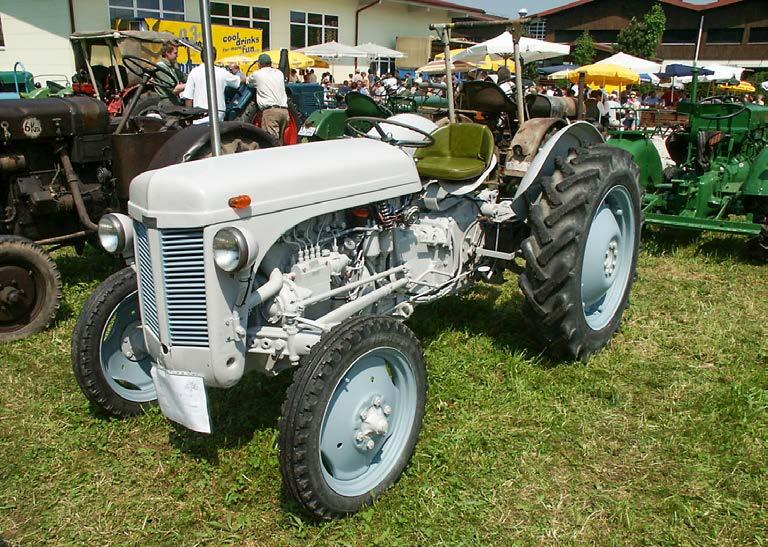
In 1946, the legendary industrial designer Harry Ferguson sat down to sketch a tractor
New Zealand.
The second world war was over, and the mechanisation of farming had come, spurred by the importation of farm machinery from the US, which Kiwis used to feed hungry troops. When Harry designed the TE20, soon to be known as the ‘little grey Fergie’, his plan was to standardise implements and make tractors versatile.
Since 1928 Ferguson had been working to combine his ideas of a threepoint hitch, PTO and suction-side valvecontrolled hydraulic system into one machine. The TE20 popularised this combination worldwide, to the extent that examples sit in museums as far apart as Poland and Canada. With its small size, tight turning radius and reliable, simple motor, the Fergie could outperform horses and access areas too small to be ploughed by bigger machines.
The ability to use one tractor to undertake a whole range of jobs on the farm was game-changing. By 1950 there were more than 60 official implements which could be used with the TE20, including balers, seed drills, ploughs, sickle mowers and cultivators. Generators and pumps could also run from the back of this hardy little machine, which could therefore deliver power and water to places that were otherwise inaccessible.
As a result of its capabilities, the little grey Fergie became a bestseller. It also became a legend. In Australia, there’s a monument to this small utility tractor where the Darling and Murray rivers meet. During a huge flood in 1956 the levees burst and the two huge waterways threatened to destroy the town of Wentworth. A fleet of TE20 tractors rebuilt the stop banks and saved the settlement.
A TE20 named Betsy, from Britain, circumnavigated the entire coastline of that island nation in 2003, securing a Guinness World Record for the longest ever journey by tractor, of 5,111 kilometres without a breakdown.
• Try Suffolk fast growing, meaty & productive breed.
• Quality Suffolk Rams available now
• Bred in Northern NZ environment
• Ewes also available
• Registered Suffolk Breeder
Then there’s the fact that the TE20 is the only tractor ever to feature on a New Zealand bank note. Between 1992 and 2015, the little Fergie was pictured on the bottom left corner of the five-dollar bill, next to the portrait of Sir Edmund Hillary. It was there because in 1958 the intrepid Sir Ed converted six TE20s to cross Antarctica. They became the first machines to drive to the south pole, and cemented the legacy of the little grey Fergie as a machine which could tackle any task.
The 1946 ‘Fergie’, perhaps New Zealand’s most famous tractor, turns 80 this year
The people behind the thoroughbreds
by Andy Bryenton
Author Brian de Lore was born within sight of Riccarton’s thoroughbred racecourse, and his latest work chronicles Kiwi equestrian history, highlighting how one of rural New Zealand’s favourite outdoors pursuits became a world-beating industry.
“My father built the first motel in Christchurch, half a kilometre from the racecourse, and all kinds of personalities and characters came to stay for race days. I had a sort of misspent youth around racing, part of that culture,” said Brian.
“Then, I moved to Sydney, Australia and got a job at a horse racing magazine,” he says, setting the background to introduce his substantial, revealing look behind the winner’s circle and the flashbulbs, titled The Horsemakers.
It’s a very personal compilation born of 91 interviews, speaking to those who have helped breed and train champions. These often unsung heroes of the Kiwi equestrian world are the folks who have made this small nation punch above its weight. Many of them come from the rural heartland, where knowing horses was a matter of make-or-break within
living memory. “This is something no one has attempted before,” says Brian. “Other books have been about race results, horse trainers, jockeys and big prizes. This book is about people, and if these people were not talked to, their stories could have been lost forever.”
Brian is not wrong. Sixteen of the luminaries he interviewed have since passed on, and their recollections of a vibrant industry are collected on the page for posterity.
“What I have tried to do with this book is to anecdotally explore how people came to be involved in horse breeding. Some of the family stories go back generations. For example, the story of Jack Alexander, who was not only a leading figure in horse racing but also the world mostacclaimed Romney lamb breeder of his generation.”
As well as being a valuable and engaging chronicle of the people who forged a leading horse breeding legacy for New Zealand, The Horsemakers serves another purpose. The book has been crafted to raise money for Catwalk, a spinal injury charity, and the proceeds from the sale of every volume go to this worthy endeavour.
Even before the presses rolled, more than $180,000 had been raised to
by
efforts; contributions from those in the industry who have given generously to the cause of spinal cord injury research.
If the heritage and the true stories of Kiwi horse breeding are a subject that interests you, this definitive and personal look behind the scenes is a must-have. You can find out more, or purchase a copy of this substantial hardback volume by visiting thehorsemakers.com.
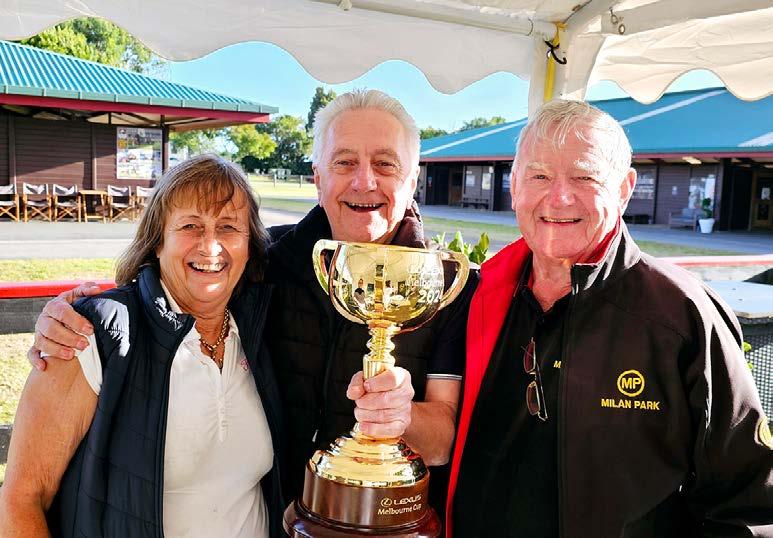
Author Brian de Lore holding the Melbourne Cup, between Sheila Laxon and the late John Jeffs
Catwalk
Brian’s
A dog’s tail …
It’s
Feel Daze hear ona farm
Well, gidday readas, is me Billy Borda Colly wot the Boss just calls me Dog, like always wen we workin’ ana proppitty. But rite now, I home alone again ’cos Boss an’ his gerlfren’ Sharlene have gone ofta the Feel Daze in town, an’ they don’t blimmin’ let us dogs go just fer fun.
But it’s not all bad, ’cos Boss’s mum is here ter feed the chooks an’ me, an’ keep an eye ona proppitty. Well, sorta, ’cos keepin’ an eye ona farm is rilly down ter me, yours truly. I get roun’ tha stock better than Mum, an’ I like her busy ina kitchen ’cos one thing I do get is blimmin’ good feeds wen she’s in charge. Specially pork craclin ’cos she like a bita roastin’, an’ if it isn’t pork, it’ll be chook or muttin, and I quite happy with everthing.
Mine you, every year atta Feel Daze, I gotta hope that Sharlene is keepin’ hold ofa farm checker book.
Boss sumtimes gets a bit carried away, an’ I rekin that might happin this year in Dargyville, ’cos Sharlene was lookin’ at the papa froma kattil stop atta road gate at smoko before they left, and she read in her skoolteecher voice:
“Kiwi farmers, growers, and primary producers are driving New Zealand’s economy with food and fibre exports set to reach a record $62 billion this year. Agriculture and Forestry Minister Todd McClay has forecast for the year to June 30 2026 building on last year’s recordsetting $60.4 billion. From meat and wool to kiwifruit and cherries, our producers are remarkable and the world wants New
Zealand’s high-quality, sustainable, safe food and fibre, Mr McClay says.”
Well readas, Boss rilly perked up wen he herd that, an’ nek thing he was ona John Dear tracta towin’ a bunch heavy stuff practicin’ fer tha tracta pull contest, an’ plannin’ a cupla days and staying ina pub in town and enjoying alla stuff atta show. Trubbil is wen he hooked the tractor for a last test he pulled out a straina post ina bull paddick. We took half-a-day fixin’ tha fince back up.
An’ Boss can be another problim. If he’s gotta checking book from Sharlene ya never knows wot he’ll bring home. I was looking atta big space unner that woolshed wear I have the odd kip ina hot day and there’s still stuff there from las’ year. Like that big carton wot Boss brouht, ’cos it hada Fergie tractor disc brake cleaning system. Trouble was Boss shooda knowed we gotta John Dear tracta ona proppitty, not a Fergie.
Over ina corner is another box wiv some ’lectric gate opiners. But boss didnit thinks; we got no electrickery wear he wanted ter use it. Like I sed readas, I jus’ hope Sharlene gotta checking book locked in her purse wen Boss has bin ina bear tent wiv his mates.
But anyway, I shood reely be happy wile I gotta bit ofa hollyday too, I kin here Mum busy ina kitchin and theresa pritty good smell driftin’ across ta tha woolshed. Time ter go and be friendly ter mum atta back door. Always good for a wee sample of dinner stuff eh?
Hava good show though, readas. Take yer time too, Boss. All fine ona farm so no rush eh?
Cheers — Billy
• Free advice - we walk the land with you and discuss your options
• Funding – KMR typically pays up to 50% of eligible costs
• Planning and support – we prepare a plan to access funding and provide project support
• Fencing to protect waterways and regeneration of native forest
• Native planting near waterways, coastal margins, around wetlands, and on erodible hill country
• Assisted native regeneration and afforestation with natives and a selection of exotic trees
Wellsford
Kawakawa
Kaikohe
Helena Bay
Helensville
Whangārei
Warkworth
Dargaville
by Paul Campbell
Dairy industry in good shape
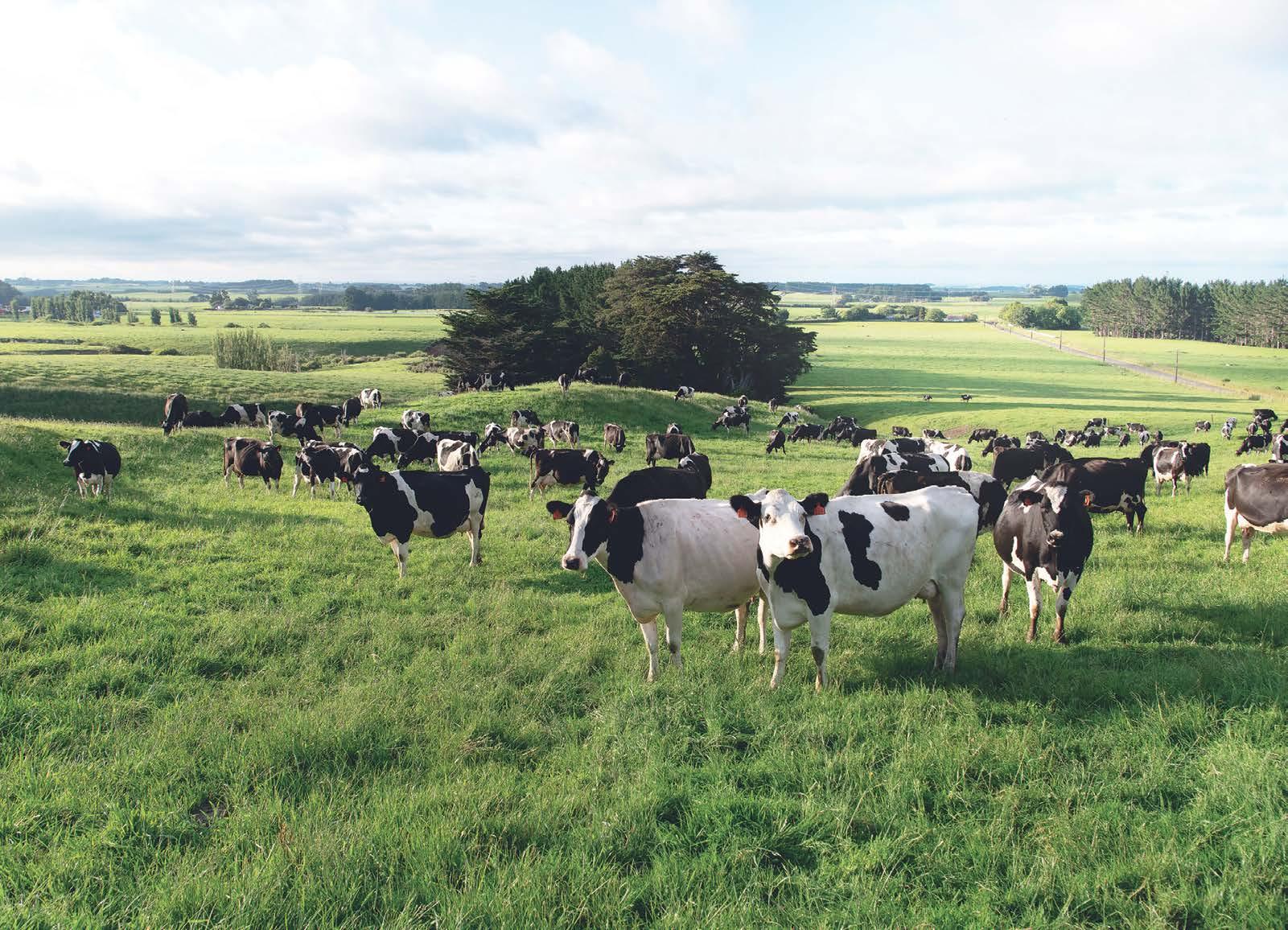
New Zealand dairy farmers are achieving more with fewer cows, shown through
genetic progress according to industry icon DairyNZ.
Statistics shared with the Livestock Improvement Corporation show that milk solids production rose 2.9% in 2024/25 to 1.94 billion kilograms, despite a 0.5% fall in cow numbers to 4.68 million.
The lift was driven by record-high productivity for each cow, with the average animal producing 414 kilograms of milk solids, which is up 14kg from last season.
DairyNZ chief executive Campbell Parker says the results reflect farmers’ strong focus on performance and adaptability despite a range of challenges over the past few years.
“Farmers continue to focus on doing things smarter and driving productivity, including managing their herds more efficiently, improving feed use, and leveraging science and technology to lift production per cow, while also responding to higher milk prices last season,” he said.
“The trend towards fewer, larger herds is continuing, but the focus on highperforming, healthy animals remains strong, with fewer cows producing more milk. It’s a real credit to farmers’ skill, resilience, and ongoing investment in herd improvement and farm management. That combination of efficiency and innovation keeps New Zealand dairy farming at the forefront internationally.”
Meanwhile, herd improvement activity strengthened notably in 2024/25, with farmers continuing to invest in data and genetics to support long-term gains.
A total of 3.84 million cows were herdtested, which is a five per cent increase from the previous season, with 82 per cent of the national herd tested in 2024/25. The proportion of cows mated to artificial breeding (AB) also increased slightly to 81.5 per cent.
Dairying has a long history in Northland with the first dairy cows introduced in 1814 by missionary
and
so the cream rose to the top. This was skimmed off with a ladle and made into butter in a small churn.
Dairy products added protein and fat to the limited pioneer diet of bread, meat, some fish, and a few fruits and vegetables. Butter, cheese and yoghurt stayed fresh and edible a lot longer than raw milk or cream.
in the Bay of Islands. The cows came from the New South Wales Crown herd. Shorthorns were useful draught animals, which gave good milk and provided excellent meat.
Shorthorn herds were established by the early 1840s, and for a long time were New Zealand’s most popular cattle breed. The dairying process of course has evolved in leaps and bounds into mass factory production but it was all very simple to start with. The milk was strained through fine mesh, then allowed to settle
Today’s dairy cows are an economic cornerstone Samuel Marsden for mission stations
by Andy Bryenton
Top gun tractor test
Who is the most steady hand on the steering wheel and the king of tractor skills in the north?
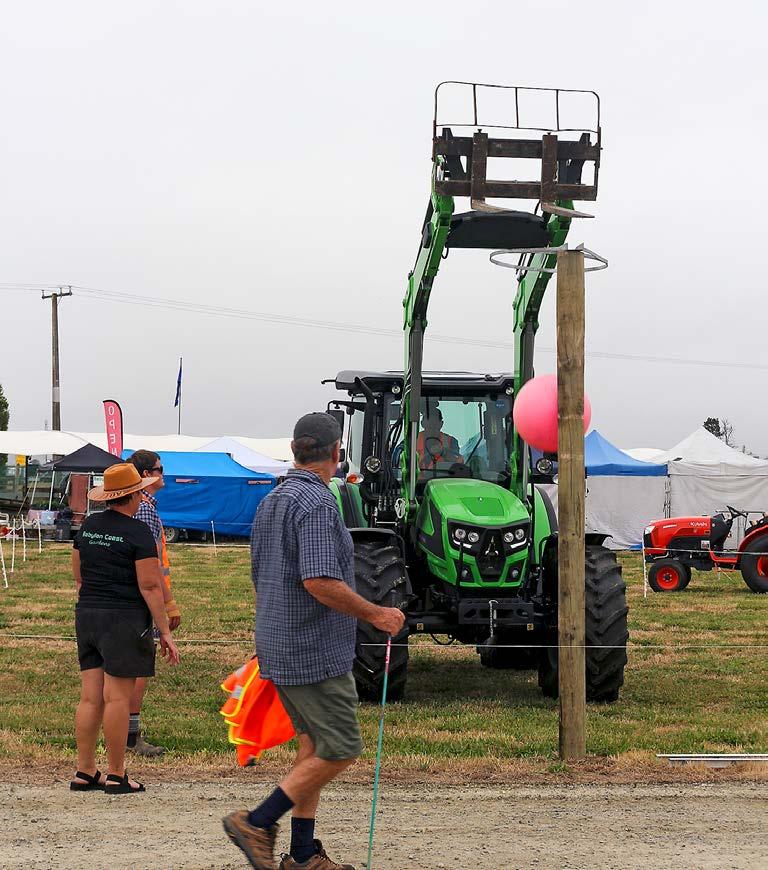
The Northland Field Days is the place to find out, as the second-annual tractor skills challenge roars into life with diesel power and precision driving on display for 2026.
It’s the return of a rural skills test that debuted in the 1980s, though its modern incarnation came back to prominence in 2025 after a long hiatus. Steve Martin is the mastermind behind this devilishly tricky tractor challenge series, and he’s brought out a group of wildly different machines anyone can step up and try to tame.
telehandler netball, where drivers must dunk the ball in a tall hoop using the forks of a full-sized bale handler. Then there’s a challenge to pick up a football from a bollard post and put it down balanced on another one, all in reverse.
Drivers then move on to a test of nerve, balancing weighted tins on a see-saw, and finish up with an event Steve calls ‘tractor fishing’, using a trailing hook. They’re games that would be a skilful puzzler using your hands, but using a range of tractors, including a vintage 1959 Massey Ferguson; that’s another ball game.
“This year is going to be bigger, more fun and more inclusive than ever. We’ll run things in two stages”
“Everyone who took part last year really enjoyed it, and there was some great competition,” says Steve. “This year is going to be bigger, more fun and more inclusive than ever. We’ll run things in two stages.
“A competition for those who just want to give it a go, and a level for those who think they can be ‘the man’ in tractor skills. There are big bragging rights and a trophy with the winner’s name on it.”
There are four games of skill to pit your wits and reflexes against. First up is
Last year, the supreme winner was still in his teens, making the contest a little more interesting for 2026. Will the seasoned veterans of the rural community triumph through experience, or is a deft thumb on the PlayStation controller the ticket to tractor mastery?
You can try out your abilities yourself just for fun, or get amongst the battle for tractor supremacy by visiting the tractor skills site on all three days of the Northland Field Days.
Anyone can take part in the exciting tractor skills challenge, coming to the Northland Field Days on February 26, 27 and 28
by Andy Bryenton
A trek through auto history
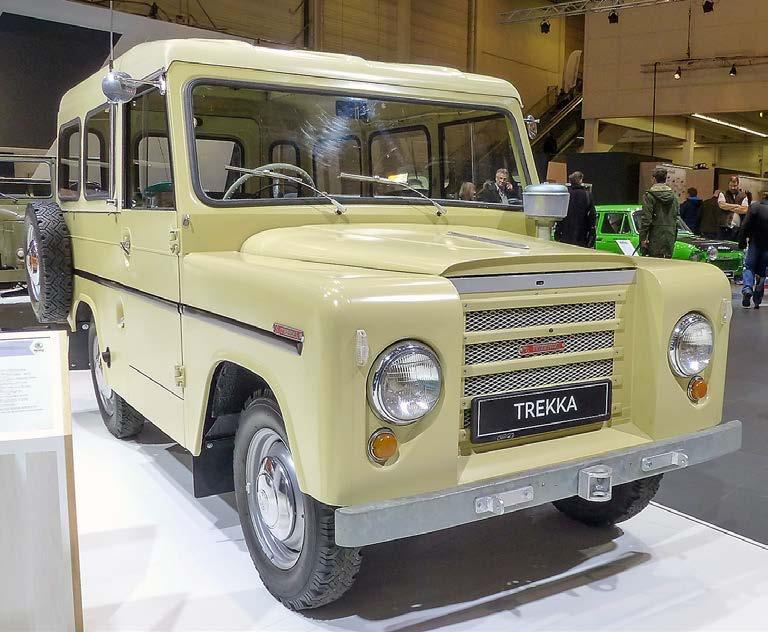
This year marks the 60th birthday of a real Kiwi battler; the little off-road machine they called
It was bold and boxy, innovative and ahead of its time. The crossover SUV before either of those terms existed, the Trekka was the brainchild of Phil Andrews and Noel Turner, who saw the Kiwi public being squeezed by hard-line vehicle importing laws in 1966. Their answer was to build vehicles here, and the recipe they cooked up combined a knowledge of local conditions with tech from behind the iron curtain of the Soviet Bloc.
Under its skin, which resembled a Land Rover in more ways than one, the Trekka
Kiwi roads in 1966, and called for a light but capable machine. They aimed for the exact qualities, which have made Toyota’s Rav 4 a bestseller in 2025; economy, practicality and the ability to tackle a range of surfaces.
The styling was unapologetically an homage to the ‘landy’, because that’s what worked. Making the entire body and interior locally meant that 70 per cent of the Trekka was Kiwi, and that sidestepped the crushing import rules holding 1960s New Zealand in a kind of automotive
The body design, which was mated to that Czech running gear, was purely Kiwi
was built on the mechanicals of a Skoda Octavia station wagon. A Czech product, in a time when that nation lay under the red empire of cold-war communism, the Skoda was not a common sight on western roads. However, it was built to be simple and tough. These qualities lent themselves well to the design philosophy of the Trekka.
The body design, which was mated to that Czech running gear, was purely Kiwi; in fact, it originated in Kawerau. The Trekka team acknowledged the reality of
limbo. Rural folk who had been forced to carve up Morris Minors into utes or thrash Prefects and Wolseleys down gravel roads were delighted.
The Australians took 50, in exchange for Holdens. The Indonesian government took 100, but allegedly then lost their wallet. Five Trekkas served with distinction at Quy Nhon during the Vietnam War, as part of New Zealand’s civilian hospital mission. All the while, people were buying the little go-anywhere machines in their hundreds. In the end, 2,500 were made.
The 1973 oil crisis, the relaxation of import laws, and the Japanese car boom that followed signalled the end for this bold experiment in local design. Rust and time took their toll, and 60 years on the Trekka is an elusive beast, coveted by
collectors. One sits in the Skoda factory museum in the Czech Republic, as an example of how innovation could span the rifts of the cold war. Oddly, the police drive Skoda Octavia station wagons of a more modern type today.
Kia ora!
New Zealand’s only mass-produced automobile turns 60 this year
NORTHLAND FIELD DAYS 2026 – MAP & SITE LISTINGS
NORTHLAND FIELD DAYS 2026 – MAP & SITE LISTINGS
Programme
National
Need
Nessie
Nestle
New
New Zealand First OL10
Newstyle Direct NZ J12
North Country Grains Ltd T/A Supa Feeds K8a
North Travel RP408
Northable Equipment Health Hub
Northern Benchtops Ltd J11
Northern Rural Haulage Ltd C13
Northland Continuous Spouting LP123
Northland Farm Water Solutions Ltd H3
Northland Fish and Game Council M2
Northland Machinery 2023 Ltd B15
Northland Mobile Windscreens E15
Northland Motor Sports
Dargaville Motors F9, F8, F7, E8, E7
Northland Regional Council I1, I2
Northland Road Safety Trust K4
Northpower OL7, OL8
Norwood C8, C9, D8, D9
Nothing Fancy Streetfood Food Court 1 NRM K10
NZ Containers Ltd D20
NZ Fudge Farm 2024 Ltd LP124
NZ Momo ITM Food Court
NZ Motors 4WD’s / Defender Off-Road Kauri Coast Show n Shine
RAM – Ringa Atawhai Mātauranga Health Hub Ravensdown H16
Read Industrial Ltd E20
Reliable Brokers LP318
Remarkable Cream LP311
Renovator Tools (Z Vise) LP313
Resolution Farming App H8a
Resonate Health Health Hub
Ringa Atawhai Mātauranga Health Hub
Ringrose Stockfoods Ltd K3
Robomate Ltd C5, C6, C7
MCCALLUM'S MEMO
As Northland’s MP, I want to update you on the two major RMA reform bills currently before Parliament the Planning Bill and the Natural Environment Bill. Together, they represent some of the most important legislation this Government will pass, finally replacing the outdated Resource Management Act with a system that is clearer, more consistent, and far more practical for communities, councils, and businesses.
The Planning Bill focuses on enabling things to get done simplifying consents, reducing delays, and cutting back the red tape that has frustrated people for years. Alongside it, the Natural Environment Bill provides the guardrails by setting national limits for air, water, soil, and biodiversity Separating these responsibilities brings much‐needed clarity after decades of confusion where environmental protection and land‐use rules were lumped together. For farmers, developers, and local families, this means certainty and rules that stay steady, regardless of who is in government.
I’ve spent a lot of time with rural families who are worried about the cost and stress of simply trying to continue long‐standing, responsible farming practices. These reforms are about restoring confidence so people can plan ahead, invest, and know the ground isn’t going to shift beneath them By 2029, the full system will be in place, delivering consistency nationwide and better outcomes for both prosperity and the environment. With submissions now closed, the Environment Committee will soon begin hearings As deputy chair, I’m looking forward to working through that feedback to ensure the system works for communities, for business, for farmers, and for the environment.
by Andy Bryenton
Slow, low and tasty is the recipe
Barbecue is big fun, big business and bursting with big flavours; a global phenomenon that has blitzed past the simple bangers and beers of yesteryear to become a culinary sensation.
Flavours from the barbecue pits of Brazil, Argentina and the southern states of the US mix and mingle with those of the traditional Kiwi barbie and the South African braai, as recipes are swapped and techniques shared by a growing barbecue community. Different designs of smoker, offset grill and kettle are debated by aficionados of ribs, brisket and fine cuts.
It’s become more than just a way to entertain outdoors. It’s become a sport, and for some, it’s a profession.
The logical pinnacle of all this flavour and savour is a barbecue festival; and what better place to host such an event than the Bay of Islands? The Old Packhouse in Kerikeri will host just such a celebration on Saturday, March 28, and everyone’s invited.
The FireD Up Barbecue Festival was a major success in 2025, attracting fans of charcoal smoke, earth ovens, wood-fired flavours and succulent meat.
A showcase of world barbecue, this festival brings together pitmasters of renown from across the land, some just to share their favourite tips and tricks, others throwing down the gauntlet in a contest of top cookery.
The annual Tai Tokerau Low and Slow Barbecue Competition sits at the heart of the Fired Up festival like the centrepiece on a fully-laden feast table. Once again,
local pitmaster Ken Van Mackelbergh will judge the best of the best, in a growing category of professionals; competitive barbecue champions.
It’s a long way from your dad burning one side of the sausages on a little charcoal plate down by the caravan. Professional barbecue pitmasters often engineer their own massive grills and smokers, looking like black iron siege engines as they roll in on big trailers. Their recipes are closely guarded, their techniques an amalgamation of skills handed down from esoteric elders of their craft.
There’s a lot to crafting the perfect barbecue; from liaising with master butchers for the perfect cuts, through to selecting the right wood or charcoal, and then the magic of marinades, rubs, ageing and preparing the meat for the grill. No two pitmasters have the same process, and some even blend in a pinch of superstition.
People will flock to Kerikeri from all over Northland on March 28, to taste barbecue creations by a host of pro pitmasters, and to soak up the carnival atmosphere. The Jordan Luck Band will be playing live, there’ll be DJs spinning tunes, the cold refreshments will flow, and you might just be inspired to join in this convivial new culinary trend yourself.
THANK YOU FOR CHOOSING LOCAL
Succulent celebration; perfect results made by professionals in the art of meat and fire is coming to Northland’s biggest barbecue festival
Light Weight
Weighing
by Paul Campbell
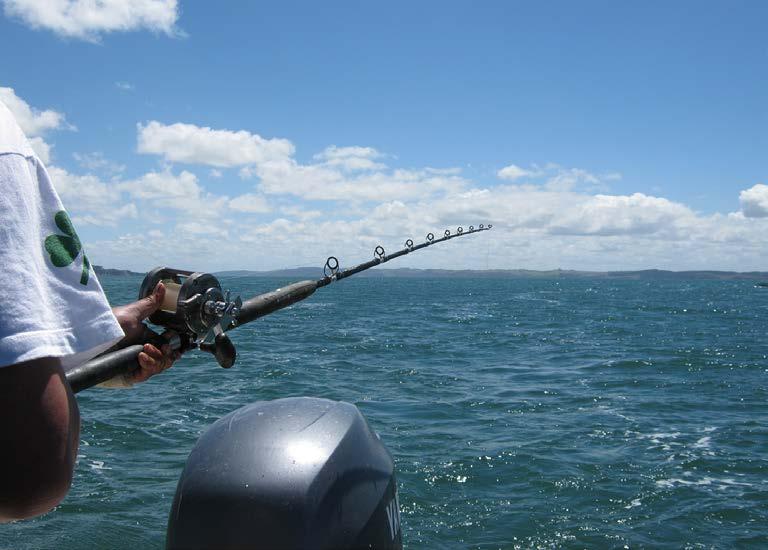
Fishing is fun and also big business
Northland is a recreational destination for visitors from New Zealand and
access to some of the country’s best fishing, be it salt or freshwater.
We’ll take a closer look though at the marine side of fishing with the Pacific and Tasman coastlines giving access within minutes to a feed of snapper, or gurnard, or kahawai, trevally — the list goes on.
Recreational fishing is a Kiwi pastime for all sorts of reasons, but top is probably the fact we can add to the family larder while escaping from life’s stresses, or teaching youngsters how to catch their own food.
You’ll develop many theories on the best places to fish but one thing this writer has already figured out, the best fish are where you are lucky enough to be at any given moment.
The location choices of course are myriad, from the huge Kaipara Harbour, westwards along wide beaches for surfcasting to the Hokianga, on the east coast — the venue choice is endless.
Whether you are heading out on the boat, or casting a line off a beach or wharf, you are reasonably sure of dinner on the table.
Of course, the fish you are lucky enough to catch is not entirely free, as there are hooks, lines, sinkers and lures, but that’s just a small start.
In fact, there’s a large commercial need that makes a substantial contribution to the economy that amounts to almost $1
billion a year and, of course, much of that is in sophisticated boating requirements. According to industry economists, fishing dollars amount to supporting around 9,000 jobs and stimulating $1.7 billion in total economic activity. Moreover, there is growth potential.
Retailers, boat builders, tackle manufacturers, suppliers, marinas, motels, restaurants, charters, media and more, employ thousands of people who are in the background every time someone heads to the water with gear in hand.
Usually that will be standard, rods, reels, line and bait and, of course, ice and a chilly bin on a day outing. There is also the fact that nets are available and rules apply here.
Regulations are that New Zealand net fishing rules for recreation focus on set nets, requiring them to be under 60m, marked, unbaited, and not staked, with restrictions on placement (for example, not across more than one-quarter of the width of water), and only one set net plus a small bait net for each boat.
Other net types like cast nets and drag nets have their own length and mesh size rules, and it’s crucial to check regional rules, too, by contacting the Ministry for Primary Industries website before you go.
A line in the water is a delight
by Andy Bryenton
Future fuel ready to flow
Hydrogen fuel has been described as the ‘logical step beyond EVs’, and is slowly gaining momentum as an alternative to fossil fuels for road freight, generators, maritime applications and tractors.
The issue with hydrogen is not its scarcity; it’s the most common element in the universe. There’s also no problem with emissions, and the hydrogen fuel process generates water as its output. The real problem is the infrastructure needed to deliver it to the pump for motor vehicles, a supply chain from producing hydrogen to its delivery and sale.
Part of that chain is being forged in Taranaki this year, with construction starting soon on a sustainable green
the previous Resource Management Act consent process,” said Regional Development Minister Shane Jones.
“A delay like this, for a project so important to a regional economy, shouldn’t have happened. I welcome the economic benefits, jobs and alternative energy source this initiative will bring to Taranaki.”
The impact will be felt beyond the borders of the Taranaki region too. Proof that green or renewable hydrogen fuel
“The initiative unlocks significant local investment and will be a vital contributor to long-term development in the region”
hydrogen facility in the region, supported by a $19.9 million government investment. The project includes supplying renewable electricity to the Ballance Agri-Nutrients’ Kapuni facility in South Taranaki for their site operations and producing green hydrogen for emissionsfree transport at Hiringa Energy’s refuelling operations.
“We’ve waited more than five years for this project to begin, after it was delayed by years of red tape and appeals under
can be made at scale in New Zealand is important, as it means that the nation is a step closer to offering hydrogen as an alternative to diesel or petrol in suburban fuel stations and farming and industry. The machines exist, and are far from experimental; big names in tractors such as New Holland, Fendt and Kubota all offer hydrogen models.
“This will be one of the first projects in New Zealand to integrate wind, industrial renewable electricity supply and zero-
“The initiative unlocks significant local investment and will be a vital contributor
to long-term development in the region, and will help diversify the Taranaki economy by supporting new, innovative clean energy industries.”
consents and project management
Architectural d esign for rural living
Ecology and land contaminati on advic e
Hydrogen tractors like this one by New Holland could be a major force in future agriculture, but the key to unlocking this power is the infrastructure to let hydrogen fuel flow carbon green hydrogen fuel production at scale,” said Mr Jones.
FORESTRY & LOGGING
by Paul Campbell
Native forest gets a helping hand
A project to restore 110 hectares of native forest on Northland’s remote Kōwhairoa Peninsula Historic Reserve is on track, says Regional Development Minister Shane Jones.
With forestry having a recent boost due to the New Zealand-India Free Trade deal the industry also admires the local vision and volunteer hard work that has grown into a thriving restoration project.
“Thanks to the Provincial Growth Fund boost in 2020 there has been 94,000 native plants established from locallysourced seeds and pests brought under control,” Mr Jones says.
The project received government funding of $1.54 million under the former Provincial Growth Fund’s One Billion Trees programme, administered by the New Zealand Forest Service.
The project, led by Te Komanga Marae Trust, involves planting 132,000 native trees and controlling pests to recreate a native forest on steep, deforested coastal land.
“The Kōwhairoa Peninsula is a significant site for Māori and was remarkable for its diverse flora and fauna, and old-growth forests, which were unfortunately cleared for their timber by early settlers. This project is restoring
What’s your woodlot worth?
the old forest species that once dominated the area.”
Mr Jones travelled by boat to the remote Whangaroa Harbour reserve late last month to plant a tree and celebrate the forest restoration progress, five years after first visiting at the project’s launch.
The reserve land was returned to the Te Komanga Marae Trust to manage, as part of Ngāti Kahu ki Whangaroa’s 2017 Treaty settlement. Te Komanga Marae trustee Roger Kingi has led the project with guidance from ecologist Dr Adam Forbes and early assistance from the Department of Conservation.
“The Kōwhairoa Peninsula Historic Reserve is culturally and ecologically significant to New Zealand, it is great to be a part of the restoration of such a site,”
Mr Jones said.
The project is on track for completion at the end of this year.
The NZ Forest Service said New Zealand’s indigenous timber resources are among the best managed in the world, but stipulates timber can only be legally harvested from native forests on private land and subject to strict controls. Where timber is milled from natural forests, it must be produced sustainably as defined by the Forests Act (1949) as Amended (1993).
Sustainable forest management (SFM) is defined by New Zealand’s Forests Act 1949 as ‘the management of an area of indigenous forests land in a way that maintains the ability of the forest on that land to continue to provide a full range of products and amenities in perpetuity while maintaining the forest’s natural values’.
Native bush regeneration on track in Northland
FORESTRY & LOGGING
by Paul Campbell
Trade deal boost for forestry
The announcement of the Free Trade Agreement (FTA) between New Zealand and India has been welcomed by the New Zealand Forest Owners Association as eliminating tariffs on more than 95% of forestry and wood exports to over 1.4 billion Indian consumers.
It offers new opportunities for Kiwi forest owners and wood processors in a significant growth market and a big win for all New Zealand exporters, but especially those in the forestry space, says New Zealand Forest Owners Association CEO Dr Elizabeth Heeg.
“Forestry is already New Zealand’s largest export to India, worth $126 million, including $71 million in log exports.”
Dr Heeg says New Zealand enjoys a reputation as a reliable, long-term supplier of premium wood products in India, and the new FTA provides the platform to lift volumes over time and grow higher-value trade in processed wood and building products.
“India has scale, strong demand for New Zealand wood products, and significant momentum, with its economy forecast to grow to $12 trillion by 2030,” said Dr Heeg.
“With improved settings for trade under the new FTA, our growers and processors can build longerterm commercial partnerships and invest more with confidence.”
The sector has seen growing interest from India through recent engagement, including the forestry and wood processing trade mission led by Trade Minister Todd McClay in November.
“Our trade mission gave us valuable first-hand experience with India’s forestry policies and its fast-
growing domestic market. With a return Indian forestry delegation due in February, there is a clear pathway to turn that interest into more trade, especially in highervalue processed wood products.”
Dr Heeg also welcomed the agreement’s emphasis on collaboration, including cooperation on research, education and forestry practice, to support stronger productivity and sustainability outcomes for both countries.
“That practical work will help lift capability in the sector, while the agreement itself gives growers and processors a stronger base to increase trade with India. Put together, it’s a great outcome for forestry and a great outcome for New Zealand.”
The New Zealand Forest Owners Association represents commercial forest growers committed to a strong, sustainable industry that supports jobs, regional economies and environmental outcomes for New Zealand.
Meanwhile, the New Zealand Farm Forestry Association will hold its 68th annual conference hosted by the Waikato branch in Cambridge from April 20–24 April, as a community of farmers, landowners, small-scale forest growers, and interested people who have been sharing a passion for trees in New Zealand since 1957.
OMAMARI LOGGING
Fire wood: gum/macrocarpa/pine, delivery available. Wanted: gum trees/macrocarpa trees, stands of pines.
- Ph Russell: 021 951 329
Dr Elizabeth Heeg, New Zealand Forest Owners Association CEO
HORTICULTURE
Healthy harbour alongside productive land
by Tania Slater
Ōtamatea HarbourCare (OHC) is an incorporated society providing local landowners from within the Maungatūroto and Paparoa areas with low-cost native plants for riparian and erosion-prone plantings.
Seed is collected locally in the autumn, prepared for germination and then sent off to a nursery specialising in propagation. The OHC nursery is managed by Mark MacKenzie in Paparoa with the help of volunteers of all ages, with the intent of reducing the sediment that enters the Kaipara Harbour.
The Kaipara Harbour is the largest natural harbour in the Southern Hemisphere, with the catchment spanning 6,000km². It’s a national treasure, and has deep environmental and cultural values, with many taonga species and some of the rarest ecosystems in New Zealand, including sand-dune, seagrass, and freshwater and estuarine wetland ecosystems.
However, the quality of its water and marine life is being damaged by run-off from the surrounding countryside, having been triggered by the initial bush clearance in the 19th century. The Ōtamatea HarbourCare Society is committed to reversing this by supporting landowners who are fencing and planting riparian and eroded areas.
As well as improving the quality of the water and boosting the numbers of fish and
shellfish, fencing and planting can result in enhanced diversity of plant, bird and insect life on the land. The extra fencing can also improve stock and pasture management and productivity.
Propagation for the 2026 planting season is now well underway at the nursery. The local homeschool group and other regular volunteers have potted up 31,000 plants for the season. Plants will be ready for distribution in May–August 2026.
Species available for planting in 2026 include:
• Flax
• Cabbage trees
• Mānuka
• Giant wetland grasses
• Coprosma
Now is the time to start thinking about site preparation for your planting project in the 2026 season. Potential areas include wetlands, waterways, areas affected by erosion, and any other water-prone areas that may affect the Harbour. For more information or to book your plants, please contact us — otamateaharbourcare.org.nz.
Anna Slater knows you are never too old to contribute to your community, as she helps at the local Ōtamatea HarbourCare Society nursery
Tough seasons prompt practical leasing decision
Faced with tough seasons and shifting circumstances, Kevin and Wendy Mickleson turned to Avoworks to lease their Bay of Plenty avocado orchard.
The move offered stability while keeping the property in top shape, and their experience shows how leasing can be a practical option for orchard owners. Kevin Mickleson with his wife Wendy (nee Clay) along with their business partners (Wendy’s parents), purchased Timon Trust, located in Katikati, Bay of Plenty, in 2011.
Kevin was no stranger to working with his in-laws, having previously spent over 20 years in business with father-in-law, Ted, in the Rotorua logging industry. The idea to move into avocados came from Wendy’s brother, who owned an orchard in Houhora and was involved in large-scale developments in the Far North.
“He got us keen on it,” Kevin says. “You never want to be an old logger, so we used the cash flow from logging to purchase Timon Trust.”
The 10-hectare property had 1,400 established trees planted in 2002 by the previous owner. “Avocados looked like a sound investment at the time — 10 hectares meant a good return each year.”
However, by 2022, the avocado industry had hit some harder times.
and
“The market had turned a bit pear-shaped. We had two bad years with storms and low prices. Timon also had a poor crop; at the same time, we were in the process of selling the logging business,” said Kevin. “So we decided to lease the orchard out.”
Kevin said it was disappointing to reach that point as the orchard was carrying a good
crop, but leasing was a quick fix under the circumstances. “The arrangement covers the costs of the property.”
Since selling the logging business in 2022, Kevin has kept busy with a few fly-in, fly-out
engineering stints at Rio Tinto’s aluminium smelter in Gladstone, Australia, and he works part time for a shelter-trimming business. Kevin and Wendy also run another avocado orchard, their own 3.6ha property purchased in 2024. “We still look after a small forestry block on Timon but Nathan, Avoworks’ general manager, takes care of the rest now.”
For Kevin and the other shareholders, the end goal is to sell Timon Trust one day, which means keeping the orchard in top condition remains a priority. Timon Trust peaked at 900 bins in the 2023–2024 season — around 28 tonnes a hectare.
Kevin is happy with how the orchard is being managed: “Nathan is really good to talk to and very open to what you want.”
For owners who want to stay living on the property or retain it without the financial risk, Kevin says leasing is “a good option.” Avoworks currently leases a combined 90ha and manages a further combined 160ha across Northland, Tapora and the Bay of Plenty.
Kevin
Wendy Mickleson
Lamb prices suggest careful planning
by Paul Campbell
With lamb prices at record highs, many farmers are considering breeding their ewe hoggets for the first time, according to Massey University’s Professor Paul Kenyon, who says while this can increase the total number of lambs weaned and boost farm revenue, it doesn’t automatically mean greater profitability.
Professor Kenyon is the Head of the School of Agriculture and Environment and a Professor in Sheep Husbandry. He says “success depends on careful planning and management. If you’re thinking about breeding hoggets, now is the time to have a well-developed plan to maximise the chance of pregnancy and healthy lambs.”
He lists key considerations for successful hogget breeding as:
Target weight and condition: Hoggets should be close to 70 per cent of their expected mature weight before mating, or at minimum 65 per cent. You can use the four-tooth ewe weight as a proxy for mature weight. Body condition scores of 2.5 or above are also recommended. Monitoring liveweights and adjusting feed levels now can make a significant difference.
Animal health: Work with your local veterinarian to ensure a robust animal health plan, including vaccinations, is in place.
Encouraging cycling: Encourage cycling by introducing vasectomised “teaser”
Concrete Blocks for
• Retaining Banks
• Silage Pits
• Storage Bays
• Fertiliser & Feed Bins
rams 17 days before breeding. Well-grown hoggets may benefit from an even earlier teaser exposure, for example, 34 or 51 days before mating. It is advised to use a teaser-to-hogget ratio of 1:100.
Ram introduction: Use mature rams in smaller paddocks, at a ratio of 1:50, since hoggets are shy breeders. Avoid ram genotypes that produce very large lambs, as hoggets have an increased risk of birthing difficulties.
“The most common challenge with hogget breeding is ensuring sufficient feed. Hoggets need to continue growing during pregnancy, gaining at least 130 grams per day to maximise lamb survival and maintain their suitability for rebreeding as two-tooths.”
Massey University modelling shows that, in many cases, farmers can adjust mature ewe numbers to maintain feed availability and still improve profitability by breeding hoggets. However, research also indicates that if mature ewe weaning percentages are below 150 per cent, it may be better to focus on improving
mature ewe performance before introducing hogget breeding.
“Our research at Massey underscores the importance of evidence-based decision-making in agriculture. While
high lamb prices are tempting, breeding ewe hoggets can be a profitable way to increase farm productivity but only if done carefully, with proper feed, animal health and overall farm management.”
Length: 600mm
Width: 600mm
Height: 600mm
Weight Approx: 490kg
Length: 1500mm
Width: 600mm
Height: 600mm
Weight Approx: 1260kg
Length: 900mm
Width: 600mm
Height: 600mm
Weight Approx: 750kg
Professor Paul Kenyon
Battle of the giants
by Andy Bryenton
Modern seed drills and undersowing machines are not small pieces of equipment, as any contractor who operates them can testify.
The efficiency of the technology on display in these machines more than makes up for their size and complexity, as pastures can be revitalised and crops laid down to just the right depth with precision and just one pass. However, one man’s idea of big, when it comes to seeding implements, may not necessarily be another’s.
Technology deployed on the undersowing and air seeding machines of Kiwi farmers often comes down from the most challenging conditions for this kind of equipment. Here, we are used to relatively small farms broken up with fences. On the giant plains of eastern Europe, Canada, the United States and parts of Australia, however, the horizon is the limit, and seeding technology has grown supersized.
Consider the Vaderstad Seedhawk, a 15-tonne monster which can load in 46 cubic metres of seed and fertiliser, covering 61 hectares with every single fill. It’s connected to a boom 25 metres wide and, unsurprisingly, requires the efforts of the very biggest tractors to get
the job done. However, in conditions of low soil moisture and wide open spaces, seeding in this way is more economical and efficient. Borgault, of North America builds a similarly large seeder to tackle the great plains of the Midwest; its main tanks pack in 45,819 litres of seed and fert.
However, it’s our neighbour across the Tasman that has taken the concept of large-scale seed drilling to its ultimate conclusion.
In 2019 Gav Zell, a farmer from northern New South Wales, hit the fields in his 600-horsepower, Aussie-built Baldwin supertractor. Why the need for all that power? He was towing a twin-linked seed drilling rig with two giant tankers and a boom measuring 65 metres across.
This monster rig was able to seed a hectare every minute, with precise fertiliser application and seed depth calculated to make the most of the dry soil conditions of the area.
It’s not every year that Mr Zell can deploy this beast of a machine; in some years, it’s just too arid to undersow.
However, when the time comes, vast tracts of land can be made ready with speed and accuracy.
While we don’t use machinery this big on local farms, the lessons learned in coordinating all those parts and all
that power are engineered into the latest seeding and undersowing technology available for Kiwi contractors. If they can tackle jobs that big, reliability and accuracy for New Zealand paddocks is assured.
Ultimate seeding power: the Vaderstad Seedhawk represents the top end of sowing technology, with lessons learned there flowing through to make smaller-scale machines more reliable and strong
by Andy Bryenton
From tariffs to quotas
The end of 2025 saw a major trade deal inked between New Zealand and India,
leaving for the Indian market.
The deal capped a year in which tariffs were the buzzword, thanks to sometimes unpredictable moves from the US government, which caused instability
in some spheres of international trade. New Zealand proved to be nimble and well positioned to take advantage; other deals with the United Arab Emirates and the EU deepened economic ties.
In January the talk shifted from tariffs to quotas, with China announcing strict beef import numbers, designed to help its own domestic market with a form of protectionism. New Zealand has been allocated a quota of 206,000 tonnes of beef each year, rising to 214,000 tonnes. Any tonnage above this figure would face duties.
On the face of it, this sounds like a return to some of the restrictive policies of yesteryear, but the devil is in the details of this potentially $1.75 billion development.
“This quota, whilst unwelcome, is larger than the last two years’ beef exports to China of around 150,000 tonnes per year, and New Zealand exports are unlikely to face restraint under the arrangements,” says trade and investment minister Todd McClay.
“I’ve been able to make the case to my Chinese counterparts on three occasions
YOUR LOCAL CLEAR SPAN BUILDING
last year that New Zealand exporters are not harming the Chinese beef market and therefore should not be adversely affected by any safeguard measures. Our quota allocation means beef exports under the China NZ FTA are, in practice, unaffected.”
This means that Kiwi beef headed for China will not be impacted unless output grows; good news for Mr McClay to deliver, as he’s also responsible for the agriculture portfolio.
That export tonnage may be needed, though; other nations may well exceed their quotas, meaning that the headroom
New Zealand has been afforded could be a blessing.
China is New Zealand’s second-largest beef market after the United States. In the 12 months to November 2025, 19 per cent of New Zealand’s beef exports by value, $961 million, went to China, representing approximately four per cent of China’s total beef imports. The appetite for high-quality meat in China continues to grow along with that nation’s growing middle class, with 11 million tonnes of beef destined for Chinese supermarkets and restaurants this year.
Beef exports to China face a new quota cap — but it’s one which actually exceeds the amount we send there annually
Field days’ fun and freshwater fears
by Colin Hannah, Federated Farmers Northland president
I want to congratulate the team behind the Northland Field Days, as we edge closer to the 40th year of this iconic event that really does bring our community together.
Like my team at Northland Federated Farmers, the Northland Field Days is run by a bunch of passionate volunteers.
I know those committee members put in a massive amount of their own personal time, while also using their own equipment and machinery to make the event work for the good of the community.
The Northland Field Days is the secondlargest event of its kind outside of Mystery Creek, and is the largest outdoor event north of Auckland, so everyone who has been a part of creating and evolving it deserves a pat on the back.
It is a great time to reconnect with people and take a well-earned break from your farm or business — something that is really important for mental wellbeing.
As a province, Northland Federated Farmers continues to maintain a strong base of members despite the amount of good farmland going into forestry.
That makes me incredibly proud of my passionate team, who do their roles voluntarily throughout the year to lobby
on behalf of our members and fight for the rights of rural Northlanders in general.
Speaking of passion, our mates from Northern Rescue Helicopter will be with us again for the full three days, on sites H12 and G12, which is next door to one of their major sponsors Westpac, and just a stone’s throw from HQ.
We will also be sharing our site with Grant Shaw from Northland Farm Services and Prostate New Zealand.
I would encourage you to come and chat to us all, and if you have been on a life-saving or life-changing flight aboard one of our impressive Northern Rescue Choppers, please come and share your story with the team.
Meantime, I can assure you that Northland Federated Farmers will continue to stand up for common sense and the rights of rural folk throughout 2026.
I encourage you all to get familiar with the Natural Environment Bill and what that could mean for rural landowners. That’s because the outdated planning
tool known as Water Conservation Orders remain largely untouched.
So, farmers need to understand the government has fired an extremely unfair warning shot at them due to some important, but unanswered questions. In essence, it could give future ministers sweeping powers to tax your water to manage your demand.
We need to be ready to push back because someone in the city could evoke a conversation, which could impact on your ability, on your land, to use your water to feed your stock. That is crazy and not the New Zealand way.
We cannot place any faith in a ‘trust us and wait’ model that opens the door to wildly different interpretations by governments.
Whether you are a Federated Farmers’ member or not, you need to be blatantly aware of the impact this, if allowed by the government, could have on your family and your farming business.
Would you stand for your freshwater rights to be auctioned, tendered, or levied — effectively enabling freshwater to be taxed — adversely impacting future generations of Kiwis?
by Amy Fifita
World at her farm gate
With 25 years in business, 12 of them exploring organic dairying, and within the last two selling raw milk, Janice Penney stands on three generations of dairy farming and the nationalities she attracts to Magnolia Dairy.
“My grandparents bought the farm in 1951, coming down from Takahue. This land was full of scrub and tea trees, and they converted it into a dairy farm,” said Janice.
“I run the farm, and my 82-year-old father still lives on the farm and offers advice where possible. Doing the raw milk
has helped me to employ workers. I was doing it alone. Being organic, you have to ensure everyone, like the vets, is aware of the standards.”
A third-generation dairy farmer, Janice decided to try something new for the family farm and went organic 12 years ago. Having now farmed on the land for 25 years, her father
•
•
–
tended to the land and, before that, her grandparents.
“There was a three-year transition period. When we took over a lease block, which we organically converted, it set us back one year, because the seed had to line up with what we could give them.
“The lease block is 90 hectares and our home farm is 76 hectares, 60ha effective because some of it is bush. Two years ago, we started selling raw milk. We have Jersey cows mostly, which is what
people want for the cream. We provide A2 raw milk, and have a shop open every day from 8am to 6pm. People come with their containers or buy bottles from us. We have eggs, honey and other crafts in the shop, too.
“Starting with the raw milk herd of 20 cows, we milk once a day at 8am for the raw milk. We finish with the 60–80 head of cows that produce milk for Fonterra.
“We’ve transitioned to split calving for the raw milk, and we’ve had to calve at
One thing that Janice loves about her lifestyle as an organic farmer is that the world comes to her doorstep to share her passion with them, including delegates from Fiji’s Ministry of Agriculture
other times of the year to keep the shop supply going. Before, when we were solely factory-supplied, we would take a couple of months off in the autumn and do spring calving.”
From conventional to organic to becoming a raw milk producer, Janice has transformed her farming operations and sometimes takes a different approach out of need or for the animal.
“We leave the calves on the cow fulltime, until they are about three months old, or when they don’t require milk. It saves work on feeding the calves, and they grow better.
“Replacement calves can grow better on their mother’s milk and can feed ad
lib. It is not always easy to manage them if they are out in the paddock, as opposed to feeding in sheds and yards, but it works well most of the time.
“Being organic, there are a few different treatments you can have; we opt for herbal and homoeopathic treatments. We cannot use antibiotics, and if you do have to, the cow’s career is over.”
A niche in the industry, Janice says, tests and audits are very much part of being organic. With New Zealand being a major exporter of organic dairy products on the international market, farmers have many standards to meet.
“New Zealand’s standard is the same as the European standards, where you
can still use antibiotics, whereas you can’t in the American standards. Most of the organic milk is turned into cheese for the American market.
“Being USDA organic certified is the highest standard. Fonterra requires us to abide by the US, Canada, China and other countries’ organic standards because they export to them. We aren’t allowed to use treated wood, so we have to use plastic, hardwood posts or waratahs because they are concerned it will leech into the soil.”
While sticking to international standards is a must, the world also comes to Janice’s farm to witness her operations. “We were on our own out here as far as
dairying goes, and we are surrounded by lifestyle blocks. We are close to Silverdale and Millwater, which are only eight kilometres away, and we get a lot of customers from those areas who come to purchase raw milk.
“Many Chinese people share it on their social media platform, RedNote, and we get many tourists coming regularly.
“People from all over the world come to the shop, and they are passionate about raw milk and the farming lifestyle, and the environment.
“I enjoy meeting with people and spending time with cows. I like being outside and physically active, and the challenges help your brain.”
Producing raw milk for her community put Janice in a good position to hire staff
Passionate about learning more, Janice went to an organic dairy farm in Luján, Argentina, to see how they farm
RURAL CONTRACTORS & SUPPLIERS
by Andy Bryenton
Plastic revolution on farms
While the debate surrounding carbon credits, methane measurements and other environmental issues continues in the rural sector, there’s a broad consensus on one ecological measure that’s fundamental.
Recycling plastics used on farms is not a new concept, and it’s been supported by schemes such as Agrecovery and Plasback. Some have been in place and developing in tandem with farmers’ needs for two decades.
Now, these two initiatives will be rolled into one, forming the basis for a single, unified nationwide plastic recycling scheme on farms. Parliamentarian Penny Simmonds, speaking at the announcement of the new programme, said that this industryled push for recycling will be free to use, simple and accessible.
“This initiative is about fixing the basics while building the future with practical solutions that protect the environment, support our farmers and ensure a productive, sustainable primary sector,” Ms Simmonds said.
The key to implementing a nationwide rural plastics recovery scheme is a new set of regulations covering agrichemical containers and farm plastics.
“We consulted on these regulations earlier this year and received strong support from the rural sector. Farmers and growers have been working towards this for a long time. Today, we’ve made it happen.
“Plastic products are essential to New Zealand’s world-leading agri-economy, but rural communities
know that waste like containers, plastic bags and bale wrap can pile up.”
The new scheme, announced in the first week of December, will share the responsibility for recovery and recycling between sellers, producers and end-users of farming products that use plastic for packaging. It won’t just benefit farmers. Forestry, manufacturing, hospitality, tourism and local authorities will also have access to national take-back services, making safe disposal easier for all New Zealanders.
“Key industry stakeholders support the scheme because it offers a better alternative to burning or burying plastics, reducing environmental risk and supporting cleaner, safer rural communities.”
Nadine Tunley, CEO of Horticulture New Zealand, and DairyNZ general manager David Burger both expressed support for the initiative.
“It is a simple and efficient way for growers to optimise environmentally positive growing practices,” said Ms Tunley.
“New Zealand dairy farmers are committed to reducing their environmental footprint, including minimising plastic waste. The green farms product stewardship scheme offers a solution to enable our farmers to progress further along this journey,” said Dr Burger.
Environment Minister Penny Simmonds has announced a new, free-to-use nationwide farm plastics recycling plan
Keeping the sting out
Radio-tracking technology has now enabled the detection of 10 yellow-legged hornet nests as the eradication response effort on Auckland’s North Shore continues to accelerate.
Biosecurity New Zealand’s commissioner north, Mike Inglis, says the technique of attaching tiny radio transmitters to worker hornets and tracking them back to their nests has quickly become a core tool in the response programme.
“Our capability with the equipment is growing rapidly, helped by practical advice from visiting experts in hornet management from the United Kingdom,” Mr Inglis says.
“Once we have a transmitter attached to a hornet, we are typically locating the nest within a few hours. The trackers, which complement on-the-ground surveillance and public notifications, will become increasingly useful as summer progresses and hornets begin building larger secondary nests high up in trees where they’re less visible to ground searchers. We have located three secondary nests so far and, after comprehensive planning, have successfully treated and removed them.
“We always expected to find increasing numbers of hornets, and we have
scaled up our surveillance and tracking programme accordingly. Finding hornets and their nests is a sign that our response is working as intended.”
Using tracking, trapping and ground surveillance, along with public notifications, the team has located and destroyed 49 queens, 51 nests and hundreds of workers to date.
The team was able to locate three small nests. One is located in Takapuna, and two are in Forrest Hill. These finds are well within zone B of the intensive surveillance and trapping area, with zone C extending to 11km. A network of more than 1,080 traps is operating. The zones reflect the density of traps, and there have been no detections outside the 11km area.
“Public support continues to be vital to our response, with more than 11,060 notifications to date.
“We encourage anyone who has a suspected hornet specimen, has located a possible nest, or has taken a clear photo to report it to us online at report. mpi.govt.nz or by calling 0800 809 966,” Mr Inglis said.
“Don’t
Services
•
•
•
MPI is asking people to keep a lookout for the yellow-legged hornet and to report it if they see any
Milk solids levy vote
Dairy farmers are encouraged to have their say on whether to continue with a milk solids levy in the upcoming vote, which opens on Monday, February 16.
Industry-good organisation DairyNZ holds the vote once every six years.
DairyNZ chair Tracy Brown says the milk solids levy enables the organisation to support farmers in driving on-farm profitability and sustainability through science and research, policy advocacy and extension behind the farm-gate.
“For generations, farmers have been part of each other’s success. Through the milk solids levy, you’ve shared knowledge, the cost of future-focussed research, and its on-farm benefits, and established the clear, united voice of dairy that has generated more government support and practical policy,” Brown said.
“The upcoming milk solids levy vote is a chance to do what you’ve always done for the sector — to come together to continue building a stronger future for New Zealand dairy farming.
“This vote is about whether DairyNZ can keep backing farmers with the research, development and advocacy that move our industry forward.
“There are no plans to change the current milk solids levy of 4.5 cents per kilogram of milk solids (MS).”
Collected under the terms of the Commodity Levies (Milk solids) Order 2020, the levy is capped at a maximum of 5c/kgMS.
Under the proposed Commodity Levies (Milk solids) Order 2026, the maximum rate will stay capped at 5c/kgMS for the term of the new levy order.
“We encourage farmers to vote. Our vision is to ensure the levy is the best investment for every New Zealand dairy farmer. A recent independent audit on our industry-good activities funded by the levy revealed a seven-fold return in value,” said Brown.
“I encourage those eligible to vote to reach out to any of your farmer-elected directors to discuss.”
Brown says the milk solids levy helps New Zealand farmers be competitive on the world stage through productivity, strong farm systems, and sustainability.
“New Zealand leads the world in responsible dairy production.
“Together, we support a thriving dairy sector that is intergenerational, where our care for land, people, animals and community is world-class. Your levy
underpins this. It’s a collective investment that has supported you on the farm and in your community, and what keeps us all moving forward. There’s more to get
done. So, let’s keep ahead. Let’s vote — together.”
Voting opens on Monday, February 16 and closes at 5pm, Friday, March 13.
TIMBER
BATTENS
2.4
DairyNZ is encouraging dairy farmers to vote on the upcoming milksolids levy
Harvested by pros — developed in antiquity
by Andy Bryenton
When European sailors came to what they called the ‘new world’, they found that maize was a staple crop; mahiz, as the Taino people called the early form of corn, literally means ‘the giver of life’.
As harvesters driven by contracting professionals cut a swathe through the maize fields this year, it’s interesting to reflect that 10,000 years ago, this valuable resource began with a nomadic Central American tribesperson taking note of an unusually ripe-seeded sprig of grass.
It was called teosinte, and when it was discovered by nomadic tribes who had walked down from North America before the last Ice Age, it was unimpressive and small. Each stalk held only a few kernels, and these were hard and tough. Humans made maize, and the white corn cobs still colloquially known as Indian corn in the US, by careful selective breeding.
Centuries before European peoples even invented the plough, or China the seed drill, the ancestors of the Aztecs and the Caribbean Taino people were engaged in genetic engineering. They didn’t know about the DNA coiled up in every cell of the teosinte, but they did know about pollination and crossing the plants with the best kernels to make a more edible crop. Some of this knowledge came down as near-mythical
stories, but it had the same effect as today’s advanced seed science, given enough time.
One of the clues pointing to this deep history comes from a corn cob found in a cave in Tehuacan, Mexico, at about the time the pyramids were being built. Someone long ago didn’t finish their dinner, and threw the threecentimetre cob with eight rows of kernels on the floor. Dry conditions kept it preserved until it was discovered in modern times.
“Based on archaeological evidence and modern DNA evidence, we know that maize was domesticated in Mexico some time between about 10,000 and 6,000 years ago,” says Nathan Wales of the Natural History Museum of Denmark in Copenhagen.
That puts thousands of years of careful selective pollination and planting between the first discovery of teosinte and the cob found in that cave in Tehuacan. Our forebears may not have had the harvesting machines or tractors we deploy today to make maize a major part of agriculture, but they definitely had the will to persevere, and turn an unassuming kind of grass into a crop that feeds millions.
Maize is such an important part of Kiwi agriculture that it’s often forgotten its origins lie half a world away and 10,000 years in the past
VEHICLES, MACHINERY & EQUIPMENT
Tuatara means no compromise Stop rust with lanolin
by Andy Bryenton
Instead of descending from motorbikes, the Tuatara range of off-road vehicles come from a fresh, blank-slate design, based entirely on what New Zealand farmers demand from a hardworking machine.
“Our design comes from talking to farmers,” says Tuatara director Geoff Hill. “I’m always listening to feedback from our customers in the field, and we incorporate that knowledge into our design. Tuatara is designed for hard work.”
Hard work begins with a steel skeleton for toughness, and the rigidity to handle rough terrain. Underpinning the durable bodywork is either a water-cooled three-cylinder, 69-horsepower petrol engine or a choice of two electric options delivering up to 175km of range — all hardened against the elements.
The petrol engine comes from the lineage of motor cars, not bikes, meaning that it’s quiet, economical and extensively tested. The electric motor gets water cooling too, to ensure it ticks one of the biggest boxes Kiwi farmers demand — total reliability. Both are mated with the means to get power to the ground, through lockable differentials and down to grippy, mud-ready tyres.
The overall design of the Tuatara emphasises the ability to go anywhere, and feedback from customers bears this out. Geoff has been sent videos of his machines towing two-tonne utes out of sticky situations, pulling
1,000 litre calf feeders, and getting to places where other UTVs fear to tread.
The Tuatara boasts an overall carrying capacity of 750kg, it manages with ease. It also comes with a winch with a two-tonne pulling capacity, just one of the many standard accessories supplied.
If you’re headed to the Northland Field Days to take a closer look at off-road machinery, stop by and get acquainted with the toughest. The Tuatara was made here, designed here, and it’s right in its niche working here, too.
Prolan, a New Zealand-made lanolin-based lubricant and corrosion inhibitor, is becoming increasingly popular with farmers, engineers, panel beaters, motor-homers, and boaties for its unique ability to adhere to metal and stop rust in its tracks. Whether it be a much–cherished Land Rover or a new vehicle showing surface rust on purchase.
“Prolan Extreme is attracting much interest from those with machinery and equipment exposed to harsh environments, such as salt, sand and mud,” says Murray. “The results are excellent. We’ve trialled it within industries throughout New Zealand from mussel spat farmers to Great Barrier Island engineers.”
A coating of Prolan on a vehicle chassis will provide a long-term environmentallyfriendly protective coating that will help it pass WOF and COF checks.
“Many vehicle stations are now recommending a coating of Prolan to cover existing rust and seal it off from air and moisture. Prolan cannot be removed by cold-water blasting — this allows vehicle chassis to be cleaned without removing the rust protection.”
Prolan is best applied on a warm day or on cooler days: the product tin can be warmed in a bucket of hot water before application. The beauty of the Prolan being a natural product is that it is safe and easy to apply.
With minimal preparation required before coating, wash the chassis down, allow to dry off before coating with Prolan. A coating can even be applied over existing rust — just a quick brush off if flaky rust is present.
For larger areas, Prolan is best applied using an airless spray gun or compressed air type system. Prolan is safe around electrical,
electronics and rubbers; it will not break them down or cause perishing.
In the past chassis have been sprayed with used engine oil, fish oil among other things, inside the chassis rails and underneath. Prolan’s main ingredient lanolin (from sheep’s wool) adheres to metal surfaces, blocking off air and moisture and stops rust in its tracks. The ability of the Prolan to creep into hardto-reach areas makes it a winner over a paint-type system where if the paint cracks — corrosion can creep in.
In coastal environments Prolan is excellent for hinges, tools, seized locks, bolts, chains, winch ropes, radio antennas, alternators, starter motors, squeaky door hinges, garage doors, lawn mower chassis, garden ornaments and fishing gear. A spray on to a metal surface, with a quick wipe off with a rag, ensures the surface is wellcoated and will prevent corrosion from the environment.
With a coverage rate of 1 litre for 8–10 square metres, Prolan is economically a winner protecting your assets, reducing maintenance and preventing expensive parts replacement down the track.
As a result, Prolan will increase asset life and resale value. “It is hard to believe it is off the sheep’s back — taken from nature to protect nature. With the added bonus, it is made in NZ by Kiwis,” Murray said.
The versatile Tuatara has been designed from first principles to work hard in real New Zealand conditions
After Prolan
Before Prolan
VEHICLES, MACHINERY & EQUIPMENT
by Andy Bryenton
Bringing one world-leading tractor brand to the Northland Field Days would be quite a coup, and a lot of hard work as well — Piako Tractors come representing four.
With a network covering Northland and the Waikato’s rolling plains, Piako Tractors know all about what farmers need. Hence their stable of big brands, which boasts some world leaders and world-beaters for 2026.
First off the line is Massey Ferguson, one of the most iconic names in the rural trade, and can rightfully claim to be foundational to the tractor industry in New Zealand. As noted elsewhere in this publication, the hard-working little ‘grey Fergie’ turns 80 this year, and it’s the machine that switched thousands of farmers on to mechanisation. Massey Ferguson has kept up its track record of powerful innovation, and today boasts a range far exceeding the classic tractors of yesteryear in technology and power. They’re still leading where others follow, too.
Another Piako Tractors’ brand of note is Valtra, winner of this year’s Tractor of the Year international award for best utility tractor. Valtra punches above its weight across the board, but its G125 CVT Active hit the sweet spot with the judges at Europe’s immense Agritechnica conference, for the smooth power delivery of its innovative gearbox
and its nimble agility. There’s a lot more in the Valtra range, but this halo award shows how they set a high standard.
Also dominating the Tractor of the Year awards was the Fendt Vario 516; another machine under the Piako Tractors’ range umbrella. Fendt crushed the midpower category with the 516 Vario, doing it with ease thanks to a technologically advanced Power CORE 50 engine under the hood, with 792Nm of torque to spare. The judges praised the Fendt’s comfort and versatility; you can be the judge by checking out a Fendt at the field days.
The new tractor stable at Piako Tractors is rounded out by Iseki, a brand delivering big power in small packages. Their utility tractors can load, tip, haul and scoop, acting as a Swiss army knife on wheels for farmyard chores. Added to this is Iseki’s powerful range of ride-on mowers that are tough enough for any swathe of greenery.
care of business; just one of four major tractor
This ‘big four’ combo comes together with machinery and implements from a
host of top innovators to make the Piako Tractors’ site a must-see this February. You’ll find Piako Tractors on sites C23 and 34 and D23 and 24, making a big square block of impressive rural
machinery to come and appreciate. If you’re looking to find the perfect tractor for the job at this Northland Field Days, there are some very convincing examples right here.
A Fendt Vario 516 taking
marques provided by Piako Tractors
VEHICLES, MACHINERY & EQUIPMENT
Supporters since day one
by Andy Bryenton
Looking back at the programme for the first-ever Northland Field Days, you’ll find only a few names that have continued on for four decades in tandem with the big show; Dargaville Motors is one of them.
Dargaville Motors’ owner Lindsay West recalls being there at the old Northland Field Days’ site in 1985 when the heavens opened, and the intervening years have only enhanced the good humour of the recollection.
“We were all up in our caravan, with water up to here,” he says, indicating the top step. “I walked around the site and took note of the exhibitors who weren’t underwater, and when it came time to book in for the next year, I insisted on one of those positions.”
It was a clever move, and sure enough in 1986 Dargaville Motors was proudly placed on sites 16 and 17; high and dry if another deluge came. That year happened to be hot and sunny, but maintaining a big presence remained at the forefront of Lindsay’s mind as he and Anthony West expanded their offering and helmed the move to a new field days’ location. Since the big move in 2006, a spot diagonal to the Northland Field Days HQ has been their home away from home, and though the cars and trucks on display have changed, the site and the field days spirit have remained the same.
In 1985, Dargaville Motors flew the flag for Ford’s model range at the first
field days in Dargaville. This was the era of the big XF Falcon, a certified classic today. It was a popular family car in sedan form, while it was also the basis for one of the most beloved Ford tradies’ utes of the 1980s.
The Ford Laser was the small-car replacement for the outgoing and muchloved Escort, while the Mark Five Cortina had just left the line-up, replaced by the dependable Telstar, examples of which are still very much on the road today.
This year at the Northland Field Days, Dargaville Motors will bring out a whole stable of the latest from Ford, including the mighty Everest SUV, the world-beating
and the versatile Kuga. They’ll also have Mahindra models on show, offering supreme value for money and a full suite of features across the XUV and Scorpio range.
Building a legacy of service and trust in Dargaville and the wider Kaipara has been all about working with the community for Lindsay and Anthony, and their ongoing support of the Northland Field Days after 40 years is an example of their local focus. If you’re in the market for a new vehicle in 2026, come and visit a team who have believed in the field days and the local rural trade since day one.
2022 Can-Am Maverick Sport Xrc
Northland Field Days is Dargaville Motors’ country; a solid supporter of the big event since its inception and still going strong Ranger
by Andy Bryenton
Sea horses unbridled
Honda has never been a company to play by the old adage ‘there’s no replacement for displacement’.
Soichiro Honda’s passion for motorcycles started things off the way they have largely continued making maximum power and performance from minimal cylinders. It’s not the Honda way to throw a big donk at the problem of velocity, in the style of those boat-sized Cadillacs of yesteryear.
So when Honda does produce a V8 engine, it’s time to pay close attention. One
broke cover as a prototype power plant for the incredible, coveted NSX supercar, but was passed over for final production. On the Indy Car circuit, Honda’s V8 prowess is undisputed. However, in their passenger car range there’s never been an eightbanger, and tucking one in a bike may have been a whispered, forbidden fantasy during the speed wars of the late 1990s, but it never amounted to anything more.
Honda’s V8 power has been unleashed, instead, at sea. “Leave them in your wake,” says the slogan for Honda’s firstever production V8, and it’s a mighty 350-horse outboard, which carries it.
The BF350 was introduced in 2024, and proceeded to reap a swathe of awards, from the Boating Industry Magazine product of the year through to a Red Dot award for design and many more.
Part of this is a sentence that will make Honda car fans and JDM purists salivate. It’s a V8 with VTEC. Let that sink in. The legendary Honda-derived valve timing system has made cars like the Prelude and Type R Civic into superstars, and that’s with just one bank of cylinders. What you feel from the helm when there’s a BF350 behind you is a smooth, flat torque curve, with crisp, precise acceleration. There’s no need for a harmonic balancer. Honda engineers have utilised a 60-degree
The upshot is power on top of power, delivered with calm, grace and efficiency. On the water, where extra power can mean the ability to stay out of trouble, this is a welcome capacity. Good engineering is also reflected in the fuel economy of
the BF350, which puts roadgoing V8s to shame with its frugal thirst. At close to five litres in displacement, this motor still looks sleek, and while it’s a big unit it’s still suitable for boats with a smaller footprint. That means a power-to-weight ratio that’s going to deliver adrenaline as well as capability.
Honda’s BF350 puts the esteemed company’s first-ever V8 on water with powerful results engine design for almost poetic balance and lack of vibration.
Cruise in for chrome and custom culture
by Andy Bryenton
Two of the best ways to enjoy the outdoor lifestyle of summer will come together on Saturday, March 14, when the great Kiwi road trip meets the outdoor festival at Hot Rods and Harleys 2026.
The scenic Northland back roads beckon in the summer months, and there are few better ways to appreciate them than with a classic car or motorcycle. Owning, customising and cruising with automotive classics is a hobby and a way of life for thousands of New Zealanders, and sheds across the nation conceal vintage gems.
When the sun shines, the calendar is wall-to-wall with big meetings, gathering in the custom car and bike tribe. For many years, Dargaville hosted a moderately-
The Hot Rods and Harleys festival and the Northland Field Days’ site proved to be a great match. At many shows, it’s not only tough to appreciate a beautiful paint job or some classic lines from all angles — it can be hard to open the long, long doors on some US classics as well. There’s no such trouble in Dargaville, and so the show has grown, and grown, and grown.
While it’s called Hot Rods and Harleys, there’s plenty of variety
sized but well-anticipated get-together of this kind, down in Day Street, where Greg Smith Engineering offered their yard as a venue.
Three years ago, Greg and his supporters in the Dargaville rod and custom scene decided to go large. They planned to take over the Northland Field Days’ site, because each year this huge flat area of grassy fields is flattened, mown and made perfect for the field days, and it has its own network of roads, power grid and bathroom facilities.
While it’s called Hot Rods and Harleys, there’s plenty of variety. Bikes of many nations park up together as live music plays.
Muscle cars, custom cars, vintage cars and classics from patina-scarred rat rods to immaculate candy-flake and chrome works of art are equally appreciated. Drag strip weapons share the field with low and lazy cruisers. A swap meet section has been built year after year, with 2026 anticipated to be the biggest ever. Hard to find parts, cool
customisation ideas, engine upgrades and auto-memorabilia abound. It’s only $20 to secure a swap meet site of your own, if your garage is filled with treasures you don’t need for your current project.
Mark the day it all happens, and the team organising this festival would love to hear from anyone who’s keen to get involved. The call is also out for volunteers to help with things like parking and directing traffic, as the show has become second only to the field days themselves in size. Give Greg a call on 021 259 3043 if you want to be part of this massive day.
Hot Rods and Harleys will take to the field on March 14, when the massive 40th Northland Field Days has packed down
changed! Have you got yours? Come & see us at Rouse Motorcycles, King Street, Hikurangi. Ph 0800 963 636. www.atvtyres.co.nz. Subject to availability. NEW YAMAHA FARM ATVs — 5.9% interest & 3 year
Only at Rouse Motorcycles, King Street, Hikurangi — phone 0800 963 636 & Yamaha MC Whangarei. Ph 09 438 0804.