
Manawatu Farming Lifestyles, February 2026

Page 1


Phone: 0800 466 793

Email: info@rml.nz

Postal Address: PO Box 474, Dargaville Physical Address: 107 River Road, Dargaville

Editor: Andy Bryenton

Journalists: Denise Gunn | Andy Bryenton | Amy Fifita

Advertising: Monique McKenzie 027 525 9172

Production: Gavin Bainbridge | Marnie Fuller | Daniel Foster | Liz Clark

Accounts: accounts@rml.nz

Distribution: Laurie Willetts Printed by: NZME

Website: farminglifestyles.co.nz

Opinions

11,708 copies DELIVERED FREE to every rural delivery address in Manawatu.

THANK YOU FOR CHOOSING LOCAL

A field days’ welcome

Central Districts Field Days is a highlight in the Manawatū calendar with tens of thousands of people coming through the gates at Manfeild in Feilding.

From farmers and foodies to techheads and townies, New Zealand’s largest regional field days has something for everyone. As well as deals and new products to experience, there is also a wealth of entertainment for young and old.

Sprawling across more than 33 hectares at Manfeild, there will be more than 500 exhibitors with so much to showcase. It’s big, but it’s not too big.

You may be coming for the latest in the agriculture arena, or the new AI tool everyone is talking about. There will be great deals to be had for your time off the farm, too — with a range of products to make your farmhouse a home.

The Central Districts Field Days has been part of the rural calendar and the local community for three decades, evolving from a small gathering of farmers and their supporting businesses

to become a giant celebration. Each year this event welcomes more than 26,000 guests through the gates, boosting the local economy and empowering the rural sector with new knowledge, innovations and networking opportunities.

In those thirty years the event has gone from 230 sites to more than 500, adding massive components such as the National Excavator Operator Competition, the NZFC Central Districts Doubles fencing competition, and the SNIWC Golden Loader Competition.

If you are hankering for some quality downtime, there’s a huge array of entertainment and some delicious treats to offer you, too. As you plan, your first bargain will be to save money by prepurchasing your ticket; you save money, and you save time queuing at the ticket kiosk, too. Visit cdfielddays.co.nz.

service for unwanted healthy cows and horses in the Manawatu-Wanganui region. If you would prefer to transport your animal yourself or have your horse or cow put down on the farm then we can arrange this with a No Hassell guarantee.

About Us

Our in-house processing plant enables us to guarantee the consistent quality and reliability of the process from the picking-up to the putting-down of the animal. As a recognised specialist you can rest assured that our years of expertise and close connection to the farming industry makes our service as convenient, respectful and professional as it can be.

The Central District Field Days gates await to welcome visitors and exhibitors into New Zealand’s largest regional field days

Sheepdog sale is a popular event

A packed gallery of buyers attended the recent Parapara-Makirikiri Sheep Dog Trials Club annual fundraising sale.

Wanganui Centre secretary Brenda O’Leary said the sale, which has been held for the past five years, gathered momentum of its own and hit a real high.

“As always, the quality of dogs presented was pretty exceptional.”

Sixty-two dogs, including four fivemonth-old heading pups were catalogued for sale. The average price for the 36 heading dogs that sold under the hammer was $4,716. Three heading dogs were passed in but sold before the day ended.

Top price for a heading dog went to Ned George’s four-and-a-halfyear-old Trix, fetching $12,200. Ned, formerly from Gisborne, now lives in the Whanganui region.

Another Gisborne-bred canine, twoand-a-half-year-old heading bitch Skye, was sold by Kurtis Mitchie for $11,200. Nineteen Huntaways sold on the day with an average price of $6,526.

Kawhatau Sheep Dog Trials Club member Peter Wilson sold the top two dogs in the Huntaway section. Two-anda-half-year-old Mufasa fetched $10,500 and Peter’s other dog, five-and-a-halfyear-old Shaggy, made $9,900.

“Peter was downsizing his team and going to a small property at Rangiwahia,”

said Brenda. “He had a great day out.”

Former Wanganui Centre member

Jonathan Smailes now lives and works in Taranaki. He sold his 11-month-old bitch Wedge on the day for $9,800.

Ned also sold his six-year-old open trial Huntaway, Kruger, for $8,500. Kruger has competed in a North Island championship run-off.

Brenda said the Parapara-Makirikiri Sheep Dog Trial Club, led by president Duncan Atkinson, put on a great event.

“It will continue to provide a platform and venue for working sheepdogs to be sold while there continues to be a demand.

“The club is blessed to have auctioneer extraordinaire Chris Hay as a club member. He is well known to everyone who has ever sold a dog at our fundraisers and always gives them the time to show their dog’s ability and work experience.”

She said a lot of work goes into putting the event together.

“Once the date goes out for the sale, my life is pretty well dogs, dogs, dogs. The club may have raised twice as much as last year. It’s much-needed financial support for our hill trial, which is held in March.”

Former Wanganui Centre member Jonathan Smailes sold his 11-month-old Huntaway bitch Wedge for $9,800

Shear determination

World champion blade shearer Allan Oldfield is currently working in the lower North Island while preparing for the Golden Shears World Shearing and Woolhandling Championships.

Raised on a large lifestyle block near Geraldine in South Canterbury, Allan was introduced to blade shearing by his father, Phil.

“I sort of joked that my older brother wasn’t interested in shearing at all, so I had no chance either way,” said Allan.

“I always enjoyed doing things on the farm, so I remember catching lambs for my father to shear when I was 11 or 12. At 13, I shore my first sheep with blade shears.”

With a couple of years experience under his belt, Allan was cycling to jobs after school to shear sheep in the district.

“My father shore on lifestyle blocks and would send me to some after school. Once I left school, I went out and did a full commercial blade shearing season, mostly in north Canterbury.”

About four years later, Allan headed to Ireland, taking up some commercial machine shearing. He continued blade

Phone: 09 945 0890

Email: info@grovesupply.co.nz

Web: grovesupply.co.nz

shearing from July to October, and worked as a barman in the summer.

“Ireland was the first place I worked overseas. It was also the first time I did any consistent amount of machine shearing.”

Allan has since shorn sheep through Europe, Argentina, the Falkland Islands and Australia. He found the variation of sheep breeds around the world surprising, along with the different shearing required to suit diverse climates and cultures. As he looks back to when he started shearing

as a teenager, Allan didn’t realise what a career as a shearer could look like.

“We grew up thinking New Zealand had all the sheep. It wasn’t until I moved overseas that I realised how much shearing happens around the world. I had friends who went shearing in Italy every year, but I didn’t realise the extent you could travel shearing.

“I think that’s what’s really cool with shearing. It’s like there’s a worldwide family.

From Left: Allan alongside his father Phil, in first and second place, with Mike McConnell and Peter Race placing third and fourth at a competition in 2025
Simon Rouanet (right) from France was taught blade shearing by Allan (left) and Allan’s father Phil

“It opens up a fraternity of shearers,” said Allan.

“My father certainly does the same. Travelling shearers can stay on the farm. He teaches a lot of people how to blade shear.”

Phil has also successfully represented New Zealand in blade shearing on several occasions, and Allan has been fortunate to have him as a mentor throughout his shearing career. The pair have competed together a few times, including at the Lochearnhead Shears in Scotland.

“He won, and I came second,” said Allan.

Shearing is hard work and takes a certain amount of persistence, especially while learning to balance the physical and mental load.

“When physically drained, it’s so much harder to concentrate.I think that’s why I’m drawn to blade shearing, which is slightly more skill-based than physicalbased. It slows you down, is quieter and a lot more relaxing.”

In 2019, Allan represented New Zealand at the World Shearing and Woolhandling Championships in France.

The event, which drew 300 shearers from 35 countries, saw Allan come first in the open blade shearing competition and win the blade shearing teams title, alongside fellow shearer Tony Dobbs.

“It felt like it took quite a while to really sink in. I had been building up to it and competed in the 2012 World Shearing Championships, but missed on the finals by two places. Since then, I really wanted to get to that level, so to have it happen was pretty unbelievable.”

When Covid-19 hit, Allan returned to New Zealand.

“Covid meant I couldn’t go shearing overseas for a year or two.

“After that my wife Yana got a job in Wellington permanently.”

Allan also started doing quite a lot of commercial and lifestyle block shearing, both sheep and alpacas, throughout the lower North Island.

“A guy who had shorn alpacas around here had passed away, and that’s when I picked up a lot of alpaca shearing.”

Masterton is hosting the 2026 World Shearing and Woolhandling Championships in March, and Allan is training towards this competition. He has expressed interest in becoming an ambassador for wool, too.

“I would like to educate the world about the value of wool, and show people the best side of shearing when I can,” he said. Future plans include a move to Australia, but Allan will return to New Zealand for several weeks each year to attend to regular customers.

Allan is training towards the 2026 World Shearing and Woolhandling Championships to be held in Masterton next month

Scholarships support local students

Three Agri Futures scholarship winners from Feilding High School are heading to university this month, furthering their education in the agricultural sector.

Haylee Baker, Bridie Humphrey and Jessica Will were selected as scholarship recipients while in their last year of secondary school studies. The trio of 18-year-olds are among 11 other recipients throughout New Zealand.

These scholarships, offered by Agri Futures in collaboration with the New Zealand Rural Games Trust and Danone New Zealand, are awarded to youth from a rural background that fit the criteria. This

includes secondary school students who have competed in Clash of the Colleges events and are pursuing further education or cadetships, or rural sports athletes under the age of 20 who are studying or training.

Haylee said reading the email and finding out she had won a scholarship was pretty cool.

“I’ve enjoyed being part of the Rural Games as a contestant in the Clash of the Colleges, and volunteering and helping

out on the day, and at the awards dinner. So, it made it really special that I received one of their scholarships with others I’ve taken part in it with.”

This year, Haylee has begun studying at Massey University.

“I am really looking forward to seeing where my career choice will take me.

“I am studying pre-vet in 2026, with hopes of being accepted and studying a Bachelor of Veterinary Science,” she said.

Growing up on a farm nurtured Haylee’s enthusiasm for agriculture, which became her favourite subject at school.

“It combines my two favourite interests. Animal health in terms of nutrition, disease and parasite prevention, and learning different farming styles, giving me more insight into the industry.”

Haylee’s parents, Duncan and Kathryn, own a 270ha property near Bunnythorpe, where they raise calves to slaughter. The family also run a contracting business,

Fertco

This year, Haylee is studying at Massey University
Haylee has a passion for caring for sick or injured animals

supplying hay and baleage to the Waikato. Haylee works part-time on a nearby dairy farm, milking a herd of between 250 to 300 Milking Shorthorn cows.

“I have always been a keen farming kid, helping out on the farm every weekend and during school holidays. The farm is my favourite place to be, because there is always something to keep you busy.

“I help out with animal health and management, managing our small flock of sheep, ensuring they are drenched, vaccinated and docked at the right time.”

Recently, Haylee learnt how to fence and is now the family’s fencer, fixing storm-damaged fences or those broken

by the odd cow. As a year three student, Haylee began competing in AgriKids events. She carried this interest through to high school where she joined the TeenAg Club, competing in the Junior Young Farmer of the Year in 2024 and 2025, reaching the grand finals in Hamilton and Invercargill.

Recently, she joined Fitzherbert Young Farmers to continue this passion. Other interests include preparing and showing Milking Shorthorn cows, watersports, trout fishing and riding her horse around the farm.

“Caring for sick or injured animals is something I love to do. Our garage quite

often has a heat lamp set up in it with all manner of small animals, including pūkeko, ducklings, lambs and kittens to name a few.

“My favourite time of year on the farm is spring. This is a very busy time of year, but it is when all the animals are born.

“I always end up with a little critter or two to look after. This time of year is also

when there are lots of interesting animal health issues.

“Getting to observe or help treat them has allowed me to gain knowledge and skills, which will help towards becoming a vet.”

Next month we will feature Bridie’s and Jessica’s farming backgrounds, community involvement and their future plans in the agricultural industry.

Haylee enjoys riding her horse around the family farm near Bunnythorpe
An Agri Futures scholarship will help Haylee towards her university studies
From left: Kate Hopkins and Haylee Baker won last year’s FMG Junior Young Farmer of the Year regional final

Alpaca appeal

Stephen Kellam and Pascale Merten began their journey breeding alpacas following their return to New Zealand from the US around 20 years ago.

The couple worked in California for a period of time, prior to moving back, and always wanted to live rurally.

“We always liked Wanganui, and found a very suitable property when on holiday back in New Zealand,” said Stephen.

Shortly after moving into their lifestyle block, Stephen and Pascale fixed fencelines and bought steers to eat the rapid spring growth in their paddocks.

“However, after a few years of dealing with cattle on a property ill-equipped for them, we decided there had to be a better,

more enjoyable solution.” That solution soon presented itself while the couple was at a garden party a few months later, where they noticed two white alpacas staring at them through a hedge.

Stephen said their immediate reaction was “What do we know about camels?”

“A crash course, using disjointed and sometimes contradictory information from the internet, led us to believe that alpacas were ideal.

“In a stroke of fate, the lady owning the alpaca boys we had seen actually

wanted to rehome them, so to our place they came.”

A steep learning curve followed and Stephen acknowledges the tolerance displayed by these two alpacas.

“We made any number of mistakes, which they quickly corrected, but over the months we learned to handle, halter, feed, get shearing done, and so on.”

After a couple of years learning the ropes, Stephen and Pascale bought two female alpacas from a Taranaki breeder, resulting in the arrival of the first two crias

at their Te Korito Alpaca farm. Three more female alpacas were added a year later.

These later purchases from different breeders and the careful planning of the couple’s breeding programme, has resulted in Te Korito Alpacas’ current herd of 20 Huacaya animals.

Two stud males, McKenzie Fields Kokomo (a rose-grey roan), and the dark brown-coloured Sunsetestates Bastille, sired the majority of the couple’s crias.

“We aim to breed cria each year but not all pregnancies result in a cria,” said

Cass Young of Shear Light shearing an alpaca on the property
Adult females inspect a one-hour-old cria

Stephen. “We choose the mating pairs, and this may involve taking females to other farms if a particularly suitable male is available. This allows us to select the traits we are looking for and ensures a healthy gene pool.”

Te Korito Alpacas’ breeding programme particularly focusses on producing alpacas that have greater fleece density and maintain their fleece fineness over the years.

“Too many animals start well, but after five years the fibre diameter blows out, making the fleeces of limited commercial value. We are not so concerned about breeding particular colours, but would like the alpacas we do breed to have certain qualities.”

One challenge that the couple has faced since starting out breeding alpacas was access to solid information about health, welfare and reproduction.

“Whilst other breeders were very supportive with their knowledge, there did not appear to be any websites which contained comprehensive information on alpacas.”

However, as both Stephen and Pascale are biological scientists, and Stephen has a good knowledge of website coding, they have built a knowledge base in their stud’s website. These pages, now used by alpaca owners worldwide, are found at tekoritoalpacas.co.nz/alpaca-welfare.html.

“We hope that making such information freely available will improve alpaca health

and welfare, wherever they are.” While Stephen takes care of the day-to-day maintenance of the alpacas, both he and Pascale are involved with alpaca activities. These include farm tours, showing alpacas annually at the Manawatu A&P Show, cria training, shearing and fibre processing.

Stephen said the farm tours started by accident after a request to visit and feed the alpacas. They now receive visitors from all over the world.

“Many of these visitors have had no experience of alpacas or only seen them from a distance and are astonished as to how calm and gentle they are.”

An on-site shop sells alpaca-related items made by many local alpaca owners and artists.

Pascale has been knitting for many years and many of her creations are sold in the shop.

“We are involved with the Alpaca Association of New Zealand, and through the lower North Island committee, organise events for association and other owners,” said Stephen.

“A newly-established lifestyle membership class is now available, and we encourage these owners to join and enjoy the alpaca community.”

which

and

cow

and

This

The first of the 2026 crias born at Te Korito Alpacas Te Korito Ravel at six months
Stephen Kellam and Pascale Merten with two of their alpacas, Renaissance and Ravel

Anyone’s game at Central Districts

Central Districts Field Days is back, promising yet another year of exhibitors, rural competitions, displays, food and entertainment all at Manfeild Park, Feilding, from March 19–21.

Atime for buying machinery, watching or getting involved in craftsmanship and enjoying the event, the field days brings various competitions to the fore for people to celebrate and cheer on.

“It’s back after seven long years. The hugely popular Tractor Pull, powered by Brandt, will pull in the crowds at this year’s Central Districts Field Days,” said spokesperson Hayley McLarin.

“There are also regular competitions that will be a drawcard for spectators: Southern North Island Wood Council Golden Loader Championship, Central Axemen’s Association Grade Championships, CCNZ Cable Price National Excavator competition, Central Districts Doubles Power Fencing

Competition and the Manawatū Strongman. Enter your tractor and test your machine’s grunt as it pulls a sled as far as possible down a 100-metre track, or watch tractors large and small battle it out. The Tractor Pull competition will run over three days at Manfeild in Feilding.

“The competitions kick off on Thursday, March 19, with the CCNZ Cable Price National Excavator Operator Competition and Tractor Pull. Both all-day events, the excavator operator contest is the national final for the 2025–2026 season.”

Many family-oriented sites are there to amaze and excite children visiting the event with their families.

“For the young at heart, there will be free Dungeons & Dragons sessions at

&

Gamersphere NZ. They specialise in board games and hobby products and will be providing free gameplay tables where attendees can sit, relax, and enjoy a board game or two — site H20.

Simulator used by train operators of forestry machines to fell trees, for people to try out — site AG15/16.”

“Teaching children about the importance of trees, the New Zealand Farm Forestry Association will be promoting alternative species, giving seedlings away to kids so they can plant them and watch them grow in the years to come. There will also be a Waratah

While there is plenty of competition on the stage, exhibitors will also be wanting attention, especially with so many farming and lifestyle options available.

“These field days have more than the latest machinery, tech and farm tools. There is also a wide offering of lifestyle brands, too. Designed and handmade in New Zealand, Fantail’s Nest has an ideal

The Central Districts Field Days team never forget to organise fun and educational activities for children entering Manfeild Park for the three-day event

Central Districts Field Days draws thousands to its event with its offer of fun activities, exhibitors, ingenuity and competitions

solution to chilly pram walks in wintertime and peace of mind when on the farm or out and about.

“Their pram nest sleeping bags adjust to the length of your pram and are designed for three months up to three years of age. After they outgrow the pram, they can be used as a sleeping bag and snuggle sack — site M44A.

“Don’t follow the crowd, be the coolest kid on the block with original, handmade designs from Rockabilly. This Hamilton company has agricultural, hunting and fishing gear for ‘cool cats and cool kitties’ — from warm polar fleece to tees, shorts and onesies, your little tyke will rock at site L49.”

For those with an appreciation for art and style, be it garden art, jewellery or

Cockery OWNER

133 South Street, Feilding 4702 06 323 1080 | 027 442 2456 feildingtractors2018@xtra.co.nz

fashion, rest assured, the field days have everybody’s needs covered.

“Goat Point specialises in designing and manufacturing corten steel garden art, and will have those and other outdoor in-ground or wall-mounted garden art at CDFD. Wellington-based business owner, Aaron, will be there to chat about ideas you may have, as he also does commissions — site LC4.

“Febuleux Vous (fabulous you) has a range of yellow and rose gold, and silver jewellery, even an equestrian-themed selection — think stirrups and horse charms. Some purchases also include a donation to Equestrian Sports NZ — site RL54

“Sixteen-year-old Jess Hindry admits to having a full-blown obsession with

farming, fashion and horses. She wanted clothes that could handle a bit of chaos, look sharp in the years and still get a few smirks at the local diary. So she designed them herself.

“The Tararua teen offers shorts, stubbies and rugby jerseys that she designs, ‘usually on the back of a feed sack or while plaiting a horse’s tail’. They are then made in Pakistan and tested, she says, on real-life farm days ‘where you spill your drink, lose your dog and still call it a win’.”

As always, the Central Districts Field Days has an abundance of exhibitors, activities and entertainment for anyone walking through its gates.

For more information, visit cdfielddays. co.nz.

76%

of New Zealanders are concerned about “fake news” and its implications
Year after year, the
The much-loved Tractor Pull Competition is returning this year to the Central Districts Field Days

3.95%p.a.Over24Months-1/3deposit,1/3after12monthsand1/3after24monthsThisHondaRiderFinanceofferisbasedona3.95%p.a.interestratefixedforthe24-monthterm oftheloan.ThisofferappliestoeligiblenewHondamotorbikemodelsonly(XR190,XR150,XRM125,CT125F,TRX250TM1,TRX420TM1,TRX420FM1,TRX420FM2,TRX420FA2,TRX420FA6,TRX520FM1,TRX520FM2,TRX520FM6,TRX520FA6,TRX520FA7,TRX700FA5,Pioneer520,Pioneer700-2P,Pioneer700-4P,Pioneer1000-3P,Pioneer1000-5PandPioneer 1000-6P),financedonorbefore27/03/26(orwhilestockslast).Anup-frontdepositofone-third(1/3)oftheRRPisrequiredplusthecostofanyaccessoriesfitted,andthefeesdetailed below.Twofurtherpaymentsof1/3oftheRRParetobepaidontheone-yearloananniversaryandthetwo-yearloananniversary.A$130UDCestablishmentfee,$10.35PPSRfee, monthlymaintenancefeeof$2anddealeroriginationfeeapplies(yourHondamotorbikedealercantellyoutheirapplicablefee).ThisofferisavailableatparticipatingHondamotorbike dealershipsonlyandisnotavailableinconjunctionwithanyotherfinanceoffer,promotion,ordiscount.HondaRiderFinanceisprovidedbyUDCFinanceLimited.Anyloanissubjecttoresponsiblelendinginquiries.UDC’sloaneligibilitycriteria,fees,termsandconditionsapply. >HondaDollarsamountincludesGST.HondaDollarscannotbeexchangedforcash.HondaDollars

Putting the bite on erosion

The coalition government aims to further protect productive land by committing nearly $28 million for erosion control projects, says Agriculture and Forestry Minister Todd McClay.

Applications for funding support under the Hill Country Erosion Programme (HCEP) opened in early February, and councils across the country were invited to submit proposals for eligible projects. This round allocates $27.8 million for erosion control work to be delivered between 2027 and 2031.

Erosion in hilly land is a leading problem facing both agriculture and ecology. Siltation of rivers and harbours, slips and damage to pastureland below can all be attributed to the collapse of steep hillsides. Earlier practices of denuding hills, from an era where erosion and its effects were less well understood, have been replaced with proactive management.

For example, in Kaipara, home to the biggest harbour in New Zealand, a programme of riparian planting to protect water quality was expanded, on the review of research data, to include planting on steep hillsides too. The effects are measurable, predictable and positive.

The government’s HCEP initiative helps to reduce the impacts of severe weather events, protect soil health, and limit downstream damage, too.

“This programme is one of our most effective tools for supporting farmers and

growers to protect their land and prepare for future storms,” said Mr McClay.

“We want to continue safeguarding productive farmland around the country, while reducing the environmental and economic impacts of erosion on local communities.”

The HCEP is not a new plan; it’s been working steadily since its inception in 2007. It’s a partnership between the Ministry for Primary Industries (MPI), councils and landowners providing funding support in four-year blocks to regional erosion-control projects that are beyond the capacity of councils to address on their own. By tackling the big-picture side of erosion control, flowon effects have propagated down to the grassroots level.

Te Uru Rākau, the New Zealand Forest Service, has a current $25.2 million investment in the programme, supported by $87 million in cash and in-kind contributions from 14 partner councils and landowners, reflecting their support. The funding has been targeted towards councils delivering regionally tailored programmes. These include treating vulnerable land, working with landowners to develop farm-scale erosion-control plans, and building regional capability.

Trace elements for human health

I recently spoke to a sheep farmer who told me that his lambs were 1kg heavier than the previous year after supplementing with trace minerals.

Farmers know that New Zealand soils are deficient in selenium and other trace minerals and the benefits of adding these for animal health and productivity. It is a pity that the human health system essentially ignores most trace elements leading to many health problems.

Minerals are critical for the health and development of every cell in our body. Insufficient trace minerals can weaken immune response and leave people feeling tired and run down. Addressing trace minerals is my first step for those who are tired with no medical cause.

The major minerals are calcium, magnesium and potassium. Of these, it is usually magnesium that is insufficient in many diets. Low magnesium can cause many health problems, including cramp, restless legs and heart rhythm problems.

We use zinc, copper, boron, selenium and manganese to make a group of antioxidant enzymes. The two most important are superoxide dismutase (SOD)

and glutathione peroxidase (GPx). We make SOD from zinc, copper, iron and manganese, while boron increases SOD and GPx activity. We make GPx from selenium. These antioxidant enzymes are the front line of our cell defences against free radical damage and are important for immune defences.

While people often respond quickly to antioxidants and vitamins, the benefits of minerals can be significant over time. This is why any good multi-nutritional will have these minerals at the right levels and in a form our body can absorb. Over the years, I have seen profound health improvements by adding a multi that is a true multimineral. Try a good multi mineral/vitamin and antioxidant for three months and see what you have been missing.

John Arts ( Adv.Dip.Nut.Med) is a nutritional medicine practitioner and founder of Abundant Health Ltd. For questions or advice contact John on 0800 423 559 or email john@abundant.co.nz. Join his newsletter at abundant.co.nz.

“CelleXtrahasessentialmineralsandvitaminsneededforthe thousandsofenzymesthatmakeourbodyfunction.Insufficient mineralsandvitaminscanpreventhealingandcausedisease. Damagefromfreeradicalscausesmanyhealthproblems. CelleXtracontainssomeofnature’smostpotentantioxidants tohelpbuildyourantioxidantdefencesagainstfreeradical damagetobodytissues.TryCelleXtrafor3monthsandsee whatyouhavebeenmissing.CallmetoseeifCelleXtrais rightforyou.”

CelleXtracontainsnature’smostpotentantioxidantstoprotectfromfree radicaldamageincludinggrapeseedOPC,Greentea,NZBlackcurrant, Hesperidin,Lutein,Lycopene,BetaCaroteneandnaturalVitaminE. CelleXtraisamulti-vitaminwithVitaminsD,EandBcomplex. CelleXtraisamulti-mineralincludingcalciumandmagnesiumwithtrace mineralsselenium,zinc,copper,boron,manganese,molybdenum,chromium, vanadiumanda50+tracemineralextractfromseawater.

Protectsjointsagainstfreeradical damage

Supportsimmunefunctionand optimumenergylevels

Supportshearthealthand circulation

Includesaspecificeyehealth formula

Future fuel ready to flow

Hydrogen fuel has been described as the ‘logical step beyond EVs’, and is slowly gaining momentum as an alternative to fossil fuels for road freight, generators, maritime applications and tractors.

The issue with hydrogen is not its scarcity; it’s the most common element in the universe. There’s also no problem with emissions, and the hydrogen fuel process generates water as its output. The real problem is the infrastructure needed to deliver it to the pump for motor vehicles, a supply chain from producing hydrogen to its delivery and sale.

Part of that chain is being forged in Taranaki this year, with construction starting soon on a sustainable green hydrogen facility in the region, supported by a $19.9 million government investment. The project includes supplying renewable electricity to the Ballance Agri-Nutrients’ Kapuni facility in South Taranaki for their site operations and producing green hydrogen for emissions-free transport at Hiringa Energy’s refuelling operations.

“We’ve waited more than five years for this project to begin, after it was delayed by years of red tape and appeals under the previous Resource Management Act consent process,” said Regional Development Minister Shane Jones.

“A delay like this, for a project so important to a regional economy, shouldn’t have happened. I welcome the economic benefits, jobs and alternative energy source this initiative will bring to Taranaki.”

The impact will be felt beyond the borders of the Taranaki region too. Proof that green or renewable hydrogen fuel can be made at scale in New Zealand is

important, as it means that the nation is a step closer to offering hydrogen as an alternative to diesel or petrol in suburban fuel stations and farming and industry.

The machines exist, and are far from experimental; big names in tractors such as New Holland, Fendt and Kubota all offer hydrogen models.

“This will be one of the first projects in New Zealand to integrate wind, industrial renewable electricity supply and zero-

“The initiative unlocks significant local investment and will be a vital contributor to longterm development in the region, and will help diversify the Taranaki economy by supporting new, innovative clean energy industries.”

Hydrogen tractors like this one by New Holland could be a major force in future agriculture, but the key to unlocking this power is the infrastructure to let hydrogen fuel flow carbon green hydrogen fuel production at scale,” said Mr Jones.

Northland gun eyes world shearing title

Northland shearer Toa Henderson will be shearing for the ultimate dream when he represents New Zealand at the 20th Golden Shears World Championships in Masterton on March 4–7.

Winning the Golden Shears and New Zealand Shears Open finals in Masterton and Te Kūiti respectively last year, Henderson dominated Shearing Sports New Zealand’s near year-long, eight-round machine shearing selection series, winning four of the first five events and finishing runnerup in the other, to secure one of the two berths with a round to spare.

“A team of two machine shearers, two blade shearers and two wool handlers will represent New Zealand with the goal of restoring the black-shirt pride after New Zealand, for the first time in world championships’ history dating back to 1977, failed to win any of the titles in Scotland in 2023,” says SSNZ spokesman, Doug Laing. “New Zealand also missed out on the glamour open

shearing individual and teams titles in Scotland, and four years earlier in France, and also has an old score to settle from when veteran Scotland national Gavin Mutch won the individual title the last time the championships were held in Masterton in 2012.”

Kaiwaka shearer, Henderson, a top senior shearer around 2007–2008, has had a dramatic rise in the open ranks

since returning eight years ago from a stint in Australia. He is now closing in on a total of 50 wins in the top grade in New Zealand, and showed his relent in top international class in winning the open title at the Royal Welsh Show in July last year.

His victories have been highlighted by the long journeys to get to the events, sometimes over 1,000km return trips

Kaiwaka’s Toa Henderson is heading for glory in Masterton
Woolhanding will show shed support skills in Golden Shears competition

by road in the North Island, and he will be out to emulate the feat of Northland’s other world champion, Rowland Smith, from Ruawai but based in Hawke’s Bay, and who won the 2014 title.

The championships in Masterton have attracted entries from 28 countries, and hundreds of others from overseas as either entrants in the supporting annual Golden Shears events or as supporters.

In addition to the six world titles, more than 20 other regular titles at the annual Golden Shears will be decided, including the Golden Shears open shearing and woolhandling events.

In all, about 600 competitors will take part, bolstered by about 150 chasing the world titles. Tickets for the major Friday and Saturday night events in Masterton’s War Memorial Stadium, where the Golden Shears international championships have been held annually since 1961, sold out quickly several months ago.

Spectators will also be accommodated in a marquee across the road in Queen Elizabeth Park, while thousands around the world are expected to watch the live-stream, covering all events over the four days.

It was back in 1958 that members of the Wairarapa district Young Farmer’s Club proposed a shearing competition at the annual Agricultural and Pastoral show. With advertising and special invitations, the stage was set for a new sporting

spectacle that would impact Masterton in the future.

The competition was a huge success and organisers, Laurie Keats, Iain Douglas and Graham Buckley approached Federated Farmers’ then chairman, Mr Roy O’Hara, and president, Mr Bob Chamberlain, to ask if an annual contest could be staged in more appropriate premises — the War Memorial Stadium.

Golden Shears was the agreed title and from this point in 1960, the world’s greatest shearing competition was conceived. The inaugural Golden Shears of 1961 surpassed all expectations, with crowds so great that the local army was called upon to help with control.

Through the 1960s and 70s, before the impact of live sport on TV, the fascination and excitement of Golden Shears made it a household name with seats booked from year to year.

Many shearing greats including Ivan Bowen, Snow Quinn, Roger Cox and

Martin Ngataki to mention a few — engraved their names in the record books.

In the late 1970s and early 80s many minor shearing competitions sprang up throughout New Zealand. Shearing had entered the world of professionalism.

Prize money for competitions became larger by the year, with many shearers adopting professional attitudes such as training programmes and fitness courses never heard of in the early days of the 1960s.

For the voluntary organisers of Golden Shears, the rate of change was difficult to keep pace with. There were many rule changes, major sponsors were required, inter-challenge events between Australia and New Zealand were implemented and a World Shearing Championship held in 1980.

Golden Shears became more than just a simple shearing competition. It became a foundation, a centre point and arena, where many constitutional meetings

INSULMA X

Warm, healthy homes start with blown insulation. If cold or damp are words you’d use to describe your home or if you’re tired of high heating bills, insulation is a major part of the solution. While heating solutions seem like the answer, reducing the amount of heat escaping from your home is the most cost effective way to get an energy efficient, warm, dry home.

were held and our world champions were

Shearing competitions throughout New Zealand and the world established their presence as a major sporting code in the late 80s and early 90s.

Rowland Smith hailing from Ruawai has won the open title in the past
Provincial competition sets the stage for world champs
founded.

Where the field days phenomenon all began

Harvest fairs and village fetes had been part of the landscape in England since the Middle Ages, or perhaps even beyond when the firstever real rural show was conceived of.

These countryside celebrations have given the world many odd and interesting traditions, such as the rolling of the cheeses, catching greased pigs and the steeplechase ‘wife carry’ run. However, it was not until the days of the industrial revolution that true agricultural shows as we know them today arose.

The Salford Agricultural Society in Lancashire wanted to prove that farming was as go-ahead and progressive as any of the steam-powered industries dominating Britain at the time. Their aim was to banish the myth of bucolic simplicity, and celebrate animal breeding, new practices and equipment, and the knowledge inherent in the rural sector. In 1768 they hosted the first A&P show, with ribbons for the cream of the crop and discussions on farming practices, as well as ample good food, cider and merriment.

The US claims they beat the UK to the punch, with records showing that a Pennsylvania show in 1765 was also the site of livestock competitions and the now-ubiquitous giant vegetables and prize pies of the indoor section. More solid is the claim of Elkanah Watson of Pittsfield, Massachusetts, who founded the Berkshire Agricultural Society and held a show very similar to the Salford, Lancashire one in 1811. This had the

stated aim of sharing farming knowledge and awarding the best breeders and growers. Ontario, Canada, hosted an early show at Niagara Falls in 1792.

The idea became a phenomenon very quickly. Farming communities loved the idea of celebrating their own, and it was also a chance for town and city dwellers to come and see a snapshot of rural excellence. Those tourist dollars were very welcome. Soon the US was hosting mammoth state fairs, some of which cover hectares today and boast

2 million visitors annually. By 1842, the idea of a rural show was cemented in the public consciousness, to the extent that people coming to forge a new life in New Zealand wanted to carry on the British tradition here.

The first such show on Kiwi soil was celebrated in the Bay of Islands in 1842.

The first official Auckland Agricultural and Horticultural Society show was held on December 19 1843.

The transition from an A&P Show to what we’d now call a field days’ event

came as machinery and technology became dominant forces in farming. Early field days arose in the US, where they were differentiated from other country shows and fairs by a focus on future farming science, networking and learning. Today, going to a field days’ event in New Zealand combines many aspects of all of these traditions, into a real showcase of rural productivity and potential.

COME FIND

Horizons Regional Council

AT SITE F14

Come chat to us about pest plant and animal control, sustainable land management, including riparian and poplar pole planting. Our rural advice team will also be on site to offer on-farm support and guidance on consenting.

Kiwi ingenuity on show

A field days’ event is never one without its exhibitors, and this year, the Central District Field Days has a

innovation for visitors to check out.

With the revolutionary advances in artificial intelligence, this technology is coming to the fore in some of the latest products brought to the rural sector this year.

Global leader in dairy cow health monitoring, smaXtec provides farmers with precise, continuous in-cow data to optimise herd health, productivity and sustainability. With its patented sensor technology and AI-driven analytics, the system enables early health detection, improved reproductive management and databased decision-making for modern dairy operations. From installation to everyday use on the farm, the smaXtec team offers support to benefit cows’ wellbeing — site AG41.

QuadSense is a revolutionary mastitis detection using a patented milk sensor and the latest detection algorithm to identify mastitis in its earliest stages, eliminating the need for manual inspections and saving hours of labour. This product has a universal design for self-installation into any dairy operation, to the job done — site I20.

On the electric vehicle front, a new e-bike, launched in late 2025 by its designers Amplify, will be showcased this year. Galvbike is an electric farm bike developed specifically for New Zealand dairy farmers and farm work in mind.

Made from a galvanised steel frame that was built to carry, this innovative e-bike is part two-wheeler and part side-by-side. Its creators say reliability and serviceability are paramount, promising “it will not die!” — site MP20.

In the farm implement range of offerings a standout is PostMate — one of New Zealand’s most talked-about farm implements. Built to solve a real on-farm problem, it was designed to pull fence

posts safely, cleanly and easily. It enables a single operator to remove posts using a standard tractor, telehandler or digger — site M10a.

Horizons Regional Council will be offering advice and information about pest plant and animal control, consent advice, rural advice and information on freshwater, native biodiversity and land management. There will also be interactive activities for families, including

a fun fish game and a pest animal tracking game — site F14.

Whether coming for the latest in the agriculture arena or the latest in technological innovations, there will be great deals for everyone from a range of products to make your business or lifestyle a bit easier. If you are hankering for some quality downtime, there’s a huge array of entertainment — and some delicious treats — on offer, too.

Builtsmart meets growing need for quality homes

Since opening a BUILTsmart branch on the outskirts of Feilding last year, the transportable

lower North Island, producing innovative and sustainable housing solutions.

BUILTsmart’s new cutting-edge factory, located at 143 Turners Road on Feilding’s western fringe, is the third facility to open, with others in Huntly and Gisborne. Each facility is specifically designed to create an efficient work environment to produce quality homes under cover within 8 to 10 weeks.

BUILTsmart can be a useful partner for homeowners wanting to take advantage of the new New Zealand granny flat building consent exemption for houses under 70sqm that came into force in early 2026. Under this law, stand-alone, single-storey dwellings up to 70sqm with a simple design can be built without a traditional building consent, as long as the work complies with the Building Code, is carried out or supervised by licensed professionals, and that we notify the relevant council before and after construction. BUILTsmart already offers homes and floor

plans under 70sqm, helping you match the exemption’s size and design criteria.

Our factory-built approach means quicker, quality-controlled builds with less on-site disruption, and our end-to-end service from planning to delivery can simplify navigating the new rules. This can make adding an affordable, compliant granny flat to your property easier and faster than traditional stick-built construction, helping you unlock extra living space or rental income under the updated regulations.

No matter what your building needs are, a first home, additional dwelling on the farm, downsizing or a bach for the beach, commitment and loyalty to clients is part of the journey through any building project. The BUILTsmart team has pursued the same successful goal since the business began, offering excellent customer service, professional workmanship, commitment to quality, and completion of contracts on time and within budgets.

Meeting a growing demand for housing solutions, BUILTsmart enjoys helping people into affordable houses. A BUILTsmart home incorporates environmental sustainability through energy-efficient features and recycled materials wherever possible, blending style and functionality.

A range of transportable home floor plans have been designed with specifications aimed

to provide clients with the most cost-effective building options available. The team has successfully completed multiple development projects for government agencies, to smaller dwellings transported to beach or farm sites.

With BUILTsmart handling the project from start to finish, providing value for money, colour selection, site specific architect drawings, consents, on-site works to

handover, clients can rest assured they are in good hands. The BUILTsmart team in Feilding aims to continue providing well-built homes that stand the test of time in the region, while offering employment to local trades.

BUILTsmart’s Feilding site is open Monday to Friday from 8am to 5pm, or Saturdays by appointment. Phone Marc on 027 650 6257. Visit builtsmart.co.nz for further information.

BUILTsmart’s branch, on the outskirts of Feilding, has increased the business’s overall capacity to produce innovative and sustainable housing solutions

February storms: what will autumn bring?

In 24 hours, severe weather swept through the district, leaving a clear mark across rural properties and town sections alike.

High winds and heavy rain brought down branches and trees throughout the region, creating significant clean-up work for farmers, contractors and homeowners. With paddocks littered with debris and accessways blocked, many locals are now focussed on restoring safety and getting their properties back in order as quickly as possible.

As a locally-owned and operated outdoor power equipment business serving the community for the past 15 years, we understand how important reliable gear is when storm damage strikes.

Our independent business is built on supplying equipment we trust — products that won’t let our customers down when the work is urgent and conditions are demanding. We proudly sell quality new equipment from leading brands, including Hustler, Masport, Echo, Shindaiwa, Cub Cadet and Lawnmaster.

We also service all makes and models of outdoor equipment, including mowers, rideon mowers, chainsaws and trimmers. With so much tree damage around the district, we know how vital it is to keep chainsaws running safely and efficiently. That’s why we can make chainsaw chains while you wait — helping you get back up and running with minimal downtime.

Generators have flown out the door as many communities still have no or partial power, for good honest advice about which

product will do the job for you – from running a pump to boiling a jug to charging a phone, call or visit us for a diagnostic before you buy. We also have a loan trailer available. If you need equipment, servicing or expert

advice following the storm, come and see Rob, Sue and Neil. We’re here to help with everything you need at 696 Tremaine Avenue, Palmerston North. Phone 06 355 2967, or find us on Facebook.

Buildings that regenerate

farm system

Across Aotearoa, farmers are proving that ‘regenerative’ isn’t a fad — it’s a practical,

based way to lift soil function, biodiversity and market trust, tailored to local conditions and values.

Government-backed research programmes are building the New Zealand evidence base, not prescribing a one-sizefits-all recipe — exactly how good farmers already think and work.

At Black Pine Architects, we bring the same mindset to your sheds, woolsheds, packhouses, processing spaces and staff housing.

With this regenerative development, buildings are designed to make the whole system better, whether it’s storing and cleaning water, reducing energy demand, using healthy materials, or strengthening community and place. It’s an approach championed by leaders in regenerative design that helps ensure buildings give more than they take.

Why partner with Black Pine Architects?

We’re a Whanganui-based Certified B Corp, so social and environmental performance isn’t an empty promise — it’s independently verified. We pair that ethos with proven performance — Passivhaus know-how for warm, dry, low-energy buildings — and a place-based design process farmers appreciate.

On-farm that translates to durable, lowmaintenance envelopes that cut running costs; daylight-rich workspaces that boost productivity; fresh air ventilation and lowtox finishes for healthier people; and site

practice that lives regenerative principles in our business and our work — Black Pine Architects.

Bottom line: if you’re ready to upgrade or add a building, choose a partner who will design for wholefarm resilience and lifetime value, not just first cost. Choose the

Call us NOW to start a Discovery Review for your next shed, facility or home: 027 487 7766 or visit blackpine.co.nz.

Let’s design a building that helps your land, people and business thrive — this season and for the next generation.

The Black Pine Architects team specialise in regenerative building design
systems that cycle nutrients and water wisely. These choices align with the long-term outcomes that regenerative agriculture values, including staff wellbeing, animal health and lower footprints.
COMMUNITY

Deer farm test breakthrough

Researchers have discovered accurate technology that could save the New Zealand deer industry millions of dollars by identifying parasites that reduce body weight and growth.

Bioeconomy Science Institute’s Bryan Thompson says parasite detection in deer is difficult, as they often show no symptoms and traditional tests used for other livestock are unreliable.

“Parasites, such as gastrointestinal worms and lungworm, can reduce growth and body weight, and in severe cases cause death. With New Zealand home to the world’s largest population of farmed deer, improving parasite management is critical to protecting this $300 million industry.”

Thompson says early results from the trial, funded by Deer Industry New Zealand are “highly encouraging” for polymerase chain reaction (PCR) technology to detect parasite DNA in deer faeces.

“PCR amplifies DNA millions of times, making it much easier to detect whether a parasite, virus or bacteria is present in a sample. Applying PCR specifically to parasite detection in deer is new territory — and the early signs point to a turning point for the industry.”

ensures treatments are used wisely and unnecessary spending is avoided.”

He says the ability to interpret the results is just as important as detecting the parasites.

“Just because an animal has parasites doesn’t mean they’re affecting its health. Some parasites are harmful, many are not. Our role is not just to detect parasites but to interpret the data and help farmers understand what action, if any, is needed.”

Liggett says commercial availability of the test will depend on the results from further trials expected to take place this autumn.

In the meantime, additional parasite information can already be provided when farmers send in samples for Johne’s disease testing.

DINZ Policy and Research Manager Emil Murphy says the investment is about giving farmers greater certainty in parasite management.

multiple parasites and diseases to be detected simultaneously.

“Farmers will get multiple insights from a single sample, helping them make the best decisions for their herd.”

He says the test could give farmers a fast, accurate and cost-effective way to detect infections earlier, helping manage herd health more effectively, as well as reduce the risk of drench resistance.

“With only one drench available to deer farmers, accurate parasite detection

Laboratory manager Simon Liggett says the project has progressed quickly thanks to earlier research funded by the Agricultural and Marketing Research and Development Trust.

“When we began this work back in 2016, the question was simply, ‘can we do this?’. Now the question is, ‘what can we do with this information?’.”

“Our goal is to help farmers move beyond a ‘drench and hope’ approach. New Zealand is the only country farming deer at this scale, so we’re leading research that hasn’t been done anywhere else in the world.”

Murphy says that once validated, the new test will function much like a lab-run multipanel Covid test, allowing

Deer are a $300 million industry

Powering Manawatū lawns with great mowers

Spring has arrived, and it’s time to take control of your lawn. Whether you’re managing a lifestyle block or perfecting your backyard, TRC Tractors in Feilding has the right mower for the job — proudly offering Masport and Gravely mowers to customers across Manawatū.

Masport mowers are built for New Zealand conditions. Known for their reliability, ease of use, and precision cutting, Masport offers a range of models from push mowers to self-propelled units — ideal for homeowners who want a tidy finish with minimal fuss.

For larger properties or commercial use, Gravely zero-turn mowers deliver unmatched speed, control, and durability. Designed for serious mowing performance, Gravely is trusted by professionals who demand efficiency and results.

Now’s the perfect time to upgrade — TRC Tractors is offering 30 months interestfree finance with Q Card on purchases over $2,000.

That’s right: get the mower you need today and spread the cost with no interest for two and a half years.

At TRC Tractors, you’ll find more than just machines — you’ll get expert advice, full servicing and genuine parts to keep your mower running season after season. Visit TRC Tractors today — where quality meets reliability.

Rural Games Return

Gather your gumboots and with over $5,000 in prizes to win, get ready for the action at the Ford Ranger New Zealand Rural Games at Palmerston North’s The Square.

Offering a massive weekend of free family fun, world-class rural sport, there is the chance to win more than $5,000 in local vouchers through two easy ways.

The Rural Games are the country’s largest celebration of rural athletes and skills, featuring thrilling championships in speed shearing, woodchopping, gumboot throwing and sheepdog trials.

How to score the vouchers? There are two prize pools available. Register on the official Rural Games App and be in to win vouchers valued at more than $4,000, including a $1,000 for first prize, $600 second prize and $400 third prize.

For the under 12s, if they grab a Have a Go booklet, they too can go in the draw for vouchers, with a total prize pool of $1,000. The 2026 games will take place from Friday, March 13 to Sunday, March 15 at The Square in Palmerston North, and entry is free!

The event is a showcase of the sports that built the nation, featuring top athletes, like world champion tree climber Steph Dryfhout and world champion axeman Jack Jordan. You can watch elite competitions and try the sports yourself at dedicated Have a Go zones — everything from tree climbing and egg roulette to gumboot throwing and digger driving.

Remember to bring money for the food trucks, the farmer’s market and chainsaw

sculptures, and gold coin donations are needed to access the Steam Traction Engine Society rides and a 40-strong petting zoo! You can find a full schedule of events on the official Rural Games App or website. Plan your visit:

• When: 13–15 March

• Where: The Square, Palmerston North

• Cost: Free entry

• Transport: Free weekend buses for Ashhurst, Feilding and Palmerston North residents

• More information and app download: ruralgames.co.nz

Don’t miss this celebration of rural skill, community and a fantastic free day out for the whole whānau.

With activities for adults, canines and children, the Rural Games promises fun, laughs and friendly competition

Time to sort your lawn drainage

If the recent storms have turned your lawn into something resembling a rice paddy, you’re not alone.

Around Manawatū, we’ve all had a reminder that when it rains here, it doesn’t just politely drizzle, it commits. Here’s the thing most people don’t realise; the best time to fix drainage issues isn’t during winter. It’s right now, in summer.

Trying to install drainage in the middle of winter is a bit like trying to dig a hole in porridge. It’s messy, slow, and no one enjoys it. In summer, the ground is drier and easier to work with. That means that installation is quicker and tidier, and your lawn has time to recover before the next round of heavy rain.

Those recent storms were a pretty good preview trailer for what winter can bring. If you noticed water pooling on your lawn, squelchy patches that don’t dry out, or runoff heading a little too close to the house, then your section is already asking for better drainage.

Sorting it now means when winter arrives, you can watch the rain from inside with a cup of tea, instead of watching your lawn slowly turn into a swamp. Standing water is tough on your lawn and landscaping. It can kill grass and leave bare patches, encourage moss and weeds and even undermine paths, paving and edges.

Good drainage means children and pets can use the lawn year-round. There’s no more avoiding that soggy corner, and no more unexpected puddles when you step off the deck.

Every property is different, especially around Manawatū where soil types can vary from sandy to heavy clay. We will design a system that suits your section — whether that’s subsoil drains, channel drains, or soak pits. Summer is your window to get it sorted properly, cleanly and ready for whatever the weather throws at us next.

Providing rural reliability

Offering clients 24/7 support, ICE Electrical is dedicated to keeping farms and businesses running at full capacity.

Established in Taranaki in 2011 with the vision to deliver excellent electrical services, ICE Electrical expanded into Manawatū in 2022.

“Breakdowns hardly ever happen during standard business hours, so we both recognise and understand the need for constant availability,” says managing director Mike Tantrum.

“When the grid goes down, particularly during calving and milking seasons, it completely disrupts a farm’s ability to function at a time when power needs to be at its most reliable. Often, the grid can stay down for days.”

The team are commercial and industrial electricians with the knowledge and skills to be able to support the rural community well. The region depends on ICE Electrical’s 24/7 availability.

“Outages do more than just potentially cause damage to improperly protected sensitive equipment; every drop of milk or centimetre of crops lost are dollars down the drain. Not to mention the potential longer-term impact on a farm’s ability to

produce and supply for that and even the following season.

“We focus on sustainable solutions, whether it’s solar panels with battery backup, pumps/generators, automation, servicing and maintenance or an unexpected equipment malfunction.”

Interested in experiencing the endless benefits or reliable power? Contact ICE Electrical at mwoffice@iceelectrical.co.nz.

“We aim to work closely with our clients to create a solution to meet their particular needs, whether they’re a farmer, an industrial or commercial business or something in between.”

Drainage is the key to useful and beautiful lawn
ICE Electrical Manawatū team (from left): Les Austin, Dave Fontillas, Luke Scarrett, Mike Burns and Andy Lennon

Water worries in RMA plans

Provisions in the government’s revamp of the Resource Management Act allowing freshwater rights to be auctioned, tendered or levied has drawn criticism from Federated Farmers saying this effectively means freshwater could be liable for tax.

BUY,EAT, WORK , PLAY

THANK YOU FOR CHOOSING LOCAL

RMA reform spokesperson Mark Hooper says while it supports the intent of the revision, “it’s not an exaggeration to say we were alarmed when we read clauses in the Natural Environment Bill that give future ministers sweeping powers to tax water to manage demand. There is no way on earth Federated Farmers can or will support that.

“I’ll be seeking urgent clarification from the Beehive, because any reform that allows water taxes by stealth is completely unacceptable to us.”

Hooper says Federated Farmers staff have spent the past eight weeks working through the details of two new bills, the Planning Bill and the Natural Environment Bill — to replace the Resource Management Act.

“It’s important to state up front that Federated Farmers is completely on board with the aims of the reform. The promise of a stronger focus on property rights, a tighter scope, fewer resource consents, more standardisation and less litigation all sound like the reset farmers have been calling for.

“However, as we’ve worked through the details, it’s become clear that there are parts of these bills that do not align with those aims at all.” Hooper says the risk of water taxes is not the only

concern. As currently drafted, the new system may be more permissive where environmental limits are comfortably met, but significantly more restrictive where a catchment is at or near its limit.

“Councils often set limits that aim to maintain current water quality levels, so this could mean many catchments are immediately at or beyond environmental limits from the outset.

“As the Natural Environment Bill becomes more restrictive as catchments approach those limits, that could

actually mean more resource consents for farmers as the bills are currently drafted. This is on top of requirements for all farmers to also have a Freshwater Farm Plan.”

Federated Farmers is preparing a strong submission aimed at highlighting weaknesses in both bills and supporting the select committee process to amend both bills.

“We’ll be doing all we can to ensure the reform delivers what farmers were promised,” Hooper said.

Water, not tax, says Federated Farmers

Forestry giants merge

Two of New Zealand’s leading forestry companies, PF Olsen and Forest360, are merging to form the largest independent forest management business in Australasia, strengthening services for farm foresters and large-scale landowners alike.

The merger brings together decades of experience, complementary services and strong regional networks across New Zealand and Australia. The new organisation will be led by Forest360’s Dan Gaddum as group CEO, PF Olsen’s Ross Larcombe as group chief commercial officer, and Forest360’s Marcus Musson as group chief operating officer.

Both PF Olsen and Forest360 have a long and proud tradition of managing woodlots and working alongside rural landowners. This will remain a core focus for the merged entity. Increased scale will enable further investment in systems, increased market access and risk management, enhancing returns and reducing exposure for woodlot owners.

Staff will transition into the merged organisation, with operations continuing from existing locations to ensure continuity and strong local relationships.

Backing the transaction is private investment firm Adamantem Capital, alongside existing PF Olsen shareholder Quayside Holdings. Adamantem’s Environmental Opportunities Fund is focused on businesses supporting the transition to a net-zero economy, aligning strongly with long-term forestry investment.

This strengthened capital base supports a strategy to develop forest joint ventures with landowners. By partnering with an experienced forestry manager and

investor, farmers can unlock value from less productive land while retaining farm flexibility and focussing capital on core operations. Structured correctly, forestry can provide diversified income, carbon revenue opportunities and long-term asset growth.

If you’re considering how forestry could complement your farming business and want to work with an experienced partner, contact Andrew Beijeman at andrew.b@forest360.nz for a no-obligation discussion.

www.theregions.co.nz

“HRock n roll

FROM THE gravel roads

ard Road came in the last few years, and that name is taken from something my father used to say to me, ‘you’ve got a hard road to hoe’. That’s why I named the album Hard Road — it is a good reflection of me,” said Merv.

“I had never understood it at the time, but when I look back, I understand what he meant, because I didn’t listen. I wasn’t one to listen, and if I thought it should be done, I was going to do it anyway.”

Born in the King Country and exploring his love for music in rural Waikato, dairy farming and music have been the two

main passions of his life. It was on the family farm that Merv learned how to overcome the challenges life handed to him, a lesson that helped him in his career.

“We were always on the farm, and we were pretty wild. My brother cut his toe off with a saw, and my other brother cut his tongue off from jumping out of the hay shed on to the truck.

“It was a bit chaotic, so our parents spent a lot of time in the accident and emergency department because we did almost anything. Being allowed to drive tractors and trucks from an early age, my

brother ran me over with a truck. That was when things changed a little bit, because people were questioning why the boy was in the truck. I spent a long time in Waikato Hospital. They didn’t think I’d be able to walk again. It was horrific for my parents, but I can only remember getting run over by the truck and the day I began walking again, probably because I was sedated.

“It is a great lifestyle for children, and the lessons that we learnt helped me with my music career, because there were some tasks that seemed impossible. My siblings and I had to dig a three-metredeep trench, and our father made us dig it

with shovels because there was no frontend loader.

“It took us two months to complete. That is one of the lessons my father taught me: nothing is impossible, you just have to keep working on it, and you’ll eventually achieve what you need to do.”

With a rural backdrop, Merv and his brothers discovered their love for music, often playing together, and eventually becoming a three-piece band.

“We had no neighbours around us, so practising and playing as loud as we wanted in mum’s lounge was an accepted thing. Our lounge was set up like a band

Since some of NZ’s largest industries are

Agricultural chains and sprockets are definitely no problem for

Bale feeders, Bucket elevators, feed out wagons, wood splitters & harvesters are just a small range of machines we carry chain for.

www.sprocketsnz.co.nz/ view/agricultural-chain

Named after one of his dad’s favourite sayings, Hard Road, an album by singer and songwriter Merv Pinny is a retrospective journey of his life and experiences.

room. The first instrument I picked up was the trumpet, and I became the most unpopular child in the family very quickly.

I didn’t get any lessons, so I was just making noise. Trumpets are very loud.

“Switching to guitar when my brother got a Les Paul guitar. He sold his old guitar to me for $10, and that’s how I got started. I was more popular on the guitar than the trumpet.

“My main instrument was the bass guitar, because my brother’s band,

Judge Hoffman, needed a bass guitarist and I happened to be there. They’d won the Battle of the Bands and their bass guitarist was sick, so I stood in. I was 14 years old at the time and able to hold my own with that band. Later on, I moved into rhythm and lead guitar. As brothers, we had a three-piece band, The Pinny Brothers. Many of the bands I played with after that were three-piece bands — fewer spaces, more money for band members and fewer people to argue with.”

Decades on, and various farms and experiences later, Merv is now based in Kerikeri on a lifestyle block and is releasing Hard Road.

“For the last few years, I’ve been working at the Turner’s Centre in Kerikeri, doing a lot of theatre shows and working with so many people country-wide.

“It has been a great learning experience for me, not just musically but entertainment-wise. I’ve learned about some of the touring acts and how they

Merv’s first instrument was the trumpet, something he says made him unpopular at home very fast, and he switched to guitar when his older brother sold him his old guitar for $10
Waikato-born, Merv moved north on a farming venture, and eventually found himself in Kerikeri working at the Turner’s Centre helping with theatre shows and touring acts

“There are so many songwriters out there trying to get heard, and there are many different ways of achieving that. There is a powerful and supportive community in the music world, even in other countries like Australia and the USA. They all have that in common.”

“Hard Road came in the last few years, and that name is taken from something my father used to say to me, ‘you’ve got a hard road to hoe’. That’s why I named the album Hard Road — it is a good reflection of me,” said Merv.

“I had never understood it at the time, but when I look back, I understand what he meant, because I didn’t listen. I wasn’t

one to listen, and if I thought it should be done, I was going to do it anyway.”

Born in the King Country and exploring his love for music in rural Waikato, dairy farming and music have been the two main passions of his life. It was on the family farm that Merv learned how to overcome the challenges life handed to him, a lesson that helped him in his

career. “We were always on the farm, and we were pretty wild. My brother cut his toe off with a saw, and my other brother cut his tongue off from jumping out of the hay shed on to the truck.

“It was a bit chaotic, so our parents spent a lot of time in the accident and emergency department because we did almost anything. Being allowed to drive

Merv says his favourite song on his Hard Road album is Bang Bang, a humorous song inspired by being told ‘you can go to hell’ and his curiosity about what would happen if he did
Balancing farming and music for his lifetime, Merv is now living on a lifestyle block and is solely focussing on making music

tractors and trucks from an early age, my brother ran me over with a truck.

“That was when things changed a little bit, because people were questioning why the boy was in the truck. I spent a long time in Waikato Hospital. They didn’t think I’d be able to walk again. It was horrific for my parents, but I can only remember getting run over by the truck and the day I began walking again, probably because I was sedated.

“It is a great lifestyle for children, and the lessons that we learnt helped me with my music career, because there were some tasks that seemed impossible. My siblings and I had to dig a three-metredeep trench, and our father made us dig it with shovels because there was no frontend loader.

“It took us two months to complete. That is one of the lessons my father taught me: nothing is impossible, you just have to keep working on it, and you’ll eventually achieve what you need to do.”

With a rural backdrop, Merv and his brothers discovered their love for music, often playing together, and eventually becoming a three-piece band.

“We had no neighbours around us, so practising and playing as loud as we wanted in mum’s lounge was an accepted thing. Our lounge was set up like a band room.

“The first instrument I picked up was the trumpet, and I became the most unpopular child in the family very quickly. I didn’t get any lessons, so I was just making noise. Trumpets are very loud. Switching to guitar when my brother got a Les Paul guitar. He sold his old guitar to

me for $10, and that’s how I got started. I was more popular on the guitar than the trumpet.

“My main instrument was the bass guitar, because my brother’s band, Judge Hoffman, needed a bass guitarist and I happened to be there. They’d won the Battle of the Bands and their bass guitarist was sick, so I stood in. I was 14 years old at the time and able to hold my own with that band.

“Later on, I moved into rhythm and lead guitar. As brothers, we had a three-piece band, The Pinny Brothers. Many of the bands I played with after that were threepiece bands — fewer spaces, more money for band members and fewer people to argue with.”

Decades on, and various farms and experiences later, Merv is now based in Kerikeri on a lifestyle block and is releasing Hard Road.

“For the last few years, I’ve been working at the Turner’s Centre in Kerikeri, doing a lot of theatre shows and working with so many people country-wide.

“It has been a great learning experience for me, not just musically but entertainment-wise.

“I’ve learned about some of the touring acts and how they do things, and I try to build some of that into my stuff as well.

“There are so many songwriters out there trying to get heard, and there are many different ways of achieving that. There is a powerful and supportive community in the music world, even in other countries like Australia and the USA. They all have that in common.

Since Merv Pinny released his recent album, Hard Road, it has gained international acclaim climbing the radio charts on college campuses in the US and Brazil

No bull — they’re the biggest

Before domestication, the giant aurochs, great-great-grandsire

and tipping the scales at 1,500kg.

Scientists now think that this huge prehistoric cattle beast was domesticated twice, once in the Middle East and once in India, giving rise to the many varied traits typifying modern cattle breeds.

The main aim of those early humans was to turn the ferocious wild aurochs into a more docile farmyard animal. However, one aspect of the aurochs farmers have longed to recover for thousands of years is their titanic size.

Breeding for good traits, such as resistance to disease, mild temperament and muscle mass went on through the Middle Ages, but it was not until the rise of agricultural societies and a scientific look at bloodlines that huge progress began toward the giant cattle of the present day.

From the 1700s onwards, the principles of natural philosophy were applied to livestock, delivering breeds such as the Belgian Blue, which was developed in the low countries in the 19th century. At the time, farmers would not have known that a genetic mutation affecting the muscle-growth chemical myostatin was responsible for these cattle’s powerful physique, but they did know how to breed for it.

Other big examples arose at a similar time, as the potential of what could be done with crossbreeding of regional cattle breeds was realised. In Italy, the publication of the Libro Genealogico in

1933 led to the development of the already-powerful Chianina breed.

By 1955, despite the ravages of the second world war on local agriculture, the Chianina breed had become world-leading giants. In that year, a bull named Donetto was shown in Siena, with a weight of 1,745kg. His home town of La Fratta became famous, and his owner reported that he kept growing until he hit a whopping 1,800kg.

In older times, one had to physically introduce a big bull to an equally hefty cow to blend bloodlines and breed for size. Modern techniques have added flexibility to selective breeding, and the size of modern bulls on show reflects this. However, the happy outcome of a cross-channel match in the 1880s has led to the biggest bull ever taken to a livestock show.

The Durham cattle of England were crossbred with the Mancell of France, creating the Maine Anjou breed by 1909. These large and characterful cattle are to be found here in New Zealand, too, but it was in Paris that the biggest ever specimen of their kind became a legend.

Presented to the 2016 Paris International Agriculture Show, Fetard

was a true giant, weighing in at 1,950kg. He was raised by Earl Frédéric Jaffré, and may have achieved the landmark figure of 2,000kg had he not perished in an accident not long after his show day triumph.

The world’s biggest bull, nearly 2,000kg of powerful Maine-Anjou bovine

• TREE REMOVAL • LAND CLEARING • LOGGING, HARVESTING/ MARKETING • FIREWOOD

OUR SERVICES

D Tree removal & dismantling (including hazardous trees) Arborists

D Large-scale land clearing & logging

D Shelterbelt, hedge & macrocarpa removal

D Fire-damaged & high-risk tree removal

D Stump removal & site reinstatement

D On-site chipping & mulching (slash repurposed)

D Firewood supply (seasonal availability)

D Site clean-ups & green waste management

WHY CHOOSE US

D Fully insured for your peace of mind

D SiteWise Gold & Tōtika Certified

D Experienced, trained operators

D Modern, well-maintained machinery

D Safety-first approach on every job

D Efficient project management from start to finish

Wiseys Firewood & Contracting is a familyowned New Zealand business specialising in tree removal, land clearing, harvesting/ marketing and firewood production.

We work across residential, rural, and commercial sites, delivering safe, efficient, and cost-effective solutions tailored to your needs.

We have the capability to handle everything from small residential jobs to large-scale clearing projects, including difficult or restricted access sites.

WORKING IN YOUR AREA

We are currently working in your area and are actively looking for more work nearby. Take advantage of reduced mobilisation costs while we’re local.

COMMUNITY FOCUSED

We believe in giving back — supporting local projects, schools, and community initiatives wherever possible.

NO JOB TOO BIG OR SMALL

A golden celebration of a show

In 1940, while the second world war was in its early stages, the Manawatū A&P Association held its spring show to record entries and a 50th anniversary celebration.

Initially named the Manawatū and West Coast Agricultural and Pastoral Association, the organisation was formed in 1886, with Sir James Prendergast elected as the first president. That first year started with 60 members, and the first show attracted 300 entries and 1,200 attendees. For the first 17 years, since it was formed, shows were held yearly each spring, until the National Dairy Association attempted to hold a winter show. It prompted the A&P association to combine with the Poultry Association, the Fruitgrowers’ Association, and the National Dairy Association in holding an annual metropolitan winter show. The shows proved highly popular and were well supported by livestock exhibitors when they were held. By 1924, the association had progressed steadily and was approached by the Royal Agricultural Society to hold the first royal show in the country.

‘Record entries in the stock classes proved that the selection of Palmerston North as the venue for the show was amply justified, assisted to swell the total takings to the record figure of nearly £6,000, of which in excess of £600 was the net profit from the fixture. The fact that such a handsome profit was made, after no expense had been spared in firmly establishing the Royal Show as a permanent festival in farming circles, indicated in no uncertain manner that the Manawatū show grounds were ideally situated.’

Four years later, in 1928, a further royal show was held, netting the association a profit of £800. By 1940, in its anniversary year, the showgrounds covered 33 acres from the initial 9 acres it had begun with when the first show had been held in 1886.

Show day came to heavy rain and lower entry numbers; however, it didn’t deter the visitors from turning up to enjoy themselves and celebrate the first 50 years. Despite being affected by the second world war, the newspapers of the day reported that the quality of the stock exhibited was of a high standard.

The rides and entertainment on offer that day were well patronised with crowds of families making the most of it, while afterwards, the profit made by the A&P association came to £400.

Crowds of showgoers celebrated the golden anniversary of the Manawatū A&P Association’s annual show in Palmerston North Image credit: Auckland Libraries Heritage Collections
like you’ ve never seen it bef or e …

like you’ ve never seen it bef or e … plus →

plus →

NNEXT TIME YOU’RE IN LONDON, ONCE you’ve eyeballed Buckingham Palace and Trafalgar Square and Big Ben, you ’ve gotta get out in the country. Why? Because there ’s more to Ye Olde England than just th e City of London …

EXT TIME YOU’RE IN LONDON, ONCE you’ve eyeballed Buckingham Palace and Trafalgar Square and Big Ben, you ’ve gotta get out in the country Why? Because there ’s more to Ye Olde England than just th e City of London …

I mean, not far along the M4 are some of the sweetest, loveliest corners you can find in thi s “green and pleasant land” An d when you wander off the beaten track (as we’re gonna do in June/July 2026) you’re soon oohing-and-aahing at fairytale vil lages, thatch-roofed cottages, flower -smothered gardens, leafy woodland lanes, pubs with weird names, cathedrals with pointy roofs, medieval castles and k i ht i hi i armour

I mean, not far along the M4 are some of the sweetest, loveliest corners you can find in thi s “green and pleasant land” An d when you wander off the beaten track (as we’re gonna do in June/July 2026) you’re soon oohing-and-aahing at fairytale vil lages, thatch-roofed cottages, flower -smothered gardens, leafy woodland lanes, pubs with weird names, cathedrals pointy roofs, medieval castles and knights in shining armour

We’ll fall in love with the honey-coloured village of Woodstock explore stunning Blenheim Palace feel the ‘Downton Abbey’ vibes in old Bampton town enjoy a walkabout in Hidcote Manor and Kiftsgate Court … discover magi cal Broadway and B ath.

We’ll meander through idyllic hamlets – like St Ives, Doc Martin’s Port Isaac, and Singleton (where ‘The Repair Shop ’ is filmed)

ve with the honey-coloured village xplore stunning Blenheim Palace … Abbey’ vibes in old Bampton town ut in Hidcote Manor and Kiftsgate magi cal Broadway and B ath er through idyllic hamlets – like St Port Isaac, and Singleton (where s filmed).

We’ll soak up the seasi de magic of Padstow And roam more bloomin’ gardens than you can shake a

the seasi de magic of Padstow And n’ gardens than you can shake a

gumboot a t: like Sissinghurst, Trebah, Heligan & Great Dixter

gumboot a t: like Sissinghurst, Trebah, Heligan & Great Dixter

We’ll finish with a Midlife Madness flourish, crossing the Channel for a spectacular live ANDRÉ RIEU concert, i n his hometown Maastricht, Holland!

We’ll finish with a Midlife Madness flourish, crossing the Channel for a spectacular live ANDRÉ RIEU concert, i n his hometown Maastricht, Holland!

BBe quick! Phone us no w on or go to our

e quick! Phone us no w on or go to our website: www.midlifemadness.tours.

PACIFIC MULCHING

Shelter Belt & Tree Deconstruction
High Volume Cartage & Heavy Haulage
Shelter Belt Topping Stump Grinding
Bedding

The camaraderie of fencing

When asked what drew him to the New Zealand Fencing Competitions, Tim Stafford

what started as a contest turned into more than that.

Starting off at the Central District Field Days, Tim began his sporting career to see how he stacked up against fencers outside of his area. Now Tim is part of a fencing family that extends countrywide.

“In your own area, you’d usually have one or two other fence contractors, and I knew I was OK against them. I used the competition as a benchmark to see how I was against the rest of New Zealand,” Tim said.

“If I were travelling around New Zealand, I feel like I could stay with any of the NZFC members. You have something in common, and they are all hard-working, good rural people, and I get on well with them.

“Our children are friends with the other fencers’ kids, and our wives all get on. It is like a big fencing family.”

Run by volunteers, NZFC members work diligently by organising events at various locations, including the Fieldays at Mystery Creek and Central Districts Field Days. This year, Jeff Joines is organising the Central Districts Doubles Power Fencing Competition.

“We are a volunteer group with a huge support network that helps run these competitions. Our event will take place over two days, with a post-driving competition on the Saturday and a hand competition on the Friday.

“The camaraderie is why I’ve kept doing it. I volunteer and help out at a lot of different competitions to help pull down or set up, and I have been chair in the past and currently of NZFC. I enjoy the people and networks in it.

“The best fencers in New Zealand will be there. Fencers from across the North Island will attend, and there will be a good

display. There is normally a bit of noise at the start when the guys kick off with their post borers and chainsaws.”

Tim says it is a good public event to watch, and everyone can get something out of it. Check out the Central Districts Doubles Power Fencing Competition at the field days. For more information, visit cdfielddays.co.nz.

“Often, in competitions, it is about the first person to finish the race, but for us, we have to create a product to the nearest millimetre. We have to be as accurate as a master builder constructing a house.

“People can watch men build fences at incredible speed. It showcases our sponsors’ products in the best way possible, and we encourage people to support them.”

Tim Stafford loves the family feel that the NZFC community has, and said it was a benchmark for him to test his skills

Lamb prices suggest careful planning

With lamb prices at record highs, many farmers are considering breeding their ewe hoggets for the first time, according to Massey University’s Professor Paul Kenyon, who says while this can increase the total number of lambs weaned and boost farm revenue, it doesn’t automatically mean greater profitability.

Professor Kenyon is the Head of the School of Agriculture and Environment and a Professor in Sheep Husbandry. He says “success depends on careful planning and management. If you’re thinking about breeding hoggets, now is the time to have a well-developed plan to maximise the chance of pregnancy and healthy lambs.”

He lists key considerations for successful hogget breeding as:

• Target weight and condition: Hoggets should be close to 70 per cent of their expected mature weight before mating, or at minimum 65 per cent. You can use the four-tooth ewe weight as a proxy for mature weight. Body condition scores of 2.5 or above are also recommended. Monitoring liveweights and adjusting feed levels now can make a significant difference.

• Animal health: Work with your local veterinarian to ensure a robust animal health plan, including vaccinations, is in place.

• Encouraging cycling: Encourage cycling by introducing vasectomised “teaser” rams 17 days before breeding. Well-grown hoggets may benefit from an even earlier teaser exposure, for example, 34 or 51 days before mating. It is advised to use a teaser-to-hogget ratio of 1:100.

• Ram introduction: Use mature rams in smaller paddocks, at a ratio of 1:50, since hoggets are shy breeders. Avoid ram genotypes that produce very large lambs, as hoggets have an increased risk of birthing difficulties.

“The most common challenge with hogget breeding is ensuring sufficient feed. Hoggets need to continue growing

during pregnancy, gaining at least 130 grams per day to maximise lamb survival and maintain their suitability for rebreeding as two-tooths.”

Massey University modelling shows that, in many cases, farmers can adjust mature ewe numbers to maintain feed availability and still improve profitability by breeding hoggets. However, research also indicates that if mature ewe weaning percentages are below 150 per cent, it may be better to focus on improving mature ewe performance before introducing hogget breeding.

“Our research at Massey underscores the importance of evidence-based decision-making in agriculture. While high lamb prices are tempting, breeding ewe hoggets can be a profitable way to increase farm productivity but only if done carefully, with proper

Professor Paul Kenyon
feed, animal health and overall farm management.”

AG CONTRACTORS & SUPPLIERS

Plastic revolution on farms

While the debate surrounding carbon credits, methane measurements and

there’s a broad consensus on one ecological measure that’s fundamental.

Recycling plastics used on farms is not a new concept, and it’s been supported by schemes such as Agrecovery and Plasback. Some have been in place and developing in tandem with farmers’ needs for two decades.

Now, these two initiatives will be rolled into one, forming the basis for a single, unified nationwide plastic recycling scheme on farms. Parliamentarian Penny Simmonds, speaking at the announcement of the new programme, said that this industryled push for recycling will be free to use, simple and accessible.

“This initiative is about fixing the basics while building the future with practical solutions that protect the environment, support our farmers and ensure a productive, sustainable primary sector,” Ms Simmonds said.

The key to implementing a nationwide rural plastics recovery scheme is a new set of regulations covering agrichemical containers and farm plastics.

“We consulted on these regulations earlier this year and received strong support from the rural sector. Farmers and growers have been working towards this for a long time. Today, we’ve made it happen.

“Plastic products are essential to New Zealand’s world-leading agri-economy, but rural communities

know that waste like containers, plastic bags and bale wrap can pile up.”

The new scheme, announced in the first week of December, will share the responsibility for recovery and recycling between sellers, producers and end-users of farming products that use plastic for packaging. It won’t just benefit farmers. Forestry, manufacturing, hospitality, tourism and local authorities will also have access to national take-back services, making safe disposal easier for all New Zealanders.

“Key industry stakeholders support the scheme because it offers a better alternative to burning or burying plastics, reducing environmental risk and supporting cleaner, safer rural communities.”

Nadine Tunley, CEO of Horticulture New Zealand, and DairyNZ general manager David Burger both expressed support for the initiative.

“It is a simple and efficient way for growers to optimise environmentally positive growing practices,” said Ms Tunley.

“New Zealand dairy farmers are committed to reducing their environmental footprint, including minimising plastic waste. The green farms product stewardship scheme offers a solution to enable our farmers to progress further along this journey,” said Dr Burger.

IMPORTED STEEL SHEDS

Environment Minister Penny Simmonds has announced a

AG CONTRACTORS & SUPPLIERS

Keeping the sting out

Radio-tracking technology has now enabled the detection of 10 yellow-legged hornet nests as the eradication response effort on Auckland’s North Shore continues to accelerate.

Biosecurity New Zealand’s commissioner north, Mike Inglis, says the technique of attaching tiny radio transmitters to worker hornets and tracking them back to their nests

has quickly become a core tool in the response programme.

“Our capability with the equipment is growing rapidly, helped by practical advice from visiting experts in hornet management from the United Kingdom,” Mr Inglis says.

“Once we have a transmitter attached to a hornet, we are typically locating the nest within a few hours. The trackers, which complement onthe-ground surveillance and public notifications, will become increasingly useful as summer progresses and hornets begin building larger secondary nests high up in trees where they’re less visible to ground searchers. We have located three secondary nests so far and, after comprehensive planning, have successfully treated and removed them.

“We always expected to find increasing numbers of hornets, and we have scaled up our surveillance and tracking programme accordingly. Finding hornets and their nests is a sign that our response is working as intended.”

MPI is asking people to keep a lookout for the yellow-legged hornet and to report it if they see any

Using tracking, trapping and ground surveillance, along with public notifications, the team has located and destroyed 49 queens, 51 nests and hundreds of workers to date.

The team was able to locate three small nests. One is located in Takapuna, and two are in Forrest Hill. These finds are well within zone B of the intensive surveillance and trapping area, with zone C extending to 11km. A network of more than 1,080 traps is operating.

The zones reflect the density of traps, and there have been no detections outside the 11km area.

“Public support continues to be vital to our response, with more than 11,060 notifications to date.

“We encourage anyone who has a suspected hornet specimen, has located a possible nest, or has taken a clear photo to report it to us online at report. mpi.govt.nz or by calling 0800 809 966,” Mr Inglis said.

Whether it’s a small residential fence or a large-scale commercial project, Offroad Fencing is your trusted partner. We specialize in bringing your fencing dreams to life, on time and on budget.

OFFROAD FENCING

Harvested by pros — developed in antiquity

When European sailors came to what they called the ‘new world’, they found that maize was a staple crop; mahiz, as the Taino people called the early form of corn, literally means ‘the giver of life’.

As harvesters driven by contracting professionals cut a swathe through the maize fields this year, it’s interesting to reflect that 10,000 years ago, this valuable resource began with a nomadic Central American tribesperson taking note of an unusually ripe-seeded sprig of grass.

It was called teosinte, and when it was discovered by nomadic tribes who had walked down from North America before the last Ice Age, it was unimpressive and small. Each stalk held only a few kernels, and these were hard and tough. Humans made maize, and the white corn cobs still colloquially known as Indian corn in the US, by careful selective breeding.

Centuries before European peoples even invented the plough, or China the seed drill, the ancestors of the Aztecs and the Caribbean Taino people were engaged

in genetic engineering. They didn’t know about the DNA coiled up in every cell of the teosinte, but they did know about pollination and crossing the plants with the best kernels to make a more edible crop. Some of this knowledge came down as near-mythical stories, but it had the same effect as today’s advanced seed science, given enough time.

One of the clues pointing to this deep history comes from a corn cob found in a cave in Tehuacan, Mexico, at about the time the pyramids were being built. Someone long ago didn’t finish their dinner, and threw the three-centimetre cob with eight rows of kernels on the floor. Dry conditions kept it preserved until it was discovered in modern times.

“Based on archaeological evidence and modern DNA evidence, we know that maize was domesticated in Mexico some time

between about 10,000 and 6,000 years ago,” says Nathan Wales of the Natural History Museum of Denmark in Copenhagen.

That puts thousands of years of careful selective pollination and planting between the first discovery of teosinte and the cob found in that cave in Tehuacan.

Our forebears may not have had the harvesting machines or tractors we deploy today to make maize a major part of agriculture, but they definitely had the will to persevere, and turn an unassuming kind of grass into a crop that feeds millions.

Maize is such an important part of Kiwi agriculture that

Dairy industry in good shape

New Zealand dairy farmers are achieving more with fewer cows, shown through record milk production for each cow and continued genetic progress according to industry icon DairyNZ.

Statistics shared with the Livestock Improvement Corporation show that milk solids production rose 2.9% in 2024/25 to 1.94 billion kilograms, despite a 0.5% fall in cow numbers to 4.68 million.

The lift was driven by record-high productivity for each cow, with the average animal producing 414 kilograms of milk solids, which is up 14kg from last season.

DairyNZ chief executive Campbell Parker says the results reflect farmers’ strong focus on performance and adaptability despite a range of challenges over the past few years.

“Farmers continue to focus on doing things smarter and driving productivity, including managing their herds more efficiently, improving feed use, and leveraging science and technology to lift production per cow, while also responding to higher milk prices last season,” he said.

“The trend towards fewer, larger herds is continuing, but the focus on highperforming, healthy animals remains strong, with fewer cows producing more

milk. It’s a real credit to farmers’ skill, resilience, and ongoing investment in herd improvement and farm management. That combination of efficiency and innovation keeps New Zealand dairy farming at the forefront internationally.”

Meanwhile, herd improvement activity strengthened notably in 2024/25, with farmers continuing to invest in data and genetics to support long-term gains.

A total of 3.84 million cows were herdtested, which is a five per cent increase from the previous season, with 82 per cent of the national herd tested in 2024/25. The proportion of cows mated to artificial breeding (AB) also increased slightly to 81.5 per cent.

Dairying has a long history in Northland with the first dairy cows introduced in 1814 by missionary Samuel Marsden for mission stations in the Bay of Islands. The cows came from the New South Wales Crown herd. Shorthorns were useful draught animals, which gave good milk and provided excellent meat.

SERVICES

Full Round Baleage and Hay Services

Full Square Baleage and Hay Services

Fine Chop Grass and Maize Silage

Ploughing/Discing/Levelling

Race/Track Maintenance and Digger Work

Grass and Stubble Mulching

Airseeder/Roller/Drill Direct Drill

Precision Maize Planting

Fertiliser Spreading & Bulk Cartage

COVERING FROM:

Pohangina Valley to Shannon & Pahiatua to Rongotea Areas

herds were established by the early 1840s, and for a long time were New Zealand’s most popular cattle breed. The dairying process of course has evolved in leaps and bounds into mass factory production but it was all very simple to start with.

The milk was strained through fine mesh, then allowed to settle so the

Dairy products added protein and fat to the limited pioneer diet of bread, meat, some fish, and a few fruits and vegetables. Butter, cheese and yoghurt stayed fresh and edible a lot longer than raw milk or cream.

SHANNON BULK HAULAGE

Getting

Rock Carting

OWNERS/OPERATORS

Ryan & Tracey Badger

Ryan 027 445 1997

Tracey 027 631 9699

ryan@rtbagri.co.nz | tracey@rtbagri.co.nz accounts@rtbagri.co.nz

Today’s dairy cows are an economic cornerstone
Shorthorn
cream rose to the top. This was skimmed off with a ladle and made into butter in a small churn.

Thunder in the dirt

The world’s most powerful motorsport doesn’t take place on tarmac or involve sleek racing cars with millionaire drivers.

With its origins in the good-natured boasting and rivalry of wagoneers and ploughmen in the early days of farming in the US, the sport of tractor-pulling has a big following worldwide. It also boasts some of the biggest figures when it comes to horsepower.

Originally, it was literal horse-power which drove the sport. The strongest teams got more than just a celebratory beer or two. Each victory was well-watched by local farmers, and winning was the best form of advertising. As motorised tractors began to take over in the 1920s, many traditional horse-drawn plough teams took on the new machines in contests between animal muscle and internal combustion. While the writing was on the wall for the horses, eventually, they paved the way for contests between tractors.

Horse pulling is still a big drawcard at many US A&P shows. Still, its offspring, the tractor pull, has advanced to levels almost absurd in their power and noise. The very first competitions used normal tractors and the same rules employed for horses; records state that the first time mechanised tractors went head-to-

head was in Vaughnsville, Ohio, in 1929. The National Tractor Pullers Association was founded in 1969, as tractors got increasingly powerful, and a set of rules covering the entire US was needed. The organisation supported mainly stock tractors and had the motto ‘pull on Sunday, plough on Monday’. Then, in the mid-1970s, something happened that changed the sport forever.

Back in 1963, hot rod maverick Ed ‘Big Daddy’ Roth had crafted a car called the Mysterion with two Oldsmobile big-block V8s. Inspired by this feat of engineering, the Bosse Brothers from Ohio created a high-power ‘crossbox’ gear train which could pump the torque from more than one tractor engine out through the back wheels. Carl and Paul deployed a twinmill tractor and smashed the competition. Then Bruce Hutcherson upped the ante with a triple-V8 tractor called Makin’ Bacon.

Tim Engler put the capstone on this mad brilliance with his Mission Impossible machine, mounted with no less than seven alcohol-powered big blocks. Things only got more brutal in the

race for power. Tractor builders took the motors from Russian military helicopters, navy torpedo boats, the giant V-12s from vintage warplanes, and more. One tractor packed the engine from an M103 battle tank. Another used a 54-litre, 18-cylinder bomber engine. Rules were reframed to prevent literal rocket and jet tractors from being fielded.

Today, there are multiple classes of tractor, from vintage and stock machines to absolute monsters with multiple turbochargers and methanol fuel. In New Zealand, most tractor pulls use the kind of machines farmers use, though watching the mad spectacle of the US championships is an eardrum-shattering thrill ride.

Rural work

Post hole augers, Pole shed site works, Farm tracks, diggers ranging from 1.8T to 16T and truck and trailer units to supply any aggregates, at very competitive rates we are a one stop shop. We also have small skid steer machines for cleaning calf sheds etc!

Residential work

Driveways, House foundations, Shed / Garage site prep, Post hole boring. We have a range of diggers, skid steers and trucks to get all sorts of residential jobs done along with a very experienced operator. No jobs too big or too small!

The 1970s and 1980s saw tractor pull machines become absolute monsters; some with multiple 1,000-horsepower engines working at once

Milk solids levy vote

Dairy farmers are encouraged to have their say on whether to continue with a milk solids levy in the upcoming vote, which opens on Monday, February 16.

Industry-good organisation DairyNZ holds the vote once every six years.

DairyNZ chair Tracy Brown says the milk solids levy enables the organisation to support farmers in driving on-farm profitability and sustainability through science and research, policy advocacy and extension behind the farm-gate.

“For generations, farmers have been part of each other’s success. Through the milk solids levy, you’ve shared knowledge, the cost of future-focussed research, and its on-farm benefits, and established the clear, united voice of dairy that has

generated more government support and practical policy,” Brown said.

“The upcoming milk solids levy vote is a chance to do what you’ve always done for the sector — to come together to continue building a stronger future for New Zealand dairy farming.

“This vote is about whether DairyNZ can keep backing farmers with the research, development and advocacy that move our industry forward.

“There are no plans to change the current milk solids levy of 4.5 cents per kilogram of milk solids (MS).”

• Organic granular slow release fertiliser

• Weed free - 67% organic matter

• Will not burn plant roots or foliage

• Can be incorporated when planting or used as a top feed

• Fantastic for ALL lawns, flowers, vegetables, roses, trees, shrubs, & container plants

• Bioboost is available from: Selected Garden Centres, Commercial Horticultural, Agricultural & Turf Service Centres

Contact Bioboost Ltd for further information by E mail office@bioboostdistribution.co.nz or Phone 06 7548454/ 0274431809 www.bioboost.co.nz

Collected under the terms of the Commodity Levies (Milk solids) Order 2020, the levy is capped at a maximum of 5c/kgMS.

Under the proposed Commodity Levies (Milk solids) Order 2026, the maximum rate will stay capped at 5c/kgMS for the term of the new levy order.

“We encourage farmers to vote. Our vision is to ensure the levy is the best investment for every New Zealand dairy farmer. A recent independent audit on our industry-good activities funded by the levy revealed a seven-fold return in value,” said Brown.

“I encourage those eligible to vote to reach out to any of your farmer-elected directors to discuss.”

Brown says the milk solids levy helps New Zealand farmers be competitive on the world stage through productivity, strong farm systems, and sustainability.

“New Zealand leads the world in responsible dairy production.

“Together, we support a thriving dairy sector that is intergenerational, where

our care for land, people, animals and community is world-class. Your levy underpins this. It’s a collective investment that has supported you on the farm and in your community, and what keeps us all moving forward. There’s more to get done. So, let’s keep ahead. Let’s vote — together.”

Voting opens on Monday, February 16 and closes at 5pm, Friday, March 13.

Solutions for small and large areas; both indoor and outdoor.

Extensive, effective range of pest, insect & odour control solutions - for you and your property

Affordable, automatic, easy and flexible. Serviced or self-service dispenser options.

Shop our range online or get in touch with us for an expert, personalised solution today.

DairyNZ is encouraging dairy farmers to vote on the upcoming milksolids levy

Sea horses unbridled

Honda has never been a company to play by the old adage ‘there’s no replacement for displacement’.

Soichiro Honda’s passion for motorcycles started things off the way they have largely continued making maximum power and performance from minimal cylinders. It’s not the Honda way to throw a big donk at the problem of velocity, in the style of those boat-sized Cadillacs of yesteryear.

So when Honda does produce a V8 engine, it’s time to pay close attention. One broke cover as a prototype power plant for the incredible, coveted NSX supercar, but was passed over for final production. On the Indy Car circuit, Honda’s V8 prowess is undisputed. However, in their passenger car range there’s never been an eightbanger, and tucking one in a bike may have been a whispered, forbidden fantasy during the speed wars of the late 1990s, but it never amounted to anything more.

Honda’s V8 power has been unleashed, instead, at sea. “Leave them in your wake,” says the slogan for Honda’s firstever production V8, and it’s a mighty 350-horse outboard, which carries it. The BF350 was introduced in 2024, and proceeded to reap a swathe of awards, from the Boating Industry Magazine product of the year through to a Red Dot award for design and many more.

Part of this is a sentence that will make Honda car fans and JDM purists salivate.

It’s a V8 with VTEC. Let that sink in. The legendary Honda-derived valve timing system has made cars like the Prelude and Type R Civic into superstars, and that’s with just one bank of cylinders. What you feel from the helm when there’s a BF350 behind you is a smooth, flat torque curve, with crisp, precise acceleration. There’s no need for a harmonic balancer.

Honda engineers have utilised a 60-degree engine design for almost poetic balance and lack of vibration. The upshot is power on top of power, delivered

Book in early for all your trailer needs before calving season starts to avoid disappointment Prescott Trailers

with calm, grace and efficiency. On the water, where extra power can mean the ability to stay out of trouble, this is a welcome capacity. Good engineering is also reflected in the fuel economy of the BF350, which puts roadgoing V8s to shame with its frugal thirst. At close to five litres in displacement, this motor still looks sleek, and while it’s a big unit it’s still suitable for boats with a smaller footprint. That means a power-to-weight ratio that’s going to deliver adrenaline as well as capability.

Honda’s BF350 puts the esteemed company’s first-ever V8 on water with powerful results

Two in a row for RAV4

The Toyota RAV4 has won a second consecutive people’s choice award and backed up this accolade with a top performance in new vehicle sales, making it the most popular new car in the nation for 2025.

“We are incredibly humbled by the trust New Zealanders continue to place in Toyota, and especially in the RAV4,” said Toyota New Zealand CEO Tatsuya Ishikawa.

“To see it voted people’s choice again and chosen more than any other new vehicle in 2025 is something our entire team is deeply grateful for. Kiwis choose the RAV4 for their families, their work and their adventures. We remain committed to earning that trust every day.”

The latest iteration of Toyota’s midsized SUV has been on forecourts since 2019, and since then, 50,000 have found homes in Kiwi garages and driveways. That’s impressive in a very packed sector, facing pressure from an onslaught of EVs utilising a similar body type and footprint. It’s even more impressive to take the crown of best-seller from the marketdominating utes, which have tussled for the gold medal for more than a decade.

That’s not just here, either. In an act of epochal dethroning, the RAV4 knocked the Ford F-150 off the US top seller’s spot. This, to put it in Kiwi perspective, is like sumo replacing rugby as our national sport.

A total of 11,295 RAV4s rolled out in 2025, helping bust another record. By 2020 the mid-sized Toyota had already exceeded 10 million units manufactured, and now it’s recognised as the bestselling SUV of all time. Which begs the question: why?

People have taken to the current RAV4 like they did to the VW Beetle, the Mini and the Escort in their respective eras. It just fits the zeitgeist of modern times, it seems.

The right size, the right amount of space, the right kind of distinctive but not madcap styling, the right blend of economy and smooth power delivery; it’s

COMMUNITY NEWSPAPERS NEWS

not here to set Nurburgring lap times or tow ocean liners, but it’s espresso in the morning. It’s that rare thing in the age of adult fads like the Labubu; popular because it’s good.

I’m a contrarian. I listen to weird bands that don’t make the top 10, love strange car designs like the Alfa GTV and the impractical little MR2, and I would normally disagree with the majority just to preserve a sense of edgy mystique, even

if it meant having a second-hand Saab convertible. However, I like the new RAV4 as well. It nailed the ‘utility’ in ‘sports utility vehicle’, and had a good swing at the ‘sports’, too.

This year there will be new RAV4 options on the table, including a plug-in hybrid. My wish list is really only for one little further upgrade: a hydrogen-powered one, and the infrastructure to make it useful all over New Zealand.

RANGER

SUPER DUTY

RAV4 dethrones Ford F-150, conquers Kiwi hearts and minds, too

Tuatara means no compromise

Instead of descending from motorbikes, the Tuatara range of off-road

on what New Zealand farmers demand from a hard-working machine.

“They’re built of steel, not plastic — they will go where other ATVs won’t,” said Geoff. “They’ll carry more, tow more, and they are cheap and easy to service. Many customers service them themselves, thus avoiding the $150 hourly rate that many dealerships charge.

“The Tuatara is not a recreational vehicle, like many of the competition, it’s a commercial vehicle that is designed to work and one that has extreme versatility in uses.”

Instead of being based on a lineage that goes back to motorcycles, Tuatara’s stable of hard-working UTVs come from a design ‘blank slate’, totally informed by the needs and wants of New Zealand’s farmers.

“Our design comes from talking to farmers,” says Geoff. “I’m always listening to feedback from our customers in the field, and we incorporate that knowledge into our design. Tuatara is designed for hard work.”

This leads to some unique points of difference, hardwired into the DNA of the whole range, petrol and electric. It starts with a solid steel construction for strength, foregoing plastics for more rigidity and toughness. Then the Tuatara is powered up with either a modern water-cooled three-

cylinder, 69-horsepower petrol engine or a choice of two electric options delivering up to 175km of range — all hardened against the elements. Like any serious off-roader, it’s equipped with locking diffs to deliver superior traction when it’s needed.

The petrol engine comes from the lineage of motor cars, not bikes, meaning that it’s quiet, economical and extensively tested.

The electric motor gets water cooling too, to make sure that it ticks one of the biggest boxes Kiwi farmers demand — total reliability. Geoff reckons that farms are a good fit for electric vehicles, which are used during the day and charged overnight. They also have the benefit of greatly reduced maintenance and running costs and improved ease of use.

The overall design of the Tuatara emphasises the ability to go anywhere, and feedback from customers bears this out. Geoff has been sent videos of his machines towing two-tonne utes out of sticky situations, pulling 1,000 litre calf feeders, and getting to places where other UTVs fear to tread.

The Tuatara boasts an over-all carrying capacity of 750kgs, which it manages with ease. It also comes with a winch with a twotonne pulling capacity, just one of the many standard accessories supplied.

The versatile Tuatara has been designed from first principles to work hard in real New Zealand conditions

Battle of the giants

Modern seed drills and undersowing machines are not small pieces of equipment, as any contractor who operates them can testify.

The efficiency of the technology on display in these machines more than makes up for their size and complexity, as pastures can be revitalised and crops laid down to just the right depth with precision and just one pass. However, one man’s idea of big, when it comes to seeding implements, may not necessarily be another’s.

Technology deployed on the undersowing and air seeding machines of Kiwi farmers often comes down from the most challenging conditions for this

kind of equipment. Here, we are used to relatively small farms broken up with fences. On the giant plains of eastern Europe, Canada, the United States and parts of Australia, however, the horizon is the limit, and seeding technology has grown supersized.

Consider the Vaderstad Seedhawk, a 15-tonne monster which can load in 46 cubic metres of seed and fertiliser, covering 61 hectares with every single fill. It’s connected to a boom 25 metres wide and, unsurprisingly, requires the

A&M Vehicle Specialists

Services

we offer:

MAINTENANCE & SERVICE CENTRE

WOF & WOF repairs

Vehicle services | Engine overhauls

Brakes & Transmission repairs/services

Suspension & Driveline repairs/services

445 Tremaine Ave, Palmerston North 021 0221 3872

aenm1@mweb.co.za

Timing kits & waterpump replacement

Diesel pump, injector & turbo testing

Trailers/Boats/ATVs/motorbikes services and much more...

DYNO CENTRE with in-house AWD dyno

Advanced ECU scanning, Diagnostics

Fault finding & repairs | Diesel Tuning solutions Fabrication - Exhaust systems Performance upgrades and much more... Francois Ferreira

efforts of the very biggest tractors to get the job done. However, in conditions of low soil moisture and wide open spaces, seeding in this way is more economical and efficient. Borgault, of North America builds a similarly large seeder to tackle the great plains of the Midwest; its main tanks pack in 45,819 litres of seed and fert.

However, it’s our neighbour across the Tasman that has taken the concept of large-scale seed drilling to its ultimate conclusion.

In 2019 Gav Zell, a farmer from northern New South Wales, hit the fields in his 600-horsepower, Aussie-built Baldwin supertractor. Why the need for all that power? He was towing a twin-linked seed drilling rig with two giant tankers and a boom measuring 65 metres across.

This monster rig was able to seed a hectare every minute, with precise fertiliser application and seed depth calculated to make the most of the dry soil conditions of the area.

It’s not every year that Mr Zell can deploy this beast of a machine; in some years, it’s just too arid to undersow. However, when the time comes, vast tracts of land can be made ready with speed and accuracy.

While we don’t use machinery this big on local farms, the lessons learned in coordinating all those parts and all that power are engineered into the latest seeding and undersowing technology available for Kiwi contractors. If they can tackle jobs that big, reliability and accuracy for New Zealand paddocks is assured.

Ultimate seeding power: the Vaderstad Seedhawk represents the top end of sowing technology, with lessons learned there flowing through to make smaller-scale machines more reliable and strong
Senior Automotive Technician

Lucky number seven

An observation from a friend, as happy off-road drivers in their modified utes and SUVs poured north across the Auckland border for summer; “petrolheads below a certain age all want trucks, because there are no more interesting, affordable cars like the ones we got.”

On reflection, growing up in the crossover SUV age must seem dire indeed, compared to the golden elysium of the 1990s, when Japan produced so many fun, pretty, modifiable sedans, coupes and hatches. Of course, there’s nothing at all wrong with wanting to build a great off-roader, either. It’s just that nobody’s dream car is a front-wheel-drive faux SUV in resale silver or white.

So, it’s a wonderful surprise to see that there’s a new sedan in town, and it’s not a pricey European model. It’s a smart, trim four door that looks like something Jaguar might have made, if they hadn’t apparently lost their glasses recently. Of further note; this is a two-litre turbo fourpot with 227 horsepower, quad exhausts and an automatic rear spoiler.

All right, you might ask, what badge has Toyota brought back this time? Is this a new Chaser or a Celica with extra seats?

Aha. There’s the trap, because despite their new mantra of ‘no more boring cars’, this new sedan is a competitor to the Camry, not its stablemate.

It’s called the MG7, and it’s being called the MG company’s ‘Stinger’ moment. MG has a long history, but its rebirth in modern times has seen

the brand start off with practical and inexpensive offerings. Kia, maker of the Stinger that gives the turn of phrase its name, dropped a blisteringly quick grand tourer, which beat the big V8s, right at the turning of the tide of public perception for their brand. The MG7 might well do the same for the artists formerly known as Morrie.

Again, there’s the looks. On a street full of econo-boxes and crossovers this thing will stand out like fully costumed

Ziggy Stardust-era Bowie at a village church service. You can have it in metallic, beetle-wing green with a green leather interior, or white with red leather. It’s a bit special in there, too, and looks sporty and retro-futuristic.

It sits on Michelin tyres. It’s packed with Bose speakers. They even talk about the MG7 being inspired by the brand’s racing heritage.

It’s not coming to the market with the pitch that it’s frugal or quirky or electric.

It’s a proper two-litre turbo like they used to make, back when call cars aspired to frameless doors like a hot Subaru. Oh, yes. It’s got those, too.

The Aussies have already got a hold of the MG7, and the reviews are good. Even better, across the ditch this sporty medium-sized sedan can reignite the fun of driving for you, for less than A$50,000. When will it arrive here? Only time will tell. When it does, expect some serious attention.

Fun is back, and it’s still got two rows of seats — the MG7

Turn static files into dynamic content formats.
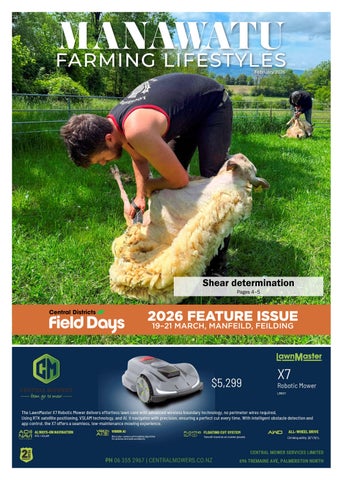
Create a flipbook
Manawatu Farming Lifestyles, February 2026 by Rural Matters - Issuu